
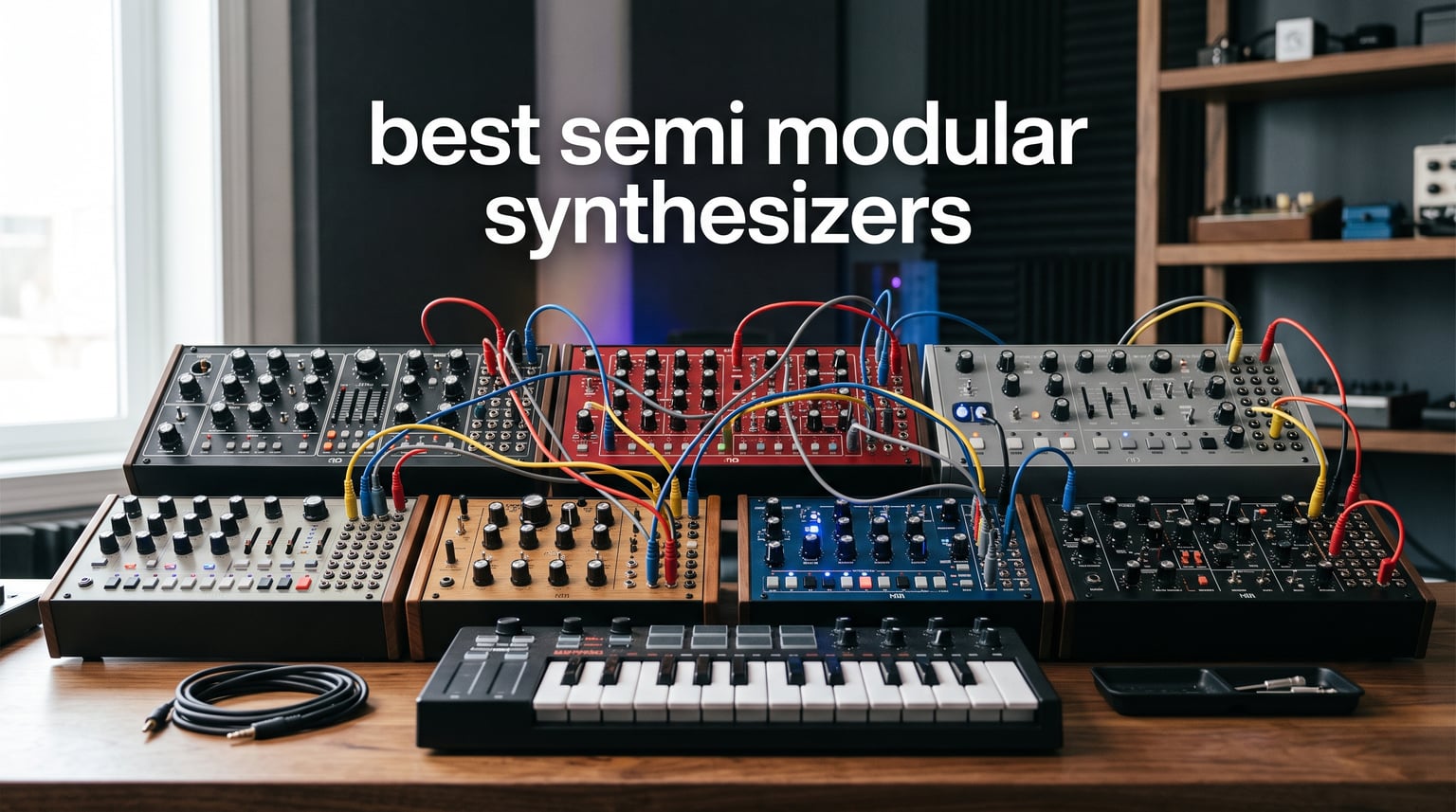
The best semi modular synthesizers give you two useful ways to work: make sound immediately through their normalled internal wiring, then change that signal path with patch cables when curiosity takes over. That middle ground is why a semi-modular synth can be a better first hardware synth than an empty Eurorack case, while still giving an experienced player serious CV tools.
A semi-modular synthesizer is a self-contained instrument with a hard-wired signal path and a patch bay. In plain terms, its VCO, VCF, VCA, envelope generator, and LFO already communicate without cables; patch points let you interrupt, reroute, and add modulation to that default path.
I built this guide around the eight products in the current data set, not a list of famous names. I compared their stated sound sources, filters, sequencing, physical control, patching approach, Eurorack role, ratings, and known limits, then matched each one to a practical kind of musician.
The result is not a single winner for every studio. A player who wants 64 saved sequences and a large CV/Gate patchbay has different needs from someone who wants a battery-powered desktop synth, dense polyrhythms, or a compact analog voice they can assemble themselves.
One important note before we start: a large patch bay is not automatically easier or more musical. Forum discussions repeatedly raise the same concern—new patchers can feel overloaded—so I have called out the instruments that make a useful sound before any cable is connected, as well as the ones that reward a more deliberate learning session.
Table of Contents
The Top 3 Picks Answer Different Semi-Modular Needs
The Arturia MiniBrute 2S is my all-round recommendation for hands-on sequencing and deep CV control. The Behringer Neutron is the direct analog choice for players who want two oscillator voices and a conventional starting path, while the Korg Volca Modular is the compact route into West Coast-inspired patching and portable pattern making.
These three are deliberately different. Pick the MiniBrute 2S for pads and saved sequences, the Neutron for paraphonic analog tone and default routing, or the Volca Modular when size, batteries, a speaker, and visual patch guidance matter most.
These Are the Best Semi Modular Synthesizers in 2026
The quick comparison below puts every reviewed synth in one place. Read the feature labels as a workflow snapshot: oscillator count and filter style shape the raw voice, while sequencer depth and patch points tell you how far the instrument can move beyond its default route.
Ratings are a useful check on ownership experience, but they do not replace fit. A highly rated compact module can still be the wrong choice if you need a keyboard-style input, saved patterns, or a full-size desktop control surface.
| Product | Specifications | Action |
|---|---|---|
 Arturia MiniBrute 2S Arturia MiniBrute 2S |
|
See Current Details |
 Behringer Neutron Behringer Neutron |
|
See Current Details |
 Korg Volca Modular Korg Volca Modular |
|
See Current Details |
 Moog Labyrinth Moog Labyrinth |
|
See Current Details |
 Moog Subharmonicon Moog Subharmonicon |
|
See Current Details |
 Moog Mavis Moog Mavis |
|
See Current Details |
 Behringer Crave Behringer Crave |
|
See Current Details |
 Behringer Grind Behringer Grind |
|
See Current Details |
1. Arturia MiniBrute 2S Is the Best Choice for Hands-On CV Sequencing
Arturia MiniBrute 2S Semi-Modular Analog Synthesizer and Step Sequencer
2 VCOs
2 LFOs
48-point CV and Gate patchbay
Pros
- Two VCOs and two LFOs
- Four-mode Steiner Parker filter
- 48-point CV and Gate patchbay
- Velocity and pressure pads
- 64 sequence memories
Cons
- Moderate review volume
- Large desktop footprint
The MiniBrute 2S is the strongest fit here for a player who wants the sequencer to be an instrument rather than an afterthought. Its 16 velocity- and pressure-sensitive pads, 16 encoders, and 64 sequence memories give it a tactile workflow that can carry a full performance without a piano keyboard.
My editorial pick goes to the MiniBrute 2S because its stated 48-point CV and Gate patchbay is paired with a very clear core voice: two VCOs, two LFOs, an ADSR, and an AD envelope. You can start with an intentional analog line, then add modulation one connection at a time instead of treating every patch point as a problem to solve.
The four-mode Steiner Parker filter is unusually useful for a first semi-modular instrument that needs range. Low-pass makes the expected rounded bass and lead behavior possible, while high-pass, band-pass, and notch filtering offer more animated percussion, thinner sequences, and moving textures.
The Sequencer Makes This a Complete Desktop Centerpiece
The 64 sequence memories matter when you want to develop variations rather than lose a good idea after one session. Pads also make rhythm-first programming more immediate than a menu-led setup.
I would choose this route for techno sequences, bass patterns, and experimental arrangements where modulation should evolve over time. The CV/Gate patchbay gives external gear a clear reason to join the setup.
The Best Fit Is a Player Who Wants Depth Without Guesswork
This is not the smallest unit in the group, and its 4.88-kilogram weight supports the sense that it is intended to stay on a desk. It suits the musician who wants many physical controls and a substantial patch field in one place.
It is less compelling for someone who only wants a tiny, self-contained travel synth. Its 4.3 rating from 80 reviews is solid context, but the bigger decision is whether its performance-style sequencing matches how you actually create.
2. Behringer Neutron Is the Best Direct Route to Dual-Oscillator Analog Tone
Behringer Synthesizer (NEUTRON)
Dual 3340 VCOs
Paraphonic
Five oscillator wave shapes
Pros
- Dual 3340 analog oscillators
- Paraphonic operation
- Default routing works without cables
- Five wave shapes
- Pure analog signal path
Cons
- No stated built-in sequencer
- Desktop unit needs external control
The Behringer Neutron makes sense when your first requirement is a conventional analog signal path with more than one oscillator. Its two authentic 3340 analog oscillators and paraphonic design invite thick intervals, detuned leads, and bass parts that do not have to begin as an abstract patch experiment.
I like that the semi-modular architecture supplies default routings. Community advice often points to the Neutron as a practical starting place because you can hear a working voice first, then learn what changes when you move a cable.
The oscillator waveform control blends between five shapes—tone mod, pulse, sawtooth, triangle, and sine—while individual pulse-width and tone-mod controls give the raw sound useful movement before it reaches further processing. That is a straightforward way to learn how timbre changes at the source.
The Default Signal Path Lets Beginners Patch at Their Own Pace
A normalled path reduces the blank-page feeling that can come with an open modular system. Start by adjusting oscillator mix and wave shape, then use one patch cable to test a new modulation route and listen for the difference.
I would pair it with an external MIDI controller or sequencer if patterns are central to your music. Its listed USB Type B connection provides a computer-oriented connection point, but the supplied data does not describe an onboard step sequencer.
The Strongest Fit Is Bass, Leads, and Two-Note Analog Parts
Paraphonic operation means it is not the same as full independent polyphony, but it creates a distinct two-note performance option. That makes the Neutron appealing for octave lines, tense intervals, and stacked lead parts.
Its 4.6 rating from 171 reviews supports the community enthusiasm, though it is still worth choosing based on workflow rather than reputation. If a self-contained sequencer is non-negotiable, select a different model in this list.
3. Korg Volca Modular Is the Best Portable Introduction to West Coast Patching
Korg Volca Modular Micro Synthesizer Semi Modular w/Eight Modules
Eight modules
50 patch points
16-step sequencer
Pros
- Eight independent modules
- 50 patch points
- 16-step sequencer
- Built-in speaker
- Battery-powered portability
Cons
- Small controls
- Patch layout can feel crowded
The Korg Volca Modular puts eight independent modules, 50 patch points, and a 16-step sequencer in an extremely compact format. It is the clearest option here for someone who wants to learn by routing signals visually, then take that experiment away from a fixed studio desk.
Its color-coded inputs and outputs are a real learning advantage. Instead of beginning with an unlabelled collection of jacks, you can trace where a cable starts and ends, which makes a basic patch exercise less intimidating.
The Volca Modular also introduces West Coast-style ideas such as routing and tone shaping that are less focused on the classic oscillator-to-ladder-filter path. Its randomize function can create unexpected combinations, but I would use it after making one patch manually so you know what it changed.
The Portable Design Makes Short Practice Sessions Easy
The built-in speaker and battery or AC operation mean you can test a sequence without adding monitors, an interface, or a controller. That low-friction setup helps turn patching into a frequent habit rather than a rare studio task.
A 16-step sequencer with two playback modes gives the instrument a musical starting point, not only a sound-design exercise. It is a useful match for small ambient motifs, plucked patterns, and unusual percussion figures.
The Best Fit Is a Curious Player Comfortable With a Compact Surface
The small physical size is its stated trade-off, since it can limit some patch configurations. I would not make it the only option for a player who needs full-size controls and a large desktop interface.
For learners who want a patchable synth that remains self-contained, the 4.6 rating from 318 reviews is encouraging. Start with the internal routing, add one cable, and keep each change audible before reaching for a denser patch.
4. Moog Labyrinth Is the Best Choice for Generative Metallic Textures
MOOG Labyrinth Semi-Modular Analog Synthesizer
Dual low-harmonic oscillators
VC wavefolder
32 patch jacks
Pros
- Dual low-harmonic oscillators
- Voltage-controlled wavefolder
- Morphing state-variable filter
- Dual generative sequencers
- 32 patch jacks
Cons
- Limited review history
- Generative workflow is less conventional
The Moog Labyrinth is the standout if your goal is not a familiar subtractive lead synth but a source of shifting, metallic, and unstable material. Its two low-harmonic oscillators, ring modulation, variable-tone noise generator, and voltage-controlled wavefolder point toward sounds that can keep changing inside a loop.
I would place it above the more conventional choices for an artist making ambient music, experimental percussion, or a live set built around controlled surprise. The parallel generative design gives the dual eight-step sequencers “corrupt” controls, so repetition can become variation instead of a static cycle.
The listed state-variable resonant voltage-controlled filter morphs between low-pass and band-pass behavior. Combined with voltage-controlled blending and a switch for signal-flow order, that gives this analog synthesizer several meaningful ways to reshape a sequence.
The Generative Sequencers Are the Core Creative Reason to Choose It
The two eight-step sequencers provide a compact framework for evolving patterns. I would begin with a slow, simple pattern and make only one generative change at a time, which preserves a sense of authorship over the result.
This approach suits drones, broken rhythms, and transitions that should avoid sounding copied and repeated. It is less suited to a player who wants traditional keyboard performance to be the center of every idea.
The Patch Bay Supports Deep Sound Design in a Small Desktop Form
Labyrinth has 32 3.5 mm jacks: 20 inputs and 12 outputs. That is enough routing capacity to make the internal blocks interact in new ways while keeping the panel more contained than a large modular case.
Its 4.5 rating is based on 30 reviews, so the rating is useful but still a small sample compared with the longer-established options here. Choose it for its stated architecture and sound tools, not for a generic expectation of classic Moog behavior.
5. Moog Subharmonicon Is the Best Choice for Polyrhythmic Harmonic Patterns
MOOG Subharmonicon Semi-Modular Analog Polyrhythmic Synthesizer
Six tonal sources
Four rhythm generators
Two four-step sequencers
Pros
- Six tonal sources
- Four rhythm generators
- Two sequencers
- 60HP Eurorack role
- DIN MIDI connectivity
Cons
- Sequencers are limited to four steps
- Specialized harmonic workflow
The Moog Subharmonicon is built for a very specific kind of abundance: two voltage-controlled oscillators, each with two subharmonic generators, create six tonal sources in total. That construction can produce dense harmonic beds before you even begin to treat it as a conventional lead or bass voice.
Four rhythm generators can drive either of its two four-step sequencers, or both. I would choose it for a player who hears music as interlocking cycles, because its short sequences can produce movement through changing rhythmic relationships rather than through long note lists.
This is the best semi modular synthesizers list entry for a producer who wants ritualistic patterns, drifting chord-like sonorities, and percussive articulation from a compact tabletop unit. It is also designed to combine with Labyrinth, Spectravox, Mother-32, or DFAM, according to the supplied product information.
The Short Sequencers Create Complexity Through Rhythm Rather Than Length
Two four-step sequencers can look restrictive on paper, but the rhythm generators change how those steps are triggered. That means the interest comes from timing combinations and subharmonic relationships, not from programming a long linear phrase.
I would record several passes of a slowly changing patch rather than expect a single pattern to behave like a conventional full-song sequencer. This is an instrument for patient layering and pattern interaction.
The Eurorack Role Makes It a Focused Voice in a Larger System
The Subharmonicon can work as a tabletop synthesizer or install as a 60HP Eurorack module. That gives it a credible next step for musicians who want to retain a distinctive complete voice when moving toward a case-based system.
Its 4.7 rating from 98 reviews is the highest rating in this selection. The limitation to four-step sequencers remains important, so pick it when polyrhythm is the attraction rather than an obstacle.
6. Moog Mavis Is the Best Compact Build-It-Yourself Analog Voice
MOOG Mavis Semi-Modular Analog Synthesizer
Two oscillators
ADSR and ladder filter
44HP Eurorack module
Pros
- Fully analog design
- Eurorack integration
- Diode wavefolder
- Two oscillators and full ADSR
- Built-in keyboard
Cons
- Assembly takes time
- Compact keyboard has a focused role
The Moog Mavis is the right answer when building the instrument is part of why you want it. It arrives as a kit and combines a fully analog design, Moog oscillator and filter circuits, a diode wavefolder, and a compact keyboard in a 44HP format.
I would recommend Mavis to a learner who wants the physical act of assembly to make the signal path feel less mysterious. The data lists the PCB, front panel, tools, patch cables, calibration tool, instruction materials, power supply, and other assembly parts, so it is designed as a complete project rather than an unfinished module.
Its sound tools are substantial for the size: two oscillators, full ADSR, ladder filter, sample and hold, wavefolding, attenuators, and mults. That makes it more than a single basic analog voice, even though the small panel asks you to work with intention.
The Kit Format Turns the First Session Into a Learning Exercise
Assembly requires time, and that is a real condition rather than a footnote. It is a good fit for someone who enjoys hands-on electronics-adjacent projects and wants to know the instrument before its first patch.
The included built-in keyboard, glide, and keyboard scaling give the finished unit a direct way to explore intervals and pitch relationships. You can make sound immediately, then bring in patch cables as the questions arise.
The 44HP Format Makes This a Natural Eurorack-Ready Companion
Mavis can operate as a standalone instrument or be removed from its case for Eurorack connectivity. That makes it a compact choice for someone who expects a future modular setup but does not want to begin with separate modules.
The 4.3 rating from 74 reviews gives a useful ownership snapshot, while the design itself should drive the decision. Choose another model if you want a finished instrument ready to play the moment it arrives.
7. Behringer Crave Is the Best Classic Ladder-Filter Sequencer Voice
Behringer CRAVE Analog Synthesizer Analog Semi-Modular Synthesizer with 3340 VCO, Classic Ladder Filter, 32-Step Sequencer and 16-Voice Poly Chain
3340 VCO
24dB ladder filter
32-step sequencer
Pros
- Prophet 5-style VCO
- Pure analog signal path
- Resonant 24dB ladder filter
- 32-step sequencer
- 16-voice Poly Chain
Cons
- One primary oscillator voice
- Poly Chain needs compatible units
The Behringer Crave is the most direct choice for a familiar analog voice with a built-in 32-step sequencer. Its pure analog VCO, VCF, and VCA signal path uses a stated Prophet 5 VCO design, then sends pulse or sawtooth output through a resonant 24dB ladder filter.
I would choose Crave for a player who wants to make a bass line or repeating lead with little setup, then use patching as a way to bend that familiar foundation. The switchable low-pass and high-pass filter modes give the single-voice idea more tonal range than a fixed low-pass route.
The 32-step sequencer is particularly practical for patterns that need more space than four or eight steps. MIDI USB connectivity also gives it a stated connection option for a computer-centered workflow.
The Sequencer Makes Classic Subtractive Synthesis Feel Immediate
Crave starts with an accessible East Coast synthesis outline: oscillator material feeds a filter, then a VCA shapes output over time. That clarity makes it useful for learning what each fundamental block contributes.
I would program a simple 16-step bass pattern first, then extend it to 32 steps and compare low-pass with high-pass filtering. A small controlled exercise like that teaches more than changing every knob at once.
The Poly Chain Feature Adds a Specific Expansion Path
The listed 16-voice Poly Chain capability makes this more than a locked single-unit proposition. It is relevant only if you intend to connect compatible units, so it should be viewed as a future option rather than instant polyphony.
Its 4.5 rating from 388 reviews is backed by the largest review count among these eight products. That broad feedback base is reassuring, but the main reason to select it is its simple analog-and-sequencer workflow.
8. Behringer Grind Is the Best Hybrid Option for Synth and Percussion Engines
Behringer Grind Semi-modular Hybrid Multi-engine Synthesizer
24 digital oscillators
10 percussion engines
32-step sequencer
Pros
- Twenty-four digital oscillators
- Ten percussion and noise engines
- Analog ladder filter
- Thirty-two-step sequencer
- Fourteen synth engines
Cons
- Hybrid architecture is not fully analog
- Limited review history
The Behringer Grind takes a different route from the traditional analog voices in this guide. It is a semi-modular hybrid multi-engine synthesizer with 24 digital oscillators, 14 synth engines, 10 percussion or noise engines, an analog ladder filter, LFO, and a 32-step sequencer.
I would shortlist it for beat makers and sound designers who want several distinct engine types from one desktop unit. The mix of digital sound sources and an analog ladder filter means its appeal is variety and rhythmic character, not a purist all-analog signal path.
The percussion and noise engines make it especially relevant for drum sounds, accents, glitchy layers, and tonal sequences that sit beside a rhythm part. A 32-step sequencer gives enough room to shape those ideas into a pattern instead of treating them as one-shot effects.
The Hybrid Engine Collection Covers More Than Standard Lead and Bass Duties
Twenty-four digital oscillators and 14 synth engines provide a wider raw palette than a single-VCO design. That can be productive for a producer who wants contrasting tones quickly, but it also asks for a little more focus when learning the panel.
I would make one engine type the subject of each session, then route it through the analog ladder filter and LFO. This keeps the hybrid design understandable and makes each patch choice easier to hear.
The Best Fit Is a Rhythm-First Producer Who Accepts Digital Sources
The analog ladder filter supplies a familiar shaping stage, yet the source section remains digital. That is an advantage for players who want the stated engine range and a limitation for those whose only goal is a fully analog voice.
Its 4.4 rating comes from 32 reviews, so this is a smaller feedback sample than the long-running Crave or Volca Modular. Select it for the documented multi-engine and percussion design, not because it imitates a conventional semi-modular synth.
Choose a Semi-Modular Synth by Workflow, Not by Patch Count
The first decision is whether you need an instrument that already behaves like a normal synth. A default or normalled route lets you play without cables; patch points then become optional experiments. Neutron, Crave, MiniBrute 2S, and Mavis offer especially clear starting concepts because their stated sound blocks map readily to oscillator, filter, amplifier, and modulation roles.
A Patch Bay Matters Most When Its Signals Match Your Ideas
Do not count jacks without asking what they control. The MiniBrute 2S lists 48 CV and Gate patch points, Volca Modular has 50 patch points, and Labyrinth has 32 3.5 mm jacks, but each panel expresses a different musical design.
For a first patch, use one cable to route an LFO to a destination you already recognize, such as pitch or filter movement. Listen to the unpatched sound, make the connection, adjust only the LFO amount or rate, and then remove the cable; that simple before-and-after comparison creates a reliable foundation.
East Coast and West Coast Synthesis Suggest Different Starting Questions
East Coast synthesis usually begins with harmonically rich oscillators, then subtracts frequencies with a filter and shapes loudness with a VCA and envelope. Crave’s VCO, VCF, VCA path and ladder filter offer a particularly direct entry to that way of thinking.
West Coast synthesis more often emphasizes modulation, wavefolding, low-harmonic sources, and changing timbre instead of only filtering a bright waveform. Volca Modular, Labyrinth, and Mavis each make those ideas approachable in different ways through their stated modules or wavefolder circuits.
Neither approach is a genre rule. East Coast tools can make abstract noise and West Coast tools can make musical bass, but knowing the distinction helps you select an interface that encourages the sounds you want to explore first.
A Built-In Sequencer Changes Whether the Synth Can Stand Alone
A sequencer is not just a checklist feature; it decides whether you can make rhythmic ideas with no additional controller. Crave and Grind list 32-step sequencers, Volca Modular has a 16-step sequencer, MiniBrute 2S saves 64 sequences, while Subharmonicon and Labyrinth turn short step patterns into more complex rhythmic systems.
If you prefer playing notes by hand, Mavis has a built-in keyboard and MiniBrute 2S has velocity- and pressure-sensitive pads. If you work from a DAW or external controller, first verify the exact MIDI and CV connections you need rather than assuming every semi-modular unit has the same implementation.
Eurorack Compatibility Requires a Format Check Before You Connect Anything
“Eurorack compatible” can mean a product fits as a module, provides compatible control-voltage connections, or both. Subharmonicon is specified as a 60HP module option, Mavis as a removable 44HP module, and MiniBrute 2S has a dedicated CV and Gate patchbay; those are meaningful expansion paths, but they are not identical.
Before connecting equipment, confirm voltage ranges, signal types, connector format, power requirements, and whether an output is intended for audio, gate, trigger, pitch CV, or modulation. The community concern about incompatible formats is sensible: a patch cable that physically fits does not prove that two signals are meant to be combined.
A Beginner Should Start With One Repeatable Patch Routine
Begin with a normalled sound, set one oscillator waveform, and make a short sequence or held note. Next, adjust filter cutoff and resonance, use an envelope to hear how the note begins and ends, then introduce an LFO to one destination.
After that, add a second oscillator, a noise source, a wavefolder, or a second modulation route only after you can describe what the previous change did. This answers the most common beginner anxiety from synth forums: you do not need to understand every patch point before you connect the first cable.
The Genre Match Can Narrow Eight Choices to Two or Three
For bass and classic leads, Neutron and Crave have the clearest conventional analog starting points. For evolving ambient textures, Labyrinth’s generative sequencers and wavefolder, Subharmonicon’s subharmonic rhythm structure, and Volca Modular’s compact patchable modules deserve closer attention.
For techno and performance pattern work, MiniBrute 2S offers pads, encoders, 64 sequence memories, and a large CV/Gate patchbay. For percussion and noise-derived parts, Grind’s stated 10 percussion or noise engines make it the most focused pick.
These FAQ Answers Settle the Main Buying Questions
What is a semi-modular synthesizer?
A semi-modular synthesizer is a self-contained instrument with a pre-wired signal path and a patch bay. It makes sound without patch cables, while its patch points let you reroute or modulate signals when you want more control.
Are semi-modular synths good for beginners?
Yes, provided the instrument has a useful default signal path and you learn one connection at a time. A normalled voice lets a beginner hear VCO, filter, envelope, and LFO changes before attempting a complex patch.
How can I expand the capabilities of my semi-modular synth?
Add external MIDI or CV control where supported, connect compatible patchable instruments, or move a specified module into a Eurorack case. Check signal type, voltage range, power, and physical format before making any connection.
What factors should I consider when buying a semi-modular synth?
Start with sound character, then check whether you need a sequencer, direct playing surface, MIDI or USB connection, a normalled signal path, and a real Eurorack route. Choose the interface that fits how you make music, not only the largest jack count.
Which Moog semi-modular synth is right for me?
Choose Mavis for a compact kit with a keyboard, analog voice, wavefolder, and 44HP role. Choose Subharmonicon for six tonal sources and polyrhythmic four-step sequencing. Choose Labyrinth for dual generative sequencers, low-harmonic oscillators, ring modulation, and a voltage-controlled wavefolder.
The Right Choice Depends on How You Want to Learn
The best semi modular synthesizers in 2026 are not interchangeable. Choose the Arturia MiniBrute 2S for physical sequence control and CV depth, the Behringer Neutron for a direct dual-oscillator analog foundation, and the Korg Volca Modular for compact, color-guided experimentation.
For a more specialized voice, follow the architecture: Labyrinth for generative timbre, Subharmonicon for polyrhythm, Mavis for building and modular growth, Crave for classic sequenced subtraction, or Grind for hybrid percussion engines. Pick the synth whose first unpatched sound makes you want to keep working, then let the patch bay teach you the next step.