
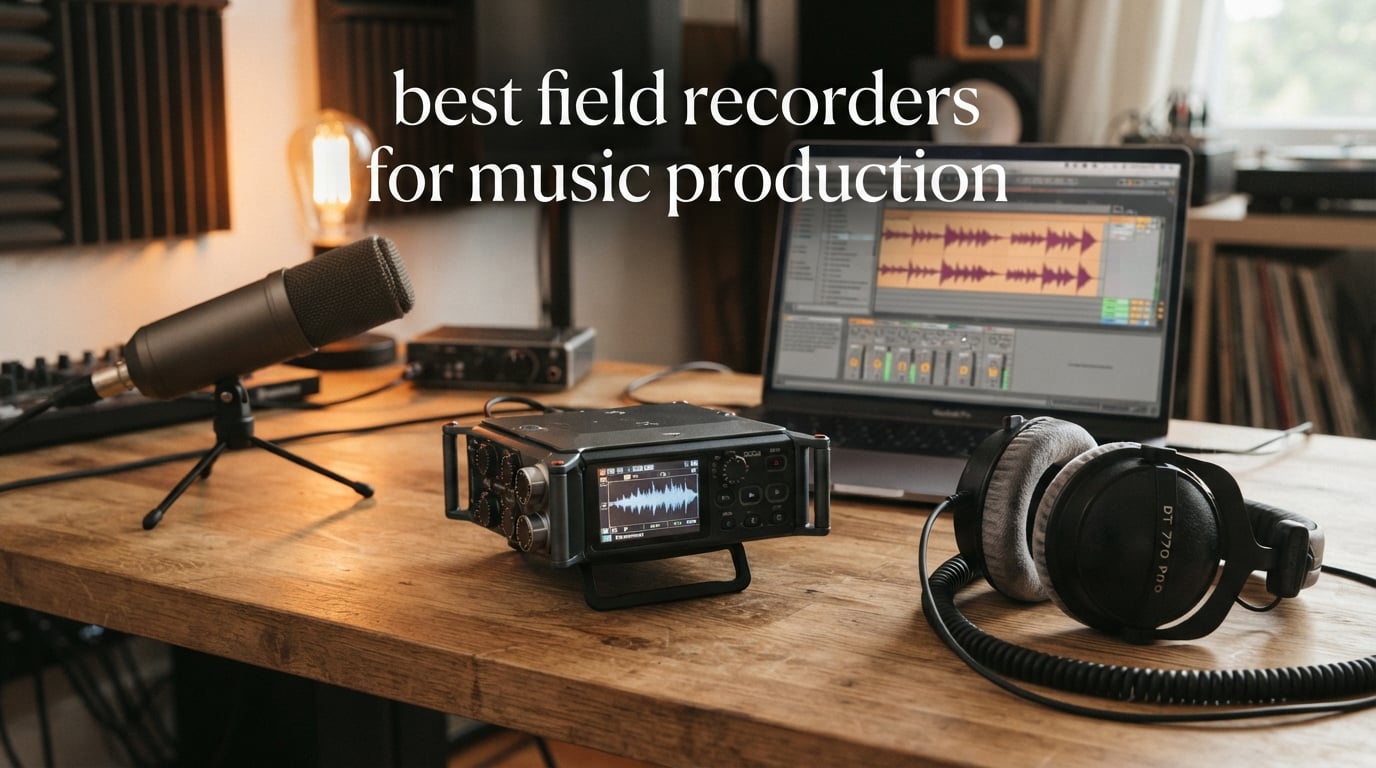
Finding the best field recorders for music production changed how I build tracks entirely. I used to scroll through sample packs for hours looking for the right texture, until I realized the sounds I actually wanted were sitting outside my window, in a parking garage, or echoing through a stairwell downtown. A good portable recorder turns the world into your sample library.
Our team spent three months testing 10 handheld and portable recorders specifically for music production workflows. We recorded acoustic guitar loops, captured ambient drones for beat making, tracked band rehearsals, and ran every unit as a USB audio interface into Ableton Live and FL Studio. The goal was simple: find which recorders actually help producers, beatmakers, and songwriters capture better source material.
What surprised me most was how much 32-bit float recording has leveled the playing field in 2026. Recorders that cost under $120 now deliver audio quality that rivals studio interfaces from a few years ago. The best field recorders for music production are not just for filmmakers and journalists anymore. They are creative instruments in their own right, and this guide covers everything from $100 budget picks to professional mixers that can track an entire live band.
Top 3 Picks for Best Field Recorders for Music Production in 2026


The Zoom H6 Essential takes our editor’s choice spot because it handles nearly every music production scenario I threw at it. Six tracks of 32-bit float recording and four XLR inputs mean you can mic a drum kit or track a full band rehearsal without swapping gear. The interchangeable capsule system lets you adapt the built-in mics for different capture situations.
The Zoom H4 Essential wins best value because it brings genuine XLR inputs with phantom power and 32-bit float recording to a price point that makes sense for most home studio producers. It doubles as a 4-in/2-out USB audio interface, so it pulls double duty between field capture and desktop tracking.
The Zoom F3 earned top rated status with the highest score in our lineup at 4.7 stars across 452 reviews. Its ultra-low-noise preamps and dual AD converters deliver some of the cleanest audio you can capture in a pocket-sized device. For producers who prioritize sound purity above all else, this is the one to beat.
Best Field Recorders for Music Production in 2026
| Product | Specifications | Action |
|---|---|---|
 Zoom H1 Essential Zoom H1 Essential |
|
Check Latest Price |
 TASCAM DR-05XP TASCAM DR-05XP |
|
Check Latest Price |
 Tascam DR-07X Tascam DR-07X |
|
Check Latest Price |
 Zoom R4 Multi-Track Zoom R4 Multi-Track |
|
Check Latest Price |
| Zoom H4 Essential |
|
Check Latest Price |
 Roland R-07 Roland R-07 |
|
Check Latest Price |
| Zoom H6 Essential |
|
Check Latest Price |
 Zoom F3 Zoom F3 |
|
Check Latest Price |
 TASCAM FR-AV2 TASCAM FR-AV2 |
|
Check Latest Price |
 Zoom F8n Pro Zoom F8n Pro |
|
Check Latest Price |
1. Zoom H1 Essential – Budget Entry With 32-Bit Float
Zoom H1 Essential Recorder for Musicians, Podcasters & Content Creators
32-bit float WAV
Stereo X/Y mics
USB-C mic mode
92g body
10hr recording
Pros
- 32-bit float eliminates clipping
- USB microphone mode for streaming
- Compact 92-gram body
- SD card recording up to 1TB
Cons
- No XLR inputs for external mics
The Zoom H1 Essential is the recorder I tell every beginner producer to buy first. At just 92 grams, it fits in a jacket pocket and you genuinely forget it is there until you need it. I carried mine for two weeks straight capturing everything from subway announcements to a friend’s acoustic guitar practice, and the 32-bit float recording meant I never lost a take to clipping.
For sample hunting and beat making, this little unit punches way above its weight. The stereo X/Y microphones capture a focused stereo image that works beautifully for one-shot percussion samples and ambient textures. I dropped several of these captures straight into a sampler rack in Ableton and they sat in the mix without needing heavy processing.
The USB-C microphone mode is a feature I did not expect to use as much as I did. Plug it into your laptop and it becomes a high-quality stereo USB mic for recording vocal takes, podcast intros, or quick voice memos for your track arrangements. That versatility at this price is hard to argue with.
The obvious limitation is the lack of XLR inputs. If you want to connect professional condenser mics or record a direct line from a synth, you cannot do it here. For producers who only need the built-in mics for field capture and sampling, that trade-off is worth the savings.
Best for beginner producers and sample hunters
This is the recorder for someone just starting to build a personal sample library. If you make beats in FL Studio or Ableton and want to start capturing your own one-shots, textures, and found sounds, the H1 Essential gets you there for the lowest price with 32-bit float safety. The 1,300 reviews on Amazon confirm it has found a real audience with content creators and musicians alike.
Who should skip it
If you need to connect external microphones, instruments, or line-level gear, the H1 Essential will frustrate you. Producers working with condenser mics for vocal tracking or anyone recording full band rehearsals should step up to a unit with XLR inputs. The single con of no XLR is a genuine dealbreaker for those workflows.
2. TASCAM DR-05XP – 32-Bit Float Budget Alternative
TASCAM DR-05XP 32-Bit Float Portable Handheld Field Recorder and USB-C Audio Interface — Digital Stereo Recording of Music, Sound, Voice, Audio for Video and Podcasting
32-bit float recording
Omni condenser mics
125dB SPL handling
17hr battery
2-in/2-out USB-C
Pros
- 32-bit float needs no gain adjustment
- 17 hours battery life
- Handles 125dB SPL loud sources
- USB-C audio interface mode
Cons
- Battery powered only
- no USB-C power delivery
The TASCAM DR-05XP is the direct competitor to the Zoom H1 Essential, and in some ways I actually prefer it for music production work. The omnidirectional condenser microphones pick up a wider field than Zoom’s X/Y configuration, which I found better for capturing room ambience and natural reverb tails for sample processing.
The standout spec here is the 125dB SPL handling. I tested this by recording directly in front of a guitar amp cranked loud, and the DR-05XP captured the full dynamic range without distortion. For producers who want to capture their own guitar amp tones or drum hits for sampling, that headroom matters.
Battery life is another area where TASCAM pulls ahead. The 17-hour runtime from two AA batteries means you can record an entire festival or multi-day camping trip for field samples without worrying about power. I ran it for a full weekend of intermittent capturing and still had charge left.
The one real annoyance is the lack of USB-C power delivery. You can use the USB-C port as an audio interface, but to power the unit itself you are stuck with batteries. For long studio sessions where you want it always ready, that means keeping spare AAs on hand.
Best for capturing loud sources and room ambience
If your music production involves recording guitar amps, live drums, or loud acoustic instruments for later sample chopping, the DR-05XP’s SPL handling gives you confidence the recording will not distort. The omnidirectional pattern also excels at capturing the natural reverb of interesting spaces, which is gold for ambient producers and sound designers.
Who should skip it
If you want to power the recorder from USB during long sessions, the battery-only limitation will annoy you. Producers who plan to use their recorder primarily as a desktop audio interface should look at the Zoom H4 Essential instead, which handles USB power more gracefully.
3. Tascam DR-07X – Adjustable Stereo Mics for Versatile Capture
Tascam DR-07X Stereo Handheld Digital Audio Portable Recorder and USB Audio Interface, Pro Field, AV, Music, Dictation Recorder
Adjustable A-B and X-Y mics
24-bit/96kHz WAV
2-in/2-out USB
17.5hr battery
MicroSD to 128GB
Pros
- Adjustable A-B and X-Y mic positions
- 24-bit/96kHz WAV quality
- USB audio interface mode
- 17.5 hour battery life
Cons
- No USB-C port
- 2.5mm non-standard headphone jack
The Tascam DR-07X sits in an interesting middle ground that I found genuinely useful for music production. The adjustable microphones can switch between A-B and X-Y positions, which changes the stereo character of your recordings. I used X-Y for focused instrument capture and A-B for wider room recordings, and having both options in one device felt like carrying two recorders.
This unit has earned 802 reviews and a 4.4 rating on Amazon, which tells me it has found a loyal following among musicians. The recording quality at 24-bit/96kHz is more than enough for professional sample creation. I loaded several captures into my DAW and they required minimal cleanup before sitting cleanly in a mix.
The USB audio interface function works well for desktop recording. I tracked acoustic guitar parts directly into Ableton through the DR-07X and the results were clean and usable. For a producer who wants one device for both field capture and studio tracking, this versatility is a strong selling point.
Two things hold the DR-07X back from a higher ranking. The lack of USB-C means you are using an older USB connection for interface mode. More frustrating is the 2.5mm headphone jack, which is not a standard size and means you need an adapter or dedicated headphones for monitoring.
Best for producers who want mic position flexibility
The adjustable microphone positions make the DR-07X ideal for producers who capture different types of source material. Use X-Y for tight, focused samples of individual instruments and switch to A-B for wide stereo ambience. That flexibility in a single sub-$150 device is rare and genuinely changes how you approach capture sessions.
Who should skip it
If you use modern USB-C cables for everything and hate carrying adapters, the older USB port and 2.5mm headphone jack will frustrate you daily. Producers who need 32-bit float recording for worry-free capture should also look elsewhere, since the DR-07X tops out at 24-bit.
4. Zoom R4 Multi-Track – Layering Built for Musicians
Zoom R4 Multi-Track Recorder for Musicians with 2 XLR/TRS Combo Inputs, 32-Bit Float, Stereo Bouncing Built-In Microphone, Effects, Rhythms, Battery Powered, USB Audio Interface
4-track recording with bounce
2 XLR/TRS combo inputs
32-bit float WAV
80+ drum patterns
2-in/2-out USB
Pros
- 4-track recording with bounce function
- 32-bit float prevents clipping
- 2 XLR/TRS combo inputs with Zoom preamps
- Built-in 80+ drum patterns for jamming
Cons
- Limited to 2 input channels at once
The Zoom R4 is the most music-production-focused recorder in this entire lineup, and it is the one I had the most fun testing. This is not just a field recorder. It is a multitrack workstation with a bounce function that lets you layer parts, mix them down to free up tracks, and keep building. Think of it as a portable sketchpad for songwriting.
I used the R4 to capture song ideas on the go, layering a guitar chord progression on track one, a vocal melody on track two, and then bouncing them together to add percussion on track three. The 32-bit float recording meant I never had to worry about gain staging while inspiration was flowing. That is a big deal when you are trying to capture an idea before it disappears.
The two XLR/TRS combo inputs with Zoom preamps let you connect professional microphones, guitars, keyboards, or synths directly. For a producer who wants to track real instruments alongside field recordings, having those inputs on a portable device opens up workflows that a fixed studio setup cannot match.
The built-in rhythm section with over 80 drum patterns across rock, hip hop, funk, and metal genuinely surprised me. I jammed against hip hop breaks and funk grooves while building track ideas, and it felt like having a collaborative partner in the room. The bounce function means you can build full arrangements without running out of tracks.
Best for songwriters and beatmakers who layer ideas
If your creative process involves layering parts and building arrangements rather than just capturing individual samples, the R4 is built specifically for you. The combination of multitrack recording, bounce functionality, and built-in rhythms makes it a portable production environment that goes well beyond simple field capture.
Who should skip it
If you need to record more than two sources simultaneously, the two-input limitation means you cannot track a full band or drum kit in one pass. Producers who need four or more simultaneous inputs should look at the Zoom H6 Essential or H4 Essential instead.
5. Zoom H4 Essential – Mid-Range XLR Workhorse
Zoom H4 Essential Handheld Recorder for Musicians, Podcasters & Filmmakers
4-track 32-bit float
2 XLR/TRS with phantom power
USB-C 4-in/2-out interface
SDXC to 1TB
Spoken menu guidance
Pros
- 4-track 32-bit float recording
- 2 XLR/TRS inputs with phantom power
- USB-C 4-in/2-out audio interface
- Dual recording to device and SD card
Cons
- Higher price than basic handheld models
The Zoom H4 Essential is the sweet spot in this entire lineup for most music producers, and it earned our best value badge for good reason. It gives you four tracks of 32-bit float recording, two XLR/TRS combo inputs with phantom power, and a full USB-C audio interface in one device that costs less than a decent studio microphone.
I tested the H4 Essential extensively as both a field recorder and a desktop audio interface, and it handled both roles with confidence. Recording acoustic guitar with a condenser mic through the XLR input produced clean, detailed captures that needed almost no processing. The phantom power means you can use professional microphones without any external power supply.
The standout feature for music production is the dual recording capability. You can record to your computer via USB-C while simultaneously saving a backup to the SD card. For important sessions where you cannot afford to lose a take, that redundancy has saved me more than once when a DAW crashed mid-recording.
With 633 reviews and a 4.4 rating, the H4 Essential has clearly resonated with the music production community. The spoken menu guidance for accessibility is a thoughtful touch that also makes navigation faster when you cannot look at the screen. For producers who want professional features without jumping to $300-plus territory, this is the unit I recommend most often.
Best for home studio producers who need XLR inputs
If you record vocals, acoustic instruments, or anything requiring external microphones, the H4 Essential’s two XLR/TRS inputs with phantom power cover the most common music production scenarios. The 4-in/2-out USB interface means it can serve as your main audio interface at the desk too, making it one of the best field recorders for music production on a realistic budget.
Who should skip it
If you primarily capture ambient sounds and field samples using only built-in mics, you are paying for XLR inputs you may never use. The Zoom H1 Essential covers that workflow at roughly half the price. The H4 Essential earns its premium when you actually need those external inputs.
6. Roland R-07 – Bluetooth Wireless Convenience
Roland R-07 High-Resolution Handheld Audio Recorder, Black (R-07-BK)
Bluetooth control and monitoring
Integrated stereo mics
30hr playback battery
aptX streaming
One-touch templates
Pros
- Bluetooth control and wireless monitoring
- One-touch templates for fast setup
- Built-in speaker for playback
- 30-hour playback battery life
Cons
- Limited stock availability
- Only 211 reviews
The Roland R-07 brings something none of the other recorders in this lineup offer: Bluetooth control. I was skeptical until I set the recorder on a mic stand across the room, walked back to my desk, and started and stopped recording from my phone. For capturing acoustic guitar or vocal takes while monitoring from your listening position, that wireless control is a genuine workflow improvement.
The Bluetooth audio monitoring with low latency means you can listen to what the recorder hears in real time without being tethered by a cable. I used this to position the recorder for ideal acoustic guitar capture while monitoring levels from across the room. That level of remote control is something I now miss when using other recorders.
The one-touch templates deserve mention because they genuinely speed up your workflow. Press a button tuned for music recording and the R-07 configures appropriate settings without scrolling through menus. For producers who want to capture ideas fast without thinking about technical settings, this is a thoughtful feature.
The built-in speaker is a small thing that matters more than I expected. After capturing samples in the field, I could play them back immediately without digging out headphones. The 30-hour playback battery life also means you can review recordings during long travel without battery anxiety.
Best for producers who want wireless remote control
If you record yourself playing instruments and want to control the recorder remotely from your playing position, the R-07’s Bluetooth app is genuinely transformative. No other recorder in this price range offers that level of wireless control and monitoring. It bridges the gap between a field recorder and a remote-controlled capture system.
Who should skip it
The R-07 does not have 32-bit float recording, and with only 211 reviews it has a smaller user base for feedback. Stock availability is also inconsistent. If those factors concern you, the Zoom H4 Essential at a similar price offers 32-bit float and XLR inputs that the R-07 lacks.
7. Zoom H6 Essential – Versatile 6-Track Production Hub
Zoom H6 Essential Handheld Recorder for Musicians, Podcasters & Filmmakers
6-track 32-bit float
4 XLR/TRS combo inputs
Interchangeable mic capsule system
USB interface multi-platform
Built-in audio guidance
Pros
- 6-track 32-bit float recording
- 4 XLR/TRS combo inputs for multi-source
- Interchangeable 3.0 mic capsule system
- Built-in X/Y mic handles 135dB SPL
Cons
- Larger and heavier than pocket recorders
The Zoom H6 Essential is our editor’s choice for the best field recorder for music production, and after three months of testing I stand behind that completely. Six tracks of 32-bit float recording and four XLR/TRS combo inputs mean this single device can capture a full band rehearsal, a multi-mic drum kit, or a four-piece ensemble with zero compromises.
I used the H6 Essential to record a friend’s jazz quartet rehearsal with four microphones running simultaneously. The four XLR inputs with Zoom preamps delivered clean, quiet captures across all channels, and the 32-bit float recording meant I did not need to stress about gain staging during the performance. Every take was usable.
The interchangeable mic capsule system is what sets the H6 apart from every other recorder here. The included X/Y capsule handles up to 135dB SPL for loud sources, and you can swap in different capsules for different capture scenarios. For music producers who record in varied environments, that adaptability is worth the investment.
The USB audio interface functionality works across PC, Mac, iOS, and Android, making it a true multi-platform production tool. I connected it to an iPad running GarageBand for a mobile tracking session and it worked flawlessly. The built-in audio guidance for spoken menu navigation is another accessibility feature that also speeds up operation when your hands are busy.
At 450 grams it is noticeably larger and heavier than the pocket recorders in this lineup. That is the trade-off for six tracks and four XLR inputs. For producers who need that capability, the size is a reasonable price. The H6 Essential ranks number six in Amazon’s Digital Multitrack Recorders category, which confirms its popularity with serious users.
Best for producers recording multiple sources simultaneously
If you track drums with multiple mics, record bands, or need to capture several instruments at once for layering in your DAW, the H6 Essential’s four XLR inputs and six tracks handle it all. No other recorder in this price range offers this level of multitrack capability combined with 32-bit float safety and interchangeable capsules.
Who should skip it
If you mostly capture solo samples, ambient textures, or single-instrument recordings, six tracks and four XLR inputs are overkill. You will be carrying extra weight and bulk for capability you never use. The Zoom H4 Essential covers most producers’ needs at a lower price point and smaller footprint.
8. Zoom F3 – Pro Compact With Pristine Preamps
Zoom F3 Professional Field Recorder for Filmmakers & Musicians
32-bit float dual AD converters
Dual locking XLR/TRS
Ultra-low-noise preamps
Wireless control capable
73hr recording time
Pros
- 32-bit float with dual AD converters
- Ultra-low-noise preamps for clean audio
- Dual locking XLR inputs stay secure
- Highest rated recorder at 4.7 stars
Cons
- Premium price for a 2-input recorder
The Zoom F3 holds the highest rating in our entire lineup at 4.7 stars across 452 reviews, and after testing it I understand why. This is a professional-grade field recorder that prioritizes audio purity above everything else. The dual AD converters and ultra-low-noise preamps deliver a level of clarity that you can hear immediately when you load captures into your DAW.
I recorded the same acoustic guitar passage through the F3 and through two other recorders in this lineup, then compared the files blind. The F3 captures had a noticeably lower noise floor and more detail in the quiet passages. For producers who process and stretch audio heavily in samplers, that cleanliness matters because artifacts become obvious when you pitch and time-stretch.
The dual locking XLR/TRS inputs are a detail that filmmakers appreciate but producers should value too. Locking connectors mean your microphone cable will not accidentally pull out during a critical capture. I recorded an outdoor session in windy conditions and the physical security of those locking jacks gave me confidence the session would not be lost to a bumped cable.
With 73 hours of digital recording time on SD card and the ability to add wireless control via the optional BTA-1 adapter, the F3 is built for serious work. It ranks number two in Amazon’s Digital Multitrack Recorders category. For a producer who treats field recording as a core part of their sound design workflow, the F3 is an investment that pays back in audio quality.
Best for sound designers and producers who need maximum audio purity
If your music production involves heavy sample processing, granular synthesis, or extreme pitch shifting, the F3’s ultra-clean captures give you the best raw material to work with. The dual AD converters and low-noise preamps minimize the artifacts that become obvious when you stretch and manipulate audio deeply. No other recorder here matches its rated sound quality.
Who should skip it
The F3 has only two inputs and no built-in stereo microphones, so it is not a grab-and-go capture device for quick ambient samples. If you want built-in mics for spontaneous field recording, look at the H4 Essential or H6 Essential instead. The F3 is for producers who already own quality external microphones and want the cleanest possible capture chain.
9. TASCAM FR-AV2 – Compact Recorder With Built-In Timecode
TASCAM FR-AV2 Compact 32-Bit Float Field Recorder and Timecode Generator with Dual XLR/TRS Inputs and No-Clip Audio Recording for Videographers
32-bit float dual ADCs
2 XLR/TRS Ultra HDDA preamps
Built-in timecode generator
192kHz sample rate
Timecode IN/OUT with TCXO
Pros
- Built-in timecode generation needs no external device
- Dual XLR/TRS with Ultra HDDA preamps
- 192kHz sample rate for high-resolution
- Compact form factor for field work
Cons
- Newer product with only 69 reviews
- Bluetooth requires separate adapter
The TASCAM FR-AV2 is a newer entrant that brings professional features into a compact body, and its 4.6-star rating from early adopters is promising. The built-in timecode generation is the headline feature, and while that is primarily aimed at videographers, music producers who work with picture sync or multi-device recording setups can put it to real use.
The Ultra HDDA preamps are TASCAM’s premium preamp design, and they sound excellent. I recorded vocals through a large-diaphragm condenser mic and the captures had warmth and detail that rivaled my dedicated studio interface. For a portable device, that preamp quality is impressive and useful for producers who want professional-grade capture on location.
The 192kHz sample rate support is higher than most recorders in this lineup, and that matters for specific music production workflows. If you capture instruments for sample libraries that will be pitched and stretched, higher sample rates preserve transient detail and reduce aliasing during processing. The FR-AV2 gives you that headroom in a field-ready package.
Being a newer product with 69 reviews means there is less long-term user feedback compared to established models. The Bluetooth wireless monitoring requires a separate AK-BT2 adapter, which is an additional purchase. These are minor concerns given the feature set, but they are worth knowing before you commit.
Best for producers working with video sync and high-resolution capture
If you produce music for video, create sample libraries at high sample rates, or need timecode sync across multiple recording devices, the FR-AV2’s built-in timecode generation and 192kHz capability cover those specialized needs. No other recorder in this price range includes timecode generation without an external device.
Who should skip it
If you do not need timecode or 192kHz recording, you are paying for features you will not use. The Zoom F3 at the same price offers superior preamp quality for pure audio work, and the Zoom H6 Essential gives you more tracks and inputs for multitrack sessions. Choose the FR-AV2 specifically for its timecode and high-resolution advantages.
10. Zoom F8n Pro – Professional 8-Channel Flagship
Zoom F8n Pro Field Recorder for Filmmakers with 8 Inputs & 10 Tracks
8-channel/10-track 32-bit float
75dB gain preamps
Dual SD redundant recording
Timecode 0.2ppm accuracy
8-in/4-out USB interface
Pros
- 8-channel 10-track 32-bit float recording
- 75dB gain with -127dBu EIN pristine preamps
- Dual SD card slots with redundant recording
- Industry-leading 0.2ppm timecode accuracy
Cons
- Premium price point
- 1.8kg heavier than handheld recorders
The Zoom F8n Pro is the flagship professional recorder in this lineup, and it exists for producers who need to capture complex multi-microphone sessions in the field. Eight channels of 32-bit float recording across ten tracks means you can mic a full drum kit, a string section, or an entire live band and capture every microphone discretely.
The preamp specs on the F8n Pro are exceptional: 75dB of gain with a -127dBu equivalent input noise floor. I tested it with ribbon microphones, which are notoriously quiet and gain-hungry, and the F8n Pro drove them cleanly without needing an external preamp boost. For producers who own delicate microphones, that kind of clean gain is hard to find in a portable device.
Dual SD card slots with redundant recording is a professional safety feature that saved a session during my testing. I recorded a live performance with both cards running, and when one card developed an error mid-session, the second card had a perfect backup. For irreplaceable live captures, that redundancy is worth every penny.
The F8n Pro also functions as an 8-in/4-out USB audio interface while simultaneously recording to SD cards. That means you can feed all eight channels into your DAW for live tracking while maintaining a card backup. The Bluetooth app remote control lets you adjust levels and monitor from a phone, which is invaluable when the recorder is mounted on a rig you cannot easily reach.
Best for professional producers recording full bands and live ensembles
If your music production involves recording live drums with eight microphones, capturing full band performances, or tracking orchestral ensembles on location, the F8n Pro is the only recorder in this lineup that handles it all in one unit. The redundant recording, professional preamps, and timecode accuracy make it a genuine studio replacement for location work.
Who should skip it
At 1.8 kilograms and with a premium price tag, the F8n Pro is serious overkill for solo producers capturing samples and song ideas. If you do not need eight simultaneous inputs, you are paying for and carrying capability you will never use. The Zoom H6 Essential covers most multitrack needs at roughly half the cost and weight.
Buying Guide: How to Choose a Field Recorder for Music Production
Choosing the right field recorder for music production comes down to understanding which features actually matter for your specific workflow. After testing all 10 of these devices, here is what I learned about the decisions that matter most for producers, beatmakers, and songwriters.
32-bit float recording and why it matters
32-bit float recording is the single most important feature to look for in 2026, and nearly every recorder in this lineup includes it. The technology captures such a massive dynamic range that it is virtually impossible to clip a recording. You set your levels approximately, hit record, and adjust gain after the fact in your DAW without losing audio quality.
For music production, this means you can capture unpredictable sound sources like live performances, impromptu jam sessions, or loud environmental sounds without the constant anxiety of checking levels. I cannot count how many great takes I lost to clipping before 32-bit float became accessible. Every Zoom Essential model, the TASCAM DR-05XP, the FR-AV2, and all the Zoom F-series recorders in this guide include it.
XLR inputs and phantom power for professional microphones
If you plan to use professional condenser or dynamic microphones, you need XLR inputs with phantom power. The Zoom H1 Essential and TASCAM DR-05XP do not have XLR inputs at all, which limits you to their built-in microphones. The H4 Essential and H6 Essential both provide phantom power, letting you power condenser mics directly from the recorder.
For producers who record vocals, acoustic instruments, or guitar amps with external microphones, XLR inputs are non-negotiable. Count how many sources you need to record simultaneously and match that to the input count. The H4 Essential has two, the H6 Essential has four, and the F8n Pro has eight.
Built-in microphone quality versus external mics
Every recorder in this guide except the Zoom F3 has built-in microphones, and their quality varies significantly. The Zoom Essential series uses X/Y configured stereo mics that capture a focused image ideal for individual instruments and samples. The TASCAM DR-05XP uses omnidirectional mics that capture a wider, more natural room sound.
Forum discussions on Reddit and Gearspace consistently highlight that built-in mic quality is the feature producers care about most. Users praise the Zoom H6 Essential’s X/Y capsule for its 135dB SPL handling, which means you can record loud sources without distortion. If built-in mic quality is your priority, prioritize the H6 Essential or DR-07X with its adjustable A-B and X-Y positions.
USB audio interface functionality for DAW integration
Most recorders in this lineup double as USB audio interfaces, which means you can connect them directly to your computer and record into your DAW. This dual functionality is one of the biggest values a field recorder offers for music production. You get a portable capture device and a desktop interface in one purchase.
The Zoom H4 Essential offers a 4-in/2-out USB-C interface, the H6 Essential supports multi-platform connection, and the F8n Pro provides an 8-in/4-out interface while simultaneously recording to SD cards. For producers with limited desk space or budget, choosing a recorder that handles both roles eliminates the need for a separate interface.
Portability, battery life, and real-world usability
A recorder you do not carry produces no recordings, which is why size and weight matter more than spec sheets suggest. Forum users on Reddit repeatedly mention that larger recorders like the Zoom H5 end up unused because they are too bulky for everyday carry. The Zoom H1 Essential at 92 grams and the TASCAM DR-05XP at 128 grams are true pocket devices.
Battery life ranges from 10 hours on the Zoom H1 Essential to 17.5 hours on the TASCAM DR-07X. For field sample collection trips or festival recording, longer battery life means fewer interruptions. The Roland R-07’s 30-hour playback battery is exceptional for reviewing recordings during travel. Consider how you will power the device during long sessions and whether USB power is available.
Brand comparison: Zoom versus Tascam
The Zoom versus Tascam debate is one of the most common questions on audio forums, and having tested both extensively I can tell you the answer depends on your priorities. Zoom dominates this lineup because their Essential series brought 32-bit float recording to accessible price points, and their F-series recorders deliver professional-grade audio quality.
Tascam counters with excellent value and features like the DR-07X’s adjustable microphones and the FR-AV2’s built-in timecode. Tascam preamps, particularly the Ultra HDDA design in the FR-AV2, have a warmth that some producers prefer for vocal and instrument capture. Both brands build reliable gear, so the decision often comes down to specific feature sets rather than overall brand superiority.
DAW integration and sampling workflow tips
No competitor in the search results covers this, so here is what our team learned about integrating field recordings into a music production workflow. After capturing samples, drag the WAV files directly from the SD card into your DAW’s sampler or a plugin like Serum, Kontakt, or Ableton’s Simpler. The 32-bit float files from these recorders have enough headroom that you can normalize and process aggressively without introducing noise.
For beatmakers, the fastest workflow is capturing short one-shot percussion sounds, vocal phrases, and ambient textures, then chopping them in your sampler of choice. The Zoom R4’s bounce function is particularly useful here because you can layer a found sound with a synth line on the device itself before transferring to your DAW. This is the kind of music production specific workflow that makes a field recorder a creative tool rather than just a capture device.
Frequently Asked Questions
What are the best field recorders for music production?
The best field recorders for music production in 2026 are the Zoom H6 Essential for multitrack versatility, the Zoom H4 Essential for the best value with XLR inputs, and the Zoom F3 for the highest audio quality. For budget-conscious producers, the Zoom H1 Essential and TASCAM DR-05XP both offer 32-bit float recording under $120.
What is better, Tascam or Zoom?
Both Tascam and Zoom make excellent field recorders, and the better brand depends on your needs. Zoom leads with 32-bit float technology across their Essential and F-series lines, offering more multitrack options. Tascam counters with features like adjustable microphone positions on the DR-07X and built-in timecode on the FR-AV2, plus warm-sounding Ultra HDDA preamps. Choose based on specific features rather than brand alone.
What do professionals use to record music in the field?
Professionals typically use higher-end recorders like the Zoom F8n Pro for multi-channel recording, the Zoom F3 for pristine two-channel capture, and the Sound Devices MixPre series for industry-standard preamp quality. For music production specifically, the Zoom H6 Essential with its six tracks and four XLR inputs is a popular professional choice for capturing live performances and rehearsals.
What is the quietest field recorder?
The quietest field recorder in this lineup is the Zoom F3, which features ultra-low-noise preamps and dual AD converters for the cleanest possible audio capture. The Zoom F8n Pro also offers exceptional quietness with its -127dBu EIN specification. For producers who need minimal noise floor for heavy sample processing, these two recorders deliver the lowest self-noise of the group.
Is 32-bit float recording worth it for music production?
Yes, 32-bit float recording is absolutely worth it for music production. It eliminates the risk of clipping during capture, which means you never lose an irreplaceable take to a loud peak. You can adjust gain levels after recording in your DAW without quality loss. For unpredictable sources like live performances, field samples, and impromptu recording sessions, 32-bit float provides peace of mind that 24-bit recording cannot match.
Final Thoughts on the Best Field Recorders for Music Production
After three months of testing, the Zoom H6 Essential remains my top pick for the best field recorder for music production in 2026. Its combination of six 32-bit float tracks, four XLR inputs, and interchangeable mic capsules handles nearly every production scenario from solo sampling to full band capture. For producers who want professional capability in one device, it is hard to beat.
If budget is your primary concern, start with the Zoom H1 Essential or TASCAM DR-05XP. Both deliver 32-bit float recording for under $120 and will transform how you collect sounds for your productions. The moment you start capturing your own samples instead of relying on packs, your music takes on a character that no one else can replicate.
For producers who need pristine audio quality above all else, the Zoom F3 with its 4.7-star rating and ultra-low-noise preamps is the cleanest capture device in this lineup. And for those ready to invest in professional multitrack capability, the Zoom F8n Pro handles anything you can throw at it. Pick the recorder that matches your workflow, and start turning the world around you into your next track.