
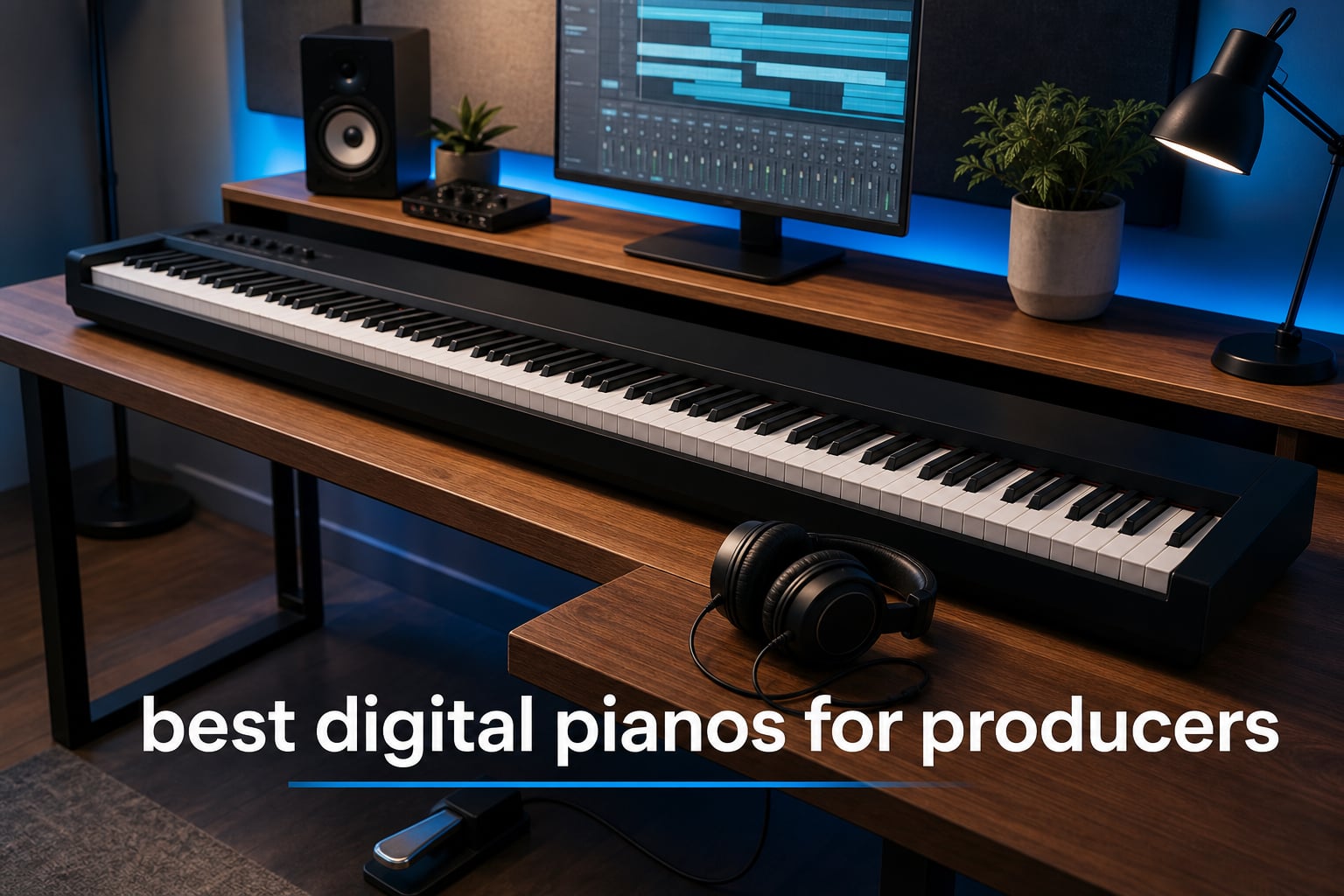
The best digital pianos for producers combine an 88-key weighted action with practical MIDI connectivity, so you can write a part with piano technique and capture it in a recording setup without changing instruments. A good studio piano should feel convincing under the hands, but it also has to fit the less glamorous jobs: triggering virtual instruments, working quietly on headphones, recalling a sound quickly, and sitting beside a computer for long sessions.
We compared the available product records for all 12 instruments below, with the producer’s questions in mind: key action, sound source, USB or Bluetooth MIDI, pedals, speakers, headphone routing, and stated software support. Rather than treat a long tone list as an automatic win, I look at whether the piano supplies the connection or physical control that makes a writing session move forward.
A digital piano for production is not a substitute for every controller. It is an 88-key weighted instrument that can provide its own sounds while sending MIDI to compatible software, which makes it a strong fit for composers, pianists, beat makers, and home-studio owners who want realistic touch as well as recording flexibility.
If your next project is electronic music, the piano is one part of the signal chain rather than the whole studio. Pair the choice below with these dubstep production techniques to turn chord ideas, bass notes, and rhythmic parts into an arranged track.
Table of Contents
The Top 3 Picks for Producers Are Roland, Roland, and Donner
The Roland RD-88 EX is my broadest recommendation because it combines a hammer-action 88-note keyboard, USB audio/MIDI, onboard speakers, and more than 3,000 ZEN-Core sounds. The Roland FP-30X is the simpler piano-first route with PHA-4 action and both Bluetooth MIDI and USB audio/MIDI, while the Donner DDP-200 suits a fixed home studio that wants Bluetooth MIDI, triple pedals, and an upright-style body.
These Digital Pianos Give Producers a Quick 2026 Overview
This overview keeps the comparison focused on facts that affect a session. In particular, USB audio/MIDI can send more than note data where it is explicitly listed, whereas USB-MIDI or Bluetooth MIDI is the stated route for using the piano as a controller.
| Product | Specifications | Action |
|---|---|---|
 Roland RD-88 EX Roland RD-88 EX |
|
Check Latest Price |
 Roland FP-30X Bundle Roland FP-30X Bundle |
|
Check Latest Price |
 Donner DDP-200 Donner DDP-200 |
|
Check Latest Price |
 STRICH SDP-300W STRICH SDP-300W |
|
Check Latest Price |
 Melentro 88-Key Melentro 88-Key |
|
Check Latest Price |
 UISCOM 1852 UISCOM 1852 |
|
Check Latest Price |
 KUMENG KU-1181 KUMENG KU-1181 |
|
Check Latest Price |
 WENCAI BL-8812 WENCAI BL-8812 |
|
Check Latest Price |
 MOSEN MDP-110 MOSEN MDP-110 |
|
Check Latest Price |
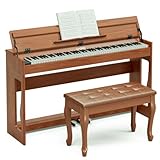 UMOMO UMP-718 UMOMO UMP-718 |
|
Check Latest Price |
 Ktaxon 88-Key Ktaxon 88-Key |
|
Check Latest Price |
 AiJoy ADP-100 AiJoy ADP-100 |
|
Check Latest Price |
1. The Roland RD-88 EX Is the Most Complete Studio Sound Source
Roland RD-88 EX Stage Piano, 88-Note Keyboard
PHA-4 hammer keys
3000+ sounds
USB audio/MIDI
Pros
- PHA-4 Ivory Feel action
- SuperNATURAL Piano 3
- 3000+ onboard sounds
- USB audio/MIDI
- Onboard speakers
Cons
- 41.5-pound listed weight
- No Bluetooth connection listed
The RD-88 EX makes the clearest case for a producer who writes beyond straight acoustic piano. Roland lists SuperNATURAL Acoustic Piano 3 Expansion alongside the ZEN-Core engine and more than 3,000 onboard sounds, so one keyboard can cover a piano sketch, electric-piano part, pad layer, or a less conventional texture without immediately opening another source.
Its stated USB audio/MIDI interface matters in a computer-based setup because the instrument is described as both an audio and MIDI connection, not simply a note controller. The onboard stereo speakers and USB-memory MP3/WAV playback also make it plausible to rehearse an arrangement away from the main monitor chain.
The PHA-4 action gives pianists a familiar 88-note writing surface
Roland specifies 88-note hammer-action keys with Ivory Feel, putting physical touch at the center of the RD-88 EX rather than treating the keys as an afterthought. I would choose that when velocity nuance in a piano or electric-piano performance needs to survive the move into a MIDI clip.
The listing also includes built-in rhythms, a DP-10 damper pedal, and a compact-design claim, which can help a songwriter move from a loop to a performed idea. Its stated 41.5-pound weight is still a number worth planning around if the keyboard will rotate between studio and rehearsal room.
The sound range suits producers who want fewer gaps between idea and arrangement
The large sound count is useful when you need contrasting roles from one instrument, not merely more presets to scroll through. Start with the SuperNATURAL piano for harmony, then audition a ZEN-Core sound for a counterline or transition while the musical phrase is still fresh.
Apple MainStage is the software named in the product details. For other software, treat the listed USB audio/MIDI capability as the connection feature to confirm in your own setup rather than assuming a particular template or control mapping.
2. The Roland FP-30X Bundle Is the Best Piano-First Controller Choice
Roland FP-30X Digital Piano Bundle with Stand, Bench & Headphones (Black)
PHA-4 action
Bluetooth MIDI
USB audio/MIDI
Pros
- PHA-4 escapement action
- SuperNATURAL sound
- Bluetooth MIDI
- USB audio/MIDI
- Bundle includes stand and headphones
Cons
- 67-pound listed bundle weight
- No DAW-specific software listed
The FP-30X bundle is the right answer when the piano experience comes first but the instrument still needs to participate in a studio. Its SuperNATURAL Piano sound engine and 88-key PHA-4 Standard keyboard are paired with Bluetooth MIDI and USB audio/MIDI, giving a producer two stated paths to send performance data.
The bundle record adds headphones, a stand, bench, sustain pedal, music rest, and power adapter. That collection reduces the number of basic pieces to source before you can sit down and record a first part.
The PHA-4 keyboard suits expressive piano tracking
Roland describes the PHA-4 Standard action as hammer action with escapement and ivory-feel keys. Those are the features I would prioritize when playing dynamics into a virtual piano, because a weighted action supports a more piano-like approach to velocity than a small synth-style keyboard.
The instrument also lists metronome, transpose, dual, split, and Twin Piano functions. Split and dual modes can be useful for mapping a bass sound under a piano idea or checking an arrangement while retaining a normal full-width keybed for serious takes.
The two MIDI routes support both wired and cable-light setups
Bluetooth MIDI is the stated wireless option, while USB audio/MIDI is the wired studio option. If recording stability and audio routing are your priority, I would begin with the physical USB connection and treat Bluetooth MIDI as a convenient alternative for control tasks.
Community discussions singled out the FP-30X for its key action at this level, which matches the product record’s emphasis on PHA-4 mechanics. The listed 67-pound bundle weight also suggests making it a planned studio position instead of assuming it will be a casual grab-and-go keyboard.
3. The Donner DDP-200 Is a Strong Fixed-Desk Piano with Bluetooth MIDI
Donner Digital Piano with 88 Key Dynamic Graded Hammer Action Weighted Keyboard Piano, DDP-200 Upright Digital Piano for Professional with LCD Screen/5 Reverb/BT MIDI/Three Pedal
Dual-sensor action
Bluetooth MIDI
128 polyphony
Pros
- Dual-sensor graded action
- Bluetooth MIDI
- 128-note polyphony
- Triple pedal system
- Five reverb effects
Cons
- No listed product weight
- No DAW-specific software listed
The Donner DDP-200 takes the home-studio upright route: an 88-key dynamic graded hammer-action keyboard, 128-note polyphony, a triple pedal system, and Bluetooth MIDI in a wood-grain body. That is a practical recipe for a producer whose piano stays in one room and needs to handle both composing and daily playing.
Its product record names a dual-sensor graded hammer action, an upgraded audio chip, and a 3D sound system with a hanging-speaker design. Those details point toward an instrument intended to feel and sound self-contained before you involve a computer.
The dual-sensor action supports deliberate performance capture
A dual-sensor action is the specified key mechanism here, and the 88-key layout avoids the octave compromises of a compact controller. I would use the graded action for chord voicings, two-handed parts, and pedal-heavy material that becomes awkward on a smaller keybed.
The triple pedal system covers sustain, sostenuto, and soft functions according to the listing. That extra control is relevant when you are recording a MIDI performance and want to keep the pedaling gestures in the part rather than adding them later.
The Bluetooth MIDI connection fits a simple computer-side workflow
The DDP-200 lists Bluetooth MIDI and support for apps that use Bluetooth MIDI and the MIDI standard protocol. MIDI carries note and control performance data; it does not replace the audio signal from the piano, a distinction worth keeping clear when planning inputs.
The 1.3-inch LCD, built-in metronome, five reverb effects, and five demo songs make basic practice and setup less dependent on external gear. Its product record does not name a specific DAW, so verify the connection procedure with your own recording software before a deadline session.
4. The STRICH SDP-300W Is a Furniture-Style Piano with Broad Device Support
STRICH Digital Piano 88 Keys, Hammer-Action Weighted Keyboard, Full size Electric Piano Keyboard with Furniture Stand, 25Wx2 Speakers, Supports USB-MIDI/Wireless Connect, SDP-300W (Color Walnut Wood)
Ivory-texture keys
Wireless MIDI
25W x 2 speakers
Pros
- Fully weighted ivory-texture keys
- Wireless and USB-MIDI
- 128 polyphony
- 25W x 2 speakers
- Furniture stand included
Cons
- 58.8-pound listed weight
- No named DAW support
The STRICH SDP-300W is a sensible choice for a producer who wants a piano to look settled in a room instead of living on an X stand. It brings an included furniture stand, 88 fully weighted hammer-action keys with simulated ivory texture, and both wireless and USB-MIDI connections.
The sound and accompaniment side is unusually broad for this group: 128 preset timbres, 200 drum rhythms, 128-note polyphony, plus layer, split, octave-shift, transpose, chorus, and smart-chord functions. Those options can make sketching an arrangement more immediate, even if the final sounds come from elsewhere.
The full cabinet setup favors a permanent writing station
This model weighs 58.8 pounds and includes the furniture stand, so I would regard it as a fixed workstation rather than a portable piano for recording away from home. The walnut-grain finish and full stand suit a room where visual footprint matters alongside keyboard function.
Two 25W speakers and an audio-in port can make the instrument useful for listening to a reference or playback through the piano system. When precision matters, use the 6.35 mm headphone jack and make monitoring choices separately from the room speakers.
The MIDI choices support several kinds of production devices
STRICH states wireless and USB-MIDI connection along with compatibility across Windows, macOS, iOS, and Android. That is a concrete advantage for producers moving between a desktop session and a mobile writing device.
The teaching-app support and auto-chord function are not DAW controls, but they can help a newer producer get a harmonic idea moving. For control-surface duties such as faders and clip launching, add a dedicated controller rather than expecting the piano’s listed functions to do everything.
5. The Melentro 88-Key Is a Feature-Dense Entry into Weighted MIDI Piano
Melentro Weighted 88-Key Digital Piano, Full-Size Electric Piano Keyboard
Hammer action
900 tones
USB/MIDI wireless
Pros
- 88 weighted hammer-action keys
- 900 tones
- 128 polyphony
- USB/MIDI and wireless
- Sustain pedal included
Cons
- Weight not specified
- No named DAW support
The Melentro 88-Key is built around a familiar producer checklist: full-size hammer-action keys with touch sensitivity, USB/MIDI and wireless connectivity, 900 tones, and 128-note polyphony. It is an appealing first studio piano for someone who wants a wide onboard palette while learning how MIDI fits into their writing routine.
The listing includes an LCD display, MP3 playback, and a sustain pedal. Those are straightforward features, but they reduce friction when you are practicing parts, auditioning a reference, or recording basic sustain gestures into a performance.
The 900-tone library supports quick sound-role experiments
For production, a long tone list is useful if it encourages you to identify a role: piano for harmony, a different color for a hook, or a simple layer for a demo. The Melentro record gives 900 tones and 128 polyphony, which leaves room for dense sustained chords and multi-note playing.
I would still build important final sounds in the sound source you know best. Use the onboard sounds as a writing tool first, then decide whether the MIDI performance should drive a virtual instrument or remain tied to the instrument’s own audio.
The connection options make controller use the practical priority
USB/MIDI and wireless connectivity are both stated, and the connector type is MIDI USB. That makes the Melentro a MIDI controller keyboard as well as a self-contained digital piano, provided the receiving device recognizes the intended connection.
The product details do not name a specific DAW or state the instrument’s weight. Confirm the device path and your intended stand or desk arrangement before treating it as a long-term studio centerpiece.
6. The UISCOM 1852 Fits Producers Who Need a Piano and Desk in One
UISCOM 88 Key Weighted Home Digital Piano,Wooden Desk Keyboard,Triple-Pedal
Progressive hammer action
MIDI
Triple pedals
Pros
- Progressive hammer action
- MIDI with sensitivity control
- Triple pedals
- Dual headphone jacks
- Recording capability
Cons
- Eight listed tones
- No product weight listed
The UISCOM 1852 stands out because its wooden desk-and-vanity form changes the furniture question, not because it tries to be a large workstation. For a small creative room, the progressive hammer-action keyboard, MIDI functionality, dual headphone jacks, recording capability, and triple pedals provide a usable piano foundation in a convertible layout.
UISCOM lists a French Dream5704 sound chip, eight distinct tones, 40 demo songs, reverb, chorus, dual-tone mode, and adjustable key sensitivity. The sound count is modest compared with some alternatives, so its appeal is more about physical form and core piano workflow than sound-library breadth.
The convertible cabinet makes space planning the first decision
If your production desk and piano cannot permanently occupy separate positions, this design deserves a closer look. I would measure the intended area and consider how often you need the desk or vanity function before treating the convertible body as an advantage.
The listing gives no product weight or dimensions, which is information to confirm before arranging a room around it. Its 6.35 mm headphone jack and dual headphone setup can be useful when an uninterrupted practice session shares space with someone else.
The pedal set supports piano technique beyond simple sustain
The supplied triple pedals cover sustain, sostenuto, and soft functions. For producers who actually play piano, recording those controls can preserve performance detail that can be difficult to recreate with a mouse afterward.
The instrument lists MIDI functionality and support across Windows, macOS, and Linux, but it does not identify a particular DAW. Treat it as a MIDI-capable piano and check the driver-free connection behavior with the computer and software you already use.
7. The KUMENG KU-1181 Is a Cross-Platform USB-MIDI Piano for Quiet Work
KUMENG Digital Piano 88 Key Weighted Keyboard Full-Size Desk Electric Piano
Progressive hammer action
800 tones
USB-MIDI
Pros
- 88 weighted keys
- Progressive hammer action
- 800 tones
- USB-MIDI
- Headphone mode
Cons
- Only 147 reviews
- No Bluetooth listed
The KUMENG KU-1181 is aimed at a straightforward home-studio setup: 88 weighted keys with progressive hammer action, USB-MIDI connectivity, a headphone mode, and an included pedal. Its product record also names 800 tones and 128 polyphonies, giving the piano both a controller role and a self-contained practice role.
Windows, macOS, and Linux compatibility are specifically listed. That matters for producers whose computer environment is not limited to the most common desktop pairing, although you should still confirm your exact recording-software configuration.
The included quiet-work features suit shared rooms and late sessions
Headphone mode is a meaningful studio feature when speakers cannot be used. It lets you practice a part or enter MIDI without making the piano’s onboard speakers part of the room’s noise budget.
The package also lists a sheet-music stand, headphones, portable legs, and a flip key cover. I see that collection as a way to get a writing corner operating quickly, not as a promise about monitor quality or computer-audio routing.
The USB-MIDI connection keeps the controller workflow simple
The stated MIDI USB connector is the core production feature. Connect it as a controller, select the MIDI input inside your software, and check that key presses and the pedal are registering before recording a full take.
No Bluetooth connection is listed, so this is best for a producer who is comfortable using a cable at the desk. The source record identifies 147 reviews and a 4.5 average rating, which is useful context but not a replacement for checking how the action fits your hands.
8. The WENCAI BL-8812 Is a Traditional Upright with Direct MIDI/USB Access
WENCAI Digital Piano 88 Key Fully Weighted Keyboard, Black
Progressive action
MIDI/USB
Triple pedals
Pros
- Fully weighted 88 keys
- Progressive hammer action
- MIDI/USB interface
- Triple pedals
- Dual stereo speakers
Cons
- 144 listed reviews
- One-year warranty
The WENCAI BL-8812 keeps the specification story direct: fully weighted 88 keys, progressive hammer action, a MIDI/USB interface, dual stereo speakers, and a triple pedal system. If you want a conventional upright electronic piano that can also send data to a computer, those fundamentals are all present in the listing.
It also lists 128 timbres, 100 rhythms, and 88 demonstration songs. That gives a producer a set of internal writing prompts without turning the instrument into a deep workstation with a complex control surface.
The familiar upright layout favors a dedicated piano area
This is a home digital piano rather than a compact slab keyboard, so the first question is whether your room benefits from a stable, piano-like station. A fixed instrument can support better playing habits because the bench, pedals, and keys remain in the same relationship every session.
Its dual stereo speakers are useful for casual playback, while the 3.5 mm headphone jack provides a private monitoring alternative. When recording polished audio, decide separately whether the piano’s own sound or a virtual instrument will be the source.
The cross-platform MIDI connection supports computer-based composition
WENCAI names Windows, macOS, and Linux compatibility and lists MIDI USB, Micro USB B, and USB Type C among the connector information. That flexibility may be helpful for a producer who uses adapters or more than one type of computer port.
The record reports 144 reviews with a 4.4 average rating and a one-year warranty. I would view those facts as a prompt to examine support terms and fit, not as evidence that any particular workflow will match your studio unchanged.
9. The MOSEN MDP-110 Is a Desk-Integrated Piano for Compact Studios
MOSEN 88 Key Fully Weighted Digital Piano Graded Hammer Action Keyboard
Graded hammer action
380 voices
USB-MIDI
Pros
- Graded hammer action
- 128-note polyphony
- 380 voices
- USB-MIDI
- Dual headphone jacks
Cons
- 53 listed reviews
- No Bluetooth connection listed
The MOSEN MDP-110 is designed around a compact-room idea: a full-sized 88-key weighted keyboard whose integrated dust cover doubles as a desk. That 2-in-1 approach is worth considering when a producer needs a clear work surface but does not want a keyboard permanently exposed.
Its stated musical features include graded hammer action, 128-note polyphony, 380 voices, 128 rhythms, USB-MIDI, a German sound engine, and audio input for play-along. The voice and rhythm range may help during composition, while USB-MIDI is the key connection for software control.
The desk cover creates a real workflow trade-off
A cover that becomes a desk can reclaim space after a session, which is useful in an apartment studio. On the other hand, opening and closing the piano is an extra step, so I would consider whether you write best with the keys always available.
The included furniture stand, three-pedal unit, and keyboard cover point to a complete home-piano setup. Dual headphone jacks are a useful shared-room feature when two people need quiet practice or one person needs to monitor alongside a teacher.
The USB-MIDI port makes it the better fit for a wired desktop rig
USB-MIDI is explicitly listed and should be the primary connection for recording note and pedal information. There is no Bluetooth connection stated, which is not a problem when the piano and computer share the same desk area.
The listing cites 53 reviews with a 4.4 average rating. Since that is a smaller review total than several other picks here, I would pay special attention to the return and warranty terms, both of which are supplied in the product record.
10. The UMOMO UMP-718 Gives Producers Standard MIDI and an Included Bench
UMOMO 88 Weighted Key Digital Piano with Duet Piano Bench, Beginner Keyboard Piano Full Size Heavy Hammer Weighted Action Electric Piano Keyboard with USB MIDI, Brown
Progressive action
Standard MIDI
64 polyphony
Pros
- Progressive hammer action
- USB and Standard MIDI
- Triple pedal system
- Included duet bench
- iOS Windows macOS support
Cons
- 64-note polyphony
- 51 listed reviews
The UMOMO UMP-718 offers both USB MIDI and Standard MIDI, a distinction that can matter for producers who connect to more than one type of music hardware. Its 88-key progressive hammer action is described as heavier in the bass and lighter in the treble, which follows the general behavior pianists expect from a graded feel.
The product record includes a duet piano bench and a triple pedal system, plus 128 tones, 128 rhythms, and 80 demo songs. It also lists iOS, Windows, and macOS compatibility, giving the piano a stated path into several computer or mobile environments.
The Standard MIDI ports add flexibility beyond USB-only gear
USB MIDI is convenient for a computer, while Standard MIDI can be relevant if the rest of your rig includes compatible external music hardware. I would choose this model when that second connection has a real place in the studio rather than merely buying it for a port you will never use.
The instrument lists a headphone jack, so it can support quiet composing sessions. Its battery-powered product detail is unusual among the picks, and it is worth checking how that power arrangement fits the location where the piano will live.
The 64-note polyphony shapes the kind of parts it suits best
UMOMO specifies 64-note polyphony. That is sufficient for many piano, chord, and MIDI-controller jobs, but producers who routinely rely on long pedal sustains and dense layered internal sounds may prefer a model whose listing specifies 128 notes.
The analyzed record has 51 reviews and a 4.4 average rating. As with every action, the stated progressive response is the reason to assess the physical key feel in a way that reflects your own playing style.
11. The Ktaxon 88-Key Combines Bluetooth Playback with USB/MIDI
Ktaxon 88 Key Weighted Upright Piano,Keyboard Piano Digital Piano Keyboard
Graded action
Bluetooth
USB/MIDI
Pros
- Graded hammer action
- 128-note polyphony
- Bluetooth audio
- USB/MIDI
- Triple pedals
Cons
- 16 listed reviews
- Reported 14 percent one-star ratings
The Ktaxon 88-Key is for the producer who wants a slim piano with graded hammer action, 128-note polyphony, Bluetooth audio playback, USB/MIDI output, and a triple pedal unit. It also includes headphones, piano stickers, a cleaning cloth, and a dustproof cloth, which may make a first dedicated piano corner easier to organize.
The stated Dream Sound Chip and two stereo surround speakers are the instrument’s internal-sound features. For computer work, USB/MIDI is the specification that matters most because it is the declared route to music-software compatibility on PC, Mac, and iPad.
The Bluetooth feature is playback, while USB/MIDI is the production link
It is easy to blur Bluetooth audio and Bluetooth MIDI, but the Ktaxon listing explicitly calls out Bluetooth audio playback and USB/MIDI output. Use Bluetooth to listen through the piano where that suits your room, and use the listed USB/MIDI connection for recording performance data.
The 3.5 mm headphone jack gives you another way to separate practice from room playback. The clamshell protection and slim form can be valuable when dust control and storage matter in a multi-use space.
The review record calls for extra care before making it a main keyboard
The source record reports 16 reviews, a 4.3 average rating, and 14 percent one-star ratings. That does not identify a single cause, but it is enough reason to read current buyer feedback and understand return arrangements before committing to it as the main 88-key surface.
For a producer who values the listed accessory set and wired computer connection, the feature mix is strong on paper. I would keep expectations centered on its stated functions rather than treating it as a substitute for dedicated mixer or DAW controls.
12. The AiJoy ADP-100 Is a Walnut-Cabinet Piano with VRM Sound
AiJoy 88-Key Digital Piano with Hammer Action Weighted Keys
Hammer action
VRM sound engine
USB-MIDI
Pros
- Hammer-action weighted keys
- VRM sound engine
- 20W x 2 speakers
- USB-MIDI
- Dual headphone jacks
Cons
- 23 listed reviews
- Reported 16 percent one-star ratings
The AiJoy ADP-100 is a furniture-style option with a walnut finish, 88 hammer-action weighted keys, a triple pedal design, USB-MIDI, and dual headphone jacks. The product record also specifies a French DREAM sound engine with Virtual Resonance Modeling, often shortened to VRM, for its natural grand-piano tone approach.
Its dual 20W amplifiers and listed stereo speakers make it one of the options aimed at filling a room without external monitors. For an after-hours workflow, the two headphone jacks offer a more direct answer than relying on speakers at low volume.
The VRM-focused sound engine suits piano-centered writing
Virtual Resonance Modeling is the named sound feature, so this pick is most appealing when a producer wants to begin with an acoustic-piano style voice and develop the arrangement from there. I would favor it for songwriting, accompaniment, and piano-led electronic sketches over a session that needs hundreds of varied onboard colors.
The listing calls its sound profile balanced and natural and includes the full three-pedal arrangement. Those pedals can support a more complete performance when MIDI is captured for later editing.
The USB-MIDI port keeps computer control within reach
AiJoy lists USB-MIDI connectivity and support for MIDI-compatible software on Windows and macOS. That makes it a DAW compatible piano in the basic, stated sense: it can send MIDI to software that accepts MIDI, while the final instrument choice remains yours.
The record cites 23 reviews, a 4.1 average rating, and 16 percent one-star ratings. Give the current return conditions, physical cabinet fit, and connection behavior the same attention as the appealing speaker and sound-engine specifications.
The Right Producer Piano Starts with Key Feel and Connection Type
Start with the action, because it changes how you play and how your MIDI performance is captured. An 88 fully weighted keybed with hammer action is the best match for a pianist writing two-handed parts, expressive chords, or pedal-led passages; a smaller MIDI controller can still be useful for drums and quick edits, but it is not the same playing surface.
Key-action labels are not interchangeable. Roland’s PHA-4 action adds escapement and ivory-feel detail in the FP-30X and RD-88 EX records, Donner names dual-sensor graded hammer action, and several models state progressive or graded hammer action. Read the exact language, then put hands on an action where possible, because the response you play matters more than a label alone.
USB-MIDI sends performance data rather than automatically recording piano sound
USB-MIDI and Bluetooth MIDI send notes, velocity, pedal movements, and other control information to compatible software. They let the digital piano act as a controller for a virtual piano, synth, sampler, or another instrument inside the computer.
That is separate from audio. The RD-88 EX and FP-30X specifically list USB audio/MIDI, while other picks list USB-MIDI or MIDI functionality; do not assume these descriptions mean identical audio-routing options. Decide whether you want the piano’s internal sound, a virtual instrument, or both before connecting cables.
Polyphony matters when the piano is creating its own dense internal sound
Polyphony is the number of notes an instrument can sound at one time. It is most relevant when you layer sounds, sustain notes with a pedal, or use the digital piano’s own engine rather than triggering a computer instrument.
This list includes stated 128-note polyphony on the Melentro, STRICH, Donner, KUMENG, MOSEN, and Ktaxon models, while UMOMO lists 64 notes. For a straightforward MIDI-controller role, the key action and connection may matter more; for internally layered playing, the higher stated figure gives more headroom.
Headphones, pedals, and placement decide whether the piano gets used every day
A home studio piano is only useful if it fits the practical boundaries of the room. Check the headphone jack size, whether dual headphone jacks matter, where the sustain or triple pedal will sit, and whether the instrument is a portable slab, a furniture cabinet, or a desk-convertible design.
For example, the STRICH is listed at 58.8 pounds, the RD-88 EX at 41.5 pounds, the FP-30X bundle at 67 pounds, and the AiJoy at 50 pounds. Those are not trivial numbers when the plan involves moving a piano around an interface, monitor stands, or a shared room.
A digital piano beats a controller when touch and internal sound are part of the job
Choose a digital piano when you want weighted keys, a playable onboard sound, speakers or headphone practice, pedals, and MIDI in the same instrument. Choose a dedicated MIDI controller when compact dimensions, knobs, pads, faders, or DAW-oriented control are more important than an authentic piano key action.
Many producers benefit from both: use the digital piano for harmonic writing and expressive performance, then add a small controller for drum programming and mixer-style control. That split reflects forum discussions where people ask whether a controller should come first; the better choice depends on the part you will play most often.
A simple studio workflow turns a digital piano into a production tool
Place the piano where your hands can reach it without blocking the computer, connect the stated MIDI port, select it as an input in your recording software, and record a short velocity-and-pedal test. If you use the piano’s speakers or headphone output, set those monitoring choices deliberately instead of letting them compete with the main studio monitors.
Then capture the musical idea first and edit second. A strong piano take can become a sampled chord progression, an electric-piano layer, a bass guide, or a synth part; our dubstep production techniques guide shows how those initial musical elements can grow into a complete electronic arrangement.
Producer forums consistently value long-term workflow reports over a raw specification list. They also praised the FP-30X action, described the Yamaha DGX-670 as versatile, and pointed to the Kawai CA401 for realistic feel; those reference models are not in this 12-product data set, so I have not ranked them here.
These Producer Questions Have Straight Answers
What piano do producers use?
Producers use either a weighted digital piano, a MIDI controller, or both. A weighted digital piano is the better fit when authentic 88-key feel, pedals, onboard piano sound, and MIDI recording are all needed; the Roland RD-88 EX and Roland FP-30X are strong examples in this guide because their listings include hammer-style action and USB audio/MIDI.
Which digital piano sounds most like a real piano?
The most realistic choice depends on both sound engine and action. In this group, the Roland FP-30X lists SuperNATURAL Piano sound and PHA-4 hammer action with escapement and ivory-feel keys, while the AiJoy ADP-100 lists a French DREAM engine with Virtual Resonance Modeling. Key feel should be tried where possible because it affects the performance as much as the sampled or modeled sound.
Who makes the best digital pianos?
Roland is a strong producer-focused brand in this list because the RD-88 EX and FP-30X both state USB audio/MIDI and weighted action. The other brands here serve different needs: Donner emphasizes Bluetooth MIDI and a fixed upright setup, STRICH supplies cross-device MIDI options, and several home-piano brands focus on furniture cabinets, pedals, and USB-MIDI. Choose by exact specifications rather than brand name alone.
What is the best keyboard for producing?
The Roland RD-88 EX is the best keyboard for producing in this guide when you need a weighted 88-key piano that can also supply a large sound palette. Its record specifies PHA-4 hammer action, SuperNATURAL Acoustic Piano 3 Expansion, more than 3,000 ZEN-Core sounds, onboard speakers, and a USB audio/MIDI interface. The FP-30X is the simpler piano-centered alternative.
Can I use a digital piano as a MIDI controller?
Yes, when the piano lists USB-MIDI, MIDI, Bluetooth MIDI, or a USB audio/MIDI interface. Connect the stated MIDI route to a compatible device, select the piano as an input in recording software, and test notes, velocity, and pedal data. MIDI records performance instructions, so you can use the digital piano to play a separate virtual instrument.
The Best Choice Depends on the Producer Workflow You Need Most
The Roland RD-88 EX is the complete choice for a producer who needs broad onboard sounds and stated USB audio/MIDI, while the Roland FP-30X puts piano response and two MIDI routes at the center. Choose Donner, STRICH, UISCOM, MOSEN, or AiJoy when a furniture-style home setup better suits the room; choose the others when their stated combination of MIDI, action, polyphony, pedals, and portability matches your actual sessions.
The best digital pianos for producers in 2026 are the ones you will leave connected, play with confidence, and use to capture ideas before they disappear. Verify the exact connection, the key feel, and the physical space, then select the piano that removes the most friction from your writing process.