
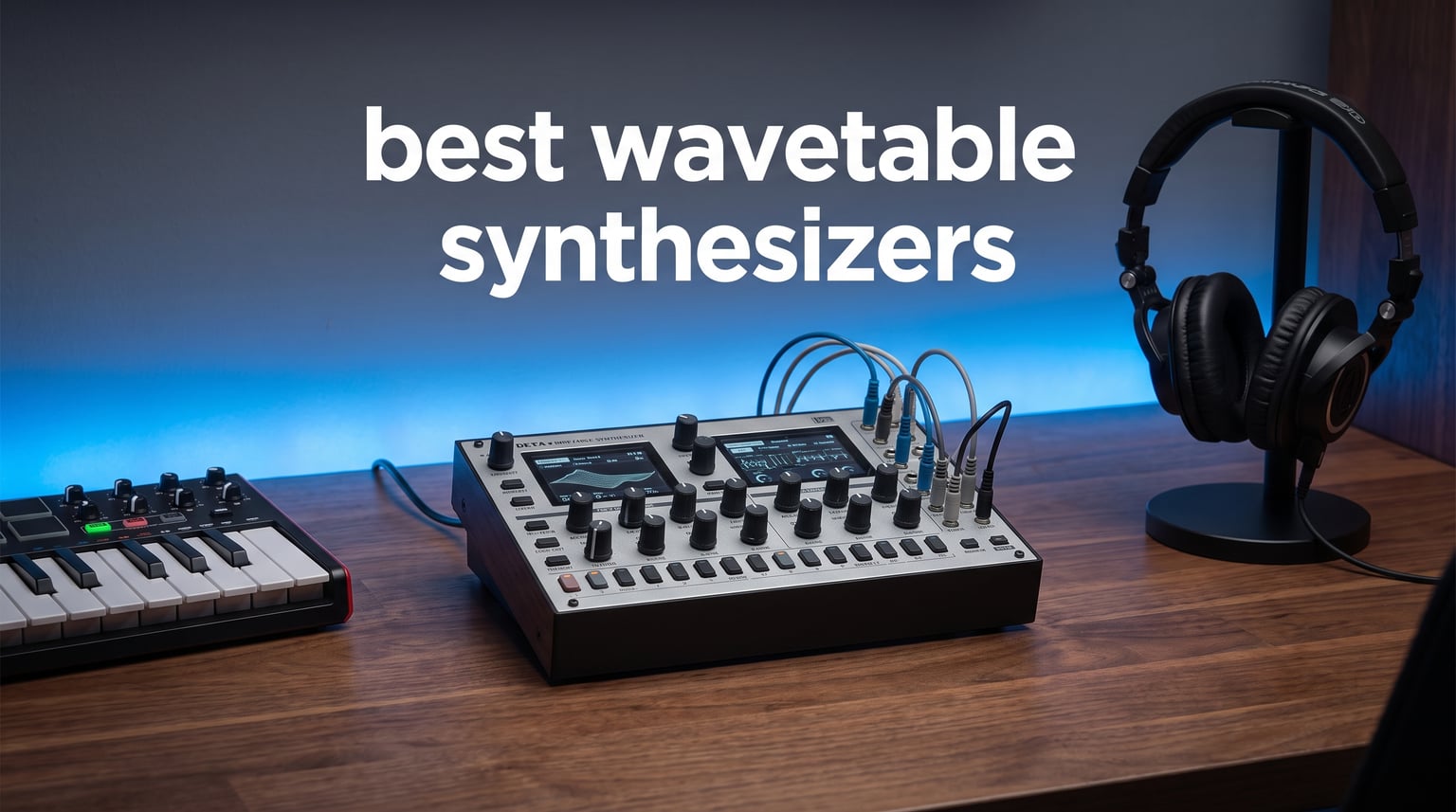
The best wavetable synthesizers make it possible to move through a changing bank of digital waveforms instead of staying on one static oscillator shape. That motion is why wavetable synthesis can make a bass growl, a pad slowly change color, or a drum hit react differently to every performance gesture.
This is a hardware-led list of ten supplied instruments and music workstations, rather than a list of plug-ins. Some are explicitly specified with wavetable synthesis or wavetables, while others are hybrid, multi-engine, or sampling tools that belong in the same hands-on sound-design conversation; I call that distinction out so you can choose on facts rather than a broad label.
I rank the options by what their published specifications say they do best: playable hybrid voices, vector morphing, ambient layers, expressive drums, or complete portable sequencing. If your aim is aggressive low end, pair the ideas here with our dubstep production tutorial for a practical bass-design starting point.
Table of Contents
The Top 3 Picks Give Three Clear Starting Points
Arturia MiniFreak is my all-round starting point for players who want keys, aftertouch, a six-voice hybrid engine, sequencing, effects, and a bundled VST counterpart. Sonicware LIVEN Evoke is the focused pick for portable acoustic-meets-wavetable textures, while Behringer Pro VS Mini is the compact route to vector-morphing oscillators and an analog low-pass filter.
These Wavetable Synthesizers Fit Different Workflows in 2026
The comparison below is a fast way to separate melodic keyboards and tabletop synths from drum-focused or workstation-style choices. A higher review average is useful context, but review totals vary widely, so I would treat the listed features and your intended workflow as the deciding evidence.
| Product | Specifications | Action |
|---|---|---|
 Sonicware LIVEN Evoke Sonicware LIVEN Evoke |
|
Check Availability |
 Polyend Tracker Mini Polyend Tracker Mini |
|
Check Availability |
 Arturia MiniFreak Arturia MiniFreak |
|
Check Availability |
 Behringer Pro VS Mini Behringer Pro VS Mini |
|
Check Availability |
 Sonicware CyDrums Sonicware CyDrums |
|
Check Availability |
 Roland AIRA Compact S-1 Roland AIRA Compact S-1 |
|
Check Availability |
 Behringer Grind Behringer Grind |
|
Check Availability |
 Behringer JT-4000 MICRO Behringer JT-4000 MICRO |
|
Check Availability |
 Sonicware LIVEN Ambient Ø Sonicware LIVEN Ambient Ø |
|
Check Availability |
 teenage engineering OP-XY teenage engineering OP-XY |
|
Check Availability |
The list also answers a common buying mistake: a device can be excellent for electronic music without being a conventional keyboard-first wavetable synth. Tracker Mini and OP-XY put sequencing and arrangement at the center, CyDrums puts drums first, and the LIVEN units favor portable self-contained creation.
1. Arturia MiniFreak Is the Best All-Round Hardware Pick
Arturia MiniFreak 37 Key Polyphonic 6-Voice Hybrid Synthesizer Keyboard (Standard, 37 Key)
6 voices
37 aftertouch keys
2 engines and VST
Pros
- 6-voice hybrid engine
- 37 keys with aftertouch
- 64-step sequencer
- SVF filter
- VST counterpart
Cons
- Some reported issues in reviews
- Compact slim-key layout
I would start with the Arturia MiniFreak when the goal is an instrument that can be played, sequenced, and taken into a computer project without changing the basic creative idea. Its supplied specification combines a six-voice hybrid synthesizer, two engines, 37 slim velocity keys with aftertouch, an SVF filter, three effects, and a 64-step sequencer.
The included MiniFreak VST counterpart is the detail that gives this hardware unit a clear place in a studio workflow. It lets a producer keep a software counterpart in mind while using the physical keyboard, although the supplied data does not make a specific DAW-compatibility claim.
At 4.7 from 140 reviews, it has the largest review base among the lead melodic picks in this guide. The review data also flags some reported issues in a small share of feedback, so I would read recent owner comments and test every control during the return period.
It works best for players who want expressive control
Aftertouch on 37 velocity-sensitive keys gives a player more direct control than a button-only box. That is especially useful for held pads, leads, and evolving parts where pressure can become part of the performance rather than a later automation task.
The 64-step sequencer also makes MiniFreak a sensible choice for writers who begin away from the computer. I like that combination for turning a short modulation idea into a complete repeating phrase before recording it.
It fits studios that move between hardware and software
The bundled VST counterpart makes this the most straightforward bridge in this particular roundup for a player who wants both a physical instrument and a companion software version. USB connectivity is listed, but confirm your own DAW and operating-system setup before making that workflow central to a session.
Choose another option if you need a dedicated wavetable engine explicitly named in the product data, a built-in speaker, or a battery-powered travel instrument. MiniFreak is a hybrid keyboard with deep published features, not a pocket device.
2. Sonicware LIVEN Evoke Is the Best for Acoustic-Textured Ambient Parts
Sonicware Liven Evoke [Acoustronic Synthesizer with Granular Effect] – Portable Synthesizer for Cinematic Ambient and Post-Classical Music Production, Battery-Powered, Built-In Speaker
34 acoustic tones
20 wavetables
12-grain Grain FX
Pros
- Acoustic and wavetable oscillator
- Tempo-synced Grain FX
- 10 reverbs
- 4-track sequencer
- Battery-powered speaker
Cons
- Small review sample
- Compact tabletop format
Sonicware LIVEN Evoke is the clearest match when you want wavetable material to meet acoustic-instrument color rather than only sharp digital tones. Its Acoustronic Flux Oscillator lists 34 acoustic instrument tones and 20 wavetables, then the Grain FX adds up to 12 tempo-synced grains for more fragmented texture.
I would use that specification as a reason to write cinematic beds, post-classical phrases, and processed plucks before reaching for a conventional supersaw. Ten deep, multi-dimensional reverbs and a one-finger chord mode with 16 chord styles give the unit a distinct songwriting personality.
The 4.8 average is encouraging, but it comes from 16 reviews, which is not enough to settle durability or long-term reliability questions. Its listed 790-gram body, built-in speaker, battery operation, sync, and MIDI integration make portability a factual strength rather than a guess.
It excels at self-contained texture writing
The four-track sequencer supports both step and real-time recording, with parameter locking listed in the review data. That makes it possible to shape change over time inside the device instead of relying only on a static patch.
Its speaker and battery power matter if you sketch away from a desk. I would still monitor on headphones or studio speakers before judging low-end balance, since the specifications only establish that a speaker is built in.
It favors acoustic and granular color over keyboard performance
Evoke makes the most sense for someone who wants a compact source of unusual layers, chord movements, and granular detail. The published feature list is unusually specific about acoustic tones, wavetables, reverb, and grain processing.
Pick MiniFreak instead if velocity keys and aftertouch are non-negotiable. Pick Tracker Mini if your main priority is a wider standalone sampling workstation rather than this focused acoustronic sound source.
3. Behringer Pro VS Mini Is the Best Compact Vector-Morphing Choice
Behringer Pro VS Mini Portable 5-Voice Hybrid Synthesizer with 4 Vector Morphing Oscillators Per Voice, Analog Low-Pass Filter, 16-Step Sequencer and Arpeggiator
5 voices
4 vector oscillators
Analog low-pass filter
Pros
- Vector morphing per voice
- 5-voice hybrid design
- Analog low-pass filter
- Sequencer and arpeggiator
- Battery or USB power
Cons
- Availability can vary
- Small 27-key interface
Behringer Pro VS Mini earns its place because its feature sheet directly names both wavetable synthesis and four vector-morphing oscillators per voice. Five hybrid voices, an analog low-pass filter, and dedicated filter, amplifier, and oscillator envelopes give it a more focused synthesis story than its tiny dimensions suggest.
Vector morphing is relevant here because changing the balance between waveform sources is a practical way to create motion. I would see this as a direct invitation to make evolving chords, animated digital bells, and changing bass timbres rather than relying on one fixed oscillator setting.
The unit has a 4.6 average from 144 reviews, giving it a more substantial feedback sample than most compact entries in the list. The analyzed listing noted temporary lack of stock at the time of capture, so availability should be checked before you decide.
It gives sound designers a direct morphing workflow
Four vector-morphing oscillators per voice supply a concrete starting point for learning how oscillator movement changes a sound. Pair that with the analog low-pass filter and the envelope sections to hear the difference between source motion and subtractive shaping.
The 16-step sequencer and arpeggiator keep the instrument useful when you want quick repeated patterns. Sync In is listed too, which matters for connecting timing with other compatible gear.
It suits portable rigs with limited space
At 8.45 by 5.45 by 2.35 inches, the Pro VS Mini is genuinely small. Battery or USB power and USB-C connectivity make it easier to include in a travel setup than a larger keyboard.
The 27-key layout changes how you play, so it is less suited to two-handed chord performance. I would choose it for compact pattern work and sound exploration, then use an external controller if broader key range is needed.
4. Polyend Tracker Mini Is the Best Standalone Wavetable Workstation
Polyend Tracker Mini Portable Standalone Audio Workstation
4,000 samples
Wavetable and granular
Standalone workstation
Pros
- Standalone operation
- 4
- 000 preloaded samples
- Wavetable synthesis
- Granular synthesis
- 2-year warranty
Cons
- Small review sample
- Button-and-dial workflow
Polyend Tracker Mini is the pick for someone who thinks in complete arrangements rather than only in one synth patch. The data identifies it as a standalone audio workstation sampler with 4,000 preloaded samples plus wavetable and granular synthesis, so it covers several sound sources in one portable unit.
I would put it ahead of a keyboard synth when the plan is to sequence drums, samples, and synthetic parts without a computer. It weighs 2.7 pounds and uses buttons, a dial, and keyboard input according to the listing, which points to a deliberate pattern-building workflow.
Its 4.8 rating is based on 11 reviews, so that number needs restraint rather than hype. A two-year warranty is listed, and the package data includes a microSD-to-USB-A adapter and a USB-A power adapter.
It answers producers who want a computer-free arrangement path
Standalone operation is the key specification here. A producer can build material from the included sample pool, wavetable synthesis, and granular synthesis without making a computer the center of every first draft.
This does not mean it replaces every studio setup. It means the initial sequence, sound choice, and arrangement decisions can happen in one device, which some writers find more focused than switching between windows.
It favors tracker-style sequencing over piano-key playing
The Tracker Mini is a workstation sampler, not a 37-key performance keyboard. Choose it if structured sequence entry, sample manipulation, and portable composition sound more attractive than aftertouch-led lead performance.
For tactile melodic playing, MiniFreak offers a larger keybed and aftertouch. For a smaller wavetable-centered tabletop synth, Pro VS Mini puts oscillator morphing closer to the front panel.
5. Sonicware CyDrums Is the Best Wavetable Tool for Expressive Drum Parts
Sonicware CyDrums [Expressive Drum Synthesizer] Neo-Hyperactive Drum Machine, Wavetable x Velocity & Pressure Modulation, Wavetable Synth, Built-in speaker & Battery-powered
4D drum sounds
8-track sequencer
Generative patterns
Pros
- Velocity and pressure modulation
- Wavetable drum synthesis
- 8-track sequencer
- Generative patterns
- Battery speaker
Cons
- Small review sample
- No Prime eligibility listed
Sonicware CyDrums approaches wavetable synthesis from the percussion side, which makes it one of the most distinctive entries here. Its specification calls out wavetable multiplied by velocity and pressure modulation for what the company describes as 4D drum sounds, along with 22 sound structures tailored to each instrument.
I would choose this when static sample playback is not enough and every hit should have a chance to react to touch. An eight-track drum sequencer, generative patterns with randomization and probability, VariSpeed, and Snip Loop all point toward rhythmic experimentation rather than a traditional keyboard-synth role.
CyDrums has a 4.6 average from 23 reviews. Its listed 32GB SDHC card, built-in speaker, battery power, two insert effects, reverb, and master effects make it a self-contained drum machine on paper.
It makes performance data part of the drum sound
Velocity and pressure modulation are important when you want drum programming to feel less uniform. This device explicitly ties those inputs to its wavetable drum approach, so dynamics can be part of the sound source instead of only an output-level change.
The 22 structures also show that this is not presented as a one-shape-fits-all drum engine. I would test kick, snare, and metallic percussion behavior separately before building a full kit around it.
It suits pattern writers who like controlled variation
Probability and randomization can create a changing pattern without manually editing every step. The eight-track sequencer provides enough lanes for a considered drum arrangement, while VariSpeed and Snip Loop give extra ways to disturb repetition.
Choose a melodic unit instead if chords and leads are your main purchase goal. CyDrums is for producers who want the wavetable idea inside percussion and generative rhythm work.
6. Roland AIRA Compact S-1 Is the Best Micro Synth for USB-C Audio
Roland AIRA Compact S-1 Tweak Synth
4 voices
Osc Draw and Chop
USB-C audio and MIDI
Pros
- 4-voice polyphony
- D-Motion control
- 64-step sequencer
- USB-C audio and MIDI
- 4.5-hour battery
Cons
- No customer-image data
- Small micro-synth controls
Roland AIRA Compact S-1 is the right entry when ultra-portability and a direct computer connection sit above a large control surface. It is listed as a four-voice micro polysynth with D-Motion sound control, Osc Draw and Chop, a 64-step sequencer, and USB-C audio and MIDI.
The 4.5-hour battery claim is useful for a small desktop or travel tool, and its one-pound listed weight supports that role. I would see the S-1 as an efficient device for capturing a melodic pattern, drawing oscillator behavior, and moving audio or MIDI through USB-C.
Its 4.5 average comes from 200 reviews, the biggest review total in this roundup. That sample does not define the sound you will prefer, but it gives the portable format more buyer feedback context than the newer, lightly reviewed options.
It connects well to compact computer-based setups
USB-C audio and MIDI are explicitly listed, which makes the S-1 practical for a minimal music-production rig. You can plan a connection path with one modern port instead of assuming a separate audio interface is required for every sketch.
Still confirm the behavior with your operating system, DAW, and any USB hub you own. The source identifies the connection features, not a complete compatibility matrix or CPU benchmark.
It rewards short-form sequencing and oscillator experiments
Osc Draw and Chop are the named sound tools that set the S-1 apart in this list. Combined with D-Motion and a 64-step sequencer, they give a producer several ways to make a repeating line less static.
Its micro format is better for compact sessions than for expansive two-hand playing. If keys with aftertouch are important, MiniFreak is the more direct match from the supplied products.
7. Behringer Grind Is the Best for Semi-Modular Multi-Engine Exploration
Behringer Grind Semi-modular Hybrid Multi-engine Synthesizer
24 digital oscillators
14 synth engines
Analog ladder filter
Pros
- Semi-modular hybrid design
- 24 digital oscillators
- 14 synth engines
- Analog ladder filter
- 32-step sequencer
Cons
- Heavier tabletop unit
- No Prime eligibility listed
Behringer Grind belongs on this list for producers who want a broader digital-engine playground with an analog ladder filter in the signal path. The supplied details list 24 digital oscillators, 10 percussion or noise engines, 14 synth engines, an LFO, and a 32-step sequencer.
I would not present it as a dedicated wavetable synth because the analyzed product data does not explicitly say wavetable synthesis. Its strength is a semi-modular hybrid approach that can serve sound designers who want to compare digital oscillator behavior with analog filter shaping.
The Grind is listed at 1502 grams and 16.6 by 8.4 by 3.65 inches, so it is more of a tabletop destination than a pocket instrument. Its 4.4 average is based on 32 reviews, another reason to listen closely to demos of its engines before choosing it.
It gives experimental producers many engine choices
Fourteen synth engines and dedicated percussion or noise engines make the Grind better suited to exploration than a narrowly defined one-oscillator workflow. A producer can begin from a digital source, add motion with the LFO, then hear what the analog ladder filter does to the result.
The semi-modular hybrid framing also suggests a more involved learning curve. I would reserve time for one engine at a time rather than expecting a finished patch in the first few minutes.
It works best as a substantial tabletop voice
The 32-step sequencer means the Grind can contribute a repeating voice without outside sequencing. MIDI connectivity is listed, so it can also be considered as part of a larger hardware setup.
Skip it when battery power, a built-in speaker, or small travel dimensions are top priorities. LIVEN Evoke, LIVEN Ambient Ø, CyDrums, Pro VS Mini, and S-1 provide the more portable directions in this comparison.
8. Behringer JT-4000 MICRO Is the Best Tiny Hybrid for SuperSaw Flavor
Behringer JT-4000 MICRO Portable 4-Voice Hybrid Synthesizer
4 voices
SuperSaw oscillators
2-operator FM
Pros
- 4-voice hybrid
- SuperSaw reproduction
- Analog filter
- 2-operator FM
- USB-C MIDI
Cons
- Small touch keyboard
- Lower review average
Behringer JT-4000 MICRO is a compact hybrid alternative for producers chasing classic SuperSaw character in a very small instrument. Its listed voice design has two analog-modeling oscillators per voice, a SuperSaw waveform reproduction, an analog filter, 2-operator FM engines, and a 12-bit DAC.
I would be precise about its place in this roundup: the source does not identify it as a wavetable synth. It is here because a tiny hybrid architecture, FM, a filter, and USB-C MIDI can still make it a useful contrast for anyone deciding how much wavetable-specific control they actually need.
It weighs 150 grams and measures 4.92 by 2.24 by 6.22 inches, which is extremely portable. The 4.3 average across 52 reviews is lower than several nearby options, so the appeal is the stated feature mix and size rather than review score alone.
It offers a focused route to supersaw and FM sounds
The two sound directions here are clear: analog-modeling oscillators with SuperSaw reproduction and separate 2-operator FM engines. That gives a producer recognizable options for trance-style stacks, digital plucks, and compact experimental tones.
The analog filter and 12-bit DAC are equally part of its declared character. Listen for how those elements fit your own mixes rather than assuming any named waveform will solve a sound-design problem by itself.
It suits producers who need almost no physical space
The JT-4000 MICRO has 16 touch-sensitive keys and USB Type-C for power and MIDI. That makes it practical as a tiny desktop sketch tool or an extra voice in a travel bag.
Those 16 touch keys are not a replacement for a regular piano-style keyboard. Pair it with another controller if performance range and detailed expression are central to the way you write.
9. Sonicware LIVEN Ambient Ø Is the Best Portable Ambient Generator
Sonicware Liven Ambient Ø [Soundscape Synthesizer] 4-Layer Ambient Generator for Drone, Pad, Atmos & Noise—Delay, Reverb, Wavetable Synth, Portable with Built-in Speaker & Battery Power
4 ambient layers
7 tunings
9 reverb types
Pros
- 4-layer ambient engine
- Noise layer with sampling
- 7 microtonal tunings
- 9 reverbs
- Speaker and battery power
Cons
- Small review sample
- Reliability concerns appear in feedback
Sonicware LIVEN Ambient Ø is for sustained atmospheres, drones, pads, noise-based movement, and slow sequencing rather than quick keyboard virtuosity. Its feature list names a four-layer ambient generator, Blendwave Modulation Synthesis, a noise layer with stereo sampling, and microtonal sound across seven tunings.
Although the supplied listing calls it a wavetable synth, it is the ambient focus that defines the choice. Nine reverb types with shimmer, a per-layer sequencer, and 64 steps across 128 patterns give a producer plenty of published tools for long-form texture building.
It is also battery-powered with a built-in speaker and weighs 790 grams. The 4.2 rating from 19 reviews and feedback mentioning some reliability concerns make this a product where I would especially check current owner reports and test the particular unit carefully.
It creates layered soundscapes without a large rig
Four layers let you think in foreground, pad, noise, and movement rather than forcing a whole atmosphere from one patch. The per-layer sequencer supports separate motion across those parts, which is useful for ambient music where small shifts carry the arrangement.
The noise layer with sampling and the listed reverb selection expand the palette beyond clean oscillator tone. I would begin with a simple two-layer patch, then add the other layers gradually so each has a clear musical job.
It favors patient ambient composition and alternate tuning
Seven tuning choices make Ambient Ø relevant to writers who want to leave standard tuning without building a separate microtonal system. That is a specific creative option that few small portable instruments state so plainly.
Choose Evoke if acoustic tones and granular Grain FX are closer to your target. Choose this unit when drones, noise, reverb, and multi-layer ambient construction are the point of the session.
10. teenage engineering OP-XY Is the Most Complete Portable Sequencing Center
teenage engineering OP–XY portable synthesizer, sampler and 64-step sequencer with built-in speaker, mic and 8 unique synth engines
8 synth engines
8 instrument tracks
64-step sequencer
Pros
- Dual-CPU system
- 8 synth engines
- 8 instrument tracks
- Built-in CV and mic
- Bluetooth LE
Cons
- Mixed review feedback
- Small review sample
teenage engineering OP-XY is the broadest portable production center in this group, combining synthesizer, sampler, and sequencing duties. The data lists a dual-CPU system, eight individual instrument tracks, eight auxiliary tracks, eight unique synth engines, a 64-step sequencer, effect sends, built-in CV, a speaker, and a microphone.
I would choose it for a producer who wants to capture, sequence, and shape an entire idea in one portable device. It does not belong in the dedicated wavetable category on the supplied evidence, since the product details do not name a wavetable engine, but its multi-engine workflow makes it a relevant alternative for an all-in-one buyer.
Its 4.0 rating from 25 reviews is the lowest in this roundup, with mixed feedback recorded in the analysis. That makes personal workflow fit more important here: watch how its sequencing and interface operate before treating its large feature count as a guaranteed match.
It handles complete portable arrangements and external gear
Eight instrument tracks plus eight auxiliary tracks make a fuller arrangement possible than on the smaller single-synth choices. Built-in CV is also stated, which can matter if the device will sit beside compatible modular or analog gear.
Bluetooth LE, USB, MIDI, audio-jack connectivity, a speaker, and mic show that it is designed to communicate beyond its own screen and keys. The listed effects sends and DAC add further production-focused context.
It suits producers who prefer an all-in-one workflow
The OP-XY is not the narrowest or simplest answer to wavetable sound design. It is for a writer who wants several synth engines, sampling, sequence construction, and portable capture in one device.
Choose Pro VS Mini or LIVEN Evoke when a clearly stated wavetable-centered engine is the priority. Choose OP-XY when your next track needs a compact production hub with more tracks and connected functions.
Choose a Wavetable Synthesizer by Workflow Rather Than Specs Alone
A wavetable synthesizer generates sound by cycling through digital waveforms stored in tables, then moving through those waveforms with manual control, envelopes, LFOs, or another modulation source. The output can then be shaped with a filter and effects, so the table is the beginning of the signal path rather than the whole sound.
That makes wavetable synthesis good for animated pads, sharp plucks, changing leads, bass music, and sound effects. It can also be simple: a slow modulation sweep through a table can add life to a sustained chord without turning the patch into an unreadable maze of routing.
Start with the sound behavior you actually want
For direct wavetable and morphing language in the supplied data, look first at LIVEN Evoke, Pro VS Mini, Tracker Mini, CyDrums, and LIVEN Ambient Ø. Pro VS Mini puts vector-morphing oscillators and an analog low-pass filter at the center, while Evoke combines 20 wavetables with acoustic tones and granular processing.
For hybrid keyboard expression, MiniFreak offers six voices, aftertouch, two engines, and an SVF filter. For alternate digital directions, JT-4000 MICRO names SuperSaw and FM, and Grind lists several digital and percussion engines; neither is described as wavetable in the supplied product record.
Pick the interface that keeps you writing
A 37-key keyboard with aftertouch creates a different kind of session from a miniature button-and-dial workstation. MiniFreak favors played melodic parts, while Tracker Mini favors standalone arrangement, CyDrums favors rhythmic programming, and OP-XY extends that arrangement concept across multiple tracks.
Forum discussion around hardware versus software regularly comes back to this tactile point: physical instruments can encourage faster exploration, but a complex modulation system can still take time to learn. I would choose a panel that makes you want to create one sound every day, not one that only looks impressive in a feature list.
Check sequencing, portability, and connection needs early
Sequencer length matters if the device will generate ideas on its own. MiniFreak, Roland S-1, and OP-XY list 64-step sequencing; Grind lists 32 steps; Pro VS Mini lists 16 steps; CyDrums offers eight tracks with generative pattern functions; and the LIVEN models support their own multi-part or per-layer approaches.
For travel, the listed battery-powered choices include LIVEN Evoke, Pro VS Mini, CyDrums, Roland S-1, and LIVEN Ambient Ø. Built-in speakers are listed for Evoke, CyDrums, Ambient Ø, and OP-XY, which is useful for sketching but does not replace proper monitoring for final mix decisions.
USB-C audio and MIDI are explicitly stated for Roland S-1, and USB-C power and MIDI are stated for JT-4000 MICRO. MiniFreak lists USB connectivity and a VST counterpart, while OP-XY lists MIDI USB, USB, Bluetooth LE, audio-jack connectivity, and built-in CV; confirm the exact connection behavior with your own gear before buying.
Separate hardware character from software convenience
Hardware gives you a dedicated physical interface, immediate sequencing, and often a path to create away from a screen. Software wavetable synths can offer more visible modulation routing, easy preset management, and repeatable project recall, but they also depend on computer resources and a DAW-centered workflow.
The research behind this guide found concern about CPU load with complex patches. None of the supplied listings provides comparable CPU-performance measurements, so I would not invent a winner; freeze or render demanding software parts when needed, and choose a self-contained unit if screen-free writing matters most.
MPE support is another item to check directly before purchase. Aftertouch is explicitly stated for MiniFreak, but the supplied product data does not make an MPE claim for the products here, and aftertouch alone is not proof of MPE support.
Trust your ears before a feature count
Forum users repeatedly recommend demos, blind comparisons, and a hands-on tryout because sound character is personal. That advice is sensible: two instruments can both offer modulation, sequencing, and filters yet inspire completely different music.
For bass-focused writing, start with a short phrase, sweep the wavetable position, then compare the filter and effects at the same loudness. For more guided patch-building ideas, see our dubstep production tutorial and adapt the method to the synth you choose.
These Answers Settle Common Wavetable Synth Questions
Is wavetable a good synth?
Yes. Wavetable synthesis is a flexible method for making changing digital tones because it can move through stored waveforms and shape that motion with modulation, filters, and effects. It works especially well for evolving pads, bass music, leads, plucks, and experimental sound design.
What synths do EDM producers use?
EDM producers use many types of synths, including wavetable, hybrid, virtual analog, FM, and sampling instruments. In this list, MiniFreak suits expressive played parts, Pro VS Mini directly offers vector morphing and wavetable synthesis, CyDrums applies wavetable ideas to percussion, and Tracker Mini supports standalone wavetable and granular work.
What is the best wavetable synth?
The best choice depends on the job. Arturia MiniFreak is the strongest all-round hardware recommendation here for six voices, aftertouch, sequencing, effects, and its VST counterpart; Behringer Pro VS Mini is the more direct compact choice for stated wavetable synthesis and vector morphing; Sonicware LIVEN Evoke is the texture-focused option with 20 wavetables and granular processing.
What are wavetable synths good for?
Wavetable synths are good for sounds that benefit from movement: evolving pads, animated basses, digital leads, metallic plucks, rhythmic effects, and layered ambient textures. A wavetable oscillator can change position through a table with an envelope, LFO, manual control, or performance input, then a filter and effects refine the result.
The Right Wavetable Synthesizer Depends on Your Next Track
For the best wavetable synthesizers in 2026, I would begin with MiniFreak for a playable hybrid keyboard, Pro VS Mini for direct compact vector morphing, and LIVEN Evoke for acoustic-granular texture. Tracker Mini, CyDrums, LIVEN Ambient Ø, Roland S-1, Grind, JT-4000 MICRO, and OP-XY each make more sense when their particular workflow matters more than a generic category label.
Listen to the instruments in the context of the music you want to finish, then compare the listed controls, sequencing, portability, and connections against your actual setup. The right choice is the one that gives you a clear path from the first moving waveform to a completed part.