
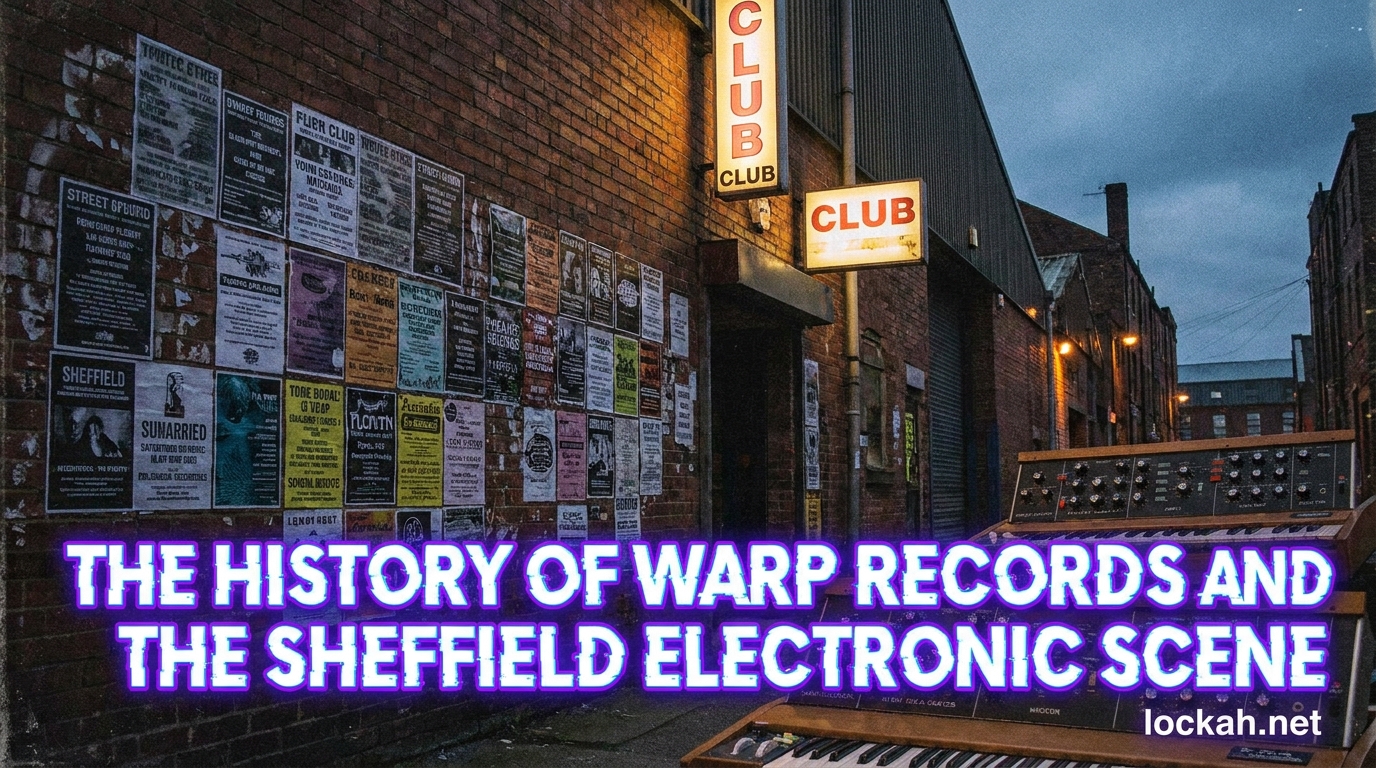
Walk down Division Street in Sheffield today, and you might miss the building that changed electronic music forever. In a back room above a record shop, three friends started something that would grow from a local curiosity into one of the most influential independent record labels in history. Warp Records was founded in Sheffield in 1989 by Steve Beckett, Rob Mitchell, and Robert Gordon. What began as a way to release music they loved became a movement that redefined how we think about electronic sound.
The story of Warp Records is inseparable from the history of Sheffield itself. This is not just a tale of a successful business. It is the story of a post-industrial city that found its voice through synthesizers and drum machines. It is the story of how three young men with no industry connections built a global platform for experimental artists. And it is the story of how Sheffield’s unique character shaped a sound that still echoes through electronic music 2026.
I have spent years exploring the connections between place and sound. The Warp story fascinates me because it shows how geography, community, and timing can create something that transcends its origins. This guide covers everything from the steel furnaces that provided the sonic backdrop to the purple sleeves that became instantly recognizable worldwide. You will learn about the early warehouse parties, the birth of bleep techno, the controversial Artificial Intelligence compilation, and how Warp continues to influence music today.
How Sheffield Became the Birthplace of British Electronic Music (2026)
Sheffield in the 1980s was a city in transition. The steel industry that had defined the city for generations was collapsing. Unemployment was high. The landscape was dominated by empty warehouses and abandoned factories. But within these spaces, something new was being born.
The connection between Sheffield and electronic music runs deeper than most people realize. The city’s industrial heritage provided both the physical spaces and the sonic environment for electronic experimentation. The rhythmic pounding of steel presses created a generation accustomed to mechanical rhythms. The vast empty warehouses became venues for illegal parties. The post-industrial wasteland became a playground for sonic pioneers.
Cabaret Voltaire emerged from this environment in the 1970s. Richard Kirk and Stephen Mallinder used tape loops, primitive synthesizers, and found sounds to create industrial soundscapes that reflected their surroundings. They were followed by the Human League, who proved that synthesizer pop could reach mainstream audiences while maintaining experimental credibility. These artists established Sheffield as a city where electronic music was taken seriously as an art form.
The warehouse party culture of the late 1980s cemented this reputation. As London’s club scene became commercialized, Sheffield’s empty industrial spaces attracted DJs and dancers seeking something rawer. These parties were not legal. They were not organized. They emerged from necessity and enthusiasm. Sound systems would appear in abandoned buildings. Word would spread through phone trees and whispered conversations. Thousands would gather to dance until dawn.
This environment created a specific Sheffield sound that would influence Warp’s early releases. The music was bass-heavy because warehouse acoustics demanded it. It was rhythmic because the industrial setting encouraged it. And it was forward-looking because the city’s past had been taken away, leaving only the future to build toward.
The FON Shop: Where Warp Records Was Born
Every great label needs a birthplace. For Warp, that place was FON, a record shop on Division Street that opened in 1987. FON stood for F**k Off Nazis, a name that announced the shop’s political stance before you even walked through the door. The shop became a gathering point for Sheffield’s electronic music community.
Steve Beckett and Rob Mitchell were working at FON when they met Robert Gordon. All three were obsessed with the emerging sounds of Detroit techno and Chicago house. They would play these records to customers who had never heard anything like them. The shop’s back room became a makeshift office where they plotted their first releases.
The FON shop atmosphere was crucial to Warp’s development. It was not a commercial enterprise in the traditional sense. It was a community hub where ideas could be tested. Customers became collaborators. Staff became artists. The boundary between consumer and creator dissolved in ways that would define Warp’s approach to label management.
Steve Beckett described the early days as chaotic and inspiring. The three founders had no business experience. They had no industry connections. What they had was passion and a clear sense of what was missing from the British music landscape. They wanted to release the kind of electronic music they loved, without compromise or commercial pressure.
The FON shop closed years ago, but its influence lives on in every Warp release. The ethos of community over commerce. The commitment to artistic vision over market trends. The belief that Sheffield could produce music as important as anything coming from London or Detroit. These values were forged in that back room on Division Street.
How Warp Records Founded in Sheffield Changed Electronic Music Forever
Warp Records officially launched in 1989 with a clear mission. The founders wanted to document and promote the electronic music emerging from Sheffield’s warehouse scene. They believed this music deserved the same respect given to traditional bands and songwriters. They were right, though it would take years for the wider world to agree.
The label’s Sheffield location was initially seen as a disadvantage. The British music industry was London-centric to an almost absurd degree. Major labels viewed northern cities as markets to be sold to, not sources of innovation to be cultivated. Warp turned this prejudice into an advantage. Being outside London meant being outside the industry’s expectations.
Steve Beckett became the public face of the label, handling distribution and promotion. Rob Mitchell focused on A&R, discovering and nurturing artists. Robert Gordon managed the business operations. This division of labor allowed each founder to focus on their strengths while maintaining collective decision-making.
Their independence was non-negotiable from day one. Major labels had shown interest in electronic dance music, but always with conditions. They wanted radio-friendly edits. They wanted vocal versions. They wanted to package the music in ways that made sense to existing marketing departments. Warp refused these compromises. They would release the music as the artists intended, or not at all.
This stance was financially risky. The first Warp releases sold in tiny quantities. Distribution was a constant struggle. Shops outside Sheffield often returned unsold stock. But the founders persisted, convinced that they were documenting something important. Their persistence paid off in ways they could not have predicted.
What Is Bleep Techno: Warp’s Early Sound
Bleep techno is a term that describes the specific electronic sound that emerged from Sheffield in the late 1980s. The name comes from the characteristic high-pitched synthesizer tones that defined the genre. These bleeps cut through warehouse sound systems with surgical precision. The sub-bass that accompanied them physically moved crowds in ways that traditional drums could not match.
Warp’s first release, Forgemasters’ “Track With No Name,” arrived in 1989. The single was recorded in a bedroom studio using a sampler and basic sequencing equipment. It cost almost nothing to produce. It sounded like the future. The track combined Detroit techno’s mechanical precision with Sheffield’s bass-heavy warehouse aesthetic. The result was something entirely new.
Nightmares on Wax followed with “Dextrous” and “Aftermath.” These releases established Warp as a label with a consistent vision. The artists were different, but the approach was unified. Each release pushed electronic music forward while remaining accessible to dance floor audiences. The bleep sound was experimental, but it was also functional. You could dance to it.
LFO’s self-titled single became the definitive bleep techno anthem. Released in 1990, it reached number 12 on the UK singles chart. For a tiny independent label from Sheffield, this was unprecedented success. LFO proved that Warp could compete commercially without compromising artistically. The single’s success brought international attention to the Sheffield scene.
The bleep era was relatively short-lived, lasting only a few years. But its influence was permanent. It established Warp as a label that could identify and nurture innovative electronic music. It proved that Sheffield could produce chart hits. And it created a template for how independent labels could operate in the electronic music space.
The Artificial Intelligence Compilation and the Birth of IDM
By 1992, Warp faced a choice. The bleep sound that had defined their early releases was becoming commercialized. Major labels were copying the formula. The warehouse scene was fragmenting. The founders needed to find a new direction that would maintain their commitment to innovation.
The Artificial Intelligence compilation provided that direction. Released in 1992, the compilation featured artists including Aphex Twin, Autechre, B12, and The Black Dog. The music was electronic, but it was not designed for dancing. It was headphone music. Home listening music. Music that demanded full attention and rewarded careful listening.
The term “intelligent dance music” or IDM appeared around this time. It was controversial from the start. Many artists rejected the implication that other dance music was unintelligent. Fans debated whether the term helped or hindered the music’s acceptance. But whatever you call it, the Artificial Intelligence compilation marked a turning point in electronic music history.
Aphex Twin’s “Polygon Window” track on the compilation introduced Richard D. James to a wider audience. His music combined melodic beauty with rhythmic complexity in ways that seemed impossible. Autechre contributed “The Egg,” demonstrating that electronic music could be abstract and emotional simultaneously. Every track on the compilation expanded the possibilities of what electronic music could be.
The compilation’s cover art showed an android smoking a cigarette in an armchair. This image perfectly captured the music’s intended context. This was not music for clubs or parties. It was music for contemplation. The Artificial Intelligence series would continue for years, establishing Warp as the primary home for experimental electronic listening music.
The IDM movement that emerged from this compilation influenced decades of electronic music production. Artists from Radiohead to Jon Hopkins have cited these records as formative influences. The idea that electronic music could be complex, emotional, and intellectually engaging became mainstream through Warp’s releases. The Sheffield label had changed the conversation about what electronic music could accomplish.
The Designers Republic and Warp’s Visual Identity
Music is only part of Warp’s legacy. The label’s visual identity, developed in collaboration with Sheffield design studio The Designers Republic, became equally influential. Ian Anderson and his team created a distinctive aesthetic that made Warp releases instantly recognizable.
The purple sleeve became a Warp trademark. The specific shade of purple varied between releases, but the commitment to bold color remained constant. Combined with futuristic typography and abstract graphics, the sleeves announced that something different was contained inside. You could identify a Warp release from across a record shop.
The Designers Republic’s work for Warp embodied an anti-establishment attitude. The designs mocked corporate aesthetics while maintaining professional quality. They referenced Japanese graphics, industrial signage, and rave culture in equal measure. Every sleeve was a statement of independence.
This visual consistency helped build Warp’s brand identity. While other independent labels came and went, Warp’s distinctive look created continuity across decades of releases. Collectors knew what to expect. New listeners had clear visual cues about the music’s character. The packaging became part of the artistic statement.
The collaboration between Warp and The Designers Republic lasted for years and produced hundreds of designs. The influence of this work extended far beyond music packaging. Graphic designers worldwide studied and referenced these sleeves. The visual language of electronic music was permanently shaped by this Sheffield partnership.
Warp Records Key Artists Who Defined the Sound
Warp’s success rests on the artists it has supported. While dozens of musicians have released records on the label, several stand out as particularly important to understanding Warp’s contribution to electronic music.
Aphex Twin: The Face of IDM
Richard D. James released his first music as Aphex Twin on Warp in 1992. Over the following decades, he became the most famous and controversial figure in electronic music. His Selected Ambient Works albums demonstrated that electronic music could achieve the emotional depth of any other genre. His later work pushed into territory that still challenges listeners decades later.
James’s relationship with Warp has been central to both parties’ success. The label gave him complete creative freedom, something he could not have found elsewhere. In return, he provided releases that consistently generated attention and sales. Albums like Richard D. James Album and Drukqs expanded the possibilities of electronic production.
His 2014 album Syro, released after a long silence, won the Grammy for Best Dance/Electronic Album. This recognition marked how far Warp and its artists had traveled from their underground origins. An artist who had started in bedroom studios in Cornwall was now winning major industry awards on a label from Sheffield.
Autechre: Abstract Electronic Pioneers
Sean Booth and Rob Brown have released music as Autechre on Warp since 1993. Their work represents the most abstract and challenging end of the Warp spectrum. Early albums like Incunabula and Tri Repetae established their signature sound of complex rhythms and alien textures. Later releases pushed further into digital experimentation.
Autechre’s music demands effort from listeners. It does not provide immediate gratification. It requires repeated listening and active engagement. This approach aligns perfectly with Warp’s commitment to treating electronic music as serious art. The label has supported Autechre through decades of increasingly abstract releases, demonstrating long-term commitment to artistic vision.
Their influence on electronic production techniques cannot be overstated. Producers worldwide have studied their methods for creating rhythmic complexity and textural depth. They proved that electronic music could sustain long-form exploration without becoming repetitive or boring. Their albums are still reference points for experimental producers 2026.
Boards of Canada: Scottish Ambient Masters
Michael Sandison and Marcus Eoin, the Scottish brothers who record as Boards of Canada, joined Warp in 1998. Their Music Has the Right to Children album became one of the most beloved electronic records ever released. The album combined nostalgic samples, warm analog synthesis, and melancholic melodies to create something genuinely moving.
Boards of Canada’s sound was different from other Warp artists. It was organic rather than mechanical. Emotional rather than cerebral. Accessible while remaining mysterious. Their success proved that Warp could support diverse approaches to electronic music without losing its identity. The label was not just about one specific sound.
Their subsequent releases, including Geogaddi and The Campfire Headphase, maintained their reputation for quality while exploring new emotional territory. The long gaps between their albums became part of their mythology. When they did release music, it felt like an event. Warp’s support for their slow, careful approach demonstrated the label’s patience and commitment to quality over quantity.
LFO and Nightmares on Wax: Bleep Era Legends
LFO’s Mark Bell, who passed away in 2014, created some of Warp’s most important early releases. The LFO single established Warp commercially. His subsequent albums advanced the bleep sound into new territory. He also produced for Bjork and other major artists, spreading Warp’s influence beyond the label’s direct releases.
Nightmares on Wax began as a bleep techno project but evolved into something more soulful. George Evelyn’s later work incorporated hip-hop, funk, and dub influences while maintaining Warp connections. His transition from dance floor production to laid-back albums showed how Warp artists could develop over time without being constrained by their early work.
Warp’s Expansion: Moving Beyond Sheffield
In 2000, Warp moved its headquarters from Sheffield to London. This decision was controversial among longtime fans who saw Sheffield as essential to the label’s identity. But the move was necessary for growth. London provided access to international distribution networks and media connections that Sheffield could not match.
The London move coincided with Warp’s expansion beyond pure electronic music. The label began releasing hip-hop through subsidiary Lex Records. They signed rock and pop artists who shared their commitment to innovation. Artists like Grizzly Bear, Battles, and Flying Lotus joined a roster that was increasingly diverse.
This expansion was risky. Many independent labels had lost their identity by chasing trends or diversifying too widely. Warp managed to maintain coherence through careful A&R and consistent visual presentation. Even when releasing guitar music or hip-hop, the Warp sensibility remained recognizable.
Warp Films was established in 2001 as a separate division focused on film production and distribution. The division produced Chris Morris’s Four Lions and other significant British films. This expansion into visual media demonstrated how Warp’s brand could extend beyond music while maintaining quality standards.
The label also pioneered digital distribution through their Bleep store. Launched in 2004, Bleep was one of the first digital music stores focused on independent electronic music. It offered DRM-free downloads years before major labels accepted this model. Warp’s commitment to artist-friendly business models extended into the digital age.
What Happened to Rob Mitchell and Warp’s Continuation in 2026?
Rob Mitchell passed away from cancer in 2001 at the age of 37. His death was a devastating blow to Warp and to the broader electronic music community. Mitchell had been the label’s primary A&R force, discovering many of its most important artists. His taste and vision had shaped Warp’s direction from the beginning.
Steve Beckett continued leading the label after Mitchell’s death. The transition was difficult, but the label survived and eventually thrived. Beckett maintained the commitment to artistic independence that he and Mitchell had established together. New artists joined the roster. Classic releases remained in print. The label continued.
The Rob Mitchell Foundation was established to support young people entering music. This effort to create something positive from tragedy reflected the community values that had driven Warp from the start. Mitchell’s legacy lives on in every Warp release that prioritizes artistic vision over commercial calculation.
Warp’s continuation after Mitchell’s death demonstrated the strength of the foundations the founders had built. The label was not dependent on any single person. Its values and processes could survive leadership changes. This institutional stability is rare in independent music and speaks to the seriousness with which the founders approached their work.
Warp Records Influence on Radiohead and Modern Electronic Music
Warp’s influence extends far beyond its direct releases. When Radiohead sought new directions after OK Computer, they turned to Warp. The connection between Warp artists and Radiohead’s Kid A and Amnesiac albums has been widely documented. Thom Yorke and Jonny Greenwood have cited Aphex Twin and Autechre as influences.
This cross-pollination worked both ways. Warp’s credibility increased through association with one of the world’s biggest rock bands. Electronic music gained respect from audiences who might otherwise have dismissed it. The boundaries between rock and electronic music blurred in ways that benefited both genres.
Contemporary electronic artists continue to reference Warp’s legacy. Producers working in ambient, techno, and experimental music still cite the classic Warp catalog as formative. The label proved that electronic music could sustain long artistic careers and develop complex discographies. This model influenced how subsequent generations approach electronic production.
Warp’s digital innovation through the Bleep store also influenced industry practices. Their early commitment to DRM-free music set standards that other labels eventually followed. Their direct-to-fan approaches provided models for independent artists seeking to maintain control over their work. The label was not just documenting electronic music history but helping to create its future.
Frequently Asked Questions About Warp Records and Sheffield
When was Warp Records founded and by whom?
Warp Records was founded in 1989 in Sheffield, England by Steve Beckett, Rob Mitchell, and Robert Gordon. The three founders met while working at the FON record shop on Division Street and started the label to release the electronic music they loved.
What is the connection between Sheffield and electronic music?
Sheffield’s industrial heritage provided the physical spaces and sonic environment for electronic music development. The city’s post-industrial warehouse spaces hosted illegal parties, while its steel industry background influenced the mechanical rhythms and bass-heavy sound of the local electronic scene. Artists like Cabaret Voltaire and the Human League established Sheffield’s electronic music reputation in the 1970s and 1980s.
What was the first release on Warp Records?
The first release on Warp Records was Forgemasters’ Track With No Name (WAP1) in 1989. It was recorded in a bedroom studio and combined Detroit techno influences with Sheffield’s warehouse sound aesthetic. This single established the bleep techno sound that defined Warp’s early releases.
How did Warp Records influence IDM (Intelligent Dance Music)?
Warp’s 1992 Artificial Intelligence compilation is credited with establishing IDM as a genre. The compilation featured artists like Aphex Twin, Autechre, and The Black Dog creating electronic music designed for home listening rather than dance floors. Warp continued releasing experimental electronic music that prioritized complexity and emotional depth, influencing decades of electronic production.
What happened to Rob Mitchell of Warp Records?
Rob Mitchell, one of Warp’s three founders and the label’s primary A&R force, passed away from cancer in 2001 at age 37. Steve Beckett continued leading the label after Mitchell’s death, maintaining their shared commitment to artistic independence. The Rob Mitchell Foundation was established to support young people entering music.
Conclusion: The History of Warp Records and the Sheffield Electronic Scene
The history of Warp Records demonstrates how three people with passion and vision can change culture. Steve Beckett, Rob Mitchell, and Robert Gordon started with nothing but enthusiasm and a record shop back room. They ended up creating one of the most important independent labels in music history.
Sheffield provided the context that made Warp possible. The city’s industrial heritage, warehouse spaces, and post-industrial energy created a unique environment for electronic experimentation. Without Sheffield, there might still have been electronic music. But there would not have been Warp’s specific contribution to how we understand and value that music.
From bleep techno to IDM, from purple sleeves to digital innovation, Warp has consistently demonstrated that independence matters. The label proved that electronic music deserves the same respect as any other art form. They showed that location is not destiny, that Sheffield can influence the world. Their work continues to resonate through electronic music in 2026 and beyond.
If you are discovering Warp for the first time, start anywhere. The early bleep singles still sound fresh. The Artificial Intelligence compilations remain mind-expanding. The recent releases prove the label continues to matter. Wherever you enter, you will find music made with care and vision, released by a label that has never stopped believing in the power of sound.