
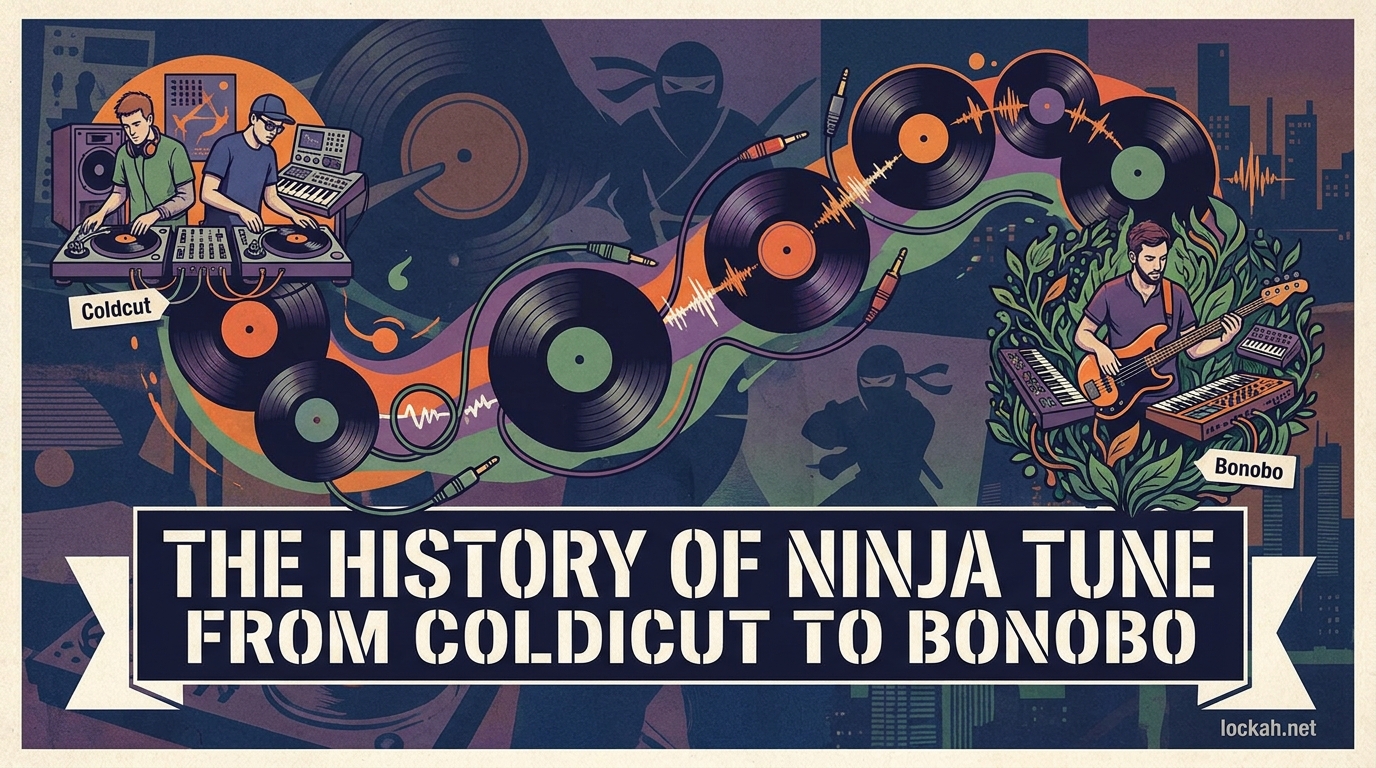
Ninja Tune stands as one of the most influential independent record labels in modern music history. Founded in London in 1990 by Matt Black and Jonathan More—better known as the pioneering DJ duo Coldcut—the label emerged from a simple desire: creative control. What began as an experimental outlet for sample-based instrumental hip hop has evolved into a global powerhouse, nurturing visionary artists from Bonobo to The Cinematic Orchestra while maintaining an unwavering commitment to artist-friendly practices.
I have spent years tracking the evolution of independent labels, and Ninja Tune’s story remains uniquely compelling. Unlike many indie labels that either fade away or sell their souls to major corporations, Ninja Tune has managed to scale its operations while preserving the founding ethos that made it special. The journey from Coldcut’s early white-label releases to Bonobo’s GRAMMY-nominated albums tells a story about artistic integrity, business innovation, and the enduring power of independent thinking.
Table of Contents
Coldcut Origins: The Meeting That Started Everything
Matt Black and Jonathan More first crossed paths in London’s vibrant rare-groove and hip-hop scene during the mid-1980s. Both were passionate collectors of vinyl records, spending countless hours digging through crates at specialist shops like Groove Records and searching for obscure breaks and samples. This shared obsession with sound and rhythm would eventually spark one of the most innovative partnerships in electronic music history.
The duo officially formed Coldcut in 1986, taking their name from an early hip-hop term for stealing or “cutting” breaks from existing records. Their approach was revolutionary for the time. While most dance music producers focused on creating tracks for clubs, Black and More approached production with the mindset of sonic architects. They treated samples as building blocks, constructing complex sonic landscapes that blurred the lines between hip hop, house, and experimental electronic music.
Their breakthrough came with the release of “Say Kids What Time Is It?” in 1987. The track became an instant underground anthem, showcasing Coldcut’s signature style of playful sampling and intricate beat construction. This was quickly followed by “Doctorin’ the House,” a collaboration with Yazz that reached number six on the UK Singles Chart. Suddenly, the crate-digging duo found themselves with a major label deal and commercial success.
However, success brought its own complications. Working with major labels taught Black and More harsh lessons about the music industry’s power dynamics. They experienced firsthand how corporate structures prioritized profit over artistry, often demanding creative compromises that diluted the vision behind their work. Major label executives pushed for more commercial sounds, radio-friendly edits, and faster release schedules that left little room for experimentation.
The frustration reached a breaking point during the promotion of their debut album. Coldcut found themselves fighting for basic creative decisions that should have been theirs by right. The experience planted a seed that would eventually grow into something revolutionary. Both Black and More began dreaming of an alternative—a label where artists retained control, where experimentation was celebrated rather than suppressed, and where the relationship between label and artist was genuinely collaborative.
Between 1987 and 1990, Coldcut continued releasing music while quietly formulating their escape plan. They developed a philosophy that would define their future venture: the “cottage industry” approach. This model emphasized keeping operations small, manageable, and artist-focused. Rather than building a corporate empire, they envisioned a tight-knit community of like-minded creators sharing resources and supporting each other’s artistic visions.
During this period, they also began developing the visual identity that would become synonymous with Ninja Tune. Black, who had studied at art school before diving into music, brought a strong design sensibility to the project. The early concepts for what would become the label’s iconic logo and aesthetic began taking shape—stealthy, mysterious, with a nod to both Japanese culture and the underground nature of their musical vision.
How to Start a Revolution: The Ninja Tune Story Begins
Ninja Tune officially launched in 1990, born from a fateful trip to Japan that gave the label both its name and its founding philosophy. Black and More traveled to Japan seeking inspiration and escape from the British music industry grind. While exploring Tokyo’s underground music scene, they discovered a culture that celebrated artistic integrity and independent thinking in ways that resonated deeply with their own values.
The name “Ninja Tune” came from this Japanese connection, combined with their love for stealthy, sample-based production techniques. Ninjas represented everything they admired: precision, independence, operating outside conventional systems, and achieving maximum impact with minimal resources. The label’s visual identity—featuring the iconic ninja logo—was designed to reflect these qualities, creating an instantly recognizable brand that stood apart from the glossy major label aesthetic.
The founding philosophy was refreshingly simple and radical for its time. Black and More committed to 50/50 profit splits with their artists, a stark contrast to the exploitative contracts common throughout the industry. They guaranteed creative control, meaning artists made the final decisions about their music, artwork, and presentation. They also rejected the traditional A&R model of telling artists what to create, instead focusing on finding unique voices and giving them the platform to develop organically.
This artist-friendly approach attracted exactly the kind of talent Ninja Tune needed to establish its identity. The early roster featured producers who shared Coldcut’s passion for sample-based production and instrumental hip hop. Acts like DJ Food, 9 Lazy 9, and Up, Bustle & Out became the label’s first wave, creating the sonic template that would define Ninja Tune’s early years: dusty breakbeats, jazzy samples, cinematic textures, and a distinctly British take on hip-hop culture.
The label’s first official release, Coldcut’s “House ’90” EP, set the tone for what would follow. Rather than chasing chart success, the release prioritized artistic vision and sonic innovation. The packaging was distinctive, featuring the bold graphic design that would become a Ninja Tune trademark. Physical releases were treated as artifacts, with attention to vinyl pressing quality, sleeve artwork, and overall presentation that made each record feel like a collector’s item.
Throughout the early 1990s, Ninja Tune operated as a true cottage industry. The office was essentially a room in Black’s house, with a small team handling everything from A&R to distribution. This hands-on approach meant the founders remained directly connected to every aspect of the business, from listening to demo tapes to packing orders for shipment. The intimacy of the operation allowed them to build genuine relationships with their artists, understanding their needs and supporting their development in ways that larger labels simply couldn’t match.
One of Ninja Tune’s most innovative early contributions was developing the concept of the “compilation album” as an artistic statement. Series like “Funkjazztical Tricknology” and the “Stealth” compilations weren’t just collections of tracks; they were curated experiences that introduced listeners to the label’s aesthetic while pushing the boundaries of what sample-based music could achieve. These compilations became essential listening for anyone interested in instrumental hip hop and trip hop, helping to build a global community of Ninja Tune enthusiasts.
The anti-corporate philosophy extended beyond business practices into every aspect of the label’s operation. Black and More rejected the traditional music industry playbook at every turn. They prioritized vinyl when CD was becoming dominant, championed album artwork when digital was taking over, and focused on long-term artist development rather than quick-hit singles. This stubborn commitment to their values earned them a reputation as mavericks—difficult to work with from a corporate perspective, but beloved by artists and fans who appreciated their integrity.
By the mid-1990s, Ninja Tune had established itself as a vital force in underground electronic music. The label’s releases were appearing in DJ crates from London to Tokyo to New York, with a particular stronghold in the emerging trip hop and downtempo scenes. Artists like The Herbaliser, Mr. Scruff, and Funki Porcini were creating defining works that would influence an entire generation of producers. The foundation was set for the explosive growth that would follow in the decades ahead.
How Ninja Tune Evolved Through the Decades in 2026?
The 1990s: Defining the Sound
The 1990s established Ninja Tune as the premier destination for sample-based instrumental hip hop and left-field electronic music. During this foundational decade, the label perfected its signature aesthetic: dusty vinyl samples, jazz-influenced harmonies, complex drum programming, and a distinctly British sensibility that distinguished it from American hip hop. The era saw the release of landmark albums that remain touchstones for the genre.
Coldcut’s own “Let Us Play!” (1997) demonstrated that the founders were more than just businessmen—they were visionary artists continuing to push their own creative boundaries. The album featured collaborations with diverse voices including Grandmaster Flash and herbalist/herbal visionary, blending hip hop heritage with forward-thinking production. DJ Food’s “Recipe for Disaster” (1995) became a blueprint for turntablism-as-composition, while 9 Lazy 9’s “Paradise Blown” (1994) brought live instrumentation into the sample-based framework.
The visual identity evolved alongside the music. The label’s sleeve designs, helmed by Black’s artistic direction, became collectible in their own right. Bold typography, ninja imagery, and distinctive color schemes made Ninja Tune releases instantly recognizable in record shops. This attention to visual presentation helped build the label’s cult following, with fans purchasing releases as much for the artwork as for the music contained within.
The 2000s: Expansion and Diversification
The new millennium brought significant changes to Ninja Tune’s scope and ambition. The label began diversifying its sound, moving beyond the instrumental hip hop template to embrace live instrumentation, electronic experimentation, and more song-based structures. This evolution was natural rather than forced—artists on the roster were growing as creators, and Ninja Tune supported their development rather than demanding they stick to established formulas.
The Cinematic Orchestra’s “Everyday” (2002) exemplified this expansion. Led by Jason Swinscoe, the project fused jazz, orchestral arrangements, and electronic production into something entirely new. The album featured vocals from Fontella Bass and Roots Manuva, demonstrating Ninja Tune’s growing confidence with collaborative, song-focused work. “All That You Give” and “All Things to All Men” became anthems that transcended the underground, reaching listeners who might never have engaged with instrumental hip hop.
Roots Manuva’s emergence as a major voice in British hip hop also defined this era. His debut “Brand New Second Hand” (1999) and follow-up “Run Come Save Me” (2001) brought a distinctly London perspective to rap music, with production that bridged Ninja Tune’s sample-based heritage with contemporary sounds. Tracks like “Witness (1 Hope)” became genuine hits, proving that independent labels could achieve commercial success without compromising artistic vision.
The 2000s also saw Ninja Tune expanding its operations internationally. What began as a bedroom operation had grown into a global enterprise with offices in London and Los Angeles. The label established distribution networks that reached record shops worldwide, while digital platforms were beginning to open new avenues for reaching listeners. Through all this growth, the core philosophy remained intact—artists still received 50/50 splits, creative control remained absolute, and the cottage industry ethos continued to guide decision-making.
The 2010s: GRAMMY Recognition and Global Reach
The 2010s represented Ninja Tune’s arrival as a major force in global music culture. The decade began with Bonobo’s “Black Sands” (2010), an album that would fundamentally reshape the label’s trajectory. Simon Green had already established himself with earlier releases, but “Black Sands” represented a quantum leap in ambition and execution. The album’s blend of electronic production, organic instrumentation, and world music influences created a sound that resonated with millions of listeners worldwide.
Bonobo’s subsequent albums built on this foundation. “The North Borders” (2013) and “Migration” (2017) both achieved widespread critical and commercial success, with the latter earning GRAMMY nominations and cementing Green’s status as one of electronic music’s most important voices. The live shows grew from club performances to arena spectacles, complete with full bands and stunning visual productions. Bonobo had become a global phenomenon, and Ninja Tune had proven it could nurture artists from underground beginnings to mainstream success while preserving their artistic integrity.
The decade also brought significant awards recognition across the roster. Young Fathers won the Mercury Prize in 2014 for “Dead,” a stunning achievement for an experimental hip hop group on an independent label. This victory validated everything Ninja Tune stood for—proof that challenging, boundary-pushing music could achieve institutional recognition without major label backing. The win generated headlines and momentum that benefited the entire label ecosystem.
Floating Points emerged as another defining artist of the era. Sam Shepherd’s “Elaenia” (2015) and “Crush” (2019) demonstrated the continued evolution of Ninja Tune’s sonic palette. Drawing from jazz, classical composition, and electronic production, Floating Points created music that challenged categorization while maintaining the label’s commitment to artistic excellence. His live performances—often featuring full orchestral arrangements—showcased the ambitious scope that Ninja Tune artists could achieve.
The 2010s also saw the label embracing streaming culture while maintaining its vinyl heritage. Ninja Tune releases regularly appeared on major playlist placements, introducing the label to younger listeners discovering music through Spotify and Apple Music. At the same time, the label continued pressing high-quality vinyl editions, often with elaborate packaging that appealed to collectors. This dual approach—embracing digital reach while preserving physical culture—became a model for independent labels navigating the streaming era.
The 2020s: Concord Acquisition and Continued Innovation
The 2020s opened with significant developments for Ninja Tune’s business structure and continued creative evolution. In March 2026, Concord—the world’s leading independent music company—announced its acquisition of Ninja Tune. This partnership provided the label with expanded resources and global infrastructure while explicitly preserving its independent ethos and artist-first philosophy. The founders emphasized that Concord understood and respected what made Ninja Tune special, promising that the partnership would enhance rather than dilute the label’s identity.
Artistically, the decade has continued Ninja Tune’s tradition of nurturing innovative voices. Bicep’s “Isles” (2021) brought the Belfast duo’s electronic mastery to the label, while ODESZA’s arrival via the Foreign Family Collective partnership demonstrated Ninja Tune’s continued relevance in the American electronic scene. The roster has grown more diverse than ever, spanning genres from ambient to experimental pop to avant-garde jazz while maintaining the cohesive artistic vision that has always defined the label.
Environmental and social initiatives have also become central to Ninja Tune’s identity in this era. The label has committed to carbon-neutral operations, exploring sustainable vinyl pressing methods, and supporting social justice causes. This evolution reflects the founders’ understanding that independence means more than just business autonomy—it encompasses responsibility to communities and the planet. Artists have embraced these values, participating in benefit releases and awareness campaigns that extend Ninja Tune’s impact beyond music.
The Artists Who Defined Ninja Tune
Roots Manuva and the British Hip Hop Revolution
Rodney Smith, operating under the name Roots Manuva, stands as one of Ninja Tune’s most important signings and a defining voice in British hip hop history. His arrival at the label in the late 1990s brought a perspective that was distinctly London—grounded in UK soundsystem culture, Jamaican heritage, and urban British experience. Unlike American rappers who dominated global hip hop conversation, Roots Manuva offered something entirely different.
His debut album “Brand New Second Hand” (1999) introduced listeners to a flow that was unmistakably British, delivered over production that bridged Ninja Tune’s sample-based aesthetic with contemporary sounds. But it was “Run Come Save Me” (2001) that truly broke through. “Witness (1 Hope)” became an anthem, its bass-heavy production and iconic opening line—”Witness the fitness!”—making it a staple of clubs, radio, and festivals. The track demonstrated that British hip hop could achieve commercial success without mimicking American templates.
The Cinematic Orchestra and Nu Jazz Excellence
Jason Swinscoe’s The Cinematic Orchestra represents Ninja Tune’s expansion into live instrumentation and jazz-influenced composition. Beginning as a studio project that incorporated samples and electronic production, the group evolved into a full live ensemble featuring some of London’s finest jazz musicians. Their albums “Motion” (1999), “Everyday” (2002), and “Ma Fleur” (2007) created a template for what would become known as “nu jazz”—a fusion of traditional jazz musicianship with contemporary production techniques.
The Cinematic Orchestra’s live performances became legendary, transforming studio compositions into improvisational journeys that could stretch to twenty minutes or more. Their work on film soundtracks, including the acclaimed score for “The Crimson Wing: Mystery of the Flamingos,” demonstrated the cinematic scope that their name promised. The group’s continued association with Ninja Tune across multiple decades stands as testament to the label’s ability to maintain long-term artist relationships.
Bonobo: From Tru Thoughts to Ninja Tune Superstar
Simon Green’s journey to becoming Bonobo is one of the most compelling artist development stories in modern electronic music. He began releasing music in the early 2000s on Brighton-based label Tru Thoughts, establishing himself as a skilled producer of downtempo and instrumental hip hop. His early albums “Animal Magic” (2000) and “Dial ‘M’ for Monkey” (2003) showed immense promise, but it was his move to Ninja Tune that would catalyze his transformation from promising newcomer to global superstar.
The transition from Tru Thoughts to Ninja Tune in the late 2000s marked a significant shift in Green’s artistic trajectory. While Tru Thoughts provided an excellent foundation for his early work, Ninja Tune offered the infrastructure and resources to support more ambitious creative visions. The label’s global reach and established reputation helped introduce Bonobo to wider audiences, while their artist-friendly approach gave Green the freedom to evolve his sound without commercial pressure.
“Black Sands” (2010) was the breakthrough. The album represented a quantum leap in sophistication, incorporating live instrumentation, world music influences, and song structures that transcended the downtempo tag. Tracks like “Kiara” and “Kong” became staples of the emerging “electronic music as experience” culture, where audiences sought emotional depth and sonic beauty rather than just dancefloor utility. The album’s success established Bonobo as one of the most important voices in electronic music.
“The North Borders” (2013) and “Migration” (2017) continued this upward trajectory. Both albums received GRAMMY nominations, with “Migration” earning nods for Best Dance/Electronic Album. The live shows evolved from solo DJ sets to full band performances featuring vocalists, multiple instrumentalists, and stunning visual productions. By the late 2010s, Bonobo was selling out venues like the Sydney Opera House and the Hollywood Bowl—achievements that would have seemed impossible for an artist on an independent label just a decade earlier.
What makes Bonobo’s story particularly significant for Ninja Tune is how it demonstrates the label’s ability to nurture long-term growth. Over fifteen years and multiple albums, Green has consistently evolved while maintaining the artistic integrity that defined his early work. The label has supported every phase of this evolution—from intimate club performances to arena shows, from sample-based production to full orchestral arrangements. This commitment to artist development over quick returns encapsulates everything that makes Ninja Tune special.
The Modern Roster: Floating Points, Bicep, and Beyond
Ninja Tune’s current roster represents perhaps its most diverse and accomplished lineup yet. Floating Points—Sam Shepherd’s project—has pushed the label into avant-garde territory that blends classical composition, jazz improvisation, and electronic production. His albums “Elaenia” and “Crush” have received widespread critical acclaim, with live performances that often feature full orchestral arrangements.
Bicep brought a different energy when they joined the label, their “Isles” album demonstrating the kind of emotional electronic music that has become Ninja Tune’s signature. The Belfast duo’s mastery of synth-driven melodic house found a perfect home alongside the label’s more experimental releases. Their live shows have become legendary, combining classic hardware with modern production to create experiences that bridge underground credibility with mainstream appeal.
Young Fathers represent another crucial voice in the modern Ninja Tune story. The Edinburgh trio’s experimental approach to hip hop and pop earned them the 2014 Mercury Prize for “Dead,” a stunning achievement for such challenging music. Their subsequent releases “White Men Are Black Men Too” and “Heavy Heavy” have continued to push boundaries, demonstrating that Ninja Tune remains committed to difficult, important art even as its commercial profile grows.
The label has also embraced international voices like Jayda G, whose house music carries the warmth and emotional depth that Ninja Tune values, and Little Dragon, the Swedish group whose blend of electronic and organic elements fits perfectly within the label’s aesthetic world. These diverse voices demonstrate that Ninja Tune’s vision extends far beyond any single genre while maintaining the cohesive artistic values that have always defined the label.
The Ninja Tune Family: Imprints and Partnerships
Big Dada: Hip Hop’s Independent Voice
Big Dada emerged in 1997 as Ninja Tune’s dedicated hip hop imprint, created to provide a focused home for rap music within the broader Ninja ecosystem. While the parent label had always embraced hip hop influences, Big Dada allowed for a more concentrated approach to the genre, signing artists who brought diverse perspectives to British and international rap music.
The imprint has been home to some of the most innovative voices in alternative hip hop. Roots Manuva released his most important work through Big Dada, while artists like Wiley, Diplo, and MF DOOM have all passed through the label’s roster. More recently, Big Dada has embraced the global nature of contemporary hip hop, signing artists from Africa, Asia, and beyond who bring fresh perspectives to the genre.
Brainfeeder: The Flying Lotus Connection
Ninja Tune’s partnership with Brainfeeder, the label founded by Flying Lotus (Steven Ellison), represents one of the most significant alliances in modern electronic music. Brainfeeder brought a distinctly Los Angeles perspective—warped beats, jazz influences, and psychedelic experimentation—that complemented Ninja Tune’s London roots perfectly. The partnership gave Ninja Tune access to a new generation of American artists including Thundercat, Kamasi Washington, and The Gaslamp Killer.
This collaboration demonstrated Ninja Tune’s understanding that independence doesn’t mean isolation. By partnering with like-minded labels, they expanded their reach while maintaining their core values. Brainfeeder’s artists brought GRAMMY recognition and critical acclaim, further validating the partnership model as a way for independent labels to compete in an increasingly consolidated industry.
Counter Records and Technicolour
Counter Records was established to nurture the more indie and alternative sides of Ninja Tune’s expanding taste. The imprint has released music from artists like ODESZA, who brought a more pop-oriented electronic sound to the label family, and various indie rock and alternative projects that might not fit the main Ninja Tune aesthetic but share the label’s commitment to artistic quality.
Technicolour focuses specifically on club-oriented electronic music, providing a home for dancefloor-focused releases from artists like Floating Points, Bicep, and various techno and house producers. This division allows Ninja Tune to engage with DJ culture and club music while maintaining the more album-oriented approach of the main label.
Foreign Family Collective
The partnership with Foreign Family Collective, founded by ODESZA, extends Ninja Tune’s reach into the American electronic scene. This collaboration has brought artists like Jai Wolf, Kasbo, and various Foreign Family affiliates into the Ninja Tune ecosystem. The partnership represents a strategic expansion that maintains the label’s values while embracing new communities and sounds.
Ninja Tune Today: Awards, Recognition, and the Concord Era
Ninja Tune’s transition into the Concord family in 2026 marked a significant milestone in the label’s evolution while maintaining its foundational ethos. The acquisition by Concord—the world’s leading independent music company—provided Ninja Tune with expanded global infrastructure and resources while explicitly preserving the artist-friendly philosophy that has defined the label since 1990. Black and More emphasized that Concord understood what made Ninja Tune special, and the partnership was structured to enhance rather than dilute the label’s identity.
The label’s recent GRAMMY recognition tells the story of its artistic credibility. Bonobo’s nominations for Best Dance/Electronic Album, recognition for Floating Points and Thundercat through the Brainfeeder partnership, and various technical nominations demonstrate that Ninja Tune releases are judged by the industry’s highest standards. These accolades validate the decades of work that went into building the label’s reputation.
Beyond the GRAMMYs, Ninja Tune has accumulated an impressive collection of industry recognition. The Mercury Prize win for Young Fathers stands as perhaps the most significant achievement, given the award’s reputation for artistic excellence over commercial success. Multiple AIM Independent Music Awards, DJ Magazine recognitions, and various genre-specific honors have cemented the label’s status as one of the most respected operations in the industry.
Environmental initiatives have become a central focus for Ninja Tune in recent years. The label has committed to carbon-neutral operations, exploring sustainable vinyl pressing methods, and implementing eco-friendly practices throughout their supply chain. This commitment reflects an understanding that independence encompasses responsibility—to artists, to communities, and to the planet. Physical releases now often include information about sustainable manufacturing processes, and the label has supported environmental causes through benefit releases and awareness campaigns.
The vinyl revival has played directly into Ninja Tune’s strengths. As one of the few labels that never abandoned vinyl culture, they were perfectly positioned when consumer interest in physical formats rebounded. Limited edition pressings, elaborate packaging, and collectible releases have become increasingly important revenue streams. The label’s commitment to vinyl quality—heavyweight pressings, careful mastering, beautiful artwork—has earned them a devoted collector following that supports the business even as streaming dominates consumption patterns.
Looking at Ninja Tune in 2026, what strikes me most is the consistency of vision across more than three decades. From the cottage industry beginnings in Matt Black’s house to the global operation under Concord, the core values remain intact. Artists still receive fair deals. Creative control remains absolute. The music continues to challenge and inspire. The journey from Coldcut’s sample-based experiments to Bonobo’s arena-filling spectacles tells a story about what’s possible when artistic integrity meets smart business practices.
Frequently Asked Questions
What is the history of Ninja Tune?
Ninja Tune is a legendary independent record label founded in London in 1990 by Matt Black and Jonathan More, collectively known as Coldcut. Born from a desire for creative control after frustrating major label experiences, the label evolved from an experimental outlet for sample-based instrumental hip hop into one of the world’s most respected independent labels. Over three decades, Ninja Tune has nurtured visionary artists from Bonobo to The Cinematic Orchestra while maintaining an unwavering commitment to artist-friendly 50/50 deals and creative freedom. In March 2026, the label was acquired by Concord while preserving its independent ethos.
Who founded Ninja Tune?
Ninja Tune was founded in 1990 by Matt Black and Jonathan More, the British DJ duo known as Coldcut. The pair met through London’s rare-groove and hip-hop scene in the mid-1980s, bonding over their shared passion for vinyl collecting and sample-based production. After achieving commercial success with hits like Doctorin’ the House but experiencing frustration with major label practices, they created Ninja Tune as an artist-friendly alternative based on principles of creative control and fair profit sharing.
Who owns Ninja Tune now?
As of March 2026, Ninja Tune is owned by Concord, the world’s leading independent music company. The acquisition provided Ninja Tune with expanded global infrastructure and resources while explicitly preserving the label’s independent ethos, artist-first philosophy, and founding values. Founders Matt Black and Jonathan More emphasized that Concord understands and respects what makes Ninja Tune special, and the partnership was structured to enhance rather than dilute the label’s unique identity and artist relationships.
What are some of Ninja Tune’s most famous albums?
Notable Ninja Tune albums include Bonobo’s Black Sands, The North Borders, and Migration (the latter two earning GRAMMY nominations); The Cinematic Orchestra’s Everyday and Ma Fleur; Floating Points’ Elaenia and Crush; Bicep’s Isles; Roots Manuva’s Run Come Save Me featuring the iconic track Witness (1 Hope); and Young Fathers’ Dead, which won the 2014 Mercury Prize. Other essential releases include Coldcut’s Let Us Play!, DJ Food’s Recipe for Disaster, and various compilations from the Stealth and Funkjazztical Tricknology series.
The Enduring Legacy of Ninja Tune
The history of Ninja Tune from Coldcut to Bonobo is more than just a story about a record label. It is a testament to what happens when artistic vision meets principled business practices. From Matt Black and Jonathan More’s frustrated experiences with major labels in the 1980s to the global operation they have built in 2026, Ninja Tune has demonstrated that independence and success are not mutually exclusive.
What makes this story particularly compelling is the consistency of values across more than three decades. The 50/50 profit splits, the absolute creative control, the cottage industry ethos—these principles defined Ninja Tune in 1990 and continue to define it today under Concord’s ownership. While the scale has changed dramatically, from bedroom operations to global distribution networks, the soul of the label remains intact.
The cultural impact extends far beyond the label’s own releases. Ninja Tune helped define trip hop, nu jazz, and instrumental hip hop as viable genres. They proved that British hip hop could find its own voice rather than mimicking American templates. They demonstrated that electronic music could achieve both critical credibility and commercial success without compromising artistic vision. Every independent label working today operates in a landscape that Ninja Tune helped create.
From the early sample-based experiments of Coldcut to the arena-filling spectacles of Bonobo, the journey has been remarkable. Artists like Roots Manuva, The Cinematic Orchestra, Floating Points, and Young Fathers have created defining works that will influence music for generations. The imprints—Big Dada, Brainfeeder, Counter, Technicolour—have extended Ninja Tune’s reach into new communities and sounds while maintaining the core values that make the parent label special.
As I look at where Ninja Tune stands in 2026, with GRAMMY nominations, Mercury Prize wins, and a partnership with one of the world’s largest independent music companies, I see an operation that has achieved everything its founders dreamed of while refusing to become what they feared. The history of Ninja Tune from Coldcut to Bonobo is ultimately a story about integrity—about proving that you can build something significant without selling out, that commercial success and artistic vision can coexist, and that the music industry can operate on principles of fairness and respect. That is a legacy worth celebrating.