
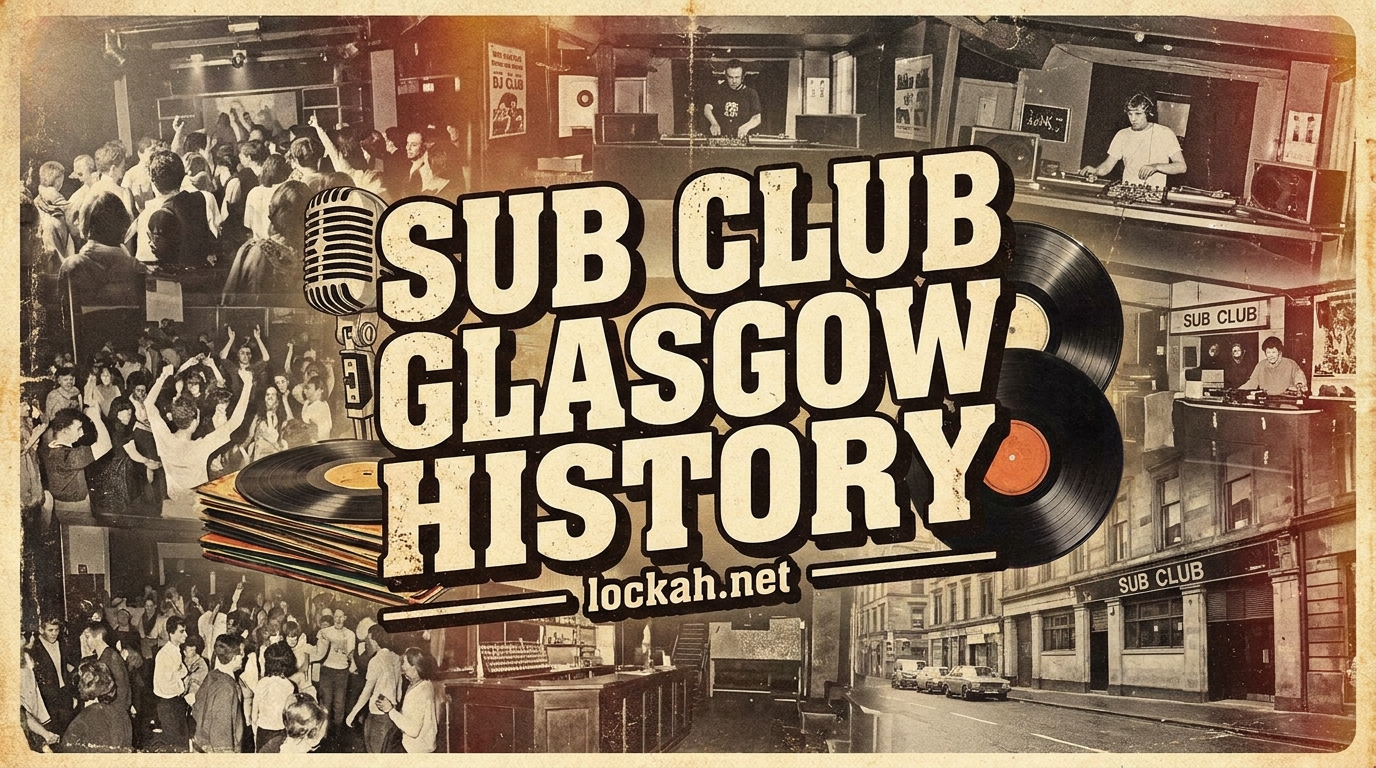
The Sub Club is a legendary underground nightclub located at 22 Jamaica Street in Glasgow, Scotland, opened on 1 April 1987 and recognized as the world’s longest-running underground dance club. Nestled in a 3,500 square foot basement beneath the city centre, this intimate 410-capacity venue has shaped UK dance music culture for nearly four decades through its pioneering sound system, legendary resident nights, and unwavering commitment to underground electronic music.
I first descended those stairs on a cold Saturday night in 2019. The queue stretched around the corner onto Argyle Street, but nobody seemed to mind. You could feel the bass through the pavement before you even reached the door. That is the Sub Club experience in a nutshell: tactile, intimate, and completely unlike the cavernous superclubs that dominated the 90s and 2000s.
What you will learn in this guide: the complete Sub Club Glasgow history from its 1960s speakeasy roots through the Lucifers era to 2026, why its sound system matters more than capacity, how a Saturday night residency has lasted 30+ years, and most importantly, why this basement venue on Jamaica Street remains fundamental to understanding UK dance music culture.
Founding and Origins: From Lucifers to Sub Club (2026)
The story begins long before 1987. The basement at 22 Jamaica Street was part of Glasgow’s 1960s speakeasy jazz circuit, hosting illicit drinking dens and live music during a time when Scottish nightlife operated under strict licensing laws. This subterranean history matters because it established the location as a place for underground culture decades before electronic music arrived.
In the late 1970s and early 1980s, the venue operated as Lucifers, a post-punk and alternative club that drew Glasgow’s counterculture crowd. Lucifers developed a reputation for leftfield music and a devoted following who would later form the core of Sub Club’s early audience. When Lucifers closed, that community did not disappear. They simply waited for something new to emerge.
On 1 April 1987, Mike and Vicky Fleming opened Sub Club. The name was deliberate: “Sub” referenced both the sub-bass frequencies that would define the club’s musical identity and its subterranean location. The Flemings had a vision for a dedicated space for house and electronic music at a time when Glasgow’s mainstream clubs were still playing chart hits and pop.
The Jamaica Street location is significant. Situated at the edge of Glasgow’s city centre, close to Central Station but away from the main shopping district, it was accessible yet discreet. The basement entrance created natural exclusivity. You had to know where to look. There was no flashy signage or velvet rope. Just a doorway, a staircase, and the promise of something different below ground level.
The Sound System: What Makes It Special?
Any discussion of Sub Club Glasgow history must address the sound system. In 2002, following the fire and reopening, the club commissioned Dave Parry of Martin Audio to design a custom installation that would maximise the basement’s natural acoustics. The result became legendary.
The centrepiece is the Bodysonic dancefloor, installed in 2006. This is not marketing hyperbole. The floor is engineered to transmit sub-bass frequencies directly into your body through tactile transducers. You feel the music physically. Standing on that dancefloor during a peak-time set, the bass does not just enter your ears. It resonates through your chest, your legs, your entire frame.
The Martin Audio system handles frequencies that would overwhelm most venues. The low ceiling, approximately 2.5 metres, creates acoustic pressure that amplifies the impact. Some regulars describe it as overwhelming at first. You learn to stand in specific spots. You discover where the sound hits hardest. It becomes part of the ritual.
This focus on audio quality over visual spectacle defines Sub Club’s approach. There are no LED walls, no elaborate lighting rigs, no VIP booths with bottle service. The money goes into speakers, amplifiers, and the dancefloor itself. For house and techno, where bass weight and clarity matter more than pyrotechnics, this prioritisation is exactly right.
Key Residents and Legendary Nights
If the sound system is Sub Club’s technical foundation, its residencies are its cultural heartbeat. The club’s commitment to long-term resident DJs is virtually unique in UK nightlife, where most venues rotate bookings constantly to chase trends.
Subculture: The World’s Longest-Running Weekly House Night
In 1994, Sub Club launched Subculture on Saturday nights. Harri and Domenic were given the residency, and they have held it ever since. That is over 30 years of continuous Saturday nights, making Subculture the world’s longest-running weekly house and techno night.
Harri had already been playing at the club since 1985, during the Lucifers era. Domenic joined in 1992. Their partnership defined the Subculture sound: deep, dubby house with techno edges, patient builds, and a refusal to chase chart trends. They have witnessed entire genres rise and fall while maintaining their own musical identity.
The BBC documented this legacy in 2026, noting how Harri and Domenic’s commitment to new music discovery has kept Subculture relevant across three decades. Harri’s son, Jasper James, has since become a respected DJ in his own right, creating a multi-generational legacy rare in electronic music.
Optimo Espacio: Sunday Nights 1997-2010
Before it became a global touring brand and record label, Optimo was simply “Espacio” on Sunday nights at Sub Club. JD Twitch and Jonnie Wilkes launched the night in 1997, and for the first 18 months, it struggled to find an audience.
Their musical policy was deliberately eclectic: krautrock, disco, post-punk, industrial, and early electro mixed with house and techno. In an era when most clubs segregated genres rigidly, Optimo refused boundaries. Eventually, the crowd caught up. By the early 2000s, Optimo was attracting a devoted following that would queue around the block on Sunday evenings.
The residency lasted until 2010, when Twitch and Wilkes ended the weekly format to focus on their label and festival appearances. Optimo’s influence on UK club culture cannot be overstated. They proved that eclecticism could work on dancefloors, and they nurtured a generation of Scottish electronic artists including Hudson Mohawke, who worked behind the bar at Sub Club during this period.
Atlantis and Slam: The 1990s Foundation
Before Subculture and Optimo, there was Atlantis. Running from 1990 to 1994, Atlantis was Sub Club’s flagship house night and the platform through which Slam (Stuart McMillan and Orde Meikle) developed their sound and reputation. The duo would go on to found Soma Quality Recordings, one of the UK’s most influential techno labels.
Atlantis bridged the gap between the Stone Roses-influenced baggy era and the emergence of pure electronic club culture in Scotland. The Stone Roses even played Sub Club during this period, before their mainstream breakthrough. Primal Scream performed their first-ever gig at the venue.
Historical Milestones and Challenges
Sub Club Glasgow history is not just about musical achievements. The venue has survived fires, pandemics, and changing nightlife economics that have closed countless other clubs.
The Fire and Three-Year Closure (1999-2002)
In 1999, disaster struck. A fire damaged the club severely, forcing closure for what would become three years. For most venues, this would have been terminal. The Glasgow nightlife landscape was shifting. New clubs opened. Trends changed. The Sub Club could have easily become a memory.
Instead, the community kept the spirit alive. Harri and Domenic continued playing elsewhere. The regulars stayed connected. When Sub Club finally reopened in 2002 with its upgraded Martin Audio system, the crowd returned immediately. The closure had not killed the club. It had strengthened the bond between venue, residents, and community.
The 20th Anniversary and Beyond
In 2007, Sub Club celebrated its 20th anniversary with a series of events featuring Roy Ayers, Karl Bartos (of Kraftwerk), and the Sugar Hill Gang. These bookings demonstrated the club’s range and respect within the broader music industry. It was not just a local Glasgow institution. It was a venue that could attract genuine legends.
COVID-19 and the Save Our Sub Campaign
When the COVID-19 pandemic forced UK nightlife to close in 2020, Sub Club faced its greatest challenge since the fire. Without trading income, the venue launched the Save Our Sub campaign, raising funds through donations, merchandise, and a documentary film to cover operating costs during lockdown.
The response demonstrated the community’s depth. Regulars who had been attending for decades contributed. Artists who had played the venue offered support. The club survived, reopening when restrictions lifted to queues that stretched down Jamaica Street. Mike Grieve, who had taken over ownership from the Flemings, used his position to advocate for Scottish nightlife through the Night Time Industries Association (NTIA), campaigning for government support for venues across the country.
The Cultural Significance of Sub Club Glasgow
What makes Sub Club truly special is not captured in specifications or dates. It is the atmosphere: the low ceiling, the intermittent smoke machine, the educated crowd, the sense that everyone present shares something.
As one regular described it on TripAdvisor: “Great venue, low ceiling, low lighting, good sound, intermittent smoke machine and educated crowd all made for a fantastic night.” This is not marketing copy. It is a genuine description of what you experience when you walk down those stairs.
A Family Atmosphere
Multiple generations of the same families have attended Sub Club. Parents who came in the 1990s now bring their adult children. Staff members have become resident DJs. Stevie Cox went from working behind the bar to playing regularly. Telford progressed from general manager to DJ. The boundaries between crowd, staff, and performers blur in ways that corporate venues cannot replicate.
JD Twitch of Optimo described the club as having “a family feeling.” This is not accidental. The long-term residencies create continuity. The same faces appear week after week. Relationships form. The crowd becomes a community rather than a collection of consumers.
Scotland’s Electronic Music Reputation
Author Irvine Welsh captured Sub Club’s importance in a quote often cited by the venue: it challenges the perception that Scotland just does “Highland fling” on weekends. Glasgow’s electronic music culture, centred on Sub Club, proved that Scottish nightlife could be as forward-thinking as anything in London or Manchester.
This matters because regional scenes often get overshadowed by the capital. Sub Club demonstrated that world-class electronic music culture could exist outside London, and that a local venue could achieve international recognition while maintaining its underground ethos.
Why Sub Club Matters to UK Dance Music?
To understand why Sub Club Glasgow history matters to UK dance music as a whole, you need to look beyond Glasgow city limits. The UK has produced several legendary clubbing cities: Manchester’s Haçienda era, Sheffield’s bleep techno and Warp Records, London’s endless venues and pirate radio culture. Glasgow’s contribution, centred on Sub Club, belongs in this conversation.
Recognition and Rankings
In 2008, Resident Advisor ranked Sub Club the 10th best club in the world. DJ Mag placed it 30th in their equivalent poll. These rankings matter because they reflected international recognition of what the club had achieved. It was not merely a good Scottish venue. It was acknowledged globally as one of the essential clubs on Earth.
The club has hosted legendary artists who shaped electronic music: Derrick May, Jeff Mills, LCD Soundsystem, Franz Ferdinand, Richie Hawtin, and countless others. Many of these acts played Sub Club early in their careers, before they became household names. The venue has always operated as a curator, booking talent that would shape the future rather than simply following trends.
The Underground Alternative
Sub Club represents something increasingly rare: a genuinely underground venue that survived the superclub era. While Ministry of Sound and Cream expanded into corporate brands, while Fabric faced license battles and reopenings, Sub Club remained what it always was. A basement. A sound system. A crowd who cared.
The club’s 410-person capacity is part of this identity. You cannot mass-market an experience that intimate. You cannot sell it to thousands of tourists. You have to be there, in that basement, feeling that bass. This scarcity preserves something that larger venues lose: the sense that you are part of a specific moment that cannot be replicated or commodified.
Influence on Scottish Electronic Artists
Sub Club has directly influenced generations of Scottish electronic musicians. Slam’s Soma label emerged from their Atlantis residency. Hudson Mohawke developed his ear working behind the bar during Optimo nights. Jasper James grew up in the DJ booth watching his father. Numbers, LuckyMe, and other Glasgow labels all have connections to the club’s ecosystem.
This influence extends beyond Scotland. The “Glasgow sound” associated with these artists has shaped electronic music globally. And that sound was developed, tested, and refined in the Sub Club basement, on that Bodysonic dancefloor, through those Martin Audio speakers.
Frequently Asked Questions
What is Sub Club Glasgow?
The Sub Club is a legendary underground nightclub located at 22 Jamaica Street in Glasgow, Scotland. Opened in 1987, it holds the distinction of being the world’s longest-running underground dance club. The venue occupies a 3,500 square foot basement with a capacity of 410 people and is famous for its Martin Audio sound system and Bodysonic dancefloor that transmits bass frequencies directly into dancers’ bodies.
What music does Sub Club play?
Sub Club primarily plays house and techno music. The legendary Saturday night residency Subculture, hosted by Harri and Domenic since 1994, focuses on deep, dubby house with techno influences. The club has also hosted eclectic nights like Optimo Espacio (1997-2010), which blended post-punk, disco, krautrock, and industrial with electronic music. Guest DJs span the full spectrum of underground dance music.
What did Sub Club used to be called?
Before becoming Sub Club in 1987, the venue operated as Lucifers, a post-punk and alternative club popular in the late 1970s and early 1980s. Before Lucifers, the basement at 22 Jamaica Street was part of Glasgow’s 1960s speakeasy jazz circuit, hosting underground drinking dens and live music during an era of strict Scottish licensing laws.
Is there a dress code for Sub Club Glasgow?
Sub Club does not enforce a strict dress code. The venue maintains an underground, unpretentious atmosphere where the focus is on music rather than appearance. Regulars typically wear whatever they feel comfortable dancing in. The club’s ethos prioritises the experience over fashion, though standard nightclub entry policies apply regarding footwear and sportswear at the door staff’s discretion.
How many people does Sub Club Glasgow hold?
Sub Club Glasgow has a legal capacity of 410 people. The venue occupies a 3,500 square foot basement space beneath 22 Jamaica Street. This intimate capacity is part of what makes the club special, creating an atmosphere that larger venues cannot replicate. The low ceiling and compact dancefloor contribute to the club’s famous acoustic pressure and intimate energy.
Conclusion: Why Sub Club Glasgow History Still Matters in 2026
Sub Club Glasgow history is the history of UK dance music in microcosm. From its 1960s speakeasy origins through the Lucifers era, from the 1987 founding through the fire and reopening, from Subculture’s 30-year residency through COVID survival, the club has demonstrated what underground dance culture can achieve when it prioritises community over commerce.
In an era of streaming playlists and algorithmic recommendations, Sub Club offers something irreplaceable: a physical space where sound, crowd, and atmosphere combine into something you cannot download or replicate. The Bodysonic dancefloor must be felt. The low ceiling acoustics must be experienced. The community must be joined in person.
If you care about UK dance music, you should visit Sub Club at least once. Descend those stairs at 22 Jamaica Street. Feel why this basement matters. Understand why, after nearly four decades, the world’s longest-running underground dance club continues to define what club culture can be.