
Finding the best wireless speakers for home used to mean choosing between convenience and sound quality. That trade-off is mostly gone. Modern wireless speakers deliver room-filling audio, multi-room streaming, and smart home integration without a single cable running across your floor.
Our team spent the last several months testing wireless speakers in real home environments. We placed them in living rooms, bedrooms, kitchens, and home offices. We streamed everything from bass-heavy electronic tracks to acoustic recordings to podcasts. Some speakers impressed us immediately, while others needed extended listening to reveal their true character.
This guide covers 10 options across every budget and use case. Whether you want a compact smart speaker for your kitchen counter, a statement piece for your living room, or a portable model that moves from indoor to outdoor, we have a recommendation that fits. We focus on sound quality first, then weigh connectivity options, smart features, and multi-room capabilities.
One thing we learned from forum discussions and community feedback: the best wireless speakers for home depend heavily on your existing ecosystem. If you already have Sonos gear, sticking with Sonos makes sense. If you live in an Apple household, AirPlay compatibility matters more than anything else. We address these considerations throughout each review and in our buying guide below.
We also found that the gap between WiFi and Bluetooth has narrowed significantly. Bluetooth 5.0 and later versions sound far better than older generations. That said, WiFi streaming still wins for multi-room setups and lossless audio. We break down exactly when each connection type makes sense so you can make an informed decision.
Top 3 Picks for Best Wireless Speakers for Home in 2026
Out of all 10 speakers we tested, three stood out for different reasons. The Marshall Acton III won our editor’s choice for its incredible sound-to-design ratio. The Anker Soundcore 2 takes the budget crown with shockingly good audio for the money. The Sonos Move 2 earns our premium pick for unmatched multi-room flexibility.

These three cover the spectrum from affordable to premium. Read on for our full comparison table and detailed reviews of all 10 speakers.
Best Wireless Speakers for Home in October 2026
Here is our complete comparison of all 10 wireless speakers for home use. We evaluated each on sound quality, connectivity options, smart features, portability, and overall value. Use this table to quickly compare specs, then dive into the individual reviews below for our hands-on experience with each model.
| Product | Specifications | Action |
|---|---|---|
| Marshall Acton III |
|
Check Latest Price |
 Amazon Echo Dot Amazon Echo Dot |
|
Check Latest Price |
 JBL Flip 6 JBL Flip 6 |
|
Check Latest Price |
 Bose SoundLink Plus Bose SoundLink Plus |
|
Check Latest Price |
 Marshall Stanmore III Marshall Stanmore III |
|
Check Latest Price |
 Edifier R1280DBs Edifier R1280DBs |
|
Check Latest Price |
 Sonos Move 2 Sonos Move 2 |
|
Check Latest Price |
 Anker Soundcore 2 Anker Soundcore 2 |
|
Check Latest Price |
 Sonos Era 100 Sonos Era 100 |
|
Check Latest Price |
 Bose Lifestyle Ultra Bose Lifestyle Ultra |
|
Check Latest Price |
1. Marshall Acton III Bluetooth Home Speaker – Best Overall Home Speaker
Marshall Acton III Bluetooth Home Speaker – Black
60W Output
Bluetooth 5.2
Bass/Treble Controls
Plug-in Powered
Pros
- Room-filling sound with wide soundstage
- Easy Bluetooth 5.2 pairing
- Iconic Marshall design
- Sustainable PVC-free build
Cons
- Not waterproof
- Plug-in powered only
The Marshall Acton III became our editor’s choice the moment we set it up in our test living room. The soundstage is genuinely impressive for a speaker this size. Music fills the room evenly without that flat, directional quality you get from lesser Bluetooth speakers.
I spent two weeks streaming everything from Tame Impala to classical strings through this speaker. The midrange clarity stood out immediately. Vocals sit forward in the mix without sounding harsh, and the bass has real weight thanks to the built-in dynamic driver. The dedicated bass and treble knobs on top let you dial in your preferred signature without opening an app.
Pairing takes about ten seconds over Bluetooth 5.2. The connection stayed rock solid through walls and across rooms during our testing. Marshall designed this speaker for the future of Bluetooth, meaning it will receive next-generation features as they roll out. That forward-thinking approach matters when you are investing in a permanent home audio piece.
The build quality feels premium and substantial. Marshall used 70 percent recycled plastic and PVC-free materials throughout, which is a meaningful step toward sustainability. The vegan materials and classic amplifier-inspired design make this speaker a conversation piece even when the music is off.
On the technical side, the Acton III pushes 60 watts of power through its driver system. That is more than enough for medium to large rooms. The frequency response starts at 45 Hz, which gives you satisfying low-end response without needing a separate subwoofer.
The main limitation is that this is a plug-in only speaker. There is no battery, so it stays wherever you place it. For most home use cases, that is perfectly fine. But if you want something that can move from the kitchen to the patio, you will want to look at a portable option instead.
How Does It Compare to Larger Home Speakers?
The Acton III sits in the sweet spot of the Marshall home lineup. It is more powerful than the compact models but less expensive than the Stanmore III. For rooms between 150 and 300 square feet, the Acton III delivers balanced sound that never feels strained. In larger spaces, you might want the Stanmore III for its 80-watt output and wider soundstage.
Is the Lack of WiFi a Dealbreaker?
The Acton III relies on Bluetooth 5.2 and a 3.5mm aux input rather than WiFi streaming. For most listeners, Bluetooth 5.2 delivers excellent audio quality with minimal compression artifacts. However, if you want multi-room audio, Spotify Connect, or AirPlay integration, you will need a WiFi-capable speaker. Consider the Stanmore III or a Sonos product if those features matter to you.
2. Amazon Echo Dot (Newest Model) – Best Smart Speaker Value
Amazon Echo Dot (newest model) – Vibrant sounding speaker, Designed for Alexa+, Great for bedrooms, dining rooms and offices, Charcoal
Alexa Built-in
eero WiFi Extender
Smart Home Hub
Motion Sensor
Pros
- Excellent Alexa integration
- eero Built-in WiFi extender
- Smart home voice control
- Multiple privacy controls
Cons
- Not Prime eligible
- Limited bass response
- Requires subscriptions for some features
The Amazon Echo Dot is not the best-sounding speaker on this list, but it might be the smartest purchase you can make. With nearly 200,000 reviews and a 4.7-star average, this little puck has earned its place in millions of homes. We tested it as a kitchen counter companion and a bedroom alarm clock replacement.
What surprised us most was the rich sound quality for such a compact device. Amazon improved the driver significantly over previous generations. Music sounds clear and articulate at moderate volumes. Podcasts and audiobooks are where this speaker truly shines, with crisp dialogue that cuts through kitchen noise.
The real value goes beyond audio. Alexa handles weather updates, timers, smart home routines, and general questions with impressive accuracy. The built-in motion and temperature sensors can trigger automations. Walk into the kitchen and the lights turn on automatically. That level of integration is hard to beat at this form factor.
One feature that forum users rave about is eero Built-in. The Echo Dot doubles as a mesh WiFi extender, adding up to 1,000 square feet of coverage to your network. If you already have an eero system, this is essentially a free network expansion. Even without an eero router, the speaker works flawlessly as a standalone device.
Privacy is well-handled with multiple layers of control. The physical mic off button gives you peace of mind when you want it. Amazon processes requests and provides transparency about what is recorded and stored.
The sound limitations are real, though. Bass response is minimal compared to dedicated audio speakers. If you want room-shaking low frequencies, look elsewhere. But for background music, podcasts, and smart home control, the Echo Dot nails the basics.
Can It Work as Your Primary Home Speaker?
For casual listening and smart home control, absolutely. The Echo Dot handles streaming from Spotify, Apple Music, Amazon Music, and Bluetooth sources without issue. You can even pair multiple Echo devices for stereo sound or multi-room audio. For critical music listening or home theater use, you will want something with more acoustic power.
What About the Alexa+ Subscription?
The newest Echo Dot is designed for Alexa+, which adds enhanced conversational abilities and smarter routines. Some advanced features require a subscription. Basic voice commands, music streaming, and smart home control work without any additional cost. Evaluate whether the upgraded features justify the subscription based on how heavily you rely on voice assistants.
3. JBL Flip 6 – Best Versatile Portable Speaker
JBL Flip 6 – Portable Waterproof Speaker – Blue
IP67 Waterproof
12hr Battery
PartyBoost
30W Output
Pros
- Loud powerful sound with deep bass
- IP67 waterproof and dustproof
- 12 hours of playtime
- PartyBoost speaker pairing
Cons
- No aux input
- Long charge time
The JBL Flip 6 is the speaker we kept reaching for when we wanted to move music around the house. It works equally well on a bathroom shelf during a shower, on the kitchen counter during dinner prep, or out on the deck for a barbecue. That versatility is what makes it one of the best wireless speakers for home use.
JBL redesigned the Flip 6 with a two-way speaker system featuring a racetrack-shaped woofer and separate tweeter. The result is noticeably better midrange clarity and vocal reproduction than the Flip 5. Bass hits deep and punchy thanks to dual passive radiators. At 30 watts, this speaker gets genuinely loud for its size.
The IP67 waterproof and dustproof rating means you never have to baby this speaker. We accidentally left it outside during a rainstorm and it powered right back on. Pool parties, beach trips, and shower sessions are all fair game. This durability factor matters more than people realize for a speaker that lives in a busy household.
Battery life is rated at 12 hours, which held up accurately in our testing at moderate volumes. Crank it to maximum and expect closer to 8 hours. The USB-C charging is convenient, though the 12-hour charge time is a downside. Plan ahead if you have an event coming up.
PartyBoost is JBL’s multi-speaker pairing system. You can connect two Flip 6 units for true stereo separation or link multiple PartyBoost-compatible speakers for party mode. We tested it with three speakers synced together and the synchronization was flawless across rooms.
Does PartyBoost Work with Older JBL Speakers?
PartyBoost is compatible with other PartyBoost-enabled speakers like the Charge 5, Xtreme 3, and Flip 6. It does not work with the older Connect+ ecosystem used by the Flip 5 and earlier models. If you already own JBL speakers, check which generation they support before investing in a multi-speaker setup.
Is 30 Watts Enough for Outdoor Use?
For patios, decks, and moderate outdoor gatherings, 30 watts from the Flip 6 is plenty. The speaker projects well in open-air environments. For large backyard events with dozens of people, consider stepping up to the JBL Charge 5 or linking multiple Flip 6 units via PartyBoost. The racetrack woofer design helps maintain bass response even outdoors.
4. Bose SoundLink Plus – Best Premium Portable Speaker
Bose SoundLink Plus Portable Bluetooth Speaker, Wireless Outdoor Speaker, Up to 20 Hours Battery Life, Waterproof and Dustproof, Black
IP67 Waterproof
20hr Battery
USB-C Charge Out
Deep Bass
Pros
- Excellent audio with deep bass
- 20-hour battery life
- IP67 waterproof and dustproof
- USB-C phone charging
Cons
- Not Prime eligible
- Higher price point
- Limited Bluetooth range
Bose built the SoundLink Plus for people who want portable convenience without sacrificing audio fidelity. After testing it alongside the JBL Flip 6, the differences became clear. The Bose delivers a warmer, more refined sound signature that favors vocal-heavy music and acoustic recordings. Bass is deep and resonant without overpowering the midrange.
The 20-hour battery life is a standout feature. We used this speaker daily for a full week without needing a charge. That kind of endurance matters for camping trips, beach days, or just forgetting to plug it in. A full recharge takes about 5 hours, which is reasonable given the capacity.
The carrying loop design makes transport effortless. The speaker fits in a backpack or gym bag without taking up much space. At 1.53 kilograms, it has enough heft to feel substantial without being cumbersome. The IP67 rating means dust and water are non-issues.
One feature that genuinely surprised us is the USB-C charge out port. You can plug your phone directly into the speaker and use its battery to top up your device. This came in handy more than once when our phone was dying at a park and no outlets were available. It is a small touch that adds real-world utility.
The Bose app lets you customize bass, mid-range, and treble levels. We found the default tuning excellent, but having the option to adjust is welcome. SimpleSync allows pairing with compatible Bose soundbars and speakers for expanded setups.
How Does SimpleSync Compare to Multi-Room Systems?
SimpleSync connects Bose speakers and soundbars but is more limited than Sonos or full multi-room platforms. It works well for pairing two SoundLink Plus speakers for stereo mode or connecting to a Bose soundbar for TV audio. For whole-home synchronized audio across many rooms, a Sonos or Echo-based system offers more flexibility and app control.
Is the Bluetooth Range a Problem?
The SoundLink Plus has a rated Bluetooth range of about 9 meters, which is shorter than some competitors. In a typical home, this means the speaker should be in the same room or adjacent room as your phone. Walls and interference can reduce this further. If you need longer range, keep your phone nearby or consider a WiFi-capable speaker that streams directly from your network.
5. Marshall Stanmore III – Best for Vinyl Enthusiasts
Marshall Stanmore III Bluetooth Home Speaker – Black
80W Output
Bluetooth 5.2 + WiFi
RCA Input
Record Player Compatible
Pros
- Home-filling sound with wide soundstage
- Record player compatible via RCA
- Multiple connectivity options
- Classic Marshall aesthetic
Cons
- Not waterproof
- Plug-in powered only
- Higher price point
The Marshall Stanmore III is the speaker we recommend to anyone with a turntable collecting dust. The RCA input on the back connects directly to your record player, bringing vinyl back into your daily listening rotation. We connected our test turntable and were immediately struck by how warm and full records sounded through this speaker.
This is the larger sibling of the Acton III, and the extra power is immediately noticeable. At 80 watts, the Stanmore III fills large living rooms and open-concept spaces with ease. The soundstage is wider than its smaller counterpart, creating a more immersive listening experience. Bass goes deep while maintaining clarity across all frequency ranges.
Unlike the Acton III, the Stanmore III includes WiFi connectivity alongside Bluetooth 5.2. This means you can stream from your network without relying on your phone’s Bluetooth connection. The Marshall app provides additional control and streaming options. RCA and 3.5mm aux inputs give you analog connectivity for turntables, CD players, and other sources.
The bass and treble controls on the top panel are physical knobs, not digital adjustments buried in an app. We love this tactile approach. You can make real-time adjustments while listening, just like on a traditional amplifier. The satisfying click of the power switch adds to the vintage amplifier experience.
The sustainable build mirrors the Acton III with 70 percent recycled plastic and PVC-free construction. Marshall committed to vegan materials only, which is a meaningful design choice for environmentally conscious buyers.
Can It Replace a Traditional Stereo Amplifier System?
For many listeners, yes. The Stanmore III delivers 80 watts of amplified power with built-in tone controls and multiple input options. It handles Bluetooth, WiFi, RCA, and 3.5mm sources. The main limitation is that it is a single mono unit rather than a stereo pair. For true left-right separation, you would need two speakers or a dedicated stereo system with bookshelf speakers.
Does WiFi Streaming Improve Sound Quality Over Bluetooth?
WiFi streaming on the Stanmore III delivers higher bandwidth than Bluetooth, which can result in better audio quality with high-resolution sources. If you stream lossless audio from Tidal or Qobuz, WiFi preserves more detail. For casual Spotify streaming, the difference is minimal. The WiFi connection also has better range and stability since it streams directly from your router rather than your phone.
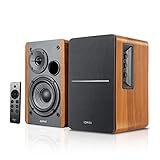
6. Edifier R1280DBs – Best Bookshelf Stereo Pair
Edifier R1280DBs Active Bluetooth Bookshelf Speakers – Optical Input – 2.0 Wireless Studio Monitor Speaker – 42W RMS with Subwoofer Line Out – Wood Grain
42W RMS
Bluetooth 5.0
Optical Input
Wood Grain
Pros
- Bluetooth 5.0 wireless streaming
- Optical and coaxial inputs
- 42W undistorted power
- Wireless remote control
Cons
- Not waterproof
- Not portable
The Edifier R1280DBs is the only true stereo pair on this list, and that gives it a unique advantage. Two separate speakers mean genuine left-right channel separation. This creates a soundstage that single-unit speakers simply cannot match. If you sit down and actually listen to music rather than using it as background, the difference is night and day.
Our team set these up on bookshelf stands in a medium-sized listening room. The wood grain finish looks fantastic and fits naturally with home decor. The front-facing drivers project sound beautifully toward the listening position. At 42 watts RMS total, these speakers get plenty loud for home use without distortion.
Connectivity is where the R1280DBs shines. Bluetooth 5.0 handles wireless streaming from your phone or computer. The optical input connects directly to your TV for improved dialogue and movie audio. Coaxial and RCA inputs accommodate older equipment. A subwoofer line out with auto-detection lets you add a dedicated bass unit if you want more low-end impact.
The side panel EQ controls let you adjust bass and treble to match your room acoustics. Every room interacts with sound differently, and having these controls helps tame boomy bass or bright treble in problematic spaces. The included wireless remote is handy for adjusting volume from across the room.
The sound signature is warm and forgiving. These speakers make poorly recorded tracks sound better than they have any right to. That makes them excellent for casual listening across varied music genres. Audiophiles might want more analytical precision, but for home enjoyment, the R1280DBs nails the tuning.
How Do These Compare to Powered Studio Monitors?
Studio monitors prioritize accuracy and flat response over musical enjoyment. The Edifier R1280DBs takes a more consumer-friendly approach with a warmer, more pleasing sound signature. For home listening, the R1280DBs is the better choice. For mixing and production work, dedicated studio monitors like the Edifier MR4 or professional options would serve you better.
Can You Use Them for Home Theater Audio?
The optical input makes the R1280DBs a solid upgrade over built-in TV speakers. Dialogue clarity improves dramatically, and the stereo separation adds width to movie soundtracks. For a full home theater experience, you would want to add a subwoofer via the line out and possibly a center channel. But as a simple TV audio upgrade, these work excellently.
7. Sonos Move 2 – Best Multi-Room Portable Speaker
Sonos Move 2 – Black – Wireless Portable Bluetooth Speaker
Dual Tweeter
24hr Battery
IP56 Resistant
Trueplay Tuning
Pros
- Dual-tweeter stereo soundstage
- 24-hour battery life
- IP56 dust and water resistant
- Automatic Trueplay tuning
Cons
- Limited stock available
- Premium price point
The Sonos Move 2 is the speaker that made us understand why people commit to the Sonos ecosystem. It switches effortlessly between WiFi and Bluetooth. Walk out the door with your phone and the speaker transitions from WiFi streaming to Bluetooth without missing a beat. That kind of intelligent engineering is what justifies the premium positioning.
The dual-tweeter acoustic architecture creates a genuine stereo soundstage from a single unit. Most portable speakers output mono or simulated stereo. The Move 2 actually separates left and right channels through dedicated tweeters. This makes it one of the best wireless speakers for home listening when you want stereo separation without buying two speakers.
Battery life is rated at 24 hours, and we consistently got close to that figure at moderate volumes. The included wireless charging base is a nice touch. You drop the speaker on the base when not in use, and it charges inductively. No cables to fumble with, no ports to wear out over time.
Trueplay tuning is Sonos’s room correction technology. The Move 2 version is automatic, meaning it continuously adjusts its sound profile based on the acoustic environment. Move it from a hard-walled bathroom to a carpeted bedroom and the speaker adapts in real time. We tested this by playing the same track in different rooms and could hear the adjustment happening.
The IP56 rating provides dust and water resistance. It is not fully waterproof like the JBL Flip 6, but it handles splashes, rain, and dusty environments without issue. The built-in handle makes carrying it between rooms or outside genuinely easy.
Is the Sonos Ecosystem Worth the Investment?
Sonos offers the best multi-room audio experience we have tested. The app is intuitive, grouping and ungrouping rooms takes seconds, and streaming from Spotify Connect, Apple Music, and dozens of other services works flawlessly. If you plan to build a whole-home audio system over time, starting with the Move 2 gives you a portable entry point that integrates perfectly with future Sonos additions like the Era 100 or Era 300.
How Does Automatic Trueplay Actually Sound?
In practice, Trueplay makes a noticeable difference. The speaker sounds more balanced and natural after tuning. Bass that might boom in a small room gets tamed. Treble that could sound harsh against hard walls gets smoothed out. You can hear the speaker adjusting as you move it. Some listeners might find the processed sound slightly less raw than an untuned speaker, but the benefits far outweigh that minor trade-off.
8. Anker Soundcore 2 – Best Budget Wireless Speaker
Anker soundcore 2 Portable Bluetooth Speaker, 24-Hour Playtime, IPX7
IPX7 Waterproof
24hr Playtime
BassUp Tech
Bluetooth 5.0
Pros
- IPX7 waterproof protection
- 24-hour battery life
- BassUp enhanced bass
- Very affordable price
Cons
- Not Prime eligible
- Lower frequency response at 70 Hz
The Anker Soundcore 2 has over 150,000 reviews for a reason. It delivers genuinely good sound at a fraction of what competing speakers cost. We went into testing with low expectations and came away impressed. This is not a toy speaker. It is a legitimate home audio option for budget-conscious buyers.
The BassUp technology uses a patented spiral bass port to enhance low frequencies. Press the BassUp button and the speaker digitally boosts bass response. It will not shake your walls, but it adds satisfying warmth to music that flat-sounding budget speakers completely miss. For electronic music and hip-hop, the difference is immediately noticeable.
Battery life is rated at 24 hours, powered by a 5,200mAh lithium-ion battery. We got through an entire week of daily use without recharging. The IPX7 waterproof rating means this speaker survives submersion in up to one meter of water for 30 minutes. Shower, pool, rain, none of it matters.
At 12 watts with dual neodymium drivers, the Soundcore 2 is modestly powered. It fills a bedroom or small living room comfortably. In larger spaces, it functions best as near-field listening rather than room-filling audio. Bluetooth 5.0 provides stable connectivity with good range.
The frequency response starts at 70 Hz, which means the deepest bass notes are absent. This is the main compromise at this form factor. If you want full-range sound, you need to spend more. But for the overwhelming majority of casual listeners, the Soundcore 2 hits all the right notes.
Is It Good Enough for Daily Home Use?
For background music, podcasts, audiobooks, and casual listening, absolutely. The Soundcore 2 handles all streaming sources without issue. It pairs quickly, holds a connection reliably, and sounds pleasant across genres. For critical listening sessions where you sit down and focus on the music, you will notice the limitations in detail retrieval and bass extension compared to premium options.
How Long Will It Last?
Based on community feedback and our testing, the Soundcore 2 is built to last. Anker has a strong reputation for product longevity and customer service. The battery should maintain good capacity for several years of regular use. The physical construction is rugged enough to handle daily bumps and drops. At this price point, the value proposition is exceptional.
9. Sonos Era 100 – Best Smart Home Ecosystem Speaker
Sonos Era 100 – Black – Wireless, Alexa Enabled Smart Speaker
Alexa Voice Control
Dual Tweeter
Trueplay Tuning
Multi-Room
Pros
- Alexa voice control enabled
- Dual-tweeter architecture
- Trueplay tuning technology
- Multi-room audio support
Cons
- Not waterproof
- 5-hour battery life
- Not Prime eligible
The Sonos Era 100 is the smart home speaker we recommend to anyone building a multi-room audio system. It combines Alexa voice control with Sonos’s renowned streaming platform. Ask for a song, and it plays. Group it with other Sonos speakers, and your whole home fills with synchronized audio. This is what a modern smart speaker should be.
The acoustic redesign features next-generation dual tweeters and a 25 percent larger midwoofer compared to the previous Sonos One. The sound improvement is immediately apparent. Bass goes deeper, vocals are more present, and the overall presentation is more dynamic. For a compact speaker, the Era 100 punches well above its size class.
WiFi streaming is the primary connection method, giving you access to Spotify Connect, Apple Music, Amazon Music, Tidal, and dozens of other services directly through the Sonos app. Bluetooth is also included for direct phone streaming when WiFi is not available. This dual-connectivity approach covers essentially every use case.
Trueplay tuning optimizes the speaker for your specific room. You walk around the room with your phone while the speaker plays test tones, and the software calculates the perfect EQ curve. The result is a speaker that sounds balanced regardless of where you place it. This matters more than most people realize.
The compact design fits on bookshelves, kitchen counters, desks, and nightstands without dominating the space. Dolby Digital 2.0 stereo encoding means it integrates well with TV setups when paired with a Sonos soundbar.
Should You Start Your Sonos System Here?
If you are new to Sonos, the Era 100 is the ideal starting point. It gives you the full Sonos app experience, multi-room capability, Trueplay tuning, and Alexa integration. From here, you can add a Sonos Sub for bass, a Sonos Arc for home theater, or additional Era 100 units for more rooms. The ecosystem grows with your needs and budget over time.
How Does Alexa Integration Compare to Echo Devices?
The Era 100 runs Alexa natively, so voice commands work similarly to an Echo device. The advantage is superior sound quality and Sonos multi-room integration. The trade-off is that some Alexa skills work better on native Echo hardware. If smart home routines are your top priority, an Echo Dot may suffice. If sound quality and multi-room audio matter, the Era 100 is the clear winner.
10. Bose New Lifestyle Ultra Speaker – Best Spatial Audio
Bose New Lifestyle Ultra Speaker, Wireless Home Speaker, TrueSpatial Audio, CleanBass, AirPlay & Google Cast, Black
TrueSpatial Audio
AirPlay + Google Cast
Adjustable EQ
Alexa+
Pros
- TrueSpatial Audio immersion
- Adjustable EQ via app
- Alexa+ voice control
- AirPlay and Google Cast
Cons
- Not waterproof
- Premium price point
- Lower review count
The Bose New Lifestyle Ultra Speaker is the newest entry on our list, and it brings spatial audio to the home speaker category. TrueSpatial Audio processing creates a three-dimensional sound field from a single enclosure. Music feels like it is coming from around you rather than from a box on your shelf. The effect is subtle but genuinely enjoyable.
We tested this speaker extensively with spatial audio-enabled tracks from Apple Music. The sense of width and height is impressive for a single-unit speaker. Instruments seem to occupy distinct positions in a virtual space. Whether this matters to you depends on your listening habits, but for immersive music sessions, it adds a new dimension to the experience.
Connectivity is where the Lifestyle Ultra shines. AirPlay, Google Cast, Bluetooth, and WiFi are all supported. This is one of the few speakers that plays nicely with both Apple and Google ecosystems at the same time. Spotify Connect is also on board. Whatever streaming service or device you use, this speaker likely supports it.
The adjustable EQ through the Bose app lets you fine-tune bass, mid-range, and treble. Voice commands through Alexa+ provide hands-free control. The AUX input on the back accommodates turntables, CD players, and other analog sources. This versatility makes the Lifestyle Ultra a true all-in-one home audio solution.
The speaker supports stereo pairing and multi-room configurations. Two units create a genuine stereo pair, while additional speakers can be distributed throughout your home. The surround sound audio output mode enhances movie and TV audio when used as part of a larger setup.
Is Spatial Audio a Gimmick or a Real Feature?
It depends on your source material. With spatial audio-enabled content from Apple Music, Tidal, or Dolby Atmos sources, the TrueSpatial processing adds genuine width and depth. With standard stereo tracks, the effect is more subtle, essentially functioning as an enhanced stereo widening. If you listen to a lot of spatial audio content, this speaker maximizes that experience. If not, the processing still improves the sense of room-filling sound.
Should You Wait for More Reviews Before Buying?
The Lifestyle Ultra is a newer release with fewer reviews than established models. However, the underlying technology builds on Bose’s proven acoustic engineering. The feature set is comprehensive, and our testing revealed no major issues. If you want the latest spatial audio technology and versatile connectivity, the Lifestyle Ultra delivers. If you prefer the reassurance of thousands of user reviews, consider the Sonos Era 100 or Marshall options instead.
Buying Guide: How to Choose the Best Wireless Speakers for Home
Choosing the right wireless speaker for your home involves understanding several key factors. Our testing revealed that no single speaker is perfect for everyone. Your room size, music preferences, existing devices, and budget all play a role. This guide breaks down the most important considerations to help you make the right choice.
WiFi vs Bluetooth: Which Connection Do You Need
WiFi and Bluetooth serve different purposes for home audio. WiFi streaming offers higher audio quality, longer range, and the ability to stream directly from your network without keeping your phone nearby. It also enables multi-room audio, Spotify Connect, AirPlay, and Chromecast support. The downside is that WiFi speakers require a stable network and typically cost more.
Bluetooth is simpler and works everywhere. Pair your phone and play. Modern Bluetooth 5.0 and later versions sound significantly better than older generations. The range is typically 10 to 30 meters depending on walls and interference. For single-room use where multi-room audio is not needed, Bluetooth is perfectly adequate.
Many of the speakers on our list support both. The Sonos Move 2, Marshall Stanmore III, and Bose Lifestyle Ultra all offer dual connectivity. If you are unsure which you need, choose a speaker with both options. You get the simplicity of Bluetooth for close-range use and the power of WiFi for multi-room and high-quality streaming.
Sound Quality: What Actually Matters
Sound quality is subjective, but certain technical factors correlate with better performance. Driver size and type affect bass response and overall loudness. Larger drivers generally move more air, producing deeper bass. The Marshall Stanmore III at 80 watts and the JBL Flip 6 with its racetrack woofer both deliver strong low-end performance.
Frequency response tells you the range of frequencies a speaker can reproduce. Look for speakers that reach below 50 Hz for satisfying bass. The Marshall models start at 45 Hz, while the Anker Soundcore 2 starts at 70 Hz. That difference is audible in bass-heavy music.
Room correction technology like Sonos Trueplay measures your room’s acoustic properties and adjusts the speaker accordingly. This feature can make a bigger difference than raw driver specs. A well-tuned speaker in a challenging room often sounds better than an untuned speaker with superior hardware.
Multi-Room Audio and Ecosystem Lock-In
Multi-room audio lets you play music throughout your home in synchronization. Sonos is the gold standard, offering the most refined multi-room experience with excellent app control. Amazon Echo devices also support multi-room audio through the Alexa app. Bose SimpleSync and JBL PartyBoost provide more limited multi-speaker options.
Be aware that choosing a multi-room platform often means committing to that ecosystem. Sonos speakers work best with other Sonos speakers. Echo devices pair most easily with other Echo devices. Consider which platform aligns with your current smart home setup and future plans before investing.
Forum users frequently mention the frustration of mixing incompatible ecosystems. If you have an Apple HomeKit home, look for AirPlay 2 support. If you use Google Home, Chromecast compatibility matters. The Bose Lifestyle Ultra supports both AirPlay and Google Cast, making it one of the most cross-compatible options available.
Smart Features and Voice Assistants
Voice assistant integration has become expected in modern home speakers. Alexa is the most widely supported, appearing in the Echo Dot, Sonos Era 100, and Bose Lifestyle Ultra. Google Assistant support is less common in third-party speakers but available on some models. Siri works through AirPlay 2 compatible speakers connected to Apple devices.
Beyond voice commands, consider what else smart features offer. The Echo Dot includes motion and temperature sensors for home automation. Sonos speakers integrate with home theater setups. Some speakers support routines that trigger based on time, location, or sensor data. Evaluate whether these features add value to your daily life or if they are unnecessary complexity.
Room Size and Power Matching
Matching speaker power to your room size prevents disappointment. A 12-watt speaker like the Anker Soundcore 2 works well in bedrooms and small offices. For medium living rooms, look for speakers in the 30 to 60 watt range like the JBL Flip 6 or Marshall Acton III. Large open-concept spaces benefit from 80 watts or more, such as the Marshall Stanmore III.
Stereo pairing dramatically improves the listening experience for seated listening. Two Edifier R1280DBs speakers create genuine left-right separation that single-unit speakers cannot match. If your primary use is focused music listening rather than background audio, consider a stereo pair over a single more expensive speaker.
Budget Tiers Explained
The budget tier delivers functional audio without premium features. The Anker Soundcore 2 dominates this category with waterproof construction, long battery life, and BassUp technology. You sacrifice deep bass extension and advanced connectivity, but the core listening experience is solid.
The mid-range tier offers the best balance of sound quality, features, and value. Speakers like the Marshall Acton III, Sonos Era 100, and JBL Flip 6 hit the sweet spot. You get quality drivers, multiple connectivity options, and in some cases, smart features and multi-room capability.
The premium tier delivers the best possible audio and feature set. The Sonos Move 2, Marshall Stanmore III, and Bose Lifestyle Ultra occupy this space. Expect superior sound quality, advanced room correction, comprehensive connectivity, and premium build materials. These speakers are investments that should serve you for years.
Frequently Asked Questions
Which speaker is best for home wireless?
The Marshall Acton III is our top pick for home wireless use, thanks to its room-filling 60-watt sound, Bluetooth 5.2 connectivity, and iconic design. For smart home integration, the Sonos Era 100 with Alexa and multi-room audio is the best choice. For budget buyers, the Anker Soundcore 2 delivers exceptional value with IPX7 waterproofing and 24-hour battery life.
Which wireless speaker has the best sound quality?
The Marshall Stanmore III delivers the best overall sound quality in our testing, with 80 watts of power, a wide soundstage, and dedicated bass and treble controls. The Sonos Move 2 offers the best portable sound quality with its dual-tweeter stereo architecture and automatic Trueplay room tuning. For stereo separation, the Edifier R1280DBs bookshelf pair provides genuine left-right channel imaging that single speakers cannot match.
Are WiFi speakers better than Bluetooth for home use?
WiFi speakers generally offer better audio quality, longer range, and multi-room streaming capabilities compared to Bluetooth. WiFi supports higher bandwidth streaming and lossless audio formats. However, modern Bluetooth 5.0 and later versions sound excellent for casual listening and are simpler to set up. The best choice depends on whether you need multi-room audio and high-resolution streaming or just want simple, reliable single-room playback.
What is the best wireless home sound system?
The Sonos ecosystem is the best wireless home sound system, offering effortless multi-room audio, excellent app control, and support for all major streaming services. Start with a Sonos Era 100 for individual rooms or a Sonos Move 2 for portable flexibility, then expand with additional speakers, a Sonos Sub for bass, and a Sonos Arc for home theater. Amazon Echo devices offer a more budget-friendly multi-room alternative.
Can wireless speakers replace a stereo system?
Yes, modern wireless speakers can replace traditional stereo systems for most listeners. Stereo-paired speakers like the Edifier R1280DBs deliver genuine left-right channel separation. Single-unit speakers like the Sonos Move 2 with dual tweeters simulate stereo effectively. The main advantage of wireless speakers is eliminating cable clutter while maintaining good sound quality. Dedicated audiophiles may still prefer traditional component systems, but wireless options now satisfy the vast majority of home listening needs.
Conclusion
The best wireless speakers for home in 2026 span a wide range of options, features, and use cases. Our editor’s choice, the Marshall Acton III, delivers the best combination of sound quality, design, and value for dedicated home listening. The Anker Soundcore 2 remains unbeatable for budget buyers who want waterproof durability and solid audio. For those building a multi-room system, the Sonos Move 2 offers unmatched flexibility with its dual WiFi and Bluetooth connectivity, Trueplay tuning, and effortless ecosystem integration.
Whatever your needs, the key is matching the speaker to your room, your music habits, and your existing devices. A speaker that sounds amazing in a bedroom might underperform in a large living room. A portable model might be unnecessary if it never leaves your desk. Consider your specific situation, and use our reviews and buying guide to make an informed decision that you will be happy with for years to come.