
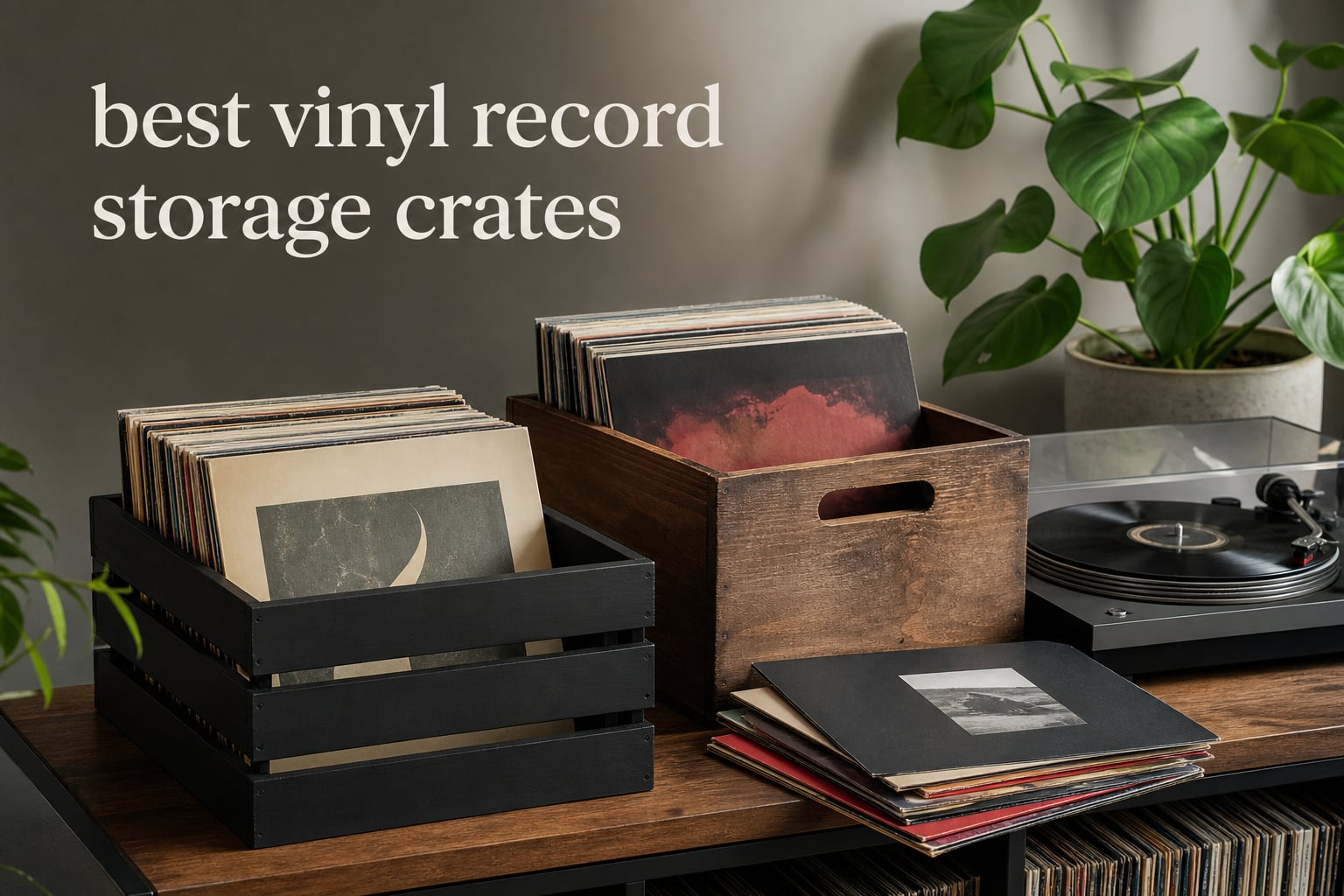
The best vinyl record storage crates keep LPs upright, supported, and easy to browse without turning a collection into a pile of heavy sleeves. A full record crate can be surprisingly heavy, and the wrong box can sag, trap moisture, or make a favorite album difficult to reach.
We compared the eight supplied options by their stated capacity, materials, dimensions, assembly, and the review feedback attached to each listing. The result is a practical split: lidded vinyl record storage boxes make sense for dust-conscious collectors, while open metal-and-wood crates suit visible, frequently played records.
Capacity numbers need a little skepticism. Thick gatefold jackets, outer sleeves, and dividers take more room than bare single LP sleeves, so treat every stated count as a useful ceiling rather than a packing target.
Table of Contents
The top 3 picks are clear choices for different collections
Homeiju is our all-around open-crate choice because its metal-and-engineered-wood frame has a stated 44-pound capacity and holds up to 60 records. DocSafe is the protection-oriented choice for a larger lidded group, while ZICOTO is the simple lidded organizer for a smaller set of single records.

Homeiju Vinyl Record Storage
- Metal and engineered wood
- 60-record capacity
- 44 lb load rating

DocSafe Vinyl Record Storage Box
- 100+ record capacity
- Lockable lid
- Fire and water-resistant shell

ZICOTO Decorative Vinyl Record Storage Box
- 50+ single records
- Lidded linen box
- Collapsible design
These vinyl record storage crates cover eight collection needs in 2026
The quick comparison below puts every option in one place. Open designs favor fast flip-through access, while the boxes with lids add a barrier against dust; neither style replaces sensible indoor climate control.
| Product | Specifications | Action |
|---|---|---|
| ZICOTO Decorative Storage Box |
|
View Product |
| Homeiju Record Storage |
|
View Product |
| DocSafe Storage Box with Lock |
|
View Product |
 3IngSeagulls Wooden Crate 3IngSeagulls Wooden Crate |
|
View Product |
 ZEDKEHO Record Storage Box ZEDKEHO Record Storage Box |
|
View Product |
 Dmevkic 3 Cube Storage Dmevkic 3 Cube Storage |
|
View Product |
 YINMIT Record Storage Crate YINMIT Record Storage Crate |
|
View Product |
 Honkazita 2 Cube Shelf Honkazita 2 Cube Shelf |
|
View Product |
1. ZICOTO is the best lidded pick for a small collection
Decorative Vinyl Record Storage Box for 50+ Single Records – LP Holder
Black linen box
50+ single records
Lid, label slot, metal handles
Pros
- Lid limits dust
- Collapsible for storage
- Metal side handles
- Card slot for labels
Cons
- Not water resistant
- Linen is less durable than wood
ZICOTO makes sense when your collection is still compact and you want it to disappear neatly between listening sessions. Its listing states room for more than 50 single records, a lift-off lid, two metal side handles, and a card slot that is genuinely useful once several boxes share a room.
The black linen exterior has a more finished look than a utility bin, and the box collapses for storage when empty. Review feedback praises its styling, sturdiness, and practical lid, with a reported 4.8 rating from more than 2k reviews.
The important limitation is material. This is a linen storage box rather than a wooden crate, and it is not water resistant, so I would keep it away from a damp basement floor, a spill-prone turntable stand, or a spot with big temperature swings.
The lid makes ZICOTO better for stored albums than daily browsing
A lid keeps dust off jackets and makes this vinyl album organizer a tidy choice for albums you rotate less often. It also makes labeling more useful because you can identify a category before lifting the cover.
It is less convenient than a front-open crate when you want to flip through records every day. Put frequently played LPs in one box and archive the less-played part of a starter collection in another rather than packing the interior too tightly.
The collapsible format makes ZICOTO better for changing spaces
The stated collapsed size is 13.6 by 13.6 by 2 inches with the lid, which is helpful for collectors who move, reorganize, or only need extra record collection storage at certain times. The two handles also make an individual loaded box easier to carry than a handle-free cube.
Do not read stackable as permission to build a tall loaded tower without checking stability. A full box of records places concentrated weight on the box below, and the product data does not provide a stacked load limit.
2. Homeiju is the best open desktop crate for 60 records
Homeiju Vinyl Record Storage, Record Box Case Crate, Vinyl Record Album Holder, Metal & Wooden LP Record Crate, Holds up to 60 Records
Metal and engineered wood
60 records
44 lb load capacity
Pros
- 44 lb stated capacity
- Open viewing design
- Side handles
- Five-minute assembly
Cons
- Assembly required
- Indoor use only
- Not water resistant
Homeiju is the pick I would place beside a listening chair because the open metal-and-engineered-wood format puts spines and sleeves in view. The listing gives it a 60-record capacity and a 44-pound load rating, which is more useful information than a capacity claim alone.
Its stated dimensions are 14.6 by 11.41 by 11.4 inches, and it has side handles for moving it around a room. Buyers in the supplied review summary call out the sturdy construction, straightforward assembly, and easy record finding.
The silicone gasket at the base is a small but relevant detail for a tabletop or shelf because it is meant to prevent sliding. This remains an indoor, open crate, however, so it is for accessible display rather than dust-sealed storage.
The open frame makes Homeiju better for active listening
Collectors who play a few albums each week benefit from being able to scan the cover art without removing a lid. The visualization design in the listing also makes this a more natural fit for sorting by genre, artist, or listening queue.
Keep each record vertical with modest side-to-side support. A tightly packed row can scuff jackets during removal, while a sparse row that leans sharply can place uneven pressure on the discs and sleeves.
The 44-pound rating makes Homeiju easier to size responsibly
Record weight grows faster than a collection feels like it should, especially once gatefold jackets and outer sleeves enter the mix. The 44-pound stated capacity provides a reason to avoid treating the crate as an unlimited catch-all for books and records together.
Assembly is listed as about five minutes with 10 screws. Tighten the hardware on a stable surface before loading it, then use the handles only for a controlled move instead of carrying it by one side.
3. DocSafe is the best protective box for more than 100 records
DocSafe Vinyl Record Storage Box with Lock,Fireproof&Water Resistant Record Organizer Storage for 100+ Single Records(12-inch),Collapsible Storage Crate with Lid&Handles for Valuable Album Collection
Fiberglass shell
100+ 12 inch records
Lock, fire resistance, water resistance
Pros
- 100+ record capacity
- Combination lock
- Fire-resistant material
- Collapsible design
Cons
- Zipper is not waterproof
- Lock code must be remembered
DocSafe is distinct from the other options because protection drives its design. The 13 by 13 by 13 inch box is listed for more than 100 12-inch records and uses three-layer silicone-coated fiberglass with a combination lock.
The product data describes the material as UL94-V0/5VA flame-retardant tested and water resistant, but it also makes an important distinction: the zipper is not waterproof. That is the right way to view it—as an added protective layer, not a substitute for a dry, climate-stable room.
Mesh pockets in the lid and sides can hold small accessories, while the non-slip bottom pad helps it stay put. The review summary emphasizes the security and high capacity, and the supplied data reports a 4.7 rating from more than 1k reviews.
The enclosed shell makes DocSafe better for stored valuables
For a collector who needs to keep a group of records away from dust or casual handling, the lidded and lockable approach is more purposeful than an open LP record crate. The reflective strip and label slots also help with identification in a closet or storage room.
Records still need to stand upright inside the box. A lock protects access, but it does not correct an overfilled row or a row left leaning at a steep angle.
The collapsible build makes DocSafe better as a dedicated reserve box
The box can collapse when it is not in service, which is practical for people who keep seasonal rotation records separate from their daily stack. At full capacity, though, plan the destination first because a loaded 100-plus-record box is not a casual one-handed carry.
The listing gives a maximum weight recommendation of 150 pounds, but record collectors should still distribute a heavy collection across multiple containers where possible. Splitting records by category also reduces the risk of overpacking and makes re-shelving less frustrating.
4. 3IngSeagulls is the best classic wooden cube for visible albums
3IngSeagulls Vinyl Record Storage Crate Wooden Record Holder, Classic Cube Record Organizer Storage 100+ Records, Brown Color Vinyl Record Holder for Albums Super Easy to Assemble…
Wood cube
80 to 100 records
15.15 by 13.58 by 9.96 inch
Pros
- Wood construction
- Classic cube shape
- 80 to 100 record capacity
- Natural brown finish
Cons
- Assembly required
- Wood grain can vary
- Standard shipping only
3IngSeagulls takes the familiar solid-looking record crate shape and gives it a brown wood finish. Its stated dimensions are 15.15 by 13.58 by 9.96 inches, with a claimed capacity of 80 to 100 records.
This is the straightforward choice for someone who wants a vinyl record holder that looks at home beside a sofa or console rather than in a closet. The supplied review insight says customers find it sturdy and like the classic design.
Its capacity range is a better signal than a single inflated number because jackets are not all the same thickness. I would use the lower end of the range when your collection has many gatefolds, protective outer sleeves, or booklets.
The low cube profile makes 3IngSeagulls easy to browse
At just under 10 inches high, this crate leaves covers visibly accessible and makes a useful display for an active row of LPs. It favors flip-through use rather than sealed preservation, so regular dusting of exposed jackets remains part of the routine.
Wood crate surfaces should be smooth around the inside edges. Before loading records, run a clean hand along the interior and remove any loose packing debris so a sleeve does not rub against a rough spot.
The 12-screw assembly makes 3IngSeagulls a deliberate setup choice
The listing calls for 12 screws, which is still a modest assembly task but more involved than a collapsible box. Assemble it on a flat floor or table and check that the crate sits squarely before putting weight into it.
Natural wood finish variation is listed as a possible downside, so expect some grain variation rather than a perfectly uniform furniture panel. That is a cosmetic consideration, not evidence of a structural defect.
5. ZEDKEHO is the best foldable box for organized 50-record groups
Sturdy Vinyl Record Storage Box – Album Storage Holds up 50+ Single Record
Linen covered cardboard
50+ records
Dividers, lid, and labeling system
Pros
- Adjustable dividers
- Removable lid
- Foldable design
- Lightweight construction
Cons
- 10 kg maximum weight
- Not water resistant
- Standard shipping only
ZEDKEHO is a lightweight lidded storage box with an adjustable divider, a removable lid, and a label system. It is stated to hold more than 50 records and folds down to 13.38 by 13.38 by 1.38 inches when empty.
The internal structure combines high-density cardboard and durable fabric, so the appeal is organization and compact storage rather than furniture-like permanence. Its listed maximum weight recommendation is 10 kilograms, a figure worth respecting when packing dense LPs.
For a starter vinyl collection, the divider is the main attraction. It gives a partially filled box support so records do not all tip to one side, and it lets you separate artists, decades, or condition-sensitive pressings.
The adjustable divider makes ZEDKEHO better for a partly filled box
A divider is useful when a collection is growing slowly because it can prevent the long lean that bends sleeves and puts discs under uneven pressure. Leave a little room to remove a record without forcing the neighboring jackets apart.
The divider also supports simple cataloging. One labeled section for records to clean and another for records ready to play can make a small storage system feel much easier to maintain.
The 10-kilogram recommendation makes ZEDKEHO a light-duty choice
The stated 10-kilogram limit means I would not use this as a dense archive box for the heaviest 12-inch records. The box is better for a moderate group that you monitor rather than for trying to reach its stated count with every sleeve heavily protected.
It is also not water resistant. Keep it elevated from floors where a small leak could reach it, and avoid sealing it into a humid utility space just because the lid makes it look protected.
6. Dmevkic is the best modular system for a growing wall of records
Dmevkic 3 Cube Vinyl Record Storage
Three mesh and wood cubes
120 to 150 records
Stackable freestanding unit
Pros
- Three-cube configuration
- Metal mesh visibility
- Modular stacking
- 100 lb per cube claim
Cons
- Assembly required
- Availability not specified
Dmevkic is the outlier here because it is a three-cube storage unit rather than a single portable crate. The listing describes a freestanding metal-mesh-and-wood system with a stated capacity of 120 to 150 records and a 12.6 by 11.8 by 41.82 inch overall footprint.
For a collector building a dedicated listening room, that vertical format can use wall height better than scattering separate boxes across the floor. The mesh sides also keep album spines and cover edges easier to see than in an opaque cabinet.
The listing says each cube can hold up to 100 pounds, but actual loading should still be even and restrained. This is the type of vinyl storage solution that deserves careful assembly and a level floor, especially if you plan to expand it.
The three-cube layout makes Dmevkic better for separated categories
Three distinct compartments can hold different genres, formats, or condition groups without needing extra dividers. That is useful for DJs and collectors who need to find a particular kind of record quickly without mixing everything into one deep row.
Its listed interior measurements are 11.4 inches wide, 12.6 inches deep, and 13 inches high per cube. Check the fit of your sleeved records before committing to a dense load, since outer sleeves and thick covers affect usable width.
The stackable design makes Dmevkic better when growth is planned
Forum discussion repeatedly points to expandability as a deciding factor for collectors whose shelves fill faster than expected. A modular system gives you a consistent visual format as the collection grows instead of forcing a total storage reset.
Stacking is not a shortcut for ignoring the floor and hardware. Use the included non-slip sponge pads, follow the supplied instructions, and do not create an unstable column in a high-traffic area.
7. YINMIT is the best compact open crate with adjustable feet
YINMIT Vinyl Record Storage, Large LP Vinyl Record Storage Crate, Metal & Wooden Record Holder, Cube Record Organizer Box, Holds up to 80+ Records
Iron and particle board
80+ records
X brackets and adjustable feet
Pros
- 80+ record capacity
- Adjustable feet
- X-shaped iron brackets
- Tools included
Cons
- Smaller than modular systems
- Assembly required
YINMIT combines an iron frame with particle board in a compact open crate listed for more than 80 records. Its stated 15.7 by 14.2 by 10.2 inch dimensions and four adjustable feet give it a useful advantage for a slightly uneven floor or a less-than-perfect shelf.
The retro brown finish and X-shaped brackets give it a deliberately visible, furniture-adjacent feel. The product data also says the necessary instructions, screws, and tools are included for assembly.
This is a strong candidate when you want records within reach but do not need the scale of a multi-cube unit. The supplied review data reports a 4.6 rating from 134 reviews, so the rating sample is smaller than the highest-volume picks in this guide.
The adjustable feet make YINMIT better for uneven surfaces
A crate that rocks can concentrate weight on one corner and make browsing annoying. Adjustable feet give you a way to level the unit before records go in, which is particularly useful on older floors or beside a sofa.
Leveling does not replace a sound surface. If a shelf itself bows under weight, move the crate to a stronger support rather than relying on the feet to solve the larger problem.
The open X-bracket design makes YINMIT a display-first crate
The design leaves your LPs accessible and adds visual character to a room, making it a natural vinyl record holder for a small active group. It can also hold books and magazines according to the listing, though a dedicated record row is easier to keep properly vertical.
Particle board and iron are practical material choices, but this is still indoor furniture. Keep drinks away, dust exposed covers regularly, and avoid placing it against a heat source.
8. Honkazita is the best two-cube choice for a mid-size collection
2 Cubes Record Holder Shelf Storage Furniture, Wooden Vinyl Record Storage
Two stackable cubes
80 to 110 records
Wood texture and metal frame
Pros
- Two-cube organization
- Stackable construction
- 80 to 110 records
- Compact vertical footprint
Cons
- Indoor use only
- Assembly required
Honkazita provides two stacked cubes in a single 12.6 by 11.8 by 27.4 inch unit, with a stated capacity of 80 to 110 records. It combines composite material with a wood texture and a metal frame, giving it a more structured format than a simple single crate.
The two levels are a sensible middle ground for someone moving beyond a starter collection but not ready for a full wall system. The listing says the interior of each cube is 11.4 inches wide, 12.6 inches deep, and 13 inches high.
The reported rating is 4.5 from 231 reviews. Its review notes emphasize the two-cube capacity and the 12-screw assembly intended to make the stacked arrangement firm.
The two compartments make Honkazita better for easy collection sorting
Separate cubes reduce the need to cram a long row into one container. You can dedicate one level to frequently played albums and one to less-played titles, or divide the collection by genre without introducing loose cardboard dividers.
Each row should still have enough room for fingers to select an album. A crate does its job best when a record can be removed by its outer sleeve without yanking hard on its neighbors.
The vertical footprint makes Honkazita better beside a sofa or television
The product listing specifically positions it near a sofa or television, and its narrow footprint supports that use. A pair of cubes can turn an otherwise empty narrow space into record collection storage without spreading albums across a wide floor area.
Because it is intended for indoor use, choose a dry location away from direct sun and heating equipment. Tighten the 12 screws during assembly and recheck the unit before adding more records as the collection grows.
A record crate should match your collection and room
The right vinyl storage setup comes down to capacity, access, material, and where it will live. A crate that looks good but cannot keep records upright or stable is not a good home for an LP collection.
A realistic capacity starts below the number on the listing
Start with your actual record count, then allow room for thicker jackets, outer sleeves, and new purchases. If a crate says it holds 100 records, treating 80 to 90 as a comfortable working range is often gentler on sleeves and much easier to browse.
For a rough plan, count records by groups of 50. One 50-record box suits a starter group, two 50-record boxes prevent a 100-record collection from becoming a heavy single load, and modular cubes are easier to expand once a collection passes a few hundred LPs.
Weight matters as much as volume. Research for this guide flags a full crate at roughly 16 to 18 kilograms, so do not assume a stylish box, weak shelf, or improvised stack has the same load tolerance as a purpose-built furniture unit.
Vertical storage protects records better than flat piles
Store LPs vertically, with enough support that they stand close to upright but not so tightly that the sleeves scrape. This spreads pressure across the record edges and gives you a chance to remove one album without dragging several others along.
A short, temporary horizontal stack is less concerning than a long-term pile, but horizontal storage is not a sensible permanent approach for a collection. The discs and jackets at the bottom carry the load, and access gets worse as the pile grows.
Material choice should follow moisture exposure and record weight
Wood crates give a classic display look and can feel substantial, but finish quality, joints, and construction matter more than the word wood alone. The 3IngSeagulls model is the wood option in this group, while Homeiju, Dmevkic, YINMIT, and Honkazita use metal combined with wood or engineered-board elements.
Linen-covered and cardboard-core boxes such as ZICOTO and ZEDKEHO work for compact, labeled storage, but their stated lack of water resistance makes placement important. DocSafe adds fire-resistant fiberglass and a water-resistant shell, although its zipper is explicitly not waterproof.
Plastic bins are not automatically harmful, but a sealed plastic LP bin in a damp, hot, or poorly ventilated area can trap moisture. Records are hygroscopic according to the research for this guide, which is why the room climate matters more than any one container material.
Open access and lidded protection solve different problems
An open crate is better when playing records is part of the daily routine. Homeiju, YINMIT, 3IngSeagulls, Dmevkic, and Honkazita make cover browsing easy, but their exposed albums benefit from a clean room and occasional dusting.
A lidded box is better when albums spend longer periods stored, when labels are helpful, or when dust is a concern. ZICOTO, ZEDKEHO, and DocSafe all offer a lid, while DocSafe adds a lock and the most protection-focused material description in this group.
Stackability needs a stated structure, not hopeful balancing
Stackable vinyl storage is useful only when the product is designed for it and the loaded base is stable. The Dmevkic and Honkazita cube systems are the clearest choices here because their listings describe modular or stacked configurations.
Forum discussion also highlights a common frustration: inexpensive storage can sag or fail as collections grow. Keep loaded crates low, distribute weight across several containers, and do not stack soft-sided or collapsible boxes without a stated stacked-load specification.
A stable indoor climate protects both records and sleeves
Choose a dry indoor room with steady conditions, away from direct sunlight, radiators, and damp concrete. Temperature spikes and moisture are harder on records and paper sleeves than the difference between one attractive crate finish and another.
Avoid a basement or garage unless you actively manage the climate. If a room feels humid, has a history of leaks, or gets very hot, move the record collection before upgrading the crate.
These vinyl storage questions have practical answers
Why are milk crates bad for storing vinyl?
Milk crates can work as a temporary container, but their open plastic grid can catch or rub jacket corners, and a full crate becomes very heavy to lift. They also offer no dust barrier or divider. A purpose-made crate with smooth interior surfaces, stable dimensions, and proper record support is usually easier on sleeves and easier to organize.
Do plastic LP bins damage records over time?
Plastic itself does not automatically damage records, but a sealed plastic bin can be a poor choice in a hot or humid space because it may hold moisture around jackets and discs. Use a dry, climate-stable indoor location, keep LPs vertical, and avoid overpacking. A bin with clean, smooth surfaces and airflow is safer than a neglected container in a damp room.
Is solid wood strong enough for heavy records?
A well-built wood crate can be strong enough for heavy records, but strength depends on panel thickness, joints, hardware, and how the load is distributed. Do not judge a crate by appearance alone. Follow any stated load guidance, assemble it squarely, keep it on a level surface, and divide a large collection among several boxes rather than overfilling one.
Can I store records horizontally in a box?
Records are best stored vertically rather than in a long-term horizontal pile. A flat stack puts the load on the records and jackets at the bottom and makes individual albums harder to remove. If you must lay records flat briefly during a move or cleaning session, keep the stack short and return them to upright, supported storage as soon as possible.
What’s the ideal climate for vinyl storage?
The best environment is a dry indoor room with steady conditions, away from direct sun, heaters, exterior walls that become damp, and unconditioned garages or basements. Consistency matters because vinyl and paper sleeves respond poorly to heat and moisture swings. A lidded box can reduce dust, but it cannot compensate for a room that is hot, wet, or unstable.
The right crate protects records while leaving room to grow
For a compact collection that needs a lid, choose ZICOTO for its 50-plus-single-record format or DocSafe when capacity and a protection-focused shell matter more. For daily browsing, Homeiju offers the clearest balance of a stated 44-pound capacity, open viewing, and a manageable 60-record size.
Collectors planning a larger record wall should look at the modular Dmevkic system or the two-level Honkazita unit, then expand only on a level, stable base. The best vinyl record storage crates in 2026 are not defined by one material or shape; they are the ones that keep your records upright, dry, accessible, and within a container’s stated limits.