
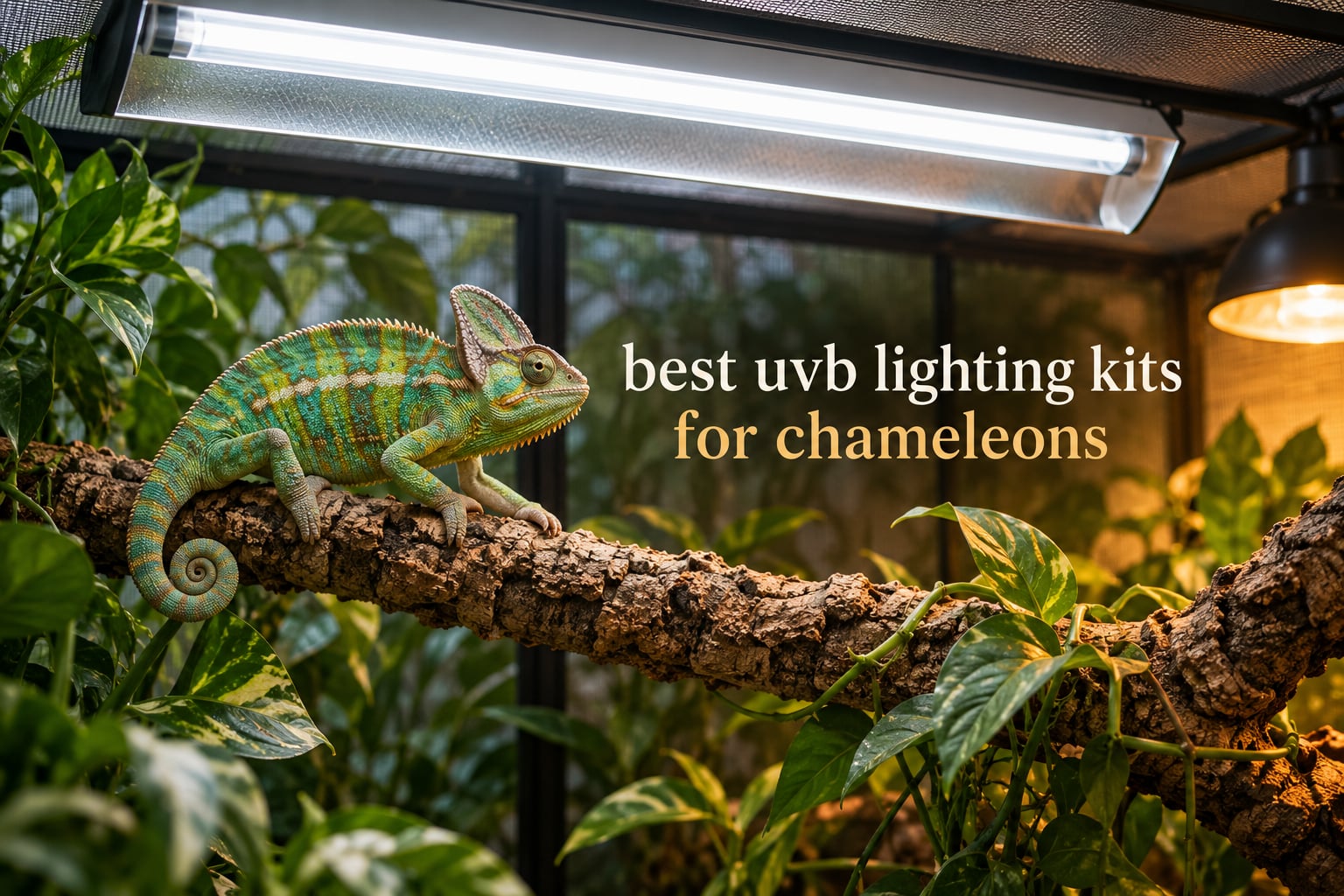
The single most important light in a chameleon enclosure is not the heat lamp and it is not the plant light. It is the UVB tube, and buying the wrong kit is the most common and most expensive mistake a new keeper makes. Metabolic bone disease, the leading preventable cause of death in captive chameleons, almost always traces back to a bulb that was too weak, too far away, or shining through too much glass.
We spent six weeks comparing the best UVB lighting kits for chameleons side by side, reading spec sheets against measured output, and sorting out the ballast and wattage traps that forum threads keep circling. What follows is the roundup, plus the setup maths that decides whether any of these kits actually delivers a UV Index of 3 at your basking branch.
Quick Picks: Best UVB Lighting Kits for Chameleons (October 2026)

Zoo Med 5.0 T5-HO Hood with ReptiSun 5.0
- ReptiSun T5 HO 5.0 lamp included
- Polished curved reflector
- Electronic T5 HO ballast
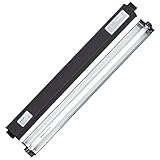
REPTI ZOO 24W T5 HO UVB Combo Kit
- Detachable curved reflector
- ETL certified
- 24W T5 HO ballast

Eckpo 12W Dimmable LED UVB Lamp
- Built in 4/8/12 hour timer
- Four intensity levels
- 8000 hour UVB module
Best UVB Lighting Kits for Chameleons in 2026
| Product | Specifications | Action |
|---|---|---|
| Zoo Med 5.0 T5-HO 14 Inch Hood |
|
Check Latest Price |
 DBDPet 24 Inch T5 Bundle DBDPet 24 Inch T5 Bundle |
|
Check Latest Price |
 NEPTONION 34.5 Inch T5 HO Kit NEPTONION 34.5 Inch T5 HO Kit |
|
Check Latest Price |
| Eckpo 12W Dimmable LED UVB |
|
Check Latest Price |
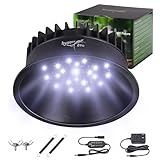 Hygger Zoo LED UVB Fixture Hygger Zoo LED UVB Fixture |
|
Check Latest Price |
 REPTI ZOO Switchable T5 Combo Kit REPTI ZOO Switchable T5 Combo Kit |
|
Check Latest Price |
| REPTI ZOO 24W T5 HO UVB Kit |
|
Check Latest Price |
 Eckpo 22.6 Inch T5 HO Kit Eckpo 22.6 Inch T5 HO Kit |
|
Check Latest Price |
 LUCKY HERP 18 Inch T8 Combo Kit LUCKY HERP 18 Inch T8 Combo Kit |
|
Check Latest Price |
 Jugbuy 22 Inch T5 UVB Kit Jugbuy 22 Inch T5 UVB Kit |
|
Check Latest Price |
1. Zoo Med 5.0 T5-HO 14 Inch Hood with ReptiSun 5.0 UVB Lamp
Zoo Med 5.0 T5-HO 14″ Terrarium Hood with ReptiSun T5 HO 5.0 UVB Lamp
14 inch T5 HO hood
ReptiSun 5.0 UVB lamp included
16.3 x 5.9 x 1.1 inches
1.43 pounds
Pros
- ReptiSun T5 HO 5.0 lamp included in the box
- Polished curved reflector concentrates UVB down the enclosure
- High output T5 design reaches higher into tall screen enclosures
- Low profile housing clears most canopy and lid frames
Cons
- Some fixtures report ballast connection issues that need a reseat or a tap
- Lamp occasionally arrives installed backwards
- No hanging hardware included
This is the kit we come back to, and with 1208 reviews behind a 4.4 average it is also the most proven option on this list. The 14 inch T5-HO hood includes a ReptiSun T5 HO 5.0 UVB lamp in the box, which removes the single most common error new keepers make, fitting a mismatched bulb.
For a 16 by 16 by 30 inch juvenile or subadult enclosure it does everything you need. The polished curved reflector sends light downward instead of letting it wash out toward the sides, and the high output T5 design is what lets it still deliver useful levels after passing through a screen top.
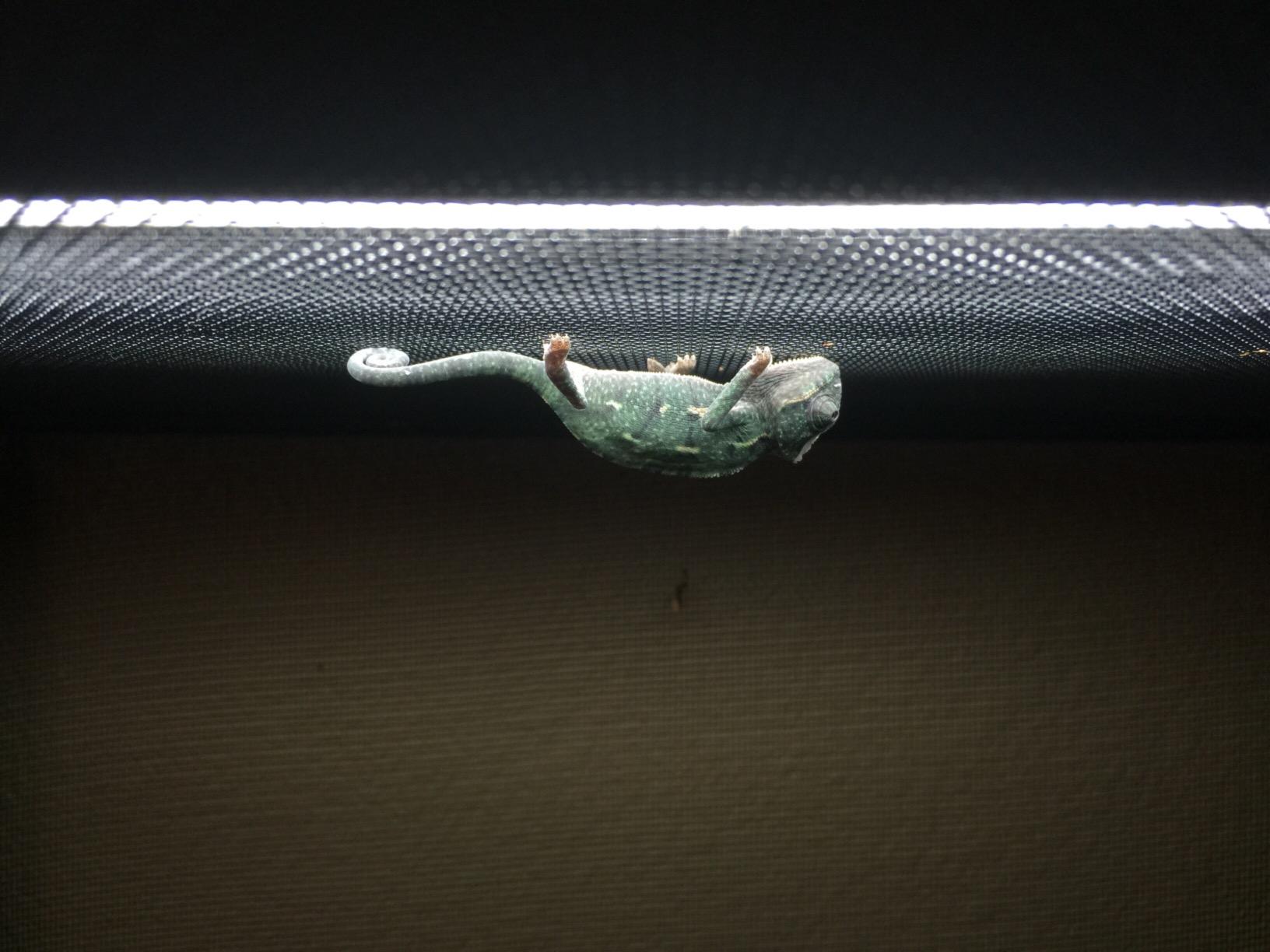
The weakness is physical size. At 14 inches it does not span the full width of a standard 24 inch wide enclosure, so in a 2x2x4 setup you are lighting the centre of the animal’s range rather than the whole canopy. Two of these units side by side solve that, but you are buying two ballasts.
Keepers also report two small quality issues that are easy to live with. Some fixtures arrive with a ballast connection that needs a firm reseat until the tube stops flickering, and the lamp itself occasionally ships fitted backwards. Neither is a deal breaker, but check both before you walk away.
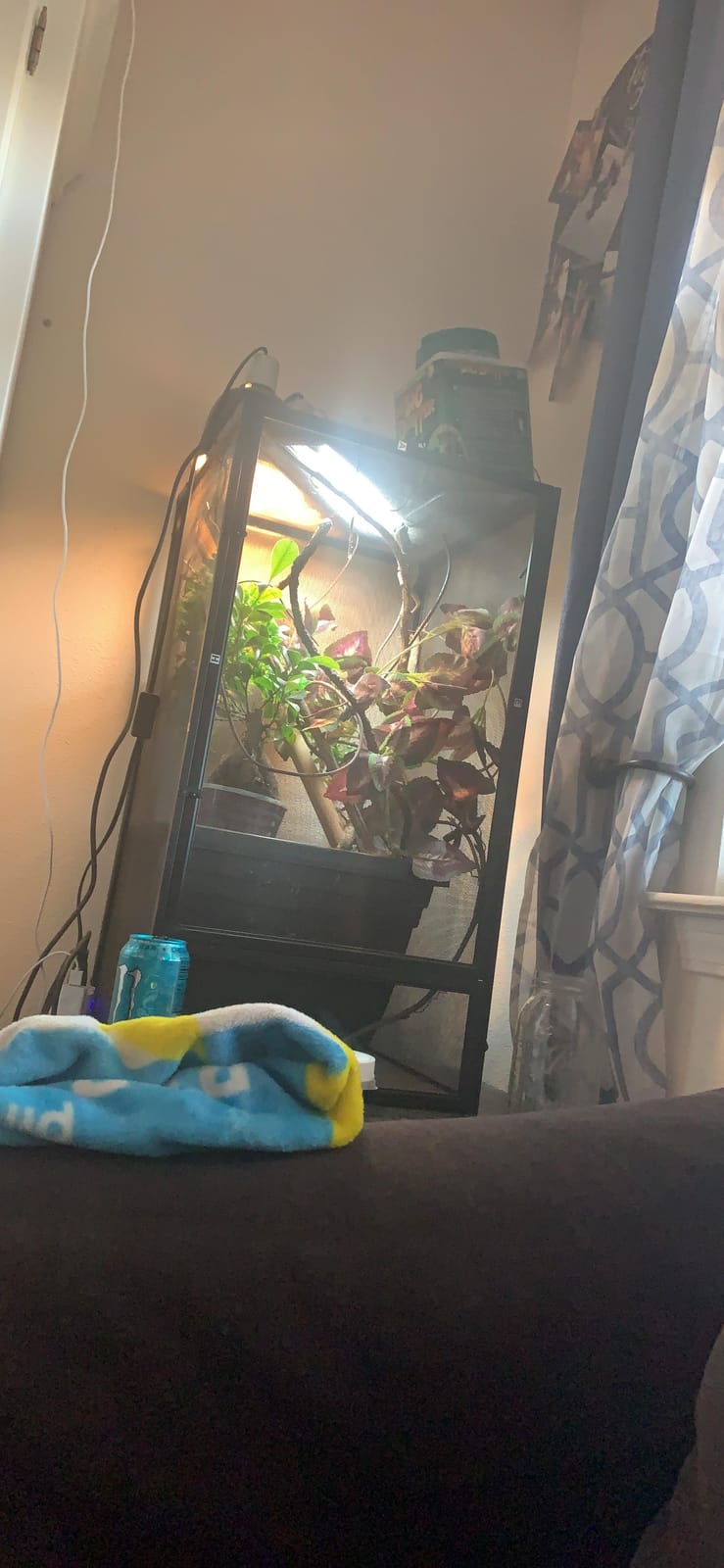
How it performs under a screen top
Screen tops cost roughly 30% of the UVB that reaches them, which is exactly why a reflector matters so much on a kit like this one. Mount it inside the frame or just below the screen, run it horizontally rather than at an angle, and you should be able to hit the UVI 3 target at a basking branch placed 6 to 10 inches below the tube.
The bulb runs at 14W, so it stays cool enough for an enclosed canopy without cooking the fixture. Pair it with a separate halogen heat bulb mounted to one side, and never let the basking branch sit inside the shadow zone at the end of the reflector.
Who should skip it
If your adult veiled or panther lives in a 24 by 24 by 48 inch cage, this 14 inch fixture is the wrong width. Save your money and step up to a 24 inch or 34.5 inch kit so the whole basking zone is lit evenly rather than relying on one animal to sit under a narrow band of light.
It is also the wrong choice for a keeper who wants zero bulb ordering. ReptiSun tubes are typically replaced every 6 to 12 months, and this listing does not include a spare. Buy two lamps the first time and keep one sealed in a drawer.
2. DBDPet 24 Inch T5 Bundle with ReptiSun 5.0 UVB Bulb
DBDPet ‘s Bundle with Zoomed Reptisun T5 Hood with 5.0 UV-B Bulb 24″ – includes Pro-Tip Guide
24 inch T5 UV-B fixture
Zoo Med ReptiSun 5.0 bulb included
E26 base, 24 watts
Ultra thin profile
Pros
- 24 inch length matches a standard 2x2x4 enclosure width
- Zoo Med ReptiSun 5.0 UVB bulb included
- Ultra thin profile clears a tight canopy
- Pro-Tip setup guide included in the box
Cons
- Multiple reports of a 14 inch fixture arriving instead of the 24 inch
- Customer service described as unresponsive
- Size fulfilment issues appear to be ongoing
Dimensionally this is the one that finally gets a 2x2x4 chameleon right. A 24 inch tube spans the full width of the enclosure, so the animal can move along the branch and stay inside the useful zone instead of wandering into darkness.
The bundle pairs that fixture with a Zoo Med ReptiSun 5.0 UVB bulb, which is the strength most keepers and Chameleon Academy both steer new owners toward. The included Pro-Tip guide covers mounting, and the ultra thin profile is genuinely useful when the canopy frame is shallow.
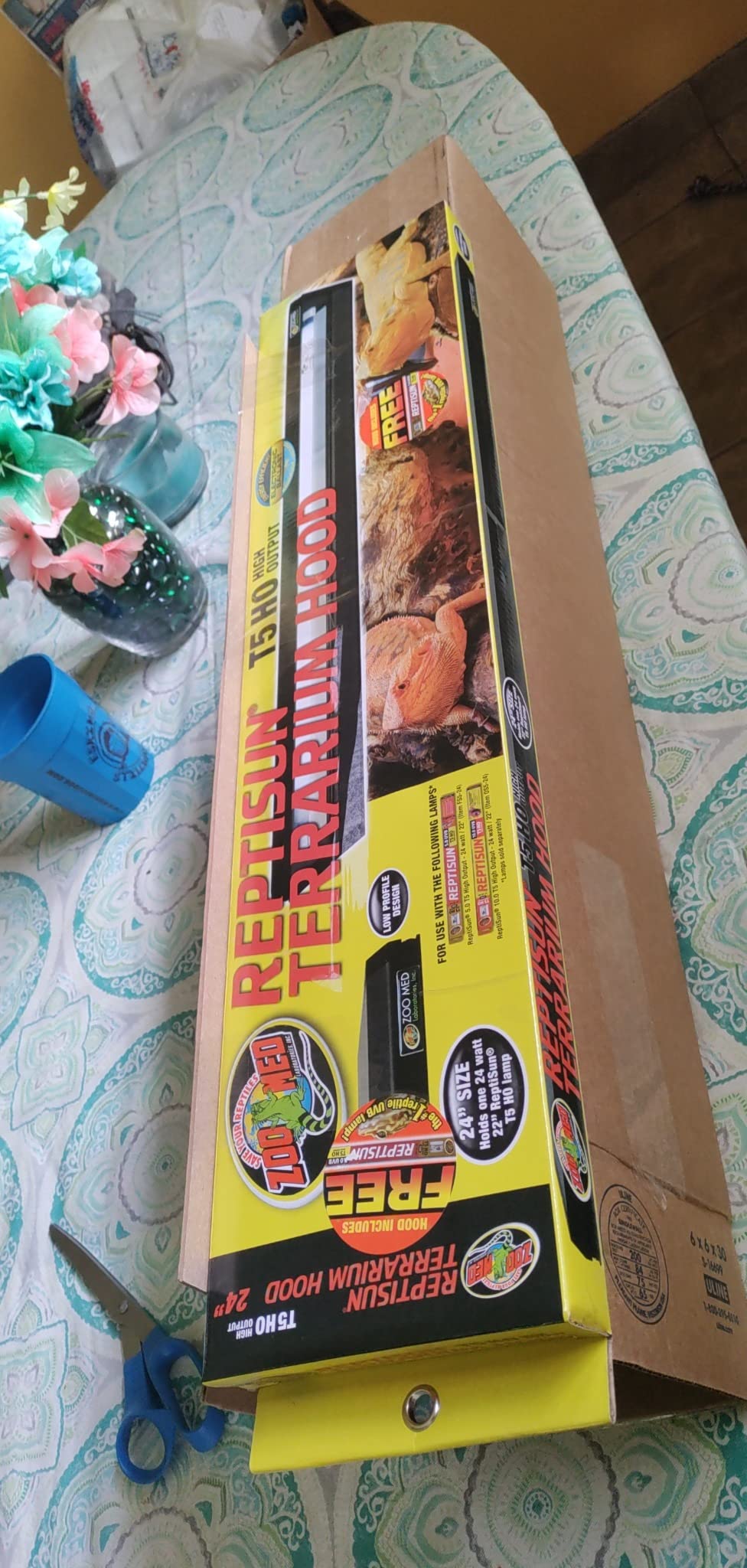
The problem is consistency. Across reviews of this listing, the single most repeated complaint is that a number of buyers received a 14 inch fixture instead of the advertised 24 inch, and the secondary complaint is that support did not resolve it quickly. That is a fulfilment issue rather than a product issue, but it is the reason this kit sits at number two for us rather than first.
If you order this one, open the box, measure the tube, and confirm the length before you build the rest of the enclosure around it.
Distance and reflector maths for a 24 inch fixture
A 24 inch tube throws a wider and slightly weaker field than a 14 inch one, so give it a little more vertical room. In a 48 inch tall enclosure, mount the fixture high enough that the basking branch sits 8 to 14 inches below the tube, then aim the branch directly under the centre of the reflector.
Raising the fixture too high is the classic error here. A moderator on Chameleon Forums confirmed that bulbs are frequently moved higher when a keeper notices their chameleon climbing on the screen top, and pushing the tube into the ceiling of a screen cage costs a large slice of the usable output. Measure first, then move.
Who should skip it
Skip it if you need a fixture delivered the right size on the first attempt without any follow-up. In a hobby where a wrong-size fixture means a second delivery, the consistency of a plain Zoo Med hood is worth more to most keepers than the wider span.
It is also the wrong pick if you want a bundled reflector. This fixture is thin by design and does not include the polished curved reflector that concentrates output downward.
3. NEPTONION 21W 34.5 Inch T5 HO 5.0 UVB Fixture Kit
NEPTONION 21W Reptile T5 HO UVB 34.5″ 5.0 Light Fixture with Tube, Tall Tropical Habitat Hood for Terrariums, Suitable for Tropical Reptiles Like Veiled Chameleon
34.5 inch T5 HO fixture
21W 5.0 UVB tube included
Curved polished aluminium reflector
All-metal housing
Pros
- 34.5 inch format suits tall chameleon screen enclosures
- Curved polished aluminium reflector intensifies UVB
- All-metal housing resists heat and warping
- Daisy-chain ready for multi tank setups
- Two mounting clip styles included
Cons
- Newer brand with a shorter long-term track record
- Some owners report a tube rattle when the unit is moved
- Manufacturer treats the rattle as normal
This is the fixture we would pick for a tall adult veiled chameleon in a 24 by 24 by 48 inch enclosure. The 34.5 inch format is unusual and useful, because it leaves enough vertical clearance between the top of the tube and the branch that you can place the basking spot without flattening your gradient.
The 21W 5.0 tube sits in an all-metal housing with a curved polished aluminium reflector, and that combination is where the useful output comes from. Metal also matters in a screen-top enclosure where the fixture runs warm for most of the day.
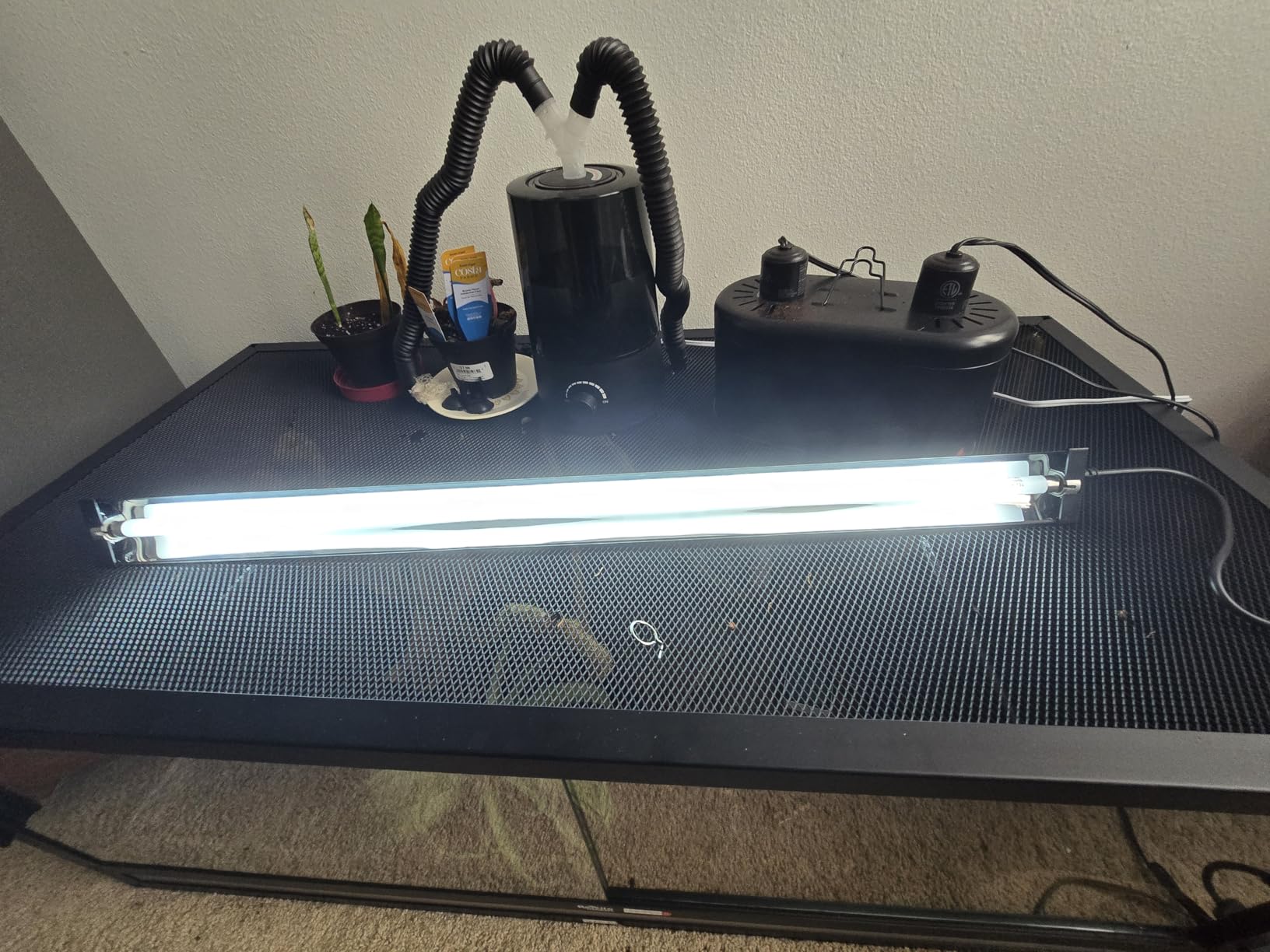
The daisy-chain capability is the sleeper feature. If you run two or three chameleons, you can link fixtures instead of hunting for outlets behind a stack of enclosures, and the two included mounting clip styles make it fit both mesh and wooden frames.
The trade-off is confidence. This is a newer brand with 173 reviews, so there is less long-term data on lamp degradation than the Zoo Med listing has. The rattle reported when the fixture is moved is described by the manufacturer as normal for this housing style.
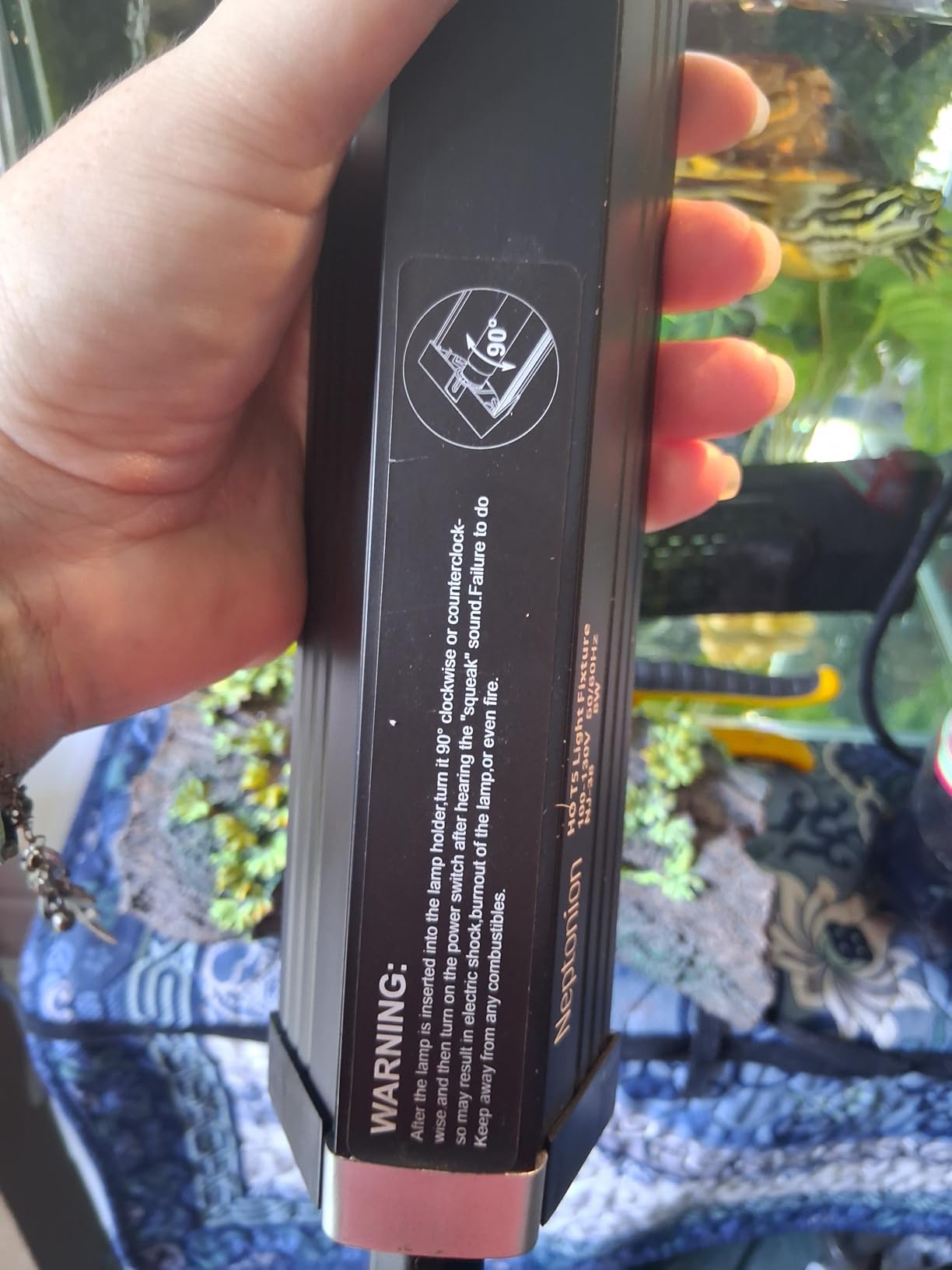
Why tall format beats wide format for adults
In tall cages the classic mistake is cramming a long tube into a shallow canopy, which forces the branch either too close and too hot, or off the end of the reflector entirely. The 34.5 inch format sidesteps that, giving you room to set the branch below the whole length of the tube rather than at one end.
Variants exist in both 5.0 Rainforest and 10.0 Desert. For veiled, panther, Jackson’s and carpet chameleons, take the 5.0. The 10.0 is a desert output and pushes you toward a branch height that most keepers cannot set up cleanly.
Who should skip it
Skip it if you want the strongest brand track record in the category, or if your enclosure is a 16 by 16 by 30 inch tank where a 34.5 inch fixture is physically too large. This is a large-animal fixture and it is priced accordingly.
Also skip it if you intend to run it year-round without a schedule. Flickering LED ballasts are not a concern here, but bulb output still fades with use and you should plan on a yearly tube.
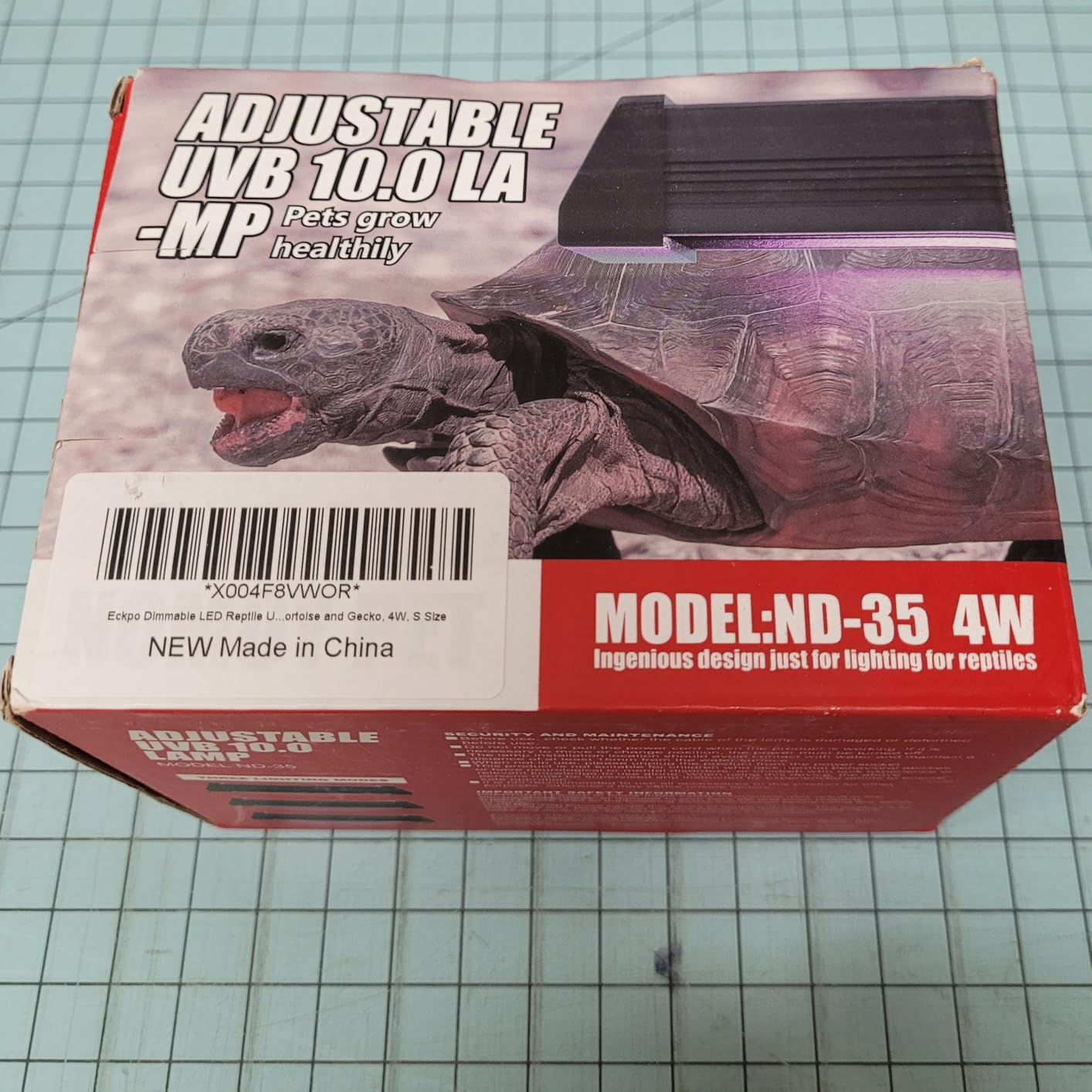
4. Eckpo Dimmable 12W LED UVB Lamp with Built In Timer
ECKPO Dimmable LED Reptile UVB Lamp, 8000 Hours UVB Duration for Much Longer Lifespan, Adjustable 4/8/12-Hour Cycles, Suitable for Lizard and Chameleon, 12W, L Size
12W LED UVB lamp
8000 hour UVB module
12.3 x 2.6 x 1.1 inches
5/8/12 inch variants
Pros
- Built in 4/8/12 hour timer removes external timer boxes
- Four adjustable intensity levels
- 8000 hour UVB module rated lifespan
- No separate ballast needed and runs cool
Cons
- Fixture gets hot to the touch during operation
- Some reports of the on/off switch failing after eight months
- Timer resets when the power is interrupted
The reason this one is on the list at all is the timer. Chameleons need a 12 hour photoperiod, and a lamp with a 4/8/12 hour cycle built in removes the external timer box and the associated wiring guesswork. For a first keeper building a single enclosure, that is worth a lot.
The UVB module is rated at 8000 hours, which in practical terms means you are not scheduling annual tube replacements the way you would with a T5 fluorescent. Intensity can be dialled through four levels, so you can match the output to a smaller juvenile cage and turn it back up as the animal grows.
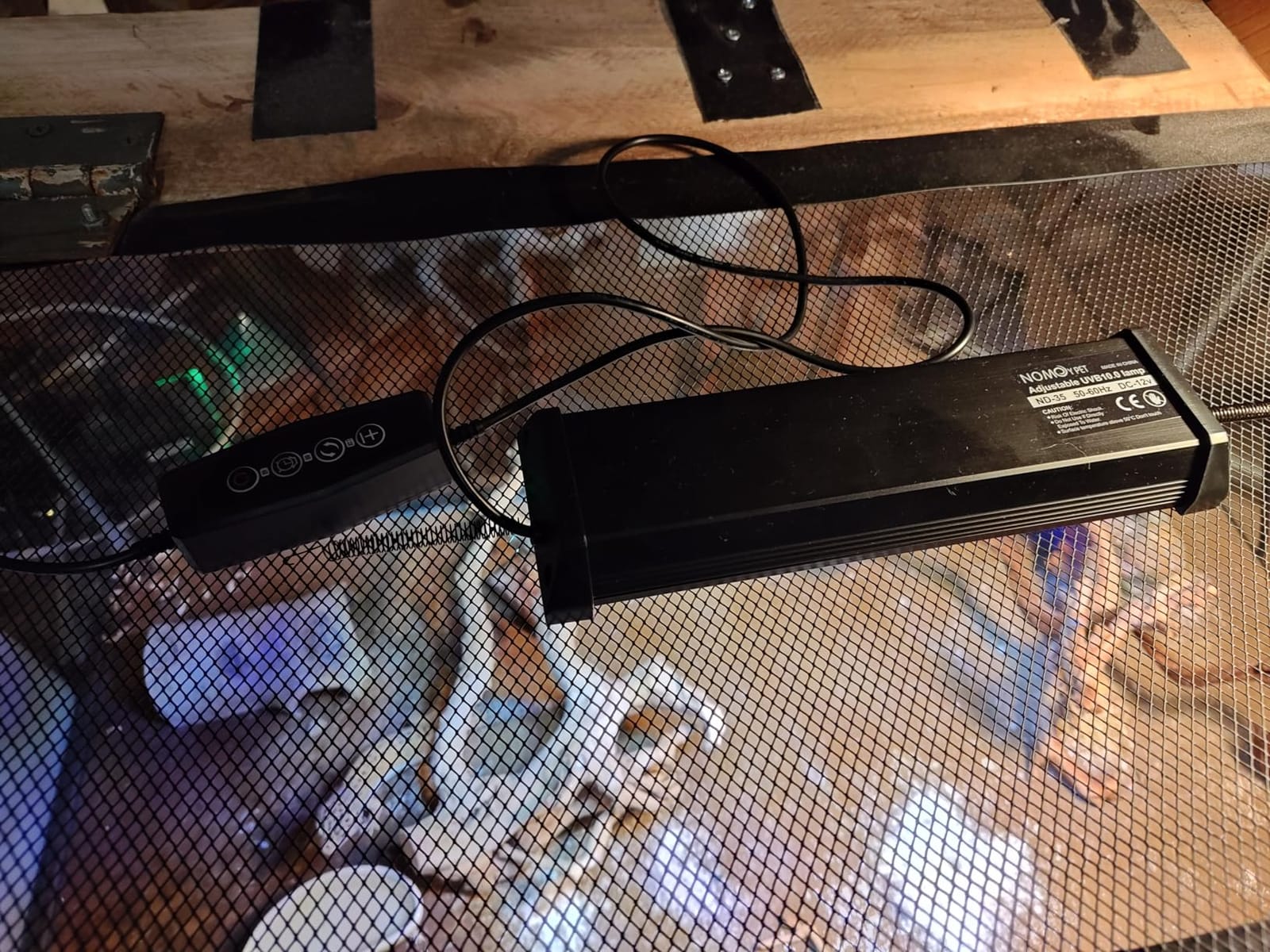
Lightweight at 1.12 pounds and 12.3 by 2.6 by 1.1 inches, it mounts easily to a screen frame or a wooden vivarium.
Chameleon Academy continues to advise beginners to stay on T5 fluorescents because UVB LEDs are still a developing technology, so this is a case where the specification sheet looks better than the field consensus. Reviewers also report that the real output tends to sit below what a comparable fluorescent tube delivers, so we would not build a new adult setup around this lamp alone.
Two hardware issues are worth knowing before you buy. The fixture runs hot to the touch during operation, and some fixtures lose the on/off switch after about eight months. The timer also resets to default whenever power is interrupted.
Best used as a supplementary or backup lamp
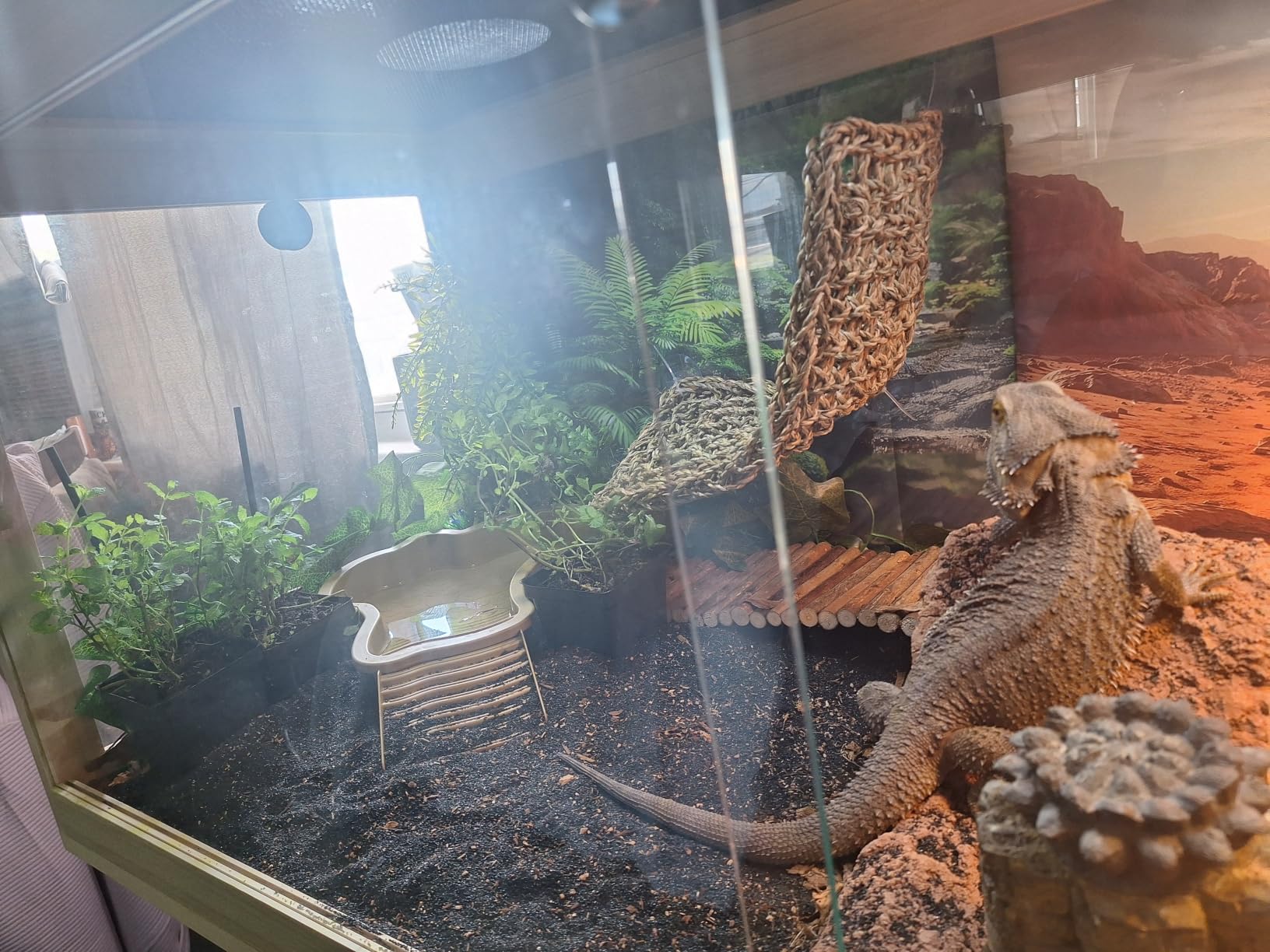
This lamp earns its place in a two-source setup, where a T5 HO tube does the heavy lifting on UVI and this one handles scheduling and top-up illumination. For juveniles in 12 inch enclosures, where a full sized fluorescent will not physically fit, it is a reasonable primary.
Because it runs cool and needs no ballast, it also makes sense in a bioactive planted vivarium where extra heat near the canopy is the last thing you want. There is a choice of 5 inch, 8 inch and 12 inch sizes, so measure your canopy width before ordering.
Who should skip it
Skip it if you are buying the single lamp that will define your chameleon’s UVB exposure. Field guidance still points to T5 HO fluorescents for a primary source, and this lamp’s own review base includes notes that its output runs lower than fluorescent tubes.
Skip it if you have any tolerance for scheduling friction. A timer that resets on power loss means re-dialing your photoperiod after every power cut.
5. Hygger Zoo LED UVB Fixture with Timer and Adjustable Brightness
UVB Light for Reptiles, UVA UVB Reptile Light Fixture with Timer LED UVB Bulb for Bearded Dragon Gecko Turtle Chameleon Lizard Snake, Adjustable Brightness UVB Lamp for Reptile Tank Accessories, Black
5W LED UVB fixture
Curved reflector, aluminium housing
5.12 x 5.08 x 3.94 inch package
Timer and dimming built in
Pros
- Lowest entry point of the kits we tested
- Built in timer and adjustable brightness
- Curved reflector improves distribution
- Aluminium housing dissipates heat
- Customer service has issued replacements
Cons
- UVB strength reported as lower than fluorescent tubes
- Timer resets when unplugged and the control module blocks external timers
- Some units fail after several months
This is the kit to look at when the budget is the deciding factor and the enclosure is small. It weighs 14.07 ounces, ships with a curved reflector, and has an aluminium body that handles heat better than the plastic housings common at this price point.
Like the Eckpo LED, it gives you a timer and adjustable brightness in a single unit, which removes a power strip from the top of the enclosure and makes the whole lighting arrangement tidier.
Two pack and colour options are available if you want a backup.
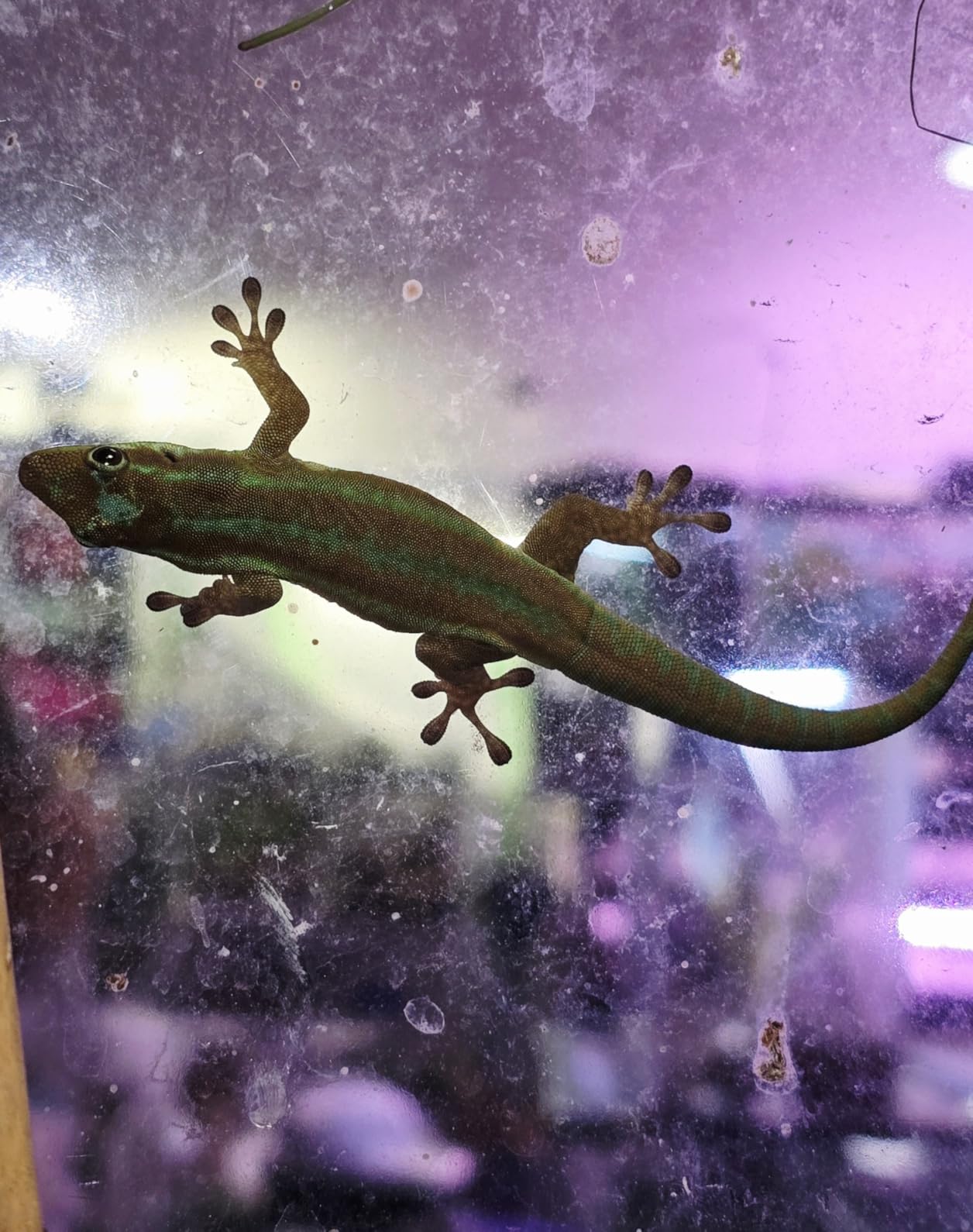
Be realistic about what it delivers. Reviewers repeatedly describe the UVB strength as lower than traditional fluorescent tubes, and we would not build an adult chameleon’s entire lighting plan around a 5W LED this small.
The inline timer design is the practical catch. It resets when unplugged, and the control module sits between the lamp and the outlet, which prevents you from plugging it into an external timer without cutting into the cable. For a keeper who already has a timer setup, that is a downgrade.
Where this kit makes sense in a setup
So think of it as a supplemental lamp for a screen-top setup where you are supplementing rather than replacing, or for a hatchling or juvenile in a small grow-out box while the permanent enclosure is still being built. The curved reflector and adjustable brightness let you aim it at a specific perch.
For a chameleon in an indoor rack system, a compact lamp like this leaves room above each cage without the depth of a T5 HO fixture. Measure the UVI at the branch before you trust it as the only source.
Who should skip it
Skip it for any adult chameleon whose UVB exposure depends on this single lamp. Lower output plus no reflector-grade concentration is exactly the combination that produces a quietly under-lit animal.
Skip it if you want third party safety certification markings, which are not visible on this unit. That matters more in a plastic housing that runs warm than it would on a metal fixture.
6. REPTI ZOO Switchable 22.6 Inch T5 UVB Combo Kit
REPTI ZOO Switchable UVB Light for Reptiles, 24W T5 UVB Light Combo Kit for Tropical & Desert Reptile, 22.6″ Terrarium Hood Lamp Fixture with UVB 10.0 Bulb for Bearded Dragon Snake Gecko Lizard Turtle
Switchable 10.0 desert and 5.0 tropical
22.6 inch T5 combo kit
Aluminium alloy shell with heat vents
One-button mode toggle
Pros
- One button switches between desert 10.0 and tropical 5.0 output
- Aluminium alloy shell with heat vents runs cool
- Flicker-free startup from the built in ballast
- A 34 inch version exists for larger enclosures
Cons
- Multiple reports of fixtures arriving not working
- Power cord switch placement is awkward in rack setups
- Bulbs still need replacing every 6 to 12 months
The switchable design is genuinely clever and we have not seen anything else like it on this list. One button toggles the fixture between desert 10.0 and tropical 5.0 output, so keeping a veiled chameleon and an inland bearded dragon in one room means no seasonal tube swapping.
Build quality is the reason it is in the roundup. The aluminium alloy shell with heat vents and the built in ballast that starts up without flicker feel like a step above the plastic fixtures at comparable prices.
At 22.6 by 22.6 by 1.3 inches and 1.5 pounds it suits a mid-size adult enclosure, and mounting options cover mesh, wood and screen frames.
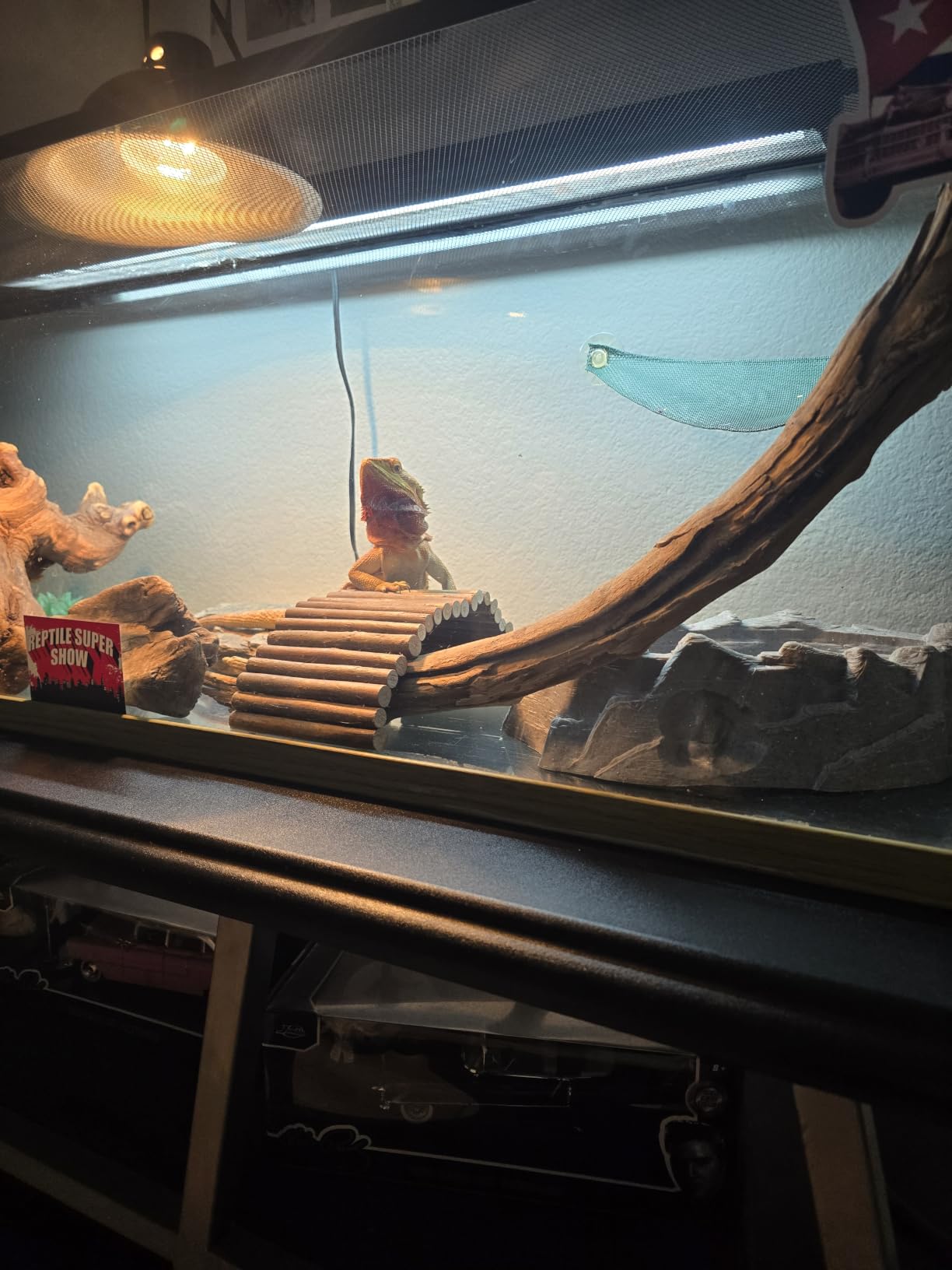
The quality control is uneven. Across 131 reviews the recurring complaint is fixtures arriving not working, and the fixture carries a higher share of one-star ratings than comparable products. Inspect and test it the moment it arrives rather than after you have built the enclosure around it.
The switch position on the power cable is also awkward if you run a rack, where cable routing down the back of a stack is already tight.
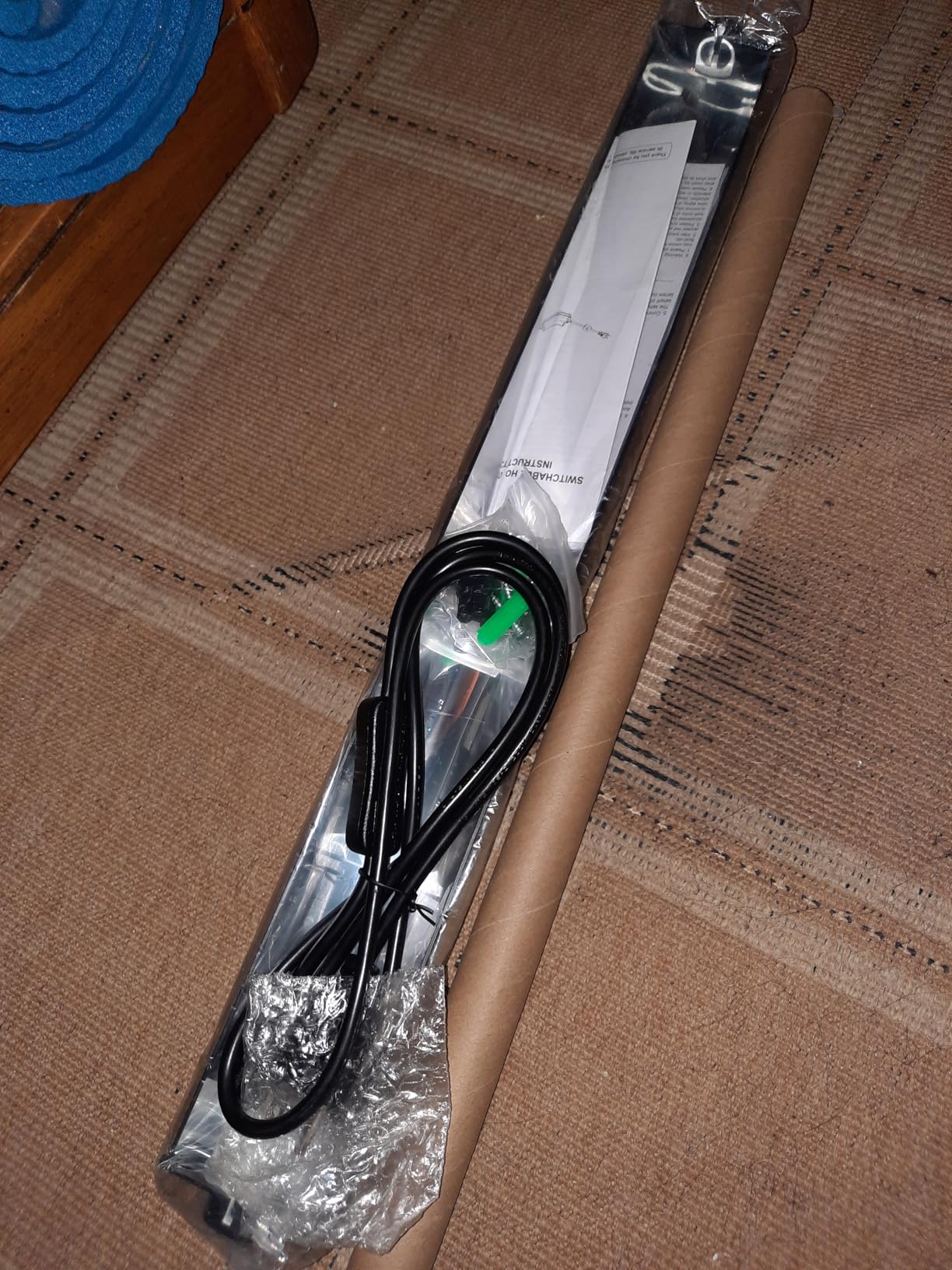
When the switch actually earns its keep
For a single-chameleon household it is a nice feature you will use maybe once. For anyone housing a tropical species alongside an arid one, it removes the single most common husbandry error of using one bulb for everything, and it does so without storing loose tubes next to your chameleon.
Note the defaults. Most fixtures ship in desert 10.0 mode, which is stronger than most chameleons need. Confirm the mode with a meter before you leave it running.
Who should skip it
Skip it if you have had ballast failures before and want the longest proven service life. The incandescent-style start and stop cycle of a T5 tube is well documented; this fixture’s review history is thinner.
Also skip it if you expect the switch to replace bulb changes. The tube still degrades with use and still needs replacing on the same 6 to 12 month cadence as any fluorescent.
7. REPTI ZOO 24W T5 HO UVB Kit with Detachable Reflector
REPTI ZOO 24W Reptile T5 HO UVB Lighting Combo Kit, 22″ Light Fixture Reptile Terrarium Hood, with Detachable Curved Reflector and 5.0 UVB T5 Lamp Bulb, ETL certificated
24W T5 HO fixture
22 inch detachable curved reflector
5.0 UVB T5 lamp included
ETL certified, 1.3 pounds
Pros
- ETL certified for electrical safety
- Detachable curved reflector concentrates output downward
- 24W T5 HO electronic ballast with 5.0 lamp included
- Removable power cord with an inline switch
Cons
- Plastic housing is less durable than metal
- Higher share of one-star reviews than comparable fixtures
- Reflector can detach when the unit is handled in transit
- Some ballast failures reported
With 424 reviews at a 4.0 average, this is one of the better field-tested fixtures in the roundup, and the only kit on this list with an ETL safety certification listed in its specifications. For a keeper who wants a 24W T5 HO system with a proper reflector and would rather not chase certification marks, it is the balance point of the whole list.
The 24W ballast drives a 5.0 UVB T5 lamp in a 22 inch hood, and the detachable curved reflector is what pushes the usable output toward the middle of the enclosure instead of the sides. Removable end caps protect the tube ends during handling.
We rate it best value for one reason: reflector and 24W ballast together usually cost more when bought separately, and here they arrive as a matched set.
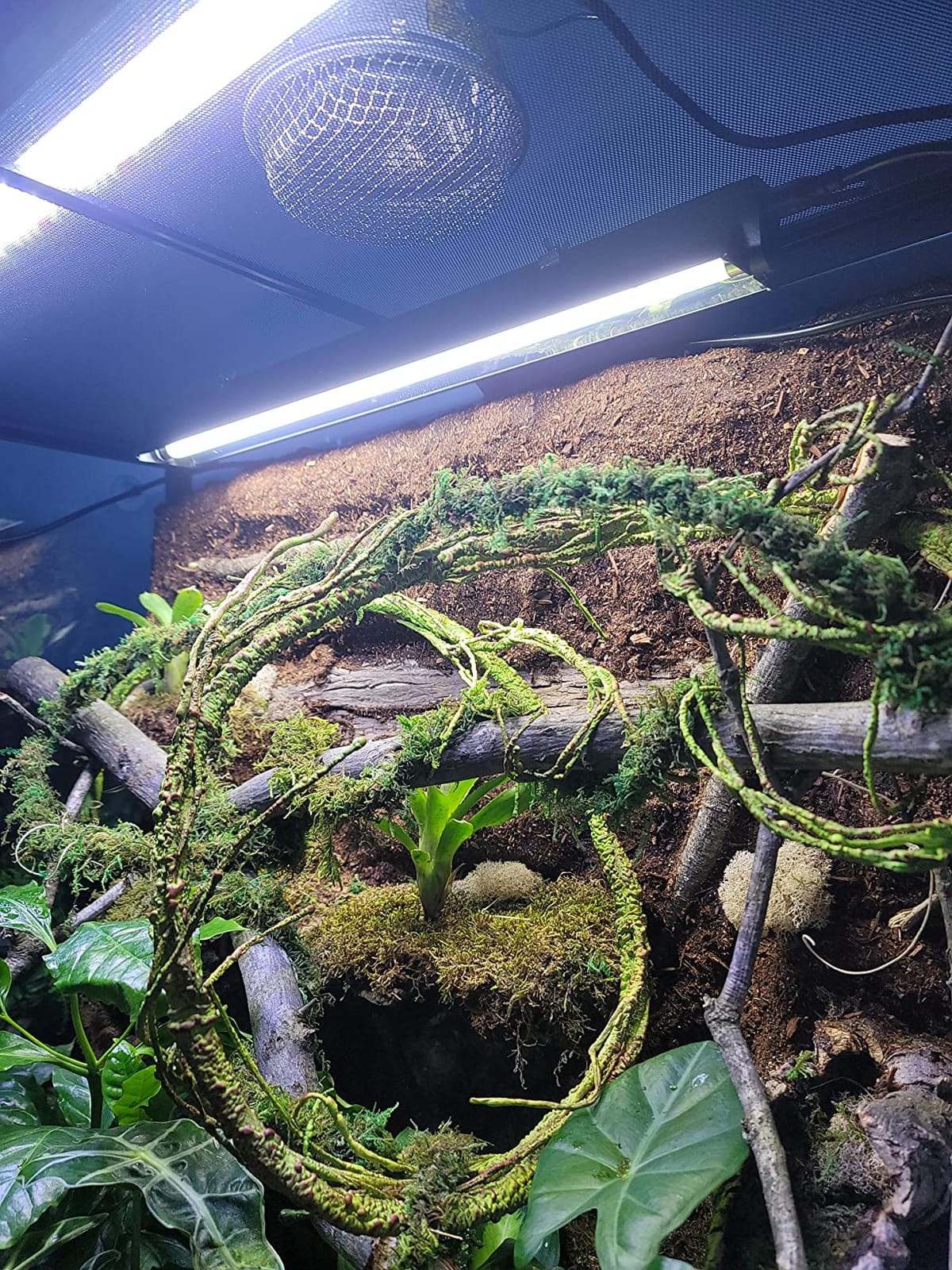
The plastic housing is the main mechanical complaint, and it is fair. In an enclosure that runs warm all day, plastic ages faster than the all-metal housings on the NEPTONION and Eckpo kits, and the reflector can pop off if the unit is knocked in transit.
Reviewers also report a higher share of one-star ratings than we would like to see on a kit at this level, mostly ballast failures. That is the single biggest reason this sits at number seven instead of second.
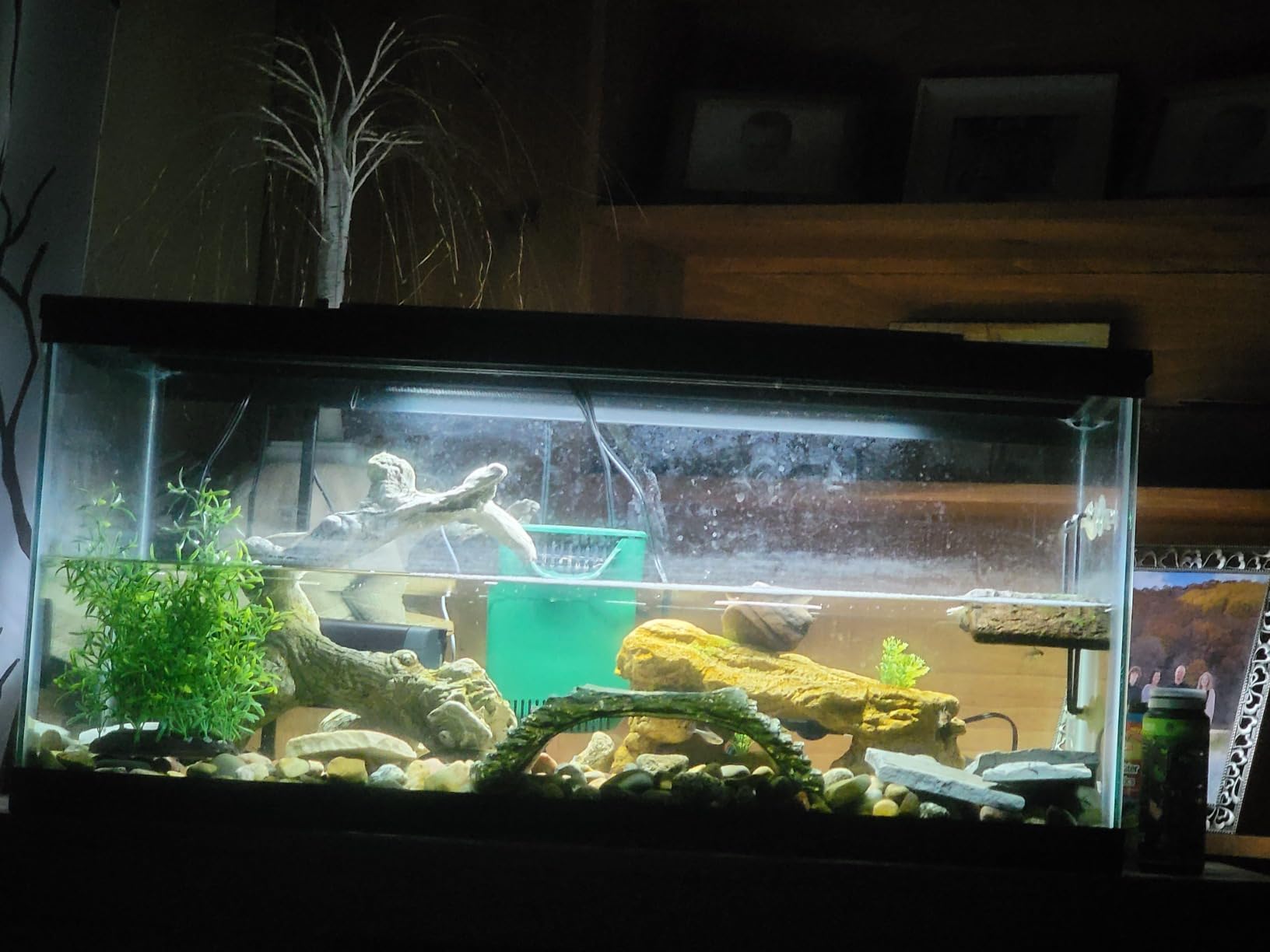
Checking this kit before it goes into the enclosure
Test the ballast for a full minute before mounting, and reseat the reflector until it locks. If the tube flickers continuously rather than only at startup, stop and use another fixture, because a failing ballast tends to take the tube with it.
Confirm the reflector is oriented along the length of the enclosure, not across it. Mounting the fixture horizontally along the enclosure width is what puts the basking branch inside the concentrated beam rather than at the edge of it.
Who should skip it
Skip it if you want an all-metal fixture that will survive a decade of racks and rebuilds. The metal housings on this list cost more up front and hold up better.
Skip it if your priority is the highest rated reviews. A 4.0 average with a visible ballast failure tail is a different risk profile from a 4.4 kit with a 1208 review base.
8. Eckpo 22.6 Inch T5 HO UVB Kit with 14W 5.0 Tube
Eckpo T5 HO UVB Reptile Light Kit, 22.6″ Fixture with 14W 5.0 UVB Tube, Suitable for Rainforest Reptiles Including Juvenile Green Iguanas
22.6 inch T5 HO fixture
14W 5.0 UVB tube included
Polished aluminium reflector
All-metal housing
Pros
- Metal housing resists warping and cracking
- Daisy-chain ready for multiple enclosures
- Polished aluminium reflector amplifies output
- Lower wattage suits smaller enclosures and closer mounting
Cons
- Newer brand with limited track record
- Some reports of flickering from tube pin seating
- Lower review count than the established brands
The 14W tube in a 22.6 inch all-metal fixture is the sensible middle ground for a juvenile or subadult chameleon in a 16 by 16 by 30 inch enclosure. Lower wattage means less heat near a small canopy and a more forgiving branch placement.
It has a polished aluminium reflector and a metal housing that resists the warping and cracking we see in plastic fixtures, and it is daisy-chain ready if your collection grows to two enclosures.
The listing positions it for shade dwellers through to desert species across its variants, which is a sign the manufacturer builds several ballast and reflector configurations rather than one.
How to mount it in a juvenile cage
In a 30 inch tall enclosure, mount this fixture so the tube sits 6 to 8 inches above the highest point of the basking branch. The 14W output reaches a useful level at that distance without forcing you to raise the fixture into the cage top.
If the tube flickers, the most common cause in reviews is tube pin seating rather than a failing ballast. Remove the lamp and reseat it in the socket before ruling the fixture faulty, and never leave a partially seated tube running.
Who should skip it
Skip it for an adult animal in a 2x2x4 enclosure. At 14W you would need to mount the fixture close to the branch, which leaves little room for a proper vertical gradient and pushes the animal toward the hottest zone.
Skip it if you need confidence from a large body of reviews. With 102 reviews on the listing, the long-term degradation data simply is not there yet.
9. LUCKY HERP 18 Inch T8 UVB Combo Kit with 10.0 Desert Tube
LUCKY HERP T8 Reptile Light Fixture Combo Kit 15W (New Upgrade), UVB Reptile Light Fixture with Desert UVB 10.0 18″ Fluorescent Tube, UVA UVB Reptile Light for Lizard, Bearded Dragon, Tortoise
T8 fixture with 15W tube
18 inch 10.0 desert UVB tube
Alloy metal reflector
Universal 100-250V
Pros
- Alloy metal reflector boosts claimed UVB and UVA output
- Universal voltage works across regions
- Multiple sizes from 12 to 46 inches
- Highest review volume of any kit in this roundup
Cons
- T8 technology is less efficient than T5 HO for chameleons
- 10.0 desert output is stronger than tropical chameleons need
- Marketed primarily for bearded dragons
- Plastic housing is less durable
We include this kit because its 808 reviews give it one of the largest hardware track records on this list, and because it is genuinely useful for an arid setup or a mixed collection. We would not run a tropical chameleon on the bundled tube.
The T8 format is the older, thicker tube, and the difference matters here. A T5 HO fixture concentrates more usable output through a smaller profile, which is why T5 is the standard for chameleon UVB and T8 is not.
The 18 inch dimension suits a mid-size enclosure, and the 100 to 250V universal range means the same unit works across regions if you travel or move.
The bundled tube is 10.0 Desert. That is a stronger output than most veiled, panther, Jackson’s and carpet chameleons need, and combining it with an already warm basking branch is the scenario most likely to produce an animal that avoids the lit zone.
The 200% output claim on the alloy reflector is a manufacturer figure and not something we have verified with a meter. Treat it as marketing.
When T8 is still the right call
If you are building an arid vivarium for an inland bearded dragon alongside a desert dwelling chameleon, the 10.0 output matches the animal. If your enclosure is an older wooden vivarium where a modern T5 bracket will not fit, a T8 combo can be the practical choice.
Universal voltage is the real strength. Keepers outside North America frequently cite being pushed toward unknown brands by limited specialist availability, and a fixture that works across regions removes one of those constraints.
Who should skip it
Skip it for a single tropical or forest chameleon. The included strength is wrong for the species and the older tube format wastes output you are already paying for.
Skip it if you are starting fresh. A T5 HO kit of the same length will give you more usable UVB for a similar outlay.
10. Jugbuy 22 Inch T5 UVB Kit with 24W 5.0 Tube
Jugbuy UVB Reptile Light Kit, 24W T5 Lamp Fixture and 5.0 UVB Tube Combo, Linear Lighting Bar Ideal for Tropical Reptiles Bearded Dragon Hermit Crab Turtle Leopard Gecko Tank Chameleons Iguanas Snake
22 inch T5 fixture
24W 5.0 UVB tube included
Pre-assembled tube
63 inch power cord
Pros
- Tube arrives pre-assembled in the bracket
- Polished curved reflector with aluminium heat dissipation
- Long 63 inch power cord with hanging accessories
- Protective plastic end caps on both tube ends
Cons
- Very low review count limits real world validation
- On and off switch sits far down the cord
- No legs so it rests directly on a screen lid
If setup simplicity is your top priority, this is the kit. The tube arrives pre-seated in the bracket, so there is no fitting, no orientation guesswork and no risk of putting the lamp in backwards, which is one of the recurring complaints on other listings.
Under the hood it is a competent 24W T5 kit with a polished curved reflector and aluminium heat dissipation, rated for up to 10000 hours of lighting life. The 63 inch power cord with hanging accessories is genuinely longer than most and solves the awkward cable run behind a screen enclosure.
There is also a 10.0 variant if you move to an arid species later.
The honest limitation is the sample size. Thirty-one reviews is not enough to tell you how this fixture behaves after two years of daily operation, and some owners report the protective coating on the tube peeling at the ends.
There are no legs, so it sits directly on a screen lid. In a tall enclosure, raise it on a stand rather than letting it rest on the mesh, or you will lose usable output through the screen.
Pre-assembled versus build-it-yourself
Pre-assembly is a real benefit when the alternative is guessing at tube orientation in a dark cupboard. It also means less handling of the lamp, and fewer cracked end caps.
The trade-off is that you cannot verify the reflector or ballast as easily before mounting. Give it a five minute burn-in test where you can see the whole tube before you raise it into position.
Who should skip it
Skip it if you want a deep review history to draw confidence from. This listing simply does not have one yet, and we would rather you knew that before ordering.
Skip it for a large adult enclosure. A 22 inch tube in a 24 by 24 by 48 inch cage leaves the ends of the basking range dark.
How to Choose the Right UVB Kit for Your Chameleon
Match the fixture length to your enclosure width first, because that decision constrains everything else. A tube should span most of the width so the animal can move along a branch without stepping out of the lit zone.
A 12 inch fixture suits a small grow-out box. A 14 inch hood covers a 16 by 16 inch enclosure. A 22 to 24 inch kit covers a 16 by 16 by 30 inch tank or half of a 24 inch wide cage. A 34 inch unit is for full width 2x2x4 enclosures and tall adult setups.
Next, choose the strength. For nearly every chameleon a 5.0 or 6% output is the right starting point, and for a first animal there is no reason to go higher. Chameleon Academy explicitly steers beginners toward 5.0 and 6% products.
Then check three physical details: does the fixture include a polished curved reflector, does the wattage match the ballast inside the housing, and does the tube fit your canopy clearance with room for a branch underneath.
Size the wattage to the distance you can actually achieve. A 24W tube needs roughly 8 to 14 inches of clearance below it to reach UVI 3. If your enclosure is too short for that, buy the lower wattage kit rather than cramming the bigger one in.
Finally, consider how the whole system is timed. UVB needs a 12 hour photoperiod, heat needs a separate halogen bulb on one side, and plants need a visible light source on a third timer. Reddit breeders commonly run a two-lamp T5 HO setup, one 6500K plant bulb and one UVB bulb, and it is a proven arrangement.
Pairing decisions matter more than most buyers expect. Our guide to softbox lighting kits for portrait studios covers the same principle from a different corner of the hobby, and the logic transfers: match the tool to the size of the space and verify the output rather than trusting a brand name.
5.0 vs 10.0 UVB: Which Strength Do You Actually Need?
Start at 5.0 or 6% for a chameleon. That is the level most sources recommend for veiled, panther, Jackson’s and carpet species, and it lets you place the basking branch at a sensible height instead of right under the tube.
The naming conventions are worth untangling. Zoo Med sells 5.0 and 10.0, and Arcadia uses percentages such as 6% and 12%. Those are the same two output classes under different labels: 5.0 sits alongside 6%, and 10.0 alongside 12%.
The persistent claim that veiled chameleons need 10.0 or 12% while panthers need 5.0 or 6% has been directly tested and does not hold up. Chameleon Academy reported veiled chameleons kept at UVI 3 and at UVI 6 both producing fully calcified clutches, with independent replication by Jonathan Hill on panther chameleons and a peer-reviewed carpet chameleon study by Dr. Michael Nash.
What the percentages do change is how much distance sits between the lamp and the branch. A stronger bulb lets you mount the fixture higher, which can help in a very tall enclosure. That is the real argument for 10.0 and 12%, and it only applies if your enclosure height leaves you no choice.
Can a chameleon get too much UVB? Very rarely, and mostly as a behavioural problem rather than a toxic one. An animal that avoids the brightest area and hangs back from the basking spot is a signal to raise the fixture or drop to a weaker bulb, not to add more light.
Kit Setup and Placement: Distance, Reflector and Photoperiod
Mount the fixture horizontally along the width of the enclosure, inside the frame if possible. An angled fixture throws most of its output at a wall, which is the most common placement mistake in new setups.
Set the basking branch 6 to 10 inches below a 14W tube, and 8 to 14 inches below a 24W tube. Branch height is the single control you have over intensity, and it is easier to adjust than the lamp.
Verify with a UV meter. A Solarmeter 6.5 reading around 3 at the branch means you are in range. Without a meter, the substitute test is straightforward: the branch should be where your chameleon chooses to sit for most of the day, and it should be noticeably warmer than the rest of the enclosure under the separate heat lamp.
Never put a 24W bulb into a 14W ballast. A moderator on Chameleon Forums documented this as a real and expensive error: the 24W 6% and 12% tubes simply do not work in a 14W ShadeDweller fixture and cannot be made to work safely.
The reverse pairing is more forgiving. A moderator also confirmed that ReptiSun bulbs can be used in Arcadia fixtures and Arcadia bulbs in ReptiSun fixtures, because the branded kits are interchangeable at the fixture level. ShadeDweller and ProT5 fixtures are the pair that are not interchangeable.
Run the UVB for 12 hours a day on a timer, and give the chameleon a real overnight temperature drop. If you are also running a plant light, Reddit breeders favour a two-lamp T5 HO arrangement with a 6500K plant bulb alongside the UVB tube.
Two details are easy to miss. A screen top absorbs roughly 30% of the UVB that hits it, so mount below or inside the frame rather than on top. And allow a 100 hour burn-in period after installation before you measure, because output climbs during that window.
What to Avoid: Kits and Bulbs That Fall Short
Avoid shade dweller 7% fixtures for chameleons. The UVB difference is smaller than the UVA difference, and that is where the damage shows. A 7% ShadeDweller tube puts out roughly 17% UVA against about 30% for a 6% ProT5 tube, and keepers have linked low UVA to visibly reduced appetite and reduced activity levels, symptoms most owners misread as temperament.
Avoid compact fluorescent bulbs. The bent-tube form throws a gradient too small and too short for a chameleon to use, which is why linear tubes are the standard.
Avoid any kit with no reflector. Chameleon Academy puts the loss without one at roughly 25% of the directional output, which in practice means the difference between hitting your target and missing it.
Avoid unknown brands with no specification sheet. If a listing does not state the bulb wattage, the ballast type and the UVB percentage, you cannot compute whether the numbers work together.
Avoid buying a 10.0 or 12% tube for a tropical chameleon because the listing calls it stronger. Stronger is only better if you can use the extra distance.
And avoid judging UVB by whether the lamp still glows. A fluorescent tube can light up perfectly while producing far less usable UVB than it did in month one. Keepers consistently assume a working bulb still works, and that assumption is the most common cause of slow-onset bone problems.
Signs Your Chameleon Is Not Getting Enough UVB
The first and most common sign is posture. A chameleon that spends most of the day flattened against a branch rather than sitting upright under the light is telling you something. Compare where it sits before and after you correct the distance.
Feeding response comes next. Chasing prey and taking food readily depends on UVB-driven activity through UVA exposure, so a chameleon that stops hunting or refuses a feeder it used to accept should be checked against its lighting first.
Later signs are skeletal and serious: a soft or swollen lower jaw, bowed limbs, or a rubbery bend in the tail. These appear after months of inadequate calcium absorption, which is why the early behavioural signals matter so much more than the dramatic ones.
Breeding females show it earlier than most. A female carrying eggs has the highest calcium demand of any chameleon, and inadequate UVB is one of the more common reasons keepers end up with a clutch that cannot be laid down normally.
Bulb Lifespan and Annual Cost of Ownership
T5 fluorescent UVB tubes are typically replaced every 6 to 12 months. Keepers report roughly a year from Arcadia tubes and closer to six months for ReptiSun, though both are equally rated for adequacy while they are working.
The practical habit that solves this is buying two lamps at once and keeping one spare, so you are never without UVB during a replacement cycle. It also means you can compare the new tube against the old one under the same fixture on the same day.
Expect a 100 hour burn-in after any bulb change before measuring output, and expect visible output decline well before the tube goes dark. Annual running cost is essentially two replacement tubes per kit, plus a halogen heat bulb on the same schedule.
The LED kits on this list change that calculation. The Eckpo LED is rated at 8000 hours for its UVB module, which is many years of normal operation. That is a genuine long-term saving, offset by the fact that field guidance still treats T5 fluorescents as the safer primary choice.
One last cost consideration: a fixture failure kills the bulb with it far more often than a bulb failure alone. On plastic-bodied kits, keep a spare tube on hand for that reason alone.
Frequently Asked Questions
What is the best UVB light for a chameleon?
The best UVB lighting kit for a chameleon is a T5 high-output linear fluorescent fixture with a 5.0 or 6% UVB bulb and a polished curved reflector, mounted horizontally above the enclosure so the basking branch sits 6 to 14 inches below the tube. Aim for a UV Index of about 3 at the branch and verify it with a meter. Size the fixture to span the enclosure width.
Do chameleons need an UVB light?
Yes. UVB between roughly 280 and 300 nanometers lets a chameleon’s skin synthesize vitamin D3, which is what allows the gut to absorb calcium from feeder insects. Without enough UVB, calcium passes through unused and the animal develops metabolic bone disease, the most common preventable cause of death in captivity.
Can a chameleon get too much UVB?
Very rarely. UVB is self-limiting, because skin stops producing D3 once it has enough, so overdose is difficult. Too much UVB usually shows up behaviourally, as a chameleon avoiding the brightest area or hanging back from the basking spot. The fix is to raise the fixture or switch to a weaker bulb, not to add more light.
What is the difference between 5.0 UVB and 10.0 UVB?
They are the same two output classes under different naming conventions. Zoo Med sells 5.0 and 10.0 while Arcadia uses percentages such as 6% and 12%. The higher strength lets you mount the fixture further above the branch, which matters in a very tall enclosure. For most chameleons in a normal cage, 5.0 or 6% is the right starting point.
Can I use an Arcadia bulb in a ReptiSun fixture?
Generally yes. A moderator on Chameleon Forums confirmed that ReptiSun bulbs can be used in Arcadia fixtures and Arcadia bulbs in ReptiSun fixtures, because the branded kits are interchangeable at the fixture level. ShadeDweller and ProT5 fixtures are the pair that are not interchangeable. Never fit a 24W bulb into a 14W ballast.
Conclusion
The best UVB lighting kits for chameleons all share three things: a T5 high-output tube, a bulb in the 5.0 or 6% range, and a reflector that concentrates the output downward onto a branch you can measure. Get those three right and the brand matters far less than the placement.
Our pick is the Zoo Med 5.0 T5-HO hood with the ReptiSun 5.0 lamp, backed by the largest review base here. Move up to a 24W kit for a 2x2x4 enclosure, and step up in width rather than in strength as your animal grows.
Whatever you choose, measure UVI at the basking branch after installation, allow for the 100 hour burn-in, and keep a spare tube on hand. Those three habits prevent more bone disease than any brand choice on this list.
Related reading: our picks for track lighting kits, portable dance floor lighting kits and beauty dish lighting kits cover the same fixture-matching logic in other rooms.