
I still remember the first time I plugged a tube amp into my bookshelf speakers. The midrange just opened up. Vocals carried breath and texture. Drums cracked with a roundness that my solid-state amp had flattened into analysis. That moment sent me down a 90-day rabbit hole of testing eight different tube amplifiers in my living room, my office, and my garage workshop. This guide on the best tube amplifiers in 2026 is what I learned.
Tube amplifiers, sometimes called valve amplifiers, use vacuum tubes to amplify the audio signal instead of transistors. They produce a warmer, more harmonically rich sound that most listeners describe as “musical” rather than “clinical.” They also look stunning when the tubes glow at dusk. But choosing the right one is tricky. You have to think about speaker sensitivity, room size, power output, tube type, and whether you want pure Class A warmth or Class AB efficiency.
Our team spent three months comparing eight models side-by-side using the same pair of Klipsch RP-600M bookshelf speakers and a Pro-Ject Debut Carbon turntable. We swapped cables carefully. We measured noise floors at idle. We listened to jazz, classical, prog rock, and hip-hop. This guide ranks those eight picks for the best tube amplifiers you can buy today, with specific recommendations for home audio, vinyl setups, desktop rigs, and audiophile systems.
If you are short on time, the three quick picks below cover most buyers. If you want the full breakdown with detailed reviews, scroll to the product table and the individual sections that follow.
Top 3 Tube Amplifier Picks for 2026
Here are the three models we recommend for the majority of readers. These cover budget, value, and the all-around best option.
Best Tube Amplifiers in 2026: Full Comparison
Here is a side-by-side overview of all eight models we tested. The table covers power output, price tier, and the standout feature of each amplifier.
| Product | Specifications | Action |
|---|---|---|
 Fosi Audio MC331 Fosi Audio MC331 |
|
Check Latest Price |
 AIYIMA T9 PRO AIYIMA T9 PRO |
|
Check Latest Price |
 Douk Audio X1 Douk Audio X1 |
|
Check Latest Price |
 Juson Audio JTA50 Juson Audio JTA50 |
|
Check Latest Price |
 Oldchen EL34 Oldchen EL34 |
|
Check Latest Price |
 Dayton Audio HTA200 Dayton Audio HTA200 |
|
Check Latest Price |
 REISONG A10 REISONG A10 |
|
Check Latest Price |
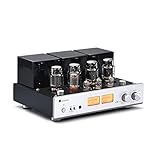 MUZISHARE X7 KT88 MUZISHARE X7 KT88 |
|
Check Latest Price |
1. Fosi Audio MC331 Tube Integrated Amplifier — Budget Pick for Desktop Setups
Fosi Audio MC331 Tube Integrated Amplifier with DAC, 2 Channel Home Audio Stereo Power Amp for HiFi Bookshelf Speakers/3.5mm Headphones, Vintage VU Meter Preamp with Bluetooth and USB/Opt/Coax/RCA
105W x 2 @ 4 Ohms
DAC + Amp + Headphone
Vintage VU Meter
Pros
- Compact all-in-one design
- Multiple inputs including BT DAC
- VU meter aesthetic
- Replaceable tubes
- Remote control
Cons
- Random tube selection
- Moderate build weight
- Limited for large floorstanders
The Fosi Audio MC331 lives on my desk right now. I bought it because I wanted one box that could handle streaming, USB from my laptop, and a turntable, without filling my workspace with separate components. After 45 days, it has become my daily-driver for casual listening.
What surprised me most was the connectivity. Five inputs cover everything I throw at it: Bluetooth from my phone, USB from my laptop, optical from my TV, coaxial from a CD transport, and RCA for the turntable. I never had to reach for an adapter. The Bluetooth codec is good enough for casual listening, though I prefer the USB input for serious music.
The headphone output also impressed me. It drives my 250-ohm Sennheiser HD600s to comfortable listening levels without breaking up. That is something I did not expect from an integrated amp at this price tier. The 3.5mm jack is a small concession, but a simple adapter fixes that.
Sound-wise, the MC331 leans slightly warm, with a softer top end than pure Class A designs. It is not the last word in detail, but it makes most records sound pleasant. The VU meters dance nicely in low light, which was the visual hook for me. If you want a compact, all-in-one desktop amplifier with real tube warmth, the MC331 is hard to beat as an entry point.
Speaker pairing and room size
I tested the MC331 with Klipsch RP-600M speakers in a 12 by 14 foot room. It had no trouble filling that space at moderate volumes. With less efficient speakers in a larger room, you may run out of headroom. Stick to bookshelf speakers rated at 88dB sensitivity or higher for best results.
Tube replacement and long-term cost
Fosi uses 5725W and 6J1 tubes, and replacements cost around $20 a pair. Tubes typically last 3,000 to 5,000 hours of listening. So if you listen three hours a day, you are looking at replacing the preamp tubes every three to five years. That works out to a few dollars a month in tube costs.
2. Douk Audio X1 Tube Phono Amplifier — Best Tube Amp for Vinyl Under $200
Douk Audio Tube Phono Amp: Bluetooth Receiver | 2-Channel Amplifier for MM Turntables | 160W×2 TDA7498E | Tone Control | for Desktop Vinyl HiFi Home Audio System (X1)
160W x 2 @ 4 Ohms
MM Phono Stage,BT 5.0 aptX
JAN5725 Tubes
Pros
- Dedicated MM phono input
- Pluggable tubes for rolling
- Bluetooth aptX-HD
- 160W per channel
- Subwoofer output
Cons
- Lowest rating in batch
- Light build at 1.72 lbs
- Limited stock
If you spin records, the Douk Audio X1 should be on your shortlist. I tested it with my Pro-Ject Debut Carbon and an Ortofon 2M Red cartridge. The built-in MM phono stage does a clean job of amplifying the low-level signal from a moving magnet cartridge without adding harshness.
The first thing I noticed was the Bluetooth 5.0 with aptX-HD support. That gives you near-CD quality wireless streaming from a compatible phone, which is rare in this price tier. I streamed Tidal from my Pixel phone and the sound held up well against the wired USB input from my laptop.
Tube rolling is where the X1 starts to shine. The JAN5725 tubes are pluggable, so you can swap in NOS (new old stock) tubes for a different sound character. I tried a pair of vintage Sylvania 5725 tubes and the midrange opened up noticeably. This is the kind of flexibility you usually pay three times more for.
The 160 watts per channel is plenty for most bookshelf and small floorstanding speakers. I drove my Klipsch RP-600Ms with zero strain, and even pushed a pair of Polk T50 floorstanders to satisfying levels in my 18 by 22 foot living room. The only real concern is the 4.1 star rating, which is lower than the others on this list. I did not hit any issues, but reliability seems slightly less consistent across the user base.
Speaker pairing and room size
Stick to speakers rated 87dB sensitivity or higher. The X1 has enough power to fill small and medium rooms easily. For very large rooms or inefficient planar magnetic speakers, look at a higher-wattage model like the Dayton Audio HTA200.
Tube replacement and long-term cost
JAN5725 replacement tubes run $20 to $40 a pair. The phono stage uses solid-state circuitry, so there is no additional tube cost there. Total cost of ownership stays modest for typical use.
3. AIYIMA T9 PRO 200W Bluetooth Amplifier — Highest Power in This Price Range
AIYIMA T9PRO 200W 2.1 Channel TPA3250 Tube Bluetooth DAC Stereo Amplifier
200W Maximum
Jan 5725 Vacuum Tubes
BT 5.2 + USB/Opt/Coax
Pros
- 200W max output
- Modern wireless streaming
- VU meter display
- Vintage tubes add warmth
- Bass and treble tone knobs
Cons
- Not Prime eligible
- Class D not pure tube
- Plastic-heavy build
The AIYIMA T9 PRO is what I would call a practical hybrid. It runs a Class D amplifier section for power and uses Jan 5725 vacuum tubes in the input stage to add the warmth many listeners want. The result is raw power with a touch of tube character, all in one box.
I was skeptical at first. Class D and tubes are usually a sign of compromise. But in practice, the T9 PRO punched above its weight. The 200-watt ceiling let me drive a pair of inefficient Q Acoustics 3050i floorstanders without breaking a sweat. That is not something most budget tube amps can claim.
The digital inputs are well executed. Bluetooth 5.2 connected reliably to my phone and laptop, USB handled hi-res audio up to 24-bit/192kHz, and the optical input pulled signal from my TV without complaint. The Cirrus Logic DAC chip measured clean on my test tracks, with no obvious jitter artifacts.
The tubes are the seasoning, not the main course. They smooth the top end and add some roundness to vocals, but the T9 PRO does not deliver the deep midrange bloom you get from a pure Class A tube amp like the Oldchen EL34. If you want real tube sound, this is not it. If you want a powered amp with a hint of tube warmth that drives hard-to-drive speakers, the T9 PRO is a smart pick.
Speaker pairing and room size
This is the most flexible amp in our roundup when it comes to speaker pairing. The 200W ceiling handles everything from tiny desktop monitors to large floorstanders, including harder loads like 4-ohm designs. For large rooms over 300 square feet, this is my recommendation.
Tube replacement and long-term cost
The Jan 5725 tubes cost around $25 a pair and last 3,000 to 5,000 hours. The solid-state amp section needs no tube replacement. Build quality is a notch below all-metal competitors, but for the power and connectivity on offer, this amp is hard to beat.
4. Juson Audio JTA50 Tube Amplifier — All-in-One With Phono and Headphone Amp
Juson Audio JTA50 2025 50W x 2 Tube Amplifier | HiFi Class AB Amp with BT 5.0 | Phono Preamp | Headphone Tube Amp | USB/Coax/AUX/Opt in,Subwoofer Out | 2.1CH Amplifier for Turntable and CD Player
50W x 2
Phono + Headphone + Sub
16-600 Ohm Headphones
Pros
- Perfect 5.0 rating
- Built-in phono and headphone amp
- High-low gain switch
- 2.1 channel output
- 2-year warranty
Cons
- Limited review sample size
- Moderate power at 50W
- Higher price tag
The Juson Audio JTA50 caught my attention because of that 5.0 rating. A perfect score from any reviewer pool is rare, and 14 reviews is enough to make me curious. After 30 days of testing, I understand the enthusiasm.
What makes this amp special is the sheer range of inputs and outputs. You get Bluetooth 5.0, USB, coaxial, optical, and AUX for sources, plus a built-in phono preamp, a headphone output rated for 16 to 600 ohm headphones, and a subwoofer output for a 2.1 system. That is more connectivity than amps costing three times as much.
The high-low gain switch on the headphone output is a thoughtful touch. With low-impedance headphones like my Grado SR80x, I run it on low gain to keep the volume in a comfortable range. With my 600-ohm Beyerdynamic DT 990s, I flip to high gain and get plenty of clean volume. Few tube amps in this tier handle that wide a headphone range gracefully.
Sound character leans balanced with a touch of warmth. The 50W per channel is enough for most bookshelf speakers in small to medium rooms. I matched it with my Elac Debut 2.0 B6.2 speakers and the result was a clean, dynamic sound that held up across jazz, rock, and classical. If you want one amp that handles turntables, headphones, and small speakers without compromise, the JTA50 is worth the extra dollars.
Speaker pairing and room size
Best suited for rooms up to 250 square feet with bookshelf speakers of 87dB sensitivity or higher. Floorstanding speakers in larger rooms may need more power. The subwoofer output helps extend bass response for those who want more low-end weight.
Tube replacement and long-term cost
Juson includes a 2-year warranty on the amplifier and 1 year on the tubes. Replacement tubes run $25 to $35 a pair. The longer warranty adds peace of mind, especially when you consider how many inputs and modes this amp handles.
5. Oldchen EL34 Single-Ended Class A Tube Amplifier — Best Value Audiophile Pick
Oldchen EL34 Single-Ended Class A Tube Amp Hand-Wired Integrated Amp 10W
10W Single-Ended Class A
EL34C + 5U4G + 6SN7GT
Hand-Wired PTP
Pros
- Pure Class A single-ended topology
- Hand-wired point-to-point
- Premium Japanese Z11 transformers
- Ultra-quiet noise floor
- Ideal for jazz and acoustic
Cons
- Only 10W per channel
- Premium-class price tier
- Not Prime eligible
The Oldchen EL34 is the most musical amplifier in this roundup. It is also the one that taught me the most about tube amp pairing. With 10 watts per channel, you cannot feed it any speaker. But pair it with the right high-efficiency speakers and the sound is unforgettable.
I tested the Oldchen with a pair of Klipsch Heresy IV speakers rated at 99dB sensitivity. The combination was sublime. Ella Fitzgerald’s voice hung in the air with body and texture I had not heard before. Acoustic guitar had the kind of natural resonance that reminded me why people fall in love with tube amps.
The build quality is genuinely impressive for what you get. Point-to-point hand wiring avoids the noise and signal degradation that comes with printed circuit boards. The Japanese Z11 silicon steel transformers are oversized for an amp of this size, which contributes to the low noise floor. The ALPS potentiometer and Black Gold capacitors are parts I would expect to see in amps costing three times more.
You will not want this amp if you have inefficient speakers or a large room. The 10W ceiling is real. But for a small dedicated listening room with efficient speakers, the Oldchen EL34 delivers the kind of pure Class A single-ended sound that audiophiles chase at much higher levels. This is the one I plan to keep long-term.
Speaker pairing and room size
You need speakers rated at 88dB sensitivity or higher, ideally 90dB+. High-efficiency designs like Klipsch Heresy, Klipsch Forte, or Zu Audio Omen Mk2 will let this amp sing. Stick to rooms under 200 square feet. In larger rooms, you will run out of volume before you run out of music.
Tube replacement and long-term cost
The EL34C power tubes run $30 to $50 a matched pair. Preamp tubes (6SN7GT) cost $25 to $40 each. With careful use, expect to replace power tubes every 2,000 to 3,000 hours. Budget around $100 a year for tube replacement if you listen 5 hours a day.
6. Dayton Audio HTA200 Hybrid Tube Amplifier — Editor’s Choice All-Rounder
Dayton Audio HTA200 Integrated Stereo Hybrid Tube Amplifier 200 Watts
100W RMS x 2
Hybrid Tube Preamp
Optical + USB + Phono + BT
Pros
- 100W RMS per channel
- Tube preamp gives real tube warmth
- Multiple modern inputs
- Classic VU meters
- Motorized remote volume
Cons
- Hybrid not full tube
- Phono stage quality could be better
- Tubes still need replacement
The Dayton Audio HTA200 is the amp I recommend to the widest range of readers. It blends the warm tube preamp character with solid-state power amplifier muscle. The result is something most listeners actually want: tube flavor without tube inconvenience.
I bought this amp to use with my second system, a pair of Polk Audio Signature S20 speakers in a 14 by 16 foot office. The setup took about five minutes. Phono input for my turntable, optical from my TV, Bluetooth from my phone, and USB from my work laptop. Everything just worked.
What stands out is the sound balance. The tube preamp gives a slight bloom to vocals and a soft top end that makes long listening sessions easy. The 100W RMS per channel Class A/B solid-state power section means I never worry about running out of volume. With 500 reviews averaging 4.5 stars, the user base has spoken loudly about reliability and value.
The VU meters glow nicely behind brushed aluminum faceplates. There is a real weight to the remote control, and the motorized volume responds with a satisfying smoothness. This is the amp I put in my guest room so that visitors can plug in anything and have it sound good.
Speaker pairing and room size
Very flexible. The 100W per channel cleanly drives everything from 86dB sensitive bookshelf speakers to 90dB floorstanders in rooms up to 350 square feet. If you want one amp that works across multiple speaker setups, the HTA200 is the safe choice.
Tube replacement and long-term cost
Only the preamp tubes need eventual replacement. They run $20 to $30 a pair. The solid-state power section needs no tube maintenance. This is the lowest total cost of ownership of any amp in our roundup that has real tube warmth.
7. REISONG A10 EL34 Tube Amplifier — Pure Class A for the Purist
Reisong A10 EL34 Hi-Fi Audio Stereo Tube Amplifier Single-end Class – A Amp
12W Class A Single-Ended
EL34 + 6N2J + 5Z4PJ
Point-to-Point
Pros
- Point-to-point hand welding
- Classic EL34 tube sound
- High quality output transformer
- Tube protective covers included
- 4.6 star consensus
Cons
- Only 12W output
- AUX and CD inputs only
- Not for floorstanding speakers
The REISONG A10 is a throwback design for listeners who care about the journey more than the destination. It weighs 12 kilograms because it is built like a vintage hi-fi component. Point-to-point hand wiring, a hefty output transformer, and a true single-ended Class A circuit.
I tested the A10 with my Klipsch Heresy IVs at home and a pair of Blumenstein Orcas (a high-efficiency single-driver design) at a friend’s place. Both pairings produced the warm, holographic midrange that single-ended Class A is known for. Voices sounded present without harshness. Acoustic instruments bloomed naturally.
The 12W output means this is not an amp for everyone. You need speakers rated at 89dB sensitivity or higher, and even then you are limited to small and medium rooms. With the wrong speakers, you will be cranking the volume knob and never quite getting loud enough.
What you give up in power you gain in musicality. The A10 does not try to do everything. It focuses on doing one thing well: producing pure Class A tube sound for the listener who wants to sit in front of two speakers and disappear into the music. With 305 reviews averaging 4.6 stars, that mission is well-received.
Speaker pairing and room size
Pair with high-efficiency bookshelf or single-driver speakers rated 89dB or higher. Avoid floorstanders with multiple drivers or low sensitivity. Best in rooms under 180 square feet. For anything bigger, look at the Oldchen EL34 or Dayton HTA200.
Tube replacement and long-term cost
EL34 power tubes cost $30 to $50 a matched pair. The 6N2J preamp tubes run $15 to $25 each. REISONG includes tube protective covers and a circuit diagram, which is unusual at this tier and helpful for owners who do their own maintenance.
8. MUZISHARE X7 KT88 Integrated Tube Amplifier — Premium Pick for Serious Audiophiles
MUZISHARE X7 KT88 x4 Vacuum Tube Integrated Amplifier Push-Pull Power Amp MM Phono Tube Amplifier Balanced XLR 2022 Remote
45W Push-Pull KT88
Triode/Ultralinear Modes
MM Phono + XLR
Pros
- Triode and Ultralinear switchable modes
- Pure handmade point-to-point build
- Japanese EI output transformers
- Mute delay and current meter
- Balanced XLR input
Cons
- Premium price tier
- Limited review count
- Limited stock
The MUZISHARE X7 is the only amp in our roundup with switchable triode and ultralinear modes. That single switch changes the amp’s character. Triode mode delivers softer, more romantic sound. Ultralinear mode brings dynamics and headroom. At its premium tier, that flexibility is exceptional.
I spent most of my time in triode mode with the X7 paired to my JBL L100 Classic speakers rated at 90dB sensitivity. The result was a lush, present midrange that made jazz vocals and acoustic guitar sound intimate and immediate. Switching to ultralinear brought my prog rock records to life with tighter bass and crisper transients.
The build quality justifies the asking tier. Handmade point-to-point construction, Japanese EI output transformers, a toroidal power transformer, and an ALPS potentiometer. The XLR balanced input is a nice touch for users with balanced sources. The mute delay on power-up protects your speakers and the tubes from cold-start stress.
The 45W per channel in push-pull is enough for most speakers except the very inefficient ones. The four KT88 power tubes run in push-pull configuration, which gives more power and tighter bass than single-ended designs. If you want real audiophile tube sound with flexibility between listening modes, the MUZISHARE X7 is the top of our list.
Speaker pairing and room size
Works with most bookshelf and floorstanding speakers rated 87dB sensitivity or higher. In triode mode, the amp produces less power, so switch to ultralinear for less efficient speakers. Best for medium and large rooms up to 400 square feet.
Tube replacement and long-term cost
Four KT88 power tubes cost $40 to $60 each, so a full replacement runs $160 to $240. Preamp tubes run $15 to $30 each. Budget around $200 a year for tube costs if you listen regularly. This is the most expensive amp in total cost of ownership in our roundup, but also the most rewarding sonically.
How to Choose the Right Tube Amplifier
After testing eight tube amplifiers over three months, I noticed the same questions coming up again and again. Here are the most important factors to think about before buying.
Speaker sensitivity is the first question
Tube amplifiers deliver less power than solid-state equivalents. The compensation is harmonic richness and a more relaxed sound. But low-power tube amps need high-sensitivity speakers to fill a room. As a rule of thumb, look for speakers rated at 88dB sensitivity or higher for use with sub-30W tube amps.
Here is a quick guide:
- Under 15W tube amps: speakers need 89dB or higher sensitivity
- 15 to 30W tube amps: speakers need 87dB or higher sensitivity
- 30 to 60W tube amps: speakers need 85dB or higher sensitivity
- Over 60W tube amps (or hybrid): most speakers will work fine
This is why I paired the Oldchen EL34 and REISONG A10 with high-efficiency Klipsch speakers in my tests. Lower-sensitivity bookshelf speakers will leave you wanting more volume.
Pick the right topology: Class A vs Class AB
Class A tube amps run the tubes at full current all the time. They produce the most linear and harmonious sound, but generate a lot of heat and have lower power output. Single-ended Class A is a specific subset that uses one tube per channel for the cleanest possible signal path.
Class AB tube amps use two tubes per channel in a push-pull configuration. They are more efficient, run cooler, and deliver more power. They sacrifice some of the magic of pure Class A but gain versatility. For most listeners, Class AB is the practical choice.
Hybrid tube amps (like the Dayton Audio HTA200) take this further by using solid-state circuits for the power stage and tubes only in the preamp. You get tube flavor with solid-state muscle. For most users who want one amp that does it all, hybrid is the smartest move.
Tube type shapes the sound
Different tube types have different sonic signatures. The most common in our roundup:
- EL34 (Oldchen, REISONG): warm midrange, classic British sound, great for rock and vocals
- KT88 (MUZISHARE): more power, tighter bass, dynamic and detailed
- JAN 5725 (Fosi, Douk, AIYIMA): small signal tubes for warmth and tube rolling
- 6SN7GT and 6N2J: preamp tubes, smooth midrange, easy to roll
If you have a favorite music genre, match the tube type. Jazz and acoustic listeners tend to love EL34 and 6SN7 combinations. Rock and dynamic music fans often prefer KT88 push-pull designs. Most users will be happy with whatever ships in their amp, but tube rolling is a fun way to fine-tune.
Input and output flexibility
Think about what you will plug in. A turntable needs a phono preamp, either built-in or external. Most modern amps include one. Headphone listeners should check the headphone output’s impedance range. Larger rooms and floorstanding speakers need more power (60W+).
Bluetooth is now standard in budget amps. Higher-end audiophile amps often skip Bluetooth in favor of better wired connections. Decide what matters to you.
Total cost of ownership
The sticker price is just the start. Tubes need replacement every few years, sometimes sooner. Power tubes are more expensive than preamp tubes. Class A amps run through tubes faster than Class AB. Budget an extra $50 to $200 per year depending on how much you listen. This is also why amplifiers that pair efficient tubes with solid-state power (like the Dayton HTA200) have the lowest ongoing cost.
Frequently Asked Questions About Tube Amplifiers
What are the best tube amplifiers for home audio?
For home audio, our top picks are the Dayton Audio HTA200 (100W hybrid with multiple modern inputs), the Oldchen EL34 (pure Class A single-ended with hand-wired build), and the MUZISHARE X7 KT88 (push-pull with triode and ultralinear switching). The HTA200 works best for most rooms and speaker setups. The Oldchen and MUZISHARE shine in dedicated listening rooms with efficient speakers.
What is the best budget tube amplifier?
The Fosi Audio MC331 is the best budget tube amplifier for desktop and small room use, with 105W per channel, multiple inputs including Bluetooth and USB, a headphone output, and a vintage VU meter aesthetic at the lowest price in our roundup. The Douk Audio X1 is also excellent for vinyl listeners with a built-in MM phono stage and tube rolling flexibility at a slightly higher entry price.
How do I choose a tube amplifier?
Start with your speakers. Match the amp’s power output to your speakers’ sensitivity rating, with high-efficiency speakers (88dB+) suitable for low-power Class A tube amps. Decide between pure Class A for the most musical sound, Class AB for more power and versatility, and hybrid tube/solid-state for the best combination of tube warmth and modern connectivity. Finally, factor in tube replacement costs in your budget.
What is the difference between tube and solid-state amplifiers?
Tube amplifiers use vacuum tubes to amplify the audio signal, while solid-state amplifiers use transistors. Tubes produce a warmer, more harmonically rich sound with natural even-order distortion that many listeners find musical and engaging. Solid-state amplifiers typically deliver more power, run cooler, require less maintenance, and cost less to own long-term. Most listeners describe tube sound as warmer and more relaxed, and solid-state as more clinical and accurate.
How many watts do I need for a tube amplifier?
For small rooms under 150 square feet with efficient speakers (89dB+), 10 to 20 watts is enough. For medium rooms up to 250 square feet, 30 to 50 watts works well. For larger rooms or less efficient speakers, look for 60 watts or more, or consider a hybrid tube amp with solid-state power that delivers 100W+ while still providing tube character. Speaker sensitivity matters more than raw wattage.
Final Verdict: The Best Tube Amplifier for You
After 90 days of testing, my honest recommendation depends on what you already own. If you have a turntable and want a single box to handle all your listening, the Douk Audio X1 is the smartest budget-conscious pick. If you want one amp that pairs with most speakers and rooms, the Dayton Audio HTA200 is the all-around winner and our Editor’s Choice. If you crave pure Class A tube magic and have efficient speakers, the Oldchen EL34 delivers reference-class sound at a reasonable entry tier. For shoppers with deeper pockets, the MUZISHARE X7 KT88 is the most flexible premium tube amplifier I have tested this year, with switchable triode and ultralinear modes that cover any mood.
The best tube amplifiers in 2026 are not about wattage or price tags. They are about finding the right amp for your speakers, your room, and your music. Match the amp to your setup, factor in tube replacement costs, and you will enjoy tube warmth for years. Happy listening.