
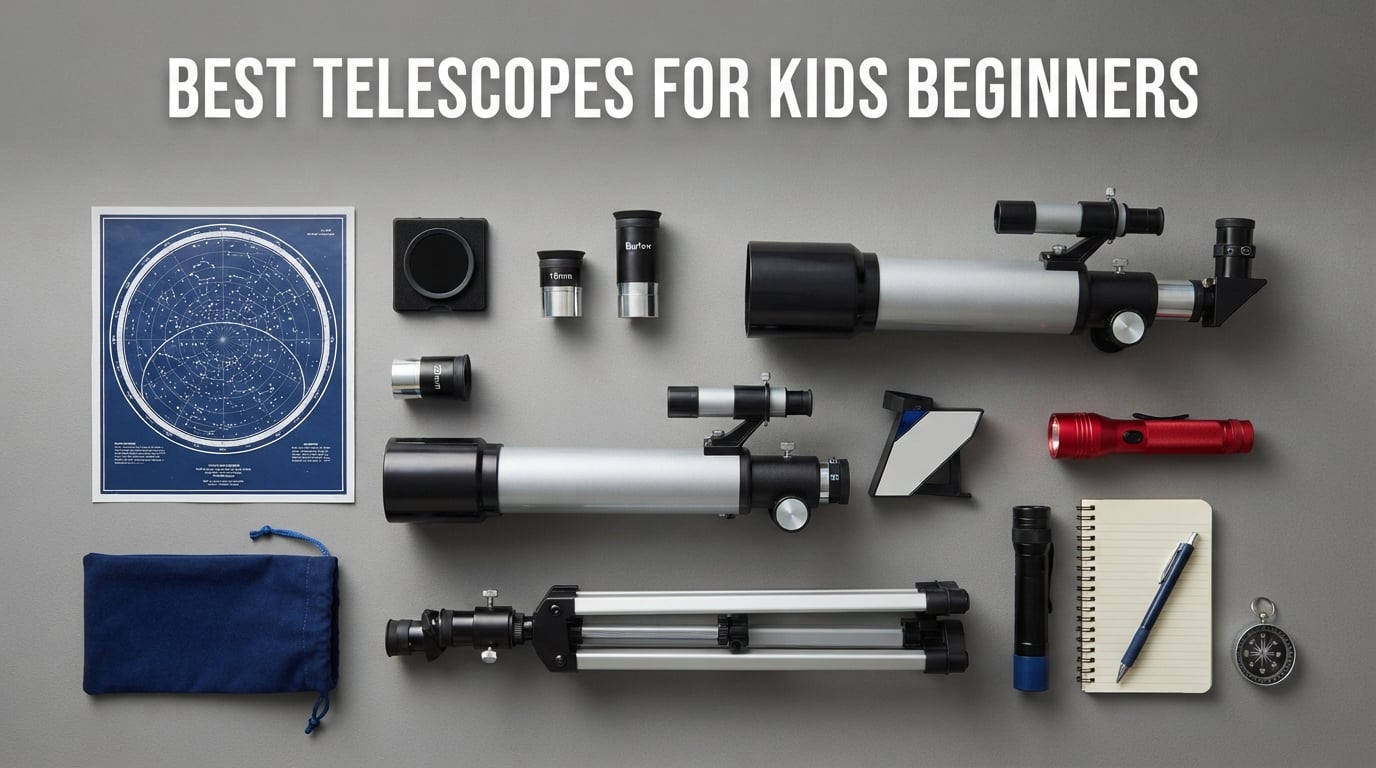
For most families, the best telescopes for kids and beginners are 70mm or 80mm fully coated glass refractors on a steady alt-azimuth mount, or a Moon-focused scope for children aged 8 to 12. A 70mm refractor will show the Moon’s craters and Jupiter’s moons on the first night, and it needs no tools to set up. Bigger marketing numbers on the box do not mean a better view.
That last point trips up more parents than any other telescope mistake. The “500x power” claim printed on a department-store box is meaningless, because useful magnification is capped by the size of the front lens, not by the number on the packaging. A 70mm aperture on a plain alt-azimuth mount will keep a child engaged for years, and it is the setup that costs the least frustration.
We went through the ten scopes below spec by spec and read the full owner-review pattern on each one, because the differences between a good kids telescope and a disappointing one are almost never visible in the product photos. Over 2026, the ten models in this guide are the ones we would hand to a family starting out, from a first Moon scope to a shared 80mm refractor an adult and child can both use.
If you are also buying equipment for a young beginner learning an instrument rather than the sky, our guides to the best DJ controllers for beginner kids and the best digital pianos for beginners follow the same hands-on testing approach.
Top 3 Picks for the Best Telescopes for Kids and Beginners (October 2026)

Gskyer 70mm AZ Refractor
- 70mm fully coated objective
- 400mm focal length
- 3x Barlow plus two eyepieces
- 5x24 reflex finder and carry bag

Celestron Travel Scope 70
- 70mm coated refractor
- 400mm focal length
- no-tool setup
- 20mm and 10mm eyepieces with backpack
NASA Lunar Telescope
- Designed around the Moon
- finder plus two powers
- tabletop tripod
- learning guide
- ages 8 and up
Our number one pick has the deepest review base in the group by a wide margin, which means its problems are already well documented and its strengths are well proven. The travel pick folds into a backpack and assembles without tools. The NASA-branded scope is the one to buy when the child is 8 or 9 and patience is the limiting factor, not optics.
Best Telescopes for Kids Beginners in 2026
| Product | Specifications | Action |
|---|---|---|
| Gskyer 70mm AZ Refractor |
|
Check Latest Price |
| Celestron Travel Scope 70 |
|
Check Latest Price |
| NASA Lunar Telescope |
|
Check Latest Price |
 Celestron PowerSeeker 50AZ Celestron PowerSeeker 50AZ |
|
Check Latest Price |
 Koolpte 70mm AZ Refractor Koolpte 70mm AZ Refractor |
|
Check Latest Price |
 ECOOPRO 70mm Refractor ECOOPRO 70mm Refractor |
|
Check Latest Price |
 MEEZAA 80mm Refractor MEEZAA 80mm Refractor |
|
Check Latest Price |
 Hawkko 80mm Refractor Hawkko 80mm Refractor |
|
Check Latest Price |
 Luzsco 50mm Starter Scope Luzsco 50mm Starter Scope |
|
Check Latest Price |
 Educational Insights Starview Educational Insights Starview |
|
Check Latest Price |
Aperture is the column that matters most in that table. Everything above 70mm gathers noticeably more light, and everything at 50mm is really a Moon instrument dressed up as something larger.
1. Gskyer 70mm AZ Refractor – The Best All-Rounder for a Family
Gskyer Telescope, 70mm Aperture 400mm AZ Mount Astronomical Refracting Telescope for Kids Beginners – Travel Telescope with Carry Bag, Phone Adapter and Wireless Remote.
70mm coated glass
400mm focal length
Altazimuth mount
5x24 reflex finder
Pros
- Bright sharp views of the Moon and planets
- Barlow and two eyepieces included
- Finder scope makes locating targets straightforward
- Carry bag and phone adapter in the box
Cons
- Targets drift out of view during longer sessions
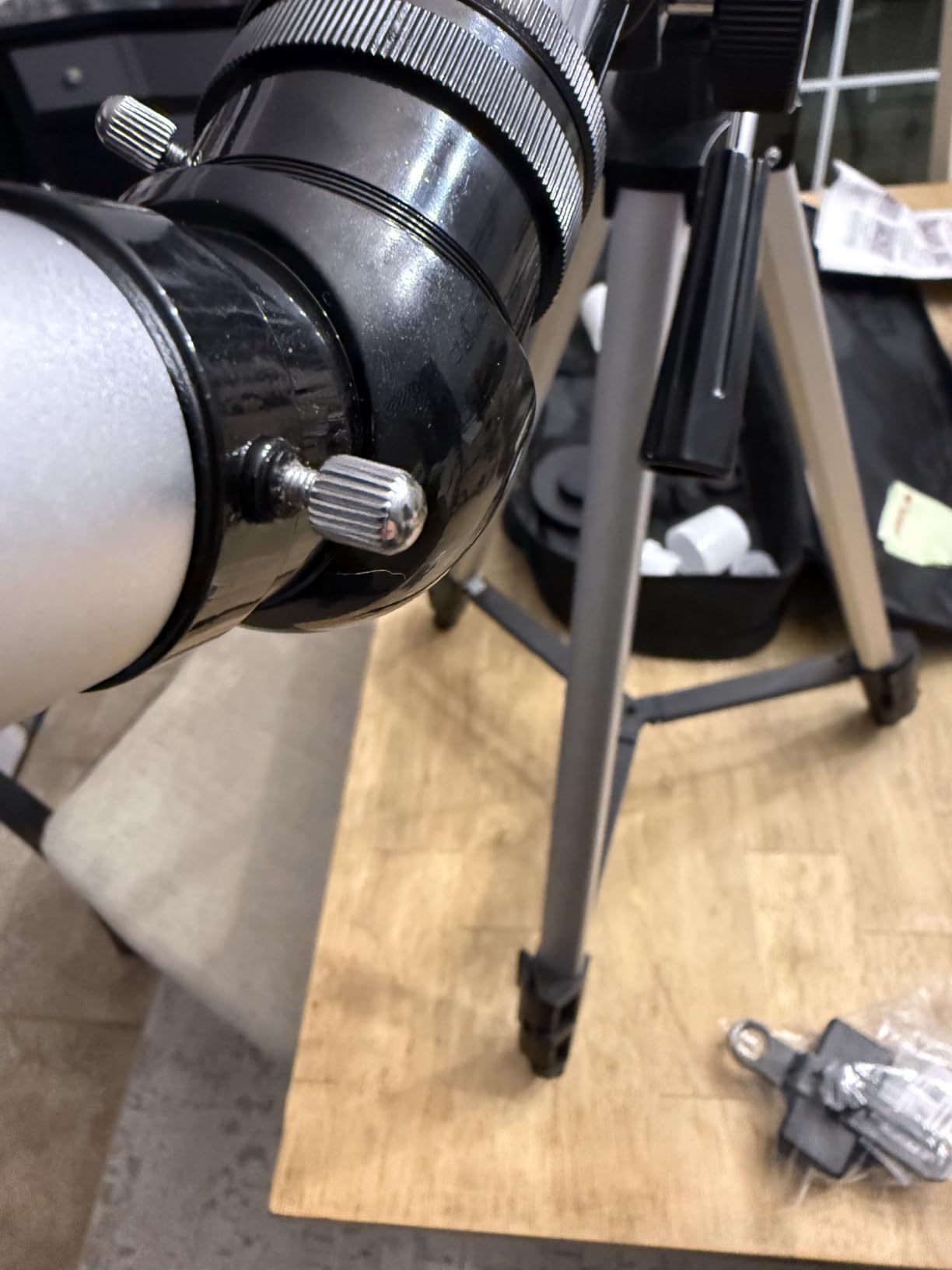
- Mounting bracket and manual focus need adult help
More than 22,000 owners have rated this scope, and that is the reason it sits at the top. When a product has a review base that size, the praise stops being vague: people describe specific craters along the lunar terminator, the brightness of Jupiter with its moons lined up, and how the finder scope made the difference on their first night.
The 70mm fully coated objective at 400mm focal length is the sweet spot the whole category is built around. That is a comfortable, wide view that fills the eyepiece without the dim, washed-out look a much longer focal length would give you on a lens this size.
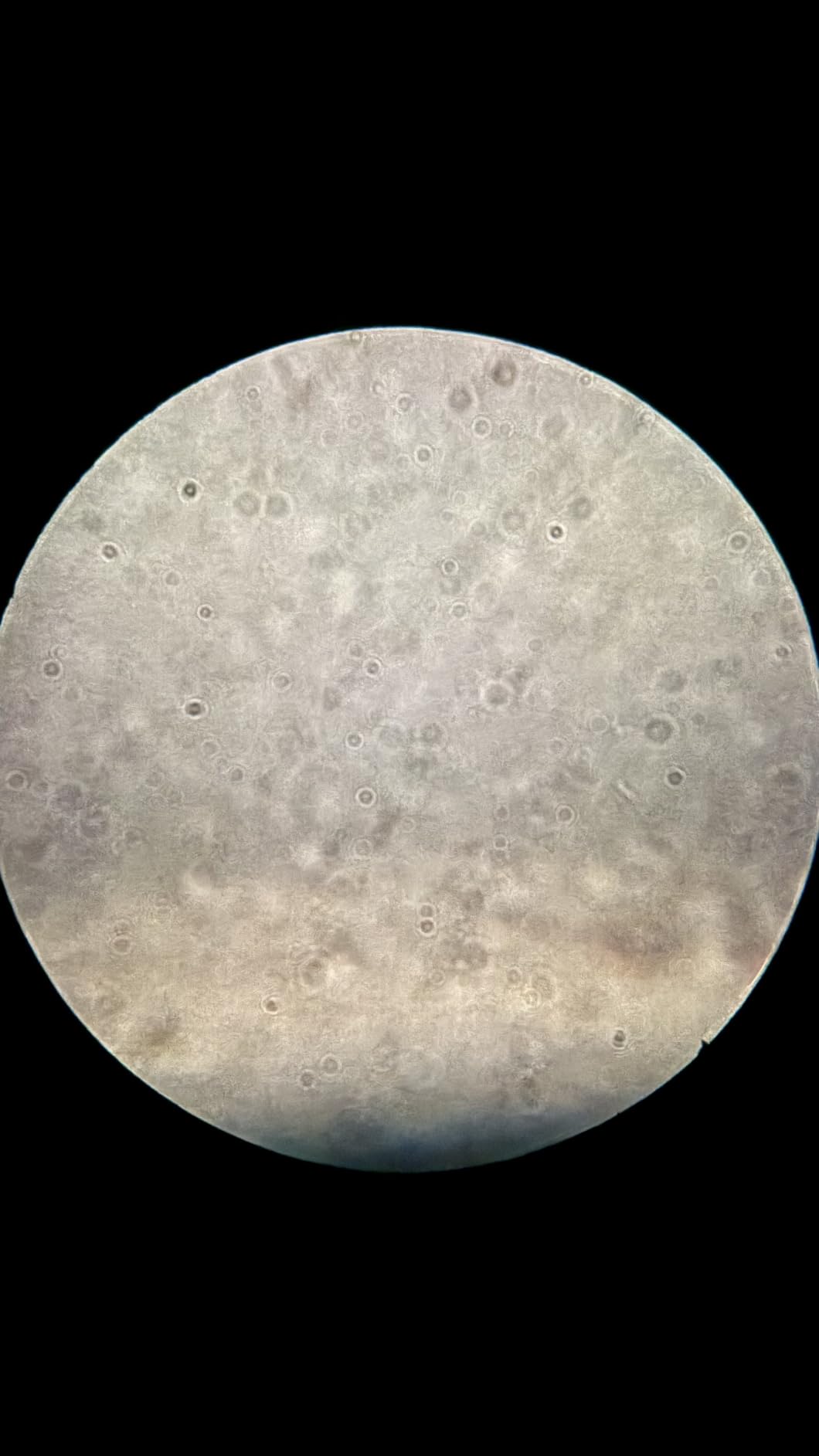
Two eyepieces plus a 3x Barlow lens give you three magnifications without buying anything else, and the 5×24 reflex finder with a crosshair is the piece parents underrate most. A child who can line the crosshair up with the Moon in thirty seconds never reaches the stage where a telescope ends up in a closet.
The included smartphone adapter and wireless remote are modest by modern standards, but they are enough for a first attempt at photographing the Moon. More valuable for most families is the carry bag, because a scope that lives in a cupboard is a scope that gets forgotten.
Who this suits
A family with a child roughly 7 to 12 who wants to see the Moon, Jupiter’s four moons and Saturn’s rings without an adult aligning anything. The accessory bundle means nothing else needs buying on day one.
Who should skip it
Anyone hoping for galaxies, nebulae or long-exposure photos. At 70mm, faint deep-sky objects stay out of reach, and the manual alt-azimuth mount will not track an object once it is found.
2. Celestron Travel Scope 70mm – The One That Lives in the Car
Celestron Travel Scope 70mm Beginner Portable Telescope with Backpack
70mm coated glass
400mm focal length
Manual alt-azimuth
4.2 pounds
Pros
- Crisp Moon and planet detail for the aperture
- No-tool setup takes minutes
- Backpack carries scope and tripod together
- Two-year US warranty with US support
Cons
- No motorized tracking so targets drift
- Soft backpack for car boot use
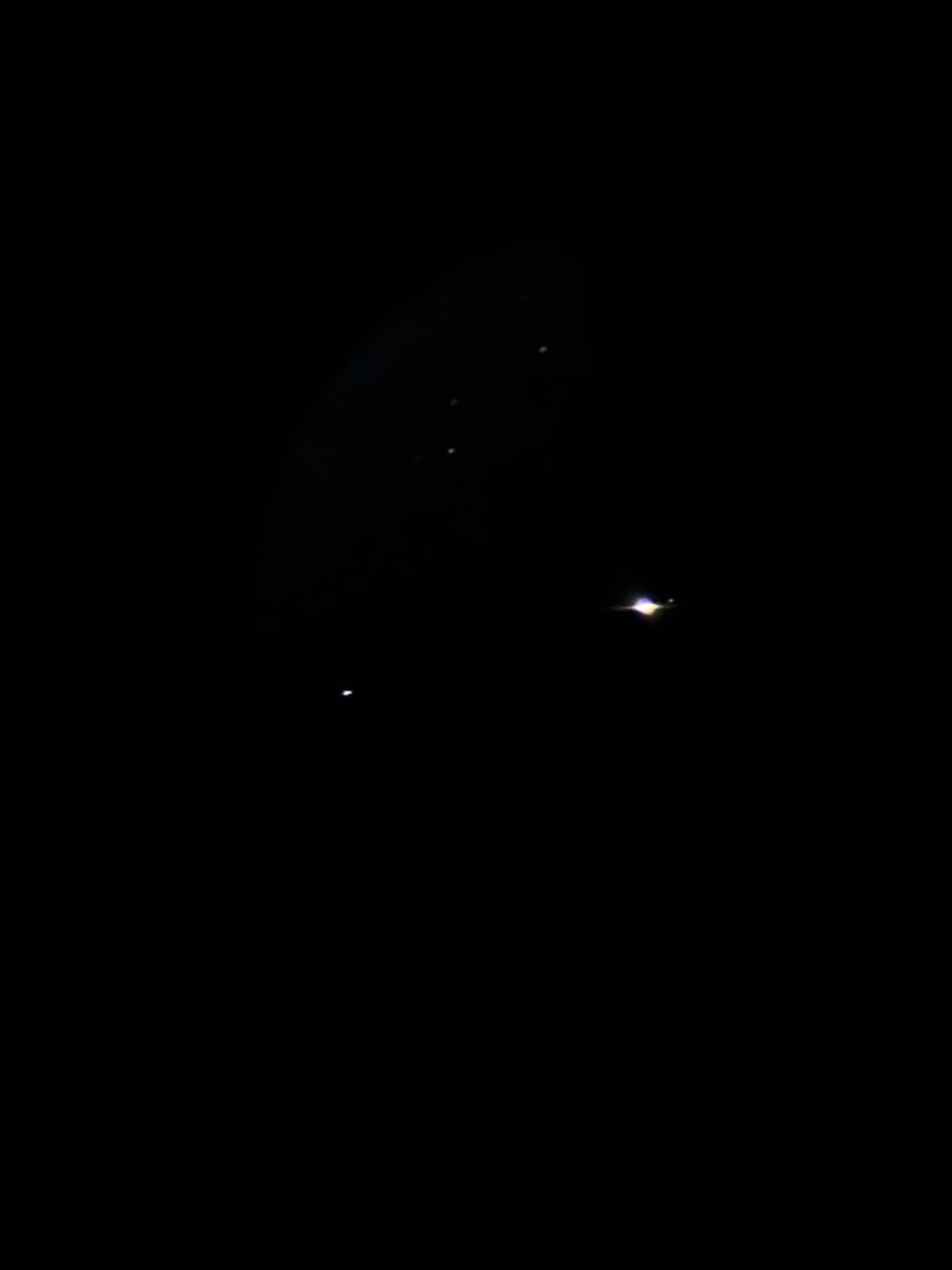
With close to 14,800 ratings, the Travel Scope 70 is one of the most proven beginner telescopes sold anywhere. The owner pattern is remarkably consistent: fast no-tool setup, a genuinely usable lunar view, and a mount that occasionally needs re-aiming during a long session.
What sets it apart for kids is portability. The tube and full-height tripod pack into the padded backpack in the box, which means the scope can go to a campsite, a dark-sky car park or a grandparent’s house without a separate bag. For a child, that difference decides whether the telescope gets used once or every clear night.
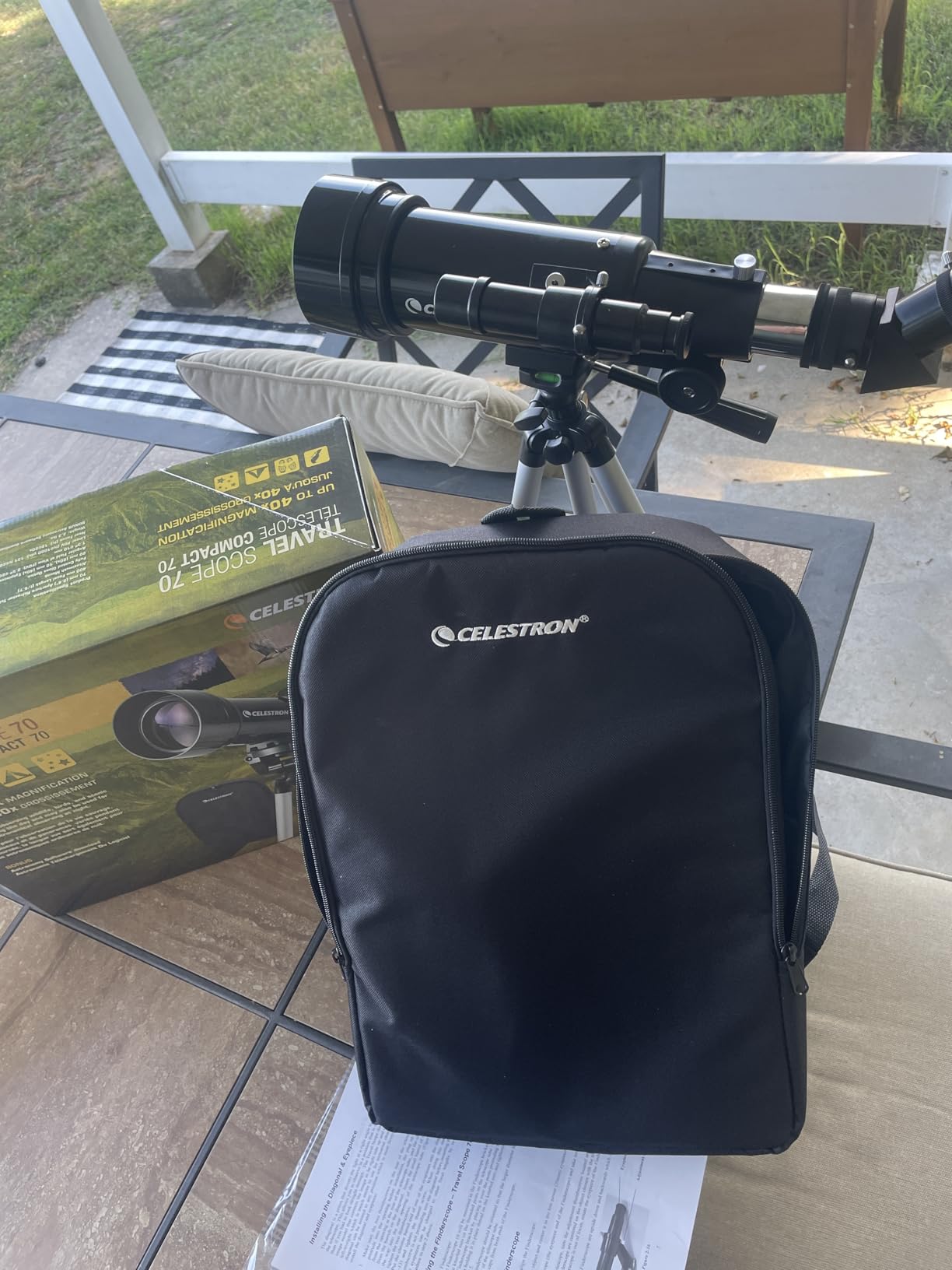
The 20mm and 10mm eyepieces with a 45-degree diagonal cover both wide cluster views and close lunar work, and the 5×24 finder scope handles target acquisition. Celestron’s two-year US warranty is a genuine advantage over no-name budget scopes, particularly for a child who will inevitably drop something.
Two honest limitations. The included tripod is the plain accessory-free style, so at high magnification a braced pair of hands is an extra step. And a padded backpack is convenient rather than protective, so a car boot full of gravel is not where this telescope should live.
Who this suits
Parents who want the first scope to travel. If your family camps, drives to the coast, or borrows a dark site, this is the one that makes the trip realistic.
Who should skip it
Anyone planning to start with planets only. The 70mm aperture resolves Jupiter’s moons and Saturn’s shape but not much detail on either, and the drift in the mount is noticeable over a long planetary session.
3. NASA Lunar Telescope for Ages 8-12 – The Scope That Fails You Least
NASA Lunar Telescope for Kids Ages 8-12 with Tripod and Finder Scope
Moon-specific design
Ages 8 and up
Finder plus two powers
Tabletop tripod
Pros
- Built around the Moon so kids find a target instantly
- Craters and maria are visible to a child
- Tabletop tripod suits small hands
- Simple low-friction assembly
Cons
- Very small aperture limits it to the Moon
- Lightweight frame is easy to knock over
- No planetary or deep-sky detail
Almost 7,000 buyers have rated this, and the reviews split cleanly into two groups: delighted first-time users and parents who conclude the optic is too weak. Both reactions are correct, and which one you get depends almost entirely on the child’s age.
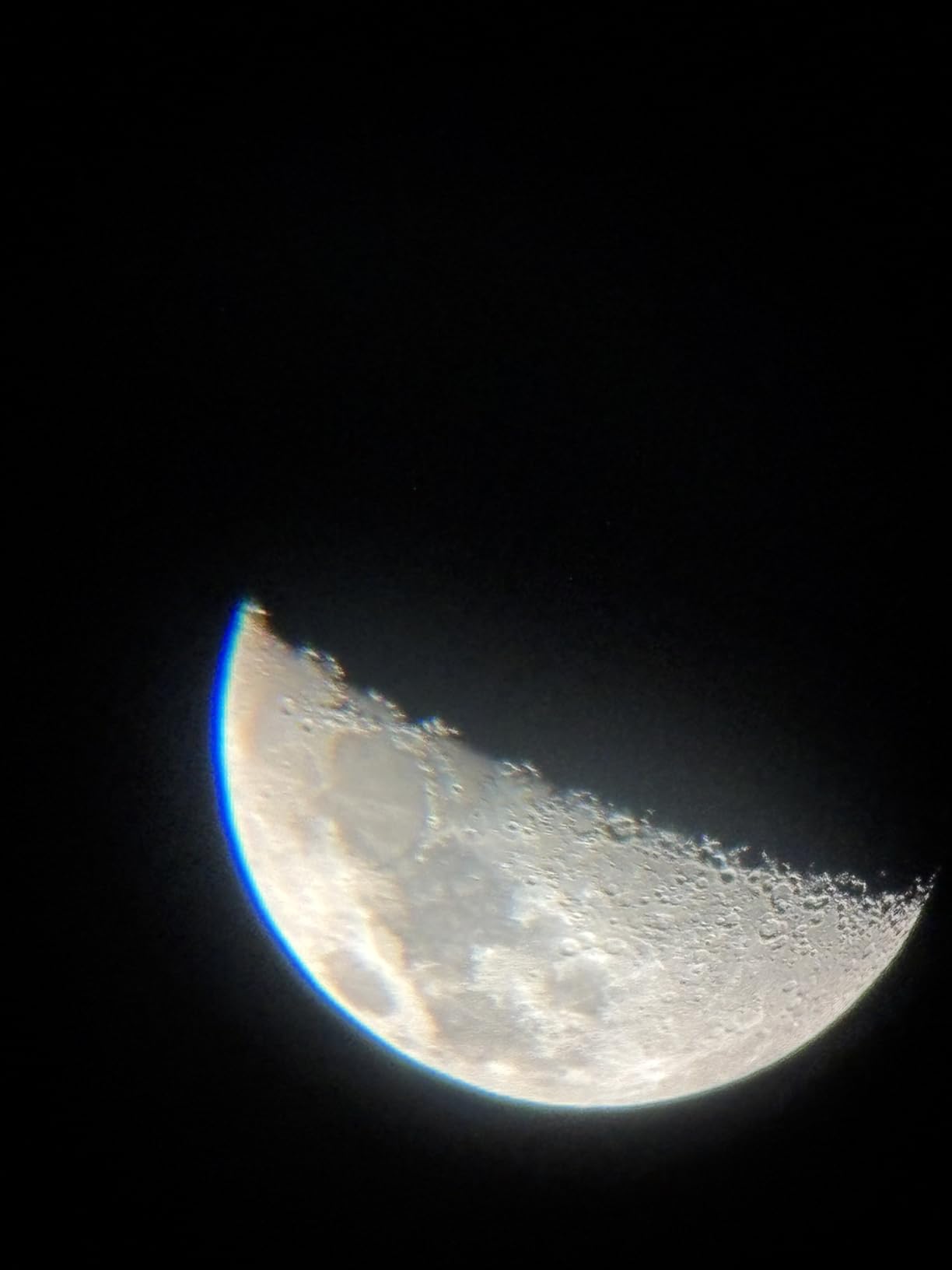
For an 8 to 10 year old, this is one of the lowest-friction first telescopes available. It is designed around one target, and that target is the brightest object in the night sky. A finder scope plus low and high power eyepieces means the sequence is find the Moon, then zoom, and there is no hunting involved.
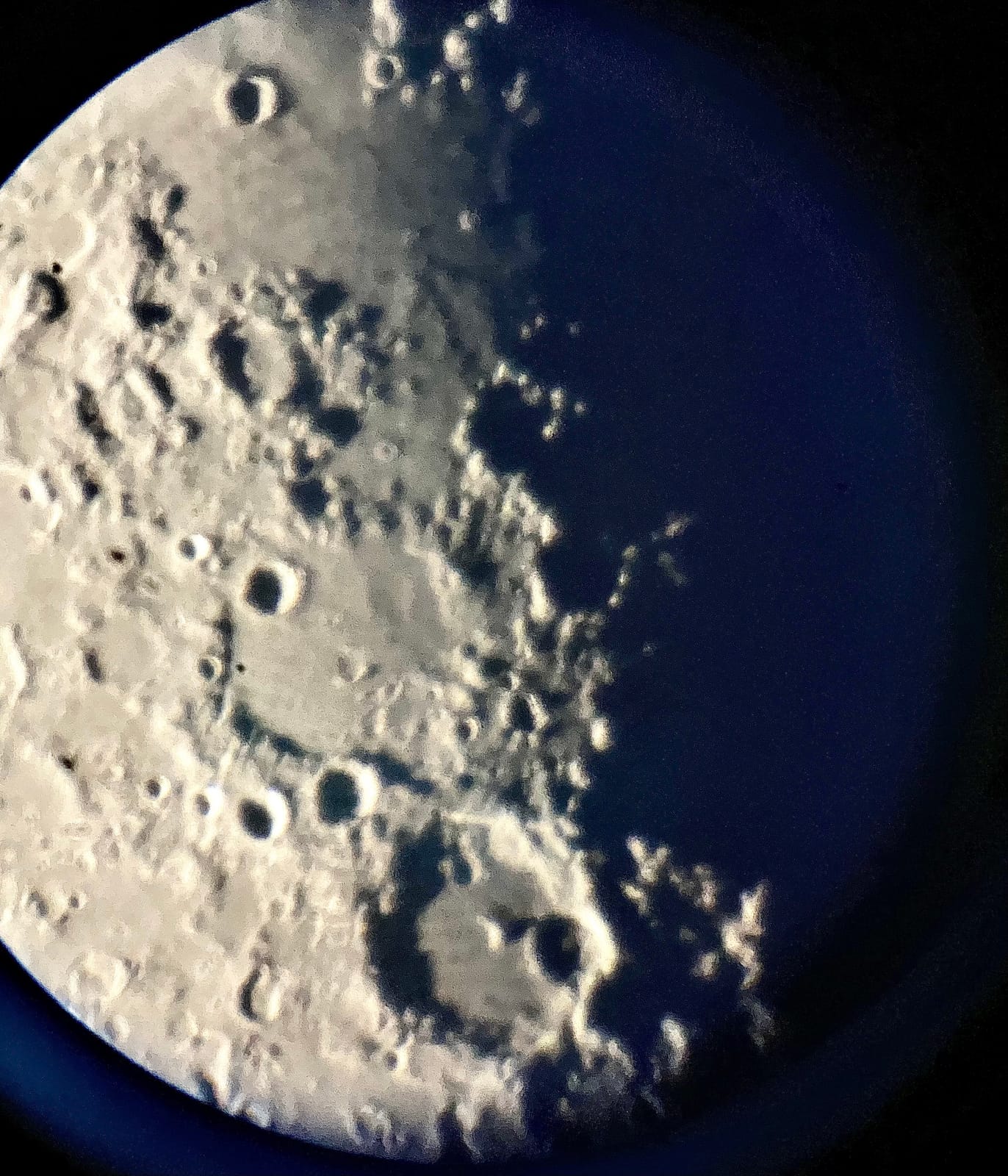
That fixed target is the whole point. The frustration that ends most children’s interest is not a dim image, it is ten minutes of failing to locate anything. This scope removes that step entirely, and the smooth scanning mount and tabletop tripod make following a feature across the lunar surface easy for small hands.
Be clear-eyed about the ceiling though. The aperture is very small, so stars stay as points, planets are unresolved, and there is nothing to find beyond the Moon’s craters and maria. Treat it as a stepping stone rather than an instrument, and pair it with binoculars for wide-field stargazing.
Who this suits
A child aged 8 to 12 who has never used a telescope, and a parent who does not want to spend the first evening working out how to point anything.
Who should skip it
Older children and anyone whose interest has already outgrown the Moon. Within a year most kids at that age ask what else they can see, and this scope has no answer.
4. Celestron PowerSeeker 50AZ – The Proven Budget Refractor
Celestron PowerSeeker 50AZ Grab-and-Go Beginner Refractor Telescope
50mm coated glass
600mm focal length
Yoke mount with slow-motion
Four eyepieces included
Pros
- Shows lunar craters and reaches Jupiter's moons
- Four eyepieces plus a 3x Barlow add real magnification range
- Slow-motion rod makes pointing smooth
- Light at 3.6 pounds so an adult can carry it
Cons
- Mount can shake at high magnification
- Planets resolve as points rather than discs
- Screws and fittings can strip with rough handling
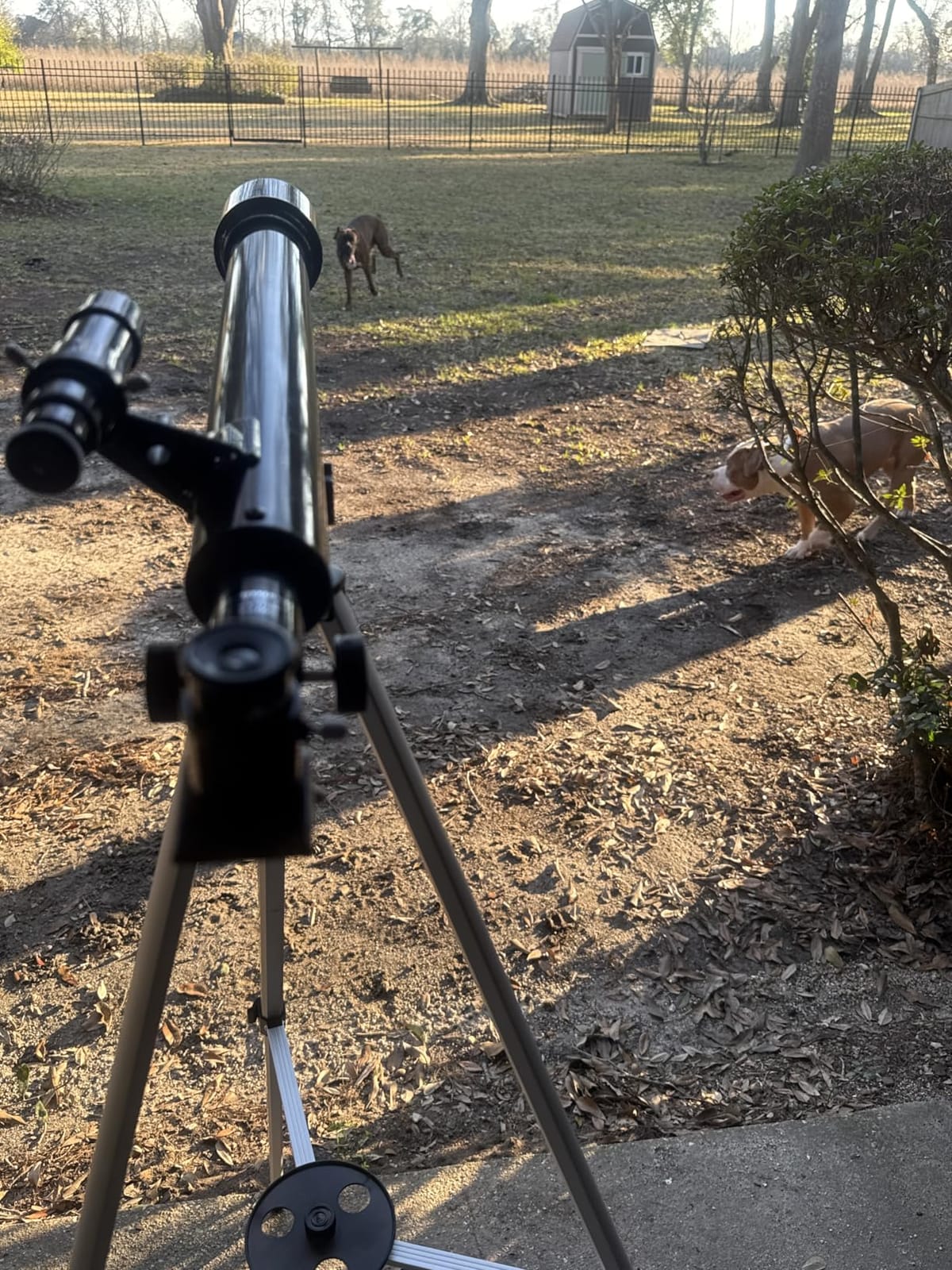
Over 4,300 ratings at 4.1 stars is the profile of a classic budget refractor: many owners report years of reliable lunar viewing, and a steady minority are disappointed by shake in the mount and how hard the first target is to locate.
The 600mm focal length on a 50mm lens is a genuinely good trick for a budget scope. It gives a narrower, flatter view that is easier to keep steady, and the 20mm, 12mm and 4mm eyepieces plus a 1.5x erecting lens mean you can go from a wide sweep to a close crater without buying a single extra accessory.
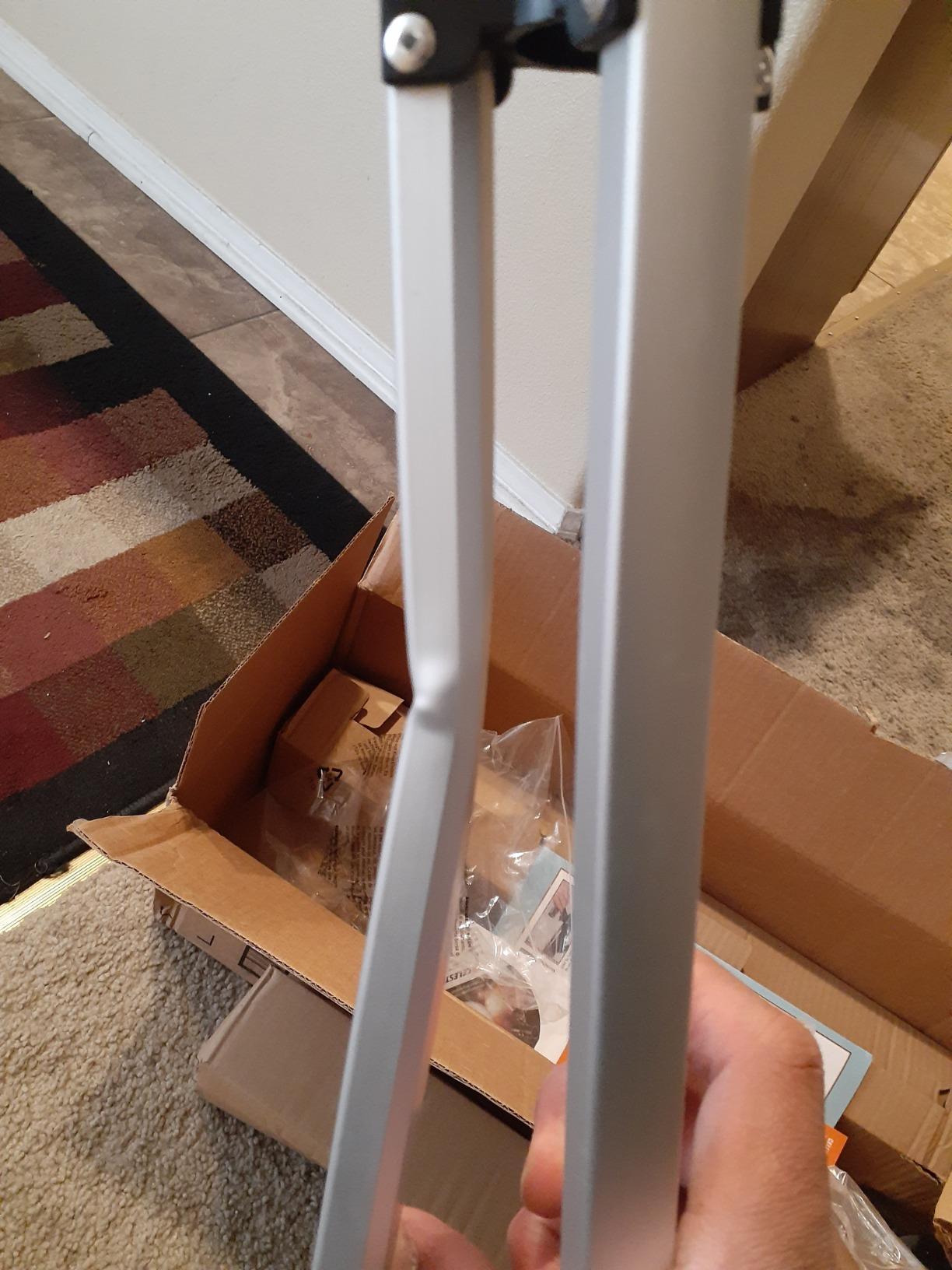
The yoke mount with its slow-motion altitude rod is better than it sounds for a child. Slow motion controls mean you can nudge a target in small increments instead of sweeping wildly, which is the difference between finding Jupiter and losing it again.
Two things to know before you commit. A 50mm aperture resolves planets as bright points with Jupiter’s moons visible, not as detailed discs, so expectations matter. And the hardware is budget-grade, so screws and fittings can strip if a child treats it like a tool rather than an instrument.
Who this suits
A parent who wants a real refractor from a name with a two-year US warranty and a small budget, and a child who mainly wants the Moon.
Who should skip it
Families hoping to see Saturn’s rings clearly or anything in the deep sky. Those need 70mm of aperture or more, and the money is better spent moving up a tier.
5. Koolpte 70mm AZ Refractor – A Wide Reach for a 6-Year-Old
Koolpte Telescope for Kids, 70mm/500mm AZ Refractor for Beginners, White
70mm coated glass
500mm focal length
5x24 reflex finder
5 pounds
Pros
- Bright Moon and landscape views
- 25mm and 10mm Kellner eyepieces with 3x Barlow
- Finder scope and phone adapter included
- Easy assembly and adjustable tripod
Cons
- Narrow field of view slows down target finding
- No tracking so objects drift
- Five pounds is heavy for a child to carry alone
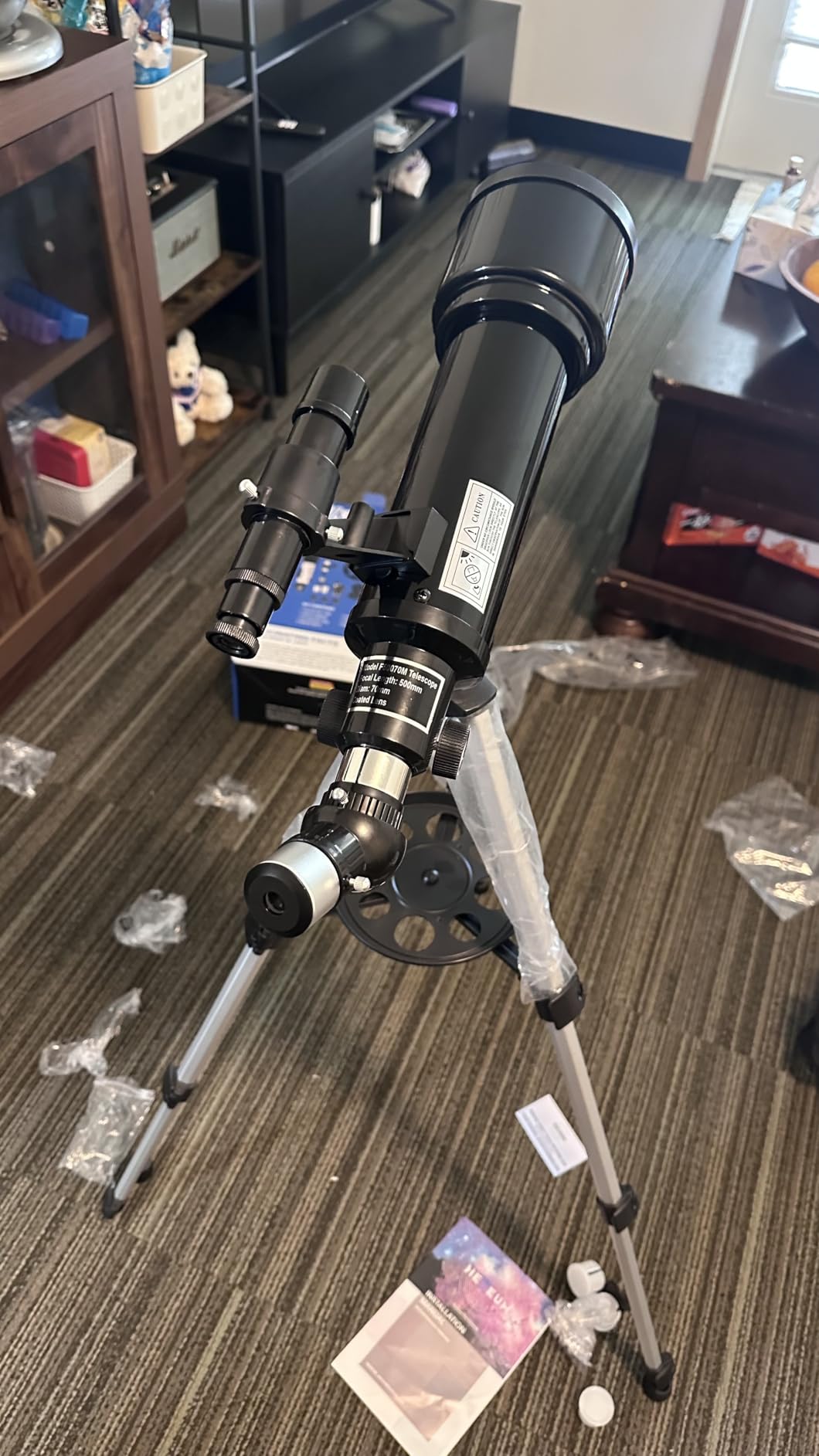
Rated by close to 3,700 buyers at 4.3 stars, with a 67% five-star share, this is one of the better-rated 70mm scopes we looked at. Reviews concentrate on the accessory bundle for the money, good lunar detail, and assembly that a parent can manage in a few minutes.
The 500mm focal length on a 70mm aperture is a nice balance of magnification and image brightness, and the Kellner eyepieces are a step up from the cheapest plastic barrel lenses you find in this category. Kellner eyepieces are glass, they have a wider field than Plossls, and they are the reason a 25mm eyepiece on this scope is usable for sweeping rather than just frustrating.
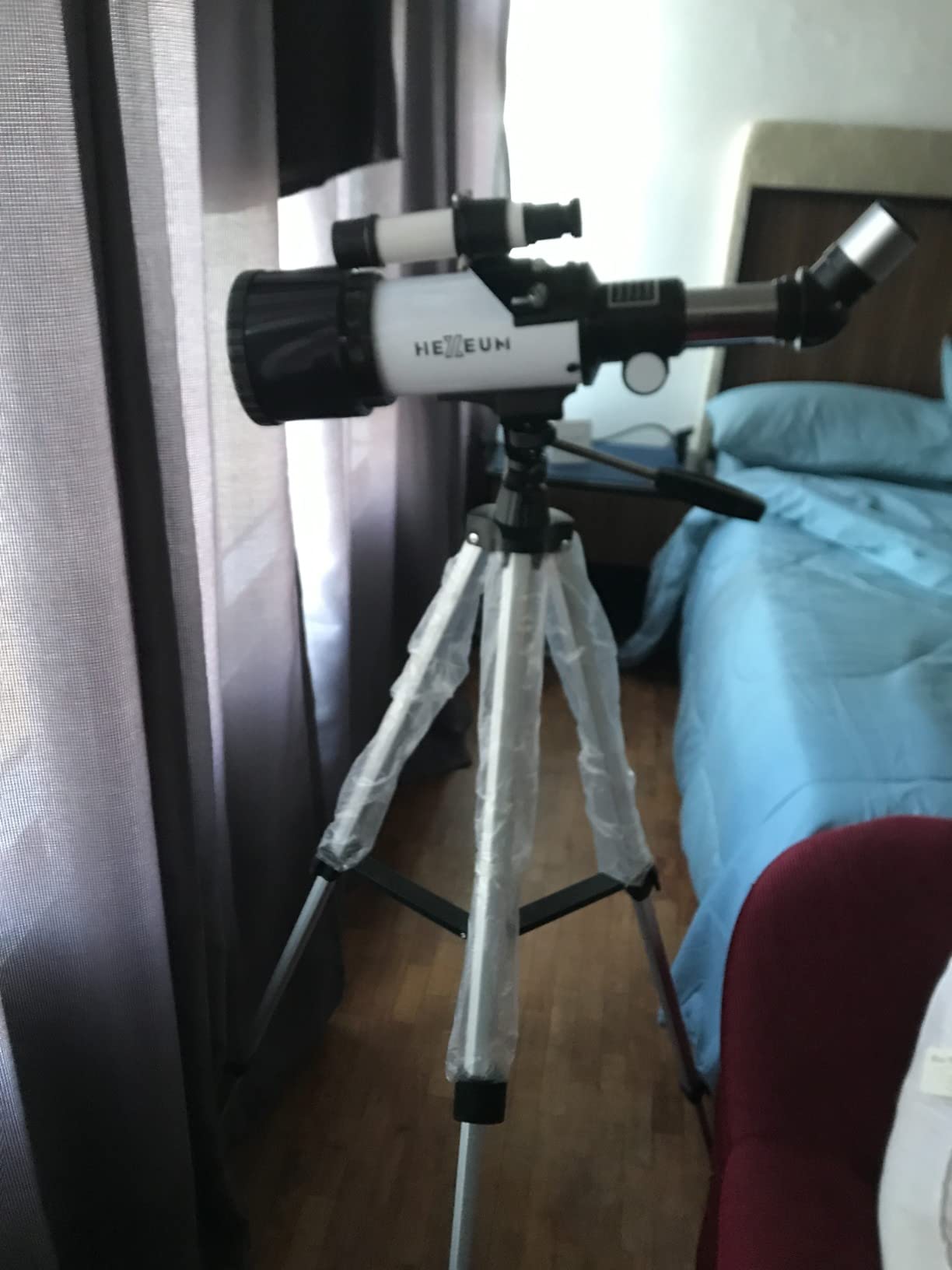
The recurring complaint is the narrow field of view, and it is fair. A longer focal length concentrates the same light into a smaller patch of sky, so a 6-year-old will spend more time hunting than on the wider-field Gskyer. If the child is small, that extra hunting time is the main thing weighing against this scope.
The 5-pound weight also matters for portability. An adult can carry it to a car park or a campsite without trouble, but it is a lot for a small child to manage solo over any real distance.
Who this suits
A child aged 6 to 8 with an adult who will spend the first few evenings helping with pointing. The quality of the included eyepieces keeps a beginner engaged for longer than most scopes at this level.
Who should skip it
Very young children and anyone with expectations beyond the Moon and the brightest planets. The narrow field makes the first session longer than it needs to be.
6. ECOOPRO 70mm Refractor – Fastest From Box to First View
Telescope for Kids & Adults, 70mm Aperture 360mm Refractor (15X-150X)
70mm multi-coated glass
360mm focal length
Quick-release build
1.4 kg
Pros
- Wide forgiving field is easy for beginners
- Tool-free design gets kids observing fast
- Compact enough to pack for darker skies
- Multi-coated glass gives bright lunar craters
Cons
- Short tripod so small children need a table
- Lock knob can let the tube flop forward
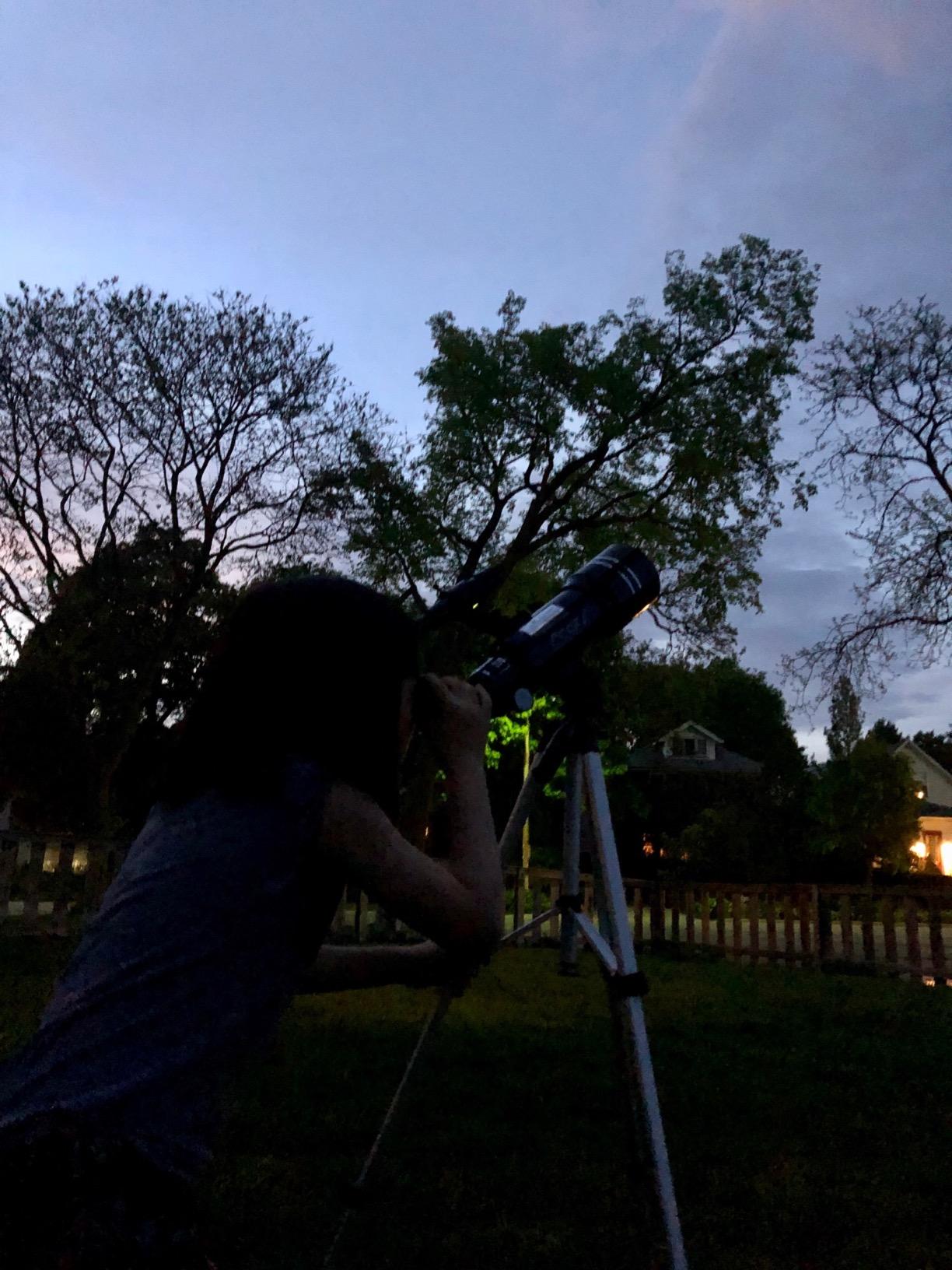
About 2,150 ratings at 4.2 stars. Owners generally confirm this delivers visible lunar craters quickly and is easy for kids to use, but a meaningful group of detailed reviews centres on the same two-part hardware problem.
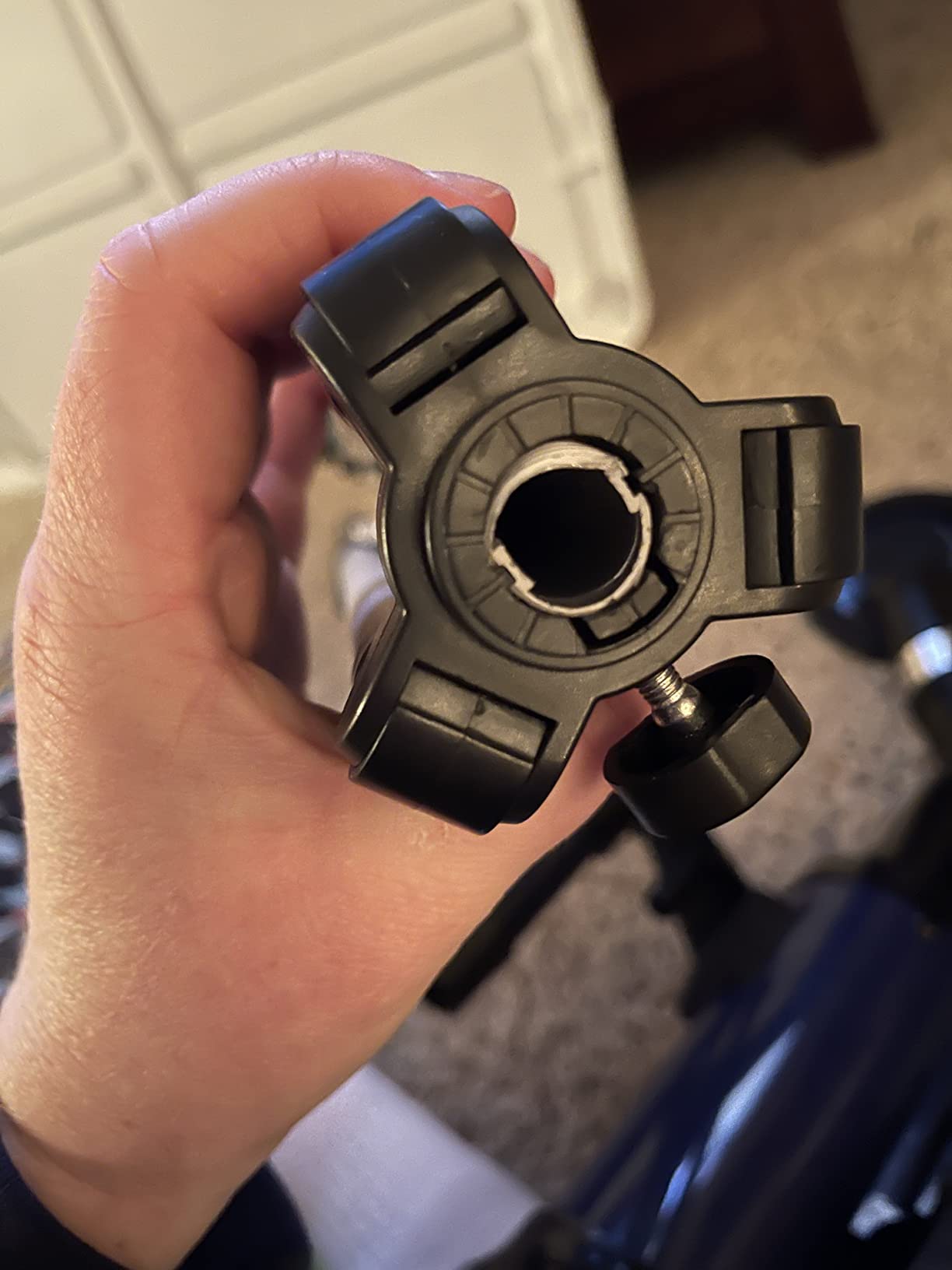
That problem is the tripod and the lock knob. The tripod is short, so a child under about seven cannot reach the eyepiece without a table or a step, and the mount lock knob is the part most likely to fail to hold the tube steady over time. Some owners end up replacing the tripod entirely.
What it does well is the wide field of view, and that is not a minor detail. At 360mm focal length on a 70mm lens, the 25mm Kellner eyepiece gives a broad, forgiving view of a large chunk of sky, so finding a target takes seconds rather than minutes. For a first-time child at the eyepiece, that is the single most valuable thing a telescope can do.
The quick-release, tool-free design is genuinely excellent. There is a real chance the child is looking at the Moon within a minute of opening the box, which is the moment that decides everything that follows.
Who this suits
A child aged 7 or older who wants the widest, easiest-to-find view available at this level, and a family that stargazes from a table in the garden rather than standing in a field.
Who should skip it
Small children, because the tripod height puts the eyepiece out of reach. Also skip it if the mount feels loose in your own hand on unpacking, since that is the failure point owners report most.
7. MEEZAA 80mm Refractor – The Scope Adults and Kids Share
MEEZAA Telescope for Adults & Kids, 80mm Aperture 500mm Refractor
80mm multi-coated glass
500mm focal length
20x-150x range
Tripod to 44 inches
Pros
- 80mm aperture gathers more light than 70mm models
- 45-degree mirror gives upright comfortable images
- Tripod adjusts from 17 to 44 inches for shared use
Cons
- Stock eyepieces are average and a Plossl helps
- No tracking for longer-exposure photography
With 645 ratings holding a 4.4 average and a 75% five-star share, this is the strongest rating profile in the group. It is also one of the few scopes here with 80mm of aperture, which is a real step up in light-gathering rather than a marketing upgrade.
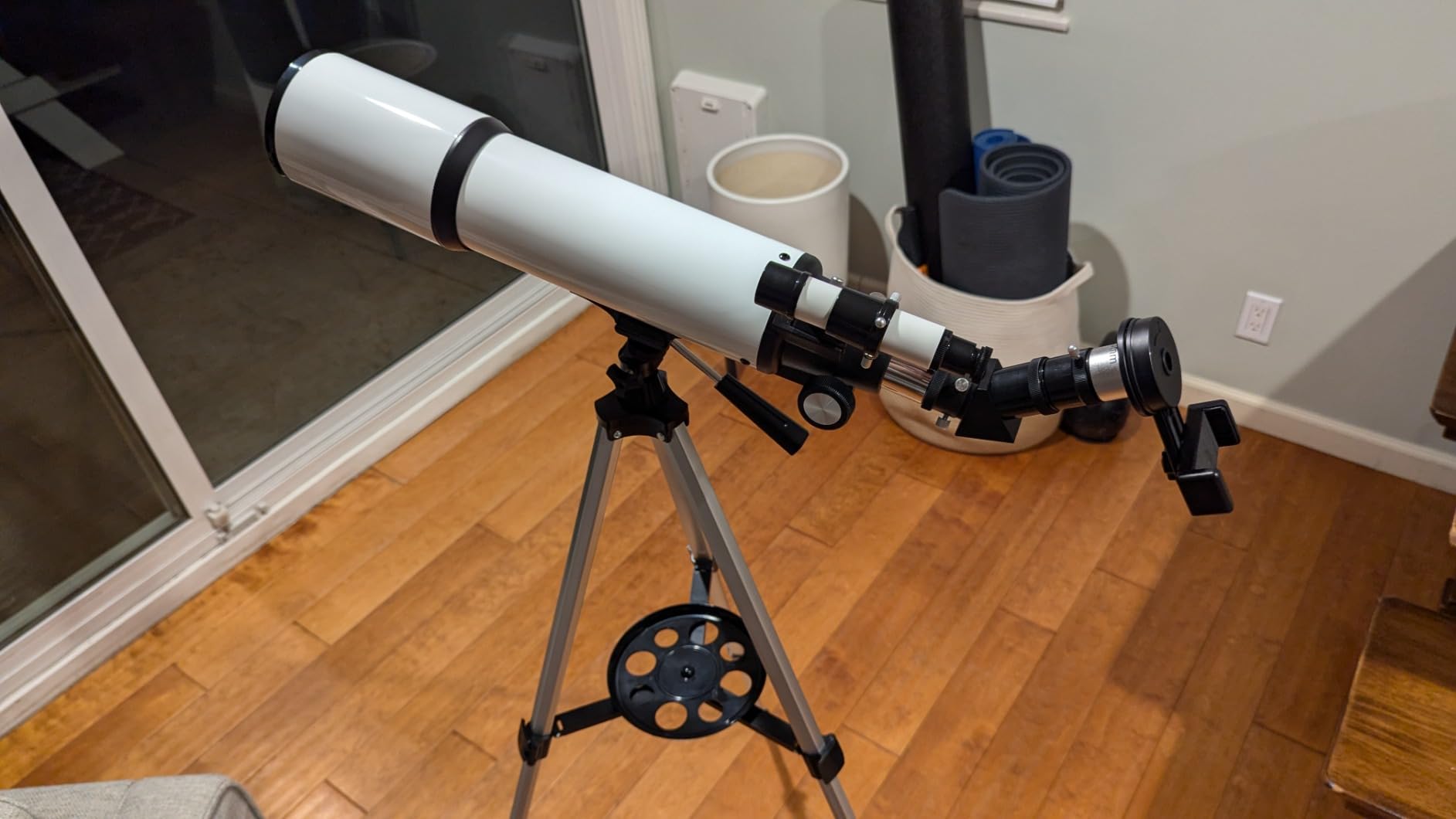
That extra aperture is the whole story. An 80mm lens collects roughly 30% more light than a 70mm, and light is what turns a grey smudge into something with visible structure. Craters at the edge of the lunar terminator resolve more cleanly, and Saturn becomes a shape rather than a dot.
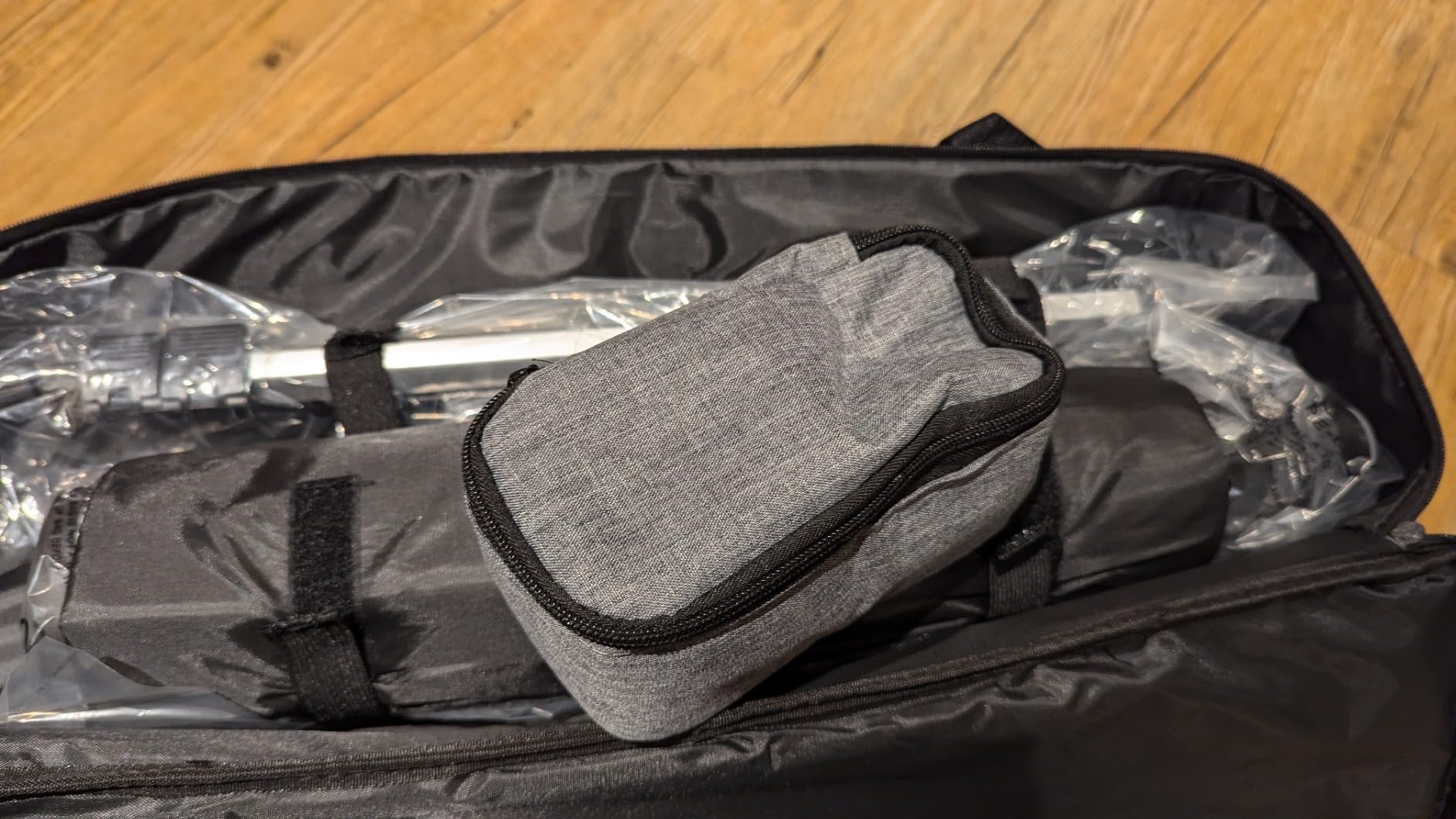
The adjustable tripod is the quietly excellent feature for a family. It runs from about 17 to 44 inches, so an adult and a child of different heights can both get a proper look at the same planet on the same night, which is the difference between a shared hobby and one person’s private interest.
The 45-degree zenith mirror is a comfort feature worth noting. It puts the eyepiece at a better angle for a shorter child, so nobody ends up on tiptoes or lying flat on the grass to look through it.
Who this suits
Families observing together across a wide range of heights, and anyone who wants more light per pound of budget than a 70mm scope offers.
Who should skip it
Buyers who want deep-sky objects or any form of astrophotography. 80mm is still a small lens, and the mount has no tracking, so long exposures are not on the menu.
8. Hawkko 80mm Refractor – Built Specifically for Ages 8-12
Hawkko 80mm Aperture 500mm Telescope for Kids 8-12 & Adults Beginners
80mm coated glass
500mm focal length
20x-150x
Two-year warranty
Pros
- 80mm lens gives crisp lunar craters
- Tool-free assembly suits a 6-year-old
- Lightweight tripod doubles as a phone stand
- Stickers let kids personalise the tube
Cons
- Planets beyond the Moon are soft
- No tracking so targets drift
This is a recent listing with 169 ratings averaging 4.4 and a 75% five-star share, so the review base is small and worth keeping in perspective. What reviewers do agree on is quick tool-free setup, crisp Moon views, and a light body that suits travel.
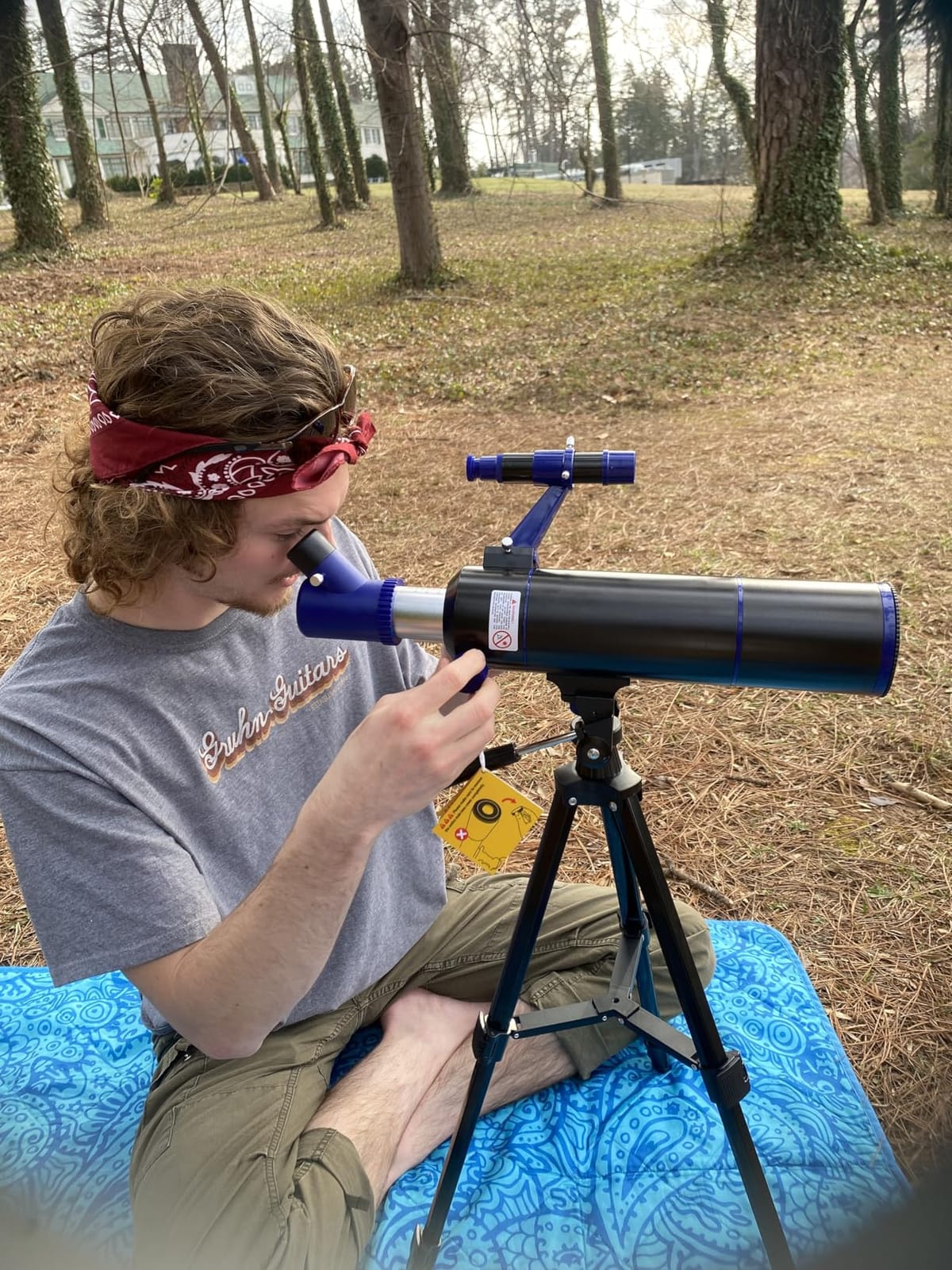
The optical design is the same 80mm at 500mm as the MEEZAA, with 25mm and 10mm eyepieces and a 3x Barlow covering 20x to 150x. Reviews mention even Venus as visible, which is a good sign for a scope at this size, and the two-year manufacturer warranty is a real plus at this level.
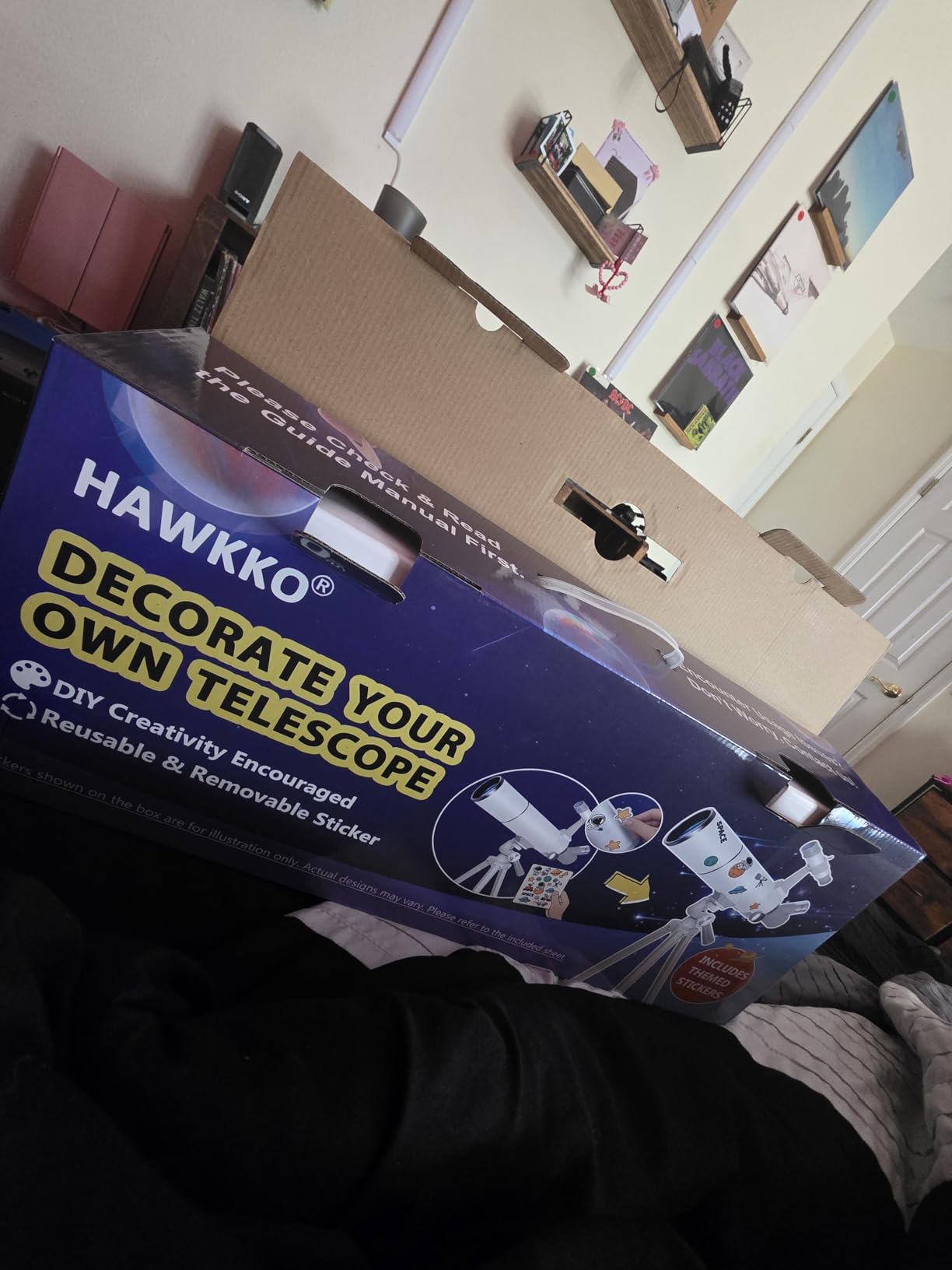
What separates it from the generic 80mm refractor is aimed squarely at a child. The space-themed stickers let a young owner personalise the tube, which sounds trivial but matters more to an 8-year-old than it does to an adult. The light tripod doubles as a phone stand, so a parent can set up a quick Moon capture without extra kit.
The most common stated limit is planet detail beyond the Moon, which is expected at this aperture. The alt-azimuth mount has no tracking, so targets drift during a long session, and a few owners found the controls needed a moment of figuring out.
Who this suits
A child aged 8 to 12 as a birthday or holiday gift, especially one who responds to a product that feels like it was designed for them rather than bought for them.
Who should skip it
Anyone who wants proven long-term reliability. With 169 ratings behind it, there is not yet the review history that the Celestron and Gskyer scopes have, and the mount hardware is not noticeably better.
9. Luzsco 50mm Starter Scope – Best as an Activity, Not an Instrument
Telescope for Kids, 50mm 100x Beginner Telescope with Tripod
50mm multi-coated lens
100x magnification
600 g tripod
Huygens eyepieces
Pros
- Light at 600 g so a child can set it up alone
- Several parts to assemble and experiment with
- Screen-free STEM activity that works with a parent
- Simple entry point for a very young child
Cons
- 50mm aperture and fixed mount limit what is resolved
- Huygens eyepieces distort the edge of the field
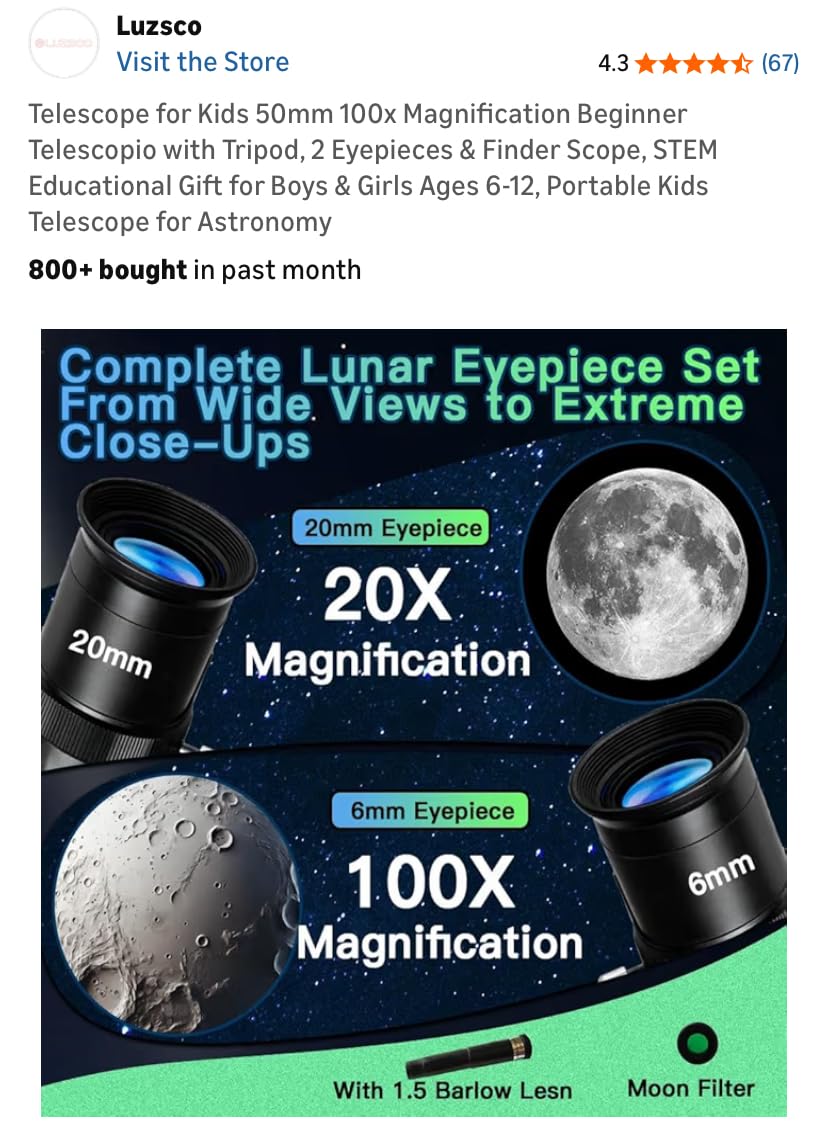
Around 324 ratings at 4.3 stars, with 74% five-star. The pattern is consistent: buyers treat this as an educational toy and an assembly activity for ages 6 to 12 rather than as an optical instrument, and satisfaction is high for what it is.
That framing is not a criticism so much as a warning. The 50mm objective with a fixed mount can really show one thing well, which is the Moon’s phase and the largest craters near the centre of the disc. Everything beyond that needs patience the child may not have.
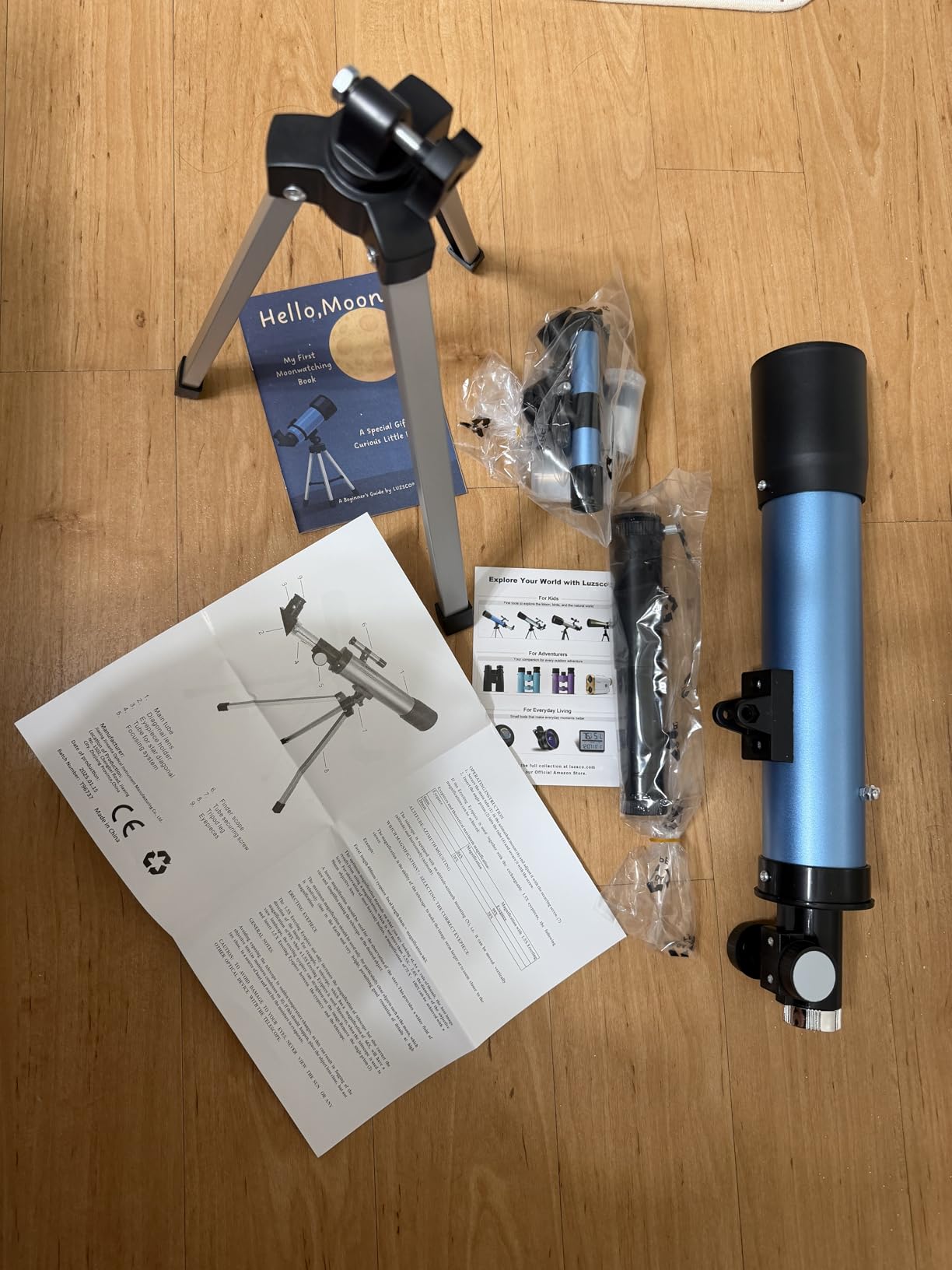
What it genuinely does well is independence. At 600 grams with a simple fixed mount, a child can carry it out of the house, set it up and get looking without an adult holding anything steady. For a six or seven year old, being trusted with the whole procedure is often the more valuable outcome.
The included reflex finderscope, 6mm and 20mm Huygens eyepieces and a moon filter give enough parts to make assembly feel like a real activity. Expect the Huygens eyepieces to soften and distort the edges of the field, and expect the whole experience to be the Moon only.
Who this suits
A child aged 6 to 8 whose parents want a low-cost, screen-free STEM activity they can do together, and who will be moving up to a real telescope within a year.
Who should skip it
Any child who expects to see planets or stars as anything other than points. If the goal is a first real telescope rather than a first astronomy activity, spend the extra and get 70mm.
10. Educational Insights GeoSafari Starview – The One for a Classroom
Educational Insights GeoSafari Starview Telescope
10x to 50x magnification
Altazimuth mount
Plossl eyepieces
Activity journal
Pros
- Simple setup lets kids scan the sky on their own
- 10x and 50x teaches low versus high power
- Activity journal adds guided projects
- Tabletop tripod moves between yard and classroom
Cons
- 50x ceiling is modest and images look soft
- Compact tripod limits viewing at eye level
A small review base of 147 ratings at 4.1. Buyers generally value it as a screen-free STEM activity and a gift for older children, with the activity journal and the simple controls doing most of the work.
That journal is the part that distinguishes it from a generic toy scope. It comes with structured stargazing projects, so a child is not handed a telescope and left to wonder what to look at. In a classroom, where an adult has to manage a group rather than one child, that structure is the difference between a useful lesson and a queue of disappointed faces.
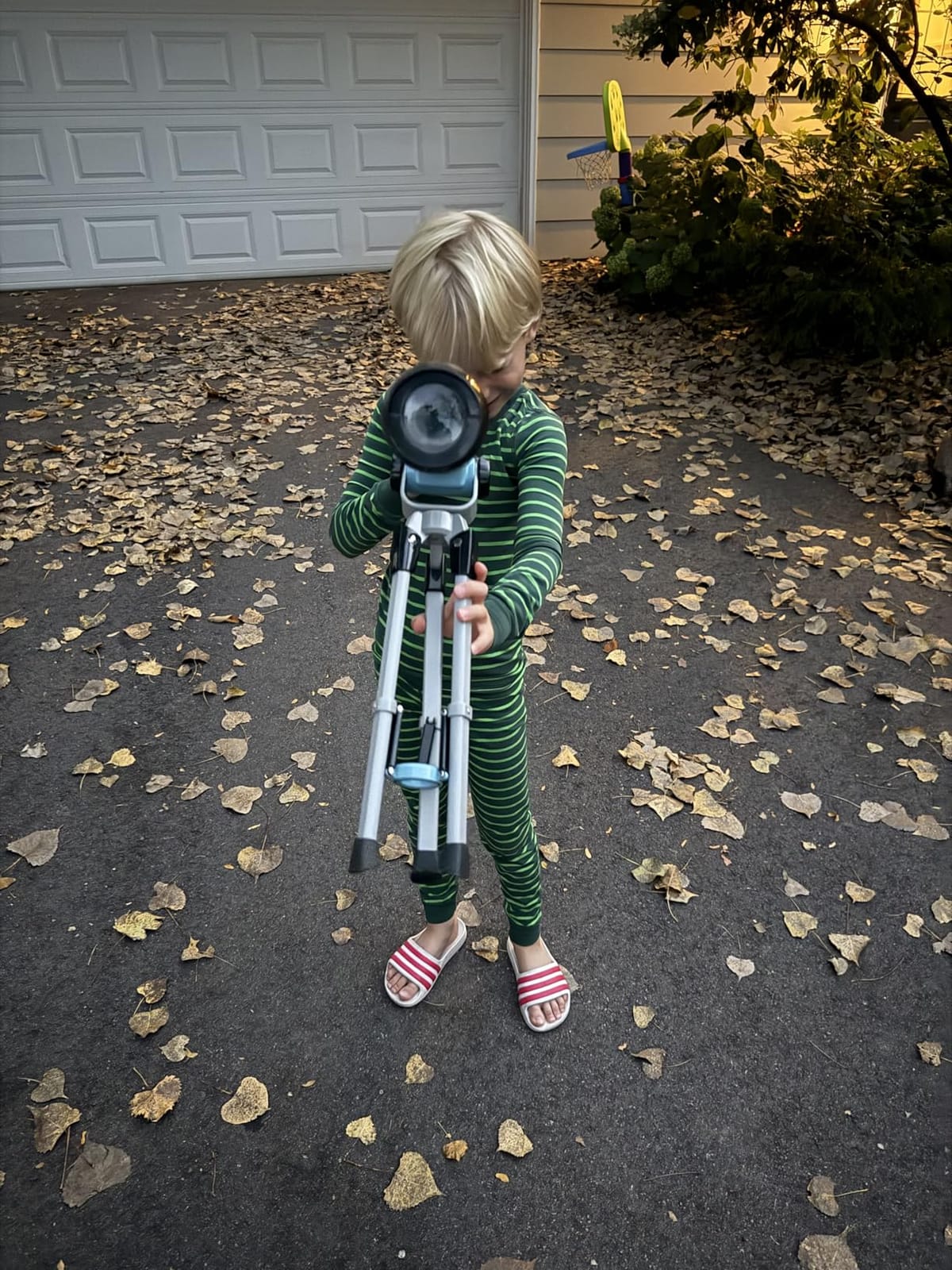
The two-power setup at 10x and 50x is deliberately modest and deliberately educational. Switching between low and high power is how a beginner learns that magnification is a trade, and a child who understands that at nine will not be disappointed by a dim 500x view later.
The limitations are real. A 50x ceiling produces soft images on larger targets, and the compact tabletop tripod means observing happens at seated height rather than at eye level. Optical performance is basic compared with any of the 70mm refractors above.
Who this suits
Teachers, Scout leaders and anyone running a group session where the goal is structured learning rather than faint astronomical detail. The journal keeps a whole class occupied.
Who should skip it
A child whose main interest is planets. Nothing in the 10x-50x range will give them Jupiter’s moons, and they will come away disappointed rather than inspired.
What You Can Actually See Through a Kids Telescope
Expectation mismatch is the single most common complaint in owner reviews, and it kills more children’s interest than poor optics ever do. The photos online are not what any of these scopes produce, and setting that straight before the first night is the most useful thing a parent can do.
The Moon is the target that justifies the purchase. At 70mm you see craters, the line between the bright highlands and the darker maria, and a terminator that changes shape night to night. It fills the eyepiece, it is bright, and it is up for half of every month.
Jupiter’s four moons are visible on any of the 70mm and 80mm scopes here, changing position from night to night. Jupiter itself resolves as a small disc with banding on the 80mm models. Saturn’s rings appear as an oval rather than a point on 80mm, and as a shape without clear rings on 70mm.
Bright stars and clusters such as the Pleiades show up as small groups, and double stars split into pairs on the wider-field scopes. A red filter or moon filter included with one of the cheaper scopes helps a lot on a bright Moon.
What you will not see: galaxies, most nebulae, and any colourful nebula imagery from deep-sky photographs. Objects like the Orion Nebula need a much larger aperture than any scope in this guide, and a 50mm scope resolves nothing beyond the Moon. Colour through a small lens is essentially absent.
How to Choose: Aperture, Mounts and Telescope Types
A good first telescope for a child has three non-negotiables: real glass optics rather than plastic, a mount or base that does not wobble, and an aperture of at least 70mm. Everything else in the specification sheet is a preference. If a scope fails any of those three, keep looking.
Aperture is the diameter of the front lens or mirror, in millimetres, and it is the only spec that determines how much light you gather. A 70mm lens collects roughly five times more light than a 50mm one, and 80mm collects more again. Brighter, sharper, more detailed images all come from this one number. When in doubt, prioritise aperture over everything else on the box.
Focal length is how long the light path is inside the tube. Shorter focal length means a wider field of view, which makes finding objects far easier for a beginner. Longer focal length means more magnification per eyepiece but a narrower view. For kids, shorter is usually kinder, and that is why the 360mm and 400mm scopes in this guide are easier to point than the 500mm and 600mm ones.
Useful magnification is roughly twice the aperture in millimetres, so a 70mm scope is genuinely useful up to about 140x and anything beyond that is just a dim, blurry enlargement. Ignore the “675x” figure printed on cheap packaging entirely.
Refractor vs reflector vs catadioptric: refractors use a lens, reflectors use a mirror, and catadioptrics use both. A short refractor is the right first choice for a child because it needs no collimation, has a sealed tube that cannot get dusty, and holds its aim. A Dobsonian is a Newtonian reflector on a simple swivel base, and while a 100mm tabletop Dob is the community favourite first telescope for a child, none of the ten scopes here is one. Catadioptrics are compact and good value, but they cost more than a child needs to spend.
Alt-azimuth vs equatorial: an alt-azimuth mount swings left-right and up-down, which is intuitive and needs no polar alignment. A German equatorial mount tracks the sky but requires setup a child cannot do alone. For beginners, alt-azimuth or a tabletop base is the correct answer, and the drift you get without tracking only matters over long sessions.
If your own interest is the more serious version of this, our guide to the best telescopes for beginners goes deeper on collimation, mounts and what to look for when the Moon stops being enough.
Which Telescope by Age? A Band-by-Band Guide
Age matters more than any specification, because patience and attention span are the limiting factors rather than optics. A child aged four and a child aged twelve buying the same 70mm refractor will get completely different results from it.
Ages 3 to 5: do not buy a real telescope yet. At this age, a pair of binoculars and an adult taking turns pointing at things will hold attention far better than an eyepiece. Optics are not the bottleneck at this stage.
Ages 6 to 8: a wide-field 70mm refractor with a finder scope, set up by an adult, works best. The ECOOPRO’s short focal length gives the easiest first view; the Koolpte’s glass eyepieces give the better looking one once they get going.
Ages 8 to 12: this is the sweet spot for a first real telescope. Anything in the 70mm to 80mm range on a stable mount, plus a Moon-focused scope if you want the least possible frustration on night one.
Ages 13 and up: move to the largest aperture you can justify. At this point the child can be taught collimation and collimation-free operation, and a bigger aperture starts to pay off with real planetary detail.
5 Red Flags in Cheap Kids Telescopes
Every problem that ends a child’s interest in astronomy traces back to one of these five. Checking the listing and the physical product against this list takes about two minutes and prevents most disappointment.
1. Plastic lens elements. This is the first thing the search engines themselves flag, and they are right. Acrylic and plastic objective lenses scratch permanently, yellow with age, and produce a dimmer and softer image than glass of the same size. Any scope claiming a large magnification number is usually trying to hide a plastic front element behind a bigger number.
2. A wobbly tripod out of the box. Cheap alt-azimuth mounts shake at any magnification worth using, and shake looks like a fault to a child. Check that the legs lock and the tube holds position before the first night, and tighten everything while you still have the manual.
3. Magnification claims that are not tied to an aperture. A “500x” or “675x” figure on the packaging means nothing if the lens is 50mm across. If the listing does not state the aperture in millimetres, treat the whole specification as unverified.
4. Single-element plastic eyepieces. The eyepieces matter more than people expect, because they are what you actually look through. Cheap one-element plastic barrels give edge distortion and a small field of view. Look for named glass types such as Kellner or Plossl in the specification.
5. No usable finderscope, or one that cannot be aligned. Without a finder, a child spends the whole session trying to point a tube at something the size of a thumbnail. If the finder is included but has no bracket, or the bracket does not hold, that is a real problem rather than a minor one.
One more worth adding: unbranded white-label optics sold on marketplace sites with a handful of reviews. They are not always bad, but they are impossible to service, and a broken tripod leg ends the purchase.
First Night: 3 Targets in Under 5 Minutes Each
Most first sessions fail on pointing, not optics. Set up in the garden or driveway rather than carrying the scope into the dark, and use these three targets in order, because each one is easier to find than the last.
1. The Moon, within five minutes. It is the brightest object in the sky and the only one a child can find without help. Start with the lowest-power eyepiece, let them find it with the finder scope, then switch to the higher power for craters.
2. Jupiter or Venus, within five minutes. A bright planet is roughly the size of the Moon, so a child who has just learned to point at the Moon can point at a planet. Jupiter’s four moons shifting position night to night is the thing that turns astronomy from a viewing activity into a project.
3. The Pleiades, within five minutes. A small cluster of stars, visible through a wide-field eyepiece and impossible to see with the naked eye from most suburban gardens. It proves the telescope is doing something the eye cannot.
Two technique notes that will save a session. Never look through a house window, because the glass distorts and dims everything badly. And go outside into the dark first, then open the box, because a child’s eyes need ten minutes to adjust and give up far too much light if the porch light is on.
How to Avoid Buying Twice
The most common mistake is not overspending, it is underspending on a toy that gets replaced a year later. A three-step path avoids the duplicate purchase without needing a large budget up front.
Step one, ages 6 to 8: start with a wide-field 70mm refractor, or even a Moon-focused scope if the child is at the younger end. The goal is the habit of looking up, not the image quality.
Step two, ages 10 to 13: move up to the largest aperture you can justify, ideally 80mm or more, and add a proper glass eyepiece set. This is the step most families skip and regret.
Step three, teenager and adult: this is when a tabletop Dobsonian or a computerized mount becomes worth the money, because the operator can collimate, align and track. Our guide to the best telescopes for beginners covers that tier in detail.
The rule of thumb: if you can see yourself still using the same scope in five years, buy a 70mm or 80mm refractor now. If the child is under six, buy binoculars and wait.
Eye Safety: Never Point It at the Sun
Never point any telescope at the Sun, or near it, without a certified solar filter fitted over the front aperture. This applies to adults as much as children, and instant and permanent eye damage can occur in a fraction of a second.
Solar filters must be certified and must sit on the front of the tube, not on the eyepiece end. A cheap filter from an unverified marketplace listing is not protection, and a smartphone held behind the eyepiece during a solar eclipse is dangerously inadequate. For solar viewing, buy a proper certified filter or wait.
Everything in this guide is for night-sky and daytime land viewing. Daytime use is fine for the Moon, distant scenery and birdwatching, but the Sun is the one target that must be avoided.
Frequently Asked Questions
What is a good beginner telescope for children?
A 70mm or 80mm fully coated glass refractor on an alt-azimuth mount is the best beginner telescope for a child aged 7 to 12. It shows the Moon’s craters and Jupiter’s four moons on the first night, assembles without tools, and needs no collimation. Choose one with a finder scope and at least two glass eyepieces, and ignore the magnification figure printed on the box.
Which type of telescope is best for kids?
A short refractor is the best type for most kids because it needs no collimation, has a sealed tube that cannot fog or get dusty, and holds its aim. A tabletop Dobsonian is the community favourite for older children, since it is stable and forgiving, but it needs occasional mirror alignment. Avoid all-plastic scopes entirely.
What kind of telescope is appropriate for a 7-year-old child?
For a 7-year-old, a wide-field 70mm refractor with a finder scope is the right choice, with an adult handling setup. A shorter focal length of 360mm to 400mm means a wider field, which makes finding the Moon far faster. Below age six, binoculars are a better first step than any telescope.
What to avoid when buying a telescope?
Avoid five things: plastic lens elements, which scratch and dim the image; a wobbly tripod that shakes at any useful magnification; magnification claims not tied to a stated aperture; single-element plastic eyepieces, which distort the edge of the field; and a missing or unalignable finderscope. Also avoid unbranded marketplace optics with almost no reviews.
How old should a child be to use a telescope?
A child around 6 or 7 can use a real telescope with an adult setting it up. From 8 to 12, a 70mm to 80mm refractor on a stable mount is the sweet spot and most children can aim it themselves using the finder. Under six, patience rather than optics is the limiting factor, so binoculars are the better first purchase.
What can you see with a 70mm telescope?
Through a 70mm refractor you can see the Moon’s craters, mountains and maria in real detail, the four Galilean moons of Jupiter moving night to night, Saturn as a small oval, bright double stars, and open clusters such as the Pleiades. You will not see galaxies, most nebulae, or any colour, since that needs a much larger aperture.
The Best Telescopes for Kids and Beginners in 2026: Final Word
The Gskyer 70mm AZ Refractor is our pick as the best telescope for kids and beginners in 2026, and the reason is the 22,000-owner review base behind it. Nothing else in this list has been proven at that scale, and at 70mm of coated glass with a finder scope, two eyepieces and a Barlow lens included, a child can find the Moon and see Jupiter’s moons on the very first evening.
Match the scope to the child rather than the other way round. The Celestron Travel Scope 70 is the one to take camping. The NASA Lunar scope is the one that fails you least for an 8-year-old. The MEEZAA and Hawkko 80mm models are the step up when you want more light, and the Luzsco is an activity rather than an instrument.
Whatever you choose, set the expectations before the first night. The Moon is the target that justifies the purchase, and everything else is a bonus. Point it away from the Sun, go outside before opening the box, and give the first session five minutes. That is the habit worth buying.