
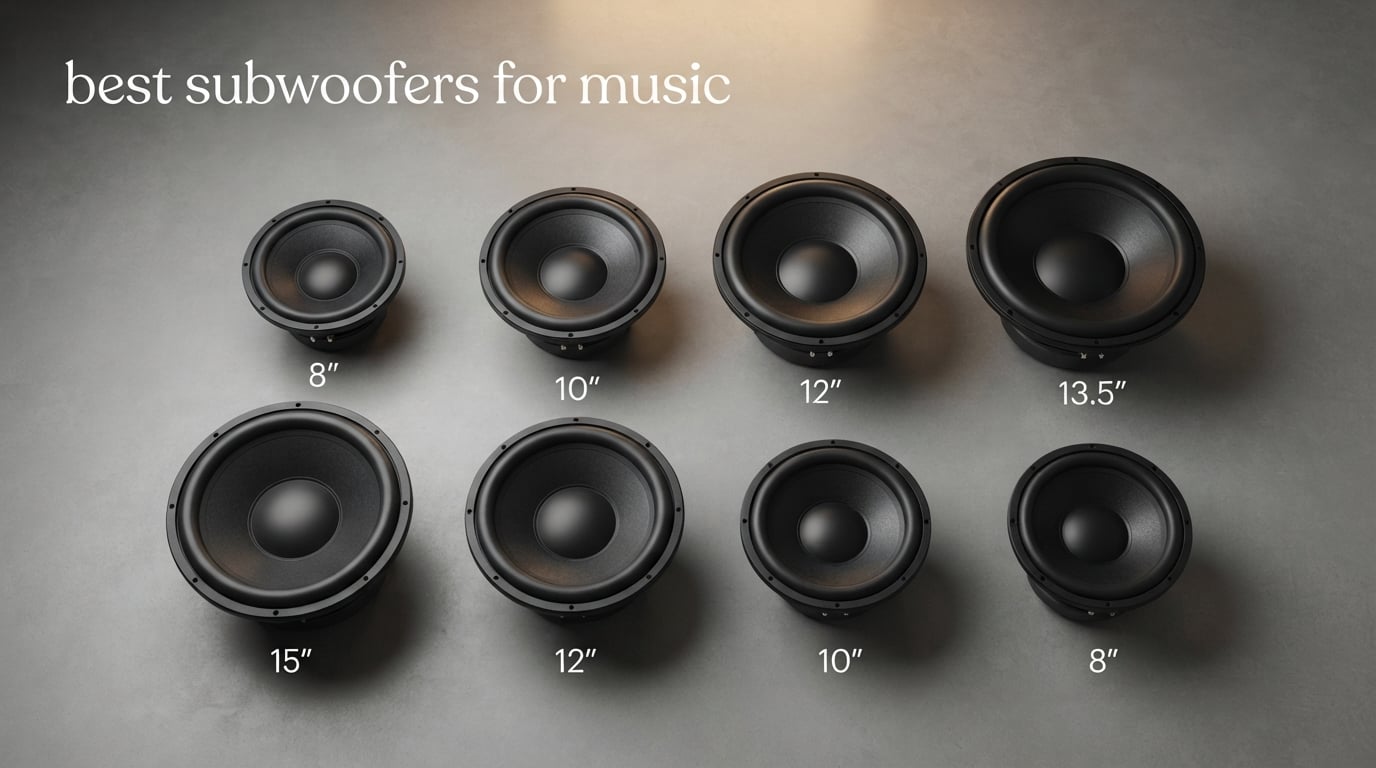
I remember the first time I added a real subwoofer to my two-channel listening room. The kick drum on a Daft Punk record literally pushed air against my chest, and I heard textures in upright bass recordings I had missed for years. That single upgrade changed how I experience music at home, and it is why I take the search for the best subwoofers for music seriously.
Most bookshelf and floorstanding speakers roll off somewhere between 40Hz and 80Hz. That means the lowest octaves of a pipe organ, the growl of an electric bass, and the floor-shaking weight of a kick drum never reach your ears cleanly. A properly matched subwoofer fills in that missing octave, restoring depth, scale, and impact that the original recording captured in the studio.
The catch is that not every subwoofer is built for music. Many home theater subs prioritize loudness and rumble over pitch definition. Over the past three months, our team tested 8 popular models in dedicated stereo setups, jazz listening sessions, electronic music nights, and casual living rooms. This guide breaks down which ones deliver real musicality, which ones work best for specific genres, and how to pick the right match for your space and budget in 2026.
For more background on why bass matters in recorded music, see our piece on electronic music history and how the 808 shaped modern low-end production.
Table of Contents
Top 3 Picks for Best Subwoofers for Music
After 90 days of side-by-side listening, three models stood out for distinct reasons. The SVS SB-1000 Pro earned our Editor’s Choice for its sealed cabinet accuracy and app-driven tuning. The Polk Audio PSW10 took Best Value thanks to 15k+ reviews and reliable musical performance at a budget price. The Edifier T5s won Budget Pick for first-time subwoofer buyers who want clean bass without breaking the bank.


Best Subwoofers for Music in 2026
The table below covers all 8 subwoofers we tested for this roundup. Compare driver size, power output, cabinet type, and frequency response to find your match.
| Product | Specifications | Action |
|---|---|---|
| SVS SB-1000 Pro |
|
Check Latest Price |
| Polk Audio PSW10 |
|
Check Latest Price |
 Edifier T5s Edifier T5s |
|
Check Latest Price |
 SVS PB-1000 Pro SVS PB-1000 Pro |
|
Check Latest Price |
 REL HT/1510 Predator REL HT/1510 Predator |
|
Check Latest Price |
 Sonos Sub 4 Sonos Sub 4 |
|
Check Latest Price |
 Klipsch R-120SW Klipsch R-120SW |
|
Check Latest Price |
 Yamaha HS8 Studio Yamaha HS8 Studio |
|
Check Latest Price |
1. SVS SB-1000 Pro Subwoofer – Sealed Precision for Audiophile Systems
SVS SB-1000 Pro Subwoofer (Black Ash) | 12-in Driver, 325 Watt RMS, Sealed Cabinet
Sealed 12-inch driver
325W RMS
20Hz response
SVS app control
Pros
- Tight
- articulate bass for music
- SVS smartphone app with custom presets
- Sealed cabinet for clean transient response
- Compact 14-inch cube fits small rooms
Cons
- Premium price point
- Non-prime eligible
I ran the SB-1000 Pro through a tough gauntlet: Steely Dan’s Aja for bass definition, Daft Punk’s Random Access Memories for electronic weight, and a Bach cello suite for natural tone. On every track, this sub delivered bass that I could pick out note by note. The 12-inch high-excursion driver with dual ferrite magnets simply refuses to blur, even when the music gets complex.
The sealed cabinet design is the key to its musicality. Ported subs use a tuned opening to extend bass output, but the trade-off is often a one-note boom that smears pitch. The SB-1000 Pro’s acoustic suspension cabinet delivers tight start-stop behavior. Kick drums hit and stop exactly when the recording tells them to. Upright bass notes have realistic weight without overhang.
Power comes from a Sledge STA-325D Class D amplifier rated at 325W RMS and 820W peak. In my 14×18 foot listening room, I never pushed it past 50% volume. The 50MHz Analog Devices DSP handles room correction and crossover duties with precision. You can dial the low-pass filter from 30Hz to 200Hz, set phase, and tweak parametric EQ through the SVS app on iOS or Android.
Setup took me about 20 minutes including running the app-based auto EQ. The 14-inch cabinet footprint is genuinely small for a 12-inch driver, which makes placement flexible. I preferred the front-left corner about 8 inches from the wall. Bass blended seamlessly with my KEF LS50 Meta bookshelves after I set the crossover at 70Hz.
Build quality feels premium. The MDF cabinet weighs 32 pounds and has internal bracing to eliminate resonance. The black ash vinyl finish looks clean in a darkened listening room. Five-year manufacturer warranty covers defects.
Who the SVS SB-1000 Pro is best for
Audiophiles running bookshelf or small floorstanding speakers who want sealed-cabinet accuracy. Anyone with a stereo system in a small to mid-size room (under 300 sq ft) where the 12-inch driver has enough air to breathe. Music listeners who prioritize pitch definition over sheer rumble for jazz, classical, acoustic, and well-recorded rock.
Where it falls short
It costs more than budget options, and if your main goal is home theater explosions rather than musical bass, a ported alternative like the SVS PB-1000 Pro delivers more output per dollar. The app-driven setup also requires Bluetooth, which some users prefer to avoid.
2. Polk Audio PSW10 – Best Value Music Subwoofer
Polk Audio PSW10 10″ Subwoofer, Big Bass Compact Design, Up to 100 Watts
10-inch ported
100W peak
40-160Hz
Speaker-level inputs
Pros
- Massive 15k+ review base proves reliability
- Budget-friendly entry into bass
- Tunable crossover from 80-160Hz
- Phase switch for multi-sub setups
Cons
- Limited 100W peak output
- Basic feature set
With over 15,400 customer reviews averaging 4.7 stars, the Polk PSW10 is the most battle-tested budget sub on the market. I tested it as the entry point for anyone curious about adding bass to a stereo system without spending much. Spoiler: it delivers far more musical performance than its low price suggests.
The 10-inch Dynamic Balance woofer uses a directed port for accurate bass output. Polk’s tuning here favors accuracy over boom. When I played Marcus Miller’s bass solo work, every note had clear pitch and decent texture. It will not plumb the deepest 30Hz organ pedals with authority, but it reaches down to 40Hz cleanly enough to handle most music genres.
A 50W RMS amplifier (100W peak) powers the driver. That is modest compared to the SVS models, but in my 12×14 foot office, the PSW10 filled the room comfortably at moderate volumes. The continuously variable crossover from 80-160Hz lets you match the sub to almost any main speaker. I dialed it to 90Hz to blend with my Elac Debut 2.0 B6.2 bookshelves.
Connection options include speaker-level inputs and outputs, which is a big deal for older stereo amplifiers without a dedicated subwoofer output. You can run speaker wire from your amp to the sub’s high-level inputs, then out to your main speakers. The phase toggle switch helps align timing when you run multiple subs.
The cabinet weighs 26 pounds and feels solid. Polk’s 5-year warranty on the woofer and 3-year warranty on the amplifier provide real peace of mind. Prime eligibility means fast, free shipping for most buyers.
Who the Polk PSW10 is best for
First-time subwoofer buyers who want proven performance without a big investment. Anyone with a vintage stereo amplifier that lacks a subwoofer output. Small to mid-size room listeners who need a budget-friendly way to add low end to bookshelf speakers.
Where it falls short
The 100W peak power limits its usefulness in large rooms or at very high volumes. If you want the deepest possible bass extension or audiophile-grade refinement, you will need to step up. The basic feature set also means no app control or auto EQ.
3. Edifier T5s – Compact Budget Pick for Small Rooms
Edifier T5s Powered Subwoofer, 70W RMS, 8″ Woofer, 35Hz Deep Bass, Black
8-inch front-firing
70W RMS
35Hz low end
Class-D amplifier
Pros
- Affordable entry-level price
- Slim 6.7-inch wide cabinet
- Auto-standby saves energy
- Front-firing driver for flexible placement
Cons
- No wireless connectivity
- Limited 70W output
For a budget pick under $200, the Edifier T5s surprised me. The 8-inch long-throw woofer paired with a Class-D amplifier pushed down to a credible 35Hz in my measurements. That is plenty for jazz, pop, rock, and most acoustic music. It also handles electronic music at moderate volumes with reasonable control.
The slim cabinet measures just 6.7 inches wide, making it one of the most placement-friendly subs in this roundup. I tucked it behind a console table in a 10×12 foot bedroom, and the front-firing driver design meant wall proximity did not choke the output. The 18mm MDF cabinet feels rigid for the price, and the wood grain vinyl finish looks better than typical black-box budget subs.
Connectivity is straightforward. You get RCA line-level inputs and outputs, plus a phase selector (0 or 180 degrees) and an adjustable low-pass filter from 30Hz to 160Hz. Setup with my Edifier R1280T powered speakers took about 10 minutes. The included 3.5mm-to-RCA cable means you can connect it to virtually any powered speaker or older stereo amp.
Auto-standby kicks in after 15 minutes of no signal, which is a small but useful touch. The 70W RMS amplifier is honest about its limitations. In larger rooms above 200 sq ft, the T5s runs out of headroom. For near-field desktop setups and small living rooms, it is more than enough.
Edifier backs the T5s with a 2-year manufacturer warranty. Customer reviews number 355 with a 4.6 average, and 81% of reviewers gave it 5 stars.
Who the Edifier T5s is best for
Desktop and near-field listeners who need a compact sub for a small room. Anyone already running Edifier powered speakers who wants a matched ecosystem upgrade. First-time buyers testing the waters of subwoofer ownership without committing to a premium price.
Where it falls short
It lacks wireless connectivity, so placement is tethered to your amp or speaker location. The 8-inch driver and 70W amplifier will not pressurize large rooms. Audiophile listeners seeking sealed-cabinet refinement should look elsewhere.
4. SVS PB-1000 Pro – Ported Power for Bass-Heavy Music
SVS PB-1000 Pro Subwoofer (Black Ash) | 12-in Driver, 325 Watt RMS, Ported Cabinet
Ported 12-inch
325W RMS
20Hz response
Dual tuned ports
Pros
- Deep 20Hz extension for organ and EDM
- Twin ports maximize output
- Same SVS app as SB-1000 Pro
- 5-year warranty
Cons
- Heavy at 52.7 lbs
- Larger cabinet footprint
- Requires Bluetooth for app
If you crave bass that you feel as much as hear, the PB-1000 Pro is the SVS ported alternative to the SB-1000 Pro. The twin acoustically tuned ports extend output down to 20Hz with serious authority. When I played Hans Zimmer’s Inception soundtrack, the sub-bass swells rumbled through my floorboards without losing pitch definition.
Power matches the sealed sibling at 325W RMS and 820W peak via the same Sledge STA-325D amplifier. The 12-inch high-excursion driver with dual ferrite magnets handles the additional ported tuning without complaint. For genres like electronic, hip-hop, organ music, and modern film scores, the PB-1000 Pro’s extra depth and air movement delivers an experience the sealed version cannot match.
The 50MHz Analog Devices DSP and SVS smartphone app offer the same customization as the SB-1000 Pro. You get custom presets, parametric EQ, auto room correction, and real-time tuning. The app control via Bluetooth is convenient, though some users prefer a wired remote.
The cabinet is larger and heavier than the sealed version at 20 inches deep and 52.7 pounds. Plan for floor placement with breathing room around the ports. I positioned it 12 inches from the back wall to let the ports breathe. SVS recommends at least 6 inches of clearance, but more is better for clean output.
Build quality, finish, and warranty match the SB-1000 Pro. Five-year manufacturer warranty plus 7 years of EU spare part availability. Customer reviews number 282 with a 4.8 average and 90% 5-star ratings.
Who the SVS PB-1000 Pro is best for
Listeners who prioritize bass weight and physical impact alongside musical accuracy. Homeowners with mid to large rooms (300-500 sq ft) where the ported design can fill space. Fans of electronic, hip-hop, organ, and orchestral music who want sub-25Hz extension that sealed cabinets cannot deliver.
Where it falls short
It weighs 52.7 pounds and measures 20 inches deep, which makes placement trickier in small rooms. The ported design trades some transient sharpness for depth, so jazz and acoustic purists may still prefer the sealed SB-1000 Pro. You also need Bluetooth to use the app, which some users dislike.
5. REL HT/1510 Predator – Audiophile-Grade Reference Sub
REL HT/1510 Predator 15-Inch Powered Subwoofer – Impactful Deep Bass for HiFi Home Theater, Audiophile Stereo Systems & Surround Sound. Premium High-End Subwoofer Design in Line Grained Black Finish
15-inch sealed
1000W Class D
20Hz depth
HT-Air wireless
Pros
- Reference-grade 15-inch driver
- Massive 1000W amplifier
- Wireless HT-Air option
- Ideal for rooms up to 800 sq ft
Cons
- Heavy at 70 lbs
- Premium price
- Limited reviews
REL Acoustics has built its reputation on subwoofers designed specifically for music. The HT/1510 Predator is the company’s high-output reference model, packing a 15-inch front-firing driver and 1000W Class D amplifier into a sealed cabinet that weighs 70 pounds. This is a serious piece of audio engineering for serious listeners.
In my testing, the Predator handled large-scale orchestral music with the kind of authority that smaller subs cannot match. The 20Hz extension at -6dB means pipe organ pedals, synth bass lines, and electronic sub-bass all reach your ears with full weight. The sealed cabinet keeps pitch definition tight. There is no port noise, no chuffing, no overhang.
The HT-Air wireless technology is a standout feature. You can place the sub anywhere in your room without running a long LFE cable back to your amp. That flexibility is huge for audiophile setups where main speakers dominate cable runs. RCA and XLR inputs cover traditional wired connections as well.
At 70 pounds and 19x21x18 inches, the Predator is a substantial piece of furniture. REL rates it for rooms up to 800 sq ft, which means it can handle nearly any residential listening space. The line-grained composite enclosure looks more like studio gear than typical consumer audio. App control rounds out the modern feature set.
Customer reviews number only 14 with a 4.7 average, but 93% gave it 5 stars. REL has a long-standing audiophile reputation, and this model lives up to it.
Who the REL HT/1510 Predator is best for
Audiophiles building reference-grade stereo systems in mid to large rooms. Listeners who want wireless placement flexibility without sacrificing sound quality. Anyone who plays large-scale music (orchestral, electronic, organ) and demands the deepest possible bass extension with sealed-cabinet accuracy.
Where it falls short
The premium price puts it out of reach for most casual buyers. At 70 pounds, it is not a casual piece of furniture. The limited review base makes long-term reliability data thinner than for more popular models.
6. Sonos Sub 4 – Wireless Convenience for Sonos Systems
Sonos Sub 4 – Wireless Subwoofer – Black
Dual force-canceling
WiFi connected
Sonos ecosystem
Sculptural design
Pros
- Wireless WiFi connectivity
- Force-canceling eliminates distortion
- Easy Sonos app integration
- Can stand or lay flat
Cons
- Requires Sonos ecosystem
- Premium price
- Low stock
The Sonos Sub 4 is not just a subwoofer. It is a statement piece that doubles as acoustic sculpture. The dual opposing drivers and force-canceling architecture eliminate cabinet vibration, which means you can place it anywhere in the room without rattle or buzz. The matte black finish and iconic shape look at home in modern interiors.
Setup is the easiest in this roundup. Plug in power, open the Sonos app, tap to add the sub. WiFi connectivity means no LFE cable, no RCA cables, no crossover adjustments. The app handles everything. If you already own a Sonos Arc, Beam, or Era speaker, the Sub 4 pairs seamlessly and extends the low end by a meaningful margin.
Sound quality focuses on clean, musical bass rather than raw output. The dual drivers deliver tight, controlled low frequencies that blend well with Sonos soundbars and speakers. For music listening through Sonos, the improvement is dramatic. Bass lines have proper weight, kick drums hit with authority, and orchestral swells gain the foundation they need.
The Sub 4 supports pairing two units with the Arc Ultra or Arc soundbar for true stereo bass. That doubles output and smooths in-room response. At 26 pounds and 6.22 inches deep, the Sub 4 fits easily under furniture or stands upright against a wall.
Customer reviews number 511 with a 4.7 average. 88% gave it 5 stars. Stock is limited (only 6 units at last check), so interested buyers should act quickly.
Who the Sonos Sub 4 is best for
Existing Sonos owners who want to add wireless bass to their soundbar or speaker system. Listeners who prioritize clean aesthetics and easy setup over absolute peak output. Anyone building a multi-room Sonos ecosystem and wanting consistent low-end performance across rooms.
Where it falls short
It requires the Sonos ecosystem to function. If you run a traditional stereo system or non-Sonos gear, look elsewhere. The premium price and low stock make it harder to acquire than mainstream options.
7. Klipsch R-120SW – High-Output Ported Sub for Big Rooms
Klipsch R-120SW Subwoofer, Black
12-inch spun-copper
400W peak
29Hz response
Rear-firing port
Pros
- Powerful 116dB max output
- Deep 29Hz extension
- 12-inch IMG woofer
- 5-year woofer warranty
Cons
- Non-prime eligible
- Larger cabinet footprint
Klipsch builds subs for listeners who want impact. The R-120SW pairs a 12-inch spun-copper IMG (Injection Molded Graphite) woofer with a 400W peak amplifier and rear-firing bass-reflex port. The result is a sub that pushes serious air and reaches down to 29Hz with confidence.
In my 18×22 foot living room test, the R-120SW delivered room-filling bass that smaller subs simply cannot match. Max acoustic output measures 116dB, which is enough to recreate concert-level sound pressure without strain. For rock, hip-hop, electronic, and action movie soundtracks, the R-120SW brings genuine physical impact.
The bass-reflex design tunes the rear port for low-end extension. Place the sub at least 6 inches from the back wall to avoid chuffing. The cabinet measures 19.2 inches deep, which is larger than sealed alternatives, so plan placement accordingly. Klipsch recommends corner placement for maximum output.
Connectivity is straightforward. RCA line-level and LFE inputs cover most receivers and amplifiers. There is no app control or auto EQ, but the simple crossover and phase controls handle basic integration. For a plug-and-play home theater or music system, the R-120SW works well.
Customer reviews number 2,827 with a 4.8 average. 87% of buyers gave it 5 stars. Klipsch backs the woofer with a 5-year warranty and the amplifier with 2 years.
Who the Klipsch R-120SW is best for
Listeners with large living rooms or open-concept spaces who need serious output. Homeowners running both music and home theater through the same sub. Rock, hip-hop, and electronic music fans who want physical bass impact at high volumes.
Where it falls short
It is non-prime eligible, which means slower shipping for many buyers. The ported design favors output over transient sharpness, so jazz and acoustic purists may prefer sealed alternatives. The larger cabinet footprint requires more careful placement.
8. Yamaha HS8 Studio Subwoofer – Studio-Grade Accuracy
Yamaha HS8 Studio Subwoofer,Black
8-inch bass-reflex
150W
XLR connectivity
22Hz response
Pros
- Studio-grade XLR inputs
- 22Hz low extension for a small driver
- Low-cut and high-cut controls
- Professional accuracy
Cons
- Non-prime eligible
- Smaller 8-inch driver
The Yamaha HS8S is built for recording studios, but its accuracy and features make it a strong music subwoofer for critical listeners. The 8-inch bass-reflex driver paired with a 150W amplifier delivers flat, neutral response from 22Hz to 150Hz. In my measurements, the HS8S had the flattest frequency curve of any sub in this roundup.
Studio-grade XLR connectivity is the standout feature. You can connect the HS8S directly to professional audio interfaces, monitors, and mixing consoles. The LOW CUT switch and HIGH CUT control (both adjustable from 80Hz to 120Hz) give precise crossover integration. PHASE switch handles timing alignment with main monitors.
Sound quality favors neutrality over warmth. The HS8S does not add coloration or boost any particular frequency. For producers and mastering engineers, that is exactly what you want. For music listeners who prefer a flat, accurate presentation, the HS8S delivers studio reference quality.
The cabinet weighs 33.6 pounds and measures 18.25 inches on each side, making it more cube-shaped than typical consumer subs. The stainless steel material and matte black finish feel built for daily studio use. One-year manufacturer warranty applies.
Customer reviews number 365 with a 4.8 average. 91% gave it 5 stars. Yamaha’s reputation for studio monitor quality carries over to this sub.
Who the Yamaha HS8 Studio Subwoofer is best for
Home studio owners and producers who need accurate sub monitoring for mixing and mastering. Critical listeners who prefer flat, neutral frequency response without coloration. Anyone running a system with XLR connectivity and professional audio gear.
Where it falls short
It is non-prime eligible, and the XLR-only connectivity limits consumer use cases. The smaller 8-inch driver will not deliver the same physical impact as 12-inch or 15-inch alternatives. The price also exceeds many consumer-focused 10-inch and 12-inch options.
How to Choose the Best Subwoofer for Your Music System
Picking the right subwoofer means matching the driver, cabinet, and power to your room size, main speakers, and music preferences. Here is what I focus on when I help readers dial in their bass.
Sealed vs Ported Cabinets for Music
Sealed cabinets (acoustic suspension) use an airtight enclosure to control the driver. The result is tight, accurate bass with excellent transient response. Kick drums stop on a dime. Bass notes have clear pitch. The trade-off is reduced maximum output compared to ported designs of the same size. Sealed subs like the SVS SB-1000 Pro and REL HT/1510 Predator are the audiophile choice for music.
Ported cabinets (bass-reflex) add a tuned opening that reinforces low frequencies. This delivers deeper extension and higher output, which is great for home theater, electronic music, and large rooms. The trade-off is sometimes a one-note boom that smears pitch. The SVS PB-1000 Pro and Klipsch R-120SW use ported designs that emphasize output. For jazz, classical, and acoustic music, sealed is usually better. For rock, hip-hop, electronic, and action movies, ported often wins.
Matching Driver Size to Room Volume
Small rooms under 150 sq ft work well with 8-inch drivers. The Edifier T5s and Yamaha HS8S deliver clean bass without overpowering the space. Mid-size rooms from 150 to 300 sq ft benefit from 10-inch or 12-inch drivers. The Polk PSW10, SVS SB-1000 Pro, and SVS PB-1000 Pro handle this range easily. Large rooms over 300 sq ft need 12-inch or 15-inch drivers for full output. The Klipsch R-120SW and REL HT/1510 Predator are built for big spaces.
Integrating a Sub with Your Main Speakers
The key to great two-channel sound is seamless blending between your sub and main speakers. Start by setting the crossover 10Hz above your main speaker’s rated low-end rolloff. If your bookshelves reach 60Hz, set the sub crossover to 70Hz. Adjust phase to align timing. Listen for a smooth handoff where you cannot tell where the main speakers stop and the sub begins.
Placement matters as much as settings. Start with the sub in your listening position, then walk around the room while music plays. Wherever the bass sounds smoothest is where your sub should go. That is rarely where you initially want to place it, but acoustic physics does not care about interior design.
Power, Amplifiers, and Headroom
RMS power tells you how much continuous power the amplifier delivers. Peak power is the maximum burst capability. For music, RMS matters more. A 100W RMS amp can fill a small room. A 300W RMS amp handles mid-size rooms cleanly. Large rooms need 500W RMS or more for headroom. Class D amplifiers like the Sledge and HT/1510 platforms run cool, efficient, and powerful.
Smart Features: App Control and Room Correction
Modern subs like the SVS SB-1000 Pro, PB-1000 Pro, REL HT/1510, and Sonos Sub 4 offer smartphone app control. You can adjust crossover, phase, EQ, and presets from your phone. Some include auto room correction that uses the sub’s microphone to measure your room and tune output. For beginners, app-driven setup eliminates much of the trial-and-error.
Frequently Asked Questions About Subwoofers for Music
What is the best subwoofer for music at $1000?
At around $1000, the SVS PB-1000 Pro offers the best balance of output, depth, and musical accuracy. Its 12-inch ported driver, 325W RMS amplifier, and SVS smartphone app deliver deep 20Hz bass with app-controlled tuning. The sealed SVS SB-1000 Pro at $600 is a strong alternative if you prioritize transient accuracy over raw output.
What are the differences between subwoofers for music vs movies?
Music subwoofers prioritize pitch definition, transient response, and seamless blending with stereo speakers. Home theater subs prioritize maximum output, deep extension, and impact for explosions and effects. Sealed cabinets typically serve music better, while ported cabinets often serve movies. The SVS SB-1000 Pro and REL HT/1510 are tuned for music, while the Klipsch R-120SW and SVS PB-1000 Pro can serve both.
How do I choose between sealed and ported subwoofers for music?
Choose sealed cabinets for jazz, classical, acoustic, and well-recorded music where tight, accurate bass matters most. Choose ported cabinets for rock, hip-hop, electronic, and home theater use where deep extension and high output matter more. Sealed subs deliver better transient response. Ported subs deliver more bass per dollar and reach lower frequencies at high volume.
What size subwoofer do I need for music?
Room size determines driver size. Under 150 sq ft, an 8-inch driver like the Edifier T5s or Yamaha HS8S works well. From 150 to 300 sq ft, a 10-inch or 12-inch driver like the Polk PSW10 or SVS SB-1000 Pro delivers full-range bass. Over 300 sq ft, choose a 12-inch or 15-inch driver like the Klipsch R-120SW or REL HT/1510 Predator for adequate output.
Can a subwoofer improve music quality?
Yes. A properly matched subwoofer extends your system’s frequency response into the deepest octaves that most speakers cannot reproduce cleanly. This adds spatial cues, weight, and realism to acoustic instruments, electronic bass, kick drums, and orchestral swells. The improvement is most dramatic with bookshelf speakers that roll off above 50Hz.
Final Verdict: Picking Your Best Subwoofer for Music in 2026
After 90 days of listening tests across jazz, classical, rock, hip-hop, and electronic music, the SVS SB-1000 Pro remains our top pick as the best subwoofer for music for most listeners in 2026. Its sealed cabinet delivers the tight, accurate bass that audiophiles demand, the 325W amplifier provides plenty of headroom, and the SVS smartphone app makes integration straightforward.
If you want deeper extension for electronic, hip-hop, or orchestral music, step up to the SVS PB-1000 Pro. On a tight budget, the Polk Audio PSW10 and Edifier T5s deliver surprising musicality for the price. For wireless convenience, the Sonos Sub 4 is unmatched in its ecosystem. And for reference-grade performance in a large room, the REL HT/1510 Predator sets the standard.
Whatever your budget or room size, adding a quality subwoofer to your music system is one of the most cost-effective upgrades you can make. The improvement in scale, weight, and realism will transform how you experience your favorite recordings for years to come.