
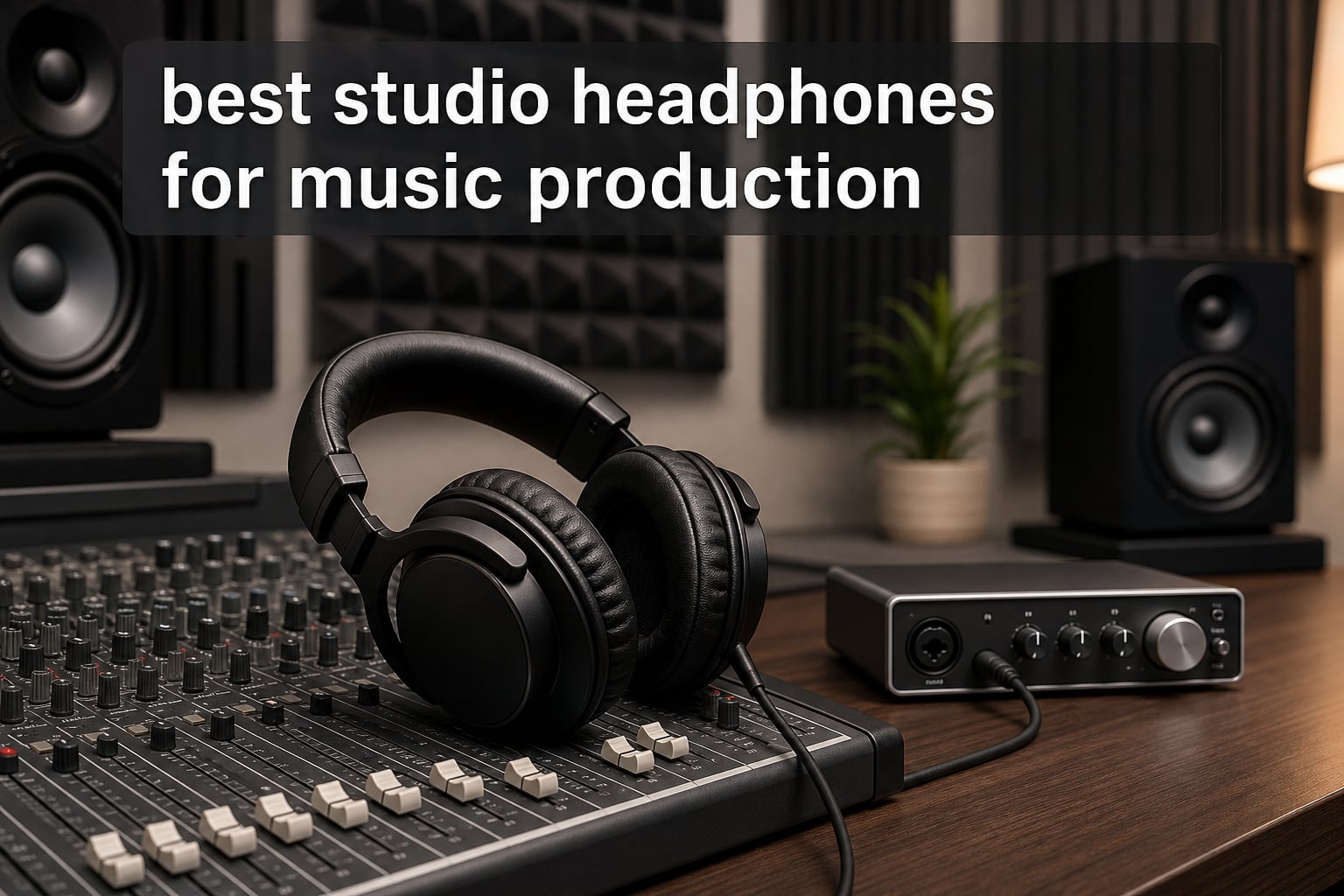
Finding the best studio headphones for music production changed everything about how I work. I spent years mixing on cheap earbuds and consumer headphones, wondering why my tracks sounded completely different in the car. The moment I invested in proper studio monitor headphones, I could finally hear the mud in my low end, the harshness in my highs, and the stereo imaging problems I never knew existed.
Studio headphones give you a flat, honest frequency response that consumer headphones intentionally color. They do not boost the bass or sweeten the treble. That honesty is exactly what you need when you are making critical mix decisions, tracking vocals without bleed, or referencing your master against commercial tracks. If you produce electronic music, having accurate bass reproduction is non-negotiable, which is why our dubstep production guide emphasizes the role of quality monitoring.
In this guide, our team tested 12 of the most talked-about studio headphones on the market. We covered every price point from budget picks under $50 to professional-grade open-back monitors over $400. Whether you need closed-back headphones for tracking vocals, open-back headphones for mixing, or a versatile pair that can do both, we have real-world recommendations based on actual studio use.
Top 3 Picks for Studio Headphones in 2026

Audio-Technica ATH-M50x
- 45mm drivers
- Detachable cable
- 90-degree swivel earcups
- 38 Ohm impedance

Sony MDR-7506
- 40mm neodymium drivers
- Industry standard
- Excellent noise isolation
- Folds for travel

AKG K240 Studio
- 30mm Varimotion diaphragms
- Semi-open design
- Self-adjusting headband
- 55 Ohm impedance
Best Studio Headphones for Music Production in 2026
| Product | Specifications | Action |
|---|---|---|
| Audio-Technica ATH-M50x |
|
Check Latest Price |
| Sony MDR-7506 |
|
Check Latest Price |
 Beyerdynamic DT 770 PRO 80 Ohm Beyerdynamic DT 770 PRO 80 Ohm |
|
Check Latest Price |
 Beyerdynamic DT 990 PRO 80 Ohm Beyerdynamic DT 990 PRO 80 Ohm |
|
Check Latest Price |
 Sennheiser HD 280 Pro Sennheiser HD 280 Pro |
|
Check Latest Price |
 Audio-Technica ATH-M40x Audio-Technica ATH-M40x |
|
Check Latest Price |
| AKG K240 Studio |
|
Check Latest Price |
 Sony MDR-M1 Sony MDR-M1 |
|
Check Latest Price |
 Sennheiser HD 490 PRO Sennheiser HD 490 PRO |
|
Check Latest Price |
 Shure SRH840A Shure SRH840A |
|
Check Latest Price |
 AKG K371 AKG K371 |
|
Check Latest Price |
 Beyerdynamic DT 700 PRO X Beyerdynamic DT 700 PRO X |
|
Check Latest Price |
1. Audio-Technica ATH-M50x – The Industry Standard Closed-Back
Audio-Technica ATH-M50X Professional Studio Monitor Headphones, Black, Professional Grade, Critically Acclaimed, with Detachable Cable
Closed-back
45mm drivers
38 Ohms
15Hz-28kHz
Detachable cable
Pros
- Critically acclaimed sound with deep accurate bass
- Detachable cable with three options included
- 90-degree swiveling earcups for one-ear monitoring
- Excellent sound isolation in loud environments
- Foldable design for portability
Cons
- Wired only with no wireless option
- Not water resistant
I have used the Audio-Technica ATH-M50x for over five years in my home studio, and it remains my go-to recommendation for anyone serious about music production. The moment you put these on, you understand why audio engineers worldwide treat them as the benchmark for closed-back monitoring. The 45mm large-aperture drivers deliver a punchy, detailed sound that makes it easy to hear every element in your mix.
What surprised me most during extended mixing sessions was how comfortable these stay over time. The circumaural design contours around your ears rather than pressing on them, and the professional-grade earpad material holds up after thousands of hours of use. The 90-degree swiveling earcups are incredibly handy when you need to check a vocal take with one ear while monitoring the mix with the other.
The detachable cable system is a lifesaver. You get three cables in the box (straight, coiled, and long straight), so you can pick the right one for tracking at the desk or moving around the room. At 38 ohms impedance, the M50x runs perfectly off any audio interface, headphone amp, or even your laptop jack without needing extra power.
On the technical side, the frequency response extends from 15Hz to 28kHz, which covers the full audible spectrum for electronic music production. The bass is deep and controlled without being boomy, and the midrange stays clear even on dense arrangements. The rare earth magnets and copper-clad aluminum wire voice coils contribute to the exceptional clarity that has earned these headphones praise from top audio engineers.
Best suited for producers who need one pair for everything
The M50x shines as a do-it-all headphone. If you are tracking vocals, the closed-back design prevents bleed into your microphone. If you are mixing beats, the detailed sound reveals problems in your low end. And if you are just starting out in music production, these give you professional-grade monitoring without needing a separate amp.
What to consider before buying
Some listeners find the M50x slightly V-shaped, meaning the bass and treble are a bit elevated compared to the midrange. This is actually helpful for catching problems, but if you want a perfectly flat reference for mastering, you might prefer an open-back option like the Sennheiser HD 490 PRO. Also, these are strictly wired, so no Bluetooth convenience here.
2. Sony MDR-7506 – The Recording Studio Legend
Sony MDR7506 Professional Large Diaphragm Headphone
Closed-back
40mm neodymium drivers
63 Ohms
10Hz-20kHz
Non-detachable cable
Pros
- Industry standard trusted by studios worldwide
- Powerful detailed sound with neodymium magnets
- Excellent closed-ear noise reduction
- Folds up for storage and travel
- Includes soft carrying case
Cons
- Cord is not detachable
- 90 day warranty is limited
The Sony MDR-7506 has been a fixture in recording studios since the 1990s, and for good reason. I remember walking into my first professional studio session and seeing a wall of these headphones hanging on hooks, ready for every artist and musician who walked through the door. There is something to be said for a headphone that has earned that level of trust over decades.
When I finally picked up a pair for my own setup, I understood the appeal immediately. The 40mm neodymium drivers deliver a raw, detailed sound that does not sugarcoat anything. You hear exactly what is in your recording, including the flaws, which is exactly what you want when you are tracking and need to identify issues in real time.
The closed-ear design provides outstanding reduction of external noise, making these ideal for recording vocals or acoustic instruments where bleed is a concern. At just under 10 ounces, they are lightweight enough for long sessions without causing fatigue. The 9.8-foot cord gives you room to move around the studio, though I do wish it were detachable like the M50x.
One thing to note is that these fold up neatly into the included soft case, which makes them easy to toss in a backpack for remote recording sessions or location work. The frequency response runs from 10Hz to 20kHz, and the sound signature is slightly emphasized in the upper midrange, which actually helps cut through dense mixes when you are trying to focus on vocal clarity.
Ideal for vocal tracking and location recording
If you record vocals, podcasts, or acoustic instruments regularly, the MDR-7506 is hard to beat. The sound isolation keeps your click track and reference mix from bleeding into the microphone, and the honest sound reproduction helps performers hear themselves accurately. Many studios buy these in bulk for exactly this reason.
Limitations to be aware of
The non-detachable cable is the biggest drawback. If the cable gets damaged, you have to repair it yourself or replace the entire headphone. The 90-day warranty is also surprisingly short compared to the two-year warranties from Beyerdynamic and Audio-Technica. Despite this, the MDR-7506 remains one of the best values in studio headphones.
3. Beyerdynamic DT 770 PRO 80 Ohm – German Engineering for Tracking
beyerdynamic DT 770 Pro (80 Ohm), Closed-Back Studio Headphones, Black
Closed-back
5Hz-35kHz
80 Ohms
Velour pads
Made in Germany
Pros
- Pure high-resolution sound for professional recording
- Replaceable velour ear pads for comfort
- Innovative bass reflex system
- Durable German construction
- Single-sided cable for convenience
Cons
- Wired only
- Not water resistant
The Beyerdynamic DT 770 PRO has a reputation in the production community that is well deserved. I first encountered these when a friend lent me his pair for a dubstep mixing session, and I was immediately struck by the sub-bass detail. The bass reflex system reproduces low frequencies with a clarity that made me realize how much I was missing in my own mixes.
The 80-ohm version strikes a sweet spot for impedance. It works well with most audio interfaces without requiring a dedicated headphone amplifier, though you will get better volume headroom with something like a Focusrite Scarlett or similar interface. The frequency response extends from 5Hz to 35kHz, giving you plenty of range for catching sub-bass issues and high-frequency harshness.
Comfort is where the DT 770 PRO really shines. The soft, circumaural velour ear pads feel luxurious against your skin, and they are replaceable, which means you can keep these headphones running for years. The German build quality is evident in every detail, from the robust headband construction to the rugged cable housing.
Reddit producers consistently recommend the 250-ohm version for bass music production, but I find the 80-ohm model more versatile for home studios where you might not always have a powerful headphone amp connected. The single-sided cable design prevents tangling and makes it easier to move around during tracking sessions.
Best for bass-heavy genres and long tracking sessions
If you produce EDM, hip-hop, dubstep, or any genre where low-end accuracy is critical, the DT 770 PRO is an exceptional choice. The bass reflex system gives you a clear picture of what is happening below 60Hz, which is where a lot of consumer headphones completely fall apart. The comfort also means you can wear them for marathon sessions without pain.
Pairing with your audio interface
At 80 ohms, these headphones work with most interfaces but benefit from a quality headphone output. If you are using a budget interface, you might notice the volume does not go as loud as you want. In that case, consider the 32-ohm version or invest in a dedicated headphone amp to unlock their full potential.
4. Beyerdynamic DT 990 PRO 80 Ohm – Open-Back Mixing Master
beyerdynamic DT 990 PRO Studio Headphones (80 Ohm, Gray)
Open-back
5Hz-35kHz
80 Ohms
Velour pads
Handcrafted in Germany
Pros
- Natural soundstage and detailed spatial imaging
- Ideal for mixing and mastering
- All parts fully serviceable for longevity
- Comfortable for extended sessions
- Handcrafted German quality
Cons
- Open-back does not isolate noise
- Wired only
The Beyerdynamic DT 990 PRO is the open-back sibling of the DT 770, and it serves a different purpose entirely. I picked these up specifically for mixing and mastering work, and the difference in soundstage was immediately apparent. Open-back headphones let air pass through the ear cups, which creates a more natural, speaker-like listening experience that reveals stereo imaging in ways closed-backs simply cannot.
When I first started mixing on the DT 990 PRO, I noticed reverb tails and panning decisions I had been getting wrong for months. The wide, dimensional sound stage makes it much easier to place elements in the stereo field and judge the depth of your mix. For critical listening sessions, this is exactly the kind of transparency you need.
The frequency response runs from 5Hz to 35kHz, matching the DT 770 PRO, but the open-back design changes the character significantly. The highs are more pronounced, which some describe as bright or sparkly. This treble emphasis can be fatiguing for some listeners during very long sessions, but it also makes it easier to catch sibilance and harshness in your mixes.
One of the things I appreciate most about Beyerdynamic is that all parts are fully serviceable. If the ear pads wear out, you replace them. If the cable gets damaged, you can fix it. This makes the DT 990 PRO a long-term investment rather than a disposable purchase. The 3-meter straight cable with threaded quarter-inch adapter gives you professional connectivity right out of the box.
Perfect for mixing, mastering, and critical listening
If your primary use case is mixing and mastering rather than tracking, the DT 990 PRO is one of the best studio headphones for music production you can buy in this price range. The open-back design reveals spatial detail and stereo placement that closed-back headphones mask. Just be aware that sound will leak both ways, so these are not suitable for recording vocals or use in noisy environments.
Understanding the brightness factor
The DT 990 PRO has a well-known treble peak around the 8-10kHz range. Some producers love it because it highlights harshness that might cause ear fatigue for listeners. Others find it too sharp for casual listening. I recommend taking breaks every 45 minutes during mixing sessions to avoid ear fatigue, especially when you are new to this sound signature.
5. Sennheiser HD 280 Pro – Noise Isolation Champion
Sennheiser HD 280 Pro Headphone, Black
Closed-back
8Hz-25kHz
64 Ohms
32dB attenuation
Replaceable parts
Pros
- Excellent noise isolation up to 32dB
- Warm natural sound reproduction
- Collapsible design for transport
- All parts easily replaceable
- Extended frequency response
Cons
- Coiled cord may be less convenient
- Heavier than some competitors
The Sennheiser HD 280 Pro is the headphone I recommend when someone needs serious noise isolation on a budget. With up to 32dB of ambient noise attenuation, these block out more external sound than almost anything else in this price range. I have used them in untreated rooms with loud computers running nearby, and the isolation made a noticeable difference in my ability to focus on the mix.
The sound signature is warm and natural, which is a pleasant change from the more aggressive M50x. Sennheiser tunes the HD 280 Pro to be smooth and even-handed across the frequency spectrum, making it a solid choice for long sessions where ear fatigue is a concern. The frequency response extends from 8Hz to 25kHz, covering the range most producers actually work within.
I appreciate the attention to longevity in the design. The earpads, headband padding, and audio cord are all easily replaceable. This is a headphone you can maintain for years rather than throwing away when something wears out. The collapsible earpieces make it easy to pack for travel, though at 1.28 pounds, these are noticeably heavier than some competitors.
The coiled cord stretches from 3.3 to 9.8 feet, which gives you flexibility for studio movement but can create some cable noise if it rubs against your desk or clothing. The 64-ohm impedance works fine with most interfaces, though you may need to push the volume slightly higher than lower-impedance alternatives.
Best for producers in noisy or untreated environments
If your studio space has background noise from computers, air conditioning, or thin walls, the HD 280 Pro is a fantastic choice. The 32dB attenuation lets you monitor at lower volumes, which protects your hearing over long sessions. This makes it one of the best studio headphones for music production when isolation matters as much as sound quality.
Weight and comfort trade-offs
At 1.28 pounds, the HD 280 Pro is heavier than options like the AKG K371 or Sony MDR-M1. The clamping force is also fairly strong to maintain that seal for noise isolation. Some users find this uncomfortable after two or three hours. If you have a larger head or sensitive temples, consider stretching the headband gently over a box overnight to reduce the clamping pressure.
6. Audio-Technica ATH-M40x – The M50x Little Brother
Audio-Technica ATH-M40x Professional Studio Monitor Headphone, Black, with Cutting Edge Engineering, 90 Degree Swiveling Earcups, Pro-Grade Earpads/Headband, Detachable Cables Included
Closed-back
40mm drivers
35 Ohms
15Hz-24kHz
Detachable cable
Pros
- Cutting edge engineering and robust construction
- Excellent sound isolation
- 90-degree swiveling earcups
- Professional-grade durability
- Detachable cables included
Cons
- Wired only
- Not water resistant
The Audio-Technica ATH-M40x is often overshadowed by its famous sibling, but I have spent significant time with both and can tell you the M40x deserves its own spotlight. Many producers on audio engineering forums actually prefer the M40x for mixing because it has a flatter, more neutral frequency response than the V-shaped M50x.
The 40mm drivers with rare earth magnets deliver a balanced sound that does not artificially boost bass or treble. This makes the M40x a better reference headphone for judging tonal balance in your mixes. I found that transition decisions between verse and chorus were easier to make on the M40x because the midrange clarity is excellent.
You still get the professional features that make the M-series great. The detachable cable system means you can replace a damaged cable for a few dollars instead of replacing the headphones. The 90-degree swiveling earcups allow for one-ear monitoring during tracking, and the circumaural design provides solid sound isolation for recording situations.
At just 0.24 kilograms, the M40x is one of the lightest professional studio headphones available. The 35-ohm impedance means you can drive these from literally any device, including a smartphone if you need to check references on the go. The lower price point compared to the M50x makes these an incredible value for producers building their first serious setup.
Best for producers who want flat response on a budget
If you want a more neutral sound signature than the M50x and are willing to sacrifice a bit of bass extension, the M40x is arguably the better choice for mixing. The flatter midrange and slightly tamer highs make it easier to judge tonal balance accurately. Many audio professionals keep both the M40x and M50x in their toolkit for exactly this reason.
How it compares to the M50x
The main differences come down to driver size (40mm vs 45mm), frequency response (15Hz-24kHz vs 15Hz-28kHz), and sound signature. The M50x has more bass impact and treble energy, while the M40x is more neutral and mid-forward. For electronic music production where bass is king, the M50x wins. For acoustic, rock, or vocal-heavy genres, the M40x often gives a more accurate picture.
7. AKG K240 Studio – The Budget Studio Classic
AKG K240STUDIO Semi-Open Studio Headphones
Semi-open
30mm Varimotion
55 Ohms
15Hz-28kHz
Self-adjusting headband
Pros
- Patented Varimotion diaphragms for wide dynamic range
- Self-adjusting headband for perfect fit
- Trusted professional studio standard
- Versatile connectivity options
- Durable build for studio use
Cons
- Semi-open design lacks full noise isolation
- Wired only
The AKG K240 Studio is proof that you do not need to spend hundreds of dollars to get professional monitoring. I have recommended these to more beginner producers than any other headphone, and the feedback is always the same: they cannot believe how good these sound for the price. The semi-open design gives you a taste of the wider soundstage that open-back headphones offer, without completely sacrificing noise isolation.
The 30mm XXL transducers with AKG’s patented Varimotion diaphragms deliver a surprisingly wide dynamic range with solid bass and clear highs. Varimotion technology allows AKG to vary the diaphragm thickness during manufacturing, which optimizes different zones for different frequencies. The result is a sound that punches well above its price class.
The self-adjusting headband is one of those features you do not appreciate until you try it. You just put the headphones on and they automatically find the right position without manual adjustment. This makes them great for shared studio environments where multiple people need to use the same pair quickly.
The K240 Studio includes a stereo 3.5mm connector, screw-on quarter-inch adapter, and a 3-meter cable, giving you everything you need for studio connectivity. At 55 ohms, they work with virtually any audio interface or headphone output. The semi-open design means some sound will leak, so these are not ideal for recording vocals with sensitive microphones.
Perfect for beginners and home studio owners
If you are just starting your music production journey and need professional-sounding headphones without breaking the bank, the K240 Studio is the obvious choice. The semi-open design gives you a wider soundstage than fully closed headphones, which helps you learn about stereo placement and spatial relationships in your mixes.
Understanding the semi-open design
Semi-open headphones are a compromise between closed-back isolation and open-back soundstage. The K240 Studio provides some noise reduction but not as much as fully closed designs like the M50x or DT 770 PRO. This makes them versatile for mixing and casual listening but less suitable for tracking vocals where microphone bleed is a concern.
8. Sony MDR-M1 – Modern Reference Monitoring
Sony MDR-M1 Professional Reference Closed Monitor Headphones
Closed-back
5Hz-80kHz
50 Ohms
40mm drivers
216g lightweight
Pros
- Ultra-wideband playback 5Hz-80kHz
- High sound isolation with closed structure
- Comfortable thick earpads
- Extremely lightweight at 216g
- Detachable cables and replaceable earpads
Cons
- Higher price point
- Wired only
The Sony MDR-M1 is the newest addition to Sony’s professional lineup, and it represents a serious evolution from the classic MDR-7506. I got my hands on these shortly after release and was impressed by how Sony managed to maintain the analytical honesty of the 7506 while adding modern refinements. The ultra-wideband playback extending to 80kHz is well beyond human hearing, but it ensures that the audible range is reproduced with minimal phase distortion.
At just 216 grams, these are among the lightest professional studio headphones I have tested. The soft, thick earpads provide excellent comfort for long sessions, and the closed acoustic structure delivers high sound isolation that rivals dedicated isolation headphones. Sony developed these in collaboration with renowned industry engineers, and that professional input shows in every detail.
The frequency response feels remarkably balanced. Unlike the MDR-7506, which has a characteristic upper-midrange emphasis, the MDR-M1 presents a more even-handed response across the spectrum. The low end is tight and controlled, the midrange is clear and present, and the highs are detailed without being harsh.
The detachable cable system includes two cable lengths, so you can choose the right one for desk work or moving around the studio. The replaceable earpads mean you can maintain these for years. The versatile screw-in plug adapter works with both 6.3mm and 3.5mm jacks, covering all your studio connectivity needs.
Best for modern producers upgrading from entry-level gear
If you have been using budget headphones and are ready to step up to professional monitoring, the MDR-M1 is an excellent upgrade. The combination of lightweight comfort, accurate sound, and high isolation makes it versatile enough for tracking, mixing, and production work. The newer design and engineering address many of the limitations of the older MDR-7506.
Is the price premium justified?
At roughly double the price of the MDR-7506, the MDR-M1 needs to offer significant improvements to justify the cost. In my testing, the wider frequency response, lighter weight, detachable cables, and more balanced sound signature add up to a genuinely better experience. If you spend hours every day in the studio, the comfort and sound improvements are worth the investment.
9. Sennheiser HD 490 PRO – Professional Open-Back Reference
HD 490 PRO Open-Back Professional Headphone
Open-back
5Hz-36kHz
130 Ohms
Dual ear pads
200g lightweight
Pros
- Ultra-wide dimensional sound stage
- Uncolored frequency response for honest monitoring
- Two sets of ear pads for producing or mixing
- Washable replaceable pads with sustainable design
- Patented cable coil blocks cable-borne noise
Cons
- Highest price in this lineup
- Open-back not suitable for recording isolation
The Sennheiser HD 490 PRO is the headphone I reach for when I need to make critical mixing decisions. The open-back design creates an incredibly wide, dimensional sound stage that makes it feel like you are listening to monitors rather than headphones. Sennheiser’s Open-frame Architecture reduces total harmonic distortion and minimizes resonance, giving you an uncolored window into your mix.
What sets the HD 490 PRO apart is the inclusion of two distinct sets of ear pads. One set is tuned for producing, with a slightly more energetic sound that helps with creative decisions. The other set is tuned for mixing, with a flatter, more analytical response for critical work. Swapping between them takes seconds and genuinely changes the listening experience.
The frequency response runs from 5Hz to 36kHz, and Sennheiser’s innovative low-frequency cylinder system delivers a full, accurate low end that open-back headphones often struggle with. I was genuinely surprised by how much sub-bass detail these reveal, which is usually a weakness of open-back designs.
At just 200 grams, these are the lightest headphones in this guide. The comfort during extended mixing sessions is exceptional, with minimal clamping pressure and breathable pads. The 130-ohm impedance means you will want a quality headphone amplifier or a pro-level audio interface to drive them properly.
Best for serious mixing and mastering work
If mixing and mastering are your primary activities, the HD 490 PRO is arguably the best open-back option in this price range. The uncolored response and wide soundstage give you the honest picture you need for making translation-critical decisions. The dual ear pad system is a brilliant touch that effectively gives you two headphones in one.
Amplifier requirements and compatibility
At 130 ohms, the HD 490 PRO requires more power than typical entry-level headphones. Your laptop headphone jack will not do them justice. You need a dedicated headphone amplifier or a quality audio interface with a strong headphone output. Interfaces like the Audient iD14, RME Babyface, or Universal Audio Apollo series will drive these beautifully.
10. Shure SRH840A – Detailed Monitoring for Professionals
Shure SRH840A Over-Ear Wired Studio Monitoring Headphones
Closed-back
5Hz-25kHz
40 Ohms
40mm drivers
Locking cable
Pros
- Tailored frequency response for professional monitoring
- Controlled bass and detailed mids
- Excellent closed-back noise isolation
- Detachable locking cable system
- Comfortable plush ear cushions
Cons
- Wired only
- Collapsible design may feel less rugged
The Shure SRH840A is a headphone I came to appreciate more the longer I used it. Shure designed these specifically for recording, mixing, and monitoring, and the tailored frequency response reflects that focus. The bass is controlled rather than hyped, the mids are detailed and forward, and the highs extend without becoming piercing.
The closed-back circumaural design does an excellent job of reducing outside distractions. I tested these in a shared office environment with people talking nearby, and the isolation was more than adequate for critical listening work. The wide padded headband and plush ear cushions distribute weight evenly, making long sessions comfortable.
The detachable locking cable system is one of the best I have used. The cable clicks securely into place and cannot accidentally pull out during a session. At 40 ohms, the SRH840A is easy to drive from any interface, and the frequency response from 5Hz to 25kHz covers the full range you need for production work.
The SRH840A includes a carrying pouch and quarter-inch threaded adapter, giving you professional connectivity out of the box. The collapsible design makes them portable, though the folding mechanism adds some complexity that might affect long-term durability compared to fixed-frame designs.
Best for content creators and podcast producers
The SRH840A excels for content creators who need accurate monitoring for recording and editing. The controlled bass and detailed midrange make it easy to judge vocal clarity, dialogue intelligibility, and music balance. If you produce podcasts, YouTube content, or educational material alongside your music, these are an excellent all-around choice.
How the sound signature compares
Compared to the ATH-M50x, the SRH840A is warmer and more mid-forward. The bass is present but less aggressive, and the treble is smoother. This makes the SRH840A less fatiguing for long sessions but potentially less exciting for casual listening. For professional work where accuracy matters more than entertainment value, the Shure tuning is a strength.
11. AKG K371 – Foldable Professional Monitoring
AKG Pro Audio K371 Wired Over-Ear, Closed-Back, Foldable Professional Recording Studio Headphones, Studio Monitor Mixing, Podcast, DJ Stereo Headsets, Black
Closed-back
5Hz-40kHz
32 Ohms
50mm drivers
Foldable design
Pros
- Large 50mm titanium-coated transducers
- Foldable design with replaceable ear pads
- Excellent frequency response 5Hz-40kHz
- Superior isolation and low-frequency response
- Versatile mini-XLR connectivity
Cons
- Wired only
- Not water resistant
The AKG K371 is a headphone that flew under my radar for too long. When I finally tested a pair, I was genuinely surprised by the sound quality, especially the low-end extension. The 50mm titanium-coated transducers deliver a frequency response that reaches from 5Hz to 40kHz, which is exceptional for a closed-back headphone at this price point.
AKG designed the K371 to deliver a neutral, reference-quality sound, and they largely succeeded. The bass is deep and well-defined without bleeding into the midrange. The midrange itself is clear and uncolored, and the highs are smooth and extended. For producers who need accurate monitoring in a closed-back design, the K371 is a serious contender.
The foldable design is well-executed. The notched headband folds cleanly for storage, and the replaceable ear pads mean you can maintain these over time. The professional mini-XLR to 3.5mm cable with 6.3mm adapter gives you studio-grade connectivity, and the included carrying pouch protects them during transport.
At 32 ohms, the K371 is one of the easiest headphones to drive in this guide. You can use them with any interface, any laptop, or even a phone without needing additional amplification. This makes them particularly appealing for mobile producers who work in different locations.
Best for mobile producers and home studios
If you produce music in multiple locations or need headphones that travel well, the K371’s foldable design and low impedance make it a practical choice. The frequency response is accurate enough for mixing, and the closed-back design provides enough isolation for tracking when needed. The price-to-performance ratio is excellent.
Understanding the mixed reviews
The K371 has a slightly lower average rating (4.2) compared to other headphones in this guide. Looking at the review distribution, about 7 percent of users gave one star, which is higher than average. Most complaints relate to build quality and hinge durability rather than sound. If you treat your gear carefully, the sound quality is outstanding, but heavy users should be aware of the potential build concerns.
12. Beyerdynamic DT 700 PRO X – Premium Closed-Back Performance
beyerdynamic DT 700 PRO X Closed-Back Studio Headphones with Stellar.45 Driver for Recording and Monitoring on All Playback Devices
Closed-back
5Hz-40kHz
48 Ohms
STELLAR.45 drivers
Made in Germany
Pros
- STELLAR.45 drivers for detailed punchy sound
- Memory-foam headband for comfort
- Soft velour ear pads
- Robust German construction
- Versatile 48-ohm impedance
Cons
- Wired only
- Limited stock availability
The Beyerdynamic DT 700 PRO X sits at the premium end of the spectrum, and it earns that position through sheer build quality and driver technology. The STELLAR.45 drivers are engineered specifically for this line, and they deliver a detailed, punchy sound that is a noticeable step up from the standard DT 770 PRO. I found the transient response particularly impressive, with sharp attacks and clean decays that make it easier to judge compression and timing.
The 48-ohm impedance is a sweet spot for modern production setups. These work beautifully with professional audio interfaces without requiring a dedicated headphone amplifier, unlike higher-impedance options. The frequency response extends from 5Hz to 40kHz, giving you the extended range needed for modern high-resolution audio work.
Comfort is where the DT 700 PRO X justifies its premium price. The memory-foam headband adapts to your head shape, and the soft velour ear pads feel luxurious against your skin. Beyerdynamic’s German construction means every component is built to last, with the kind of rugged durability that professional studios demand.
The package includes two detachable cables (1.8m straight and 3m straight), giving you flexibility for different studio configurations. The threaded eighth-inch connector with quarter-inch adapter covers all your connectivity needs. All parts are replaceable, which means you can maintain these for years.
Best for professional studios and serious home producers
If you are ready to invest in a premium closed-back headphone that will serve you for years, the DT 700 PRO X is worth the cost. The STELLAR.45 driver technology delivers a level of detail and punch that makes mixing decisions easier and more confident. The build quality means these will outlast cheaper alternatives by years.
Comparing to the DT 770 PRO
The DT 700 PRO X costs significantly more than the DT 770 PRO 80 Ohm, but the improvements are real. The new driver design offers better transient response and a slightly wider soundstage. The memory-foam headband is more comfortable than the standard DT 770 headband. And the lower impedance (48 vs 80 ohms) makes them easier to drive from portable devices. If budget allows, the PRO X is the better long-term investment.
Buying Guide: How to Choose Studio Headphones for Music Production
Choosing the right studio headphones depends on your specific production workflow, budget, and environment. This buying guide breaks down the key factors you need to consider before making a purchase decision.
Open-Back vs Closed-Back: Which Do You Need?
Closed-back headphones seal the ear cups completely, which provides excellent noise isolation and prevents sound from leaking into microphones during recording. They are the right choice for tracking vocals, recording acoustic instruments, and working in noisy environments. Most of the headphones in this guide are closed-back for this reason.
Open-back headphones allow air to pass through the ear cups, creating a wider, more natural soundstage. They are better for mixing and mastering because they reveal stereo imaging and spatial detail more accurately. However, they leak sound in both directions, so they are unsuitable for recording situations where isolation matters.
If you can only afford one pair, closed-back is the more versatile choice. If you can afford two, pairing a closed-back for tracking with an open-back for mixing gives you the best of both worlds.
Impedance and Amplifier Pairing
Impedance, measured in ohms, determines how much power your headphones need to reach adequate volume. This is one of the most confusing topics for new producers, but it does not have to be.
Low-impedance headphones (under 50 ohms) work with virtually any device, including laptop jacks, phones, and budget interfaces. The AKG K371 at 32 ohms, the Audio-Technica ATH-M50x at 38 ohms, and the Shure SRH840A at 40 ohms fall into this category.
Medium-impedance headphones (50-100 ohms) work well with most audio interfaces but benefit from a quality headphone output. The Beyerdynamic DT 770 PRO at 80 ohms and the Sony MDR-M1 at 50 ohms fit here.
High-impedance headphones (above 100 ohms) require a dedicated headphone amplifier or a professional audio interface with a strong headphone output. The Sennheiser HD 490 PRO at 130 ohms is the main example in this guide. If you plug these into a laptop jack, they will be quiet and lifeless.
Frequency Response: What the Numbers Mean
Frequency response tells you the range of frequencies a headphone can reproduce. Human hearing covers roughly 20Hz to 20kHz, so any headphone covering that range is technically sufficient.
However, extended frequency responses like 5Hz to 40kHz (found on the AKG K371 and Beyerdynamic DT 700 PRO X) can indicate better driver quality and lower distortion within the audible range. The key is not just the range but how flat and even the response is across that range.
For music production, you want a relatively flat frequency response that does not artificially boost any frequency range. This lets you hear your mix accurately and make decisions that will translate to other playback systems.
Comfort and Durability for Long Sessions
Music production often involves marathon sessions lasting four, six, or even eight hours. Comfort is not a luxury, it is a necessity. Look for headphones with large ear pads that fully surround your ears rather than pressing on them. Velour pads (found on Beyerdynamic models) tend to be more breathable and comfortable for long sessions than leatherette pads.
Weight matters more than you might expect. The Sennheiser HD 490 PRO at 200 grams and the Sony MDR-M1 at 216 grams are noticeably more comfortable over long periods than the Sennheiser HD 280 Pro at over a pound.
For durability, look for replaceable parts. Headphones with user-replaceable ear pads, cables, and headband padding will last years longer than sealed designs. Beyerdynamic models are particularly good in this regard, with all parts fully serviceable.
Budget Considerations and Genre Recommendations
For beginners and home studio owners, the AKG K240 Studio at under $50 is the best entry point. For intermediate producers ready to invest, the Audio-Technica ATH-M50x or Beyerdynamic DT 770 PRO offer professional performance in the $150-$200 range.
Genre matters too. For EDM, dubstep, and bass-heavy production, the Beyerdynamic DT 770 PRO’s bass reflex system and the M50x’s punchy low end are excellent choices. Our dubstep production tutorial covers how critical bass monitoring is for getting your low end right. For acoustic, rock, and vocal-heavy genres, the flatter response of the ATH-M40x or AKG K371 often works better.
For professional mixing and mastering, the Sennheiser HD 490 PRO and Beyerdynamic DT 990 PRO provide the soundstage and neutrality needed for translation-critical decisions. Budget for a quality headphone amplifier if you go the open-back route.
FAQs
What headphones do musicians use in the studio?
The most common headphones found in professional recording studios are the Sony MDR-7506, Audio-Technica ATH-M50x, and Beyerdynamic DT 770 PRO. These models have been industry standards for decades because they provide reliable sound isolation for tracking, honest frequency response for monitoring, and durable construction that withstands daily use by multiple artists.
Which headphones are best for music production?
The best studio headphones for music production depend on your workflow. For tracking and recording, closed-back models like the Audio-Technica ATH-M50x and Sony MDR-7506 are ideal. For mixing and mastering, open-back options like the Sennheiser HD 490 PRO and Beyerdynamic DT 990 PRO offer wider soundstage and more accurate spatial imaging.
What headphones do pro producers use?
Professional producers typically use a combination of closed-back headphones for tracking (like the Beyerdynamic DT 770 PRO or DT 700 PRO X) and open-back headphones for mixing (like the Sennheiser HD 490 PRO or DT 990 PRO). Many also reference their mixes on the Sony MDR-7506 because it is a known quantity in every professional studio.
Are studio headphones good for listening to music?
Studio headphones are excellent for listening to music if you value accuracy and detail over enhanced bass and treble. They reveal the full production of a track, including elements that consumer headphones mask. However, some listeners find the flat response less exciting than the boosted bass of consumer headphones. The Audio-Technica ATH-M50x is one model that bridges the gap with a slightly V-shaped sound that is enjoyable for both production and casual listening.
Do I need an amp for studio headphones?
You need an amp for studio headphones with impedance above 100 ohms, like the Sennheiser HD 490 PRO at 130 ohms. Low-impedance models under 50 ohms (ATH-M50x, AKG K371, Shure SRH840A) work fine with any audio interface or laptop jack. Medium-impedance models between 50 and 100 ohms benefit from a quality interface but do not require a dedicated headphone amplifier.
Conclusion: Finding Your Perfect Studio Headphones
Finding the best studio headphones for music production comes down to understanding your workflow and choosing accordingly. For an all-around workhorse that handles tracking, mixing, and production with equal competence, the Audio-Technica ATH-M50x remains the gold standard. For unbeatable value, the Sony MDR-7506 and AKG K240 Studio deliver professional performance at accessible prices.
If mixing and mastering are your priorities, the Sennheiser HD 490 PRO and Beyerdynamic DT 990 PRO provide the open-back soundstage and neutral response you need for translation-critical decisions. And for producers who want premium closed-back performance, the Beyerdynamic DT 700 PRO X with its STELLAR.45 drivers represents the pinnacle of German engineering.
The most important thing is to choose a headphone you can trust and learn its sound signature inside out. Even the most accurate headphone takes time to understand. Spend weeks, not days, referencing your mixes on your chosen pair before making critical decisions. Your ears will adapt, and your productions will sound better for it. All 12 headphones in this guide are capable of professional results in the right hands.
2 thoughts on “12 Best Studio Headphones for Music Production (October 2026) Reviewed”