
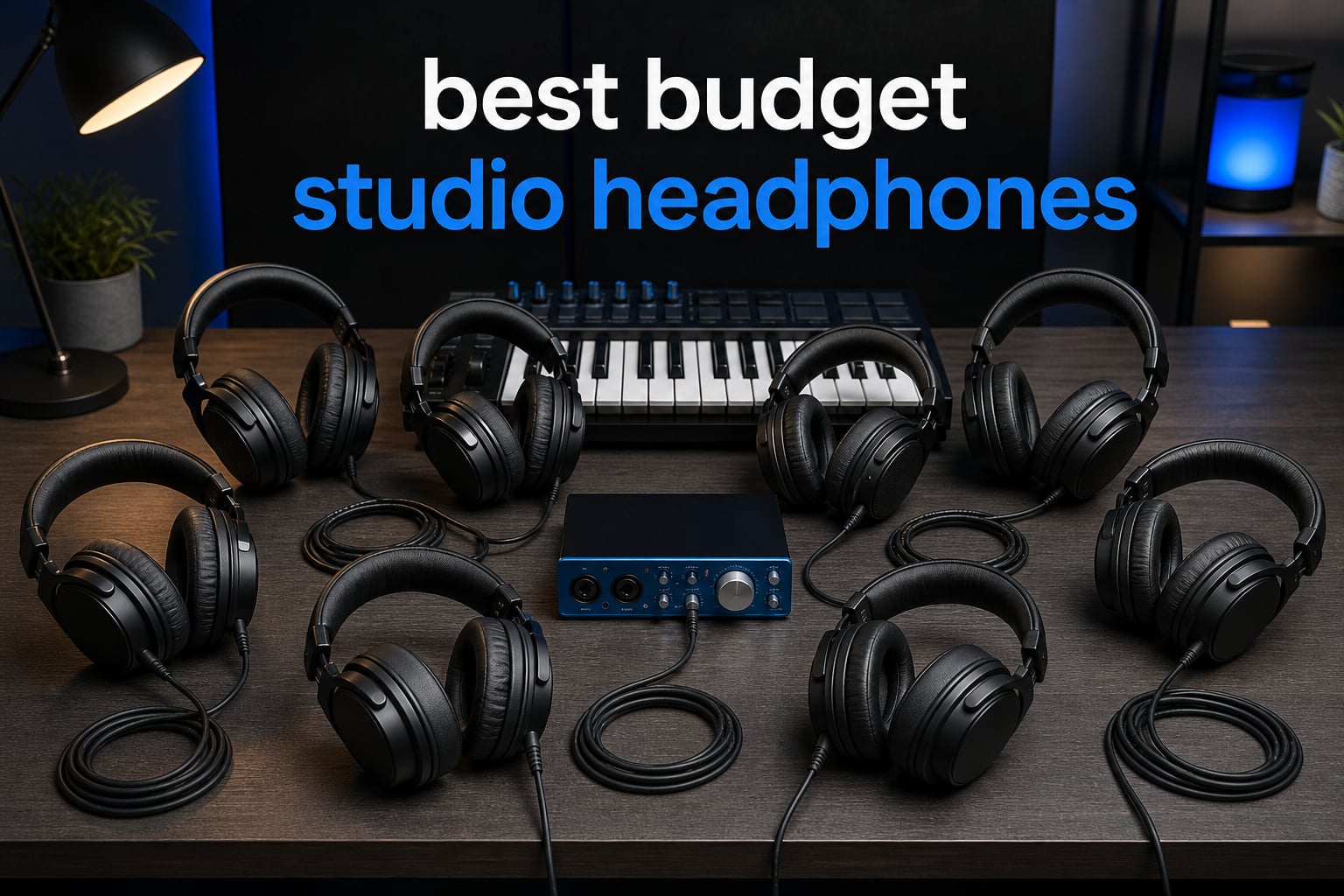
The best budget studio headphones are wired models that let a home producer hear timing, balance, edits, and unwanted noise without adding wireless latency. A lower cost does not make a pair neutral or automatically ready for mastering, but it can give you a dependable reference when you learn its behavior.
I selected the ten models below from the available analyzed product data, looking closely at driver size, stated frequency response, impedance, cable arrangement, fit features, review volume, and the work each design is built to do. Most are closed-back models for recording and monitoring; the Audio-Technica ATH-R30x is the one open-back option for a quiet-room mix check.
For context, community discussions repeatedly come back to the same point: no inexpensive headphone removes the need to compare your mix on other systems. I agree with that practical approach—use your headphones to make decisions, then check a familiar commercial track and another playback system. If electronic music is your focus, our studio headphones for music production guide pairs well with this roundup.
Table of Contents
JOYO, Audio-Technica, and MAONO are the Top 3 Picks for Budget Studio Headphones
JOYO JMH-02 is my first all-round tracking and monitoring pick because its stated flat response, 32-ohm load, closed-back isolation, and long cable line up with everyday home-studio use. Audio-Technica ATH-R30x is the focused mixing choice for a quiet room, while MAONO MH601 is the practical closed-back value choice for long tracking sessions.
These 10 budget studio headphones cover tracking, mixing, and monitoring in 2026
The overview below is a quick way to narrow the field. Closed-back choices suit vocal takes, instrument practice, podcast recording, and DJ cueing because they limit sound leakage; open-back designs make more sense for mixing when the room is quiet.
| Product | Specifications | Action |
|---|---|---|
 PUPGSIS PG-M20PRO PUPGSIS PG-M20PRO |
|
Check Latest Price |
 EKSA P100 EKSA P100 |
|
Check Latest Price |
 JOYO JMH-02 JOYO JMH-02 |
|
Check Latest Price |
 MAONO MH700 MAONO MH700 |
|
Check Latest Price |
 NUBWO HD01 NUBWO HD01 |
|
Check Latest Price |
 OneOdio A71 OneOdio A71 |
|
Check Latest Price |
 MAONO MH601 MAONO MH601 |
|
Check Latest Price |
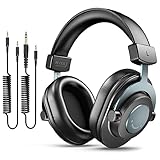 FIFINE H8 FIFINE H8 |
|
Check Latest Price |
 Audio-Technica ATH-R30x Audio-Technica ATH-R30x |
|
Check Latest Price |
 syndesmos Studio syndesmos Studio |
|
Check Latest Price |
1. JOYO JMH-02 is the best all-round closed-back monitoring pick
JOYO Studio Monitor Headphones, 50mm Drivers Over-Ear with Passive Noise Isolation, Flat Response for Recording/Mixing/Guitar Amp/Podcast, 3.5mm & 6.35mm Adapter (JMH-02)
50mm drivers
32 ohms
20Hz-20kHz
Pros
- Flat-response claim
- Closed-back isolation
- Long 3m cable
- Detachable connection
- Strong review base
Cons
- Passive isolation only
- May create ear pressure
The JOYO JMH-02 makes the most balanced starting point for a producer who needs one wired pair for recording, editing, and everyday reference listening. Its 50mm neodymium drivers, stated 20Hz–20kHz response, and 32-ohm impedance are simple specifications, but they fit common laptops, interfaces, keyboard amps, and headphone outputs well.
JOYO describes the sound as flat and accurate, which I treat as a useful aim rather than a laboratory measurement. The more meaningful practical detail is the closed-back design: it is set up to keep a backing track from spilling into a vocal mic and to reduce distractions while you edit.
The 3m detachable cable has enough reach to move between a desk and a vocal position without dragging an interface along. Both 3.5mm and 6.35mm connections are included, so you can go from a computer to mixer or amplifier without adding an adapter to the signal path.
The JOYO JMH-02 suits first-time home-studio owners
I would choose this model for a beginner who wants a single pair for recording vocals, monitoring a guitar amp, making beats, and basic mix work. The product data also shows 570 reviews and a 4.6 rating, giving it a broader feedback base than several newer models here.
The self-adjusting leather-cushion headband and over-ear pads aim at extended sessions. If pressure builds around your ears over a long session, take regular breaks; user feedback specifically flags that possibility.
The JOYO JMH-02 needs mix translation checks
Closed-back cups can make bass feel more immediate than it does through speakers, so I would check low-end choices on a familiar track and a second device. That routine matters more than chasing a marketing claim of perfect flatness.
There is no active noise cancellation, but active cancellation is not a requirement for wired recording work. Passive isolation is the relevant feature when microphones are open nearby.
2. Audio-Technica ATH-R30x is the quiet-room choice for open-back mixing
Audio-Technica ATH-R30X Open-Back Headphones
Open-back
40mm drivers
36 ohms
Pros
- Natural spacious presentation
- Lightweight design
- Clear mids
- Two-year warranty
- Wide stated response
Cons
- No isolation
- Fixed cable
- Few reviews
The Audio-Technica ATH-R30x is different from every closed-back pick in this list because its open-back construction lets air and sound move freely through the cups. That can create a more speaker-like sense of space, which is useful when placing reverbs, checking panning, and judging whether a dense arrangement feels crowded.
Its stated 15Hz–25kHz range, 40mm drivers, and 36-ohm impedance fit normal desktop listening and many interfaces. At 0.46 pounds, it is also the lightest-feeling option on paper for someone who spends long blocks editing or balancing a mix.
Open-back headphones leak sound in both directions. I would never use them for a live vocal take, a noisy apartment, or next to a person who needs quiet; the room becomes part of the monitoring environment.
The ATH-R30x is best for deliberate mix decisions in a quiet room
This is the clear pick if your priority is open back headphones for mixing rather than isolation. Audio-Technica positions its enhanced 40mm drivers around clarity and balance, and the reported review theme is a natural, speaker-like presentation.
For mastering or final mix revisions, compare with familiar speakers or another trusted pair. No headphone’s spatial image is identical to loudspeakers, even one designed for reference work.
The ATH-R30x is wrong for recording near microphones
Its no-isolation design means click tracks and loud playback can escape from the ear cups. Choose a closed-back model from this guide if you track vocals, acoustic instruments, or podcast interviews.
The cable is non-detachable, so you cannot replace just the cable in the way you can with several other picks below. The available data also records only 63 reviews, which is worth considering beside its 4.5 rating.
3. MAONO MH601 is the long-cable closed-back tracking choice
MAONO MH601 Wired Studio Headphone for Podcast Recording Stream DJ Mixing
50mm drivers
32 ohms
9.8 foot coil
Pros
- Strong passive isolation
- Long detachable cable
- 50mm drivers
- Three-year warranty
- High review count
Cons
- No built-in microphone
- May need phone adapter
MAONO MH601 is a straightforward tool for the person recording at a desk but occasionally stepping away to play guitar, keys, or vocals. The detachable 9.8-foot spring cable and included 3.5mm-to-6.35mm connection make that movement easier than a short fixed lead would.
The 50mm drivers use a stated 20Hz–20kHz range, with 32-ohm impedance and 103dB sensitivity. That combination should be easier for common interface headphone outputs than a very high-impedance studio model, while the wired connection avoids latency during tracking.
MAONO says the closed-back cups block 85% of ambient noise. Treat that percentage as a manufacturer claim, but the physical direction is clear: circumaural padded cups are better suited to keeping a cue mix contained than open-back headphones.
The MH601 works best when cable reach and isolation matter
I would put this model high on the list for vocal tracking, podcast recording, or a keyboard station several feet from the interface. The 90-degree swiveling ear cups also support the single-ear cueing style DJs and performers often use.
Its review base is substantial at 3.7k+ ratings, and the product data indicates a three-year warranty. Those details are practical confidence signals for a pair expected to move between desk, stand, and bag.
The MH601 is not a call headset
There is no built-in microphone, so it does not replace a headset for voice chat. In a studio setup, that is normally irrelevant because a dedicated microphone is preferable for recording.
People using recent phones without a 3.5mm port may need an appropriate adapter. For a mixer, amplifier, or interface with a 6.35mm output, the supplied interchangeable plug arrangement is the more useful connection.
4. PUPGSIS PG-M20PRO is the best pick for shared monitoring
PUPGSIS M20 Wired DJ & Studio Monitor Headphones, 50mm, 3.5/6.35mm
50mm drivers
32 ohms
3m retractable cable
Pros
- Dual sharing port
- Comfortable floating band
- Foldable with case
- Good passive isolation
- One-year warranty
Cons
- No active cancellation
- Not water resistant
PUPGSIS PG-M20PRO brings a feature that is unusually useful when two people need to hear the same source: a dual headphone-sharing port. It can remove the need for a separate splitter during a casual co-writing session, a lesson, or a collaborative edit.
The stated configuration is a 50mm dynamic driver, 20Hz–40kHz frequency range, 32-ohm impedance, and 98dB sensitivity. Those figures describe a low-power-friendly wired headphone, though the extended upper range alone does not prove a more accurate mix reference.
I like the practical layout: a 3m retractable cable, detachable 3.5mm and 6.35mm plugs, foldable body, and carrying case. The manufacturer also says the cable has been bend tested beyond 2,000 bends, an encouraging detail but not a substitute for long-term independent durability data.
The PG-M20PRO is strongest for two-person recording sessions
Use the sharing port when an artist and producer need to follow the same playback without interrupting the work to find another splitter. It is also handy for a keyboard lesson or podcast guest monitoring arrangement where simplicity matters.
The 4D floating headband is intended for long wear, and the review insights report comfort over six-hour sessions. I would still adjust it before judging the fit: correct cup placement affects both comfort and bass perception.
The PG-M20PRO is not a weatherproof travel headphone
The product is not water resistant, so it belongs in a dry studio bag rather than an outdoor commute. It also relies on passive isolation, not active noise cancellation.
With 140 reviews and a 4.8 rating, the early feedback is positive but smaller in scale than the longest-established models in this roundup. That makes its specialized sharing function the main reason to select it.
5. EKSA P100 is the flexible single-ear monitoring option
EKSA Wired Headphones, Over Ear Headphones for Studio Monitor/Mixing DJ
50mm drivers
32 ohms
90 degree swivel cups
Pros
- Swiveling cups
- Self-adjusting band
- Shared audio port
- Two-year warranty
- Padded cushions
Cons
- No active cancellation
- Limited colors
EKSA P100 focuses on the mechanics of DJ and recording use. Its 90-degree swiveling ear cups make it easier to monitor one side while hearing the room or another source with the free ear, a simple workflow advantage during cueing.
The dynamic 50mm drivers use neodymium magnets, with stated 32-ohm impedance and 110dB sensitivity. That sensitivity figure suggests it should reach usable levels from many common outputs, although safe monitoring levels are more important than maximum loudness.
The soft padded cushions and self-adjusting flexible headband are designed around fatigue-free use. It also has a shared audio port, so the headphone can serve the same collaborative job as the PUPGSIS without an added splitter.
The EKSA P100 serves DJs and performers who cue with one ear
Rotating cups are the decision feature here. If you switch between a cue channel and the room often, the P100’s 90-degree swivel is more relevant than a claim about extreme high-frequency extension.
Its included 3.5mm and 6.35mm connectivity covers a computer, amplifier, and many interfaces. The two-year warranty is another useful data point for a working wired pair.
The EKSA P100 needs more independent listening context
The listing has 36 reviews despite its 4.8 rating, so its feedback pool is still small. I would buy it for its fit and monitoring features, then spend time learning how familiar reference songs translate through it.
As with the other closed-back models, it has sound isolation rather than active cancellation. This is appropriate for a studio headphone, where a reliable wired signal and contained playback matter more than electronic noise processing.
6. NUBWO HD01 is the lightest closed-back pick for long sessions
NUBWO HD01 Studio Headphones Wired, Hi-Res Over Ear Headphones with 1/4 inch to 3.5mm Adapter, Lightweight Closed Back Monitor Headphones for Piano Guitar AMP Recording Mixer Amplifier
45mm drivers
50 ohms
241g weight
Pros
- Very light
- Memory foam pads
- Twist-lock ports
- Angled drivers
- Two-year warranty
Cons
- 50 ohms needs more power
- Limited colors
NUBWO HD01 stands out because it weighs 241g, a meaningful difference when you are editing for hours or wearing headphones while speaking into a microphone. It pairs that lower weight with memory-foam ear pads and a closed-back build for focused work.
The HD01 uses angled 45mm dynamic drivers and carries a Hi-Res certification, with a stated 20Hz–40kHz response. Angled drivers can change the way sound reaches the ear, but I would judge spatial decisions by comparing known mixes rather than assuming a specification predicts mix accuracy.
It includes two detachable cables: a 1.5m 3.5mm-to-3.5mm lead and a 2.5m 3.5mm-to-6.35mm lead. The dual twist-lock ports are a sensible feature if accidental cable disconnection has interrupted your sessions before.
The HD01 is the comfort-led choice for long editing blocks
For me, low weight is an underappreciated studio specification. A pair that causes less neck or clamp fatigue makes it easier to keep attention on timing edits, vocal cleanup, and automation decisions.
The ear cups rotate 90 degrees and flip 180 degrees, so the design also works for single-ear monitoring. It is a more flexible form factor than a fixed-cup reference headphone.
The HD01 asks a little more from weak headphone outputs
Its 50-ohm impedance is still modest, but it is higher than the 32-ohm models dominating this list. A basic interface should often be a better match than a low-output laptop or phone, especially if you find yourself pushing the volume control high.
Do not add a headphone amplifier automatically. First listen at normal working volume through your interface; an amp is useful only if volume is inadequate or the source audibly struggles.
7. OneOdio A71 is the established portable monitoring pick
OneOdio A71 Hi-Res Wired Over-Ear Studio Headphones for DJ, Mixing – Black
40mm drivers
32 ohms
SharePort
Pros
- Large review base
- SharePort
- Swiveling cups
- Foldable design
- Coiled detachable cable
Cons
- Heavy-use durability reports
- Isolation is moderate
OneOdio A71 is a familiar-looking closed-back option with a large review history: 17k+ ratings at a 4.5 average in the analyzed data. That does not turn it into a universal reference headphone, but it provides much more user feedback than newer listings.
Its 40mm drivers are rated from 20Hz to 40kHz, with 32-ohm impedance and 110dB sensitivity. The detachable coiled cable extends from 6.6 to 9.8 feet, giving useful reach while keeping extra cable from trailing across the floor.
The built-in SharePort can connect a second pair for shared listening, while 90-degree swiveling cups help with one-ear cueing. Foldability makes the A71 a logical choice for a producer who records in different rooms or carries a compact setup.
The A71 suits portable beat-making and shared playback
This is one of the best budget studio headphones for a mobile creator who needs a closed-back pair that packs away and connects to both 3.5mm and 6.35mm outputs. The padded cups and adjustable headband also support general listening between sessions.
Use it for rhythm programming, rough arrangement decisions, DJ rehearsal, and monitoring a recording. Before finalizing low end, compare to at least one other source because the reported strength is broad value rather than a documented neutral target.
The A71 deserves careful handling in frequent use
Some user feedback reports durability concerns under heavy use. I would avoid pulling on the coiled cable, store the headphones folded only as intended, and inspect the connector before a critical session.
Its passive isolation is described as decent rather than professional grade. If microphone bleed is your most pressing concern, the MAONO MH601 or FIFINE H8 are stronger closed-back candidates to consider first.
8. MAONO MH700 is the flexible cable-and-cup choice for DJs
MAONO MH700 Wired Studio Headphone for Podcast Recording DJ Mixing Monitor
50mm drivers
32 ohms
dual detachable cables
Pros
- Two cable types
- 180 degree cups
- Good isolation
- Foldable body
- Locking connection
Cons
- 400g weight
- No active cancellation
MAONO MH700 gives you two different detachable cables out of the box: a 1.2m straight lead and a 3m coiled lead. That is a genuine convenience for a producer who moves between a laptop, a keyboard position, and a recording setup without wanting a long coil everywhere.
The stated 50mm dynamic drivers cover 20Hz–20kHz with 32-ohm impedance and 100dB sensitivity. The closed-back construction and soft over-ear cups target focused monitoring, while the plug-in lock design is intended to keep a cable secure.
The important trade-off is mass. At 400g, the MH700 is the heaviest model in this guide, so its feature set may appeal more than its comfort to users sensitive to headband weight.
The MH700 fits DJ cueing and multi-device studio work
The ear cups reverse through 180 degrees, offering the broadest single-ear position of the picks here. This is useful if you cue a track with one side while listening to the venue, a performer, or an instrument with the other.
I would also select it for a setup where cable choice matters every day. Use the shorter straight cable at a desk and the longer coiled cable when you need movement around an amplifier or microphone stand.
The MH700 needs a comfort check before all-day use
Weight is not a minor detail after several hours. If possible, start with shorter sessions and adjust the headband before committing to a long mix or editing day.
The listing calls the metal headband lightweight, but the analyzed 400g product weight is the more practical comparison number. It is still a capable option when rotating cups and dual cables outrank featherweight comfort on your checklist.
9. FIFINE H8 is the straightforward recording isolation choice
FIFINE HD8 Wired Studio Monitor Headphone, Detachable 3.5mm/6.35mm Cables
50mm drivers
32 ohms
265g weight
Pros
- Dual long cables
- Lightweight design
- Closed-back cups
- No adapter needed
- High category rank
Cons
- 95dB sensitivity
- Initial clamp can feel tight
FIFINE H8 is built around a simple recording workflow: 50mm drivers, a circumaural closed-back shape, and separate 9.8-foot detachable coiled cables for 3.5mm and 6.35mm connections. That means you can connect directly to common home-studio gear without stacking adapters.
At 265g, it sits in the lighter part of this group, and its stated 20Hz–20kHz response covers the conventional audible range. Its 32-ohm impedance is interface-friendly, though the 95dB sensitivity is lower than several competitors here.
The listing describes passive noise control and an ergonomic form intended to reduce sound leakage. This is the correct direction for recording vocals or instruments where the cue mix needs to stay out of an active microphone.
The FIFINE H8 is a sensible choice for direct interface connections
Choose the H8 if you regularly switch between a 3.5mm computer source and a 6.35mm mixer or amplifier output. Two dedicated cables are tidier than a loose adapter and provide a practical backup if one lead is damaged.
It has 1.5k+ reviews at a 4.5 rating, plus a strong category position in the provided data. Those signals make it one of the more established affordable studio headphones in this list.
The FIFINE H8 may need a short break-in period for fit
Some users report initial tightness. That is a comfort observation, not something to force through: use shorter sessions first and verify that the pads sit around, rather than on, the ears.
Because sensitivity is 95dB, it may need a slightly higher volume setting than a 110dB model from the same source. Avoid solving that by monitoring louder than necessary; clear, moderate level is better for reliable decisions.
10. syndesmos Studio is the entry-level pick for DJ-style sharing
Wired Headphones, Over Ear Headphones for Studio Monitor & Mixing DJ
50mm drivers
32 ohms
258g weight
Pros
- Music sharing feature
- Lightweight cushions
- Swivel cups
- Detachable cable
- Strong DJ category rank
Cons
- Durability reports
- One-year warranty
- Fewer reviews
The syndesmos wired studio headphones take a feature-led route: 50mm dynamic drivers, closed-back isolation, 90-degree swiveling cups, and music-sharing technology that lets you daisy-chain compatible headphones. It is aimed as much at DJ monitoring and collaborative listening as at a fixed desk.
Its 32-ohm impedance and detachable 5.7-to-6-foot coiled cable make connection straightforward with both 3.5mm and 6.35mm outputs. At 258g, it is also light enough on paper to be a reasonable option for a longer practice session.
The memory-foam cushions, protein-leather contact surfaces, and self-adjusting band address comfort directly. As with any closed-back pair, fit affects perceived bass and isolation, so do a few reference-track checks after adjusting the cups.
The syndesmos model works for basic DJ monitoring and sharing
The key decision point is the daisy-chain sharing feature. It can help a teacher, collaborator, or two DJs hear a source without hunting for splitter hardware.
The available data also places it strongly in the DJ Headphones category. Choose it when cueing flexibility and a light foldable-style studio form factor are more important than a large long-term review record.
The syndesmos model needs realistic durability expectations
It has 287 reviews and a 4.4 rating, with some users reporting durability concerns. A one-year manufacturer warranty is shorter coverage than the two- and three-year terms attached to some alternatives above.
I would use the detachable cable and storage habits to reduce wear, but not assume that care eliminates every long-term risk. For critical daily studio work, higher review volume can be a useful tie-breaker.
Closed-back headphones are the right starting point for recording
Closed-back headphones put a solid outer shell behind the driver. That shell limits sound leakage and outside distractions, which makes it the practical choice for tracking vocals, recording acoustic instruments, podcasting, DJ cueing, and playing near open microphones.
Open-back headphones use a ventilated outer cup. They tend to feel more open and can make panning and ambience easier to judge, but they leak enough sound that they are a poor match for live recording in the same room as a microphone.
For one pair only, I recommend starting closed back. Add an open-back reference pair later if mixing becomes the larger share of your work and you have a reliably quiet space.
A 32-ohm to 50-ohm pair is usually easiest for a basic interface
Impedance is the electrical resistance a headphone presents to the source. In this roundup, 32-ohm models are common, and they are generally the simplest match for laptops, controllers, entry-level interfaces, and mixer outputs.
The 36-ohm ATH-R30x and 50-ohm NUBWO HD01 are still moderate-impedance choices, not extreme studio loads. Before buying an amplifier, connect the headphones to your intended source and listen for adequate clean volume; an amplifier is needed only when the source cannot drive them comfortably or sounds strained.
Sensitivity changes the picture too. A higher sensitivity number can mean more output from the same source, but it does not tell you whether the tonal balance is accurate. Keep the volume moderate and take breaks so your ears stay a dependable reference.
Frequency-response claims are a starting point, not a mix verdict
Frequency response states the range a manufacturer says a headphone can reproduce. A 20Hz–20kHz specification covers the conventional audible range, while a 40kHz upper figure does not automatically mean clearer cymbals, more detailed vocals, or more reliable EQ choices.
What matters in practice is the balance within that range: whether bass is boosted, whether upper mids push vocals forward, and whether treble feels sharp. Community advice is sound here: learn one pair with reference tracks you know well rather than expecting any inexpensive model to be perfectly flat.
For electronic music, check kick and bass relationships at low to moderate volume, then compare on speakers, earbuds, and a car system if available. That translation routine reveals more than a specification sheet can.
Comfort and cables decide whether headphones get used every day
Look at weight, pad material, cup depth, headband adjustment, and clamp feedback before fixating on driver size. The 241g NUBWO HD01, 258g syndesmos model, and 265g FIFINE H8 prioritize lower listed weight, while the 400g MAONO MH700 gives up some of that advantage for its rotating-cup and dual-cable setup.
Detachable cables are useful because they simplify replacement and let you select cable length for the task. A short straight lead is tidy at a desk; a coiled or longer lead is safer when you need to stand at a microphone or instrument.
Pick 6.35mm connectivity if you use a traditional interface, mixer, or amplifier, and 3.5mm for many computers and portable devices. Several products here include both, avoiding an extra connection point between source and headphones.
These task-based picks make the decision simpler
Choose JOYO JMH-02 for one closed-back pair that covers general monitoring, tracking, and basic mix practice. Choose Audio-Technica ATH-R30x for open-back mix checks in a silent room, and MAONO MH601 for tracking sessions that benefit from isolation and a long coiled lead.
Choose PUPGSIS PG-M20PRO, EKSA P100, OneOdio A71, or syndesmos if shared monitoring is a regular need. Choose NUBWO HD01, FIFINE H8, or MAONO MH700 when comfort weight, cable choices, or rotating ear cups are the deciding features.
A useful beginner progression is simple: learn one closed-back pair, compare your work on other systems, and only then decide whether an open-back reference pair solves a real mixing problem. This approach prevents gear changes from taking the place of listening practice.
These answers cover the most common budget studio headphone questions
What are the best budget studio headphones for mixing?
For a quiet room, the Audio-Technica ATH-R30x is the mixing-focused choice here because it is open back and designed for a natural, spacious presentation. For one all-purpose pair, JOYO JMH-02 is the more practical closed-back option; always compare your mix on another system.
Are cheap headphones good enough for music production?
Affordable wired headphones can be good enough for learning arrangement, editing, tracking, and mixing if you learn their sound and check work on other systems. They are not automatically flat or a replacement for room-treated speakers, but a consistent reference is useful.
What is the difference between open-back and closed-back studio headphones?
Closed-back headphones reduce sound leakage and are better for recording near microphones, tracking, and noisy rooms. Open-back headphones leak sound but can feel more spacious, making them better suited to mix checks in a quiet room.
What impedance should studio headphones have?
For common laptops and entry-level audio interfaces, 32-ohm headphones are usually an easy choice. Models around 36 or 50 ohms can also work well; test whether your source provides clean, adequate volume before deciding you need an amplifier.
Can you mix on budget headphones?
Yes, you can mix on budget headphones when you use familiar reference tracks, work at moderate volume, take breaks, and check results on other speakers or headphones. Translation checks matter more than expecting an inexpensive pair to sound perfectly neutral.
JOYO JMH-02 is the strongest all-purpose choice, while task fit should decide the rest
The best budget studio headphones are not the ones with the largest driver or the broadest printed frequency range; they are the ones that suit your recording space and become a reference you know. Start with JOYO JMH-02 for a versatile closed-back pair, choose ATH-R30x for quiet-room mixing, or choose MAONO MH601 for isolated tracking with extra cable reach.
In 2026, buy for the job you do most, then give yourself time with familiar music before making important mix choices. A calm comparison across several playback systems will do more for your production than a rushed upgrade.