
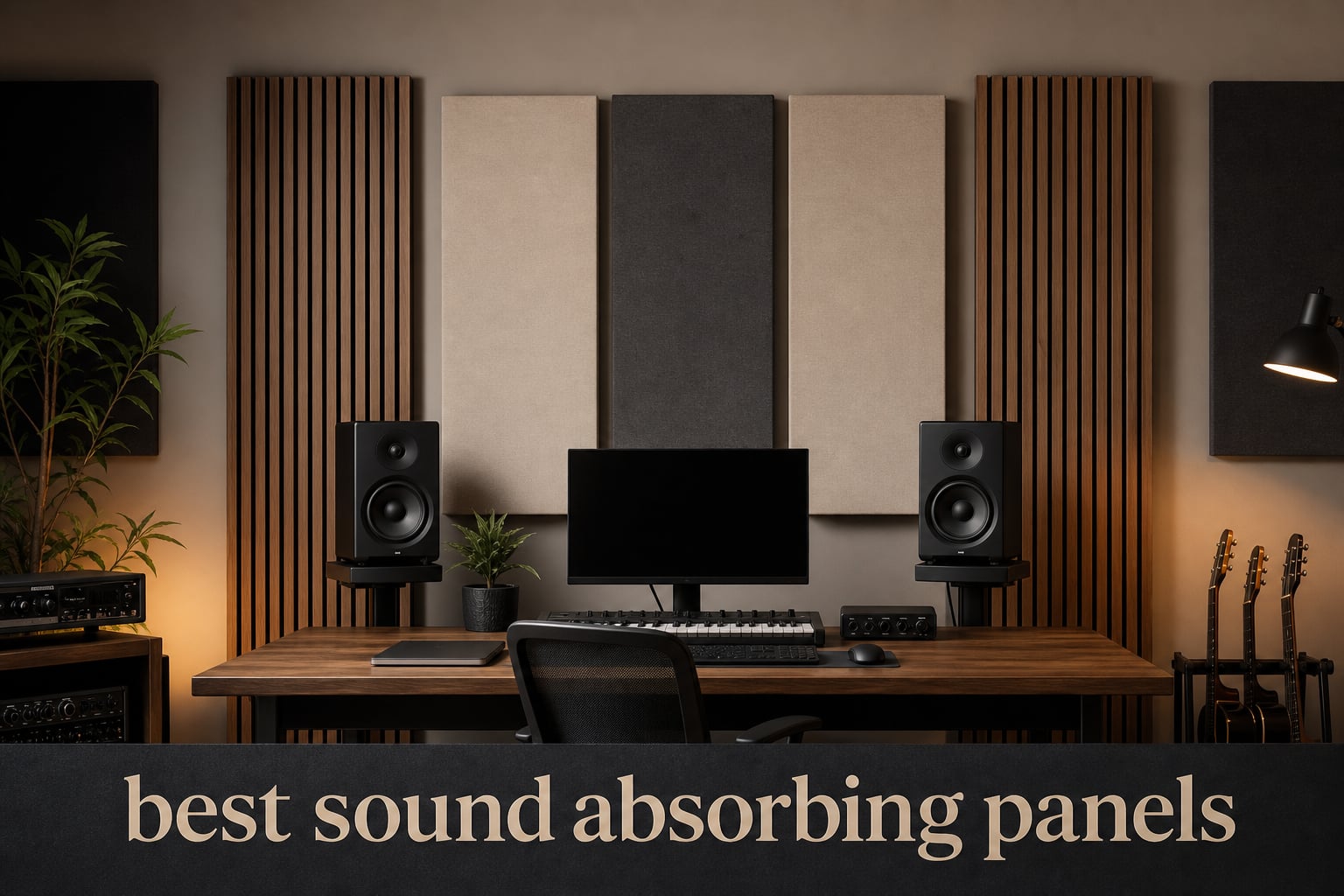
The best sound absorbing panels make a room easier to listen in, not quieter on the other side of the wall. That distinction matters: acoustic treatment absorbs reflections inside your space, while soundproofing blocks sound from traveling through a structure.
I compared eight panels using the facts that matter after the listing photo: material, thickness, stated NRC where the maker provides one, coverage, mounting method, and the limits stated in customer feedback. The result is a mix of fabric-wrapped fiberglass, decorative polyester slats, peel-and-stick tiles, and 2-inch wedge foam for different rooms and expectations.
For a studio, home theater, gaming room, office, or echo-prone living room, sound absorbing panels can reduce the hard, splashy reflections that blur dialogue and music. They cannot silence a noisy neighbor, and thin tiles should not be treated as a substitute for deep bass traps, but well-placed acoustic panels can make speech clearer and recordings less boxy.
UMIACOUSTICS, Art3d, and Dmsky Are Our Top 3 Sound Absorbing Panel Picks in 2026
UMIACOUSTICS is my technical pick because its two-inch fiberglass panels carry a stated 0.95 NRC and include hanging hardware. Art3d is the décor-led choice for a large wood-look installation, while Dmsky is the practical foam option when broad 2-inch wedge coverage is the goal.
These Are the Best Sound Absorbing Panels in 2026 at a Glance
This overview separates panels by construction and installation instead of treating every product as equal. Use it to narrow your choice, then read the review that fits your room, surface, and acoustic problem.
| Product | Specifications | Action |
|---|---|---|
 NeatiEase Wood Slat Panels NeatiEase Wood Slat Panels |
|
Check Latest Price |
 UMIACOUSTICS Fiberglass Panels UMIACOUSTICS Fiberglass Panels |
|
Check Latest Price |
 Art3d Wood Slat Panels Art3d Wood Slat Panels |
|
Check Latest Price |
 Soon Global Art Panels Soon Global Art Panels |
|
Check Latest Price |
 Lebenforce Self-Adhesive Tiles Lebenforce Self-Adhesive Tiles |
|
Check Latest Price |
 NEPIS Brick Acoustic Tiles NEPIS Brick Acoustic Tiles |
|
Check Latest Price |
 TONOR Hexagon Panels TONOR Hexagon Panels |
|
Check Latest Price |
 Dmsky Wedge Foam Panels Dmsky Wedge Foam Panels |
|
Check Latest Price |
1. NeatiEase Is the Best Long-Format Wood Slat Choice
NeatiEase Wood Panels for Wall, 4-Piece 96″ x 12.6″ Soundproof Wood Slat Wall Panel for Interior Wall Decor Noise Cancelling, Acoustic Wall Panels, Sound Absorbing Panel (Teak)
4 panels
96 x 12.6 in
About 33 sq ft
MDF and polyester
Pros
- About 33 sq ft coverage
- Long continuous slat look
- Wall or ceiling placement
- Multiple finish choices
Cons
- 19.96 kilogram listed weight
- No warranty
NeatiEase takes a decorative route to acoustic treatment. Its four teak panels measure 96 by 12.6 inches and cover about 33 square feet, so I would look at it first when a broad, continuous wood-slat feature wall matters as much as reducing reflected sound.
The construction combines MDF with high-density polyester fiber. That material pairing and the long format make this a sensible candidate for a living room, office, bedroom, studio wall, or ceiling where small square foam tiles would look out of place.
The 33-Square-Foot Package Fits Feature Walls Better Than Small Patches
The listed coverage gives you a useful planning number: one package handles a substantial visual section rather than a few scattered spots. You can mount the panels horizontally or vertically, which helps when lining up the design with a desk, television wall, or ceiling direction.
The package is listed at 19.96 kilograms, so measure the wall and think through fastening before committing. The product data says screws or superglue can be used; for a heavy installation, the mounting surface and method deserve more attention than the pattern alone.
The Slat Format Serves Décor-Led Echo Control, Not Deep Bass Treatment
The polyester backing is intended to absorb sound and reduce noise, but no NRC figure or low-frequency performance claim is supplied. I would use this type of slat panel to soften reflective room surfaces and retain a finished interior look, not to solve a stubborn low-end buildup by itself.
The range of listed oak, teak, walnut, black, and other variants is a real advantage for matching existing finishes. Customer feedback is strongly positive on design and acoustic performance, with a 4.6 rating across 521 reviews, yet the absence of a warranty should be part of the decision.
2. UMIACOUSTICS Is the Best Technical Absorption Pick
2 Pack Acoustic Panel 47.2″x23.6″ Soundproof Fiberglass Panel,Charcoal Grey
2 panels
47.2 x 23.6 x 2 in
Fiberglass core
NRC 0.95
Pros
- Stated NRC 0.95
- Hanging hardware included
- Two-inch panel depth
- High-density fabric wrap
Cons
- Heavy 24.1 pound package
- Fiberglass core may not suit every buyer
UMIACOUSTICS is the clearest recommendation when you want published absorption data instead of a general noise-reduction claim. The listing states an NRC of 0.95 for its 47.2 by 23.6 by 2 inch fabric-wrapped fiberglass panels, a strong figure for handling the midrange and high-frequency reflections that smear speech and mixes.
This two-panel charcoal-grey set includes hanging hardware, which is useful because the listed package weight is 24.1 pounds. The material is white fiberglass inside a high-density polyester fabric wrap, and the product data lists an E0 environmental rating.
The 0.95 NRC Gives This Panel a Clear Measurement-Led Advantage
NRC, or Noise Reduction Coefficient, is an average absorption measure that runs from 0 to 1. A stated 0.95 does not mean the room gets 95 percent quieter, but it does indicate that the panel is designed to absorb a large share of incident sound in the test range.
That is why I would place UMIACOUSTICS high on a short list for a recording space, home theater, meeting room, or gaming room with audible echo. It also keeps the advice honest: the listing does not publish a frequency chart, so nobody should infer a specific bass result from NRC alone.
The Large Two-Inch Format Rewards Deliberate Reflection-Point Placement
For stereo listening or a production desk, start at the side-wall first reflection points: have a helper slide a mirror along the wall while you sit in the listening position, and mark where you can see each speaker. A panel at each marked point reduces an early reflection before it reaches your ears.
The panels are also suited to the wall behind a speaker or the rear wall of a small room, depending on the reflection path. Fiberglass may concern buyers who prefer an all-polyester construction, so this is a product where the fabric enclosure and intended mounting location should be considered carefully.
3. Art3d Is the Best Large Decorative Slat Installation
Art3d 4-Pack Fluted Acoustic Wood Slat Wall Panel, 47.2 x 23.6 Inch, Teak
4 panels
47.2 x 23.6 in
0.83 in thick
About 31 sq ft
Pros
- About 31 sq ft coverage
- Wall and ceiling mounting
- Wood-look fluted finish
- Manufacturer warranty listed
Cons
- 0.83 inch panel thickness
- Finish may vary by sample
Art3d makes the most sense for a room that needs an intentional architectural surface rather than a conventional studio-panel look. The teak four-pack uses a 3D fluted wood finish over high-density polyester, measures 47.2 by 23.6 inches per panel, and covers about 31 square feet.
The product is 0.83 inches thick and can go on a wall or ceiling with basic tools. It is listed for offices, yet the natural finish and several variant options also make it relevant to a living room, home theater, or a studio that has to share space with the rest of a home.
The Four-Piece Format Covers a Coherent Wall Section
Large panel faces reduce the number of visible seams compared with a grid of small tiles. I like that approach behind a desk, across a media wall, or as a ceiling treatment above a listening position, where the visual line matters almost as much as breaking up reflections.
The package weight is 12.35 pounds, which is much more manageable than some larger fiberglass assemblies, but it still calls for a mounting plan. The listing supplies no included components, so confirm the correct hardware for your wall or ceiling substrate before installation.
The 0.83-Inch Profile Prioritizes Appearance and General Reflection Control
This is not a thick broadband absorber, and the supplied data does not state an NRC rating. The fluted polyester-backed construction can support echo reduction, but I would not select a sub-one-inch slat panel as the only treatment in a room where bass buildup or severe reverberation is the main complaint.
Review data is encouraging, with a 4.5 rating from more than 1,000 reviews and praise for the natural appearance. The brand recommends a sample pack because finish can vary, a sensible step when a large part of the wall will be covered.
4. Soon Global Is the Best Tool-Free Acoustic Wall-Art Option
Soon Global Acoustic Wall Panels, Arcadian Vortex
6 panels
23.62 x 23.62 in
Polyester fiber
30 adhesive squares
Pros
- Tool-free mounting
- Continuous groove design
- Lightweight polyester fiber
- Multi-room use
Cons
- Weight not listed
- No warranty information listed
Soon Global is the visual pick for buyers who want acoustic treatment that reads as wall art. This Arcadian Vortex set has six 23.62-inch square polyester panels with a continuous groove pattern and wood-texture print, making the whole arrangement feel more like a single composition.
The set covers 3,348 square inches in total and comes with 30 transparent double-sided adhesive squares. That is a meaningful practical difference for someone who cannot drill into a wall or who wants a cleaner, faster installation than a hardware-mounted panel.
The Adhesive-Square System Makes Placement Easy to Test First
I would lay the full arrangement on the floor before attaching it, then mark the center line and work outward. This avoids ending with uneven perimeter gaps, which stand out on a six-piece design and can make an otherwise attractive installation look improvised.
The supplied adhesive squares are designed for a tool-free job, but any adhesive approach deserves a clean, dry, sound surface. Test a discreet area and follow the product directions, especially in rental spaces where paint condition and removal matter.
The Polyester Art Panels Suit Living Areas and Workspaces With Echo
High-density polyester fiber and a grooved face are the stated absorption elements. I would use this set to break up reflections in a home theater, recording workspace, living room, or office where a bare wall is causing a sharp clap echo and a decorative finish is non-negotiable.
The listing does not state panel thickness, an NRC, a weight, or a warranty. That leaves less technical information than the UMIACOUSTICS option, though the 4.5 rating from 587 reviews and comments about easy installation support its appeal as a décor-first choice.
5. Lebenforce Is the Best Peel-and-Stick Square Panel Set
22 Pack Sound Proof Foam Panels for Walls, Acoustic Panels 12″x12″x0.4″
22 tiles
12 x 12 x 0.4 in
21.27 sq ft
Self adhesive
Pros
- 22-tile pack
- Peel-and-stick backing
- 21.27 sq ft coverage
- Polyester construction
Cons
- Only 0.4 inch thick
- No warranty
Lebenforce is a straightforward option when you need a flexible grid of small panels without tools. The pack includes 22 black 12-inch square polyester tiles, each 0.4 inches thick, for stated coverage of 21.27 square feet.
Its self-adhesive backing is the main selling point for renters, casual podcast corners, and small home-office setups. The product information recommends covering 20 to 30 percent of wall surface for its intended acoustic-treatment result, which is a more useful starting point than placing a few tiles at random.
The Twenty-Two Tiles Let You Target the Noisiest Reflection Zones
Small tiles are adaptable: distribute them across first reflection areas, the wall behind a speaking position, or opposite a hard desk wall rather than making one isolated patch. Spreading absorption over the room is often more helpful for flutter echo than concentrating every tile in a corner.
Before peeling the backing, check that the surface is smooth and clean. A self-adhesive tile is easy only if the wall finish is compatible, and its compact size means accurate alignment at the first tile makes the rest of the grid much easier.
The 0.4-Inch Depth Makes This a Surface-Reflection Tool
These panels can help with high-frequency echo and reverberation, but their thin profile does not make them bass traps or structural soundproofing. Forum discussions repeatedly make this point: thin foam-style treatment is not the answer to low-frequency problems or noise coming through a shared wall.
The product carries a 4.5 rating from 362 reviews, and its eco-friendly polyester material is a plus for a lightweight application. I would choose it for quick, non-permanent room tuning, not for a critical recording room that needs deep broadband absorption.
6. NEPIS Is the Best Textured Self-Adhesive Brick Panel
20 Pack Acoustic Panels with Self Adhesive, 11.8″ X 11.8″ X 0.36″ High Density Sound Proof Foam Panels for Wall, Soundproof Wall Panel, Brick Sound Absorbing Panel for Home Studio Office Decor – Black
20 tiles
12 x 12 x 0.4 in
NRC over 0.95
20 sq ft
Pros
- Stated NRC over 0.95
- High-density polyester
- Self-adhesive backing
- Brick texture
Cons
- Smooth dry surfaces only
- 0.4 inch depth limits bass treatment
NEPIS offers a brick-pattern tile for buyers who want the convenience of a peel-and-stick installation with more texture than a plain square. The 20 black polyester panels are 12 by 12 by 0.4 inches and cover about 20 square feet.
Its listing makes two specific technical claims: an NRC coefficient exceeding 0.95 and high-density material up to 14.35 pounds per cubic foot. Those numbers make it stand out among thin tiles, although the 0.4-inch depth still defines the type of acoustic role it can play.
The Stated Density and NRC Make This More Than a Purely Decorative Tile
A published NRC claim provides a more concrete basis for comparison than phrases such as noise reducing. It suggests this panel is built to absorb efficiently in the measurement range, but it should still be read alongside thickness, placement, and the fact that NRC is not a bass-performance chart.
I would place these sound absorbing panels where you have clear high-frequency reflections: beside a desk, on a wall opposite glass, or around a voice-recording position. The brick relief can make a functional layout look intentional in a studio corner, office, or gaming room.
The Adhesive Backing Requires a Smooth and Dry Wall
The manufacturer limits installation to smooth, dry surfaces, which is a real constraint rather than a minor footnote. Textured plaster, dusty paint, damp walls, and loose finishes can all undermine an adhesive bond, so preparation is part of the project.
Review feedback supplies a 4.3 rating across 413 reviews, lower than several selections here but still solid. If you want a deeper panel for broader frequency control, choose a thicker fiberglass panel or 2-inch foam instead; use NEPIS for compact, high-density surface treatment.
7. TONOR Is the Best Hexagon Panel for Custom Wall Patterns
TONOR 12 Pack High Density Hexagon Acoustic Panels for Wall, 12″x 10″x 0.4″
12 hexagons
0.9 NRC
Polyester fiber
Self adhesive
Pros
- Stated NRC 0.9
- Light 2.16 pound pack
- Hexagon layouts
- Odorless polyester
Cons
- Smooth dry surfaces required
- One pack may not cover a large room
TONOR’s 12-pack is made for people who want acoustic treatment to become part of the room design. The beige hexagons use 100 percent polyester fiber, have self-adhesive backing, and carry a stated 0.9 NRC rating.
The honeycomb shape makes it easy to build a small clustered pattern over a desk, near a microphone position, or on a gaming-room wall. At 2.16 pounds for the listed pack, this is also one of the easiest options to handle alone while you work out the arrangement.
The Hexagon Shape Supports Flexible Coverage Around Furniture
Unlike long slats or fixed rectangles, hexagons can wrap a wall feature, avoid a wall-mounted display, or grow into a larger pattern later. I would use painter’s tape or paper templates to sketch the pattern first, especially if you want the cluster centered behind a chair or desk.
That visual flexibility can solve a practical issue in compact rooms where a full panel would conflict with shelves, windows, or artwork. It does not change the acoustic principle: coverage should still sit near reflection zones, not simply wherever the shape looks nicest.
The 0.9 NRC Helps With Echo, While Pack Coverage Limits Large Rooms
TONOR publishes a 0.9 NRC, a useful stated measure for its polyester fiber construction. Its product data does not give a square-foot coverage figure, and a 12-piece pack will not cover the same broad surface as the large slat or 50-panel foam choices.
The product has a 4.2 rating from more than 1,800 reviews and is intended for studios, gaming rooms, offices, and home theaters. Smooth, dry surfaces are required for adhesion, so I would avoid treating this as a universal fit for every wall finish.
8. Dmsky Is the Best 2-Inch Wedge-Foam Coverage Set
50 Pack Acoustic Foam Panels,2″X 12″ X 12″Sound Proof Foam PanelsHigh Density Sound Absorbing Panels,Soundproof Wedges Panels for Studio Recording & Office & Home
50 panels
12 x 12 x 2 in
Polyurethane foam
One-year warranty
Pros
- Two-inch foam depth
- 50-panel coverage
- Formaldehyde-free
- Cuttable panels
Cons
- Adhesive not included
- Needs 24 hours to recover
Dmsky is the quantity-and-depth choice in this group. It supplies 50 polyurethane wedge panels, each 12 by 12 by 2 inches, giving you far more pieces to distribute across a studio, control room, podcast booth, office, or home setup than the smaller tile sets.
The listing describes high-density, non-toxic, formaldehyde-free polyurethane foam and a one-year warranty. It also specifically claims that the wedges control reverberation and standing waves, while the two-inch depth gives this foam more physical depth than the 0.4-inch adhesive tiles.
The Two-Inch Wedge Profile Gives You More Treatment Flexibility
Two inches is not a complete answer to deep bass, but it is a more serious starting point for general reflection and reverberation control than a thin decorative tile. The 50-piece count lets you treat several surfaces in a balanced way, including rear walls, side walls, and areas around a recording position.
The foam is lightweight and can be cut to size, which helps around outlets, shelving, and irregular wall sections. I would plan the layout first and leave some pieces uncut until the main reflection points are covered, since a random checkerboard rarely gives the most coherent result.
The Packaging Recovery and Separate Adhesive Add Two Setup Steps
The panels arrive vacuum packed and need 24 hours in a ventilated place to recover shape, according to the listing. That wait is normal for compressed foam, but it means you should not schedule installation until you can inspect the recovered wedges.
Spray adhesive or nail-free adhesive is not included, so mounting is a separate decision. With a 4.1 rating from more than 3,000 reviews, Dmsky is a practical coverage-focused pick, yet the installer still needs to choose an adhesive appropriate for both foam and wall finish.
Panel Type, Placement, and Thickness Decide the Right Choice
The right product begins with the sound problem, not the panel pattern. If the room sounds bright, echoey, or hard to understand, absorption at reflection points can help; if traffic, neighbors, or another room can be heard through the wall, you are dealing with isolation and need construction-based soundproofing measures instead.
NRC Explains Midrange and High-Frequency Absorption, Not Total Quiet
NRC is the Noise Reduction Coefficient, an average score that describes how much sound a material absorbs in a standard test range. A higher stated figure is useful when comparing similar panel types, which is why UMIACOUSTICS at 0.95, NEPIS at over 0.95, and TONOR at 0.9 are easier to compare than listings with no published number.
Do not translate NRC into a room-wide decibel reduction or a promise that neighbors will hear less. A room’s result changes with surface area, panel placement, ceiling height, furniture, windows, and the frequency of the sound.
Thickness and an Air Gap Improve the Chance of Lower-Frequency Help
Thickness matters because a deeper porous absorber can interact with longer sound-wave energy than a thin facing. Community discussions consistently warn that 0.4-inch tiles are mainly an echo and flutter-control tool, while two-inch and deeper panels are a better fit for broader acoustic treatment.
An air gap behind a porous panel can improve low-end absorption because the panel sits away from the rigid wall. That does not turn a thin tile into a bass trap, but it is a useful mounting choice for a thick fabric-wrapped panel when wall depth allows it.
Fiberglass, Polyester, Polyurethane, and Slats Serve Different Rooms
Fiberglass fabric-wrapped panels such as UMIACOUSTICS are the most measurement-led selection here, with a stated 0.95 NRC and a two-inch profile. They fit critical listening, voice work, and home-theater reflection control where performance details matter more than a feature-wall appearance.
Polyester tiles and art panels are lighter and often easier to mount. Soon Global, Lebenforce, NEPIS, and TONOR use polyester, while NeatiEase and Art3d pair a wood-look outer design with high-density polyester backing for rooms where acoustic treatment has to blend with décor.
Polyurethane wedges like Dmsky are a familiar studio format with more physical depth and a large number of pieces. Their exposed foam look is less residential, yet it is useful when you need to spread treatment through a workroom rather than create one feature wall.
First Reflection Points and Opposing Walls Give Panels Their Best Start
Start with the first reflection points instead of trying to cover every inch of wall. In a listening setup, use the mirror method at each side wall; where you can see a speaker from the listening seat is a strong placement candidate.
For a voice booth or podcast setup, put absorption behind and beside the speaker or microphone position, then listen for the strongest remaining slap echo from the opposite wall. In a home theater, treat side-wall reflections near the main seats and consider the rear wall if dialogue still feels smeared.
Ceilings count too. Art3d and NeatiEase are listed for ceiling use, which can help in rooms with hard floors and a bare ceiling, but only use a fastening method appropriate for the product weight and ceiling construction.
Twenty to Thirty Percent Coverage Is a Sensible Starting Point for Thin Tiles
Lebenforce recommends covering 20 to 30 percent of wall surface for its intended treatment result. Treat that as a starting point rather than a universal formula: a furnished living room with rugs and curtains needs a different amount from a bare office with glass, laminate, and a high ceiling.
Clap once in the room and listen for a sharp ringing tail, then identify the largest hard surfaces facing each other. Add panels in those areas, pause, and listen again; gradual coverage makes it easier to hear what each change is doing.
Room Priorities Make the Product Choice Easier
For a recording studio or serious podcast corner, I would begin with UMIACOUSTICS for its two-inch fiberglass format and stated NRC, then add deeper corner treatment if bass is an issue. Dmsky is the practical foam alternative when you need many two-inch panels spread around the recording area.
For a home theater or living room, NeatiEase, Art3d, and Soon Global bring more decorative options, while UMIACOUSTICS is still the technical choice for reflection control. For a rental-friendly home office or gaming setup, Lebenforce, NEPIS, and TONOR simplify placement through self-adhesive designs, provided the wall is smooth and dry.
Fire Information and Mounting Instructions Deserve a Separate Check
Fire safety is a real concern raised in user discussions, especially when covering a large area. None of the supplied product records provides a Class A fire rating, so do not assume one; check the current manufacturer documentation and local requirements before installing panels in a commercial, public, or regulated setting.
Mounting is also safety, not just convenience. Heavy fiberglass and wood-slat products need suitable hardware and a sound substrate, while adhesive tiles need a compatible wall. Follow the supplied instructions and avoid blocking vents, electrical access, or required exits.
DIY Panels Can Be Deep, While Premade Panels Save Setup Time
Forum users often mention mineral wool or fiberglass insulation products as DIY materials because a builder can choose depth and frame size. That route requires careful material handling, fabric selection, construction skill, and attention to safe installation, so it is not automatically the easier choice.
Premade sound absorbing panels remove the framing and wrapping work and give you a finished surface from day one. The eight options above are more practical when appearance, speed, or a repeatable modular layout matters, while DIY is worth considering only when you can build safely and need a custom dimension.
Sound Absorbing Panel FAQs Answer the Questions That Matter
What type of sound absorbing panels are best?
The best type depends on the room. Two-inch fabric-wrapped fiberglass panels are a strong choice for measured reflection control, while wood-look polyester slats suit décor-led rooms and self-adhesive tiles suit quick echo treatment. Thin tiles are not a replacement for deep bass treatment or structural soundproofing.
Do sound absorbing panels actually work?
Yes. Porous acoustic panels absorb part of the sound energy that reaches them, reducing reflections, echo, and reverberation inside a room. Their effect depends on material, thickness, area covered, and placement. They improve room acoustics but do not stop sound from passing through a wall to a neighbor.
What is the most effective sound deadening material?
For room absorption, thick porous materials such as fiberglass or mineral wool are commonly used because depth helps them absorb more broadly. In this comparison, the UMIACOUSTICS panel is a two-inch fiberglass option with a stated NRC of 0.95. Sound deadening inside a room is different from sound-blocking construction.
Which material is most effective for sound absorption?
Fiberglass and mineral wool are common choices for broadband acoustic absorption, especially at greater thicknesses. Polyester can work well for lighter panels and decorative designs, while polyurethane foam is widely used for wedge-style treatment. Material alone is not enough: thickness, panel area, air gap, and placement set the result.
UMIACOUSTICS Is the Strongest Technical Pick for Most Treated Rooms
UMIACOUSTICS is my first choice when a stated NRC, a two-inch profile, and supplied hardware matter most. Choose Art3d, NeatiEase, or Soon Global when your room needs a décor-led surface, and choose Dmsky when many two-inch foam pieces fit the plan.
The best sound absorbing panels in 2026 are the ones matched to your actual reflection problem, wall surface, and room use. Pick one category, map the reflection points, and treat absorption as room tuning rather than a promise of soundproofing.