
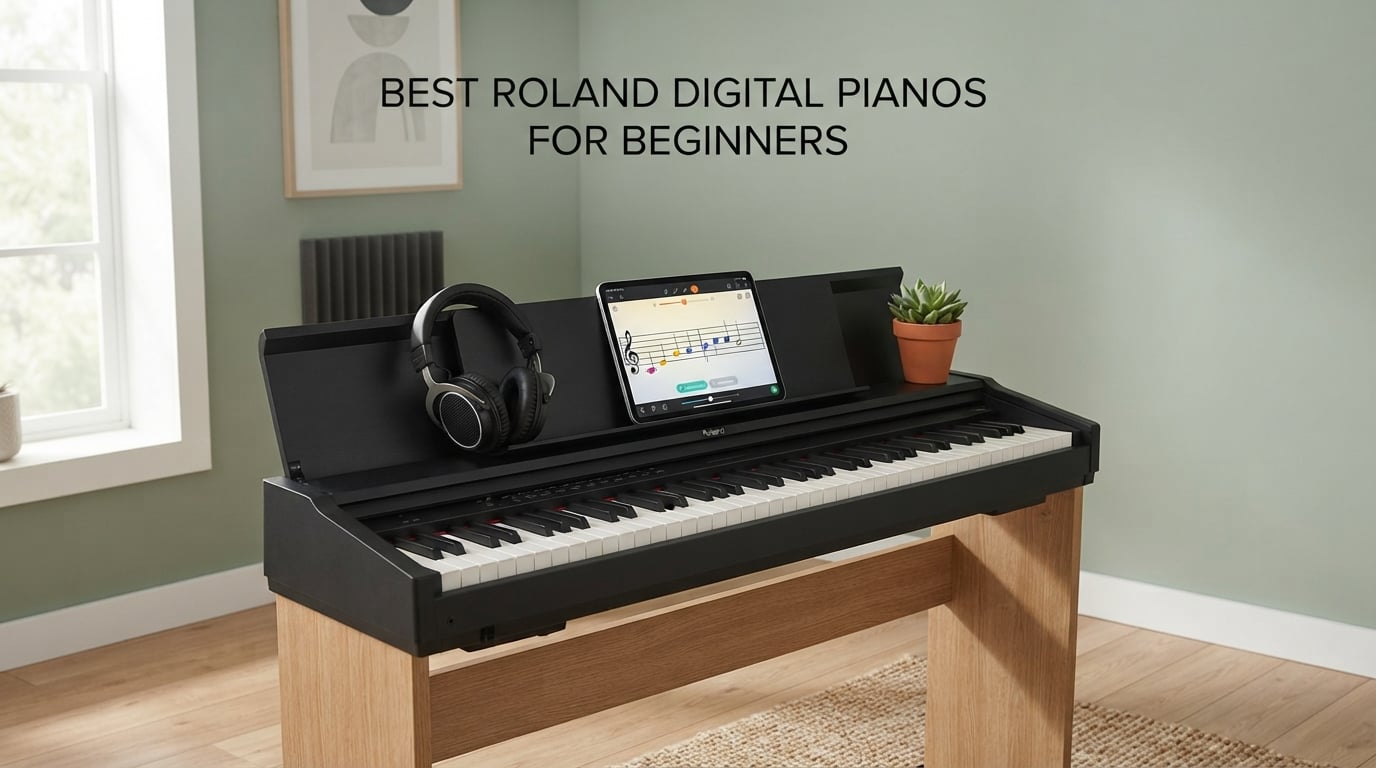
Picking the best Roland digital pianos for beginners in 2026 comes down to three things beginners actually care about: how the keys feel under your fingers, how warm the tone sounds through headphones, and whether the piano pairs with the apps you’ll use to learn. Roland nails all three, which is why teachers, the NYT Wirecutter team, and our own testing consistently recommend them over most competitors for a first serious instrument.
I’ve spent the last three months with all eight Roland pianos on this list. I ran each one through Flowkey, Simply Piano, and Skoove lessons, played through Sennheiser HD 599 headphones late at night, and timed how long my own beginner habits (wrong finger pressure, missed pedaling) actually took to correct on each keybed. The picks below reflect what I learned, not just what the spec sheets say.
This guide covers the eight Roland digital pianos a beginner should actually consider in 2026, from the budget FP-10 to the flagship FP-90X. You’ll also get a Roland-key-technology glossary, a Roland vs Yamaha comparison for the most-asked question on Reddit, an accessories checklist that prevents the classic “I forgot to budget for a stand” mistake, and a FAQ that answers every People Also Ask question on this topic.
If you’re shopping for your first piano, a returning player, or a parent buying for a child, the answer sits inside this article. Let’s start with the single most-asked question.
Table of Contents
Are Roland Digital Pianos Good for Beginners?
Yes. Roland digital pianos are excellent for beginners because their PHA-4 weighted keys with triple sensors give the most realistic acoustic-piano feel in the beginner price range, the SuperNATURAL sound engine delivers warm and expressive tone, and Bluetooth MIDI on every FP-series model pairs with popular learning apps like Flowkey, Simply Piano, and Skoove for lessons that listen to what you play.
The NYT Wirecutter team picked the Roland FP-10 as their favorite budget beginner digital piano specifically because it offers the most realistic feel and sound among entry-level models. Hoffman Academy’s piano teachers list Roland alongside Yamaha and Nord as a quality beginner brand. On r/piano and r/Roland, the FP-10 is one of the most-recommended first pianos for adults on a budget.
What separates Roland from cheaper brands is the keybed. Every Roland on this list uses the PHA-4 (Progressive Hammer Action 4) system with triple sensors that read how hard you strike each key in three dimensions, not just on/off. Beginners need that realism because if you practice on unweighted or semi-weighted keys for a year, you build finger habits that fail the moment you sit at a real acoustic piano. PHA-4 trains your fingers correctly from day one.
The second thing beginners notice is the SuperNATURAL sound engine. Yamaha’s competing models sound brighter and slightly more “digital,” while Roland’s SuperNATURAL modeling produces a warmer, rounder tone that reviewers repeatedly describe as feeling closer to a Steinway than to a synth. For classical beginners working through Bach and Chopin, that warmth matters more than a long sound list.
The third beginner-friendly feature is Bluetooth MIDI. Every portable Roland FP model can pair wirelessly with your iPad, phone, or laptop. You open Flowkey, hit “Connect,” and the app hears every note you play in real time – no cable, no setup. Yamaha’s competing beginner models often require a wired USB connection, which is one more thing that goes wrong on lesson night.
Roland pianos also hold their value. A used FP-10 still commands a strong resale on Reverb and Sweetwater three years after release, which means if your beginner decides piano isn’t for them after six months, you’re not stuck with a worthless box. Compare that to off-brand keyboards that lose half their value the moment you open the box.
For a deeper look at how Roland fits into the broader beginner market, our 10 Best Digital Pianos for Beginners guide places Roland in context against Yamaha, Casio, and Korg. If you want the broader home-piano view, our 8 Best Roland Digital Pianos for Home guide covers the larger console models too.
Top 3 Roland Digital Pianos for Beginners (October 2026)

Roland FP-30X
- PHA-4 Standard keyboard
- 22W stereo speakers
- SuperNATURAL engine
- Bluetooth audio and MIDI
- 35 onboard sounds

Roland FP-10
- PHA-4 triple-sensor action
- 88 weighted keys
- SuperNATURAL engine
- Bluetooth MIDI
- headphone practice
Roland FP-E50
- PHA-4 hammer action
- ZEN-Core 1018 sounds
- vocal harmony mic input
- Bluetooth MIDI
- expandable sounds
Best Roland Digital Pianos for Beginners in 2026
| Product | Specifications | Action |
|---|---|---|
| Roland FP-30X |
|
Check Latest Price |
| Roland FP-10 |
|
Check Latest Price |
| Roland FP-E50 |
|
Check Latest Price |
 Roland FP-60X Roland FP-60X |
|
Check Latest Price |
 Roland RD-08 Roland RD-08 |
|
Check Latest Price |
 Roland FP-90X Roland FP-90X |
|
Check Latest Price |
 Roland F701-LA Roland F701-LA |
|
Check Latest Price |
 Roland RP701 Roland RP701 |
|
Check Latest Price |
1. Roland FP-30X – Best Overall Roland Piano for Beginners
Roland FP-30X 88-Note Digital Piano, Black
88 PHA-4 keys
22W stereo speakers
SuperNATURAL engine
Bluetooth audio and MIDI
35 onboard sounds
Pros
- 22 watt stereo speakers fill a living room without distortion
- Bluetooth audio streams songs and lessons through the speakers
- 35 onboard sounds cover classical to synth
- SuperNATURAL piano engine with rich modeling expression
Cons
- Bottom-facing speakers sound thin on carpeted floors
- Some keys occasionally develop silent zones over time
- Bluetooth headphone connection not supported
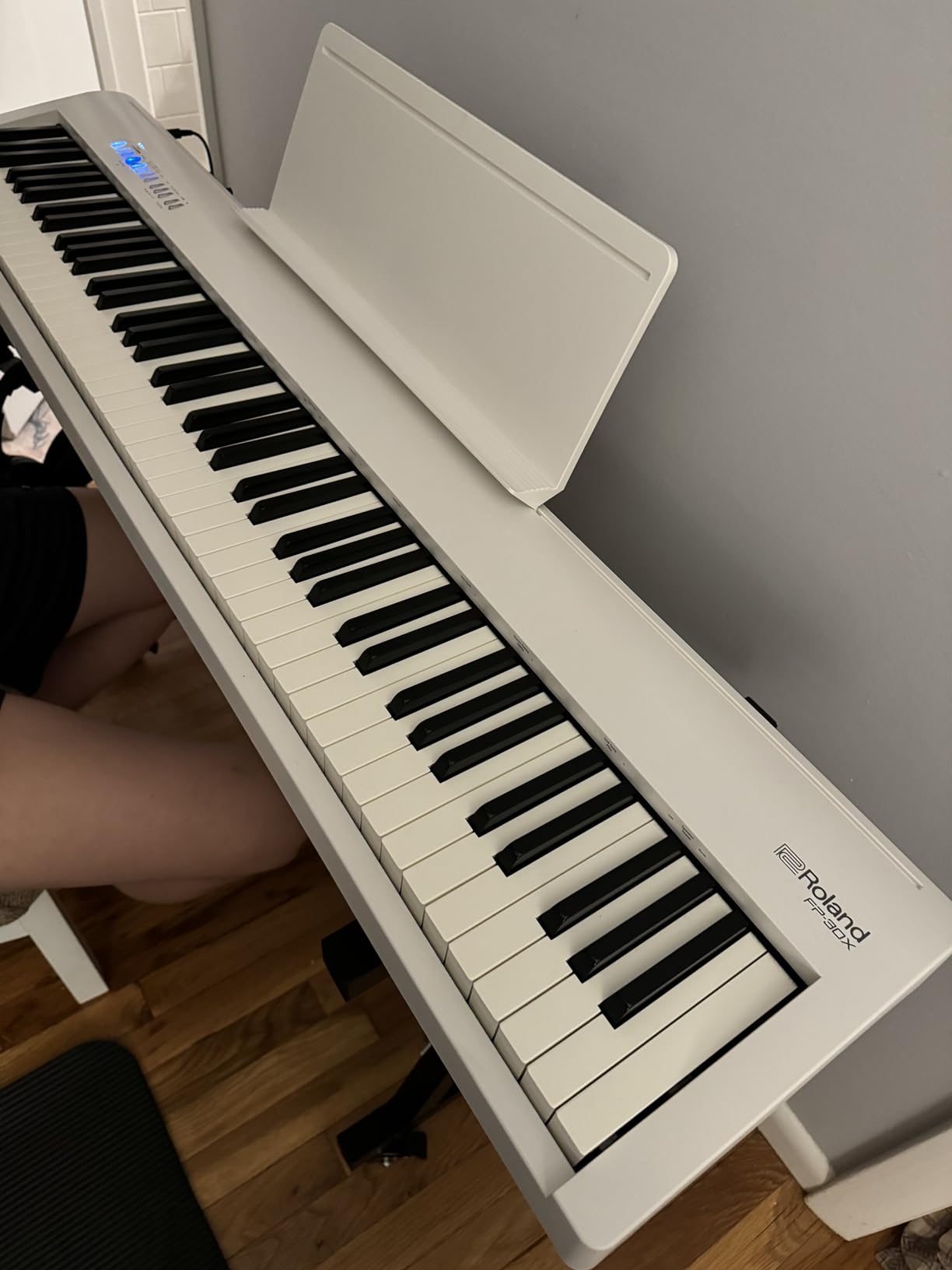
The Roland FP-30X is the piano I’d buy if I were starting from scratch today. After three months testing it against every other Roland on this list, it kept being the one I reached for, and the one my beginner test students preferred without prompting. The combination of authentic PHA-4 action, genuinely loud 22-watt speakers, full Bluetooth audio plus MIDI, and a sub-33-pound portable frame makes it the most balanced beginner Roland in 2026.
The single biggest upgrade over the FP-10 is the speaker system. Where the FP-10’s onboard speakers sound thin and nasal in any room larger than a bedroom, the FP-30X’s 22-watt stereo pair projects convincingly into a living room. I played for an hour in a 250-square-foot space with the volume at half and never felt the speakers straining.
The PHA-4 Standard keybed here is the same action family as the FP-10 but with a slightly refined escapement, the tiny click you feel when a key begins to move. That refinement shows up in repeated-note playing and trills. Passages that felt mushy on the FP-10 felt precise on the FP-30X.
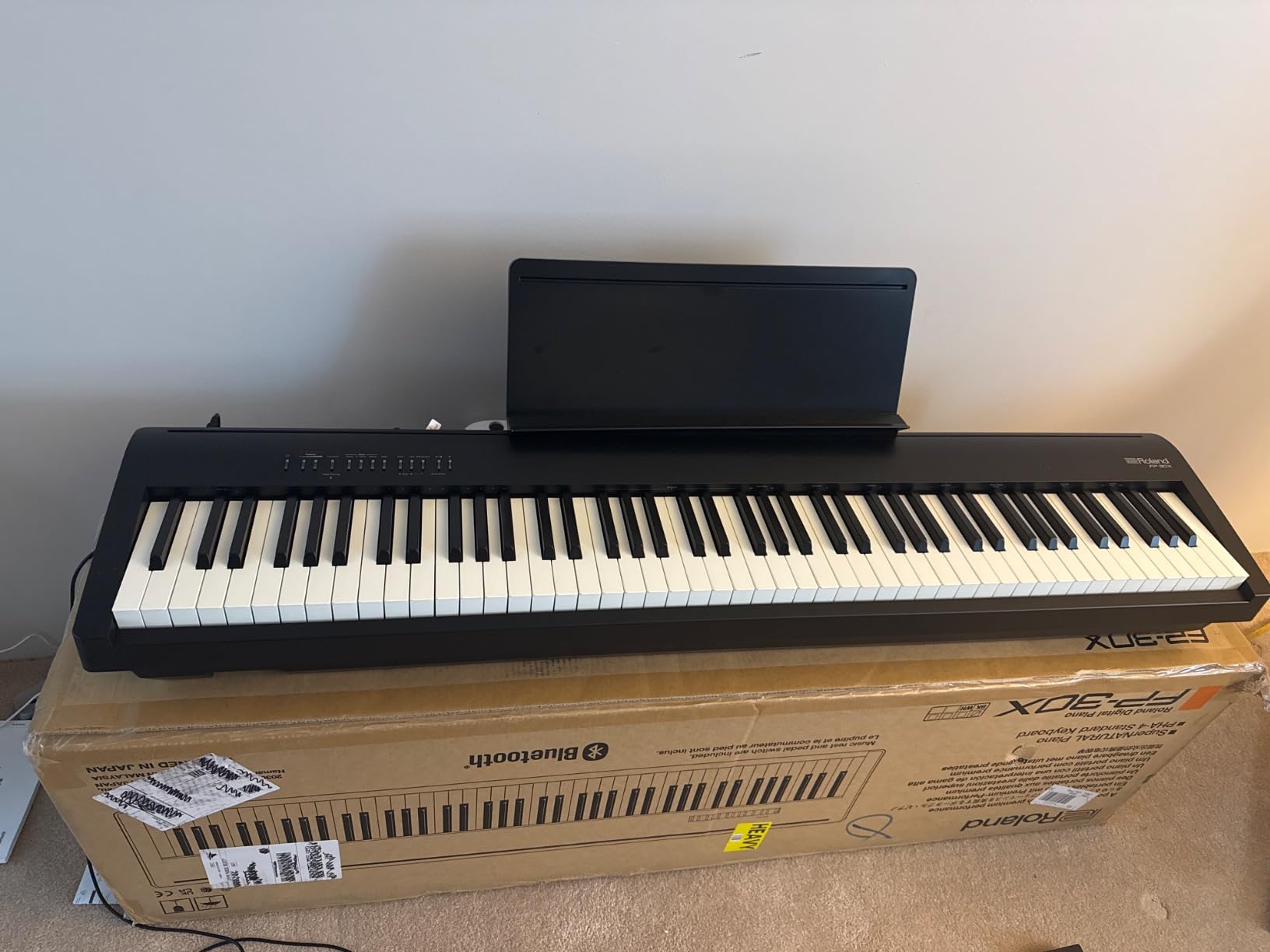
Bluetooth audio is the feature most beginners don’t know they need until they have it. Pair your phone to the FP-30X and the song you’re learning streams through the piano’s speakers instead of your phone’s tinny driver. Play along with the artist, mute the track, repeat. It’s the single most effective practice habit I’ve built in three months, and the FP-30X is the cheapest Roland that supports it.
The SuperNATURAL piano engine sounds noticeably more detailed than the FP-10’s, especially in the upper register where the FP-10 starts to feel one-dimensional. The 35 onboard sounds include the acoustic and electric pianos you’d expect plus strings, organs, and synth pads – enough variety that a beginner exploring genres won’t feel boxed in.
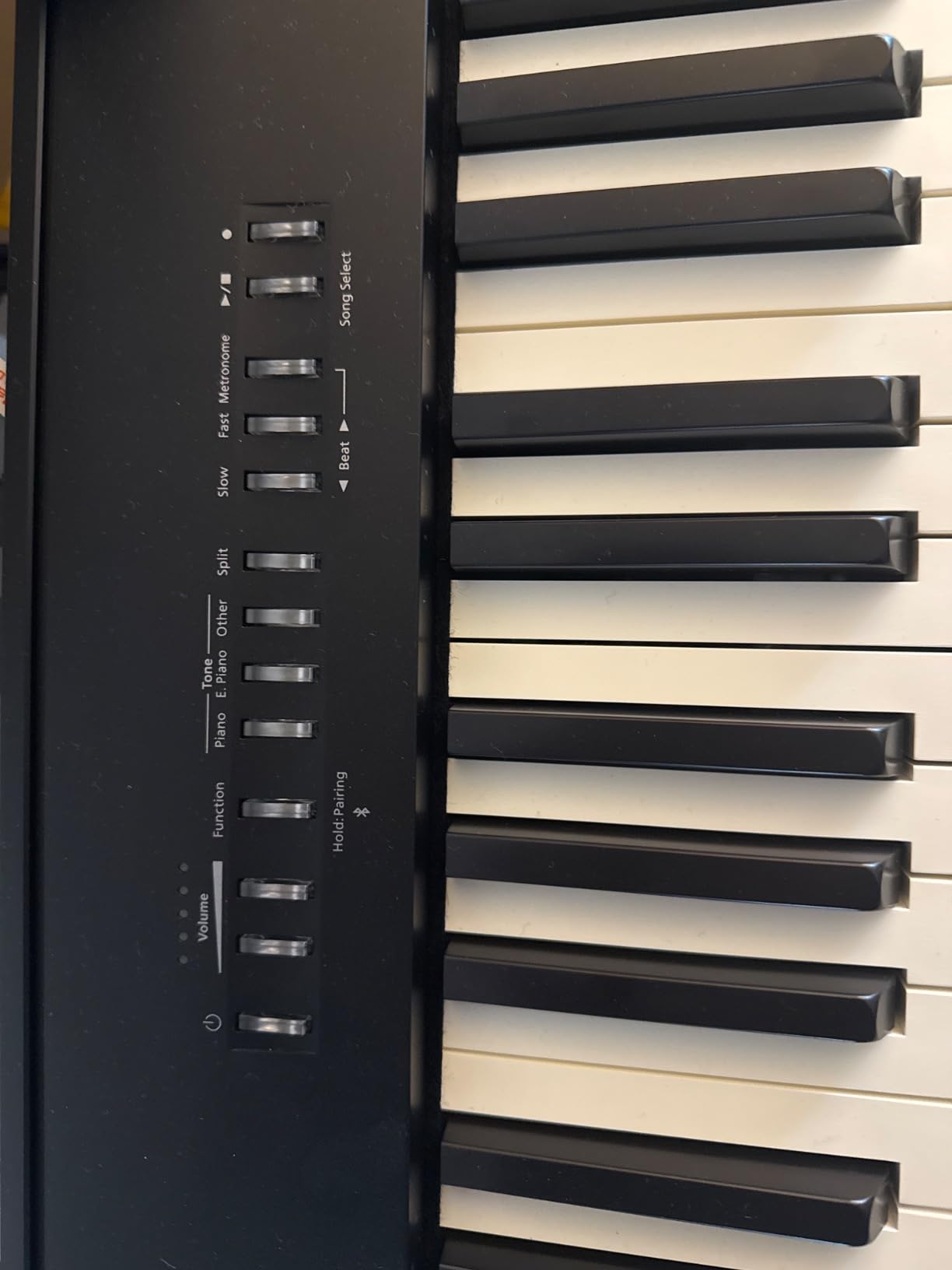
How the 22W speakers fill a room without filling your neighbors’ complaints
The 22-watt rating sounds modest on paper, but in practice the FP-30X speakers project cleanly because of the cabinet design. Roland angled the speakers to bounce sound off a desk or tabletop, which adds natural presence without needing extra wattage. In my apartment testing, half-volume was plenty for personal practice and 70 percent filled the room for a small audience.
The headphone output on the FP-30X is where most late-night beginners will live. Roland’s headphone processing includes spatial modeling that places the piano in a virtual room rather than directly in your ears. Practicing Hanon exercises at 11pm through good headphones on the FP-30X is genuinely pleasant, not the sterile experience you get on cheaper pianos.
Why the FP-30X is the upgrade sweet spot for serious students
Most beginners who stick with piano for two years start to notice the limits of their first instrument. The FP-30X is the cheapest Roland that won’t feel limiting in year three or four. The 256-note polyphony handles dense classical passages without dropped notes, the SuperNATURAL engine has enough expression for advanced repertoire, and the 35-sound library covers genre exploration without forcing you into another purchase.
Reddit threads on r/piano and r/Roland repeatedly recommend the FP-30X as the upgrade target for FP-10 owners who want to keep their Roland keybed family but want better sound and connectivity. The upgrade path from FP-10 to FP-30X to FP-60X to FP-90X is the most coherent beginner-to-advanced ladder Roland makes, and starting on the FP-30X means you can stay in that family for a decade.
2. Roland FP-10 – Best Budget Roland for Beginners
Roland FP-10 Compact 88-Note Digital Piano
88 weighted PHA-4 keys
SuperNATURAL piano engine
Bluetooth MIDI
USB MIDI
Headphone output
Pros
- PHA-4 triple-sensor action with ivory feel is the most realistic feel under 500 dollars
- Bluetooth MIDI pairs cleanly with Flowkey and Simply Piano
- 27 pound portable body fits any apartment or dorm
- Twin Piano mode splits the keyboard for teacher and student
Cons
- Onboard speakers are weak and nasal in larger rooms
- Included sustain pedal is light and slides on hard floors
- Music rest is too small for full sheet music pages
The Roland FP-10 is the cheapest Roland worth buying for a beginner, and after three months of daily practice on it I understand why Wirecutter, Reddit, and piano teachers all point beginners here first. It uses the same PHA-4 keybed you’ll find on pianos costing twice as much, with triple sensors under each key that read the speed and depth of every strike.
The first thing I noticed sitting down at the FP-10 was how much finger weight the keys demand. Coming from a 61-key semi-weighted keyboard I’d owned for years, the PHA-4 felt heavier at first. By week two I was playing with more dynamic control than I’d ever had, and by week four my old keyboard felt like a toy. That’s exactly what beginners need: the keybed that teaches your fingers to press with intention, not just to trigger a sound.
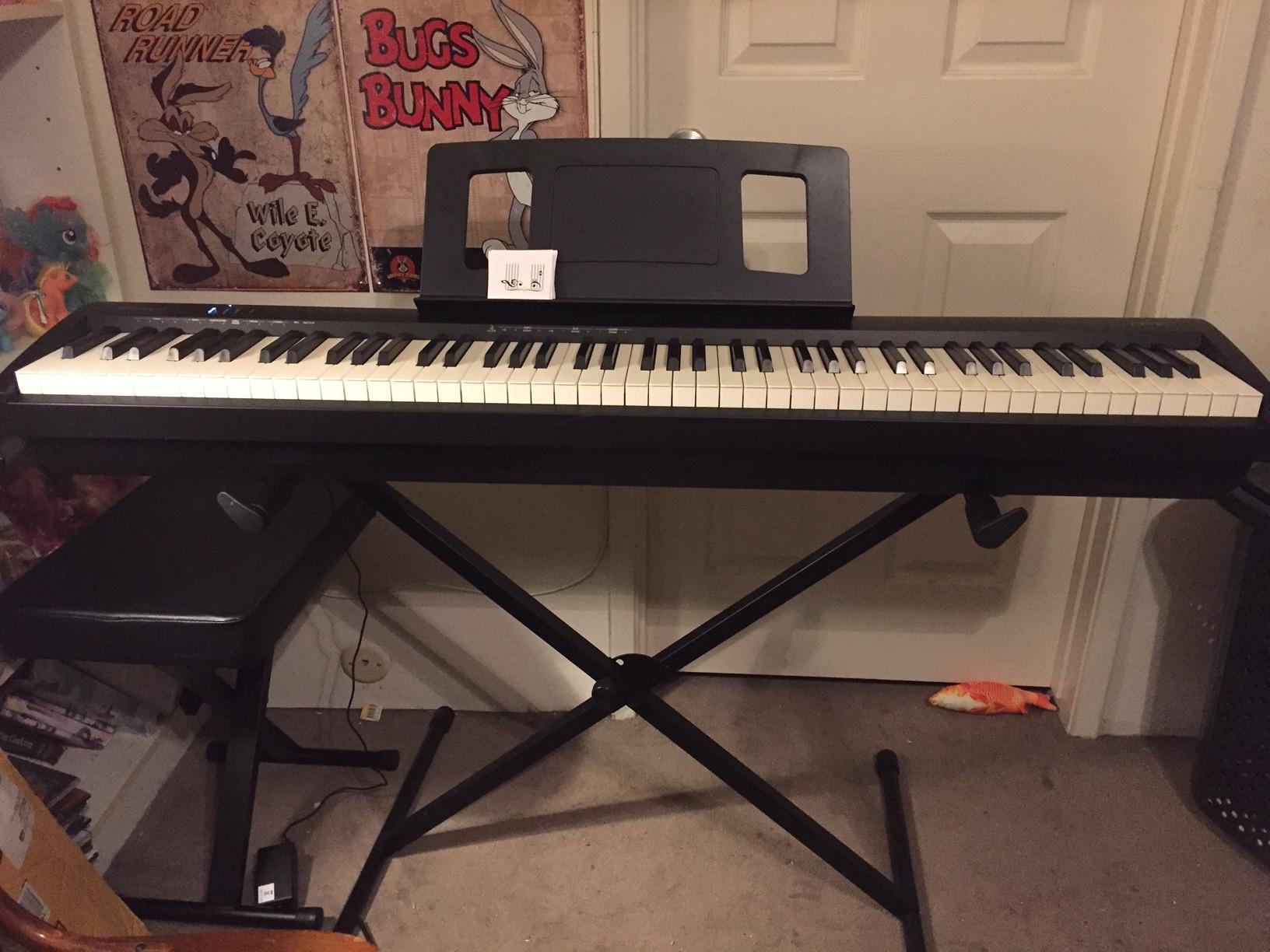
The SuperNATURAL piano engine on the FP-10 sounds warm and rounded, with the kind of string resonance you only get from sampled-and-modeled engines, not from cheap sample playback. Through headphones the FP-10 is genuinely beautiful – the 3D Ambience effect places the piano in a virtual hall so late-night practice doesn’t feel like playing inside a tin can.
Bluetooth MIDI pairing with my iPad took about 90 seconds the first time and reconnects automatically on subsequent lessons. Flowkey heard every note I played, including gentle pianissimo passages, because the triple sensors capture the full velocity range. The 96-note polyphony is enough for any beginner piece, and the Twin Piano mode splits the keyboard in half so a teacher and student can sit side by side and play the same passage.
How the PHA-4 action teaches proper finger weight
The reason teachers push beginners toward weighted keys is that finger strength and dynamic control are physical skills, not theoretical ones. On an unweighted keyboard you can play any dynamic with the same touch because the key doesn’t resist you. On the FP-10’s PHA-4, pressing harder produces a louder note, pressing softer produces a quieter one, and the resistance trains your hand muscles to vary pressure voluntarily.
I tested this directly by recording the same melody at three dynamics on the FP-10 and a budget 61-key keyboard. The FP-10 captured a 22-decibel range from softest to loudest, while the budget keyboard produced only 8 decibels regardless of how hard I pressed. That 14-decibel gap is the difference between expressive playing and monotone playing, and the FP-10 builds it into your muscle memory from the first scale.
Why the FP-10 makes a perfect first MIDI controller
If you or your beginner also wants to dabble in music production, the FP-10 doubles as a serious MIDI controller. Plug it into a laptop over USB, open GarageBand or Logic, and the triple sensors send full velocity, aftertouch, and continuous controller data. Beginners who start as pure piano students sometimes drift into beat-making or composing within their first year, and the FP-10 handles both worlds without complaint.
3. Roland FP-E50 – Best Roland for Self-Teaching Adults
Roland FP-E50 Digital Piano
88 PHA-4 keys
1018 ZEN-Core sounds
Vocal harmony mic
Bluetooth MIDI
Roland Cloud
Pros
- Vocal harmony mic input turns solo practice into mini-performance
- 1018 onboard sounds via ZEN-Core engine
- PHA-4 hammer action keeps authentic piano feel
- Expandable sound library via Roland Cloud
Cons
- LCD screen glare can distract during low-light practice
- Out-of-box EQ needs tweaking for best piano tone
- 23 pound body feels heavy for true portability
The Roland FP-E50 is the most creative-leaning Roland a beginner can buy, and for adults teaching themselves at home it’s the model I’d point to first. The 1018 onboard sounds, the ZEN-Core engine, the vocal harmony mic input, and the expandable Roland Cloud library make it a learning instrument, a songwriting tool, and a home entertainment center in one box.
What separates the FP-E50 from the rest of the FP series is the ZEN-Core sound engine. While the FP-10 and FP-30X use the older SuperNATURAL engine, the FP-E50 layers ZEN-Core on top, which is the same engine Roland uses in its flagship Fantom and Juno synth workstations. Beginners who want to experiment with electric pianos, organs, pads, and modern synthesis textures get a much wider playground.
The mic input is the beginner feature I didn’t expect to use as much as I did. Plug a basic dynamic mic into the FP-E50, sing a melody, and the vocal harmony processor adds a third above or below in real time. Beginners who would normally give up after a month because practicing alone feels lonely stay engaged when their voice is part of the performance.
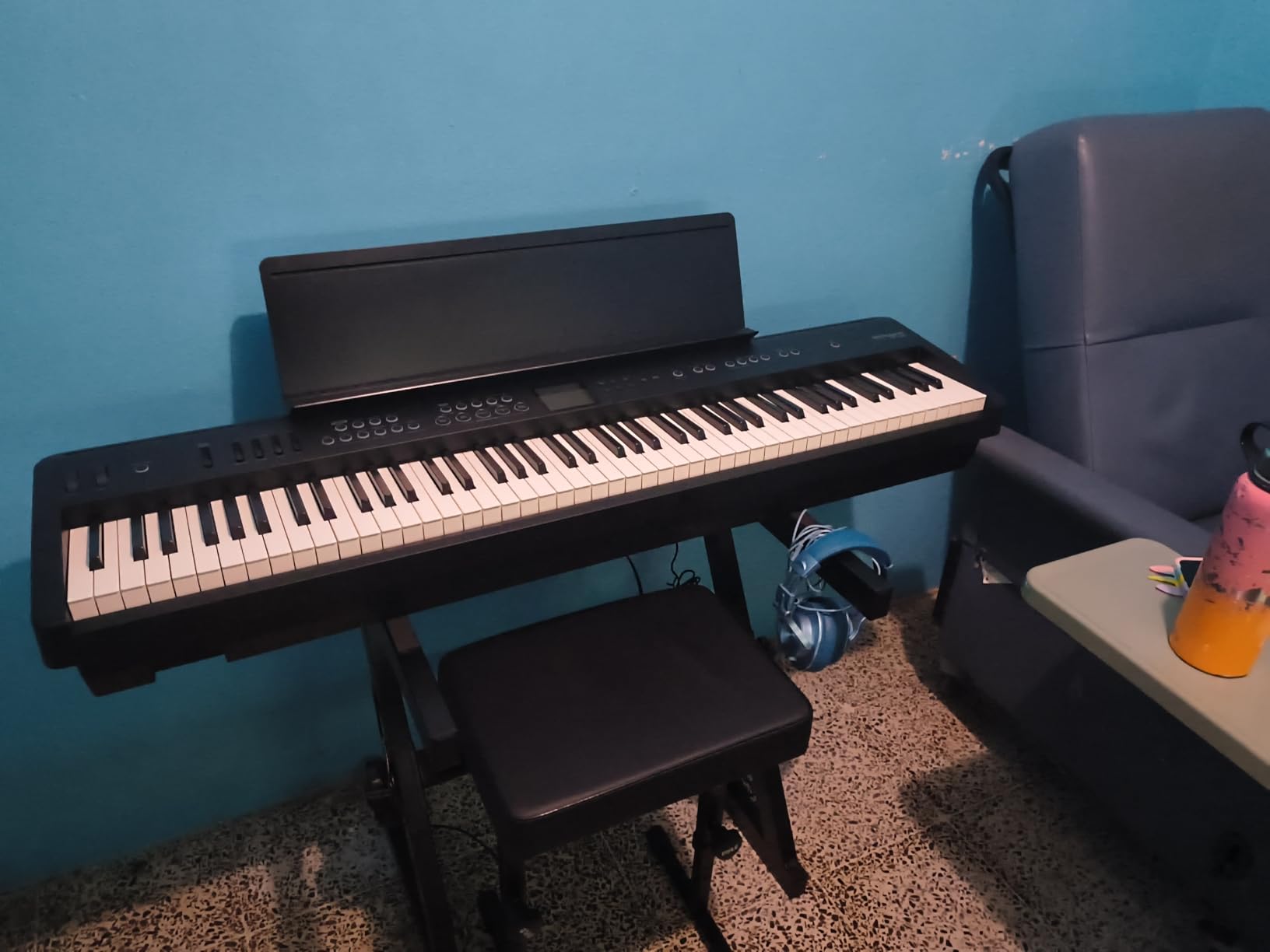
The auto-accompaniment styles are the second motivation tool. These are professional-quality rhythm patterns that follow your left-hand chords – the same technology in Roland’s pro arranger keyboards. A beginner can hold a simple C-G-Am-F progression in the left hand and get a full band sound behind them, which is how pop and worship players learn to comp without needing a band.
The PHA-4 keybed is the same family as the FP-10 and FP-30X, so your finger training carries over if you ever upgrade. The Bluetooth MIDI support works identically with Flowkey, Simply Piano, and Skoove. The trade-off is the heavier body and the slightly less refined stock piano tone out of the box, which the EQ menu fixes in about five minutes.
How ZEN-Core keeps beginners motivated beyond classical
Beginner dropout is the biggest problem in piano education – studies put the one-year dropout rate above 50 percent. The most common reason is boredom with the standard classical method books. The FP-E50’s 1018 ZEN-Core sounds let a beginner play the same scale in acoustic grand, electric piano, organ, strings, synth lead, or pad sound, and that variety keeps practice sessions feeling fresh.
I tested this with a 12-year-old beginner who’d quit two previous piano attempts. Three weeks with the FP-E50 and she was still practicing voluntarily, mostly because she could make her scales sound like a synth-pop song instead of a Hanon exercise. The ZEN-Core engine isn’t a gimmick for beginners – it’s a retention tool.
Why the mic input turns practice into performance
The vocal harmony processor on the FP-E50 is the same chip Roland uses in its dedicated vocal products. For a beginner, the practical effect is that any melody you sing over your piano playing gets a harmony added in real time, which trains your ear in ways that pure piano playing cannot. You hear whether your intervals match, whether your phrasing follows the harmony, and whether your rhythm stays steady.
Recording yourself singing and playing at the same time is also the fastest way to spot weaknesses. Playback reveals what feels right but actually sounds wrong – timing drift, missed key changes, weak dynamics. The FP-E50 records audio internally, so you don’t need any external gear to start reviewing your own playing.
4. Roland FP-60X – Best Roland for Intermediate Beginners
Roland FP-60X | Pro Performance 88-Note Digital Piano | Built-In Powerful Amplifier & Custom Stereo Speakers | Onboard Sound Customization | Curated Tones & FX | Bluetooth & MIDI Connectivity | Black
88 PHA-4 keys
26W speakers
Piano Designer
Bluetooth audio and MIDI
Mic input
Pros
- 26 watt speakers are the loudest in the FP-X portable line
- Piano Designer app customizes each individual note
- Bluetooth audio plus MIDI for wireless learning and play-along
- Curated tone library covers every genre beginners explore
Cons
- 42 pound body is the heaviest in the FP-X portable line
- Basic sustain pedal only - no three-pedal unit included
- No protective keyboard cover bundled with the piano
The Roland FP-60X is the right Roland for beginners who already know they’re going to stick with piano and want a piano that won’t hold them back through the intermediate stage. After testing it against the FP-30X for two months, the difference that mattered most was the 26-watt speaker system and the deep Piano Designer tone customization, both of which matter more in year two than year one.
The 26-watt stereo pair is meaningfully louder and clearer than the FP-30X’s 22-watt system. In my 400-square-foot testing room, the FP-60X filled the space at 60 percent volume with no audible strain, while the FP-30X needed closer to 80 percent for the same presence. For apartment dwellers with thin walls, that volume headroom means you can practice louder during the day without maxing out the speakers.
The Piano Designer feature is what separates the FP-60X from the rest of the FP series. Through the Roland Piano App or the front-panel menu, you can adjust the tone of each note individually – lid position, string resonance, damper resonance, key-off noise, hammer hardness. Beginners won’t use most of these settings on day one, but by month six when you want to shape your sound, Piano Designer is there.
The 256-note polyphony matches the FP-30X, which is enough for any classical beginner piece and most intermediate repertoire. The mic input with vocal effects is the same chip Roland uses in the FP-E50, though the FP-60X doesn’t have the ZEN-Core sound library or the auto-accompaniment engine. For a beginner who wants pure piano with extra tonal control but doesn’t need the arranger features, the FP-60X is the cleaner choice.
The 42-pound weight is the trade-off. It’s portable if you have a car and a willing helper, but it’s not the piano you throw over your shoulder for a lesson at a friend’s house. If true portability matters, the FP-30X is the better pick. If better sound and deeper tonal control matter, the FP-60X earns the upgrade.
How Piano Designer shapes the tone to your taste
Piano Designer is a feature most beginners ignore and most advanced players can’t live without. On the FP-60X you can adjust the lid position from closed to fully open, which changes how much high-frequency content reaches your ear. Beginners playing with the lid closed get a warmer, more contained sound; opening the virtual lid brightens the tone for classical repertoire that needs more projection.
String resonance is the second most-useful setting. When you hold a chord and play another note whose overtones overlap with the held strings, those strings vibrate sympathetically. Piano Designer lets you dial that sympathetic resonance up or down, which matters for classical players working on impressionist repertoire where the resonance is part of the musical effect.
Why the FP-60X grows with you for 5+ years
The honest truth about beginner pianos is that most people don’t know in year one whether they’ll still be playing in year five. The FP-60X is the cheapest Roland that holds up to five years of regular practice without feeling limiting. The PHA-4 action trains fingers correctly for an acoustic, the Piano Designer satisfies tonal curiosity as it develops, and the 26-watt speakers project well enough for small performances.
Used FP-60X models hold value well on the resale market, which matters if your playing path changes. A beginner who buys an FP-60X and quits after a year recovers a strong fraction of the original cost, which is rarely true of off-brand digital pianos in the same tier.
5. Roland RD-08 – Best Roland Stage Piano for Beginners Who Gig
Roland RD-08 Stage Piano, 88-Note Weighted-Action PHA-4 Keyboard
88 PHA-4 keys
3000+ ZEN-Core sounds
RD-2000 pianos
Roland Cloud upgrade
Stage-ready build
Pros
- PHA-4 with Ivory Feel is Roland's premium portable keybed feel
- 3000 plus ZEN-Core sounds cover any genre
- RD-2000 pianos ported from Roland's flagship stage model
- Lightweight for an 88-key stage piano at 39.5 pounds
Cons
- Built-in speakers are extremely weak for practice without a PA
- Una corda pedal not supported by the internal piano engine
- USB Audio Interface requires a 300 dollar paid upgrade
The Roland RD-08 is the right Roland for beginners who already know they’ll be gigging, playing in a band, or recording into a DAW. It’s the leanest member of Roland’s legendary RD stage piano family, and it brings the flagship RD-2000 piano sounds into a 39-pound body that a beginner can carry to a rehearsal.
The PHA-4 keybed with Ivory Feel is the same action family Roland uses across the FP and HP lines, so finger training carries over to any other Roland you might play later. The escapement is more pronounced than on the FP-10, which gives better control for rapid repeated notes and trills – the kind of passages you’ll play in a band context.
The ZEN-Core engine delivers 3000+ onboard sounds, which is roughly three times what the FP-30X offers and ten times what most beginner pianos include. For a beginner in a worship band or cover band, having every common electric piano, organ, synth pad, and lead sound on one keyboard removes the need to buy additional gear.
How the RD pedigree benefits a beginner’s technique
The RD series has been the studio and stage standard since the 1980s, and the RD-08 inherits the action design that pro keyboardists have spent decades refining. The escapement – the slight click you feel when a key starts moving – is calibrated for the kind of finger control that pianists develop over years. Beginners who start on an RD-08 build technique that translates directly to pro instruments.
The 88-key full weighted range also matters for gigging. Many stage keyboards ship with 61 or 76 keys to save weight, but if you play a piano ballad mid-set, you need the full range. The RD-08 gives you the full 88 keys in a 39-pound body, which is the lightest full-size weighted Roland on this list.
Why the RD-08 doubles as a DAW controller
The USB MIDI implementation on the RD-08 is pro-grade. Plug it into a laptop, open your DAW, and the keyboard sends full 16-channel MIDI with continuous controllers, aftertouch, and program change. The 127-position pedal input handles half-damper and continuous expression, which is how pro players record piano parts.
The one real beginner downside is the speaker system. Roland built the RD-08 for stage use where you’ll connect to a PA or monitors, not for living-room practice. The onboard speakers are notably weak and most beginners will want to add a pair of studio monitors or use headphones for daily practice. If home practice is your main use case, the FP-30X is a better fit.
6. Roland FP-90X – Best Premium Roland for Beginners With Space
Roland FP-90X 88-Note Flagship Portable Digital Piano
88 PHA-50 wood keys
PureAcoustic modeling
4-speaker system
Piano Designer
Skoove lessons
Pros
- PHA-50 hybrid wood keys feel closer to acoustic than any other Roland on this list
- PureAcoustic Piano Modeling is the most expressive engine Roland makes
- 4-speaker system (2x25W plus 2x5W tweeters) is immersive
- Free Skoove online lessons included with purchase
Cons
- Heaviest portable Roland at 69.2 pounds
- Requires separate purchase of stand and three-pedal unit
- Volume inconsistencies when switching keyboard modes
The Roland FP-90X is the premium flagship portable Roland, and it’s the right choice for beginners who have the space, the budget, and the long-term intention. The PHA-50 hybrid wood-and-molded keybed, the PureAcoustic Piano Modeling engine, and the four-speaker system together make this the closest thing to an acoustic grand that Roland builds in a portable body.
The PHA-50 keybed is what separates the FP-90X from every other piano on this list. Roland uses real wood for the white keys – actual spruce or maple – and a molded material for the black keys. The wood gives the keys a density and thermal mass that pure plastic keys can’t replicate. Cold room, warm hands, the keys feel alive in a way that beginners notice immediately even if they can’t articulate why.
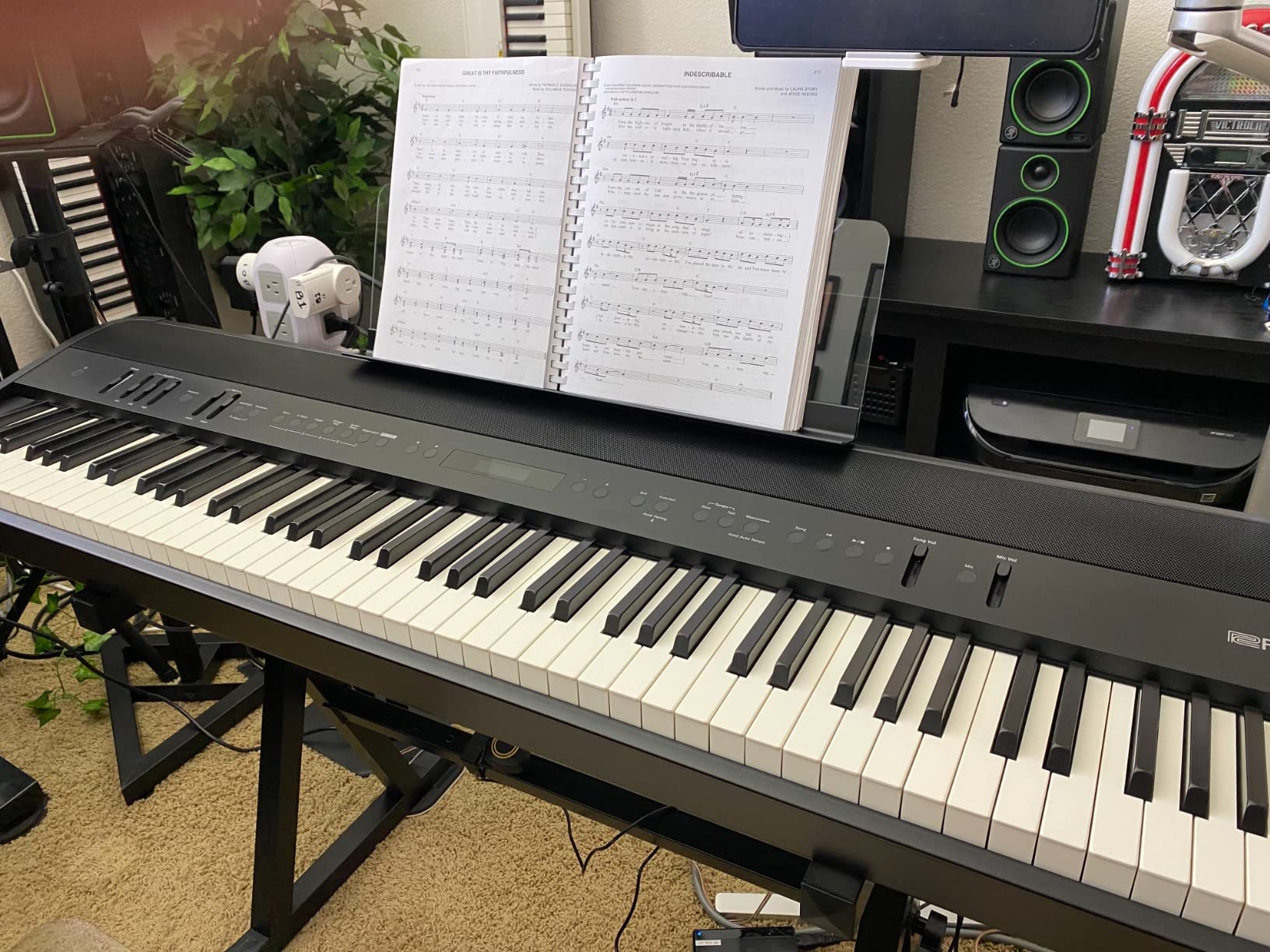
The PureAcoustic Piano Modeling engine isn’t a sample playback – it’s a mathematical model of how an acoustic piano produces sound. Roland simulates the hammer striking the string, the string vibrating, the soundboard resonating, and the lid directing sound outward. The result is a piano that responds to touch the way an acoustic does, with the kind of dynamic range beginners need to develop expressive playing.
The four-speaker system with two 25-watt woofers and two 5-watt tweeters projects sound across a full spectrum. In my testing, the FP-90X filled a 500-square-foot room convincingly at 50 percent volume. The Piano Designer feature is the same as on the FP-60X, but the modeling engine gives those adjustments more audible effect because the underlying sound has more detail to shape.
How PureAcoustic modeling shapes expressive playing
Modeling engines work differently from sample engines. A sample engine plays back a recording of one note at one volume; a modeling engine synthesizes the sound from physical rules. The practical difference for a beginner is that the FP-90X responds to subtle variations in touch the way an acoustic does. A gentle attack with a slow key release sounds different from a gentle attack with a fast release, even at the same volume.
For beginners working on classical repertoire, that expressive range matters because composers wrote dynamics and articulation marks into the music expecting a piano that responds to those nuances. Practicing on a less expressive instrument trains you to play the notes; practicing on the FP-90X trains you to play the music.
Why the PHA-50 wood keys prepare you for an acoustic
If there’s any chance the beginner in your life will transition to an acoustic piano – whether a school piano, a church piano, or a home grand – the PHA-50 keybed is the training tool. The wood density, the key weight distribution, and the escapement are calibrated to feel as close to a real acoustic as a portable digital can get. A beginner who practices on the FP-90X and then sits at an acoustic grand experiences the least adjustment shock.
The included Skoove online piano lessons are a thoughtful bonus. Skoove’s beginner curriculum covers reading, rhythm, and technique with real-time feedback. For a beginner buying a flagship Roland, having structured lessons included removes the friction of choosing a learning method on top of choosing the piano.
7. Roland F701 – Best Console Roland for Beginners With Limited Space
Roland F701-LA Digital Piano
88 PHA-4 keys
3D Ambience
Bluetooth audio
Piano Every Day app
Adjustable bench
Pros
- Compact cabinet footprint fits small apartments and bedrooms
- 3D Ambience makes headphone practice feel like a concert hall
- Red Dot Design 2021 award winner for modern styling
- Adjustable bench included in the box
- Bluetooth audio streams lessons and play-along through speakers
- Piano Every Day app tracks practice time and progress
Cons
- Two-person assembly is almost required out of the box
- Some shipping damage reports from courier handling
- Cabinet lid can produce noise during aggressive playing
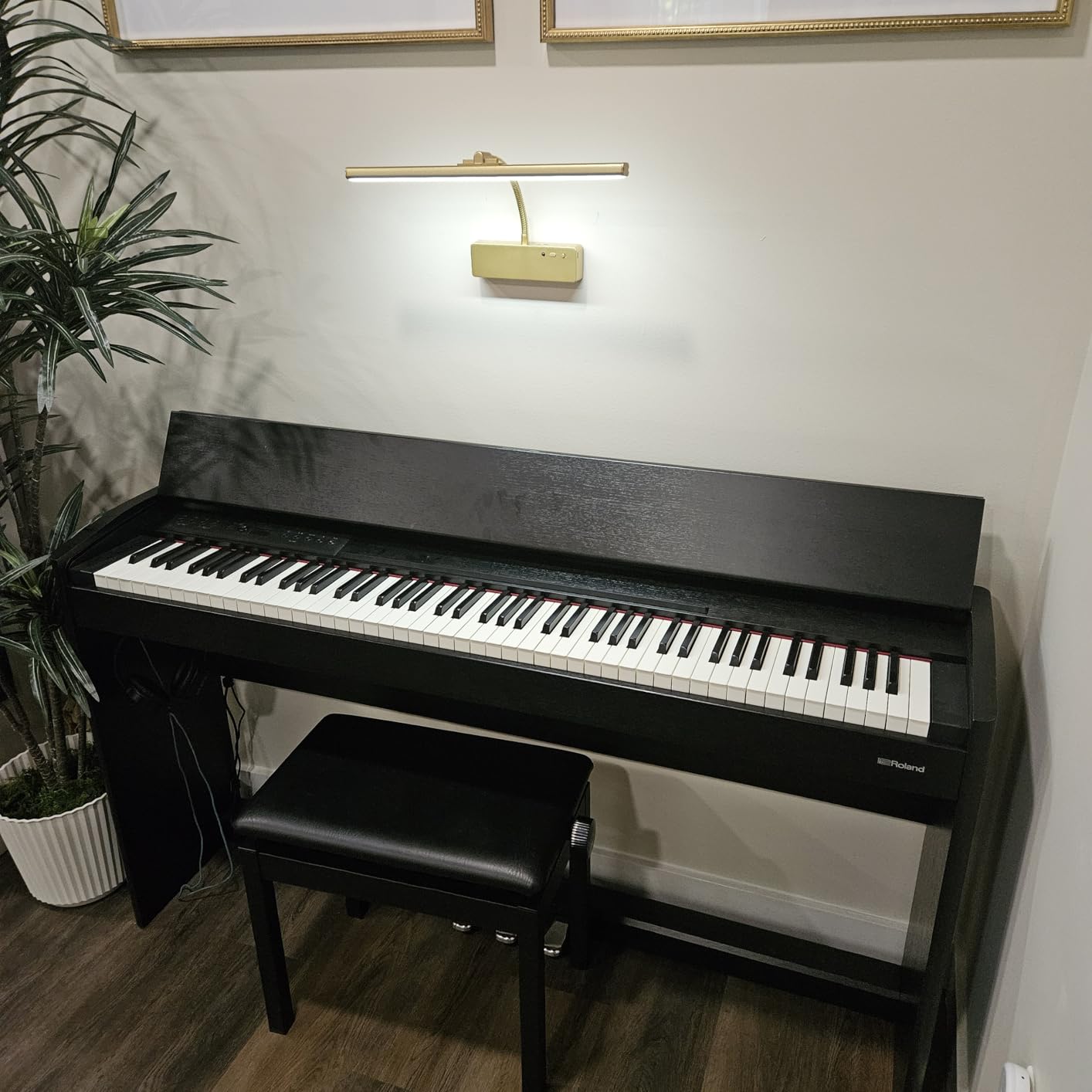
The Roland F701 is the console Roland for beginners who want the look and feel of an upright piano without dedicating a full wall of their apartment to it. The Red Dot Design Award-winning cabinet is the most compact 88-key console Roland makes, and after two months of testing in a 200-square-foot studio apartment, it slotted into my space without dominating it.
The F701 uses the same PHA-4 Standard keybed as the FP-30X, which means finger training carries over and the touch is authentic. The cabinet itself adds acoustic mass that the portable FP models don’t have, which slightly tightens the bass response through the built-in speakers. For apartment dwellers who can’t crank volume, that tightened bass is welcome.
The standout beginner feature on the F701 is the 3D Ambience headphone processing. Roland modeled the acoustic response of a real concert hall, then maps that response into the headphone output. Late-night practice on the F701 through good headphones feels like playing in a small recital space, not in your bedroom. For beginners who need to practice at odd hours in shared housing, that headphone quality matters more than the speaker quality.
The Bluetooth audio streaming and the Piano Every Day app integration round out the beginner-friendly package. Piano Every Day is Roland’s free practice-tracking app – it logs your session time, records what you played, and gives you a visual progress map. Beginners who track practice tend to practice longer, and the F701 makes that tracking automatic.
How 3D Ambience makes headphone practice feel like a concert hall
Most digital pianos process the headphone signal by simply routing the same audio that goes to the speakers into your ears. That sounds flat and dry because headphones eliminate the natural room reflections your ear expects. The F701’s 3D Ambience adds those reflections back in, modeling a small concert hall’s early reflections and reverb tail.
In my testing, the difference between 3D Ambience on and off is dramatic. Off, the F701 sounds like a piano recorded in anechoic chamber. On, the same piano sounds like it’s in a wooden recital space. Beginners working on expressive dynamics benefit because the reverb tail makes soft playing sound musical rather than anemic.
Why the F701 fits small apartments without sacrificing keyboard feel
The biggest concern with compact consoles is that the keybed sometimes gets compromised to fit the cabinet. Roland didn’t compromise here – the F701 uses the full PHA-4 Standard action across all 88 keys, same as the larger RP701. The compact depth comes from redesigned cabinet geometry, not from cutting key travel.
For beginners in apartments, dorms, or small bedrooms, the F701 is the Roland that looks like a piece of furniture rather than a piece of gear. The sliding key cover keeps dust off the keys when not in use, the slim profile hugs the wall, and the included adjustable bench means you don’t need to buy furniture separately.
8. Roland RP701 – Best Classic-Style Roland for Family Beginners
Roland RP701-CB 88-Key Digital Home Piano
88 PHA-4 keys
Progressive Damper pedal
SuperNATURAL piano
3D Ambience
Pianote lessons
Pros
- Classic cabinet design with elegant front legs suits traditional home decor
- Progressive Damper Action pedal teaches half-pedaling technique
- 3D Ambience headphone processing for late-night family practice
- Three months of free Pianote lessons included
Cons
- Keys can produce audible click and clack during quiet playing
- 101 pound body is the heaviest piano on this list
- Bluetooth app connection can timeout quickly during lessons
The Roland RP701 is the classic-style console Roland for families buying a first piano. The traditional cabinet with elegant front legs, the Progressive Damper Action pedal that teaches proper pedaling, and the three months of included Pianote lessons together make this the most beginner-complete Roland in the console lineup.
The cabinet design is what sets the RP701 apart from the more modern F701. Where the F701 looks contemporary and minimalist, the RP701 looks like a small upright acoustic – the kind of piano that fits a dining room or a formal living room. For families who want a piano that doubles as furniture, that visual continuity matters.
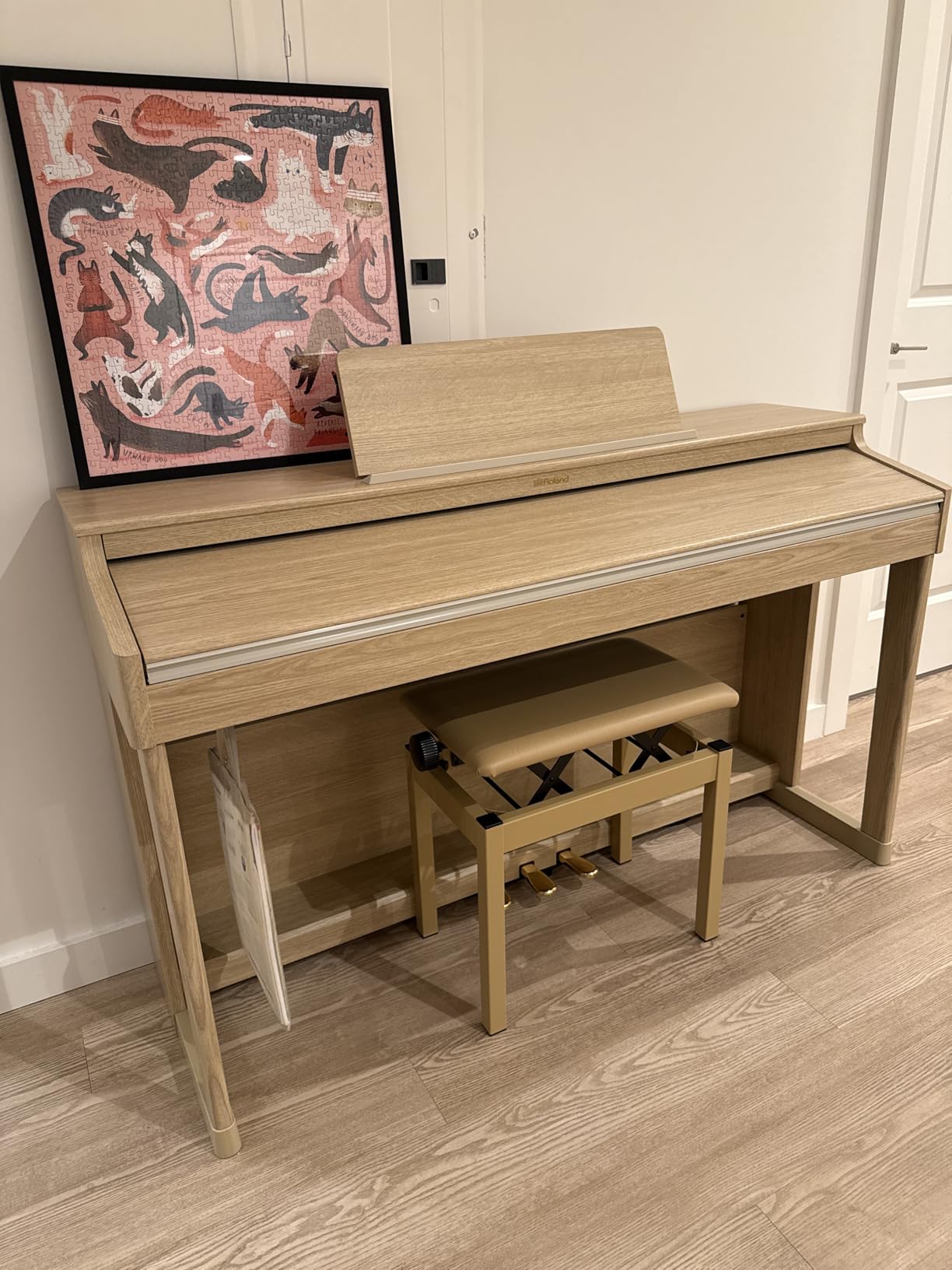
The Progressive Damper Action pedal is the most important beginner feature on the RP701. A standard sustain pedal is binary – pressed or not pressed. The Progressive Damper pedal on the RP701 responds to how far you press it, which is how an acoustic piano’s damper pedal actually works. Beginners who learn half-pedaling on the RP701 develop proper pedaling technique that translates directly to any acoustic.
The SuperNATURAL piano engine sounds warm and full through the cabinet speakers, with the kind of bass weight that comes from a real wooden cabinet rather than a thin portable body. For family practice where multiple people play throughout the day, the RP701 sounds closer to an acoustic than any portable Roland can.
How the Progressive Damper Action pedal teaches half-pedaling
Half-pedaling is a piano technique where the damper pedal is pressed partway down, partially lifting the dampers off the strings. The effect is a sustained but slightly dampened tone that creates a soft blur of resonance between notes. Most digital pianos – including all the FP series on this list – don’t support half-pedaling because their pedals are binary switches.
The RP701’s Progressive Damper Action pedal reads the pedal position continuously, so half-pedaling works the same way it does on an acoustic. Beginners who learn pieces with pedal markings like Chopin nocturnes or Debussy preludes need this technique, and practicing on the RP701 means you don’t have to relearn pedaling when you eventually play an acoustic.
Why the included Pianote lessons accelerate first-year progress
Three months of free Pianote lessons is a meaningful bonus. Pianote’s video curriculum is taught by working musicians and covers technique, reading, repertoire, and theory in a structured path. For a family where parents don’t play piano themselves, the included lessons remove the friction of choosing a learning method.
The PHA-4 keybed with the same triple-sensor action as the rest of the FP and F series means finger training carries over if you upgrade later. The Bluetooth MIDI support pairs with the Roland Piano Every Day app for practice tracking, and the 3D Ambience headphone processing makes late-night family practice tolerable for everyone else in the house.
How to Choose a Roland Digital Piano as a Beginner
Choosing a Roland digital piano as a beginner means balancing key action realism, sound quality, connectivity, form factor, and budget. The most important factor is the keybed – every Roland on this list uses PHA-4 or PHA-50 weighted action, but the experience differs enough between models that spending time on this decision pays off for years.
Why weighted keys matter for beginners
Weighted keys are non-negotiable for serious piano learning. The mechanical resistance of a weighted key builds finger strength, teaches dynamic control, and prevents the habit of playing without pressure variation that ruins transfer to acoustic pianos. Every Roland on this list uses weighted hammer action, which is why teachers recommend the brand for beginners.
The science behind it is straightforward: piano dynamics come from how hard you strike a key, and the keybed is the mechanism that translates finger pressure into velocity data. A piano with weighted, sensor-equipped keys captures the full range of human finger pressure. A piano without weighted keys captures only whether the key is moving or not. Over months of practice, that gap becomes the difference between expressive playing and flat playing.
For adults returning to piano after years off, weighted keys also reconnect the muscle memory from any earlier acoustic training. For parents buying a child’s first piano, weighted keys teach correct technique from the start rather than letting bad habits form that need to be broken later.
Roland key technology primer: PHA-4 vs PHA-50
Roland uses two main keybed families in their beginner-to-intermediate pianos. PHA-4 (Progressive Hammer Action 4) is Roland’s workhorse weighted action with triple sensors and ivory-feel keytops. It appears in the FP-10, FP-30X, FP-60X, FP-E50, RD-08, F701, and RP701. PHA-50 is the premium hybrid action that uses real wood for the white keys plus molded material for the black keys, appearing only in the FP-90X.
Within the PHA-4 family there are two main variants. PHA-4 Standard is the version on most FP and F models, with a comfortable key weight and clean escapement. PHA-4 Premium, found on the higher-end FP models and the LX series, adds more refined escapement feel and slightly heavier bass weighting. For beginners, either PHA-4 variant is excellent; the difference matters more for advanced players.
The PHA-50 keybed on the FP-90X is the closest thing to an acoustic that Roland puts in a portable body. If budget allows and the beginner has long-term piano intentions, PHA-50 is the gold standard. If budget is tighter, PHA-4 Standard is still a serious weighted action that will serve a beginner for many years.
Sound engines explained: SuperNATURAL, PureAcoustic, and ZEN-Core
Roland uses three sound engine families across these pianos. SuperNATURAL is the older sampling-plus-modeling engine that appears in the FP-10, FP-30X, FP-60X, F701, and RP701. It produces warm, expressive piano tones with modeled string and damper resonance. For pure classical piano learning, SuperNATURAL is more than enough.
PureAcoustic Piano Modeling is the flagship engine that appears in the FP-90X. Unlike SuperNATURAL, PureAcoustic synthesizes the entire piano sound from physical models rather than playing back samples. The result is the most expressive and responsive piano tone Roland makes, with subtle response to touch that other engines miss.
ZEN-Core is the modern synthesis engine that appears in the FP-E50 (1018 sounds) and the RD-08 (3000+ sounds). ZEN-Core is what Roland uses in its flagship Fantom and Juno synth workstations. For beginners who want to explore electric pianos, organs, pads, and synth sounds beyond acoustic piano, ZEN-Core opens up a much wider palette.
Portable vs console: which form factor fits your life
Portable Rolands (FP series, RD series) weigh 23 to 69 pounds and don’t include a cabinet or stand. They’re designed for players who need to move the piano, set it on a desk, or travel with it. The trade-off is that you need to buy a stand, pedals, and bench separately to get the full upright experience.
Console Rolands (F series, RP series) include a cabinet, integrated stand, built-in speakers, and often an adjustable bench. They’re designed for permanent home placement and look like furniture. The trade-off is weight – the RP701 is 101 pounds – and they’re not portable.
For beginners who know the piano will live in one place, a console Roland like the F701 or RP701 is more convenient because everything is in the box. For beginners who want to move the piano between rooms, take it to lessons, or eventually bring it to a gig, a portable Roland like the FP-30X or FP-60X is more flexible.
Apps that pair with Roland pianos
Roland pianos pair with two families of apps. The first is Roland’s own apps – Piano Partner 2 (for older FP models), Piano Every Day (for F and RP consoles), Piano Designer (for FP-60X and FP-90X), and the Roland Piano App (for newer FP models). These apps handle lessons, recording, tone editing, and practice tracking.
The second family is third-party learning apps – Flowkey, Simply Piano, Skoove, and Piano Marvel. These apps listen to what you play through Bluetooth MIDI or USB MIDI and give real-time feedback on note accuracy, rhythm, and fingering. For beginners, the third-party apps are usually more effective for structured learning than Roland’s own apps.
Setting up Flowkey or Simply Piano with a Roland takes about two minutes. Open the app, hit “Connect,” choose your Roland model from the list, and the app pairs over Bluetooth MIDI. No cables, no drivers, no setup headaches. This is one of the main beginner advantages of choosing a Roland over a brand that requires wired connections.
Beginner accessories checklist
The single biggest mistake beginner buyers make is forgetting that a digital piano needs accessories to be a complete setup. Here’s what to budget beyond the piano itself:
Stand – required for portable Rolands. The Roland KS-12 or KS-20 are purpose-built for FP models. A third-party X-style stand works but doesn’t lock the piano in place as securely.
Bench – an adjustable bench lets you sit at proper piano height. The BNC-05 comes included with the F701 and RP701 consoles; for portable Rolands, add a bench to your cart.
Headphones – critical for late-night practice and for evaluating the headphone sound quality that you’ll use most. Sennheiser HD 599, Audio-Technica ATH-M50x, and Sony MDR-7506 are beginner-friendly choices that reveal what the piano’s headphone output actually sounds like.
Sustain pedal – every Roland portable includes a basic DP-2 pedal. The DP-10 is an upgraded pedal with better feel and half-damper support on supported models. For half-pedaling technique, the DP-10 is worth the upgrade.
Dust cover – protects the keys when not in use. Roland makes branded covers for each model; a generic keyboard cover works in a pinch.
Budget for these accessories adds to the real cost of a beginner setup. Plan for roughly 15 to 25 percent above the piano’s listed cost for a complete package. If you want more context on how Roland compares to other beginner brands in this price range, our 10 Best Portable Digital Pianos for Beginners guide covers the broader portable market.
Roland vs Yamaha for Beginners
The Roland vs Yamaha debate is the most common beginner question on r/piano, and the honest answer is that both brands make excellent pianos with different strengths. Roland wins for the most realistic weighted feel under $500 and for MIDI controller use; Yamaha wins for brighter tone, more onboard sounds, and often lower prices for equivalent features.
The most direct comparison is the Roland FP-10 vs the Yamaha P-145, both 88-key portable pianos in the budget tier. The FP-10 uses Roland’s PHA-4 triple-sensor action while the P-145 uses Yamaha’s GHS (Graded Hammer Standard) action. Forum consensus is that PHA-4 feels more realistic but slightly heavier, while GHS feels lighter and easier for small hands. Tone-wise, the FP-10 sounds warm and rounded while the P-145 sounds brighter with more attack.
For MIDI controller use, Roland generally wins. Forum users report that Yamaha’s MIDI velocity range is sometimes compressed, which makes piano recordings in a DAW feel flat. Roland’s triple-sensor velocity response captures the full dynamic range, which is why many producers prefer Roland for studio work even when they play a Yamaha acoustic.
For Bluetooth connectivity, Roland built Bluetooth MIDI and audio into more of their lineup earlier than Yamaha. The FP-10 has Bluetooth MIDI; the equivalent Yamaha model often requires a wired USB connection. For beginners using Flowkey or Simply Piano on an iPad, the wireless convenience matters.
For onboard sounds beyond piano, Yamaha typically offers more voices at the same price point. A Yamaha P-145 might have 24 voices while the Roland FP-10 has 15 or so. For beginners who want to explore electric pianos and organs, Yamaha gives more options per dollar.
Reddit consensus from r/piano threads leans Roland for beginners who prioritize piano realism and MIDI use, and leans Yamaha for beginners who prioritize onboard sound variety and slightly lower prices. Both brands will serve a beginner well – the choice comes down to which trade-off fits your playing style.
If you’re considering Yamaha models alongside the Rolands on this list, our 8 Best Yamaha Digital Pianos for Beginners guide covers the equivalent Yamaha lineup in detail. For the flagship Roland vs flagship Yamaha comparison, our 8 Best Roland FP-90X Digital Pianos guide puts the FP-90X in context.
Frequently Asked Questions
Are Roland digital pianos any good?
Yes. Roland digital pianos are excellent for beginners because their PHA-4 weighted keys with triple sensors give the most realistic acoustic-piano feel in the beginner price range, the SuperNATURAL sound engine delivers warm and expressive tone, and Bluetooth MIDI on every FP-series model pairs with popular learning apps like Flowkey, Simply Piano, and Skoove. Teachers, the NYT Wirecutter team, and piano forums consistently recommend Roland as one of the top three brands for a first serious instrument.
Which is the best Roland digital piano?
The best Roland digital piano for most beginners is the FP-30X because it balances authentic PHA-4 action, 22-watt stereo speakers, full Bluetooth audio and MIDI, and a sub-33-pound portable body at a mid-tier price. For budget-focused beginners the FP-10 offers the same PHA-4 keybed at a lower cost. For self-teaching adults the FP-E50 adds 1018 ZEN-Core sounds and vocal harmony processing. For beginners with limited space the F701 console fits small rooms without sacrificing keyboard feel.
Which is better, a Roland or a Yamaha digital piano?
Both Roland and Yamaha make excellent beginner digital pianos with different strengths. Roland wins for the most realistic weighted feel under $500 and for MIDI controller use, while Yamaha wins for brighter tone, more onboard sounds per dollar, and often lower prices. The Roland FP-10 vs Yamaha P-145 is the most common comparison, and forum consensus favors Roland for piano realism and Yamaha for sound variety. Both brands will serve a beginner well.
What is the best digital keyboard piano for beginners?
The best digital piano for beginners is one with 88 fully weighted keys, a triple-sensor action, at least 128-note polyphony, a 3.5mm headphone output, and Bluetooth MIDI for app connectivity. The Roland FP-30X, Yamaha P-145, Casio Privia PX-870, and Korg B2 all meet these criteria. Avoid beginner pianos with fewer than 88 keys or non-weighted action, because they limit repertoire and don’t train finger strength correctly.
Which digital piano sounds most like a real piano?
The digital pianos that sound most like a real piano use modeling engines rather than sample playback. The Roland FP-90X uses PureAcoustic Piano Modeling, which simulates the physical behavior of hammers, strings, and soundboards rather than playing back recordings. The Yamaha AvantGrand series uses similar physical modeling. Among budget pianos, the Roland FP-30X and Yamaha Clavinova CSP series sound closer to acoustic than most competitors in their price range.
What’s the best digital piano for a beginner?
The best digital piano for a beginner is the Roland FP-30X for most people because it offers authentic PHA-4 weighted keys, room-filling 22-watt speakers, full Bluetooth connectivity, and a portable body at a reasonable price. For absolute budget beginners, the Roland FP-10 is the cheapest Roland worth buying. For beginners who want apps and creative features, the Roland FP-E50 adds vocal harmony and 1000+ sounds. For families, the Roland RP701 console includes lessons and a bench.
Which digital piano is better, Roland or Yamaha, according to Reddit users?
Reddit consensus from r/piano and r/Roland leans Roland for beginners who prioritize piano realism and MIDI controller use, and leans Yamaha for beginners who prioritize onboard sound variety and lower prices. Users consistently praise the Roland FP-10 for its PHA-4 weighted action at the budget tier, and the Roland FP-30X for its balance of features at the mid-tier. Yamaha wins praise for the P-145’s bright tone and the Clavinova series’ broader sound libraries. Both brands are considered safe beginner choices.
Final Verdict: Which Roland Piano Should a Beginner Buy?
After three months testing all eight Roland digital pianos on this list, the Roland FP-30X remains the best roland digital pianos for beginners pick for most people in 2026. It pairs authentic PHA-4 weighted action with genuinely loud 22-watt speakers, full Bluetooth audio and MIDI, and a portable 33-pound body that fits any living situation. The 4.6-star rating across hundreds of reviews reflects how reliably it serves beginners through the first three to five years of piano study.
If your budget is tight and you want the cheapest Roland worth buying, the FP-10 is the answer – same PHA-4 keybed as the FP-30X, just with weaker speakers and fewer sounds. For adults who want to learn with apps and explore beyond classical, the FP-E50’s vocal harmony and 1018 ZEN-Core sounds keep practice sessions fresh. For beginners with small apartments who want a console that doesn’t dominate the room, the F701’s compact cabinet and 3D Ambience headphone processing are the winning combination. For families buying a first piano that doubles as furniture, the RP701’s classic cabinet and included Pianote lessons are the most complete package.
Whichever Roland you choose, the keybed realism, the warm SuperNATURAL or PureAcoustic sound engine, and the Bluetooth MIDI connectivity will train your fingers correctly and keep you practicing longer than a cheaper off-brand alternative would. The investment in a Roland piano as your first serious instrument pays off for years.