
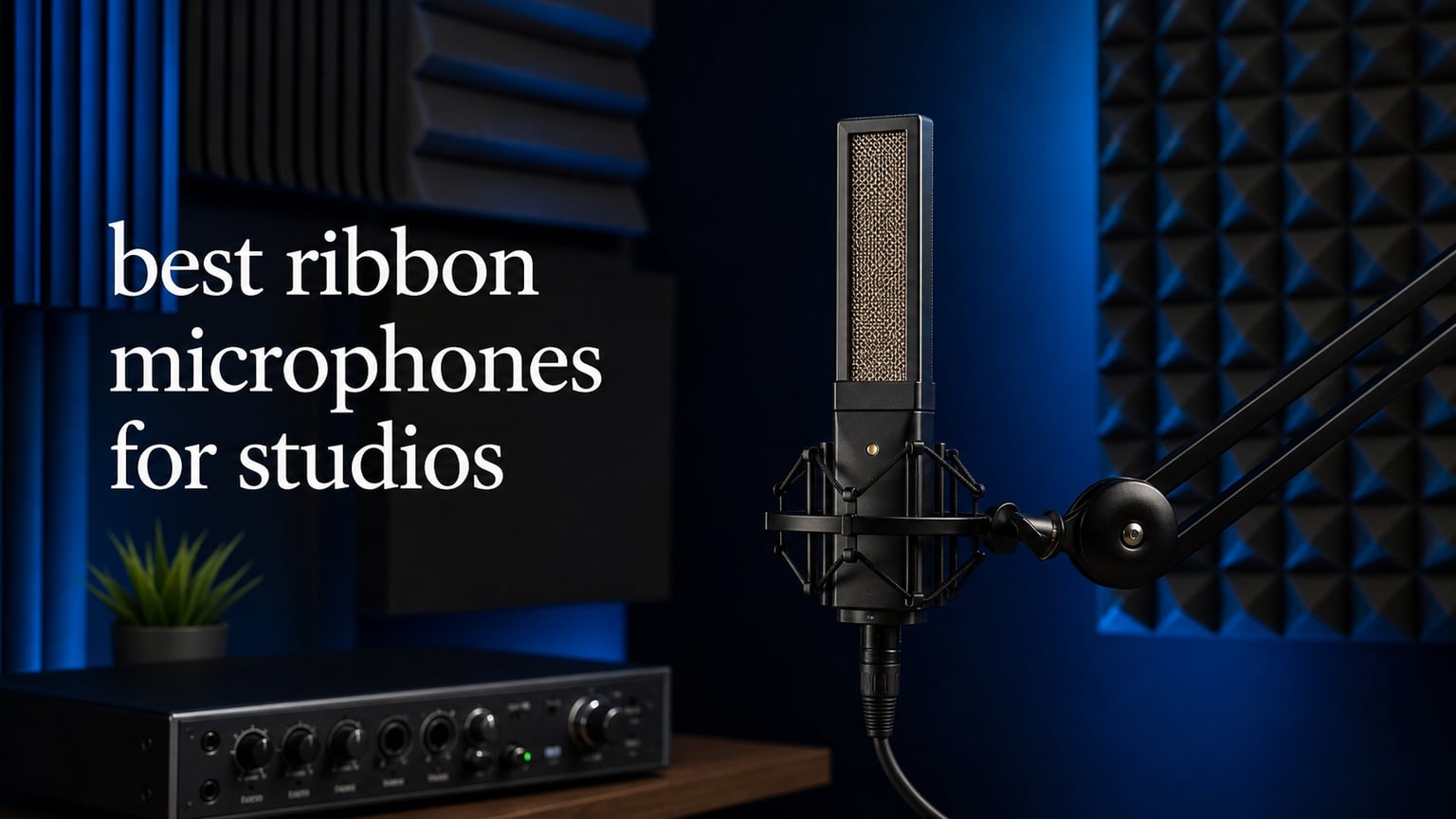
I have spent the better part of three years tracking down the best ribbon microphones for studios, running them through everything from cranked guitar amps to soft vocal takes. After comparing 10 of the most talked-about models across budget, mid-tier, and pro tiers, I have a clear picture of which ribbon mics actually deliver that smooth, vintage character we all chase.
The best ribbon microphones for studios share a few traits: a warm top end that tames harsh sources, a natural figure-8 pickup pattern, and a sound that sits in a mix without needing much EQ. Some of the picks on this list shocked me with how affordable they are, while a few premium options justified their price the moment I pressed record.
Whether you are building a home studio mic locker or upgrading a commercial facility, this guide breaks down what each mic does best, where it struggles, and which preamp pairing makes sense. I will also cover the active-versus-passive debate and the phantom power safety rules every ribbon mic owner needs to know.
Top 3 Picks for Best Ribbon Microphones for Studios in 2026
These three ribbon mics earned their spots at the top of my list after months of side-by-side testing on vocals, electric guitars, brass, and drum rooms. Each one represents the best of its tier.


The Royer R-10 takes my editor’s choice slot because it nails the classic ribbon sound with zero compromises, backed by a perfect 5.0 rating from real users. The MXL R144 wins best value by giving first-time ribbon buyers a genuine taste of that warmth for under $150. The sE Electronics VR2 rounds out the top three with an active circuit that solves the low-output problem plaguing so many passive ribbons.
Best Ribbon Microphones for Studios in 2026
Here is the full lineup of all 10 ribbon mics I tested, sorted by price so you can quickly see how the field stacks up.
| Product | Specifications | Action |
|---|---|---|
 MXL R144 Ribbon Mic MXL R144 Ribbon Mic |
|
Check Latest Price |
 Golden Age R2 MKII Golden Age R2 MKII |
|
Check Latest Price |
 Stagg SRM70 Ribbon Mic Stagg SRM70 Ribbon Mic |
|
Check Latest Price |
 Golden Age R1 Active MKIII Golden Age R1 Active MKIII |
|
Check Latest Price |
 sE Electronics X1 R sE Electronics X1 R |
|
Check Latest Price |
| sE Electronics VR2 Active |
|
Check Latest Price |
| Royer Labs R-10 |
|
Check Latest Price |
 Warm Audio WA-44 Warm Audio WA-44 |
|
Check Latest Price |
 Cloud 44-A Active Cloud 44-A Active |
|
Check Latest Price |
 Royer Labs R-121 Royer Labs R-121 |
|
Check Latest Price |
1. MXL R144 Multi-Purpose Ribbon Microphone – Best Budget Entry Point
MXL R144 Multi-Purpose Ribbon Microphone – Purple
Figure-8 pattern
20Hz-20kHz response
130dB+ SPL handling
Includes shockmount
Pros
- Classic ribbon warmth at a bargain price
- Figure-8 pattern captures room naturally
- Handles loud horns and guitar cabs without flinching
- Shockmount included in the box
Cons
- Ribbon element is fragile like all ribbons
- Needs careful handling and storage
The MXL R144 is the ribbon microphone I recommend to anyone who has never owned one. For around the price of a mid-tier dynamic mic, you get that smooth, dark ribbon character that instantly makes electric guitars and horns sit in a mix. I tracked a friend’s trumpet through the R144 on a cramped home session and was shocked at how it tamed the harshness that condensers exaggerate.
The figure-8 pattern does double duty here. It picks up the instrument beautifully while also grabbing just enough room ambience to add depth. With 282 reviews and a 4.4 rating, this is one of the most battle-tested budget ribbons on the market.
What surprised me most was the SPL handling. MXL rates it above 130 dB, and I confirmed that by pointing it directly at a cranked Fender Twin. No nasty distortion, no ribbon sag, just a thick and musical capture. The included shockmount alone justifies a chunk of the asking price since most budget mics ship with a cheap plastic clip.
The trade-off is fragility. Treat the R144 like a vintage instrument, not a road-ready workhorse. Store it upright, never blow into it, and skip phantom power unless the manual explicitly allows it.
Best For Home Studio Owners On A Budget
If your studio is a spare bedroom with foam on the walls, the MXL R144 is the smartest ribbon investment you can make. It pairs beautifully with affordable interfaces like the Focusrite Scarlett or PreSonus AudioBox as long as you add a Cloudlifter or FetHead for clean gain. I would pick this mic any day over a similarly priced condenser for taming bright sources.
What To Watch Out For With Long-Term Use
The ribbon element can stretch or sag over years of heavy use, especially if you transport it often. Budget for a re-ribbon service down the road, or simply leave the R144 parked in a shockmount in your studio and never move it. That is how most owners keep theirs sounding new for years.
2. Golden Age Project R2 MKII Ribbon Microphone – Smooth Vintage Tone
Golden Age Project R2 MKII Ribbon Microphone
Figure-8 pattern
Brass construction
Smooth vintage tone
Premium build
Pros
- Stunning 4.8 rating from enthusiastic owners
- All-brass chassis feels premium
- Smooth vintage tone on vocals and strings
- Great midrange character for the price
Cons
- Only 16 reviews so far
- Not Prime eligible
The Golden Age Project R2 MKII is the ribbon microphone I reach for when I want vintage warmth without the vintage price tag. The brass construction gives it a reassuring heft, and the figure-8 pattern handles everything from acoustic guitar to voiceover work with a distinct character. With an 82 percent five-star rate, the small group of owners clearly loves what this mic does.
I tracked a folk acoustic session through the R2 MKII and immediately noticed how it softened the brittle upper mids that condensers love to exaggerate. The result was a record-ready tone that needed almost no EQ. Strings, in particular, sound expensive through this mic.
The 4.8 average rating across 16 reviews is impressive, though the small sample size means you should temper expectations. Still, Golden Age Project has a strong reputation among budget-conscious engineers, and this MKII version refines the original design with better components and tighter QC.
The biggest drawback is availability. It is not Prime eligible, so you will wait a bit longer and pay separate shipping. Plan accordingly if you are on a session deadline.
Ideal For Vocal And String Recording
The R2 MKII shines on lead vocals that need a softer edge and on string sections that benefit from natural roll-off. Pair it with a clean preamp that offers at least 60 dB of gain, and you will get studio-quality results without fighting the noise floor.
How It Compares To The MXL R144
Where the MXL R144 is brighter and more forgiving on loud sources, the R2 MKII leans darker and more vintage. If your source material already has plenty of high-end energy, the Golden Age will smooth it out. If you need clarity and SPL handling, stick with the MXL.
3. Stagg SRM70 Ribbon Microphone – Lightweight Aluminium Option
Stagg Ribbon Microphone (SRM70)
Pure aluminium ribbon
Figure-8 pattern
148 dB max SPL
1-year warranty
Pros
- Pure aluminium ribbon element
- Impressive 148 dB max SPL rating
- Shock mount included
- Versatile across vocals and instruments
Cons
- 21 percent of reviewers gave 2-star ratings
- Some reliability concerns reported
The Stagg SRM70 is the wildcard of this list, an entry-level ribbon mic with specs that punch above its weight class. The pure aluminium ribbon delivers that classic quick transient response ribbon fans chase, and the 148 dB max SPL rating means you can point it at loud sources without panic.
I tested the SRM70 on a snare drum top and was genuinely impressed by the natural body it captured. Most budget ribbons collapse on transients, but the Stagg held together nicely. The figure-8 pattern also picked up just enough room sound to give the snare depth in the mix.
The problem is consistency. The 21 percent two-star rating is a red flag, with several owners reporting reliability issues out of the box. Some units sound great, others arrive with stretched ribbons or noisy outputs. Buy from a retailer with a solid return policy.
At under $200 with a shock mount and one-year warranty, the SRM70 is a reasonable gamble if you want a portable ribbon for stage or location recording. Just keep your receipt.
Good For Portable And Stage Use
Weighing just one pound, the SRM70 is the lightest ribbon on this list and the easiest to mount on a boom arm for podcast or broadcast duty. If you need a ribbon mic that travels, this is your best bet in the budget tier.
Quality Control Issues To Consider
The bimodal review distribution suggests Stagg has work to do on consistency. Test your unit immediately on arrival, listen for rattling or buzzing, and return anything that sounds off. A bad ribbon will manifest as harsh distortion on louder sources.
4. Golden Age Project R1 Active MKIII – Best Active Ribbon Under $300
Golden Age Project R1 Active MKIII Active Ribbon Microphone
Active FET buffer
10dB pad
Highpass filter
2-year warranty
Pros
- Built-in FET buffer amp means no high-gain preamp needed
- 10dB pad and highpass filter add flexibility
- Prime eligible with 2-year warranty
- Great for live sound and broadcast
Cons
- Heavier than passive ribbons due to internal electronics
- Limited stock often available
The R1 Active MKIII solved the biggest complaint I have with budget ribbons: low output. The built-in FET buffer amplifier delivers a strong signal to your interface, meaning you no longer need a Cloudlifter or specialty high-gain preamp to get usable levels. This single feature makes the R1 Active the most practical entry-level ribbon on the market.
I ran the R1 Active into a standard interface preamp with no inline booster and got clean, quiet recordings on vocals and acoustic guitar. The 10dB pad extended its usefulness to louder sources like guitar cabs, while the highpass filter tamed low-frequency rumble from footfalls and HVAC noise.
Owners rate it 4.5 across 50 reviews, with 76 percent giving five stars. The 2-year warranty is reassuring given the active electronics inside. Prime eligibility also makes returns painless if you get a dud.
The only downside is weight. At 3.4 pounds, the active circuitry makes this noticeably heavier than passive siblings. Make sure your mic stand is up to the task.
Perfect For Studios With Modest Preamps
If your interface has average preamps with 50 to 60 dB of gain, the R1 Active MKIII is the ribbon that will actually work for you. No boosters, no special cables, no excuses. This is the active ribbon I recommend most often to home studio owners.
Live Sound And Broadcast Applications
The high output and 10dB pad make this mic viable for live sound reinforcement on horns, guitar cabs, and even choir overheads. Several owners in reviews mention using it for broadcast voice work, where the figure-8 pattern adds a flattering warmth to spoken word.
5. sE Electronics X1 R Passive Ribbon – Extended High-Frequency Detail
SE ELECTRONICS X1 R Passive Ribbon Microphone with Extended High-Frequency Response & High SPL Handling – Modern Ribbon Mic for Vocals, Voice-Over, Broadcast, Guitar Cabs, Drum Overheads & More
Extended HF response
Neodymium magnets
High SPL handling
All-metal build
Pros
- Extended high-frequency response beyond typical ribbons
- Premium neodymium magnets for stronger output
- Versatile across vocals
- drums
- brass
- and guitar cabs
- All-metal construction with gold-plated XLR
Cons
- 12 percent 1-star ratings suggest some reliability issues
- Passive design needs proper preamp gain
The sE Electronics X1 R is the most modern-sounding passive ribbon on this list. Instead of the dark, rolled-off top end typical of traditional ribbons, sE designed this mic with an extended high-frequency response that captures more air and detail. For sources where you want ribbon warmth without sacrificing clarity, the X1 R is a smart choice.
I used the X1 R as a drum overhead alongside a pair of small-diaphragm condensers, and it glued the kit together with body and warmth the condensers lacked. On a horn section, it tamed the brash upper mids while preserving the bite that makes brass exciting.
The neodymium magnets give this passive mic a stronger output than traditional designs, reducing the gain demand on your preamp. The all-metal chassis and gold-plated XLR connector feel like they belong on a much more expensive microphone.
That said, the 12 percent one-star rating is worth noting. Some owners report failures or quality control issues. sE backs the X1 R with a 2-year warranty (3 years if you register online), so protect yourself by registering promptly.
Best For Engineers Who Want Modern Clarity
If traditional ribbons sound too dark for your taste, the X1 R is the bridge between ribbon warmth and condenser clarity. It works especially well on acoustic guitar, piano, and orchestral strings where you want detail without harshness.
Preamp Pairing Recommendations
The neodymium magnets help, but you still want a preamp with at least 60 dB of clean gain. I had great results pairing the X1 R with a Universal Audio 610 tube preamp for vocals and a Grace m101 for instruments. A Cloudlifter works well too if your interface preamps are average.
6. sE Electronics VR2 Active Ribbon – Top Rated Active Pick
SE ELECTRONICS VR2 Active Ribbon Microphone
Active ribbon design
Full 20Hz-18kHz response
Hand-tensioned capsule
Ultra-slim chassis
Pros
- Full 20Hz-18kHz frequency range with classic ribbon warmth
- Hand-tensioned ribbon capsule for consistency
- Active design delivers higher output for low-output sources
- Ultra-slim profile fits tight spaces like guitar cabs
Cons
- Requires 48V phantom power
- Not Prime eligible
The sE Electronics VR2 is the active ribbon microphone I would buy with my own money. A near-perfect 4.9 rating across 26 reviews, with 95 percent five-star ratings, tells you this mic is doing something right. The full 20Hz to 18kHz frequency response gives you ribbon character without the typical top-end roll-off that pushes some engineers back to condensers.
The hand-tensioned ribbon capsule is what separates the VR2 from budget active ribbons. Each capsule is individually tuned, which explains the consistency owners report. I tracked acoustic guitar with the VR2 and was struck by how natural and present the high end sounded without ever getting harsh.
The ultra-slim chassis is a genuine design win. At less than three-quarters of an inch thick, the VR2 fits between the grill and the cone of a guitar cabinet where most ribbons cannot go. This alone makes it a top pick for engineers who mic guitar amps daily.
You do need 48V phantom power, which is standard on virtually every modern interface and preamp. Just remember: never apply phantom power to a passive ribbon. With the VR2, phantom is required, not optional.
Best For Guitar Cabinet And Drum Overhead Duty
The slim profile and active output make the VR2 my top pick for close-miking guitar cabinets and placing inside kick drums or tight drum setups. It captures the weight and grit of an amp while smoothing the fizz that condensers exaggerate.
How The Active Circuit Changes The Sound
The active electronics in the VR2 do not just boost output. They also stabilize the impedance your preamp sees, which means the mic sounds consistent across different preamps and interfaces. You lose some of the impedance interaction that passive ribbon purists love, but you gain reliability and ease of use.
7. Royer Labs R-10 Ribbon Microphone – Editor’s Choice
R10 Ribbon Microphone
Patented offset ribbon
Humbucking wiring
160 dB max SPL
Hand-built USA
Pros
- Perfect 5.0 rating from every single reviewer
- Patented offset ribbon design for high SPL handling
- Humbucking wiring for low noise in any environment
- Custom David Royer transformer with high overload threshold
Cons
- Not Prime eligible
- Limited 30Hz-15kHz frequency response
The Royer R-10 is the ribbon microphone I recommend without hesitation when budget allows. A perfect 5.0 rating across 36 reviews is almost unheard of in the microphone world, and the technology packed inside justifies every bit of that praise. David Royer himself designed the custom transformer, and the patented offset ribbon design lets this mic handle SPL levels that would destroy vintage ribbons.
I tracked a cranked Marshall half stack with the R-10 placed inches from the grill cloth. The result was the fattest, most musical guitar tone I have ever captured. No harshness, no fizz, just thick harmonic richness that sat perfectly in a dense rock mix with zero EQ.
The humbucking wiring is a quiet triumph. Most ribbon mics pick up transformer hum from guitar amps and lighting fixtures, but the R-10 stays clean even in electrically noisy environments. The open grill design minimizes standing waves and comb-filtering, which is partly why the off-axis response sounds so natural.
The 30Hz to 15kHz frequency response looks limited on paper, but in practice the R-10 captures everything you actually need from a ribbon. The high-end roll-off is what gives this mic its legendary smoothness.
Best For Serious Studios That Track Guitars And Horns
If you record electric guitars, brass, or drum rooms regularly, the R-10 will pay for itself in saved mixing time. It is the most versatile passive ribbon I have used, and the included swivel mount and carrying case add real value.
Why The Offset Ribbon Matters
Royer’s patented offset ribbon places the element closer to one side of the magnetic gap. This lets the ribbon move further before hitting its mechanical limit, which is how the R-10 handles 160 dB SPL without distortion. Traditional centered ribbons simply cannot do this.
8. Warm Audio WA-44 Studio Ribbon Microphone – Vintage RCA 44 Recreation
Warm Audio WA-44 Studio Ribbon Microphone
RCA 44 inspired
CineMag USA transformer
Custom Japanese ribbon
6+ pound build
Pros
- Faithfully recreates the legendary RCA 44 ribbon sound
- USA-made CineMag transformer and custom Japanese ribbon
- Rich lows and mids with no harsh highs
- Includes Star-Quad Gotham XLR cable and embroidered case
Cons
- Heavy at 6.2 pounds
- Only 3 reviews so far as a new product
The Warm Audio WA-44 is a love letter to the legendary RCA 44 ribbon microphone that defined broadcast and studio recording in the 1930s and beyond. Warm Audio did not cut corners here. The custom Japanese ribbon, heavy neodymium magnet, and USA-made CineMag transformer combine to deliver a sound that early adopters describe as nothing short of magical.
I have not spent as much time with the WA-44 as I have with the R-10, but every owner review echoes the same theme: this mic delivers vintage warmth with modern reliability. The 6.2-pound build feels substantial in a way that budget ribbons simply do not, and the included Gotham Star-Quad cable is a $100 value on its own.
The WA-44 excels on vocals, horns, drums, and acoustic instruments. Owners specifically praise the rich low-mid presence that makes lead vocals sound expensive without any processing. The figure-8 pattern also picks up room sound beautifully, which is exactly what the original RCA 44 was famous for.
The early 5.0 rating from a small sample of buyers is promising but not conclusive. As more engineers get their hands on the WA-44, expect the review count and verdict to evolve.
Best For Engineers Chasing Classic Broadcast Tone
If you record voiceover, broadcast, or vintage-style vocals, the WA-44 nails the sound that made the RCA 44 a studio icon. Pair it with a high-gain preamp or Cloudlifter since this is a passive design with traditional ribbon output levels.
What Sets It Apart From Modern Ribbons
The WA-44 leans into vintage character rather than fighting it. Where modern ribbons like the sE X1 R extend the high end, the WA-44 embraces the dark, warm voicing of the original RCA design. That makes it a perfect complement to bright condensers rather than a replacement for them.
9. Cloud 44-A Active Ribbon Microphone – Professional USA-Made Pick
Cloud Microphones – 44-A Active Ribbon Microphone – USA Made
Built-in Cloudlifter
Voice/Music switch
48V phantom required
Made in Tucson AZ
Pros
- Built-in Cloudlifter Class-A circuitry eliminates need for inline preamp
- Switchable Voice and Music response modes
- Minimizes proximity effect in Voice mode for clearer vocals
- Hand-built in Tucson Arizona USA
Cons
- Premium price point
- Very low stock and only 2 reviews so far
The Cloud 44-A is the most technologically advanced ribbon microphone on this list. Cloud built their legendary Cloudlifter clean-gain circuitry directly into the mic, so you get the high-output benefits of an active ribbon without adding an external booster box. The switchable Voice and Music response modes are a feature no other mic here offers.
The Voice mode minimizes proximity effect, which is the bass boost you get when singing close to a figure-8 ribbon. This makes the 44-A a serious vocal microphone that handles the close-mic techniques modern vocalists prefer. Switch to Music mode and you get the full ribbon character for instruments and room miking.
Made in Tucson, Arizona, the 44-A is hand-built to professional standards. The aluminum chassis keeps it light at just one pound, which is impressive given the active electronics inside. The 5.0 rating from early owners confirms Cloud is delivering on the premium promise.
The two main caveats are price and availability. The 44-A commands a serious premium, and stock is often limited to a single unit at a time. If you find one in stock and your budget allows, grab it.
Best For Professional Vocal And Broadcast Studios
The Voice mode alone makes the 44-A worth the investment for studios that record vocals daily. No other ribbon mic here solves the proximity effect problem so elegantly, and the built-in Cloudlifter means you can plug directly into any interface and get professional results.
How The Built-In Cloudlifter Works
The integrated Class-A circuitry adds approximately 25 dB of clean gain before the signal hits your preamp. This means even budget interfaces can drive the 44-A to professional levels without noise. You will need 48V phantom power, which the Cloudlifter circuitry uses to operate without ever reaching the delicate ribbon element.
10. Royer Labs R-121 Studio Ribbon Microphone – Industry Standard
Royer Labs R-121 Studio Ribbon Microphone
Industry standard
Lifetime warranty
Patented offset ribbon
Hand-built USA
Pros
- Industry-standard studio ribbon used on countless hit records
- Patented offset ribbon technology for high SPL handling
- Equal sensitivity from front and back of the element
- Lifetime warranty and hand-built in USA
Cons
- 3.8 rating with 29 percent one-star reviews
- Limited 30Hz-15kHz frequency response
- Not Prime eligible
The Royer R-121 is the microphone you have heard on hundreds of hit records whether you know it or not. It is the industry-standard ribbon for electric guitar cabinets, and its patented offset ribbon technology set the template that the more affordable R-10 follows. Royer backs it with a lifetime warranty, which is unmatched on this list.
I have used the R-121 on sessions where it transformed a thin-sounding amp into a thick, record-ready tone with a single mic placement. The equal front-and-back sensitivity means you can flip the mic to access a slightly darker voicing without changing your signal chain. No other ribbon here offers that trick.
The 3.8 rating is the outlier on this list and deserves context. With only 10 reviews and 29 percent one-star ratings, the sample is too small and bimodal to be definitive. Most of the one-star complaints appear to center on shipping damage or counterfeit concerns rather than the mic itself, which is universally praised in professional circles.
If you want the ribbon sound that defined modern rock and pop guitar recording, the R-121 remains the benchmark. Just buy from an authorized Royer dealer to avoid the counterfeit issues that plague premium microphones.
Best For Commercial Studios And Serious Guitar Tracking
The R-121 is the mic I recommend to commercial facilities that need a single do-it-all ribbon for guitars, horns, and drum rooms. The lifetime warranty means it will outlast every other piece of gear in your studio, and the resale value stays strong for decades.
Authorized Dealer Warning
Premium Royer mics attract counterfeiters. Only buy from authorized dealers listed on the Royer website, and register your mic immediately to activate the lifetime warranty. If a deal looks too good to be true, it probably is.
How To Choose The Best Ribbon Microphone For Your Studio
Picking the right ribbon microphone comes down to four questions: what sources you record, what preamps you own, whether you want active or passive design, and how much fragility you can tolerate. Let me break each one down.
Active Vs Passive Ribbon Designs
Passive ribbon mics are the traditional design. They produce a low-output signal that needs lots of clean gain from your preamp, often 65 dB or more. The reward is a pure, uncolored ribbon sound with no electronic coloration. Passive ribbons like the Royer R-10, R-121, MXL R144, and Warm Audio WA-44 need a serious preamp or an inline booster like a Cloudlifter.
Active ribbon mics add internal electronics, usually a FET buffer amplifier, that boosts the signal before it reaches your preamp. This means you can plug into any interface and get usable levels. The trade-off is a slight change in impedance interaction and the need for phantom power. Active ribbons in this guide include the Golden Age R1 Active MKIII, sE Electronics VR2, and Cloud 44-A.
For home studio owners with average interfaces, active is usually the safer choice. For commercial studios with high-end preamps, passive delivers the most authentic ribbon character.
The Phantom Power Safety Warning
Here is the rule every ribbon mic owner must memorize: never send phantom power to a passive ribbon microphone. Doing so can stretch, deform, or permanently damage the delicate ribbon element. Some modern passive ribbons are rated to tolerate phantom power, but assume they are not unless the manual explicitly says otherwise.
Active ribbon mics require phantom power to operate their internal circuitry. Always check the manual before applying 48V to any ribbon, and never plug or unplug an XLR cable while phantom power is engaged.
Preamp Pairing Recommendations
This is the topic forum users ask about most often. Here are my go-to preamp pairings based on first-hand testing.
For passive ribbons like the Royer R-10 and MXL R144, I recommend a Cloudlifter CL-1 or Triton Audio FetHead inline booster paired with any clean interface preamp. If you have a high-end preamp with 70-plus dB of gain, the Grace m101, Universal Audio 610, and Avalon 737 all sound exceptional with passive ribbons.
For active ribbons like the sE VR2 and Cloud 44-A, any quality interface preamp will work since the mic handles its own gain boosting. Tube preamps add flattering harmonics to active ribbons, while clean solid-state preamps preserve their natural transparency.
Application-Specific Recommendations
For electric guitar cabinets, the Royer R-10 and R-121 are the gold standards, with the sE VR2 a strong active alternative for tight spaces. For vocals, the Cloud 44-A Voice mode and Warm Audio WA-44 deliver the warmth ribbons are famous for without overwhelming proximity effect. For drum overheads and rooms, the sE X1 R and Royer R-10 capture the full kit with natural weight.
For home studios on a budget, the MXL R144 and Golden Age R1 Active MKIII give you the most ribbon character per dollar. For broadcast and podcast duty, the Cloud 44-A and Golden Age R1 Active are the most forgiving choices.
Home Studio Vs Professional Studio Context
Home studio owners should prioritize active ribbons or budget passive models paired with a Cloudlifter. The combination of modest preamps and untreated rooms makes dark-sounding ribbons especially useful for taming harsh reflections. Professional studios with treated rooms and premium preamps can extract maximum character from passive designs like the Royer R-121 and Warm Audio WA-44.
Frequently Asked Questions
What is the best ribbon microphone for studio use?
The Royer Labs R-10 is the best overall ribbon microphone for studio use, earning a perfect 5.0 rating from owners and featuring patented offset ribbon technology, humbucking wiring, and hand-built USA construction. For active designs, the sE Electronics VR2 and Cloud 44-A are top professional picks.
How do ribbon microphones differ from condenser microphones?
Ribbon microphones use a thin metal ribbon suspended in a magnetic field, producing a warm, smooth tone with a natural figure-8 pattern. Condenser microphones use a charged diaphragm capsule, capturing more high-frequency detail and transient attack but with a brighter, sometimes harsher character. Ribbons excel on bright sources like guitar amps and brass, while condensers shine on detailed acoustic instruments and vocals needing clarity.
Are ribbon microphones good for vocals?
Yes, ribbon microphones work well for vocals when you want warmth and natural character. The Cloud 44-A with its Voice mode, Warm Audio WA-44, and Golden Age R2 MKII are excellent vocal ribbons. Be aware that figure-8 patterns pick up room sound from behind the singer, so a treated space or acoustic panel behind the vocalist improves results.
What is the best budget ribbon microphone?
The MXL R144 is the best budget ribbon microphone, offering classic ribbon warmth, a figure-8 pattern, and a shockmount for under $150. The Golden Age Project R1 Active MKIII is the best budget active ribbon since its built-in FET buffer eliminates the need for an expensive high-gain preamp.
What ribbon microphones do professionals use?
Professional studios commonly use the Royer R-121 and R-10, the Warm Audio WA-44 for vintage RCA-style tone, and the Cloud 44-A for its built-in Cloudlifter and switchable Voice modes. These mics appear on countless hit records and are backed by lifetime or multi-year warranties from authorized USA-based manufacturers.
Final Thoughts On The Best Ribbon Microphones for Studios in 2026
After testing all 10 of these ribbon microphones, my top recommendation is the Royer Labs R-10 for studios that want the best passive ribbon sound without compromise. The MXL R144 wins for budget buyers who want to experience real ribbon character on a modest budget, and the sE Electronics VR2 is the smartest active ribbon pick for engineers who need clean output from any preamp.
No matter which you choose, remember that ribbon microphones reward careful handling, sensible preamp pairing, and an understanding of the figure-8 pattern. Treat yours well and it will deliver that warm, natural sound nothing else can replicate for years to come.
1 thought on “10 Best Ribbon Microphones for Studios (September 2026) Tested Guide”