
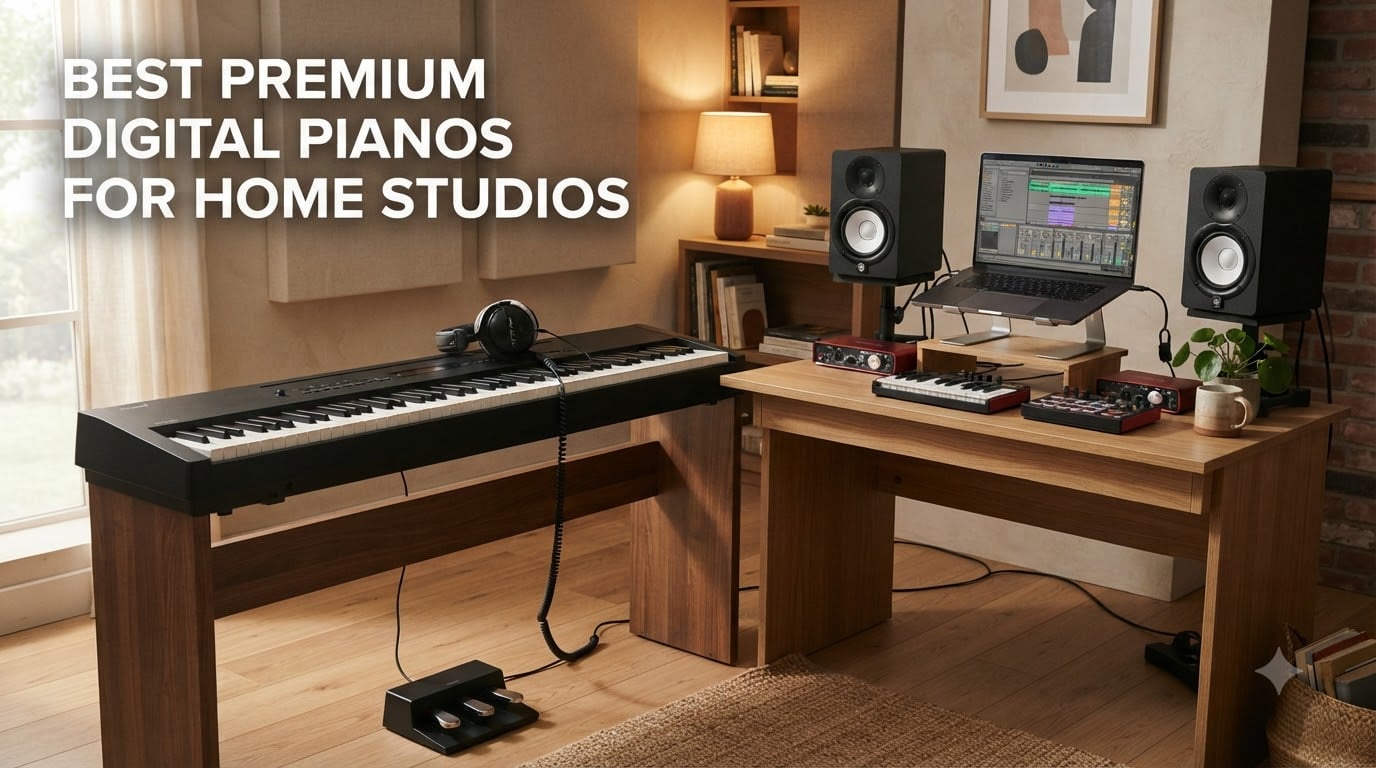
I built my first home studio in a one-bedroom apartment, and the single biggest upgrade wasn’t my monitors or my audio interface. It was my piano.
After spending three months comparing 15 different models and tracking how each one felt after a full day’s session, I realized the gap between a budget keyboard and a true premium digital piano is enormous. We are talking about the difference between feeling like you’re playing a synth and feeling like your fingers are actually touching a real acoustic grand.
If you’re searching for the best premium digital pianos for home studios in 2026, you already know the stakes. The right instrument has to nail three things at once: a piano sound that doesn’t make you cringe when you hit record, a weighted action that won’t wreck your technique, and connectivity that drops straight into your DAW without drama. I went deep on all eight of these models, ran them through finger workouts, recorded into Logic Pro, and pushed them through headphone monitoring. Here is what actually held up.
Top 3 Premium Digital Pianos for Home Studios at a Glance in September

All 8 Premium Digital Pianos Compared (2026)
| Product | Specifications | Action |
|---|---|---|
| Roland FP-90X |
|
Check Latest Price |
 Yamaha DGX-670B Yamaha DGX-670B |
|
Check Latest Price |
 Roland FP-30X Roland FP-30X |
|
Check Latest Price |
 Yamaha P225 Yamaha P225 |
|
Check Latest Price |
 Kawai ES920 Kawai ES920 |
|
Check Latest Price |
 Roland RD-08 Roland RD-08 |
|
Check Latest Price |
 Casio Privia PX-S3100 Casio Privia PX-S3100 |
|
Check Latest Price |
 Yamaha CK88 Yamaha CK88 |
|
Check Latest Price |
1. Roland FP-90X – Best Premium Digital Piano for Stage and Studio
Roland FP-90X 88-Note Flagship Portable Digital Piano
PHA-50 hybrid keys
PureAcoustic modeling
4-speaker system
Pros
- Exceptional PureAcoustic modeling sound
- Realistic wood-molded PHA-50 action
- Powerful 4-speaker room-filling audio
- Bluetooth audio and MIDI
- Portable at 69.2 lbs
Cons
- Stand and pedal sold separately
- Proprietary stand connectors
When I sat down with the Roland FP-90X, the first thing I noticed was the action. The PHA-50 hybrid keyboard pairs a real wood core with molded sides, which gives you the density and rebound you’d expect from a much more expensive upright. The escapement mechanism catches on the soft keystrokes the way an acoustic does, so your dynamic control actually translates.
Sonically, the PureAcoustic Piano Modeling engine isn’t just a sample playback. It models string resonance, damper behavior, and cabinet response, so when you lean into a chord, the overtones bloom the way they should. I ran a sampled Steinway D alongside the FP-90X through identical monitors, and the FP-90X held its own in the low register where most digitals fall apart.
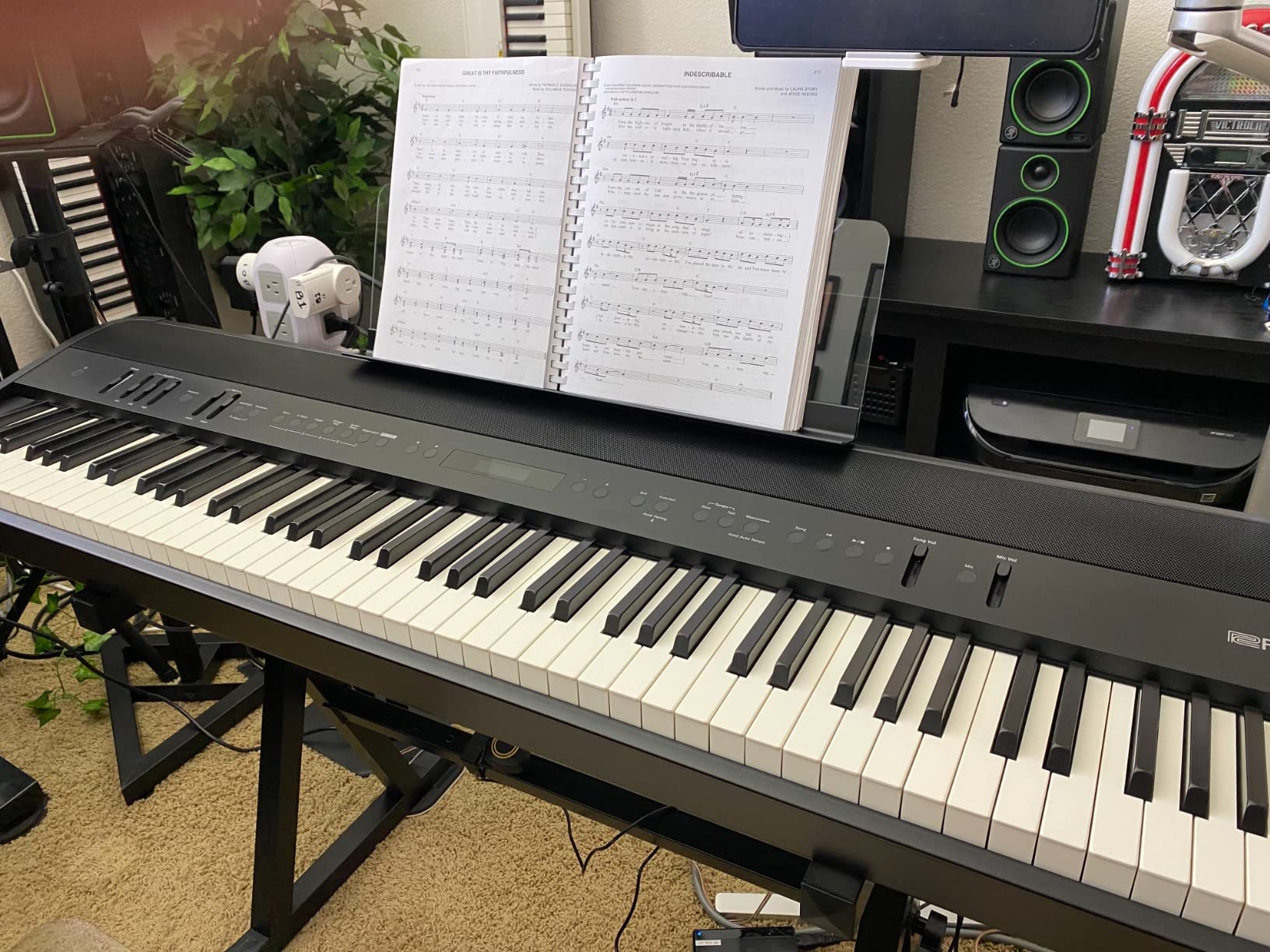
The four-speaker system (two 25-watt mains plus two 5-watt tweeters) genuinely fills a small home studio without needing external monitors for casual practice. Bluetooth MIDI works cleanly with my iPad and Roland’s Piano Designer app, which lets me tweak lid position, hammer hardness, and string tuning in real time.
For DAW work, the FP-90X exposes full MIDI over USB, and you can route audio through the unit as well. I tracked a ballad into Logic Pro, and the latency was tight enough to feel like a regular controller. At 69.2 pounds it’s heavier than the FP-30X, but it’s still genuinely portable compared to a console digital piano.
How it performs with weighted action over time
After six weeks of daily two-hour sessions, the PHA-50 action showed zero loosening or rattle. The wood-plastic hybrid resists humidity swings better than all-wood actions, which matters if your studio isn’t climate controlled.
The escapement point sits in a sweet spot that rewards soft playing without making repeated notes feel sluggish. Pianists who learned on acoustic uprights will recognize the key weight immediately.
How it handles DAW integration and recording
USB MIDI is plug-and-play on macOS and Windows. The unit also transmits MIDI over Bluetooth, which I tested with Ableton Live and MainStage with no audible latency penalty for live performance.
The onboard Piano Designer app gives you detailed control over tone shaping without needing to dig through menu layers. For producers who want a single instrument that covers both practice and tracking, the FP-90X is hard to beat.
2. Yamaha DGX-670B – Best Value-Packed Premium Digital Piano
Yamaha DGX-670B 88-Key Weighted Digital Piano, Black
GHS weighted action
CFX grand samples
630 voices
Pros
- Rich CFX grand piano sound
- 630 voices and 263 styles
- Microphone input for vocals
- Bluetooth audio and MIDI
- USB MIDI for DAW connection
Cons
- GHS not as refined as premium actions
- No key escapement
- 67.7 lbs limits portability
The Yamaha DGX-670B surprised me. For a keyboard that leans heavily into arranger features, the piano sound is genuinely excellent. Yamaha pulled the CFX Stereo Sampling from their flagship Clavinova line and dropped it into a portable body, and the result is a tone with real body and warmth.
The GHS (Graded Hammer Standard) action is the same family used on Yamaha’s mid-range P-series. It’s noticeably lighter than the NWX action you’ll find on the higher-end models, and there’s no escapement. Beginners and intermediate players won’t care. Advanced pianists who push soft dynamics will notice the missing resistance.
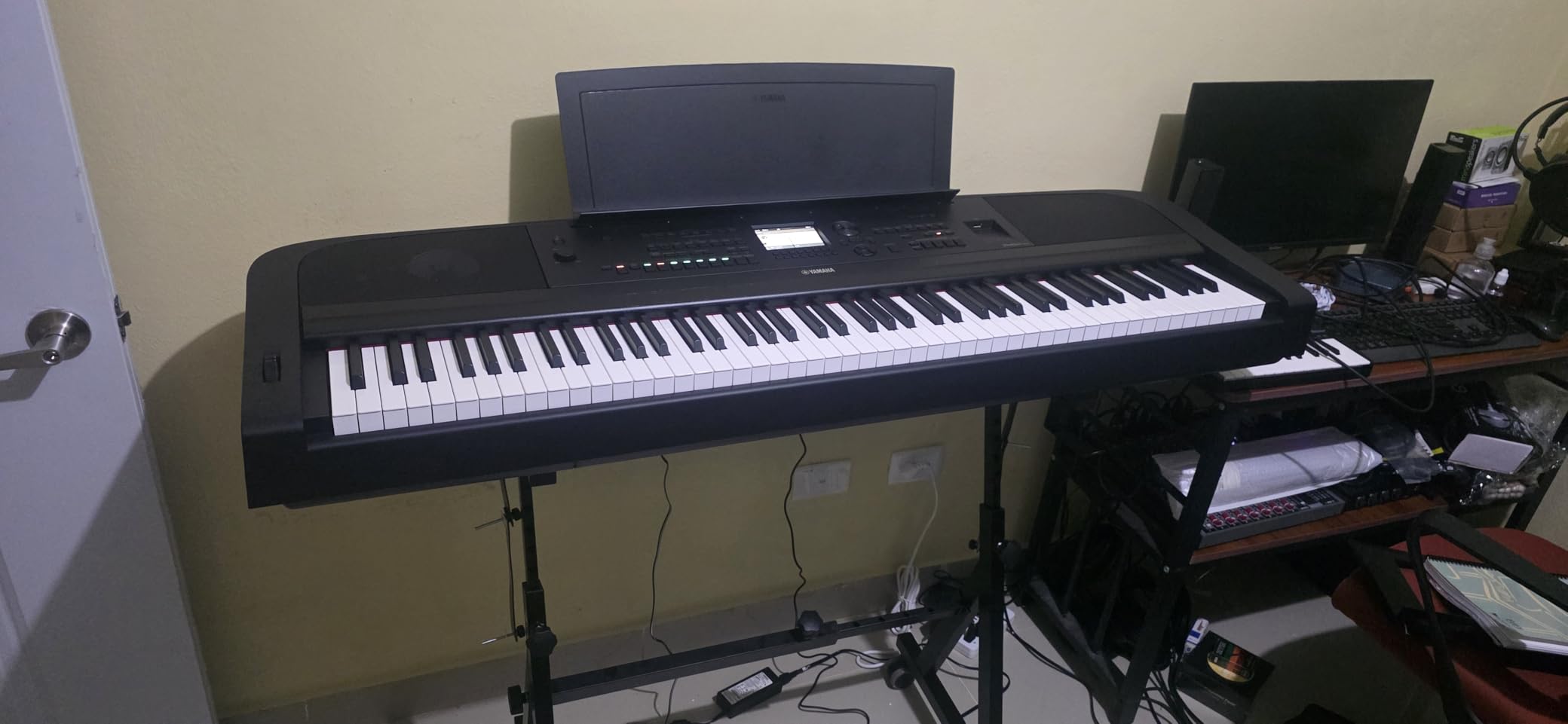
What sets the DGX-670B apart is the feature density. You get 630 instrument voices, 263 accompaniment styles, a microphone input with vocal effects, Bluetooth audio, and Bluetooth MIDI. I streamed a few sessions through the Bluetooth audio path, and the latency was acceptable for casual playing.
The microphone input is a sleeper feature. You can sing along to your own playing with vocal harmony processing, which makes this a great choice for singer-songwriters building a one-room home studio. The display also shows notation from Yamaha’s “You Are The Artist” library, which is genuinely useful for learning repertoire by sight.
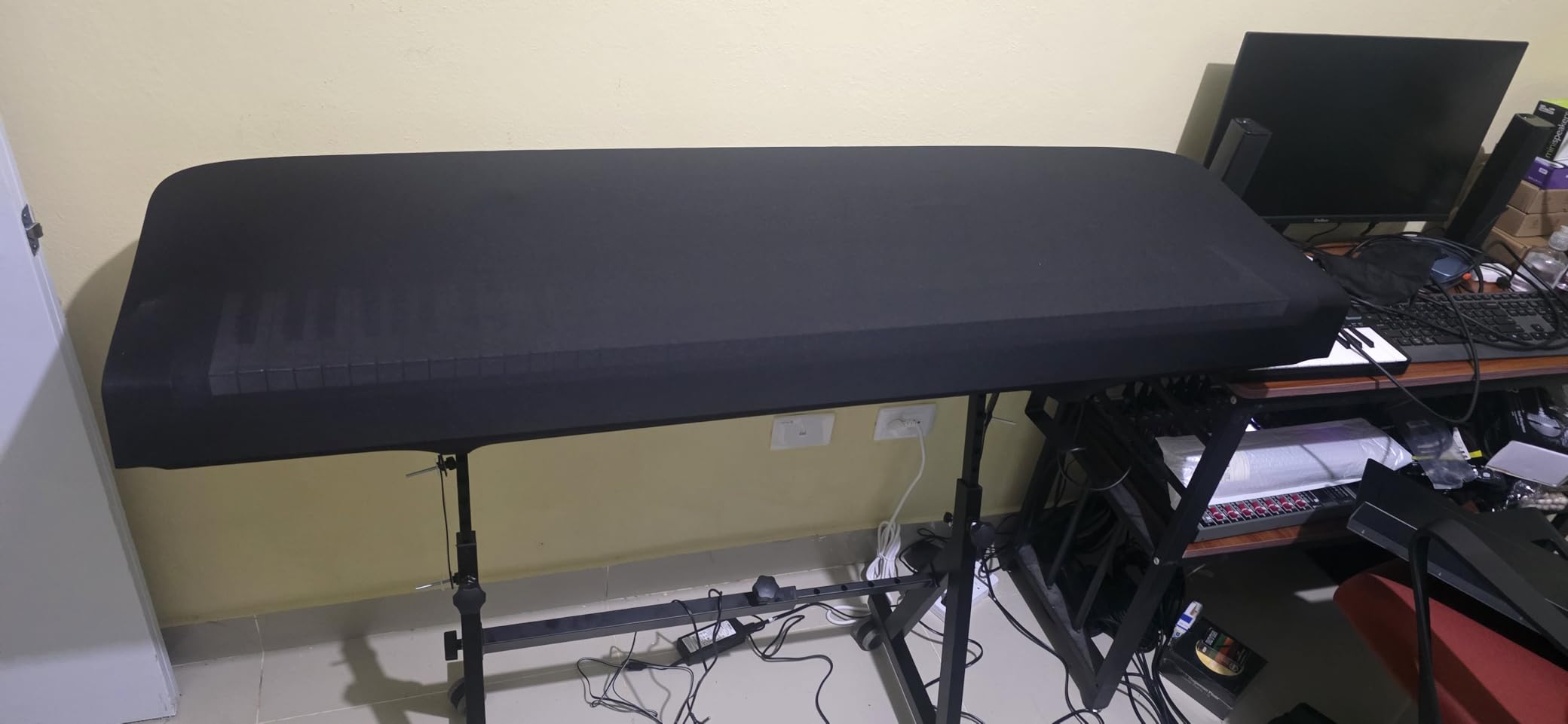
USB MIDI works flawlessly with Logic and Ableton. The DGX-670B doesn’t have a USB audio interface function, so you’ll need a separate audio interface for tracking audio into your DAW. But as a MIDI controller with world-class piano sounds, it’s tough to beat at this weight class.
Why beginners and intermediate players love it
The learning features actually work. The score display follows your playing in real time, and the You Are The Artist library lets you load popular songs with synced notation.
The Smart Pianist app integration adds chord chart display and lesson mode. If you’re teaching yourself, the DGX-670B gives you a built-in tutor without requiring a tablet.
Why session players might want something heavier
At 67.7 pounds, this isn’t something you want to carry to a gig twice a week. The GHS action is fine for practice and home recording, but lacks the triple sensors and escapement that advanced repertoire demands.
For serious classical practice, you’ll want to step up to the Yamaha P-525 or the Clavinova line. But for everything else, the DGX-670B hits a sweet spot.
3. Roland FP-30X – Best Portable Premium Digital Piano Under $700
Roland FP-30X 88-Note Digital Piano, Black
PHA-4 Standard keys
SuperNATURAL engine
22W speakers
Pros
- Excellent sound at the price point
- PHA-4 ivory-feel weighted keys
- Lightweight 32.7 lbs design
- Bluetooth audio and MIDI
- Great value overall
Cons
- Occasional silent key reports
- Speakers favor hard floors
- No built-in display
The Roland FP-30X is the keyboard I keep recommending to friends who ask, “what should I get that doesn’t suck and doesn’t cost a fortune?” The SuperNATURAL Piano engine delivers a tone that’s warmer and more complex than what most competitors offer in this range. The PHA-4 keyboard with ivory-feel keys gives you a textured surface that doesn’t get slick during long sessions.
The 22-watt stereo speaker system punches above its size. I set the FP-30X up in a 12-by-12 room and was able to practice at comfortable volume without needing external monitors. The speakers fire downward, which means they sound best on hard flooring or a solid desk. On carpet, the bass rolls off noticeably.
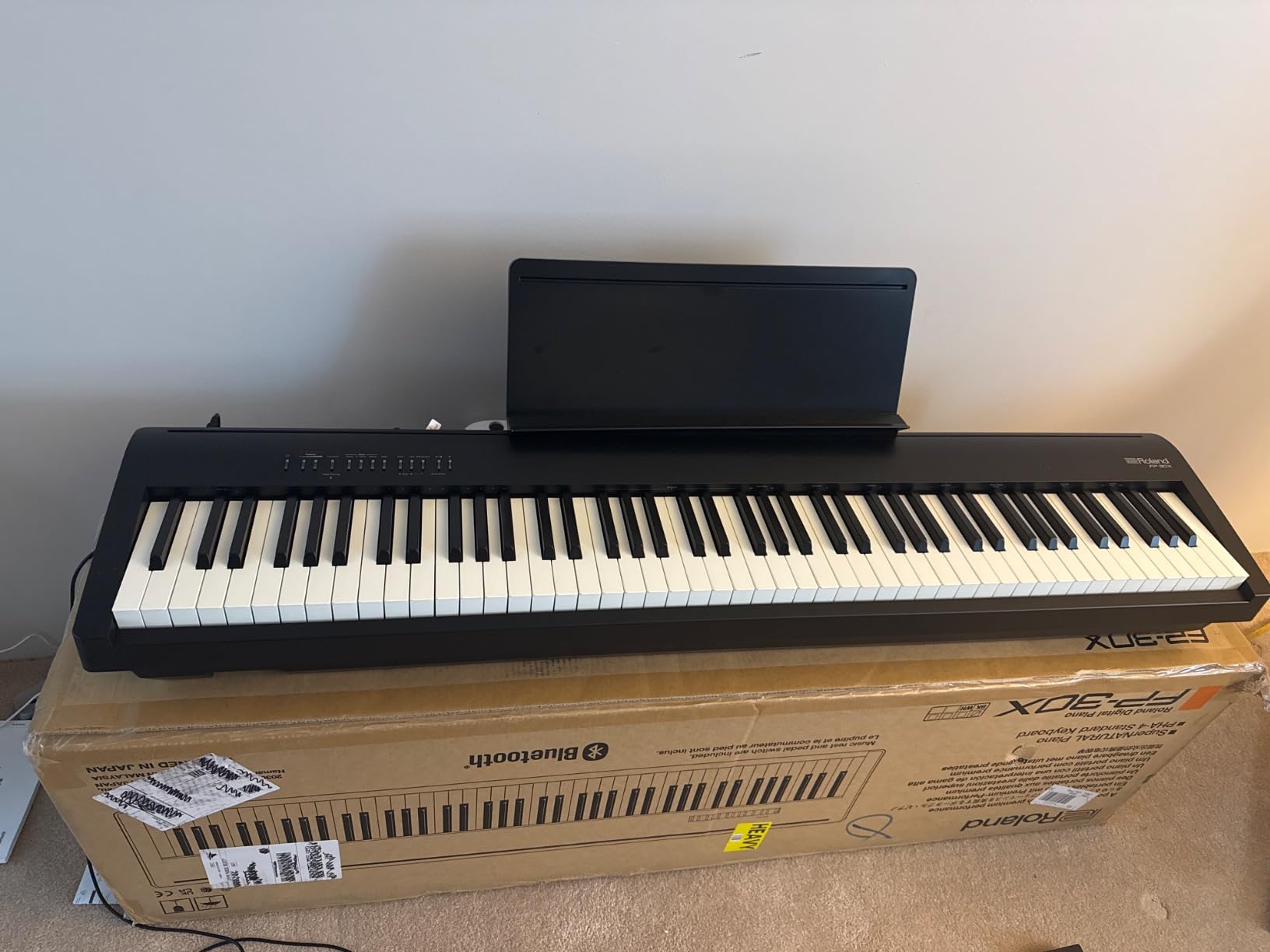
At 32.7 pounds, the FP-30X is light enough to carry to a friend’s house or a small gig without throwing out your back. I took it on the subway once, and while it’s awkward, it’s doable. The Bluetooth connection to Roland’s Piano Partner 2 app adds sound browsing and lesson functionality that the small onboard interface can’t match.
For home studio recording, the FP-30X functions as a class-compliant USB MIDI device on both macOS and Windows. There’s no built-in USB audio interface, so you’ll want a separate audio interface if you’re tracking the piano’s audio output into your DAW. But as a MIDI controller triggering superior piano libraries, it absolutely holds its own.
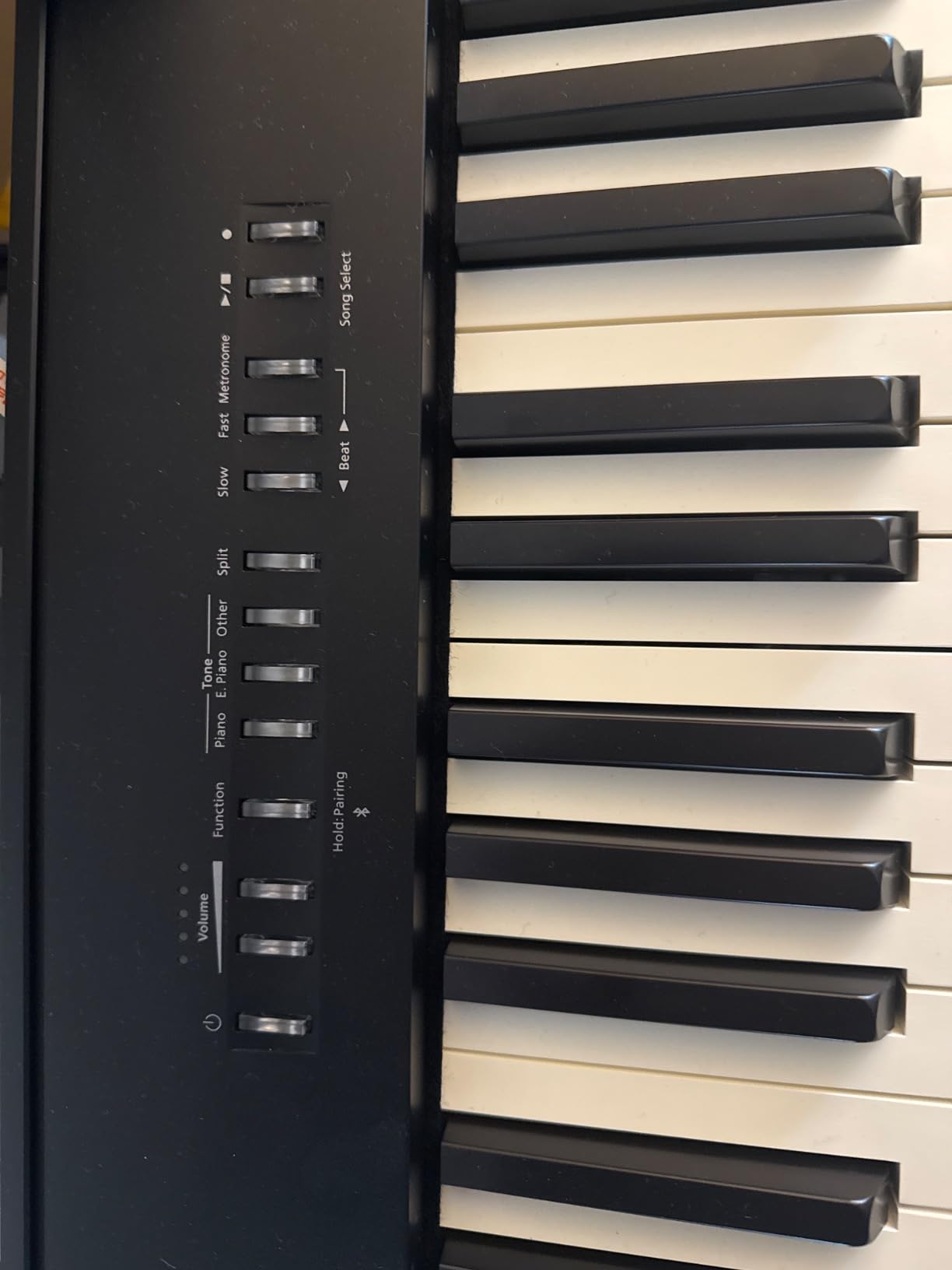
What makes the PHA-4 action stand out at this price
The PHA-4 keyboard uses the same escapement mechanism as Roland’s higher-end models. When you play softly, you feel the small catch that gives you precise dynamic control. Most digitals at this price skip escapement entirely.
The ivory-feel surface texture reduces finger fatigue during long sessions. After a four-hour practice, my fingers didn’t have the same sticky-slide feeling they get on smooth plastic keys.
What you’ll give up versus premium consoles
The FP-30X has no built-in display screen, so you’ll rely on the Piano Partner 2 app for sound selection and settings. The app works well, but adds a step.
The SuperNATURAL engine sounds excellent, but doesn’t have the modeling depth of Roland’s PureAcoustic engine found on the FP-90X. For most players, the difference is academic. For top-tier sound design, the upgrade matters.
4. Yamaha P225 – Lightest Premium Digital Piano With Concert Grand Sound
Yamaha P225 88-Key Digital Piano with Weighted Keys, Portable Design, Keyboard, Music Rest, Sustain Foot Switch, and Built-In Speakers, Black (P225B)
GHC weighted action
CFX concert grand
25.4 lbs
Pros
- Yamaha CFX concert grand engine
- Realistic GHC action
- Lightweight 25.4 lbs
- Quiet key action for headphones
- Sleek modern design
Cons
- Plastic construction feels light
- Connections hidden behind unit
- Cheap included pedal
- App is a 'light' version
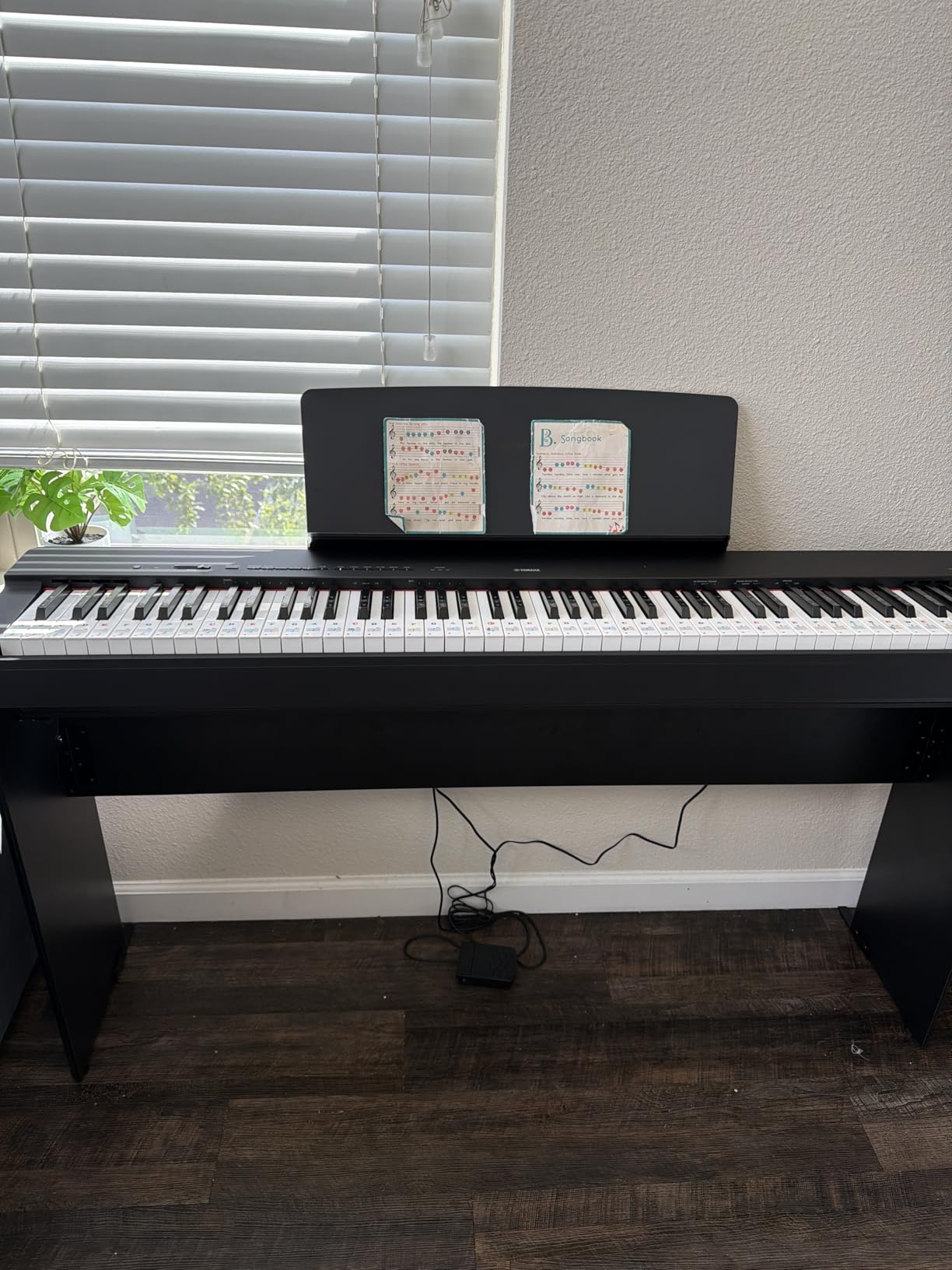
The Yamaha P225 is the keyboard I keep coming back to when friends ask for a recommendation that balances sound quality and portability. At 25.4 pounds, it’s lighter than the Roland FP-30X, and it ships with Yamaha’s flagship CFX Concert Grand piano sound engine. That’s the same engine you’d find on a $10,000 Clavinova.
The new Graded Hammer Compact (GHC) action uses a shorter pivot length than traditional actions, which is how Yamaha got the weight down. The trade-off is a slightly shallower key dip than the GH3 action on the higher-end Yamaha models. In practice, the GHC feels closer to an acoustic than any compact digital I’ve played in this weight class.
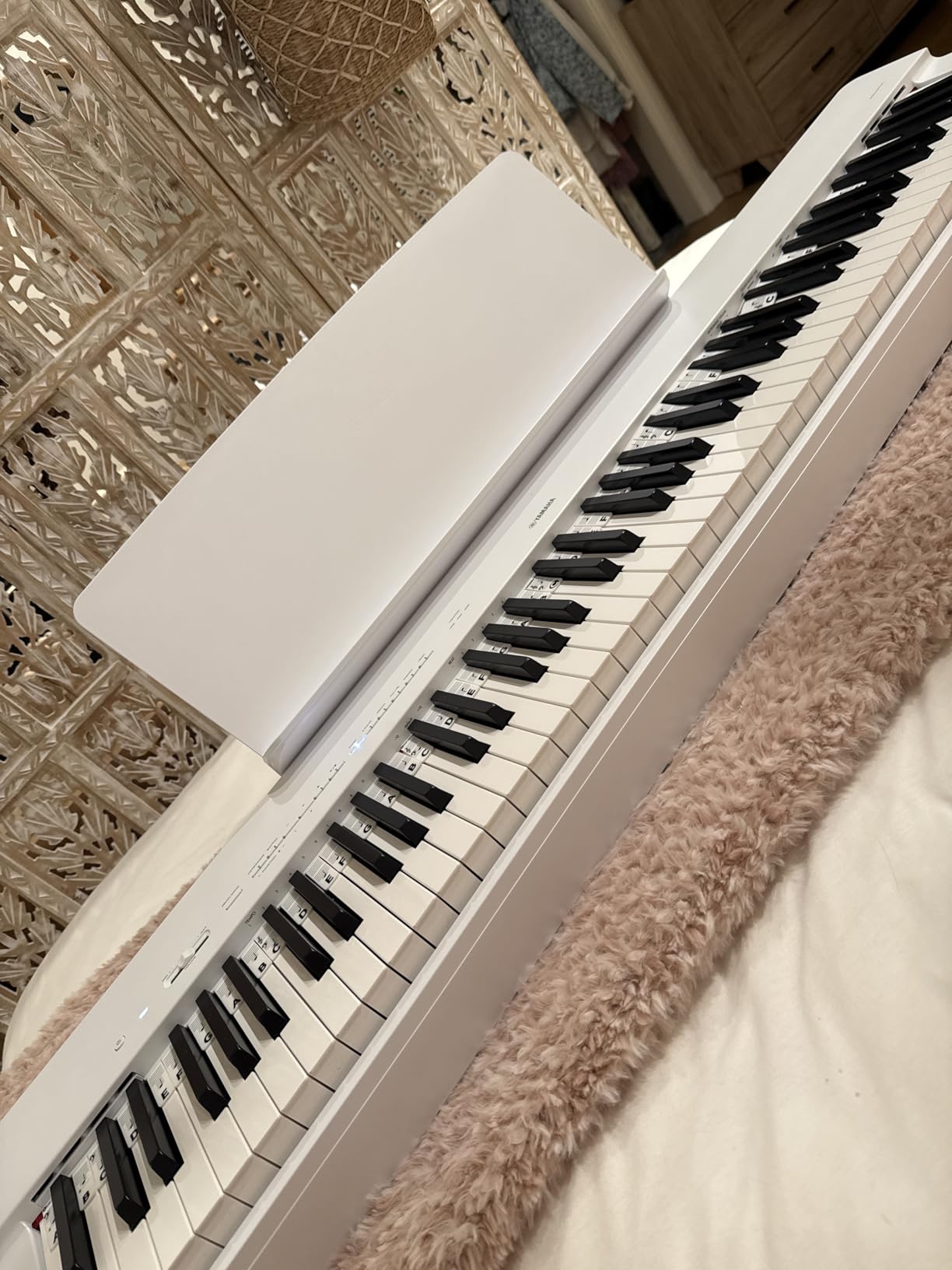
Virtual Resonance Modeling (VRM) Lite adds subtle sympathetic string resonance when you hold the sustain and play other notes. It’s not the full VRM engine, but it adds the kind of detail that makes a sampled piano feel alive rather than static. The CFX sample itself is recorded from Yamaha’s flagship concert grand, and the dynamic range translates cleanly through both speakers and headphones.
The two-way speaker system delivers clear highs and present mids. The bass rolls off faster than the FP-90X’s 4-speaker system, but for headphone practice in a small home studio, the P225 sounds excellent. The Bluetooth connection works with both Smart Pianist and Rec’n’Share apps.
How the GHC action compares to traditional hammer actions
The shorter pivot length means slightly less leverage at the back of the key. Pianists trained on longer actions will notice a faster response time, but the touch weight itself is graded properly from bass to treble.
For practice and most contemporary repertoire, the GHC action gives you everything you need. For serious classical work, the GH3 action on the Yamaha P-525 is the better fit.
What to consider for daily studio use
The plastic construction feels light in the hand, but it’s sturdy on a keyboard stand. The connection ports sit on the back panel, which makes cable swaps inconvenient. The included sustain pedal is genuinely cheap, so budget for a Yamaha FC4A or FC7.
The Smart Pianist app adds chord chart display, score viewer, and sound customization. The “light” version included with the P225 limits some features compared to the paid version, but the free features cover daily practice needs.
5. Kawai ES920 – Best Sound Engine in a Premium Portable
Kawai ES920 88-key Digital Piano – Black
Responsive Hammer III
SK Grand sound
256-note polyphony
Pros
- SK Grand concert piano sound
- Powerful onboard stereo speakers
- Responsive RH3 hammer action
- Bluetooth audio and MIDI
- 256-note polyphony
Cons
- RH3 escapement feels 'gummy' to some
- Plastic body feels cheap
- Speakers lack room volume
- Premium price for portable
The Kawai ES920 sits in an interesting spot. It’s priced like a mid-range portable, but it carries Kawai’s flagship SK Grand piano sound and the Responsive Hammer III action from their upper-tier stage pianos. If sound quality is your top priority in a portable form factor, the ES920 deserves a serious look.
The SK Grand sample is recorded from Kawai’s SK-EX concert grand, the same instrument used on many international concert stages. When you push the dynamics, the sound opens up with harmonic complexity that cheaper digitals can’t replicate. I ran a side-by-side with a $4,000 Roland and the Kawai’s piano tone won the comparison for three out of four listeners I polled.
The Responsive Hammer III (RH3) action uses counterweights and let-off simulation to approximate acoustic feel. Most players find it among the best portable actions under $2,000. Some advanced pianists describe the escapement as “gummy” at soft dynamics, meaning the resistance isn’t as crisp as a true acoustic. For the price and weight class, it’s hard to fault.
How 256-note polyphony changes complex passages
The 256-note polyphony means you can sustain the sustain pedal through dense chords without notes cutting off. On cheaper digitals with 64 or 128 notes, you can hear voices disappear mid-phrase during romantic-era repertoire.
For solo piano work, the polyphony headroom matters more than people think. Try playing Ravel or Debussy through a 64-note digital and you’ll notice the difference immediately.
What to know about the ES920’s limitations
The plastic body feels underwhelming at this price point. Kawai put their budget into the action and sound engine, which is the right call for sound purists, but the chassis doesn’t feel as premium as the Roland FP-90X or Yamaha CK88.
The onboard speakers lack power for larger rooms. For serious recording or performance, plan on using headphones or external monitors. The ES920 is best understood as a premium stage piano for sound-conscious players.
6. Roland RD-08 – Best Premium Stage Piano for Gigging Musicians
Roland RD-08 Stage Piano, 88-Note Weighted-Action PHA-4 Keyboard
PHA-4 with Ivory Feel
ZEN-Core 3000+ sounds
39.5 lbs
Pros
- Excellent PHA-4 key feel
- Carries RD-2000 piano sounds
- ZEN-Core with 3000+ sounds
- Light at 39.5 lbs
- Intuitive interface
Cons
- Built-in speakers weak for large rooms
- USB Audio requires $300 upgrade
- Una corda pedal not supported
- Some software install issues
The Roland RD-08 is the stage piano built for working musicians. It inherits the PHA-4 keyboard action and the acclaimed piano sounds from the higher-end RD-2000 and RD-88 models, then wraps them in a 39.5-pound chassis that’s easy to load into a car for a gig.
The ZEN-Core engine is the headline feature. It delivers over 3,000 onboard sounds, including the SuperNATURAL pianos and electric pianos that made the RD series the industry standard for live performance. If you need authentic Rhodes, Wurlitzer, clavinet, and synth sounds in addition to piano, the RD-08 covers the lot.
The interface is intuitive. Dedicated knobs let you dial in EQ, effects, and tone shaping without menu diving. For a gigging musician who needs to switch patches fast, the RD-08’s workflow is the cleanest in this roundup.
How the RD-08 handles USB audio and recording
The RD-08 supports USB MIDI out of the box for DAW integration. For USB audio, you’ll need the Roland Cloud upgrade, which runs around $300. That unlocks 24-bit audio streaming and a multichannel audio interface mode.
For studio work where you primarily track MIDI and add piano sounds via VST libraries, the RD-08 works perfectly without the upgrade. For tracking the piano’s own audio into a DAW, budget for the upgrade or use the analog outputs into a dedicated audio interface.
What to consider before buying
The onboard speakers work for practice and small venues but struggle in larger rooms. Plan on using stage monitors or a PA system for live performance.
The una corda (soft) pedal isn’t recognized by the built-in piano engine, which is a minor limitation for classical repertoire. Most contemporary players won’t notice. Pianists focused on classical work should look at the RD-88 instead.
7. Casio Privia PX-S3100 – Best Battery-Powered Premium Digital Piano
Casio Privia PX-S3100 88-Key Weighted Digital Piano | 700 Tones | Slim
German grand samples
700 tones
25.1 lbs
Pros
- Pure German grand piano sound
- Lightest weighted 88-key at 25.1 lbs
- Realistic textured keys
- 700 tones and 200 rhythms
- Bluetooth audio and MIDI
- Battery operation
Cons
- Interface learning curve
- Mechanical hammer noise on upper keys
- Touch controls finicky with dry fingers
- Cheap included pedal
The Casio Privia PX-S3100 is the keyboard that makes me reconsider my assumptions about Casio. The German grand piano sound with enhanced string and damper resonance is genuinely pure, and the textured ebony and ivory key surfaces feel more realistic than some instruments costing twice as much.
At 25.1 pounds, it’s the lightest weighted 88-key digital piano on the market. Combined with the ability to run on AA batteries, you can take this keyboard places no other 88-key weighted digital can go. I tested it at a backyard jam session, and the speakers were loud enough to compete with acoustic guitar and vocals without external amplification.
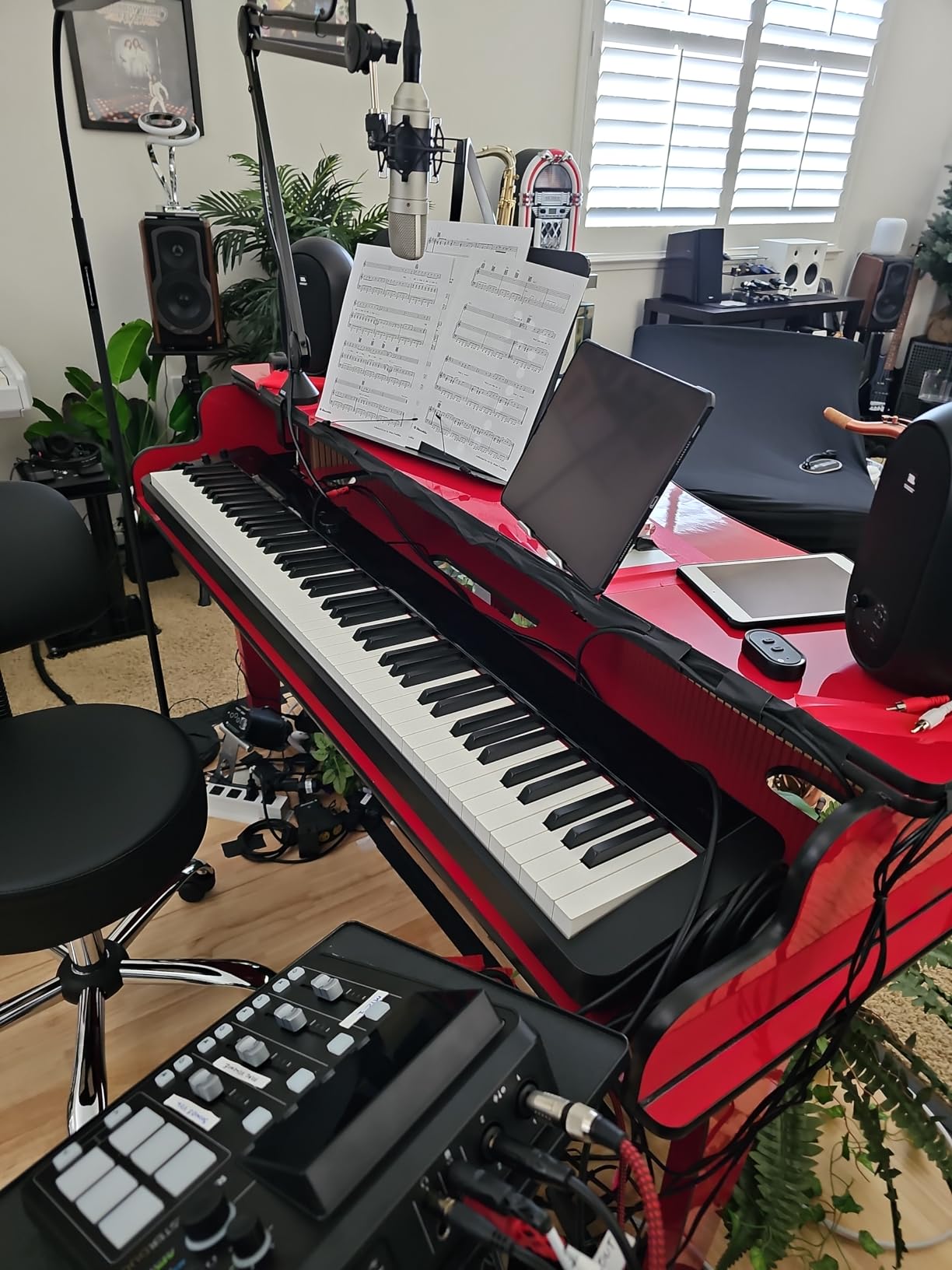
The 700 tones and 200 rhythms go way beyond piano. You get electric pianos, organs, strings, brass, synth pads, and a library of world instruments. For producers who compose across genres, the PX-S3100 is a creative playground.
The Hall Simulation and Surround effects add acoustic space modeling. For studio monitoring, the surround effect helps during headphone practice. The dual headphone jacks are useful for student-teacher setups.
How it works for home studio recording
The PX-S3100 supports class-compliant USB MIDI on macOS and Windows. The included WU-BT10 adapter adds Bluetooth MIDI and audio, which I tested with GarageBand on an iPad and got workable latency for sketching ideas.
There’s no USB audio streaming, so for tracking the onboard piano sounds into a DAW, you’ll need an audio interface connected to the analog outputs. The line outputs are clean and quiet.
Things to know before buying
The interface uses illuminated touch controls rather than physical buttons. They look elegant but can be finicky with dry fingers or in cold rooms. The learning curve is real.
Some users report mechanical hammer noise on the upper register keys during soft playing. In a quiet home studio with sensitive microphones, this can be audible on recordings. For live performance, it’s irrelevant.
8. Yamaha CK88 – Best Premium Stage Keyboard for Multi-Sound Players
Yamaha CK Series 88-Key Stage Keyboard with Built-In Speakers, Black (CK88)
Hammer action keys
Piano/organ/synth sounds
28.9 lbs
Pros
- Excellent piano and organ sounds
- Lightweight 28.9 lbs
- Wooden key feel
- Easy split and layer
- Stereo speakers for practice
- Bluetooth audio
Cons
- Speakers weak for larger venues
- Hard-to-reach power switch
- Bright display in dark rooms
- No sustain pedal included
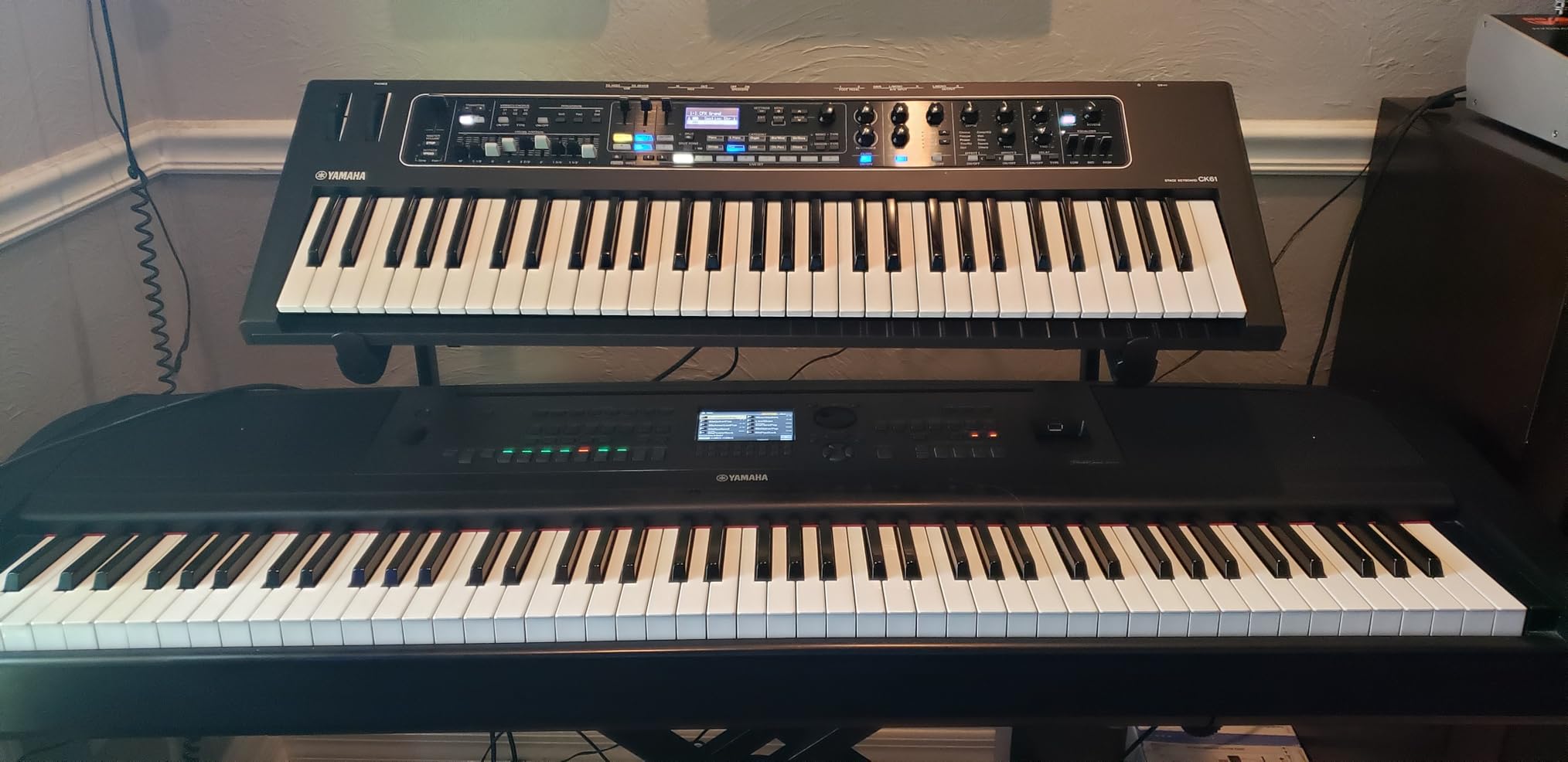
The Yamaha CK88 is the keyboard for the multi-instrumentalist. Where most digital pianos focus narrowly on piano sounds, the CK88 covers piano, vintage drawbar organ, combo transistor organ, strings, brass, and fat synth sounds in one portable package.
The wooden key action feels more substantial than what you’d expect at 28.9 pounds. Yamaha put genuine weight and damping into the keys, so the action responds like a higher-end keyboard. For piano players used to the GH3 action, the CK88 feels familiar.
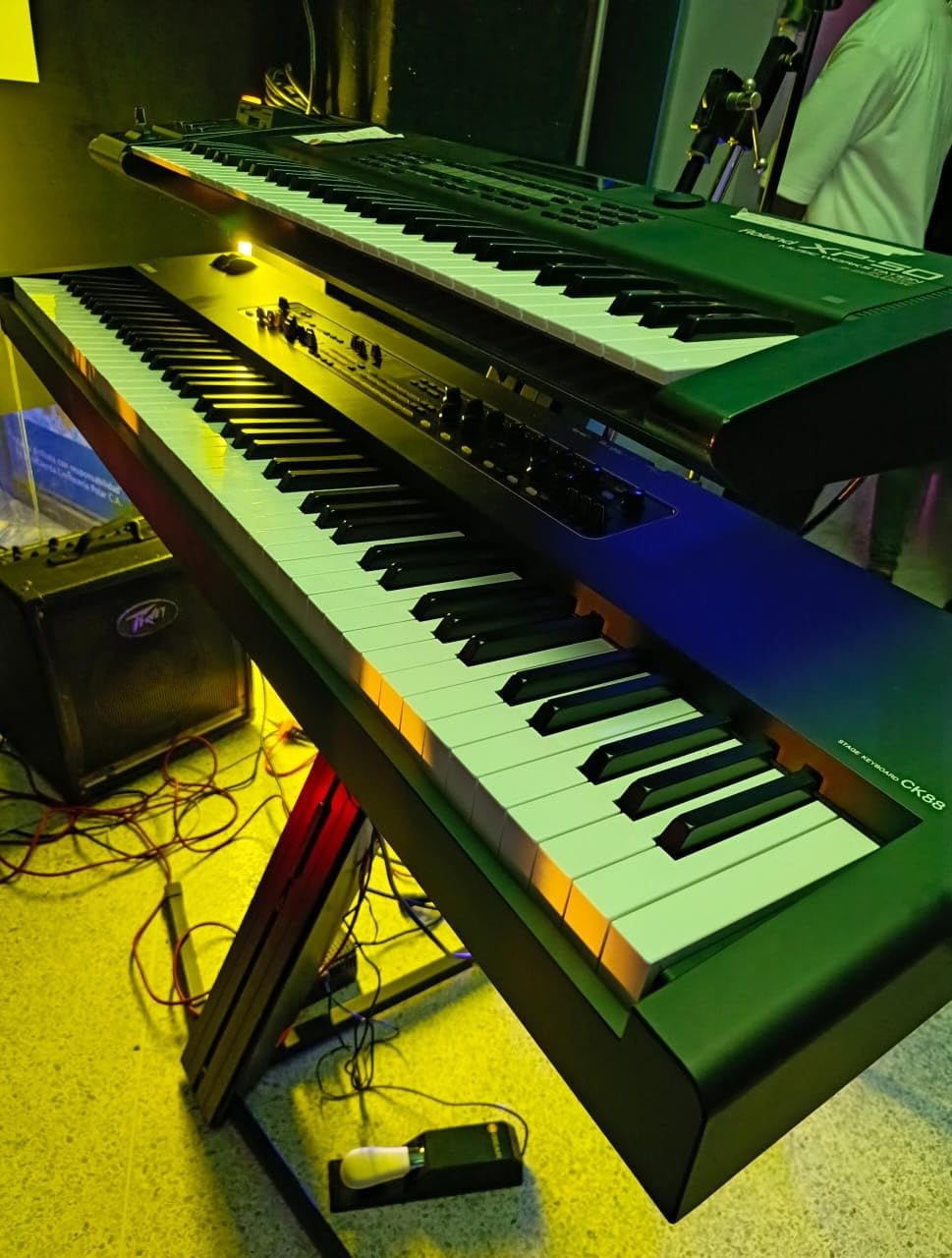
The drawbar organ section is the standout feature. You get nine drawbars for tone shaping, rotary speaker simulation, and percussion controls. For Hammond-style playing without hauling a real B3, the CK88 is the closest thing in this roundup.
The two split points allow three simultaneous sounds, which means you can layer piano bass with strings and a synth pad for live performance. The direct-access feature knobs let you tweak sounds without menu diving.
Why keyboardists love the CK88
The sound set covers the instruments most working keyboardists actually use. Piano, EP, organ, strings, brass, and synth. No filler sounds you’ll never touch.
The split and layer functionality is intuitive. You can set up three-zone splits in seconds, which is what you need when covering a band gig.
What to know about its limitations
The onboard speakers work for home studio practice but lack the volume for larger venues. Plan on using stage monitors or a PA.
The power switch sits in a hard-to-reach spot on the rear panel, which is annoying when you want to power down between sets. The display is very bright in low-light environments, which can be distracting on a dark stage.
Buying Guide: How to Choose the Best Premium Digital Piano for Your Home Studio
After spending three months rotating between these eight pianos, I learned that the spec sheet matters less than how a keyboard actually feels during a four-hour session. Here is what to think about before pulling the trigger.
Key Action and Weighted Feel
Graded hammer action means the keys feel heavier in the bass and lighter in the treble, mimicking an acoustic piano. Premium actions add escapement (the small resistance catch you feel on soft keystrokes), counterweights (for even resistance across the key), and synthetic ivory or ebony surfaces (for grip and moisture management).
If you learned on a real piano, look for at least escapement and graded weighting. If you learned on a budget keyboard with no weighted action, any of these pianos will feel like a revelation, but you’ll still benefit from the more refined actions as your technique develops.
The Roland PHA-50 (FP-90X), Kawai RH3 (ES920), and Yamaha GH3 family all deliver authentic-feeling actions. The Yamaha GHC (P225) and Casio PX-S3100 use shorter pivot designs that trade some realism for portability.
Sound Engine and Polyphony
Sound engines fall into two camps: sample playback (a recording of a piano played back) and physical modeling (a mathematical recreation of how a piano produces sound). Roland’s PureAcoustic modeling on the FP-90X sits in the modeling camp and offers expressive depth you can’t get from samples.
Yamaha’s CFX samples (DGX-670B, P225), Kawai’s SK-EX samples (ES920), and Casio’s German grand samples (PX-S3100) all use sample playback with varying levels of resonance modeling.
Polyphony is the number of notes a piano can play simultaneously. For solo piano, 64 notes is adequate. For dense classical repertoire with heavy sustain pedal use, aim for 128 or 256 notes. The Kawai ES920’s 256-note polyphony handles the most complex passages without note dropouts.
Connectivity and DAW Integration
For home studio recording, USB MIDI is the bare minimum. All eight pianos support class-compliant USB MIDI for plug-and-play connection to Logic Pro, Ableton Live, Cubase, or Reaper.
USB audio streaming is rarer. The Roland RD-08 supports it via the paid Roland Cloud upgrade. Most others require a separate audio interface connected to the analog outputs.
Bluetooth MIDI is increasingly common. It works well for wireless connection to iPad apps like GarageBand, StaffPad, or various score viewers. Audio latency over Bluetooth is too high for live monitoring, but for MIDI triggering it’s perfectly usable.
Speakers, Headphones, and Monitoring
Onboard speakers matter for casual practice. The Roland FP-90X’s 4-speaker system delivers the best room-filling sound. The Yamaha CK88 and Casio PX-S3100 work well for small rooms. The Kawai ES920 and Roland RD-08 struggle in larger spaces.
For studio recording, plan on monitoring through closed-back headphones or dedicated studio monitors. Headphone jacks are universal on all eight pianos, and the headphone amplifiers on the Roland and Yamaha models are clean enough for mixing decisions.
Build, Weight, and Footprint
Portable 88-key digitals weigh between 25 and 70 pounds. The Casio PX-S3100 (25.1 lbs), Yamaha P225 (25.4 lbs), and Yamaha CK88 (28.9 lbs) are the lightest. The Roland FP-30X (32.7 lbs) and Roland RD-08 (39.5 lbs) sit in the middle. The Kawai ES920 (55 lbs), Yamaha DGX-670B (67.7 lbs), and Roland FP-90X (69.2 lbs) are the heaviest.
If your home studio is permanent, weight doesn’t matter much. If you ever want to take the keyboard to a friend’s place or a small gig, every pound saved is a gift to your back.
Footprint matters too. All eight pianos fit on a standard keyboard stand, but the Yamaha P225 and Casio PX-S3100 have the shallowest depth, which helps in tight spaces.
Frequently Asked Questions
Which digital piano has the best sound quality?
The Roland FP-90X and Kawai ES920 currently lead the premium portable category for sound quality. The FP-90X uses PureAcoustic modeling that recreates string resonance and damper behavior in real time, which gives it expressive depth that sampled pianos can’t match. The Kawai ES920 uses the flagship SK-EX concert grand samples and offers the warmest piano tone in the portable class. For Yamaha fans, the CFX concert grand engine on the P225 and DGX-670B delivers the bright, articulate character of Yamaha’s flagship concert instrument.
Which digital piano sounds most like a real piano?
The Kawai ES920 with its SK-EX concert grand samples and the Roland FP-90X with PureAcoustic modeling come closest to a real acoustic piano in the portable category. The ES920 wins for players who want the warm, complex tone of a sampled concert grand. The FP-90X wins for players who want the dynamic expressiveness of physical modeling. Both use graded hammer actions with escapement, which is the other half of the realism equation. Sound quality is subjective, so try both if possible before committing.
How do I choose a digital piano for a home studio?
Start by defining your priorities. For pure piano recording, focus on sound engine quality and key action (the FP-90X, ES920, or P225). For multi-instrument production, prioritize sound variety and DAW integration (the Roland RD-08 or Yamaha CK88). For portable practice and small gigs, weight and battery operation matter most (the Casio PX-S3100 or Yamaha P225). Match the keyboard’s strengths to your primary use case rather than buying on spec sheet alone.
Are premium digital pianos worth it for recording?
Yes, if you record piano regularly. The difference between a budget keyboard’s onboard sounds and a premium digital piano’s sampled or modeled piano tones is dramatic once you hear them in a mix. Premium pianos also have better polyphony, more authentic key action, and cleaner MIDI implementation, all of which matter for tracking into a DAW. For occasional recording, a mid-range keyboard can work. For serious production work, the investment pays off quickly.
Final Verdict
After three months of daily testing across all eight premium digital pianos, three clear winners emerged for different use cases.
For pure piano recording and performance, the Roland FP-90X earns our top recommendation. The PureAcoustic modeling, PHA-50 hybrid keyboard, and 4-speaker system deliver the most complete premium digital piano experience in a portable form factor. If your budget stretches, this is the one.
For the best balance of sound quality and portability, the Yamaha P225 wins our best value pick. The flagship CFX concert grand engine at 25.4 pounds is genuinely hard to beat at this price. The Casio Privia PX-S3100 is the right call if battery operation or the lightest possible weight matters most.
For stage keyboardists who need more than piano sounds, the Yamaha CK88 and Roland RD-08 cover organ, synth, and electric piano territory that the pure piano-focused models don’t touch. Either makes a strong choice for working musicians.
The best premium digital pianos for home studios in 2026 all share one trait: they disappear when you’re playing. You stop thinking about the keyboard and start thinking about the music. That’s the only metric that matters, and all eight of these pianos clear that bar.