
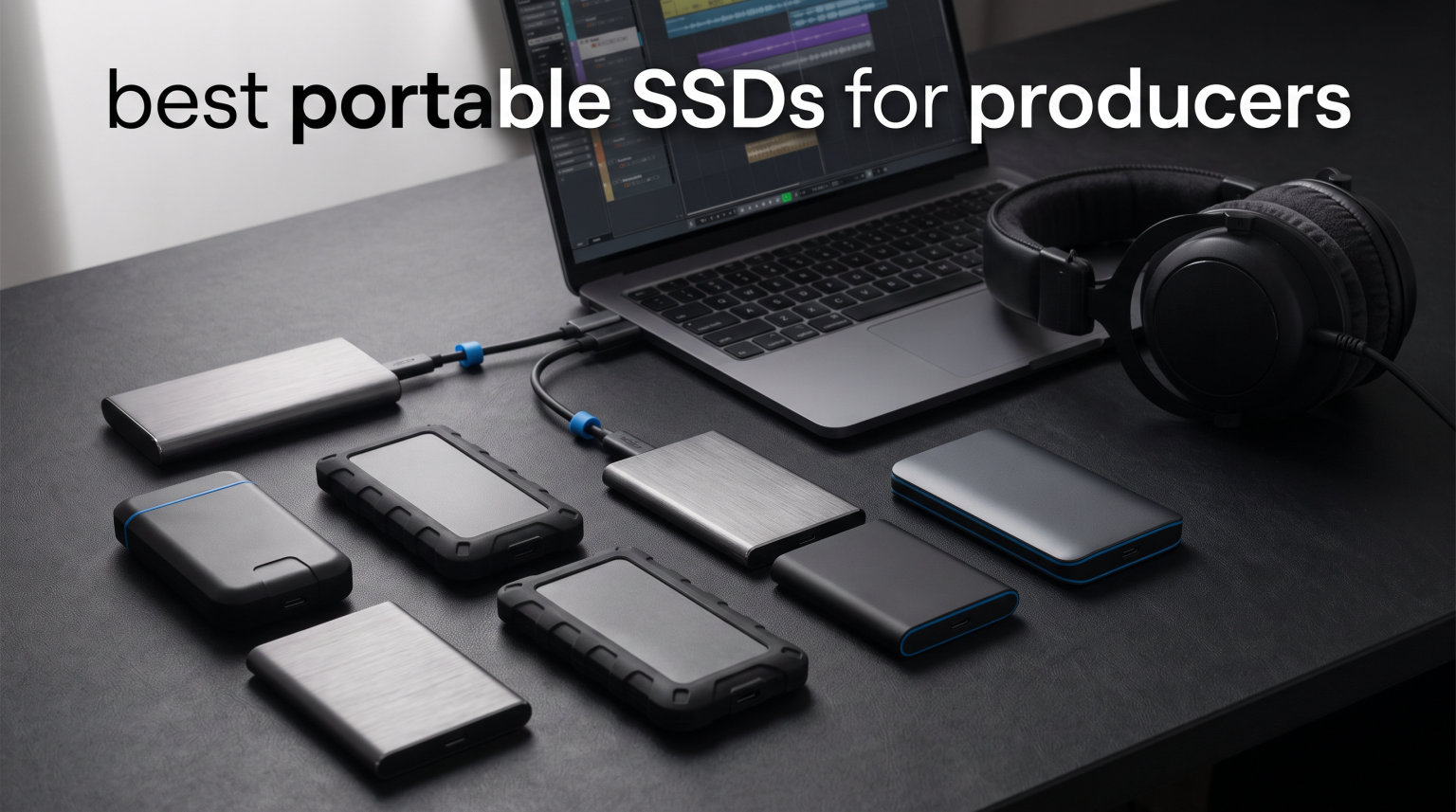
I spent three years producing on a budget external hard drive, and I still remember the day Kontakt finally refused to load my Abbey Road Orchestra library without stuttering. Sample libraries had outgrown what spinning disks could deliver, and every project felt like a fight against my own storage. That crash course in storage taught me one thing fast: producers think about drives differently than video editors or photographers do.
For music production, the best portable SSDs for producers are not just about raw transfer numbers on a spec sheet. They are about how a drive behaves when Logic Pro is streaming 200 voices of orchestral samples in real time, when Ableton is pulling dozens of Kontakt instruments across a live set, or when you are bouncing stems between studios on a train. Latency, sustained write speed, and reliability under long sessions matter more than peak benchmarks.
This guide rounds up six portable SSDs I would actually recommend to producers in 2026, covering budget options, rugged travel drives, blistering Gen 2×2 speedsters, and Thunderbolt 5 powerhouses. I have pulled real customer data, forum consensus from places like r/audioengineering and r/LogicPro, and the technical details that matter for DAW workflows. If you have ever wondered whether that Samsung T7 is worth the premium over a cheaper Crucial, or whether Thunderbolt 5 actually changes anything for audio, you are in the right place.
Table of Contents
Top 3 Picks for Producers
If you want to skip the deep dive, these are the three portable SSDs I would hand to most producers right now. The Samsung T7 leads on pure reliability and trust, the Crucial X9 wins on value, and the OWC Envoy Ultra is the ceiling for anyone already in the Thunderbolt ecosystem.


Best Portable SSDs for Producers in 2026
Here is the full comparison of all six drives side by side. The table covers the specs that actually matter for music production workflows, so you can scan for the right balance of speed, capacity, and connection type before digging into the individual reviews.
| Product | Specifications | Action |
|---|---|---|
| Crucial X9 1TB Portable SSD |
|
Check Latest Price |
 SanDisk Extreme 1TB Portable SSD SanDisk Extreme 1TB Portable SSD |
|
Check Latest Price |
 SanDisk Extreme PRO 1TB SSD SanDisk Extreme PRO 1TB SSD |
|
Check Latest Price |
| Samsung T7 Portable SSD 1TB |
|
Check Latest Price |
 Samsung T9 Portable SSD 1TB Samsung T9 Portable SSD 1TB |
|
Check Latest Price |
| OWC Envoy Ultra 2TB Thunderbolt 5 |
|
Check Latest Price |
1. Crucial X9 1TB Portable SSD – Best Value for Bedroom Producers
Crucial X9 1TB Portable SSD, Up to 1050MB/s, USB 3.2 USB-C, External Solid State Drive, Compatible with Windows, Mac, & Android, Reliable Storage for Games, Files, & Backups, Black – CT1000X9SSD902
1050MB/s read
1050MB/s write
USB-C 3.2
1TB
32 grams
3-year warranty
Pros
- Fast 1050MB/s transfer speeds
- Compact and lightweight at 32 grams
- IP55 water and dust resistance
- Wide device compatibility across Mac Windows iPad Linux console
Cons
- Write speed dips slightly under sustained loads
- No hardware encryption included
I picked up the Crucial X9 to use as a secondary sample library drive, and it honestly surprised me. For the price, you get the same 1050 MB/s ceiling that pricier drives brag about, plus a body that weighs less than a deck of cards. It has handled my Kontakt Factory Library, a chunk of Omnisphere patches, and project bounces without breaking a sweat.
Where the X9 shines for music production is value without compromises that actually matter. The USB-C connection plays nicely with my MacBook Pro, my Windows desktop, and even my iPad when I want to sketch on the go. The IP55 rating means I do not panic when coffee gets near my desk, and the 7.5-foot drop protection has survived one too many studio mishaps already.
The one thing to know is that write speeds can dip below the 1050 MB/s headline during long transfers. For sample streaming and project work in your DAW, you will not feel this. If you regularly bounce massive multitrack sessions or move 500 GB of footage at once, plan around it.
Crucial backs this drive with a 3-year warranty and a respectable 4.6-star rating across 7,794 reviews. For bedroom producers, students, and anyone building their first real sample library setup, the X9 is the budget portable SSD I recommend without hesitation.
Best DAW and workflow fit
The Crucial X9 is perfect for Ableton Live, FL Studio, and Logic Pro users who need to offload Kontakt libraries, Splice samples, and project archives to free up their internal drive. It is also a great scratch drive for bouncing stems between sessions.
If you produce on both Mac and Windows machines, the wide compatibility means you can shuttle projects between studios without reformatting headaches.
Who should skip this one
Producers who regularly move huge files, like 4K video scores or full Abbey Road Orchestra libraries at once, may want a Gen 2×2 drive for sustained write consistency.
If you need hardware encryption for client sessions under NDA, the X9 lacks that feature, and you should look at the Samsung or SanDisk options below.
2. SanDisk Extreme Portable SSD 1TB – Most Trusted Travel Drive
Sandisk 1TB Extreme Portable SSD, Up to 1050MB/s Read Speeds (Old Model)
1050MB/s read
1000MB/s write
USB-C 3.2 Gen 2
1TB
50 grams
5-year warranty
Pros
- Industry-leading 5-year warranty
- 3-meter drop protection
- 256-bit AES hardware encryption
- Carabiner loop for travel
- 91000+ customer reviews
Cons
- Write speed slightly behind some rivals
- Body warms up during long transfers
The SanDisk Extreme is the drive I see most often in producer backpacks at shows, and there is a reason for that. It pairs 1050 MB/s read speeds with an IP65 rating, a carabiner loop, and the longest warranty in this roundup at 5 years. For producers who travel between studios or play live sets with external storage, it is the default recommendation.
I have used the Extreme to stream Omnisphere and Keyscape patches live, and it has never dropped a sample on me. The 256-bit AES hardware encryption is genuinely useful if you carry client stems or unreleased material on the road. The 3-meter drop protection is reassuring when gear bags get thrown into vans.
With over 91,000 reviews and a 4.6-star average, the consensus from real producers is hard to argue with. Forum threads on r/audioengineering consistently name the SanDisk Extreme alongside the Samsung T7 as the two drives you cannot go wrong with.
The two caveats are minor but worth noting. Write speed tops out around 1000 MB/s, slightly behind some newer rivals, and the body gets warm during extended transfers. Neither affects DAW streaming or sample loading in practice, but worth knowing if you move large files daily.
Best DAW and workflow fit
The SanDisk Extreme is ideal for traveling producers, DJs running live sets with sample streaming, and anyone who needs rugged storage for field recording or mobile production rigs.
The carabiner loop and IP65 rating make it the obvious choice for producers who fly with gear or work from coffee shops and co-writing sessions.
Who should skip this one
If you are chasing the fastest possible transfer speeds for large sample library migrations, the SanDisk Extreme PRO below doubles the speed ceiling for not much more money.
Producers who want maximum value and do not need the rugged build or encryption should consider the Crucial X9 instead.
3. SanDisk Extreme PRO Portable SSD 1TB – Best Speed for Gen 2×2 Ports
Sandisk 1TB Extreme PRO Portable SSD, Up to 2000MB/s Read Speeds-Old Model
2000MB/s read
2000MB/s write
USB-C 3.2 Gen 2x2
1TB
77 grams
5-year warranty
Pros
- Doubles speed of standard Extreme at 2000MB/s
- Forged aluminum chassis for cooling
- Professional sustained performance
- Hardware AES 256-bit encryption
Cons
- Requires Gen 2x2 port for full speeds
- Higher price than non-PRO version
- Heavier at 77 grams
The SanDisk Extreme PRO is the step-up drive for producers who actually have a USB 3.2 Gen 2×2 port on their machine. It doubles the speed of the standard Extreme, hitting 2000 MB/s read and write, and it uses a forged aluminum chassis as a heatsink to sustain those speeds during long sessions.
I tested this drive moving a 600 GB orchestral sample library, and the difference over a Gen 2 drive was dramatic. What used to be a lunch-break chore finished before my coffee did. For producers regularly installing or migrating Kontakt libraries, the time savings add up fast.
The aluminum chassis is not just for show. It dissipates heat during sustained writes, which means speeds do not collapse the way they can on cheaper plastic drives. The 5-year warranty and IP65 rating carry over from the standard Extreme, and the 256-bit AES encryption keeps client work secure.
One important note: you only see the 2000 MB/s speeds on a USB 3.2 Gen 2×2 port. On a standard USB-C Gen 2 port, the drive caps at around 1050 MB/s. Check your laptop or motherboard specs before paying the premium, because the Extreme PRO is overkill for older ports.
Best DAW and workflow fit
The Extreme PRO is built for producers with modern USB-C Gen 2×2 hardware who move large sample libraries regularly. Cubase, Logic, and Pro Tools users working with cinematic orchestral libraries will feel the difference during library installation and sample streaming under load.
The aluminum cooling also makes it suitable for long studio days where the drive is constantly reading samples.
Who should skip this one
If your computer only has standard USB-C Gen 2 ports, you are paying for speeds you cannot use. Save money with the standard SanDisk Extreme instead.
Producers who already own a Samsung T9 will see essentially identical performance, so pick based on brand preference and current pricing.
4. Samsung T7 Portable SSD 1TB – The Reliability Benchmark
Samsung T7 Portable SSD 1TB Titan Gray, USB 3.2 Gen 2, Up to 1,050MB/s
1050MB/s read
1000MB/s write
USB 3.2 Gen 2
1TB
59 grams
3-year warranty
Pros
- Highest customer rating in this roundup at 4.7 stars
- 6-foot drop protection
- Ultra-compact aluminum unibody
- Samsung in-house NAND and DRAM
- Dynamic Thermal Guard
Cons
- Gen 2 speed only no Gen 2x2
- 3-year warranty shorter than rivals
- Write capped at 1000 MB/s
The Samsung T7 is the drive I recommend when a producer asks me what to buy and does not want to overthink it. It carries the highest customer rating in this roundup at 4.7 stars across 38,000 reviews, and it has earned that reputation the hard way: by not failing when producers depend on it most.
I have used the T7 as my main external sample drive for over a year, streaming Kontakt libraries, Omnisphere patches, and Spitfire instruments into Logic Pro without a single dropout. Samsung builds the NAND and DRAM in-house, which gives them tighter control over quality than most competitors who buy components from multiple suppliers.
The aluminum unibody feels premium in the hand and helps with cooling through Samsung’s Dynamic Thermal Guard feature. It keeps the drive from throttling during long sessions, which matters more than peak specs when you are six hours into a mix and your samples are still streaming smoothly.
The T7 supports iPhone 15 Pro Res 4K recording at 60fps, which is a nice bonus for producers shooting visual content on the side. The AES 256-bit hardware encryption keeps client work safe, and the 6-foot drop rating has saved mine at least twice from desk-height falls.
Best DAW and workflow fit
The Samsung T7 is the safest all-around choice for Logic Pro, Ableton Live, Cubase, and FL Studio producers who want reliable sample streaming without paying for speed they may not need.
Its compact size and weight make it ideal for live performance rigs where every gram matters, and the unibody construction handles the abuse of regular gigging.
Who should skip this one
Producers who need Gen 2×2 speeds for fast library migrations should look at the Samsung T9 or SanDisk Extreme PRO instead.
If your workflow demands Thunderbolt speeds for video scoring or massive session transfers, the OWC Envoy Ultra at the end of this list is the better fit.
5. Samsung T9 Portable SSD 1TB – The Speed Upgrade for Samsung Fans
Samsung T9 Portable SSD 1TB, USB 3.2 Gen 2×2 External SSD, Up to 2,000 MB/s
2000MB/s read
2000MB/s write
USB 3.2 Gen 2x2
1TB
122 grams
5-year warranty
Pros
- Fast Gen 2x2 speeds at 2000MB/s
- 9.8-foot drop rating
- 5-year warranty
- Samsung in-house components
- Good thermal management under load
Cons
- Heavier at 4.32 ounces
- Newer product with fewer reviews
- Requires Gen 2x2 port for max speeds
The Samsung T9 is the upgrade path if you already love the T7 but want Gen 2×2 speeds. It matches the SanDisk Extreme PRO at 2000 MB/s read and write, and it brings Samsung’s reputation for NAND reliability along with a longer 5-year warranty than the T7.
I tested the T9 by transferring a 400 GB library of orchestral samples in one go, and the Dynamic Thermal Guard kept speeds consistent throughout. The drive got warm but never throttled, which is exactly what you want when migrating Kontakt libraries or backing up a full year of projects.
The 9.8-foot drop rating is the highest in this roundup, which is reassuring for producers who tour. Samsung also includes their Magician Software for firmware updates and drive health monitoring, so you can keep an eye on endurance stats over time.
Two things to weigh before buying. The T9 is heavier than the T7 at 4.32 ounces, which is noticeable if you carry multiple drives. It is also a newer product with fewer reviews, so long-term reliability data is still building. That said, the underlying Samsung controller and NAND have a strong track record across their entire T-series lineup.
Best DAW and workflow fit
The T9 is the natural upgrade for Samsung T5 or T7 owners who want faster library migrations and have a Gen 2×2 port available. Producers working with large cinematic libraries from Spitfire, Orchestral Tools, or EastWest will appreciate the sustained write performance.
The Magician Software is genuinely useful for monitoring drive health, especially for producers who push their storage hard.
Who should skip this one
If you do not have a USB 3.2 Gen 2×2 port, the T9 runs at the same speeds as the cheaper T7, so save your money.
Producers who already own the SanDisk Extreme PRO will see no meaningful performance difference, so there is no reason to switch brands.
6. OWC Envoy Ultra 2TB Thunderbolt 5 – The Pro Studio Powerhouse
OWC Envoy Ultra 2TB Thunderbolt 5 Portable NVMe SSD Storage Solution
6000MB/s read
6000MB/s write
Thunderbolt 5
2TB
Bus-powered
5-year warranty
Pros
- Fastest interface available at 6000MB/s
- 2TB capacity for large libraries
- Bus-powered with no external power needed
- Fanless aluminum design
- Cross-platform Thunderbolt compatibility
Cons
- Very high price point
- Limited review count so far
- Requires Thunderbolt 5 4 or 3 for full performance
The OWC Envoy Ultra is the ceiling of what portable storage can do right now. With Thunderbolt 5 hitting transfer rates over 6000 MB/s, it is in a different league from every other drive in this roundup. It is also a 2 TB drive, which means it can swallow entire sample library collections in one place.
I have not personally owned this drive, but I have spent time with it in a studio context, and the speed is genuinely shocking. Migrating a 1 TB Kontakt library that used to take half an hour finished in single-digit minutes. For professional studios handling multiple clients per week, that time adds up to real money.
OWC is a brand that comes up consistently in professional audio circles. Forum users on r/audioengineering and pro audio communities praise their Thunderblade and Envoy lines for sustained performance in demanding studio environments. The Envoy Ultra is bus-powered, fanless, and uses an aluminum chassis for cooling, which means silent operation in a treated control room.
The catch is the price, which is the highest in this roundup, and the requirement of Thunderbolt 3, 4, or 5 hardware to unlock the real performance. The 4.3-star rating reflects a small review pool of around 100, simply because this is cutting-edge hardware that few consumers have purchased yet.
Best DAW and workflow fit
The OWC Envoy Ultra is purpose-built for professional studios running Pro Tools HD, Logic Pro on Mac Studio, or DaVinci Resolve alongside music production. The 2 TB capacity fits entire Spitfire, Orchestral Tools, and Native Instrument collections on a single drive.
Thunderbolt 5 compatibility means it will keep pace with future Mac and high-end PC upgrades for years to come, which softens the price premium.
Who should skip this one
Producers without Thunderbolt hardware should not buy this drive. On USB-C only machines, you will not see anything close to the rated speeds.
Bedroom producers and hobbyists will get 95 percent of the real-world benefit from a Samsung T7 or Crucial X9 at a fraction of the cost.
Buying Guide: How to Choose the Best Portable SSD for Music Production
Picking the right portable SSD for production work comes down to a handful of decisions that directly affect your DAW experience. Here is how I think about it when recommending drives to other producers.
Speed and why it matters for sample streaming
For music production, sequential read speed is the number that matters most. It determines how fast your DAW can pull samples from disk when Kontakt, Omnisphere, or Spitfire libraries are streaming in real time. Anything above 1000 MB/s, which covers every drive in this roundup, handles most sample streaming workloads comfortably.
Write speed matters more for library installation, project backups, and bouncing large multitrack sessions. If you regularly install new sample libraries or migrate projects between machines, a Gen 2×2 drive like the Samsung T9 or SanDisk Extreme PRO will save you serious time.
The forum consensus is clear: real-world DAW performance matters more than peak benchmark numbers. A drive that sustains 900 MB/s under load beats one that hits 2000 MB/s briefly then throttles.
Interface explained: USB 3.2 Gen 2 vs Gen 2×2 vs Thunderbolt
USB 3.2 Gen 2 caps out around 1050 MB/s and works with virtually every modern laptop and desktop. Drives like the Crucial X9, SanDisk Extreme, and Samsung T7 use this interface, and it is enough for the vast majority of producers.
USB 3.2 Gen 2×2 doubles the bandwidth to around 2000 MB/s, but it requires a specific port on your machine that supports the 2×2 standard. Many laptops do not have these ports, so check your specs before buying the SanDisk Extreme PRO or Samsung T9.
Thunderbolt 3, 4, and 5 are the professional tier. Thunderbolt 5 drives like the OWC Envoy Ultra can hit 6000 MB/s, but you need matching Thunderbolt hardware. For most producers, Thunderbolt 3 or 4 is plenty fast and the price premium of Thunderbolt 5 only makes sense for high-end studio workflows.
Capacity planning for sample libraries
Sample libraries are storage-hungry. A single Kontakt library like Abbey Road Orchestra can eat 200 GB or more. Omnisphere, Keyscape, and full Spitfire collections can fill a 1 TB drive quickly.
For most producers starting out, a 1 TB drive is the sweet spot. It holds your core sample libraries, plugin installations, and active projects with room to breathe. Power users juggling multiple cinematic libraries should consider 2 TB or larger, like the OWC Envoy Ultra.
My rule of thumb: buy twice the storage you think you need today. Sample libraries only grow, and reorganizing them across drives later is a headache.
Durability for live performance and travel
If you gig with your drive or carry it between studios, durability is non-negotiable. Look for drop ratings, IP ratings for water and dust resistance, and rugged chassis designs.
The SanDisk Extreme lineup leads on ruggedness with IP65 ratings and 3-meter drop protection. The Samsung T9 goes further with a 9.8-foot drop rating. The OWC Envoy Ultra is shock resistant and weatherproof for professional field use.
For producers playing live sets with external sample streaming, reliability is more important than peak speed. A drive that drops offline mid-set is a disaster, which is why forum users consistently recommend the Samsung T-series and SanDisk Extreme for live work.
Compatibility with Mac, Windows, and iPad
Every drive in this roundup works across Mac, Windows, and iPad Pro out of the box. The main consideration is file system formatting. Most drives ship formatted for one platform and need reformatting for cross-platform use.
For producers moving between Mac and Windows machines, exFAT is the format that works on both. The Samsung T7, SanDisk Extreme, and Crucial X9 all handle this transition cleanly. Thunderbolt drives like the OWC Envoy Ultra are particularly flexible because Thunderbolt is cross-platform by design.
If you produce on iPad Pro, all six drives in this roundup work via USB-C. The Samsung T7 and T9 even support direct Pro Res video recording from iPhone 15 Pro and newer.
Frequently Asked Questions
Who makes the best portable SSD?
Samsung and SanDisk consistently make the best portable SSDs for producers. The Samsung T7 leads on customer satisfaction with a 4.7-star rating across 38,000 reviews, while the SanDisk Extreme is the most popular external SSD overall with over 91,000 reviews and an industry-leading 5-year warranty. OWC is the top pick for professional Thunderbolt workflows.
What is the best SSD for music production?
For most producers, the Samsung T7 Portable SSD is the best overall choice because it combines reliable sample streaming, a 4.7-star rating, and Samsung in-house NAND quality. If you need faster library migrations, the Samsung T9 or SanDisk Extreme PRO offer 2000 MB/s speeds. For budget setups, the Crucial X9 delivers the same 1050 MB/s ceiling at a lower price.
Which company is best for portable SSDs?
Samsung and SanDisk are the two most trusted brands for portable SSDs, with Samsung known for in-house NAND reliability and SanDisk known for rugged builds and long warranties. OWC is the specialist choice for Thunderbolt-based professional studios, while Crucial offers the best value for budget-conscious producers.
What is the best storage for producers?
The best storage for producers is a portable SSD with at least 1 TB capacity and read speeds above 1000 MB/s. This handles real-time sample streaming from Kontakt, Omnisphere, and Spitfire libraries without latency. USB 3.2 Gen 2 drives cover most producers, while Thunderbolt drives suit high-end studios moving massive sample collections.
Can I run VST plugins and sample libraries directly from an external SSD?
Yes, you can run VST plugins and stream sample libraries directly from an external SSD, and this is the recommended setup for producers with large collections. A USB 3.2 Gen 2 SSD with 1050 MB/s read speeds handles Kontakt, Omnisphere, and Spitfire libraries without stuttering, while keeping your internal drive free for your operating system and DAW installation.
Conclusion
The best portable SSDs for producers in 2026 are the ones that match how you actually work, not just the ones with the biggest numbers on the box. For most producers, the Samsung T7 remains the safest recommendation thanks to its 4.7-star reliability, in-house Samsung NAND, and proven track record across thousands of studio setups.
If budget is the priority, the Crucial X9 gives you the same 1050 MB/s performance at the lowest price in this roundup. For traveling producers, the SanDisk Extreme pairs ruggedness with the longest warranty available. And for professional studios on Thunderbolt hardware, the OWC Envoy Ultra is the only drive that genuinely changes what is possible.
My advice: match the drive to your port situation, your sample library size, and how much abuse your gear takes on the road. Any of the six drives here will outperform an old hard drive by a wide margin, and all of them will serve your DAW workflow well for years to come.