
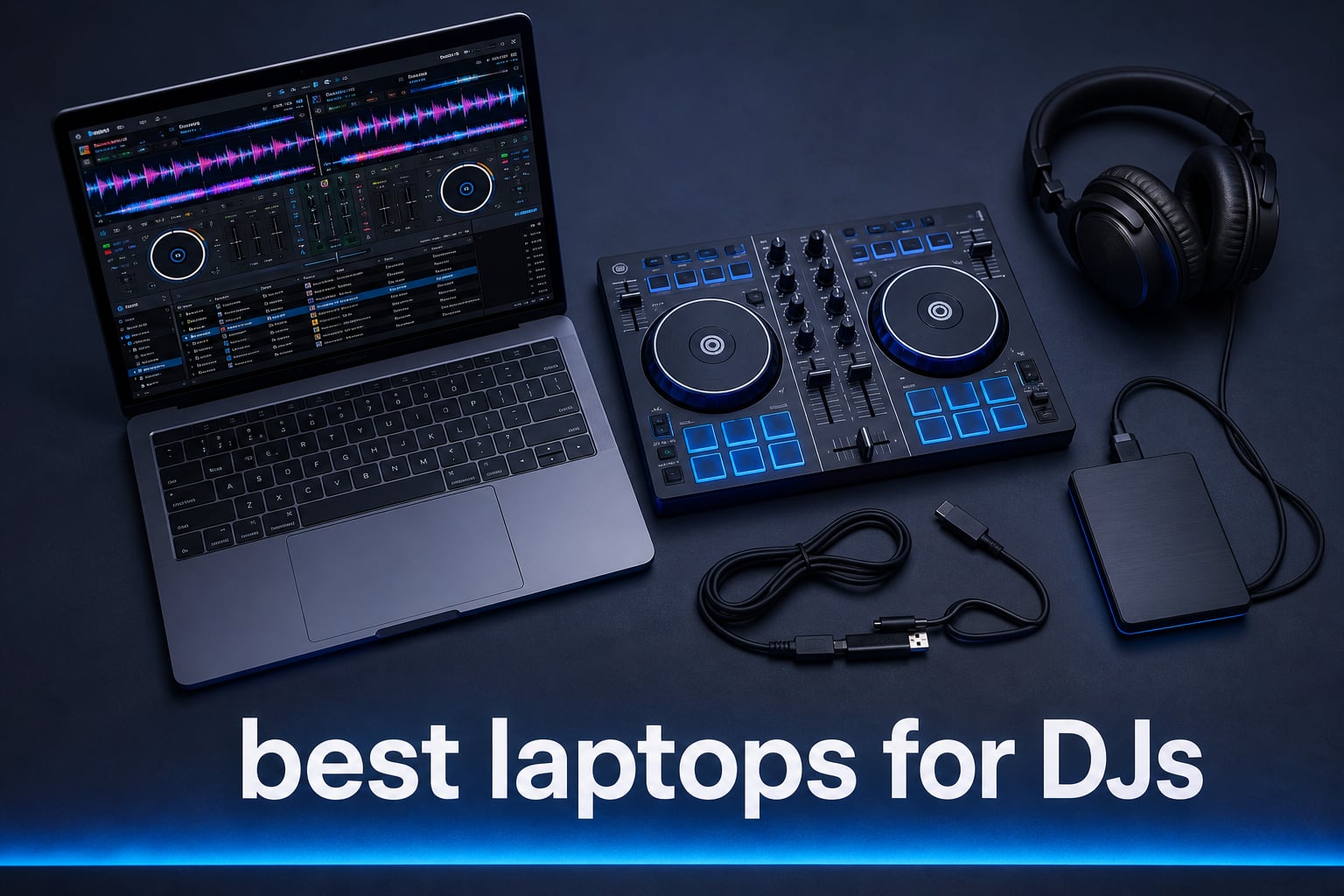
The best laptops for DJs have three non-negotiable traits: 16GB of memory, solid-state storage, and a connection plan that fits the controller you actually use. A DJ laptop is the computer that runs Serato DJ, Rekordbox, VirtualDJ, or similar software and sends audio and control data by USB to a controller or audio interface.
For 2026, my short answer is the Apple MacBook Pro 14-inch M5 for DJs who need the most built-in connection options, the 13-inch MacBook Air M5 for DJs who travel light, and the Dell 15 for a straightforward Windows configuration. Those choices are based on the supplied configurations, connection details, stated weight, and review data rather than made-up performance tests.
Reliability matters more than a flashy specification sheet when a crowd is waiting. DJ discussions repeatedly flag rough transport, too few USB ports, heat in clubs, screen glare outdoors, and short battery life, so I have treated those as practical filters throughout this guide.
A good existing computer may already be enough for home practice if it meets your DJ software’s current requirements. Before replacing it, check its available memory, free SSD space, operating-system support, and ports with your controller connected; a careful setup and backup library often make a larger difference than a new chassis.
Table of Contents
The top 3 laptops answer most DJ needs
Choose the MacBook Pro 14-inch M5 when you want a 1TB SSD, a bright 14.2-inch display, and the most flexible port mix in this group. Choose the 13-inch MacBook Air M5 when carrying a 2.71-pound laptop matters most, or the Dell 15 when you want 16GB RAM and a 512GB SSD in a conventional 15.6-inch Windows machine.
- Apple MacBook Pro 14-inch M5: Best for demanding DJ, music, and display-connected workflows because it has three Thunderbolt 4 ports, HDMI, SDXC, 16GB unified memory, and 1TB SSD storage.
- Apple MacBook Air 13-inch M5: Best for mobile DJs who value low carry weight, stated battery life up to 18 hours, two Thunderbolt 4 ports, and a headphone jack.
- Dell 15 DC15250: Best for a familiar Windows route with an Intel Core i7-1355U, 16GB DDR5, 512GB SSD, and 15.6-inch FHD display.


The best laptops for DJs in 2026 are easy to compare
This overview puts the supplied configurations side by side. Check the connector layout against your controller, external drive, phone, and any display before treating a laptop’s headline processor as the deciding fact.
| Product | Specifications | Action |
|---|---|---|
| Apple MacBook Air 13-inch M5 |
|
Check Latest Price |
 Apple MacBook Air 15-inch M5 Apple MacBook Air 15-inch M5 |
|
Check Latest Price |
| Apple MacBook Pro 14-inch M5 |
|
Check Latest Price |
 Lenovo ThinkPad E16 Gen 2 Lenovo ThinkPad E16 Gen 2 |
|
Check Latest Price |
 Dell 15 DC15250 Dell 15 DC15250 |
|
Check Latest Price |
 ASUS ROG Strix G16 ASUS ROG Strix G16 |
|
Check Latest Price |
 ASUS Vivobook 16 ASUS Vivobook 16 |
|
Check Latest Price |
 HP 15.6-inch Touchscreen HP 15.6-inch Touchscreen |
|
Check Latest Price |
1. Apple MacBook Air 13-inch M5 is the lightest DJ travel pick
Apple 2026 MacBook Air 13-inch Laptop with M5 chip: Built for AI, 13.6-inch Liquid Retina Display, 16GB Unified Memory, 512GB SSD, 12MP Center Stage Camera, Touch ID, Wi-Fi 7; Midnight
M5 chip
16GB memory
512GB SSD
2.71 pounds
Pros
- 2.71-pound carry weight
- Up to 18-hour battery claim
- Two Thunderbolt 4 ports
- Headphone jack
Cons
- Only two Thunderbolt 4 ports
- No dedicated GPU
I would start with this MacBook Air when the laptop will be in a backpack for every rehearsal, wedding, or club night. Its listed 2.71-pound weight is the lowest stated figure among the models with a listed weight here, while 16GB of unified memory and 512GB of SSD space meet the practical baseline repeatedly raised in DJ guidance.
The M5 chip, two Thunderbolt 4 ports, MagSafe charging, and headphone jack describe a clean working setup for a controller and headphones. The product listing also states support for up to two external displays and up to 18 hours of battery life, useful facts for a home desk or long travel day.
The controller connection plan is the deciding check
Two Thunderbolt 4 ports can be enough for a controller and a powered hub, but they do not leave much room for an external SSD, Ethernet adapter, or phone charger without planning. I would map every cable before a gig and carry a known-good powered hub only after testing it with the DJ software.
The dedicated MagSafe port preserves the two Thunderbolt ports while charging, which helps. The headphone jack also avoids spending a data port on a basic headphone adapter.
The portability case is strongest for mobile sets
The 13.6-inch Liquid Retina display keeps the physical footprint small, and the 12MP Center Stage camera may help DJs who also stream or take remote calls. It is not a dedicated-GPU machine, so its record should be judged as a focused DJ laptop rather than a video-rendering workstation.
Its listing has a 4.8 rating from 793 reviews, with users cited for praising performance, battery life, and display quality. For outdoor work, I would still check the viewing position at the venue because glare depends on the environment, not just the panel specification.
2. Apple MacBook Air 15-inch M5 is the larger-screen fanless choice
Apple 2026 MacBook Air 15-inch Laptop with M5 chip: Built for AI, 15.3-inch Liquid Retina Display, 16GB Unified Memory, 512GB SSD, 12MP Center Stage Camera, Touch ID, Wi-Fi 7; Silver
M5 chip
16GB memory
512GB SSD
15.3-inch display
Pros
- Large 15.3-inch display
- Up to 18-hour battery claim
- Six-speaker system
- Two Thunderbolt 4 ports
Cons
- 3.32-pound carry weight
- No dedicated GPU
This version answers the DJ who wants more waveforms, crates, and browser space without leaving the MacBook Air line. It keeps the same M5 chip, 16GB unified memory, 512GB SSD, two Thunderbolt 4 ports, MagSafe, and headphone jack as the smaller model while moving to a 15.3-inch Liquid Retina display.
The 3.32-pound listed weight is still manageable, though it is 0.61 pounds above the 13-inch Air. I would take that trade when I spend more hours preparing sets, organizing music libraries, or working in two software panes than walking between venues.
The added display room helps library preparation
A larger screen does not change the audio path, but it can make a dense library view and performance view less cramped. The listing also notes a six-speaker system with Spatial Audio and Dolby Atmos, a useful convenience for casual cueing but not a replacement for headphones or a proper sound system.
Its 12MP Center Stage camera has automatic framing, which has value for streamed sets. For serious performance monitoring, I would keep the laptop screen focused on the DJ application and use an external display only after testing it at home.
The same two-port limitation needs a real solution
This Air is fanless by design, which removes fan noise and one moving part, but the supplied listing does not offer a club heat benchmark. Keep it on a hard, clear surface and do not block the underside during a long set.
As with the 13-inch model, a controller, fast external drive, and accessory can quickly consume two data connections. The listing says it supports up to two external displays, but external-display ability is not the same thing as having enough physical ports for a complete booth setup.
3. Apple MacBook Pro 14-inch M5 is the most complete Apple connection pick
Apple 2025 MacBook Pro Laptop with Apple M5 chip with 10‑core CPU and 10‑core GPU: Built for AI, 14.2-inch Liquid Retina XDR Display, 16GB Unified Memory, 1TB SSD Storage; Space Black
M5 10-core CPU
16GB memory
1TB SSD
Three Thunderbolt 4
Pros
- 1TB SSD
- Three Thunderbolt 4 ports
- HDMI and SDXC
- 1600-nit peak display
Cons
- 3.41-pound carry weight
- Heavier than MacBook Air
This is my strongest all-round recommendation because the supplied configuration solves more of the everyday DJ connection puzzle without adapters. Alongside 16GB unified memory and 1TB SSD storage, it has three Thunderbolt 4 ports, HDMI, an SDXC card slot, MagSafe 3, and a headphone jack.
The M5 chip includes a 10-core CPU and 10-core GPU, so I would place it first for someone combining Rekordbox or Serato work with video, music projects, and large file management. The 1TB SSD also gives more room for a music library and local backup before an external drive becomes necessary.
The port selection reduces booth friction
A controller can occupy one Thunderbolt connection while an external SSD and a hub or interface use the others. HDMI is particularly helpful for a second screen or a venue display, and the SDXC slot may suit DJs who move media from cameras or other recording gear.
No port layout eliminates the need for a backup cable. I would label and pack a short spare USB cable for the controller, then test every adapter with the exact software version before performance day.
The bright display suits demanding viewing conditions
The 14.2-inch Liquid Retina XDR display is listed at up to 1600 nits peak brightness, giving this model the clearest stated display brightness claim in this roundup. That is a meaningful advantage when the booth receives daylight or strong stage lighting, though screen angle still matters.
At 3.41 pounds, it is not the lightest Apple option, but it stays below the stated weights for the Dell and ThinkPad models. The listing’s 4.8 rating from 211 reviews is encouraging, yet I would base a gig decision on a complete controller-and-library rehearsal, not on rating alone.
4. Lenovo ThinkPad E16 Gen 2 is the business-class Windows answer
Lenovo ThinkPad E16 16″ Ryzen 7 7735HS 16GB DDR5 512GB SSD Business Laptop
Ryzen 7 7735HS
16GB DDR5
512GB SSD
16-inch WUXGA
Pros
- RAM expands to 64GB
- Anti-glare 16-inch display
- USB-C and HDMI 2.1
- Aluminum chassis
Cons
- 3.75-pound carry weight
- Non-touch display
For DJs who prefer Windows, this ThinkPad is the most business-oriented configuration in the group. Its eight-core, 16-thread Ryzen 7 7735HS, 16GB DDR5, and 512GB PCIe 4.0 NVMe SSD meet the storage and memory floor I would want before loading a serious music library.
Forum discussion around Windows DJ machines consistently favors business-class designs, and this listing backs that angle with an aluminum chassis, a fingerprint reader, discrete TPM 2.0, and a Kensington Nano Security Slot. Those are not audio-performance specifications, but they fit a laptop that will be transported and left briefly in busy work areas.
The anti-glare display is the practical screen benefit
The 16-inch WUXGA IPS display has a 1920 by 1200 resolution, 300-nit rating, and anti-glare finish. Its extra vertical workspace can make library browsing easier than a 16:9 panel, while the anti-glare treatment directly addresses a common outdoor and bright-venue complaint.
The 3.75-pound listed weight makes it more of a backpack commitment than either MacBook Air. I would choose it for a desk-to-gig routine rather than for a DJ who wants the smallest possible carry load.
The memory upgrade path protects future use
The supplied specification says its 16GB DDR5 SODIMM memory can expand to 64GB. That leaves a route for a DJ who later adds Ableton Live projects, STEM processing, or other demanding work, without changing the basic machine.
It lists USB-C with Power Delivery and DisplayPort 1.4 plus HDMI 2.1. Confirm the exact port count and controller connector at purchase, because a specification that says USB-C support does not itself promise multiple free ports at the booth.
5. Dell 15 DC15250 is the straightforward Windows DJ laptop
Dell 15.6 Laptop, FHD, Intel Core i7 1355U, 16GB RAM, Windows 11 Home
Core i7-1355U
16GB DDR5
512GB SSD
15.6-inch FHD
Pros
- 16GB DDR5 memory
- 512GB SSD
- 15.6-inch FHD display
- Wi-Fi 6
Cons
- No fingerprint reader
- No dedicated graphics
The Dell 15 gives a no-frills Windows configuration: a 13th Gen Intel Core i7-1355U, 16GB DDR5 RAM, and a 512GB SSD. Those verified components line up well with the common recommendation to avoid an underpowered general-purpose laptop when running DJ software, a browser, and an external drive.
Its 15.6-inch FHD display runs at 1920 by 1080 and has a 120Hz refresh rate. Refresh rate is not the priority for mixing, but the standard FHD resolution gives a familiar, usable workspace for DJ software and library preparation.
The Windows setup remains easy to keep focused
Windows 11 Home, Wi-Fi 6, Bluetooth 5.3, and the listed HD webcam cover the basic platform needs. For a performance computer, I would keep unnecessary startup programs off, install DJ software updates only after testing, and keep library files on the internal SSD plus a separate backup.
The product has Intel UHD Graphics rather than a dedicated GPU. That is acceptable for a focused controller-based DJ setup, while demanding video work and heavy visual processing point more naturally toward the ASUS ROG Strix G16.
The 3.6-pound chassis changes the travel calculation
The stated 3.6-pound weight sits between the MacBook Pro and ThinkPad. I would find it reasonable for regular transport, but a padded sleeve and a bag with a separate controller compartment matter because forum users repeatedly describe rough handling as a real failure point.
Dell includes Express Charge support and ComfortView blue-light reduction in the supplied details. Neither replaces checking actual battery behavior with your controller attached, especially for a long set where wall power may be uncertain.
6. ASUS ROG Strix G16 is the high-headroom Windows performance choice
ASUS ROG Strix G16 (2025) Gaming Laptop, 16” FHD+ 16:10 165Hz/3ms, NVIDIA® GeForce RTX™ 5060, Intel® Core™ i7 Processor 14650HX, 16GB DDR5, 1TB Gen 4 SSD, Wi-Fi 7, Windows 11 Home, G615JMR-AS74
Core i7-14650HX
RTX 5060
16GB DDR5
1TB SSD
Pros
- RTX 5060 graphics
- 1TB Gen 4 SSD
- Three USB ports and Thunderbolt
- Tri-fan cooling
Cons
- Listed 2-hour battery life
- 2.65-kilogram weight
This ASUS is excessive for basic two-deck mixing, but it is the right kind of excess for a DJ who also works on video, graphics-heavy visuals, or more demanding music projects. The stated configuration includes an Intel Core i7-14650HX, NVIDIA GeForce RTX 5060 laptop GPU, 16GB DDR5-5600 memory, and a 1TB PCIe Gen 4 SSD.
It has three USB ports, one Thunderbolt port, HDMI, Wi-Fi 7, and a 16-inch 1920 by 1200 display. That combination gives it more physical connection detail than many thin systems, which is helpful when the DJ controller, SSD, camera, and an external display all enter the plan.
The active cooling suits sustained heavy workloads
The listing specifies a vapor chamber, tri-fan technology, and liquid metal on the chipset. Active cooling is useful when the laptop is doing more than DJ playback, but it also means keeping the vents clear and avoiding a dusty, enclosed position in the booth.
For a simple DJ software session, a fanless laptop may be quieter and easier to carry. For production, visual work, or AI-assisted audio tasks alongside the set preparation, the ROG’s processor and dedicated graphics provide more stated hardware headroom.
The battery rating makes wall power a requirement
The product details list battery life at two hours, so I would never treat this as an unplugged-gig machine. Pack its power supply, confirm outlet access with the venue, and use a surge-protected extension only where venue rules permit it.
Its listed weight is 2.65 kilograms, which is substantially more than the portable MacBook options. The 165Hz display and RGB light bar serve the gaming design; Stealth Mode can turn off the lighting when a low-key professional setup is preferred.
7. ASUS Vivobook 16 is the broad-connection everyday Windows choice
ASUS Vivobook 16″ WUXGA Laptop Intel Core i7-1355U 16GB RAM 512GB SSD Intel Iris Xe Graphics Lightweight Portable Notebook Black Windows 11
Core i7-1355U
16GB RAM
512GB SSD
16-inch WUXGA
Pros
- USB-C USB-A HDMI and microSD
- 16GB RAM
- 512GB SSD
- 16-inch WUXGA screen
Cons
- Non-touch display
- Listed availability may vary
The ASUS Vivobook 16 provides the baseline configuration I look for in an everyday Windows laptop for DJing: Intel Core i7-1355U, 16GB of RAM, and a 512GB SSD. The 16-inch WUXGA display gives more workspace than a standard 15.6-inch FHD machine because its native resolution is listed as 1920 by 1200.
Its connection list is unusually clear: USB-C, USB-A, HDMI, a microSD card reader, and a 3.5mm audio jack, with Wi-Fi 6 and Bluetooth 5.1. A laptop for DJing lives or dies by this sort of practical detail more often than by display marketing.
The connector variety cuts adapter dependence
USB-A remains useful because many DJ controllers ship with USB-A cables, while USB-C can cover newer accessories or a display adapter. HDMI adds a direct display path, and the 3.5mm jack gives a simple wired headphone option.
The listing says it has two USB ports but does not break out their exact allocation in the supplied data. I would confirm the manufacturer’s current port diagram before buying if the rig needs two separate data accessories at once.
The 16-inch workspace favors preparation at home
A 16-inch screen is comfortable for sorting crates, tagging tracks, and managing a music-production session. It is a non-touch display, which is not a concern for normal DJ software use because controller controls and keyboard shortcuts matter more than touch input.
The supplied review data shows a 4.5 rating from 30 reviews, so it has a smaller review pool than several other picks. That does not disqualify it, but it is a reason to verify the exact configuration and return conditions before committing to a work machine.
8. HP 15.6-inch Touchscreen is the basic 16GB configuration for beginners
HP 15.6″ Touchscreen Laptop, Intel Core i5 Processor, 16GB RAM, 512GB SSD, Numeric Keypad, Bluetooth, Wi-Fi, Long Battery Life, Windows 11 Home, Alpacatec Accessories, Silver
Core i5
16GB RAM
512GB SSD
15.6-inch touchscreen
Pros
- 16GB RAM
- 512GB SSD
- Three USB ports
- Numeric keypad
Cons
- 1366 by 768 screen
- Listed 7-pound weight
This HP has a 12th Gen Intel Core i5, 16GB RAM, and 512GB SSD, so it clears the basic memory and storage threshold for learning a controller workflow. Three USB ports, HDMI, Wi-Fi 6, Bluetooth, and a headphone/microphone combo also give it a workable stated connectivity list.
I would frame it as a simple laptop for a beginner DJ who will run a single DJ application and build a first library, not as the best fit for screen-heavy editing or graphics work. The 15.6-inch touchscreen and numeric keypad are convenience features rather than performance requirements.
The low-resolution screen is its biggest practical compromise
The native display resolution is listed as 1366 by 768, lower than the 1920 by 1080 or 1920 by 1200 screens elsewhere in this selection. DJ applications can run at lower resolutions, but library browsing and multiple panes will feel less spacious.
Before using it outdoors, I would specifically examine readability in bright light, because the provided details do not state an anti-glare coating or brightness value. A laptop hood or shaded booth position can be more useful than hoping a screen alone solves glare.
The listed weight favors a stationary setup
The supplied product details list this laptop at 7 pounds, making it the heaviest stated option in the roundup. That may be fine for home practice or a car-to-venue setup, but it is a poor match for frequent public-transit travel with a controller.
Its 4.3 rating from 80 reviews is the lowest rating of this group, and the supplied review summary notes a 1366 by 768 screen as a limitation. Keep expectations tied to the configuration: it can cover a basic software rig, while the other laptops give more screen or processing room.
The right DJ laptop depends on five setup decisions
The best purchase is the one that fits the software, controller, library, travel routine, and backup plan you have today. A capable processor helps, but enough memory, SSD capacity, ports, and a stable pre-gig routine are the parts most likely to prevent an avoidable failure.
Sixteen gigabytes of RAM is the sensible starting point
Choose 16GB RAM or unified memory as the practical minimum for current DJ use. That leaves room for the DJ application, an operating system, browser tabs, background audio tools, and normal library tasks without relying on an 8GB configuration that can feel constrained as projects grow.
All eight supplied laptops meet that 16GB line. The ThinkPad is the only one here explicitly listed as expandable to 64GB, while Apple’s unified-memory models should be selected with the 16GB configuration from the beginning.
A 512GB SSD is the baseline for a working music library
Use an SSD rather than an HDD for the operating system and active music collection. DJ forums repeatedly identify SSD storage as essential because a hard drive is more vulnerable to vibration and slower for a working library.
Start at 512GB if you maintain an organized collection, then retain a second copy on a separate external SSD. The MacBook Pro and ASUS ROG Strix G16 each list 1TB SSD storage, a more comfortable amount for DJs who keep larger libraries, edits, video files, or production sessions locally.
USB ports should be counted before the laptop is purchased
List every item you will connect: controller, external SSD, phone, camera, wired network adapter, audio interface, and display. Then select a laptop that leaves at least one tested path for the accessories you need, rather than assuming any USB-C port makes the whole rig simple.
The MacBook Pro offers the most explicitly listed set of built-in options: three Thunderbolt 4 ports, HDMI, SDXC, MagSafe, and a headphone jack. The Air models have two Thunderbolt 4 ports and MagSafe, while the Vivobook advertises USB-C, USB-A, HDMI, microSD, and a headphone jack.
Mac is best for a focused rig and Windows is best when the exact machine fits
MacBook choices give you Apple Silicon, compact hardware, and in the case of the Air models, fanless operation. Forum users often prefer MacBooks for consistent Core Audio behavior, but that does not make every Windows laptop unsuitable for DJing.
Windows is a strong route when your software and controller are supported and you buy a machine with 16GB RAM, a fast SSD, and appropriate ports. The ThinkPad’s business-focused build, Dell’s conventional configuration, and ASUS models’ varied connectivity offer different Windows answers without treating the operating system as the only decision.
Screen size and cooling should match the venue and workload
A 13.6-inch screen and low weight suit frequent travel, while 15- and 16-inch screens make crate management and music production more comfortable. For bright venues, favor a panel with stated brightness or anti-glare information when available, and do not dismiss booth position as part of screen visibility.
Fanless models avoid fan noise, while active cooling can better support sustained processor and graphics work. Dust-prone environments call for clear airflow around vented models; never rest a running laptop on fabric, in a sealed case, or where spilled drinks can reach it.
A backup routine is the final reliability feature
Prepare an exported playlist or music backup on a separate SSD, and keep a tested spare controller cable in the bag. If the event matters, bring a second playback option or coordinate with the venue about emergency media, because even the strongest laptop cannot help if a cable or library fails.
Run the exact controller, USB hub, audio device, and external drive together before leaving home. Avoid operating-system, DJ software, or driver changes immediately before a performance, since stability is more valuable than a feature you have not rehearsed.
DJ laptop questions have straightforward answers
What laptop should I use to DJ?
Use a laptop with 16GB RAM or unified memory, a 512GB SSD, supported DJ software, and enough tested ports for your controller and backup drive. The MacBook Pro 14-inch M5 is the most connection-ready pick here, while the MacBook Air 13-inch M5 is the lightest and the Dell 15 is a straightforward Windows option.
Do professional DJs use laptops?
Yes. Professional and beginner DJs use laptops to run software such as Serato DJ, Rekordbox, and VirtualDJ, which sends data and audio through a USB connection to a controller or audio interface. Professional use depends on a rehearsed and backed-up setup, not on the laptop name alone.
How much RAM do I need for DJing?
Choose 16GB RAM as a practical minimum for DJing. It gives DJ software, the operating system, music-library work, and normal background tasks more room than an 8GB configuration, while 32GB or more can make sense for heavier production, video, or STEM workflows.
What kind of laptop does a DJ need?
A DJ needs a reliable laptop with 16GB RAM, a 512GB SSD, supported software, and ports that match the controller and accessories. A 13- to 16-inch screen, wired headphone option, durable transport case, and a separate SSD backup also make live work easier.
Is $100 an hour good for a DJ?
A DJ rate depends on experience, event type, travel, equipment, preparation time, local demand, and business costs. Treat an hourly figure as one part of the agreement, then define the set length, setup time, music requests, deposit, cancellation terms, and equipment responsibilities in writing.
The best laptop is the one that survives your full DJ setup
For most demanding performers, the MacBook Pro 14-inch M5 is the most complete recommendation because of its 16GB memory, 1TB SSD, display specification, and unusually useful port selection. The MacBook Air 13-inch M5 makes more sense when every pound in the travel bag counts, while the Dell 15, ThinkPad E16, and ASUS options give Windows users sound configurations to compare.
The best laptops for DJs in 2026 are not chosen by processor name alone. Pick the model whose memory, SSD, screen, physical connections, and carry weight fit your controller setup, then rehearse the complete system and protect it with a current library backup.