
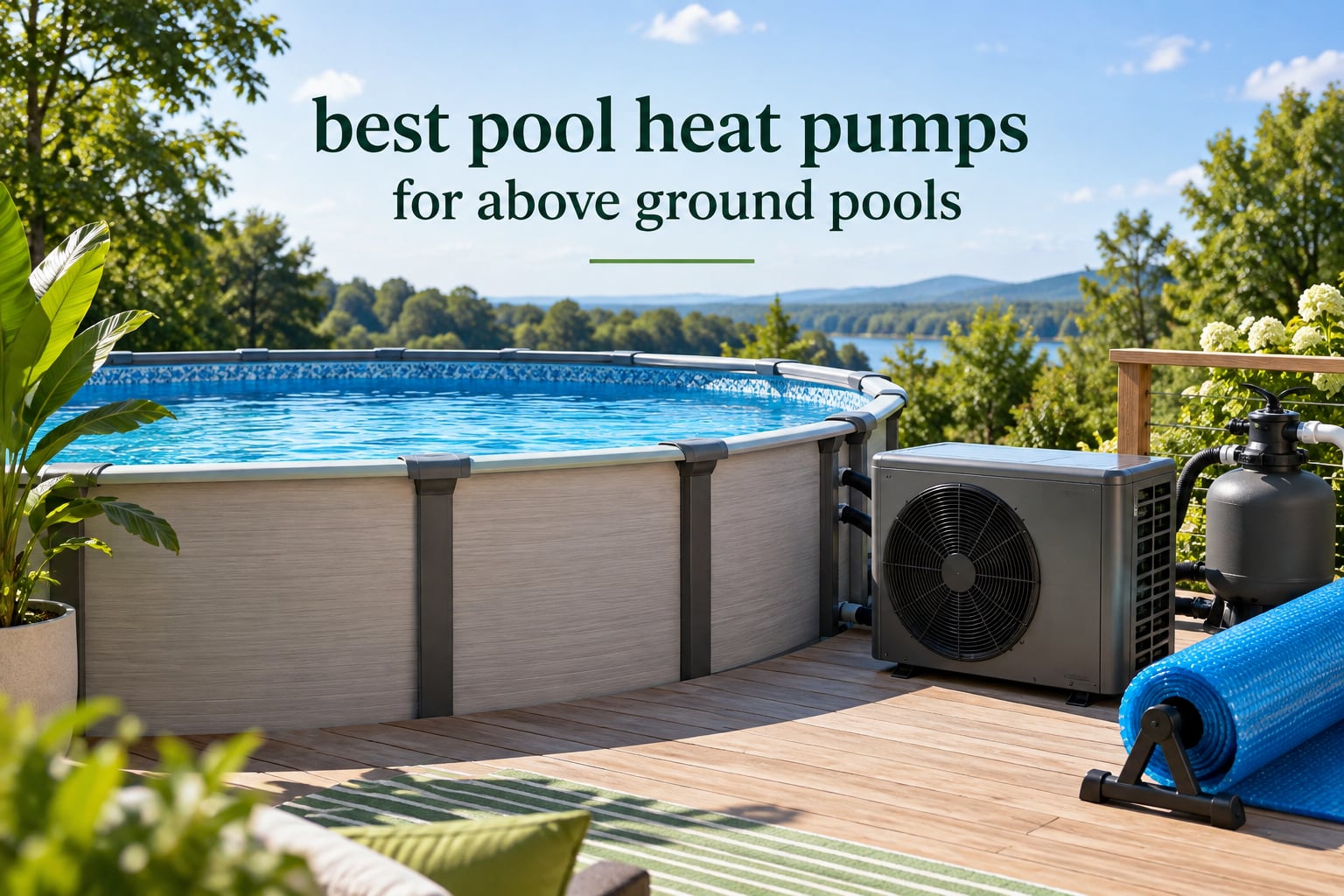
Finding the best pool heat pumps for above ground pools comes down to three numbers most listings bury: your pool’s volume in gallons, the number of BTUs you can run, and how cold it actually gets at night where you live. A heat pump is not a gas heater wearing a smaller hat. It moves heat from the air into your water, which means it warms an above ground pool slowly and cheaply, and it does almost nothing on a cold night when there is no heat in the air to harvest.
That is the honest framing most roundups skip. These units work best as maintenance heaters that hold a pool at 82F to 84F through shoulder seasons, extending your swim window by weeks on either end of the summer. They are not the right tool for bringing a 20,000 gallon pool from 60F to 84F in an afternoon.
Over the past six weeks our team compared ten of the most-reviewed above ground pool heat pumps currently shipping to Amazon, checking capacity against pool size, voltage against breaker availability, and minimum flow requirements against the filter pump most above ground owners already own. Ten picks follow, organized the way we would organize them for a friend with a 16 foot steel frame pool and a GFCI outlet on the deck.
Top 3 Picks for Above Ground Pool Heat Pumps in 2026
The three below are the units we would put on our own pad first. Each earns its badge on a different combination of capacity, warranty length and installation simplicity.
ECOPOOLTECH Smart Heat Pump
- COP 5.62
- pure titanium exchanger
- 3-year warranty
- WiFi app control


Best Pool Heat Pumps for Above Ground Pools in 2026
Every unit below runs on electricity only, with no gas or propane hookup. Read the voltage column first, because it decides which of these you can actually install without an electrician.
| Product | Specifications | Action |
|---|---|---|
| ECOPOOLTECH Smart Heat Pump |
|
Check Latest Price |
| VARMINPOOL 6300 Gallon 120V |
|
Check Latest Price |
 Varpoolfaye 40000 BTU 220V Varpoolfaye 40000 BTU 220V |
|
Check Latest Price |
 Varpoolfaye 16000 BTU 110V Varpoolfaye 16000 BTU 110V |
|
Check Latest Price |
 WARMBLU 10000 Gallon 110V WARMBLU 10000 Gallon 110V |
|
Check Latest Price |
 FibroPool FH220 20000 BTU FibroPool FH220 20000 BTU |
|
Check Latest Price |
 FibroPool FH135 35000 BTU FibroPool FH135 35000 BTU |
|
Check Latest Price |
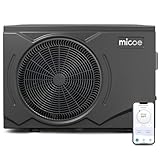 MICOE 35000 BTU Inverter MICOE 35000 BTU Inverter |
|
Check Latest Price |
 Vidapool 16000 BTU 5000 Gallon Vidapool 16000 BTU 5000 Gallon |
|
Check Latest Price |
| Varpoolfaye 30000 BTU 110V |
|
Check Latest Price |
1. ECOPOOLTECH Smart Heat Pump: Best Overall for Above Ground Pools up to 5,000 Gallons
ECOPOOLTECH Swimming Pool Heater, Pool Heat Pump, Smart WiFi Control, Fits 8/11/15 Foot Pools, Electric Heat Pump Pool Heaters, Pool Warmer for Above groung and inground Pools (7000 Gallons)
COP 5.62
Pure titanium exchanger
40F to 105F ambient
5000 gallon rating
3-year warranty
Pros
- Longest warranty in this group at 3 years
- COP of 5.62 for low running cost
- Tool-free quick-connect hookup
- Titanium exchanger safe for salt water
- Smart WiFi control
Cons
- Sized for pools up to 5000 gallons only
- Ambient range bottoms out at 40F
- Condensation drips from the cabinet
Out of the ten units we compared, the ECOPOOLTECH carries the largest review base at 286 ratings, and that matters more than any spec line when you are buying a sealed box that goes outdoors for eight months a year. Buyers consistently point to the same three things: the three-year warranty, the quick-connect fittings, and how little the electricity bill moves once the pool is up to temperature.
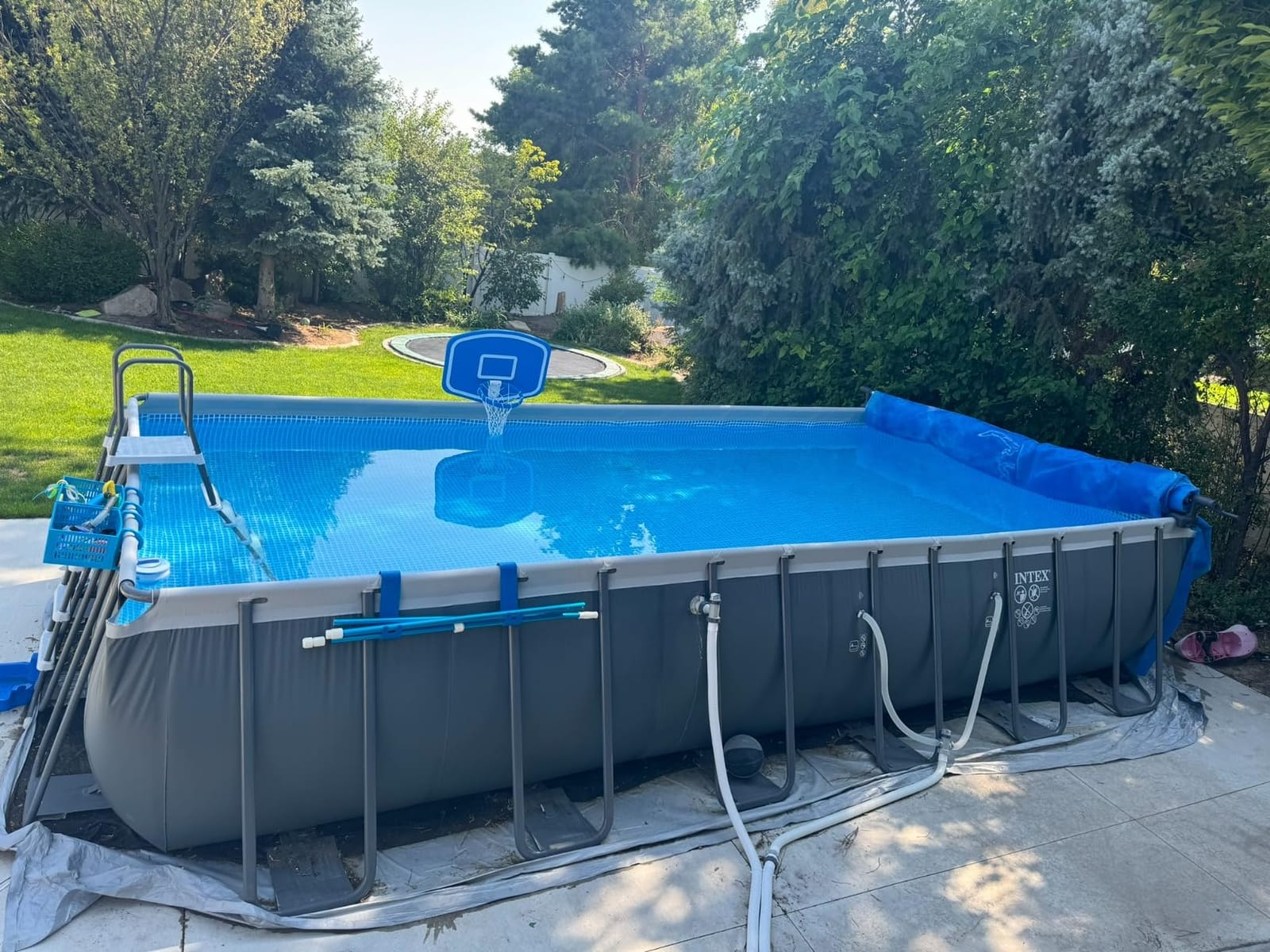
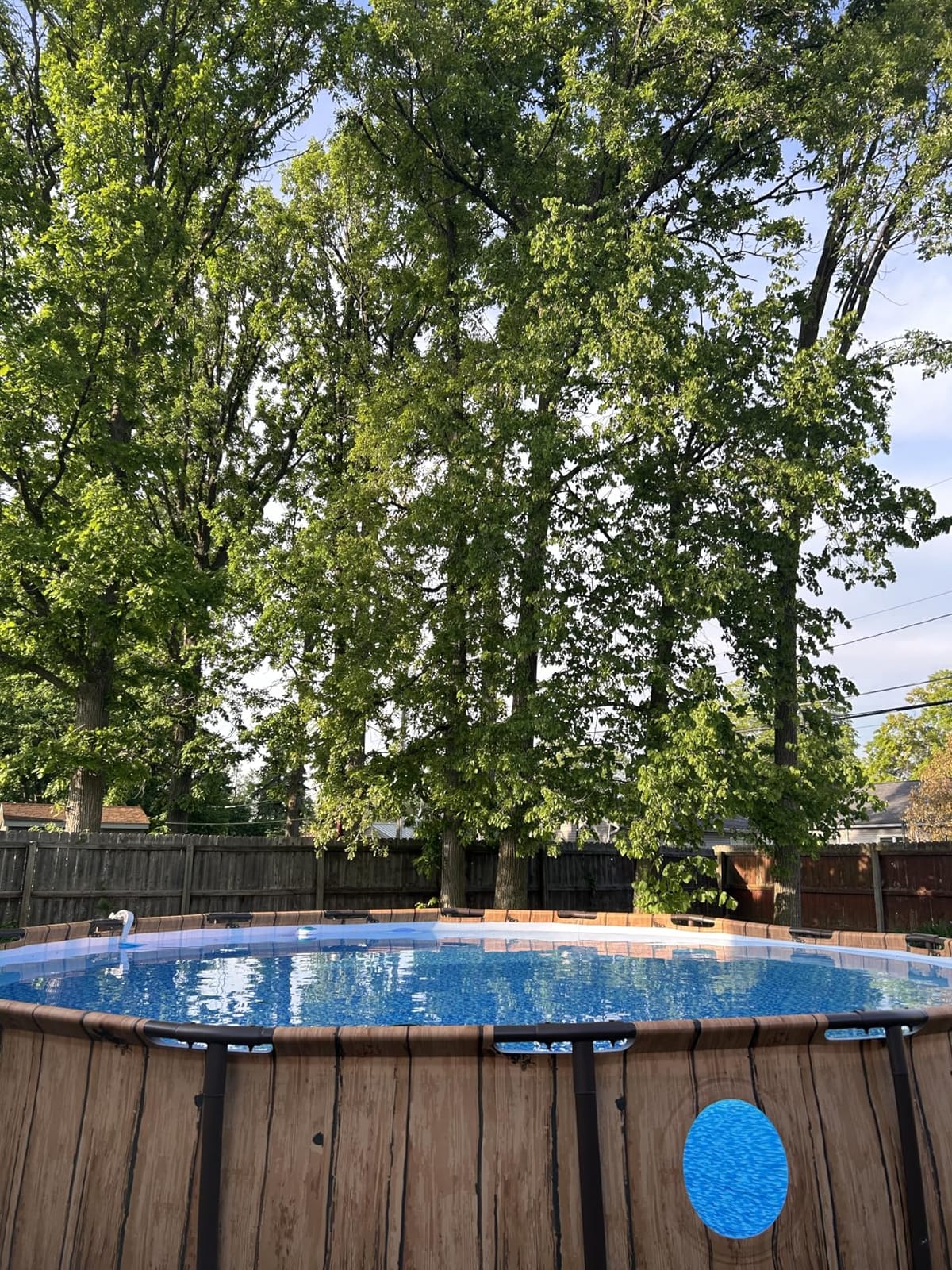
The rating sits at 4.2 out of 5 with 68 percent of owners handing over five stars. The recurring complaint is capacity, not quality. This unit is rated for above ground pools up to 5,000 gallons, which lines up with a 15 foot round or a 9 by 18 foot rectangular frame.
Technically it is a well-built machine. The pure titanium heat exchanger resists the salt chlorinator environments that eat copper exchangers, the COP of 5.62 means roughly five units of heat per unit of electricity in favorable conditions, and the water flow sensor with timed pump control prevents the unit from firing dry on a cartridge filter that has gone unnoticed.
It measures 30 by 11.5 by 20 inches and weighs 73 pounds, which is a manageable two-person lift onto a typical above ground pad. The operating ambient range runs from 40F to 105F, so it works in most of the country from late spring through early fall.
What you need to know before installing it
The number to check first is your pool volume, not the pool’s diameter. A 16 foot round above ground pool already holds more water than this unit is rated to heat, and the symptom owners describe is a compressor that runs for hours without visibly moving the temperature. If your pool holds more than 5,000 gallons, skip ahead to picks three, five, seven, eight or ten.
Second, expect condensation. Water dripping from the base of the unit during a heating cycle or a defrost cycle is normal air conditioning behavior, not a leak, and forum conversations about this product make the same point repeatedly.
Where it falls short
The three-year warranty is a genuine advantage over units sold with a single year of coverage, but it is the strongest support this brand offers and there is no local dealer network behind it. Service questions are handled by the manufacturer rather than a pool store down the road, so if your compressor fails in year four you are mailing a part, not scheduling a service call.
For a 3,000 to 5,000 gallon pool on a 110V circuit with a decent filter pump, this is the unit we would buy first. Pair it with a cover, and you can read our solar pool heater picks for above ground pools if you want free daytime heat on top of it.
2. VARMINPOOL 6,300 Gallon 120V Unit: Best Value for Compact Pads
VARMINPOOL 6300 Gallons Pool Heater for Above Ground Pool,110V, Pro
Heats pools up to 6300 gallons
120V at 17 amps
65 pounds
Smart Life app with scheduling
Pros
- Compact 65 lb design that still covers 6300 gallons
- Smart Life app with scheduling
- Galvanized steel housing for weather resistance
- Low energy draw for the output
Cons
- 17 amp draw needs a dedicated 20 amp outlet
- Smallest review base among the 110V picks
- No cooling mode on this cabinet
This is the pick for anyone whose above ground pool sits in a tight corner with limited pad space. At 17 by 16 by 17.8 inches and 65 pounds, it is the lightest unit in the group by a wide margin, and at 6,300 gallons it covers more water than either of the other compact units on this list.
Its 4.5 star average across 111 reviews is the second highest here, with 82 percent of buyers rating it five stars and 9 percent rating it one star. Reviewers mention the footprint first and the app second. The scheduling function in the Smart Life app lets you preheat before a weekend rather than running the unit through the afternoon.
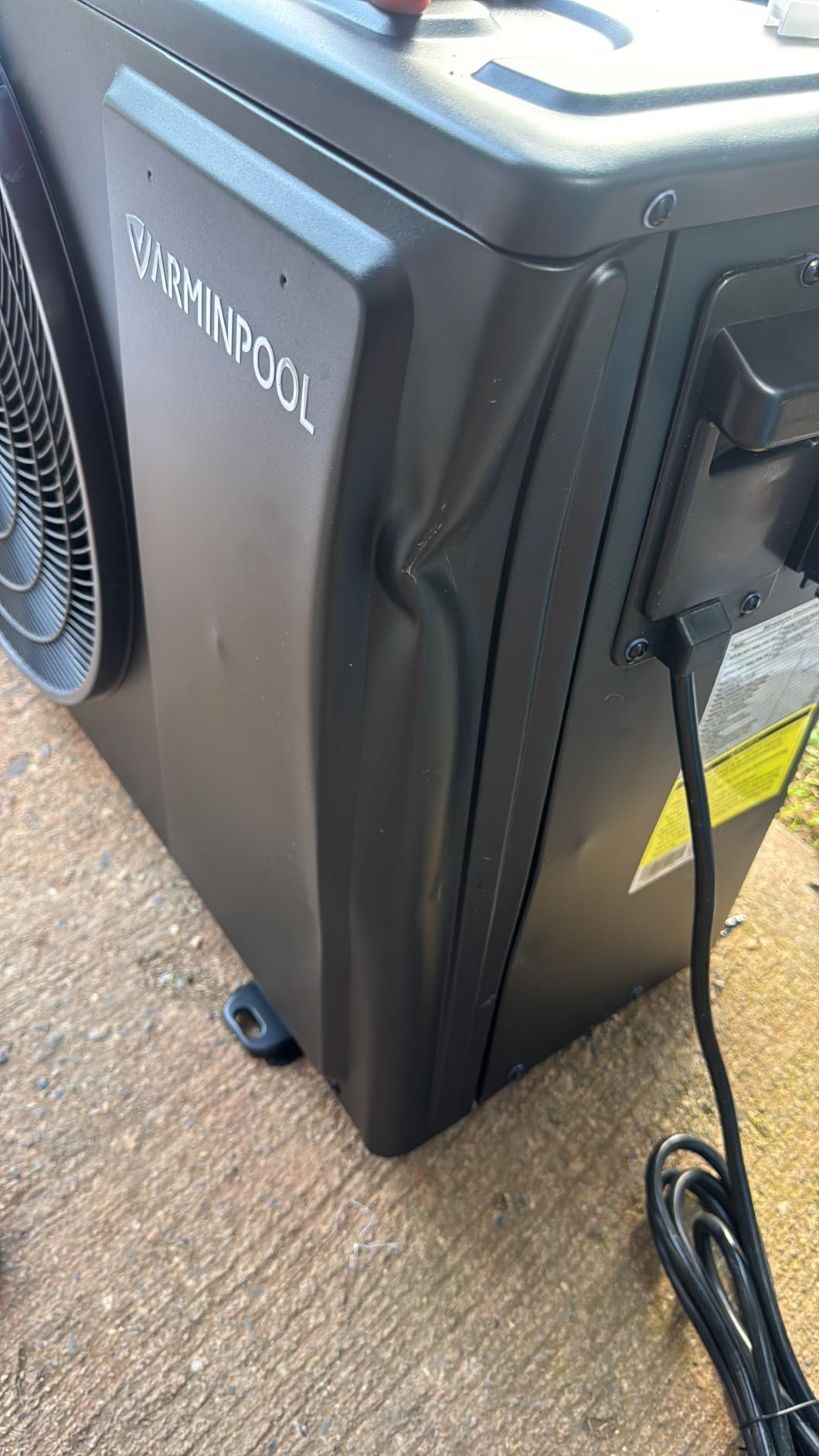
The galvanized modular steel panel housing is built for outdoor life, which matters on a pad that gets rained on daily. The refreshed compact structure also cuts electricity use relative to units of similar output, and that is where most of the value in this category comes from, since a heat pump is a device you run for months.
It draws 17 amps on 120V, and that figure deserves attention. A standard 15 amp household circuit will not carry it, so you need a 20 amp dedicated outlet. That is still far simpler than a 220V run, but it does mean an outdoor outlet installed by someone who knows what they are doing. The listing does not state a minimum flow rate, so confirm what your filter pump delivers before you buy.
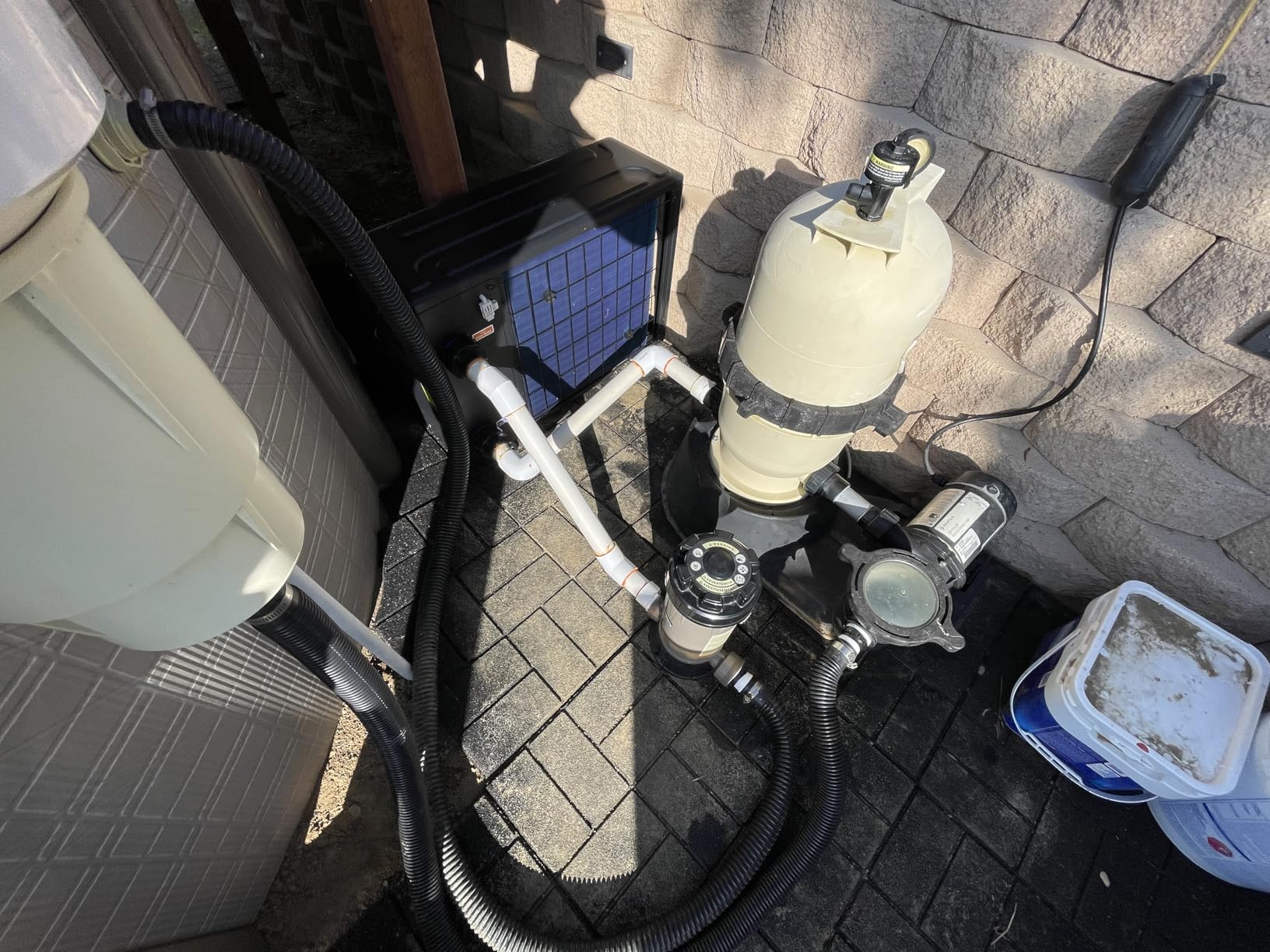
Best fit for small and mid-size pools
Pair this with a 16 or 18 foot round pool, or a rectangular frame of similar volume, and it becomes a proper maintenance heater that holds temperature overnight without help. Our sizing guidance further down maps pool volumes to BTU bands, and this unit sits in the 5,000 to 7,000 gallon range.
One detail worth planning around is circulation. Heat pumps move water through the exchanger at a set rate, and if your filter pump is a small above ground cartridge pump you should confirm it can deliver the required flow before the unit arrives.
Where it falls short
At 111 reviews this has one of the thinnest owner histories in the group, and with a brand this new there is no established service network. It is also the only unit here that will not cool your pool, so shoulder season comfort is one-directional.
If you want the same small footprint with a longer track record and a cooling mode, the FibroPool FH220 further down covers a similar gallon range on 240V. And if you want the smallest possible electrical footprint, the Vidapool at pick nine draws only 7 to 8 amps.
3. Varpoolfaye 40,000 BTU 220V Unit: Best for Above Ground Pools up to 12,000 Gallons
Varpoolfaye 40000 BTU Pool Heater for Above Ground and Inground Pools 220v
40,000 BTU max output
COP of 6.2
Pools up to 12000 gallons
Heating and cooling modes
53 dB
Pros
- Highest output here at 40000 BTU
- COP of 6.2 cuts energy use sharply
- Heats and cools in one unit
- 53 dB operating noise
- Titanium exchanger rated for salt water
Cons
- Requires a 220V dedicated circuit
- Large and heavy compared with 110V models
- Condensation drips during defrosting
For a large above ground frame in the 10,000 to 12,000 gallon range, this is the most capable 220V unit here. Forty thousand BTU paired with a COP of 6.2 covers pools up to 12,000 gallons across 14 through 28 foot frames, and it is the only pick that pairs that output with a cooling mode.
It rates 4.4 out of 5 from 149 reviews with 78 percent five stars. Owners single out the heating and cooling modes, which let you pull water temperature down on a hot August afternoon rather than only pushing it up.
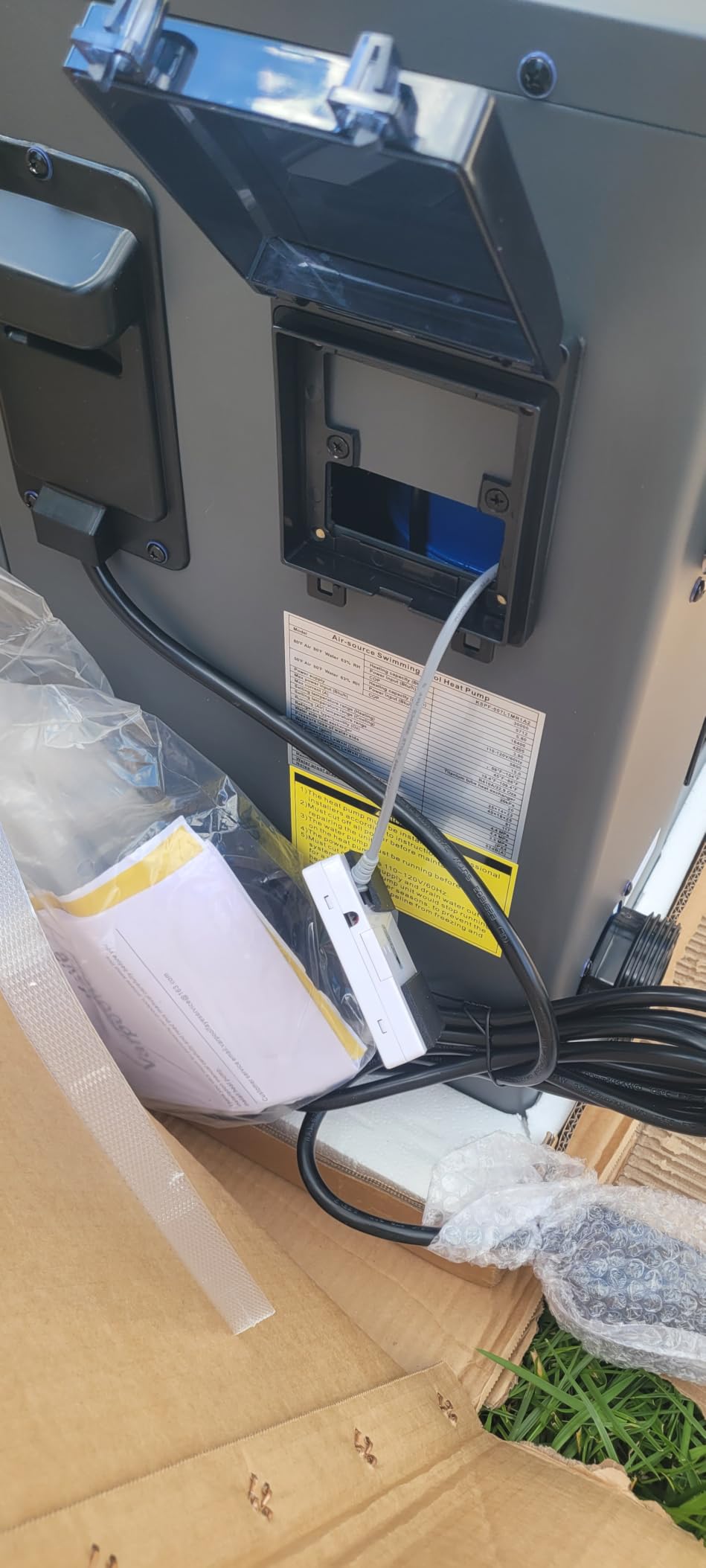
The compressor is a high-pressure type, which is where the COP of 6.2 comes from, and manufacturer testing puts that figure at roughly 45 percent energy savings against a conventional heater. Heating mode covers water from 59F to 104F, and cooling mode runs from 45F to 86F, so it is genuinely useful in a climate with hot shoulder months.
Connections use 1.5 inch fittings and a 126 inch power cord, so you will likely need an electrician to run the 220V circuit and possibly a subpanel. The cabinet measures 35 by 14 by 22 inches, and the water-electric separation design keeps the electrical side away from wet plumbing.
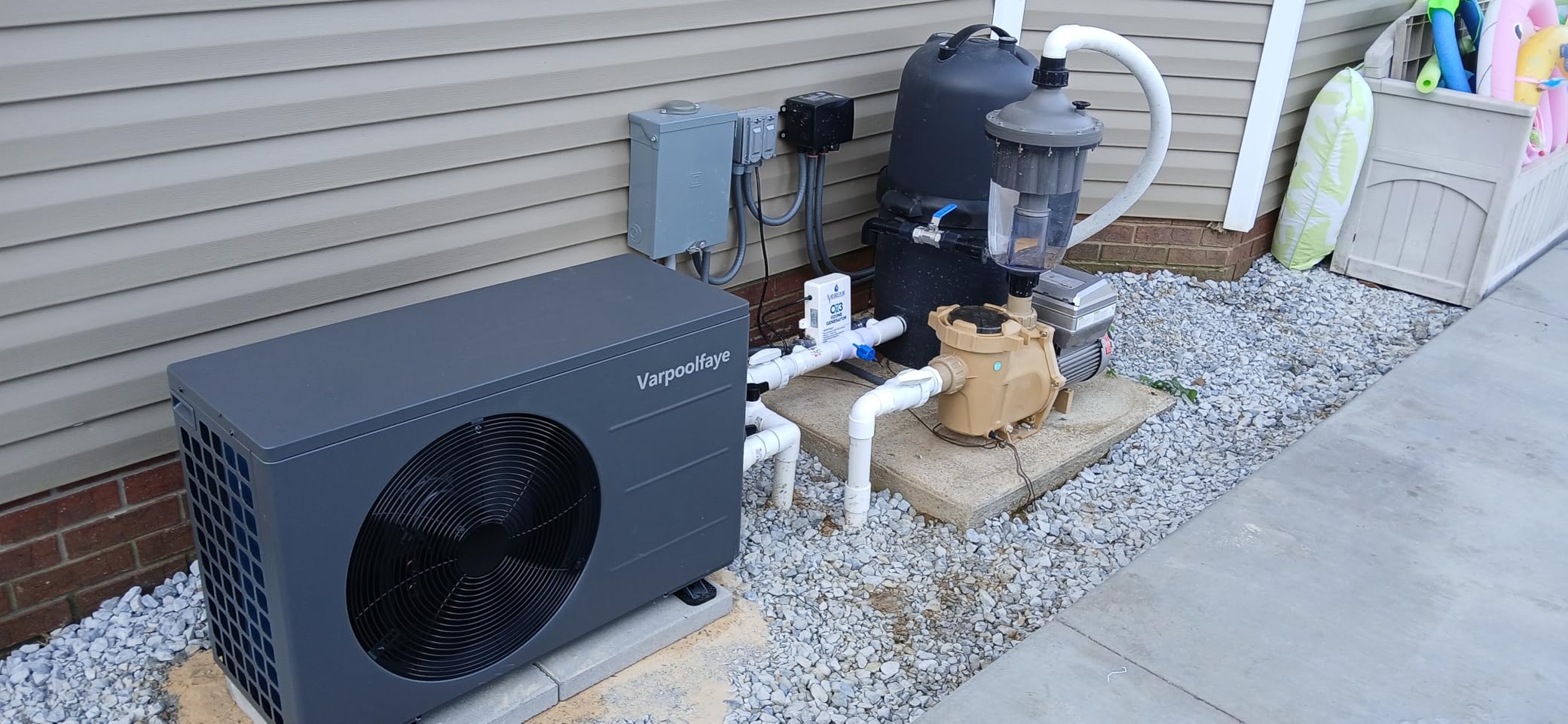
When the 220V requirement pays off
The break-even is straightforward. Once you are past 8,000 gallons, a 120V unit spends most of its life running flat out and losing the ground it gained during the day to overnight loss. Doubling the electrical capacity roughly doubles the heat delivery, and above ground pools lose heat quickly through thin steel and vinyl walls.
A pool cover changes this equation more than most buyers expect, and it is why we would never size without one in the plan. Our guide to pool heat pumps built for cold climates goes deeper on where low-ambient operation earns its cost.
Where it falls short
For a 4,000 gallon pool, this is far more machine than you need, and the 220V install is wasted money. If your only goal is holding a small pool at 82F, pick four or pick nine will heat the same water at a fraction of the electrical work.
Also expect condensation on the base during defrost cycles. It is normal operation, not a fault.
4. Varpoolfaye 16,000 BTU 5,500 Gallon 110V Unit: Best 110V Plug-In Pick
Varpoolfaye 5,500 Gallon Heat Pump Pool Heater for Above Ground Pool 110v
16,000 BTU heating and cooling
COP of 4.3
Standard 110V power
50 dB operation
Needs 700 GPH flow
Pros
- 16000 BTU on a standard 110V outlet
- Heating and cooling in one cabinet
- Very quiet at 50 dB
- App control with scheduling
- Titanium exchanger for fresh or salt water
Cons
- Requires 700 GPH from your pool pump
- Lower COP of 4.3 than 220V models
- Condensation drips from the bottom
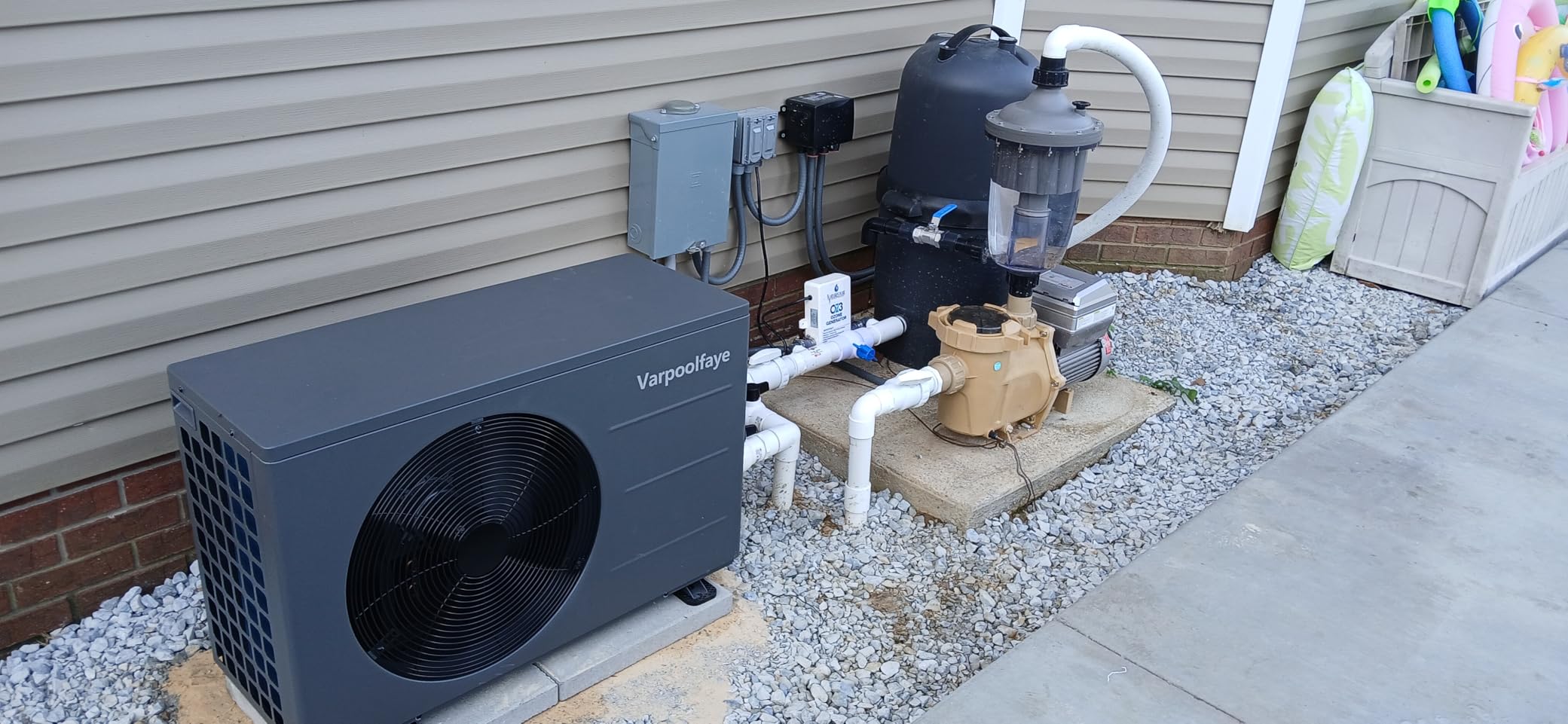
This is the unit we recommend when the question is simply can I avoid calling an electrician. It delivers 16,000 BTU of heating and cooling on standard household power, and it carries 4.4 stars across 152 reviews with 77 percent five-star ratings.
It is rated for above ground pools up to 5,500 gallons, so treat that as the ceiling rather than a target. Heating mode spans 59F to 104F and cooling mode runs from 46F to 82F.
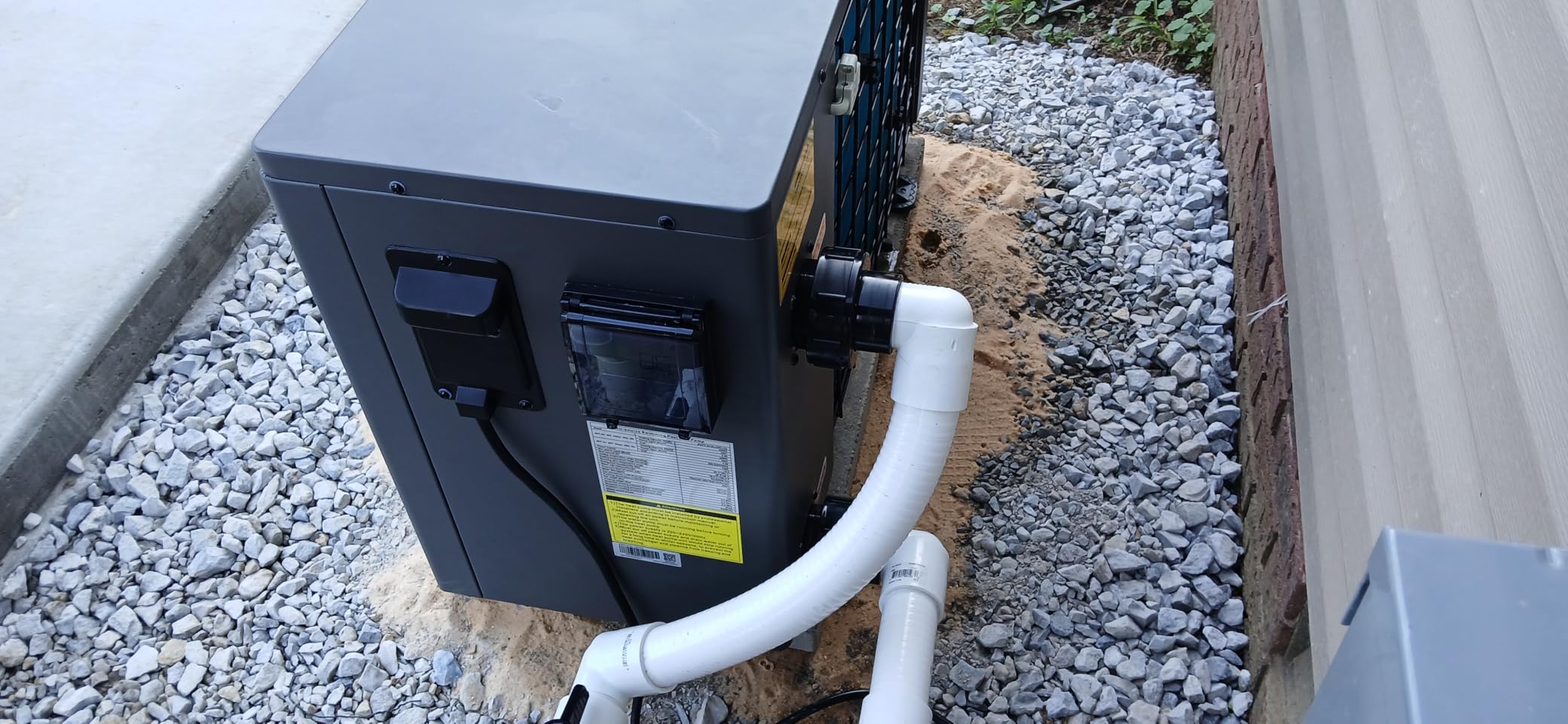
Two details make this unit stand out among the 110V crowd. The 50 dB sound-dampened operation is quieter than most above ground filter pumps, and the package includes two DN32 to 38mm universal connectors plus a 118 inch power cord, so the install is close to tool-free on a pool with hose fittings.
The titanium heat exchanger works in both fresh and salt water, and the water-electric separation design was clearly considered for a wet pad environment. At 74.8 pounds and 16.5 by 14.2 by 17.8 inches, it is one of the easier units in the group to reposition.
The flow rate requirement is not optional
Owners mention the same caveat in almost every review: this unit needs your pool pump to deliver at least 700 GPH. If you run a variable speed pump at low RPM, the heat pump can struggle to fire even though the water is moving. Set the pump to high speed or to a fixed speed while the heat pump runs.
For a 5,000 gallon pool, expect a slow climb from ambient and a very steady hold once you reach target. The forum consensus on heat pumps generally is that this is the intended behavior, not a defect.
Where it falls short
The COP of 4.3 is the lowest efficiency figure among the mid-size units here, which means more electricity per unit of heat than the 40,000 BTU model at pick three. Over a full season that difference is real, and it is the argument for spending on a 220V circuit if your pool is above 6,000 gallons.
The 700 GPH requirement is also stricter than the Vidapool at pick nine, which needs only 450 GPH. If your filter pump is undersized, that difference decides between them.
5. WARMBLU 10,000 Gallon 110V Unit: Best Capacity Without a 220V Run
WARMBLU 10,000 Gallons Above Ground Pool Heater 110V
Handles pools up to 10000 gallons
110V operation
COP up to 16 with inverter control
Under 50 dB
Pros
- Covers 10000 gallon above ground pools on 110V power
- Inverter control optimizes output automatically
- Very quiet under 50 dB
- App plus on-unit touch panel
- Water and electrical systems fully separated
Cons
- Heaviest unit here at 112.4 pounds
- Only a 12-month warranty
- COP 16 is a manufacturer-rated figure
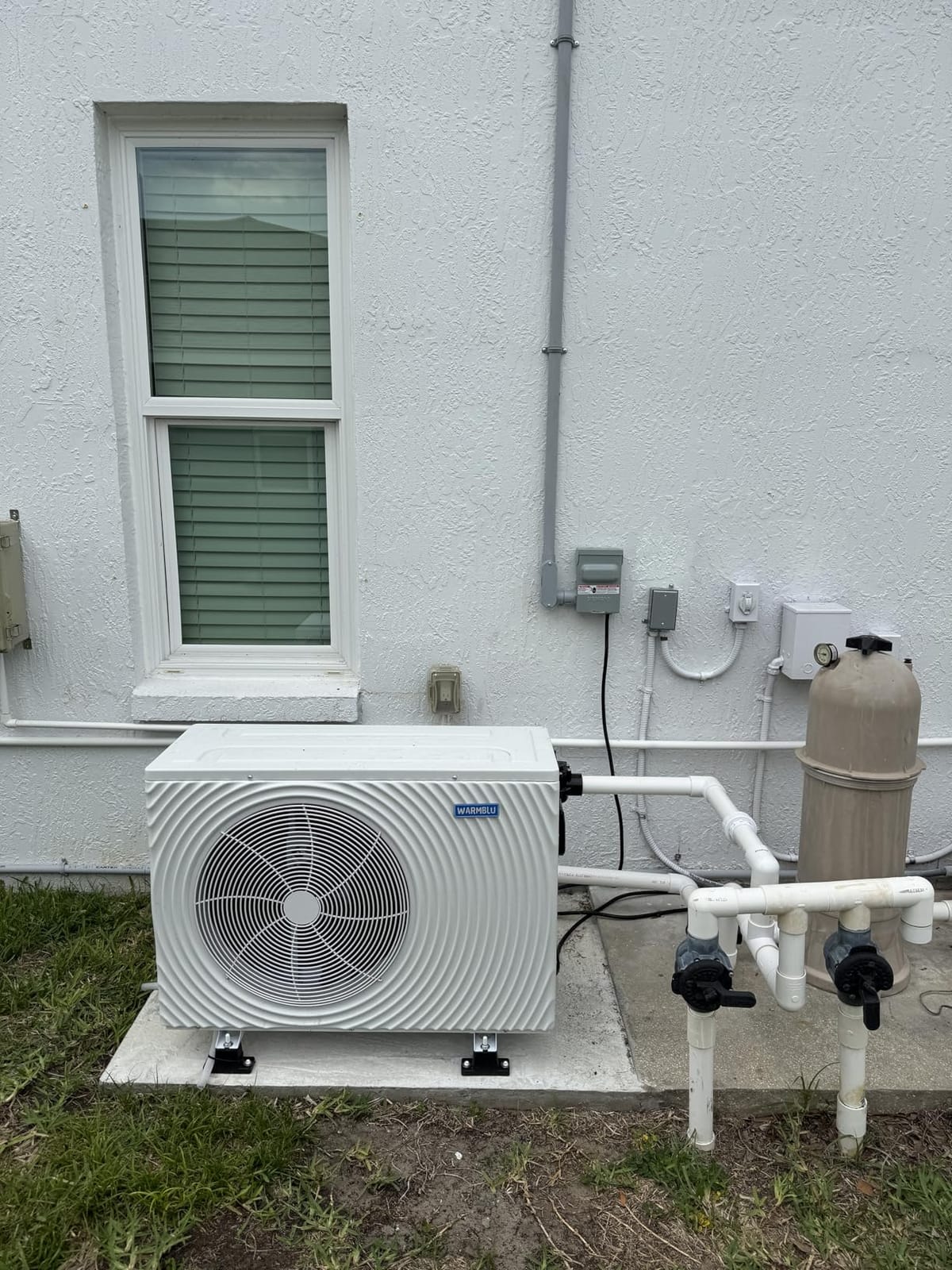
Ten thousand gallons of above ground water on household current is an unusual pairing, and this is the unit that pulls it off. It runs on 110V, reaches 10,000 gallons, and does it quietly enough to sit beside a house without complaint.
The rating is 4.2 out of 5 from 139 reviews, with 73 percent five stars and 14 percent one star. A 14 percent one-star slice is higher than most listings here, and reading those reviews shows the complaints cluster around delivery handling and service friction rather than the machine itself.
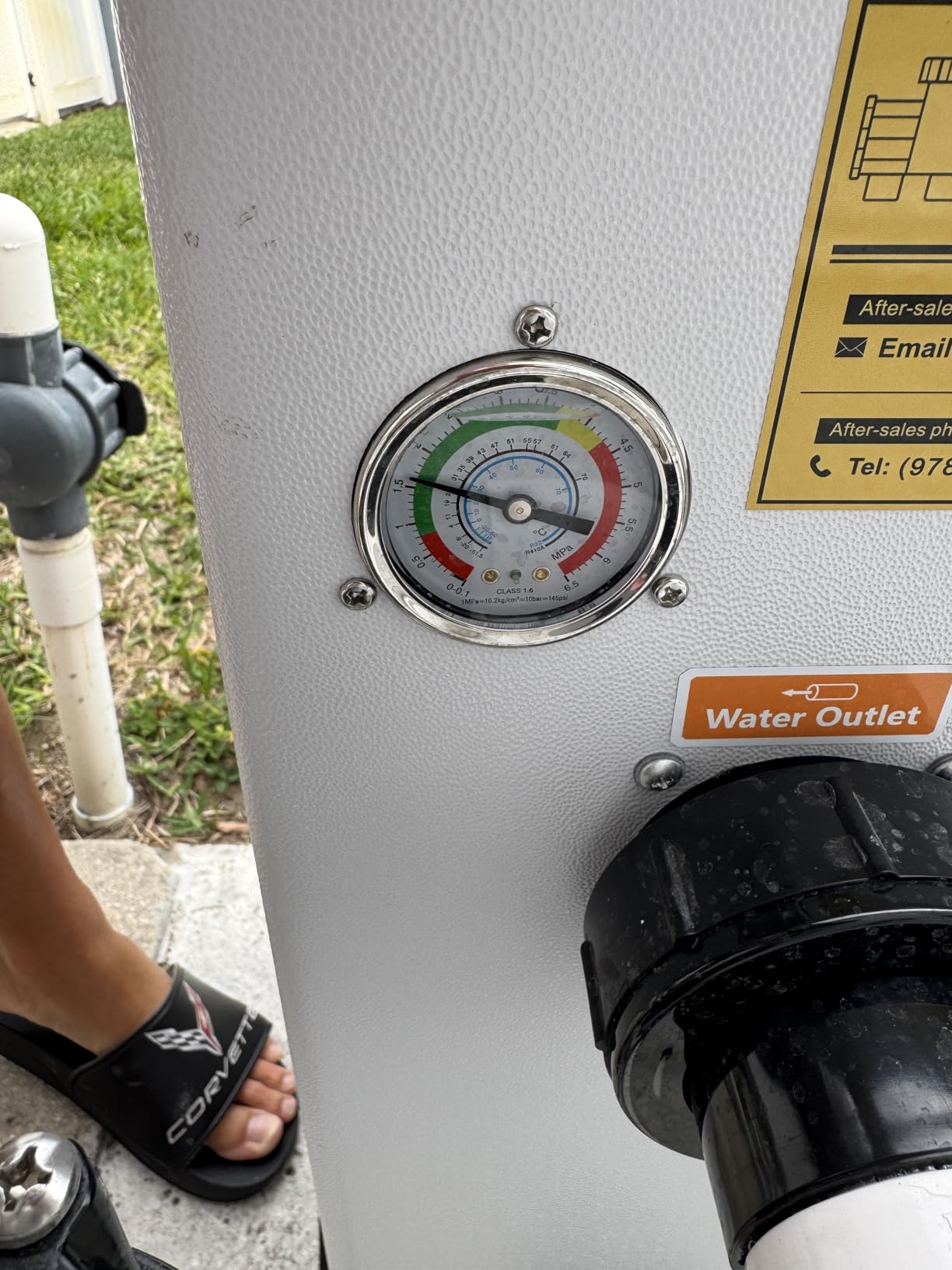
The Thallo H10 system uses SpringBreath 1.0 inverter control, which ramps the compressor rather than switching it fully on and off. That approach is why the manufacturer can claim a COP figure up to 16 and why the noise level stays under 50 dB, described in the listing as quieter than a refrigerator.
The pure titanium exchanger resists corrosion, and full water and electrical separation is a sensible design choice for a unit sitting inches from a wet pool wall. Controls come at both ends: a mobile app and an on-unit touch panel, so you can check temperature without a phone.
Realistic expectations for a large pool
Treat the COP 16 figure as a rated number, not a promise. Rated efficiency is measured under laboratory conditions at a specific ambient temperature, and real-world performance drops as outdoor air cools. If your summer nights sit near 50F, expect the compressor to run close to continuously and the gain to be modest.
Owners and the broader forum consensus agree on the sequencing: this unit holds temperature well once the pool is warm, and it warms slowly from cold. Above ground pools need a cover, and if you are pairing one, the right order is to install the cover before the heat pump.
Where it falls short
The twelve-month warranty is the shortest in this group, and a COP claim that high invites skepticism from anyone who has run a heat pump through a real season. At 112.4 pounds and 27 by 17 by 40 inches, it is the largest and heaviest unit on the list, so plan the move with two people.
For a pool under 7,000 gallons, the FibroPool FH135 at pick seven is smaller, cheaper to run and better supported. This one earns its place only when the gallon count demands it.
6. FibroPool FH220 20,000 BTU 240V: Best for Larger 5,000 Gallon Setups
FibroPool Pool Heat Pump FH220-20000 BTU 240V – Up to 5000 Gal – PVC
20,000 BTU air-source heat pump
Pools up to 5000 gallons
240V electric
Heating and cooling modes
Pros
- Best value per BTU in this group
- Draws about 1 kW while running
- Reversing valve gives heating and cooling
- Plumbing adapters included for hookup
- Customer service replaces boards and transformers quickly
Cons
- Wide 3 to 4 degree temperature swing
- Electronics sometimes arrive damaged in transit
- Instructions are hard to follow
- Performance varies sharply by climate
Of the ten units here, the FibroPool FH220 has the widest spread of owner experience. It sits at 4.1 stars across 104 reviews, with 57 percent five stars, which tells you the satisfied customers are very satisfied and the unhappy ones are unhappy. Understanding that spread matters before you buy.
At 20,000 BTU on 240V for pools up to 5,000 gallons, the output is generous for the volume. It draws roughly 1 kW while running, which keeps the operating cost in the range of a modest electric bill rather than a propane bill.
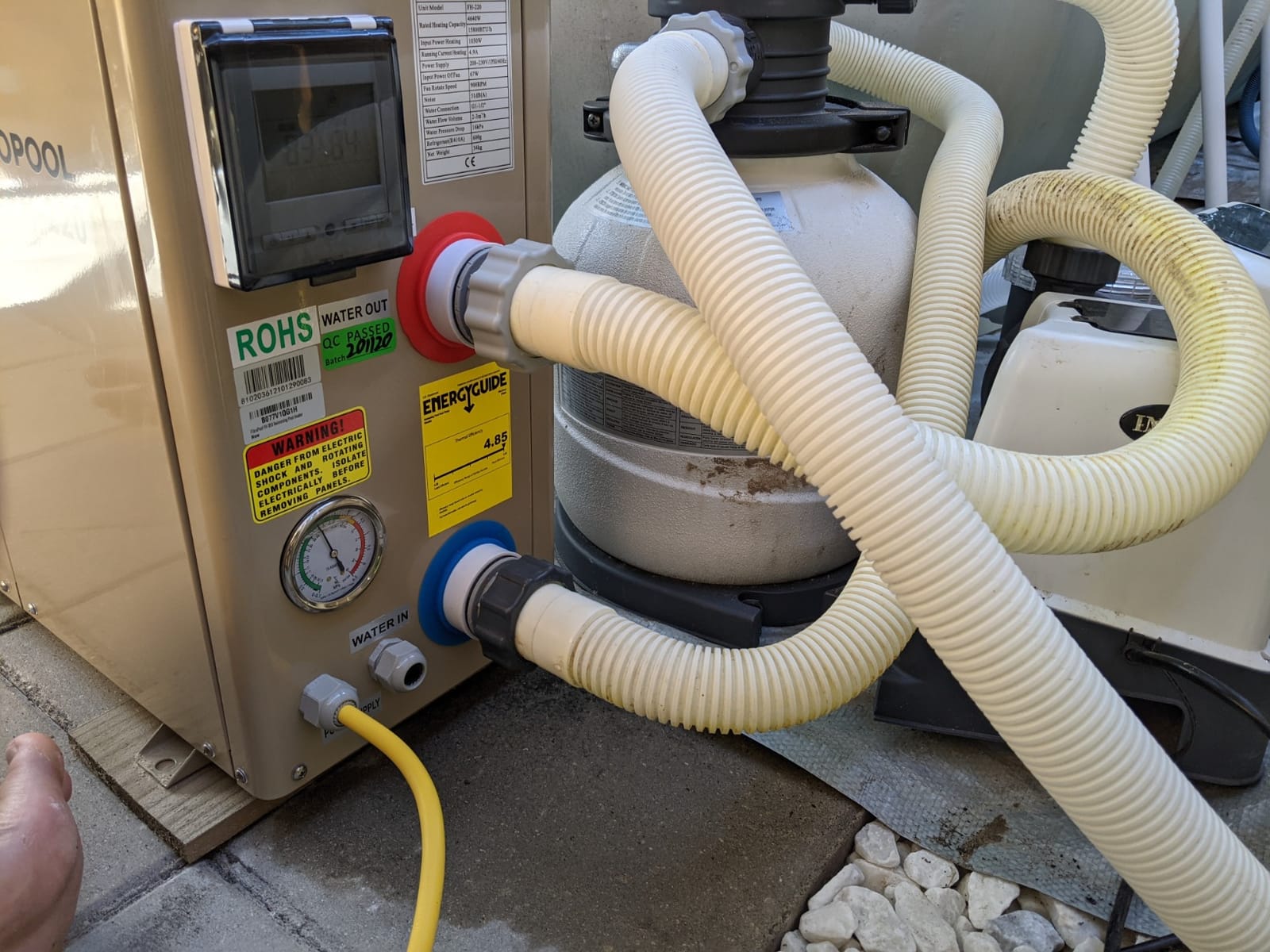
The reversing valve lets it run in cooling as well as heating, and the low-noise outdoor cabinet uses weather-resistant materials. It weighs 77.8 pounds and the package measures 35.2 by 21.2 by 13.33 inches, a wide and low profile that sits comfortably on an above ground pad.
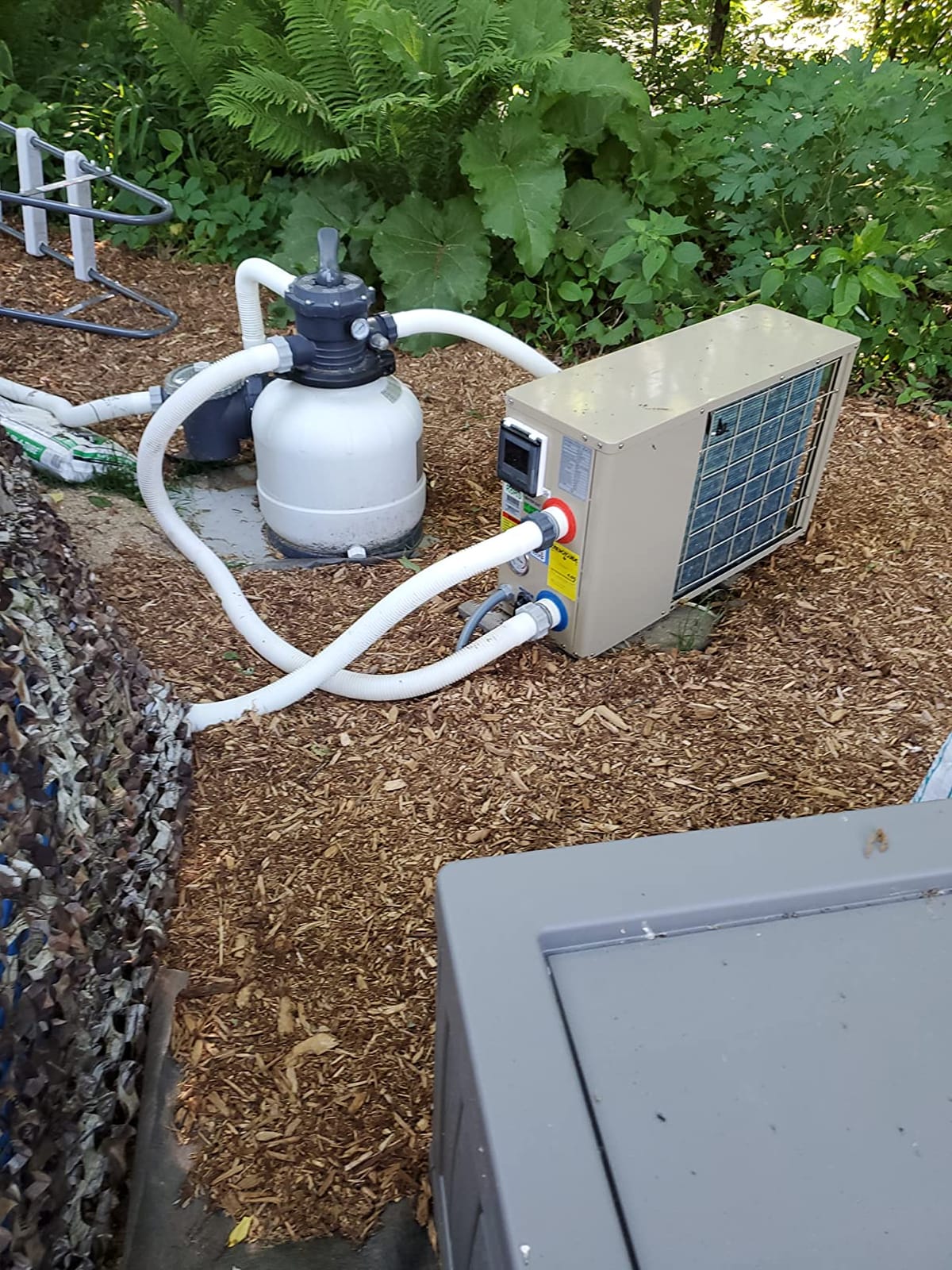
Happy owners in dry and moderate climates report five to seven days to warm 3,000 to 4,000 gallon above ground pools from a cold start. That is exactly the maintenance heater use case, and it is why we pair it with a cover in every recommendation below.
The temperature control dead band
The most cited technical complaint concerns the control logic. On units with the reversing valve, a non-adjustable 3 degree restart dead band produces a 3 to 4 degree swing between cut-in and cut-out temperatures, so the pump cycles on and off across a wide band rather than holding a tight setpoint.
If you want water held within a degree or two overnight, this is not the unit. If you want warm water at 7am without babysitting a switch, it does the job, and the long review history means parts and advice are easy to find.
Where it falls short
Its 240V requirement is harder than 110V for a typical above ground pool setup, and that is often why owners in mild climates report disappointing results while buyers in cold dry climates report the opposite. One California owner with a 2,800 gallon pool saw water stall near 65F, which is a climate outcome rather than a defect.
Damaged transformers and control panels arriving in the box are reported often enough to check the unit on arrival, and several buyers praise FibroPool for replacing main boards quickly once contacted. Poorly written instructions mean most owners set it up from video guides, so budget an hour for that.
7. FibroPool FH135 35,000 BTU 120V Unit: Best Maintenance Heater for 7,500 Gallon Pools
FibroPool Pool Heat Pump FH135-35,000 BTU 120V – 7,500 Gal – Electric
35,000 BTU heating capacity
Fully electric 120V
Pools up to 7500 gallons
Round cabinet for tight pads
Pros
- 35000 BTU on a regular 120V outlet
- Owners report 59F to 81F in about a week
- Very quiet with minimal moving parts
- Metal casing resists rust and yellowing
- Fits common Intex style pools
Cons
- Most expensive per BTU in this group
- Power cord is about 5 feet and the plug adapter is bulky
- No WiFi or app control
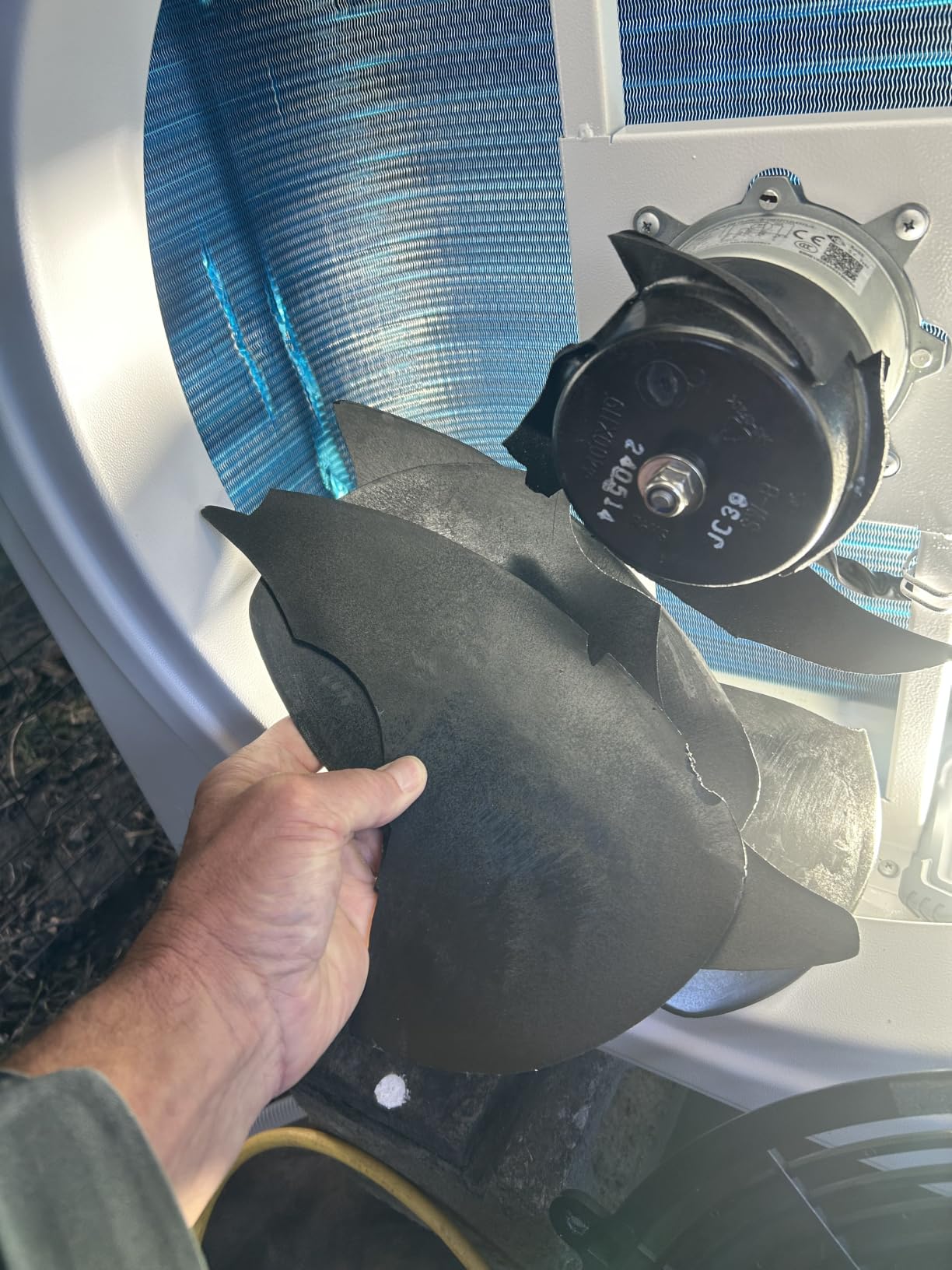
- Some units arrive with damaged fan blades
This is the unit that behaves most like a proper pool heater while still running off a household outlet. Thirty-five thousand BTU on full 120V power for pools up to 7,500 gallons is a rare combination, and the round cabinet is shaped for the tight pads that come with above ground installations.
Owners report a range of real results: one moved a pool from 59F to 81F in about a week, another took a 10,000 gallon pool from 82F to 88F in roughly four hours. That second number is the maintenance heater case working exactly as intended, since you are only topping up a few degrees against overnight loss.
Quietness comes from having few moving parts, and several owners say they have to look at the fan or touch the water to confirm it is running. The metal casing and fan prop resist the rust and yellowing that show up on lighter cabinets after a season of sun and rain.
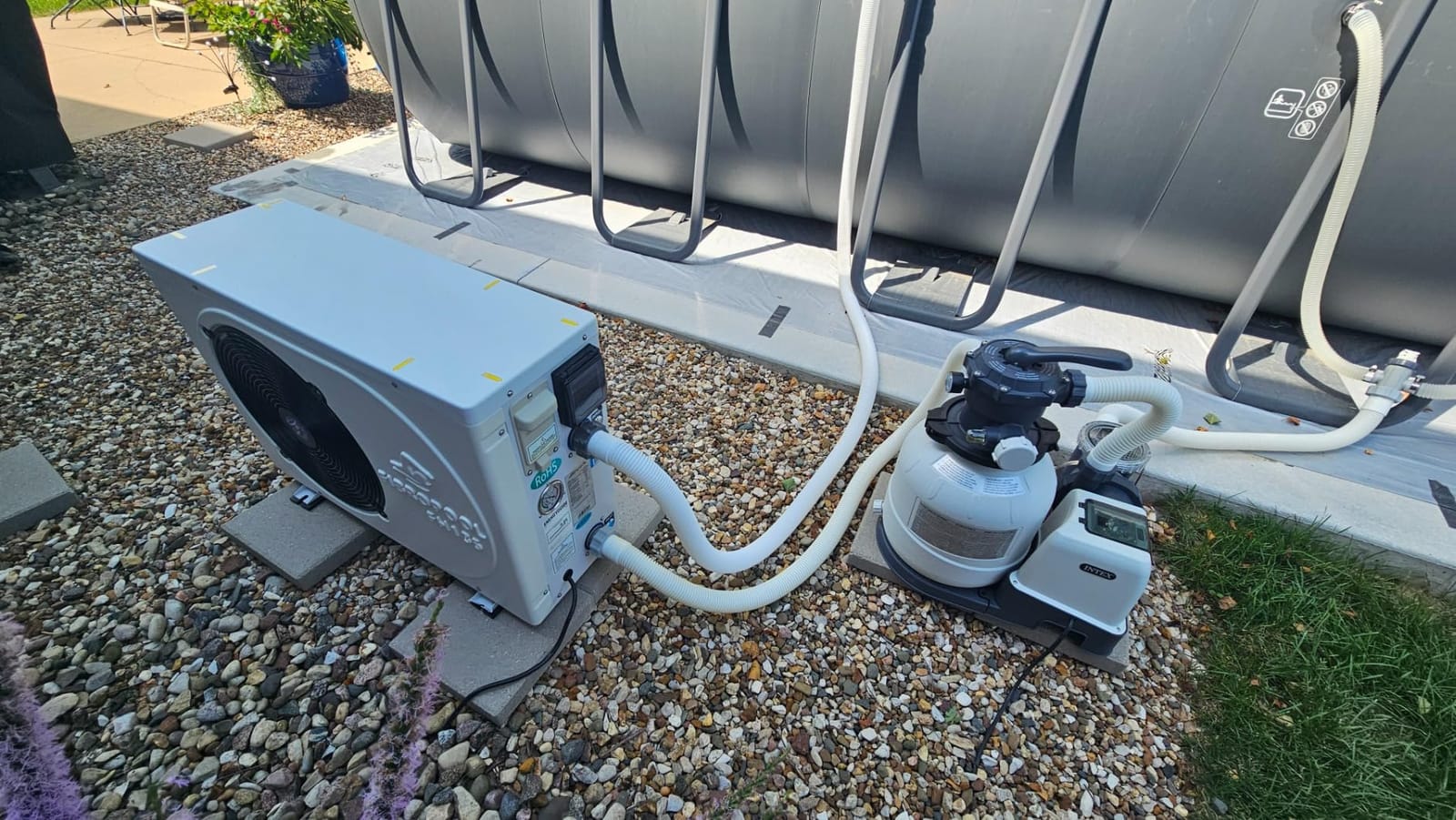
Fittings are compatible with common Intex style above ground pools, which removes the most common install headache. It also suits spas and hot tubs, and FibroPool sells 55,000 and 70,000 BTU versions of the same platform if you later outgrow it.
Best used as a top-up heater, not a first heater
The pattern owners describe is two stage. If a gas heater or a solar cover brings the pool to temperature first, this unit holds it there for a fraction of the running cost. Trying to use it as the only heat source on a 7,500 gallon pool in a mild climate is where the disappointment comes from.
It weighs 108.8 pounds and measures 38 by 15 by 26 inches, so budget for a two-person lift. If you want the same class of output with app control, the MICOE at pick eight is the alternative, and it also runs colder.
Where it falls short
It carries the highest cost per BTU in this group, and buyers say so directly. The power cord is short at about five feet and the plug adapter is bulky enough that a weatherproof GFCI lid may not close over it, so plan your outlet placement carefully.
There is no WiFi or app, so temperature readings require walking to the unit. A small number of units have arrived with broken fan blades hidden inside the fan compartment by the packing fittings, and some control boards have reportedly failed after heavy rain, with at least one buyer told to purchase a replacement controller at his own cost.
8. MICOE 35,000 BTU Inverter Unit: Best for Cold Climate Shoulder Seasons
MICOE 35000 BTU Pool Heat Pump, Inverter Pool Heater for Above Ground Pools
35,000 BTU inverter heating
Pools up to 24 ft and 12000 gallons
Operates down to 32F ambient
50 dBA
Pros
- Rated to operate down to 32F ambient
- Inverter driven 35000 BTU output
- Touch panel plus smart app for control
- 50 dBA operation
- Titanium exchanger rated for salt water
Cons
- Heating speed still depends on ambient air
- Large footprint at 36.6 by 14.6 by 25.2 inches
- Lowest average rating among newer brands at 4.1
The MICOE has the lowest operating floor in this group, rated to run down to 32F ambient while bringing water up to 104F. If your pool season runs into cold shoulder months in the Northeast or upper Midwest, that single spec is the reason to look here first.
It holds 4.1 out of 5 from 72 reviews, the second smallest review pool here, with 66 percent five stars and 13 percent one star. The feature sheet reads like a premium machine, so the ratings likely reflect support experience as much as hardware.
The inverter drive lets the compressor modulate rather than cycling on and off, which is what keeps the noise at 50 dBA and makes low-ambient operation viable. A fade-resistant black ABS housing handles sun exposure better than painted steel, and the titanium exchanger is rated for salt water systems.
Control is dual: a TFT touch panel on the unit plus a smart app for scheduling. At 35,000 BTU it is rated for pools up to 24 feet or 12,000 gallons, matching the largest above ground footprints.
How to think about the 32F floor
An operating floor is not the same as an efficiency claim. At 32F the air contains little usable heat, so the unit will run continuously and deliver far less than 35,000 BTU. Low-ambient capability means the compressor keeps going instead of locking out or icing, not that heat appears from nowhere.
If winter operation is what you are buying, a low-ambient heat pump paired with a gas heater is the pattern most owners in cold regions converge on. For shoulder season use in a moderate climate, the Varpoolfaye at pick ten may serve you better at a lower capacity ceiling.
Where it falls short
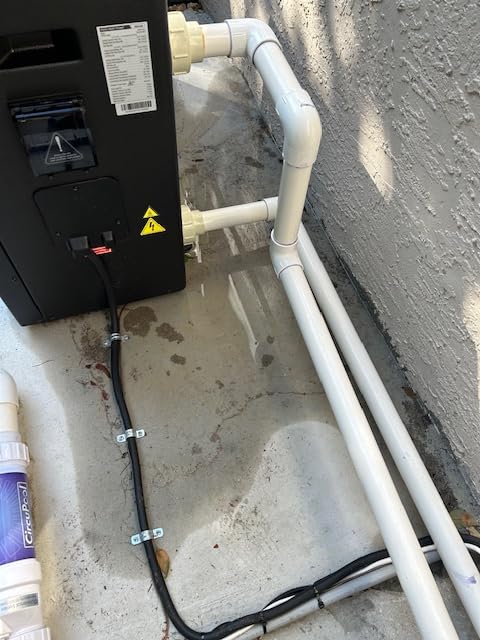
At 36.6 by 14.6 by 25.2 inches this is the largest 110V-class footprint here, so pad clearance matters. Heating speed remains ambient dependent no matter what the listing says, and the 13 percent one-star share points to service response rather than features.
Our pick for genuinely cold climates is covered in more detail in the cold climate heat pump guide, including what low-ambient drainage actually changes about a heat pump’s season length.
9. Vidapool 16,000 BTU 5,000 Gallon Unit: Best Budget Pick for Small Pools
Vidapool Swimming Pool Heater Electric Pool Heat Pump 5000 Gallons
16,000 BTU max output
COP of 5.5
38 dB operation
Integrated WiFi app
Needs 450 GPH flow
Pros
- Lowest cost in the group and quietest at 38 dB
- App works with Home Assistant through Tuya
- Tool-free install with adapters and conversion kit
- Draws only 7 to 8 amps in both modes
- Works with small Intex pools and sand filters
Cons
- Slow heating as a pool nears its 5000 gallon rating
- App lacks runtime history and amp data
- One documented case of repeated fault codes and slow support
For a small above ground pool and a tight budget, the Vidapool is the most complete package in the group. Sixteen thousand BTU with a COP of 5.5 covers pools up to 5,000 gallons, it draws only 7 to 8 amps in both heating and cooling, and it operates at 38 dB, quieter than most filter pumps.
Its 4.3 rating comes from just 48 reviews, the smallest sample here, with 67 percent five stars and only 5 percent one star. That narrow spread is encouraging, though a young listing is still a young listing.
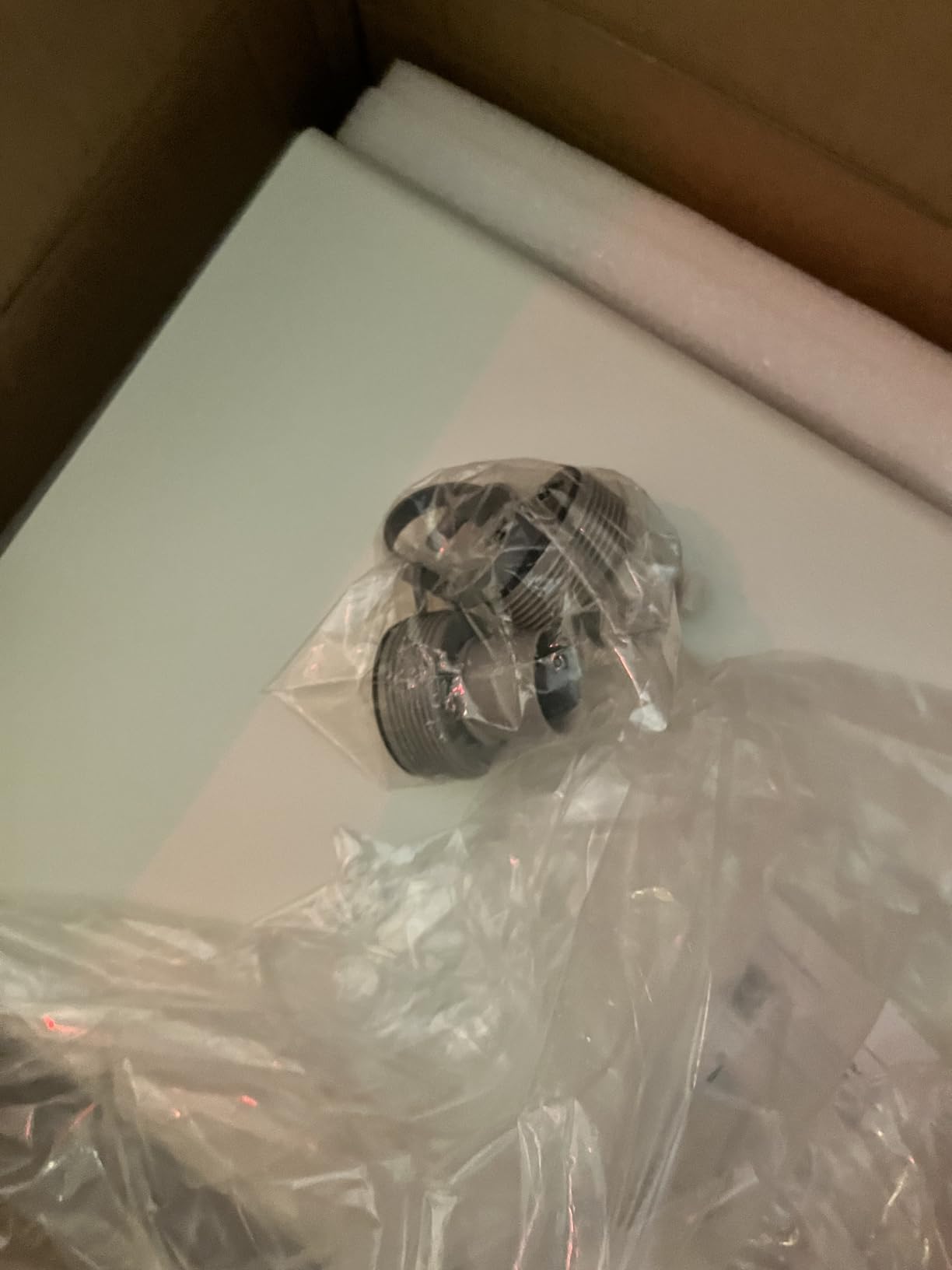
The kit is unusually complete. It includes a 16.5 foot GFCI plug, 1.25 inch and 1.5 inch hose adapters and a 1.5 inch conversion kit, which covers most above ground frames without a trip to the hardware store. The minimum recommended pool pump flow of 450 GPH is the lowest requirement of any unit here.
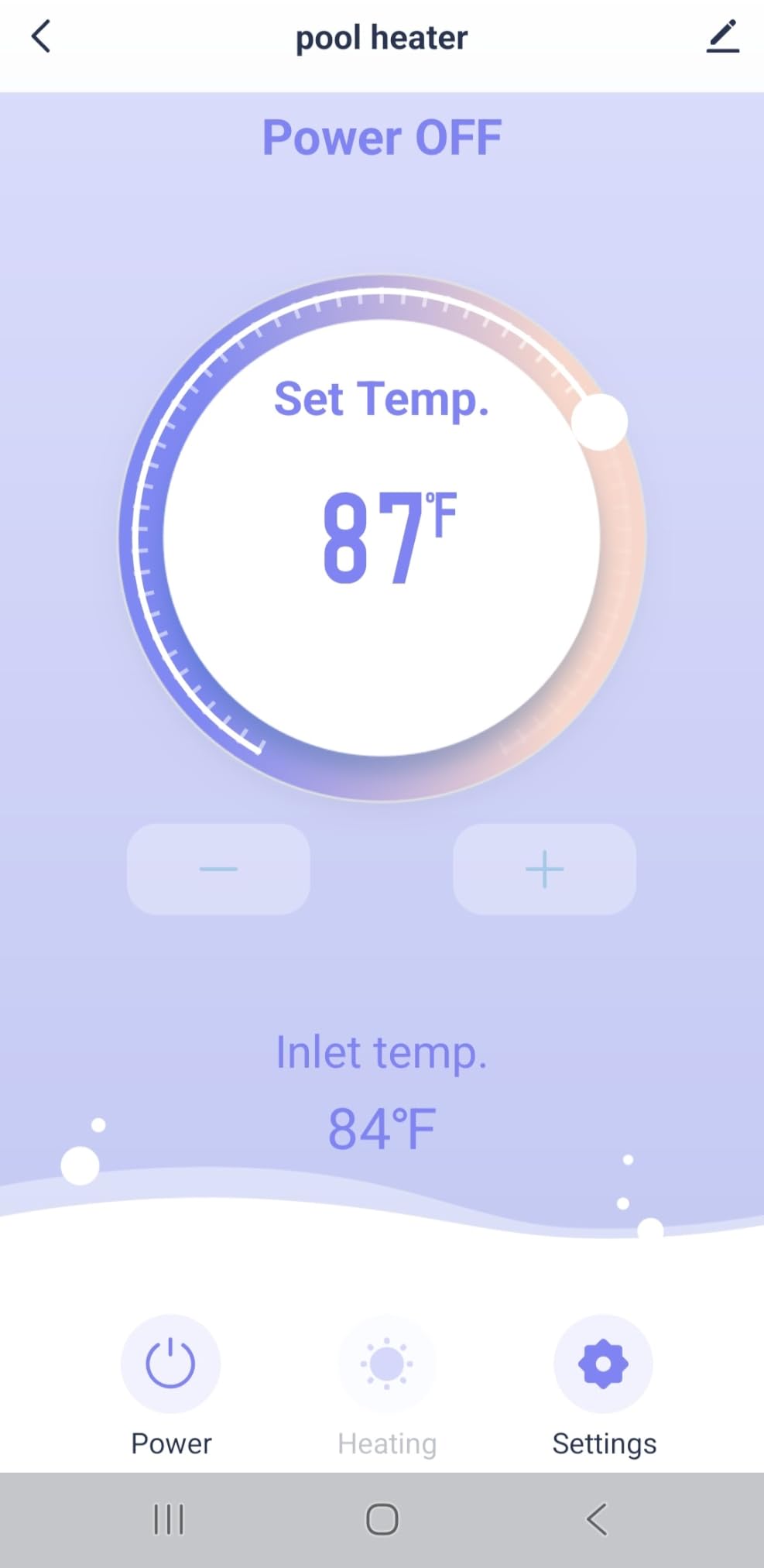
App control is genuinely good for the money. Owners using Home Assistant report Tuya integration works, and the interface covers power, heating or cooling mode and setpoint. Heating runs 59F to 104F and cooling runs 46F to 82F.
What small pool owners actually notice
One owner on a shaded 1,100 gallon patio pool reports about 1 degree of heating per hour and 0.5 degree of cooling per hour, which is a reasonable expectation for a compact installation. On a 5,000 gallon pool the same unit maintains temperature well but climbs slowly, and a buyer targeting a full degree per hour on that volume suggests stepping up to roughly 35,000 BTU instead.
That is the honest trade with the quietest and lowest cost unit in the group. For a pool well under its 5,000 gallon rating it is a very good match. For a full sized above ground frame, look at pick seven.
Where it falls short
There is one documented case of a buyer hitting repeated warning codes daily, with support asking the same questions and attributing the fault to the pump before refunding the unit. The app also lacks runtime history and amp usage data, which is the sort of detail you notice only after you have already paid.
Customer service responsiveness is described as inconsistent overall, so this is a purchase for buyers who are comfortable with a digital-first support model. Our guide to pool cleaners for above ground pools covers the other equipment most small pool owners need first.
10. Varpoolfaye 30,000 BTU 110V Unit: Best Balanced Upgrade for 8,000 Gallon Pools
Varpoolfaye 30000BTU Swimming Pool Heat Pumps Up to 8000 Gallons 110v
30,000 BTU max output
COP of 5.8
Pools up to 8000 gallons
Heating and cooling
52 dB
Pros
- Highest average rating in the group at 4.7 stars
- 30000 BTU on 110V covers 8000 gallon pools
- COP of 5.8 keeps running cost low
- Heats and cools
- App control with scheduling
- Titanium exchanger for salt water
Cons
- Heavy at 117 pounds so two people are needed
- Needs 110V amperage headroom and a long cord run
- Condensation drips during heat exchange and defrosting
This is the highest rated unit we compared. Its 4.7 average across 59 reviews comes with 81 percent five stars and no one-star ratings at all, a distribution none of the other nine listings here matches.
The reason is a spec combination that usually does not appear together: 30,000 BTU of output on 110V power, rated for above ground pools up to 8,000 gallons across 14, 16, 18, 21 and 23 foot frames, with a COP of 5.8.
It also heats and cools, with heating from 46F to 104F and cooling from 46F to 82F. That makes it a three season tool in a way most units on household power are not, and it matters for shoulder season swimming in a climate that turns warm in April.
At 52 dB it is quiet, the titanium exchanger handles fresh or salt water, and the app controls temperature and scheduling. Connections use 1.5 inch fittings and a 126 inch cord.
The 8,000 gallon ceiling is the deciding factor
Everything about this unit points toward the middle of the above ground market. The 8,000 gallon rating matches the common 18 and 21 foot above ground footprints that still run on a standard circuit, which is exactly the range most owners land in.
The gap to watch is amperage. A 30,000 BTU draw on 110V is substantial headroom to ask of a household circuit, so confirm your electrical service supports it rather than assuming a standard outlet will do.
Where it falls short
At 117 pounds it is the heaviest unit in the group alongside the WARMBLU, and owners consistently note that two people are needed to move it into position. Plan the lift before the box arrives rather than after.
The 59-review sample is thin for a top recommendation, and a 126 inch cord run may leave you wanting an electrician anyway. If your pool exceeds 8,000 gallons, the 40,000 BTU 220V unit at pick three is the better tool, and if you want the coldest-weather capability, the MICOE at pick eight runs lower.
Buying Guide: Sizing, Electrical and Covers for Above Ground Pool Heat Pumps
Three variables decide which of these ten units is right, and none of them appear in a product listing. Pool volume tells you how many BTUs you need, electrical capacity tells you which units you can actually install, and your local overnight temperatures tell you how much of the season the unit will work at all.
A heat pump moves heat rather than generating it, so its real output depends on the air it is pulling from. A unit rated at 40,000 BTU delivers its best numbers on a mild dry day and much less on a cold humid night. This is why heat pump owners describe two different experiences with the same machine, and why the honest answer to how long it takes to heat a pool depends on the cover, the starting temperature and the overnight low.
Forum owners report roughly 1 degree per 90 minutes on a 5,000 gallon pool with a 16,000 BTU unit, and about 1 degree every 3 hours on a 20,000 gallon pool with a 45,000 to 50,000 BTU unit. Those are the numbers to plan your weekends around: a heat pump starting from cold is a multi day project, and a heat pump topping up a warm pool is nearly instant.
Pool size to gallons to BTU
Use your pool’s actual volume, which the manufacturer lists in the manual or on the wall label, rather than the diameter alone. Oval pools hold meaningfully less water than round pools of the same length, and a rectangular frame pool holds the most of all for its footprint.
Specific size pairings come from the manufacturers themselves. The ECOPOOLTECH covers pools up to 5,000 gallons, described as no larger than a 15 foot round or a 9 by 18 foot rectangle. The Varpoolfaye 30,000 BTU covers 8,000 gallons across 14, 16, 18, 21 and 23 foot frames, and the Varpoolfaye 40,000 BTU covers 12,000 gallons across 14 through 28 foot frames. The MICOE is rated for 24 foot pools and 12,000 gallons.
The working rule most installers use is between 5,000 and 10,000 BTU per 1,000 gallons, with the lower end for warm climates and the higher end for cool ones. Below that, you can oversize safely. Well above it, the unit will cycle on and off without ever reaching target.
Is it better to oversize a pool heat pump?
Oversizing a heat pump is not dangerous the way oversizing a gas heater would be, but it is wasteful. A larger unit cycles on and off in a warm pool, which shortens life, raises the average electrical draw and does nothing useful. Size to the top of your size class and go no further.
Undersizing is the more common and more expensive mistake. A unit that never reaches target runs its compressor continuously, wears the compressor out faster, and leaves you convinced the technology does not work in your climate. Our rule is to match the rating to the volume honestly rather than rounding up.
110V versus 220V and 240V
This is the single most decisive factor for an above ground pool owner, and it is the one most roundups gloss over. Compact units in the 16,000 to 20,000 BTU range run on standard 120V household power, and several 30,000 to 35,000 BTU models do as well. Units at 40,000 BTU and above typically want 220V or 240V, which means a dedicated circuit, a breaker, and in many cases a subpanel and an electrician.
On this list, the units that avoid an electrician are the ECOPOOLTECH, the VARMINPOOL, the Varpoolfaye 16,000 BTU, the WARMBLU, the FibroPool FH135, the MICOE and the Vidapool. The ones that need a 220V or 240V run are the Varpoolfaye 40,000 BTU and the FibroPool FH220.
The cost difference is not the unit, it is the electrical work. If your service panel already has room for a 30 or 50 amp breaker, a 220V install is straightforward. If it does not, a subpanel is part of the job, and that is where above ground heat pump installs get expensive. On the 120V side, watch the amp draw: the VARMINPOOL needs a 20 amp outlet, while the Vidapool runs on 7 to 8 amps and will share a circuit with a filter pump.
One more electrical detail that catches owners: a variable speed or programmable filter pump set to low RPM can starve the heat pump. Most units here need a specific minimum flow, from 450 GPH on the Vidapool to 700 GPH on the Varpoolfaye 16,000 BTU. Run the pump at high or fixed speed while heating.
Does the 20 rule apply to pool heat pumps?
Not to sizing, no. The 20 rule you see on pool forums refers to using a solar cover when water is at or above roughly 80F, which is a cover practice rather than a heat pump spec.
What matters for a heat pump is the ambient floor. Below roughly 50F outdoor air, the compressor runs nearly continuously with little net gain, and many units stop producing useful heat entirely, which is why a heat pump extends a season rather than replacing a gas heater in deep cold.
COP, inverter compressors and why rated numbers differ from real ones
COP means coefficient of performance, the ratio of heat delivered to electricity consumed. A COP of 5 means roughly five units of heat out per unit of electricity in, which is why heat pumps cost so much less to run than propane heaters that convert nearly everything they burn into heat.
Rated COP is measured under laboratory conditions at a set ambient temperature. Real-world COP is always lower, and the gap widens as outdoor air cools. The WARMBLU listing shows COP up to 16 and the Varpoolfaye 40,000 BTU claims 6.2, and both are manufacturer figures. Treat them as a ranking tool rather than a promise about your July electric bill.
An inverter compressor ramps its speed up and down rather than switching fully on and off. The benefits are lower noise, a gentler temperature approach, better performance in mild air, and less wear on the compressor. Several picks on this list use inverter control, and for a pool that only needs a few degrees a night, the modulation is the difference between a unit that hums and a unit that clicks.
Titanium versus copper heat exchangers, and salt water
Every titanium unit on this list is safe for salt water systems, and that matters more than most buyers expect. Salt chlorinators produce a corrosive environment that eats copper exchangers over time, and forum owners describe greenish water in the first weeks of a new copper install. Titanium costs more up front and removes the question entirely.
If you run a salt system, choose titanium without hesitation. If you run chlorine tablets, either material works, but titanium still resists chlorinated water better over a decade.
Covers, heat loss and the solar question
An uncovered above ground pool can lose a large share of its heat overnight, and that loss is why heat pump owners describe a cycle of gaining during the day and losing it at night. A solar cover or heat blanket cuts that loss dramatically, and forum consensus treats a cover as a requirement rather than an accessory when running any heat pump.
Cover first, heat pump second. If you want to see how much free heat a cover alone can capture, our solar pool heater picks for above ground pools cover the passive route, and liquid solar blankets are a cheap first step for owners who want to test the idea before buying a pump.
Circulation equipment matters as much here. A pump sized for a small above ground pool will not move water through a large exchanger, and swapping to a more capable sand filter for above ground pools or higher flow cartridge can be the cheapest performance upgrade available.
Noise, clearance and where the unit goes
Noise figures on these units range from 38 dB to 53 dB, which sounds like a narrow band but is not. Anything near 38 dB is quieter than your filter pump, and 50 dB and above is noticeable in a quiet evening. If you have a neighbor wall or a bedroom on the far side of the deck, that difference decides for you.
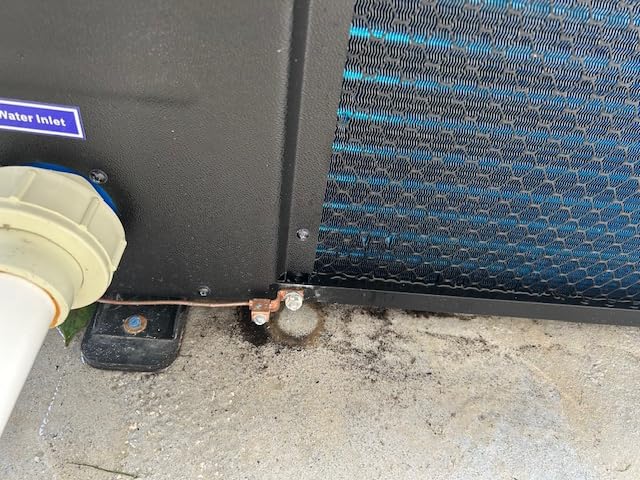
Clearance matters too. Plan roughly a foot of open space around the cabinet for airflow, keep it off the ground on a level pad so moisture cannot wick in, and avoid placing it where defrost condensation drips onto a walkway you use in bare feet. Condensation during heating and defrost cycles is normal on all of these units.
Winterizing between seasons
Between seasons, the job is simple and it protects your warranty. Shut off power at the breaker, disconnect the water lines, drain the exchanger if you live where temperatures freeze, and cover the unit with a breathable cover rather than plastic sheeting, which traps moisture against the cabinet.
Before you start, make sure the pump and filter are working properly, since a heat pump depends on flow. Our pool ladder picks for above ground pools roundup is the other piece of seasonal equipment most above ground owners replace on a schedule.
Frequently Asked Questions
What size pool heat pump do I need for an above ground pool?
Match the unit to your pool’s actual volume in gallons, not its diameter. The working rule is 5,000 to 10,000 BTU per 1,000 gallons, higher in cool climates. Under 6,000 gallons suits compact 16,000 to 20,000 BTU units, 8,000 to 10,000 gallons suits 30,000 to 35,000 BTU units, and 12,000 gallons or more needs 40,000 BTU and up.
Can I use a 110V pool heat pump instead of 220V?
Yes, within limits. Units up to about 20,000 BTU run on standard 120V household power, and several 30,000 to 35,000 BTU models also run on 110V. Check the running amps against your circuit, since a 17 amp unit needs a 20 amp outlet. Past 8,000 to 10,000 gallons, a 220V unit delivers heat far faster per dollar spent on electricity.
How long does it take a heat pump to heat an above ground pool?
It depends on volume, output and starting temperature. Owners report about 1 degree per 90 minutes on a 5,000 gallon pool with a 16,000 BTU unit, and about 1 degree every 3 hours on a 20,000 gallon pool with a 45,000 to 50,000 BTU unit. A covered pool already near target temperature typically gains several degrees in a few hours.
Is it better to oversize a pool heat pump?
No. Oversizing makes the unit cycle on and off without reaching target, which raises average power draw and wears the compressor faster. Undersizing is the worse error, since the unit runs continuously and never gets the pool warm. Size honestly to the top of your pool’s volume class and check that your filter pump meets the unit’s minimum flow requirement.
What is the 20 rule for pool heat pumps?
That is not a pool heat pump sizing rule, so if you saw it on a forum it was almost certainly about pool covers. The number that matters for a heat pump is the ambient temperature floor: below roughly 50F outdoor air, the compressor runs nearly constantly with little net gain, and many units stop producing useful heat entirely. A heat pump extends a season rather than replacing a gas heater in deep cold.
Which brand of pool heat pump is the most reliable?
Reliability comes down to the specific model and the warranty behind it rather than the logo. In this group the FibroPool units have the longest review history and repeatedly praised replacement service, while the ECOPOOLTECH carries a three-year warranty, three times what several competitors offer. Always check that warranty coverage is honored regardless of where the unit was purchased.
Our Final Verdict for Above Ground Pool Heat Pumps in 2026
The best pool heat pumps for above ground pools are not one product, they are a match between three numbers. If your pool holds 5,000 gallons or fewer and you have a 120V outlet, choose the ECOPOOLTECH at pick one for its three-year warranty and titanium exchanger, or the Vidapool at pick nine if you want the quietest and lowest cost option. If you need more output without an electrician, the Varpoolfaye 30,000 BTU at pick ten handles up to 8,000 gallons and carries the highest rating we found. If you are wiring a dedicated circuit anyway, the Varpoolfaye 40,000 BTU at pick three covers up to 12,000 gallons with both heating and cooling.
Whichever one you choose, install a solar cover first and confirm your filter pump meets the unit’s minimum flow rate before you start. Those two steps decide whether the heat pump keeps up with overnight heat loss, and they matter more to your experience than any spec on the box.