
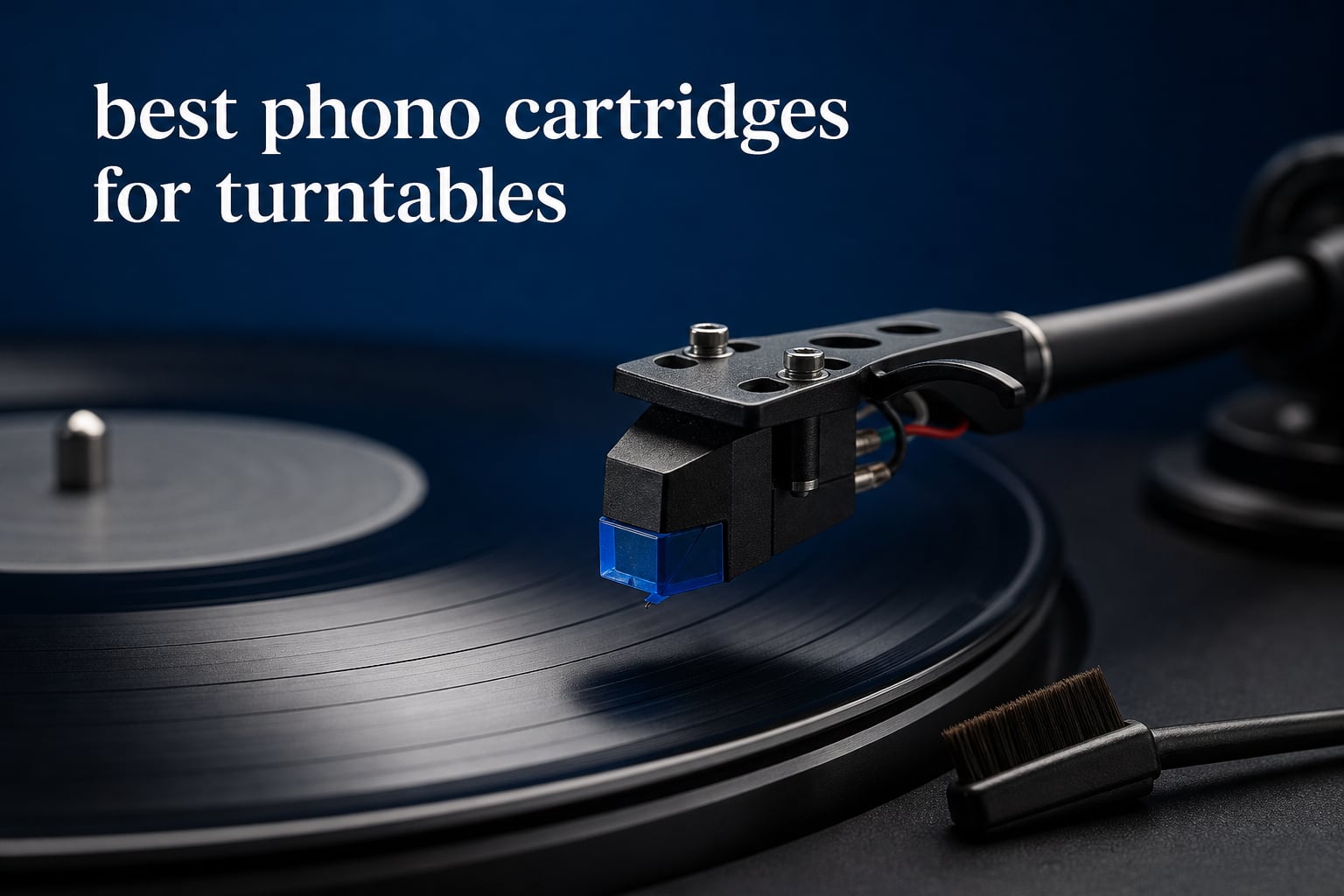
A phono cartridge holds the stylus and turns record-groove movement into the small electrical signal your system plays. The best phono cartridges for turntables are therefore not just a sound choice: they must also match your turntable mount, tonearm, and phono preamp.
That fit explains the concerns that recur in turntable communities. Owners want to know whether MM or MC will work with their phono stage, whether a cartridge will physically fit the arm, and whether incorrect tracking force could harm records.
This 2026 guide reviews all eight analyzed cartridges, from basic elliptical-stylus replacements to a classic moving-coil option. I focus on manufacturer-supplied features, verified rating data, mounting limits, and the setup details that decide whether an upgrade makes sense.
Table of Contents
The top 3 picks give most turntables a clear starting point
The AT-VM95ML is my feature-led standard-mount pick because it has a micro-linear stylus and threaded inserts. The Ortofon 2M Blue is the direct choice for a nude elliptical stylus and stated gains in openness and detail, while the Omega 1e is the uncomplicated standard-turntable replacement.

These phono cartridges cover the main turntable fits in 2026
Use this overview as a first filter, then confirm your turntable manual. The AT85EP requires T4P P-mount hardware, while the Denon DL-103 is a moving-coil design that needs an MC-capable phono stage.
| Product | Specifications | Action |
|---|---|---|
 Audio-Technica AT-VM95E Audio-Technica AT-VM95E |
|
View Details |
 Audio-Technica AT85EP Audio-Technica AT85EP |
|
View Details |
 Ortofon 2M Blue Ortofon 2M Blue |
|
View Details |
| Audio-Technica AT-VM95ML |
|
View Details |
 Ortofon Omega 1e Ortofon Omega 1e |
|
View Details |
 Ortofon 2M Bronze Ortofon 2M Bronze |
|
View Details |
 Nagaoka MP-110 Nagaoka MP-110 |
|
View Details |
 Denon DL-103 Denon DL-103 |
|
View Details |
1. The Audio-Technica AT-VM95E makes headshell mounting less fussy
Audio-Technica AT-VM95E Dual Moving Magnet Turntable Cartridge Green
Dual magnet
0.3 x 0.7 mil elliptical
Aluminum cantilever
Pros
- Elliptical stylus
- Aluminum cantilever
- Threaded inserts
- Low-resonance housing
Cons
- Elliptical profile may not suit every preference
- Confirm standard-mount compatibility
The AT-VM95E is a direct moving-magnet starting point for a conventional headshell. Its supplied specification combines a 0.3 x 0.7 mil elliptical stylus, aluminum cantilever, 4 mV output, and low-resonance polymer housing.
I particularly like the threaded inserts: the cartridge mounts to a headshell with two screws and no loose nuts. That does not remove the need for alignment, but it makes a stock cartridge replacement less awkward.
Audio-Technica says specially wound coils increase output voltage. The listing reports a 4.7 rating from 3.8k+ reviews, with feedback centered on sound quality, installation ease, and satisfaction.
The threaded inserts make this a practical standard-mount replacement
Choose the AT-VM95E if your turntable uses a conventional screw-mounted headshell and you want an elliptical stylus. It is not a P-mount cartridge, so check the connection before ordering.
The stated 6.1-gram weight belongs beside your tonearm documentation. Balance the arm again after fitting any new body.
The elliptical profile makes this a conventional rather than micro-linear choice
The supplied elliptical diamond is a sensible selection for listeners who want that familiar profile. It is not the micro-linear profile supplied on the AT-VM95ML.
Set tracking force and anti-skate to the manufacturer guidance, then listen on clean records. Incorrect setup is a bigger record-care concern than a small difference between two compatible bodies.
2. The Audio-Technica AT85EP directly fits T4P P-mount turntables
Audio-Technica AT85EP Turntable Cartridge with Elliptical Stylus P Mount
P-mount
0.3 x 0.7 mil elliptical
Dual moving magnet
Pros
- T4P plug-in fit
- Elliptical stylus
- Para-toroidal coils
- Wide channel separation
Cons
- P-mount only
- Not Prime eligible
The AT85EP answers a different need from every screw-mounted cartridge here. It is made for linear-format turntables with T4P plug-in connectors, and the manufacturer says it works with those connectors regardless of brand.
Its 0.3 x 0.7 mil elliptical stylus pairs with Audio-Technica’s dual moving-magnet construction. Para-toroidal coils are specified for clarity and wide channel separation.
The 4.7 rating from 2.4k+ reviews is backed by feedback that repeatedly mentions channel separation and clarity. For a P-mount owner, correct fit is the more important fact than comparison with a standard headshell model.
The T4P connection makes this the direct answer for a linear-tracking deck
Pick this cartridge when the old cartridge plugs into a T4P socket. Take a photo before removal, since that simple check can prevent a costly mounting mismatch.
I would still consult the turntable manual before installation. A plug-in connection is simple, but the deck’s own setup instructions still apply.
The stated channel separation makes focused listening the best check
After fitting it, play familiar material with vocals or instruments located clearly left and right. That gives the stated channel-separation benefit a useful real-world test.
Keep the stylus clean with a dedicated brush and follow the maker’s brushing direction. Dust can hide the clarity a cartridge is designed to provide.
3. The Ortofon 2M Blue adds a nude elliptical stylus and 5 mV output
Ortofon 2M Blue Moving Magnet Cartridge
Moving magnet
Nude elliptical diamond
5 mV output
Pros
- Nude elliptical stylus
- Replaceable stylus
- Universal fit
- More stated detail than 2M Red
Cons
- Confirm standard-mount compatibility
- Stock level can vary
The Ortofon 2M Blue is the MM cartridge I would show to a listener considering a known step up from the 2M Red. Ortofon describes it as more open, more dynamic, and more detailed, and gives it a Nude Elliptical diamond.
The stated 5 mV output is a useful phono-stage clue. A normal MM input is the expected direction, though the manual remains the final compatibility reference.
Its stylus is replaceable, which matters for long-term ownership and record care. The listing carries a 4.7 rating from 1k+ reviews, and community conversations frequently identify the 2M Blue as a midrange MM recommendation.
The nude elliptical diamond makes this a clear 2M Red upgrade path
Choose the 2M Blue when a compatible standard-mount turntable already has a 2M Red and the stated gain in openness and detail is the goal. The shared family makes the comparison easy to understand.
Do not change just because a cartridge name is familiar. Confirm mounting and MM phono-stage fit before working on the headshell.
The replaceable stylus makes maintenance part of the ownership decision
Inspect the stylus in good light and clean it gently with a purpose-made brush. A clean tip tracks the groove more reliably than a dusty one.
Give a new cartridge consistent, normal playback before reaching a conclusion. Avoid changing alignment and tracking settings repeatedly during the same early sessions.
4. The Audio-Technica AT-VM95ML brings a micro-linear stylus to the VM95 body
Audio-Technica AT-VM95ML Dual Moving Magnet Turntable Cartridge Red
Dual magnet
Micro-linear stylus
Aluminum cantilever
Pros
- Micro-linear stylus
- Aluminum cantilever
- Threaded inserts
- Replacement stylus compatibility
Cons
- Confirm standard-mount fit
- Not Prime eligible
The AT-VM95ML is the feature-focused Audio-Technica option because its M Series body carries a 2.2 x 0.12 mil micro-linear stylus. That stylus profile, rather than its red color, is the reason to choose it over the elliptical AT-VM95E.
It also has an aluminum cantilever, durable low-resonance polymer housing, and threaded inserts for two-screw mounting. The listing says it works with AT-VMN95 replacement styli.
Rating data shows 4.7 from 828 reviews, with supplied feedback praising detail, build quality, and replacement-stylus compatibility. I would treat those strengths as a reason for careful alignment, not as a substitute for it.
The micro-linear stylus makes careful alignment part of the decision
Select this model when a standard-mount turntable can accommodate it and the supplied micro-linear profile is the target. It is not suitable for a T4P socket.
Use the alignment approach specified by your tonearm maker. Confirm overhang, azimuth, vertical tracking angle where adjustable, tracking force, and anti-skate one at a time.
The AT-VMN95 fit makes future stylus changes more predictable
Replacement-stylus compatibility gives the cartridge body a stated long-term path. That is helpful when a buyer wants to plan beyond the first stylus.
Keep the stylus guard in place while moving or servicing the turntable. It offers protection during the moments when a cantilever is most exposed.
5. The Ortofon Omega 1e gives standard turntables an elliptical replacement path
Ortofon Omega 1e Moving Magnet Cartridge
Moving magnet
Elliptical diamond
Replaceable stylus
Pros
- Fits most standard turntables
- Replaceable stylus
- Elliptical diamond
- Stereo playback focus
Cons
- Plastic enclosure
- Lower rating than several picks
The Ortofon Omega 1e is the simple moving-magnet option for casual playback on most standard turntables. Manufacturer data identifies an elliptical diamond, replaceable stylus, and distortion-free playback of stereo records.
Its stated 4 mV output points to a normal MM phono input as the first check. That makes it a much more direct fit for many systems than a moving-coil cartridge.
The listing reports 4.6 from 682 reviews. The supplied review summary describes it as suited to casual listening, which is the right expectation rather than a promise of a high-specification stylus design.
The standard-turntable fit makes this a straightforward replacement candidate
Consider the Omega 1e when you need a standard-mount cartridge with a replaceable elliptical stylus. “Most standard turntables” still calls for a check of your own headshell and manual.
The housing is listed as plastic. That is a construction fact to weigh beside the polymer and metal materials specified on other cartridges.
The replaceable stylus makes routine care more approachable
Inspect the tip, clean it gently, and replace it if wear is suspected rather than playing records with a damaged stylus. Clean records also limit debris arriving at the diamond.
Use a familiar stereo record for the first check and confirm both channels play evenly. Weak output on one side can also point to cartridge wiring.
6. The Ortofon 2M Bronze adds a Nude Fine Line diamond and 5 mV output
Ortofon 2M Bronze Moving Magnet Cartridge
Moving magnet
Nude Fine Line diamond
5 mV output
Pros
- Nude Fine Line stylus
- Universal fit
- Evenhanded detail
- 2M Black stylus upgrade path
Cons
- Confirm standard-mount compatibility
- Stock level can vary
The Ortofon 2M Bronze is for the standard-mount listener seeking the supplied Nude Fine Line diamond specification. It has a stated 5 mV output and is presented as a step above the 2M Red and 2M Blue within the same family.
Ortofon describes its sound as evenhanded with excellent detail. I would take that as a useful listening clue, while keeping tonearm setup and record condition in the picture.
The supplied details include a stylus brush and screwdriver, and list a 7.2-gram weight. It has a 4.6 rating from 234 reviews and can accept an Ortofon Stylus 2M Black.
The Nude Fine Line specification makes this a considered 2M upgrade
Choose the 2M Bronze if that Fine Line profile is a clear goal and your deck supports the conventional 2M mount. A cartridge cannot correct an arm that is not balanced or aligned.
Check headshell geometry, tonearm balance, and MM phono-stage compatibility first. The stated 5 mV figure helps identify the electrical direction.
The 2M Black path makes later stylus planning clear
The documented option to move to a 2M Black stylus gives the Bronze body a defined family relationship. It does not mean every listener needs to make a further change.
Use the included brush for gentle dry cleaning and avoid touching the diamond or cantilever. Sideways force is a preventable source of stylus damage.
7. The Nagaoka MP-110 focuses on broad frequency clarity and dynamic range
NAGAOKA Cartridge MP Series – MP-110 Record Cartridge
MP series
Full dynamic range
Wide frequency clarity
Pros
- Clarity across frequencies
- Full dynamic range
- Modern materials
- Strong review history
Cons
- Older model
- No detailed stylus profile supplied
The Nagaoka MP-110 enters this list on the strength of its stated crystal-clear clarity across frequencies, fluidity through the spectrum, and full dynamic range. Its supplied product data is less detailed than the Ortofon and Audio-Technica entries, so I will not invent an output or stylus profile.
The listing has a 4.5 rating from 831 reviews, with 78% five-star feedback in the supplied summary. It has been available since 2012, which helps explain its long-standing place in enthusiast discussions.
Forum research often names the MP-110 as an alternative to Ortofon and Audio-Technica choices. That social proof is helpful, but mounting and phono-stage checks still come before a forum recommendation.
The full-range description makes this a listener-led shortlist choice
Put the MP-110 on the shortlist when broad clarity and dynamic range are the appeal. Compare it with your current cartridge using familiar voices, acoustic instruments, and changing dynamics.
Do not judge from one dense or worn record. A small set of clean, familiar records gives a more useful listening picture.
The limited supplied specifications make a manual check particularly important
Consult manufacturer documentation for mounting, tracking force, alignment, stylus care, and phono-stage requirements. That is how you avoid a mismatch and look after the records you play.
Check replacement-stylus availability from an authorized source if long-term ownership matters. The analyzed listing does not give that information, so it should not be assumed.
8. The Denon DL-103 is the moving-coil choice for an MC-capable phono stage
Denon DL-103 Moving Coil Turntable Phono Cartridge
Moving coil
40 ohm impedance
Long-running design
Pros
- Moving-coil construction
- 40 ohm impedance
- Long-running industry design
- Alloy enclosure
Cons
- Requires MC-capable phono stage
- Stock level can vary
The Denon DL-103 is different from the other picks because it is a moving-coil cartridge. Its listing calls it an industry standard for decades and specifies 40-ohm impedance, but the deciding question is whether your phono preamp supports MC gain and loading.
This is not a cartridge to choose first and troubleshoot later. Community concern about MC compatibility is justified because an MM-only input may not provide the needed amplification.
The supplied product data lists an alloy enclosure and a 4.5 rating from 171 reviews, with 81% five-star feedback. The description does not state a stylus geometry, output figure, or specific sound signature, so none should be assumed.
The moving-coil design makes phono-preamp support the first check
Choose the DL-103 only when the phono preamp, or a suitable step-up arrangement, is documented for MC cartridges. MC is not automatically better; it simply creates a different system requirement.
Write down the phono stage’s MC settings, gain options, and loading guidance before installing. If the manual only identifies MM support, resolve that limitation first.
The 40-ohm impedance makes documented loading guidance more useful than guesswork
Take the stated 40-ohm figure to the phono-preamp documentation. It is an electrical detail, not a setting instruction by itself.
After system compatibility is confirmed, do normal alignment, tracking-force, and anti-skate checks just as carefully as with MM. The generator type changes the phono-stage question, not the mechanical work at the tonearm.
The right cartridge choice starts with mounting and phono-stage limits
Start with the turntable manual rather than a popularity list. Identify the mount first—standard screw-mounted headshell or T4P P-mount—then identify whether the phono preamp accepts MM only or has documented MC support.
MM is the practical default when the phono preamp has a normal MM input
A moving-magnet cartridge generates signal by moving a magnet near coils, while a moving-coil cartridge moves coils near a magnet. Both need phono amplification, but MC asks more of the input stage.
For many record players, MM is the direct path because the phono stage already provides an MM input. The six Audio-Technica and Ortofon MM options in this guide make that route easy to explore.
MC is the specialist route when the phono stage documents the needed support
A moving-coil cartridge can be a good match for a prepared system, but it is not automatically a superior choice. The Denon DL-103 makes the task plain: check MC gain and loading support before considering it.
Do not confuse a turntable’s built-in preamp switch with a guarantee of MC capability. Read the amplifier or phono-preamp manual for the actual supported cartridge types.
The mount and tonearm decide whether the cartridge can work mechanically
The AT85EP is for T4P P-mount systems, while the other choices call for a standard-mount or headshell check. Sound preference cannot overcome a physical mounting mismatch.
After mounting, balance the tonearm and apply the cartridge maker’s stated tracking-force guidance. Then follow turntable guidance for anti-skate.
The cartridge weight and compliance require documentation rather than a guess
Effective mass and compliance matching can sound abstract, but the practical action is to compare the cartridge and tonearm manuals. The AT-VM95E and AT-VM95ML each list 6.1 grams, while the 2M Blue and 2M Bronze list 7.2 grams.
A balanced arm is a necessary first step, not proof that every match is settled. Ask the turntable maker or a qualified technician when the documentation is unclear.
Alignment and correct tracking force protect records during playback
Use the alignment method stated by your turntable or tonearm maker, secure screws without overtightening, and inspect the cantilever from the front. Overhang, azimuth, and vertical tracking angle are separate adjustments.
Never assume lighter tracking is kinder to vinyl. Use the manufacturer’s recommended range, since too little force can give poor groove contact and an incorrect setting in either direction causes problems.
Normal break-in listening works best after setup is stable
New cartridges can change subtly during early normal playback, so resist changing alignment after every side. Use clean records and a stable setup for several familiar albums before judging the result.
A short listening log is more useful than constant adjustments. Note channel balance, repeated distortion, and mistracking, then recheck setup if those symptoms recur.
Clean records and a clean stylus preserve the intended contact with the groove
Brush dust away gently with a proper stylus brush and follow the maker’s recommended direction. Do not touch the diamond or cantilever with fingers, and use the stylus guard while moving the turntable.
Record cleaning matters because groove debris reaches the stylus. Replaceable styli and the 2M Bronze’s supplied brush help, but care is better than treating replacement as routine.
An upgrade is sensible when the existing cartridge is worn or mismatched
An upgrade can be worthwhile when a stylus is worn, the current cartridge is a poor fit, or a stated feature such as nude elliptical, Fine Line, or micro-linear construction meets a real listening goal. It is not a guarantee of dramatic change without proper setup.
Write down your current mount, cartridge type, and phono-preamp input before selecting a replacement. That small preparation answers the most common community pain points.
These phono cartridge questions have direct answers
What is considered the best phono cartridge?
The best phono cartridge is the one that fits your turntable mount, works with your phono preamp, and matches the stylus profile you want. In this group, the Audio-Technica AT-VM95ML is the feature-led standard-mount pick, the Ortofon 2M Blue is a strong moving-magnet upgrade path, and the AT85EP is the direct pick for a T4P P-mount turntable.
Is it worth upgrading a turntable cartridge?
An upgrade is worth it when the existing stylus is worn, the current cartridge is a poor mechanical or electrical match, or a stated feature such as a nude elliptical, Fine Line, or micro-linear stylus meets a real listening goal. Check mounting, tracking force, alignment, and phono-preamp type first; those fundamentals can matter as much as the cartridge body.
What is the best MM cartridge of all time?
There is no single best MM cartridge for every turntable. The Ortofon 2M Blue is frequently recommended in community discussions and has a nude elliptical stylus and replaceable stylus, while the Audio-Technica AT-VM95ML offers a micro-linear stylus and threaded inserts. The best choice is the one that fits your arm and your phono stage.
Which is better MC or MM phono cartridge?
MM is usually the simpler choice because many phono preamps provide an MM input, while MC needs documented gain and loading support. MC is not automatically better: the Denon DL-103 is a moving-coil cartridge with a stated 40-ohm impedance, so it needs an MC-capable phono stage or appropriate step-up arrangement. Choose by system compatibility before sound preference.
The best choice is the cartridge your complete system can support
For a standard-mount turntable, I would begin with the AT-VM95ML for its micro-linear stylus or the Ortofon 2M Blue for its stated open, detailed, and dynamic presentation. Pick the AT85EP when T4P P-mount fit decides the matter, and consider the Denon DL-103 only after confirming MC phono-stage support.
The best phono cartridges for turntables in 2026 are not one-size-fits-all components. Check the mount, arm setup, stylus-care plan, and phono preamp before choosing, then give the cartridge a stable, carefully aligned installation.