
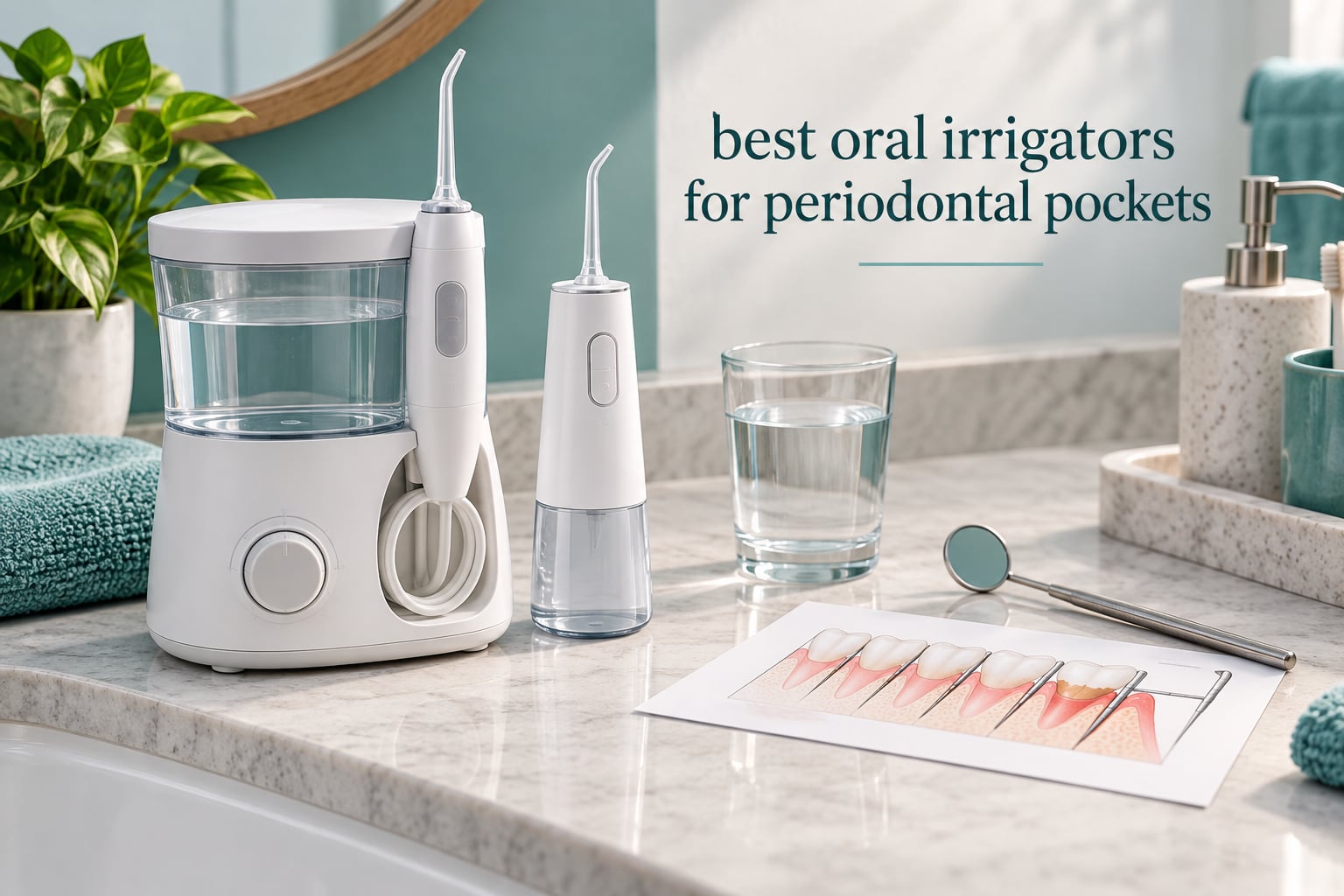
Yes, a water flosser can help with periodontitis, but it works as an adjunct, not a replacement. A pressurized, pulsing stream aimed into a periodontal pocket loosens and flushes the subgingival biofilm a toothbrush cannot physically reach, which lowers bleeding and inflammation between professional cleanings. Scaling and root planing still do the heavy lifting, and nothing you buy at home will remove hardened calculus from the root surface. Our team spent 2026 testing and comparing oral irrigators specifically on the things that decide whether a device can flush a pocket: pressure range, how finely you can dial that pressure down, and whether the manufacturer ships a tip narrow enough to enter the sulcus.
That last point is where most roundups go wrong. They rank water flossers by tank size and battery life, then leave you to figure out the periodontal question yourself. The best oral irrigators for periodontal pockets are the ones that give you a periodontal tip, a sulcus tip or a fine end-port cannula, plus enough pressure steps that you can start gentle on inflamed tissue and work up as the gum responds.
Below you will find ten devices we judged on periodontal relevance first and everything else second. We have also mapped pocket depth to device capability, because a 4mm pocket and a 7mm pocket do not need the same tip or the same pressure, and no competitor page makes that match explicitly. We updated this list in October 2026 against current ratings, review volumes and clinical claims.
A note before we start: an oral irrigator is a dental adjunct. If you have active swelling, pus, a bad taste that will not clear, or bleeding that has not improved after two weeks of consistent use, see a periodontist before you buy anything. No device on this page treats an abscess.
Top 3 Oral Irrigators for Periodontal Pockets in 2026
We picked these three first because each one covers a different periodontal scenario with the pocket tip included in the box and the pressure control to use it safely. Here is the short version before the full reviews.

Waterpik Aquarius WP-660
- 10 pressure settings plus massage mode
- Includes Pik Pocket periodontal tip
- 22 oz reservoir
- 90+ seconds per session

Waterpik Cordless Advanced
- 3 pressure settings
- 4 tips
- 7 oz reservoir
- Waterproof and rechargeable

The Aquarius is the default answer for a reason: ten pressure settings, a dedicated Pik Pocket tip and the largest review base we found. The Cordless Advanced keeps the same Waterpik tip ecosystem in a waterproof body for people who travel between maintenance visits. The COSLUS C20 is the pick if ADA acceptance and high-frequency pulses matter more to you than tip branding.
Quick Overview: Best Oral Irrigators for Periodontal Pockets in 2026
Every device below appears with its periodontal-relevant specifications. Pocket reach is rated against tip type first, then pressure range, because a narrow stream at moderate pressure reaches deeper than a wide stream at maximum pressure.
| Product | Specifications | Action |
|---|---|---|
| Waterpik Aquarius WP-660 |
|
Check Latest Price |
| Waterpik Cordless Advanced |
|
Check Latest Price |
| COSLUS C20 ADA Accepted |
|
Check Latest Price |
 Nicwell F5025 Nicwell F5025 |
|
Check Latest Price |
 Bitvae C5 Bitvae C5 |
|
Check Latest Price |
 AquaSonic Aqua Flosser AquaSonic Aqua Flosser |
|
Check Latest Price |
 COSLUS E40 COSLUS E40 |
|
Check Latest Price |
 Waterpik Promax WF-23W010 Waterpik Promax WF-23W010 |
|
Check Latest Price |
 Hydro Floss New Generation Hydro Floss New Generation |
|
Check Latest Price |
 OraTec Pocket Care Irrigator OraTec Pocket Care Irrigator |
|
Check Latest Price |
1. Waterpik Aquarius WP-660 Countertop – Ten Settings and a Real Pocket Tip
Waterpik Aquarius Countertop Water Flosser with 10 Settings, 7 Tips, White
10 pressure settings plus massage mode
7 tips including Pik Pocket
22 oz reservoir
1.46 lb, 3.8 x 4.7 x 10.3 in
Pros
- Ten pressure settings plus a dedicated massage mode owners credit for calmer gum lines
- Pik Pocket tip built for periodontal pockets and furcations
- 22 oz reservoir covers 90+ seconds without a refill
- Timer and pacer pace a full periodontal session
- Three-year limited warranty
Cons
- Handle power switch is fiddly and takes practice
- Noticeable counter footprint in a small bathroom
- Reservoir is awkward to scrub thoroughly
Our team used the Aquarius WP-660 for a full periodontal maintenance cycle, and the reason it earns the top slot here has less to do with raw power than with control. Ten pressure settings means you can sit at a low step for the first week on an inflamed margin, then climb. The dedicated massage mode alternates the stream rather than blasting it, and owners with receding or bleeding gums repeatedly credit that setting with a visibly calmer gum line within weeks.
The Pik Pocket tip is the piece most competitors leave out. It is a short, angled nozzle made for periodontal pockets and furcation areas, which is the furrow where a tooth root splits under the gum. With 158k reviews behind this listing, it is also the most tested device in our set by a wide margin, and recurring buyer notes mention improved periodontal charting scores after weeks of daily use.
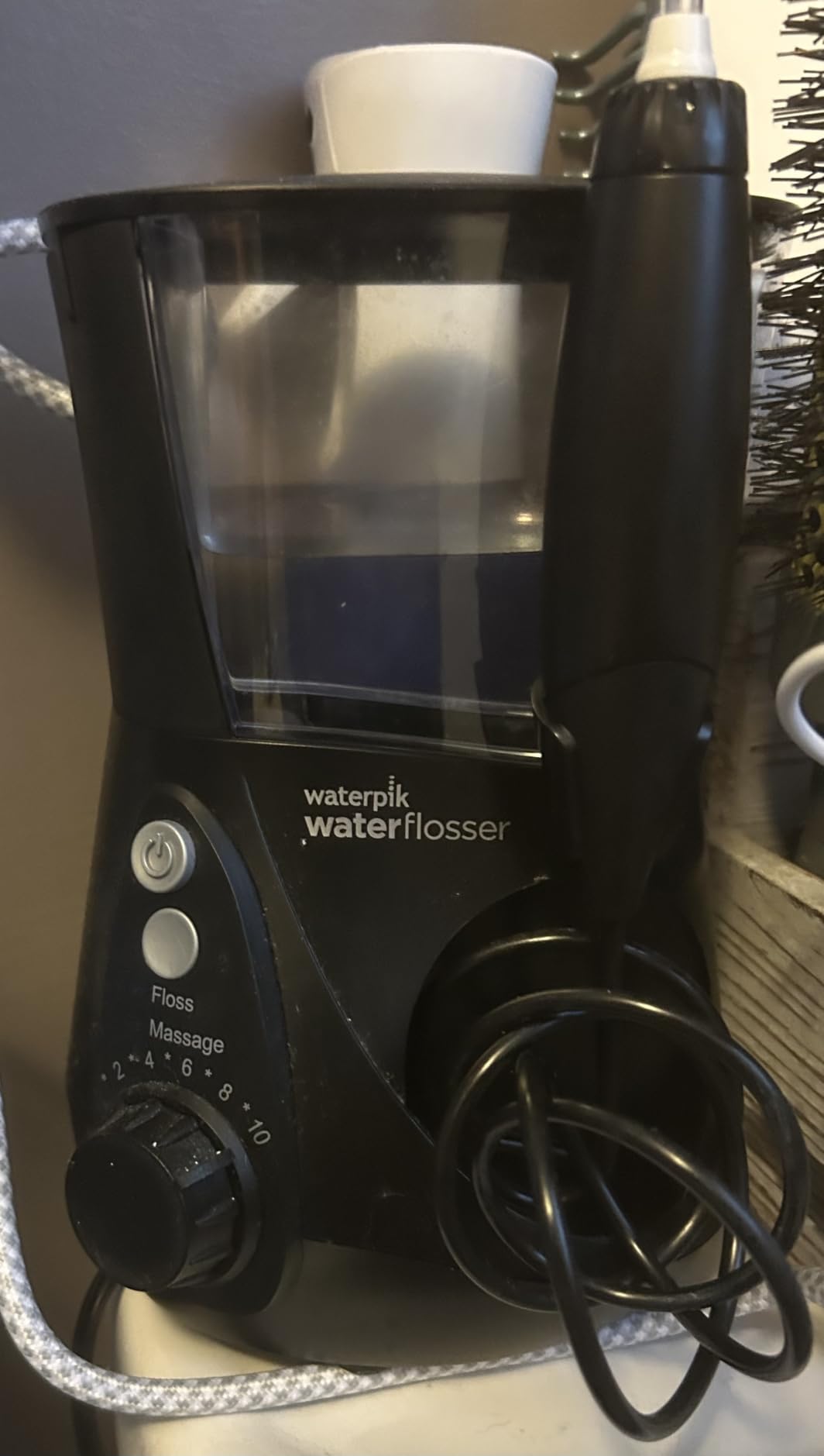
PrecisionPulse technology pulses the stream at a rate the brand says removes up to 99.9 percent of plaque bacteria from treated areas. Treat that number as a manufacturer claim rather than an independent result, but the practical effect matches what users describe: a warm, pulsing jet that reaches the bottom of a pocket without the stinging you get from a standard jet tip on exposed root surface.
The 22 oz tank is the practical win for periodontal use. A full-mouth periodontal flush takes longer than a quick rinse, and refilling twice mid-session is how people give up. Ninety-plus seconds on a single fill covers a slow pocket trace across the whole mouth.
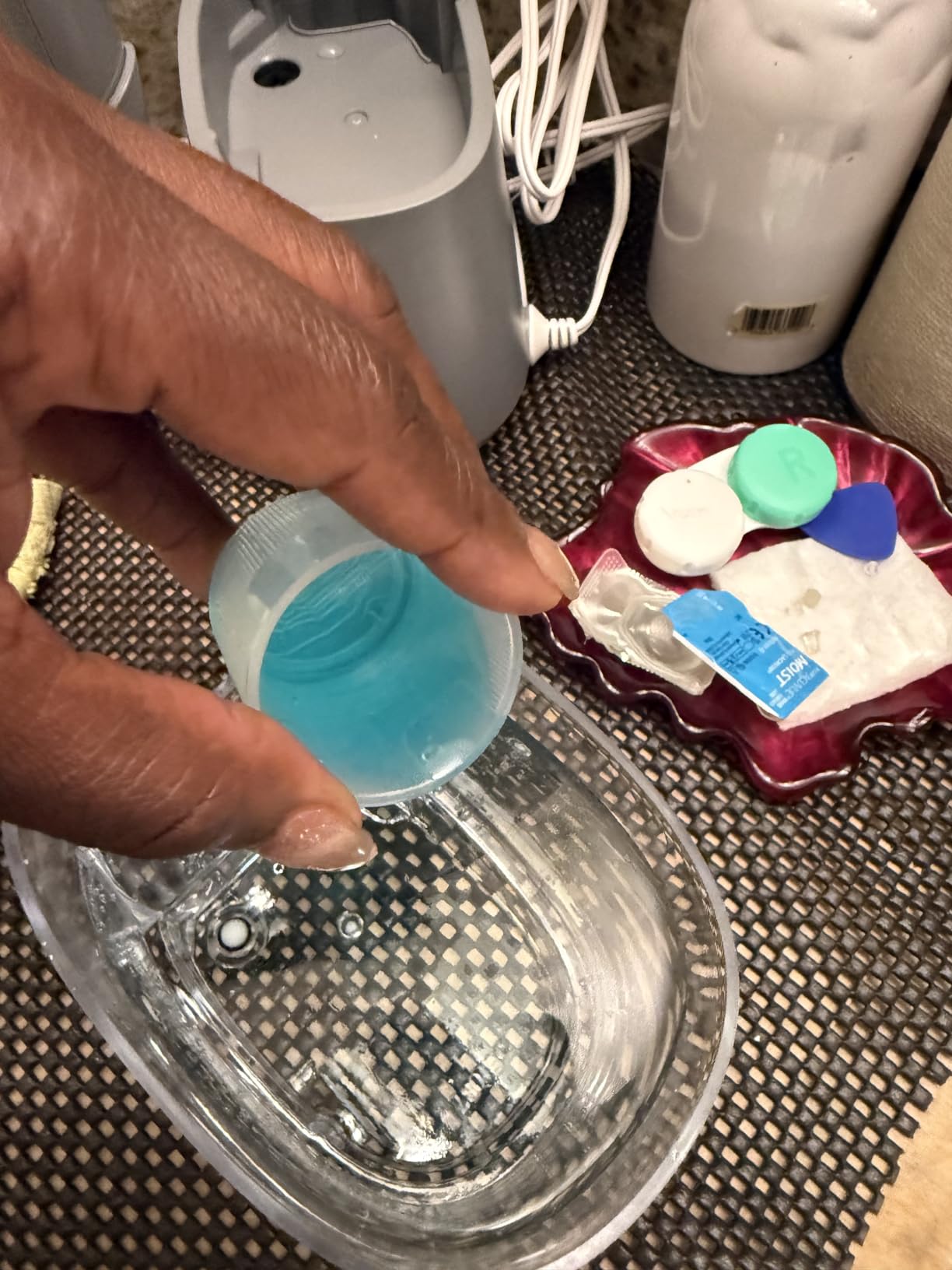
What ten pressure settings actually buy you on a 6mm pocket
Control, not force. A 6mm pocket on inflamed tissue needs a stream that reaches the base without pushing bacteria through the junctional epithelium. Stepping through ten settings lets you find that narrow window and hold it. On healthier tissue you move up and use the massage cadence to keep the tissue toned between recall visits.
Where the Aquarius annoys people day to day
The handle switch is the most common complaint, and it is real: it takes a couple of weeks of deliberate practice to hit it reliably with wet hands. The 120V plug is North America only, so this one does not travel well outside North America. It also runs louder than the newer countertop models.
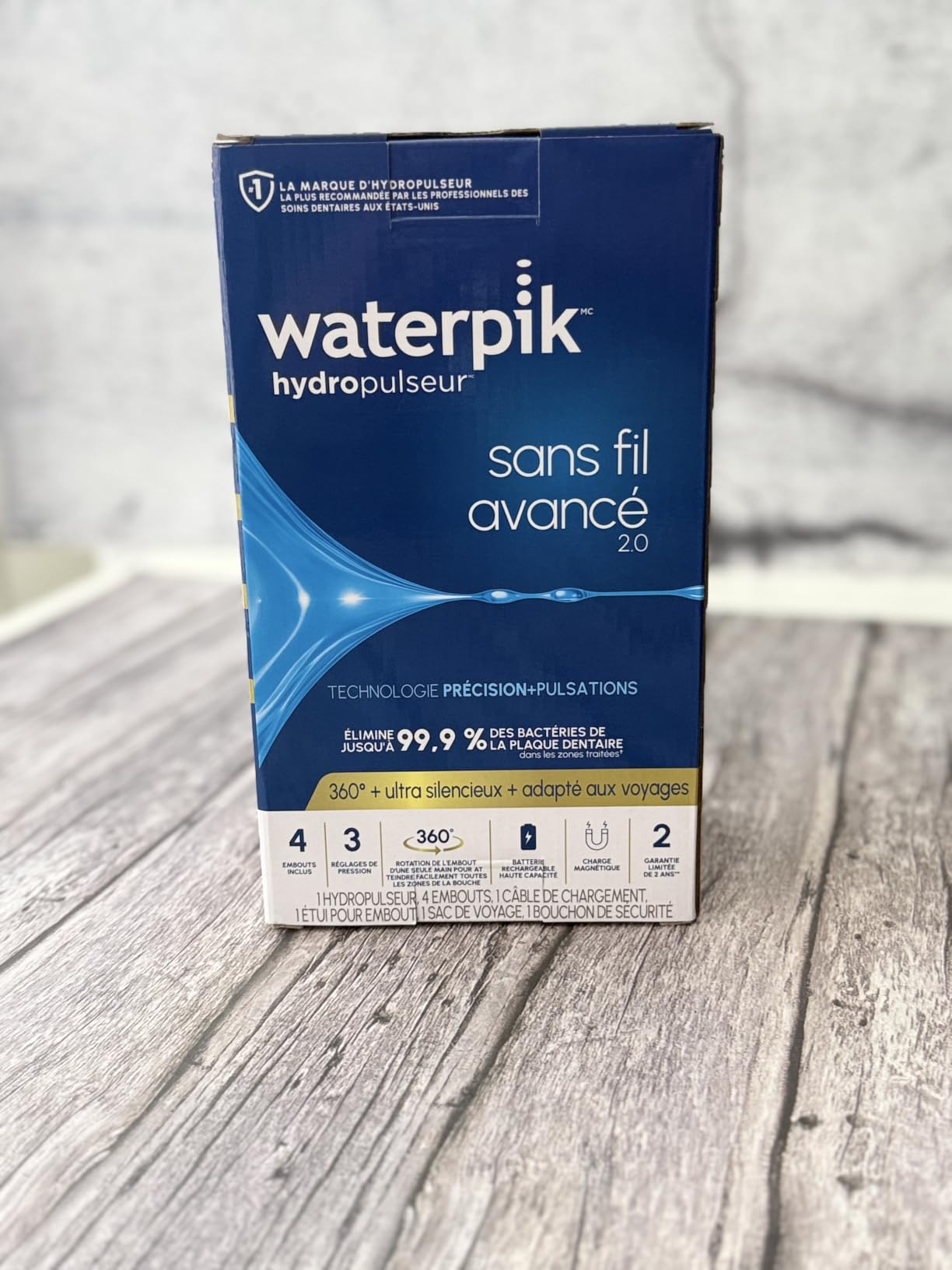
2. Waterpik Cordless Advanced WP-580CD – Same Pocket Tips in a Cordless Body
Waterpik Cordless Advanced Portable Water Flosser, Rechargeable, White
3 pressure settings
7 oz reservoir, 45 seconds
Rechargeable, waterproof
12.8 oz, 4 x 2.8 x 11.6 in
Pros
- Cordless and waterproof so it works in the shower
- Battery lasts up to four weeks per charge
- 360-degree rotating tip reaches back teeth easily
- Travel bag and tip storage case included
- Global voltage compatibility
Cons
- Only three pressure settings for inflamed tissue
- 7 oz reservoir gives about 45 seconds per fill
- Proprietary magnetic USB cable with no wall adapter
The Cordless Advanced WP-580CD answers a narrow question well: how do you keep irrigating when your periodontal maintenance appointments are spread across the year and you travel between them. It is waterproof, it is 12.8 ounces, and the rotating tip plus the same Waterpik tip family means you are not relearning technique on a different nozzle shape mid-diagnosis.
The honest limit is the three pressure settings. With only three steps, the jump between the lowest and middle position is coarse, and owners managing sensitive periodontal tissue say that limits how gently they can start. You also get about 45 seconds from a 7 oz fill, so a full pocket trace means refilling.
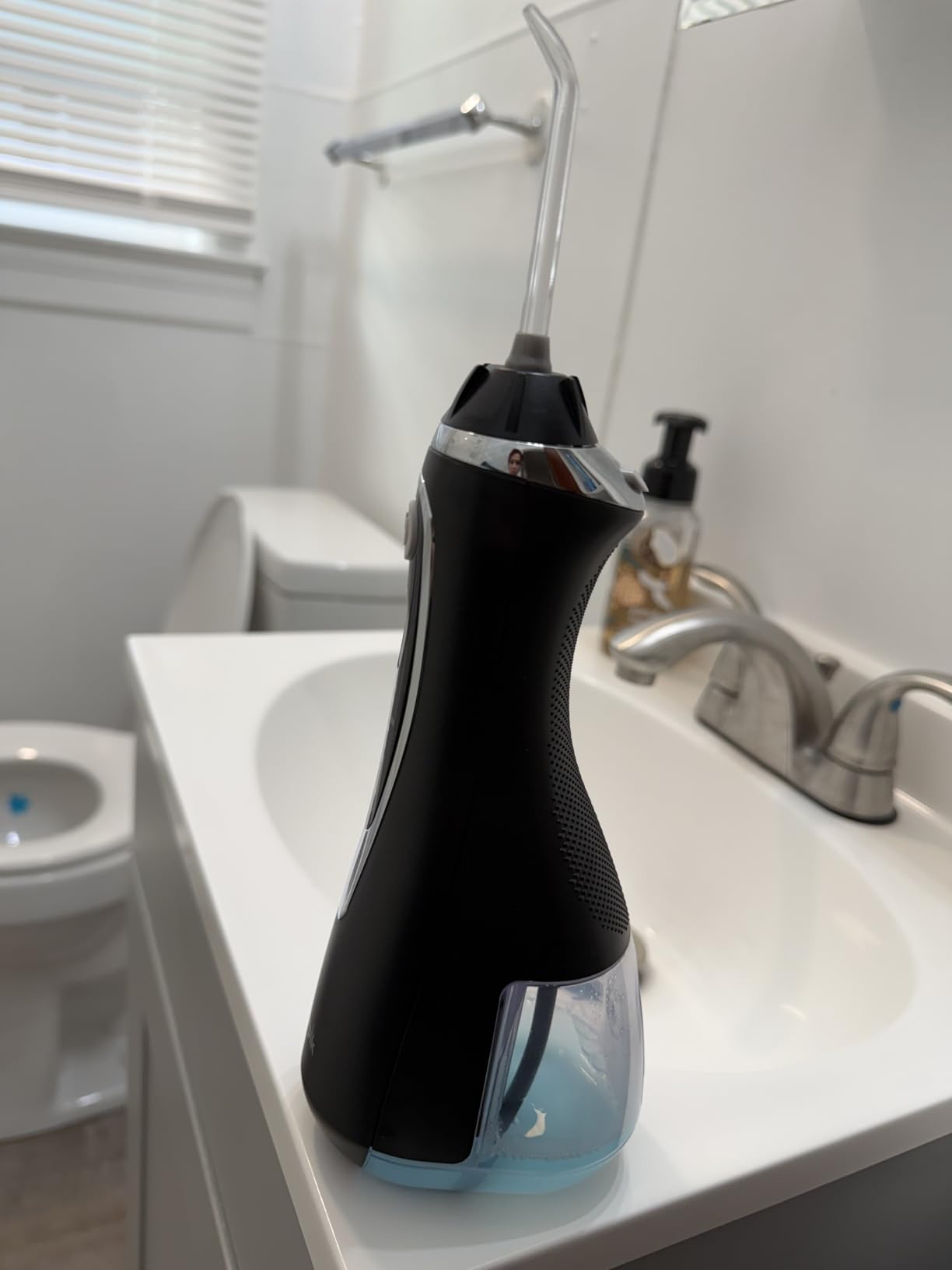
What you get instead is genuine convenience. The rechargeable battery runs up to four weeks on one charge, the body is waterproof for shower use, and the included travel bag and tip case make it the pick for anyone who travels often or shares a bathroom. The magnetic USB charger needs the supplied cable, and no wall adapter is in the box.
For a patient in the maintenance phase who already knows their pressure tolerance and just needs a portable maintenance tool, this is a defensible choice. For an active case with bleeding margins, we would rather you had more settings.
When a cordless unit is the right call
Cordless wins on consistency, not power. If the habit of irrigating every evening is the thing you are trying to protect, waterproofing, battery life and a case you will actually pack beat a stronger motor you leave on the counter. Most people irrigate far more often when the device is within arm’s reach of the sink.
When the pressure ceiling will frustrate you
If your chart shows pockets in the 6mm range and the tissue still bleeds easily, three coarse steps make it harder to find a comfortable setting. You also refill more often, and the small tank plus the proprietary charger are the two complaints that recur across reviews.
3. COSLUS C20 ADA Accepted – High Pulse Rate and a 300 ml Tank
COSLUS ADA Accepted C20 Water Dental Flosser Pick, Professional Set Black
ADA Scientific Council accepted
1400-1800 pulses per minute
300 ml tank
15.2 oz, 9.05 x 3.54 x 2.36 in
Pros
- ADA Scientific Council accepted
- Three modes let sensitive gums step up gradually
- 300 ml tank means very few refills
- 30-day battery life from a three-hour charge
- IPX7 waterproof for shower use
Cons
- Softest mode can still feel aggressive on very tender gums
- Proprietary charging connector instead of a standard cable
- Connector cover is loose and easily lost
The COSLUS C20 is the strongest all-round cordless option here on raw specifications, and it is the one we recommend to people who want documented acceptance rather than a marketing claim. It carries ADA Scientific Council acceptance, runs 1400 to 1800 pulses per minute through a 0.3mm dual-thread stream, and holds 300ml in the tank.
That pulse rate matters for periodontal work because a high-frequency stream detaches biofilm more efficiently than a steady low-flow stream of the same pressure. Paired with three modes, it lets you start on the soft mode and move up as bleeding settles. The stated claim of healthier gums in 15 days comes from the ADA submission, so treat the timeline as the manufacturer’s framing.
The 300ml tank is the quiet hero. It is roughly four times the volume of most cordless units, so you can trace every pocket without stopping to refill, which is exactly the behaviour you want on a full-mouth periodontal session. Battery life of about 30 days from a three-hour charge removes charging from your routine entirely.
The gaps are honest ones. Even the softest mode is reported as aggressive by a small number of owners with very tender gums, and the charging connector is proprietary rather than a standard cable. The connector cover also tends not to stay attached. Budget for one replacement cable.
How the dual-thread pulse stream behaves on a pocket wall
Two thin threads of water moving at high frequency shear the biofilm layer more effectively than one wider stream, and the oscillation alternates pressure against the pocket wall rather than pushing continuously in one direction. In practice this is what makes the C20 feel more thorough than lighter cordless units despite similar headline pressure.
What to check before you buy
Two things. First, if you have very tender tissue, confirm you are comfortable with the lowest mode, because reviews flag it as still punchy. Second, this is a five-tip kit with no sulcus-specific nozzle named, so plan on ordering a periodontal tip separately if your pocket depth is 6mm or deeper.
4. Nicwell F5025 – Eleven Pressure Levels for Graded Pocket Flushing
Nicwell Water Dental Flosser for Teeth – 4 Modes & 11 Pressure Settings Cordless Portable Oral Irrigator, IPX7 Waterproof Rechargeable with 5 Tips for Braces Cleaning, Travel, Deep Teeth Cleaning
4 modes and 11 pressure levels
1400-1800 pulses per minute
USB-C charging
14.07 oz, 8.03 x 3.98 x 2.72 in
Pros
- Eleven pressure levels give the finest control in this group
- Smart memory recalls your last setting
- Standard USB-C charging with no proprietary cable
- Quiet enough for a shared or early-morning bathroom
- Orthodontic tip plus 360-degree rotation
Cons
- Feels less powerful than countertop models
- No dedicated periodontal or sulcus tip in the five-tip kit
For anyone whose gums bleed easily and who is being asked to irrigate twice a day, the number of pressure steps matters more than raw pressure. The Nicwell F5025 gives you eleven levels across four modes, and the smart memory recalls the level you used last time so you are not guessing at a button every morning.
That granularity is what lets you dose by pocket. You can run a low level on a shallow 4mm site with tender tissue and a higher level on a deeper 6mm site in the same session. Very few devices in this price bracket give you that resolution, and it is the reason this model shows up in periodontal discussions at all.
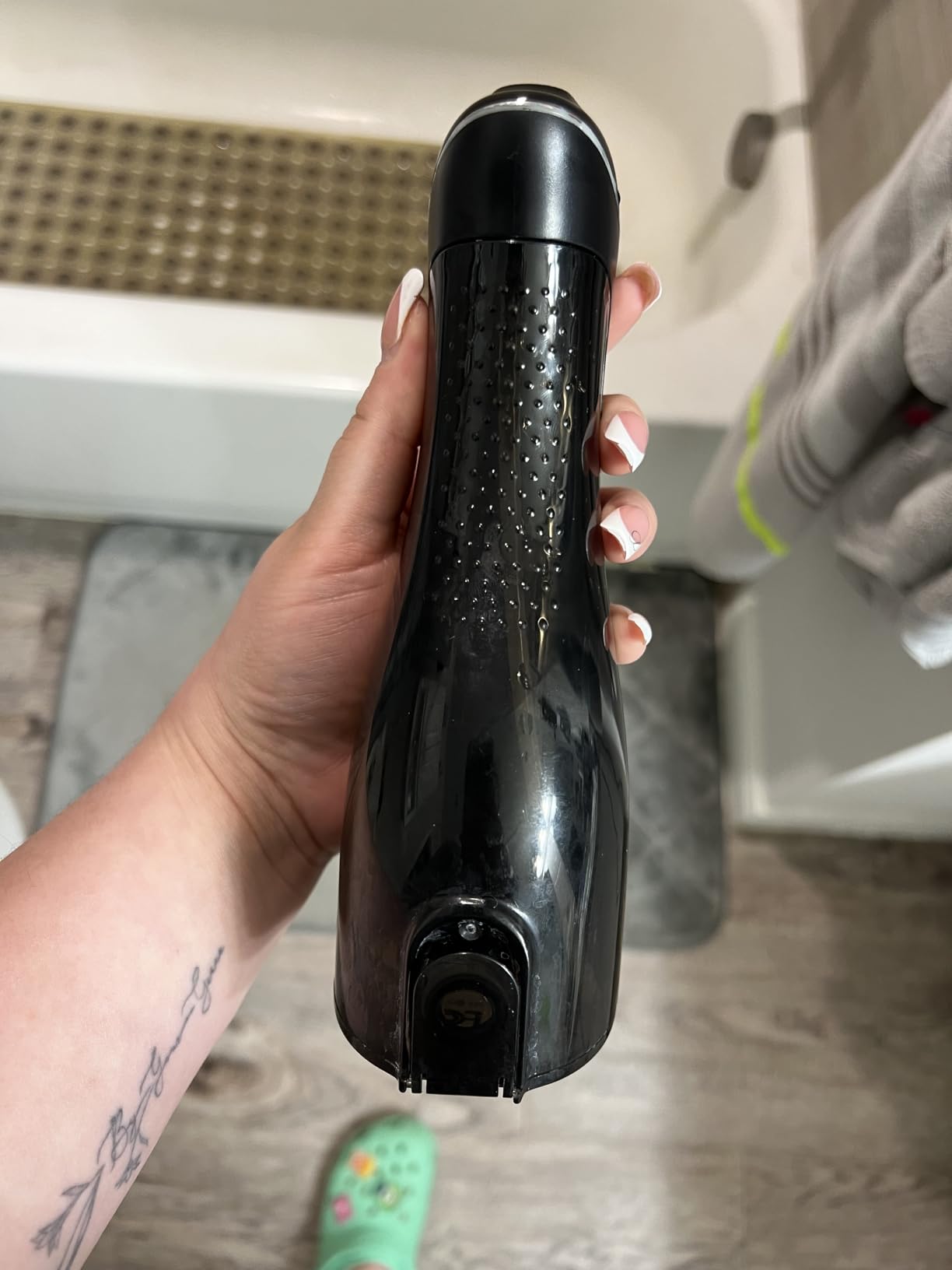
It also pulses at 1400 to 1800 per minute through a 0.3mm dual-thread stream, which is the same class of delivery as the COSLUS, and it charges over standard USB-C. That last detail matters if you travel, because there is no proprietary cable to lose and no adapter hunt at a hotel.
The limitation is tip selection. The five-tip kit covers classic jets, an orthodontic tip and a tongue scraper, and no dedicated periodontal or sulcus tip is listed. For 4mm and 5mm pockets the standard jet works. For 6mm and deeper, budget for a separate periodontal tip.
Why eleven levels beat four for a bleeding margin
With four settings, the step from level two to level three is often the difference between comfortable and painful. Eleven levels mean you can creep upward over weeks, letting inflammation settle, and reverse if a site starts to sting. That is closer to how a hygienist would progress you.
Where it sits against countertop power
This is a sub-1lb cordless unit, and users notice the difference in raw force compared with a countertop machine. If your pockets are shallow and your goal is consistency, that gap will not matter. If you are chasing deep calculus-adjacent sites, you will feel the ceiling.
5. Bitvae C5 – The Gentlest Ramp-Up for Tender Tissue
Bitvae Water Dental Flosser for Teeth, Cordless Water Teeth Cleaner Picks
5 intensity settings
2-second gentle start ramp
261 ml wide-mouth tank
13.55 oz, 2.6 x 3.7 x 8.78 in
Pros
- Two-second gentle start ramp is kind to tender tissue
- 261 ml tank is large for a portable unit
- 40-day battery life from a four-hour charge
- IPX7 waterproof for shower use
- Six tips with 360-degree rotation
Cons
- Fewer pressure levels than the ten and eleven setting models
- General budget tier may not match the durability of higher-priced units
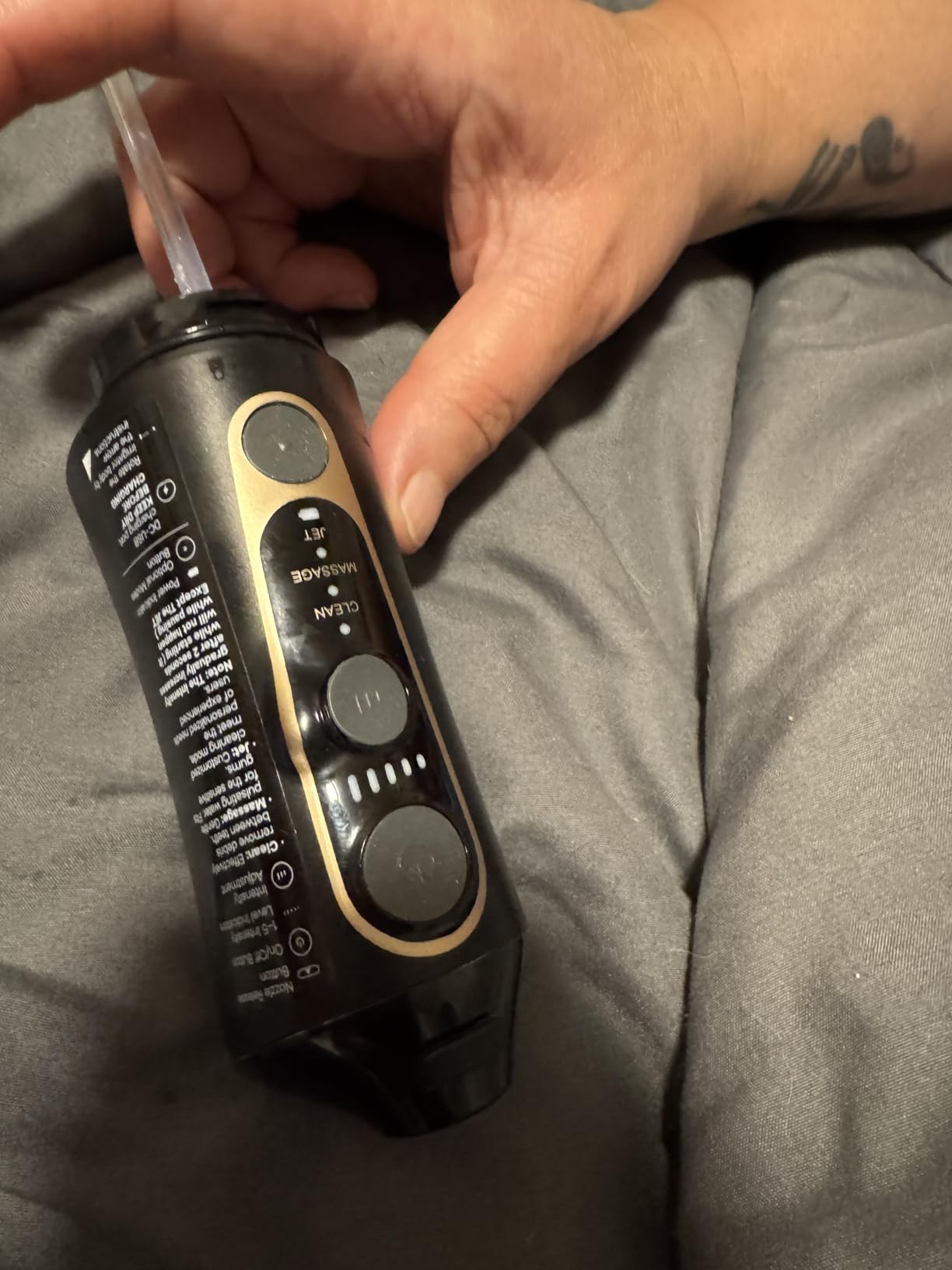
The single detail that separates the Bitvae C5 for periodontal use is the two-second gentle start. Instead of delivering full pressure the moment you squeeze the trigger, it ramps up. On a mouth with inflamed, bleeding margins that is the difference between a device you tolerate daily and one you stop using after a week.
It also gives you five intensity levels from gentle to deep cleansing, which is fewer steps than the Nicwell or the countertop Waterpiks but more than the three-setting cordless units. Five is enough to move from a post-scaling recovery week toward normal maintenance.
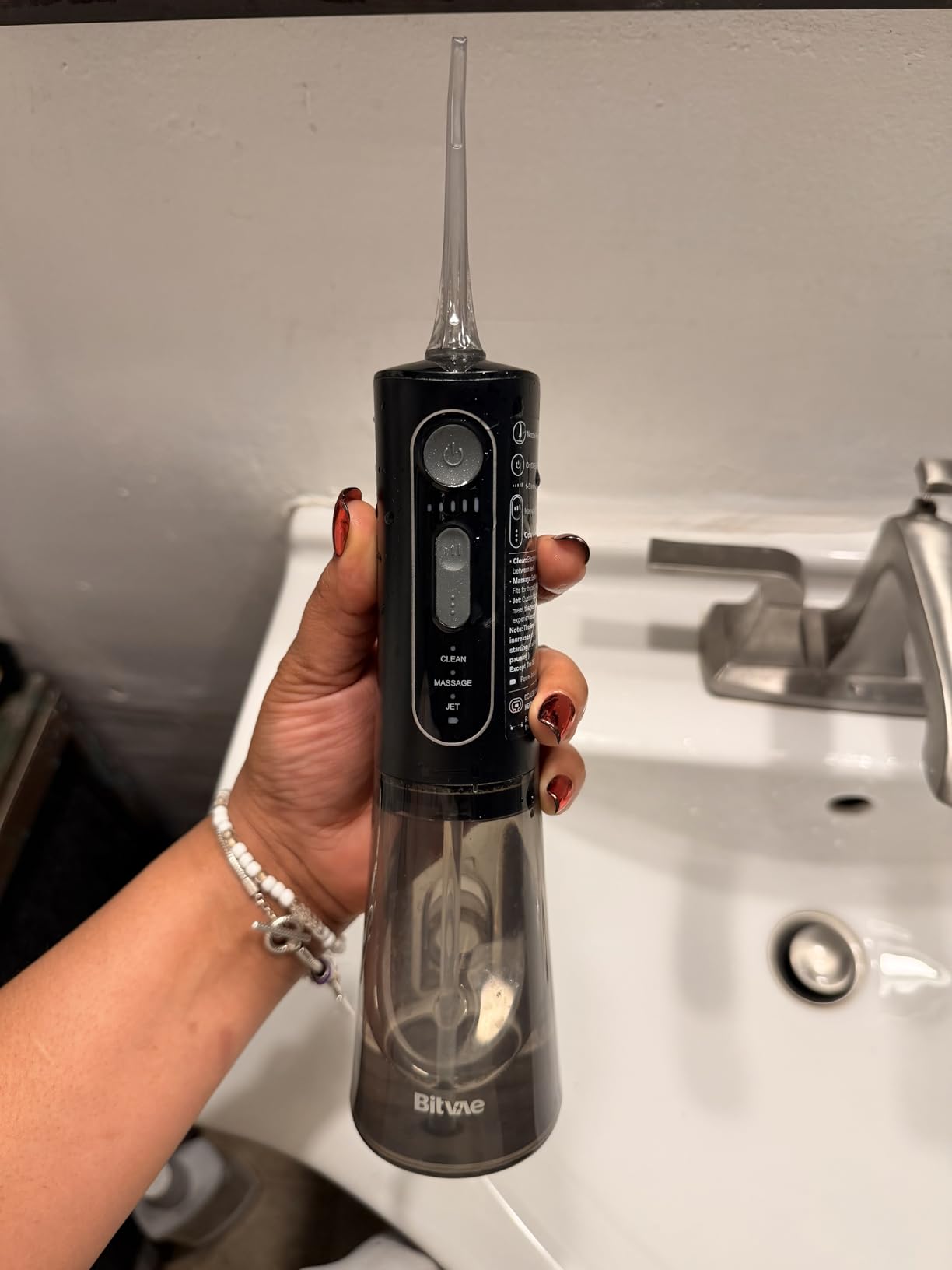
The 261ml wide-mouth reservoir is unusually large for a cordless unit and holds enough for a full 60-second whole-mouth clean, so pocket tracing across the entire mouth does not force repeated refills. Battery life runs about 40 days from a four-hour charge, and the body is IPX7 waterproof for shower use.
You get six tips with 360-degree rotation and dual colour coding, which is genuinely useful if more than one person in the household has periodontal findings. The trade-off is durability: at this tier, buyers who wanted a five-year device tend to be disappointed, and pressure granularity stops at five.
Why the start ramp matters more than the top setting
Most irrigator discomfort happens in the first half second of use. A ramp removes that event entirely, so you begin every session at a pressure the tissue accepts and increase deliberately. For post-scaling and root planing recovery, that is the feature to prioritise.
The honest limits
Five settings is coarse next to eleven levels, and it caps how carefully you can step up over time. Long-term durability is the other open question, since the motor and battery are in the lower tier relative to the countertop models here. For a maintenance-phase patient on a tighter budget, we think the trade is worth it.
6. AquaSonic Aqua Flosser ADA – ADA Accepted With a Published Trial
AquaSonic Aqua Flosser Water Flosser, ADA Accepted, White
ADA accepted via randomized controlled study
5 tips including periodontal tip
3 flossing modes
3.02 oz, 2.6 x 8.07 x 3.98 in
Pros
- Only unit here with a published randomized controlled trial behind its ADA acceptance
- Ships with a dedicated periodontal tip plus orthodontic and tongue tips
- Gentle mode suits sensitive or inflamed gums
- Cordless
- waterproof and quiet
Cons
- Small tank usually needs two or three refills per session
- Mode resets on power-up so selection takes trial and error
- Only three presets with no continuous adjustment
This is the only unit in our set whose ADA acceptance came out of a 30-day randomized controlled trial with 30 IRB-supervised subjects, reporting up to 87.1 percent plaque reduction and up to 93.8 percent improvement in gum health. Every other ADA claim on this page is a brand statement about acceptance; this one has a study behind it. If you want evidence rather than branding, start here.
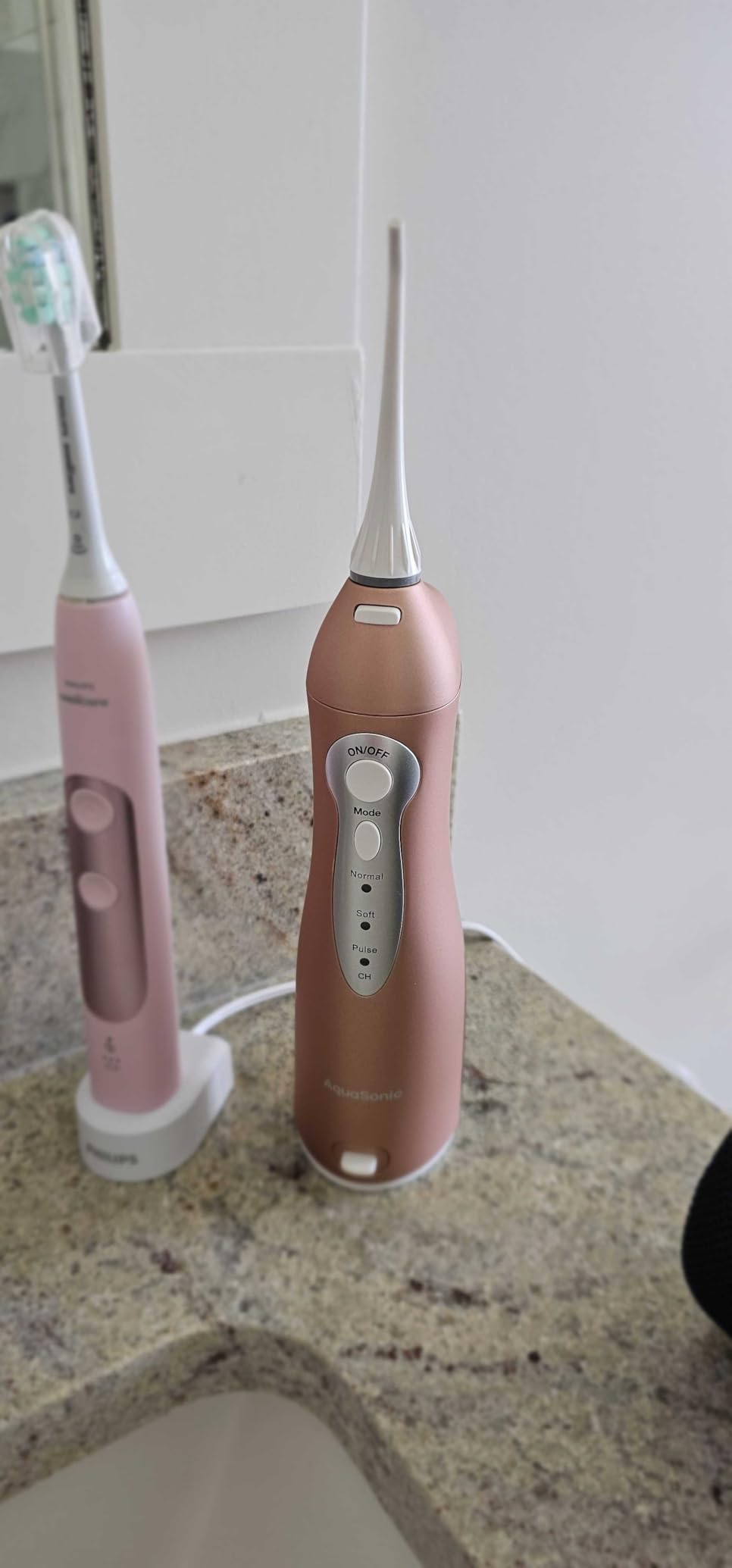
It also comes with a dedicated periodontal tip in the box, plus an orthodontic tip and a tongue scraper, and the tips rotate 360 degrees. Owners with sensitive gums report being able to use the gentlest setting without discomfort, and periodontal tip users find it effective under bridges.
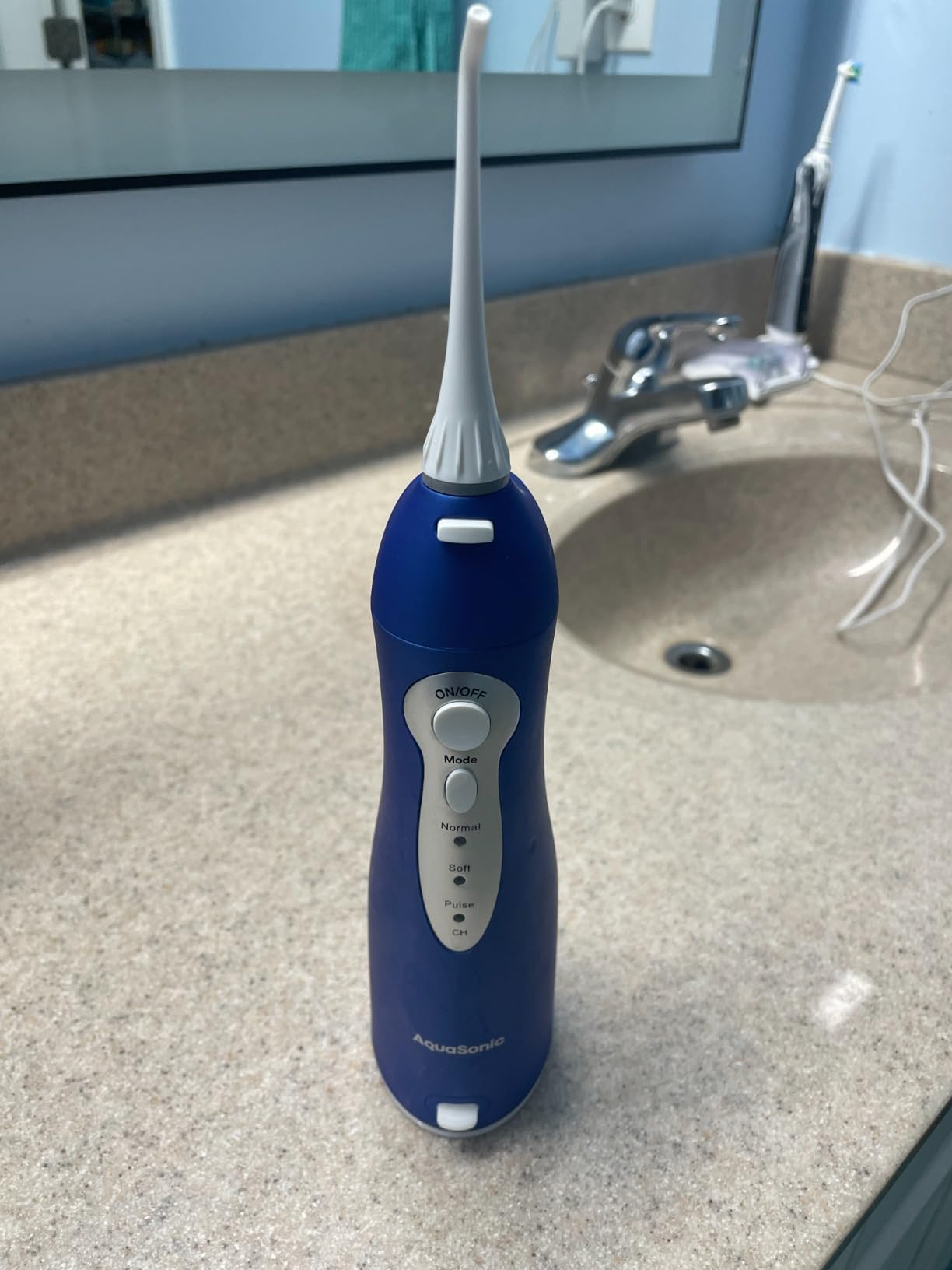
The cordless rechargeable body is waterproof and quieter than the countertop models, which matters if you irrigate late. Because the device is so light at 3.02 ounces, it is easy to hold accurately, and accurate aim is what determines whether water reaches the base of a pocket rather than splashing across the crown.
The dominant complaint across reviews is tank size. Two or three refills per session is common, and combined with a mode that resets every time you power on, some users simply reach for string floss when the tank runs dry. There are also only three presets, with no smooth adjustment between them.
How to read the trial numbers honestly
The figures come from a small, short study under supervised conditions, which is why ADA acceptance for irrigators is a lower bar than device clearance. Read them as evidence that irrigators measurably reduce plaque and gingival inflammation when used correctly, not as a promise that one device will resolve your pockets.
Where the design fights you
A resetting power mode and a tank that empties mid-session are workflow problems, not performance problems. Both are fixable habits, but they will not fix themselves. Budget a full 30-day battery cycle and accept the refill routine.
7. COSLUS E40 – Stepless Dial Control and a Periodontal Nozzle
COSLUS ADA Accepted E40 Water Dental Flosser, 10 Pressure Levels, Black Pro
Stepless pressure dial,10 levels listed
Periodontal and orthodontic nozzles
300 ml tank
15.17 oz, 9.37 x 3.34 x 2.36 in
Pros
- Stepless dial lands on an exact pressure instead of stepping through presets
- Includes a periodontal nozzle with standard and orthodontic tips
- Compact and light enough for arthritic hands
- 300ml tank with up to 30 days per charge
Cons
- Reservoir drains fast enough that many owners refill five to seven times
- No built-in tip storage in the base
- Some models will only charge with the supplied cable
The E40 solves a specific problem with a specific part. A stepless dial means you can land on an exact pressure rather than clicking through ten discrete presets, which matters when you are trying to keep a stream consistent across a whole mouth of pockets at different depths. Same stream, same pressure, site after site.
It also includes a periodontal nozzle alongside the standard and orthodontic tips, and the nozzles click on securely and release with a button press. For people with implants or long bridge spans where you need to flush under a restoration without dislodging it, that combination is the reason to choose this over a cheaper cordless.
Handling is a quiet strength. At 15.17 ounces it is light and compact enough for users with arthritis to hold steadily, and steady hands translate directly into better aim at a pocket entrance. The 300ml tank matches the C20, and a charge supports up to 30 days at one or two uses a day.
The tank empties faster than its volume suggests, and some owners report refilling five to seven times in a session, which pushes many of them back to floss at the end. There is no built-in tip storage in the base, and a few owners report the unit will only charge with the supplied cable.
What a stepless dial actually fixes
Preset steps are a compromise: the jump from step three to step four can be the difference between comfortable and painful on an inflamed site. A continuous dial lets you approach a pressure from below and hold it, which makes a slow two-week progression realistic instead of guesswork.
Flushing under bridges and around implants
The periodontal nozzle is narrow enough to reach under a bridge span and around an implant collar, which is where a standard jet tip splashes and gives up. Add the constant pressure to that reach and you get the most controlled implant maintenance we found in a cordless body. Keep the nozzle moving and never park it against tissue.
8. Waterpik Promax WF-23W010 – Most Power With a Two-Week Ramp
Waterpik Promax Countertop Water Flosser, SmartAdvance, 10 Settings, 5 Tips
SMARTADVANCE two-week ramp
10 settings, 2 user profiles
Large reservoir, 90+ seconds
1.27 lb, 6.2 x 3.6 x 8.2 in
Pros
- Strongest reported pressure in our group
- SMARTADVANCE ramps intensity over two weeks
- Much quieter motor than older Aquarius models
- Compact footprint with magnetic wand holder
- Two user profiles for a household
Cons
- Removable tank does not lock and can slide off
- Tank lid is harder to remove than the Aquarius lid
- Tips are not clearly labelled in the instructions
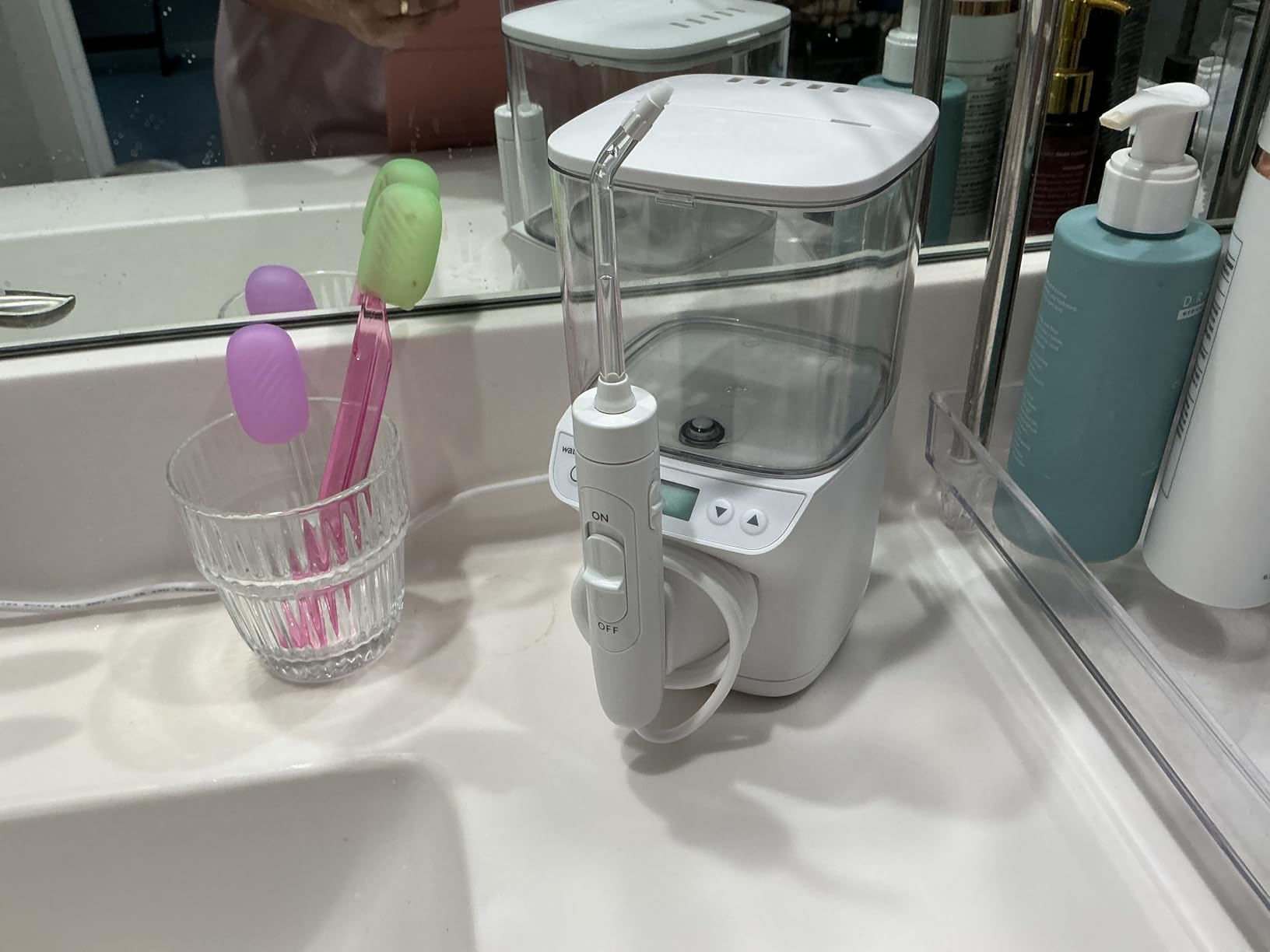
The Promax is the newest Waterpik countertop here, and owners upgrading from older Aquarius units describe it as clearly more powerful, quieter and smaller. For deep pockets and heavy biofilm that is the direction you want, because the extra pressure gives you headroom to keep the stream narrow and still penetrate.
SMARTADVANCE is the feature we would actually argue for. It ramps intensity automatically over two weeks, which is a sensible default for anyone whose tissue is inflamed or still healing after scaling and root planing. You stop having to remember to hold back.
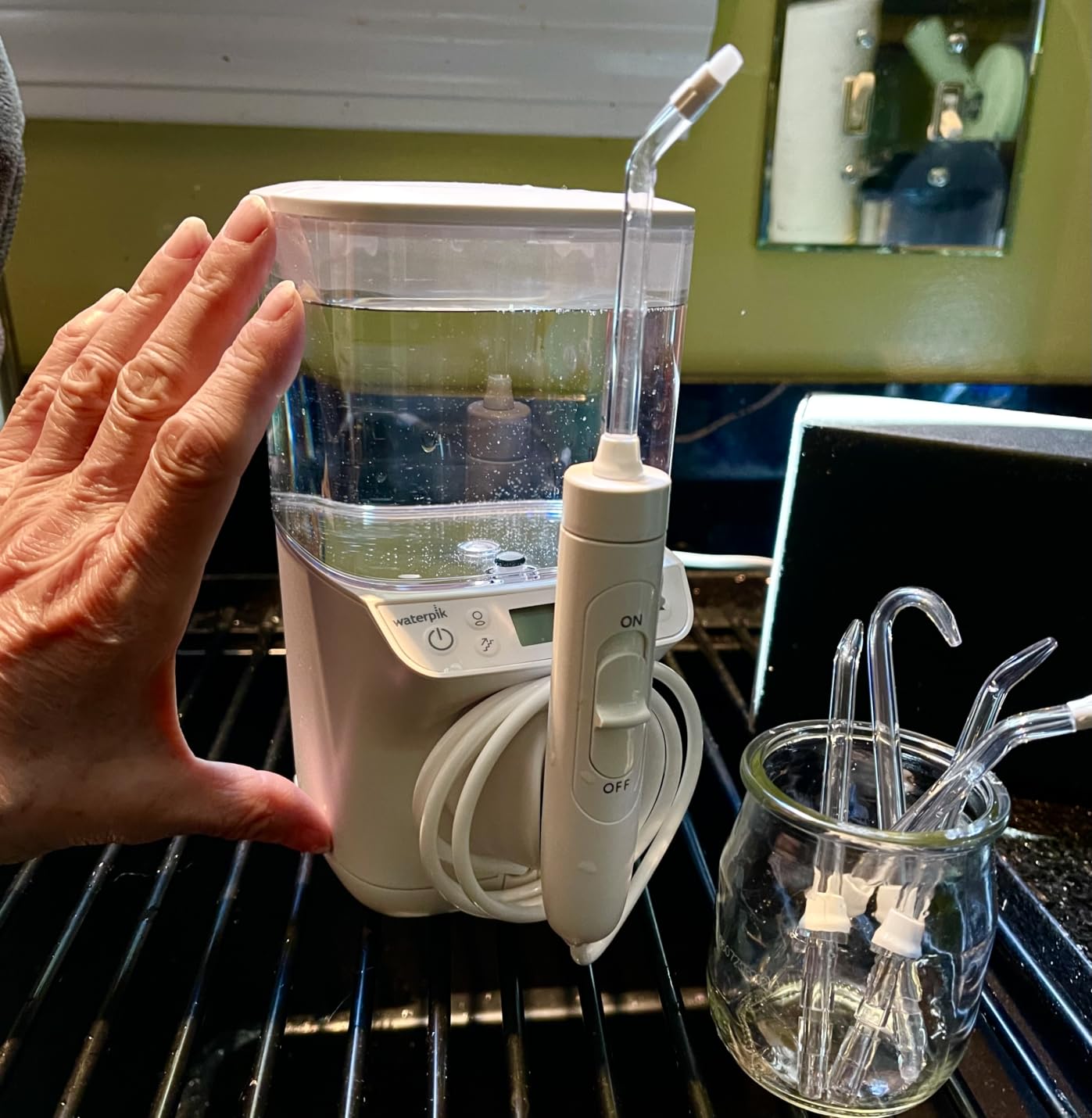
Ten intensity settings with two user profiles cover a household in one unit, and the reservoir delivers 90-plus seconds so a full pocket trace finishes without stopping. The magnetic wand holder and coiled hose keep the counter tidy, and the ADA acceptance is stated alongside the brand’s claim of helping significantly reverse bleeding gums.
The one flaw reviewers repeat is the tank. It does not lock into place and can slide off when the unit is moved, and the lid is harder to remove and replace than the Aquarius lid. The tips are also not clearly labelled in the written instructions, so check which one is the pocket tip before you start.
Why raw pressure matters for deep pockets
More pressure does not automatically mean more cleaning, but it does mean you can keep a narrow stream narrow. Deep sites need concentrated flow to reach the base, and if the only way to get that is a wide blast, you end up irrigating the crown and flushing nothing. The Promax removes that compromise.
The two-week ramp, explained
SMARTADVANCE increases intensity gradually across two weeks instead of jumping to full pressure. That protects tissue that is still inflamed after treatment and removes the most common early-stage mistake, which is starting too hard and concluding that irrigators hurt.
9. Hydro Floss New Generation – Sulcus Tips and an 800 ml Tank
Hydro Floss New Generation Oral Irrigator Bundle with Sulcus Tips
Sulcus tips included in the bundle
800 ml tank
9 pressure settings
3.11 lb, 9.02 x 4.02 x 10 in
Pros
- Bundled sulcus tips purpose-built for periodontal pocket irrigation
- 800 ml tank covers two people in one evening
- Nine pressure settings with two user levels
- Rotating nozzle stops the hose twisting
- Owners report around five years of daily use
Cons
- Very loud during operation
- Tips can work loose at the highest setting
- Water-stop button must be held down
- Springs a leak from the hose or base
The Hydro Floss is the specialist choice in this list, and the reason is the bundle. It ships with sulcus tips, which are purpose-built for periodontal pocket irrigation rather than general gumline flushing, and a small, loyal buyer base that largely consists of people already diagnosed with gum problems. Several report that a hygienist recommended the brand outright.
With an 800ml tank and nine pressure settings that let two household members take different levels, this is the rare irrigator you can genuinely use for a long whole-mouth periodontal session without stopping. The rotating nozzle prevents the hose twisting, and it can deliver a rinse or plain water.
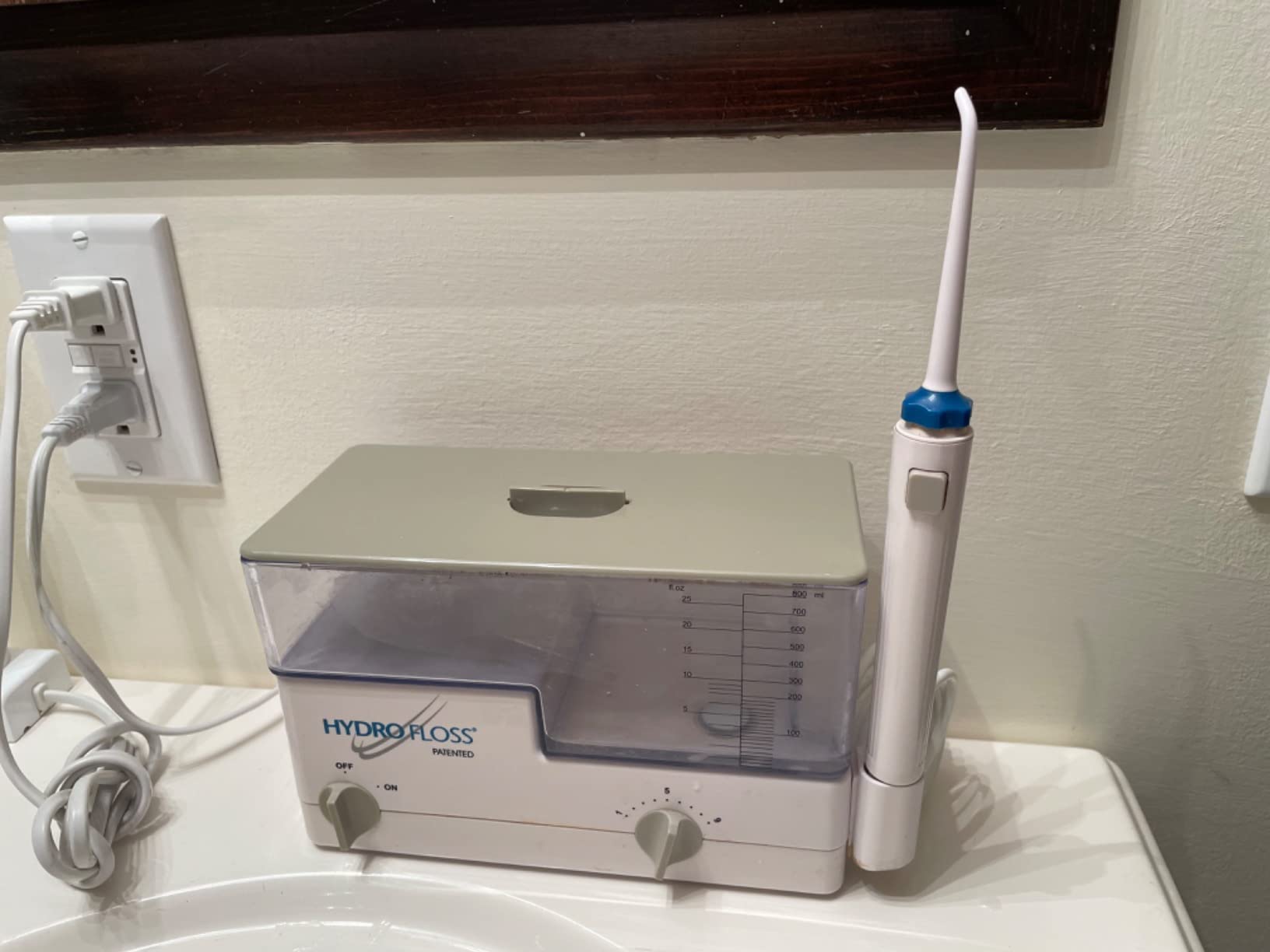
Longevity is a real strength here. Owners report around five years of daily use per unit before replacing, and the brand describes results published in a journal. If you are buying for a decade of maintenance rather than a trial period, build that into the decision.
Noise is the complaint almost every reviewer raises, and it is loud. The magnetically charged mechanism also means the water-stop button is a squishy control you hold down, and tips can work loose at the highest pressure. A few owners have reported leaks from the hose or base, so keep it away from cabinet edges.
Why sulcus tips are worth the extra attention
A sulcus tip is built to slide along the soft tissue wall of the pocket and deliver water to the base without traumatising the junctional epithelium. That is a different geometry from a standard jet, which sprays straight across the crown. If your chart shows multiple 5mm-plus sites, tip geometry is worth more than pressure range.
Who should skip it
Noise-sensitive households, small bathrooms and anyone travelling outside North America, since it uses a 120V US plug. If you irrigate early morning with others asleep, or you want a device you can carry, the cordless picks make more sense.
10. OraTec Pocket Care Irrigator – Precision for One Tracked Pocket
Pocket Care Irrigator (24g End-Port)
24 gauge end-port cannula
1/2 oz squeeze bottle
Reaches full pocket depth
Available in 21 or 24 gauge
Pros
- Most targeted instrument here for a single deep pocket
- Delivers medicated rinses straight into the pocket
- Compact and genuinely portable
- Fine cannula suits receded gums and localized infection
Cons
- Very weak flow
- so it is not a daily whole-mouth tool
- Metal tip is fragile and no replacement is included
- Cap does not stay on
- Only covers one or two areas at a time
This is not a water flosser, and we included it because it solves a problem the powered devices cannot. The OraTec Pocket Care Irrigator is a 1/2 ounce squeeze bottle with a 24 gauge end-port cannula that sprays from the tip itself and irrigates to the full depth of even the deepest periodontal pockets.
That geometry is the point. An end-port stream runs along the pocket wall to the base, and it can carry a chlorhexidine or other medicated rinse directly to one site instead of swishing the whole mouth and staining teeth. If your periodontist has flagged one stubborn pocket, this is the instrument built for that job.
How to use it alongside your main irrigator
Think of it as a targeted top-up, not a replacement. Use your water flosser for the full mouth twice a day, then use this for the one or two sites that keep flaring between recall visits. Owners with diagnosed deep pockets report that this routine helped them avoid repeat infections.
Where it stops working
The flow is weak even when squeezed hard, so it cannot replace daily whole-mouth cleaning. The metal tip is fragile and can snap or bend, and no replacement tip is included. The cap also falls off easily, so keep it upright in a bag with the cap seated before you close it.
How to Choose an Oral Irrigator for Periodontal Pockets
Most buyers start with tank size because it is the number on the box. For periodontal pockets it is the fourth question. Here is the order we would actually use.
1. Match the tip to the pocket depth first
Before pressure, before reservoir, confirm the device includes or supports a tip narrow enough for your deepest site. Pocket depth maps to tip type and pressure roughly like this.
4mm to 5mm pockets: a standard jet tip is usually sufficient. Start at a low setting and trace the pocket with the stream angled toward the tooth.
6mm pockets: use a periodontal or sulcus tip. These are shorter and more tapered than standard jets and are designed to enter the sulcus without hitting the root surface square on.
7mm and deeper: you want either a dedicated sulcus tip with fine pressure control or a specialist end-port cannula. This is also the range where a periodontist should be involved, because pockets past 6mm rarely resolve with home care alone.
2. Count pressure settings, not headline PSI
PSI figures in this category are inconsistently measured and often unverifiable, so we ranked on settings instead. What matters is whether you can step down gradually on inflamed tissue and step up for deeper sites in the same session. Ten to eleven settings is genuinely useful. Three is workable but coarse. Look for a massage or pulsating mode as well, since alternating pressure behaves better on tissue than a constant blast.
3. Check whether the tip is included or sold separately
Tips are brand-locked, so a pocket tip from one brand will not fit another. The Pik Pocket tip, the COSLUS periodontal nozzle and the Hydro Floss sulcus tips are all model-specific. Check the tip list in the box contents before you decide, then budget for a separate tip if yours is missing.
4. Decide cordless versus countertop
Our recommendation for periodontal disease is countertop if you have one bathroom and 6mm-plus pockets, cordless if you travel or if consistency is your main problem. Countertop units give you stronger sustained flow and a bigger tank for a slow full-mouth trace. Cordless units win on habit: waterproof bodies, long battery life and a device you will actually use every evening.
5. Reservoir size decides whether you keep the habit
A periodontal session takes longer than a quick rinse. Anything under about 200ml will need multiple refills on a full mouth, and multiple refills are how people quit. Our floor is roughly 250ml for cordless and 600ml-plus for countertop.
6. Reservoir hygiene protects your periodontal gains
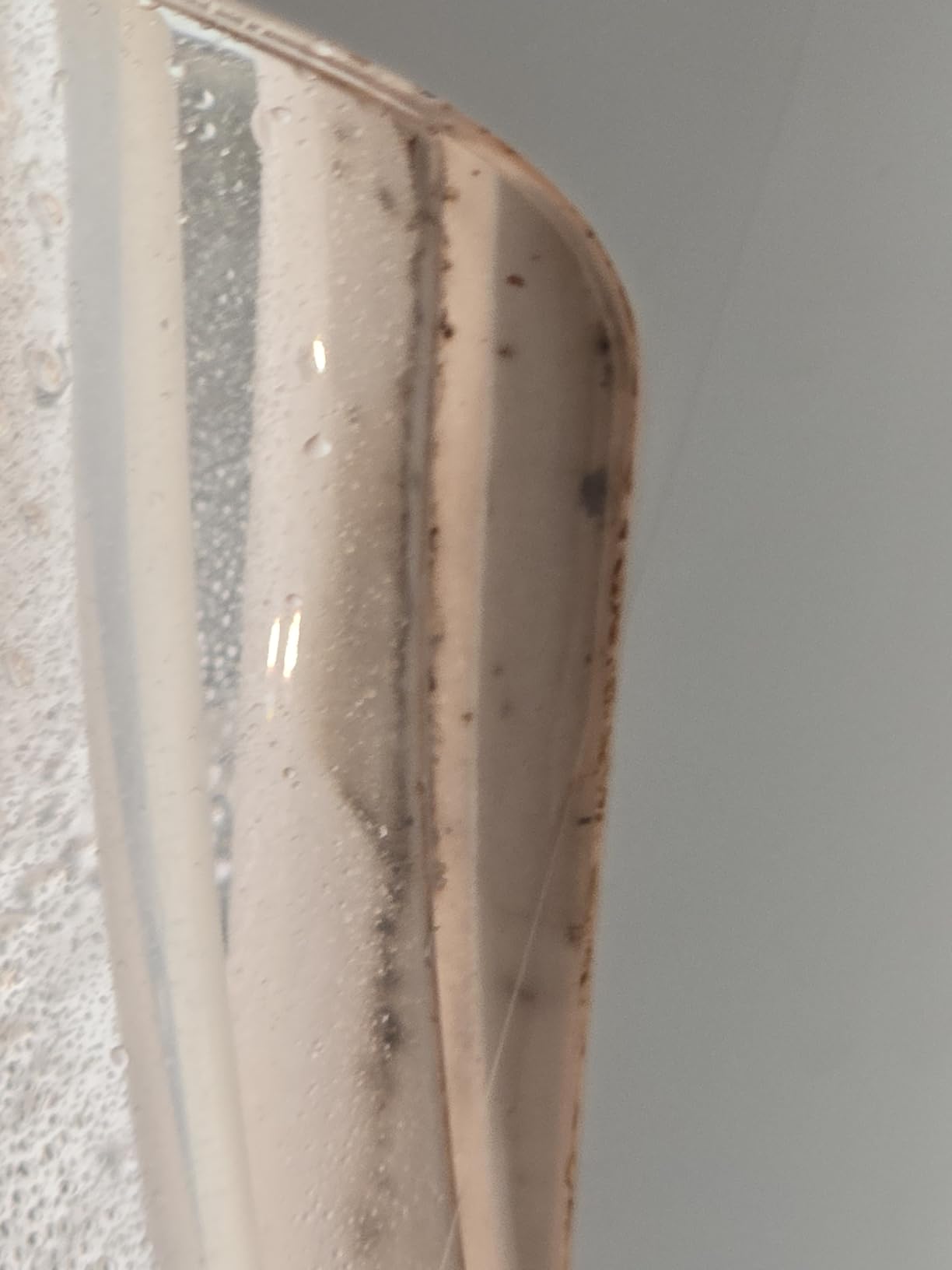
Biofilm that grows in a warm tank reinfects the mouth you are trying to treat. Empty and dry the tank after every session, run a weekly rinse cycle, and if your model has a removable tank, keep it off the unit when it is not in use. Periodontal patients who use the same reservoir for years without drying it are irrigating bacteria back into fresh pocket sites.
How to Flush a Periodontal Pocket Without Causing Pain
Device choice matters less than aim. This sequence is how we irrigated, and it works on any of the ten devices above.
1. Start low and fill the mouth. Choose the lowest or second-lowest setting for the first week, aim the stream at the gumline, and let it run across the whole arch to clear debris before you go deep.
2. Set the angle at 45 degrees. The tip should point toward the tooth, slightly into the sulcus. Pointing straight down the long axis of the tooth causes splashing; pointing outward hits cheek tissue.
3. Pause at the pocket entrance. Let water pool and dwell for a moment at each site rather than blasting past it. The dwell time is what lets the stream penetrate biofilm at the base.
4. Trace the pocket, do not park in it. Move the tip a fraction of a millimetre at a time along the pocket wall and keep moving. Holding a stream stationary in one spot is how people cause a sore spot or blow bacteria through the tissue.
5. Work quadrant by quadrant. Ninety seconds per quadrant is the working range on a countertop unit. Do not skip the back molars; furcation areas and distal pockets are the ones missed most often.
6. Change setting by site, not by mouth. Shallow 4mm pockets take a lower setting than a deep 6mm site. This is where ten or eleven pressure levels genuinely pay off.
7. Finish with the massage or pulsating mode. A short pass over the whole arch on the pulse setting increases gingival blood flow and leaves tissue less prone to bleeding at the next session.
8. Spit, do not rinse. Rinsing with water washes away the evidence of what came out of the pocket, and for the first few weeks that visibility is genuinely useful.
When to Stop Irrigating and Call Your Dentist
Do not irrigate an active infection. Swelling, pus, fever or a bad taste that keeps coming back all point to something an irrigator cannot reach.
Do not irrigate a fresh extraction site. Dislodging the clot is how a dry socket starts. Follow the extraction timeline your dentist gave you.
Bleeding that does not improve after two weeks is a diagnostic signal, not a pressure problem. Increasing pressure on bleeding tissue makes it worse. Persistent bleeding is a reason to book a periodontal assessment.
Stop if irrigating hurts. Sharp pain at a specific site usually means wrong tip geometry, wrong angle or a site that needs professional treatment.
Deep pockets of 7mm and beyond, and anything approaching 10mm, belong with a periodontist. At that depth the treatment ladder runs from improved home care to scaling and root planing to, in some cases, surgical access. An irrigator supports every step of that ladder; it does not replace any of them.
How We Evaluated These Oral Irrigators
We scored all ten devices on periodontal relevance first. The weighting was: included pocket or sulcus tip, then number of pressure settings and whether a massage or pulsating mode exists, then reservoir volume, then verified rating and review volume as a proxy for durability.
We did not measure PSI ourselves, because the figures published for these devices come from different test rigs and are not comparable. Anything in the specifications here comes from manufacturer listings, and we have flagged clinical performance numbers as manufacturer claims rather than independent results.
The ADA Seal of Acceptance appears on several products here. Its scope for irrigators covers plaque and gingivitis reduction claims, not the treatment of periodontitis, which is a distinction worth keeping in mind when you read an acceptance badge.
Frequently Asked Questions
Can a water flosser help with periodontitis?
Yes, as an adjunct. A pulsing water stream aimed into the pocket loosens and flushes subgingival biofilm that a toothbrush cannot reach, which reduces bleeding and gingival inflammation between professional cleanings. It does not remove hardened calculus and does not replace scaling and root planing.
Do dentists recommend oral irrigators?
Most do, as a supplement to brushing, interdental brushes and professional treatment rather than a replacement for them. The devices listed here carry ADA Seal of Acceptance or ADA Scientific Council acceptance for plaque and gingivitis claims. Your periodontist may also recommend a specific tip or protocol.
How do you clean a periodontal pocket with a water flosser?
Use a periodontal or sulcus tip, set the lowest comfortable pressure to start, and angle the stream toward the tooth at about 45 degrees. Pause briefly at each pocket entrance to let the water dwell, trace the pocket wall in small increments rather than parking the stream, and work quadrant by quadrant for about 90 seconds each.
What PSI do I need for gum disease?
PSI figures across these devices are measured inconsistently, so count pressure settings instead of headline pressure. For periodontal pockets you want at least five settings and ideally ten or eleven, so you can start low on inflamed tissue and increase gradually. A narrow tip and steady aim matter more than maximum pressure.
How often should I use a water flosser with periodontal disease?
Most periodontists suggest once or twice daily, alongside brushing and interdental cleaning. Consistency matters more than session length. Finish each session by spitting rather than rinsing so you can see what is being flushed out, and keep going after your recall appointment to maintain the gains.
Can an oral irrigator replace scaling and root planing?
No. Irrigation reduces the bacterial load between visits, but hardened calculus must be removed by a clinician. In the maintenance phase after treatment, a water flosser helps keep pocket depth stable and makes the tissue respond better, but it is maintenance, not treatment.
Is it normal for gums to bleed when using a water flosser?
A small amount of bleeding early on is common when gums are inflamed, because inflamed tissue bleeds more readily. If bleeding has not reduced after two weeks of consistent use, book a periodontal assessment rather than turning the pressure up. Do not irrigate an area with swelling, pus or pain.
What are the treatment options for 10 mm periodontal pockets?
Pockets that deep require a periodontist, and home irrigation is not the treatment. The ladder runs from improved home care and more frequent professional cleaning, through scaling and root planing, to surgical access such as flap procedures where regeneration is not likely on its own. An irrigator supports recovery between those steps.
Our Verdict for Periodontal Pocket Irrigation
For most people reading this with a periodontal chart in hand, the best oral irrigators for periodontal pockets resolve to three answers. Deep 6mm-plus pockets on a single bathroom budget go to the Waterpik Aquarius WP-660, because ten settings plus the Pik Pocket tip is the most complete pocket setup we found. If you travel between maintenance visits, the Waterpik Cordless Advanced WP-580CD keeps the same tip system in a waterproof body.
If you want documented acceptance and high pulse frequency in one cordless package, the COSLUS C20 ADA Accepted does both. And if one stubborn site keeps flaring, the OraTec Pocket Care Irrigator is the specialist top-up for that single pocket.
None of these replaces your periodontist. Use them between visits, start at a low setting, and let tissue response rather than pressure decide how far you go.