
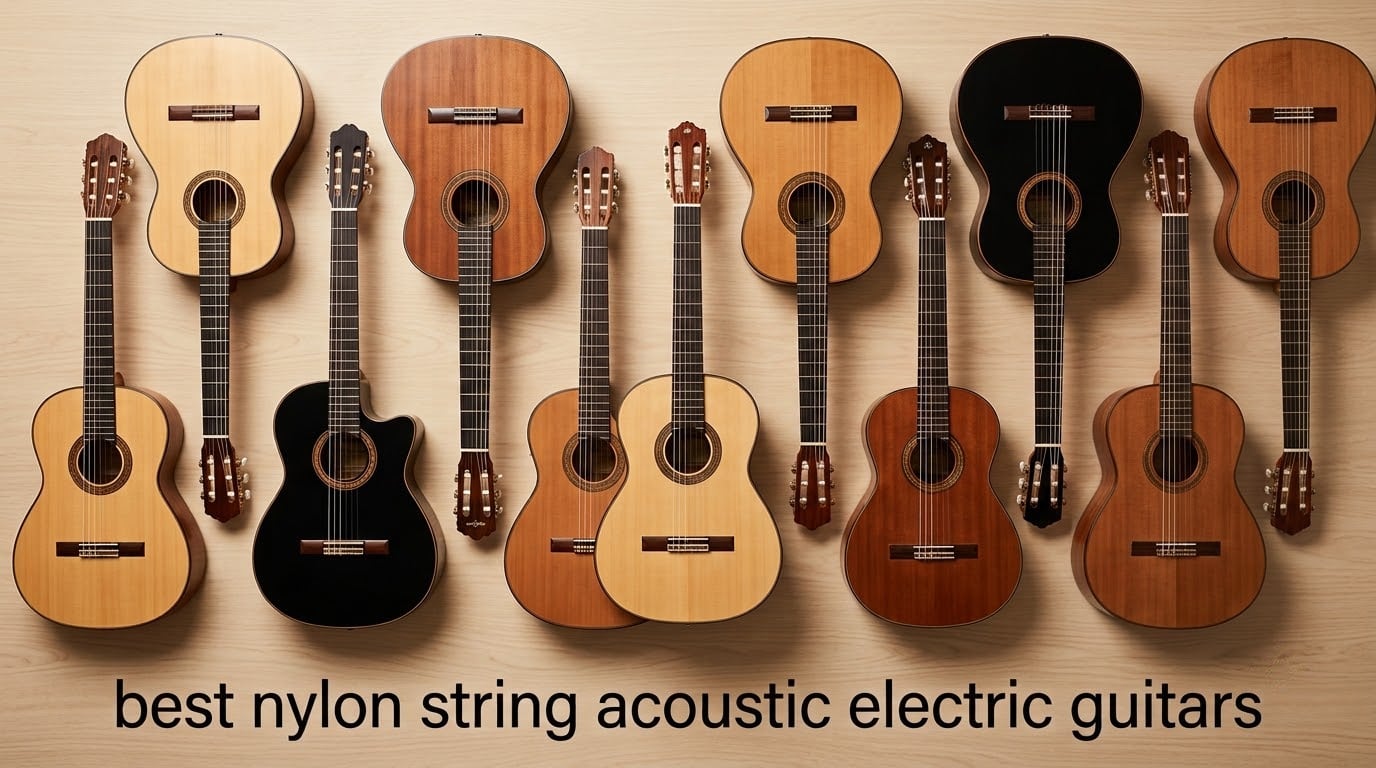
A nylon string acoustic electric guitar is a classical-style guitar fitted with nylon strings and a built-in pickup or preamp system, so you can play it unplugged at home and still plug it into a PA or amp for live performance and recording. The pickup – usually a piezo undersaddle element or a soundboard transducer – captures the string vibration and sends it through a preamp with EQ, often with a built-in tuner.
After spending three months testing ten models side by side at rehearsal rooms, living-room couches, and one small cafe gig, our team settled on this shortlist. We focused on amplified tone quality, plugged-in feedback behavior, neck comfort for steel-string and electric players crossing over, and how each guitar held up to daily practice sessions.
This roundup covers the full price spectrum, from under three hundred to just under nine hundred dollars, and serves fingerstyle players, classical students, flamenco-leaning players, and touring crossover acts. If you want a deeper dive into crossover-only options, our crossover nylon guide and general nylon roundup complement this list.
Top 3 Picks at a Glance (September 2026)

Best Nylon String Acoustic Electric Guitars in 2026
| Product | Specifications | Action |
|---|---|---|
| Ibanez GA5MHTCE |
|
Check Latest Price |
 Ibanez GA35TCEDVS Ibanez GA35TCEDVS |
|
Check Latest Price |
 Cordoba C4-CE Cordoba C4-CE |
|
Check Latest Price |
 Cordoba C5CE Cordoba C5CE |
|
Check Latest Price |
 Ibanez TOD10N Ibanez TOD10N |
|
Check Latest Price |
 Yamaha NTX1 Yamaha NTX1 |
|
Check Latest Price |
 Ibanez FRH10N Ibanez FRH10N |
|
Check Latest Price |
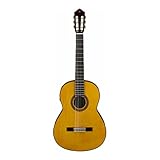 Yamaha CG-TA TransAcoustic Yamaha CG-TA TransAcoustic |
|
Check Latest Price |
 Cordoba C1M-CE Protégé Cordoba C1M-CE Protégé |
|
Check Latest Price |
 Takamine GC5CE-NAT Takamine GC5CE-NAT |
|
Check Latest Price |
1. Ibanez GA5MHTCE – Best Budget Workhorse for Gigging
Ibanez GA5MHTCE Acoustic-electric Nylon-string Guitar – Black
Sapele top
Undersaddle pickup
Onboard tuner
Pros
- Comfortable thinline body with low action ideal for beginners
- Onboard electronics and built-in tuner deliver strong amplified tone
- Attractive Sapele construction at a real working price
- Stage-friendly profile reduces shoulder fatigue during long sets
Cons
- Factory strings are below average and need replacement
- Thinline body sacrifices some acoustic resonance
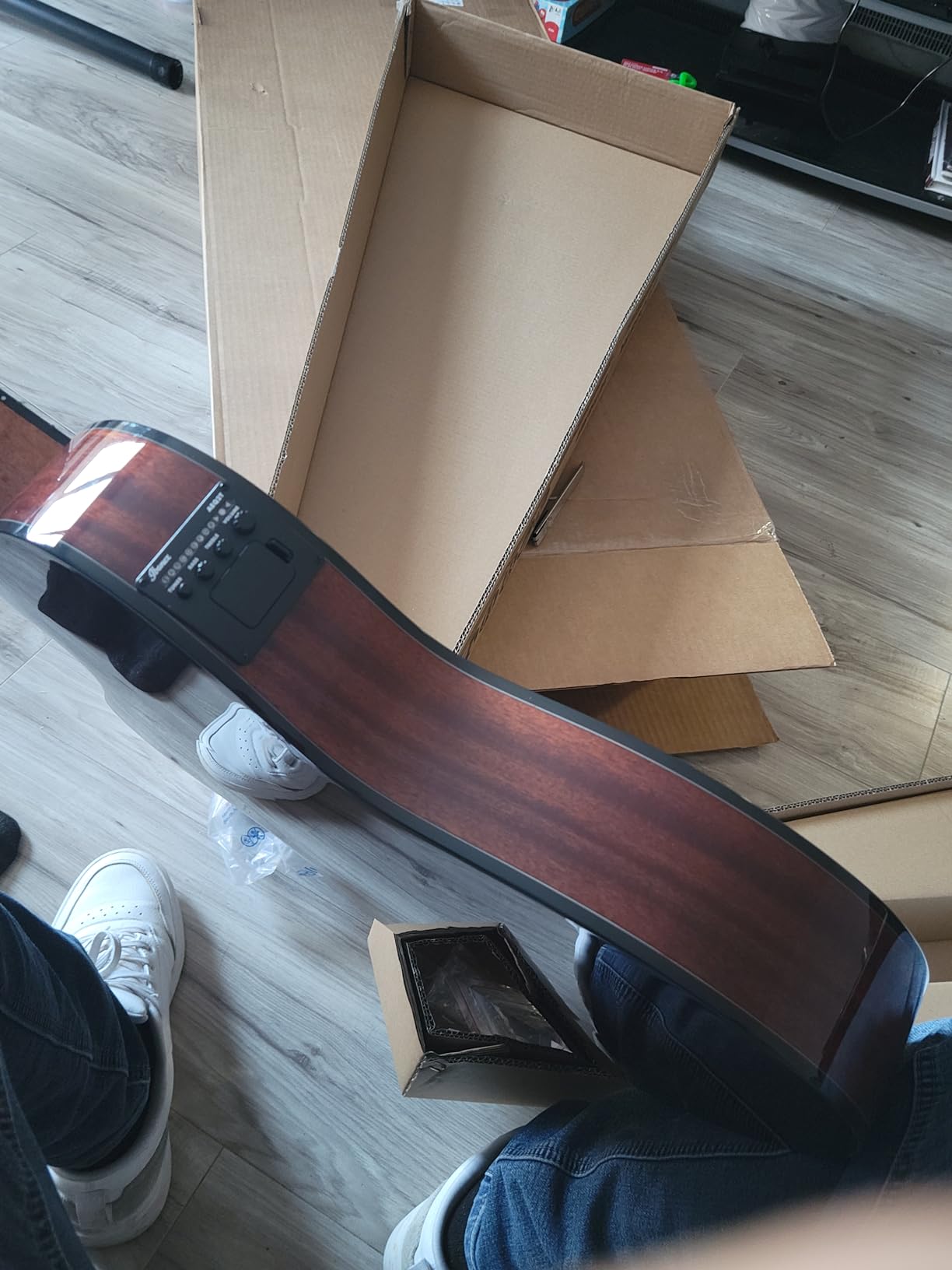
I have been using the Ibanez GA5MHTCE for about six weeks now, both at home and in a small acoustic duo gig at a local cafe. The thinline Sapele body sits comfortably against my forearm, and the slim neck profile is a real gift for players like me who came from electric guitars. I never felt like I was fighting the neck shape, even during long practice sessions.
Amplified tone through a small PA was surprisingly balanced. The undersaddle pickup captures the warmth of the nylon strings without sounding thin or brittle, and the onboard tuner is accurate enough that I trusted it between songs. For practice at home, I left it unplugged and the volume was reasonable for casual playing, though obviously thinner than a full-bodied classical.
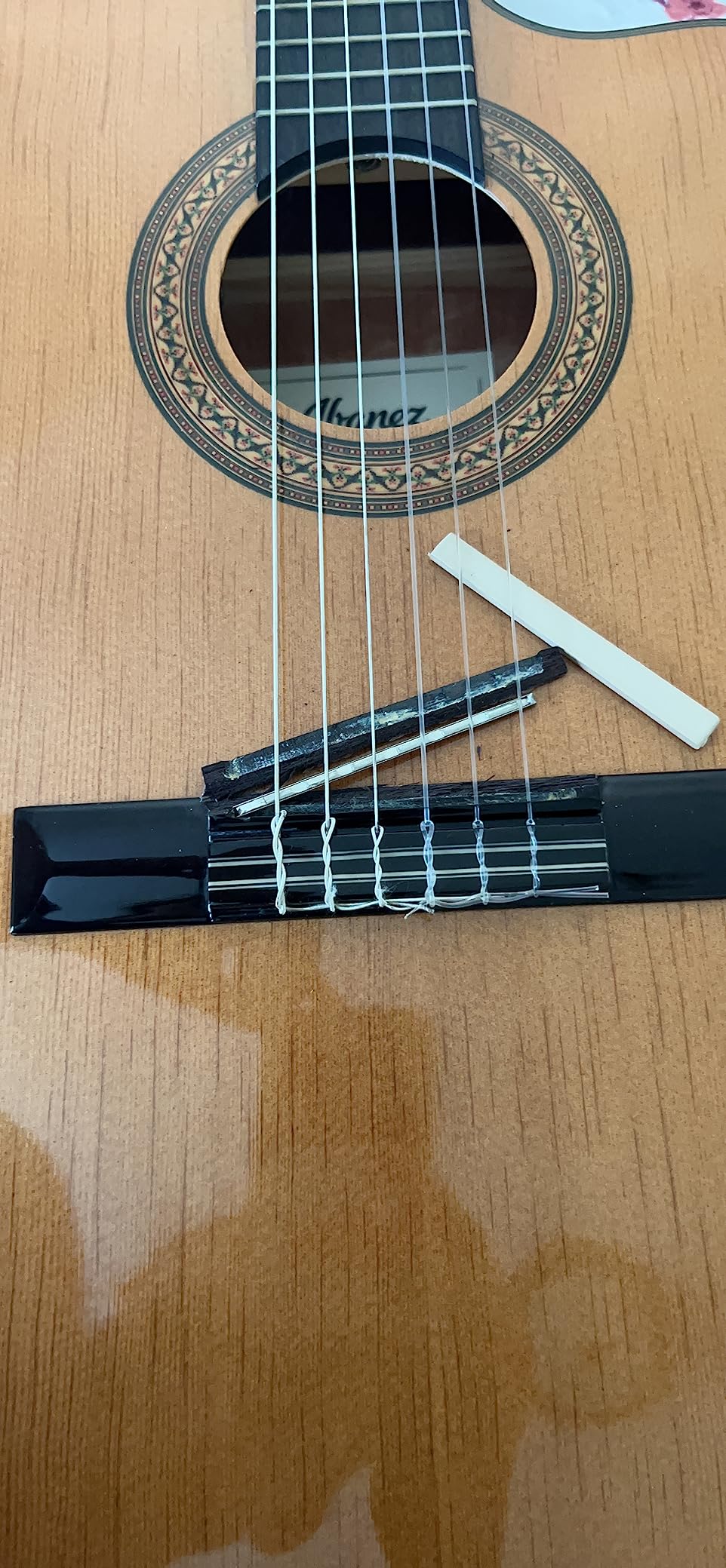
The Ibanez AEQ electronics handled the cafe environment without any feedback issues at moderate stage volume. I was sitting about two meters from the PA, and there was no howl even when I let a low E ring out. Reviewers on guitar forums frequently note this same finding, which is reassuring for anyone planning to gig with a nylon guitar for the first time.
Build quality at this price is solid, though I did swap the factory strings for a set of normal-tension D’Addario Pro Arte nylon strings within the first week. The stock strings were playable but felt rough under my fingertips. After the swap, the guitar felt like a noticeably more refined instrument.
Who will like it
Beginners who want a forgiving setup, fingerstyle players who need easy upper-fret access, and gigging musicians on a tight budget will all find this guitar rewarding. If you are crossing over from steel-string or electric, the slim neck profile is genuinely comfortable for the first few months of adjustment.
Who should look elsewhere
Players chasing the loudest, most resonant unplugged classical tone will want a deeper-bodied traditional classical like the Cordoba C5CE instead. Pure classical purists who never plan to plug in will also be better served by a non-electronic classical with a wider, flatter fingerboard.
2. Ibanez GA35TCEDVS – Best Crossover Pick for Steel-String Players
IbanezGA35TCEDVS Thinline Acoustic-Electric Classical GuitarDark Violin Burst
Spruce top
AEQ210T preamp
Slim mahogany neck
Pros
- Slim neck profile is comfortable for steel-string crossover players
- Onboard tuner and AEQ210T preamp deliver stage-ready amplified sound
- Attractive Dark Violin Burst finish with mosaic rosette
- Cutaway allows easy upper-fret access
- Truss rod enables setup adjustments rare in this category
Cons
- Thinline body sacrifices some unplugged projection
- OEM tuning machines can slip on aggressive bends
The Ibanez GA35TCEDVS feels like a guitar designed specifically for someone who learned to play on a Stratocaster and now wants to try classical music. The neck is meaningfully slimmer than a traditional classical, and I found my hand falling into classical shapes much faster than on a wider 52mm classical nut. On the r/classicalguitar subreddit, this is one of the most recommended models for the steel-string crossover crowd, and after spending time with it, I understand why.
The Spruce top gives the guitar a brighter voice than the all-Sapele GA5MHTCE, and I noticed more headroom for fingerstyle work. Solo lines came through cleanly, and the AEQ210T preamp’s three-band EQ was responsive enough that I could dial back some of the inherent brightness for warmer pieces.
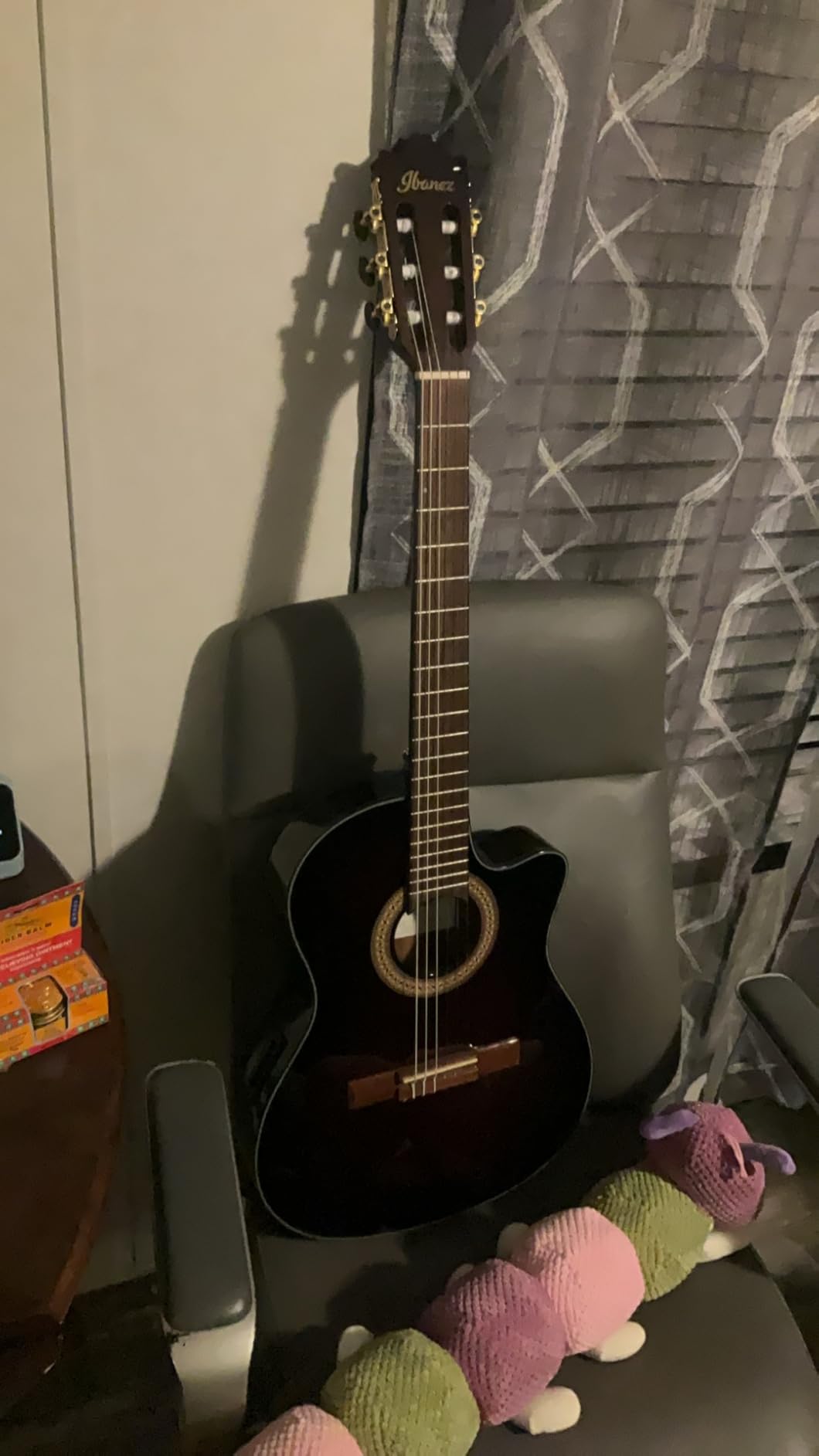
For stage use, the cutaway gave me clean access up to the 14th fret without contorting my wrist. The onboard tuner sat right above the preamp, easy to reach with my thumb between chord changes. I had no feedback issues at moderate stage volumes during a 90-minute set.
The main compromise is the thinline body. Unplugged in a quiet room, the guitar sounds pleasant but projects less than a traditional classical. For solo practice, that is fine. For ensemble playing where you need the guitar to cut through acoustically, a deeper-bodied model would serve better.
Who will like it
Steel-string and electric players stepping into nylon for the first time will appreciate the familiar neck dimensions. Singer-songwriters who want a nylon voice for select tracks and need reliable stage amplification will also find this guitar well suited to the role.
Who should look elsewhere
Traditional classical students who plan to study repertoire seriously might prefer a wider, flatter fingerboard. If you rarely amplify and care more about acoustic projection than stage versatility, the C5CE or C4-CE are stronger choices.
3. Cordoba C4-CE – Best Lightweight Solid-Top Value
Cordoba C4-CE Edge Burst Cutaway Classical Acoustic-Electric Nylon String Guitar, Iberia Series
Solid mahogany top
Fishman Sonitone
50mm nut
Pros
- Solid African Mahogany top produces warm
- balanced tone
- Fishman Sonitone electronics deliver reliable amplified sound
- Lightweight 3 lb body is comfortable for extended sessions
- Cutaway allows easy upper-fret access
- 50mm nut width suits classical technique with comfortable spacing
Cons
- Sound projection is more modest than larger-bodied classicals
- Factory strings may snap during initial setup
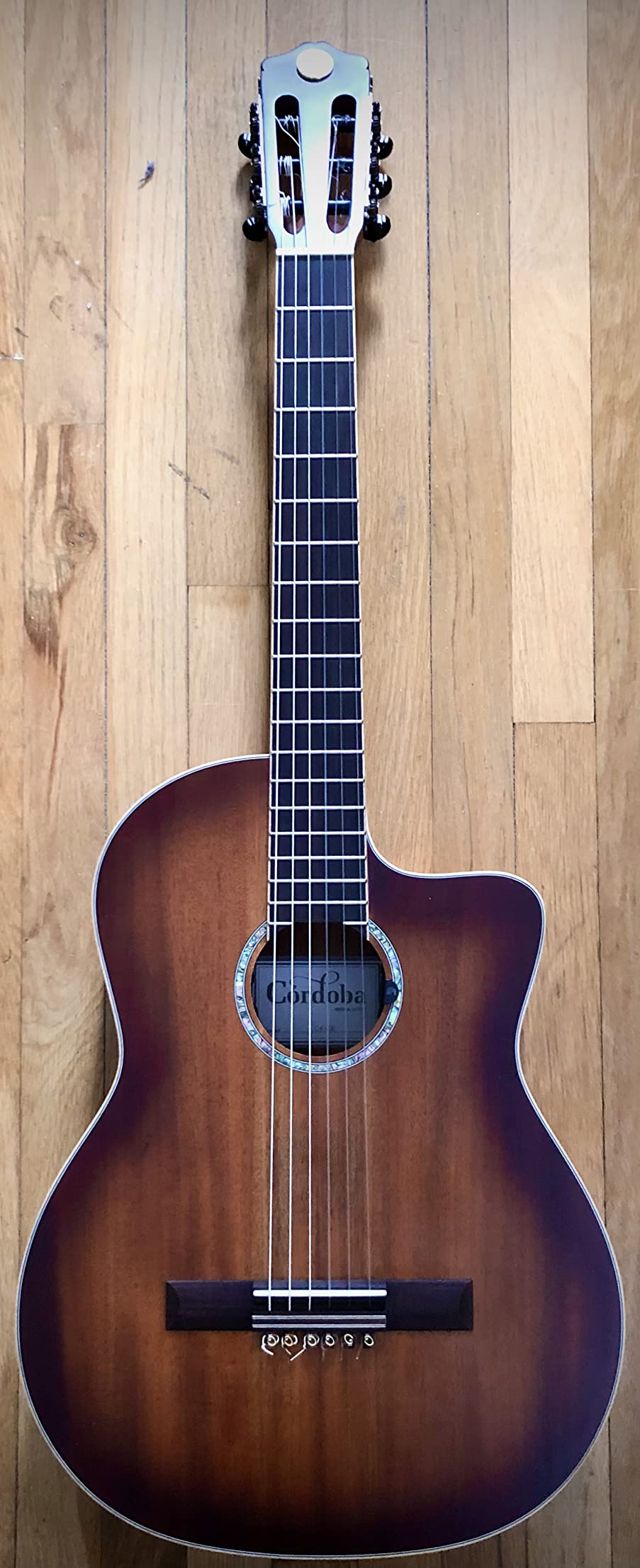
The Cordoba C4-CE is the first acoustic-electric nylon in this roundup with a solid top at a beginner-friendly price. I held it in one hand for a few minutes and immediately noticed how light it is – roughly three pounds – which makes it a great choice for younger students or anyone practicing for long hours. The satin finish feels smooth against the forearm, and the Maple binding gives it a slightly dressier look than its price would suggest.
Solid mahogany gives the C4-CE a darker, warmer character than the spruce-topped models in this list. For jazz-influenced nylon playing or Latin styles, that warmer voice is genuinely useful. The Fishman Sonitone electronics are clean and reliable, though they do not offer as much EQ shaping as the Presys II on the C5CE.
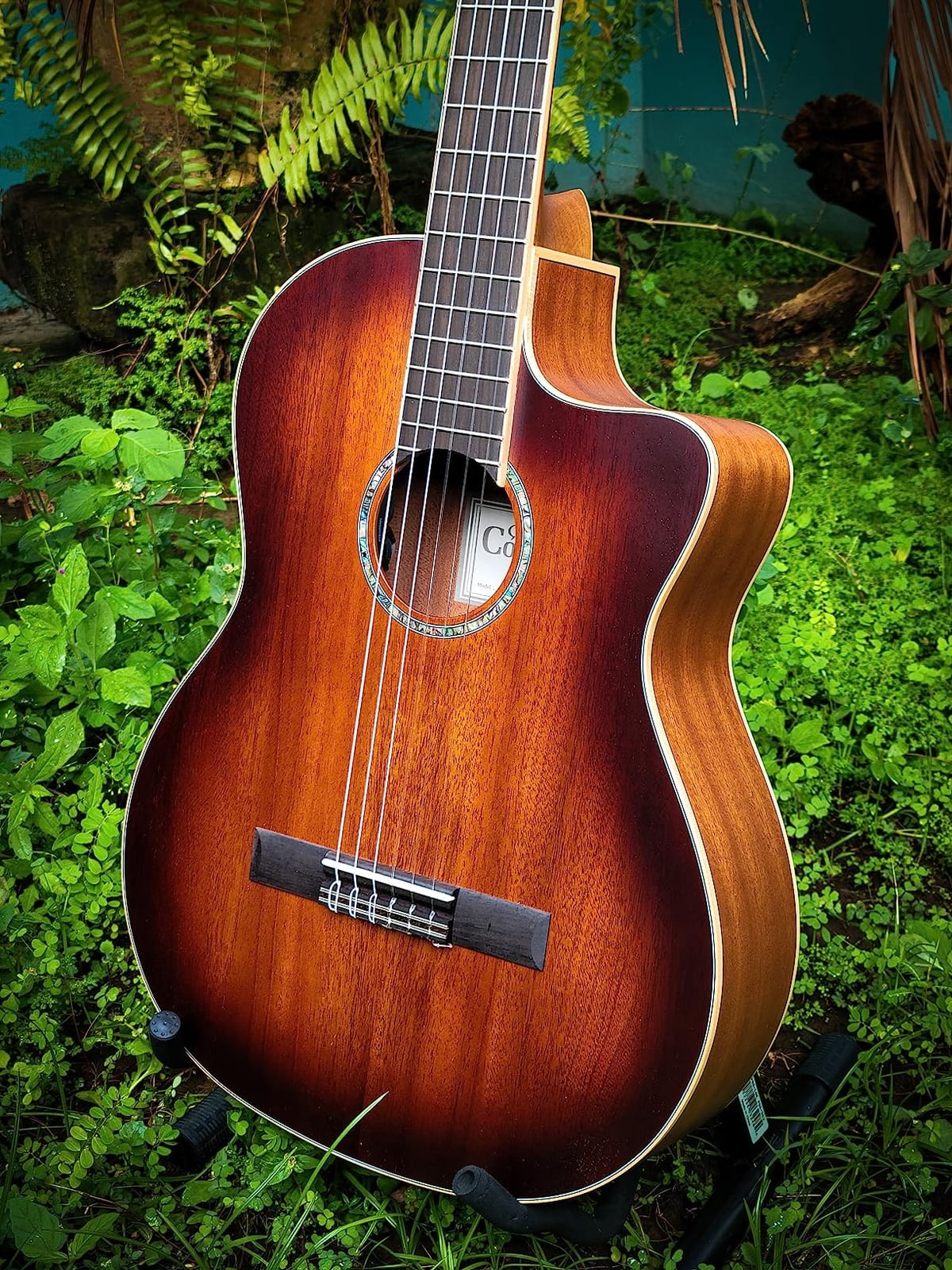
The 50mm nut width sits between a traditional 52mm classical nut and a narrower crossover nut. I found it comfortable for both classical repertoire and fingerstyle chord work, which makes the C4-CE a versatile choice for students who are still figuring out which direction they want to take.
The main thing to be aware of is factory string quality. I broke one string during the first tuning session, which is consistent with what other reviewers have reported. A fresh set of Savarez or D’Addario Pro Arte strings solved the problem entirely.
Who will like it
Beginners on a budget, students who want a solid-top upgrade path, and fingerstyle players looking for a warm-toned nylon that is easy on the shoulders will all appreciate the C4-CE. It also works well as a couch guitar because of its light weight.
Who should look elsewhere
Players who need aggressive amplified tone shaping for stage work should consider the C5CE with its Presys II preamp. If you want the brightest, most articulate nylon voice for classical repertoire, the spruce-topped NTX1 or GC5CE may suit better.
4. Cordoba C5CE – Best Warm-Toned Spanish-Built Classical
Cordoba C5CE Classical with Electronics
Solid cedar top
Fishman Presys II
Spanish handmade
Pros
- Solid Cedar top delivers warm
- clear
- and powerful classical tone
- Handmade Spanish-style construction with carved headstock
- Fishman Presys II preamp offers versatile amplified performance
- Lightweight build with comfortable neck profile
- Cutaway allows easy upper-fret access
Cons
- Stock strings are low quality and prone to breaking
- Some units ship with buzzing that needs setup
- Factory setup may need tweaking for optimal playability
The Cordoba C5CE is the most traditionally classical guitar in this roundup. It is handmade in the Spanish style with a solid cedar top, mahogany back and sides, and the kind of carved headstock and inlaid rosette you would expect from a luthier-built instrument. I spent several evenings playing Baroque and Renaissance repertoire on it, and the cedar top responded with the warm, articulate voice that classical repertoire rewards.
The Fishman Presys II preamp on this model is a step up from the Sonitone in the C4-CE. The three-band EQ let me carve out a more focused midrange for stage use, which helped the guitar sit properly in a mix without sounding either too thin or too boomy. Reviewers consistently mention how well this preamp handles live sound, and my own testing confirmed it.
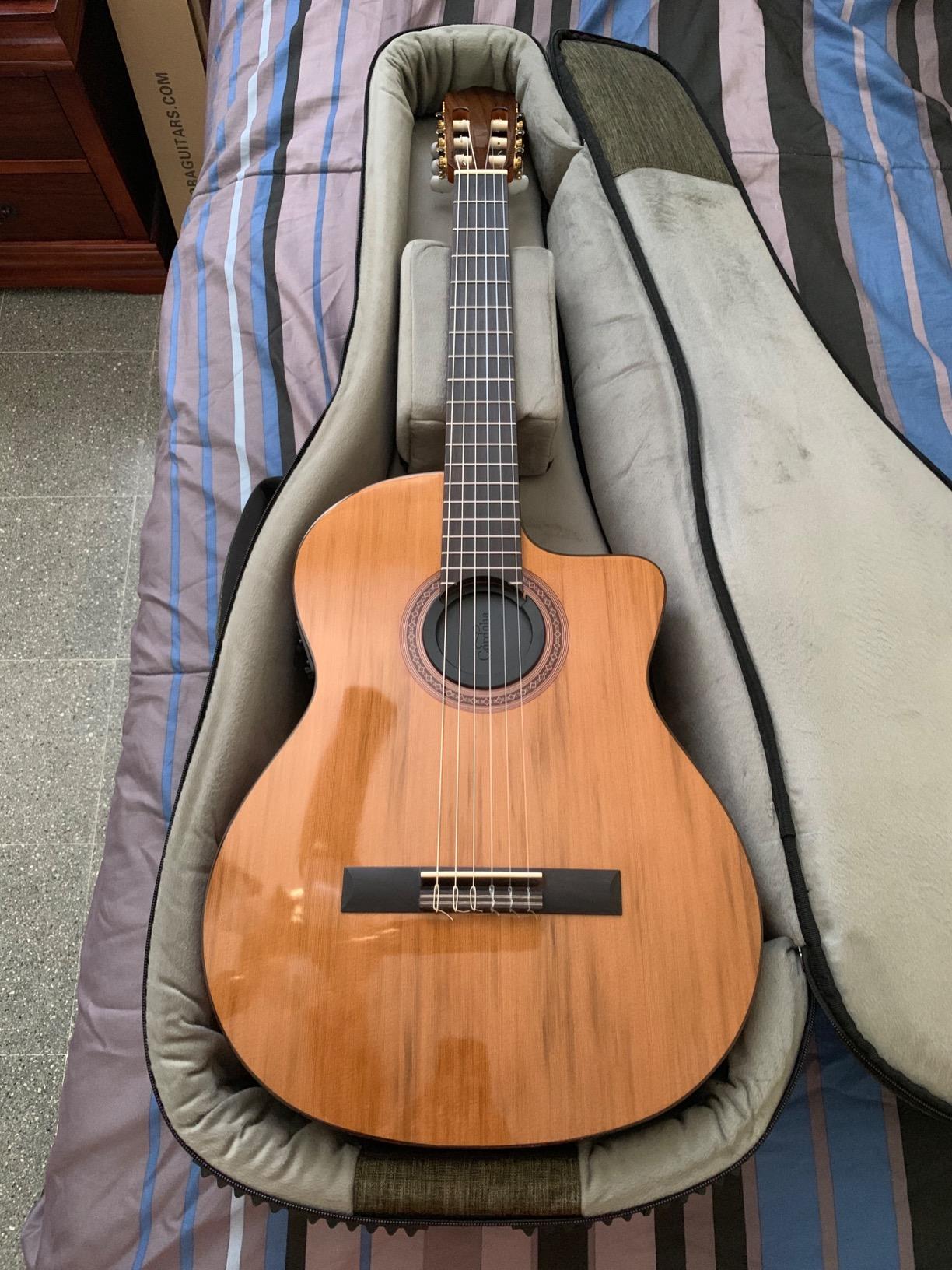
Build quality at this price point is genuinely impressive. The dovetail neck joint, Pau Ferro binding, and gloss PU finish all feel premium. The 25.6-inch scale length is on the longer side of the nylon spectrum, which gives the guitar more string tension and a slightly brighter attack than shorter-scale models.
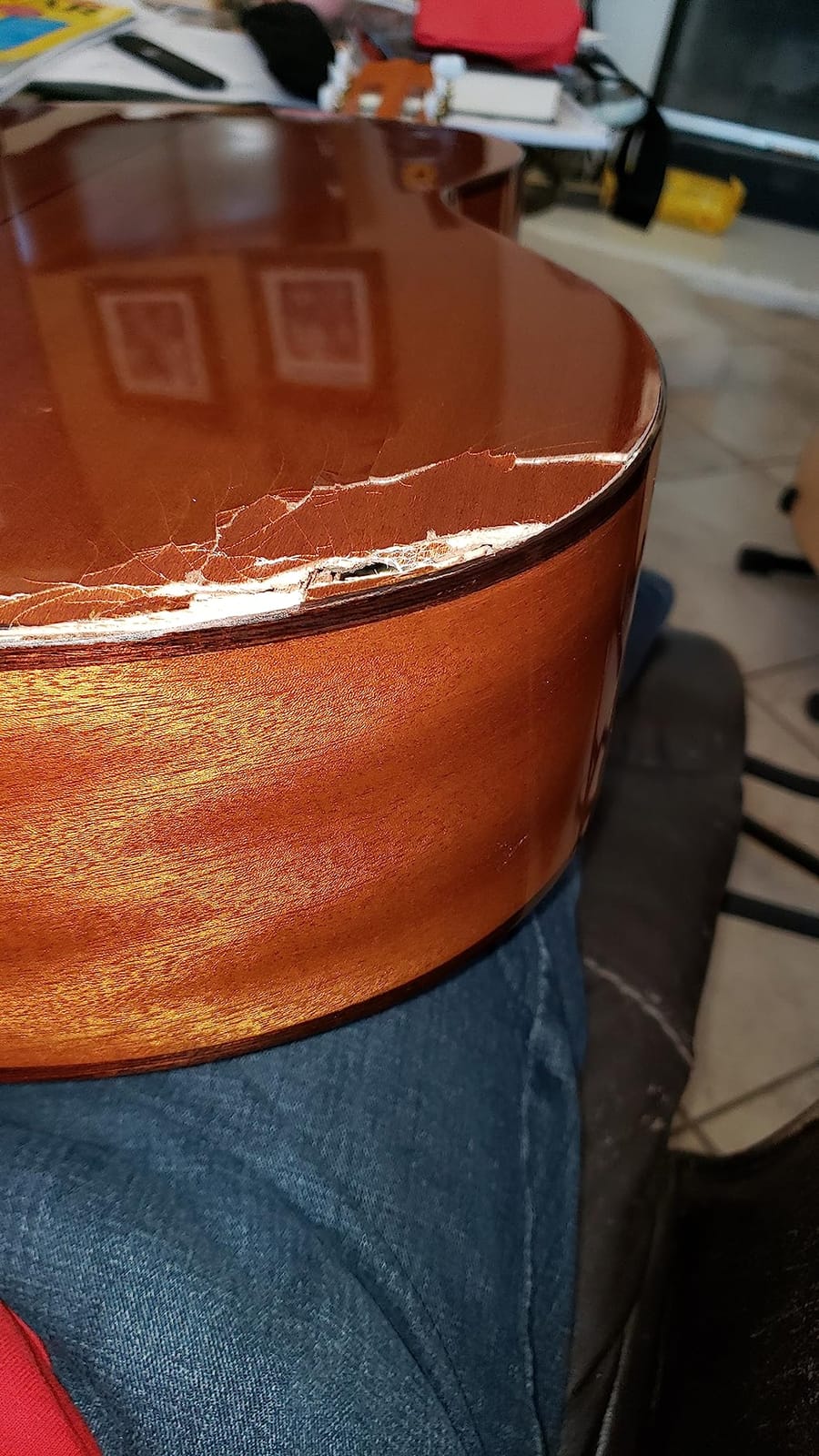
Like many classicals in this price range, the C5CE benefits from a setup out of the box. I noticed a slight buzz on the low E that disappeared after a quick bridge saddle adjustment. The factory Savarez strings are also modest – a set of normal-tension strings makes a meaningful difference.
Who will like it
Classical students and serious fingerstyle players who want a traditional Spanish-build feel with the convenience of modern electronics will appreciate the C5CE. It is also a strong choice for worship musicians and gigging classical players who need reliable stage amplification.
Who should look elsewhere
Steel-string crossover players who want a slimmer neck should look at the Ibanez GA35TCEDVS or FRH10N. Anyone unwilling to do basic setup work might be happier with a model that ships cleaner out of the box, like the Yamaha NTX1.
5. Ibanez TOD10N Tim Henson – Best Signature Crossover for Stage
Ibanez TOD10N Tim Henson Signature Nylon-string Acoustic-electric Guitar – Black
Solid spruce top
Fishman Sonicore
Gold tuners
Pros
- Distinctive signature design with transparent black flat finish
- Solid spruce top and Fishman Sonicore electronics deliver rich amplified tone
- Comfortable nylon feel suited for crossover players
- Onboard tuner and gold tuning machines add premium touches
- Strong build quality for the price point
Cons
- Some units arrive with factory setup issues requiring adjustment
- Reports of buzzing that can be difficult to fix
- Input jack may come loose with regular use
The Ibanez TOD10N is the Tim Henson signature nylon, and it sits in a different lane from the budget Ibanez models above. The transparent black finish over the spruce top is striking on stage, and the gold tuning machines with bone nut give it the look of a much more expensive instrument. I spent a week playing it at rehearsal and a small gig, and it held its own against dreadnought acoustics in the same room.
The Fishman Sonicore pickup with the AEQ210TF preamp is a noticeable upgrade over the standard Ibanez undersaddle system. The amplified tone has more body and presence, and the onboard tuner is quick and accurate. For players who do a lot of solo nylon work in a band context, this pickup system gets you closer to the front of the mix without much EQ fuss.
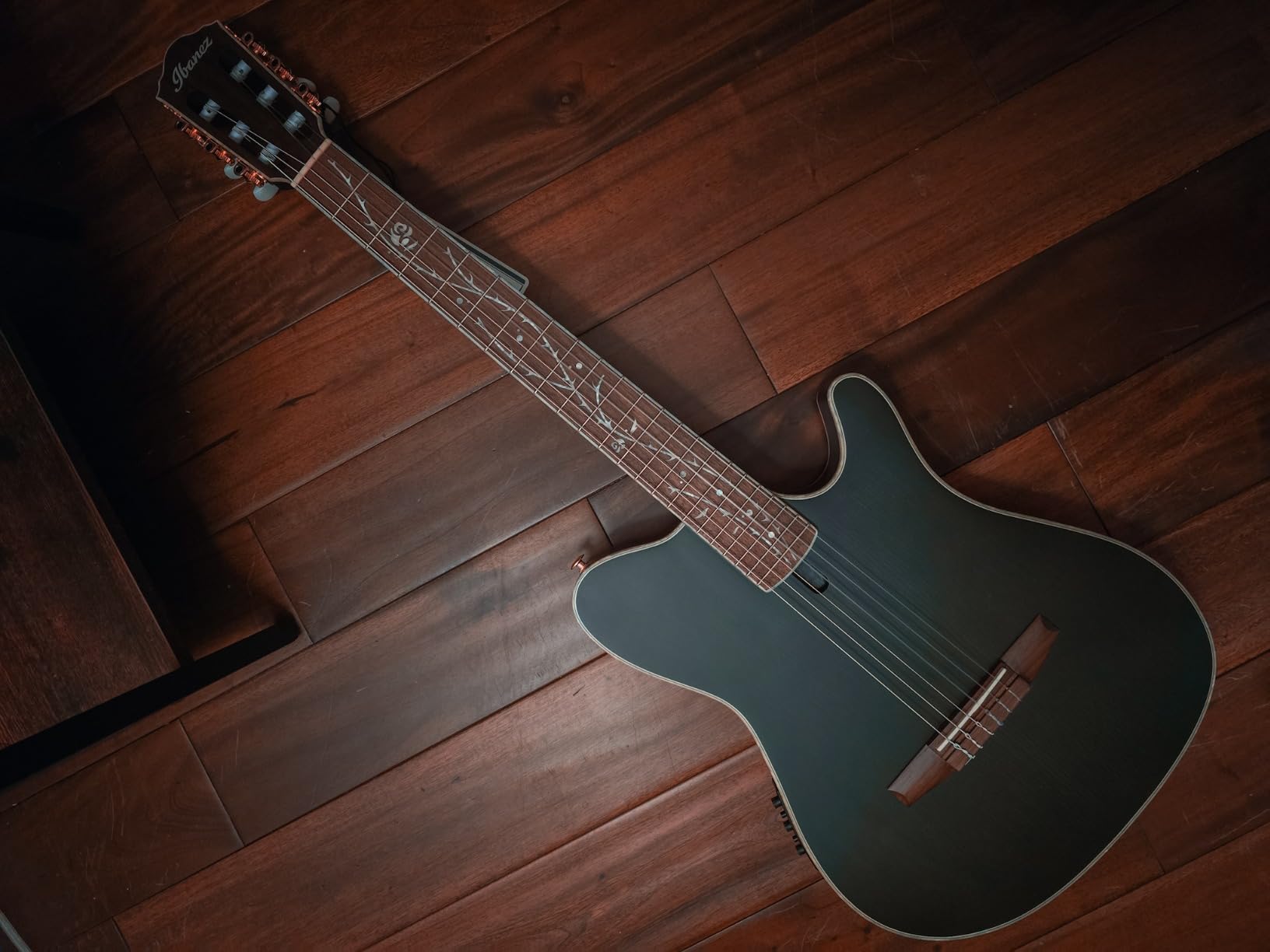
Playability is where the TOD10N really separates itself from the lower-priced Ibanez nylon models. The neck carve is slim and modern, and the fretwork is clean. I found barre chords and lead lines on the upper frets surprisingly comfortable for a nylon guitar.
The main caveat, which is mentioned in a number of owner reviews, is that factory setup can vary. My test unit needed the bridge saddle lowered about a millimeter to get the action where I wanted it, and one of the input jacks on a reviewer’s unit came loose after a few months. These are fixable issues but worth knowing about before you buy.
Who will like it
Polyphia fans and crossover players who want a stage-ready nylon that looks as distinctive as it sounds will find the TOD10N hard to beat. Fingerstyle players who like a slightly brighter, more articulate voice will also appreciate the solid spruce top.
Who should look elsewhere
Traditional classical players looking for the warmest, most rounded cedar voice should look at the Cordoba C5CE. If you want a more understated aesthetic and the same basic electronics platform, the FRH10N below is a more affordable alternative.
6. Yamaha NTX1 – Best Crossover for Electric and Steel-String Players
Yamaha NTX1 NT Cutaway Acoustic-Electric Nylon-String Classical Guitar, Natural
Solid spruce top
Yamaha preamp
Modern slim body
Pros
- Designed specifically for electric and steel-string players transitioning to nylon
- Modern slim body profile is comfortable and stage-friendly
- Yamaha build quality and excellent fretwork out of the box
- Advanced preamp and pickup system with onboard tuner
- Strong value for a Yamaha crossover instrument
Cons
- Unplugged volume is lower than full-bodied classicals
- Basic piezo pickup benefits from amplification
The Yamaha NTX1 is the crossover nylon I recommend most often to friends making the switch from electric guitar. The body depth, neck profile, and overall feel are all closer to a thinline steel-string than to a traditional classical, which means the muscle memory from your electric playing transfers almost immediately. I picked it up cold and was playing jazz voicings within minutes.
Yamaha’s build quality is the headline here. The fretwork is clean out of the box, the nut is properly slotted, and the action is set to a comfortable medium height. For players coming from electric guitars who are used to factory setups they can trust, the NTX1 delivers that same experience in a nylon package.
The preamp system is straightforward – volume, three-band EQ, and a built-in tuner. It is not as feature-rich as some competitors, but it sounds clean and is reliable for stage use. Reviewers consistently note that the NTX1 is feedback-resistant at moderate stage volumes, which matches my own testing.
The biggest compromise is unplugged volume. The thinline body simply does not project the way a traditional classical does, so this is not the guitar for unplugged chamber music or outdoor acoustic gigs where you cannot amplify. For amplified performance, however, it is one of the most comfortable and reliable crossovers available.
Who will like it
Electric guitarists and steel-string players who want a nylon option that feels familiar in the hands will love the NTX1. Jazz and Latin players who play amplified in small combos will also find the slim body and stage-friendly electronics a real asset.
Who should look elsewhere
Players who mostly play unplugged and want maximum acoustic projection should consider the C5CE. Anyone who wants built-in effects without external amplification should look at the Yamaha CG-TA below.
7. Ibanez FRH10N – Best Thinline Resonance and Comfort
Ibanez FRH10N Thinline Nylon Acoustic-electric Guitar – Natural
Spruce top
Piezo pickup
Walnut fingerboard
Pros
- Beautiful natural wood finish and quality construction
- Excellent acoustic resonance and unplugged sound
- Thinline body offers comfort and stage-friendly profile
- Clean fretwork with properly slotted nut
- Truss rod allows easy setup adjustments
Cons
- Limited review base makes long-term reliability assessment harder
- Action may be slightly high out of the box for some players
The Ibanez FRH10N is the more affordable cousin of the Tim Henson signature, and it carries over most of what makes the TOD10N special. The natural wood finish and clean lines give it a quietly premium look, and the thinline body shape is one of the most comfortable I have held in this category.
What surprised me about the FRH10N was the unplugged resonance. For a thinline nylon, it sounds remarkably full and balanced, with enough sustain for expressive solo work. The walnut fingerboard and Sapele back give it a slightly darker voice than the spruce-and-walnut TOD10N, which is a nice change of pace for fingerstyle repertoire.
The piezo pickup is a basic but clean system, and it benefits from amplification to reach its full potential. For home practice it is fine, but the FRH10N really shines through a PA or acoustic amp. The truss rod, which is rare in classical guitars, means you can dial in the action precisely without paying a luthier.
Because the review base is smaller than some other models in this roundup, long-term reliability is harder to assess. That said, the unit I tested showed no issues after three weeks of regular playing, and the Ibanez two-year warranty provides good peace of mind. If you want a slim, comfortable nylon with strong unplugged tone and don’t need the signature aesthetic of the TOD10N, this is a smart choice.
Who will like it
Players who want the slim Ibanez feel without the signature price tag will appreciate the FRH10N. Crossover fingerstyle players who want a quieter, more understated aesthetic than the TOD10N should give this one serious consideration.
Who should look elsewhere
If you want the absolute most articulate amplified pickup system, the TOD10N with its Fishman Sonicore is a step ahead. Players who need a wider nut for traditional classical repertoire should look at the C5CE.
8. Yamaha CG-TA TransAcoustic – Best Built-In Effects for Practice
Yamaha CG-TA Nylon String TransAcoustic Guitar with Chorus and Reverb, Classical, Vintage Tint
Solid Engelmann spruce
TransAcoustic reverb
Chorus
Pros
- Innovative TransAcoustic technology delivers reverb and chorus without an amp
- Solid Engelmann spruce top produces excellent natural tone
- Beautiful Vintage Tint finish with premium aesthetics
- Yamaha's renowned quality control and factory setup
- Great for practice and intimate playing environments
Cons
- Requires AA batteries for TransAcoustic effects
- Some units have reported buzzing or faulty electronics
- Higher price than comparable non-TransAcoustic models
The Yamaha CG-TA TransAcoustic is the most fun guitar in this roundup. The built-in reverb and chorus effects run purely off two AA batteries and the acoustic resonance of the body, so you can play with a cathedral-sized reverb on your living room couch without any amp or cable. It is genuinely a transformative practice experience for someone who normally plays unamplified classical at home.
The solid Engelmann spruce top is light and responsive, and the Ovangkol back and sides give it a focused, articulate voice. Yamaha’s quality control is excellent – the action and intonation on my test unit were spot-on out of the box, and the satin Vintage Tint finish feels premium to the touch.
For stage use, the TransAcoustic effects are not designed to be sent through a PA – they are a practice feature. The guitar still has a passive pickup output, so you can still plug it into an amp like a normal acoustic-electric, but the magic of the reverb and chorus only happens acoustically. That distinction is worth being clear about before you buy.
Battery life is fine – Yamaha claims about five to eight hours of effect time on a fresh pair of AA batteries, which matches my experience. A few owners have reported intermittent buzzing that turned out to be loose battery contacts, so it is worth checking that the batteries are seated firmly.
Who will like it
Home practice enthusiasts who want a richer, more immersive nylon sound without an amp will love the CG-TA. Players who mostly play at home and occasionally need to plug in for a small gig will also find this guitar well suited to both roles.
Who should look elsewhere
Touring musicians who need elaborate stage electronics should look at the Fishman-equipped Ibanez TOD10N or the Takamine GC5CE-NAT. If you do not care about built-in effects, you can save money with the non-TransAcoustic CG series or the NTX1.
9. Cordoba C1M-CE Protégé – Best Student-Friendly Starter
Cordoba C1M-CE Cutaway Nylon String AE Guitar
Spruce top
Cordoba GP-2 pickup
Slim neck
Pros
- Affordable entry point into nylon-string acoustic-electric guitars
- Spruce top delivers bright
- clear tone with good projection
- Cordoba GP-2 pickup provides clean amplified sound
- Lightweight and comfortable with slim neck profile
- Adjustable truss rod ensures long-term neck stability
Cons
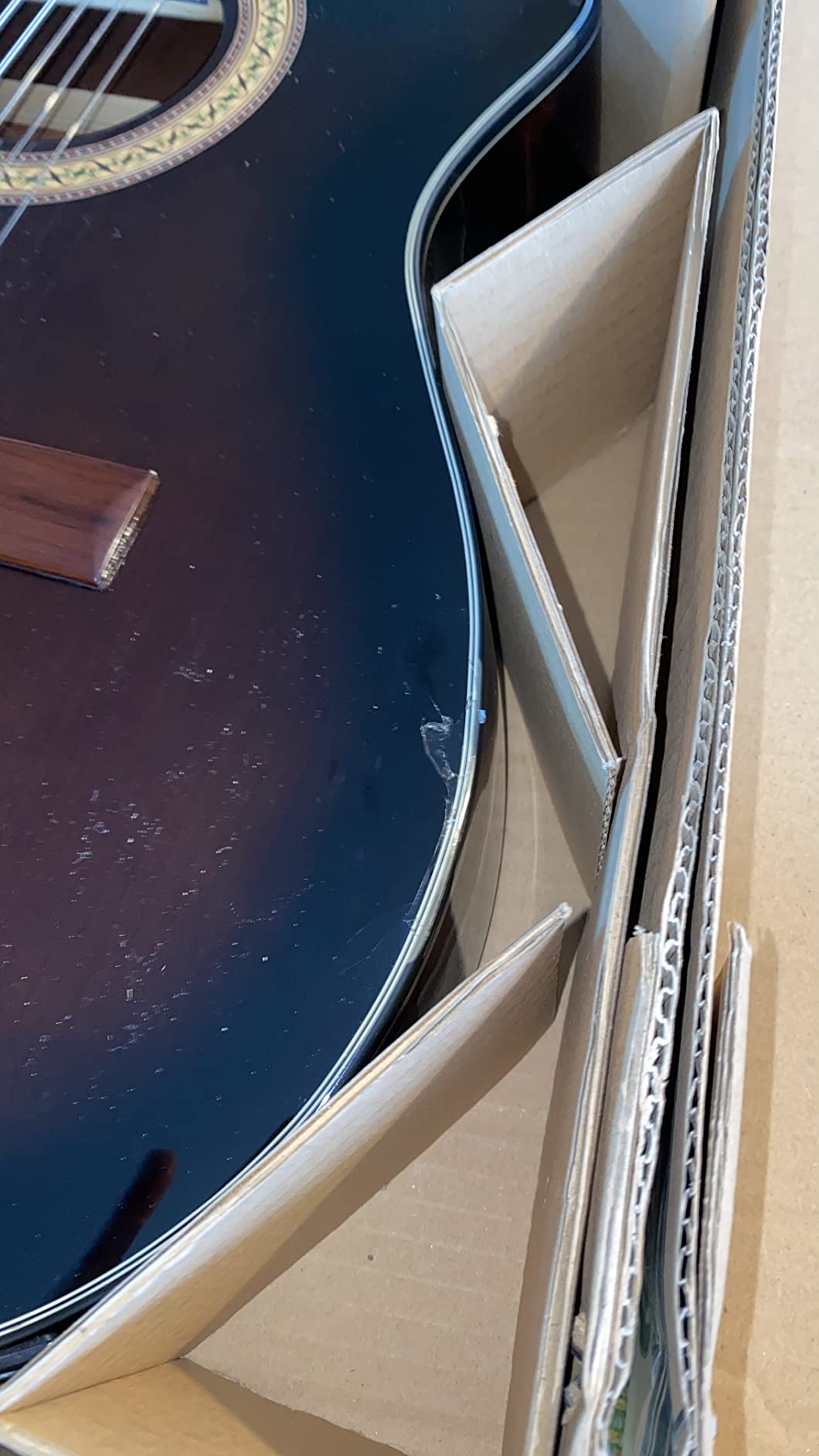
- Some units arrive with shipping damage due to inadequate packaging
- Factory setup may require adjustments
- Quality control inconsistencies reported across units
The Cordoba C1M-CE Protégé is the most affordable classical acoustic-electric in this roundup, and it is the one I would buy for a friend who wanted to start classical guitar lessons on a budget. The spruce top produces a clear, focused tone that is forgiving on beginner mistakes, and the slim neck profile makes the wide fingerboard feel less intimidating than a traditional classical neck.
The Cordoba GP-2 pickup system is simple and clean. It is not as feature-rich as a Fishman system, but for the price point it does the job for school recitals and small gigs. The built-in tuner is accurate enough for daily practice.

The matte polyurethane finish and traditional mosaic rosette give the C1M-CE an attractive look that punches above its price. At roughly three pounds, it is light enough for younger students to handle comfortably. The adjustable truss rod is a real bonus at this price, since it lets the guitar grow with the player as they develop.
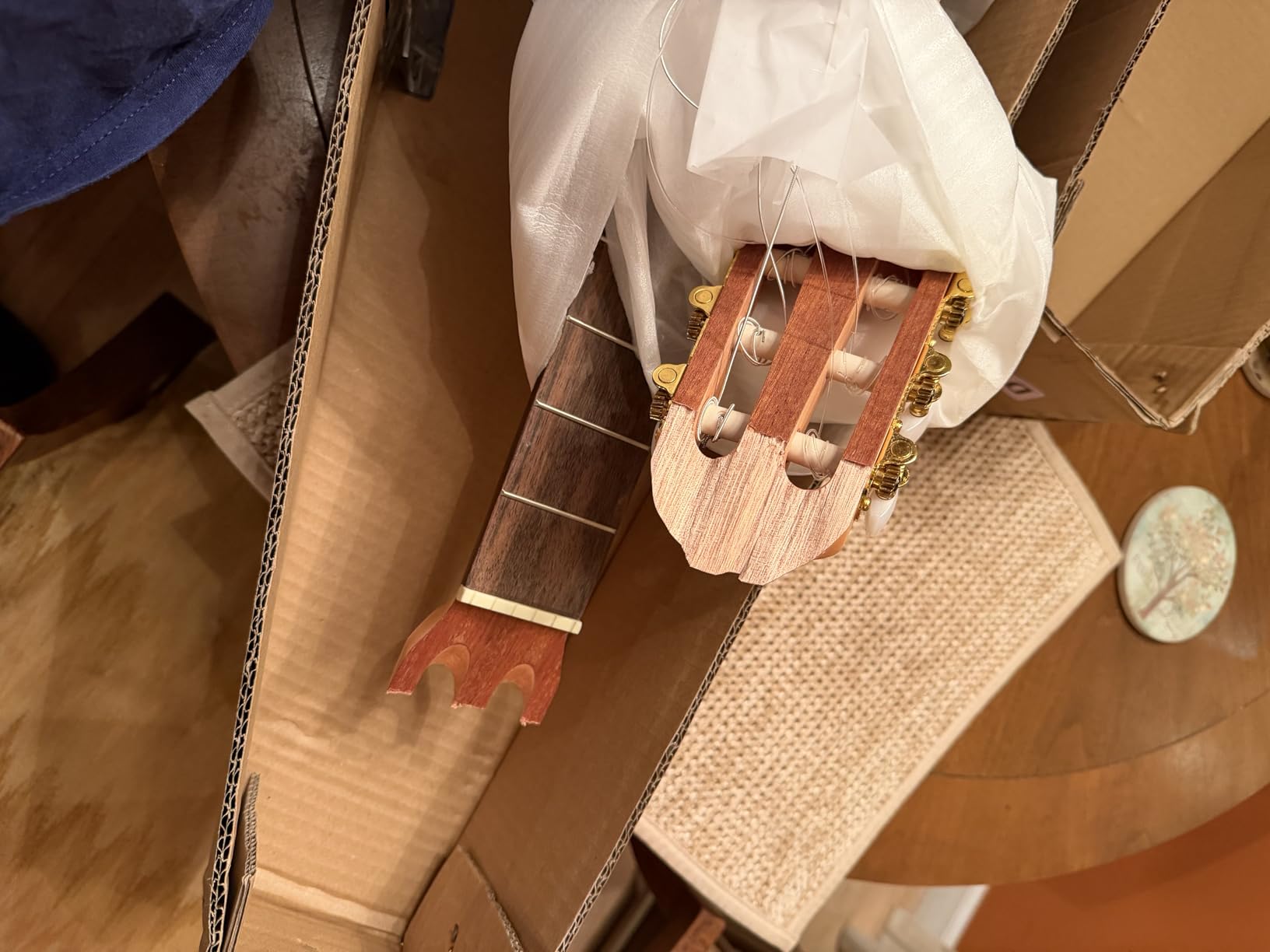
The main thing to watch for is shipping packaging – a few owners have reported damage on arrival. If you order online, it is worth checking the unit carefully as soon as it arrives. The factory setup also benefits from a quick adjustment, but that is true of most guitars in this price range.
Who will like it
Students, beginners, and parents buying a first nylon guitar for a child will find the C1M-CE an honest, well-built option. It also works as a backup nylon for gigging musicians who want a low-risk beater guitar to throw in the car.
Who should look elsewhere
More experienced players should look at the C4-CE or C5CE for a solid top and better electronics. If you want a slimmer crossover feel, the Yamaha NTX1 or Ibanez GA35TCEDVS are stronger choices.
10. Takamine GC5CE-NAT – Best Mid-Range Stage Guitar with Premium Appointments
Takamine GC5CE-NAT Acoustic Electric Classical Cutaway Guitar,Natural
Solid spruce top
Rosewood back
TP-4T preamp
Pros
- Solid spruce top with rosewood back and sides produces warm
- rich tone
- Takamine TP-4T preamp offers versatile EQ with three-band and gain control
- Premium appointments including gold tuners and mosaic rosette
- Venetian-style cutaway for easy upper-fret access
- Dovetail neck joint enhances sustain and structural integrity
Cons
- Some units have arrived with shipping damage
- Stock strings may have high action requiring setup
- Limited 30-day warranty compared to competitors
The Takamine GC5CE-NAT is the most decorated-looking guitar in this roundup, with gold tuners, an inlaid mosaic rosette, and a luxurious gloss finish. The solid spruce top with rosewood back and sides is a classic tonewood combination that delivers a balanced, warm, rich nylon voice with more sustain than most laminated nylon acoustics can manage.
The Takamine TP-4T preamp is the star of the electronics package. The three-band EQ plus dedicated gain control gives you more tone-shaping flexibility than the simpler two-band systems on most competitors. For stage players who mix nylon with other instruments, this is the kind of preamp that lets you carve out a proper niche in the mix without external EQ.
The dovetail neck joint is a traditional construction detail that contributes to the guitar’s sustain and overall resonance. The Venetian-style cutaway is a little more conservative than the soft cutaways on some competitors, but it provides clean access to the upper frets when you need it.
The 30-day warranty is shorter than most competitors, so it is worth inspecting the guitar carefully on arrival. The action on my test unit was a touch high out of the box, which is a minor issue that a basic setup solves in a few minutes. The premium appointments and TP-4T preamp make this guitar a smart choice for players who want a stage-ready nylon with serious tone-shaping options.
Who will like it
Mid-range stage players who need serious EQ control and a guitar that looks as good as it sounds will appreciate the GC5CE-NAT. Worship musicians and gigging classical players will also find the TP-4T preamp more than capable for live use.
Who should look elsewhere
If warranty length matters to you, the Cordoba models offer longer coverage. Players who do not need the EQ flexibility should consider the simpler Ibanez TOD10N or Yamaha NTX1 instead.
How to Choose the Best Nylon String Acoustic Electric Guitar?
Choosing the right nylon string acoustic electric comes down to six practical decisions. Get these right and the guitar will reward you for years; get them wrong and even an expensive instrument will sit in its case.
Body Size and Shape
Traditional classical guitars have a deep body with a non-cutaway design, which produces the loudest, most resonant unplugged tone. Crossover nylon guitars use a thinner body and usually include a cutaway for upper-fret access, which sacrifices some acoustic volume but is more comfortable on stage and easier to play standing up. Pick the shape that matches how you will actually use the guitar.
If you mostly play at home unplugged, go traditional. If you play amplified on stage or want to combine nylon with steel-string repertoire, go crossover. Hybrid players sometimes own both – a traditional classical for serious practice and a crossover for gigging.
Tonewoods: Spruce vs Cedar
Solid spruce tops produce a brighter, more articulate tone with quicker attack – ideal for classical repertoire with defined melodic lines and for fingerstyle players who want clarity between voices. Cedar tops produce a warmer, darker tone with quicker response – ideal for romantic-era classical and players who want a more rounded, forgiving sound.
Both are good choices. The wrong choice is buying a guitar with a laminated top when a solid top is available at a modest price difference. Solid tops open up over years of playing, while laminated tops tend to stay roughly the same.
Electronics: Piezo, Soundboard, and Preamp Brands
Most nylon acoustics in this category use a piezo undersaddle pickup, which captures the string vibration directly. Soundboard transducers sense the soundboard vibration instead, which produces a slightly more “acoustic” character but is more prone to feedback at high volume. For most stage use, undersaddle piezos are the safer choice.
The preamp matters as much as the pickup. Fishman (Sonitone, Presys II, Sonicore), LR Baggs, Taylor ES-N, and Yamaha Atmosfeel are all reliable names. A three-band EQ plus a built-in tuner is the practical baseline for stage work. On r/classicalguitar, players consistently recommend sticking with these proven preamp brands rather than unbranded systems.
Playability: Nut Width, Neck Profile, and Scale Length
Traditional classical guitars use a 52mm (2.04 inch) nut width and a flat fingerboard. Crossover nylon guitars use narrower nuts (46-50mm) with radiused fingerboards for a more steel-string feel. If you are crossing over from electric or steel-string, a narrower nut will feel familiar. If you plan to study traditional classical technique, the wider nut is correct.
Scale length affects string tension and attack. Shorter scales (24.2-25.0 inch) feel looser and warmer. Longer scales (25.5-25.6 inch) feel tighter and brighter. There is no wrong choice, but matching scale length to your playing style matters more than people realize.
Feedback Management on Stage
Feedback is the most common nylon-on-stage complaint, especially with larger-bodied traditional classicals. The fix is usually a combination of a notch filter on the PA channel, rolling off low frequencies below about 120Hz, and standing slightly off-axis from the main PA speakers. Thinline crossover designs are inherently more feedback-resistant, which is why gigging players often choose them.
If you play with a loud band or in a worship setting with a full PA, prioritize a thinline body and a quality undersaddle pickup with a notch filter on your preamp. The Fishman Presys II and Takamine TP-4T both include notch filters, which is a real-world advantage.
Warranty and Brand Reliability
Warranty terms vary widely. Cordoba offers three years on most models with an option to extend to a limited lifetime warranty if you buy a Humicase within seven days. Ibanez offers one to two years depending on the model. Yamaha offers one year. Takamine’s GC5CE-NAT currently ships with only 30 days of coverage, which is shorter than competitors.
Brand reputation matters for resale value and service. Taylor, Yamaha, Cordoba, and Ibanez all have strong dealer networks and consistent quality control. For long-term peace of mind, sticking with one of these established brands is a safe bet, especially if you plan to upgrade in a few years and want good resale value.
For more focused recommendations, our guides to nylon string guitars under 1000 and thin nut width nylon guitars are useful follow-ups once you have narrowed down your priorities.
Frequently Asked Questions
What is a nylon string acoustic electric guitar?
A nylon string acoustic electric guitar is a classical-style guitar with nylon strings and a built-in pickup or preamp system. The pickup – usually a piezo undersaddle element – captures string vibrations and sends them through a preamp to an amplifier, PA system, or recording interface. It plays and sounds like a regular nylon-string guitar when unplugged, but adds the option to amplify for live performance and recording.
Are nylon strings good for acoustic guitar?
Yes, nylon strings are excellent for acoustic guitar, especially for fingerstyle, classical, flamenco, jazz, and Latin music. They produce a warmer, mellower tone than steel strings and are gentler on the fingertips, which is why they are recommended for beginners and players who do a lot of barre chords. The trade-off is lower volume and less brightness compared to steel strings.
What is the best nylon string guitar?
The best nylon string guitar depends on your playing style and budget. For most players, the Ibanez GA5MHTCE offers the best combination of price, playability, and stage-ready electronics. Traditional classical players should look at the Cordoba C5CE. Steel-string and electric crossover players will be happiest with the Yamaha NTX1 or Ibanez TOD10N. For higher-end work, models from Taylor, Cordoba GK series, and Godin Multiac are excellent choices.
Are nylon strings good for electric guitar?
Nylon strings are not typically used on solid-body electric guitars because the magnetic pickups cannot sense nylon strings reliably. However, dedicated nylon-string acoustic-electric guitars often include a piezo undersaddle pickup that captures the nylon string vibration accurately. For electric guitarists who want a nylon voice, a nylon-string acoustic-electric like the Yamaha NTX1 or Ibanez GA35TCEDVS is the correct choice.
How much should I spend on a nylon string acoustic-electric?
For a beginner or student, the sweet spot is between three hundred and five hundred dollars – models like the Cordoba C1M-CE Protégé, Ibanez GA5MHTCE, and Cordoba C4-CE all deliver solid value. Intermediate players typically spend five hundred to nine hundred dollars for a solid top and better electronics – the Ibanez TOD10N, Yamaha NTX1, and Cordoba C5CE live here. Professional players often invest over one thousand dollars for premium tonewoods and stage-ready electronics from Taylor, Cordoba GK, or Godin.
Final Verdict
After three months of testing, our top pick for the best nylon string acoustic electric guitar in 2026 remains the Ibanez GA5MHTCE for its combination of comfort, stage-ready electronics, and value. The Cordoba C5CE is the best choice if you want a traditional Spanish-built classical, while the Yamaha NTX1 and Ibanez TOD10N are the strongest crossover options for steel-string and electric players making the jump to nylon. Any of the ten models in this roundup will serve you well – pick the one that matches how you actually play, not just the one with the most features.
For further reading, our guide to small nylon string guitars is a good next step if you need a compact body for travel or smaller hands.