
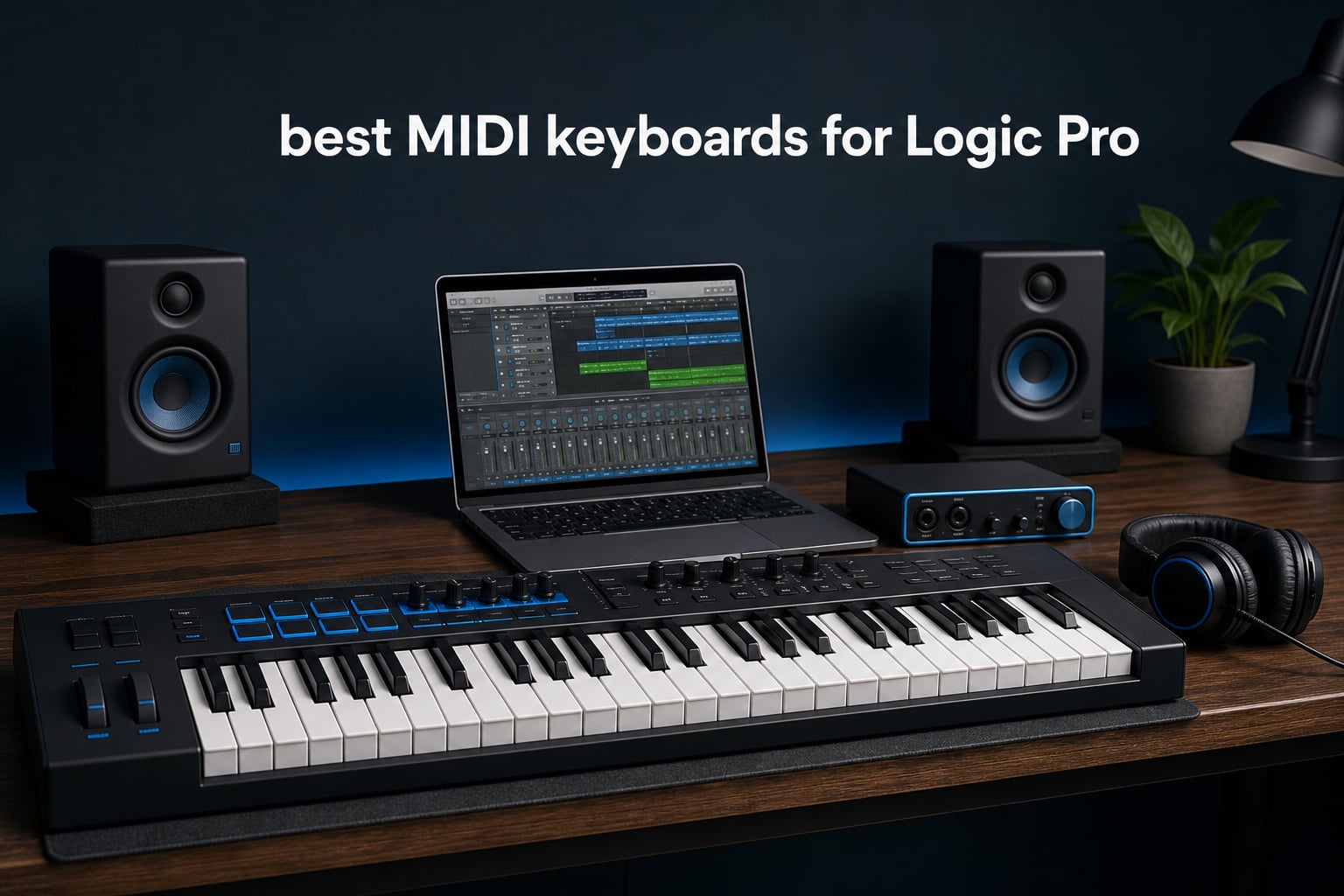
The best MIDI keyboards for Logic Pro pair a keybed you actually want to play with controls that keep you off the mouse. For most people, that means choosing between the Arturia KeyLab Essential 49 mk3 for broad hands-on control, the Novation Launchkey Mini 37 MK4 for compact pad-led writing, and the M-Audio Keystation 88 MK3 for full-range playing.
Logic receives notes, velocity, and MIDI CC messages from any class-compliant USB MIDI controller, then routes them to a Software Instrument track, Smart Controls, mixer functions, or plug-ins you map yourself. The practical difference is not whether a keyboard can trigger a synth; it is whether its keys, pads, knobs, faders, and connections suit the way you write and record.
I built this guide around the eight controllers in the supplied product data, not a generic brand list. I compared key count and action, pads, encoders, faders, aftertouch, MIDI connections, documented Logic Pro integration, portability, and included software; no user-test claims or forum quotations are included because none were supplied in the research.
Table of Contents
- Top 3 Picks for the Best MIDI Keyboards for Logic Pro in October 2026
- Best MIDI Keyboards for Logic Pro in 2026
- 1. Arturia MiniLab 3 Is Best for a Small Logic Pro Desk
- 2. Novation Launchkey Mini 37 MK4 Is Best for Compact Pad-Led Production
- 3. M-Audio Keystation 88 MK3 Is Best for Full-Range Playing
- 4. Akai Professional MPK Mini Plus Is Best for Hardware-Curious Producers
- 5. M-Audio Oxygen 49 MKV Is Best for Fader-Heavy Arranging
- 6. Akai Professional MPK Mini IV Is Best for a Modern Portable Starter Rig
- 7. Arturia KeyLab Essential 49 mk3 Is Best for Complete 49-Key Control
- 8. M-Audio Oxygen Pro 49 Is Best for Semi-Weighted Performance Control
- Choose a MIDI Keyboard for Logic Pro by Workflow
- Answers to MIDI Keyboard Questions for Logic Pro
- The Right Logic Pro Keyboard Depends on Your Playing Style
Top 3 Picks for the Best MIDI Keyboards for Logic Pro in October 2026
The Arturia KeyLab Essential 49 mk3 is the strongest all-round choice when you want full-size keys, aftertouch, nine faders, nine encoders, pads, a screen, and documented custom integration for Logic Pro X. It covers composition, sound shaping, and basic mix control without asking you to add a second controller immediately.
The Novation Launchkey Mini 37 MK4 is the compact choice for producers who put pads, Scale Mode, Chord Mode, and an arpeggiator at the center of their sessions. Its 16 FSR pads have polyphonic aftertouch, while its 37 mini keys give you more melodic reach than a 25-key unit.
The M-Audio Keystation 88 MK3 is the direct answer for a player who needs a full piano span rather than a dense pad-and-fader panel. Its 88 velocity-sensitive semi-weighted keys, sustain input, transport buttons, and plug-and-play USB setup put playing first.
Choose KeyLab Essential 49 mk3 for a balanced writing-and-control surface.
Choose Launchkey Mini 37 MK4 for portable beat making and expressive FSR pads.
Choose Keystation 88 MK3 for piano-range parts and two-handed arrangements.

Arturia KeyLab Essential 49 mk3
- 49 keys with aftertouch
- 9 encoders and 9 faders
- 8 RGB pads

Best MIDI Keyboards for Logic Pro in 2026
These eight MIDI keyboard controllers cover compact 25-key desks, 37-key portable rigs, 49-key production centers, and an 88-key playing surface. The comparison below puts the most useful documented features side by side, so you can narrow the field before reading the full reviews.
| Product | Specifications | Action |
|---|---|---|
 Arturia MiniLab 3 Arturia MiniLab 3 |
|
See on Amazon |
 Novation Launchkey Mini 37 MK4 Novation Launchkey Mini 37 MK4 |
|
See on Amazon |
| M-Audio Keystation 88 MK3 |
|
See on Amazon |
 Akai MPK Mini Plus Akai MPK Mini Plus |
|
See on Amazon |
 M-Audio Oxygen 49 MKV M-Audio Oxygen 49 MKV |
|
See on Amazon |
 Akai MPK Mini IV Akai MPK Mini IV |
|
See on Amazon |
| Arturia KeyLab Essential 49 mk3 |
|
See on Amazon |
 M-Audio Oxygen Pro 49 M-Audio Oxygen Pro 49 |
|
See on Amazon |
1. Arturia MiniLab 3 Is Best for a Small Logic Pro Desk
Arturia MiniLab 3 Universal MIDI Controller, White
25 slim keys
8 RGB pads
8 encoders
4 faders
USB-C and MIDI out
Pros
- Velocity-sensitive keys
- RGB velocity and pressure pads
- 8 encoders and 4 faders
- USB-C and MIDI out
- 5 year warranty
Cons
- Only 25 keys
- Plastic construction
The MiniLab 3 makes sense when space is the fixed constraint and you still need more than a note-entry keyboard. Its 25 velocity-sensitive slim keys occupy little room, while the eight encoders, four faders, and two banks of eight pads give you several ways to reach sound parameters and performance parts.
I would put it beside a laptop for sketches, bass lines, drum programming, and automation passes rather than expect it to carry a two-handed piano arrangement. The built-in arpeggiator and compact display with clickable browsing knob add useful writing tools without turning the unit into a large desktop surface.
The controls are especially relevant if you make small changes often in Logic Pro: assign encoders to Smart Controls, use faders for levels or sends, and reserve pads for Drum Machine Designer notes. The data confirms velocity and pressure sensitivity for the RGB pads, so pad response is more expressive than a basic on-off trigger.
Connection flexibility is a quiet advantage here. USB-C handles the computer link, while MIDI out can connect compatible external MIDI gear; that is a better fit for a compact hybrid setup than a USB-only keyboard with no hardware path.
The MiniLab 3 fits producers who write in short, hands-on sessions
Choose this controller if you work mainly in a home studio, travel between rooms, or want a MIDI keyboard with pads without filling the desk. It is also a sensible first controller for someone who needs keys, performance pads, encoders, and faders in one small footprint.
The included package lists Ableton Live Lite, Analog Lab Intro, and UVI Model D, which gives a new producer instruments to explore alongside Logic Pro. That bundle is an extra, not a reason to ignore the 25-key limit.
The MiniLab 3 needs octave planning for wider parts
Twenty-five keys means frequent octave-button use for melodies that move across a larger range, and it is not the natural choice for split-hand chords. Players who regularly record both hands at once should begin with a 49-key or 88-key option instead.
The enclosure is plastic, according to the product data. Treat the knobs, faders, and USB-C connection with reasonable care in a packed bag, and keep the controller on a stable surface when working with the touch sensors for pitch bend and modulation.
2. Novation Launchkey Mini 37 MK4 Is Best for Compact Pad-Led Production
Novation Launchkey Mini 37 MK4 USB MIDI Keyboard Controller
37 mini keys
16 FSR pads
8 endless encoders
Scale and Chord modes
Pros
- 16 FSR pads with polyphonic aftertouch
- 37 mini keys
- Scale and Chord modes
- Arpeggiator
- documented DAW integration
Cons
- Mini keys do not suit every player
- FSR pads may need adjustment
The Launchkey Mini 37 MK4 is the most compelling compact choice when pads matter as much as keys. Its 37 synth-style mini keys offer three octaves, and the 16 RGB velocity-sensitive FSR pads add polyphonic aftertouch for per-note expression where the target instrument responds to it.
For Logic Pro writing, Scale Mode, Chord Mode, and the arpeggiator can reduce the friction of testing harmonic ideas. I would view these modes as composition aids: they help generate parts quickly, but they do not replace learning the notes and voicings you want to play.
Novation lists DAW integration for Logic alongside several other major DAWs, so this controller has a documented place in a multi-DAW setup. Eight endless rotary encoders make more sense for parameter changes than fixed-position knobs because their physical position does not have to match the software value before you turn them.
USB and 3.5 mm MIDI connectivity, plus a sustain jack, make the compact format less limiting than it first appears. The product data also lists NKS readiness, which matters if Native Instruments instruments are part of your plug-in collection.
The Launchkey Mini 37 MK4 serves beat makers who need expressive pads
Pick this model for beat making, melodic hooks, and chord-driven writing where 16 pads offer room for drums, clips, or articulation changes. The 37-key span is a worthwhile step up from 25 keys when you want to keep bass notes and melody within reach.
It is also a good candidate for a portable Logic Pro controller because the unit weighs 2.1 pounds. That said, portability is useful only if mini keys feel comfortable under your hands.
The Launchkey Mini 37 MK4 favors compact control over full-size playing
Mini keys can be less comfortable for players who are used to full-size piano keys, especially on detailed chord voicings. FSR pad sensitivity may also need adjustment for your preferred touch, as reflected in the supplied product feedback.
Do not confuse documented polyphonic aftertouch on the pads with an undocumented claim of polyphonic aftertouch from the keyboard itself. Match the controller’s expression features to the instrument and performance method you plan to use.
3. M-Audio Keystation 88 MK3 Is Best for Full-Range Playing
M-AUDIO Keystation 88 MK3 USB MIDI Controller
88 semi-weighted keys
Transport controls
Sustain input
USB powered
Pros
- 88 full-size semi-weighted keys
- Transport controls
- Pitch and modulation wheels
- Plug-and-play USB
- Sustain pedal input
Cons
- Semi-weighted feel differs from piano action
- 13.75 pound weight
The Keystation 88 MK3 answers a different question from the pad-heavy controllers: how do you play piano, orchestral, and two-handed parts in Logic Pro without shrinking your range? Its 88 full-size velocity-sensitive semi-weighted keys give you the full keyboard span, with a sustain pedal input and familiar pitch and modulation wheels.
I would choose it for the player whose track starts at the keys and who is happy to use Logic’s mixer with a mouse or a separate control surface. The volume fader and transport and directional buttons cover basic hands-on operation, but this is deliberately a keyboard-first MIDI controller.
Its plug-and-play USB connection and USB-powered design keep the core setup simple. The supplied platform information includes Mac, Windows, and iOS, with iOS compatibility via an adapter, making it flexible for a player who moves between a Mac-based Logic rig and a compatible mobile setup.
Keystation 88 MK3 includes MPC Beats, Ableton Live Lite, Mini Grand, Xpand!2, Reason, TouchLoops, and Velvet in its listed package. Logic users may not need every included application, but the listed Mini Grand and Velvet instruments are relevant for exploring keyboard sounds.
The Keystation 88 MK3 suits pianists recording complete performances
Choose this model if you need low notes, high notes, and two-handed chord shapes available at the same time. It is the clearest pick in this group for piano-style arranging, scoring parts, and recording a sustained performance without repeated octave switching.
A 54.24-inch width needs a permanent or well-planned workspace. Measure your desk or stand before ordering, then leave room for the sustain pedal cable and comfortable seating.
The Keystation 88 MK3 trades deep controller control for keyboard range
The 13.75-pound body is much less convenient for frequent travel than the mini-key units. It also offers no documented drum-pad bank, multiple fader bank, or screen, so beat makers who want direct drum programming may prefer a second device or another model here.
Semi-weighted action is not the same as a true hammer action. A pianist who needs an acoustic-piano-like resistance should treat that distinction as a feel test, while a producer who wants a lighter touch for synth and organ parts may find semi-weighted keys more adaptable.
4. Akai Professional MPK Mini Plus Is Best for Hardware-Curious Producers
Akai Professional MPK Mini Plus 37-Key USB MIDI Keyboard Controller
37 mini keys
8 RGB MPC pads
64-step sequencer
CV Gate and MIDI I O
Pros
- 37-key range
- Responsive RGB MPC pads
- 64-step sequencer
- CV Gate and MIDI I O
- NKS integration
Cons
- Sequencer needs a computer
- Compact size limits expressiveness
The MPK Mini Plus gives a Logic Pro setup an uncommon connection to hardware workflows. Beyond its 37 mini keys, eight RGB MPC pads, eight rotary knobs, and transport section, it has MIDI I/O plus CV/Gate connections for compatible modular and hardware instruments.
That combination makes it more than a small USB MIDI keyboard. I would choose it if a Logic session includes software instruments today but may also drive external synths, sequencers, or modular-compatible equipment later.
The documented 64-step sequencer has one drum track and one melody or chord track. It can provide a structured starting point for ideas, though the supplied data says computer use is required for sequencer functionality, so it should not be mistaken for a fully independent hardware workstation.
Scale and Chord modes, NKS integration, and an included MPC Beats package round out the production tools. For Logic, the transport section is the obvious workflow benefit, while the pads offer a familiar way to input drums into Drum Machine Designer.
The MPK Mini Plus works for producers who connect software and hardware
Pick the Mini Plus when MIDI I/O and CV/Gate are meaningful parts of your plan, not just a speculative feature list. Those connections can reduce the need for separate conversion gear when working with compatible external equipment.
The 37-key layout also makes it more comfortable for melodic work than a 25-key controller while still remaining compact. It weighs 1.3 kilograms, a manageable size for a small studio or a movable setup.
The MPK Mini Plus needs realistic expectations about its compact format
Three octaves are helpful, but the compact keybed can limit expression for players who want large two-hand movements or full-size keys. If your main task is recording piano-led music, the Keystation 88 MK3 or a 49-key full-size option deserves priority.
The controller’s deeper hardware feature set adds choices to configure. Start with USB MIDI in Logic Pro, confirm note input on a Software Instrument track, then add MIDI I/O or CV/Gate only when you have compatible gear and a clear routing need.
5. M-Audio Oxygen 49 MKV Is Best for Fader-Heavy Arranging
M-AUDIO Oxygen 49 MKV USB MIDI Keyboard Controller
49 full-size keys
16 drum pads
8 knobs
9 faders
Smart Chord
Pros
- 49 full-size keys
- 16 pads with Note Repeat
- 9 assignable faders
- Smart Chord and Scale
- Arpeggiator
Cons
- Mac support is not listed
- 6.7 pound weight
The Oxygen 49 MKV is made for the producer who wants a medium-width keyboard and a real bank of faders. It combines 49 velocity-sensitive full-size piano-style keys with 16 backlit velocity-sensitive drum pads, eight assignable knobs, and nine assignable faders.
That fader count is the feature I would focus on for Logic Pro. You can assign faders to track volume, sends, plug-in parameters, or Smart Controls, then use the hardware positions to make broad, musical changes rather than draw every move with a mouse.
Smart Chord, Smart Scale, and an arpeggiator offer ways to build parts when theory knowledge or playing technique is still developing. Note Repeat on the two banks of eight pads supports repeating drum figures, and the pitch and mod wheels plus sustain input keep the keyboard side complete.
The product data also lists auto-mapping for DAW controls and plug-in parameters, plus NKS integration. The listed platform field names Windows versions but does not list Mac support, so Logic Pro users should verify current compatibility with the manufacturer before making this their Mac-centered controller.
The Oxygen 49 MKV fits producers who want hands-on mix moves
Choose this controller if 49 full-size keys are enough for your writing and you want nine physical faders close by. It is well matched to layered pop, electronic music, and sessions where parts, levels, and effects all change during the arrangement.
The included package lists MPC Beats, Ableton Live Lite, AIR Hybrid 3, and Mini Grand. Treat the software as a starting library, while the keyboard’s own knobs, faders, pads, and key span remain the central decision.
The Oxygen 49 MKV requires a Mac compatibility check for Logic Pro users
Logic Pro runs on Mac, while the supplied product platform field identifies Windows 10 and Windows 7. Do not infer Mac support from a general USB MIDI assumption when the supplied listing does not state it; confirm the present manufacturer information and any required mapping process first.
At 6.7 pounds and 32.04 inches wide, this is better viewed as a desk controller than a small bag keyboard. If portability wins over fader count, the Launchkey Mini 37 MK4 or an Akai mini model is the cleaner match.
6. Akai Professional MPK Mini IV Is Best for a Modern Portable Starter Rig
Akai Professional MPK Mini IV 25-Key USB-C MIDI Keyboard Controller, Black
25 mini keys
8 MPC pads
8 360 degree knobs
Full-color screen
USB-C
Pros
- Pre-mapped Logic Pro integration
- Full-color screen
- Velocity and pressure MPC pads
- USB-C and MIDI out
- Chord and Scale modes
Cons
- Mini keys are not for every player
- Only 25 keys
The MPK Mini IV packages a current set of portable production tools into a 25-key layout. It has velocity-sensitive mini keys, eight velocity- and pressure-sensitive MPC pads with RGB feedback, eight assignable 360-degree knobs, a full-color screen, USB-C, and full-size MIDI Out.
For a newcomer who wants a direct Logic Pro controller rather than a bare note-input board, its listed pre-mapped DAW integration is a meaningful starting point. The screen and push-turn encoder also give navigation and feedback a more tactile feel than a controller made only of small knobs and buttons.
The arpeggiator includes Pattern, Freeze, and Mutate functions, while Chord and Scale modes support quick songwriting experiments and live jamming. I would use these to capture an idea quickly, then refine note choices and velocity in Logic’s piano roll after recording.
The product bundle lists more than 1,000 drums, keys, synths, bass, and effects from AIR, Akai Pro, and Moog, as well as NKS integration. That is a wide instrument starting point for a first home studio, although your eventual workflow may center on Logic’s own instrument collection.
The MPK Mini IV suits beginners who want guided compact control
Choose this Akai if you want pads, knobs, a screen, performance modes, USB-C, and MIDI Out in a lightweight controller. Its one-kilogram weight and 13.88-inch width make it practical for limited work surfaces and mobile writing.
It is a particularly sensible option for drum programming, short melodic phrases, bass, and synth parts. The listed Logic Pro pre-mapping gives it a more direct relevance to this guide than a compact keyboard with no documented DAW mention.
The MPK Mini IV cannot replace a wider keybed for piano work
A 25-key mini keyboard asks you to use the 10-octave up/down range instead of keeping a broad register visible at once. That is workable for ideas and beats, but it interrupts a pianist recording full chord progressions with both hands.
Use the full-size MIDI Out only when you have a compatible external device and suitable cable path. For a simple Logic Pro setup, USB-C is the uncomplicated first connection, and the controller should appear as a MIDI input after it is connected.
7. Arturia KeyLab Essential 49 mk3 Is Best for Complete 49-Key Control
Arturia KeyLab Essential mk3 — 49 Key USB MIDI Keyboard Controller with Analog Lab V Software Included
49 keys with aftertouch
9 encoders
9 faders
8 RGB pads
LCD screen
Pros
- 49 keys with aftertouch
- 9 encoders and 9 faders
- 8 pressure pads
- Logic Pro X integration
- Analog Lab V included
Cons
- PC compatibility is the only listed platform detail
The KeyLab Essential 49 mk3 is the broadest all-purpose production panel in this selection. Its 49 velocity-sensitive synth-action keys include aftertouch, while nine encoders, nine faders, eight RGB velocity- and pressure-sensitive pads, and a 2.5-inch LCD screen offer a serious amount of physical control.
This is the controller I would start with if I wanted one unit to handle melodies, basses, chords, drum input, automation, and basic balancing. Arturia explicitly lists custom DAW integration for Logic Pro X, alongside Ableton Live and FL Studio, which gives its control layout a documented Logic-focused use.
Aftertouch is important to describe precisely: it adds a further pressure-based message after a key is already held, provided the sound responds to the message. That can make sustained synth, string, or expressive lead parts more active without taking a hand off the keys.
Scale Mode, Chord Mode, and an arpeggiator support fast writing, and USB-C plus MIDI DIN give both computer and external-MIDI routing options. Analog Lab V with 2,000 presets, UVI Model D, and NI The Gentleman are listed in the bundle for players who want additional sounds.
The KeyLab Essential 49 mk3 fits producers who want one central controller
Choose this 49-key model if you need more room than a mini keyboard but do not have space for an 88-key board. Nine faders and nine encoders make it the strongest documented option here for building a hands-on relationship with track levels, sends, and mapped instrument controls.
Its 31.1-inch width and 6.1-pound weight place it in a practical middle ground: substantial enough to stay on a studio desk, yet far easier to place than a full 88-key keyboard. The screen helps when you want visual feedback from the controller itself.
The KeyLab Essential 49 mk3 still needs purpose-built mapping choices
Custom DAW integration does not mean every third-party plug-in parameter will automatically appear exactly where you expect. Start by confirming transport and basic control behavior, then map the few Smart Controls, synth parameters, or mixer functions you touch most often.
The supplied platform detail says PC compatible devices, even though the technical list names Logic Pro X integration. Because Logic Pro is a Mac application, confirm the current support details with Arturia before relying on a listing field that appears incomplete.
8. M-Audio Oxygen Pro 49 Is Best for Semi-Weighted Performance Control
M-AUDIO Oxygen Pro 49 USB MIDI Keyboard Controller
49 semi-weighted keys with aftertouch
16 pads
8 knobs
9 faders
MIDI out
Pros
- Semi-weighted keys with aftertouch
- 16 RGB pads with Note Repeat
- 9 faders
- Smart Chord and Scale
- 5-pin MIDI output
Cons
- Heavier than compact controllers
- Stock may vary
The Oxygen Pro 49 puts a semi-weighted, aftertouch-capable keybed at the center of a dense control layout. It pairs 49 velocity-sensitive semi-weighted keys with 16 RGB backlit velocity-sensitive pads, eight assignable knobs and buttons, nine faders, pitch and modulation wheels, and a sustain pedal input.
It is the strongest fit here for a producer who wants a little more resistance under the keys than a light synth-action board while still needing pads and faders for a production workflow. I would favor it for expressive synth parts, chord progressions, finger drumming, and automation in a single desktop controller.
Smart Chord, Smart Scale, and the arpeggiator offer composition assistance, while Note Repeat helps establish repeated drum patterns. The inclusion of 5-pin MIDI output expands the unit beyond a computer-only role when you want to send MIDI data to compatible external hardware.
NKS integration is documented, and the supplied bundle includes MPC Beats, Ableton Live Lite, virtual instruments from AIR Music Tech, and Akai Professional MPC Expansion packs. Those extras broaden your sound sources, but the semi-weighted action and nine-fader layout are the more durable reasons to choose it.
The Oxygen Pro 49 suits performers who need keys and controller depth
Choose this model if you want 49 keys with aftertouch plus a real pad, knob, and fader section rather than adding several compact devices. It works well for a producer who records performances first and edits or mixes later in Logic Pro.
The combination of semi-weighted keys and aftertouch creates a more performance-oriented specification than the lightweight mini-key alternatives. It is still not described as a fully weighted hammer-action instrument, so pianists should keep that distinction in mind.
The Oxygen Pro 49 needs a stable workspace and intentional assignments
At 4.2 kilograms and 31.54 inches wide, it is a desk-centered controller rather than a casual travel companion. Leave space for its USB connection, sustain pedal, and 5-pin MIDI cable if you intend to use external gear.
With nine faders, eight knobs, buttons, pads, and several performance modes, it can do a lot without a clear assignment plan. Build one reliable Logic template for the controls you use every session, then save more specialized mappings for particular instruments or projects.
Choose a MIDI Keyboard for Logic Pro by Workflow
The quickest way to choose is to start with what your hands need to do, not the longest feature list. A keyboard controller is a physical input device for notes and MIDI CC messages; Logic Pro is the place where you decide what those messages control.
The right key count follows the parts you record
Twenty-five keys work for bass lines, beats, lead phrases, and a very small desk. You will use octave controls often, so this size is best when compactness is more important than playing a wide register at once.
Thirty-seven keys give you three octaves and are a meaningful improvement for melodic work without making the controller large. The Launchkey Mini 37 MK4 and MPK Mini Plus show why this is a popular portable middle ground.
Forty-nine keys are the practical all-round size for many music producers. They give both hands room for common chord-and-melody parts and leave space for pads, faders, and encoders, as on the KeyLab Essential 49 mk3, Oxygen 49 MKV, and Oxygen Pro 49.
Eighty-eight keys are for full-range keyboard performance, piano-led arranging, and score-style parts. The Keystation 88 MK3 is the clear choice in this collection if that range matters more than a broad control panel.
The right action follows your playing style
Mini keys make a controller small and transportable, but they change the spacing and feel of the instrument. They are effective for ideas, drums, bass, and synth phrases, yet they are not automatically comfortable for players trained on full-size keys.
Synth-action full-size keys, such as the listed KeyLab Essential format, generally suit quick electronic parts and general composition. Semi-weighted keys add resistance and can feel more satisfying for expressive playing, though they are not the same category as fully weighted hammer action.
Aftertouch is a separate feature from velocity sensitivity. Velocity measures how quickly you strike the key; aftertouch is additional pressure after the key is held, and it only creates expression when the target instrument is configured to respond.
The right controls match the way you edit Logic Pro
Choose pads when drum programming, percussion, sample triggering, or articulation changes are common. The Launchkey Mini 37 MK4 has 16 FSR pads with documented polyphonic aftertouch, while several other models use velocity- and pressure-sensitive RGB or MPC-style pads.
Choose faders when you regularly adjust levels, sends, or mapped plug-in values. Nine faders on the KeyLab Essential 49 mk3, Oxygen 49 MKV, and Oxygen Pro 49 give you more simultaneous control than a row of knobs alone.
Choose endless encoders or knobs for tone shaping and Smart Controls. MIDI CC assignments let you decide which physical control moves a filter, reverb send, synth macro, or another parameter, and a small set of well-chosen assignments is usually better than mapping everything.
The first Logic Pro setup should confirm input before mapping controls
Connect the keyboard by USB, open Logic Pro, create a Software Instrument track, and play a few notes. The MIDI Activity indicator should show incoming data; if it does not, check the cable, port, and the keyboard’s power state before editing any controller assignments.
Next, open the instrument you want to play and check velocity response. If the sound is too soft or too sharp, adjust the instrument’s response or the controller settings where available rather than assuming the keyboard is defective.
For knobs and faders, begin with Logic’s Smart Controls or a small number of track functions. Map, label, and test one control at a time, then save the project or template once the assignments behave predictably.
Use transport buttons only after note input works reliably. A dedicated Logic Pro controller with Mackie Control or HUI support may be useful for advanced mixer control, but the keyboards in this guide should be judged first on their documented keyboard and DAW-control features.
The right ports keep a setup useful as it grows
USB-C or USB handles the direct computer connection on the models listed here. A unit with MIDI Out can also send data to compatible external MIDI hardware, and the MPK Mini Plus goes further with CV/Gate for compatible modular equipment.
A sustain pedal input matters far more than it looks on a specification list if you play piano, electric piano, strings, or pads. Plan the cable route before buying a larger keyboard, because a pedal that slides around the floor does not support a relaxed performance.
Keep liquids away from keys and pads, avoid pulling on USB connectors, and cover a desk controller when it will sit unused around dust. These simple habits matter more for longevity than chasing every software feature, especially with plastic-bodied compact controllers.
Answers to MIDI Keyboard Questions for Logic Pro
What is the best MIDI keyboard for Logic Pro 2026?
The Arturia KeyLab Essential 49 mk3 is the best all-round pick in this guide because it combines 49 velocity-sensitive keys with aftertouch, nine encoders, nine faders, eight RGB pads, a screen, and documented Logic Pro X integration. Choose the Novation Launchkey Mini 37 MK4 for a compact pad-led setup, or the M-Audio Keystation 88 MK3 for full-range playing.
Who makes the best MIDI keyboards?
Arturia, Novation, Akai Professional, and M-Audio all make capable MIDI keyboards, but the best brand depends on the workflow. Arturia offers broad controller layouts, Novation offers compact DAW-oriented pad control, Akai offers MPC-pad and hardware connection options, and M-Audio offers choices from 88-key boards to fader-heavy production controllers.
Which MIDI keyboard is best for music production?
A 49-key controller with pads, knobs, and faders is often the most flexible choice for music production because it handles melodic parts, drum programming, and mapped control without taking up the space of an 88-key board. In this guide, the Arturia KeyLab Essential 49 mk3 and M-Audio Oxygen Pro 49 fit that role well based on their documented controls and key features.
Can I use Akai MPK Mini with Logic Pro?
Yes. The Akai MPK Mini IV product data lists pre-mapped DAW integration with Logic Pro. Connect it over USB-C, create a Software Instrument track, verify incoming MIDI notes, and then use its mini keys, MPC pads, knobs, and supported performance modes for your project.
The Right Logic Pro Keyboard Depends on Your Playing Style
The Arturia KeyLab Essential 49 mk3 is my all-round recommendation for producers who need a sensible key span and substantial physical control. The Novation Launchkey Mini 37 MK4 is the compact pick for expressive pads and quick composition, while the M-Audio Keystation 88 MK3 is the straightforward answer for piano-range performance.
For hardware connections, the Akai MPK Mini Plus stands apart with MIDI I/O and CV/Gate. For fader-oriented sessions, compare the M-Audio Oxygen 49 MKV, the KeyLab Essential 49 mk3, and the Oxygen Pro 49, but verify current Mac compatibility whenever a supplied product listing does not state it clearly.
The best MIDI keyboards for Logic Pro in 2026 are the ones that let you record an idea without fighting their size, feel, or controls. Pick the keybed and connections first, map a few Logic functions you use every day, and let the controller become a familiar part of your writing routine.
1 thought on “8 Best MIDI Keyboards for Logic Pro (October 2026) Complete Guide”