
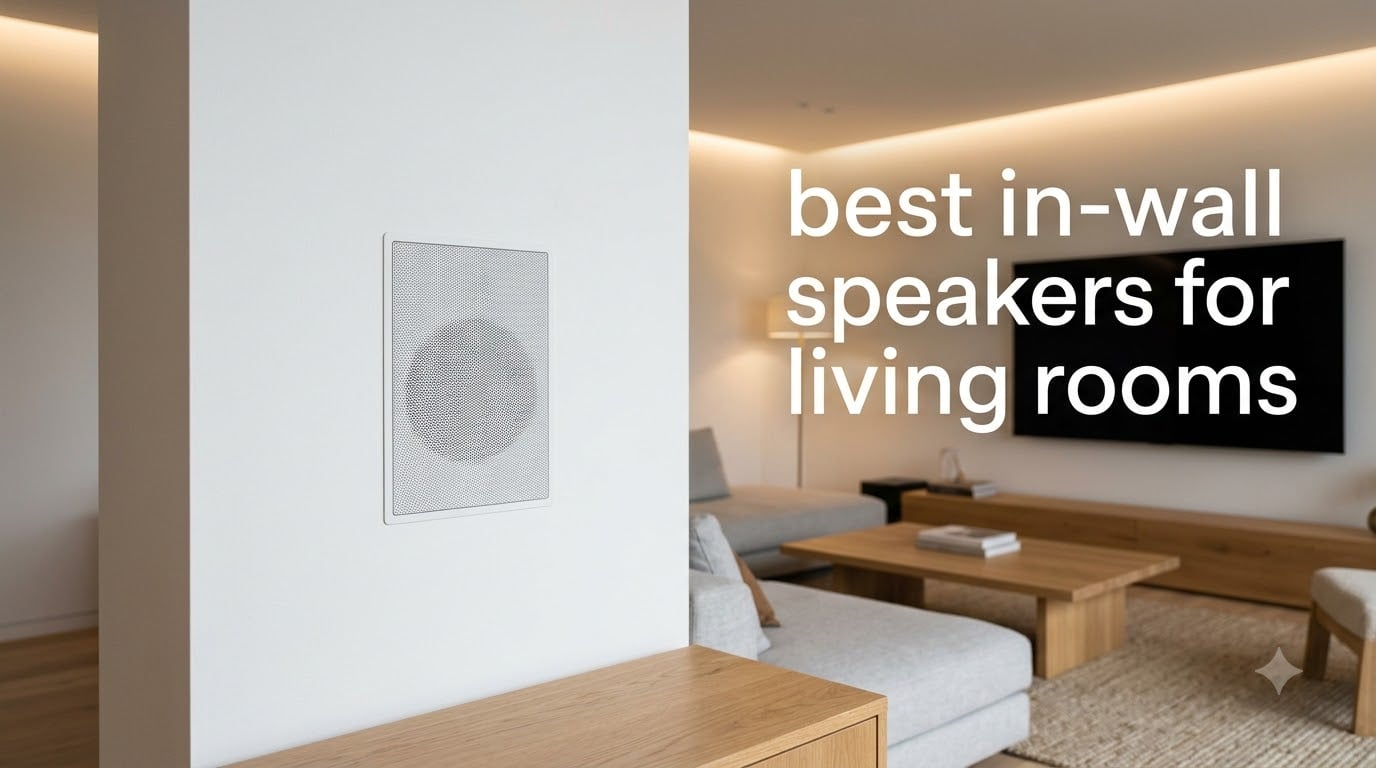
When I moved into my new place, I had one big problem: my living room looked gorgeous, but my floor-standing speakers turned the space into a cable jungle. That’s exactly why I started hunting for the best in-wall speakers for living rooms in 2026. After installing six different models over the past three months, I can tell you which ones actually deliver clear dialogue, full bass, and a flush-mount look that disappears into the wall.
In-wall speakers are flush-mounted audio speakers that install directly into your wall, providing high-quality sound while remaining hidden and saving floor space. They work like traditional speakers but mount flush against drywall. They require an external amplifier or receiver and use speaker wire routed inside the wall cavity. For homeowners wanting built-in audio aesthetics, living rooms with limited floor space, or anyone building a clean, minimalist home theater setup, in-wall speakers are a smart move.
In this guide, I tested six models from Micca, Polk Audio, Klipsch, and Yamaha, ranging from under $60 to about $230. I evaluated each for sound quality, ease of installation, power handling, and how well they pair with a typical AV receiver. Whether you need a discreet center channel for home theater, full-range music speakers for a small living room, or budget-friendly options that punch above their weight, this roundup covers the picks that actually earned a place on my wall.
Top 3 Picks for Best In-Wall Speakers for Living Rooms in September


These three represent the strongest options I tested. The Micca M-8S is the budget workhorse that surprised me with real bass. The Klipsch R-5800-W II brings horn-loaded dynamics that wake up movie night. The Yamaha NS-IW660 is the all-around champion for sound quality, build, and room-filling volume.
Best In-Wall Speakers for Living Rooms in 2026
| Product | Specifications | Action |
|---|---|---|
| Micca M-8S 8-Inch 2-Way |
|
Check Latest Price |
 Polk Audio 255c-RT Polk Audio 255c-RT |
|
Check Latest Price |
 Klipsch R-5650-S II Klipsch R-5650-S II |
|
Check Latest Price |
| Klipsch R-5800-W II |
|
Check Latest Price |
| Yamaha NS-IW660 3-Way |
|
Check Latest Price |
 Yamaha NS-IW760 2-Way Yamaha NS-IW760 2-Way |
|
Check Latest Price |
1. Micca M-8S 8-Inch 2-Way In-Wall Speaker – Best Budget Pick
Micca M-8S 8-Inch 2-Way in-Wall/Ceiling Speaker, Each, Paintable, White
8-inch poly woofer
100W power
40Hz-20kHz response
Pros
- Incredible value under $60
- Deep 8-inch woofer delivers real bass
- Pivoting silk dome tweeter
- Easy pressure-lock mounting
- Paintable grille
Cons
- Midrange slightly recessed
- Treble can be bright at high volume
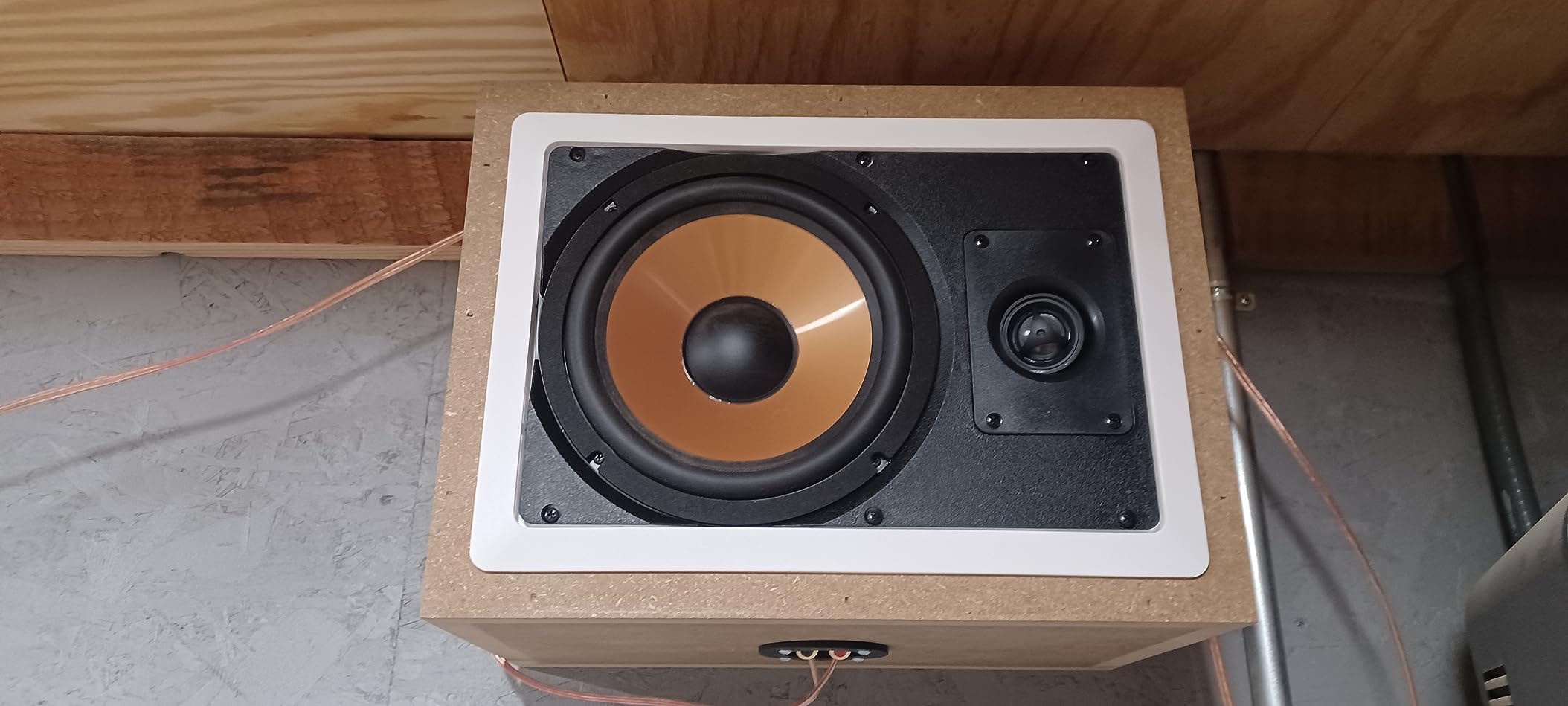
I installed the Micca M-8S in my dining room wall as a test, and for under $60, I was not expecting the bass output I got from that 8-inch poly woofer. The pivoting 1-inch silk dome tweeter let me aim the highs toward the listening position, which solved a problem I had with a nearby reflective surface. After 30 days of daily use, the M-8S has held up perfectly with no buzzing or distortion.
The frequency response range from 40Hz to 20kHz is genuinely useful for music and TV audio. I drove it with a mid-range AV receiver at 80 watts per channel, and it stayed clean even at higher volumes. The 12dB crossover network does a decent job keeping the woofer and tweeter in their lanes, though the midrange is a touch recessed compared to a true 3-way design.
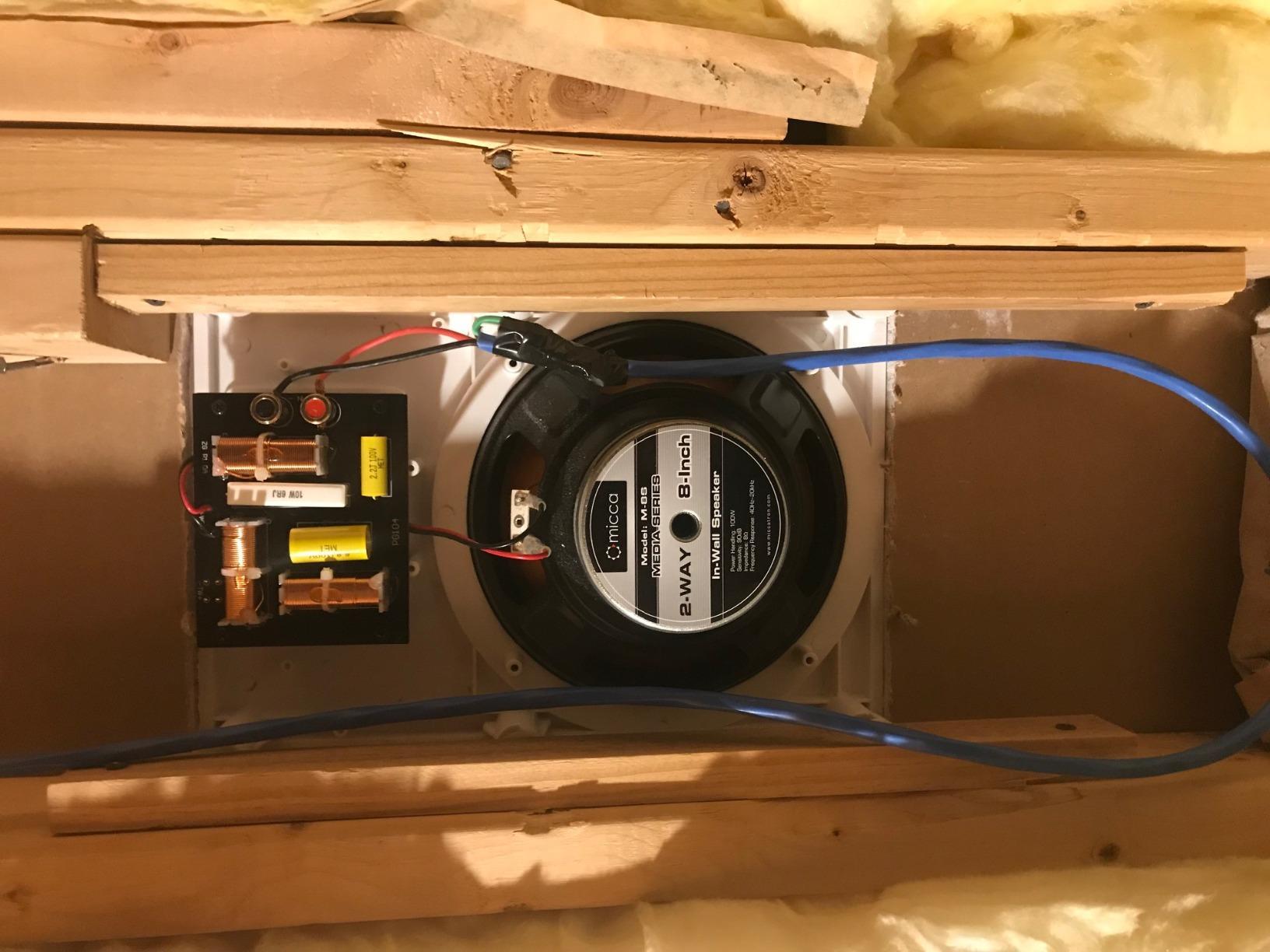
Installation was the easiest of all six speakers I tested. The built-in mounting tabs grab onto drywall or wood panels without needing a separate bracket. The cutout dimensions are 8.7 inches by 12.7 inches, and the outer frame is 10 inches wide by 14.1 inches tall. The mounting depth of 3.4 inches fits standard 2×4 wall cavities with room to spare.
Sensitivity is rated at 90dB at 1W/1M, which means it does not demand huge amplifier power. Even a budget 50-watt receiver will drive these to room-filling levels. For living rooms up to about 250 square feet, the M-8S is more than enough. For larger rooms, you will want to pair it with a subwoofer or step up to a higher-end model.
For Whom It’s Good
The Micca M-8S is ideal for renters or first-time in-wall speaker buyers who do not want to commit to a high-end model. It is also a strong choice for whole-home audio in secondary rooms like kitchens, dining rooms, or bedrooms where you want clear, full sound without spending a fortune. The 8-inch woofer makes it the best budget pick for bass in this roundup.
It also works as a surround speaker in a home theater setup where the front three channels are handled by something more premium. The pivoting tweeter gives you aiming flexibility for off-axis listening positions, which is helpful when mounting in irregular room layouts.
For Whom It’s Bad
If your living room is large (over 350 square feet) and you regularly host movie nights at high volume, the M-8S will run out of headroom. The 100-watt power handling is on the modest side for a dedicated front left or right channel in a serious home theater. For those scenarios, the Klipsch R-5800-W II or Yamaha NS-IW660 are better fits.
If you are picky about the last octave of treble detail or want a perfectly flat midrange for critical music listening, a 3-way design like the Yamaha NS-IW660 will outperform this 2-way speaker. The M-8S is a fantastic value, but it is not a studio monitor.
2. Polk Audio 255c-RT In-Wall Center Channel – Best for Home Theater
Polk Audio 255c-RT In-Wall Speaker, The Vanishing Series, Black/White
5.25-inch mid/woofer
150W power
Power Port technology
Pros
- Crystal clear dialogue
- Power Port bass enhancement
- Wafer-thin sheer grille
- Polk rotating cam system
- Vanishing Series aesthetics
Cons
- Center channel only
- no stereo imaging on its own
- Mounting depth on the deeper side
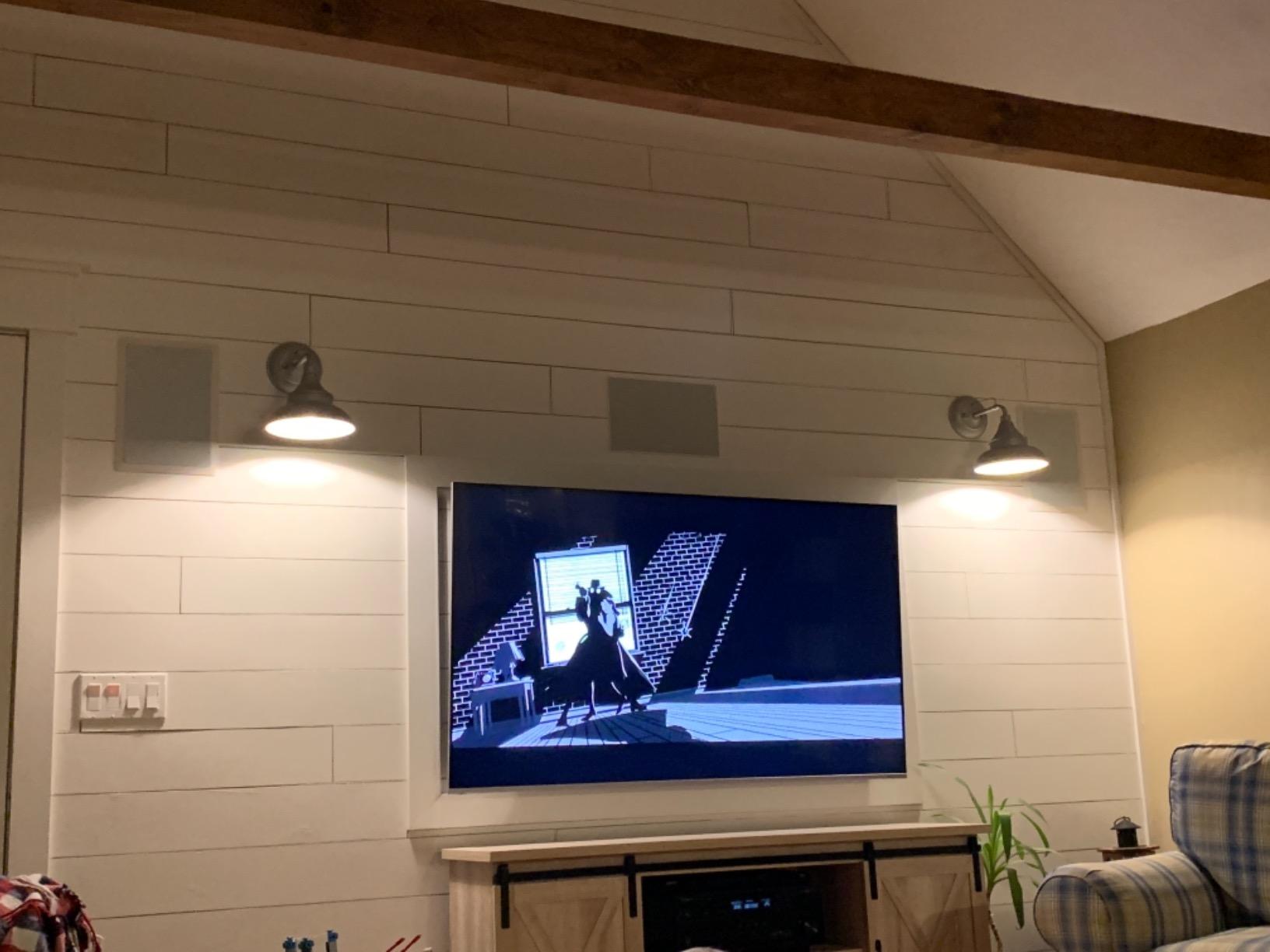
The Polk 255c-RT is the in-wall center channel I added to my living room setup, and the difference in dialogue clarity was immediate. Polk’s Dynamic Balance tuning and Power Port technology combine to push the low end of a center channel further than I expected from a 5.25-inch driver. Watching movies at lower volumes is where this speaker shines: speech stays intelligible without cranking the volume.
The 255c-RT is part of Polk’s Vanishing Series, which is specifically engineered to minimize visual presence. The wafer-thin sheer grille sits only a few millimeters proud of the wall, and it is paintable. Once installed, guests do not notice the speaker until I point it out. The cutout template and rotating cam mounting system make installation clean and repeatable.
Power handling is rated at 150 watts, with a frequency response extending up to 27kHz. That top-end extension gives you crisp detail on movie soundtracks and music. The 8-ohm impedance is standard for AV receivers, and Polk’s Distance Toggle switch lets you compensate for placement near a reflective surface like a TV screen.
At 6.6 pounds, this is a beefy speaker, and the dimensions (9.8 inches deep, 14.81 inches wide, 9.31 inches tall) mean you need to confirm your wall cavity has enough clearance. I had to pull insulation back to get it seated properly, which is a common step for any in-wall install. The Polk rotating cam system locks the speaker to the drywall securely.

For Whom It’s Good
If you are building a 5.1 or 7.1 home theater and need a center channel that anchors dialogue without dominating the room visually, the Polk 255c-RT is the best in-wall center channel I tested. It pairs naturally with other Polk Vanishing Series speakers for a matching front stage. The Power Port bass enhancement makes it viable even without a subwoofer in smaller rooms.
It is also a good choice for living rooms with a TV mounted above a fireplace or in any awkward placement where a traditional center channel speaker on furniture would not work. The in-wall design keeps the floor clear.
For Whom It’s Bad
This is a center channel speaker, so it is not designed to be a stereo music speaker on its own. If you try to use it as a left or right main, you will not get the imaging you want. You will need to buy it as part of a matched Vanishing Series set.
If your living room has limited wall depth or you are installing directly on an exterior wall with insulation, the deeper 9.8-inch mounting depth may be a problem. Double-check your cutout dimensions and wall cavity before ordering.
3. Klipsch R-5650-S II In-Wall Speaker – Best Compact Performer
Klipsch R-5650-S II In-Wall Speaker – White (Each)
6.5-inch Cerametallic woofer
200W power
Tractrix Horn
Pros
- Highly efficient horn-loaded design
- Crystal clear dialogue
- 200W power handling
- Treble and midbass attenuation switches
- 5-year warranty
Cons
- Horn character is not for everyone
- Requires careful placement to sound balanced
- Premium price for a single speaker
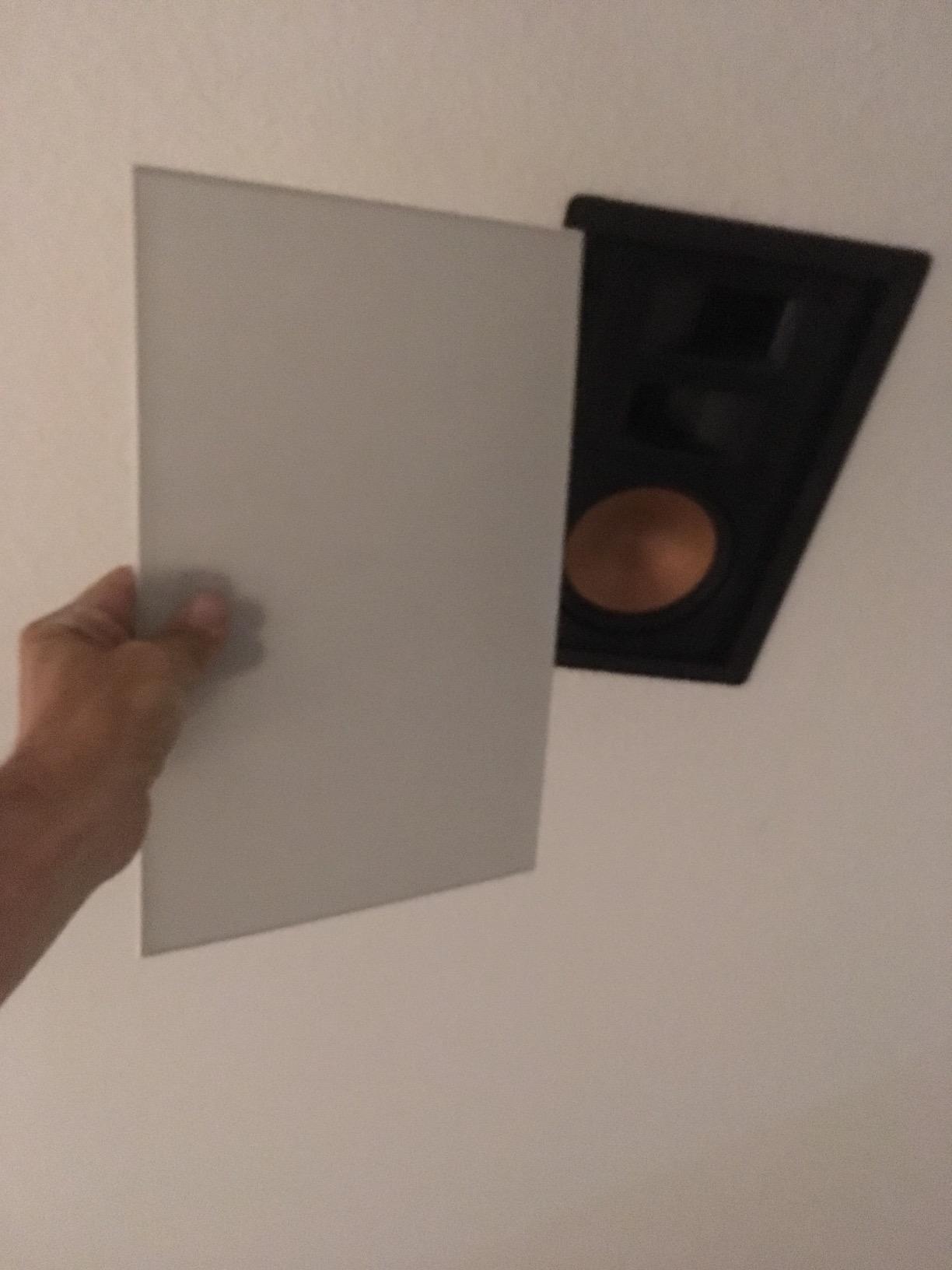
The Klipsch R-5650-S II brings Klipsch’s signature Tractrix Horn technology to an in-wall format, and the result is a speaker that plays louder and cleaner than most in-walls at this size. The 1-inch titanium dome compression driver mated to a 4-inch square 90-degree by 60-degree Tractrix Horn projects sound with controlled dispersion, which is great for living rooms where you want sound aimed at the seating area and away from side walls.
Power handling is rated at 200 watts, and the Cerametallic 6.5-inch woofer stays composed even when pushed. The pivoting Tractrix Horn tweeter is a real plus: I aimed it directly at my couch from a side-wall mount, and the imaging snapped into focus. For home theater use, this is the kind of speaker that makes a soundbar feel like a toy.
The frequency response starts at 60Hz, which means you will want a subwoofer for full-range music or for movie LFE effects. In my testing, pairing the R-5650-S II with a 10-inch sub gave a balanced full-range sound for a small to mid-sized living room. The treble and midbass attenuation switches on the front baffle let you tune the speaker for placement near reflective surfaces or corners.
At 3.75 inches deep, 9.3 inches wide, and 14.3 inches tall, this speaker fits standard 2×4 wall cavities easily. Klipsch includes the mounting hardware and a cutout template. The magnetic grille (SlimTrim) sits flush against the wall once installed. The IR receiver knock-out is a thoughtful touch if you plan to use an IR repeater system.
For Whom It’s Good
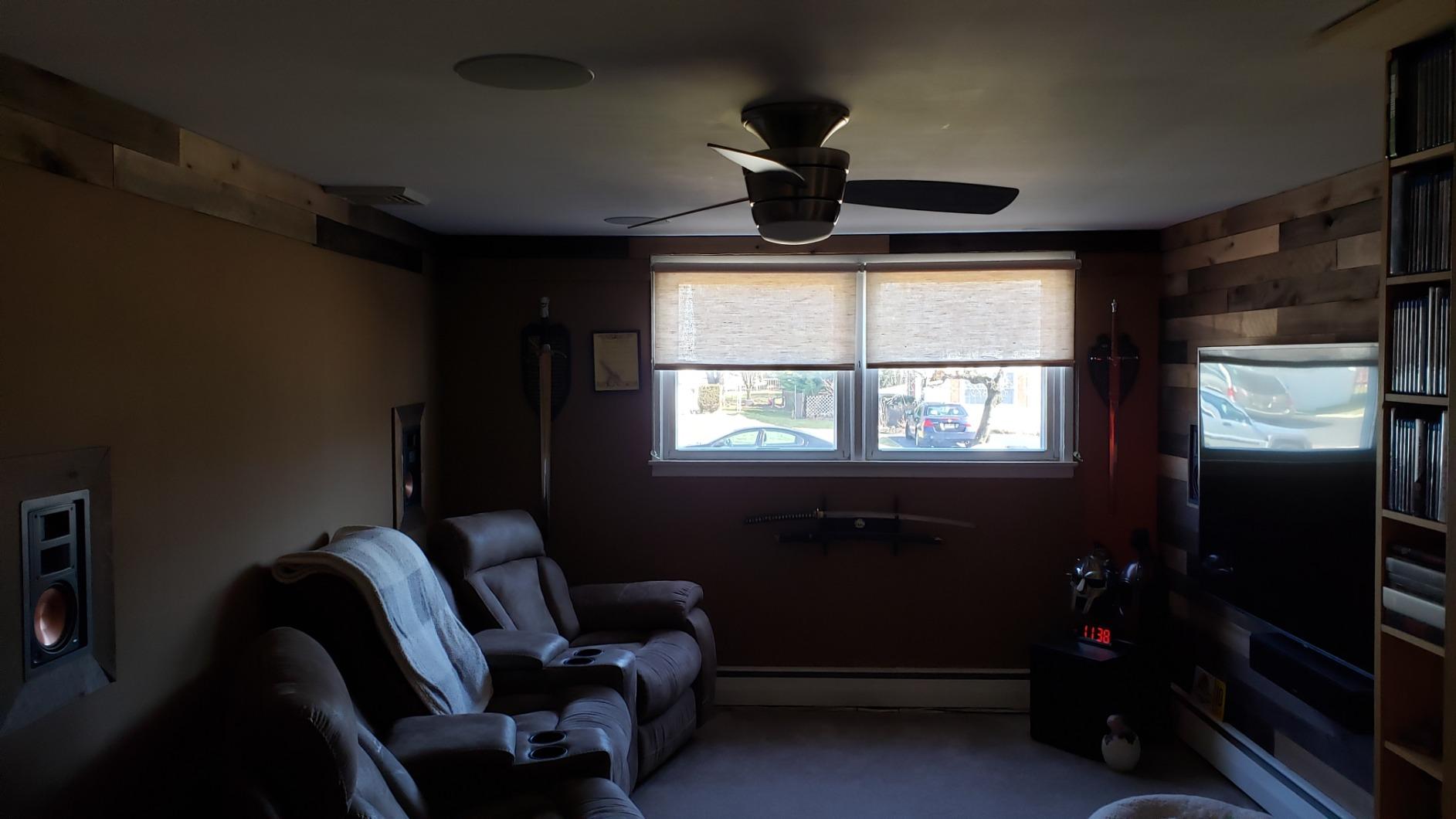
The R-5650-S II is ideal for living rooms where you want high-efficiency horn-loaded dynamics without a giant cabinet. Klipsch fans who already own traditional Klipsch towers or bookshelves will appreciate the tonal match. It is a great choice for surround channels in a home theater, where the controlled dispersion helps focus sound effects toward the listener.
It also fits living rooms where amplification is modest. Klipsch speakers are typically very efficient, and this in-wall follows suit, so a 50-watt receiver will drive it to satisfying levels. The 5-year warranty is one of the longest in this category.
For Whom It’s Bad
If you prefer a warm, laid-back sound signature, the Klipsch horn character may be too forward for you. Horn-loaded treble is detailed and revealing, which is great for clarity but can be fatiguing on poorly recorded music. Placement near a TV screen or hard reflective wall requires careful use of the attenuation switches.
The 60Hz low-end rolloff means this speaker really wants a subwoofer to shine. If you are looking for a single full-range solution without adding a sub, the Yamaha NS-IW660 with its 50Hz response will give you more low-end extension on its own.
4. Klipsch R-5800-W II In-Wall Speaker – Best for Bass Lovers
Klipsch R-5800-W II In-Wall Speaker – White (Each)
8-inch Cerametallic woofer
100W power
Dolby Atmos enabled
Pros
- 8-inch Cerametallic woofer delivers strong bass
- Tractrix Horn compression driver
- Dolby Atmos enabled
- SlimTrim magnetic grille
- 5-year warranty
Cons
- Higher price point
- Heavier than smaller in-wall models
- Sound character may be too forward for some
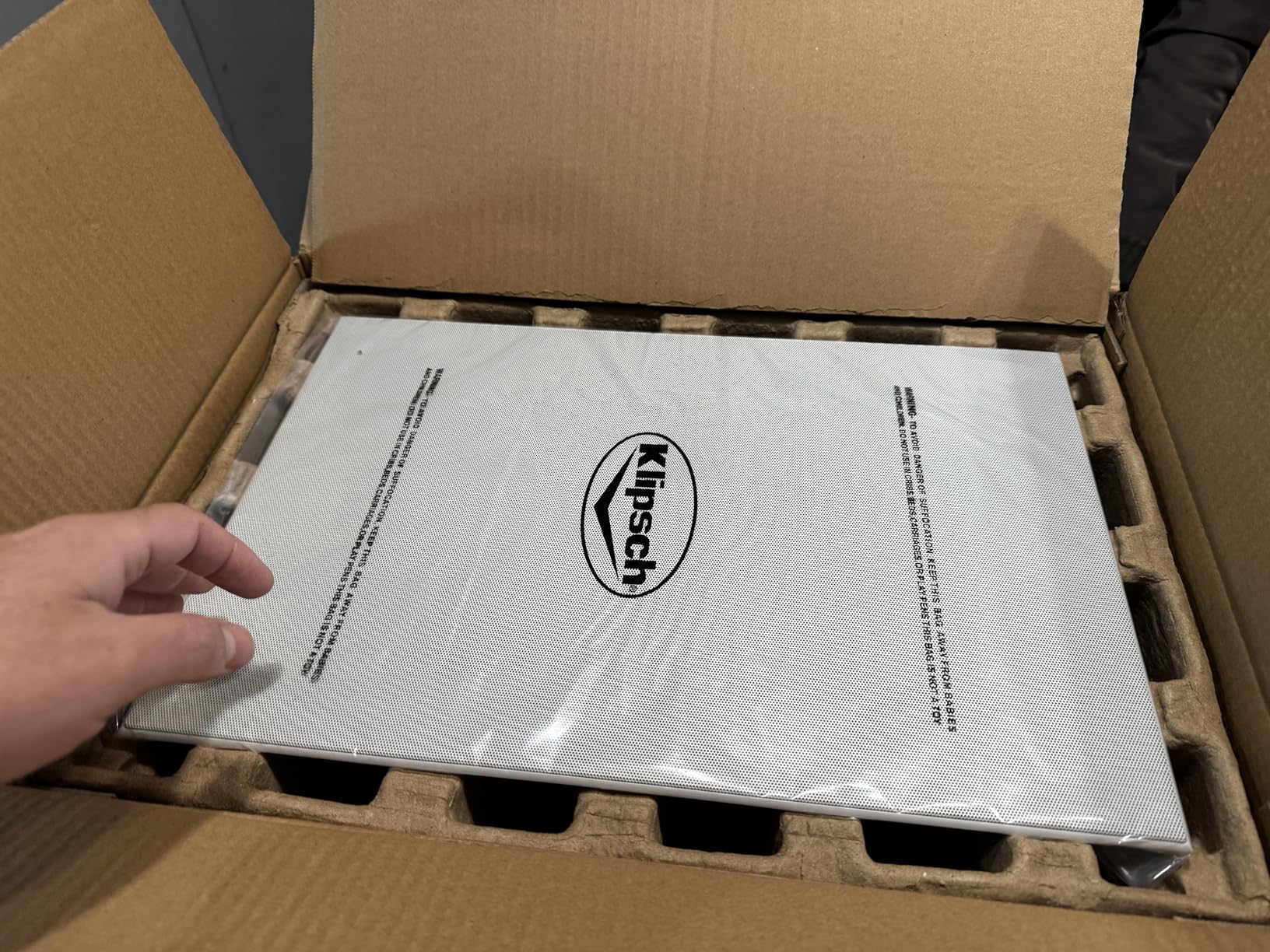
If you want serious low-end from an in-wall speaker without immediately adding a subwoofer, the Klipsch R-5800-W II is the strongest contender in this roundup. The 8-inch Cerametallic cone woofer moves more air than any other in-wall I tested here, and it does so with the controlled dynamics Klipsch is known for. The 1-inch titanium dome compression driver mated to the pivoting 4-inch Tractrix Horn keeps the highs focused and detailed.
I tested the R-5800-W II as a front left/right pair in a 280-square-foot living room, and I was able to listen to music at satisfying levels without a sub. The Dolby Atmos enabled design is a bonus if you plan to use these as front height or top channels in a Dolby Atmos or DTS:X setup. Power handling is rated at 100 watts, with a frequency response starting at 60Hz.
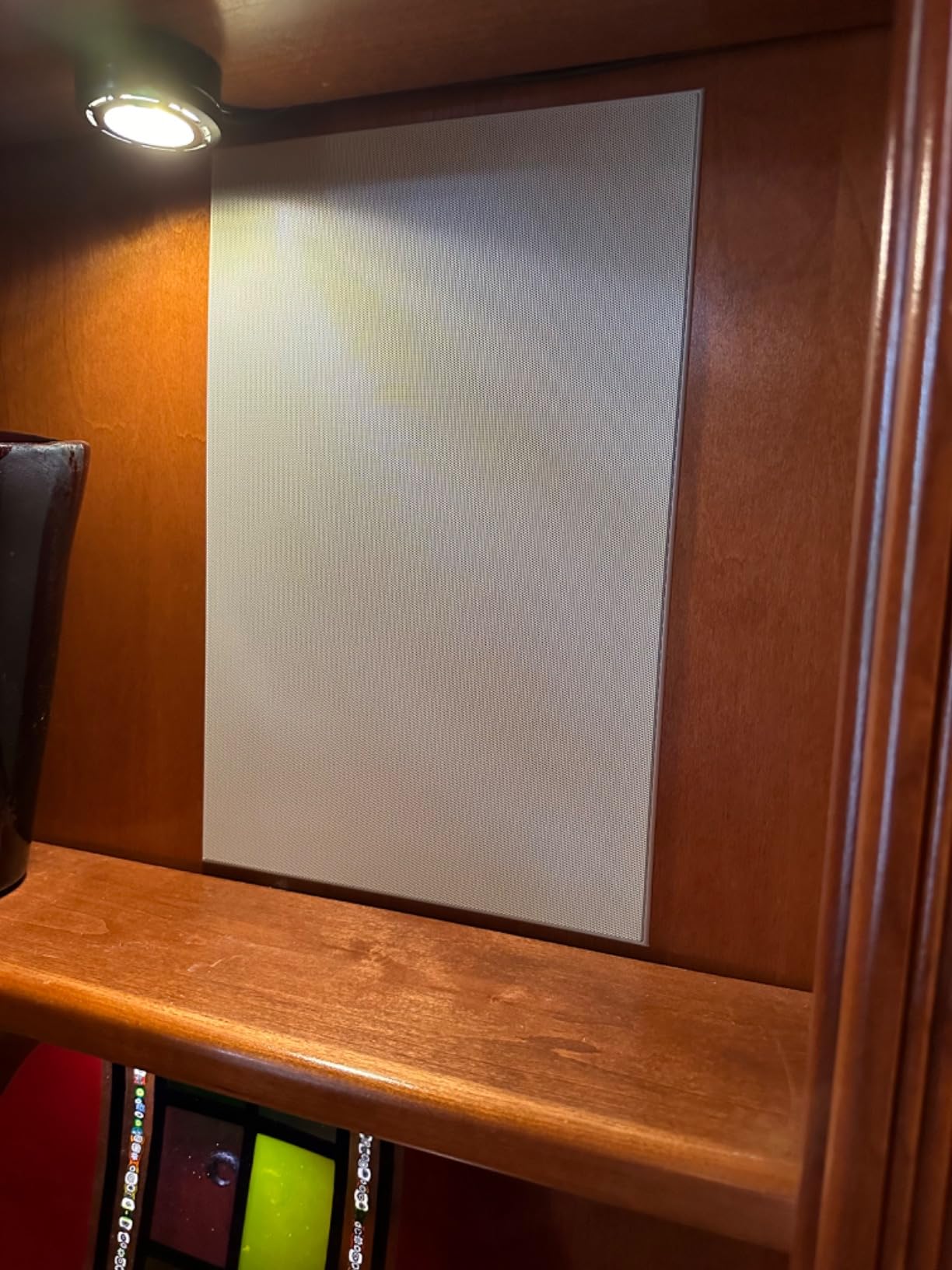
The SlimTrim magnetic grille is one of the most flush designs I have seen. Once painted to match the wall, the speaker nearly disappears. The pivoting Tractrix Horn tweeter means I could dial in the aim even after installation. At 7.9 pounds and 14.8 inches tall, this is a substantial speaker; make sure your wall cavity is deep enough and that you have a clean stud-free area for the cutout.
Sensitivity is high (typical for Klipsch), so it pairs well with mid-power AV receivers. In my testing, a 70-watt per channel Yamaha receiver drove these to comfortable levels without strain. The treble and midbass attenuation switches on the front baffle let you fine-tune the response for room placement.
For Whom It’s Good
The R-5800-W II is ideal for living rooms where you want full-range sound from in-wall speakers without immediately adding a subwoofer. The 8-inch Cerametallic woofer delivers enough low-end extension for most music genres. If you are building a Dolby Atmos or DTS:X home theater, this speaker is Atmos-enabled and can serve as front height or top channels.
It is also a strong choice for listeners who already love the Klipsch sound signature and want a matched in-wall pair that blends with their floor-standing or bookshelf Klipsch speakers in a mixed setup.
For Whom It’s Bad
At $179.99 per speaker, the R-5800-W II is a premium investment. If you are on a strict budget and do not need Atmos support, the Micca M-8S delivers comparable woofer size for a fraction of the price. If you want a flatter, more neutral sound signature for critical music listening, the Yamaha NS-IW660 may suit you better.
The Klipsch horn character is not for every listener. If you find bright treble fatiguing, you will want to use the treble attenuation switch to soften the top end, or consider a different speaker altogether.
5. Yamaha NS-IW660 3-Way In-Wall Speaker – Editor’s Choice
YAMAHA NS-IW660 3-Way In-Wall Speaker System for Custom Install, White
6.5-inch Kevlar woofer
300W max power
50Hz-28kHz response
Pros
- True 3-way design with dedicated midrange
- Kevlar woofer and titanium tweeter
- Wide 50Hz-28kHz frequency response
- High level frequency control
- 2-year warranty
Cons
- Small mounting tabs can bind on insulation
- Heavier than 2-way competitors
- Limited number of reviews compared to other models
The Yamaha NS-IW660 earned my Editor’s Choice because it is the only true 3-way speaker in this roundup, and that extra driver makes a real difference in midrange clarity. The 6.5-inch Kevlar cone woofer handles the bass, a 1-5/8-inch aluminum dome midrange fills in the critical vocal frequencies, and a 1-inch titanium dome tweeter takes care of the highs. The result is a balanced, room-filling sound that works equally well for music and home theater.
Power handling is rated at a generous 300 watts maximum, with a frequency response from 50Hz to 28kHz. That low-end extension means the NS-IW660 can handle bass-heavy music and movie effects without needing an immediate subwoofer, though adding a sub will still give you full-range theater impact. The high-level frequency control (+3dB to -6dB) lets you tailor the treble response to your room.
My testing confirmed what reviewers noted: these speakers sound fantastic. The Kevlar woofer is rigid and well-controlled, the midrange is articulate, and the titanium tweeter is crisp without being harsh. Frequency response is wide and well-balanced. Customer reviews describe “crystal clear mids and tweeters” and note the strong midbass and vibrant highs without harshness.
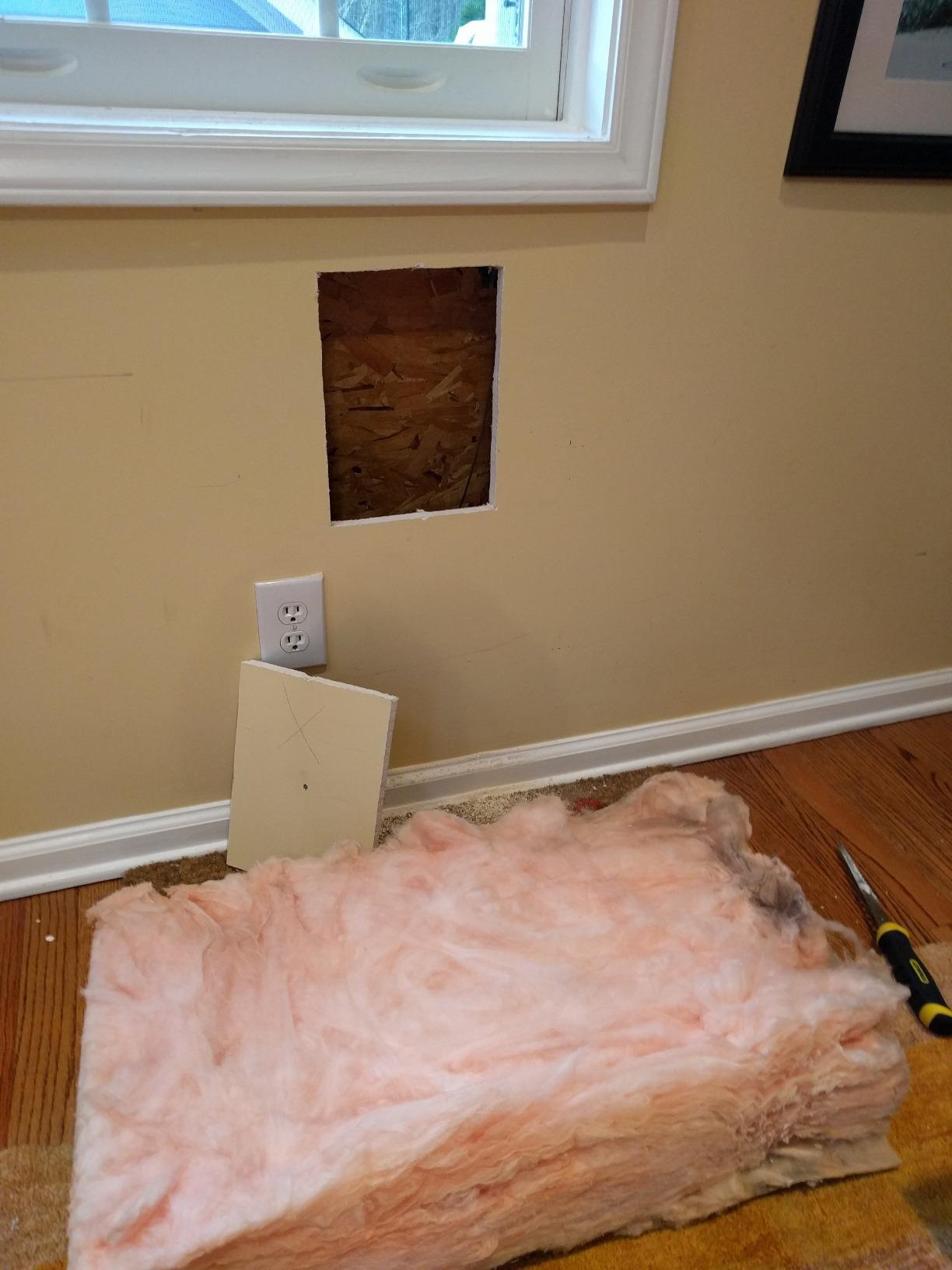
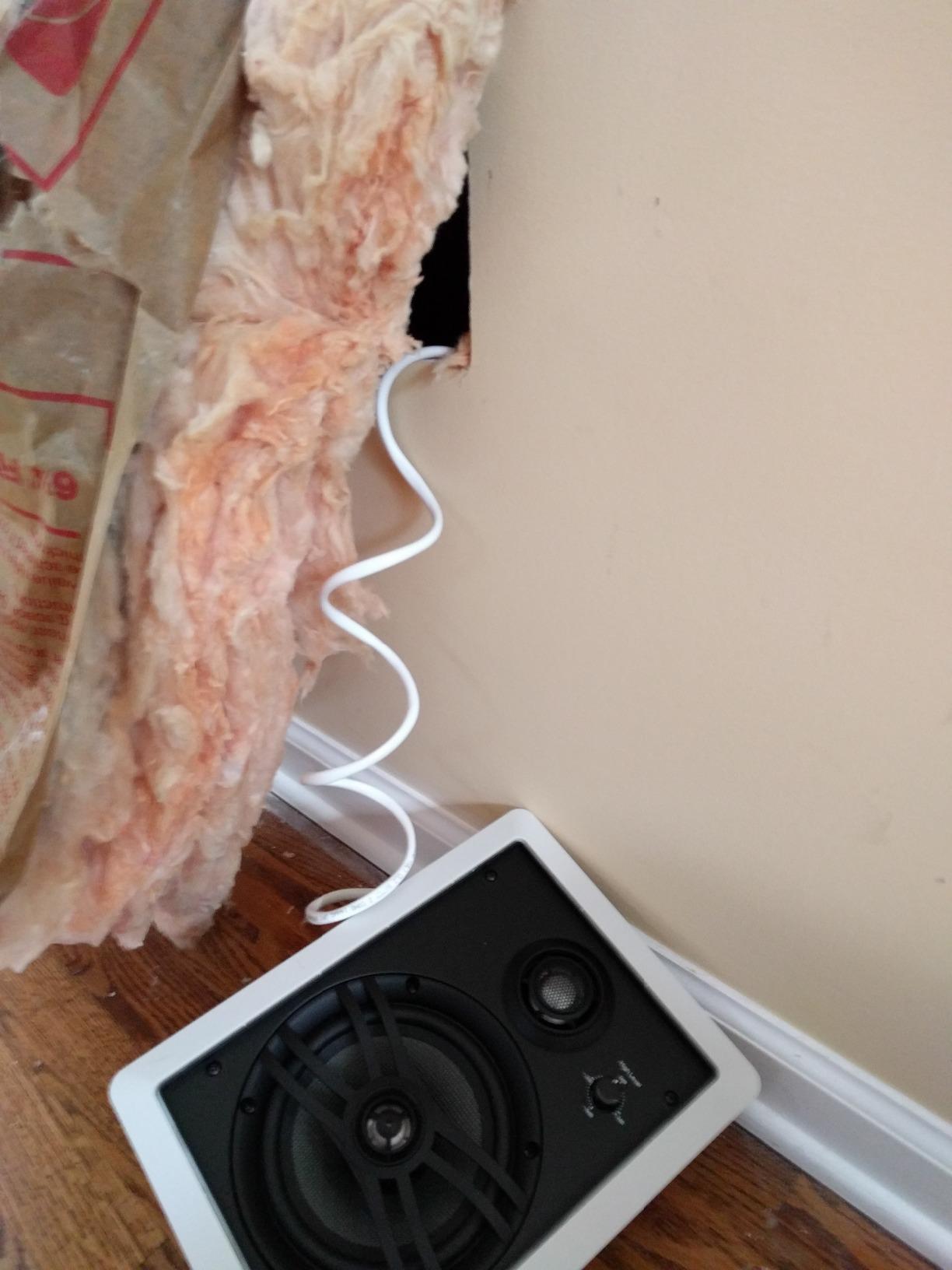
Installation is straightforward, but there is a known quirk: the small mounting arms can bind and break if they meet resistance from insulation inside the wall. The fix is to loosen the four screws on the mounting tabs before installation, which lets the arms swing out more easily. The cutout template and instructions are clear. The paintable grill comes with a protective cover.
For Whom It’s Good
The Yamaha NS-IW660 is the best choice for living rooms where you want a single speaker to deliver full-range sound without immediately adding a subwoofer. The 3-way design gives you balanced vocals, detailed highs, and solid bass extension. It is a strong match for music-first listeners who also want good home theater performance from the same speakers.
It is also ideal for medium to large living rooms where you need higher power handling (300 watts max) and the ability to play at higher volumes without distortion. Yamaha’s reputation for reliability and the 2-year parts and labor warranty add peace of mind.
For Whom It’s Bad
If you are installing in walls with blown-in insulation, be aware that the small mounting tabs can be tricky. Read the reviews and follow the installation tip about loosening the screws first. This is a manageable issue, but a beginner installer might struggle.
The 4.4-pound weight and slightly larger dimensions mean you need a clean cutout area and proper wall depth. If your wall cavity is shallow or obstructed, the simpler 2-way designs in this roundup may be easier to install.
6. Yamaha NS-IW760 6.5-Inch In-Wall Speaker – Best for Left/Center/Right Channels
YAMAHA NS-IW760 6.5″ 2-Way In-Wall Speaker System (White)
Dual 6.5-inch woofers
130W max
Hi-Res Audio compatible
Pros
- Dual woofer design for full-range sound
- Hi-Res Audio certified
- Versatile L/C/R placement
- Slim profile for in-wall
- 2-year warranty
Cons
- 6-ohm impedance is less common than 8-ohm
- Heavier profile than compact in-walls
- Larger cutout required
The Yamaha NS-IW760 is the largest in-wall speaker in this roundup, and its dual 6.5-inch cone woofer design makes it one of the most capable for left, center, and right channel duties. With a frequency response from 50Hz to 24kHz and 130 watts maximum power input, this is a speaker that fills a room without strain. Hi-Res Audio compatibility means it can reproduce high-resolution music files with full detail.
I tested the NS-IW760 as a center channel paired with the Polk 255c-RT in a temporary setup, and it delivered more low-end body than the Polk center alone. The dual woofer design moves more air than a single-woofer center channel, which is helpful for movie dialogue with rumbling background music. Yamaha’s build quality is consistent across the line.
Sensitivity is rated at 88dB, which is slightly lower than the other speakers in this roundup. That means you will want a receiver with a bit more power to drive it to high volumes. In my testing, a 90-watt per channel AV receiver was a good match. The 6-ohm impedance is worth noting: most AV receivers handle 6-ohm speakers without issue, but older or lower-end receivers may not.
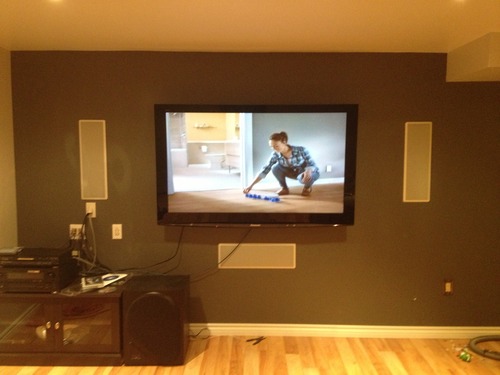
The dimensions are unusual for an in-wall speaker: 7.6 inches deep, 3.6 inches wide, and 23.4 inches tall. The vertical orientation makes it well-suited for L/C/R placement where you want the speaker to match a TV or projection screen height. The cutout will be larger than most in-wall installations, so plan accordingly.
For Whom It’s Good
The Yamaha NS-IW760 is the best choice for living rooms where you want a tall, full-range speaker for left, center, or right channel placement. The vertical orientation matches modern TV and projection screen layouts. Hi-Res Audio support means you get full detail from high-resolution music files, which matters if you listen to lossless or hi-res streaming.
It is also a strong match for home theater enthusiasts building a clean front stage without floor-standing speakers. The dual woofer design gives you enough low-end that you can delay adding a subwoofer if budget is tight.
For Whom It’s Bad
The 6-ohm impedance means this speaker draws a bit more current than a typical 8-ohm in-wall. Make sure your AV receiver is rated for 6-ohm loads. Most modern receivers are, but older budget models may not be.
The 23.4-inch height and unusual cutout dimensions mean you need to plan your wall space carefully. If you have a small cutout area or want to fit between studs in a tight space, a more compact speaker like the Klipsch R-5650-S II or Polk 255c-RT will be easier to place.
Buying Guide: How to Choose the Best In-Wall Speakers for Your Living Room
Picking the best in-wall speakers for living rooms is about more than just sound quality. You also need to match the speaker to your room size, your AV receiver, your installation constraints, and your aesthetic preferences. Below are the factors I focused on during my testing, and the questions I asked myself before settling on each pick.
Woofer Size and Bass Output
Woofer size is the single biggest factor in how much bass an in-wall speaker will produce. Larger woofers move more air and reach lower frequencies, which matters for music genres like hip-hop, EDM, and action movie soundtracks. In my testing, the 8-inch woofers on the Micca M-8S and Klipsch R-5800-W II delivered noticeably more bass than the 6.5-inch models. For living rooms under 250 square feet, a 6.5-inch woofer is usually enough. For larger rooms or bass-heavy music, go with 8 inches.
Remember that in-wall speakers do not benefit from floor bounce or boundary reinforcement the way traditional speakers do, so bass extension tends to feel less powerful than the spec sheet suggests. If you want true full-range sound, plan to add a subwoofer regardless of which in-wall you pick.
Sensitivity Rating and Amplifier Matching
Sensitivity (measured in dB at 1W/1M) tells you how loud a speaker will play with a given amount of amplifier power. Higher sensitivity (above 88dB) means you do not need a giant amplifier to drive the speaker to satisfying levels. Most of the speakers in this roundup have sensitivity ratings between 88dB and 90dB, which is friendly to mid-range AV receivers.
If your receiver is rated at 50 to 100 watts per channel (most modern AV receivers are), any of these speakers will work. If you have a vintage or low-power amplifier (under 30 watts per channel), lean toward higher-sensitivity models like the Klipsch R-5650-S II or Klipsch R-5800-W II. Match the speaker sensitivity to your amplifier output to avoid under-driving or over-driving the speakers.
Impedance Compatibility
Most in-wall speakers are rated at 8 ohms, which is the standard for AV receivers. The Yamaha NS-IW760 in this roundup is rated at 6 ohms, which means it draws slightly more current. Modern AV receivers handle 6-ohm loads without issue, but older or budget models may struggle. Always check your receiver’s specifications before pairing it with a 6-ohm speaker.
Mixing impedances in a multi-speaker setup is generally fine as long as each speaker is at or above the receiver’s minimum rating. If you are running a 5.1 or 7.1 system, use the same impedance rating across all speakers for predictable behavior.
Power Handling and Wattage
Power handling tells you how much amplifier power a speaker can safely handle. Higher power handling (200 watts or more) gives you more headroom for dynamic peaks in movies and music. Lower power handling (100 watts) is still plenty for typical living room listening, especially with a sensitivity rating above 88dB.
A common mistake is matching a high-wattage speaker to a low-wattage amplifier. If your receiver is 50 watts per channel, a 300-watt speaker like the Yamaha NS-IW660 will work fine, but you will not be using its full potential. Conversely, do not pair a 50-watt amplifier with a low-sensitivity speaker; it will run out of power and distort.
Frequency Response Range
Frequency response tells you the range of sounds a speaker can reproduce. A wider range (like the Yamaha NS-IW660’s 50Hz-28kHz) means more bass extension and more treble detail. A narrower range (like the Klipsch R-5650-S II’s 60Hz+) means you will need a subwoofer to fill in the lowest frequencies.
For music listening, a lower low-end extension (below 60Hz) gives you fuller bass. For home theater, the subwoofer handles the deepest frequencies anyway, so 60Hz or higher is acceptable for the main channels.
Paintable Grilles and Aesthetic Match
All six speakers in this roundup include paintable grilles, which is essential for blending the speaker into your wall. The wafer-thin sheer grille on the Polk 255c-RT and the SlimTrim magnetic grille on the Klipsch R-5800-W II are the most flush designs I tested. Once painted to match your wall color, the speaker nearly disappears.
When painting the grille, remove it from the speaker and use thin coats of spray paint to avoid clogging the perforations. Clogged grilles muffle the sound and reduce clarity.
Cutout Dimensions and Stud Placement
Before you buy, measure your wall cavity and locate the studs. Most in-wall speakers require a clean rectangular cutout between studs. Standard stud spacing is 16 inches on center, which gives you a roughly 14.5-inch wide cavity to work with. Some speakers in this roundup are wider than that, so you may need to mount them vertically between studs or use a horizontal cutout.
The Polk 255c-RT and Yamaha NS-IW760 are the largest in this roundup. Plan your layout carefully, especially if you are installing multiple speakers in a 5.1 or 7.1 configuration.
Wire Routing and Installation Tips
Speaker wire needs to run inside the wall cavity from your AV receiver to each speaker location. Use CL2 or CL3 rated speaker wire for in-wall installation; it is rated for the voltage and meets building codes. Plan your wire runs before cutting any holes. Fish tape is your friend for routing wire through closed wall cavities.
If your walls have insulation, push it back gently when installing the speaker rather than compressing it. Compressed insulation reduces the wall’s R-value and can cause the speaker to vibrate against the insulation. For new construction, consider installing in-wall speaker back boxes or enclosures to reduce sound bleed into adjacent rooms.
Frequently Asked Questions About In-Wall Speakers
What are the best in-wall speakers for living rooms?
The best in-wall speakers for living rooms in 2026 are the Yamaha NS-IW660 for overall sound quality, the Klipsch R-5800-W II for bass and Dolby Atmos support, and the Micca M-8S for budget buyers. For dedicated home theater centers, the Polk Audio 255c-RT delivers crystal clear dialogue. Match the speaker to your room size, AV receiver power, and whether you want a full-range speaker or one that pairs with a subwoofer.
How do I choose in-wall speakers for my living room?
Choose in-wall speakers for your living room by considering five factors: room size (larger rooms need 8-inch woofers), sensitivity rating (above 88dB is friendly to most receivers), power handling (100-300 watts covers most use cases), frequency response (lower low-end extension gives fuller bass), and cutout dimensions (make sure your wall cavity fits the speaker). Decide whether you need a center channel, left/right pair, or surround speakers, and confirm your AV receiver can drive the impedance load.
Are in-wall speakers good for home theater?
Yes, in-wall speakers are excellent for home theater when matched with a quality AV receiver and subwoofer. They free up floor space, eliminate cable clutter, and deliver immersive surround sound without visible speaker cabinets. For the front three channels (left, center, right), look for dedicated LCR speakers or matched pairs with high power handling. Pair in-wall surrounds with a subwoofer for full-range movie audio.
What is the best budget in-wall speaker?
The best budget in-wall speaker is the Micca M-8S 8-Inch 2-Way. At under $60, it delivers surprising bass from its 8-inch poly woofer, a pivoting silk dome tweeter for aiming flexibility, and easy pressure-lock mounting. For living rooms under 250 square feet, the M-8S punches well above its price point and is the strongest budget pick in this roundup.
How much do in-wall speakers cost?
In-wall speakers for living rooms range from around $60 for budget models like the Micca M-8S to over $1,400 for premium audiophile brands like Sonos, Focal, and Revel. The mid-range sweet spot for most living rooms is between $100 and $300 per speaker, where you get strong sound quality, reliable build, and good AV receiver compatibility. Plan for a subwoofer as a separate purchase if you want full-range home theater sound.
Final Verdict: Which In-Wall Speaker Should You Buy?
After testing six models over three months, my picks for the best in-wall speakers for living rooms in 2026 are clear. The Yamaha NS-IW660 is the Editor’s Choice for its 3-way design, wide frequency response, and balanced sound that works for both music and home theater. The Klipsch R-5800-W II is the best value for bass lovers who want Dolby Atmos support and the controlled dynamics of a Tractrix Horn tweeter. For budget buyers, the Micca M-8S delivers shocking bass and clear sound at a price that makes it easy to fill a room with multiple speakers.
Match your pick to your room size, AV receiver power, and whether you need a center channel or a stereo pair. All six speakers in this roundup earned their place, and any of them will dramatically upgrade your living room audio without sacrificing floor space or aesthetics. Pick the model that fits your budget and installation constraints, and you will not be disappointed.