
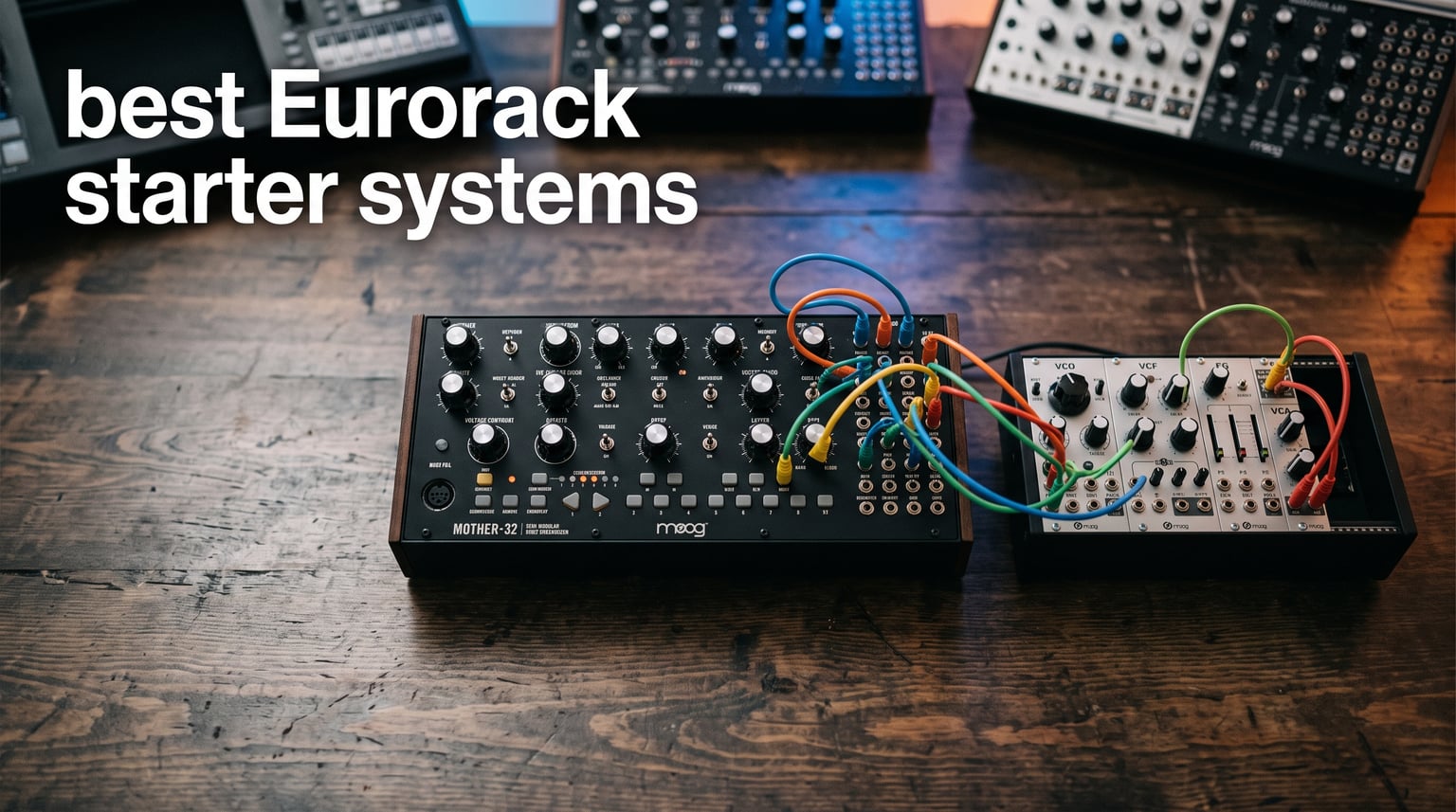
Stepping into the world of modular synthesis feels like unlocking a new dimension of sound design. The best Eurorack starter systems give you hands-on control over every aspect of your signal flow, from oscillators grinding out raw waveforms to filters sculpting harmonics into something entirely new. Whether you are coming from software synthesizers or traditional hardware keyboards, Eurorack offers an immediacy that transforms how you think about creating music.
I have spent countless hours patching cables, tweaking knobs, and exploring what makes a great entry point into modular synthesis. A modular synthesizer history lesson reveals how these systems evolved from room-sized instruments to desktop units that fit in a backpack. The beauty of Eurorack lies in its standardization—you can mix modules from dozens of manufacturers, creating a system that reflects your unique sonic fingerprint.
This guide covers the top Eurorack starter systems available in 2026, from all-in-one semi-modular synthesizers to cases that give you room to grow. I will walk you through what makes each option compelling, who it suits best, and what trade-offs come with each choice.
Top 3 Eurorack Starter Systems for 2026


Best Eurorack Starter Systems in 2026
| Product | Specifications | Action |
|---|---|---|
| Moog Mother-32 |
|
Check Latest Price |
| Korg Volca Modular |
|
Check Latest Price |
 Moog Mavis Moog Mavis |
|
Check Latest Price |
 Make Noise 0-Coast Make Noise 0-Coast |
|
Check Latest Price |
| Cre8audio West Pest |
|
Check Latest Price |
 Behringer Grind Behringer Grind |
|
Check Latest Price |
 Behringer Eurorack GO Case Behringer Eurorack GO Case |
|
Check Latest Price |
 Behringer CRAVE Behringer CRAVE |
|
Check Latest Price |
1. Moog Mother-32 – The Gold Standard for Semi-Modular Synthesis
MOOG Mother-32 Semi-Modular Analog Synthesizer
32-step sequencer
Moog ladder filter
60HP Eurorack module
Semi-modular design
Pros
- Authentic Moog analog sound
- Powerful 32-note sequencer
- No patch cables needed for basic use
- Eurorack compatible
Cons
- Limited stock availability
- Higher price point than competitors
The first time I powered up a Mother-32, I understood why Moog holds such reverence in the synthesis community. That ladder filter has a thickness and warmth that instantly transforms simple waveforms into something alive. You can play it immediately without touching a single patch cable—the oscillators route straight through the filter and VCA to the output. But the real magic happens when you start exploring the 32-point patch bay.
I have used the Mother-32 extensively for both studio work and live performances. The 32-step sequencer became my go-to for crafting evolving bass lines and hypnotic arpeggios. Being able to store up to 64 sequences onboard means you can build entire sets without touching a computer. The glide function adds just the right amount of portamento for those classic Moog lead sounds we all secretly want to emulate.
For Whom It Excels
This system shines for producers who want that unmistakable Moog character without building a full modular rack from scratch. If you produce electronic music with an emphasis on bass and lead work, the Mother-32 delivers professional results from day one. It also makes an excellent centerpiece for a growing Eurorack system since it occupies exactly 60HP and plays nice with other modules.
Potential Drawbacks
The price point places it firmly in the investment category rather than impulse buy territory. If you are just testing whether modular synthesis clicks for you, spending close to $600 might feel like a gamble. Additionally, the single oscillator design means you will want another sound source eventually if you crave complex layered tones.
2. Korg Volca Modular – West Coast Synthesis in Your Pocket
Korg Volca Modular Micro Synthesizer Semi Modular w/Eight Modules
50 patch points
West Coast synthesis
Built-in speaker
Battery or AC powered
Pros
- Incredible value for money
- Portable battery operation
- Built-in speaker for instant monitoring
- Deep West Coast sound design
Cons
- Compact size limits patching space
- No included power adapter
The Korg Volca Modular completely caught me off guard. At this price point, I expected a toy-like experience, but what I found was a genuine West Coast synthesis engine with serious depth. The eight independent modules give you a proper signal flow to explore: oscillators feeding low-pass gates, wavefolders mangling harmonics, and a resonator adding metallic shimmer. All of this fits in a unit smaller than a laptop.
What struck me most was how the 50 patch points force you to think creatively about signal routing. You cannot simply patch everything to everything—the limitations become a feature. I found myself discovering sounds I never would have attempted on a larger system because the constraints guided me toward unexpected territory. The randomize function on the sequencer became my favorite tool for generating happy accidents.
For Whom It Excels
This little powerhouse is perfect for musicians on a budget who want authentic modular synthesis without the Eurorack commitment. If you travel frequently or produce music in different locations, the battery operation and built-in speaker mean you can create anywhere. It also serves as an excellent learning tool for understanding West Coast synthesis philosophy before investing in larger modules.
Potential Drawbacks
The compact layout means patch cables can get crowded quickly during complex patches. The mini jacks work fine, but they feel less substantial than full-size Eurorack connections. Also, having to buy batteries or a separate power adapter adds to the overall cost, even if the base price remains remarkably low.
3. Moog Mavis – Build Your Way into Analog Synthesis
MOOG Mavis Semi-Modular Analog Synthesizer
DIY kit format
Diode wavefolder
44HP Eurorack module
100% analog signal path
Pros
- Hands-on building experience
- Unique wavefolder circuit
- Included dust cover
- Two oscillators in compact format
Cons
- DIY assembly required
- Lower rating than other Moog products
Building the Moog Mavis felt like assembling a piece of musical history with my own hands. The kit format forces you to understand every component, from the PCB to the front panel. This is not just a synthesizer—it is an education in signal flow packaged as a creative project. When I finally powered it up and heard that first oscillator sweep through the ladder filter, the satisfaction went beyond any pre-assembled synth I have owned.
The wavefolder caught my attention immediately. Moog traditionally leans East Coast, focusing on subtractive synthesis through their famous filter. But the diode wavefolder in the Mavis opens harmonic territories I had not explored on other Moog instruments. Combined with two oscillators, sample and hold, and a full ADSR envelope, you get a complete synthesis voice in just 44HP. The built-in keyboard with glide adds playability that many rack modules lack.
For Whom It Excels
This kit appeals to makers and tinkerers who enjoy understanding how their tools work at a fundamental level. If you have ever wanted to peek inside your synthesizers and see what makes them tick, the Mavis lets you do exactly that. It also works beautifully as a Eurorack module once you remove it from the desktop enclosure, making it a smart starting point for a larger system.
Potential Drawbacks
The DIY aspect means you need patience and steady hands. While Moog designed the assembly process for success, mistakes can happen, and troubleshooting a misbehaving build adds frustration to what should be a joyful experience. The lower overall rating compared to other Moog products likely reflects some users struggling with assembly rather than the sound quality itself.
4. Make Noise 0-Coast – West Coast Philosophy Meets Desktop Practicality
Make Noise 0-Coast
MIDI to CV conversion
West Coast philosophy
13 sources/14 destinations
Semi-modular desktop
Pros
- Excellent MIDI integration
- Deep West Coast synthesis
- No patch cables needed for basic use
- High-quality build
Cons
- Limited stock available
- Not Prime eligible
The Make Noise 0-Coast represents everything fascinating about West Coast synthesis in a format that feels approachable. I remember patching it for the first time and discovering how the dynamics generator and contour section could transform a simple waveform into something richly organic. The philosophy here differs from Moog’s subtractive approach—instead of carving away harmonics, you build them up through wavefolding and low-pass gates.
The MIDI integration proved seamless in my testing. Two channels of MIDI to CV conversion mean you can control the 0-Coast from any sequencer or keyboard while simultaneously triggering other Eurorack gear. The arpeggiator adds motion to static sequences, and the MIDI clock sync keeps everything locked to your DAW when needed. For desktop use, it works perfectly without any patching—the internal normalization routes the oscillator through the wavefolder and dynamics section automatically.
For Whom It Excels
Producers who work primarily in a DAW will appreciate how easily the 0-Coast integrates into existing setups. The MIDI capabilities mean you can control it from your controller keyboard without needing separate MIDI-to-CV modules. If you are curious about West Coast synthesis but intimidated by the complexity of full systems, this unit gives you the philosophy without the headache.
Potential Drawbacks
Availability fluctuates, and you may need to hunt for stock or wait for shipments. The price sits in the middle ground—more expensive than budget options but less than premium Moog gear. Some users might find the West Coast approach less immediately familiar than traditional subtractive synthesis, requiring more exploration to find sounds that fit conventional genres.
5. Cre8audio West Pest – High Features at an Accessible Price
Cre8audio Synthesizer (West Pest)
Wavefolding oscillator
32-step sequencer
40HP Eurorack format
MIDI with DIN support
Pros
- Highest rating in the group
- Excellent feature set for price
- Eurorack compatible
- Includes patch cables and MIDI pigtails
Cons
- Limited stock available
- Small review sample size
The Cre8audio West Pest surprised me with how much it delivers for the price. The wavefolding oscillator immediately sets it apart from budget synths that rely solely on traditional subtractive architecture. I found myself drawn to the harmonic complexity that wavefolding introduces—sounds that start simple and evolve into aggressive, richly textured tones with just a twist of a knob. This is West Coast synthesis made accessible.
The 32-step sequencer gives you serious compositional power in a compact package. I used it for creating evolving sequences that morph over time, something that would require much more expensive modules to achieve otherwise. The included patch cables and MIDI pigtails mean you can start experimenting immediately without additional purchases. The fact that it fits in a 40HP Eurorack space makes it expandable when you are ready to build a larger system.
For Whom It Excels
Beginners who want maximum features without maximum investment will find the West Pest hits a sweet spot. The high user rating suggests owners are genuinely satisfied with their purchase, which speaks volumes in the sometimes fickle synthesizer market. If you plan to eventually expand into a full Eurorack system, the 40HP format and Eurorack compatibility make it a logical first module.
Potential Drawbacks
The limited number of reviews means the long-term reliability picture is still developing. While early adopters report positive experiences, the smaller sample size makes it harder to gauge potential issues that might emerge over years of use. Availability also tends to fluctuate, so you might need to act quickly when stock appears.
6. Behringer Grind – Hybrid Digital-Analog Powerhouse
Behringer Grind Semi-modular Hybrid Multi-engine Synthesizer
24 digital oscillators
Analog ladder filter
Hybrid design
14 synth engines
Pros
- Massive oscillator variety
- Classic analog filtering
- Versatile hybrid architecture
- Semi-modular flexibility
Cons
- May require Eurorack expansion for full experience
The Behringer Grind takes a different approach from the other systems in this roundup. Instead of purely analog oscillators, it offers 24 digital oscillators feeding into an authentic analog ladder filter. This hybrid design gives you the harmonic variety of digital sound generation with the warmth and character of analog filtering. I found this combination particularly effective for creating sounds that straddle the line between vintage and modern.
The 14 synth engines cover a remarkable range of sonic territory. From traditional subtractive synthesis to more experimental digital textures, you can dial in radically different characters without reconfiguring your entire patch. The 10 percussion and noise engines add rhythmic possibilities that go beyond what typical melodic synthesizers offer. For producers who want variety without buying multiple modules, the Grind delivers impressive versatility.
For Whom It Excels
Electronic music producers who need both melodic and percussive sounds from a single unit will appreciate the Grind’s hybrid approach. If you work across multiple genres and do not want to commit to a specific synthesis style, the variety of engines keeps your options open. The semi-modular design also means you can use it standalone while having the patchability to grow into a larger Eurorack system.
Potential Drawbacks
Purists might prefer fully analog signal paths, and the digital oscillators do not have quite the same drift and character as vintage VCOs. The hybrid nature means you are trusting digital-to-analog converters to sound musical, which some users find less satisfying than purely analog designs. Additionally, getting the most from the Grind often means expanding into Eurorack, adding to the total investment.
7. Behringer Eurorack GO Case – The Foundation for Your Modular Journey
Behringer EURORACK GO Mobile 2 x 140 HP Eurorack Case with Massive Power Supply, 32 Keyed Power Connectors
280HP mounting space
Built-in power supply
Mobile rugged chassis
32 keyed power connectors
Pros
- Massive space for expansion
- Over-specified power supply
- Portable mobile design
- Module protection with keyed connectors
Cons
- Currently out of stock
- Requires module purchases separately
If you are serious about building a Eurorack system rather than starting with a pre-configured semi-modular, the Behringer Eurorack GO Case provides an excellent foundation. The 280HP of mounting space across two rows gives you room for years of expansion. I have seen systems grow from a few essential modules to full racks, and having that space available from the start prevents the frustration of outgrowing a small case.
The power supply deserves special attention. At +12V at 3A, -12V at 1A, and +5V at 1A, it delivers more than enough current for even power-hungry digital modules. The 32 keyed power connectors protect your modules from incorrect voltage connections—a crucial feature when you are investing hundreds or thousands of dollars in modules. The rugged mobile chassis means you can transport your system without worrying about damage.
For Whom It Excels
This case suits musicians who plan to build a substantial Eurorack system over time. If you know modular synthesis is for you and want to avoid buying multiple cases as you expand, starting with 280HP means you have room to grow. The power specifications handle virtually any module combination, giving you freedom in your purchasing decisions.
Potential Drawbacks
The case itself does not make sound—you still need to purchase modules separately, which adds significantly to the total cost. If you are uncertain whether modular synthesis will click for you, buying a case plus modules represents a larger commitment than an all-in-one semi-modular. Current stock issues also mean you might need to wait or look elsewhere for availability.
8. Behringer CRAVE – Prophet Meets Moog in an Affordable Package
Behringer CRAVE Analog Synthesizer Analog Semi-Modular Synthesizer with 3340 VCO, Classic Ladder Filter, 32-Step Sequencer and 16-Voice Poly Chain
Prophet 5 VCO design
Moog ladder filter
32-step sequencer
16-voice Poly Chain
Pros
- Legendary oscillator design
- Classic Moog filtering
- Excellent price-to-feature ratio
- Poly Chain for layered sounds
Cons
- Limited stock remaining
- Not Prime eligible
The Behringer CRAVE combines two iconic synthesizer histories in one affordable package. The 3340 VCO design traces back to the Prophet 5, delivering that thick, rich oscillator character that defined countless classic recordings. Pair that with the Moog-style 24dB ladder filter, and you have a signal path that would have cost thousands of dollars just a few years ago. I found the bass response particularly impressive—this thing growls in all the right ways.
The 32-step sequencer adds significant compositional capability. Being able to store and recall sequences makes the CRAVE useful as both a sound source and a creative tool for generating ideas. The 16-voice Poly Chain feature stood out as something unusual at this price point—you can link multiple CRAVE units together for polyphonic setups or layer sounds for massive textures. The pulse and sawtooth wave outputs give you the raw materials for everything from aggressive leads to warm pads.
For Whom It Excels
Beginners who want authentic analog character without the premium price tag will find the CRAVE delivers serious value. If you produce bass-heavy music like techno, hip-hop, or EDM, the combination of Prophet-style oscillators and Moog filtering hits the sweet spot. The sequencer also makes it useful as a standalone instrument for sketching ideas without needing external sequencing.
Potential Drawbacks
Stock levels fluctuate, and you may need to act quickly when inventory appears. The semi-modular design offers patch points, but the internal normalization means you might not feel compelled to explore patching as deeply as with more fully modular systems. Some users also note that the build quality reflects the budget price—functional, but without the premium feel of more expensive instruments.
How to Choose the Best Eurorack Starter System?
Finding the right entry point into Eurorack requires understanding several key factors that will shape your modular journey. The best Eurorack starter systems balance immediate usability with room for expansion, giving you a satisfying experience from day one while leaving space to grow.
Semi-Modular vs Full Modular Systems
Semi-modular synthesizers like the Mother-32, 0-Coast, and CRAVE work without any patch cables at all. Internal connections route signals automatically, so you can start playing immediately. This approach reduces the intimidation factor significantly—you learn synthesis concepts gradually rather than drowning in complexity. Full modular systems require you to patch every connection manually, which offers ultimate flexibility but demands more knowledge upfront.
I generally recommend semi-modular units for first-time buyers. You get the satisfaction of immediate sound creation while having the patch bay available when you are ready to experiment. The transition from playing to patching happens naturally as your curiosity grows.
Essential Modules for Beginners
Every Eurorack starter system needs certain core components: an oscillator to generate sound, a filter to shape harmonics, a VCA to control amplitude, and modulation sources like LFOs and envelope generators. Many starter systems package these essentials together. The Mother-32 includes all of these plus a sequencer, while the Volca Modular spreads similar functionality across its eight modules.
Understanding module types helps you evaluate what each system offers. Oscillators produce the raw waveforms—sine, triangle, sawtooth, pulse. Filters sculpt these waveforms by removing harmonics. VCAs control volume over time. Modulation sources add movement and variation. A good starter system gives you all of these in a coherent package.
Case and Power Supply Considerations
If you choose a Eurorack-compatible module like the Mother-32 or Mavis, you will eventually need a case with a power supply. The Behringer Eurorack GO Case provides ample space and robust power for growing systems. Power supply specifications matter more than you might expect—insufficient current causes instability and noise, while an over-specified supply like the GO’s ensures clean operation even with power-hungry digital modules.
HP (horizontal pitch) measures the width of Eurorack modules. The Mother-32 occupies 60HP, the Mavis takes 44HP, and the West Pest uses 40HP. When planning a system, add up the HP of all modules you intend to include, then choose a case with enough space and power for everything plus room for future additions.
East Coast vs West Coast Synthesis
These terms describe different philosophical approaches to sound creation. East Coast synthesis, embodied by Moog instruments, uses subtractive techniques—you start with harmonically rich waveforms and filter them down. West Coast synthesis, pioneered by Don Buchla, builds complexity through wavefolding, frequency modulation, and low-pass gates. The 0-Coast and Volca Modular embrace West Coast philosophy, while Moog instruments lean East Coast.
Neither approach is better—they just sound different. East Coast synthesis often produces warm, familiar tones that work well in traditional musical contexts. West Coast synthesis creates more experimental, complex timbres that can surprise and inspire. Many modern musicians blend both philosophies in their systems.
Budget Planning for Your First System
Realistic budgeting prevents disappointment. A complete Eurorack starter system including case, power, and essential modules typically runs $500-1000. Semi-modular desktop units like the Volca Modular or CRAVE offer entry points under $200 but may require additional investment for cases if you later expand into full Eurorack. Consider not just the initial purchase but also patch cables, power adapters, and potential future module additions.
Forum discussions consistently suggest starting with 4-6 modules rather than filling a case immediately. This focused approach lets you learn each module deeply before adding complexity. Quality over quantity leads to more satisfying systems than a case full of modules you barely understand.
Frequently Asked Questions
What are the essential modules for a beginner Eurorack system?
A beginner Eurorack system needs four core components: a VCO (voltage controlled oscillator) for sound generation, a VCF (voltage controlled filter) for harmonic shaping, a VCA (voltage controlled amplifier) for amplitude control, and modulation sources like LFOs and envelope generators. Many starter systems package these essentials together with a sequencer, giving you a complete voice in one unit.
How much does a beginner Eurorack setup cost?
A complete beginner Eurorack system typically costs between $500 and $1000, including case, power supply, and essential modules. Semi-modular desktop synthesizers like the Korg Volca Modular or Behringer CRAVE offer entry points under $200, providing a complete synthesis voice without the need for a separate case or power supply.
Do I need a case and power supply for Eurorack?
Eurorack modules require a case with an integrated power supply to function. The power supply provides the +12V, -12V, and often +5V rails that modules need. However, semi-modular desktop synthesizers like the Mother-32, 0-Coast, and Volca Modular include their own power supplies and can operate standalone, making them excellent starting points before committing to a full Eurorack case.
What is HP in Eurorack?
HP stands for Horizontal Pitch, the standardized unit for measuring Eurorack module width. One HP equals 5.08mm (0.2 inches). A module’s HP rating determines how much space it occupies in a Eurorack case. Common sizes include 4HP for slim utility modules, 10-14HP for typical modules, and larger formats like the Moog Mother-32 at 60HP. When planning a system, total the HP of all modules to ensure they fit your case.
Are semi-modular synths good for beginners?
Yes, semi-modular synthesizers are excellent for beginners because they work immediately without any patching required. Internal connections route signals automatically, letting you play and learn synthesis concepts before diving into patch cables. When you are ready to experiment, the patch bay provides access to override internal connections and integrate with other Eurorack modules. This gradual learning curve makes semi-modular units the most recommended starting point for modular synthesis.
Conclusion
The best Eurorack starter systems offer different paths into modular synthesis, each suited to specific goals and budgets. The Moog Mother-32 remains my top recommendation for those who want authentic analog character and professional build quality from day one. For budget-conscious explorers, the Korg Volca Modular delivers genuine West Coast synthesis depth at an unbeatable price. The Cre8audio West Pest offers the best value proposition, combining wavefolding synthesis with high user satisfaction ratings.
Your choice ultimately depends on how you prefer to learn. Semi-modular units let you start playing immediately while leaving room for patching exploration later. Full Eurorack cases like the Behringer GO provide the foundation for building a custom system tailored precisely to your sonic vision. Whichever path you choose, the hands-on nature of modular synthesis transforms sound design from a technical process into a physical, intuitive experience that connects you directly to your music.