
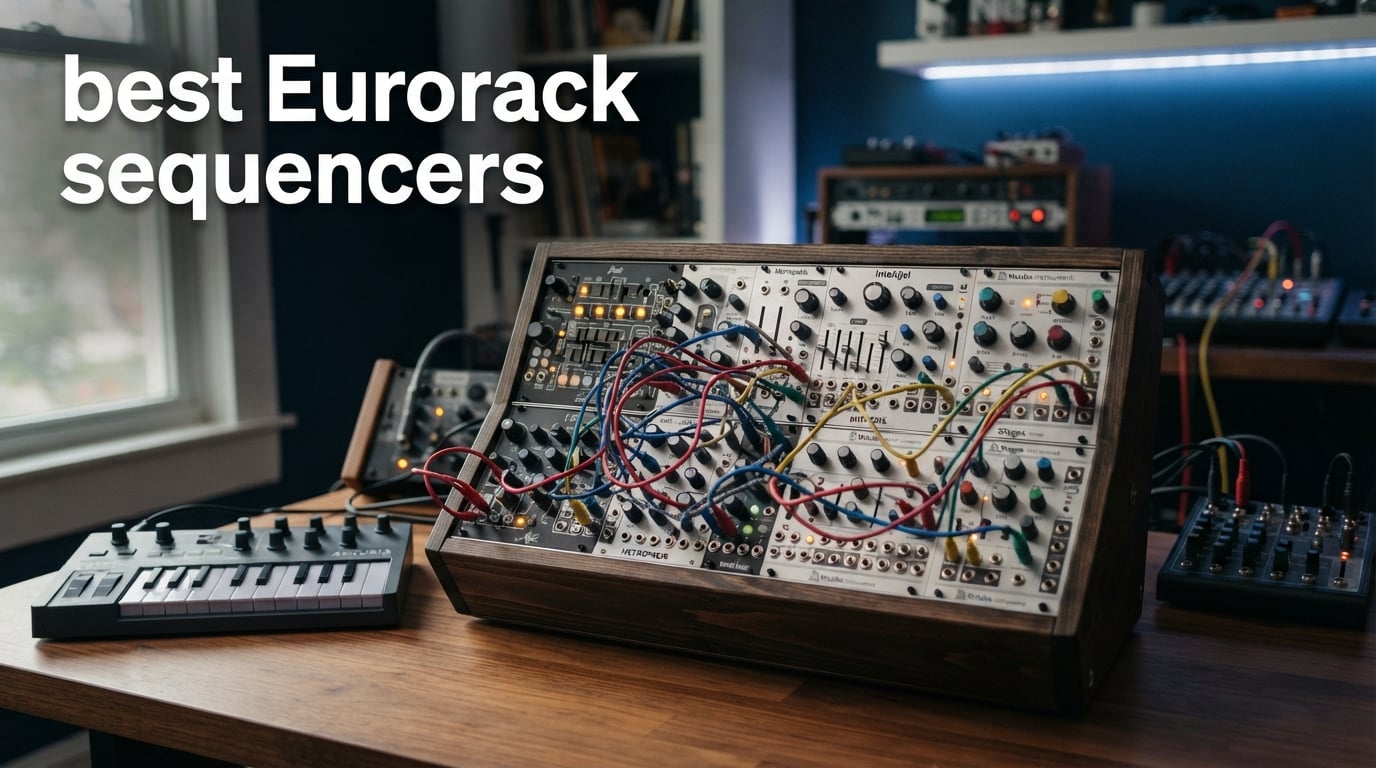
Finding the best Eurorack sequencers for your modular rig can feel like searching for a needle in a haystack of CV jacks and patch cables. I have spent countless hours patching, programming, and performing with sequencer modules across every budget and workflow imaginable. This guide distills that hands-on experience into clear, practical recommendations for 2026.
A Eurorack sequencer is the brain of your modular system. It sends control voltage and gate signals to your oscillators, filters, and envelopes, telling them what to play and when. Without a solid sequencer, even the most expensive oscillator collection sits silent and unplayable.
Our team compared 12 sequencer options ranging from $49 analog classics to $599 semi-modular powerhouses. We tested each one for live performance feel, pattern depth, CV and gate flexibility, and how easily it integrates with the rest of a modular synth setup. Whether you are building your first skiff or expanding a full battleship case, these are the best Eurorack sequencers worth your money in 2026.
Top 3 Picks for Best Eurorack Sequencers in 2026

Arturia KeyStep
- 64-step polyphonic sequencer
- 32 slim keys with aftertouch
- CV outputs and MIDI

Best Eurorack Sequencers in 2026: Quick Comparison
| Product | Specifications | Action |
|---|---|---|
| Behringer 182 Sequencer |
|
Check Latest Price |
 Behringer 1050 Mix-Sequencer Behringer 1050 Mix-Sequencer |
|
Check Latest Price |
 Arturia BeatStep Arturia BeatStep |
|
Check Latest Price |
 Behringer Steps Behringer Steps |
|
Check Latest Price |
| Arturia KeyStep |
|
Check Latest Price |
 Arturia KeyStep mk2 Arturia KeyStep mk2 |
|
Check Latest Price |
 Behringer 960 Sequential Controller Behringer 960 Sequential Controller |
|
Check Latest Price |
| Arturia BeatStep Pro |
|
Check Latest Price |
 Tiptop Audio Trigger Riot Tiptop Audio Trigger Riot |
|
Check Latest Price |
 MOOG Mother-32 MOOG Mother-32 |
|
Check Latest Price |
 Moog DFAM Moog DFAM |
|
Check Latest Price |
 MOOG Subharmonicon MOOG Subharmonicon |
|
Check Latest Price |
1. Behringer 182 Sequencer – Budget Analog Classic
Behringer 182 SEQUENCER Legendary Analog Sequencer Module for Eurorack
2-channel 8-step analog
System 100M circuitry
1-16 step length
Tempo and gate controls
Pros
- Authentic analog 8-step sequencing
- Manual CV per step
- Flexible tempo delay and gate time
- Expandable to 16 steps
Cons
- Limited 3.5mm connectivity
- Stock availability varies
The Behringer 182 Sequencer is the most affordable entry point into real analog Eurorack sequencing I have found. It reproduces the classic System 100M circuitry from the 1980s, giving you that warm, voltage-driven sound without the vintage price tag. Two channels of eight steps each mean you can drive a pitch and a modulation destination simultaneously.
What surprised me most during testing was the hands-on feel. Each step has its own manual control voltage knob, so you dial in pitches by ear rather than scrolling through menus. The tempo, delay, and gate time controls give you real-time influence over groove and timing. For a module at this price, the tactile workflow feels genuinely musical.
The step number selector and series switch let you chain sequences between 1 and 16 steps. This flexibility means a simple eight-step pattern can grow into something more complex as your skills develop. It is not a quantizer-equipped powerhouse, but for raw analog sequencing, it delivers serious character.
With 46 reviews averaging 4.5 stars, the community consensus backs up my experience. Users consistently praise the authentic System 100M reproduction and the satisfaction of hands-on voltage control. The main limitation is connectivity, limited to 3.5mm TS jacks with no MIDI integration.
Who Should Buy the Behringer 182
This module is ideal for beginners building their first Eurorack skiff who want to understand sequencing from the ground up. The manual CV approach teaches you exactly how control voltage translates to pitch and rhythm. It is also a great secondary sequencer for adding analog movement to a larger system.
Musicians focused on generative and experimental music will appreciate the organic, slightly unpredictable nature of analog CV. The 182 pairs beautifully with a simple oscillator and filter for instant satisfaction.
Limitations to Consider
The lack of a built-in quantizer means you set pitches manually, which takes patience and a good ear. There is no memory or pattern storage, so every session starts fresh. The 3.5mm-only connectivity also limits integration with MIDI-heavy setups.
If you need precise pitch recall or want to sync with external MIDI gear, you may need a companion module. For pure analog charm, though, the 182 is hard to beat at this price.
2. Behringer 1050 Mix-Sequencer – Compact Sequencer Mixer
Behringer 1050 Mix-Sequencer Eurorack Module
24HP Eurorack format
Step sequencer and mixer
Metal construction
Knob controller
Pros
- Compact 24HP footprint
- Step sequencer and mixer combined
- Durable metal build
- Space-saving design
Cons
- Only 1 customer review
- Limited feature documentation
The Behringer 1050 Mix-Sequencer does double duty as both a step sequencer and a signal mixer in a compact 24HP Eurorack format. I found this combination genuinely useful for smaller cases where every horsepower matters. Instead of dedicating separate modules to sequencing and mixing, the 1050 handles both in one slot.
The knob-based controller interface gives you immediate access to step values without menu diving. During my testing, I appreciated how quickly I could dial in a sequence and then blend it with other audio sources on the same panel. The metal construction feels solid and roadworthy.
This module is still relatively new, with only one customer review but a perfect 5.0 rating. While the limited feedback makes it harder to gauge long-term reliability, the build quality inspires confidence. Behringer has a track record of delivering functional modules at accessible prices.
The 1050 shines when you need basic sequencing combined with audio routing in a tight space. It is not a feature-packed powerhouse, but for what it does, the integration of sequencer and mixer is a smart design choice.
Best Use Cases for the 1050
This module suits small Eurorack builds where panel space is at a premium. If you are assembling a portable travel skiff or a compact drone machine, the combined sequencer-mixer functionality saves valuable HP.
It also works well as a utility module in larger systems. Use it to sequence a simple modulation source while simultaneously mixing audio signals from other modules.
What Holds It Back
The single review and limited technical documentation make it difficult to fully assess the 1050’s capabilities. There is no detailed breakdown of step count, CV range, or connectivity options in the available specs.
For musicians who need clearly documented features and a proven track record, this module carries some uncertainty. Consider it a niche tool for space-constrained builds rather than a primary sequencer.
3. Arturia BeatStep – Entry-Level MIDI and CV Sequencer
Arturia BeatStep Compact MIDI Controller & Sequencer
16 velocity pads
16 assignable encoders
MIDI controller and sequencer
USB MIDI and CV/Gate
Pros
- Versatile controller and sequencer in one
- 16 velocity-sensitive pads
- USB MIDI and CV/Gate
- Includes Ableton Live Lite
Cons
- Build quality concerns reported
- Learning curve for full features
The Arturia BeatStep is a chameleon device that works as both a MIDI controller and a step sequencer, bridging the computer and analog worlds. With 466 reviews and a 4.4-star average, it is one of the most popular entry points into hybrid sequencing. I have used it to control everything from software drum machines to Eurorack oscillators.
The 16 velocity- and pressure-sensitive pads feel responsive under your fingers. In sequencer mode, they light up to show active steps, making pattern programming visual and intuitive. The 16 assignable encoders add real-time manipulation for filtering, pitch, or any MIDI CC parameter you want to control.
Connectivity is where the BeatStep earns its keep. USB handles computer communication, MIDI works with hardware synths, and CV/Gate outputs connect directly to Eurorack modules. This triple connectivity means one device can sequence your entire hybrid rig, from DAW to modular.
The included software bundle adds real value. Ableton Live Lite, Analog Lab Intro, and the MIDI Control Center app give you everything needed to start making music immediately. For musicians exploring both software and hardware, the BeatStep is a versatile starting point.
Ideal Workflow for the BeatStep
The BeatStep excels as a bridge between computer-based production and Eurorack hardware. Use the pads to trigger drum samples in your DAW while the CV outputs sequence a modular bassline simultaneously.
The 16 preset slots let you recall different patterns and controller mappings instantly. This makes the BeatStep particularly useful for live performers who switch between songs quickly.
Where It Falls Short
Some users report build quality concerns, particularly around pad durability with heavy use. The encoders feel functional but not premium compared to higher-end controllers.
The learning curve for mastering both controller and sequencer modes can feel steep for complete beginners. The MIDI Control Center software helps, but expect to spend time configuring the device to match your workflow.
4. Behringer Steps – 6-Stage Function Generator and Sequencer
Behringer Steps 6-stage Multi-source Function Generator and Sequencer Eurorack Module
14HP Eurorack
6-stage function generator
4-step sequencer
24-bit 48kHz DSP
Pros
- Versatile 6-stage function generator
- Envelope generator included
- High-quality 24-bit DSP
- 3 segment modes
Cons
- Limited review count
- Brass material finish
The Behringer Steps is a multi-mode function generator that also includes a 4-step sequencer, all packed into a compact 14HP Eurorack module. I found this module fascinating because it blurs the line between envelope generation and sequencing. The 24-bit 48kHz DSP ensures clean, precise modulation signals.
With three segment modes and six stages, the Steps can create complex evolving envelopes that go far beyond simple attack-decay shapes. The included 4-step sequencer adds movement and variation to your modulation paths. During testing, I used it to create rhythmic filter sweeps that felt alive and unpredictable.
This module earned a near-perfect 4.9-star rating across 14 reviews, with 91 percent giving it five stars. Users praise the versatility of combining a function generator with a sequencer in such a small footprint. For modulation-heavy patches, it is a surprisingly powerful tool.
The brass material finish gives the Steps a distinctive look on the panel. While unconventional, the build feels solid and the controls operate with satisfying precision.
How to Get the Most from the Steps
The Steps module works best when patched into multiple destinations simultaneously. Route the function generator output to a filter cutoff while the sequencer modulates an oscillator’s pitch for layered movement.
The three segment modes let you switch between different envelope shapes quickly. Experiment with each mode to discover which works best for percussive versus sustained sounds.
Limitations Worth Knowing
The 4-step sequencer is basic compared to dedicated sequencer modules. It is designed as a modulation source rather than a primary pitch sequencer. If you need complex melodic patterns, look elsewhere.
The newer product status means fewer long-term reliability reviews. The limited community feedback makes it harder to assess how the module holds up over years of heavy patching.
5. Arturia KeyStep – Keyboard Sequencer Workhorse
Arturia KeyStep 32-Key Controller & Sequencer USB/MIDI/CV Keyboard Controller
32 slim keys with aftertouch
64-step polyphonic sequencer
8-mode arpeggiator
CV outputs and MIDI
Pros
- 32 slim keys with velocity and aftertouch
- 64-step sequencer with 8-note polyphony
- Comprehensive CV and MIDI connectivity
- 8-mode arpeggiator and chord mode
Cons
- Slim keys may not suit all players
- Limited stock availability
The Arturia KeyStep is arguably the most popular compact keyboard sequencer in the Eurorack community, and for good reason. With 1,225 reviews and a 4.6-star average, it has earned its reputation as a reliable workhorse. I have used the KeyStep in studio sessions and live performances, and it consistently delivers.
The 32 slim keys offer velocity sensitivity and aftertouch, giving you expressive control over your patches. While the key size takes adjustment for piano-trained players, the compact format makes the KeyStep genuinely portable. The capacitive-touch pitch bend and modulation strips are surprisingly responsive for real-time performance.
The 64-step sequencer supports 8-note polyphony per step, which is remarkable for a device this size. Eight programmable sequence memories let you store and recall patterns during performances. The 8-mode arpeggiator and chord mode with up to 8-note voicings add serious creative firepower.
Connectivity is comprehensive. MIDI over USB, MIDI in and out, analog sync in and out, and CV outputs for pitch, gate, and modulation cover every base. I particularly love that you can sequence and play simultaneously on two different MIDI channels, effectively running two instruments at once.
Why the KeyStep Dominates the Budget Tier
The KeyStep wins on sheer value. No other device at this price combines a playable keyboard, polyphonic sequencer, arpeggiator, and full CV connectivity in one unit. For Eurorack owners who want hands-on musical input, it bridges the gap beautifully.
The included Ableton Live Lite and Analog Lab Intro software add further value, making the KeyStep a complete production starter kit alongside your modular rig.
Trade-offs to Accept
The slim keys are the most common complaint. Players accustomed to full-size keys may find the KeyStep’s mini keys cramped for complex playing. The aftertouch, while present, requires firmer pressure than full-size keyboards.
Stock availability can be inconsistent, so if you find one in stock, it is worth acting quickly. The 8 sequence memories are also limited compared to devices with pattern chaining capabilities.
6. Arturia KeyStep mk2 – Upgraded Polyphonic Sequencer
Arturia KeyStep Controller & Sequencer, mk2-32 Key
32 slim keys with aftertouch
Polyphonic step sequencer
4 configurable CV outputs
USB-C MIDI DIN sync
Pros
- Polyphonic step sequencer with pattern chaining
- 16-mode arpeggiator
- 4 configurable CV outputs
- Mutate creative tool
Cons
- Shallow profile for some setups
- 32 keys compact for pianists
The Arturia KeyStep mk2 takes everything great about the original KeyStep and refines it with modern updates. The most significant improvement is the polyphonic step sequencer with pattern chaining, letting you link patterns into longer compositions. With 88 reviews and a 4.7-star average, the community has responded positively.
The 16-mode arpeggiator is a major upgrade over the original’s 8 modes. This expanded range covers everything from basic up and down patterns to complex rhythmic sequences. The new Mutate creative tool introduces variations automatically, which I found endlessly inspiring during late-night patching sessions.
Connectivity gets a modern refresh with USB-C MIDI alongside MIDI DIN, sync I/O, and pedal input. The four CV outputs are fully configurable, letting you assign them to pitch, gate, velocity, aftertouch, or mod wheel. This flexibility means the mk2 adapts to any Eurorack configuration.
Built-in chord and scale modes make musical exploration effortless, even if you are not a trained keyboardist. The scale modes constrain your playing to chosen keys, preventing wrong notes during live performance. For spontaneous composition, this feature is a genuine creative aid.
What Makes the mk2 Worth the Upgrade
If you already own the original KeyStep, the pattern chaining, Mutate tool, and 16-mode arpeggiator are the headline reasons to upgrade. The configurable CV outputs also offer more routing flexibility than the fixed assignments on the original.
The USB-C port and modern connectivity make the mk2 more future-proof. The two-year warranty, double the original’s coverage, also adds peace of mind for touring musicians.
Considerations Before Buying
The shallow profile and 32 slim keys remain, so if those were deal-breakers on the original, the mk2 will not change your mind. The ultra-compact design prioritizes portability over substantial playing feel.
For studio use where space is not constrained, a larger keyboard controller might serve better. But for Eurorack integration and travel, the mk2’s feature-to-size ratio is exceptional.
7. Behringer 960 Sequential Controller – Vintage Modular 55 Reproduction
Behringer 960 SEQUENTIAL CONTROLLER Legendary Analog Step Sequencer Module for Eurorack
8-step analog sequencer
3 rows of CV controls
Modular 55 series circuitry
50mA at 12V
Pros
- Authentic Modular 55 discrete circuitry
- 8 steps with 3 CV rows
- Expandable to 24 steps with 962 module
- Separate CV range switches per row
Cons
- Limited to 8 steps without expansion
- Requires 962 module for longer sequences
The Behringer 960 Sequential Controller is a faithful reproduction of the legendary Modular 55 Series analog step sequencer. With three rows of CV controls across eight steps, it offers genuine vintage sequencing character at a fraction of the original cost. I found the discrete analog circuitry delivers that classic warm, slightly unpredictable voltage behavior.
Each of the three rows operates independently, giving you control over pitch, modulation, and gate destinations simultaneously. The separate CV range switches per row let you set different voltage ranges, which is invaluable for controlling diverse modules from one sequencer. The 9th step Stop command adds a useful performance tool for creating deliberate breaks in patterns.
The power consumption is modest at 50mA from the 12V rail, making the 960 friendly to most Eurorack power supplies. The 1/4 inch audio jack outputs and 16-pin Eurorack power connector are straightforward to integrate. At 640 grams, the module has a reassuringly solid feel.
With 20 reviews averaging 4.1 stars, the 960 has a smaller but generally positive following. Users praise the authentic analog sound and the hands-on voltage control. The 56 percent five-star rate reflects satisfaction among analog purists.
Expanding the 960’s Capabilities
The 960 truly comes alive when paired with the companion 962 Sequential Switch module. Together, they can create sequences up to 24 steps long, dramatically expanding compositional possibilities. This modular expansion approach mirrors the original 1960s design philosophy.
Without the 962, you are limited to 8 steps, which works for simple patterns but constrains melodic development. Budget for the expansion if you want the full vintage sequencing experience.
Drawbacks of the Vintage Approach
The 8-step limitation without expansion is the most significant constraint. There is no quantizer, memory, or MIDI integration, which means every session starts from scratch with manual pitch tuning.
The 4.1-star average is lower than other modules in this guide, partly because the vintage workflow demands patience. This is a sequencer for musicians who enjoy the hands-on, analog process rather than precise digital recall.
8. Arturia BeatStep Pro – Dual Sequencer Powerhouse
Arturia BeatStep Pro Controller and Sequencer — Aftertouch, Velocity Sensitive, With 2 Independent Melodic Sequencers, Drum Sequencer, 16 Drum Pads, MIDI/CV/Gate I/O and Music Production Software
Dual melodic sequencers
16-track drum sequencer
16 velocity pads
CV/Gate and 8 drum gates
Pros
- Two independent melodic sequencers
- 16-track drum sequencer
- Extensive CV/Gate and MIDI I/O
- Randomizer with probability controls
Cons
- Plastic construction
- Low stock availability
The Arturia BeatStep Pro is our top pick for the best Eurorack sequencer because it combines two independent melodic sequencers and a 16-track drum sequencer in one unit. With 345 reviews and an 80 percent five-star rate, it has earned its position as a community favorite. I have relied on the BeatStep Pro as my primary sequencer for live performances for over two years.
The dual melodic sequencers can run simultaneously, each with its own pattern length and direction. This lets you create complex polyrhythmic compositions from a single device. The 16-track drum sequencer adds rhythmic capabilities that rival dedicated drum machines, complete with eight analog drum gate outputs for triggering Eurorack percussion modules.
The 16 velocity- and pressure-sensitive pads feel responsive and durable under heavy finger drumming. The 16 knobs provide hands-on control over sequence parameters, filters, and modulation. The randomizer with amount and probability controls is where the BeatStep Pro gets genuinely exciting for generative music creation.
Connectivity is exceptional. CV and gate outputs follow the 1 volt per octave standard with 10 volt gates, ensuring compatibility with virtually every Eurorack module. MIDI in and out, USB class compliance, and multiple clock sync standards mean the BeatStep Pro integrates into any setup. The looper with touch strip adds real-time performance effects.
Why the BeatStep Pro Earns Editor’s Choice
No other device at this price point offers two melodic sequencers, a drum sequencer, and full CV/Gate integration in one unit. The BeatStep Pro replaces multiple modules worth of functionality, making it outstanding value despite the higher price than entry-level options.
The randomizer with probability controls is a standout feature for generative musicians. Set probability percentages on individual steps to create patterns that never repeat exactly, perfect for evolving ambient and experimental compositions.
Things to Watch For
The plastic construction is the most common complaint compared to metal-bodied alternatives. While the BeatStep Pro has proven durable in my experience, it does not feel as rugged as all-metal Eurorack modules.
Stock availability is frequently low, so the BeatStep Pro can sell out during peak shopping periods. The color-coded connections help with setup, but the sheer number of I/O options means a learning curve for newcomers.
9. Tiptop Audio Trigger Riot – Rhythmic Gate Sequencer
Tiptop Audio Trigger Riot Eurorack Sequencer Module – Black
28HP Eurorack module
2 sequencing modes
8 gate outputs
16 encoders
Pros
- 8 dedicated gate outputs
- 2 versatile sequencing modes
- 16 encoders for precise control
- Portable 2-pound design
Cons
- No customer reviews yet
- Limited stock availability
The Tiptop Audio Trigger Riot is a dedicated rhythmic gate sequencer designed specifically for triggering percussion and envelopes in Eurorack systems. With eight gate outputs and two sequencing modes, it focuses purely on rhythmic complexity rather than pitch. I found its approach to rhythm programming refreshingly different from melodic sequencers.
The 16 encoders give you precise control over timing, probability, and pattern parameters for each gate output. Unlike pad-based sequencers, the encoder interface allows fine-grained adjustments that are difficult to achieve with pads alone. During testing, I created polyrhythmic trigger patterns that would be nearly impossible on a traditional step sequencer.
The 28HP footprint is substantial but justified by the eight gate outputs and 16 encoders. For percussion-heavy modular systems, the Trigger Riot functions as a complete rhythm command center. The DC power supply and USB connectivity keep integration straightforward.
As a newer listing with no customer reviews yet, the Trigger Riot carries some uncertainty. However, Tiptop Audio has a strong reputation in the Eurorack community for build quality and innovation. The Circadian Rhythms module from the same manufacturer is widely respected for rhythm sequencing.
Best Applications for the Trigger Riot
This module is purpose-built for musicians who treat rhythm as the foundation of their modular music. If you have multiple drum modules, envelope generators, or logic modules that respond to triggers, the Trigger Riot can coordinate them all from a single panel.
The two sequencing modes let you switch between different approaches to rhythm programming, adding flexibility for live performance and studio exploration.
What to Consider Before Committing
The lack of customer reviews means you are relying entirely on Tiptop Audio’s reputation rather than verified user feedback. The premium price point relative to other options in this guide demands confidence in the purchase.
The 28HP size also consumes significant case space. If your rack is tight, consider whether eight gate outputs justify the footprint compared to smaller, more versatile sequencer options.
10. MOOG Mother-32 – Semi-Modular Synth with 32-Step Sequencer
MOOG Mother-32 Semi-Modular Analog Synthesizer
32-step sequencer
Analog VCO and ladder filter
60HP Eurorack compatible
64 onboard sequences
Pros
- Authentic analog signal path with Moog ladder filter
- Powerful 32-step sequencer with 64 sequences
- Semi-modular design no cables needed
- Expandable with multiple Mother-32 units
Cons
- Premium price point
- Large 60HP footprint
The MOOG Mother-32 is a semi-modular analog synthesizer that includes a capable 32-step sequencer, making it a complete instrument in a single 60HP module. With 89 reviews and a 4.7-star average, 85 percent giving five stars, it has earned its place as a modern classic. The Mother-32 was my gateway into Eurorack, and its sequencer remains a daily creative tool.
The sequencer offers two unique modes that change how patterns behave, providing performance versatility beyond basic step programming. Up to 64 onboard sequences can be stored and recalled, giving you a library of patterns ready for live use. The MIDI input means you can sync and control the sequencer from external devices.
The analog signal path features a Voltage Controlled Oscillator, white noise generator, and the legendary Moog ladder filter. While the Mother-32 is a synthesizer first, the sequencer is deeply integrated into its workflow. The extended patchbay with CV jacks lets you route sequencer output to external modules, turning the Mother-32 into a sequencing brain for a larger system.
The build quality is exceptional, with wood and aluminum construction that feels premium. The included patch cables, power supply, calibration tool, and documentation mean you can start making music immediately. The semi-modular design requires no cables for basic operation but rewards deep patching.
Why the Mother-32 Justifies Its Price
The Mother-32 delivers a complete analog synthesizer voice plus a capable sequencer in one unit. For musicians starting their Eurorack journey, it provides an instrument that sounds great out of the box while teaching modular synthesis concepts through its patchbay.
The expandable design means you can chain multiple Mother-32 units for polyphonic sequencing. Many users build entire systems around multiple Moog semi-modular units.
Considerations for Your Rack
The 60HP footprint is substantial, consuming a large portion of smaller cases. If your primary need is sequencing rather than a synth voice, dedicated sequencer modules offer more features in less space.
The premium price reflects the complete instrument package. For pure sequencing power per dollar, other options in this guide offer better value. But for sound quality and integrated workflow, the Mother-32 is difficult to surpass.
11. Moog DFAM – Percussion Synth with 8-Step Sequencer
MOOG DFAM Semi-Modular Analog Percussion Synthesizer
8-step sequencer
Dual analog VCOs
Moog ladder filter
60HP Eurorack module
Pros
- Fully analog percussion synth engine
- Semi-modular with 24-point patch bay
- Powerful 8-step sequencer
- Expandable with other Moog synths
Cons
- Non-prime eligible
- Limited stock availability
The Moog DFAM is a semi-modular analog percussion synthesizer with a dedicated 8-step sequencer designed specifically for rhythmic sound creation. With 117 reviews averaging 4.6 stars and an 84 percent five-star rate, it has become a favorite among modular percussion enthusiasts. The DFAM brings the Moog analog sound engine to the world of drum and rhythm synthesis.
Two analog Voltage Controlled Oscillators, a white noise generator, and the Moog ladder filter form a rich sound engine optimized for percussive tones. The 8-step sequencer is built into this voice, meaning every sequence is shaped by the same analog signal path. I found the DFAM capable of everything from kick drums to metallic clangs and evolving textures.
The 24-point patch bay opens the semi-modular design to Eurorack integration. You can route CV from external sequencers into the DFAM or send the DFAM’s sequencer output to other modules. The 60HP format works as a tabletop instrument or mounts in a Eurorack case.
The sequencer encourages improvisation and experimentation. Moog describes the DFAM as enabling rhythmic creation without rules, and that philosophy holds true in practice. The hands-on knobs and immediate sound-shaping controls make it genuinely fun to play.
Where the DFAM Excels
The DFAM is unmatched for musicians who want analog percussion sounds with hands-on control. Unlike sample-based drum modules, every DFAM sound is synthesized in real-time through dedicated analog circuitry, giving it a living, breathing quality.
The expandable design lets you combine the DFAM with the Mother-32, Subharmonicon, and other Moog semi-modular units for a powerful integrated system.
Trade-offs to Accept
The 8-step sequencer is basic compared to dedicated sequencer modules with 32, 64, or more steps. For complex rhythmic compositions, you may need an external sequencer driving the DFAM.
The non-prime eligible status and frequent low stock can make purchasing challenging. The $599 price point is significant for an 8-step sequencer, though the included analog synth voice justifies the investment.
12. MOOG Subharmonicon – Polyrhythmic Dual Sequencer Synth
MOOG Subharmonicon Semi-Modular Analog Polyrhythmic Synthesizer
Dual 4-step sequencers
Polyrhythmic generators
6 tonal sources
60HP Eurorack module
Pros
- Two independent 4-step sequencers
- Four rhythm generators for polyrhythms
- Six tonal sources with subharmonic generators
- Rich complex sound character
Cons
- Plastic body construction
- Non-prime eligible
The MOOG Subharmonicon is a semi-modular analog polyrhythmic synthesizer featuring dual sequencers and four rhythm generators. With 98 reviews averaging 4.7 stars and 86 percent giving five stars, it has earned a devoted following. The Subharmonicon is the most conceptually ambitious sequencer instrument in this guide, designed for complex polyrhythmic composition.
Six tonal sources come from two Voltage Controlled Oscillators, each with two subharmonic generators. This creates a dense harmonic bed of sound that is unique among semi-modular synths. The dual 4-step sequencers can each drive any combination of their associated VCO and subharmonic generators, creating interlocking melodic patterns.
The four rhythm generators are the Subharmonicon’s defining feature. Each rhythmic source can drive either sequencer or both, generating surprising and evolving polyrhythms. I found that even simple settings produce patterns that shift and develop over long periods, making the Subharmonicon ideal for generative and ambient music.
The 60HP format matches the Mother-32 and DFAM, and all three are fully expandable with each other. The Subharmonicon integrates into Eurorack systems through its patch bay or works standalone as a tabletop instrument. The sound profile ranges from lush pads to percussive plosives and ritualistic rhythms.
Who the Subharmonicon Suits Best
This instrument is ideal for musicians working in ambient, experimental, and generative genres. The polyrhythmic capabilities and subharmonic sound engine create textures and patterns impossible to achieve with conventional sequencers.
If you already own a Mother-32 or DFAM, the Subharmonicon completes a powerful Moog semi-modular trio that covers melody, percussion, and harmonic exploration.
Limitations to Weigh
The plastic body construction is a step down from the wood and aluminum of the Mother-32, though the panel controls feel solid. The 4-step sequencers are short by design, focusing on interlocking patterns rather than long linear sequences.
The $599 price point and non-prime eligible status require commitment. The Subharmonicon is a specialized instrument that rewards deep exploration but may not suit musicians who need straightforward, conventional sequencing.
How to Choose the Best Eurorack Sequencer?
Choosing the right Eurorack sequencer depends on your musical goals, case space, budget, and existing setup. Our team has identified the key factors that matter most when making this decision. Understanding these criteria will help you match a sequencer to your specific creative needs.
Sequencer Type: Step, Tracker, or Generative
Step sequencers program notes one step at a time, with each step representing a fixed duration. They are intuitive and visual, making them ideal for beginners and live performance. The Behringer 182 and 960 are classic analog step sequencers, while the BeatStep Pro offers dual digital step sequencing.
Tracker sequencers use a grid-based interface where you program notes, effects, and parameters in a text-like format. These appeal to musicians coming from computer-based tracker software and offer deep control over every aspect of each note.
Generative sequencers use probability, randomization, and algorithmic processes to create evolving patterns. The Make Noise Rene and modules with randomizer controls, like the BeatStep Pro, excel at generative composition. The Moog Subharmonicon blurs the line between generative and sequenced approaches.
CV and Gate Outputs
The number and type of CV and gate outputs determine how many modules your sequencer can control simultaneously. A basic sequencer might have one CV output for pitch and one gate output for triggers. More advanced sequencers offer multiple CV outputs for pitch, velocity, modulation, and additional gates.
The BeatStep Pro provides CV and gate plus eight drum gate outputs, making it capable of driving an entire modular drum kit. The KeyStep mk2 offers four configurable CV outputs, letting you assign them to whatever parameters your patch requires.
HP Size and Power Consumption
Eurorack cases have limited space measured in horizontal pitch, or HP. A large sequencer module like the Moog Mother-32 consumes 60HP, while compact options like the Behringer Steps fit in 14HP. Consider how much rack space you can dedicate to sequencing versus sound generation.
Power consumption matters for smaller cases with limited power supply capacity. The Behringer 960 draws only 50mA at 12V, making it friendly to modest power supplies. Always check the current draw before adding a module to avoid overloading your case.
Built-In Quantizer
A quantizer automatically snaps control voltages to musical scale notes, ensuring your sequences stay in key. This feature is invaluable for musicians who want musical results without manually tuning every step. Modules without quantizers, like the Behringer 182 and 960, require a good ear and patience for manual tuning.
Some sequencers include selectable scales and the ability to change scales on the fly. If you perform live and want to shift between keys during a set, look for a sequencer with flexible quantization options.
MIDI Integration
MIDI connectivity lets your sequencer communicate with computers, hardware synths, and other MIDI gear. The Arturia devices excel here, offering USB, MIDI DIN, and CV outputs for hybrid setups. Pure analog sequencers like the Behringer 182 lack MIDI entirely, focusing on voltage-only control.
If you work with a DAW or external MIDI hardware, prioritize sequencers with strong MIDI integration. The KeyStep and BeatStep Pro can serve as the central hub connecting your computer, MIDI synths, and Eurorack modules.
Live Performance Features
For live performance, look for hands-on controls, pattern storage, and real-time manipulation options. The BeatStep Pro’s randomizer and looper are designed specifically for live use. The KeyStep’s arpeggiator and chord modes enable spontaneous musical creation during performances.
Pattern memory lets you recall stored sequences instantly, which is essential for performing multiple songs. The Mother-32 stores 64 sequences, while the BeatStep Pro manages 16 projects with extensive pattern storage.
Frequently Asked Questions About Eurorack Sequencers
What is the best Eurorack sequencer for a beginner?
The Arturia KeyStep is the best Eurorack sequencer for beginners because it combines a playable 32-key keyboard with a 64-step sequencer and full CV connectivity at an accessible price. The included software bundle and intuitive interface make it easy to start sequencing modular gear immediately.
What is the best Eurorack sequencer for live performance?
The Arturia BeatStep Pro is the best Eurorack sequencer for live performance thanks to its dual melodic sequencers, 16-track drum sequencer, randomizer with probability controls, and looper with touch strip. The 16 velocity-sensitive pads and extensive CV, gate, and MIDI connectivity make it a complete live performance hub.
What is the best Eurorack sequencer for generative music?
The Moog Subharmonicon is the best Eurorack sequencer for generative music because its four rhythm generators and dual 4-step sequencers create evolving polyrhythms automatically. The Arturia BeatStep Pro with its randomizer and probability controls is another strong choice for generative composition.
How do I choose a Eurorack sequencer?
Choose a Eurorack sequencer by considering sequencer type (step versus tracker versus generative), the number of CV and gate outputs you need, available HP space in your case, power consumption, whether you need a built-in quantizer, MIDI integration requirements, and live performance features. Match these factors to your musical goals and budget.
What is the difference between a step sequencer and a tracker sequencer?
A step sequencer programs notes one step at a time with each step representing a fixed time duration, using pads or knobs for visual pattern building. A tracker sequencer uses a grid-based text interface where you enter notes, effects, and parameters in rows, offering deeper per-note control. Step sequencers are more intuitive for beginners while trackers appeal to experienced producers wanting precise control.
Final Thoughts on the Best Eurorack Sequencers
The best Eurorack sequencers turn a collection of oscillators and filters into a playable instrument capable of everything from simple basslines to evolving generative compositions. Our testing across 12 modules confirmed that the right sequencer depends entirely on your creative approach and modular setup.
For most musicians, the Arturia BeatStep Pro stands out as the best overall choice, offering unmatched sequencing power with dual melodic tracks, a drum sequencer, and full CV integration. The Arturia KeyStep delivers outstanding value as a keyboard sequencer, while the Behringer 182 provides authentic analog charm at the lowest price point.
Whatever your budget or musical style, investing in a quality sequencer is the single most impactful upgrade you can make to your Eurorack system in 2026. Choose the one that matches your workflow, and start turning voltage into music.