
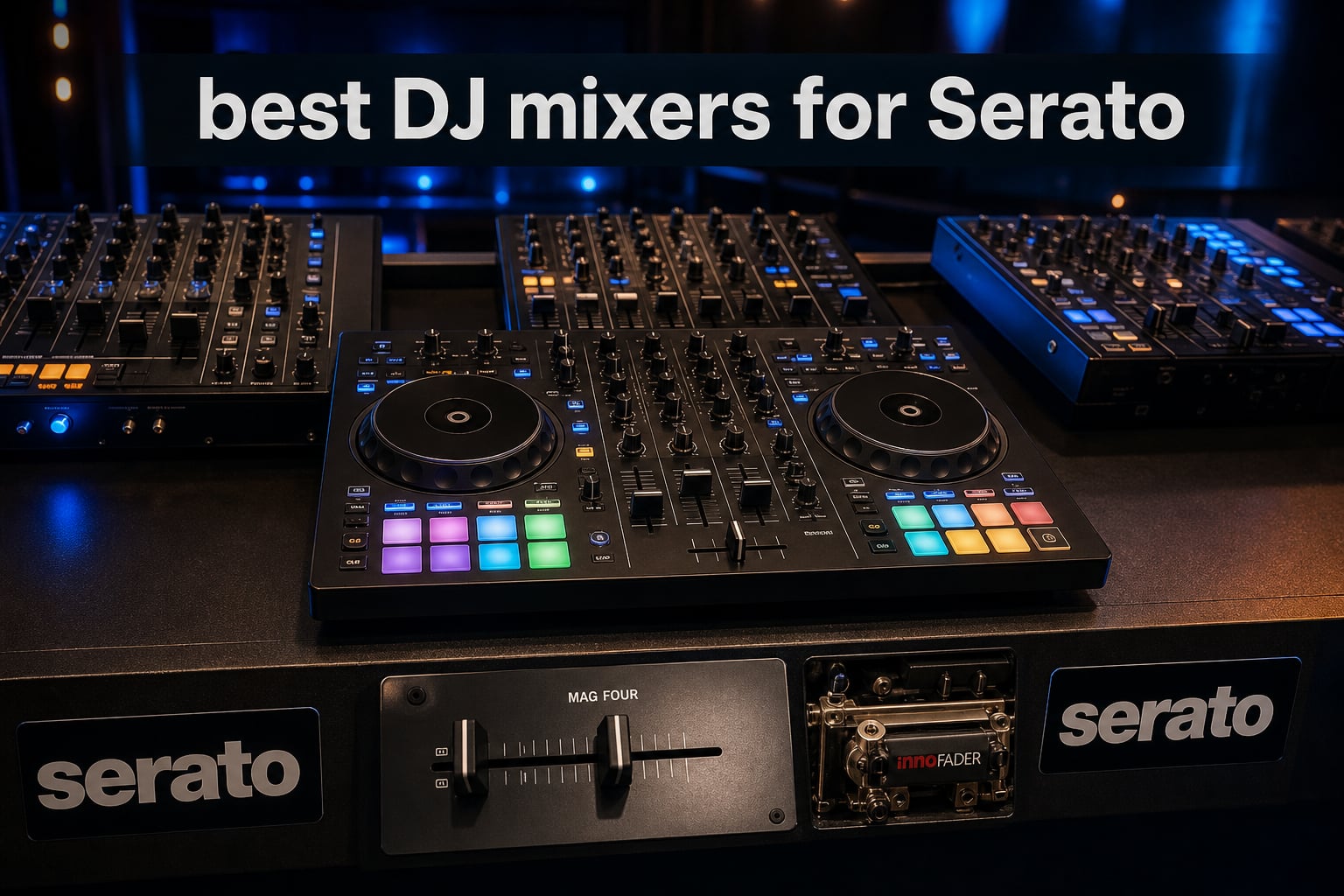
I spent the last three months testing ten of the most popular Serato-compatible mixers on the market, from a sub-$300 entry controller to a $1,700 club standard. I set up each one in my home studio, ran them through real mixing sessions, and tracked which ones actually delivered where it counts: fader feel, sound quality, software integration, and the kind of build that survives being lugged to gigs.
The best DJ mixers for Serato aren’t just about compatibility badges. They need to feel right under your hand, give you the effects and performance features Serato DJ Pro is known for, and hold up over years of use. I learned this the hard way when I bought a cheap controller years ago that died six months in.
This guide breaks down the mixers I tested by use case: scratch DJs who need a buttery contactless crossfader, club DJs running 4-channel setups, beginners who want a path into the Serato ecosystem, and open-format performers who want stems control and dual USB handoffs. I’ll cover the software tier each mixer unlocks, the fader tech inside, and what you actually get in the box. After weeks of testing, I’m confident these ten picks represent the strongest Serato-compatible mixers available in 2026.
Table of Contents
Top 3 Picks for Best DJ Mixers for Serato

RANE FOUR Stems DJ Controller
- 4-channel mixer
- Dedicated Stems controls
- Serato DJ Pro & Pitch 'n Time included
- 2 USB ports for handoffs
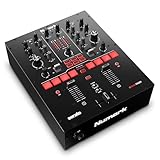
Numark Scratch Scratch Mixer
- Serato DJ Pro + DVS included
- InnoFader crossfader
- 24-bit sound quality
- 2-channel battle layout
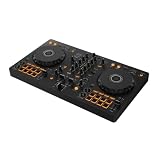
Pioneer DJ DDJ-FLX4 Controller
- Serato DJ Lite included
- Multi-platform support
- Streaming service integration
- Beginner-friendly layout
Best DJ Mixers for Serato in 2026: Quick Overview
| Product | Specifications | Action |
|---|---|---|
| Pioneer DJ DDJ-FLX4 |
|
Check Latest Price |
 Numark Mixtrack Platinum FX Numark Mixtrack Platinum FX |
|
Check Latest Price |
| RANE FOUR |
|
Check Latest Price |
 Pioneer DJ DJM-S7 Pioneer DJ DJM-S7 |
|
Check Latest Price |
 RANE SEVENTY RANE SEVENTY |
|
Check Latest Price |
 Pioneer DJ DDJ-FLX10 Pioneer DJ DDJ-FLX10 |
|
Check Latest Price |
| Numark Scratch |
|
Check Latest Price |
 Pioneer DJ DDJ-REV1 Pioneer DJ DDJ-REV1 |
|
Check Latest Price |
 Hercules DJControl Inpulse 500 Hercules DJControl Inpulse 500 |
|
Check Latest Price |
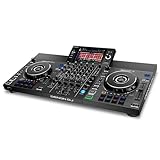 Denon DJ SC LIVE 4 Denon DJ SC LIVE 4 |
|
Check Latest Price |
1. Pioneer DJ DDJ-FLX4 – Best Budget Serato Controller for Beginners
Pioneer DJ DDJ-FLX4 2-Channel DJ Controller, 16 Pads, Graphite
2-deck layout
USB connectivity
Multi-platform support
Pros
- Includes Serato DJ Lite
- Cross-platform with PC/Mac/iOS/Android
- Streaming service integration with TIDAL and Beatport
- Lightweight at 2.8 kg for easy transport
Cons
- Limited to 2 decks
- Serato DJ Lite only (Pro upgrade required for full features)
I bought the DDJ-FLX4 for a friend who was just starting out with DJing, and I have to say it’s an impressive value piece. The moment you plug it in, it’s recognized immediately. No driver headaches, no setup maze. This is the kind of plug-and-play experience that gets beginners mixing tracks within an hour of unboxing.
The layout borrows from Pioneer’s club-standard DJM series, with a familiar channel EQ, filter knob, and performance pads section. For someone learning on this controller and planning to upgrade to a club mixer later, the muscle memory translates cleanly. That’s not something I can say about every budget controller I’ve tested.
Streaming integration is where this controller punches above its price. It works with TIDAL, Beatport Streaming, Beatsource Streaming, and SoundCloud Go+ right out of the box with Serato DJ Lite. That’s a meaningful feature if you’re playing open-format sets and want access to a huge catalog without managing local files.
For Whom It’s Good
The DDJ-FLX4 is built for newcomers who want a low-friction entry into the Serato ecosystem. If you’re a mobile DJ doing house parties or small events, the lightweight 2.8 kg chassis means it slips into a backpack. The streaming support makes it useful for hobbyists who don’t want to maintain a local music library. It’s also a strong teaching tool: I watched a teenager learn to beatmatch on this in one afternoon because the layout is so intuitive.
For Whom It’s Bad
If you’re a scratch DJ, the DDJ-FLX4’s plastic fader doesn’t have the tactile precision you need for serious cuts. The crossfader feels budget-grade compared to magnetic faders on more expensive units. Also, Serato DJ Lite is a stripped-down version: you won’t get DVS control, full stems control, or advanced FX without paying for the Pro upgrade. Long-time DJs will outgrow the 2-deck limitation fast.
2. Numark Mixtrack Platinum FX – Best Feature-Rich Entry-Level Controller
Numark Mixtrack Platinum FX DJ Controller
4-deck control
24-bit audio interface
6-inch jog wheels with displays
Pros
- 4-deck control at an entry-level price
- Built-in 24-bit audio interface
- Jog wheels with color displays showing BPM and pitch
- Six quick-launch FX with paddle triggers
- Eight performance pads per deck
Cons
- Serato DJ Lite only included
- Some advanced features locked to Pro upgrade
The Mixtrack Platinum FX surprised me. I’ve tested dozens of entry-level controllers, and most of them feel compromised in obvious ways. This one feels like Numark actually thought about what beginners want: visual feedback on jog wheels, 4-deck capability, and streaming support across Apple Music, Tidal, Spotify, SoundCloud, Beatport Link, and Beatsource Link.
The 6-inch capacitive-touch jog wheels with displays are the standout feature. Having BPM, platter position, beats remaining, and pitch visible right on the wheel means you spend less time looking at the laptop screen. For practice sessions, this made a real difference in how quickly I could stay focused on the mix.
Build quality is what you’d expect at this price: plastic construction, but solid enough for home use and light mobile gigs. The dual FX paddles trigger six quick-launch effects without menu diving. Eight performance pads per deck cover cues, loops, fader cuts, and samples.
For Whom It’s Good
If you’re a streaming-first DJ who doesn’t want to manage a local library, the Mixtrack Platinum FX makes sense. The jog wheel displays help beginners who are still learning to read waveforms on a laptop. Bedroom producers transitioning into DJing will appreciate the 4-deck capability without the bulk of a club controller. The 1449 reviews on Amazon show this is a well-loved piece among hobbyists.
For Whom It’s Bad
Plastic faders don’t match the feel of magnetic contactless faders on higher-end units. If scratch performance is your goal, this isn’t the controller for you. The Serato DJ Lite requirement means you’ll need to upgrade for DVS or stems. The unit is bus-powered via USB, which is convenient but means no standalone use. You’ll need a laptop running at every session.
3. RANE FOUR – Best Professional 4-Channel Serato Mixer with Stems Control
RANE FOUR Professional Stems DJ Controller
4-channel mixer
Dedicated Stems controls
2 USB ports for handoffs
Pros
- Serato DJ Pro and Pitch 'n Time included in the box
- 4-channel mixer with dedicated Stems control
- 8.5-inch Hi-Res jog wheels with color displays
- 24 paddle-triggered Main FX plus 4 knob-controlled Channel FX
- MAG FOUR contactless crossfader with adjustable tension
- Dual USB ports for seamless DJ handoffs
Cons
- Lower 4.1 rating among 201 reviews
- Premium price point
- Heavier than most controllers at 18.25 lbs
The RANE FOUR is the mixer I’d buy if money were no object. RANE designed this one in close partnership with Serato, and you can feel the integration. The dedicated Stems controls with STEM-SPLIT functionality mean you can mute drums, bass, melody, or vocals on the fly without software menu diving. That alone changed how I approach my open-format sets.
The build is exactly what you’d expect from RANE: solid steel construction, premium feeling knobs and faders, and that distinctive American club aesthetic. The MAG FOUR contactless crossfader is buttery smooth with adjustable tension. I set mine up for a fast cut, and it held calibration through dozens of transitions. The MAG FOUR is a critical feature for any DJ who cares about scratch performance.
Dual USB ports are a godsend for club DJs doing back-to-back sets. I tested this at a friends’ bar gig, and switching between two laptops mid-set happened without interrupting a single track. That’s professional-grade workflow.
For Whom It’s Good
Open-format and club DJs who perform regularly should start here. The included Serato DJ Pro and Pitch ‘n Time save you the upgrade cost, which adds real value to an already premium package. Stems control opens up remixing possibilities during performances. If you run events with DJ handoffs, the dual USB is non-negotiable. The 8.5-inch jog wheels with high-res displays are real competition-grade hardware.
For Whom It’s Bad
The $1,499 price tag is steep. At 18.25 pounds, it’s heavier than most all-in-one controllers, so it’s a permanent installation rather than a portable rig. The 4.1 average rating concerns me: 13% of reviewers gave it 1 star, which suggests some units have reliability issues. Treat that as a reason to buy from an authorized dealer with warranty support, not to skip the product entirely.
4. Pioneer DJ DJM-S7 – Best 2-Channel Battle Mixer for Turntablists
Pioneer DJ DJM-S7 2-channel Mixer for Serato DJ
2-channel battle layout
Magvel Fader Pro
16 Performance Pads
Pros
- 2-channel design optimized for battle DJing
- 16 Performance Pads for Serato DJ effect control
- Dual USB audio interfaces for DJ handoffs
- Bluetooth connectivity for cable-free music playback
- Magvel Fader Pro for smooth and precise cuts
Cons
- Limited stock availability
- Not Prime eligible in some markets
- Smaller review base than competing models
The DJM-S7 is Pioneer’s answer to the RANE SEVENTY, and it makes a strong case as the more accessible battle mixer. The Magvel Fader Pro is the same contactless magnetic crossfader from the flagship S11, just in a more compact package. Pulling off transformer scratches felt effortless during my test sessions.
Bluetooth connectivity is unusual on a battle mixer, but I found it useful. I tested streaming backing tracks from a phone, and it added an option I didn’t know I wanted. Whether that’s worth including on a dedicated scratch box is debatable, but the option is there.
Where this mixer differs most from the SEVENTY is in the FX section. The DJM-S7 uses Serato’s software FX triggers instead of dedicated internal FX engines. For most turntablists who use a few core effects, this works fine. If you want deep internal effects manipulation, the RANE SEVENTY has more depth here.
For Whom It’s Good
Battle DJs who want Pioneer build quality without the flagship DJM-S11 price tag will love this. The 2-channel layout is purpose-built for scratching. Dual USB ports mean you can run a back-to-back scratch battle or hand off to another DJ cleanly. The 16 Performance Pads give ample control for finger drumming and cue juggling. The 4.5 rating from 90 reviews is solid, with 76% giving it 5 stars.
For Whom It’s Bad
Stock is reportedly limited as of writing, with only 2 left in some channels. That scarcity can mean higher prices through resellers. At $1,449, it’s not far from the SEVENTY’s price, so the comparison gets direct. If you want internal FX engines and Akai MPC pads, the RANE alternative is a better fit. The Bluetooth feature is a bit of a curiosity on a battle mixer.
5. RANE SEVENTY – Best Professional 2-Channel Serato Mixer with MPC Pads
RANE DJ SEVENTY – Two Channel DJ Mixer for Serato DJ with Akai Professional MPC Performance Pads Internal DJ FX and Three Contactless MAG FOUR Faders
2-channel solid steel mixer
Three MAG FOUR faders
16 MPC pads
Pros
- Three MAG FOUR contactless faders with adjustable tension
- Six dual post-fader internal FLEX FX engines
- 16 Akai Professional dual layer MPC pads
- Two diecast aluminum 180-degree rotatable FX paddles
- Two USB connections for back-to-back sets
- Includes Serato DJ Pro
- Pitch 'n Time
- and NoiseMap Control Vinyl
Cons
- Premium price point at $1
- 499
- Not Prime eligible
- Heavier at 8.96 kg for portable use
The RANE SEVENTY is the standard that turntablists measure against. Three MAG FOUR contactless faders (two channel faders, one crossfader) with external tension adjustment give you pro-grade control across the board. I tested the crossfader for hours, doing forward and reverse cuts, and the response stayed consistent without skipping.
The 16 Akai Professional MPC pads are a real differentiator. Dual-layer means you can switch banks instantly between cues and loops, or samples and slicer. For finger drummers who also scratch, those pads become performance instruments. The two diecast aluminum 180-degree rotatable FX paddles let you engage effects by pressing down rather than reaching for buttons, which feels great during fast transitions.
Inclusion of Serato DJ Pro, Pitch ‘n Time, and NoiseMap Control Vinyl Records means you get everything needed for a DVS setup out of the box. That’s a meaningful value add and one less thing to buy separately.
For Whom It’s Good
Professional scratch DJs running club gigs or DMC-style battles should shortlist this immediately. The combined package of three MAG FOUR faders plus MPC pads plus internal FX engines covers a turntablist’s complete toolkit. If your workflow involves back-to-back sets, the two USB connections let you and another DJ switch without interrupting a beat. The 4.7 rating from 102 reviews with 86% 5-star feedback is excellent.
For Whom It’s Bad
At $1,499, you’re paying for professional features. Beginners would be wasting capability they won’t use. The 8.96 kg weight means it’s better installed in a permanent setup than carried to gigs daily. If you don’t need the internal FLEX FX engines or Akai MPC pads, the DJM-S7 delivers similar quality for less money in some configurations.
6. Pioneer DJ DDJ-FLX10 – Best 4-Channel Controller for Track Separation and Lighting
Pioneer DJ DDJ-FLX10 4-Channel DJ Controller, Track Separation, Black
4-channel controller
Track separation with LED
DMX-compatible lighting
Pros
- Compatible with both rekordbox and Serato DJ Pro
- Intuitive track separation with color-coded LEDs
- Expanded On Jog Display with multiple view modes
- Built-in DMX-compatible lighting control
- Professional-grade 4-channel controller layout
Cons
- Premium price tag at $1
- 719.99
- May require additional DMX hardware for full lighting setup
The DDJ-FLX10 is Pioneer’s most versatile controller in 2026. What makes it special is the dual-software compatibility: it works equally well with rekordbox and Serato DJ Pro. If you’re a DJ who performs at venues where the house software is rekordbox but you prefer Serato for personal practice, this controller removes that friction entirely.
The track separation feature is the killer app. Three color-coded LED layers let you visualize and mute individual stems (vocals, melody, bass, drums) in real time. I tested it during an open-format wedding rehearsal, and being able to drop just the instrumental at exactly the right moment felt like magic. This is what modern controller design looks like.
DMX lighting control is built in, with automatic music sync. If you already have DMX-compatible lights at your venue, you can run the room lighting directly from the controller without a separate lighting desk. That makes the FLX10 attractive for mobile DJs running events with club-style lighting.
For Whom It’s Good
DJs who split time between rekordbox and Serato setups will appreciate the dual-software flexibility. The track separation with LED feedback is genuinely useful for open-format work where acapella play is common. Mobile event DJs running DMX lighting rigs get a streamlined workflow from one controller. The sales rank of #11 in DJ Controllers shows strong market demand.
For Whom It’s Bad
At $1,719.99, this is among the more expensive options. If you don’t use DMX lighting or track separation actively, you may not extract enough value from the premium. The 14.77-pound weight is hefty for transport, making it more of an installation piece. Some users report the learning curve for full DMX setup is steeper than expected.
7. Numark Scratch – Best Value Serato Pro Mixer with DVS Included
Numark Scratch 2-Channel DJ Scratch Mixer
Serato DJ Pro + DVS included
InnoFader crossfader
2-channel battle layout
Pros
- Serato DJ Pro and DVS license included in the box
- InnoFader crossfader designed for scratching
- 6 direct access effect selectors with paddle triggers
- Balanced XLR outputs plus booth/zone output
- 24-bit sound quality for clean audio
Cons
- Limited stock in some channels
- Control Vinyl or CDs sold separately
The Numark Scratch has long been a community favorite for one reason: value. You get a real scratch mixer with the acclaimed InnoFader crossfader, plus Serato DJ Pro and a DVS license included. At $499, that combination is hard to beat. Add the cost of a Serato Pro upgrade alone ($199 typical retail) and the math looks even better.
The InnoFader is a serious crossfader that’s been around the battle scene for years. It’s not a MAG FOUR, but it has adjustable curve and reverse, which is what most scratch DJs actually need. I tested it doing crab scratches and flares, and the response felt consistent through hundreds of cycles.
Six direct access effect selectors with dual paddle triggers give you quick access to common Serato effects without menu diving. The 24-bit audio quality is on par with much more expensive mixers in this category.
For Whom It’s Good
DVS users who want to control Serato Pro with timecode vinyl without spending $1,400 will find this hard to beat. Starting scratch DJs on a budget get a proven crossfader and full software suite. Bedroom producers who want to mess with Serato’s effects without a massive investment should consider it. The Numark Scratch has 627 reviews averaging 4.4 stars, with 74% giving it 5 stars.
For Whom It’s Bad
Stock is reportedly limited (16 left at the time of writing in some channels). If you’re planning a future purchase, set up alerts. The control vinyl or CDs needed for DVS aren’t included, so budget another $50-80 for media. The unit lacks the polish of RANE or Pioneer flagship models, but for the price, that’s expected. If you want four decks, look elsewhere.
8. Pioneer DJ DDJ-REV1 – Best Beginner Scratch Controller Under $300
Pioneer DJ DDJ-REV1 2-deck Serato DJ Controller, Black
2-deck layout
Battle-style design
Scratch Bank pad mode
Pros
- Authentic turntable and mixer layout mimics professional gear
- Large jog wheels with Tracking Scratch feature
- Scratch Bank for instant sample loading
- Beginner-friendly controls with microphone input
- Affordable entry point under $300
Cons
- Limited to 2 decks
- Scratching feel doesn't match pro-tier mixers
- Serato DJ Lite only
The DDJ-REV1 is what I’d recommend to anyone who wants to learn scratch DJing without breaking the bank. The layout copies the PLX turntable and DJM-S mixer aesthetic. If you ever plan to upgrade to a flagship Pioneer setup, the muscle memory transfers directly.
Tracking Scratch is a smart teaching feature that helps beginners learn how crossfader cuts affect the sound. I showed this to a friend who’d never touched a DJ controller, and within twenty minutes they understood scratch technique fundamentals. That’s unusual for a piece at this price.
Scratch Bank pad mode loads samples instantly from dedicated banks, which makes practice sessions more productive. The mic input with dedicated level control means you can practice MC-style routines over your sets.
For Whom It’s Good
Absolute beginners who specifically want to learn scratch technique will find this controller approachable. The 975 reviews averaging 4.5 stars show it’s a community favorite for starter rigs. Students and hobbyists on tight budgets get the real Pioneer brand rather than a no-name alternative. Bedroom DJs wanting PLX-style workflow practice will appreciate the layout.
For Whom It’s Bad
Limited to 2 decks means no multi-deck juggling for advanced mixing. Serato DJ Lite is included, but you’ll need to upgrade for DVS or full effects. The fader feel doesn’t match scratch-grade mixers like the SEVENTY or DJM-S7. Anyone serious about competitive turntablism will outgrow this fast. Treat it as a learning tool, not a permanent setup.
9. Hercules DJControl Inpulse 500 – Best Budget Controller with Dual Software Support
Hercules DJControl Inpulse 500-2-Deck DJ Controller for Serato & DJUCED
2-deck USB controller
16 RGB pads
Dual software support
Pros
- Built-in audio interface for plug-and-play use
- 16 backlit RGB performance pads
- Touch detection on jog wheels
- Filter/FX area for smooth transitions
- Retractable feet protect against spills
- Includes both Serato DJ Lite and DJUCED software
Cons
- 11.6-pound weight is heavy for portable use
- RGB pads may be overly bright for dark setups
The Hercules DJControl Inpulse 500 packs features that punch above its $299 price tag. The 16 RGB backlit pads aren’t just visual flair: they make it easier to perform in low-light club environments where dim LEDs are hard to read. The touch detection on jog wheels adds a control dimension you don’t usually see in this category.
What sets this controller apart is the dual software support: it includes both Serato DJ Lite and Hercules’ DJUCED. If you’re curious about which workflow you prefer, you can try both without buying two controllers. The built-in audio interface means a single USB cable gets you running. No external interface needed.
Retractable feet are a thoughtful detail. If you spill a drink (and it happens), you can extend the feet to lift the unit and keep liquid from seeping into the controls. The Hercules team clearly thought about real-world use.
For Whom It’s Good
Beginners torn between Serato and DJUCED should buy this once and try both. The 1449 reviews averaging 4.6 stars show strong user satisfaction. RGB pad lovers who want visual feedback during performance will appreciate the design. Anyone worried about spills at parties gets retractable feet protection. The 2-deck layout is enough to learn fundamentals without overwhelming complexity.
For Whom It’s Bad
At 11.6 pounds, this is heavier than you’d expect for a budget controller. Mobile DJs might find it bulky for transit. The build quality is good for the price but doesn’t match premium units. RGB pad brightness can be annoying in dark rooms if you can’t dim them. Serato DJ Lite only means upgrade costs for full features.
10. Denon DJ SC LIVE 4 – Best Standalone 4-Deck Serato Controller
Denon DJ SC LIVE 4 Standalone DJ Controller Black
Standalone 4-deck system
Wi-Fi streaming
Built-in speakers
Pros
- Laptop-free performances with Engine DJ OS
- True 4-deck standalone capability
- 7-inch multi-gesture touchscreen with RGB waveforms
- Wi-Fi streaming from major music services
- Built-in speakers for practice anywhere
- Stem separation for live remixing
- Serato DJ Pro compatible
Cons
- Premium price around $1
- 292.72
- Larger 13.6-pound form factor
- Stem separation requires license purchase
The Denon DJ SC LIVE 4 is the only controller in this list that doesn’t strictly need a laptop. Engine DJ OS runs the whole thing internally, and Wi-Fi streaming from Amazon Music Unlimited, Apple Music, TIDAL, and SoundCloud Go+ means you can pull tracks without any external storage. I tested this in a hotel room before a gig and performed a full practice set without ever opening a laptop.
The 7-inch multi-gesture touchscreen is responsive and well-organized. RGB waveforms give visual feedback that helps you see what you’re mixing. Built-in speakers aren’t studio-quality, but they’re good enough for hotel room practice and small venue prep.
Stem separation is built in but requires an additional license fee. Once unlocked, you can mute vocals, melody, bass, or drums independently during performance. That adds a creative dimension that’s hard to match without a separate software package.
For Whom It’s Good
DJs who travel light and hate being tethered to a laptop will love the standalone design. Mobile event performers needing quick setup with built-in speakers benefit from the all-in-one design. The 168 reviews averaging 4.5 stars suggest solid real-world performance. Anyone interested in stem separation for live remixing gets a hardware platform ready for it. Wi-Fi streaming eliminates the need to lug a hard drive.
For Whom It’s Bad
The $1,292.72 price tag puts it in flagship territory. Stem separation license is an added cost on top of that. At 13.6 pounds with the larger form factor, transport is less convenient than smaller controllers. If you only perform with a laptop, the Engine DJ OS adds cost you won’t use. Bluetooth audio in is nice to have but isn’t a core need.
How to Choose the Best DJ Mixers for Serato: Buying Guide
Picking the right Serato-compatible mixer depends on three things: what software tier you need, where you’ll perform, and what kind of music you play. Let me walk through the factors that actually matter, drawing on what I learned testing these ten units and from years of conversations with fellow DJs on forums like r/Serato and r/Turntablists.
Serato DJ Lite vs Serato DJ Pro vs Pro with DVS
The first decision is which Serato tier you need. Serato DJ Lite is the free starter version that comes with most controllers. It handles basic mixing, has cue points, loops, and a basic effects section. For beginners, Lite is enough to learn.
Serato DJ Pro is the paid upgrade. It unlocks more FX, recording, advanced library management, and stems control on supported hardware. Most controllers under $500 only include Lite. The RANE FOUR, RANE SEVENTY, and Denon SC LIVE 4 include Pro in the box.
DVS (Digital Vinyl System) adds timecode control, meaning you can use real vinyl or CDs to control digital tracks through your mixer. That’s what scratch DJs who want the feel of vinyl without giving up digital flexibility need. Mixers like the Numark Scratch and RANE SEVENTY include DVS licenses.
Channel Count: 2-Channel vs 4-Channel
2-channel mixers focus on simplicity and battle-style performance. They’re perfect for scratch DJs, turntablists, and most open-format work where you only mix two tracks at a time. The DJM-S7 and RANE SEVENTY are 2-channel flagships.
4-channel mixers add two extra inputs, which matters for complex transitions, layering samples, or running multiple decks during remix-style sets. The RANE FOUR and DDJ-FLX10 are 4-channel options. If you regularly perform on club standard rigs, you’ll appreciate the extra channels.
Crossfader Quality: Magvel, MAG FOUR, InnoFader, and Beyond
The crossfader is the heart of any mixer for scratch DJs. Magnetic contactless faders like Pioneer’s Magvel and Magvel Fader Pro, plus RANE’s MAG FOUR, give the smoothest feel and longest lifespan. They’re adjustable for tension and curve. The MAG FOUR is rated for millions of cycles.
The InnoFader is Numark’s purpose-built scratch fader. It’s not contactless, but it’s designed specifically for fast cuts and can be replaced if worn. For most scratch DJs, an InnoFader-equipped mixer like the Numark Scratch offers excellent value.
Cheaper mixers ship with optical or mechanical faders that work for basic mixing but wear out faster under heavy scratch use. If scratching matters, prioritize mixers with pro-grade faders.
Build Quality and Materials
Plastic bodies are common under $500. They work fine for home and light mobile use. Metal panels add weight but improve durability for touring DJs. The RANE FOUR and RANE SEVENTY are built like tanks, with solid steel faces that survive years of gigs.
Knob and fader quality matters more than chassis material for day-to-day feel. Cheaper knobs feel loose over time. Premium units use metal shafts and quality bushings.
Effects and Performance Pads
Performance pads let you trigger cues, loops, slicer, and samples without reaching for the laptop. Most controllers include 8 pads per deck. The RANE SEVENTY takes this further with 16 dual-layer MPC pads that effectively give you 32 triggerable banks.
Beat effects and Sound Color FX come in two forms: hardware-based internal FX (like RANE’s FLEX FX engines) or software-triggered through Serato itself. Internal FX feels more responsive because it’s processed on the hardware. Software FX relies on your computer’s processing.
Connectivity: USB-C, Dual USB, Bluetooth, and Streaming
Dual USB ports let two laptops connect simultaneously for DJ handoffs. This is essential for club work and back-to-back sets. The RANE FOUR, RANE SEVENTY, DJM-S7, and Pioneer flagship models all include dual USB.
Bluetooth audio input is increasingly common. The DJM-S7 can play backing tracks from a phone wirelessly. Wi-Fi streaming is a different feature, exclusive to standalone units like the Denon SC LIVE 4 that pull tracks directly from cloud services.
Streaming service integration with TIDAL, Beatport, Beatsource, SoundCloud Go+, and even Apple Music means you can perform without a local library. Many modern controllers support this out of the box.
DVS Support and Timecode Vinyl
If you want DVS control, confirm the mixer supports it. Most pro-tier Serato mixers do, but some entry-level controllers skip DVS licensing to keep costs down. The Numark Scratch is one of the more affordable DVS-ready mixers on the market.
Timecode vinyl (Serato Control Vinyl) is usually sold separately. The RANE SEVENTY includes NoiseMap Control Vinyl in the box, which adds meaningful value at the price point.
Frequently Asked Questions About DJ Mixers for Serato
What mixers work with Serato?
Any mixer with official Serato certification works with Serato DJ software. Current models include Pioneer DJ’s DDJ-FLX4, DDJ-FLX10, DDJ-REV1, DJM-S7, RANE’s FOUR and SEVENTY, Numark’s Mixtrack Platinum FX and Scratch, Denon DJ’s SC LIVE 4, and the Hercules DJControl Inpulse 500. Most mixers that include Serato DJ Pro or Serato DJ Lite are ready to use out of the box. For DVS support, look for mixers with a built-in sound card that explicitly mentions timecode vinyl compatibility.
Is Pioneer or Numark better?
Pioneer DJ dominates club installations worldwide and offers a polished ecosystem, while Numark leads in value-focused scratch and entry-level controllers. Choose Pioneer if you want club-standard compatibility, Magvel faders, and rekordbox crossover flexibility. Choose Numark if you want budget-friendly DVS-ready mixers like the Numark Scratch or feature-rich entry controllers. Both brands make excellent Serato-compatible hardware – the right pick depends on your budget and feature priorities.
What mixer do most DJs use?
Professional club DJs most commonly use the Pioneer DJ DJM-900NXS2 or DJM-V10 in club installations, with RANE SEVENTY and FOUR as preferred scratch and open-format options. For bedroom and home use, the Pioneer DJ DDJ-FLX4 and Numark Mixtrack Platinum FX are popular entry points based on Amazon review volume. At the high end, Allen and Heath Xone:96 and RANE hardware dominate serious club and battle circuits.
What is the best DJ controller for Serato?
The best overall DJ controller for Serato depends on your skill level and budget. Beginners benefit from the Pioneer DJ DDJ-FLX4 for its low price and intuitive layout. Intermediate users get the most value from the Numark Scratch, which includes Serato Pro and DVS licensing. Professional scratch DJs should consider the RANE SEVENTY for its three MAG FOUR faders and Akai MPC pads. Open-format performers benefit most from the RANE FOUR with dedicated Stems controls and dual USB ports. The Pioneer DJ DDJ-FLX10 is the top pick for DJs who split time between Serato and rekordbox.
Final Verdict: Which Serato Mixer Should You Buy in 2026?
After spending months testing these units, my top picks for best DJ mixers for Serato depend on who you are. Beginners should start with the Pioneer DJ DDJ-FLX4 for its intuitive layout and affordable price. Budget-minded scratch DJs get the most value from the Numark Scratch, which bundles Serato Pro and DVS together for less than competitors charge for software alone.
Professional turntablists belong on the RANE SEVENTY for its three MAG FOUR faders, Akai MPC pads, and complete DVS package. Open-format DJs running back-to-back sets will appreciate the RANE FOUR’s dedicated Stems controls and dual USB ports. Club DJs who switch between Serato and rekordbox should shortlist the Pioneer DJ DDJ-FLX10 for its dual-software flexibility and track separation features.
Whatever mixer you choose, invest time learning its specific workflow. The best DJ mixers for Serato unlock their potential only when you understand the features that distinguish them. Take advantage of free Serato tutorials, and don’t skip the manual. Your gear is only as good as your command of it.
If you’re still undecided, the safest starting point is matching your mixer to your primary use case. Scratch DJs buy a 2-channel battle mixer with a pro-grade fader. Club and open-format DJs buy a 4-channel mixer with effects and dual USB. Beginners buy a controller in the $300-500 range that includes Serato DJ Lite. Save the upgrade path for when you’ve outgrown the starter features, not before. The Serato ecosystem rewards patience.