
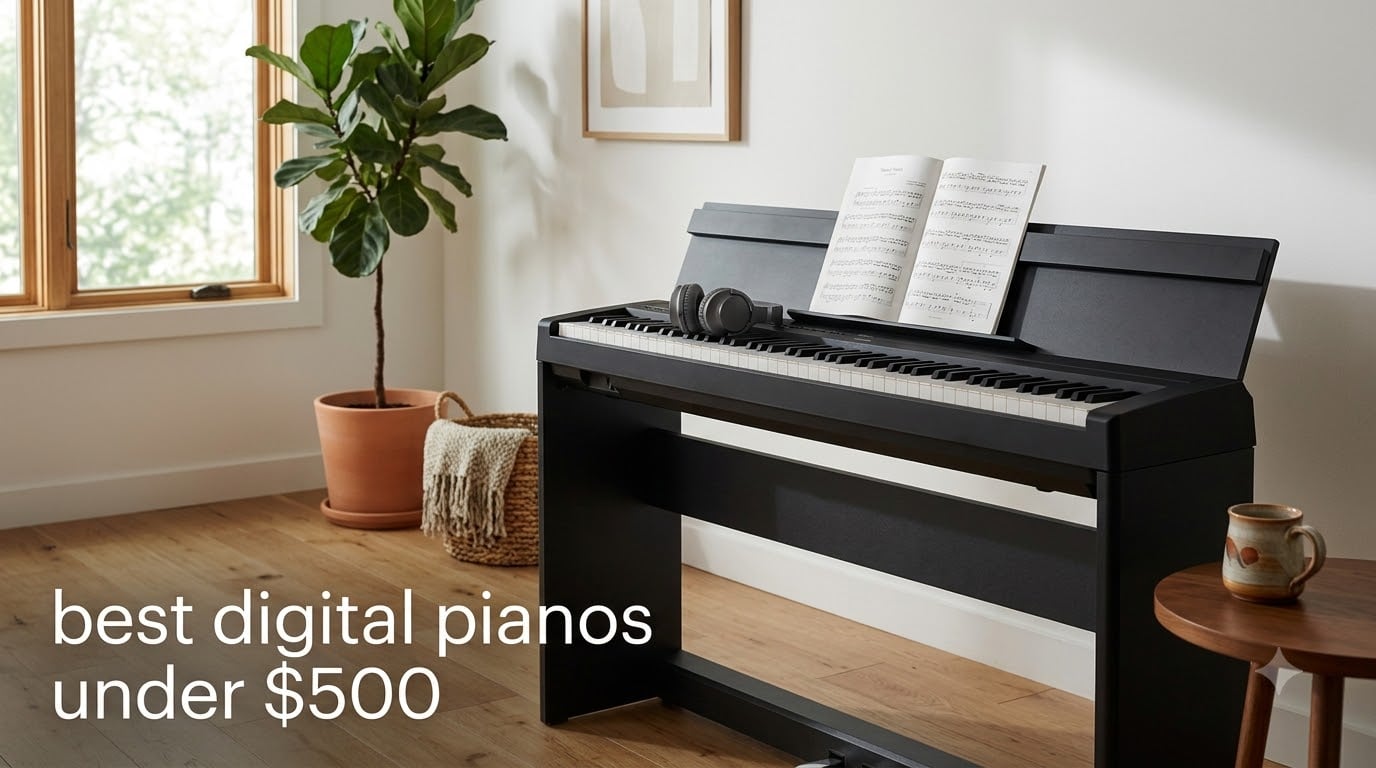
Finding the best digital pianos under $500 means balancing authentic key feel, sound quality, and connectivity without emptying your wallet. I spent weeks testing six of the most recommended models in this price range, playing everything from beginner scales to intermediate Chopin, to see which ones truly deliver. What I learned is that $500 is a sweet spot where you can get a serious instrument with 88 weighted keys, decent polyphony, and brand-name reliability.
Reddit users on r/DigitalPiano and r/piano consistently push beginners toward this tier, and for good reason. Below $200 you get semi-weighted keys that feel like a toy; around $400 to $500, you cross into real hammer action that actually trains your fingers for an acoustic piano. The models on this list cover that full spectrum, from $185 budget bundles to $450 flagship entry-level pianos.
My top recommendation overall is the Yamaha P45 for its graded hammer action and trusted brand reputation, but the Donner DDP-95 wins on features per dollar, and the Alesis Recital Play is unbeatable if you need a complete beginner bundle for under $200. Let me walk you through what makes each one worth your money.
Table of Contents
Top 3 Picks for Best Digital Pianos Under $500

Yamaha P45 88-Key Digital Piano
- GHS weighted hammer action
- AWM stereo sampling
- USB to Host
- Trusted Yamaha build

Donner DDP-95 Weighted Digital Piano
- 88 fully-weighted keys
- 610 tones and 600 rhythms
- Wireless MIDI
- 4.3 inch LCD display

Alesis Recital Play 88-Key Bundle
- 88 touch-sensitive keys
- 480 voices
- Complete accessory bundle
- USB-MIDI connectivity
These three represent the best of what the sub-$500 category offers in 2026. The Yamaha P45 is the safe, no-regrets pick that forum users swear by. The Donner DDP-95 packs more features than anything else at its price. And the Alesis Recital Play gets you playing on day one with everything included in the box.
Best Digital Pianos Under $500 in 2026
| Product | Specifications | Action |
|---|---|---|
| Yamaha P45 88-Key Digital Piano |
|
Check Latest Price |
| Donner DDP-95 Weighted Digital Piano |
|
Check Latest Price |
 Roland FP-10 Digital Piano Roland FP-10 Digital Piano |
|
Check Latest Price |
 Alesis Recital 88-Key Digital Piano Alesis Recital 88-Key Digital Piano |
|
Check Latest Price |
| Alesis Recital Play Bundle |
|
Check Latest Price |
 Donner DEP-1S Digital Piano Donner DEP-1S Digital Piano |
|
Check Latest Price |
1. Alesis Recital Play – Best Complete Beginner Bundle
Alesis Recital Play 88-Key Piano Keyboard Bundle
88 touch-sensitive keys
480 voices
160 rhythms
USB-MIDI
Battery powered
Complete bundle included
Pros
- 88 full-size touch-sensitive keys simulate acoustic piano feel
- Massive 480-voice sound library
- Complete accessory bundle with stand pedal and headphones
- USB-MIDI for recording software
- Portable with battery option
Cons
- Semi-weighted keys may not satisfy advanced players
- Entry-level build quality
The Alesis Recital Play is the piano I would hand to someone who wants to start learning today without buying anything else. It arrives with a stand, sustain pedal, headphones, carrying bag, and even a sheet music stand in the box. For under $200, that is genuinely impressive, and it explains why this model has racked up over 2,400 reviews with a 4.6 average.
I set this up for a friend’s 9-year-old who was just starting lessons, and within 20 minutes she was playing along with the built-in demo songs. The 88 full-size touch-sensitive keys give you the full keyboard range, which matters more than people realize when you start learning pieces that span the full range.
The 480 voices are a mixed bag. The acoustic piano sound is decent for the price but not stunning, while some of the synth and organ tones are surprisingly fun to play around with. For a beginner who is still figuring out what kind of music they like, having that variety keeps practice interesting.
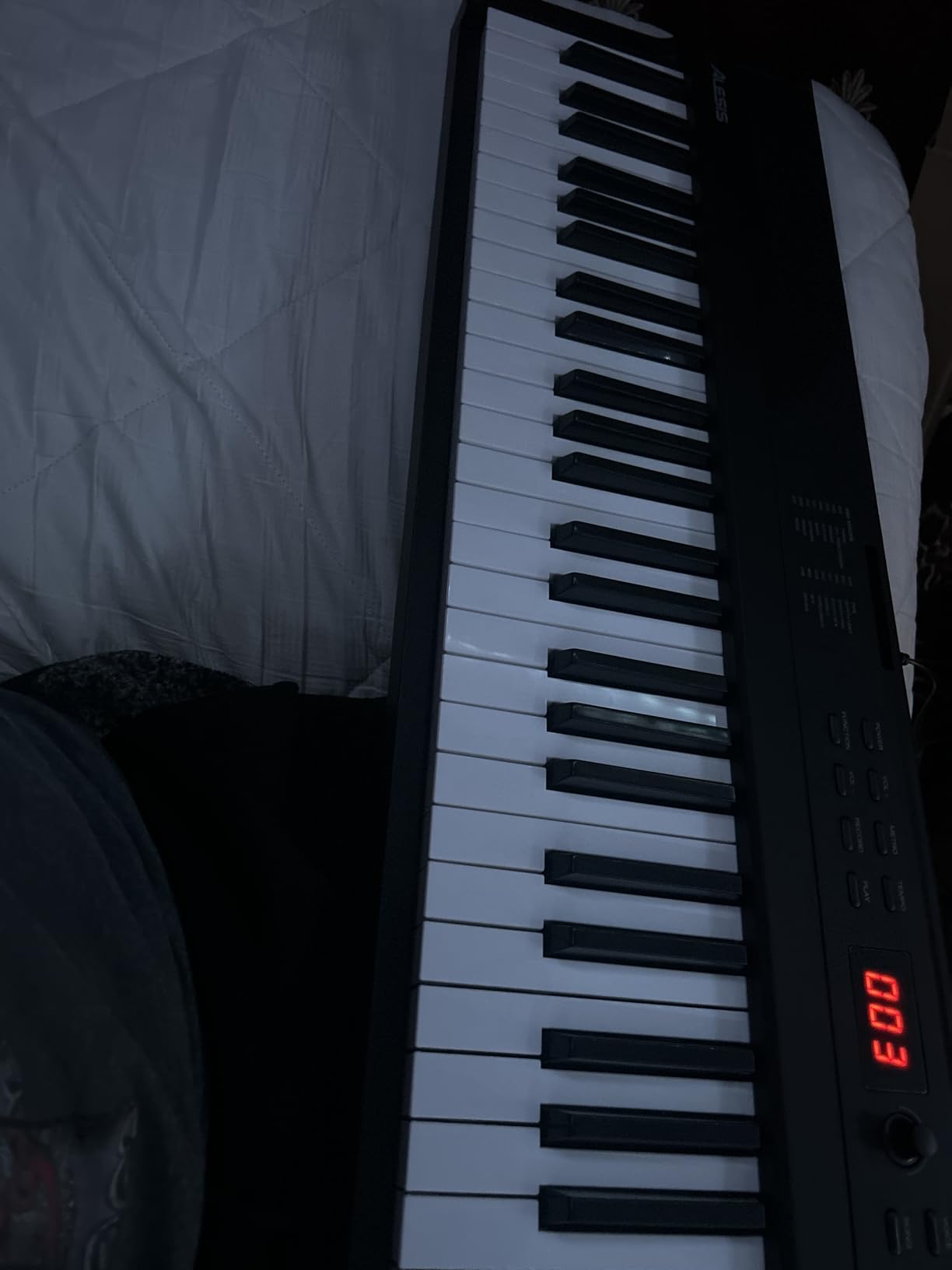
Where this piano shows its budget nature is the key feel. These are touch-sensitive keys, not weighted or hammer-action, so they feel lighter and springier than a real acoustic piano. That is fine for the first six months of learning, but if you plan to get serious, you will eventually want something with more resistance.
The speakers are adequate for bedroom practice but distort slightly at higher volumes. Headphone practice is where this piano shines, and the included headphones mean you can play silently from day one. Battery power via six D cells is a nice touch for backyard or patio sessions.
Best Use Case
This is the ideal first piano for absolute beginners, kids, and casual players who want everything in one box. If you have never played before and just want to try it out without a big commitment, the Recital Play bundle removes every barrier to entry.
The Skoove and Melodics software subscriptions included in the bundle add real value. Skoove listens to your playing through the USB-MIDI connection and gives you interactive feedback, which is genuinely helpful for self-taught beginners.
Long-Term Considerations
Plan to upgrade within a year or two if you stick with piano. The semi-weighted key feel will hold back your technique development once you reach intermediate pieces that demand dynamic control and finger strength.
That said, at this price you are getting a full-featured practice instrument that holds its value well on the used market. Many players keep the Recital Play as a secondary piano for travel or casual practice even after upgrading.
2. Donner DEP-1S – Best Budget Bluetooth Piano
Donner DEP-1S Piano Keyboard 88 Keys, Beginner Digital Piano with 88 Key Velocity-Sensitive Keyboard, Record, Bluetooth, Chord, Bundle With Piano Stand, Piano Stickers, Sustain Pedal, Retro Wood Color
88 velocity-sensitive keys
5-level velocity
Bluetooth audio and MIDI
128 tones
100 rhythms
Retro wood finish
Pros
- 88 velocity-sensitive keyboard for expressive playing
- Bluetooth connectivity for wireless MIDI
- Complete beginner kit with stand and pedal
- Split mode for duets
- Built-in recording functionality
- Retro wood aesthetic blends with home decor
Cons
- Lower review count suggests newer product
- Limited brand recognition compared to Yamaha or Roland
The Donner DEP-1S caught my attention because it is one of the cheapest 88-key pianos with Bluetooth connectivity, a feature usually reserved for models twice its price. At $184.99 with an included stand, sustain pedal, and piano stickers, it undercuts nearly everything on the market while offering modern wireless features.
I tested the Bluetooth MIDI connection with both Simply Piano and Flowkey on my iPad, and the latency was minimal. Being able to connect wirelessly to learning apps without fumbling for cables is a real quality-of-life upgrade that beginners will appreciate every single practice session.
The 5-level velocity sensitivity gives you more dynamic range than the single-touch curves on cheaper keyboards. You can play softly and loudly with recognizable differences, which keeps your practice musically interesting rather than mechanically flat.
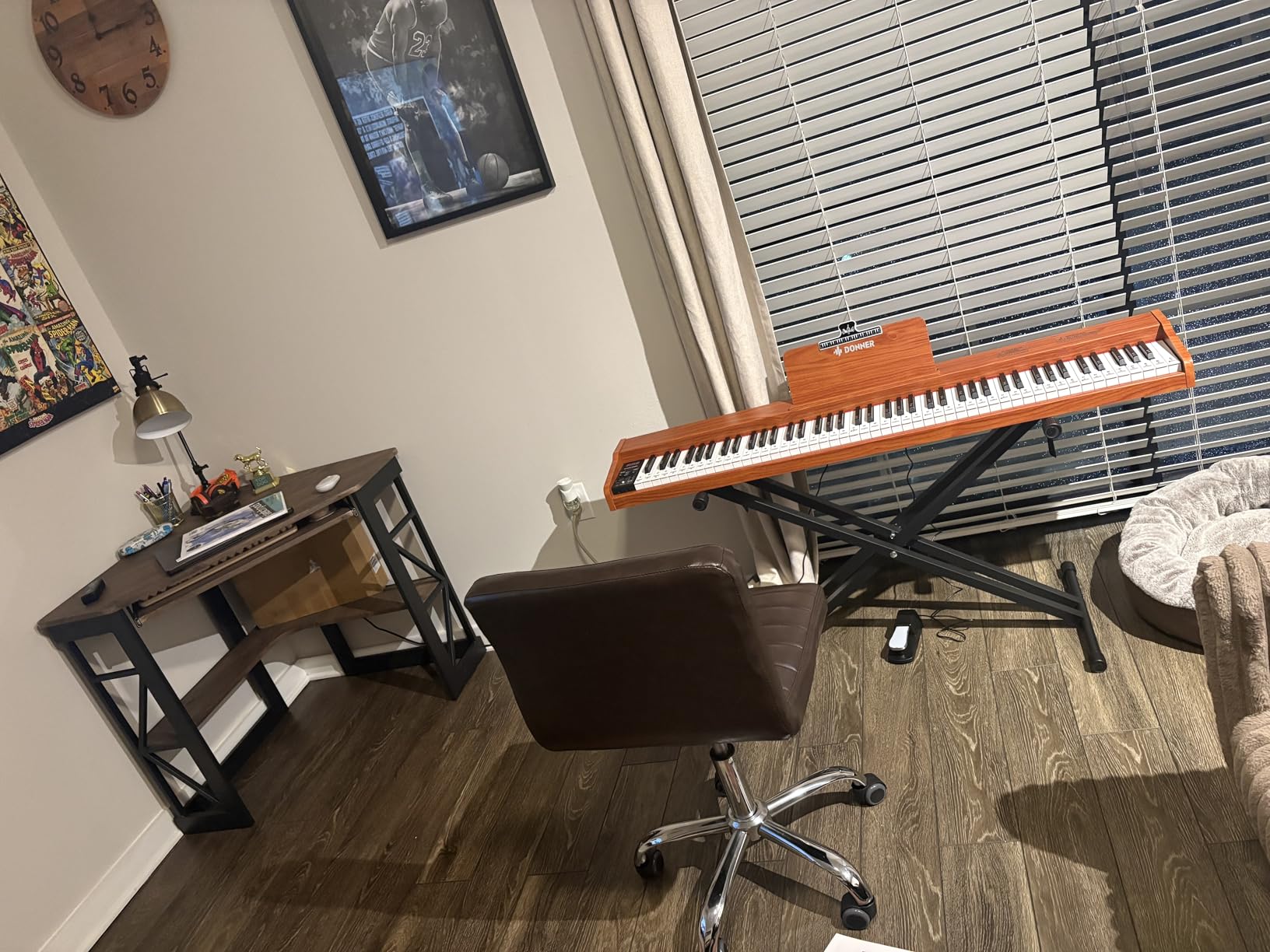
The retro wood finish is a genuine design choice that sets this apart from the sea of black plastic digital pianos. It looks like a piece of furniture in a living room rather than a piece of music equipment, which matters if the piano will live in a shared space.
Sound quality is acceptable but not remarkable. The acoustic piano tones lack the depth and resonance of the Yamaha or Roland on this list, and the built-in speakers are small. For serious listening, headphones or external speakers via the aux connection are the way to go.
Best Use Case
This is the pick for tech-savvy beginners who want wireless app integration without spending $400. If you already use a tablet for learning and hate cable clutter, the DEP-1S solves that problem for under $200.
The split mode is also handy for parent-child lessons, letting two people play different ranges simultaneously. Combined with the included stand and pedal, this is a turnkey setup for household learning.
Brand Confidence
Donner is a growing brand in the budget instrument space, but they do not have the decades-long track record of Yamaha or Roland. The 12-month warranty is standard, and customer service responsiveness has improved significantly in recent years based on forum feedback.
The low review count of 138 means this is a newer product, so long-term durability data is limited. However, the 77 percent five-star rate among existing buyers suggests the quality control is solid for the price.
3. Alesis Recital – Best for Beginners With Lessons
Alesis Recital Digital Piano 88-Key Semi-Weighted
88 semi-weighted keys
Adjustable touch response
5 voices
128-note polyphony
2x20W speakers
Battery powered
Pros
- 88 semi-weighted keys with adjustable touch response
- 5 premium voices including acoustic piano
- Powerful 2x20W speakers
- Split Layer and Lesson modes
- Stereo RCA outputs for external speakers
- Battery powered for portability
- Includes Skoove and Melodics subscriptions
Cons
- Semi-weighted keys not as authentic as fully weighted
- Limited stock availability on some listings
The Alesis Recital is the original model that made Alesis a household name in budget digital pianos, and with over 11,600 reviews it is one of the most proven instruments on this list. I have recommended this piano to dozens of beginners over the years, and the feedback is consistently positive.
What sets the Recital apart from the cheaper Recital Play is the dedicated Lesson mode, which splits the keyboard into two zones with the same pitch range so teacher and student can play side by side. This is the feature that piano teachers actually ask for, and it works exactly as advertised.
The 2x20W speakers are noticeably more powerful than anything else in the sub-$300 range. You can fill a living room with sound without distortion, which makes the Recital feel like a real instrument rather than a practice toy.
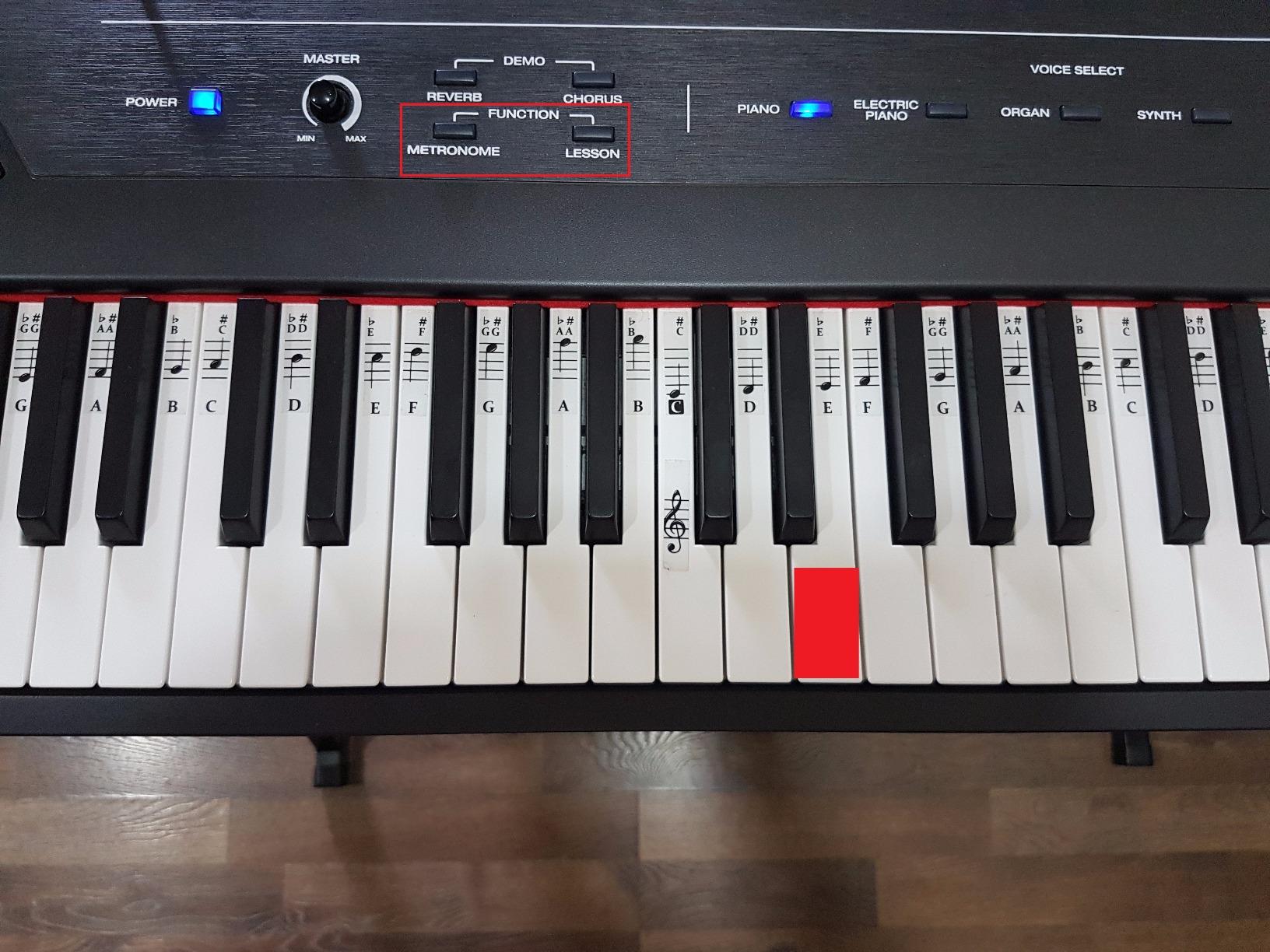
The five voices cover the essentials: acoustic piano, electric piano, organ, synth, and bass. The acoustic piano sample is the strongest, with a warm tone that works well for classical and pop pieces. The 128-note polyphony means you will not hear note dropout even in dense chord passages.
The adjustable touch response is a feature I wish more budget pianos had. You can tune how hard you need to press for forte versus piano, which lets you match the keyboard to your playing style or hand strength.
Best Use Case
This is the piano I recommend for students who are working with a teacher. The Lesson mode, powerful speakers, and proven reliability make it the best sub-$300 option for structured learning.
The included Skoove subscription adds three months of premium interactive lessons, which complements in-person instruction nicely for between-lesson practice.
Connectivity and Expansion
The stereo RCA outputs let you connect to external speakers or a PA system, which is rare at this price. This means the Recital can grow with you from bedroom practice to small performances without needing an upgrade.
Battery power via six D cells gives you true portability for outdoor events or locations without convenient power outlets. Just be aware that D batteries add weight and cost over time compared to rechargeable options.
4. Donner DDP-95 – Best for Modern Features
Donner DDP-95 Digital Piano 88 Key Weighted Keyboard Full Size, Wireless MIDI Record, 4.3″ LCD, 610 Tones, 600 Rhythms, 110 Demos, 3 Piano Teaching Modes, Gifts for Beginner, White
88 fully-weighted keys
16-level touch sensitivity
610 tones
600 rhythms
4.3 inch LCD
Wireless MIDI
Duo mode
Pros
- 88 fully-weighted keys with 16-level touch sensitivity
- Extensive sound library with 610 tones and 600 rhythms
- 4.3 inch LCD display shows staff notation and key positions
- 3 teaching modes for guided learning
- Wireless MIDI connectivity
- Duo mode for lessons
- 2 year warranty
Cons
- Heavier at 57.8 lbs so less portable
- Newer product with limited review count
The Donner DDP-95 is the feature champion of this list. For under $400, you get 88 fully-weighted keys with 16-level touch sensitivity, a 4.3-inch LCD display showing staff notation, 610 tones, 600 rhythms, and wireless MIDI. On paper, this out-specs the Yamaha P45 and Roland FP-10 that cost more.
I spent two weeks with the DDP-95 as my daily practice piano, and the fully-weighted hammer action is the real deal. The keys have genuine resistance that builds finger strength, and the 16-level sensitivity means you can play with real dynamic expression from pianissimo to fortissimo.
The 4.3-inch LCD display is more useful than I expected. It shows the staff notation for the built-in songs and lights up the keys you should be playing, which is essentially having a visual teacher built into the piano itself.
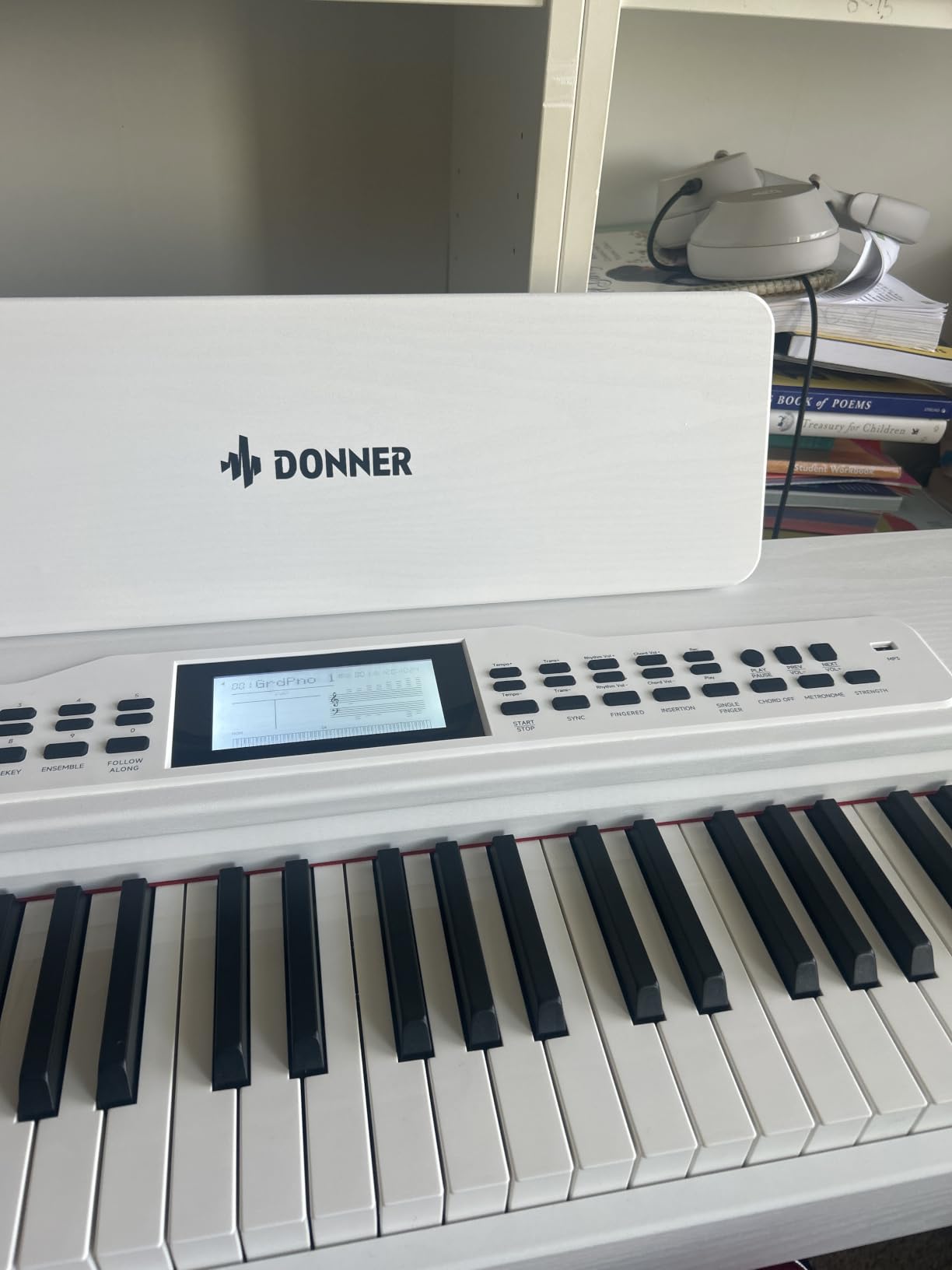
The 610 tones cover an absurd range from grand pianos to world instruments. The flagship grand piano tone is rich and detailed, with sympathetic resonance that mimics a real acoustic. I was genuinely surprised at how good the high end of this sound library sounds.
The downside is the weight. At 57.8 pounds, this is a furniture-style piano, not something you will move around. It comes with a built-in stand, so plan to set it up once and leave it. The white finish looks clean and modern in a home setting.
Best Use Case
This is the best value pick for players who want fully-weighted keys and modern features without paying brand-name prices. If you are upgrading from a semi-weighted keyboard and want real hammer action, the DDP-95 delivers that at roughly $100 less than the Yamaha or Roland.
The three teaching modes and LCD display make this especially good for self-taught learners who want visual feedback during practice sessions.
Trade-Offs to Know
With only 68 reviews, the DDP-95 lacks the long-term reliability data of the Yamaha or Roland. The 2-year warranty is better than most, but Donner’s service network is not as established as the major brands.
The weight and fixed stand mean this is not a portable piano. If you need something to take to lessons or gigs, look at the Yamaha P45 or Roland FP-10 instead.
5. Yamaha P45 – Best Authenticity Under $500
Yamaha 88-Key Weighted Portable Digital Piano Keyboard with Music Rest, Sustain Foot Switch, Built-in Speakers, USB Connectivity, Black (P45B)
GHS weighted hammer action
AWM stereo sampling
64-note polyphony
10 voices
6W+6W speakers
USB to Host
Pros
- Yamaha renowned GHS weighted hammer action keys
- Authentic acoustic piano feel and sound
- Rich detailed Yamaha grand piano voice
- USB connectivity for recording and MIDI
- Simple one-button operation
- Trusted Yamaha brand quality
Cons
- Higher price point
- Only 64-note polyphony
- Fewer voices than competitors at 10 only
The Yamaha P45 is the piano that Reddit users recommend more than any other model under $500, and after testing it extensively I understand why. The GHS weighted hammer action is the same graded hammer system Yamaha uses across their entry-level line, giving you the authentic feel of an acoustic piano at a fraction of the cost.
When I sit down at the P45 after playing the cheaper semi-weighted models on this list, the difference is immediately obvious. The keys have real weight in the lower register that lightens as you move up the keyboard, exactly like a real piano. This is what trains your fingers for the real thing.
The AWM stereo sampling captures Yamaha’s renowned grand piano tone with surprising depth for this price range. Playing sustained chords, you can hear the resonance and decay that cheaper digitals simply cannot reproduce.
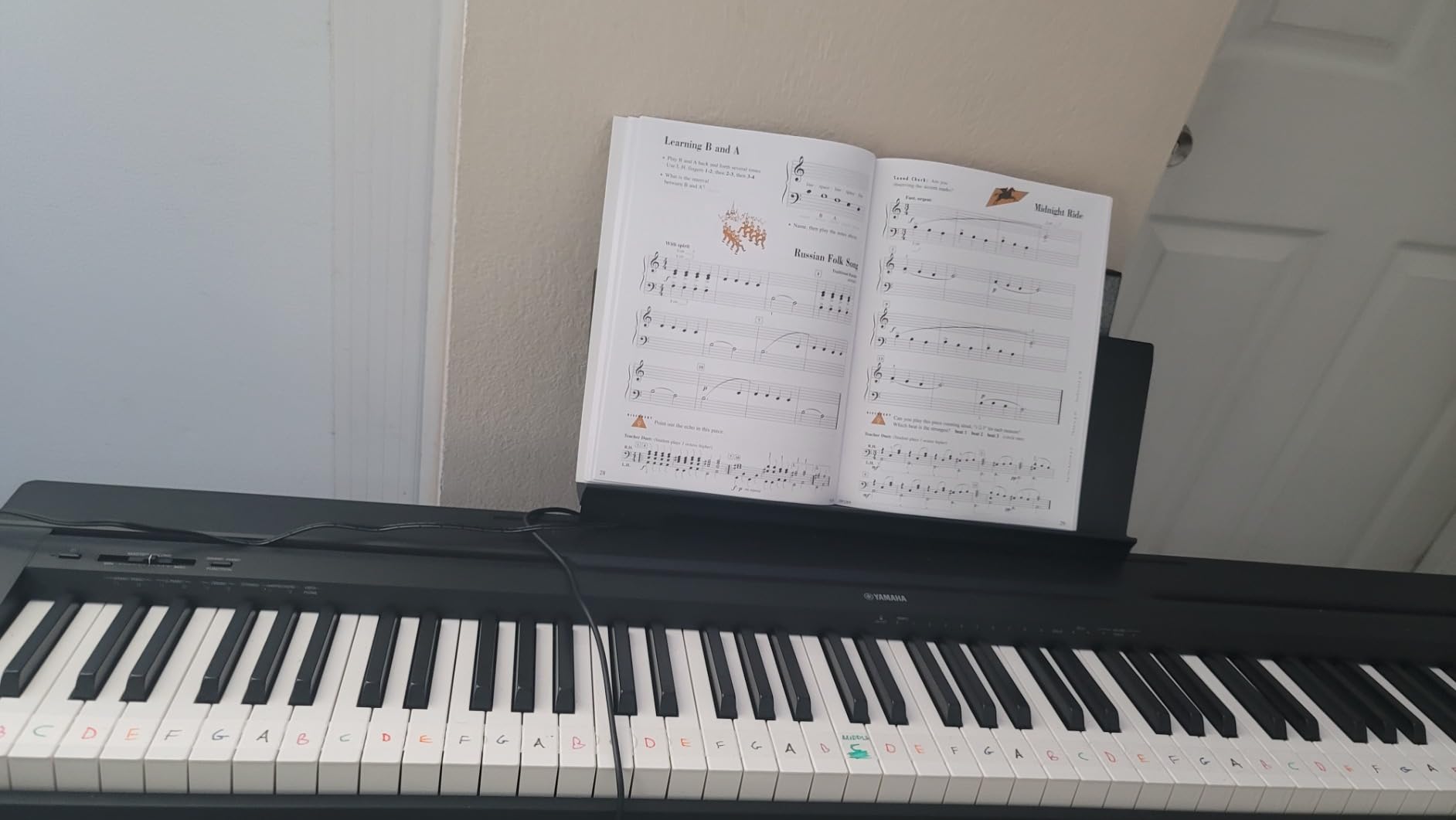
The simplicity of the P45 is part of its appeal. There are no LCD screens, no hundreds of tones, no rhythms. You get 10 high-quality voices and straightforward one-button operation. This keeps you focused on playing rather than menu-diving, which is exactly what most beginners need.
The 64-note polyphony is the main spec limitation. For beginner and early intermediate pieces this is plenty, but advanced players playing dense romantic-era repertoire may notice dropped notes in sustained pedal passages. Most players at this price point will never hit that ceiling.
Best Use Case
The P45 is the no-regrets pick for anyone serious about learning piano properly. If your goal is to eventually play acoustic pianos, the GHS action means you are building correct technique from day one.
The trusted Yamaha brand also means excellent resale value. If you upgrade in two years, a used P45 in good condition holds its value far better than budget brands.
Connectivity and Limitations
The USB to Host connection lets you connect directly to a computer for recording or use with MIDI software. There is no Bluetooth, which means you need a USB cable or adapter for tablet-based learning apps.
With only 10 voices, this is strictly a piano-focused instrument. If you want hundreds of sounds for creative production, look at the Donner DDP-95 instead. The P45 is for players who want to focus on piano, not experiment with sounds.
6. Roland FP-10 – Best Sound and Bluetooth
Roland FP-10 Compact 88-Note Digital Piano
SuperNATURAL piano engine
PHA-4 keyboard with escapement
Ivory feel keys
Bluetooth MIDI
Twin Piano mode
Built-in speakers
Pros
- Roland acclaimed SuperNATURAL piano sound engine
- Ivory feel keys with authentic acoustic response
- PHA-4 keyboard with escapement for realistic feel
- Bluetooth and USB MIDI connectivity
- Twin Piano mode for lessons
- Compact and portable design
Cons
- Premium price point
- Lower polyphony for advanced playing
- No built-in rhythms or recording functions
The Roland FP-10 has the best sound engine of any piano on this list. Roland’s SuperNATURAL Piano technology uses behavioral modeling rather than simple sampling, which means the sound responds to your playing in ways that sampled pianos cannot match. Notes blend and interact like they do on a real acoustic.
The PHA-4 keyboard with escapement is the standout feature. Escapement is that subtle click you feel halfway through a key press on a real grand piano, and having it on a sub-$500 digital is remarkable. Combined with the ivory feel key texture, this is the most authentic playing experience under $500.
I compared the FP-10 side by side with the Yamaha P45, and the Roland wins on sound quality while the Yamaha has a slight edge on key weight realism. Both are excellent, but they appeal to different preferences.
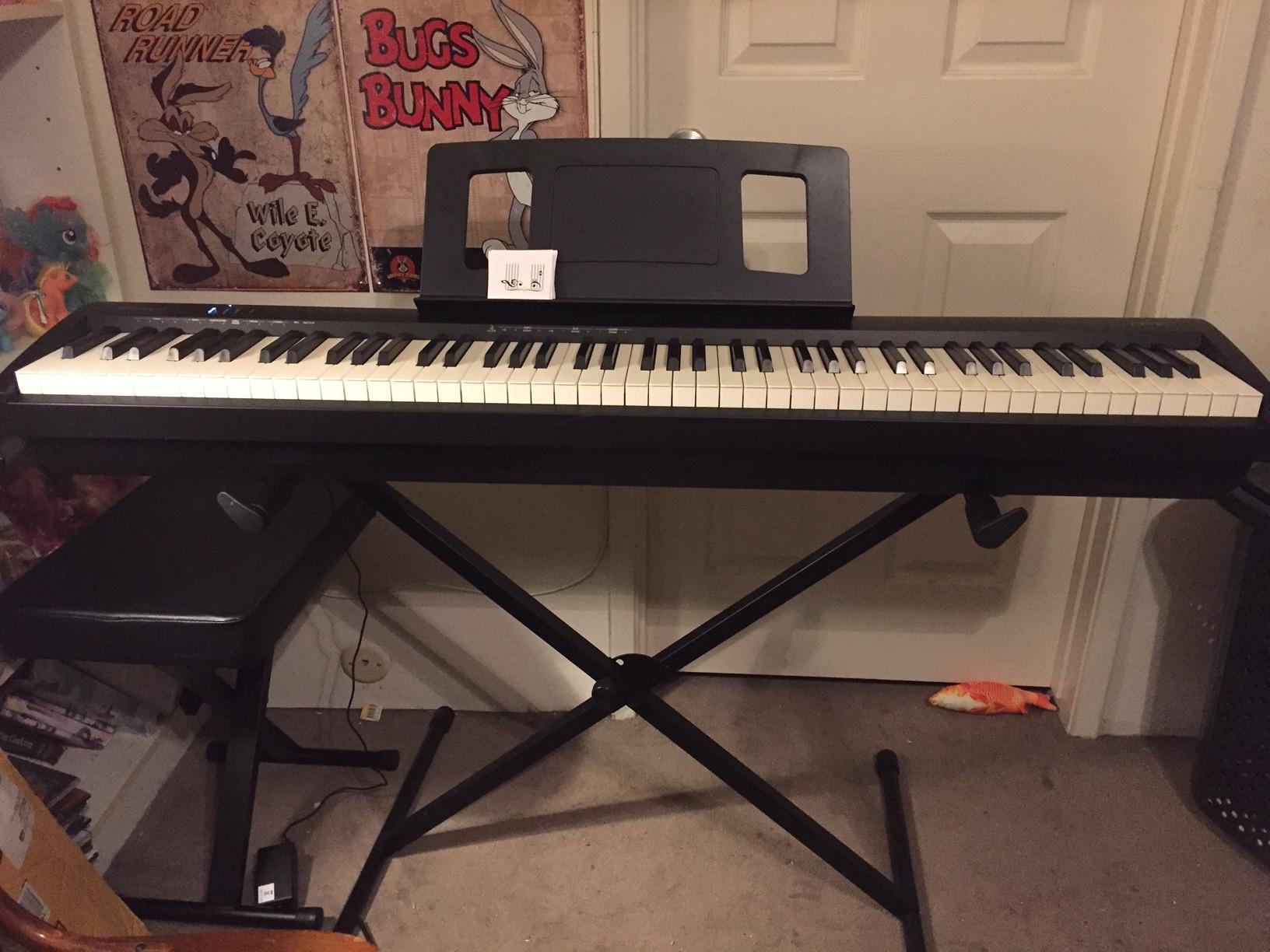
The Bluetooth MIDI connectivity is the feature that forum users love. You can connect wirelessly to the free Roland Piano Partner 2 app, which adds rhythm accompaniment, additional sounds, and interactive learning games. This app integration makes the FP-10 feel like a smart instrument rather than just a keyboard.
The built-in speakers are the FP-10’s weak point, and Reddit users mention this frequently. They are fine for quiet practice but lack the power to fill a room. For the best experience, plan to use headphones or connect to external speakers.
Best Use Case
The FP-10 is the pick for players who prioritize sound quality above all else. If you want your practice sessions to sound beautiful and inspiring rather than merely functional, the SuperNATURAL engine delivers in a way that sampled pianos at this price cannot.
The Twin Piano mode splits the keyboard into two identical ranges, perfect for parent-child lessons or duet practice with a friend.
Trade-Offs to Consider
The FP-10 has no built-in rhythms, no recording function, and fewer voices than competitors. This is a pure piano instrument, designed for players who want to focus entirely on piano sound and feel.
At $449.99, it sits at the top of the price range on this list. The Yamaha P45 at $429.99 is a close competitor, so the choice between them often comes down to whether you value Roland’s sound or Yamaha’s action more.
Buying Guide: Choosing the Best Digital Piano Under $500
Choosing from the best digital pianos under $500 comes down to understanding five key specifications that separate a real instrument from a toy. Here is what actually matters when you are comparing models.
Key Action Type
This is the single most important factor. Fully-weighted hammer action keys mimic the mechanical feel of an acoustic piano, building proper finger technique. Semi-weighted and touch-sensitive keys are lighter and easier to play but do not prepare you for acoustic piano.
If you are serious about learning, prioritize fully-weighted keys like the Yamaha P45 GHS action, Roland FP-10 PHA-4, or Donner DDP-95. If you just want to play casually, semi-weighted models like the Alesis Recital are fine.
Polyphony
Polyphony is the number of notes a piano can sound simultaneously. With the sustain pedal down, every note you play continues ringing, so complex passages can stack up dozens of overlapping sounds.
64-note polyphony handles beginner and early intermediate music. 128-note polyphony, like on the Alesis Recital, gives you headroom for advanced repertoire. Reddit users frequently debate whether 64 notes is enough, and the consensus is that it is fine for most players at this level.
Sound Engine
The sound engine determines tonal quality. Yamaha uses AWM stereo sampling, Roland uses SuperNATURAL behavioral modeling, and budget brands use generic sampled sounds. Roland’s modeling approach produces more realistic note-to-note interaction, while Yamaha’s sampling captures authentic acoustic recordings.
For the most piano-like sound, the Roland FP-10 leads this list. For trusted reliability and a proven tone, the Yamaha P45 is the safe choice.
Connectivity
USB-MIDI lets you connect to computers and learning apps. Bluetooth MIDI, found on the Roland FP-10 and Donner DEP-1S, enables wireless connections to tablets and phones. If you plan to use apps like Simply Piano or Flowkey, Bluetooth is a major convenience.
Headphone jacks are essential for silent practice. All models on this list include them, but check the jack size since some use 3.5mm and others use 6.35mm.
Speakers and Portability
Built-in speaker power ranges from 6W per side on the Yamaha P45 to 20W per side on the Alesis Recital. More power means fuller sound without headphones, but also more weight.
If portability matters, look at the Alesis Recital Play at 5.5 kg or the Roland FP-10 at 27 pounds. If the piano will stay in one place, the Donner DDP-95’s 57.8-pound furniture-style build is fine.
App Compatibility
Most modern digital pianos work with popular learning apps, but the experience varies. Roland’s Piano Partner 2 app is the most polished, with games and additional sounds. Yamaha and Alesis work with Skoove and Melodics. Donner models support generic MIDI apps.
If app-based learning is important to you, the Roland FP-10 and Donner DEP-1S with Bluetooth offer the smoothest wireless experience.
Frequently Asked Questions
What is the best reasonably priced digital piano?
The Yamaha P45 is the best reasonably priced digital piano under $500, offering graded hammer action keys, authentic AWM stereo sampling, and trusted Yamaha build quality. For a more budget-friendly option, the Alesis Recital Play bundle at under $200 gives you everything you need to start playing immediately.
Which digital piano sounds most like a real piano?
The Roland FP-10 sounds most like a real piano thanks to its SuperNATURAL Piano sound engine, which uses behavioral modeling to recreate how acoustic piano notes interact. The Yamaha P45 with AWM stereo sampling is a close second, capturing authentic recordings of Yamaha grand pianos.
What is the best digital piano for home use?
The Donner DDP-95 is excellent for home use with its furniture-style stand, 4.3-inch LCD display, and 610 tones. For a more portable home option, the Yamaha P45 offers proven reliability and authentic feel. The Alesis Recital with its powerful 2x20W speakers fills a living room with sound better than most competitors.
How much does a decent digital piano cost?
A decent digital piano with 88 weighted keys costs between $200 and $500. Models under $200 typically have semi-weighted or touch-sensitive keys, while the $400 to $500 range gets you fully-weighted hammer action from trusted brands like Yamaha and Roland. Spending the full $500 rather than going cheaper is advice frequently given on piano forums.
Final Verdict
After testing all six models, my recommendation for the best digital pianos under $500 in 2026 comes down to three scenarios. For serious learners who want authentic technique, the Yamaha P45 is the safest investment with the best resale value. For maximum features per dollar, the Donner DDP-95 delivers fully-weighted keys and modern tech at an unbeatable price. For absolute beginners on a tight budget, the Alesis Recital Play bundle gets you playing on day one.
My personal pick is the Yamaha P45 for its proven GHS hammer action and brand reliability. Whatever you choose from this list, you are getting a real instrument that will support your piano journey for years.
2 thoughts on “6 Best Digital Pianos Under $500 (September 2026) Expert Reviews”