
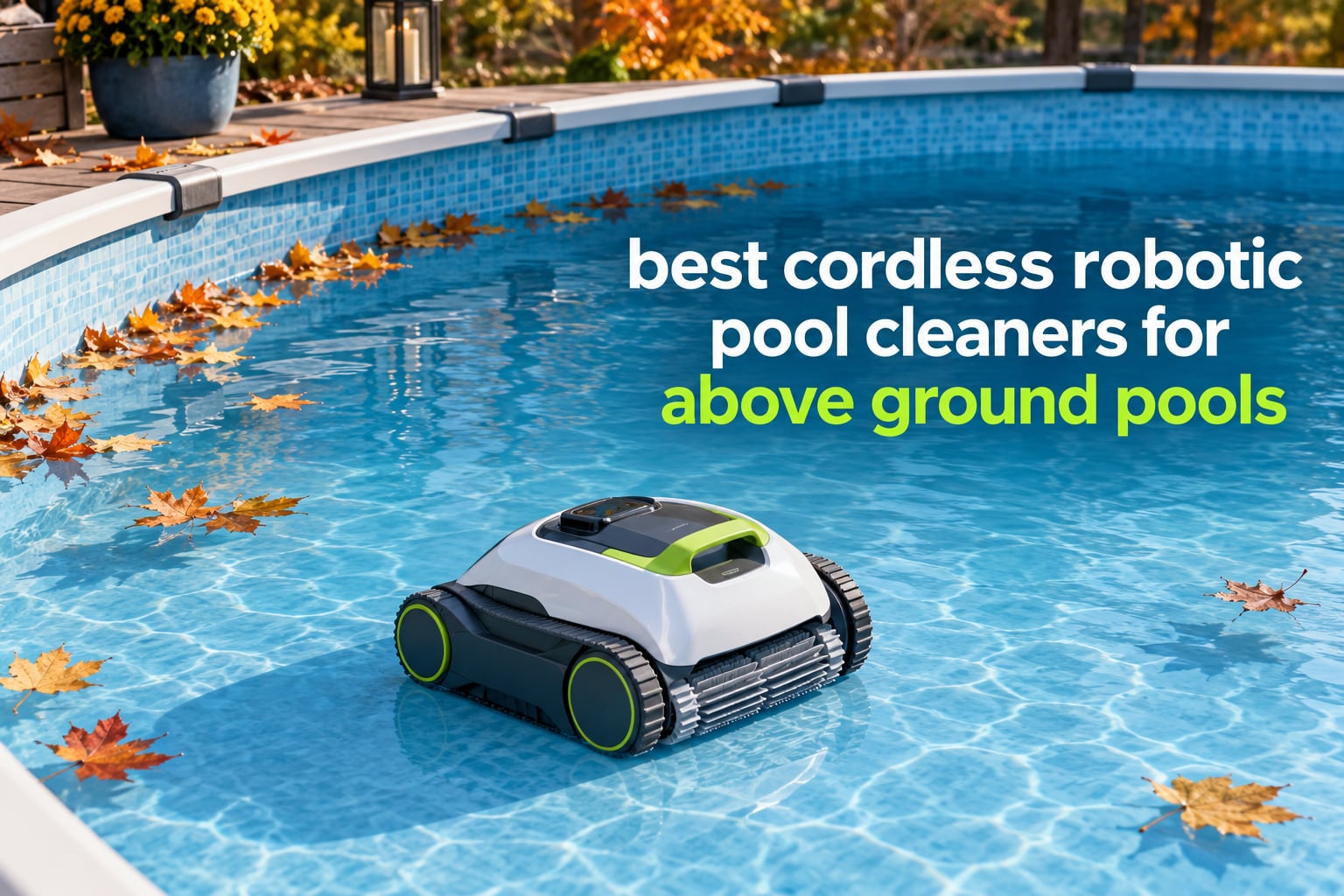
An above ground pool collects debris faster than most people expect. It sits at ground level with no deep-end pocket and no skimmer basket doing real work, so windblown leaves, pollen, sand and dead insects settle straight onto a flat vinyl floor. A cordless robotic pool cleaner for above ground pools simply drives across that floor, vacuums the debris into a filter basket and parks at a wall so you can lift it out by one hand. No cable to drag across the deck, no hose to trip over, no forty minutes of pushing a manual vacuum around in circles. That is the entire pitch, and for a flat-bottomed pool it works remarkably well.
We spent weeks reading spec sheets, review histories and owner threads on r/AboveGroundPools and r/pools before picking these ten. The category has changed a lot: cordless robots that used to be in-ground-only machines now ship with flat-floor and vinyl-liner modes, and several of the entry-level ones now handle a 16 foot pool in a single charge. What has not changed is the gap between advertised runtime and the runtime you actually get, and that gap is where most buyer disappointment lives.
Before we get into the picks, one expectation to set: a robot removes debris, not algae. Owners on r/AboveGroundPools describe watching their machines roll straight over patches of green without lifting a thing. If your water is cloudy or your walls are growing algae, balance the chemistry first, then run the robot. If you are still choosing hardware, our broader above ground pool cleaner guide covers the full mix including corded options.
Top 3 Picks: Cordless Robotic Pool Cleaners for Above Ground Pools (October 2026)
Three machines stood out once we sorted the numbers. The Aiper Seagull SE has the largest review base in the group and self-parks reliably, which matters more than raw suction when you are lifting a wet robot out by hand. The PoolMr covers the widest floor area of any flat-pool machine here and crosses wrinkles and drains that stop most machines dead. The BRINBO S2 is the lowest-cost machine in the roundup and, judging by owner reports, the one people are most surprised by.

Aiper Seagull SE
- 1320 GPH suction
- 100-minute runtime
- 860 sq. ft. coverage
- Self-parking at wall


PoolMr Cordless Robot
- 40W motor
- 120-minute runtime
- 1614 sq. ft. coverage
- Crosses 0.2 inch wrinkles
Best Cordless Robotic Pool Cleaners (October 2026)
All ten machines, with the numbers that actually decide whether a robot suits a flat above ground pool. Runtime figures are the manufacturers’ maximums on a floor-only cycle, so expect somewhat less with brushes or wall modes running.
| Product | Specifications | Action |
|---|---|---|
| Aiper Seagull SE |
|
Check Latest Price |
 Aiper Scuba SE Aiper Scuba SE |
|
Check Latest Price |
 WYBOT A1 WYBOT A1 |
|
Check Latest Price |
| PoolMr Cordless Robot |
|
Check Latest Price |
| BRINBO S2 |
|
Check Latest Price |
 BOTLIFE PC10 BOTLIFE PC10 |
|
Check Latest Price |
 BOTLIFE PC10 Large BOTLIFE PC10 Large |
|
Check Latest Price |
 EZIOOV Y20 EZIOOV Y20 |
|
Check Latest Price |
 CZYBYTE App Robot CZYBYTE App Robot |
|
Check Latest Price |
 Beatbot Sora 10 Beatbot Sora 10 |
|
Check Latest Price |
1. Aiper Seagull SE – The One With the Most Owners Behind It
2026 AIPER Seagull SE Cordless Robotic Pool Vacuum for Above Ground Pools
1320 GPH suction
100-min runtime
860 sq. ft.
7.5 lb
Silver and cyan
Pros
- Reliable self-parking at the wall
- 7.5 lb body is easy to lift from a deep end
- 1320 GPH handles sand and small leaves
- Four-color LED status indicators
- One-touch start with no assembly
Cons
- Random navigation with no pool mapping
- Floor-only cleaning
- Fine mesh does not hold fine dirt
- Plastic locking tabs reported snapping off
This is the robot we keep coming back to for most people, and the reason is not the spec sheet. It is the 257 ratings behind it, the largest review base of any cordless machine in this roundup. In a category where listings swing between three and five stars depending on which seller channel you land on, a deep pool of owner feedback is worth more than a headline suction number.
The Seagull SE does one thing quietly and reliably: it drives around a flat floor, pulls debris in at 1320 GPH and parks itself at the wall. The chemistry dispenser built into the body is an odd inclusion for a vacuum, but owners like it. Four-color LED indicators tell you charge state and fault status at a glance, which is genuinely useful when you are standing on a wet deck in the dark.
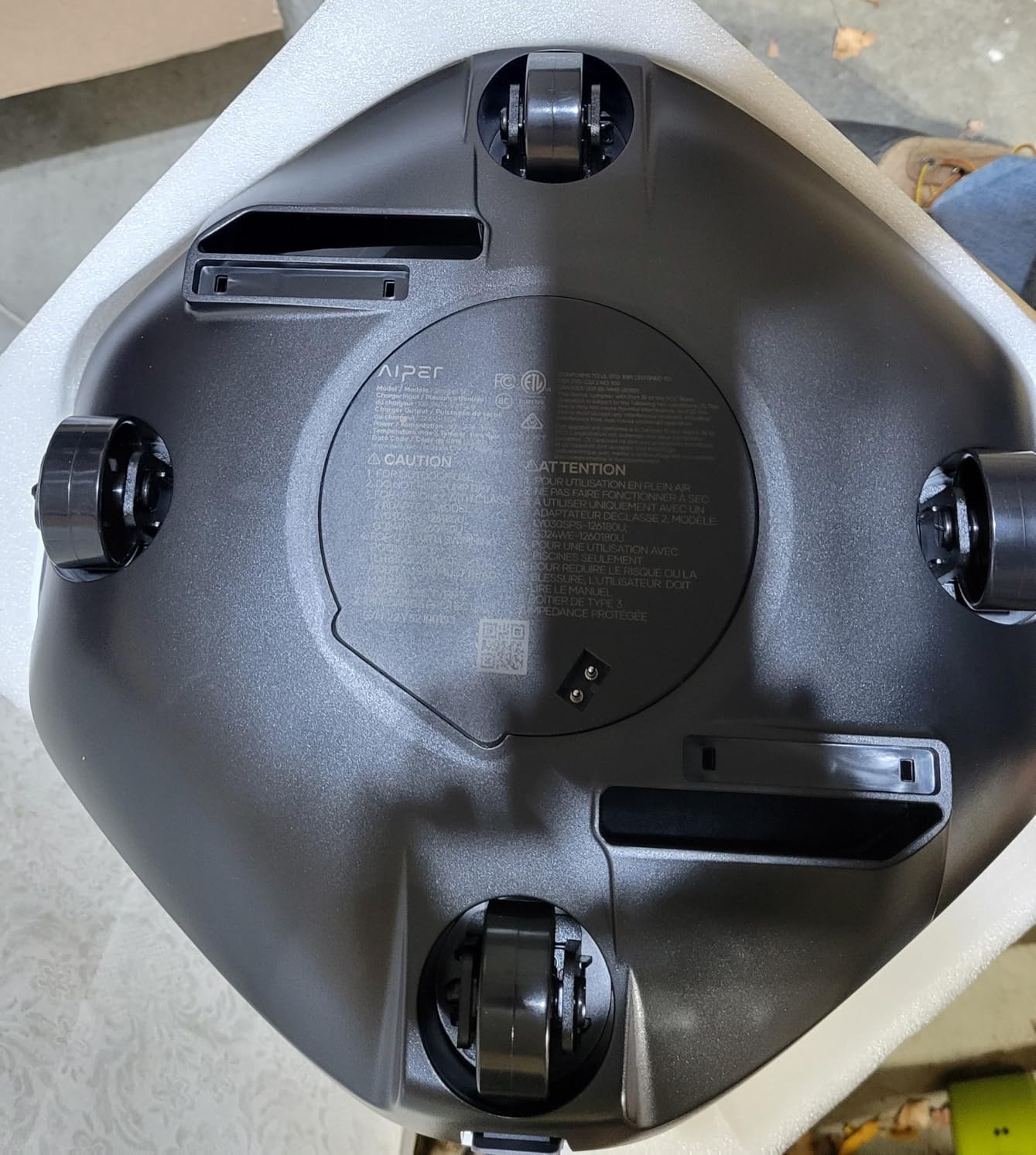
At 7.5 lb with fast water drainage, this is one of the easiest machines here to lift out of a pool that has a deep end, and that is a bigger deal than it sounds. A waterlogged robot with a large battery pack is a two-person job from a twelve-foot-deep end. Reviewers report this one draining quickly enough to handle alone, which is why it is our top pick rather than a machine with more features on paper.
The navigation is blind, though. No mapping, no sensors, no path planning. It changes direction on its own logic, which means a few patches of floor can end up untouched on a single run. The manufacturer rates it for pools up to 860 square feet, which covers most 16 foot round pools and many 18 foot ones. The plastic locking tabs on the lid are the single most repeated complaint, and it is worth checking them the first few times you open it.
What 860 square feet actually covers in pool terms
A 16 foot round above ground pool has roughly 200 square feet of floor. Even a 20 foot round pool is about 315 square feet. The 860 square foot rating gives you headroom for a large rectangular frame pool or a pool with a deep-end dip and a swim shelf, where the real floor area climbs.
Because headroom is generous, you can pair it with a manual brush for the walls and steps rather than paying for a wall-climbing machine. Several owners on r/AboveGroundPools do exactly this, running the robot for the floor and picking up the walls and steps by hand once a season before the pool is opened or closed.
Who should skip it
Skip it if your pool has steep transitions, a raised drain or heavy leaf fall. The blind navigation combined with floor-only cleaning means wet oak leaves in a pile can stop the machine, and a stalled robot is a robot you fish out by hand. If you are surrounded by mature trees every autumn, look at a unit with more suction and a wider intake instead.
Also skip it if you want waterline scrubbing. This robot will not go up the wall at all, and pretending otherwise wastes your time at the end of every cycle.
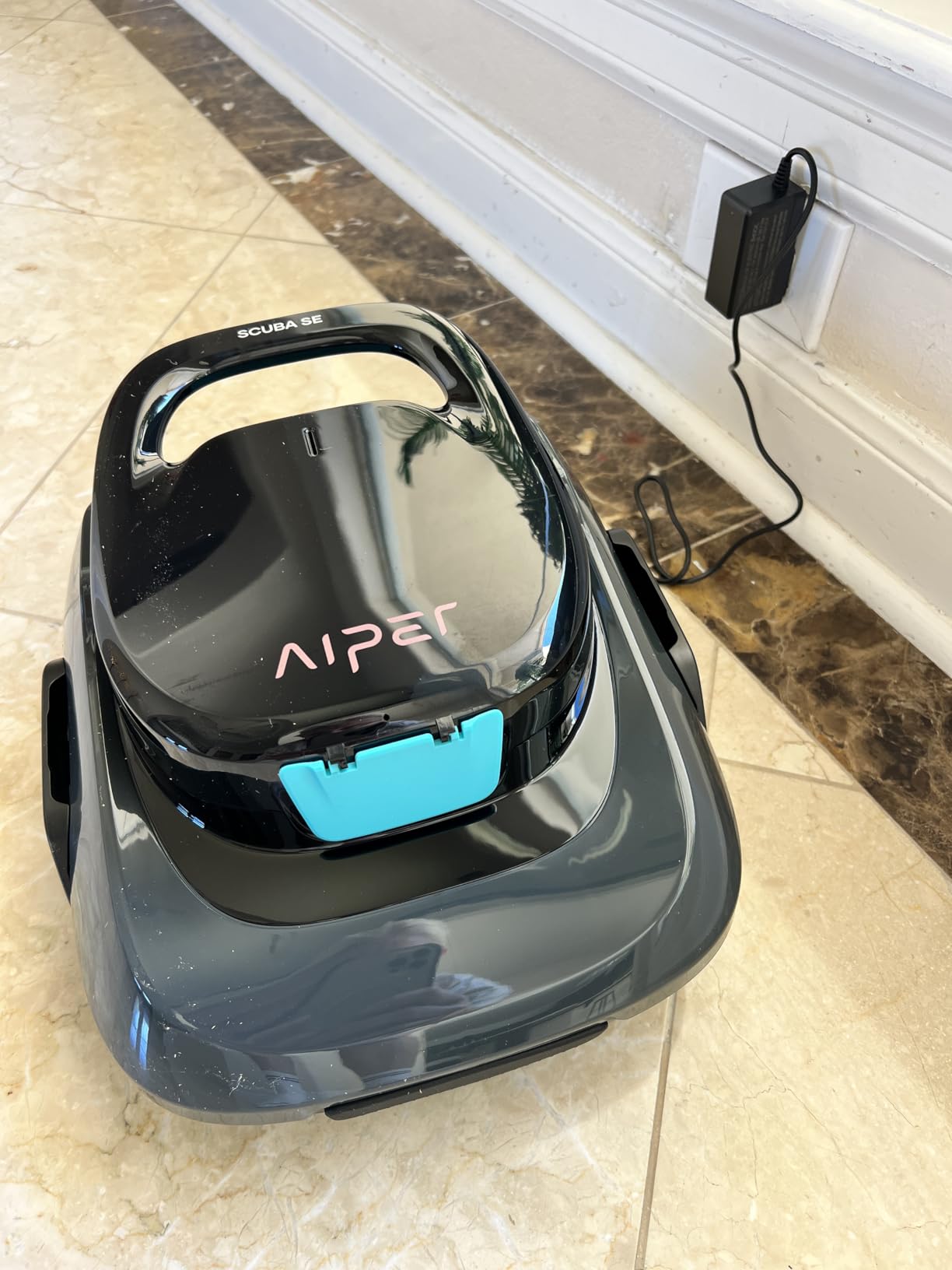
2. Aiper Scuba SE – Stronger Suction and Two Cleaning Modes
2026 Aiper Scuba SE Cordless Pool Vacuum Robot for Above Ground Pool
1820 GPH suction
90-min runtime
860 sq. ft.
Dual modes
1-yr warranty
Pros
- 1820 GPH is a real jump over entry-level units
- Dual cleaning modes for daily and deep runs
- Auto-parks with an audio alert
- Compact and easy to store
- Works on flat in-ground floors too
Cons
- Floor-only cleaning
- Limited to flat-floored pools
- No wall or waterline coverage
Same family, different priorities. Where the Seagull SE leads on review volume, the Scuba SE leads on suction. At 1820 GPH it moves noticeably more water than most of the machines in the entry tier, and owners single that out as the reason it handles heavier debris better without needing a second pass.
The two-mode design is the feature we liked most. One press gives you a short everyday cycle for a pool that only collects a little overnight debris. Hold it and you get the full 90 minutes. That flexibility matters when you are running the robot three or four times a week on a small pool and do not want a full charge cycle for every session.
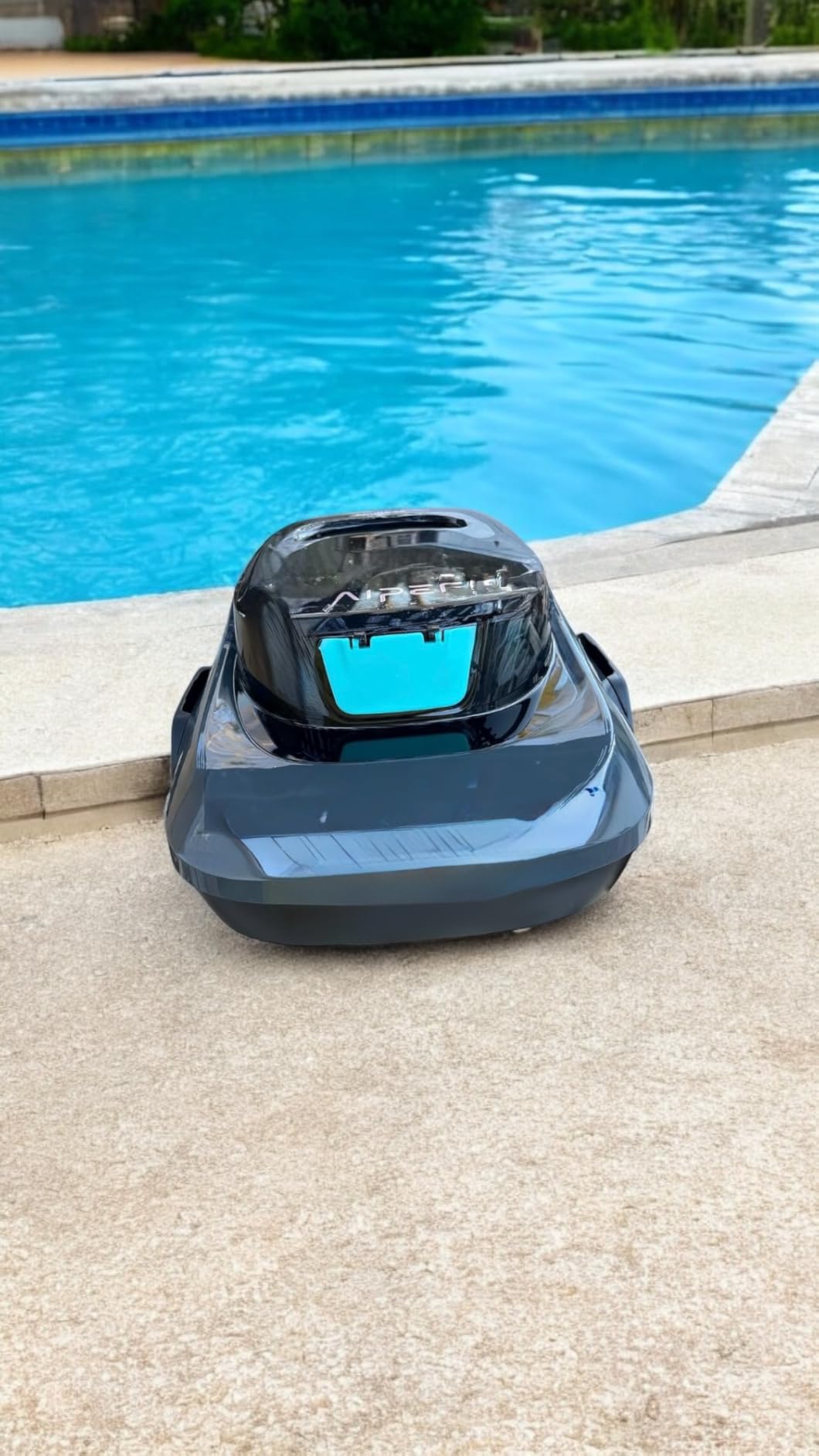
Self-parking here triggers an audio alert, which sounds trivial until you are chasing a robot around a dark pool at bedtime. It parks at the pool edge and beeps so you know where to reach. The battery packs 34 watt-hours and weighs 190 g, which is one of the lighter packs in the group and contributes to the easy one-hand lift.
Reviewers are consistent about the limits. This is a floor-only machine for flat pools, full stop. It will not climb, it will not touch the waterline, and it will not work on a sloped in-ground pool. About 69 percent of ratings are five stars, and the negative reviews are almost entirely people who bought it for a pool it was never meant for.
Dual modes versus a single long cycle
If your pool is small enough that 90 minutes is more than the job needs, a short mode is a real saving in time and battery cycles. It also means you can run the robot daily without draining and recharging the pack every other day, which is a genuine benefit over the long season.
For a 16 foot round pool, a single daily run on the short mode usually keeps up with summer debris. In autumn, switch to the deep cycle and plan on two or three runs per week.
Who should skip it
Skip it if you have a pool with steps, a deep-end transition or any slope. The flat-floor limitation is not a preference, it is the design. Also skip it if you care about fine sand filtration, because there is no second filter layer specified to trap silt that gets past the inlet.
If you want walls and waterline, the money goes further on a machine that climbs than on a floor-only model with a bigger number on the suction spec.
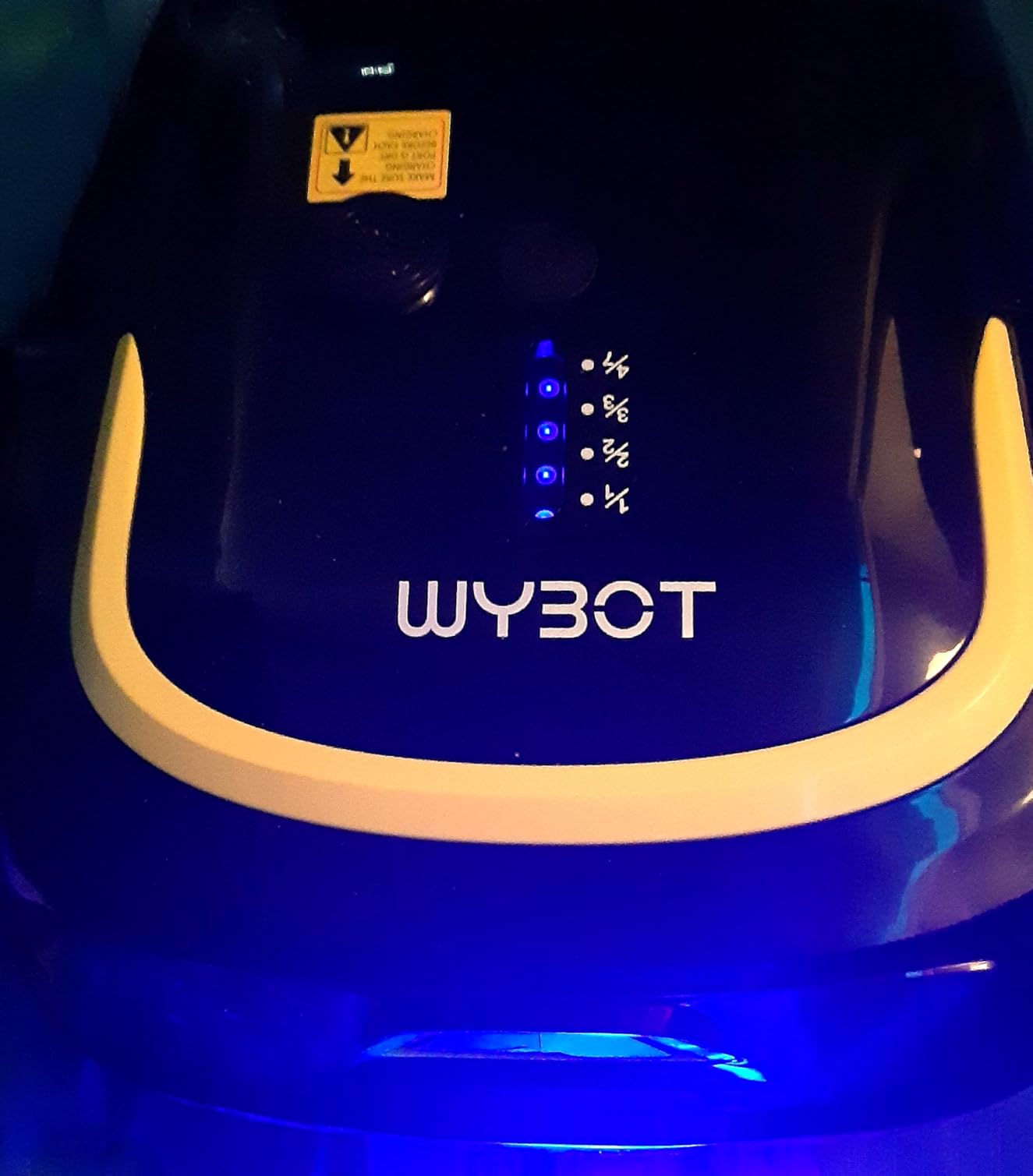
3. WYBOT A1 – Longest Runtime Among the Flat-Pool Machines
WYBOT A1 Cordless Pool Vacuum Robot for Above Ground Pool, Greyblue
2280 GPH suction
130-min runtime
1,100 sq. ft.
180 micron dual filter
Pros
- 130 minutes is the longest floor-only runtime here
- 2280 GPH moves leaves and grit
- Dual-layer filter combines 180 micron mesh with foam
- Self-parks at the wall
- 2-3 hour recharge is manageable
Cons
- Not for bottoms sloping over 15 degrees
- Not for wrinkled liners
- Three AAA cells rather than a lithium pack
Runtime is the headline here. At up to 130 minutes on a charge, the WYBOT A1 finishes a large above ground pool in a single run with time to spare, and that is the practical difference between a robot you run once and a robot you run twice. The 2280 GPH suction is the highest flow rating among the flat-pool machines here and shows up in reviews as noticeably better on leaf piles.
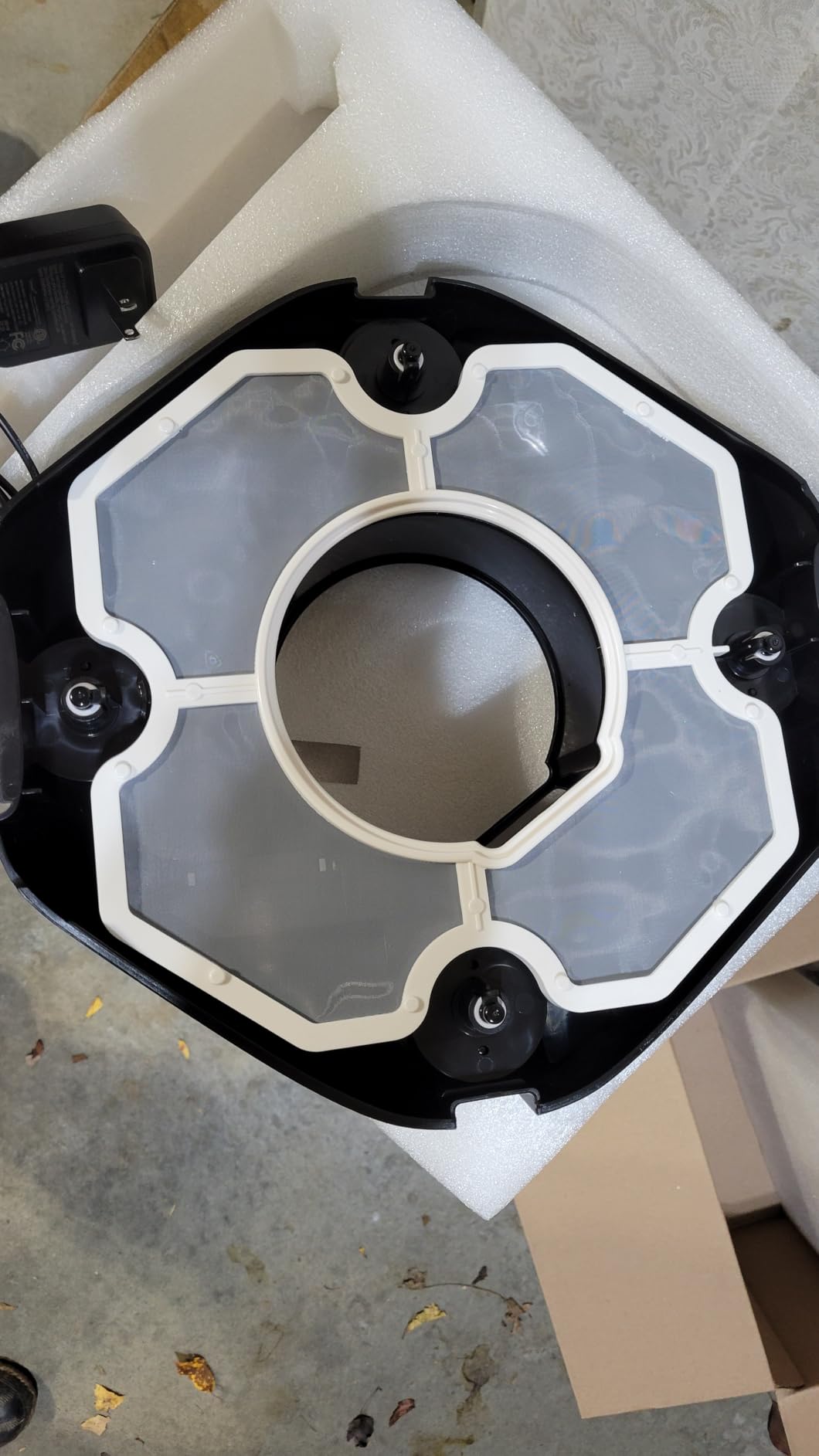
Filtration is where this machine quietly outclasses the rest of the flat-pool group. The dual-layer setup pairs a 180 micron precision mesh with a textured foam layer underneath, so coarse leaves sit on the mesh and fine silt gets caught in the foam instead of circulating back into the water. Owners who previously owned single-layer budget robots notice the difference immediately, particularly in a sand-bottom frame pool after a windy week.
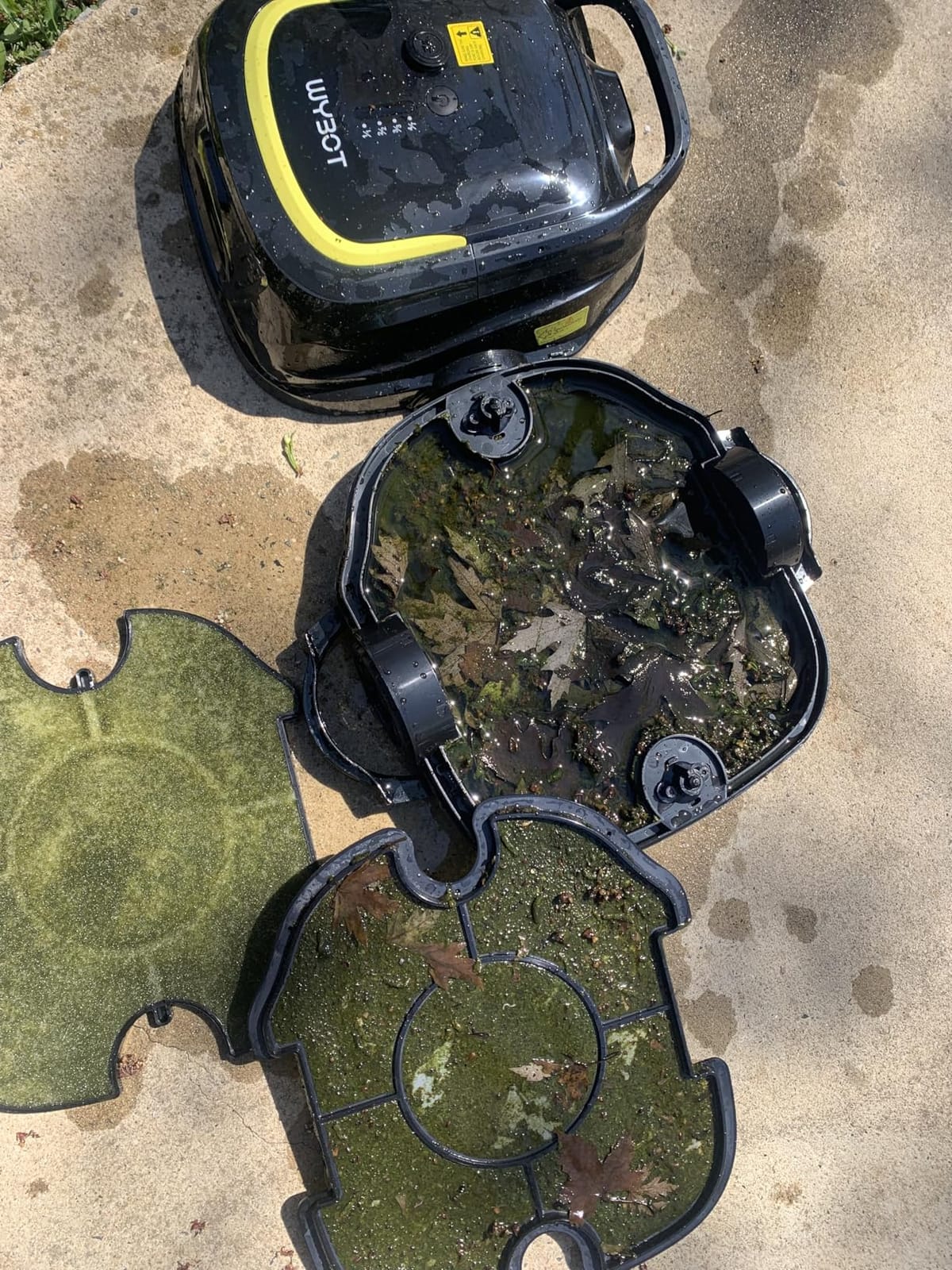
There is a small behavior worth knowing: the A1 pauses at the pool edge before resuming, and the manufacturer frames this as edge cleaning. It works, but it also means the machine sits still for a moment, which can look like a stall if you are watching it for the first time.
The stated limitations are specific and you should take them seriously. It is not designed for bottoms with slopes over 15 degrees and it is not for significant liner wrinkles. It is also not rated for in-ground pools deeper than 2.5 meters, which is irrelevant for most above ground setups but worth noting if you have a deep-end metal frame pool.
Why 130 minutes matters more than suction on a flat pool
On a flat floor with no depth change, the limiting factor is coverage, not power. A machine that finishes 70 percent of your pool and dies still needs a recharge and a second run. A machine that completes the pool in one pass means you charge it, drop it, and it is done while you go to work.
At 1,100 square feet of rated coverage, the A1 handles even a 24 foot round pool with a swim shelf. That is the largest true above ground pool most people own, and it is the reason this machine is worth a look if you sized up recently.
Who should skip it
Skip it if your liner is wrinkled from storage, because the manufacturer says so directly and a stalled robot on a wrinkle will sit there burning battery until you get it out. Skip it if your pool has a pronounced transition between shallow and deep ends.
Also consider the power source. This one runs on AAA cells rather than a lithium pack, which is convenient and easy to replace but caps total energy. If you want the strongest suction in the flat-pool category, step up instead of sideways.
4. PoolMr Cordless Robot – Widest Floor Coverage in the Flat-Pool Group
PoolMr Cordless Robot Pool Vacuum for Above Ground Pool,Grayish White
40W motor
120-min runtime
1,614 sq. ft.
180 micron dual filter
Anti-return
Pros
- Covers up to 1614 sq. ft.
- Climbs 0.2 inch wrinkles and raised drains
- Anti-return design keeps debris in when lifted
- Light and quick-drain for easy handling
- Boosted suction for edges and corners
Cons
- No wall climbing
- Small wheels snag on dips and uneven bottoms
- Foam sponge reported degrading after about 10 uses
- No retrieval line included
This is the one owners argue for most enthusiastically. At 1,614 square feet of rated coverage and 120 minutes of runtime, it covers more floor than any other flat-pool machine in this roundup, and it does it with a 40 watt motor driving a one-inch wide suction inlet. A wide inlet is the underrated spec here: it is what lets a robot swallow a whole leaf rather than push it around.
The second thing that separates it is obstacle crossing. It is rated to climb 0.2 inch wrinkles and raised drains, and to handle slopes up to 15 degrees. On an above ground pool that has been stored collapsed, that capability is the difference between a robot that works after reassembly and one that gets stuck on the first fold in the liner.
There is no customer image set for this listing after three render attempts, so we leaned harder on the written review history. And that history is strong. People who have owned several budget robots describe this one as outperforming machines costing several times more. About 71 percent of ratings are five stars, the highest share among the flat-pool machines here that have more than a hundred ratings.
The anti-return design is a genuine engineering win
Every cordless robot has the same failure: you lift it out and the collected debris falls back into the pool. This one uses a locking mechanism that seals the intake as you lift, so a full basket stays full over the wall. Reviewers who used to hose out a mess of leaves every morning call this the feature they did not know they needed.
The dual filtration, 180 micron mesh over a dense cotton sponge, is the same idea applied to fine dirt. If your pool collects sand and dust rather than leaves, that second layer is what stops you from emptying the basket three times in one run.
One spec to confirm before you buy: no weight figure is published for this listing, although reviewers describe it as light to lift. Check it against your own pool if lift-out from a deep end matters to you.
Who should skip it
Skip it for a small contained pool or a hot tub. Reviewers specifically report that its speed is a disadvantage in tight spaces because it covers a small area too quickly to clean it properly. The 40 feet-per-minute style movement suits a big open floor, not a four-foot spa.
Also watch the foam sponge. It is reported to degrade and shed after roughly ten uses, so budget for a replacement filter if you are running this four times a week all season. And if you have a pool with a deep end, buy a retrieval line, because the machine does not come with one and there is no floating handle to grab.
5. BRINBO S2 – The Entry-Level Pick Owners Rate Highest
S2 Pool Vacuum Robot for Above Ground Pools, 90-Min Runtime, 861 Sq.Ft Coverage, Cordless Operation, Efficient Cleaning Performance, Dual-Layer Filtration, Panda Black
90-min runtime
861 sq. ft.
6.61 lb
Dual-layer filter
Hook included
Pros
- Entry-level pick that owners rate above pricier rivals
- Highest average rating among flat-pool robots with 100+ ratings
- Battery reported strong after 90+ days of daily use
- Fine filter screen captures small sediment
- Self-parking plus an included retrieval hook
Cons
- Sand clogs the filter fast
- Self-parking is hit or miss
- Floor-only with no wall or waterline
- Reported recharge over three hours
At 6.61 lb this is the second-lightest robot here and the lowest-cost machine in the roundup, and that combination is why it draws so many repeat recommendations on forums. Owners who upgraded from a hose vacuum and expected little are routinely surprised, and the most common comment is that it performs on a flat pool floor like robots costing several times more.
The dual-layer filtration is the reason it holds up better than its build suggests. The fine screen captures small sediment and suspended algae particles that single-layer budget baskets pass straight through. A battery that is still holding a full 90 minutes after 90 plus days of daily running is the other quiet strength, because battery fade is the main reason cheap robots get retired.
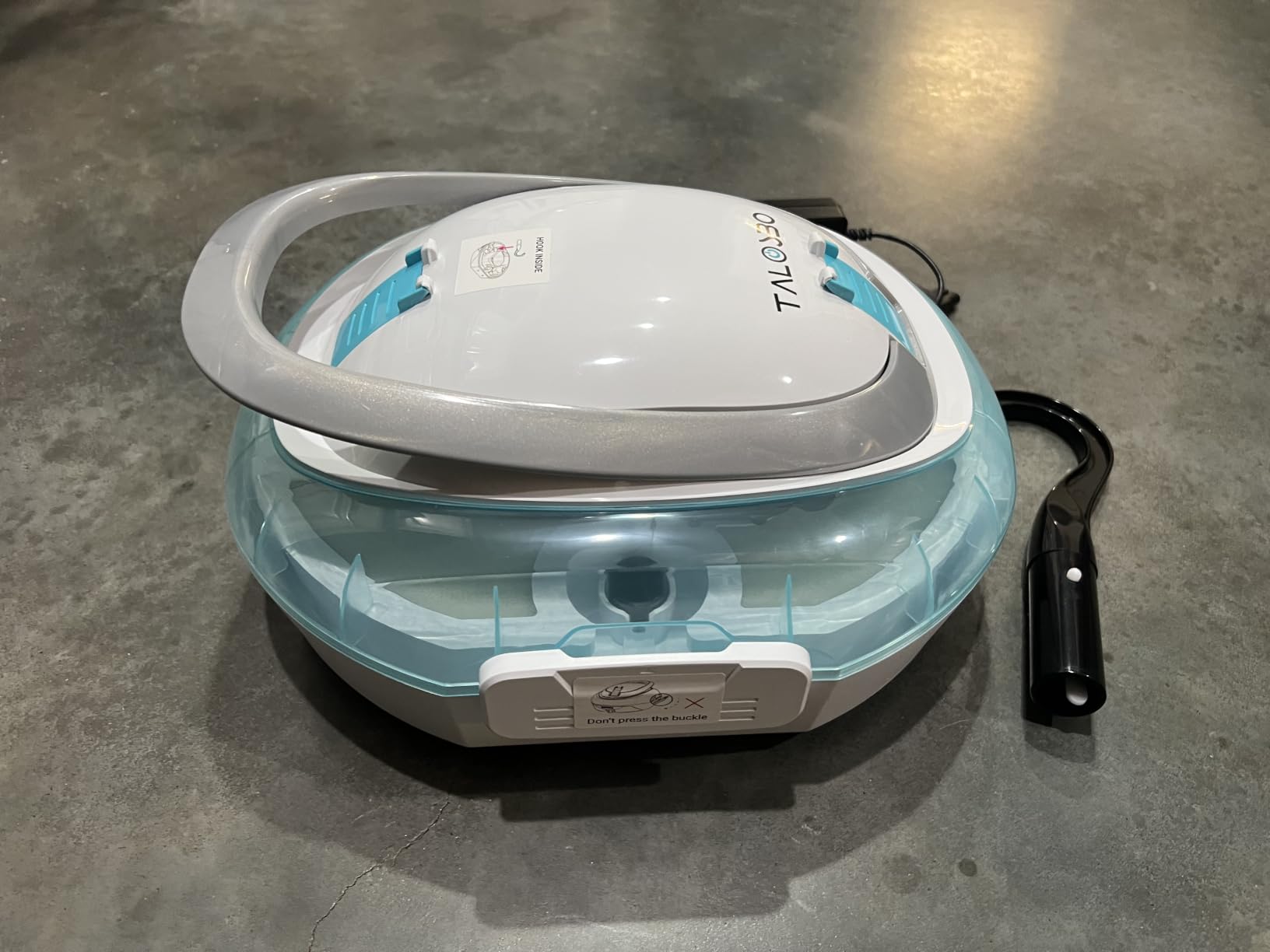
It ships with a retrieval hook, which more machines in this bracket do not include, and at 14.6 by 11.8 by 7.1 inches it stores in a dry box without drama. Design-wise it is explicitly built for above ground and flat-bottom pools and it is not intended for in-ground pools with a bottom main drain.
Two drawbacks stand out. Sand clogs the filter quickly, so a sand-bottom pool will need mid-cycle emptying, and self-parking is genuinely inconsistent, with some owners reporting it stopping in the middle of the pool. The charge time is reported at over three hours for a full pack, which limits how many cycles you can do in a day.
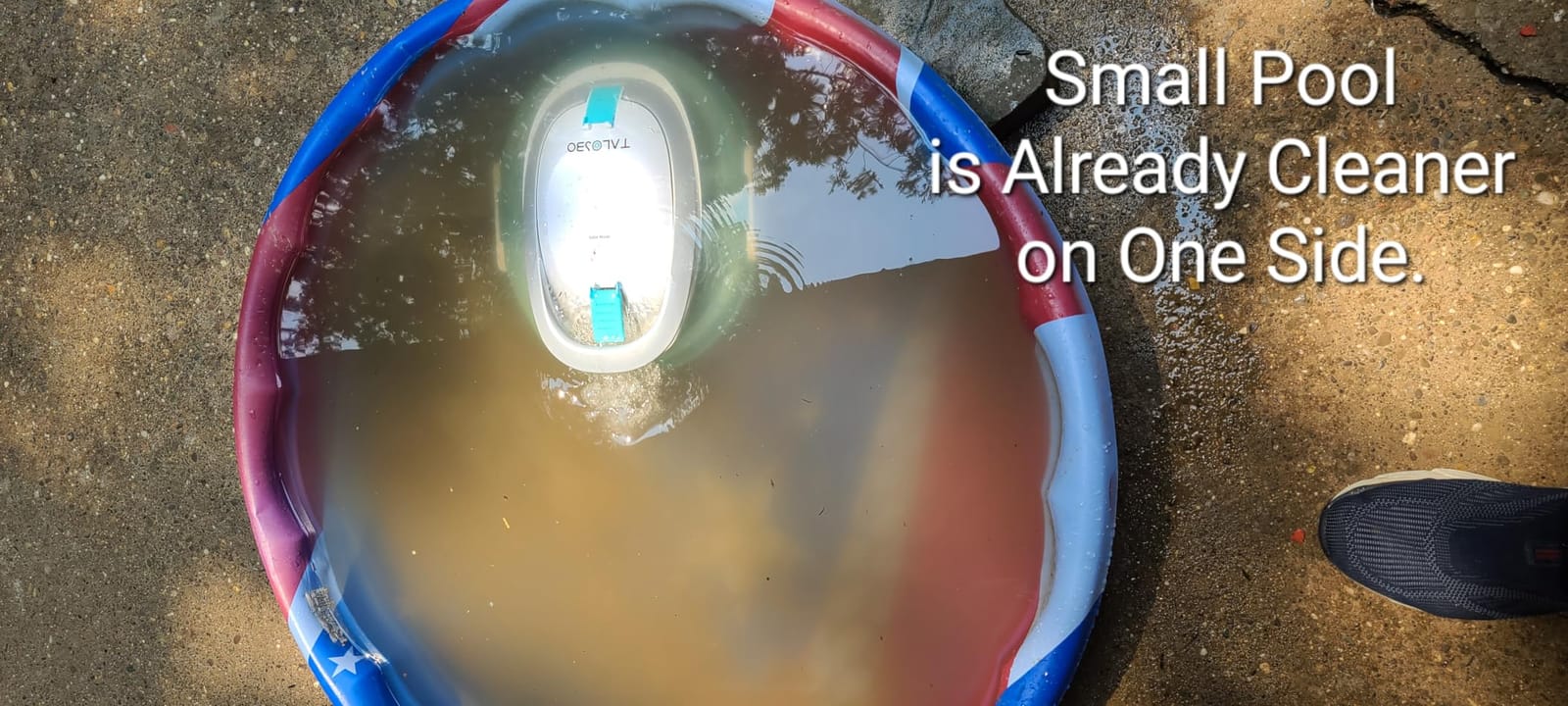
What this budget robot covers, and what it gives up
The BRINBO S2 covers 861 square feet in 90 minutes, filters in two layers, and parks itself often enough to be useful. For a 12 foot to 16 foot round pool running two or three times a week in summer, that is the whole job done.
What you give up is wall climbing, reliable parking, and filter capacity under sand. None of those matter if your pool is flat, small and shaded by a patio rather than a tree canopy. All of them matter if you have a 20 foot pool next to a maple.
Who should skip it
Skip it if you run a lot of sand or dust into the pool, because the filter will need emptying more often than the 90 minute cycle assumes. Skip it if you need to finish a full pool in a single run and cannot wait out a three-hour recharge. And skip it if your pool has a bottom main drain, which this one is not built for.
One practical note: the charge port is proprietary rather than USB-C, so a lost cable means a support request. The foam sponge needs careful rinsing, because debris that gets back into the pump is the other recurring complaint.
6. BOTLIFE PC10 – Wall Climbing That Actually Works on a Flat Pool
BOTLIFE PC10 Cordless Robotic Pool Vacuum for Inground & Above Ground Pools
5000 GPH suction
120-min runtime
1,830 sq. ft.
4L basket
Floor wall waterline
Pros
- 5000 GPH is 2.5 times the entry-tier suction
- Climbs walls and scrubs the waterline
- Three modes including floor-only
- S-path and N-path navigation cuts missed spots
- Top-loading 4L basket rinses clean
Cons
- Track drive is heavier than wheeled models
- Longer recharge than entry-level robots
This is where the category splits. Everything before it in this roundup is a floor machine that treats walls as optional. The PC10 genuinely climbs, genuinely scrubs the waterline and routes deliberately across the floor in an S pattern, and it does all of that for 120 minutes on a 5200mAh pack. About 73 percent of ratings are five stars, the highest share of the wall-climbing group.
Suction is the headline at 5000 GPH from dual drive motors plus a dedicated pump, with two active brushes working the floor. On a pool with a swim shelf or a tanning ledge, the brushes reach the horizontal surfaces that a suction-only machine cannot. The tracks handle transitions and slopes up to 30 degrees, which makes this the most forgiving robot here if your above ground pool has any depth change at all.
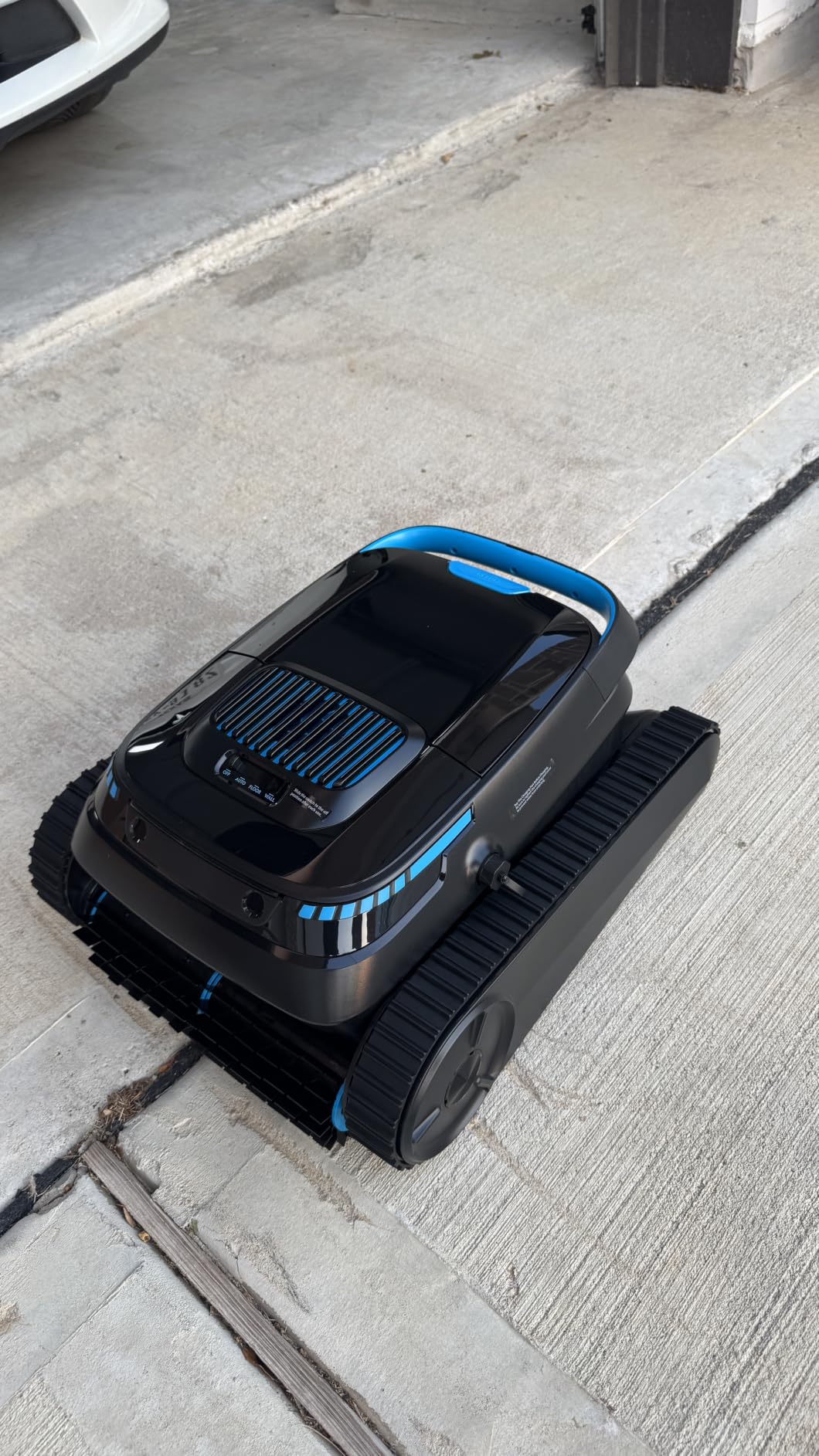
Three cleaning modes matter on an above ground pool because the floor is not the whole job. The floor-only mode runs a shorter pass for everyday debris, while the full pool and wall modes add the waterline, which is where dirt and biofilm collect along the liner edge.
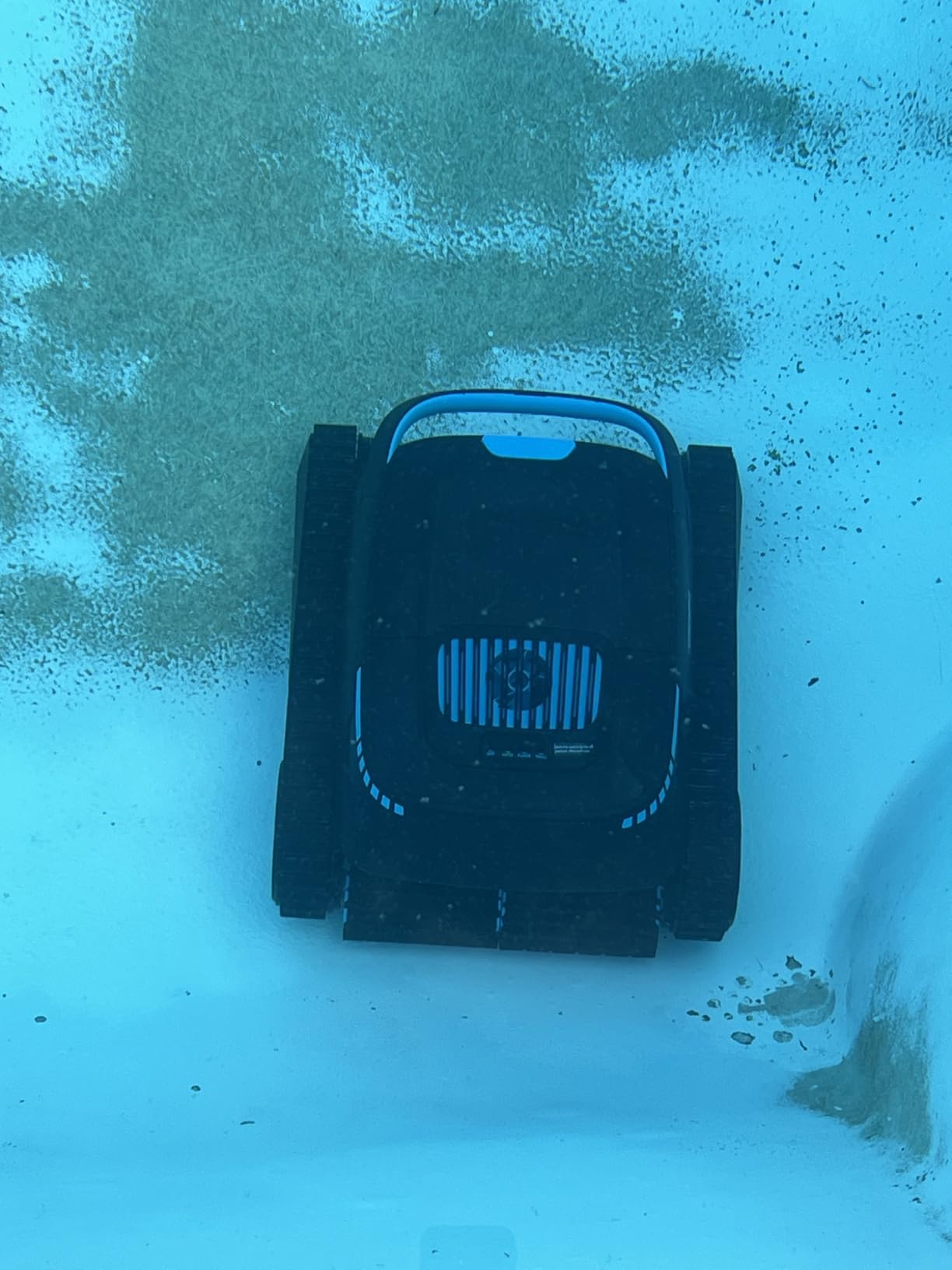
Floor-only mode is the reason this is worth the extra money
Most owners of a wall-climbing robot end up running it floor-only most of the time and saving the wall cycle for opening week and closing week. On a flat above ground pool with a 30 or 40 minute floor pass, that uses a fraction of the battery and leaves time for a second run.
The waterline mode still earns its place twice a year. In spring, it removes the dirt and biofilm that collect at the water line over winter. In autumn, it gets the band of leaves that pile up where the liner meets the water before they stain.
If your pool has steps or a deep end, the tracks and the 30 degree slope rating are worth more to you than wall climbing. This machine will cross a transition that stops wheeled robots cold.
Who should skip it
Skip it if your pool is 12 foot round and has no steps. You will be paying for suction and coverage you never use, and the track drive is heavier to lift than anything else in this group except the larger PC10 variant.
Also weigh the recharge. At roughly 2.5 hours it is longer than the entry-tier machines, so plan on one or two cycles a day rather than three. And note the basket is top-loading, which is a genuine convenience that shows how the pack is put together.
7. BOTLIFE PC10 Large – The Same Platform at 12 Pounds
Cordless Robotic Pool Vacuum Cleaner for Inground & Above Ground Pools
5000 GPH suction
120-min runtime
1,830 sq. ft.
12 lb
4L basket
2-yr parts
Pros
- Same 5000 GPH platform with wall and waterline modes
- Track drive handles 30 degree slopes and transitions
- 1830 sq. ft. covers the largest pools here
- 4L top-loading basket is easy to rinse
- Spare part support listed at one year
Cons
- Heaviest machine in the roundup at 12 lb
- Longer recharge than wheeled flat-pool models
- Price jump over the smaller PC10 for similar output
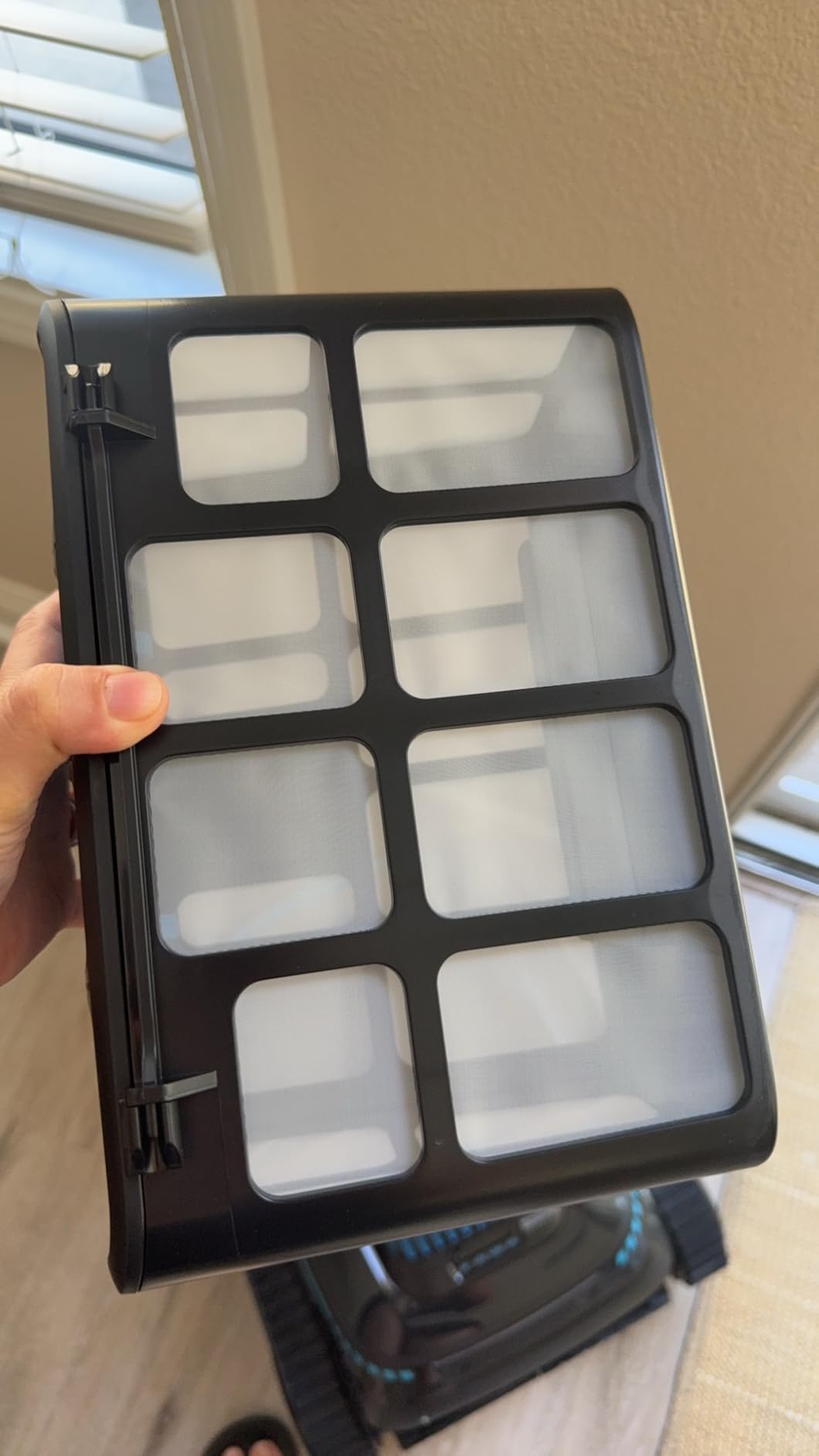
This is the same cleaning platform as the PC10 above, listed separately and heavier at 12 pounds with a stated item weight. If you already read that section, the suction, runtime, coverage and navigation are identical at 5000 GPH, 120 minutes and 1,830 square feet. What differs is handling and how the machine sits in a deep pool.
Twelve pounds matters more than the spec sheet suggests. Dry it is manageable. Waterlogged, coming up from a twelve-foot deep end in a metal frame pool, it is a genuinely awkward lift. The tracked design and the 5200mAh pack account for most of the weight, and there is no floating handle or retrieval line to make it easier.
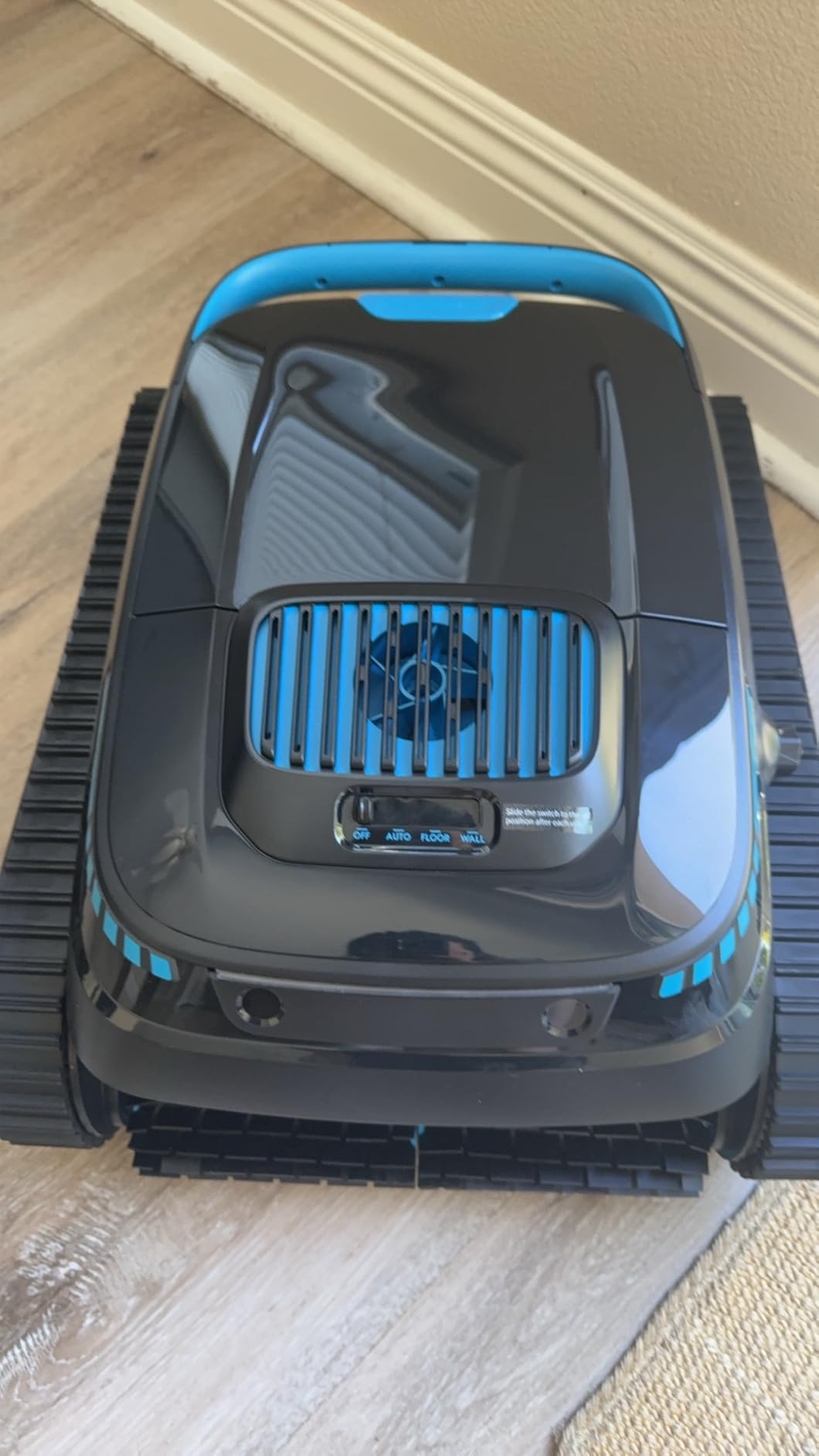
The tracks are what justify the weight when a pool has a deep end. A machine that climbs a 30 degree slope will find its own way back toward a shallow end far more often than a wheeled robot that stalls at the bottom of the slope, and every stall costs you a manual retrieval.
When a bigger, heavier robot is the right call
Weight is a fair trade when your pool has a deep end. A robot that climbs a 30 degree slope and drives across a transition will find its own way to a shallow end more often than a wheeled machine that stalls at the bottom of the slope. Every stall costs you a manual retrieval.
The large 4L basket is the other reason to prefer this listing if your pool collects a lot of leaves. Fewer mid-cycle emptyings on a pool that is 1,830 square feet adds up over a season, and a bigger basket means a heavier lift, so the two considerations partly cancel out.
Who should skip it
Skip it if you are the only person lifting the robot and your pool has a deep end. Skip it for a small flat pool, where the size advantage is wasted. And if you are choosing between the two PC10 listings, the deciding question is retrieval, not cleaning, because the cleaning specs are the same.
Charging is listed at both 2 hours and roughly 2.5 hours depending on the field, so treat the longer figure as the realistic one. Spare part availability is listed at one year, which is worth checking against any pool equipment you already own.
8. EZIOOV Y20 – The Highest Rating and the Smallest Review Base
Y20 Robotic Pool Cleaner, Cordless Pool Vacuum for Above & Inground Pools
1500 GPH suction
150-min runtime
1,300 sq. ft.
6.6 lb
180 micron mesh
Pros
- Highest average rating of the flat-pool machines with 100+ ratings
- 150 minutes is the longest flat-pool runtime here
- Zigzag path at 40 ft per minute covers fast
- 6.6 lb with quick-drain and a floating handle
- 180 micron mesh traps fine silt
Cons
- Floor-only cleaning
- Not for walls or waterline
- Small 2.2L basket needs frequent emptying
- Only 35 ratings behind the score
Here is the honesty problem with reviews in this category, in one product: the Y20 carries a 4.8 average with 97 percent five stars, and it also carries 35 ratings. The next machine in this roundup has 240, so a 4.8 from 35 people is promising rather than proven, and we will not pretend otherwise.
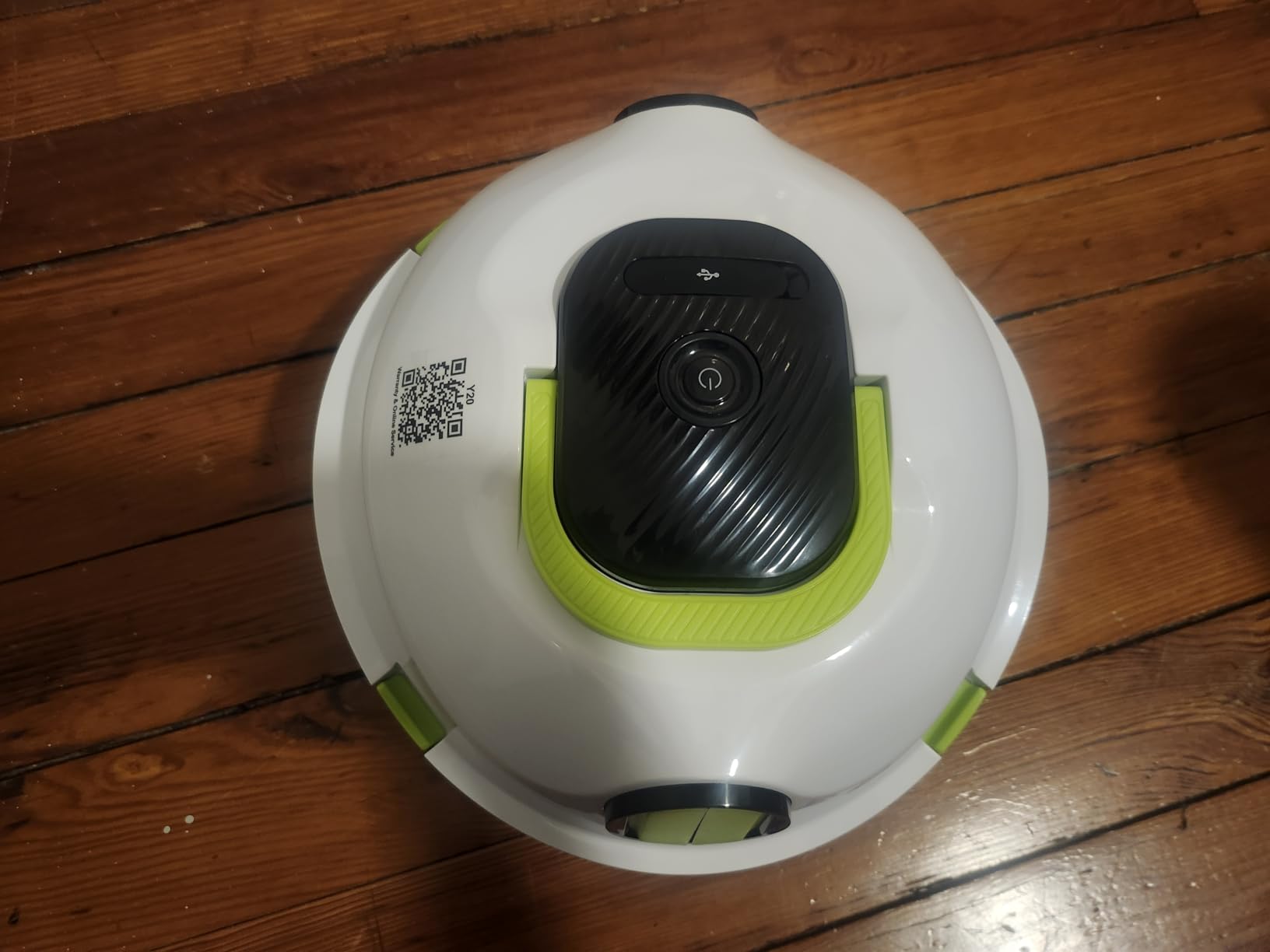
Setting the sample size aside, the machine is well specified. 150 minutes of runtime on a 5200mAh pack is the longest floor-only figure here, the zigzag path moves at 40 feet per minute, and the 180 micron mesh is fine enough to hold the silt and dust that settles on a liner. It is rated safe for vinyl, fiberglass, mosaic tile and PVC liners, which covers essentially every above ground pool on the market.
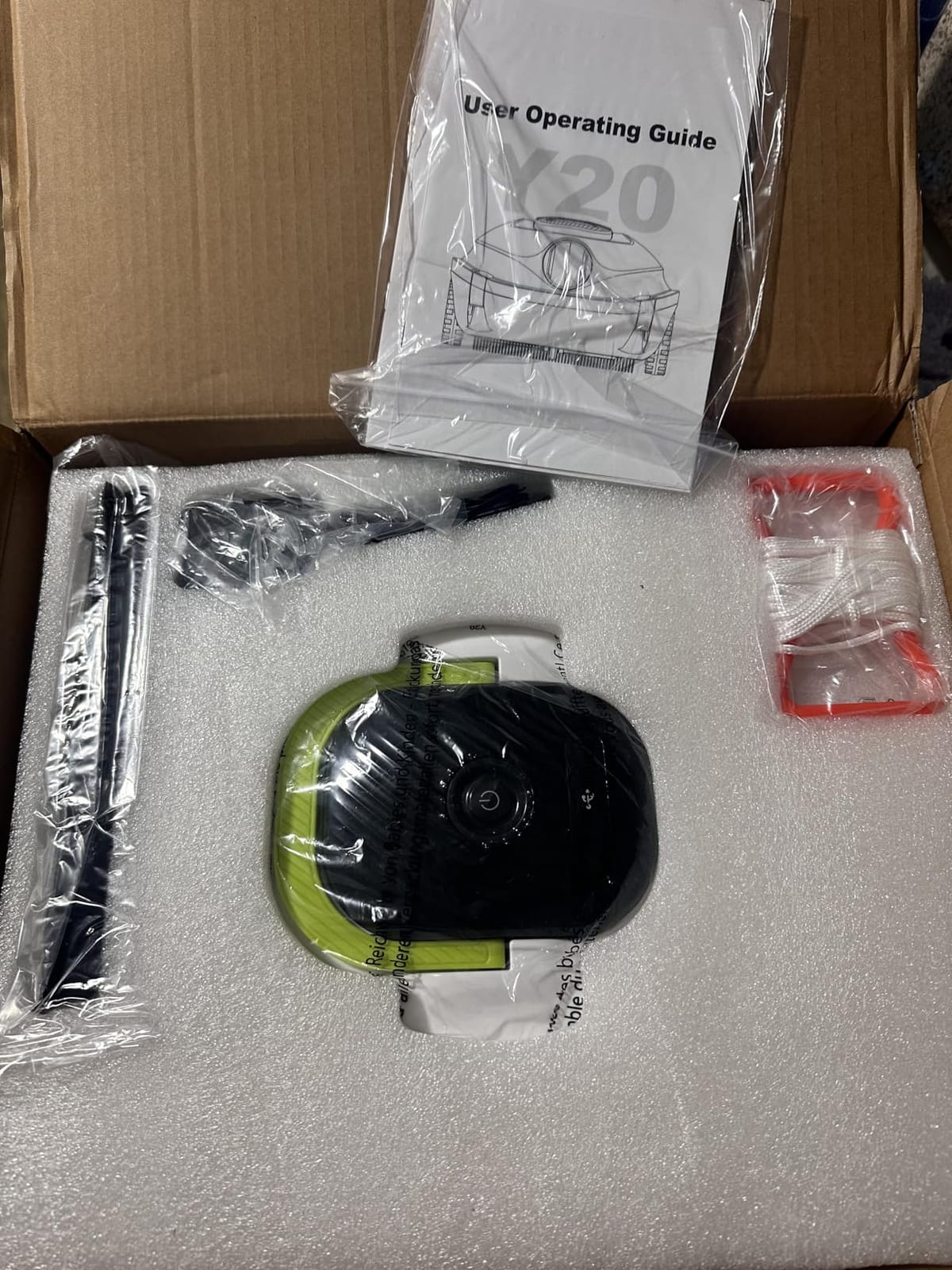
The quick-drain design is worth pausing on, because water inside the body is what makes a robot heavy. Draining fast matters most in a fine dust pool, where you may need to empty and restart the cycle more than once in a session.
Sand and dust versus leaves
The floating handle and quick-drain design are what make this one interesting for a sand-bottom pool. At 6.6 lb it is the second-lightest machine here, so when a fine silt load means you need to stop and empty the basket halfway through, you can do it quickly and get back to work.
The 2.2L basket is the compromise. It is roughly half the capacity of the wall-climbing machines, so a heavy silt load means two emptyings instead of one. In exchange you get a machine that is a fraction of the weight and runs 20 minutes longer per charge than the next-longest flat-floor unit.
It is built for flat bottoms with slopes under 15 degrees. No wall climbing, so a swim shelf or steps will be missed entirely.
Who should skip it
Skip it if you want an established track record, because 35 ratings is thin and this brand is small. Skip it if you have a pool with a deep-end transition or a slope over 15 degrees. And skip it if leaf load is the problem, because 1500 GPH is modest next to the 5000 and 6800 GPH machines here.
It is a limited warranty, so check the terms before you buy. For a pool that is 12 to 18 foot, flat, and dusty rather than leafy, the runtime and the weight make it a genuinely good option to watch.
9. CZYBYTE App Robot – App Control Without the Premium Price
CZYBYTE Cordless Robotic Pool Vacuum Cleaner, APP Support,Orange
4500 GPH suction
120-min runtime
2,000 sq. ft.
App control
4L basket
Pros
- App control and OTA updates at a mid-range listing
- 4500 GPH brushless suction
- Parks above the water surface when finished
- 4L top-loading basket with 150 micron mesh
- Adjustable suction power
Cons
- Latches are stiff and hard to re-close
- Heavy for a lift-out unit
- Filter replacement interval unclear
- App installs from a QR code
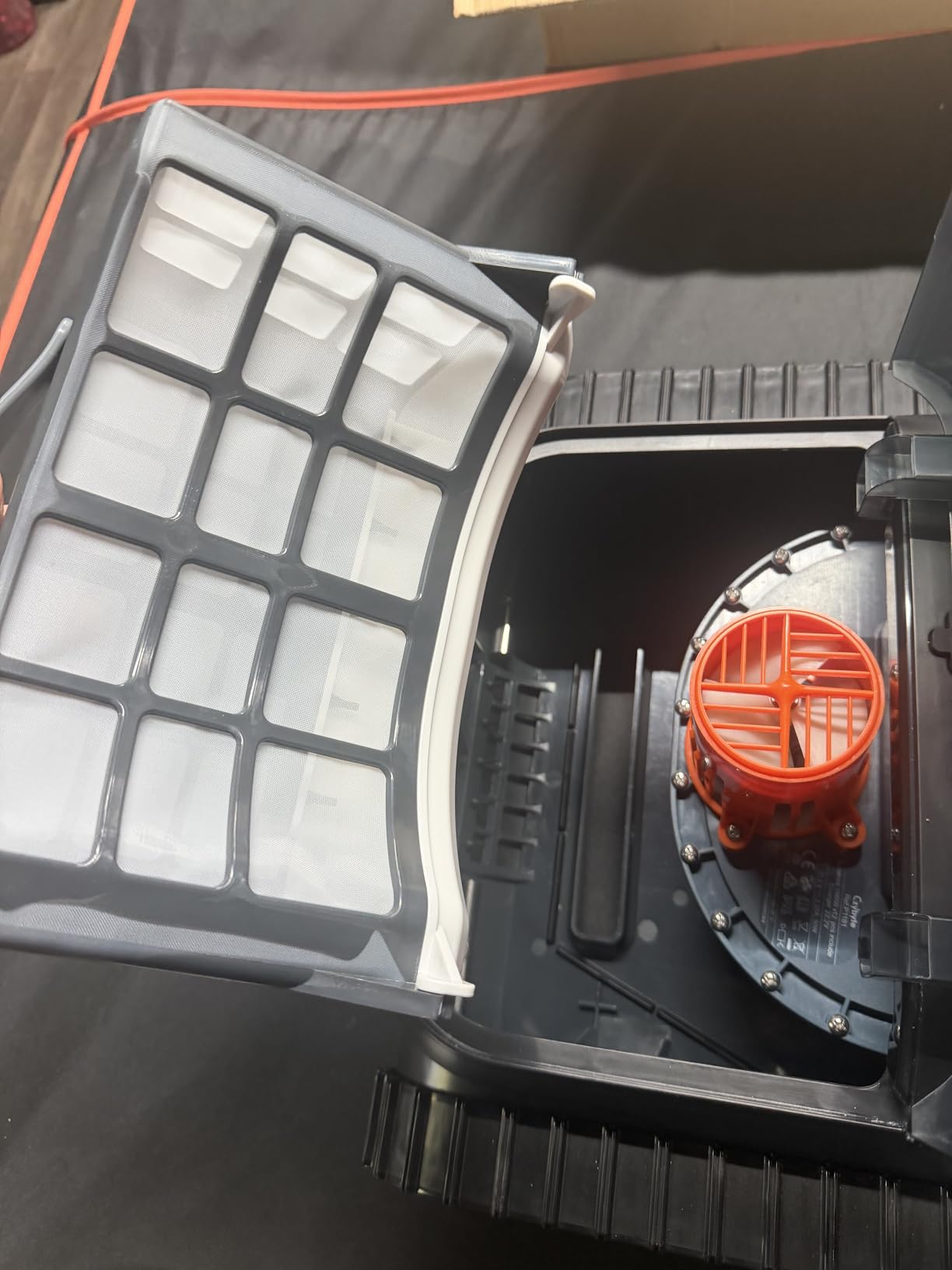
App control usually means paying twice as much. This one pairs Wi-Fi control and over-the-air updates with 4500 GPH of brushless-motor suction and a 150 micron mesh basket, and it parks above the water surface when the cycle ends or the battery runs low, which solves the single most common complaint about the wall-climbing group.
Parking above the waterline is the detail that sets it apart. When a robot finishes at the water surface rather than in the middle of the pool, you are reaching down and lifting, not chasing it with a pole. On an above ground pool where you may be standing on a ladder, that difference is worth more than it sounds.
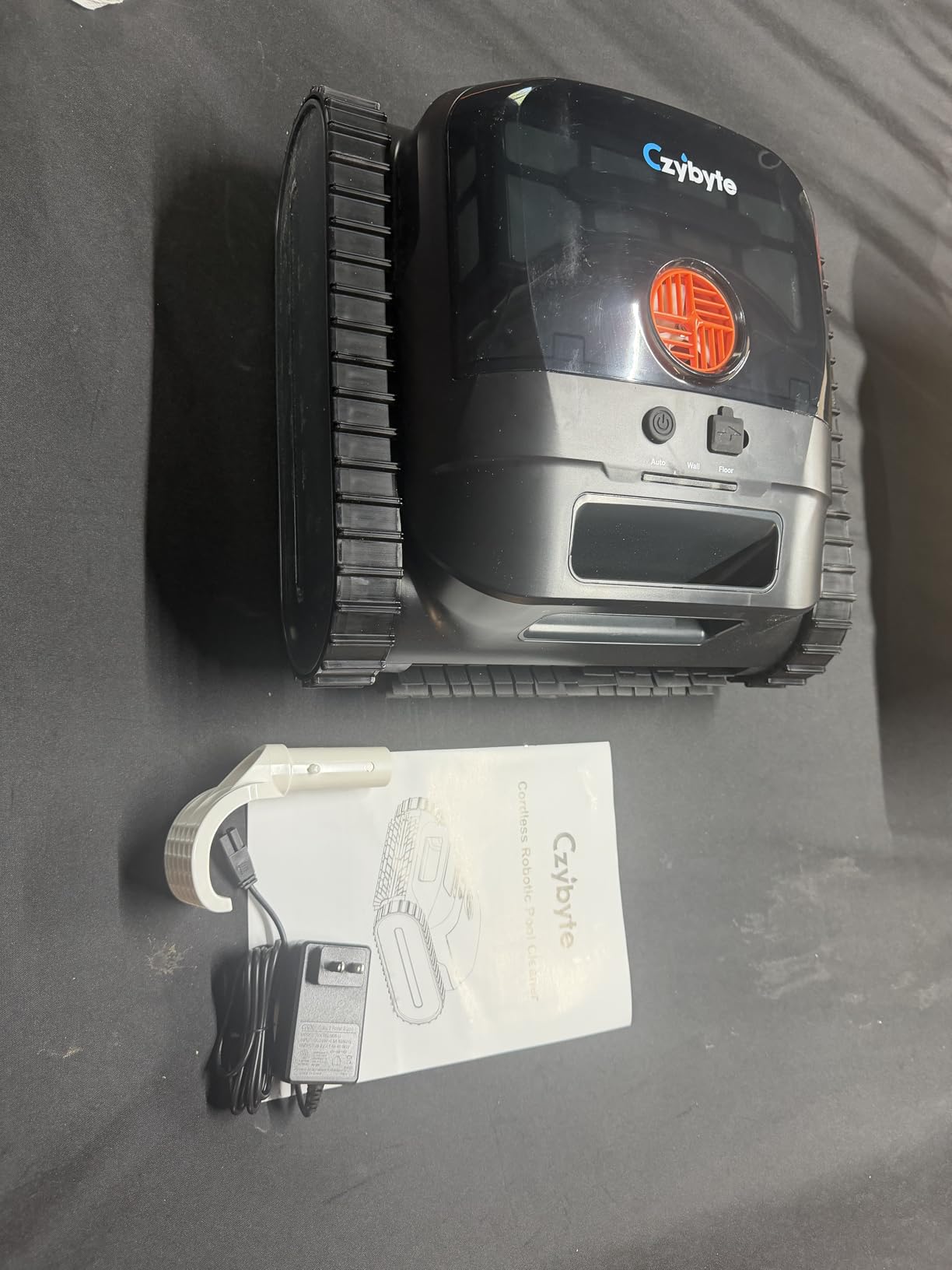
The charge port needs its cover fitted before submersion, which sounds trivial until you submerge it without and the unit refuses to power on. It is a two-second habit once you know it, and it is in the listing rather than buried in a manual.
What app control is actually worth
The useful parts are scheduling a cycle while you are away, checking battery state remotely, and driving the machine manually to a spot it missed. Those are real conveniences. What an app cannot do is make a robot clean a wrinkled liner or get a machine unstuck from a step, and plenty of buyers overvalue the screen and undervalue the suction.
Route planning here is S-shaped, which is a genuine step up from random navigation for even floor coverage. Adjustable suction power lets you drop it down for a delicate liner or raise it for a sand patch, which is a small feature that matters on above ground liners.
Who should skip it
Skip it if you dislike dealing with an app at all. The app installs from a QR code rather than a standard store link, and some units arrive with no charging indicator light when the cord is connected, which is a support question rather than a dealbreaker but worth knowing.
The latches are the most repeated physical complaint, described as very hard to snap back together after cleaning. If you will be opening this four times a week, that friction adds up. The round filter design is also unfamiliar enough that the replacement interval is unclear, and filters are a consumable you will eventually need.
10. Beatbot Sora 10 – Longest Runtime and Largest Basket Here
Beatbot Sora 10 Cordless Pool Vacuum Robot for Inground & Above Ground Pools, 6800 GPH Suction, Floor/Wall/Waterline/Shallow Area Cleaning, Waterline Parking, 300 Mins Runtime Royal Blue
6800 GPH suction
300-min runtime
3,229 sq. ft.
5L basket
2-yr warranty
Pros
- 300 minutes is the longest runtime in this roundup
- 6800 GPH handles heavy leaf loads
- 5L basket holds up to 650 leaves
- 4-zone cleaning down to 12 inches
- Saltwater safe below 5000 ppm with 2-yr protection
Cons
- Self-parking is unreliable and often mid-pool
- Misses curved corners and stairs
- 10.5 kg weight is a hard lift from a deep end
- Shell scratches easily
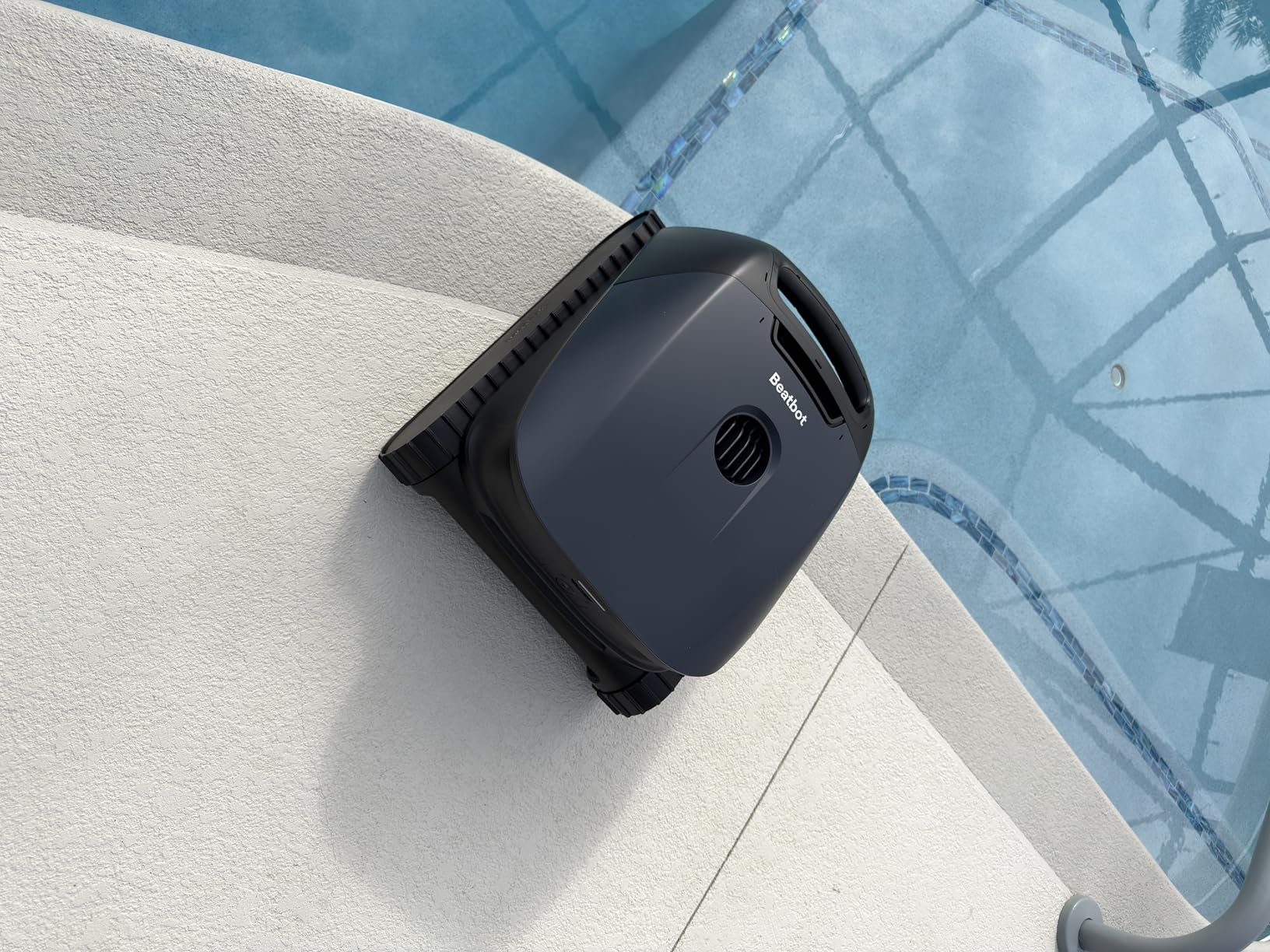
At 6800 GPH and up to 300 minutes per charge, the Sora 10 is the only robot here rated for pools of 3,000 square feet and beyond, and the 5 liter basket is rated to hold around 650 leaves. Reviewers report it outperforming robots costing considerably more, particularly under heavy leaf load.
The four-zone cleaning is what separates it from the floor-and-wall group. It works the floor, the wall, the waterline and the shallow areas down to 12 inches, and it is specifically designed to handle tanning ledges and sun shelves, which is the part of an above ground pool that floor-focused robots miss completely. Wi-Fi and Bluetooth app control comes with OTA updates, and optional 3 micron filtration is available for fine dust.
Saltwater and two-year coverage
The unit is rated saltwater safe below 5000 ppm NaCl with a two-year protection period, which is the longest warranty in this roundup by a wide margin. If your above ground pool runs a salt system rather than chlorine, most of the cheaper cordless machines are a poor long-term bet because the electronics and the pump seal corrode.
That warranty also matters for battery support. Lithium-ion packs in sealed robots are typically not user replaceable, so a two-year commitment is a meaningful difference against a one-year warranty when you are choosing between two otherwise similar machines.
Who should skip it
Skip it if lifting the robot is a two-person job. The item weight is 10.5 kg and the battery alone is 938 g, so coming out of a deep end is real work. The weight is shipping weight rather than a wet lift weight, but owners still describe it as heavy for above ground handling.
Skip it if you rely on self-parking. Waterline parking that holds position for ten minutes sounds ideal and often fails, which leaves the machine in the middle of the pool. There are other complaints too: it misses curved corners and stairs, sometimes re-engages the impeller when lifted, and the top lid is hard to confirm as fully latched.
For a very large above ground pool under trees, it is the strongest cleaner in this roundup. For a 14 foot round pool, it is far more machine than the job needs.
Match Your Above Ground Pool Diameter to the Right Robot Coverage
Above ground pools are sold by diameter and robots are rated by square feet, and almost nobody converts between the two. Here is the conversion, using the standard assumption of about 0.81 gallons per square foot of surface for a round pool at typical depth.
12 ft round – roughly 113 sq ft of floor, about 1,500 gallons. Any machine in this roundup covers it, often several times over in one cycle.
14 ft round – roughly 154 sq ft, about 2,000 gallons. Still within every machine’s rating, including the 861 sq ft budget units.
16 ft round – roughly 201 sq ft, about 2,600 gallons. The most common size in this roundup, and the sweet spot where runtime starts to matter.
18 ft round – roughly 254 sq ft, about 3,300 gallons. Comfortable for the 1,100 and 1,300 sq ft machines.
20 ft round – roughly 314 sq ft, about 4,100 gallons. Now runtime is the constraint, not coverage.
24 ft round – roughly 452 sq ft, about 5,900 gallons. Only the longest-runtime machines finish in one pass.
Rectangular frame pools – 16 by 32 is about 512 sq ft, and 18 by 36 is about 648 sq ft. These are where the 1,614 and 1,830 sq ft ratings earn their keep.
One rule of thumb: pick a machine that finishes your pool in one charge with twenty percent to spare. A robot that covers eighty percent and dies still needs a two to three hour recharge before the second pass, which is where cordless cleaning starts to feel slow. If your pool has a deep end, add the deep-end floor area to your estimate and subtract the swimmable area you do not need cleaned.
Water chemistry still matters for the cycle you run. Keeping the pool filtered on a sand filter between robot runs reduces how often you need the robot at all, and a pool that circulates cleanly needs a shorter cycle. If you are running a salt system, note the ppm limits on each machine before you commit.
Cordless vs Corded vs Hybrid: The Disagreement Explained
You will find sharply conflicting advice online about this, and it is worth naming the disagreement rather than picking a side silently.
Retailer advice: several pool robot retailers advise above ground owners to avoid cordless entirely, arguing that battery units need daily charging and deliver weaker suction than corded machines. Their picks are usually corded.
Manufacturer advice: brands selling cordless units describe the format as ideal for above ground pools, pointing out that there is no cable, no transformer and no outlet to run.
Owner reports: forum owners consistently land in the middle. Cordless works well on a flat pool, the suction difference is real but rarely decisive, and the cord-free convenience is the feature people end up recommending to friends.
Our read matches the owners. The retailer argument is strongest for in-ground pools with deep ends, steep transitions and tile, where corded suction and a long cable have real justification. On a flat vinyl above ground floor, the difference shrinks to something you are unlikely to notice, and you gain the single biggest quality-of-life improvement in pool cleaning.
Hybrid robots, which add a low-voltage cable for a light top-up before parking, are a middle path worth considering if you want the retrieval guarantee of a corded machine without running a full-length cable all season. We did not include one here because the cordless models in this roundup now cover the above ground sizes these pools actually come in.
Vinyl Liner, Steps and Drain Compatibility Warnings
Every mainstream above ground pool brand we looked at is vinyl lined with a flat floor: Bestway and Power Steel, Intex, Coleman, Steelite and Summer Wave. That is good news for cordless robots, because a flat liner is the easiest surface to clean and the safest for plastic wheels. It is also where the failure modes concentrate.
A pool that has been stored collapsed will have folds in the liner for weeks after reassembly. Wheels drop into the fold and the robot sits there until the battery dies, which is why both the WYBOT A1 and the EZIOOV Y20 are explicitly not for significant wrinkles. The fix is to walk the liner flat with a shop vac before the first run.
Pool steps. Ladder steps inside the pool are the single most common stall point across this whole category, because a robot that climbs a step sometimes gets over it and sometimes wedges under it. Either way you are reaching into the water with a pole, so budget for occasional manual retrieval no matter which machine you buy.
Raised drains and main drains. Above ground pools rarely have a bottom main drain, which is one reason these flat-pool machines work so well. The BRINBO S2 is explicitly not for in-ground pools with a main drain. Where a drain fitting or a raised fitting does exist, a robot that cannot cross it will circle it forever.
Deep-end retrieval. This is the physical problem nobody warns you about, because a waterlogged cordless robot in a twelve-foot deep end is heavy and the machines with the biggest batteries and tracks are the heaviest. A floating handle, as on the EZIOOV Y20, or a retrieval line you buy separately, changes this completely. Our above ground pool ladder picks cover the retrieval side of getting in and out safely.
Liner safety. Modern cordless robots use soft rubber wheels and plastic brushes, none of which will scratch a vinyl liner under water. The risk comes from metal components and from running a robot on a dry liner, which no one should do. Keep water chemistry steady, and avoid superchlorinating while a robot is in the pool.
It will not remove algae, polish a stain or balance your water: one owner with a 24 foot pool described watching the robot roll over an algae patch on the bottom. Treat it as a debris machine and run it after you have cleaned up green water, not instead of cleaning up green water.
How to Choose a Cordless Robot for an Above Ground Pool
1. Start with coverage, not features. Measure your pool’s floor area using the diameter conversion above, then pick a machine rated comfortably above it. Coverage ratings here range from 861 to 3,229 square feet for pools that are typically 113 to 648 square feet, so almost anything will fit. Coverage is the least useful way to separate these machines.
2. Make runtime finish the job in one pass. This is the number that decides whether cordless feels fast or feels like a chore. Aim for a machine that completes your pool in one charge with margin. Flat-floor machines here run 90 to 150 minutes; the wall-climbing machines run 120; the Beatbot runs 300. On a 16 foot pool, 130 minutes is comfortable. On a 24 foot pool, 90 minutes is not.
3. Count the recharge before you fall for the runtime. Charge times run from 2 to 2.5 hours on the mid-tier machines to over three hours on the budget units. Two machines with 120 and 150 minute runtimes can be very different in practice if one needs three hours between cycles and the other needs two. Decide how many cycles a day you actually want.
4. Buy suction proportional to your debris. The 1320 to 2280 GPH machines handle everyday leaves and dust on a flat floor. The 4500 to 6800 GPH machines earn their money on heavy wet leaf loads, sand and on pools with steps and shelves. The wide suction inlet matters as much as the GPH number, because it is what determines whether a leaf goes in or gets pushed around.
5. Look at the second filter layer. A single mesh basket passes fine silt back into the pool and clogs twice as fast. Dual-layer setups, 180 micron mesh over foam or cotton, are the reason the budget machines in this roundup hold up as well as they do. The wall-climbing group uses 150 micron mesh in a larger 4 or 5 liter basket. Micron fineness below 150 is available as an optional upgrade on the Beatbot.
6. Treat navigation as a real feature, not a spec. Random or blind navigation leaves patches behind and is fine for a small pool. S-path and N-path routing, or a zigzag pattern, covers a large floor evenly. On a big pool, mapped navigation is worth more than any extra suction.
7. Plan for retrieval before you fall in love with the battery size. Check the weight, look for a floating handle, and confirm a retrieval hook is included. The 938 g battery in the Beatbot and the 12 lb BOTLIFE variant both turn a one-person lift from a deep end into a job. Weight is the specification that owners complain about two seasons later.
8. Check warranty and battery support last, but do check it. Most batteries in sealed cordless robots are not user replaceable, so the warranty length is your real end-of-life clock. The Beatbot carries two years; several entry machines carry one. Check whether spare parts and filters are sold separately, and whether the filter is a standard part or a proprietary one you can only buy from the brand.
Two final checks before you buy. Read the exclusion list, not the feature list, because several machines here are explicitly not for slopes over 15 degrees, wrinkled liners or in-ground pools with main drains. And if you run a salt system, confirm the machine is rated for your ppm level.
Frequently Asked Questions
Do robotic pool cleaners work in above ground pools?
Yes. Above ground pools are flat-bottomed and vinyl-lined, which is exactly the environment floor-focused cordless robots are designed for. Choose a robot rated for your pool’s square footage, keep the floor free of big wrinkles, and expect it to handle leaves, sand and dust well. Wall climbing is usually unnecessary because the walls are shallow.
What is the best cordless vacuum for an above-ground pool?
For pools under 1,100 square feet, a mid-priced unit with 90 to 130 minutes of runtime and self-parking covers a full cycle in one charge. Our top pick, the Aiper Seagull SE, covers 860 square feet with 100 minutes and parks reliably. The BRINBO S2 covers a similar area as the lowest-cost option in this roundup.
What is the best robotic cleaner for an above-ground pool?
The Aiper Seagull SE is our overall pick because it has the largest review base in the category and self-parks reliably. The BRINBO S2 is the budget option, the PoolMr covers the most square footage of any entry-level machine here, and the Beatbot Sora 10 handles the largest pools and heaviest leaf loads.
Are cordless pool cleaners better than corded?
Not for raw suction, which is generally weaker than a corded machine. On a flat vinyl above ground floor, that difference rarely matters, and cordless wins on convenience because there is no cable to drag across the deck. Corded units still make more sense for deep in-ground pools with steep transitions.
How long does a cordless robotic pool cleaner run?
Roughly 90 to 150 minutes per charge on flat-pool models, and up to 120 minutes on wall-climbing models, with 300 minutes on the premium Beatbot. Brush and wall modes use power faster than the maximum figure, so verify the robot covers your pool in one charge rather than trusting the headline runtime.
Will a robotic pool cleaner scratch my vinyl liner?
Not with modern soft rubber wheels and plastic brushes, which are standard on all ten models here. The real risks are metal components, which are rare, and running a robot on a dry or badly wrinkled liner, which no one should do. Keep water chemistry steady to protect the liner surface.
How often should I run a cordless robotic pool cleaner?
Two to four runs per week during swimming season, and more often if the pool sits under trees. Rinse the filter basket after every cycle, since a clogged filter reduces suction and shortens runtime. Emptying the basket mid-run on a sand-heavy pool is normal.
Which Cordless Pool Robot Should You Buy?
Buy the Aiper Seagull SE if you want the safest default: the largest review base, reliable self-parking and a 7.5 pound body that one person can lift out of a deep end. Buy the BRINBO S2 if you want the same basic job for the least money. Buy the PoolMr if your pool is 20 feet or larger or has wrinkles and drains the machine needs to cross. Buy the WYBOT A1 for the longest runtime in the budget tier and the best two-layer filtration for silt. Step up to the BOTLIFE PC10 or the CZYBYTE if you have steps, a deep end or a waterline that needs scrubbing, and to the Beatbot Sora 10 if you have a very large pool under heavy leaf cover and a two-year warranty matters to you.
Whatever you pick, walk the liner flat before the first run, check the exclusion list against your pool’s slope, and expect a floor machine to be the right answer for most above ground setups. As of 2026, the cordless category has closed the gap with corded machines on the flat floors that define this kind of pool.
While you are setting up, our solar pool heater picks keep the water warm enough to actually use the pool you are cleaning, and our broader above ground cleaner guide covers the corded options if your pool has a slope that a battery robot cannot handle.