
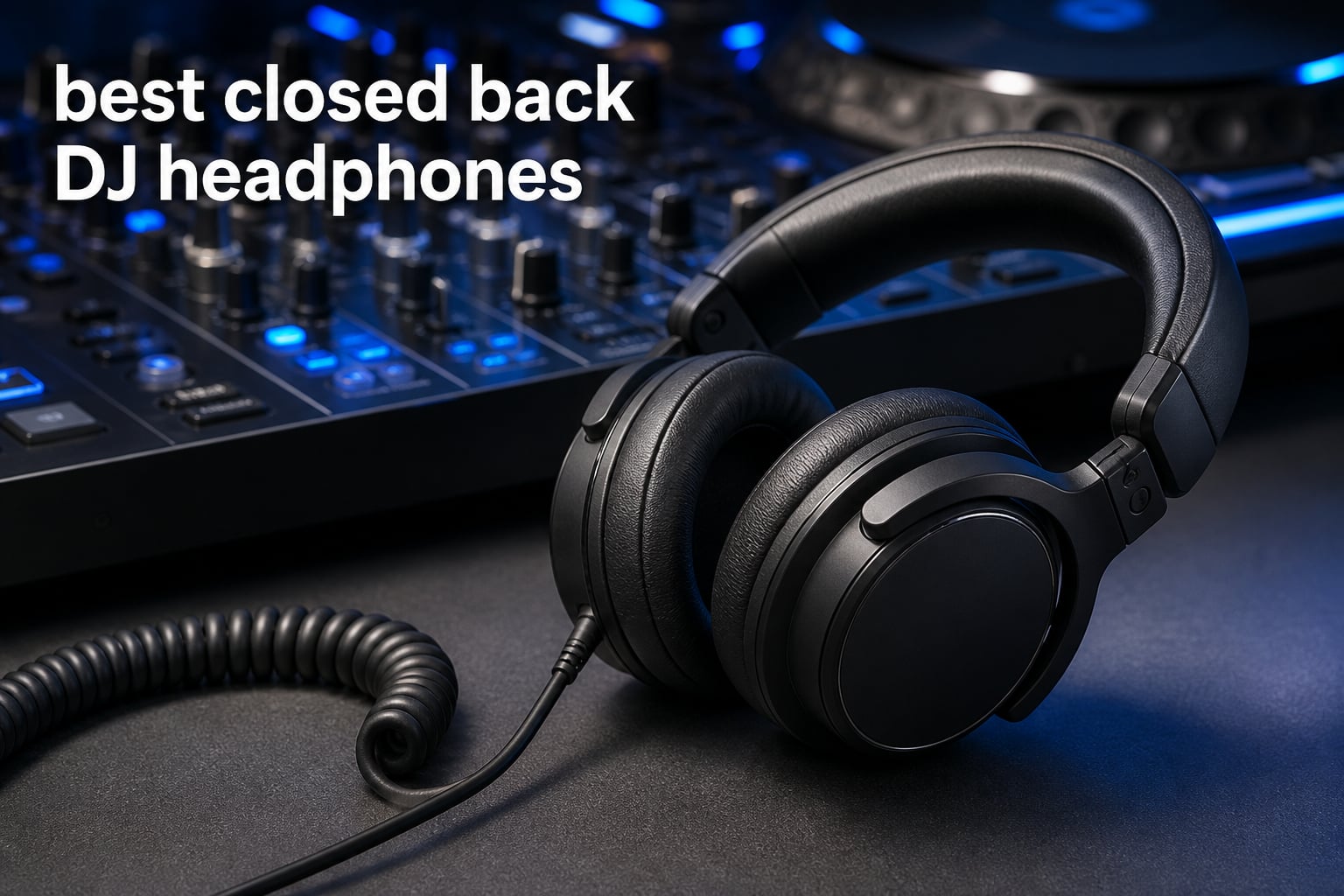
The best closed back DJ headphones let you hear a cue track when the room is loud, then stay comfortable when a practice session runs long. For this roundup, I would start with the beyerdynamic DT 770 Pro X if you want an over-ear monitoring pair with a detachable locking cable, soft velour pads, and replaceable components.
Closed-back headphones use sealed earcups to reduce the sound reaching your ears from speakers and people around you. That isolation matters when beatmatching: you need to hear kick transients, phrasing, and the incoming track without turning the cue level excessively high.
I compared the ten selected wired models by their verified driver and impedance data, cable setup, cup movement, weight where published, stated isolation design, and marketplace review feedback. This is not a laboratory test report, so I separate confirmed specifications from editorial fit recommendations rather than pretending every claim is a measured result.
There is no single shape that works for every DJ. Club DJs usually benefit from firm isolation, a secure cable, and a cup that moves for one-ear cueing; home DJs may put more weight on spacious monitoring, comfort, and an easy connection to a controller or audio interface.
All ten choices below are wired. That is deliberate: forum discussions repeatedly flag wireless latency as a beatmatching problem, while a physical cable gives a controller’s cue output a direct, predictable path.
Top 3 picks answer the main DJ needs in 2026
The DT 770 Pro X is my broad monitoring recommendation, the FIFINE H8 pairs useful DJ-friendly basics with the largest review base here, and the Technics EAH-DJ1200 is the focused choice for DJs who routinely monitor with one ear. Each has a different fit philosophy, so the quick cards are a starting point rather than a substitute for the full sections.

Best closed back DJ headphones in September 2026 at a glance
This overview keeps the decision points visible: over-ear designs generally spread pressure around the ear, while the Technics uses a light on-ear build and a 270-degree swivel. Check the full review before choosing, especially if one-ear monitoring or a removable cable is a non-negotiable feature for your setup.
| Product | Specifications | Action |
|---|---|---|
| beyerdynamic DT 770 Pro X |
|
Check Latest Price |
 FIFINE H8 FIFINE H8 |
|
Check Latest Price |
 Technics EAH-DJ1200 Technics EAH-DJ1200 |
|
Check Latest Price |
 V-Moda M-10 V-Moda M-10 |
|
Check Latest Price |
 Sennheiser HD 620S Sennheiser HD 620S |
|
Check Latest Price |
 MAONO MH700 MAONO MH700 |
|
Check Latest Price |
 DOQAUS HD1 DOQAUS HD1 |
|
Check Latest Price |
 JOYO JMH-02 JOYO JMH-02 |
|
Check Latest Price |
 NUBWO HD01 NUBWO HD01 |
|
Check Latest Price |
| SEJJ EMR100 |
|
Check Latest Price |
1. beyerdynamic DT 770 Pro X is the strongest monitoring-led pick
beyerdynamic DT 770 Pro X (48 Ohm), Closed-Back Studio Headphones, Black
48 ohm
STELLAR.45 driver
3m locking cable
Pros
- Clear STELLAR.45 driver
- Soft velour pads
- Detachable locking cable
- Replaceable components
Cons
- No water resistance
- May benefit from an amplifier
The DT 770 Pro X makes the most sense for a DJ who also records, edits, or wants a set of closed-back monitor headphones for concentrated listening. Its published 48-ohm impedance is friendlier to varied sources than many high-impedance studio models, while the 45mm STELLAR.45 driver is the headline technical feature.
beyerdynamic specifies a 5Hz to 40kHz frequency range, a steel-reinforced headband, and a 3m straight cable that locks through mini-XLR. The included threaded adapter takes the 3.5mm plug to 6.35mm, so it can move between a controller, mixer, laptop interface, and studio hardware without treating a loose adapter as the main connection.
The comfort proposition is unusually clear in the supplied data: soft velour pads, an ergonomic headband, and a listed weight of 0.39kg. User feedback also centers on clarity, long-session comfort, and build quality, which speaks directly to the four-hour-set concern that comes up often among working and home DJs.
The tradeoff is purpose. Its cup design is not presented as a swivel-heavy DJ mechanism, so I would not choose it solely for dramatic single-ear movements; I would choose it when controlled over-ear monitoring and long ownership matter more.
The DT 770 Pro X works best for DJs who also monitor recordings
This model is a practical bridge between DJ cueing and studio work because it combines closed-back passive isolation with a 48-ohm design and a full-length removable cable. The replaceable parts are also meaningful if you dislike treating a worn pad or cable as the end of a headphone’s usable life.
Its published two-year manufacturer warranty adds another concrete ownership point. For a DJ building one wired system around a controller and an interface, that repair-minded design is more persuasive than flashy extras.
The DT 770 Pro X is less suited to one-ear performance habits
Choose another model if a 90-, 180-, or 270-degree rotating cup is part of how you cue every transition. The product data describes comfort and monitoring, not a reversible-cup DJ workflow.
Also check the output strength of a low-powered source before assuming any studio headphone will play at the level you expect. The 48-ohm specification is flexible, but the product information still notes that an amplifier may help achieve its best performance.
2. FIFINE H8 is the best value for flexible controller connections
FIFINE HD8 Wired Studio Monitor Headphone, Detachable 3.5mm/6.35mm Cables
50mm drivers
32 ohm
Two detachable coiled cables
Pros
- Large review base
- Passive closed-back isolation
- Two long cables
- Light 265 gram build
Cons
- Passive rather than active isolation
- Fit varies by ear shape
The FIFINE H8 has the most substantial review base in this group, with a 4.5 rating from 1,517 reviews in the supplied dataset. I see it as a sensible answer for a home DJ who wants familiar 50mm drivers, a 32-ohm load, and a wired closed-back design without getting caught up in studio jargon.
Its frequency range is listed as 20Hz to 20kHz, and the passive noise-canceling circumaural construction is intended to keep your attention on the cue signal. Two 9.8-foot detachable coiled cables are included, one ending in 3.5mm and one in 6.35mm, removing a common controller-to-mixer compatibility headache.
At 265g, it is lighter than several over-ear choices here. Review feedback praises its comfortable fit and connection options, though the same data warns that some ear shapes may not get the ideal seal.
That seal matters more than many beginners expect. Passive isolation depends on the cushions meeting your head consistently, so try the adjustment before a long session rather than judging comfort in the first five minutes.
The FIFINE H8 suits beginner and home-mixing setups
A 32-ohm wired headphone is easy to pair with the usual controller, computer, and basic mixer outputs. The dual detachable coiled cables are especially helpful if your practice space alternates between a compact controller with 3.5mm output and equipment with a 6.35mm socket.
The published 50mm drivers and balanced sound description also make this a reasonable multipurpose choice for cueing, recording, and general monitor use. Its high review count gives more buyer feedback to inspect than many newer selections on this list.
The FIFINE H8 is not a substitute for active noise control
The product uses passive isolation rather than electronic active noise cancellation. In a very loud booth, cup seal and cue volume still do much of the work, so keep expectations grounded.
Its cups are adjustable, but the data does not identify a dedicated swivel mechanism for one-ear monitoring. DJs who cue with a cup lifted constantly should look closely at the MAONO, DOQAUS, or Technics sections.
3. Technics EAH-DJ1200 is the clearest one-ear cueing choice
Technics Professional DJ Headphones with 40mm CCAW Voice Coil Drivers, 270° Swivel Housing and Locking Detachable Cord; Lightweight, Foldable High Input – EAH-DJ1200-K (Black)
40mm drivers
270 degree swivel
Locking detachable cord
Pros
- 270 degree cup movement
- 233 gram weight
- Locking cord
- Foldable carrying design
Cons
- On-ear pads can fatigue
- Limited review base
The Technics EAH-DJ1200 is the most overtly DJ-focused design among the ten because its housings swivel through 270 degrees for single-side monitoring. If your normal routine is one ear on the mix and one ear on the room, that mechanism is a direct answer instead of a workaround.
Technics lists 40mm CCAW voice-coil drivers, a 20Hz to 20kHz frequency range, and high 2500mW input capacity. It is wired, foldable, and light at 233g, with both a 1.5m coiled cord and a 1.2m straight cord in the box alongside a pouch and 6.3mm adapter.
The locking detachable-cord mechanism deserves attention. A cable that cannot pull free easily is useful near a busy booth or when you frequently change your head position while cueing.
On-ear headphones make a different comfort bargain than circumaural models. The lower weight can feel liberating, but pad pressure sits on the ear rather than around it, and product feedback notes this may become tiring during very long sessions.
The EAH-DJ1200 is made for active club cueing
The 270-degree swivel is the decisive feature here, not just a spec-sheet decoration. It gives you a wide range of cup positions for checking a cue track, matching a kick, or listening to the room while one side remains on your ear.
The light, foldable body and choice of coiled or straight lead also fit a DJ bag better than a large fixed studio headphone. Its published high input capacity is another relevant detail for loud monitoring duties.
The EAH-DJ1200 asks you to accept an on-ear fit
Pick an over-ear design instead if you know sustained ear pressure bothers you. The H8, DT 770 Pro X, V-Moda M-10, and MAONO MH700 put their cushions around the ear and are the safer starting places for long home sessions.
The available review count is 57, which is far smaller than the FIFINE or DOQAUS figures here. That does not disqualify the model, but it means less aggregate owner feedback is available.
4. V-Moda M-10 is the beat-driven over-ear performance option
V-Moda M-10 Over-Ear DJ Headphones, Black
Dual diaphragms
5Hz to 40kHz
Coiled and straight cables
Pros
- Tuned for DJ music
- Memory foam cushions
- Closed-back isolation
- Two included cables
Cons
- Only 19 reviews
- Low stock reported
The V-Moda M-10 is explicitly described as an over-ear DJ headphone tuned for beat-driven music, which makes it a natural candidate for electronic sets. Its dual-diaphragm drivers and stated 5Hz to 40kHz frequency response point toward a design that gives low-frequency material serious attention.
The closed-back build and large memory-foam cushions target two recurring DJ needs: keeping external sound down and avoiding discomfort during a performance. The package includes both a 3m coiled cable and a 1.5m straight cable, so you can match cable behavior to a booth or desk position.
I would treat the review score with care because the supplied data records a 4.4 rating from only 19 reviews. Early owner feedback mentions deep bass, clarity, and cushion comfort, but that is a much narrower evidence base than the products with hundreds or thousands of ratings.
It is also one of the heavier models at 1.43 pounds. Weight does not predict comfort on its own, yet it is worth considering beside the 233g Technics and 241g NUBWO if you move around a lot while mixing.
The M-10 fits DJs who want closed-back bass focus
This is the pick for someone whose decision begins with electronic and beat-driven material rather than neutral studio monitoring. The stated extended frequency response, dual-diaphragm construction, and closed-back design make that intent plain.
Two supplied cable lengths are a practical touch for DJs who use one listening station at home and another at a controller. Memory foam cushions also address the comfort question better than a thin-padded portable design would.
The M-10 needs more owner history before a sure verdict
The low review count is the main reservation, not a reported technical fault. Buyers who want broad long-term feedback on durability should weigh that against the DT 770 Pro X’s replaceable parts or the FIFINE H8’s much larger review pool.
Product availability was reported as limited when the data was collected. Verify current availability before building a purchase decision around this specific model.
5. Sennheiser HD 620S is the detailed home-monitoring choice
Sennheiser HD 620S Closed-Back Over-Ear Headphones, Comfortable Design
150 ohm
Angled 42mm drivers
1.8m detachable cable
Pros
- Spacious closed-back sound
- Angled transducers
- Soft leather earpads
- Steel-reinforced slider
Cons
- 150 ohm impedance
- No stated noise control
The Sennheiser HD 620S has a different mission from the Technics. It is an over-ear closed-back model built around natural soundstage and precise stereo imaging, using 42mm dynamic drivers with angled transducers and a reported frequency range of 6Hz to 30kHz.
That description makes it appealing for home mixing, track preview, and music production where you want to study placement and balance in a closed enclosure. The soft artificial-leather earpads with internal venting and steel-reinforced slider are its published comfort and build highlights.
Its 150-ohm impedance is the central buying question. It may work from some DJ and audio-interface outputs, but a stronger dedicated headphone output is the safer companion if you want headroom without guessing.
The cable is detachable, 1.8m long, and ends in 3.5mm with a 6.3mm adapter. That is a tidy desk length, although DJs who need to roam a booth may prefer the 3m cable on the DT 770 Pro X or the coiled options in this guide.
The HD 620S suits careful home mixing and production
Choose this Sennheiser when stereo imaging, a natural presentation, and long seated sessions carry more weight than a rotating DJ cup. User feedback praises spaciousness and long-session comfort, which aligns with its stated angled-transducer design.
It is also a credible closed-back partner for a producer-DJ who wants one pair for arranging, checking a mix, and practicing transitions. Its design is more listening-led than booth-led, and that distinction matters.
The HD 620S is not the easy choice for every controller output
The 150-ohm specification should stop you from making assumptions about loudness. Check your controller or interface documentation, and consider a dedicated amplifier where the output is known to be weak.
The supplied data reports no specific noise-control feature beyond its closed-back construction. Club DJs who prioritize stated isolation and cup mobility have clearer matches elsewhere on this list.
6. MAONO MH700 is the reversible-cup all-rounder
MAONO MH700 Wired Studio Headphone for Podcast Recording DJ Mixing Monitor
50mm drivers
180 degree cups
32 ohm
Pros
- Reversible 180 degree cups
- Multiple detachable cables
- Foldable design
- Soft over-ear cups
Cons
- 400 gram weight
- Passive isolation only
The MAONO MH700 brings a DJ-friendly 180-degree reversible-cup system to a conventional over-ear format. That makes it one of the more balanced choices for someone who wants physical single-ear monitoring capability but does not want to move to an on-ear headphone.
It uses 50mm dynamic drivers, 32-ohm impedance, 100dB sensitivity, and a published 20Hz to 20kHz range. The data also lists detachable cables, a storage bag, a foldable chassis, and a metal headband, all relevant to carrying it between a desk and a performance setup.
At 400g, it is heavier than the lightweight NUBWO and Technics alternatives. Review feedback praises the soft cups, flat response, and connection flexibility, but weight is a real factor when a DJ wears the headphones rather than resting one cup on a shoulder.
The listed 10-millisecond audio latency should not be confused with wireless latency, as this is a wired product. The key operational point is still the wired connection and a 180-degree cup movement that lets you hear the incoming track with one side.
The MH700 works for DJs who alternate between cueing and production
The 32-ohm impedance, reversible cups, 50mm drivers, and multiple detachable cables make the MH700 unusually versatile on paper. It can fit a controller practice session, a keyboard or amp connection, and basic recording duties without a complicated accessory list.
The foldable build and included bag suit DJs who do not leave their equipment in one room. Its 4.6 rating from 496 reviews gives it a solid base of owner feedback as well.
The MH700 may feel heavy after extended wear
At 400g, this is not the pair I would choose purely for the lightest possible feel. A four-hour session can make weight and clamp as important as driver size, so prioritize fit if you tend to keep both cups on.
It offers sound isolation through its physical design, not active noise cancellation. That is normal for wired DJ headphones, but it means room loudness and pad seal remain part of the result.
7. DOQAUS HD1 is the easiest direct-jack DJ pick
DOQAUS Studio Monitor Headphones, Professional Wired DJ Headphones Over Ear
50mm drivers
90 degree swivel
3.5mm and 6.35mm jacks
Pros
- Two direct jacks
- 90 degree swivel
- Memory foam pads
- Two detachable cables
Cons
- Budget-grade build concerns
- 32 ohm tuning may color sound
The DOQAUS HD1 puts an unusually practical feature first: both 3.5mm and 6.35mm wired jacks are built into its dual-duty design. If you use a controller one day and a mixer or audio interface the next, that can remove the inconvenience of locating the right adapter.
Its 50mm dynamic drivers run at 32 ohms with 108dB sensitivity, and the supplied technical notes list a 20Hz to 20kHz range. It also has memory-foam pads, a 90-degree swivel for one-ear monitoring, and two detachable cables in 3.5-foot and 9.8-foot lengths.
For basic cueing headphones, those details line up well: closed-back sound isolation for track preview, a swivel for checking the room, and a short or long lead based on where the output sits. It has a 4.4 rating from 1,079 reviews, so there is much more feedback to scan than for newer entries.
The owner feedback praises comfort and connectivity but raises the sensible expectation that a budget-positioned pair may not have premium build refinement. Treat it as a functional, feature-heavy option rather than a promise of lifelong gig duty.
The HD1 is a good match for changing DJ and studio connections
Its direct 3.5mm and 6.35mm connection design is the model’s strongest convenience feature. That setup can simplify switching between headphone outputs without adding an adapter to the cable path.
The 90-degree swivel is also specific enough for DJs who want one-ear monitoring but do not require the Technics model’s 270-degree range. The two detachable cable lengths make the desk-to-controller move straightforward.
The HD1 is best treated as a practical rather than premium build
The product review summary itself flags that its budget positioning may mean less refined build quality. If cable locking, replaceable components, or a steel-reinforced construction are major priorities, compare it directly with the Technics, beyerdynamic, or SEJJ.
Its 32-ohm design may also present sound differently from a higher-impedance monitor pair. Sound preference is personal, so avoid assuming the same tuning will serve both relaxed listening and precise mix decisions equally.
8. JOYO JMH-02 is the flat-response budget monitor option
JOYO Studio Monitor Headphones, 50mm Drivers Over-Ear with Passive Noise Isolation, Flat Response for Recording/Mixing/Guitar Amp/Podcast, 3.5mm & 6.35mm Adapter (JMH-02)
50mm drivers
32 ohm
3m cable and adapter
Pros
- Flat balanced response
- Passive circumaural isolation
- Self-adjusting band
- 3.5mm and 6.35mm support
Cons
- No electronic ANC
- Pressure can build over hours
The JOYO JMH-02 is a closed circumaural monitor headphone that puts flat, balanced response ahead of DJ-specific swivel mechanics. Its 50mm neodymium drivers, 32-ohm impedance, and 20Hz to 20kHz frequency range make it a straightforward wired option for cueing, recording, guitar amps, and home mixes.
A 3m cable and both 3.5mm and 6.35mm connection support are supplied, which makes the JMH-02 ready for common DJ-controller and studio sockets. Its self-adjusting headband and plush earcups are intended to make the over-ear design easier to wear across a longer work block.
Review feedback supports its reputation as a balanced, inexpensive monitor choice, with a 4.6 rating from 570 reviews. Users praise passive isolation and comfort, while the data also notes that pressure may build over several hours.
I would call it one of the best closed back DJ headphones for a beginner who mostly practices at home and also wants a useful recording pair. In a loud venue, however, lack of a swivel cup and the ordinary passive-isolation approach may lead more serious performers toward the Technics or MAONO.
The JMH-02 fits balanced home cueing and recording work
The stated flat response is the reason to consider this model when you do not want an aggressively bass-led headphone. It can help a home DJ hear the relationship between kick, bassline, and percussion without chasing a party-style tuning.
The 3m lead is long enough for a fixed desk or controller position, and the included 6.35mm adapter extends its use to mixer or interface outputs. Its 300g listed weight falls in the middle of this group.
The JMH-02 does not prioritize booth movement
There is no published rotatable or reversible-cup feature. DJs who regularly place a single cup on one ear should treat that omission as meaningful rather than assuming every over-ear headphone behaves the same way.
Passive isolation is not electronic ANC, and extended ear pressure is reported in the product feedback. Take breaks during long sessions and favor a model with a proven personal fit over any generic comfort claim.
9. NUBWO HD01 is the lightest high-resolution over-ear pick
NUBWO HD01 Studio Headphones Wired, Hi-Res Over Ear Headphones with 1/4 inch to 3.5mm Adapter, Lightweight Closed Back Monitor Headphones for Piano Guitar AMP Recording Mixer Amplifier
45mm angled drivers
50 ohm
241 gram weight
Pros
- Light 241 gram build
- 20Hz to 40kHz response
- Twist-lock ports
- Memory foam pads
Cons
- Only 53 reviews
- Native connection is 3.5mm
The NUBWO HD01 is the lightweight over-ear candidate in this comparison, listed at 241g. That number is useful for DJs who have found that large studio headphones become distracting after an hour of cueing or editing.
It uses angled 45mm dynamic drivers, 50-ohm impedance, and a published 20Hz to 40kHz frequency range. The dual audio ports have a twist-lock design to discourage accidental disconnection, and the package includes two 3.5mm cables plus a 6.35mm adapter.
Memory-foam earpads and a 101dB sensitivity complete a well-rounded specification list. The 4.6 rating is encouraging, but it comes from 53 reviews, so it represents a more limited collection of owner experiences than the larger-review models.
This is a good example of why raw frequency range does not decide a DJ purchase. Its light weight and locking ports may make more difference to daily practice than the 40kHz upper figure, while a lack of published cup rotation may matter more during a live set.
The HD01 suits DJs who prioritize a light over-ear fit
At 241g, the HD01 is substantially lighter than the 400g MAONO and Sennheiser models in the dataset. That makes it a logical short-list option for home mixing, instrument practice, or any cueing session where physical fatigue is the main concern.
The twist-lock port approach is also helpful at a desk where cables can snag. Angled drivers and a broad stated frequency range add monitoring-focused credentials without making it a complicated headphone to connect.
The HD01 has less feedback and less DJ-specific movement data
The review count is 53, and the product is identified as newer in the supplied feedback. Buyers who want a lengthy record of real-world ownership should compare that against the larger review bases elsewhere in this guide.
The native jack is 3.5mm, though a 6.35mm adapter is included. No rotating-cup feature is specified, so do not select it expecting the dedicated single-ear workflow of the Technics, MAONO, or DOQAUS.
10. SEJJ EMR100 is a sturdy home-studio alternative
Pros
- Steel-reinforced headband
- Two cable options
- Memory foam pads
- 50mm composite drivers
Cons
- Only 46 reviews
- No stated noise control
The SEJJ EMR100 is an over-ear monitor headphone with a vintage-style wood-grain ABS shell, aluminum elements, and a stainless-steel headband with spring-steel core. Its build description makes durability the main point of interest, especially for a home DJ who is hard on gear but does not need a folding or rotating design.
The technical listing specifies 50mm dynamic drivers with a PEK-and-PU composite diaphragm, 32-ohm impedance, 102dB sensitivity, and a 20Hz to 20kHz range. It comes with a 1.5m cable with inline microphone plus a 3m extension cable that includes 6.35mm support.
Memory-foam pads and the steel-reinforced construction are attractive practical features, and it has a 4.6 rating from 46 reviews. The important limit is that the product details list no noise-control specification, even though its feature copy describes protein-leather cushions as part of a noise-isolation design.
That mismatch is a reminder to judge claimed isolation carefully. Cup seal, pad material, and physical fit can help, but the supplied data does not support presenting this as the strongest loud-club isolation choice in the group.
The EMR100 fits a fixed home setup with durability priorities
The steel-core headband, detachable cable arrangement, and standard 32-ohm load make the EMR100 a sensible fixed-desk alternative. It can connect to common consumer and music hardware with the included cable setup, and its 50mm drivers target standard monitoring tasks.
The 1.5m inline-mic cable is convenient for general computer use, while the 3m extension with 6.35mm support better suits an amp, mixer, or interface. That dual-purpose approach helps if DJ practice shares space with calls, games, or recording.
The EMR100 is not the strongest live-DJ specialist
The data does not list a swiveling cup, folding body, or explicit noise-control rating. For active performance cueing, those missing details push it behind the Technics, MAONO, and DOQAUS options.
It also has only 46 reviews, so its durability story is based more on listed materials than a huge archive of long-term buyer reports. Consider it when the build concept suits you, not because its rating alone settles the decision.
Choose closed-back DJ headphones by your actual mixing environment
The right pair starts with where and how you mix. For club DJing, prioritize physical isolation, a secure cable, and cup movement for cueing; for home DJing, a comfortable over-ear fit and accurate monitoring may be more useful than extreme swivel range.
Closed-back isolation is the first requirement for loud-room cueing
Closed-back DJ headphones have sealed earcups that reduce outside sound reaching your ears. That lets you hear a cue track against the main system and makes beatmatching less dependent on pushing the headphone volume higher and higher.
Isolation is not the same thing as active noise cancellation. Most wired headphones in this list rely on pad seal and closed cups, so their result changes with fit, glasses, hair, head shape, and how firmly the pads sit around or on your ears.
Wired connections are the safer choice for beatmatching
Use a wired connection when timing matters. A physical cable avoids the wireless-latency concern raised repeatedly in forum discussions, and every product in this roundup is intended for a direct wired headphone output.
Look at the connector before ordering. The DOQAUS HD1 has direct 3.5mm and 6.35mm jacks, while several others ship with an adapter or separate cable ends; these small differences affect how cleanly a headphone fits your controller or mixer.
Single-ear monitoring needs cup movement, not just a closed shell
For DJs who keep one ear open to the room, the Technics EAH-DJ1200 has the strongest published movement at 270 degrees. The MAONO MH700 offers 180-degree reversible cups, while the DOQAUS HD1 has a 90-degree swivel.
A standard over-ear closed-back model can still be excellent for home practice, but it may not stay comfortably positioned when you lift one cup throughout a full performance. If that is your habit, make swivel range a top filter.
Comfort depends on weight, cushion style, and set length
Do not choose by weight alone, but use it as a useful first filter. The Technics is listed at 233g and the NUBWO at 241g, while the MAONO and Sennheiser are both listed at 400g; heavier models can still be comfortable when their padding and clamp suit you.
Over-ear cushions such as the velour pads on the beyerdynamic or memory foam on the V-Moda distribute contact around the ear. On-ear models can be lighter and better for fast cueing, but the Technics feedback correctly notes that they may fatigue some users over long sessions.
Impedance tells you how carefully to match the output
Impedance is measured in ohms and relates to the electrical load a headphone presents to its source. A 32-ohm model such as the FIFINE H8, JOYO JMH-02, DOQAUS HD1, or SEJJ EMR100 is a familiar match for many controllers and computers, while the 150-ohm HD 620S deserves more attention to output strength.
It is not a quality score. The 48-ohm DT 770 Pro X is designed for broad device use, and the 50-ohm NUBWO lands between the common low-impedance choices and the Sennheiser; check volume and clarity with your exact gear when possible.
Detachable cables and replacement parts can change long-term ownership
Forum users rightly value cables and replaceable parts because these are the components most likely to see repeated stress. The beyerdynamic offers a detachable locking mini-XLR cable and replaceable components, the Technics locks its detachable cord, and several other models here include detachable leads.
A detachable cable does not automatically mean every repair is simple, but it is better than treating a damaged lead as a fixed failure. For gigging, route a coiled or straight cable so it does not snag under a chair, mixer stand, or foot.
The rule of 32 is a phrasing tool, and headphones help you hear it
The rule of 32 in DJing is the practice of counting phrases in blocks of 32 beats, which is commonly eight bars in 4/4 music. DJs use that count to anticipate when intros, breakdowns, or drops change and to start transitions at musically sensible points.
Headphones do not create phrasing skill, but clear cueing helps you count the incoming track before the audience hears it. Listen for the first beat of a phrase, count the structure, then align the next track so its change arrives with the outgoing record’s change.
FAQ answers the most common closed-back DJ headphone questions
Do DJs use closed-back headphones?
Yes. DJs commonly use closed-back headphones because sealed earcups reduce the sound of speakers and the room, making it easier to cue an incoming track and beatmatch it against the live mix. A wired model with a good pad seal is especially useful in loud environments.
What are good closed-back headphones?
Good closed-back headphones for DJing combine physical isolation, a dependable wired connection, comfortable pads, and the connection or cup movement your setup needs. The DT 770 Pro X suits monitoring, the FIFINE H8 is a versatile value pick, and the Technics EAH-DJ1200 is built for one-ear cueing.
What headphones do most DJs use?
Many DJs use wired closed-back models because cueing in a loud room benefits from isolation and has no wireless-latency concern. The familiar industry choices vary by venue and workflow, but a swiveling cup, secure cable, and a fit you can wear through a full set matter more than a brand label.
What is the rule of 32 in DJing?
The rule of 32 means counting music in 32-beat phrases, often eight bars in 4/4 time. DJs use this structure to begin mixes and transitions where sections naturally change, such as before a breakdown, chorus, or drop.
The best choice is the pair that supports your cueing style
For the best closed back DJ headphones in 2026, I would choose the beyerdynamic DT 770 Pro X for long-form monitoring and repair-minded ownership, the FIFINE H8 for a broadly practical over-ear setup, and the Technics EAH-DJ1200 for serious single-ear cueing. The MAONO MH700 is the useful middle ground if you want reversible cups without leaving the over-ear category.
Before you decide, check your headphone output, choose the cable length and connector you actually need, and think honestly about whether you mix at a quiet desk or in a loud room. A secure fit and a cue signal you can clearly hear will help more than a dramatic specification that does not fit your workflow.