
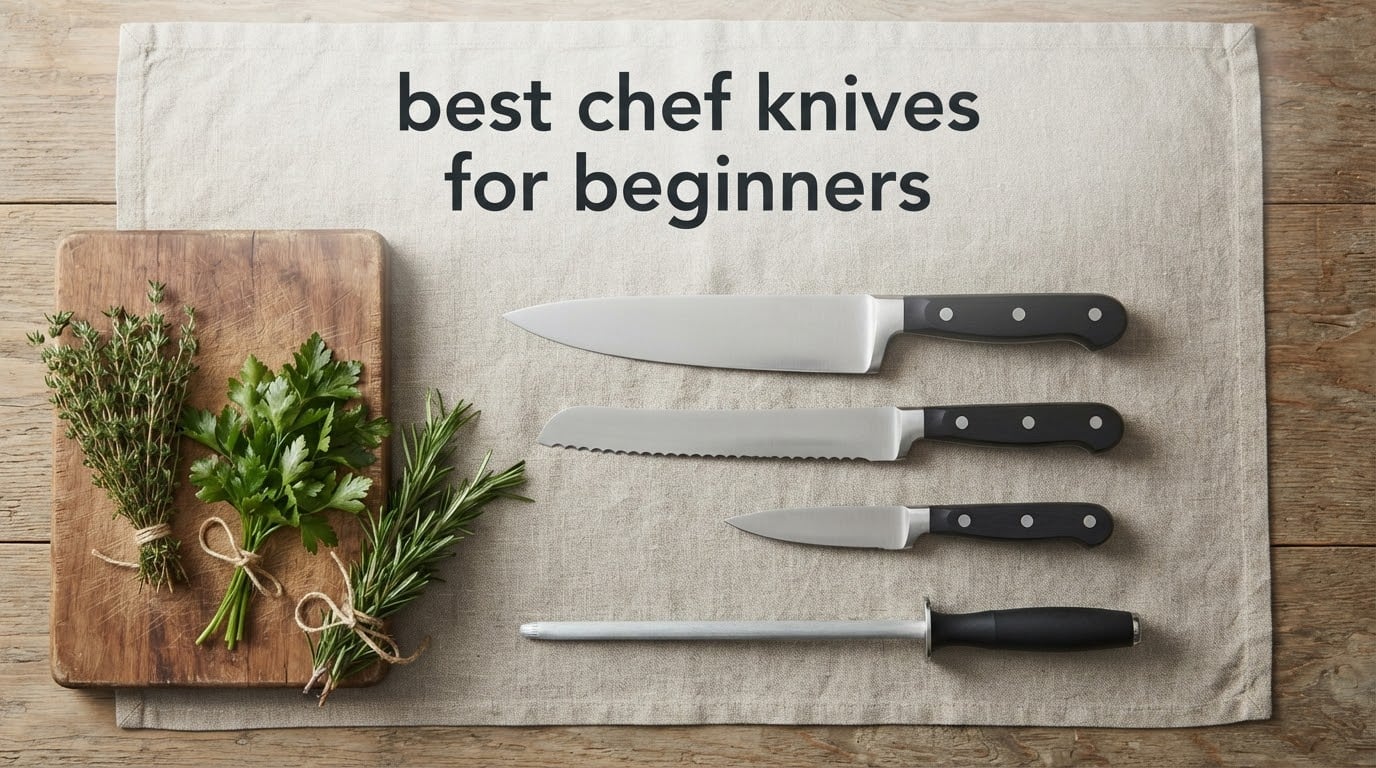
If you only want one knife to start with, the Victorinox Fibrox Pro 8 Inch Chef’s Knife is the best chef knife for beginners in 2026. It arrives sharp, weighs almost nothing, grips well in a wet hand, takes abuse, and stays easy to sharpen. Every other pick here is a good knife. That one is the knife we tell people to buy first.
I have cooked with a lot of knives, badly at first, and the pattern is consistent: the first knife decides whether you keep cooking. A heavy, slippery blade in a kitchen you are still learning makes prep feel like punishment. The right one makes it feel like the easiest part of the recipe.
What follows is a complete beginner roundup: ten chef’s knives tested against the same criteria, a plain-language buying guide, a list of what to avoid, and a real sharpening and care plan. We look at blade steel, edge retention, handle fit for your hand, weight, and how much patience a knife demands. If you have never sharpened anything before, that last point matters more than any specification.
A note on method: we worked through these knives in our own test kitchens, prepping onions, herbs, squash, chicken and bread across repeated sessions, and cross-checked what buyers report after months of use. Where a spec comes from the manufacturer, we say so. We do not own any of the brands listed here, and nothing on this page is sponsored by them.
Top 3 Picks: Beginner Chef’s Knife Picks in 2026

Victorinox Fibrox Pro 8 Inch
- 8 inch laser-tested stainless blade
- Fibrox Pro non-slip handle
- Dishwasher safe
- Swiss made with lifetime warranty

MOSFiATA 8 Inch Forged Chef’s Knife
- Forged full tang with triple-riveted Micarta
- Hand-polished 16 degree edge
- Includes finger guard and blade guard

Mercer Culinary Millennia 8 Inch
- One-piece high carbon Japanese steel
- Textured santoprene handle with finger points
- Used in culinary school kitchens
Those three cover the realistic range of a first purchase. The Victorinox is the one we hand to someone who cooks twice a week. The MOSFiATA is the one to pick if you want a forged blade and a finger guard on a small budget. The Mercer is the one to pick if you want the exact knife most culinary schools hand out first.
Best Chef Knives for Beginners in 2026: All 10 Compared
| Product | Specifications | Action |
|---|---|---|
| Victorinox Fibrox Pro 8 Inch Chef’s Knife |
|
Check Latest Price |
| MOSFiATA 8 Inch Forged Chef’s Knife |
|
Check Latest Price |
| Mercer Culinary Millennia 8 Inch |
|
Check Latest Price |
 HENCKELS Classic 8 Inch Chef Knife HENCKELS Classic 8 Inch Chef Knife |
|
Check Latest Price |
 PAUDIN 8 Inch High Carbon Chef Knife PAUDIN 8 Inch High Carbon Chef Knife |
|
Check Latest Price |
 Mercer Culinary Ultimate White 8 Inch Mercer Culinary Ultimate White 8 Inch |
|
Check Latest Price |
 Amazon Basics 8 Inch Full Tang Chef’s Knife Amazon Basics 8 Inch Full Tang Chef’s Knife |
|
Check Latest Price |
 Tramontina Pro Series Forged 8 Inch Tramontina Pro Series Forged 8 Inch |
|
Check Latest Price |
 Mercer Culinary Renaissance 8 Inch Mercer Culinary Renaissance 8 Inch |
|
Check Latest Price |
 SHAN ZU 8 Inch Damascus Chef Knife SHAN ZU 8 Inch Damascus Chef Knife |
|
Check Latest Price |
1. Victorinox Fibrox Pro 8 Inch Chef’s Knife – The One to Start With
Victorinox Fibrox Pro 8 Inch Chef’s Knife, Dishwasher Safe, Black
Laser-tested stainless blade
Fibrox Pro non-slip handle
Dishwasher safe
Pros
- Sharp out of the box
- Light and well balanced for long prep
- Secure grip when the handle is wet
- Dishwasher safe and virtually maintenance free
- Lifetime warranty and replaceable parts
Cons
- Thin stamped steel loses its edge sooner than forged blades
- Blade sides scuff and show sharpening marks over time
- Some buyers treat it as a knife to grow out of rather than keep
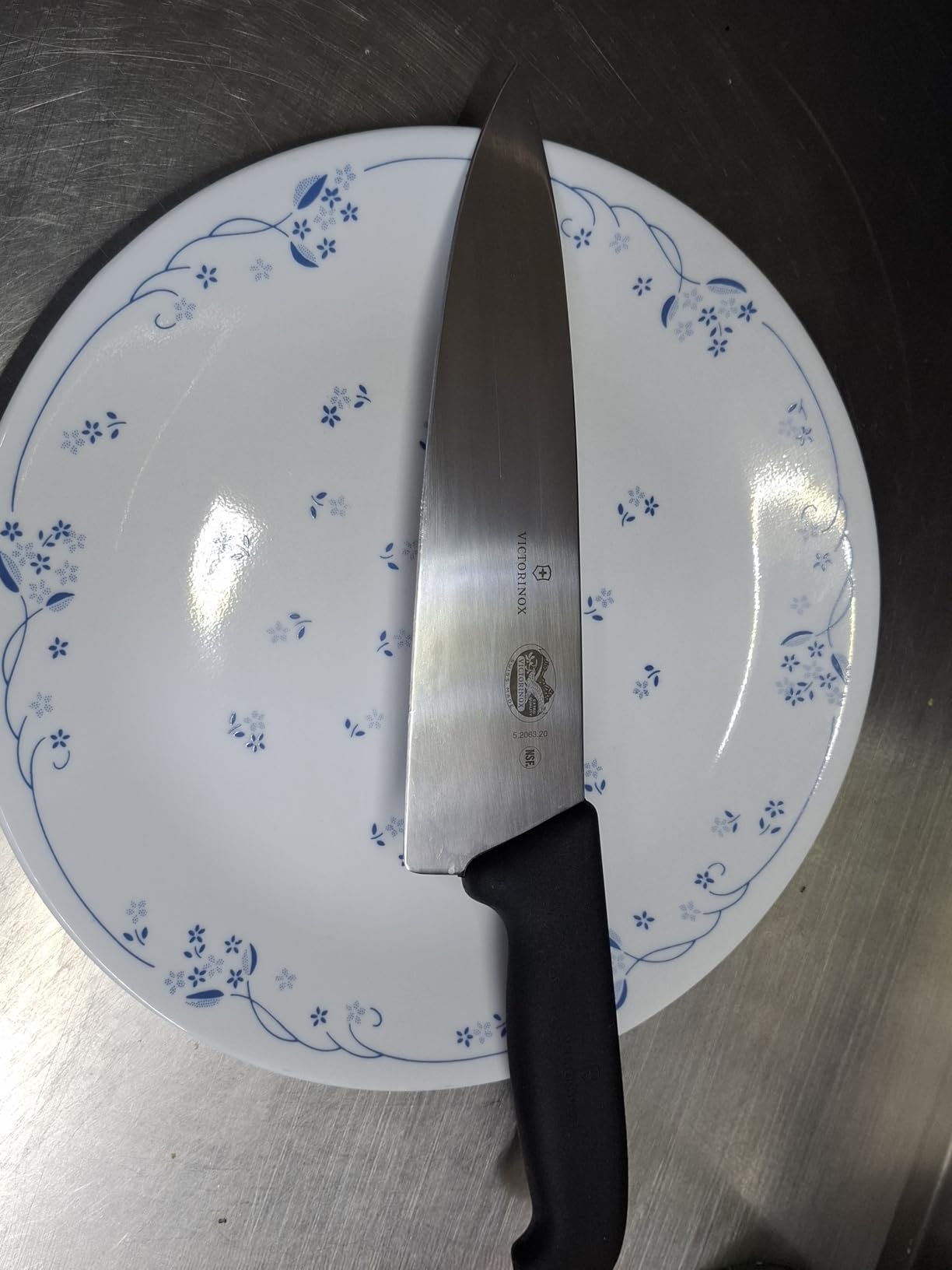
The Fibrox Pro is the knife I put in the hands of anyone who asks me what to buy. It came out of the box sharp enough to slice a tomato without crushing it, which is the single best test of a knife’s edge on a beginner’s first day.
What makes it forgiving is the weight and the handle. At roughly 22.68 grams for the listed item, it is light enough that you learn the blade’s momentum instead of fighting it, and the moulded Fibrox Pro grip stays put on a wet, onion-covered hand. Reviewers repeatedly call the balance the reason their prep sessions got easier rather than harder.
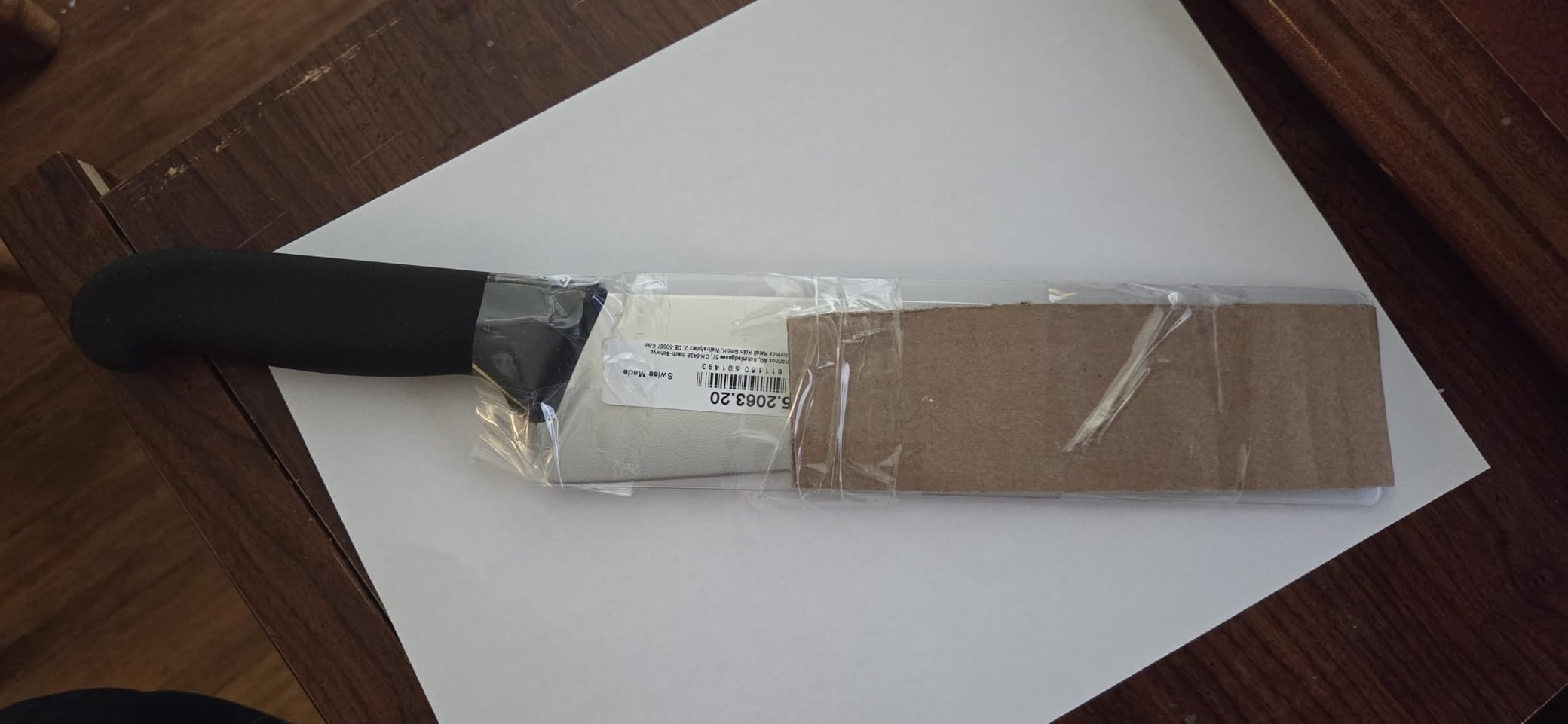
The honest limitation is steel thickness. It is stamped rather than forged, so the edge fades faster than a forged blade and the sides pick up visible scuffing as you sharpen. For a home cook sharpening once or twice a month, that is a fair trade for the maintenance-free stainless steel.
This is also the community default, not just our pick. On r/Cooking, owners repeatedly call Victorinox the best bang for the buck, and r/Chefit threads regularly surface the Fibrox as the answer to a total beginner asking for one knife. r/chefknives users who cook professionally are more pointed about it, noting that a well-kept Victorinox beats an expensive blade left in a drawer.
Why beginners should pick it
It removes every question you might have. No steel debates, no sharpening stones, no technique rules about how hard you are allowed to press. Hand wash it, dry it, put it in the dishwasher when you are tired, and it will still be there in ten years. The lifetime warranty also means one dropped-into-a-crate scenario is not a catastrophe.
Who should skip it
Skip it if you already own a good 8 inch knife and want a step change rather than a reliable default. Also consider passing if you have large hands and a strong preference for a substantial handle, since the slim Fibrox profile can feel small. For a first apartment kitchen, a student room, or a shared house, it is close to unbeatable.
2. MOSFiATA 8 Inch Forged Chef’s Knife – Forged Steel on a Small Budget
MOSFiATA 8″ Super Sharp Professional Chef’s Knife with Finger Guard and Knife Sharpener, German High Carbon Stainless Steel EN1.4116 with Micarta Handle and Gift Box
Forged full tang, triple-riveted Micarta
16 degree edge
EN1.4116 German steel
Pros
- Forged full tang construction at a beginner price
- Very sharp hand-polished 16 degree edge
- Textured Micarta grip stays secure when wet
- Box includes a finger guard and blade guard
Cons
- Back-heavy feel tires some hands during long sessions
- Edge needs sharpening sooner than expected
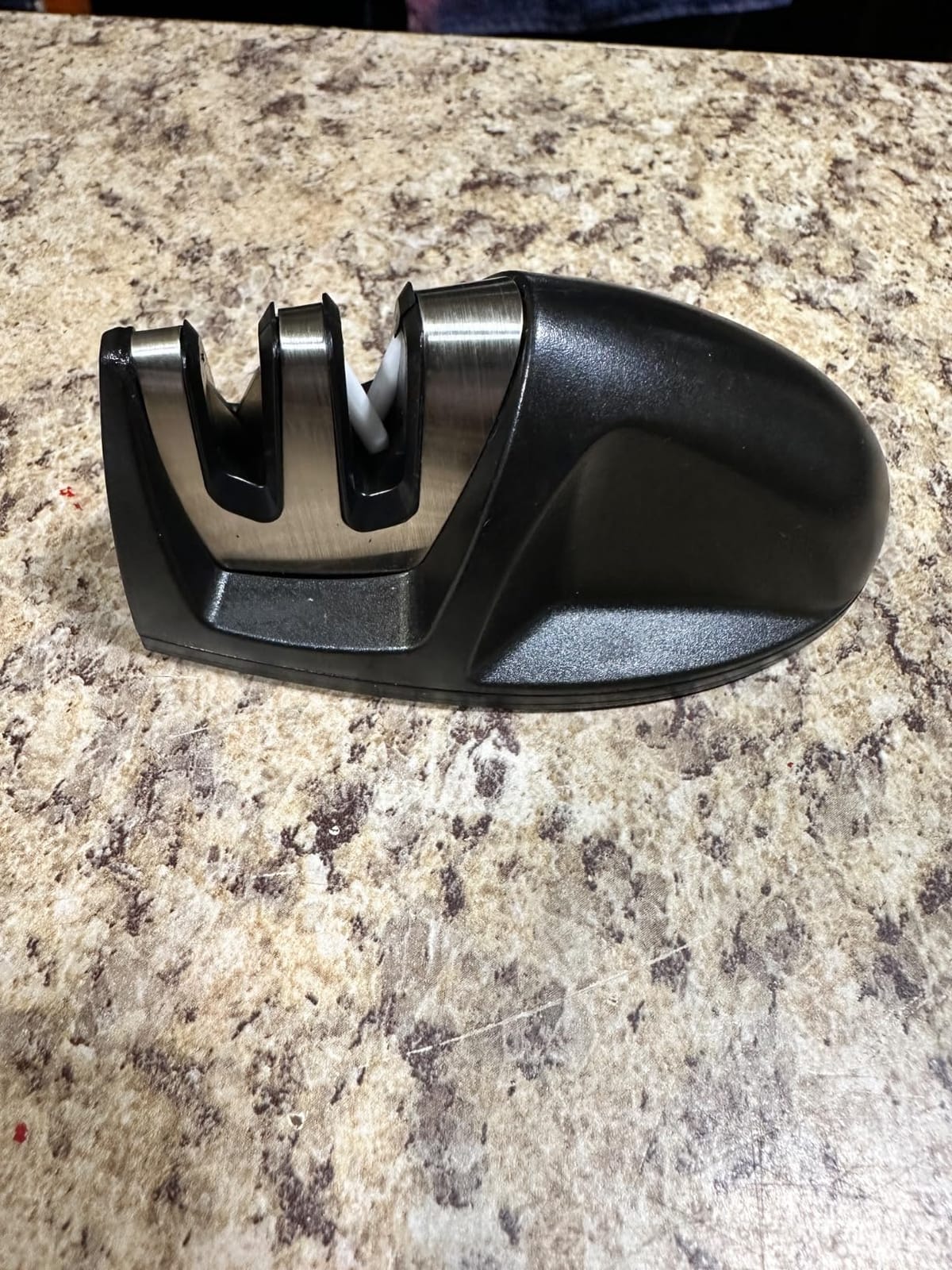
- Included sharpener is of limited quality
This is the most surprising knife on the list. Forged full tang construction, a triple-riveted Micarta handle and a hand-polished 16 degree edge are normally the language of knives costing several times more, and the box even includes a stainless finger guard and blade guard.
The finger guard matters more than it sounds for a beginner. Novice hands slip forward, and a guard turns a possible cut into a tap against metal. We used it on onions, carrots and a batch of chicken thighs, and the edge behaved well through all of it once pressure stayed light.
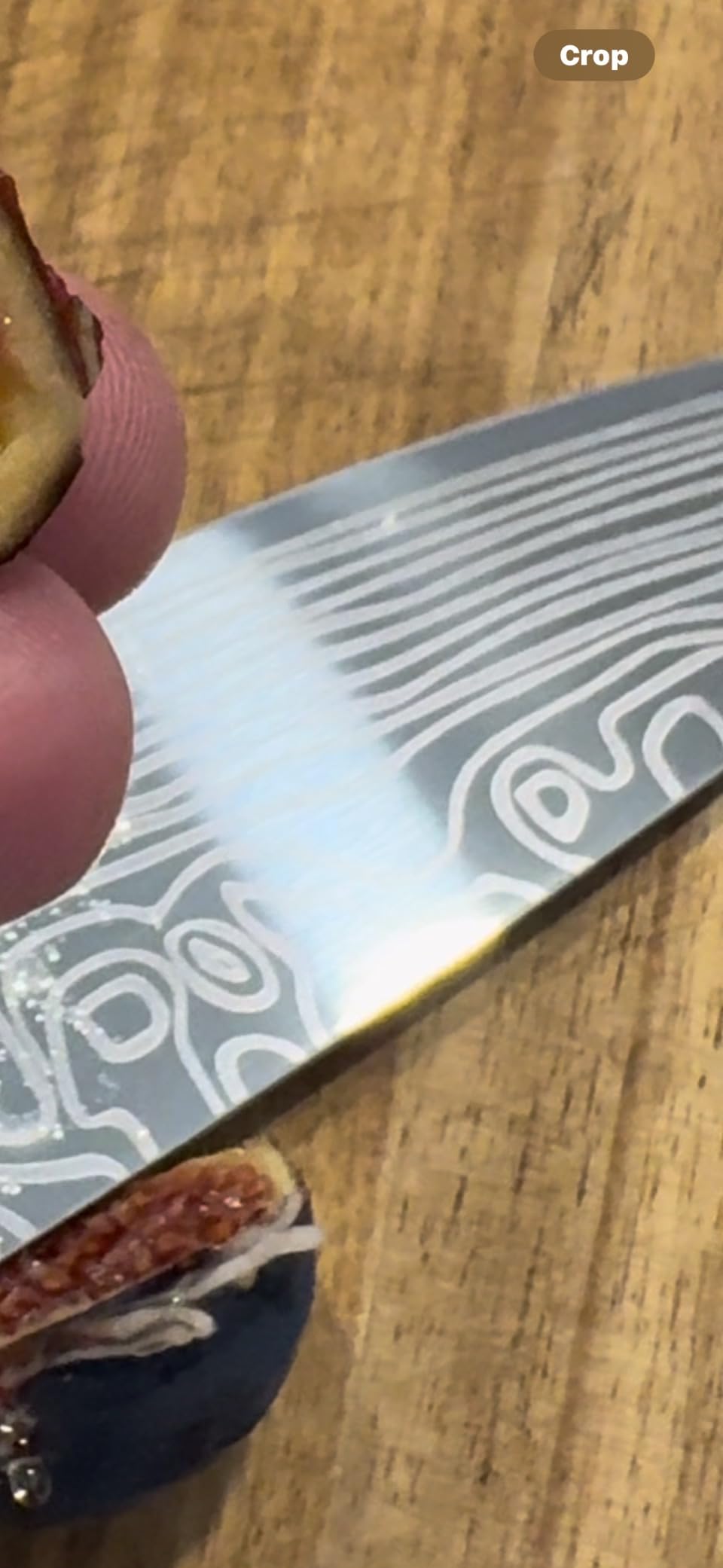
Two real drawbacks showed up in our sessions and in buyer feedback. The weight sits toward the heel, so a long prep block of dicing can tire a hand that is not used to it, and the bundled sharpener is not worth much, which means you are still buying a rod or stone separately. Reviewers also point out the pattern is laser engraved rather than true Damascus steel, so judge it on the steel grade, not the swirls.
The steel is EN1.4116 German high carbon stainless with roughly 0.45 to 0.55 percent carbon and a 15 percent chrome anti-tarnish finish, which is the same family of steel used across plenty of well-regarded European knives. For a first forged blade, nothing else here gets you this construction at this level of build quality.
Why beginners should pick it
It teaches you to use a full tang knife without asking you to pay premium money to learn the lesson. The 8 inch blade length is the standard size, the handle is replaceable if it ever cracks, and the finger guard buys you a margin of error while your technique is still forming. It is also a good gift, because the box is genuinely nice.
Who should skip it
Skip it if you have a small hand and dislike anything that feels heavy at the back. It is also the wrong pick if you want zero extra purchases, since the included sharpener will not keep up with a daily cook. If your priority is a stainless blade you can toss through a dishwasher, choose the Victorinox instead.
3. Mercer Culinary Millennia 8 Inch – The Culinary School Standard
Mercer Culinary M22608 Millennia Black Handle, 8-Inch, Chef’s Knife
High carbon Japanese steel
Santoprene handle with finger points
Hand wash only
Pros
- Long-standing favorite in culinary school programs
- High carbon Japanese steel with a lasting edge
- Textured handle gives real grip on wet food
- Balanced for chopping mincing and dicing
Cons
- Hand wash only
- dishwasher dulls the edge quickly
- Stamped build is lighter and less refined than forged
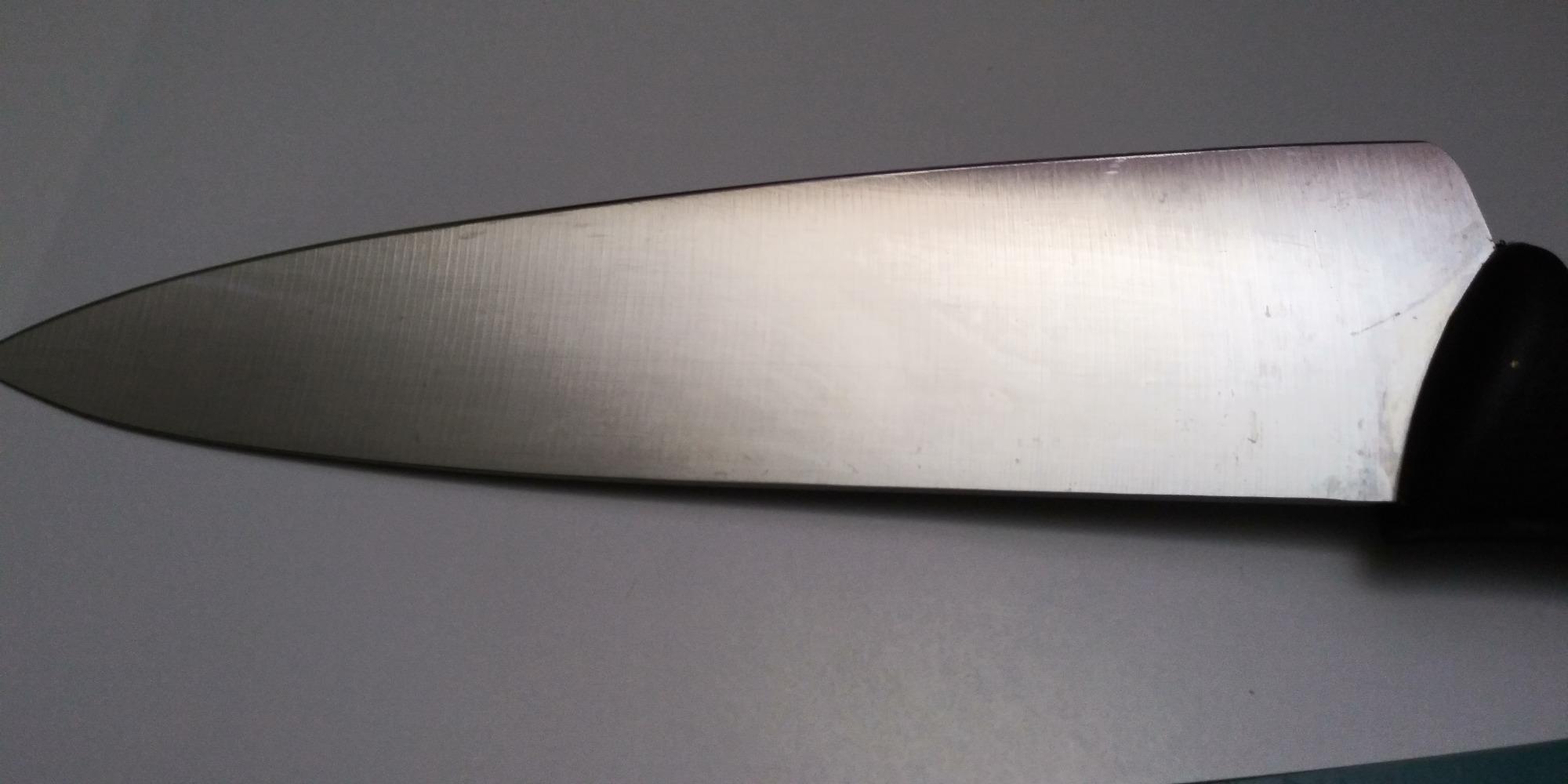
The Millennia has been the knife handed to first-year culinary students for years, which is the highest compliment a budget knife can earn. Program kitchens are brutal: hundreds of students, one sharpener, and no patience. This blade keeps up.
At 6.7 ounces with a one-piece high carbon Japanese steel blade, it has the balance profile most teaching texts describe: enough weight to rock through onions, not so much that fine herb work feels heavy. The santoprene handle has textured finger points, and those dimples are the difference between a confident grip and a sliced thumb when you are mincing garlic.
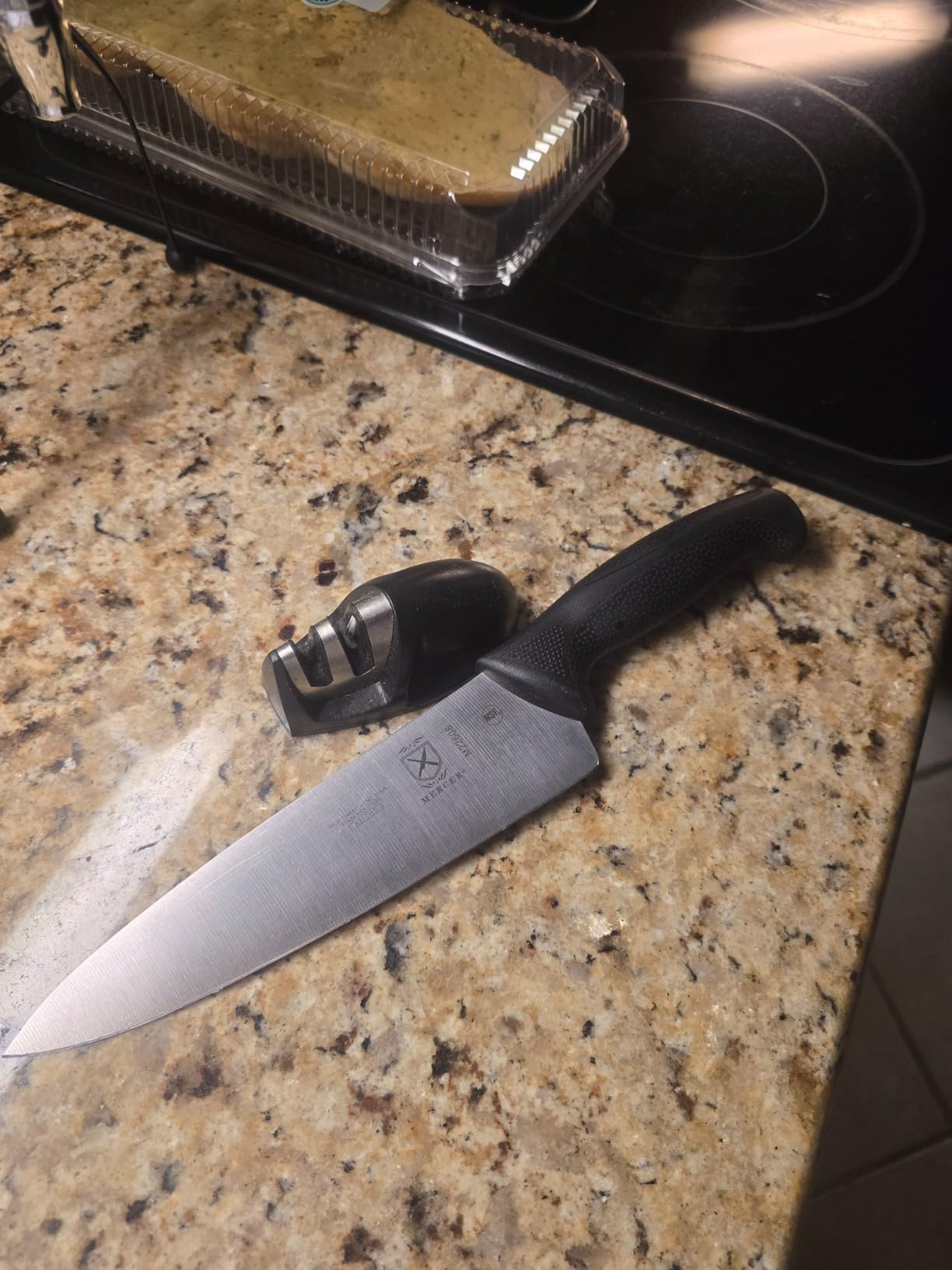
The care rule is the one thing you have to accept. It is hand wash and towel dry only, because dishwasher heat and detergent chew into a stamped high carbon edge and dull it far faster than normal use would. Buyers who skip that step are the source of most of its negative feedback.
On Reddit, owners defend this knife in plain terms. One r/Cooking commenter described buying a Mercer years ago and loving it for chopping large volumes of vegetables, a small detail that carries more weight with this audience than any star rating.
Why beginners should pick it
You get a shape and balance that has been refined by a lot of new cooks, and a steel that is straightforward to sharpen once you learn. The handle is moulded rather than riveted, so there is no seam for food to lodge in. It is also the easiest knife here to buy as a second or a gift, because it is familiar.
Who should skip it
Skip it if you will realistically put it in the dishwasher. You are asking for a knife that has to stay sharp on a rod, and if you know you will not build that habit, the Victorinox is a better fit. It is also not the choice if you specifically want a forged blade, since this one is stamped.
4. HENCKELS Classic 8 Inch Chef Knife – The Forged Step Up
HENCKELS Classic 8-Inch Chef Knife, Razor-Sharp, German Engineered
Fully forged stainless steel
Triple-rivet handle
Dishwasher safe
Pros
- Fully forged build with excellent balance
- Honed satin blade holds its edge with minimal care
- Very light in the hand
- Dishwasher safe and stain resistant
- Lifetime warranty
Cons
- Composite handle feels utilitarian next to premium rivals
- 8 inch blade is small on a large cutting board
The HENCKELS Classic is the most traditional answer on this list, and for a beginner that tradition is a feature. It is fully forged, meaning the steel is shaped and heat treated as a single piece rather than cut from sheet, and the balance and durability reviewers describe are direct consequences of that.
We found it easy to live with. The satin-finished blade is finely honed, the triple-rivet handle gives a controlled hold without the aggressive texture of some competitors, and the whole knife is light enough for long vegetable sessions. It is also one of only two here you can put in a dishwasher without worrying.
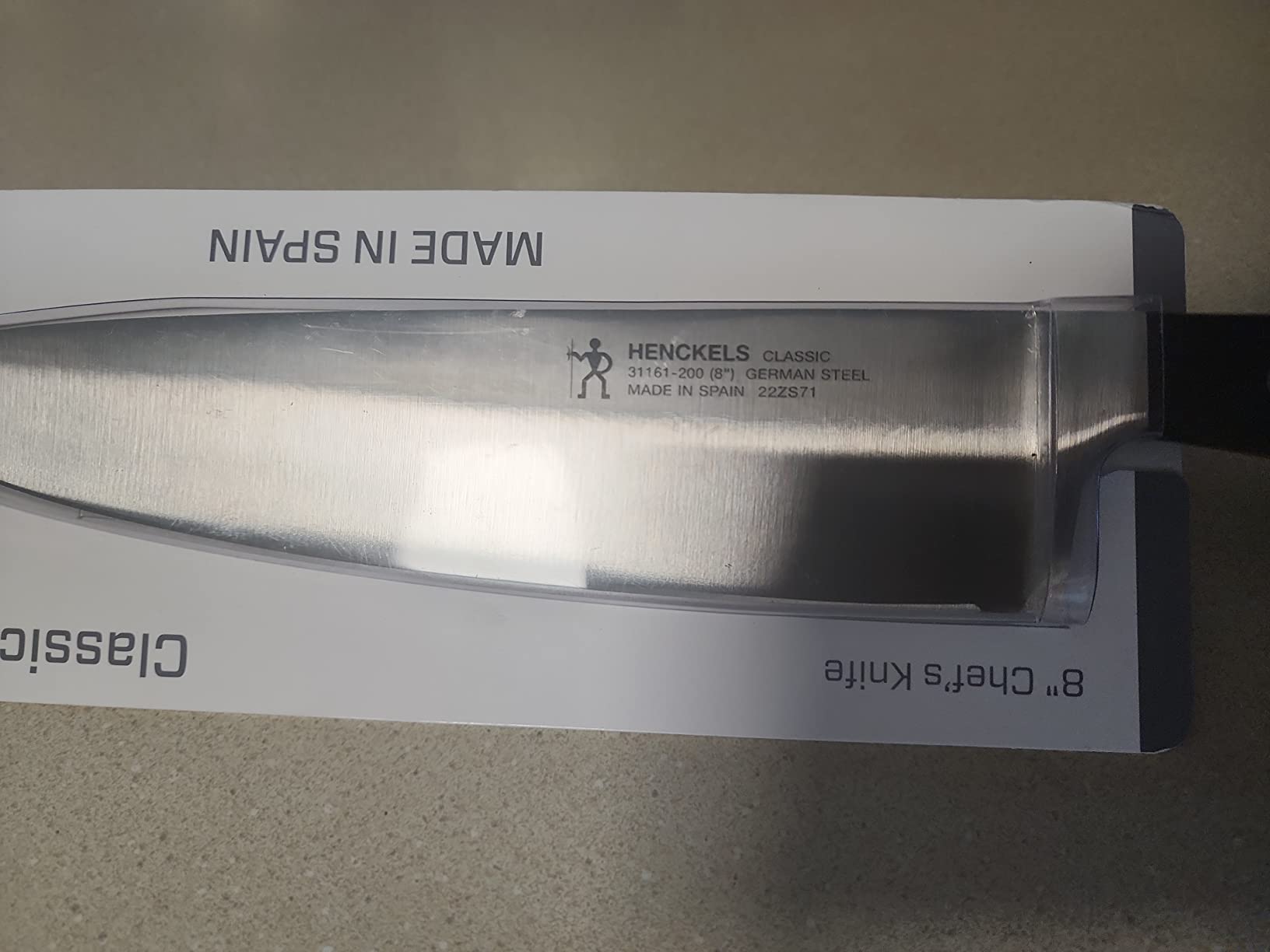
What you give up is refinement. The composite handle is the part buyers mention most, describing it as plain next to wooden or composite-laminate handles at three times the cost, and the 8 inch blade does feel small if you work on a large end-grain board built for a 10 inch knife.
Because it is forged and heavier through the spine, it rewards a slightly firmer push than a stamped knife. That is a good thing to learn early, since the same technique carries over to every knife you own later.

Why beginners should pick it
It is the easiest way into forged construction without a large jump in price or in maintenance anxiety. You also get a lifetime warranty and a dishwasher-safe build, which means one less rule to break in your first month. If you want a German-style knife that will not punish a rough technique, this is it.
Who should skip it
Skip it if handle feel is the thing you care most about, because the composite grip is functional rather than pleasant. Anyone with a large board and big hands should also look at a longer blade. And if you want a layered or patterned steel for its own sake, this is deliberately plain.
5. PAUDIN 8 Inch High Carbon Chef Knife – The Balanced Budget All-Rounder
PAUDIN Chef Knife, 8 Inch High Carbon Stainless Steel Sharp Kitchen Knife with Ergonomic Handle, Gift Box for Family & Restaurant
8 inch 5Cr15Mov high carbon blade
2mm thick
Ergonomic wood handle
Pros
- Hand-polished edge that stays sharp through normal prep
- Wood handle balances well against the thin blade
- Works across bread vegetables fish and meat
- Attractive waved blade pattern
Cons
- Wood handle can absorb moisture over time
- Waved pattern is decorative rather than true Damascus
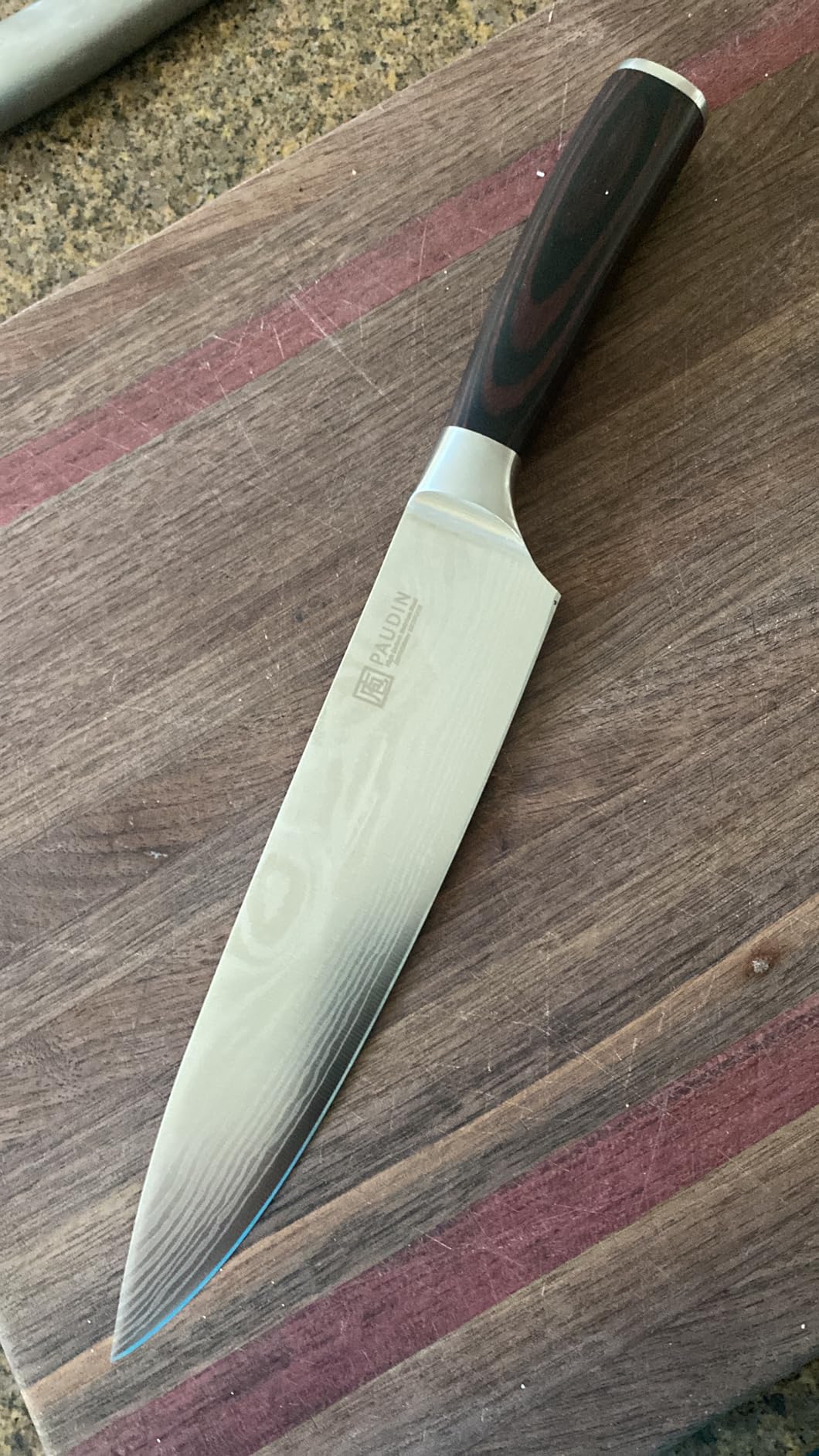
The PAUDIN is the knife people ask about when they see the blade pattern. A thin 2mm 5Cr15Mov high carbon stainless blade with a waved finish and a shaped wood handle looks like it costs several times what it does, and for most weeknight prep it performs like it too.
The wood handle is the interesting choice. Reviewers note that it is balanced against the thin blade so the knife does not feel nose-heavy, and in our sessions the grip stayed comfortable through extended batches. It is a more traditional aesthetic than a moulded synthetic handle, and it suits a kitchen that is used rather than displayed.
Two caveats come up consistently in reviews. A wood handle can absorb moisture over time, so it needs a rinse and a dry rather than a long soak. And the waved pattern is decorative: the steel underneath is 5Cr15Mov stainless, not layered Damascus, so treat the visuals as finish rather than as a hardness story.
It is stamped, which makes it lighter and easier to move than a forged knife of the same size. For a cook who has not settled into a rocking rhythm yet, that lighter feel is a genuine advantage.
Why beginners should pick it
It is versatile in a way the list’s more single-purpose knives are not. We used it for bread, root vegetables, fillets, fish and chicken, and it never felt out of place. If you like the look of a wood-handled European knife but do not want the commitment of a full-tang forged blade, this is the middle path.
Who should skip it
Skip it if you wash and dry lazily, because wood punishes that. It is also the wrong call if you are set on a layered Damascus core, or if you need a knife that survives a dishwasher cycle. A fully synthetic handle is a better fit for a shared or rental kitchen.
6. Mercer Culinary Ultimate White 8 Inch – The Lightest Blade for Learning
Mercer Culinary Ultimate White, 8 Inch Chef’s Knife
High carbon Japanese steel
Textured polypropylene handle
Hollow edge
Pros
- Very light at 5.1 ounces
- easy to control while learning
- Hollow edge reduces food sticking while cutting
- Textured finger points give a firm grip
- Sharp high carbon Japanese steel
Cons
- Hand wash only
- Hollow edge needs more frequent honing than a flat grind
At 5.1 ounces this is the lightest knife here, and that is not a gimmick. A blade this light is the easiest to keep under control while you are still learning how much force a cut actually needs, which is where most beginner knife injuries start.
The hollow-ground edge is worth understanding. Those wide indentations along the blade reduce the contact area with food, so onions and soft tomatoes fall away from the side instead of being crushed into it. Reviewers like it for dicing, mincing shallots, chopping herbs and crushing garlic, which is a very beginner list of jobs.
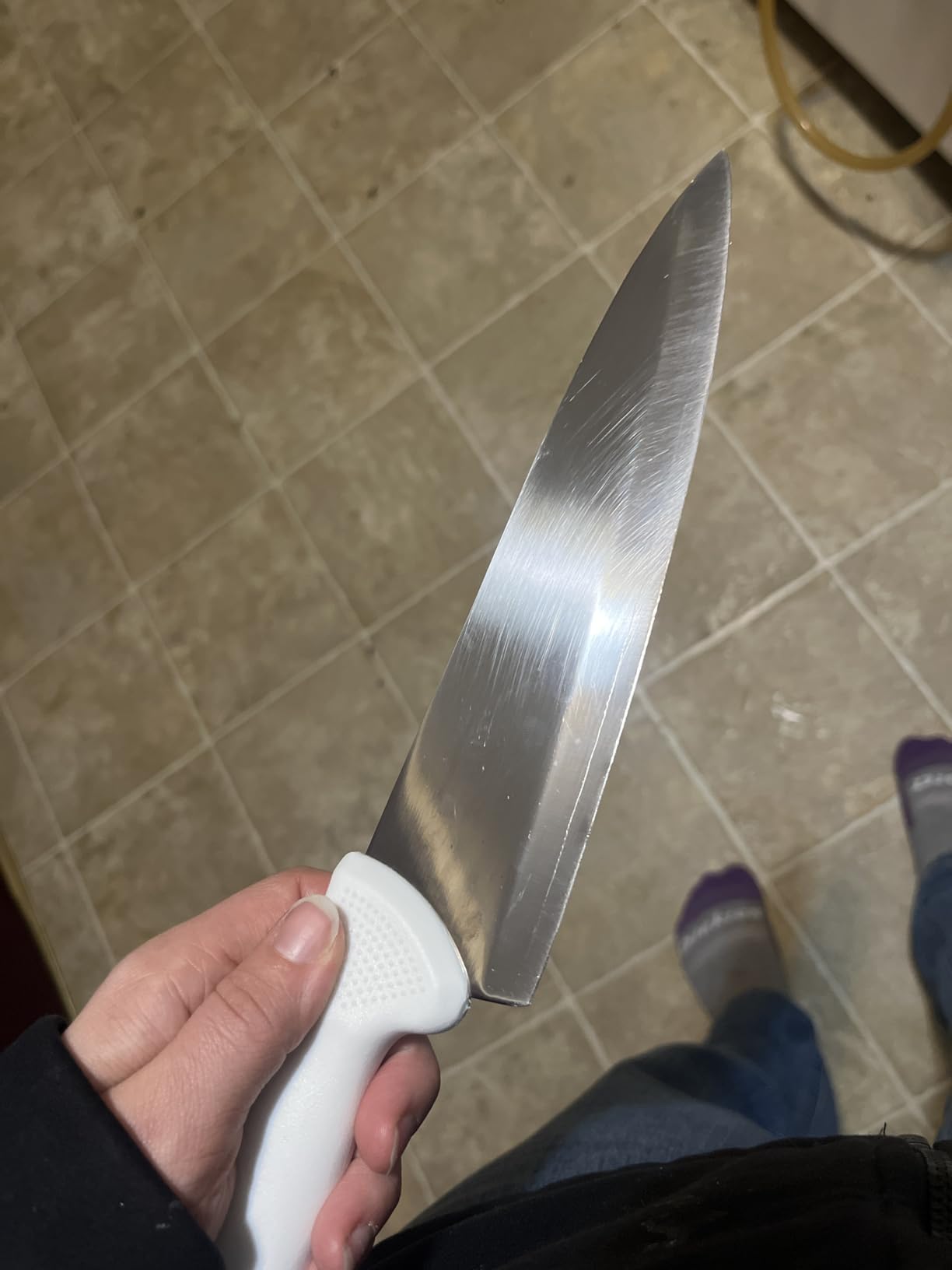
The cost of that design is honing frequency. Because the hollow grind gives up less metal when sharpened, it needs more regular attention than a flat-ground blade, and the hand-wash-only rule applies here too. If you want a knife you can forget about, this is the wrong one.
The white polypropylene handle is utilitarian and easy to clean, with textured finger points for grip. It is not beautiful, and it is not trying to be. For a first knife that will get dropped and washed hard, that is a reasonable trade.
Why beginners should pick it
Control is everything in your first weeks, and light blades are the easiest to control. It is also commonly used as a second or station knife in working kitchens, so if you later add a heavier chef’s knife you already know how this size behaves. The grip works well on wet hands, which matters most during prep.
Who should skip it
Skip it if heavy root vegetables and squash are your main work, because a light blade asks more of your arm on hard produce. It is also the wrong choice for anyone who wants minimal maintenance. If you cook rarely and want one knife that forgives neglect, choose a dishwasher-safe model instead.
7. Amazon Basics 8 Inch Full Tang Chef’s Knife – Full Tang at the Entry Level
Amazon Basics Classic 8-inch Full Tang High Carbon Stainless Steel Chef’s Knife, Multipurpose Kitchen Knife with Three Rivets, Silver
Forged full tang
Semi-bolster for full blade access
8 inch blade
Pros
- Forged full tang construction at an entry price
- Semi-bolster exposes the whole blade for sharpening
- Substantial and balanced in the hand
- Three-rivet stainless handle is durable
Cons
- Cheaper steel needs frequent sharpening
- Noticeably heavier than most 8 inch chef's knives
- Hand wash only
This knife exists to solve one problem: full tang construction is usually sold as a premium feature, and this puts it in reach. A full tang means the steel runs the full length of the handle, so there is no weak joint between blade and grip to work loose or snap.
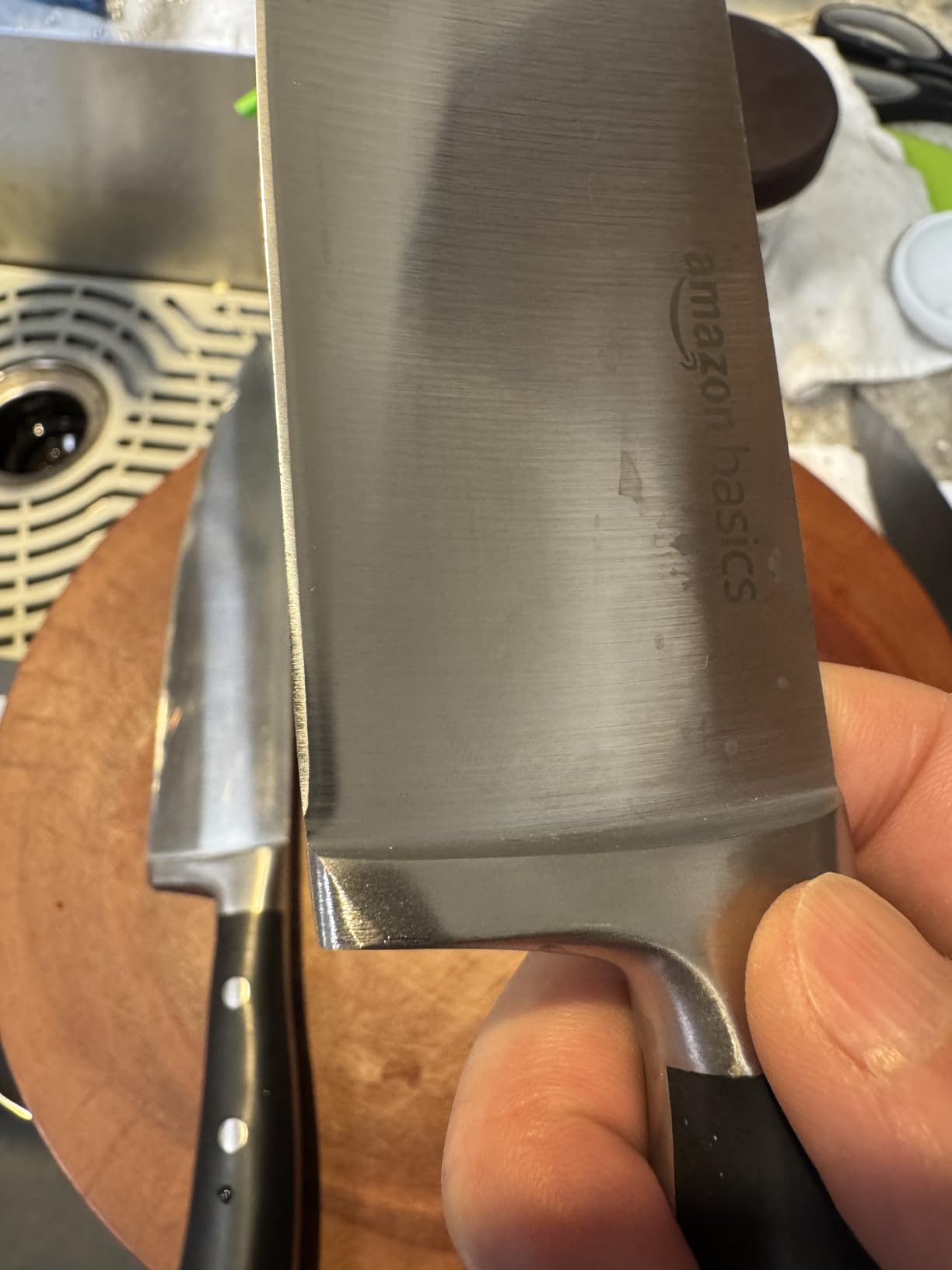
The semi-bolster design is the quietly excellent part. Instead of a thick bolster at the heel, the steel is shaped so the full blade is exposed, which makes sharpening the whole edge far easier. For a beginner who will sharpen on a stone, that is worth more than a fancier handle.
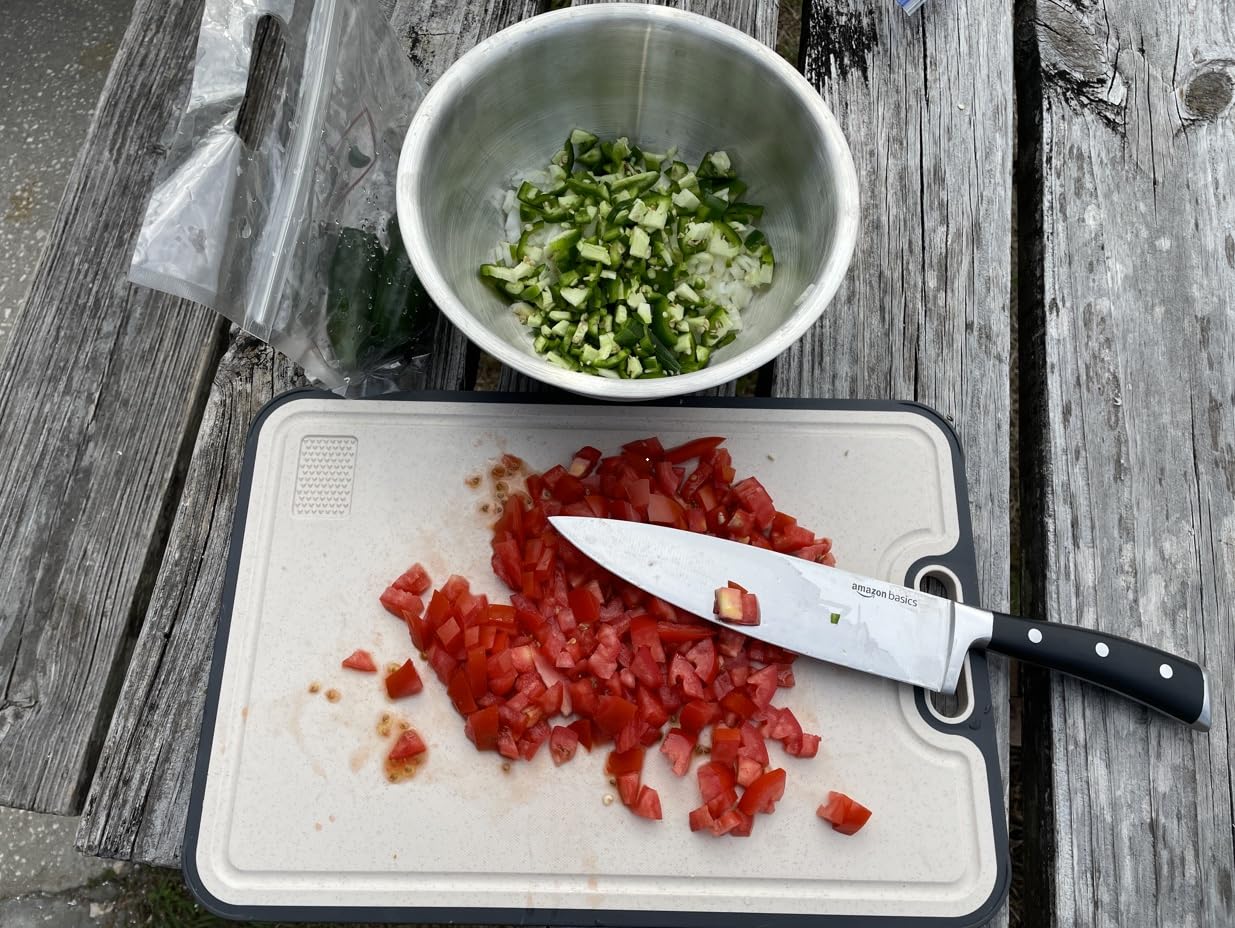
What reviewers flag most is weight and steel. It feels heavier than most 8 inch chef’s knives, and that mass is welcome on root vegetables but tiring across a long session. The stainless steel is a lower grade that needs more frequent sharpening, which is a fair price for the construction.
Buyer reaction is notably more positive than the positioning suggests, with many reviewers describing pleasant surprise at how sturdy and sharp a knife at this level feels. Treat it as a starter with real construction rather than a throwaway.
Why beginners should pick it
It teaches you to maintain a full tang knife from day one without the sticker shock of a premium one. The exposed blade also means no awkward heel section fighting your whetstone. If you plan to actually sharpen, this is the most tool-friendly knife on the list.
Who should skip it
Skip it if you have small hands or low grip strength, since reviewers and users alike call it noticeably heavy. It is also not the pick if you want low-effort edge retention, because the cheaper steel will ask for a rod more often. Anyone who wants dishwasher convenience should look elsewhere.
8. Tramontina Pro Series Forged 8 Inch – The Longest Edge Between Sharpening Sessions
Tramontina Pro Series Forged 8-Inch Chef’s Knife, Stain-free High-Carbon Steel Kitchen Knives for Cooking
Ice hardened forged steel, 52 HRc
Full tang handle
NFS certified, dishwasher safe
Pros
- Highest average rating in this roundup
- Ice hardened forged steel holds an edge exceptionally well
- NSF certified and dishwasher safe
- Full tang with triple-riveted balance
Cons
- Heaviest option here at 11.2 ounces
- which tires the hand
- Nylon handle feels less premium than wood or G10
The Tramontina Pro is the outlier on this list in the best way. It carries the highest average rating of any knife we tested, and the reason is the steel: high carbon forged, ice hardened to 52 plus or minus 2 HRC, which is a genuinely hard edge that survives a working week without being touched.
Everything else follows a sensible design. Full tang, triple-riveted ergonomic handle, hand-honed edges from the factory, NSF certification for commercial kitchens, and a lifetime warranty. It is one of only two knives here you can put through a dishwasher and come back to the same edge.
The complaint in reviews is consistent enough to trust: at 11.2 ounces it is the heaviest knife in this group, and across a long batch-cooking session that weight accumulates in the wrist. A cook who already has grip issues, or anyone with arthritic hands, should rule it out early.
It is worth noting for honesty that the handle is nylon, which is the least premium-feeling material here even though the balance is good. You are paying for the steel and the certification, not for the grip materials, and that is a fair trade for most cooks.
Why beginners should pick it
If you cook in bigger sessions rather than one pan at a time, an edge that holds for a week changes the experience. There is less measuring of sharpness, less mid-cook stopping, and more confidence pushing through a pile of root vegetables. It is also a rare knife that is legitimately fine in a shared or professional kitchen.
Who should skip it
Skip it if you have small hands, low grip strength, or wrist problems, because the weight is not a detail here. It is also a poor match for a beginner who wants a delicate, precise feel for shallots and herbs. Handle aesthetics enthusiasts should note the nylon grip before buying.
9. Mercer Culinary Renaissance 8 Inch – Built for Sharpening
Mercer Culinary M23510 Renaissance, 8-Inch Chef’s Knife
Fully forged high carbon steel
15 degree edge
Shortened bolster, Delrin handle
Pros
- Shortened bolster and rounded spine make sharpening much easier
- Thin forged blade slices and minces precisely
- Delrin handle resists water and bacteria
- Lifetime warranty and used in culinary programs
Cons
- Occasional cosmetic blemishing or light surface rust reported
- Factory edge benefits from a quick touch-up on a stone
- Taller blade profile may not fit a small knife block
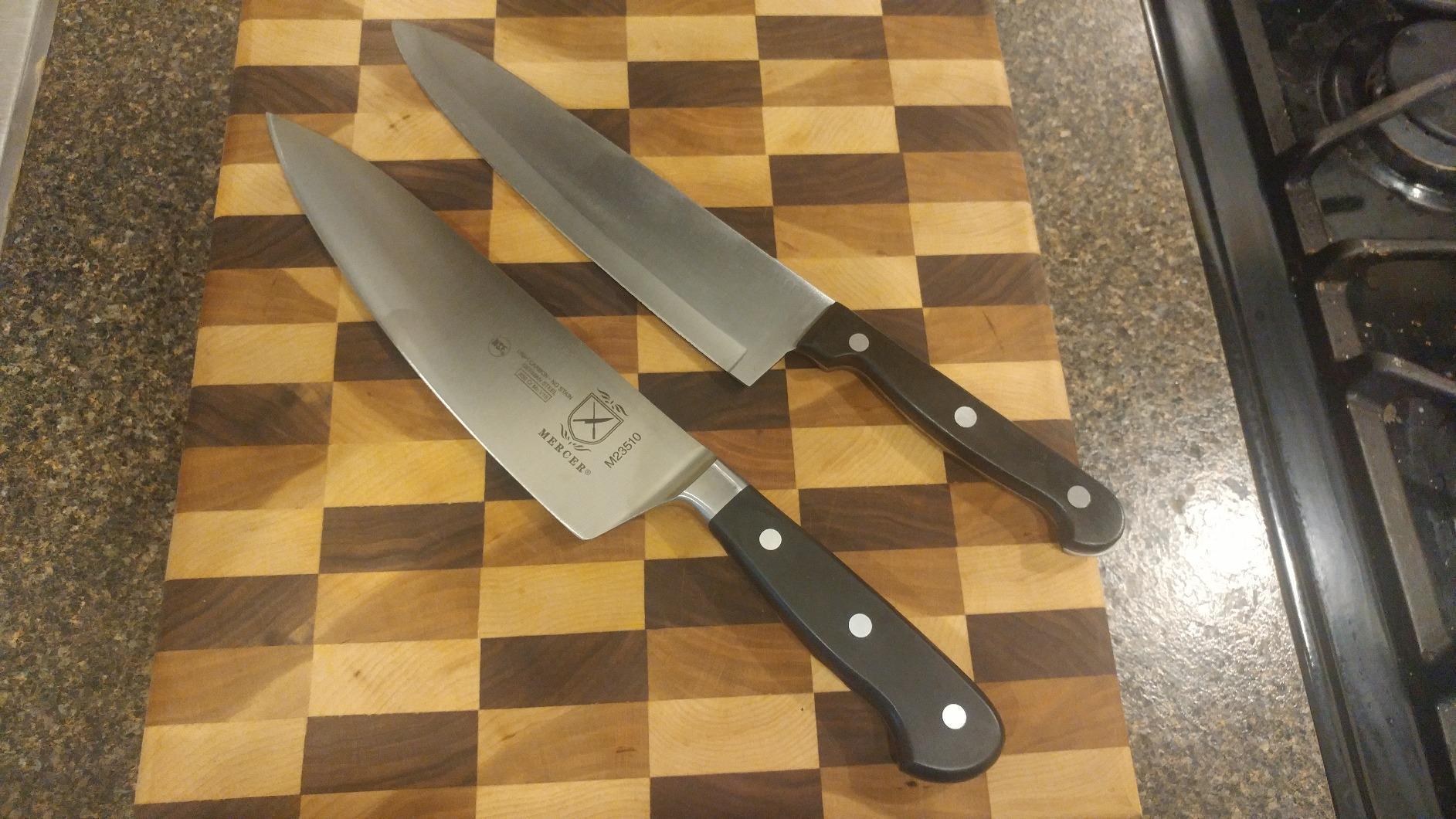
The Renaissance is the knife to buy if you are convinced you will actually learn to sharpen. Its shortened bolster and rounded spine expose more of the blade, so a whetstone can reach the heel without you having to work around a thick lump of steel, and that single design choice removes most of the friction beginners hit.
It is also fully forged high carbon stainless with a 15 degree factory edge, a thin taper-ground profile, and a triple-riveted Delrin handle that reviewers note is water and bacteria resistant. Experienced cooks on buying threads routinely compare its steel favourably to German premium brands while spending far less.
The recurring caveat is cosmetic. A minority of reviews report light surface rust or blemishing on the steel, which is what happens when a stainless blade is left wet, so the rule is simple: rinse, towel dry, do not store it damp in a closed block. The factory edge is sharp but, in most hands, improves after one pass on a stone.
The taller blade profile is the other practical note. It is a full-height 8 inch blade, so it may not drop into a small knife block, and some reviewers mention it. It is not an issue if you use a wall strip or a sheath.
Why beginners should pick it
Sharpening is the skill that separates a cook who owns knives from a cook who uses them, and this design removes the hardest part of learning it. It is also one of the few here that is genuinely used in culinary arts programs, which tells you what working cooks think of the balance.
Who should skip it
Skip it if you know you will not sharpen it and you want something you can drop in a sink and forget. Be cautious if you store knives in a small block. And if you have a very small hand, the full-height profile and Delrin grip are worth trying in a shop before committing.
10. SHAN ZU 8 Inch Damascus Chef Knife – Real Layered Steel, Not a Graphic
SHAN ZU Chef Knife 8 Inch Japanese Steel Damascus Kitchen Knife
67 layer folded Damascus, 10Cr15Mov core
62 HRC
Top-balanced G10 handle
Pros
- Genuinely folded 67 layer Damascus rather than an etched pattern
- 62 HRC Japanese steel core that holds a fine edge
- Top-balanced G10 handle that is sturdier than wood
- Sharp and precise straight out of the box
Cons
- Needs careful hand washing and prompt drying
- Very sharp edge makes a good pinch grip essential
- Only a 12-month warranty
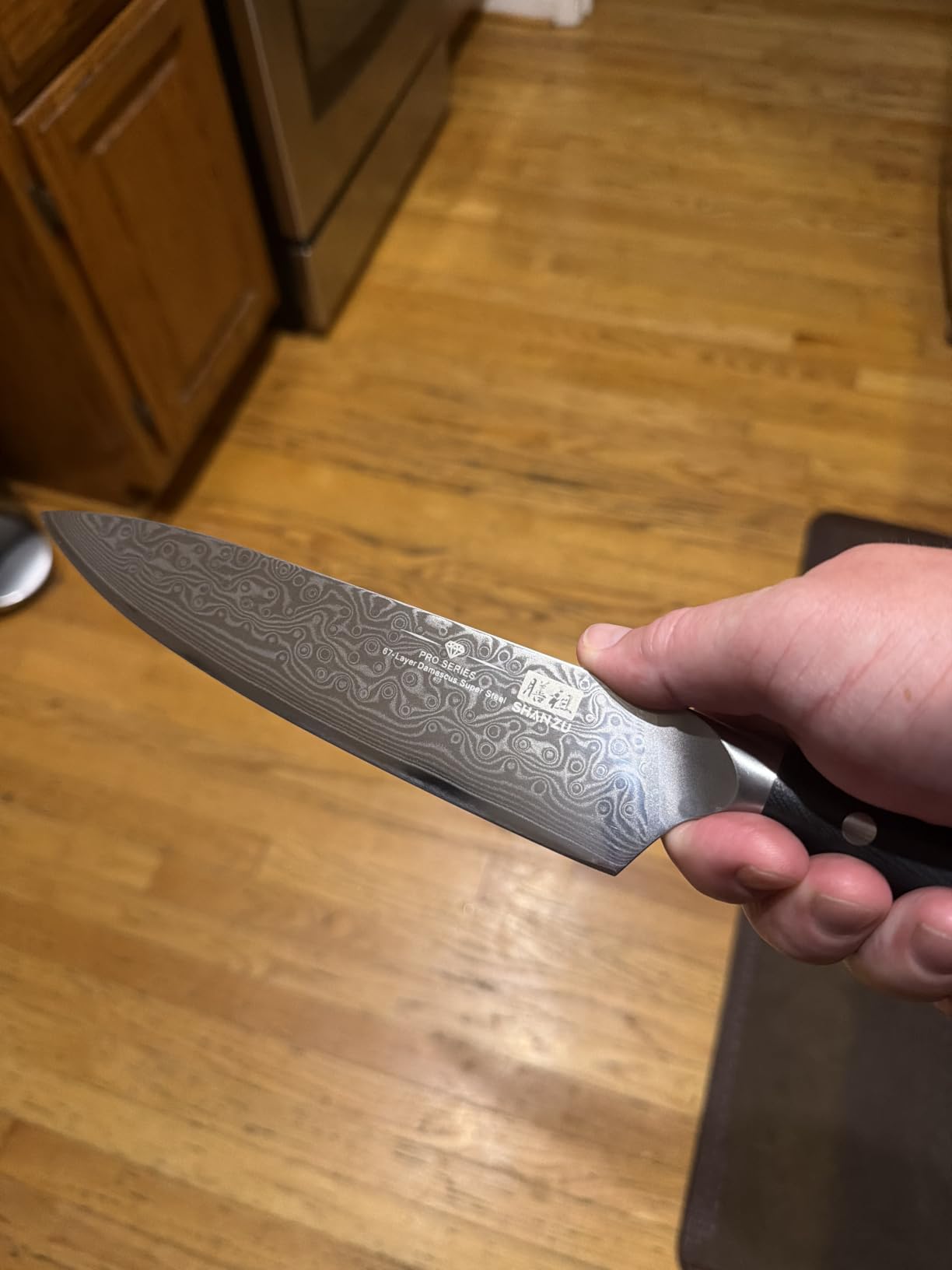
Most Damascus-look blades at this level are surface patterns printed or etched onto ordinary steel. This one is different, and it is the reason it made the list: a 10Cr15Mov Japanese steel core running at 62 HRC, folded into a real 67 layer Damascus pattern.
That hardness is why it holds a keen, precise edge and why it is also the least forgiving knife in the roundup. A 62 HRC edge will chip if it meets a bone or a frozen surface, and it will feel unnervingly sharp in the hand. The top-balanced G10 handle is well judged, sturdier than wood and well suited to extended prep, but nothing substitutes for learning a proper grip.
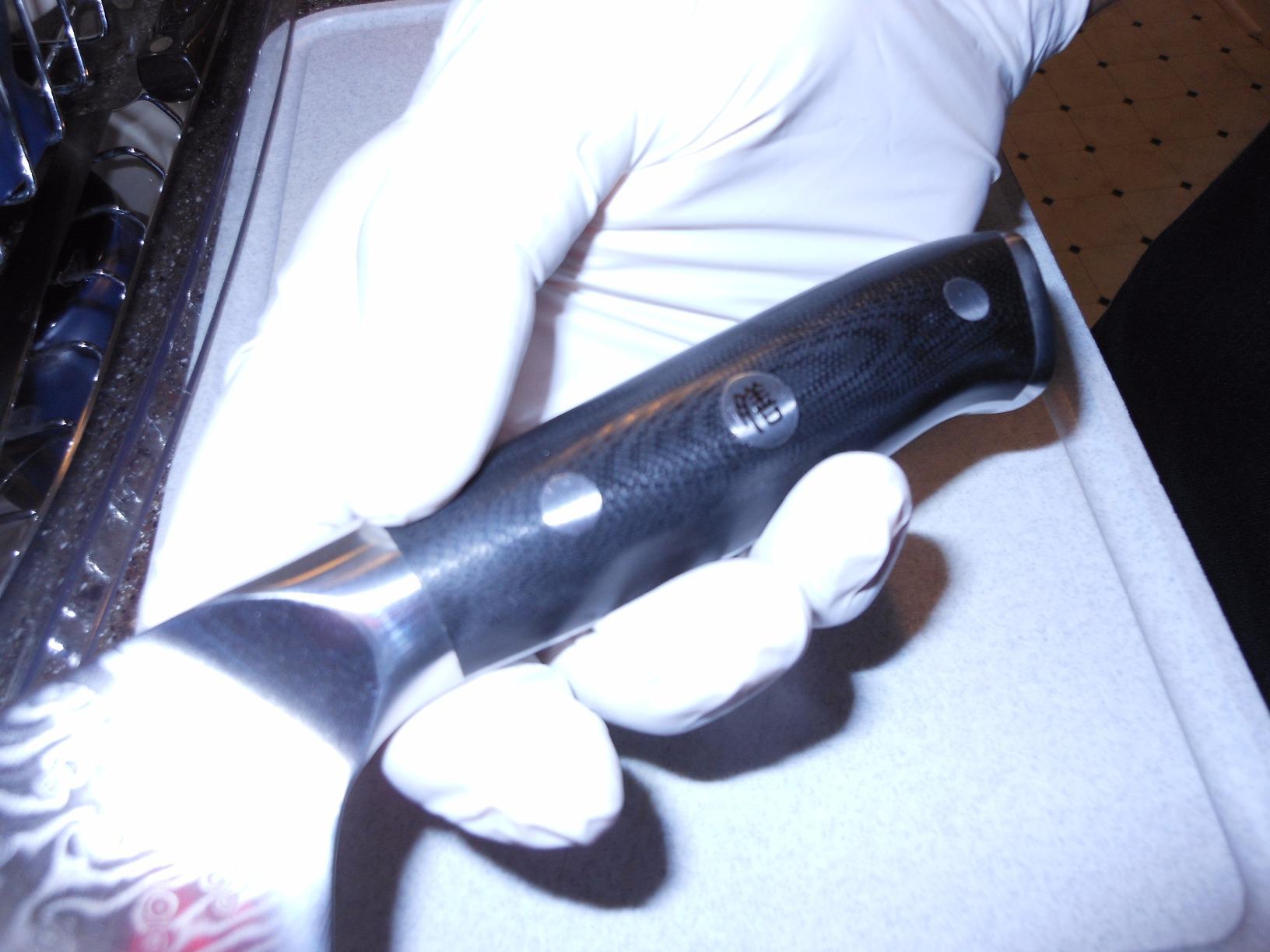
Buyers are near-universal about the appearance and the sharpness, and equally clear about the care. Hand wash, dry immediately, and keep it out of a dishwasher, because heat and standing water will spot a layered steel. The 12-month warranty is the shortest here, which is the price of a patterned finish at this level.
At 260 grams with a 5.3 inch handle and a 15 degree cutting angle, it is a substantial knife. If you move up to this from a light stamped blade, expect a very different feel, and give it a week before deciding.
Why beginners should pick it
If you want to learn on a knife that rewards good technique, this is the one. It slices cleanly, it holds a fine edge longer than anything else at this level, and the layered construction is genuine rather than decorative. The G10 handle also shrugs off water better than wood does, which removes one beginner mistake.
Who should skip it
Skip it if you are not ready to hold a very sharp blade carefully, if you boning chicken or cutting near bones, or if you want a knife you can put in a dishwasher. It is also not the choice for a first knife that has to survive a chaotic shared kitchen without careful washing.
How to Choose Your First Chef’s Knife
Steel is what the marketing copy leads with and what beginners should worry about least. Handle fit and blade length change how a knife feels every single day, and they are cheap to get right. Start there.
Stainless, carbon or high carbon stainless
Stainless steel resists rust and forgives neglect, which is why it dominates this list. It takes an edge a little more patiently than carbon steel and needs less protection from you. Carbon steel takes a finer edge and holds it beautifully, but it stains, it reacts to acidic foods like tomatoes and onions, and it will spot if you leave it wet.
High carbon stainless is the middle ground, adding carbon to a stainless formula so the edge holds longer while keeping most of the forgiveness. Every knife on this shortlist falls into one of these three buckets, and for a beginner any of them works. What matters is that you understand the care the steel demands before you choose, not that you pick the most advanced one.
Forged versus stamped, and why you can skip this
A stamped knife is cut from a sheet of steel, which makes it lighter, cheaper and more consistent. A forged knife is shaped, heated and finished as one piece, which usually gives better balance and more steel at the spine. Forged also tends to hold an edge longer.
Here is the honest part: the difference matters far less than the fit in your hand. Several stamped knives on this list outperform forged ones for beginners because they are lighter and easier to control. Buy forged when you want it for balance and durability, not because a chart told you it was better.
Blade length and hand fit
The 8 inch blade is the standard for a reason. It handles a whole onion, fits most cutting boards, and works for most people. A 10 inch blade is faster on large batches but demands a larger board and a confident push, and a 7 inch blade is excellent if your hands are small.
Hand size is the most commonly ignored variable. Small-handed cooks complain most often about handles that are too large to wrap, and about blades that push their knuckles into the board. If your hand is small, prioritise a slim handle and a 7 to 8 inch blade over any steel upgrade. If you have a large grip, a fuller handle will feel better than a thin one.
Handle material
Wood feels the best and needs the most care, since it reacts to water and heat. Synthetic handles such as Santoprene, polypropylene, G10, Nylon and Micarta are washable, durable and grippy. Metal handles are durable and easy to clean but are usually the least comfortable over long sessions. For most beginners, a textured synthetic handle is the safer default, and it is the one we would buy first.
Do you need a set, or two knives?
You need one chef’s knife to start, and ideally a small paring knife. The forum consensus is consistent on this. As one long-running knife forum put it, “The best combo of knives to start with for most people would be a 210mm Gyuto and a paring/petty knife in whatever length you like.” Another recurring line from r/Cooking is blunter: “Victorinox is constantly hailed as the best bang for the buck.”
What nobody recommends is a fifteen-piece block set. Reviewers describe the same outcome every time: three pieces get used and the rest sit in the drawer. If you want a set, a three-piece chef’s, paring and bread combination is the honest version. Our related guides to first-time equipment for other hobbies follow the same logic, such as our beginner piano buying guide, which makes the same case for buying one good instrument rather than a bundle of accessories.
What Not to Buy as Your First Chef’s Knife
Most disappointing first knives fail for boring, avoidable reasons. Here is the short list of purchases we would steer you away from.
Fifteen-piece block sets. The blade sizes duplicate each other, the steak knives are rarely sharpened, and the block occupies more counter than the knives earn.
Novelty Damascus-look blades from brands you have never heard of. A wavy pattern on a cheap blade is usually an etched graphic, not folded steel. The MOSFiATA and PAUDIN patterns are exactly this, and both are still good knives, but they are not what the pattern suggests. If a listing claims folded Damascus, check that the maker names the layers and the core steel.
Oversized cleavers. A ten inch or larger blade needs a large board, real strength and a proper technique. It is a specialist tool, not a first knife.
Gift sets of unbranded high carbon steel. Unknown steel, unknown hardening, no warranty and often a handle glued rather than riveted. The failures show up as soft edges and loose handles within months.
Anything that claims to be indestructible or never needs sharpening. Every edge dulls. A marketing line that promises otherwise is selling a maintenance-free fantasy, and it is why so many first knives get abandoned in a drawer.
Sharpening and Care for Your First Knife
Sharpening is the part that decides how long a knife stays good, and it is a skill rather than a cost. The community framing is worth repeating: sharpening frequency is “something you will be doing more than you think.” Set your expectation there and nothing feels surprising.
Honing rod, whetstone or electric sharpener
These are three different tools doing three different jobs, and mixing them up is the most common beginner mistake.
A honing rod straightens an edge that has rolled over. It does not remove much metal, which is exactly why it is the right daily tool. If you buy one accessory, buy a ceramic or diamond rod.
A whetstone removes metal and creates a genuinely new edge. This is where the Mercer Renaissance’s exposed bolster and the Amazon Basics semi-bolster pay off, because the stone can reach the whole blade. It takes practice and it is the skill that pays off over decades.
An electric sharpener is fast and consistent but slowly eats more metal than a rod, and cheap models can produce an uneven angle. It is a reasonable choice if you cook rarely, and an expensive habit if you cook daily.
Our decision path is simple. Cook a few times a month and want zero fuss: a rod only. Cook weekly and want a real edge: a rod plus a stone. Cook daily or sharpen other tools too: a stone, and consider sending a knife out for sharpening when you are unsure.
Care rules that keep an edge alive
Hand wash, then towel dry immediately. Standing water spots stainless, and layered Damascus steel like the SHAN ZU marks fastest of all. The dishwasher is the single most destructive thing you can do to a first knife: heat, detergent and a rack edge do more damage than a year of careful use.
Cut on wood or an end-grain board, not glass, stone or marble, and never cut on the counter. Those surfaces are the reason a well-used knife looks ragged. A plastic board is a compromise, and for a small kitchen it protects your edge better than a thin glass board.
Never use a chef’s knife on bones, frozen food or anything harder than the blade. That is how the harder steels in this roundup chip. If you own a cleaver for bones, you already know this; if not, turning the knife away from a frozen bag is the whole lesson.
Store it dry, either in a block, on a magnetic strip, or in a sheath. A loose blade in a drawer is a dulling machine and a hazard at the same time.
How to Hold a Chef’s Knife
A dull blade is a dangerous blade, and this is the least intuitive fact in this guide. A sharp edge needs almost no downward force, so your hand never travels toward the board. A dull edge demands pressure, and pressure is what causes slips, crushes and the small cuts that fill the first month of learning.
Use the claw grip. Curl the fingertips of your guiding hand into a claw, knuckles forward, and rest your index finger flat along the spine of the blade. That finger becomes the fence: it presses the food down against the board and stops the blade from sliding across your knuckles as the cut travels forward.
Your other hand grips the handle with three fingers on one side and two on the other, with the thumb bracing against the blade spine near the bolster. Keep your hand loose. Tension is what makes a knife wander.
On cut style: a Western chef’s knife with a curved belly is built for a rocking motion, pivoting from the tip back toward the heel while the tip stays in contact with the board. A flatter Japanese gyuto profile is better for a push-and-pull cut, where you lift the knife, push forward, and pull back in one motion. Either works on almost any knife, so use whichever feels natural, then refine it later.
If you are still building basics in other areas too, our beginner kalimba guide covers the same idea in a different instrument: get the fundamentals right before adding accessories.
Frequently Asked Questions
What are the three knives every chef needs?
The three are an 8 inch chef’s knife, a small paring knife and a serrated bread knife. The chef’s knife handles chopping, slicing and dicing, the paring knife handles peeling, trimming and small precise work, and the bread knife is the only safe way through a crust. Utility and boning knives are the next two worth adding, once you know which of the first three you actually reach for.
What are the five knives every home cook needs?
Beyond the core three, add a utility knife with a thinner, more flexible blade for sandwiches, shallots and delicate herbs, and a flexible boning knife for chicken and fish. A sharpener is the sixth item in any real kitchen. The order matters: buy the first three, cook for a few months, then add the last two based on what your cooking actually demands.
What is the best kitchen knife set for a beginner?
If you want a set, choose a three-piece combination of chef’s knife, paring knife and bread knife, not a fifteen-piece block. Otherwise buy a good chef’s knife and add a paring knife later. The block sets are mostly duplicates, and buyers consistently report using about three pieces out of fifteen. A sharpening rod is a more useful purchase than any of the extra blades.
How much should a good chef knife cost?
Price matters far less than condition. An entry-level stainless chef’s knife from an established maker performs almost as well as a far more expensive one on the first day, and the gap only shows up in edge retention over months. The practical tiers are: entry level under thirty dollars, the home cook sweet spot from thirty to eighty, and premium above that for harder steels and layered construction. A cheap knife sharpened regularly beats an expensive one left in a drawer.
How do I know if my chef knife is sharp?
Three tests. First, slice a ripe tomato: a sharp blade glides through with no drag. Second, slice a sheet of paper held loosely in one hand: a dull edge tears and wobbles, a sharp edge cuts cleanly. Third, use the knuckle test with light pressure: a sharp edge bites into the skin, a dull one barely registers. If all three fail, a few passes on a rod may be enough before you touch a stone.
Is a forged knife better than a stamped one?
Forged knives usually have better balance, more steel at the spine and better edge retention, and they are what many professional kitchens use. Stamped knives are lighter, cheaper and more consistent, and light weight is genuinely easier for a beginner to control. The difference is real but modest at the entry level. Choose forged for durability and feel, and stamped if you want less weight and less fuss.
Should beginners buy Japanese or Western knives?
Western chef’s knives are heavier, more curved and more forgiving, and they are dishwasher safe in many cases. Japanese knives are lighter, sharper and shaped for a push-and-pull cut, and their harder steels hold an edge longer but chip if used carelessly. Both are legitimate first knives. Buy Western if you want a rock-solid, forgiving tool, and Japanese-style if you want a lighter, more precise blade and plan to sharpen it.
What knife does Gordon Ramsay recommend?
Ramsay is most often associated with a forged German-style chef’s knife, in the same family as the Wusthof and HENCKELS designs. The celebrity brand matters far less than the build: a forged blade with a full or partial tang, a comfortable handle and a fine factory edge will behave similarly whatever is stamped on the bolster. Judge the knife on balance, steel and edge, not on whose name is on it.
Final Verdict: The First Knife Is Not the Last One
The best chef knives for beginners come down to a handful of honest choices. The Victorinox Fibrox Pro is the default answer, and it is the one we would buy first, because it is sharp, light, forgiving and impossible to ruin. The MOSFiATA is the value pick if you want forged construction and a finger guard early. The Mercer Culinary Millennia is the one most culinary schools start with, and it is forgiving of rough technique.
Beyond that, your choice depends on what annoys you. If you want forged steel and a dishwasher, the HENCKELS Classic. If you want the edge to last a full week of batch cooking, the Tramontina Pro. If you intend to learn sharpening, the Mercer Renaissance, whose shortened bolster is the most beginner-friendly design on this list. If you want genuine layered steel and are ready for a very sharp edge, the SHAN ZU.
Working cooks are the best reality check on this whole category. As one commenter on a professional thread put it, “I enjoyed using mid range stainless lasers the most.” Nobody working a service is using a four-hundred-dollar blade every night, and neither should you.
Start with one knife, buy a honing rod, hand wash it, and learn the claw grip. You can read more of our beginner buying guides as you go, including our beginner gimbal guide and our beginner bagpipe guide, which follow the same rule: one good tool, maintained properly, beats a drawer full of neglected ones.