
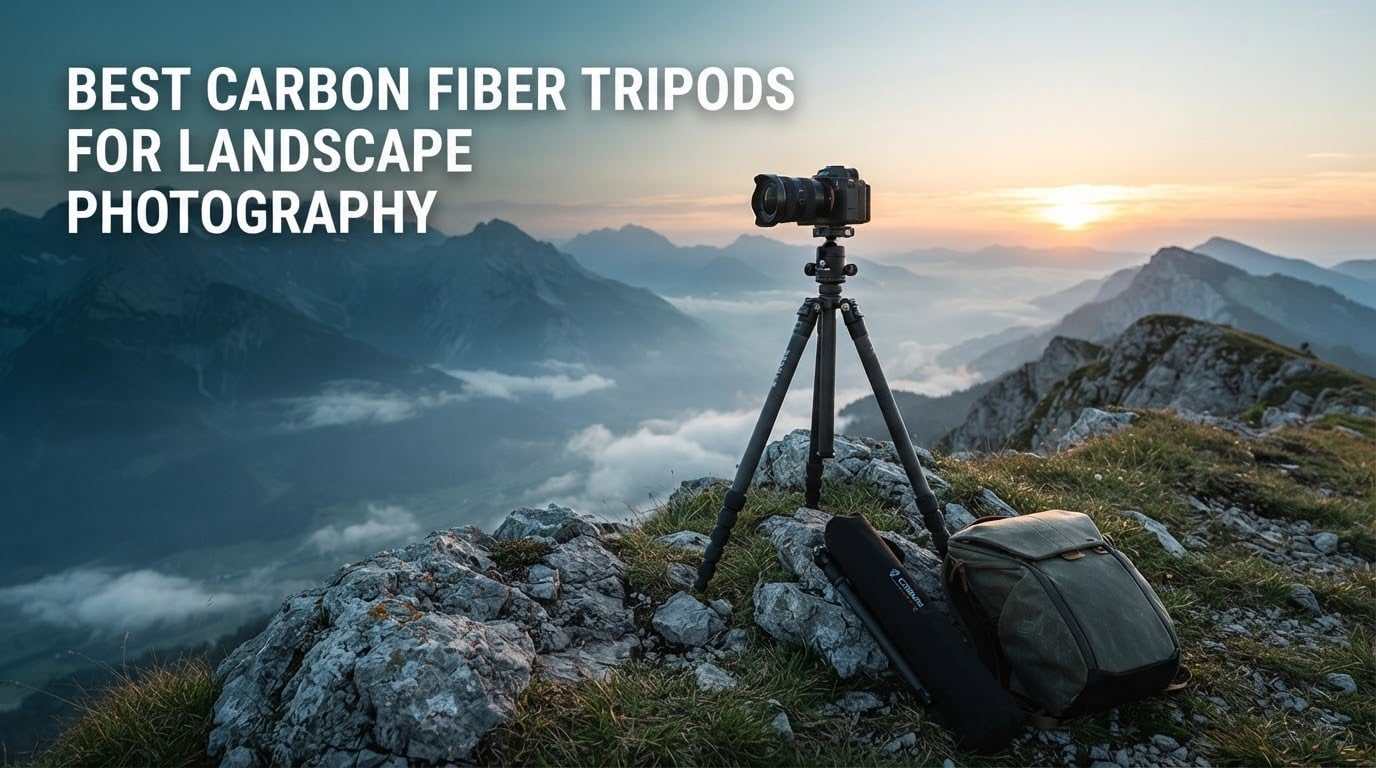
The best carbon fiber tripods for landscape photography are the ones that stay rigid at full extension while you can still carry them to the viewpoint. That combination matters because a foreground-to-horizon frame at f/11 blurs from movement alone, and a three-hour walk with a 4 kg tripod on your shoulder is how a lot of good light gets missed. Carbon fiber is the material that solves both problems at once, and the eight models below cover everything from carry-on travel rigs to 40 kg studio-rated heavy glass.
We spent weeks going through the spec sheets, the long-term owner reports, and the failure notes that only show up after a tripod has been in the mud a few seasons. Every pick here is a carbon fiber body, and every pick is judged on landscape work rather than studio or video use. That restriction is deliberate. Several of the biggest names in tripods make superb studio legs that are a poor choice for a hillside at sunrise, and most roundups mix those into the list anyway.
Two numbers do most of the work when you compare these. Load capacity tells you whether a telephoto zoom and a star tracker can live on the head at the same time, and collapsed length tells you whether the tripod is going in the boot or over your shoulder. Both are listed for every model below. If your work is mostly handheld-support or one-lens travel shooting, you will also want our guides to the best carbon fiber monopods and the best travel tripods as lighter alternatives.
Top 3 Picks: Best Carbon Fiber Tripods for Landscape Photography in 2026
Our top three covers the three ways this gear actually gets used: an all-round tripod that does everything, a heavy-glass rig for telephoto compression, and a pack-down model for long walks to remote viewpoints. The full list of eight follows below, with specs and honest flaws for each.

NEEWER N55CR Carbon Tripod
- 28mm carbon legs rated to 26.5 lb
- Converts to a monopod in seconds
- 80.7 inch max height with 2-section column
- Dual bubble levels on the 36mm ball head

INNOREL RT90C Bowl Tripod
- 40mm upper tube with 40kg load rating
- 10-layer carbon fiber construction
- 75mm bowl and adapter included
- Folds to 23.2 inches at 6 lb

Peak Design Travel Tripod
- Packs to water-bottle diameter
- Deploys in seconds with no leg rotation
- 20 lb capacity
- Tool-free inversion for low angles
Best Carbon Fiber Tripods for Landscape Photography in 2026
This table puts the eight tripods in the same order as the reviews that follow, so you can scan the collapsed length, load rating, and head type of each one before reading further.
| Product | Specifications | Action |
|---|---|---|
| NEEWER N55CR Carbon Fiber Tripod |
|
Check Latest Price |
| INNOREL RT90C Bowl Tripod |
|
Check Latest Price |
 Manfrotto MT055CXPRO3 Carbon Tripod Manfrotto MT055CXPRO3 Carbon Tripod |
|
Check Latest Price |
| Peak Design Travel Tripod |
|
Check Latest Price |
 K&F Concept X-Series 68 inch Tripod K&F Concept X-Series 68 inch Tripod |
|
Check Latest Price |
 SIRUI AM-284 Carbon Fiber Tripod SIRUI AM-284 Carbon Fiber Tripod |
|
Check Latest Price |
 NEEWER LT32 LITETRIP NEEWER LT32 LITETRIP |
|
Check Latest Price |
 K&F Concept 60 inch Carbon Tripod K&F Concept 60 inch Carbon Tripod |
|
Check Latest Price |
1. NEEWER N55CR – the do-everything carbon fiber tripod
NEEWER N55CR Upgraded 80.7″ Carbon Fiber Camera Tripod Monopod Travel Stand
3.9 lb
Load: 26.5 lb
Max: 80.7 in
4-section legs
Head: 36mm ball
Pros
- Converts to a monopod in seconds
- 80.7 in max height suits telephoto and overhead angles
- 26.5 lb rating is generous for a landscape kit
- 28mm tubes hold up at full extension
- Carrying bag included
Cons
- Lock knobs have no springs so they are slow to open
- Included ball head has coarse friction control only
- Some owners question the true carbon composition
The N55CR is the tripod we reach for first when a single body has to handle a full day of landscape work, and with 3135 reviews behind it, it is also the one with the deepest pool of real-world feedback. Weights sit at 3.9 lb for the whole kit including the head, which is light enough for a long approach walk and heavy enough to stay planted on a windy headland.
What separates it from the other seven is the centre column. A two-section telescopic column on four-section legs takes you to 80.7 inches, and it inverts, so the same legs that carry a telephoto zoom at eye level can be flipped for a low foreground boulder frame. That range covers more landscape compositions than any compact alternative we looked at.
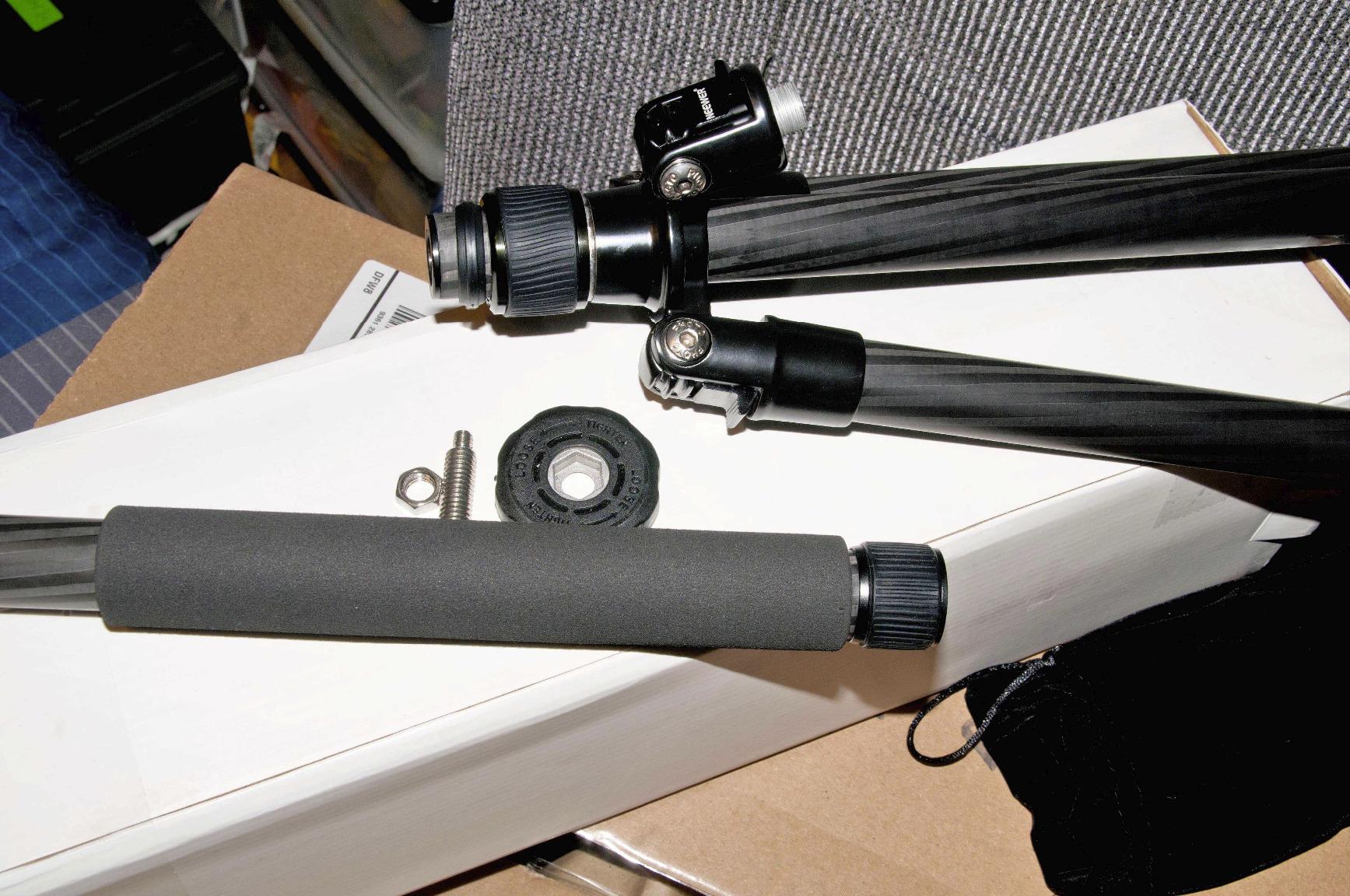
The head is a 36mm ball with two bubble levels, one on the collar and one on the body, which is more levelling information than most travel tripods give you. Quick release is 1/4-inch Arca-type with three spare screw holes, so plates from other systems will usually clamp on without an adapter.
It also strips down into a monopod. Pull the column and one leg and the remaining leg screws onto the shaft, which is the single most useful feature here for ridge-line shooting where a wide stance is impossible. If you shoot heavy glass regularly and want one body, our carbon fiber monopod guide covers the dedicated single-leg options.
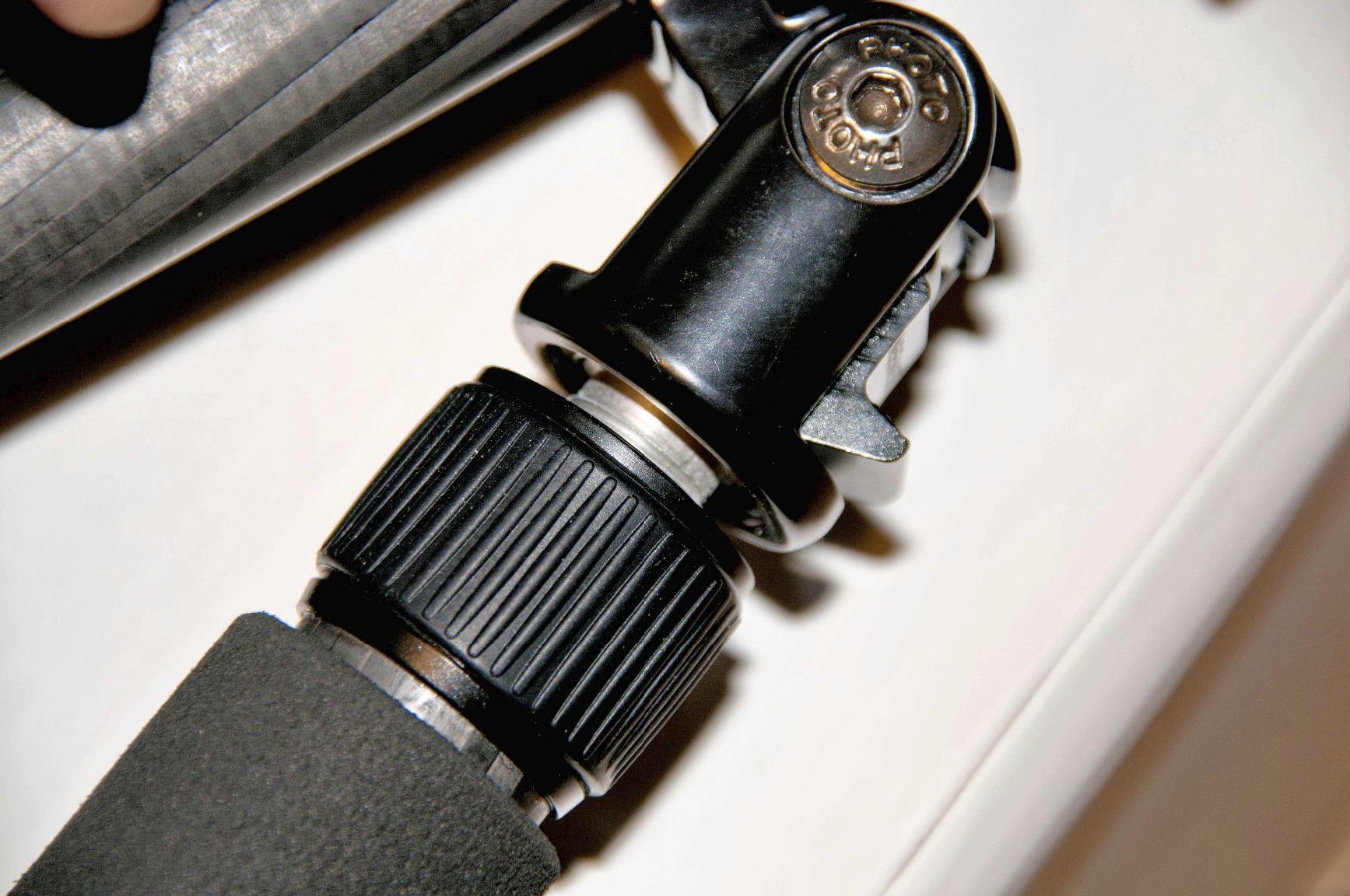
How the N55CR behaves on long exposures and heavy glass
Owners running multi-minute waterfall exposures report the legs staying quiet at full extension without hanging a bag from the column hook, which is the practical test of a carbon build. The 28mm tube diameter is the reason. Lighter tripods in this list use 22mm to 26mm sections, and those transmit knock-induced vibration noticeably further up the rig.
At 26.5 lb the load rating comfortably covers a full-frame body, a wide zoom, and a telephoto. It is not a heavy-glass rig, and we would not hang a 100-400mm plus a star tracker off it. For telephoto compression work at 200mm and below, the rating and the 80.7 inch height are both comfortable.
Where the N55CR falls short in the field
The lock knobs are the weak point. They have no springs, so each one needs a deliberate twist open and a deliberate twist shut, and on a wet headland with numb fingers that is slower than a spring-loaded lever. It is a small thing that you feel most when you are setting up in failing light.
The ball head that comes with it is serviceable but coarse. Its friction control is a single ring with limited range, and owners say it can flop under load when a heavy lens is offset from the apex. Swapping in a higher-specification ball head is the first upgrade most landscape shooters make, and it also opens up the option of shooting with a filter ring or a rail on long exposures.
2. INNOREL RT90C – 40kg load and a 75mm bowl
Carbon Fiber Tripod INNOREL RT90C Bowl Tripods Professional Heavy Duty Camera Stand with 75mm Bowl Adapter for DSLR Cameras Compatible with Ball Head & Fluid Head, 63 inch, 40mm Tube 40kg Load Black
6 lb
Load: 40kg
Max: 63 in
4-section legs
Bowl: 75mm
Pros
- 40mm upper tube resists torsional flex
- 40kg rating takes any landscape rig
- 75mm bowl levels on uneven ground
- Ten-layer carbon construction
- Spikes and rubber feet both included
Cons
- No head included so you must budget for one
- Twist locks take practice to set up quickly
- Heaviest carbon tripod in this group
The RT90C is the only tripod here rated at 40kg, and that figure is not marketing. The 40mm upper tube is nearly twice the diameter of the sections on the travel models, which is what allows a 6 lb tripod to hold a rig most manufacturers would rate at 25 lb. If your landscape work involves a 100-500mm, a large filter stack, or a permanently mounted star tracker, this is the body that will not flinch.
It carries a 4.8 rating from 500 reviews, with 86 percent of buyers giving five stars, and the praise clusters on stiffness and the bowl rather than on lightness. Owners using it for long exposures on uneven ground point to the 75mm bowl and included adapter as the feature that makes side-hill compositions possible without a levelling base.
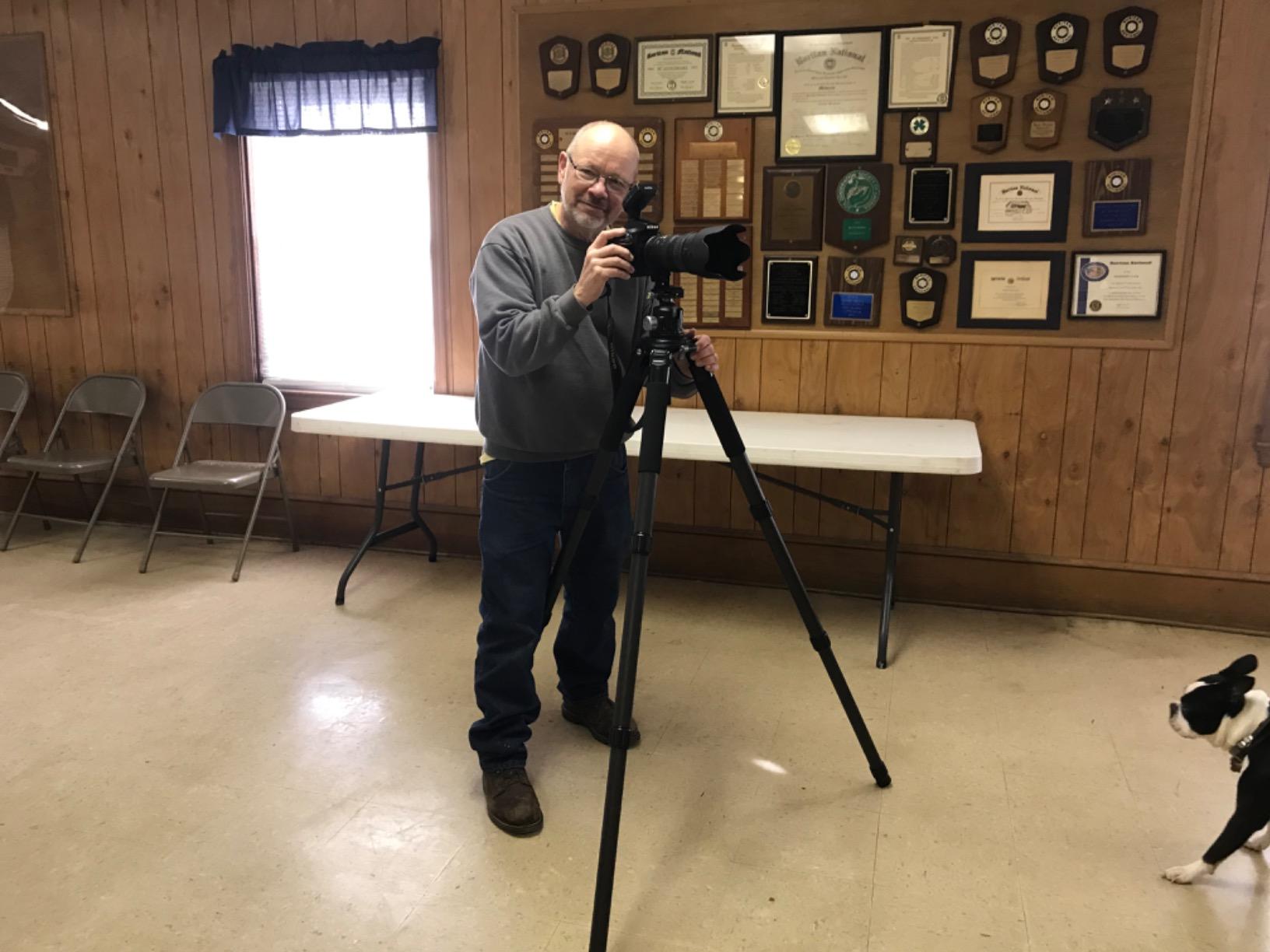
The bowl works with whatever head you fit. A 75mm bowl accepts ball, fluid, gimbal, and panoramic heads through the standard adapters, so you are not locked into one system. Leg angle positions at 9, 37, and 69 degrees give you the low and inverted framings that wide lenses need, and the rubber and stainless spike feet swap without tools.
It folds to 23.2 inches. That is longer than the travel models but short enough for a rear seat or a boot, and the included bag takes the folded tripod rather than a fully assembled rig. The oversized hook under the mount plate takes a counterweight bag for windy cliff-top work, which is exactly where the extra mass helps.
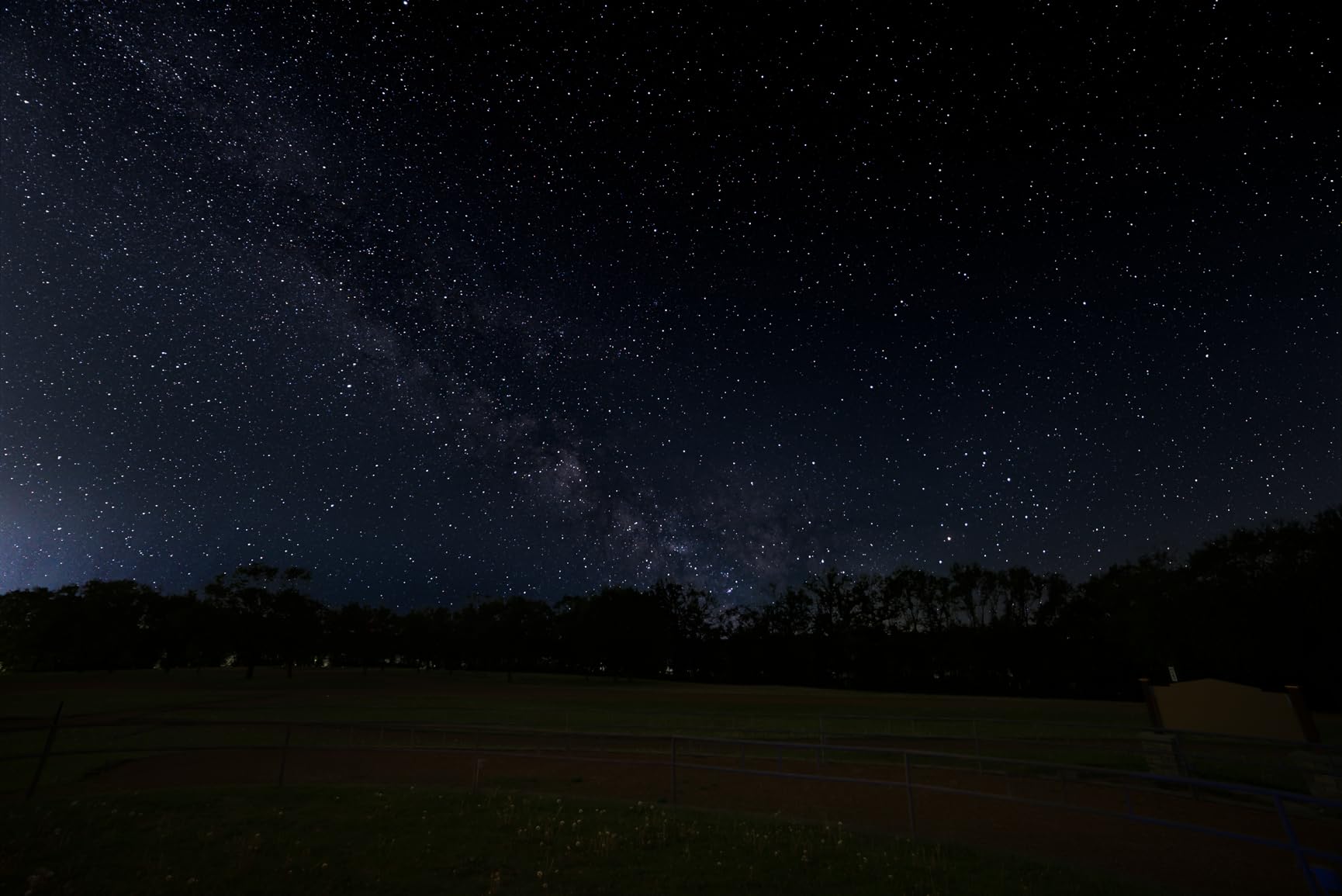
Why heavy telephoto landscapes need a big upper tube
Leg flex scales with the cube of length and inversely with the cube of tube diameter, so the jump from a 22mm section to a 40mm section is worth more than the extra weight suggests. A 300mm lens sitting on a 70-200mm and that extra mass creates enough leverage to twist a narrow leg visibly at full extension, and that twist reads as a blurred corner on a long exposure.
The practical rule long-term owners use is to rate the tripod at roughly twice your total kit weight, which is the sizing advice that repeats across the photography forums this category lives in. On that basis a body plus a 24-70mm, a 70-200mm, and a small tripod totals well under 20 lb, which the RT90C covers many times over.
What you give up for that stiffness
No head is included. That is not a flaw so much as a design decision, but it means the system cost lands later, and a 75mm bowl needs a head that fits that bowl diameter. Budget for a quality ball or a small fluid head before you compare this to bundled kits.
At 6 lb it is the heaviest carbon tripod in this group, and the four twist locks need a moment of practice to operate smoothly once you get used to levers. For a photographer who shoots from a car, this is an irrelevant tradeoff. For someone walking 8 km with the kit, it is the whole decision.
3. Manfrotto MT055CXPRO3 – the horizontal center column tripod
Manfrotto MT055CXPRO3 Carbon Fiber 3-Section Tripod with Horizontal Column,Black
4.4 lb
Load: 19.8 lb
Max: 66.93 in
3-section legs
Head: not included
Pros
- Q90 column rotates to horizontal in one motion
- Exceptionally stiff carbon legs
- Rotating bubble level works on all planes
- Easy Link port for accessories
- Ten-year warranty extendable on registration
Cons
- No tripod head included
- Locking levers can pinch fingers
- Carbon column grinds down and sheds black dust
- One owner reported a leg failure and a poor warranty outcome
The MT055CXPRO3 is the one to buy when your landscape compositions include overheads, flat-lay abstracts, and ground-level foregrounds. The Q90 centre column swings to horizontal with a single-finger movement, so you can hang a 16-35mm over a stream bed or lay it out beneath a rock arch without crouching into a bad position. Very few tripods at this weight do that cleanly.
Manfrotto is one half of the Vitec Group alongside Gitzo, and the build here reflects it. Owners describe the carbon legs as rock solid with no wobble under heavy gear, and the three-section layout means fewer joints between the ground and the head, which is where torsional flex starts.
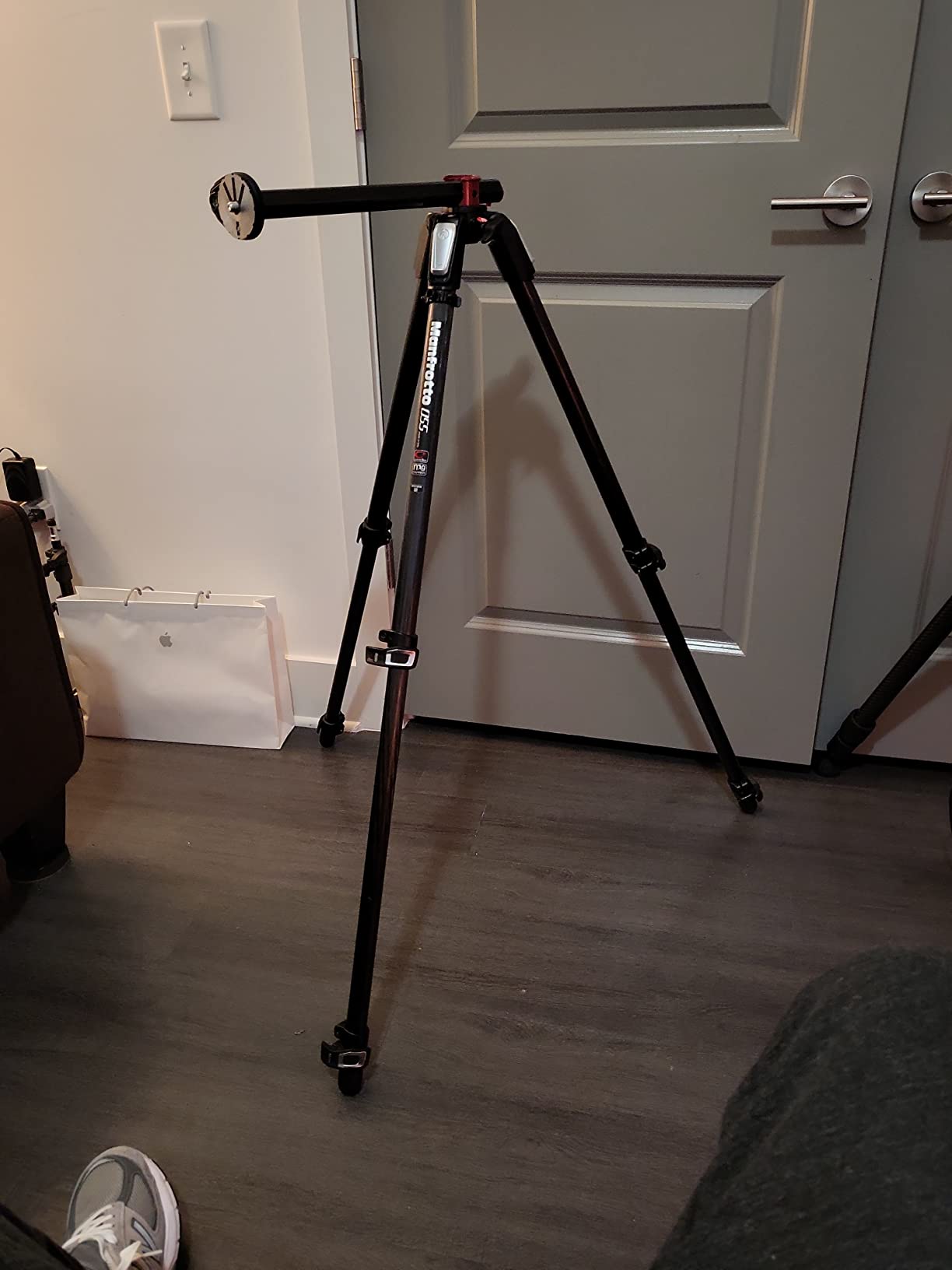
The upper disk carries a rotating bubble level, which matters more than it sounds. Most landscape work is a long-exposure job, and a bubble that stays readable as you rotate the disk on uneven ground saves a great deal of framing time. The Easy Link port on the side of the upper casting also gives you a clean place to hang a wireless shutter release or a graduated filter holder.
Maximum height is 66.93 inches, and the leg diameter is 1.15 inches at the top, which is a good compromise between stiffness and packed size. The 19.8 lb load rating covers a full-frame body with a telephoto zoom, though it leaves less headroom for a mounted filter system than the INNOREL does.
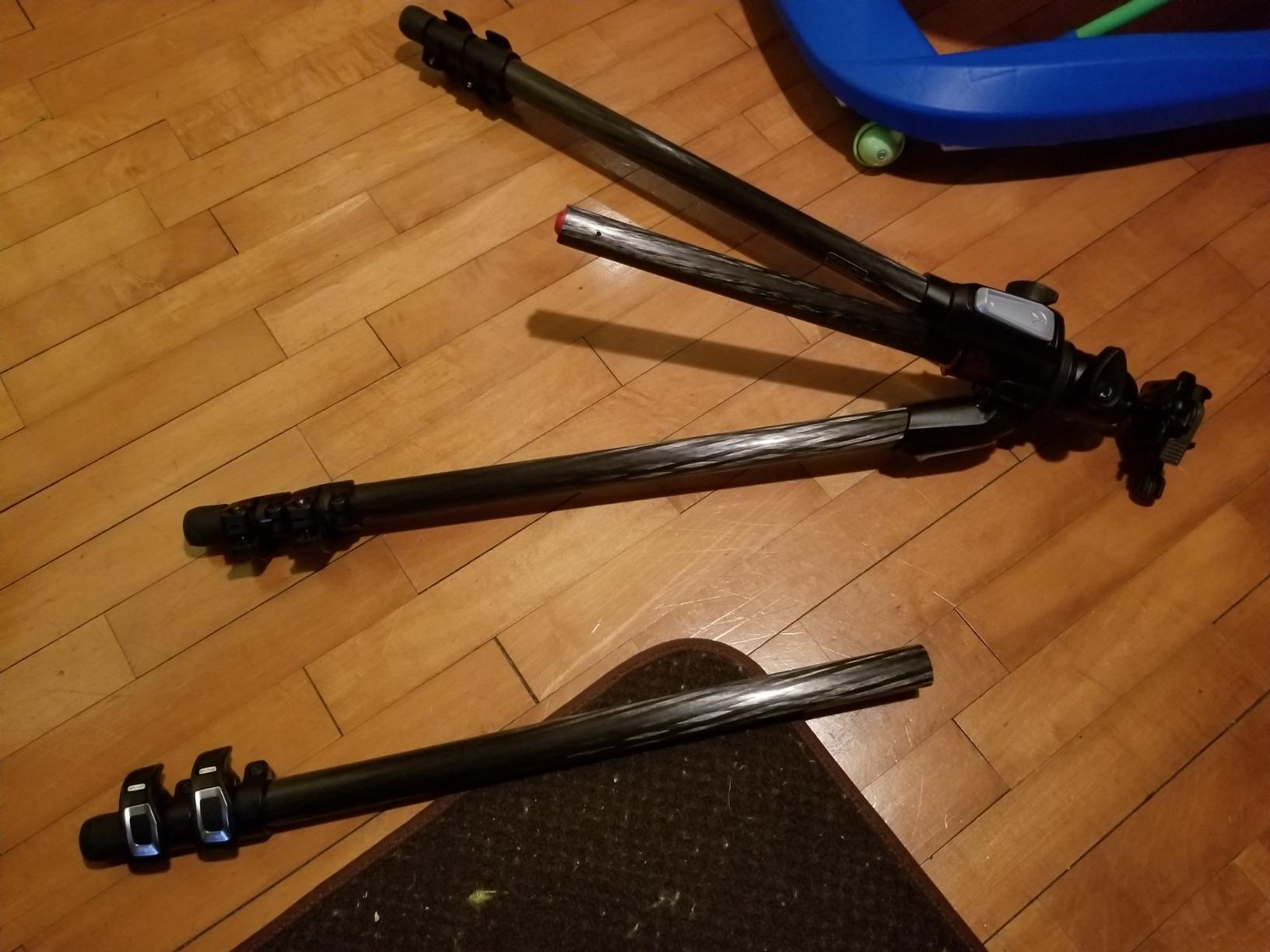
The rotating column in real landscape work
A horizontal column turns a tripod into an overhead or ground-level arm, and that is the difference between framing a foreground stream and guessing at it. Because the camera hangs directly beneath the apex rather than out to one side, the load stays centred over the legs, so the setup stays stable in a way that a straight column cannot manage at full extension.
The same geometry helps with mirrorless and tethered shooting, where the sensor plane matters more than usual, and with the low-angle compositions that use a wide lens close to the ground. The stated minimum height of 9 centimeters with the column inverted gets you essentially into the dirt for a moss and rock frame.
The complaints worth knowing before you buy
The centre column wears. Owners report the carbon surface grinding down over years and shedding a black dust that transfers to clothing and camera bags. It is cosmetic rather than structural, but it is a recurring note and worth expecting on a tripod you intend to keep for a decade.
There is no head in the box, and the locking levers can pinch fingers if you swing them hard, which is a small thing that matters when you are working fast in gloves. One owner also reported a leg breaking after two months of use with an unsatisfying warranty response. Manfrotto’s standard limited warranty is extendable to ten years on registration, but individual outcomes clearly vary.
4. Peak Design Travel Tripod – folds to a water bottle for the longest walks
Peak Design Travel Tripod, Carbon Fiber, Compact Design, Quick Setup and Takedown, Pro-Level Stability, Ergonomic Ball Head, Compact and Portable Travel Tripod for Camera and Phone, 20 lb Capacity
2.8 lb
Load: 20 lb
Max: 60 in
5-section legs
Head: reversible ball
Pros
- Folds to water-bottle diameter
- Deploys and locks in seconds
- 20 lb rating holds a full-frame with telephoto
- Inverts tool-free for low angles
- Counterweight hook built into the column
Cons
- Ball head is awkward rotating to vertical
- Leg clips pinch fingers during fast setup
- Hex key holder ejects the tool easily
- Less rigid than heavier rigs in wind
The Peak Design Travel Tripod is the one people carry when the walk to the viewpoint is the point. It folds to roughly the diameter of a water bottle, weighs about 2.8 lb with the case, and it deploys without the flipping and rotating of leg sections that makes a normal tripod slow to set up. For a 30-second exposure at a remote lake, that speed is the feature that matters.
It still holds 20 lb, which is enough for a full-frame body with a telephoto lens mounted, and the reversible ball head lets the camera sit between the legs for ground-level work. The integrated hook accepts a backpack as a counterweight, which is a genuinely clever use of the gear you are already carrying.
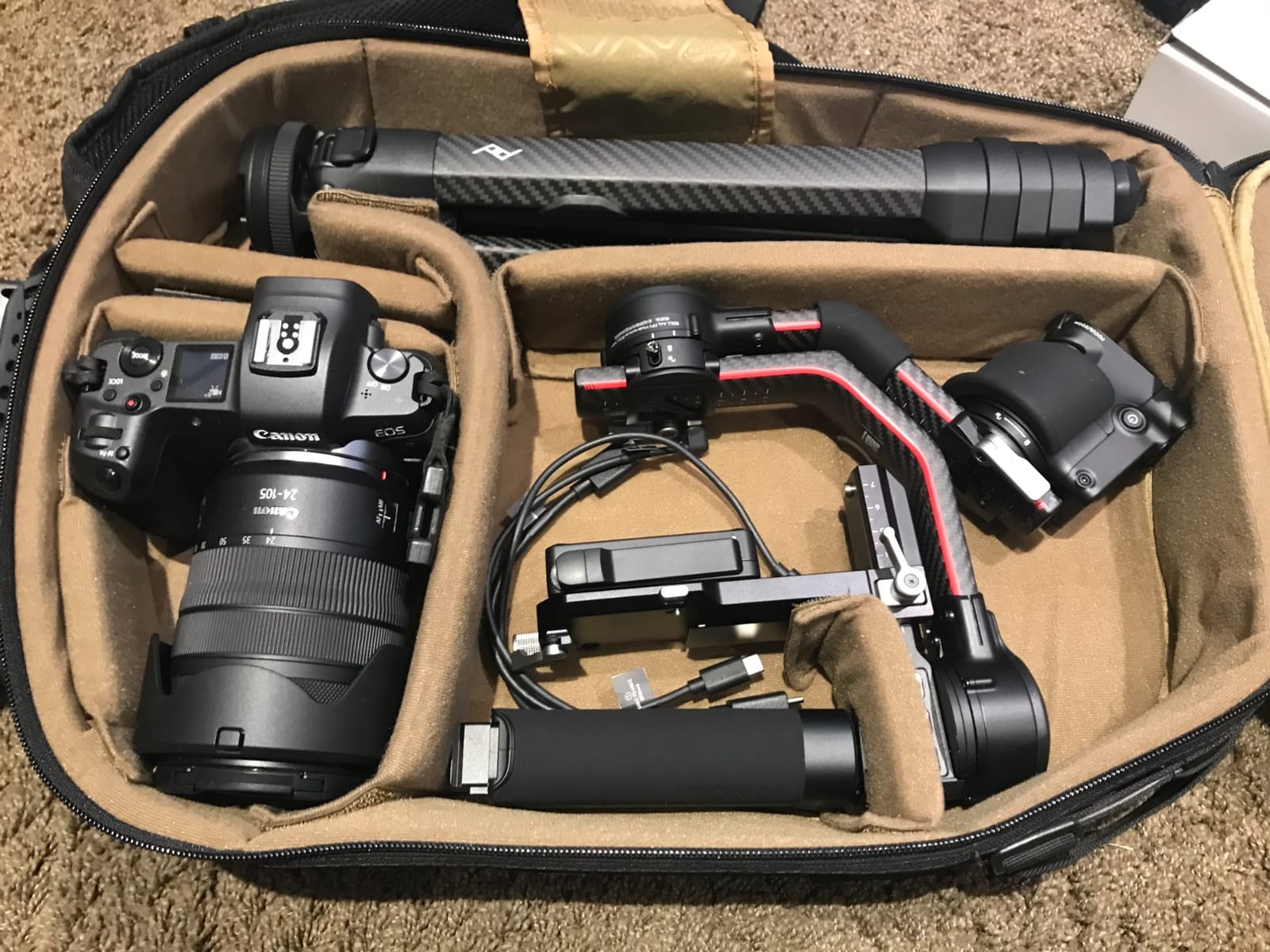
Owners using it for multi-night trips report it holding up well after years of weekly use, though one long-term user did have a small adjuster clip break while the tripod itself kept functioning. That is the durability-versus-price tradeoff in a single sentence, and it is worth weighing if you are buying this as your only tripod.
There is a built-in phone mount that pops out of the centre column, and the allen key stores on one of the legs. The leg storage works about as well as you would expect, which is to say the tool ejects too easily and goes missing on a windy ridge more than once.
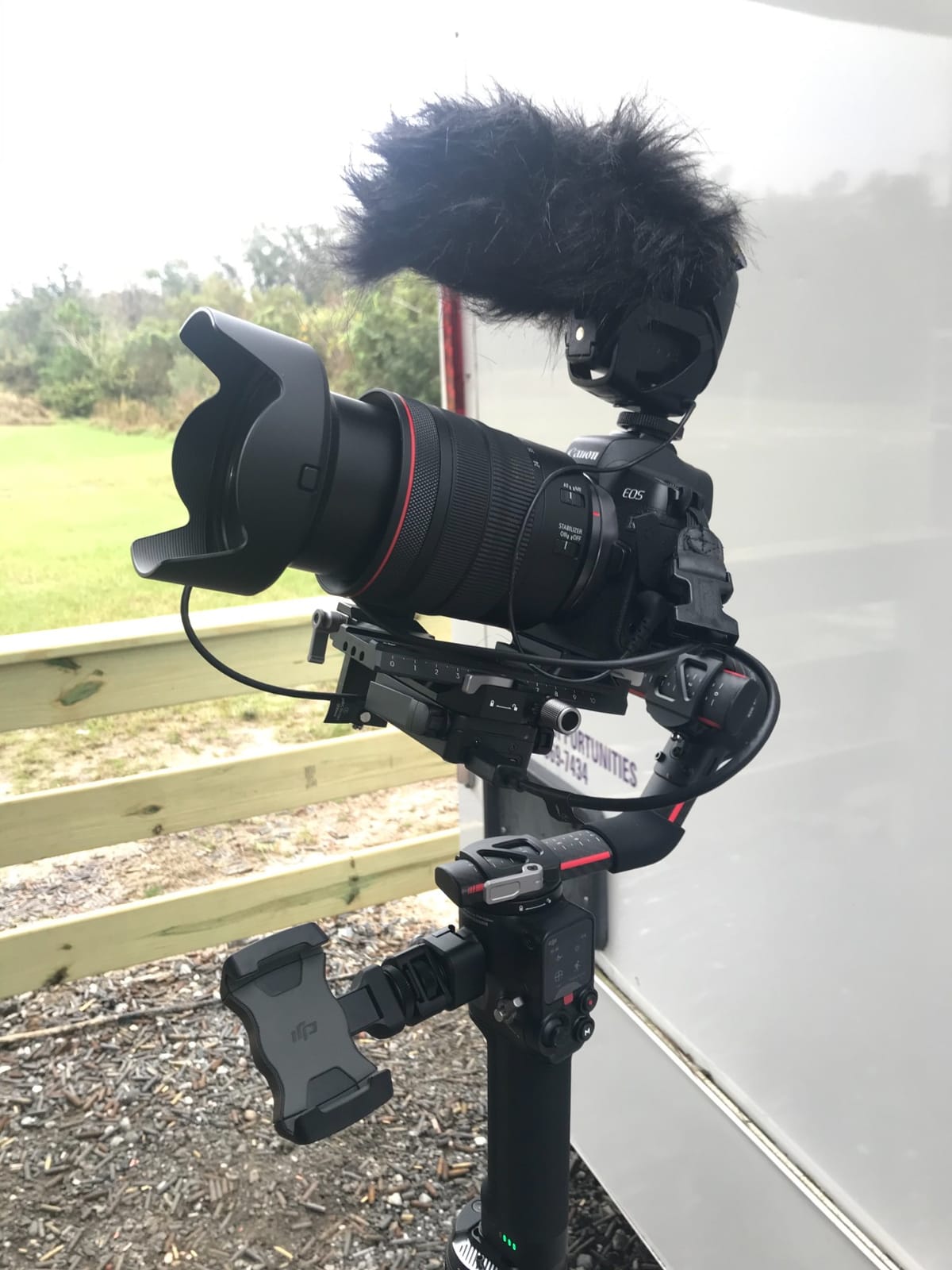
When 5 sections are the right answer
Five sections let the pack length shrink to 15.4 inches without making each section so thin that it rings under load. The trade is extra joints: every section is a place for flex and for grit to lodge. On rough rock, the shorter packed length wins because the collapsed length is what has to fit through a gap in the terrain.
For dawn and dusk work, where you are setting up in low contrast and often by feel, the deployment speed is worth the extra joints. You can have the camera on a long exposure in a fraction of the time a twist-lock tripod takes, and the reversal time at the end of a session matters when you are packing in failing light with cold hands.
Where it is not the right tool
Stiffness is the limit. At full extension with a long lens in wind, owners report it as less rigid than heavier studio tripods, and that is exactly the scenario a 30-second exposure at f/11 in coastal air puts you in. The stiffness trade is the honest cost of a 2.8 lb pack that fits through any gap in the terrain, and it is the one thing to weigh before buying.
The ball head also moves awkwardly when you rotate the camera to vertical, which is a common landscape orientation. Fitting a different head requires the separately sold universal adapter, so if you already own a quality head, check that before you commit to the body.
5. K&F Concept X-Series 68 inch – rated for astro tracking rigs
K&F Concept X-Series 68″ Carbon Fiber Camera Tripod
1.55 kg
Load: 35.2 lb
Max: 67.9 in
4-section legs
Head: 36mm CNC ball
Pros
- Full 28mm carbon tubes at only 1.55 kg
- 16 kg rating covers a mounted star tracker
- 36mm CNC ball head with graduated scale
- Removable leg converts to a monopod
- Standard 1/4 inch Arca-type thread
Cons
- Ball head sags under off-center loads
- Twist locks are slower than lever locks
- Center column feels wobbly past halfway
- Vibration transmits when a leg is knocked
This is the tripod in the group that makes the most sense if your landscapes include a night sky. A star tracker is an off-centre load, and most included ball heads struggle with that because they are designed to hold a camera centred over the apex. The 16 kg rating here leaves real headroom for a tracker plus a counterweight bar, which is what makes it usable rather than merely adequate.
At 1.55 kg with the head, it is one of the lighter 4-section carbon tripods we found, and the 28mm tubes are full diameter rather than tapered. The CNC-machined 36mm ball head has a graduated scale on the pan axis, which makes repeatable panning sequences across a star field straightforward.
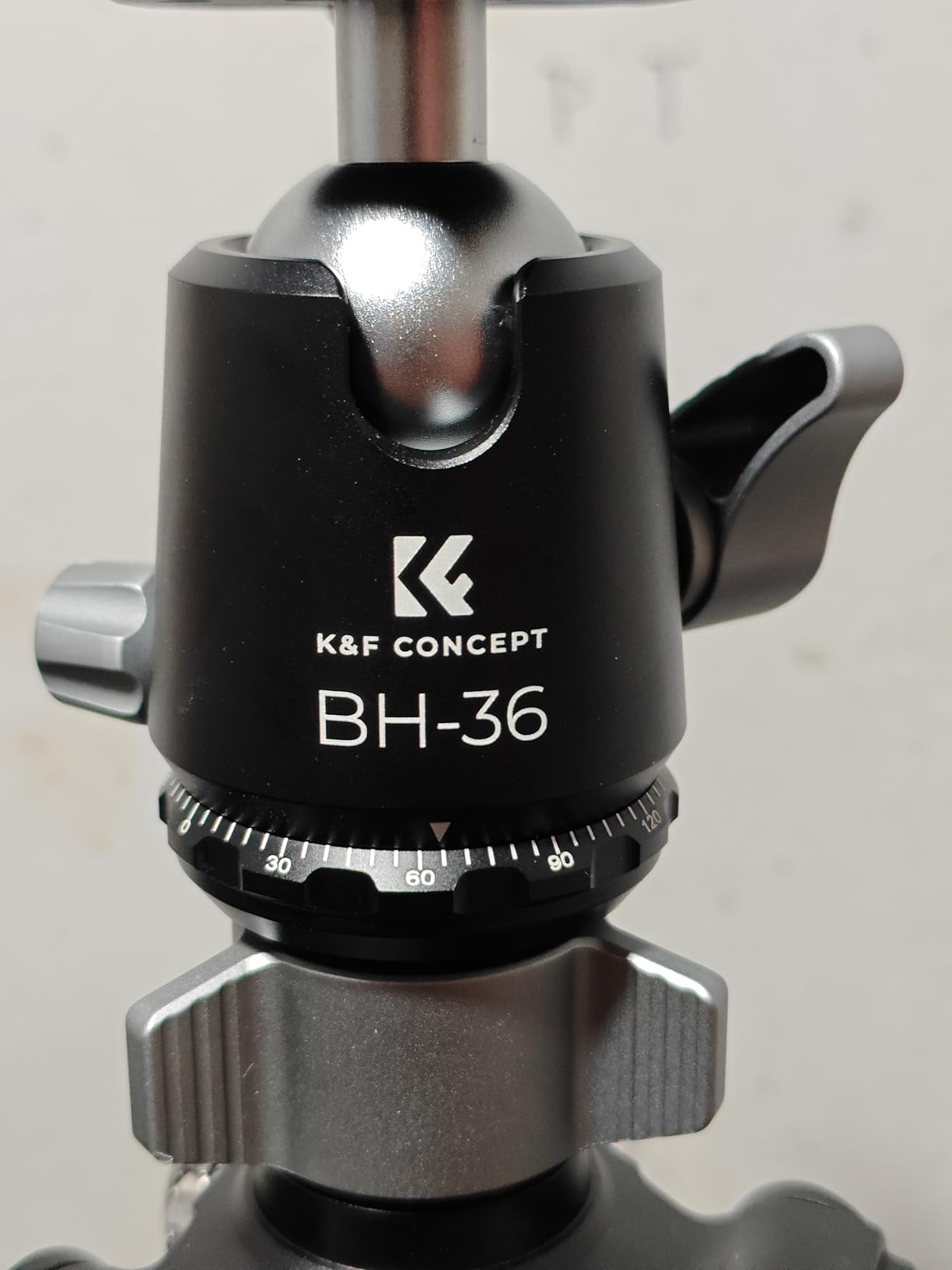
K&F Concept has several listings sitting in the carbon tripod corner of the shopping results, and buyers repeatedly describe the value here as hard to argue with, with owner reviews and long-term reports backing that up. The consensus is that the legs are rigid and light, and that the head is the part to upgrade first.
Which is, in the end, the honest verdict. For a moving foreground at a waterfall in daylight, this tripod is excellent. For a night sky with a tracker hung off the side, you should treat the included head as a placeholder.
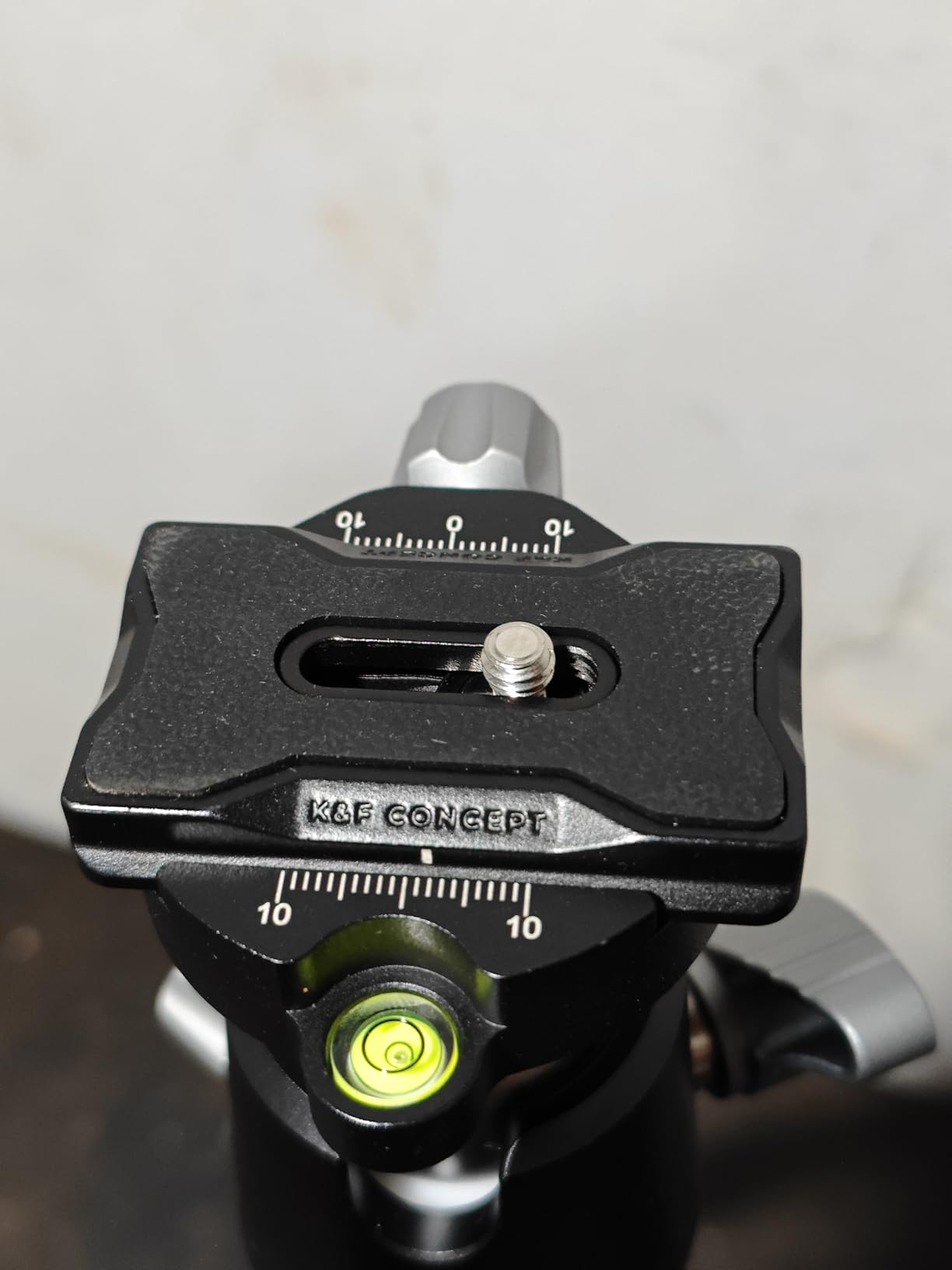
Load capacity for astro-modified landscape work
The number to work from is your tracker plus camera plus lenses plus any counterweight bar, not just the camera. Night landscape kits add up quickly because a tracker mount and counterweights can weigh as much as a telephoto. On the twice-your-kit-weight sizing rule, a 25 lb rig wants a tripod rated at 50 lb, which is where the INNOREL rather than this model becomes the right answer.
Within daylight-plus-stars workflows where the tracker is light and the counterweight is small, the 16 kg rating is comfortable. The graduated pan scale also helps you build a foreground-to-sky sequence at the same camera height across multiple frames, which is how a 20-frame sky blend is usually made.
The two things reviewers warn about
The screw-down twist locks take about half a twist each, and they are slower than lever locks in a cold, wet, or gloved hand. That is a genuine cost when you are on a ridge in failing light, and it is the main reason this tripod sits below the top pick despite the strong capacity.
Owners also report the centre column feeling wobbly when extended more than halfway, and vibration transmitting through the rig if a leg is knocked. Both matter less for a short daylight exposure than for a two-minute one, and neither affects the daylight landscape use this tripod is genuinely strong at.
6. SIRUI AM-284 – rigid carbon legs that fold to carry-on size
SIRUI 47″/120cm Carbon Fiber Camera Tripod, Max Laod 15KG
2.69 lb
Load: 33.1 lb
Max: 47 in
4-section legs
Head: ball
Pros
- Stiffer than comparable travel models
- 29.4mm max tube diameter
- Folds to 45.3cm for carry-on
- Steel spike feet included
- Build quality close to far costlier brands
Cons
- No center column so no eye-level or inverted height
- Slightly bulkier than lighter travel rivals
- Twist locks are not to every taste
- 120 cm limit on tall compositions
The AM-284 makes its case on one specific number: 29.4mm at the top tube. That is wider than most travel tripods in its weight class, and owners comparing it directly with the Leofoto LS-284C consistently report that the SIRUI feels stiffer and more solid, at the cost of some bulk. For long exposures, that is the trade you want.
It folds to 45.3cm, which fits most airline carry-on limits, and the four twist-lock sections open with the semi-automatic angle buttons at 22, 55, and 85 degrees. Removable rubber feet swap to the included steel spikes for sand, soft ground, or mud, which matters more on a landscape trip than it sounds.
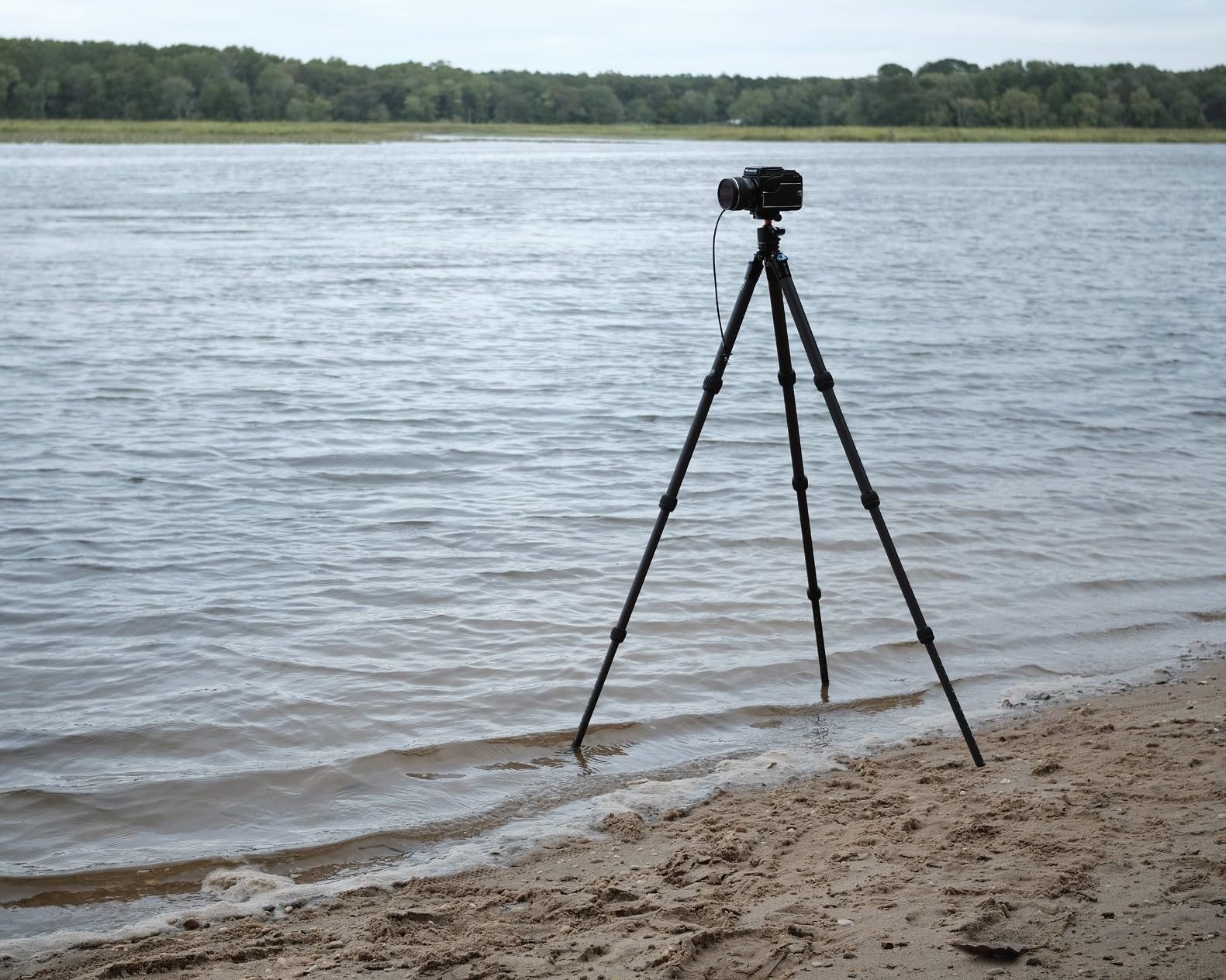
The build finish is the other recurring theme. With a 4.5 rating across 177 reviews, the comments describe a tripod that punches above its class and holds up next to bodies costing several times more. SIRUI is one of the names buyers most often ask about in the forums, and the answer there is consistently positive on rigidity and finish.
The 33.1 lb load rating handles a telephoto plus astro mounting setups, which is more than the collapsed length would suggest. You are trading height for capacity, and for a photographer who shoots wide-to-normal landscapes from a low or ground-level position, that is a good trade.
What a missing center column actually costs you
Without a centre column, the maximum working height is the top of the legs, which here is 47 inches. That is enough for a seated composition, a low wide-angle landscape, or a ground-level frame with a 24mm, and it is not enough for an eye-level shot with a 70-200mm across a valley. Landscape work is where that limitation bites least, which is why we still shortlist it.
It also means no inverted height for macro and moss work, though the 3.1 inch minimum from the leg angle positions gets you very low. If your landscapes are wide and low rather than compressed and upright, this constraint barely registers.
Who should skip it, and who should not
Skip it if you shoot a lot of tall compositions and expect to be standing at eye level with a telephoto. The 120cm ceiling is a hard limit, and no centre column exists to extend past it.
Do not skip it if the top tube diameter is what you care about. On a two-minute exposure at a waterfall, the stiffer 29.4mm section and the fact that there is no centre column contributing wobble are both advantages over lighter travel models. Owners with long tenure on this tripod describe it as still going strong, and the 6 year manufacturer warranty is the longest in this group.
7. NEEWER LT32 – fastest setup with a leveling head base
NEEWER LITETRIP LT32 62″ Travel Tripod Carbon Fiber with +/-5° Leveling
2.6 lb
Load: 22 lb
Max: 61.8 in
4-section legs
Head: detachable level base
Pros
- Spring flip buckles with visual lock confirmation
- Detachable leveling head base
- Removable column drops to 7.5 inches
- Arca plate compatible with Peak Design plates
- Spikes and nonslip pads both included
Cons
- Included ball head has limited horizontal adjustment
- Ball shifts at high tilt with long telephoto
- Stability softens when fully extended
- Carry bag fits the bare tripod only
The LT32 is the fastest tripod here to deploy, and for dawn starts that is not a minor feature. The spring flip buckles open in one movement and give a visual confirmation when locked, with a wing design intended to keep your fingers out of the mechanism. Setup happens in a fraction of the time a four-twist-lock tripod needs.
The detachable levelling base on the head is the feature that separates it from other travel models. It gives roughly 15 degrees of quick levelling, with dual U slots for 90-degree tilt, which means you can set a level horizon on a sloping riverbank without a separate levelling base or a wedge. On uneven landscape ground that saves an enormous amount of framing time.
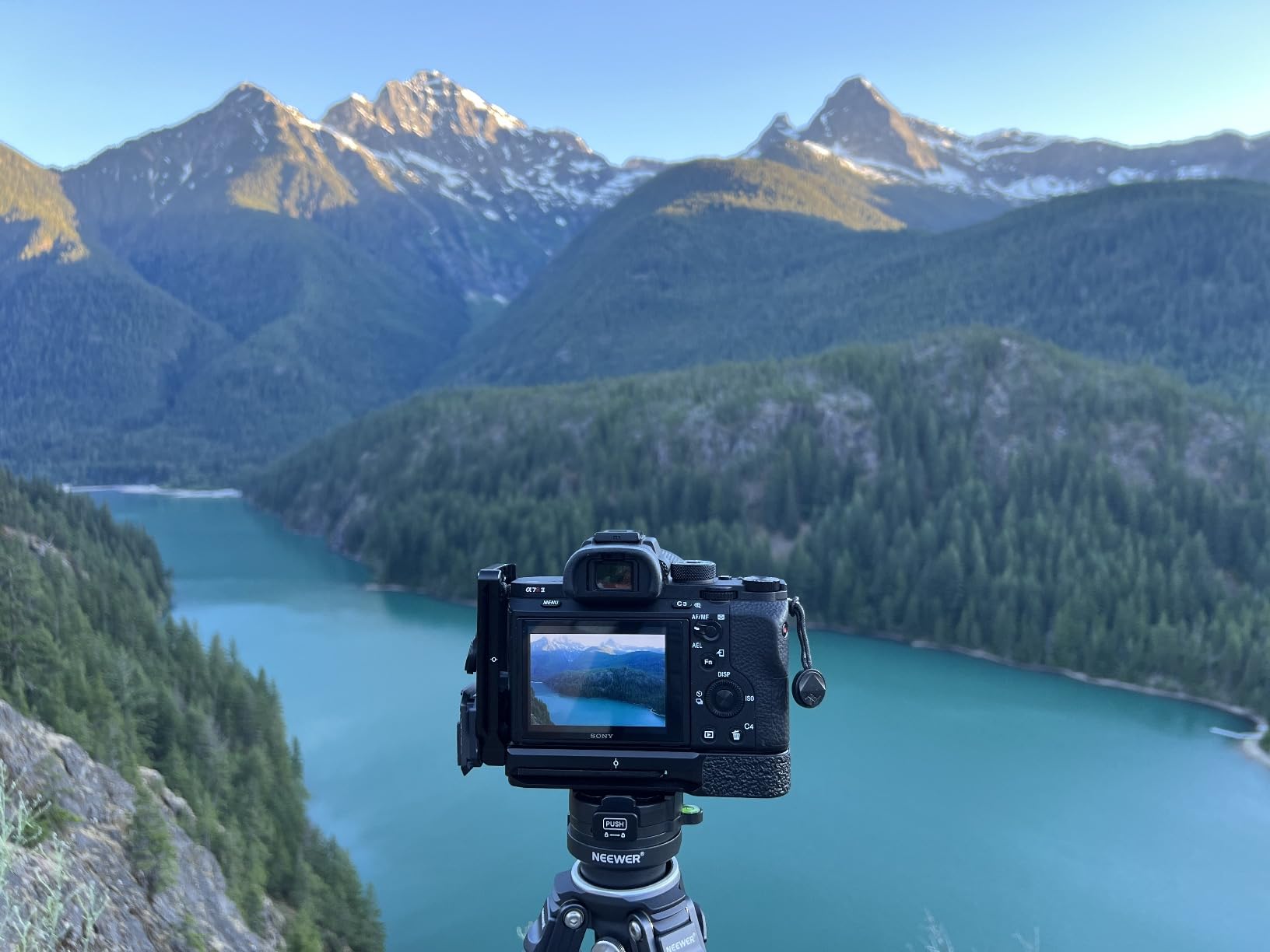
It folds to 17 by 2.6 inches, and the removable centre column drops to 7.5 inches for macro work. The quick release plate is Arca-type and compatible with Peak Design plates, so mixing it with another body on the same kit is straightforward if you own the other tripod in this list.
With 543 reviews and a 4.5 rating, the most common owner advice is to replace the included head. That is a reasonable upgrade path, and the detachable design means it is an easy one.
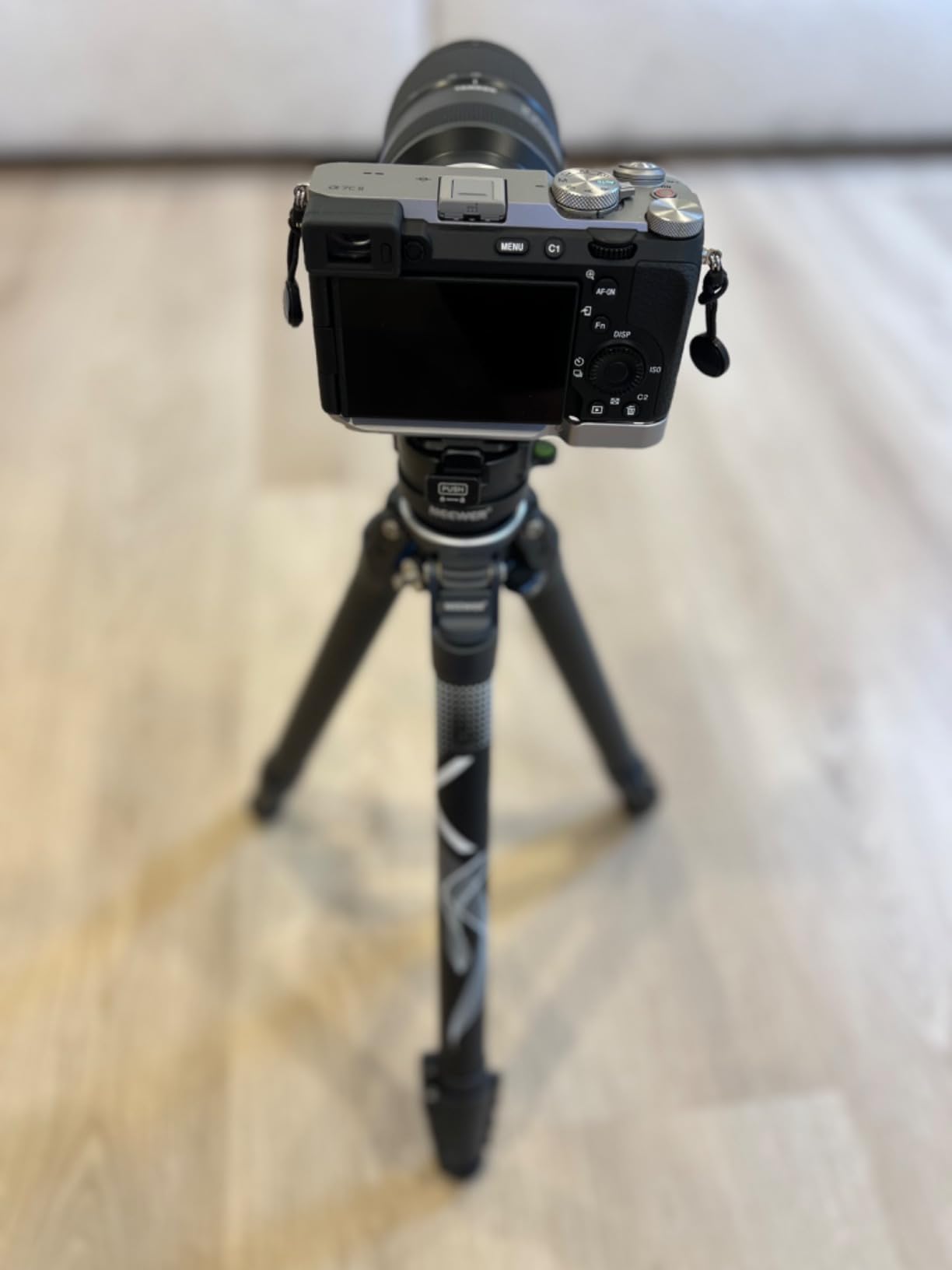
Flip locks and grit in the field
Flip locks open fast and, crucially, they shed debris when they close. That is the mechanism photographers on coastal and desert shoots praise most, because sand in a screw-threaded twist lock is a genuine long-term problem and sand in a flip lock is a problem you brush out. The switch to levers is a real field-durability decision, not just a speed one.
The trade is that levers need clearance to swing. On a 26mm tube the LT32 avoids this cleanly, and the pinch-free wing shape addresses the common complaint about lever tripods pinching fingers on hard surfaces. Setup speed and hand safety are both better than most of the twist-lock models here.
The limits you should plan around
The 26mm lower sections are the soft point. Stability softens when the legs are fully extended, and the ball shifts slightly at high tilt angles with a long telephoto. For a 10-second exposure at f/11 that is fine. For a two-minute one with a 300mm on a slope, it is not, and the INNOREL or the Manfrotto is the better body for that job.
The included carry bag fits the bare tripod only, not the tripod with the head attached. Owners note this repeatedly, so if you plan to travel with a full rig, allow for a separate head case or a different bag.
8. K&F Concept 60 inch – the lightest tripod in the group
K&F Concept 60″ Carbon Fiber Camera Tripod, Detachable Monopod for SLR DSLR
2.2 lb
Load: 17.6 lb
Max: 60 in
5-section legs
Head: 25mm ball
Pros
- Aerospace grade carbon legs at only 2.2 lb
- Folds to 13.8 inches for carry-on
- Detachable monopod mode from 14.6 to 62 inches
- 180 degree reflex folding
- Works with most Arca-Swiss plates
Cons
- Minimum height of 18 inches limits ground level work
- Resin plate clamp on the ball head
- Raised clamp screw limits longer plates
- Thin carry bag zipper wears early
At about 2.2 lb this is the lightest tripod in the group, and it is the one to carry when weight is the deciding factor. The 914 reviews make it the second most reviewed listing here, and the comments converge on a simple message, which is that it is remarkably light and still feels solidly built rather than flimsy.
Five section legs fold to 13.8 inches, which clears most airline carry-on length limits without a separate bag, and the 180-degree reflex folding gets the whole thing down to something you can strap to the side of a pack rather than clip in.
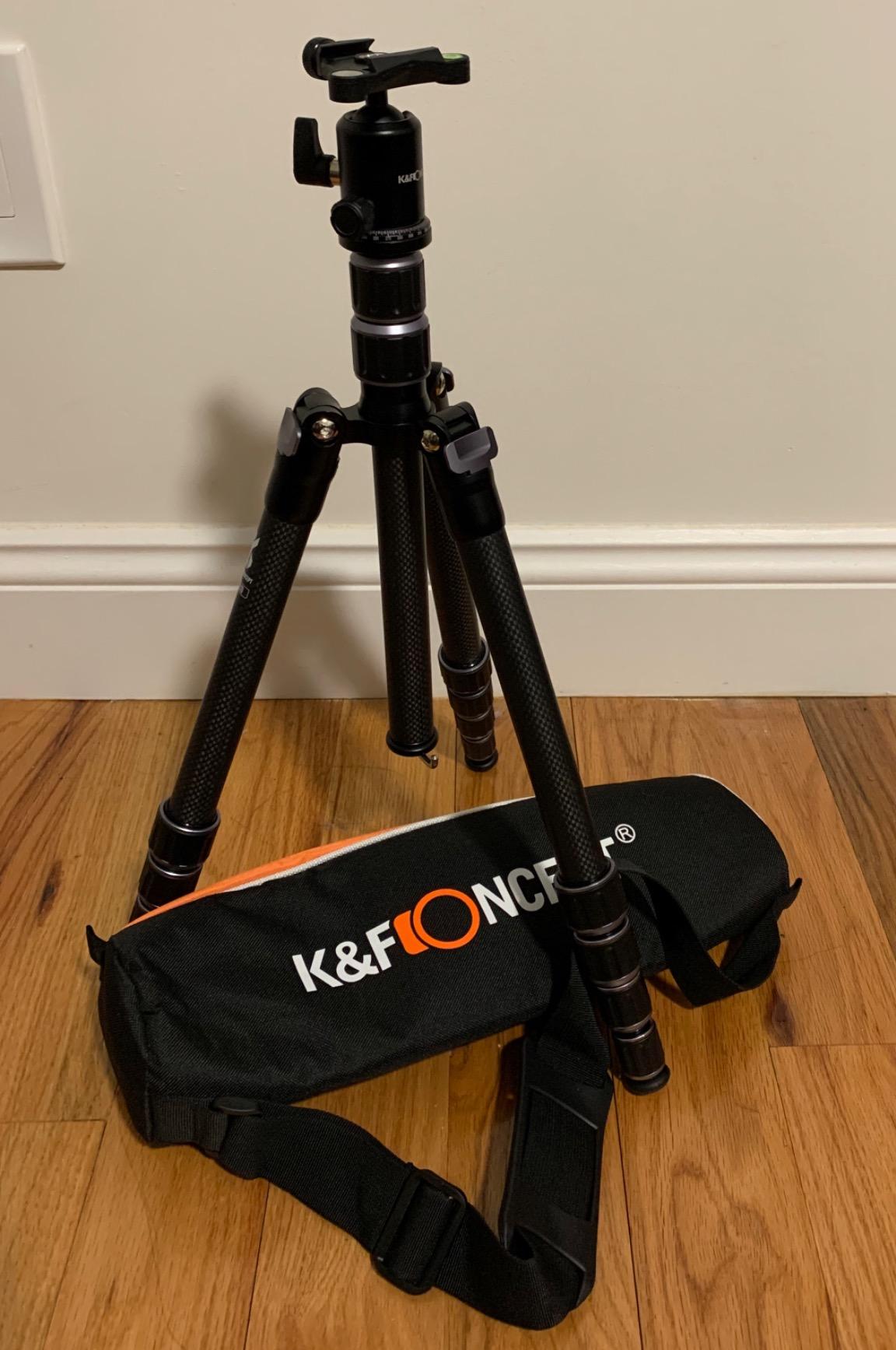
The detachable monopod mode is the cleverest feature here. One leg unscrews and the centre shaft screws on top, giving a working range from 14.6 to 62 inches, which is a real second tripod for tight spaces where three legs will not fit. For a gorge or a woodland frame that is worth more than a heavier body would be.
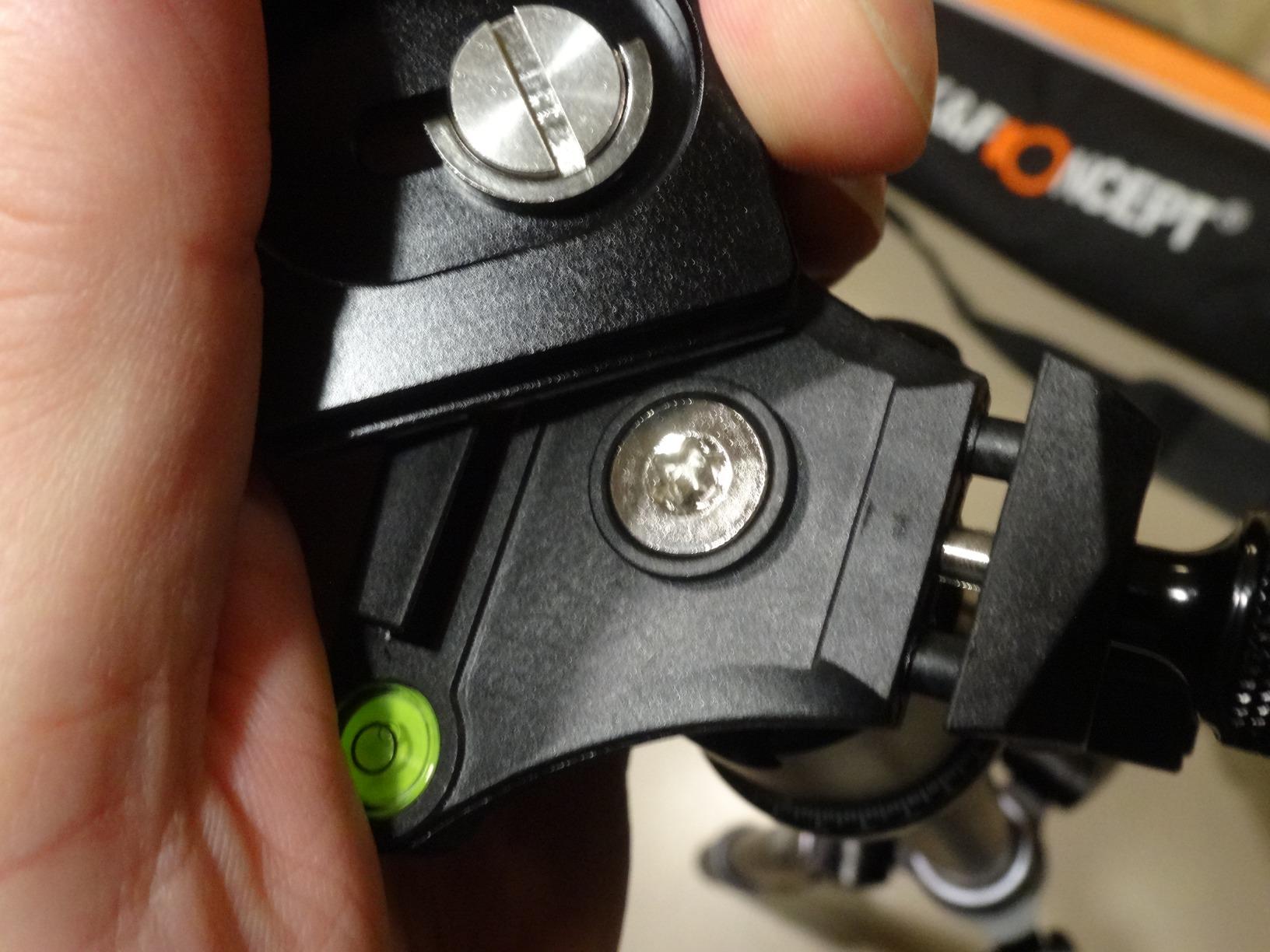
Load capacity is 8 kg, which covers a mirrorless body with one or two lenses comfortably. The 25mm ball head has a 360 degree scale and a bubble level, and the quick release accepts most Arca-Swiss plates, so it mixes with better heads if you outgrow it.
Where 2.2 lb stops being an advantage
The 22mm tubes are the trade. They are light enough to hike with, but they are the narrowest in this group, and owners report that vibration transmits noticeably through the rig when a leg is knocked. If your long exposures run past 30 seconds, the stiffness of a wider-tube model is worth the extra pounds.
The minimum height of about 18 inches also limits true ground-level landscape framing. The reflex folding helps with packing, not with getting the camera down into the foreground, and if moss, water, and foreground texture are the point, this is not the body.
The honest flaws to plan for
The plate clamp on the ball head is moulded resin, and some owners treat it as the part most likely to fail first. The raised clamp screw also limits how much of a longer Arca plate you can slide in, which matters if you use a long plate for a heavy rig.
Buyers also report a strong smell from the foam or rubber grip on one leg, and a thin carry bag zipper that can fail early, and the occasional tripod arriving with leg angle latches that do not hold position. None of these stops the tripod working, but they are the reasons the rating sits at 4.4 rather than higher, and they are worth checking on arrival.
How We Picked These Eight Tripods
We scored every tripod on eight criteria drawn from the spec sheets and from long-term owner reports, and we only kept carbon fiber bodies that are made for landscape work rather than video, tabletop, or studio-only use. Where the manufacturer and owners disagreed, we weighted the owner reports, because a load rating tells you nothing about how a leg feels after two years of sand and salt.
Load capacity against real kit weight. We used the sizing rule that repeats across the photography forums, which is to buy a tripod rated at about twice the total weight of your camera, lenses, and head. A typical landscape kit with a telephoto zoom sits between 15 and 20 lb, so anything rated at 33 lb or above clears it comfortably.
Rigidity at full extension. Upper tube diameter was the most useful published proxy we found, and we weighted it heavily because torsional flex is the failure mode that blurs long exposures. Models with 26mm to 29.4mm upper sections scored above 22mm ones for this reason.
Collapsed length and packed weight. Both numbers are manufacturer-published and cross-checked against owner reports. We care about collapsed length because it is the number that decides whether a tripod fits the boot, the pack, or the train, and about carried weight because the walk to the viewpoint is part of the job.
Leg lock type. Twist locks and flip locks behave very differently with grit in them, and photographers working on coastlines and desert ground consistently prefer the mechanism that sheds debris when closed. We did not treat this as decisive, but we treated it as a real differentiator.
Head and levelling system. A ball head is the norm for landscapes because a single control lets you compose quickly, but a levelling base or a bowl changes what is possible on sloped ground. We also checked whether the head was included, since a bundled head is a meaningful part of the total system cost.
Height range and column geometry. Maximum height matters for telephoto and foreground compression, and an invertible or horizontally rotating column is the difference between reaching a low angle comfortably and contorting into it. The SIRUI AM-284 is in this list with a known limitation here, and we say so.
Plate standard. Arca-Swiss compatibility was the tiebreaker, because it determines whether you can use the head you already own. The proprietary clamp problem is a real cost that buyers underestimate until they own two incompatible systems.
Durability and warranty. We looked for reports of grit intrusion, lock failure, and column wear, and at published warranty length, which ranges from one year on the NEEWER models to six years on the SIRUI.
Carbon Fiber vs Aluminium: Stiffness, Weight, and Damping
Carbon fiber earns its premium through stiffness-to-weight and through damping, and the first of those is easy to measure while the second is what actually shows up in your long exposures. An aluminium tripod of the same rigidity is typically 30 to 60 percent heavier, and for a landscape photographer that difference is the difference between carrying the tripod to the viewpoint and leaving it in the car.
The reason carbon stays rigid at a lower weight is the layup. Layers of carbon strands in a stiff resin matrix carry load along the leg axis while resisting the torsional flex that makes a thin aluminium leg ring after it reaches full extension. Practically, a lighter leg can stay stiff, so the tripod can be light enough to hike with and still hold a shot sharp without hanging a bag from the centre column hook to damp it.
Aluminium still wins on two points, and fair-minded comparisons should say so. It is cheaper, it is easier to repair, and it does not shed carbon dust from a worn centre column. For a photographer on a hard budget who shoots from a car, aluminium is often the correct answer. For a photographer carrying a kit up a mountain, the weight difference is the whole argument.
Cold weather is worth a mention too. Composite legs do not suffer the same brittleness at low temperatures that thin aluminium sections can, and there are many owners photographing winter landscapes who stay on carbon for exactly that reason. The main cold-weather concern with carbon is not the material but the locks, where stiff fingers and metal mechanisms are the bottleneck.
How to Choose a Carbon Fiber Tripod for Landscape Work
Start with your heaviest realistic kit, not your lightest. Add up the body, every lens you would actually mount together, the head, and a filter ring if you use one, then double it. That rule of thumb appears repeatedly in owner advice and it exists because a tripod rated exactly at your kit weight is a tripod at its limit, with no margin for a gust or an awkward stance.
Leg segments. Three sections give the stiffest legs and the largest packed size. Four sections are the balance most landscape shooters land on. Five sections pack smaller but add joints, and every joint is both a flex point and a place for grit to sit. If you shoot from a car, do not compromise stiffness for packability you do not need.
Twist locks versus flip locks. Twist locks are tighter and cheaper, and they seal dirt in. Flip locks open in one movement, confirm visually when locked, and push debris out as they close. On a beach or in desert sand, that difference decides how the tripod looks after three seasons. For everything else, it is a preference.
Anti-rotation leg design. This is the detail that separates tripods designed for outdoor work from those designed for a studio floor. When the wider section of the leg sits on the lower end, there is far less chance of dirt working into the joints and locking rings, and the legs can swing through the main locking point for extreme angles. Owners with long tenure on Benro and Induro tripods both point at this design as the reason their legs still move freely after years.
Head type. A ball head is the right default for landscapes because one control lets you frame and recompose quickly. A 3-way or pan-tilt head gives finer control for long exposures, since you can lock each axis independently instead of fighting friction to hold a position. The PAA question about shooting both portrait and landscape orientation comes down to the same thing, since a ball head swings to any angle in seconds, while a 3-way needs a pan handle and a level lock.
Height against focal length. To compress a foreground into a distant ridge you need the camera high, and roughly, every additional 100mm of focal length beyond 200mm wants a proportionate amount more height above the foreground. A tripod that reaches 65 to 80 inches will get you the elevated compositions that make layered landscapes work. One that tops out at 47 inches will not, and there is no substitute for height when the composition depends on it.
Arca-Swiss compatibility. If you already own a decent head, check the plate standard before you buy a body. Arca-type plates and clamps are the common standard, and they let you swap between bodies and heads freely. Proprietary plates are a genuine cost, because they lock you into one system and force a second purchase later. The NEEWER LT32 and the two K&F Concept models here all take standard Arca-type plates.
Monopod conversion and levelling bases. A removable leg that becomes a monopod turns one body into two tools and is invaluable in tight spaces. A levelling base lets you set a level horizon on sloped ground, which landscape work hits constantly. Both features are more valuable to a landscape shooter than a panning handle or a portrait orientation lock, and they are worth paying for.
Total system cost. Two of the tripods here ship without a head, and one needs a head that fits its bowl diameter. A bundle that looks like a saving on day one can be worse value than a headless body plus a good head, because the bundled head is usually the component you will replace first. Work out the full cost before comparing, and our travel tripod guide covers the packed-size question in more detail.
Used and refurbished. Tripods hold value well and the used market for carbon bodies is active, which makes a lightly used Gitzo, Manfrotto, or Benro a reasonable route to a higher tier. Inspect the leg sections for cracks in the resin, the locks for thread damage, and the centre column for the carbon dust that comes with age. Wear on the clamp screws and the ball head is normal; wear on the leg fibres is not.
The Right Carbon Fiber Tripod for Each Landscape Genre
Matching the tripod to the genre is faster than comparing spec sheets. Here is how the eight divide up by the kind of landscape work people actually do with them.
Seascapes and waterfalls on long exposures. This is the genre where stiffness and twist locks matter most. The NEEWER N55CR and the INNOREL RT90C are the safest choices, with the Manfrotto MT055CXPRO3 close behind. The lighter travel models are usable at 10 to 30 seconds and become marginal past a minute.
Milky Way and night landscapes. Load capacity for a tracker and a repeatable pan scale matter more than height. The K&F Concept X-Series is the right body for a light tracker setup, and the INNOREL covers a heavier rig with counterweights. The SIRUI AM-284 handles astro mounting setups and packs down small, which is the combination night photographers tend to want.
Mountains and remote viewpoints. Collapsed length and carried weight decide this one. The Peak Design Travel Tripod and the K&F Concept 60 inch are the two lightest here, and the SIRUI AM-284 folds small enough for a carry-on. The INNOREL wins on the tripod you never have to carry.
Telephoto compression and layered foregrounds. Load capacity and maximum height are the criteria. The INNOREL RT90C is the clear answer for heavy glass at 88 lb, and the NEEWER N55CR covers the majority of 200mm work at 80.7 inches. Anything topping out near 47 inches limits you.
Low-angle and ground-level foregrounds. Minimum height and column geometry decide it. The Manfrotto MT055CXPRO3 wins with its horizontal column, the NEEWER LT32 gets to 7.5 inches with its removable column inverted, and the NEEWER N55CR inverts to a 26.8 inch minimum working height. The K&F Concept 60 inch is the weakest here at an 18 inch minimum.
Winter and cold-weather shooting. Look at the locks and the feet rather than the material. Spring flip buckles on the NEEWER LT32 stay workable with cold hands, and the SIRUI AM-284 and K&F Concept 60 inch both include steel spikes for frozen ground and packed snow.
Frequently Asked Questions
What are the best tripods for landscape photography?
The best tripods for landscape photography reach 60 to 80 inches, carry a load rating of at least twice your total kit weight, and have an invertible or horizontal center column for low-angle foregrounds. A ball head is the most flexible option, and carbon fiber legs are worth the premium because they cut carried weight by 30 to 60 percent while staying rigid at full extension. Our overall pick is the NEEWER N55CR.
Are carbon fiber tripods worth it?
For landscape photography, usually yes. Carbon fiber legs are 30 to 60 percent lighter than an equivalent aluminium tripod at comparable stiffness, so you can carry the tripod to a remote viewpoint and still have a rig that does not flex at full extension. They also damp vibration better, which matters on exposures past 30 seconds, and they stay less brittle in cold weather. The exception is if you shoot from a car, where the weight saving and damping are worth less.
What load capacity do I need for landscape photography?
Add up your camera body, every lens you would mount together, the head, and any filter ring, then double that figure. A typical landscape kit with a telephoto zoom totals 15 to 20 lb, so a tripod rated at 33 lb or more gives you real headroom. A star tracker or counterweight bar changes the calculation more than an extra lens does.
How many leg segments should a landscape tripod have?
Three sections are the stiffest and pack largest, four sections are the balance most landscape shooters use, and five sections pack smallest but add joints that are both flex points and places for grit to sit. Choose three sections if you shoot from a car, four if you carry and extend regularly, and five only if the collapsed length is the binding constraint.
What is the best tripod for long exposure photography?
For long exposures, look for wide upper tubes, a load rating at least double your kit weight, and a column that does not add wobble. The INNOREL RT90C with its 40mm upper tube and 40kg rating is the most rigid option here, and the NEEWER N55CR with 28mm tubes and a 2-section column is the best all-round choice. Avoid ultralight models with 22mm to 26mm lower sections for exposures past a minute.
The Verdict on Carbon Fiber Tripods for Landscapes
The NEEWER N55CR is the pick. At 3.9 lb it is light enough to hike a long way, at 80.7 inches it is tall enough for telephoto and inverted low-angle work, and at 26.5 lb it is rated well above a typical landscape kit, with the deepest review history of any tripod here. If you need more capacity for heavy glass or a star tracker, the INNOREL RT90C takes 40kg on a 40mm upper tube and simply will not flex.
Buy the Peak Design Travel Tripod if the walk to the viewpoint is the hard part, and buy the Manfrotto MT055CXPRO3 if your compositions go overhead or flat to the ground. Whichever you choose from our best carbon fiber tripods for landscape photography roundup, size the load rating at twice your kit weight, keep a spare quick release plate in the bag, and it will still be holding your horizons steady in 2026 and every year after.