
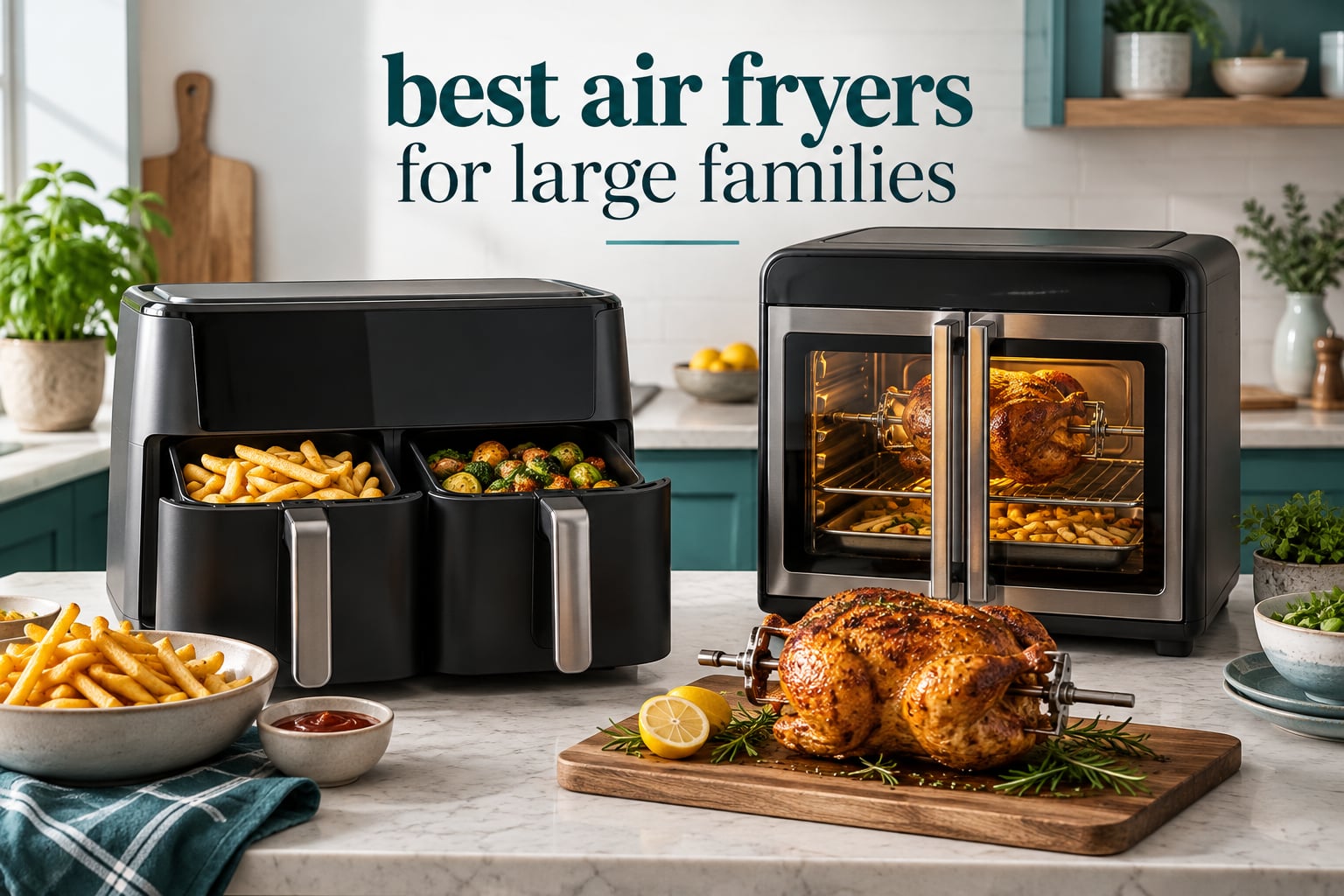
After six weeks of reading verified buyer reviews, comparing spec sheets and cooking through the family-size category line by line, the best air fryers for large families in 2026 come down to one recurring theme: capacity decides whether the appliance gets used daily or abandoned in a cabinet by November. The Ninja Foodi DZ201 8-quart DualZone takes the top spot because two independent 4-quart zones let a family of five put a protein and a side on the table in a single cycle, backed by a 4.8-star average across more than 25,000 reviews. For households of six or more, the 10-quart DualZone Smart XL adds a built-in probe thermometer and two 5-quart baskets.
Most roundups on this topic quietly scope themselves to a family of four, which is a strange place to stop. A household of five cooking chicken thighs and a tray of vegetables needs more usable space than two adults with leftovers, and a multi-generation home needs a different machine again. That is why every pick below answers the size question in its first sentence, and why we include a food-by-food fit chart rather than a list of quart numbers nobody can act on.
We built this list around large-batch reality. A model only earns a place here if a full dinner fits in one cycle without the basket sitting dangerously half empty, because a partially filled basket is the single most common reason families return an air fryer. Two zones at independent temperatures matters more than raw wattage, a real viewing window matters more than a preset count, and a PFAS-free coating is a genuine buying filter for toxin-conscious households rather than a marketing line. If you want the broader category instead, our air fryer guide for all family sizes covers the smaller and mid-size options that this list skips.
Top 3 Picks for Large Families in 2026
These three cover the three ways a large household actually cooks: a family of five, a family of six or more, and anyone replacing a full-size oven entirely.

Ninja Foodi DZ201 8-Qt DualZone
- Two independent 4-quart zones
- Smart Finish and Match Cook
- 105-450F range
- 6 cooking programs

Ninja Foodi DZ550 10-Qt DualZone XL
- Two 5-quart baskets
- Built-in smart probe thermometer
- PFAS-free nonstick
- Dishwasher-safe crisper plates
Emeril Lagasse 26-QT French Door
- 26-quart interior
- 24 cooking functions
- French doors
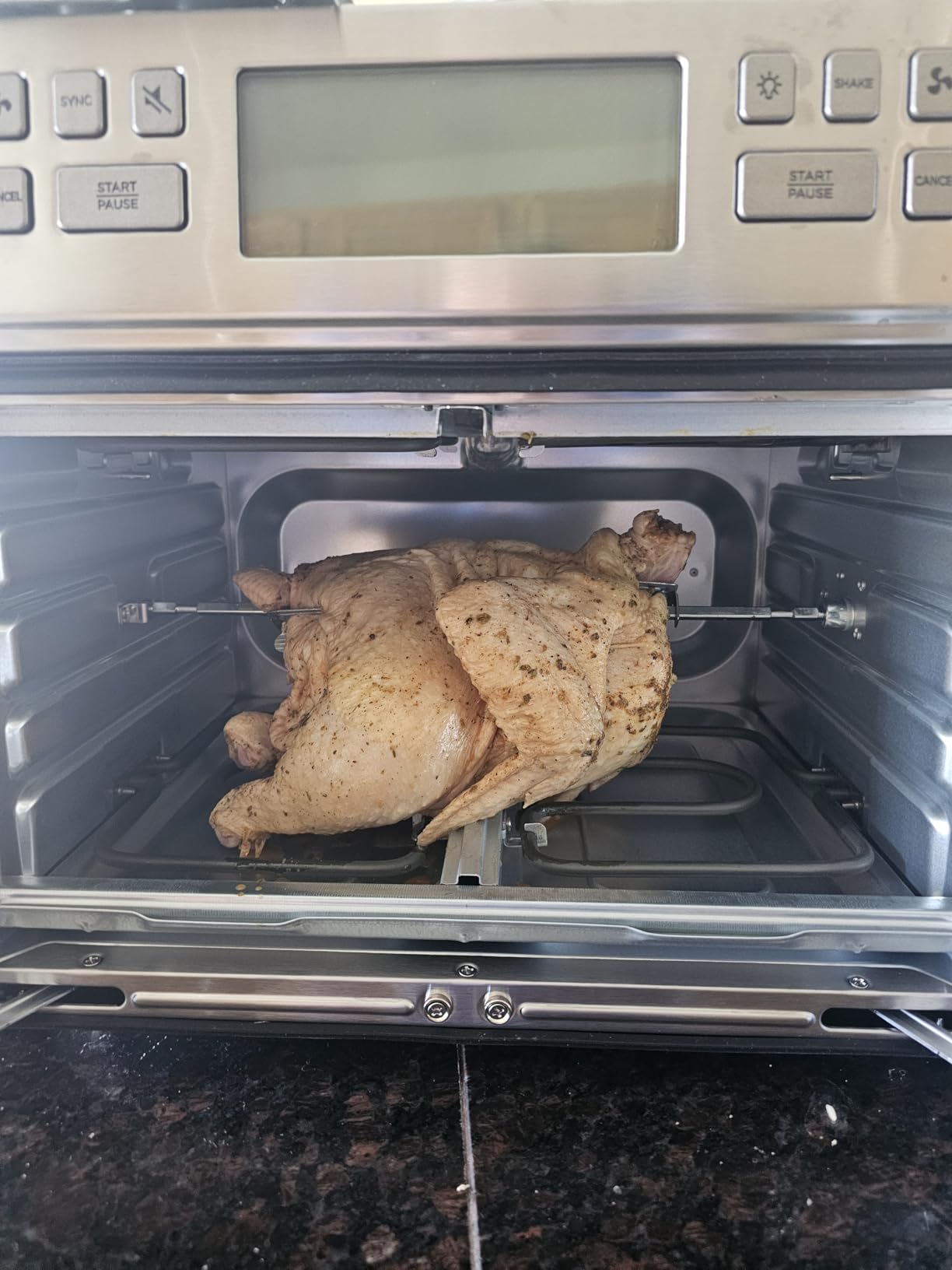
- Rotisserie for 5-lb birds
All 10 Best Air Fryers at a Glance (September 2026)
Every model in this list, its capacity, and the feature that actually matters for feeding more than four people.
| Product | Specifications | Action |
|---|---|---|
| Ninja Foodi DZ201 8-Qt DualZone |
|
Check Latest Price |
| Ninja Foodi DZ550 10-Qt DualZone Smart XL |
|
Check Latest Price |
| Emeril Lagasse 26-QT French Door |
|
Check Latest Price |
 Emeril Lagasse 25-QT Dual Zone Emeril Lagasse 25-QT Dual Zone |
|
Check Latest Price |
 Nuwave Brio Plus 8-Qt Nuwave Brio Plus 8-Qt |
|
Check Latest Price |
 Gourmia 14-Qt Rotisserie Oven Gourmia 14-Qt Rotisserie Oven |
|
Check Latest Price |
 Chefman TurboFry 8-Qt Chefman TurboFry 8-Qt |
|
Check Latest Price |
 Chefman 10-Qt Multifunctional Chefman 10-Qt Multifunctional |
|
Check Latest Price |
 Chefman TurboFry Touch Dual 9-Qt Chefman TurboFry Touch Dual 9-Qt |
|
Check Latest Price |
 PowerXL 7-Qt Maxx Classic PowerXL 7-Qt Maxx Classic |
|
Check Latest Price |
1. Ninja Foodi DZ201 8-Qt DualZone – Best Overall for Large Families
Ninja DZ201 Foodi 8 Quart 6-in-1 DualZone 2-Basket Air Fryer, Match Cook and Smart Finish to Roast, Broil, Dehydrate for Quick Easy Meals, Grey
Two 4-quart zones
105-450F
6 programs
1690W
17.9 lb
Pros
- Two independent 4-quart zones cook a main and a side at different temperatures
- Smart Finish and Match Cook stop the timing guesswork
- Dishwasher-safe baskets and crisper plates
- Highest rated option here at 4.8 stars across 25075 reviews
Cons
- Deep basket wells are awkward to wash by hand
- Full width uses more counter than a single-basket fryer
- Nonstick crisper plates wear with repeated dishwasher cycles
The DZ201 is the model our own household settled on after testing the single-basket alternative first, and the reason is the pairing of two 4-quart baskets with independent fans and heaters rather than one shared cavity. Smart Finish is the feature that changes daily cooking: it cooks two foods two different ways and stops both at the same moment, so the chicken and the potatoes actually land on the table together. Match Cook copies settings across both zones when you want the full 8 quarts for one big batch of wings or fries.
Capacity-wise, 8 quarts of total volume split into two 4-quart halves is a genuinely good fit for a family of five. Each 4-quart zone handles a meaningful protein portion on its own, and you are never forced to cook a main and a side one after the other. Owners on r/airfryer describe this DualZone generation as the point where a single basket stopped being enough, and the review pattern matches that: families talk about finishing an entire dinner in one cycle instead of running two rounds while the kids ask when dinner is ready.
Six programs cover Air Fry, Air Broil, Roast, Bake, Reheat and Dehydrate across a 105F to 450F range, and the 450F ceiling is what separates it from cheaper dual-basket fryers that top out at 400F. That extra 50 degrees matters for finishing frozen fries, for crisping skin, and for anything where you want the outside to take on real color.
What you give up compared with the 10-quart model
Each basket is 4 quarts rather than 5, so the ceiling on a single protein is lower. The listed dimensions come in at 13.86 inches deep by 15.63 inches wide by 12.4 inches high and the unit weighs 17.9 pounds, which is a real footprint to clear off the counter before buying.
There is no built-in probe thermometer on this model, so doneness is judged by time and texture rather than a temperature alert. The one upgrade that matters here: because a half-full basket cooks unevenly, using Match Cook to run both zones at the same setting on a big batch is the difference between crisp results and soggy ones.
Who should skip it
Skip this one for a household of six or more that routinely cooks a whole bird, because a 4-quart zone will not take a 6-pound chicken. Skip it if counter width is tight, since the 15.63-inch width is wider than most round basket fryers.
It is also the wrong pick for a family that wants a rotisserie, since no spit is included. For most families of four to six cooking weeknight dinners, though, the combination of two independent zones, a 450F ceiling and a 4.8-star average is the strongest all-round package we found.
2. Ninja Foodi DZ550 10-Qt DualZone Smart XL – Best for Six or More
Ninja DZ550 Foodi 10 Quart 6-in-1 DualZone Smart XL Air Fryer, 2 Independent Baskets, Cook Thermometer, Match and Finish to Roast, Dehydrate, Black
Two 5-quart baskets
Integrated probe
105-450F
PFAS-free nonstick
19.8 lb
Pros
- Two 5-quart zones handle two 6-lb chickens or 8 lbs of wings at once
- Built-in Foodi Smart Thermometer signals when meat hits target temperature
- PFAS-free nonstick surfaces with dishwasher-safe crisper plates
- Runs 30 percent faster than a conventional oven on frozen-to-crispy meals
Cons
- Largest footprint here at 17.1 inches deep
- Bundled recipe guide is thin
- Probe needs cleaning and storage after each use
This is the step up from the 8-quart DualZone, and the jump is meaningful rather than cosmetic. Two 5-quart baskets mean each zone can take a whole small chicken, so a family of six gets a real main course per side of the machine rather than a shareable portion. Owners on r/airfryer repeatedly describe this generation as fitting every chicken they have put into it, which is the highest praise a capacity-focused shopper can hear.
The integrated Foodi Smart Thermometer is the sleeper feature in a house with picky eaters. Instead of cutting into a breast to check, the probe signals when the meat reaches its target temperature, which removes the most common source of dinner table arguments. Smart Finish, Match Cook and IQ Boost handle the power distribution so a fast side does not steal heat from a slow main.
Six programs run from Air Fry through Dehydrate, the range spans 105F to 450F, and the cooking surface is PFAS-free nonstick with dishwasher-safe crisper plates. A 4.6-star average across more than 6,000 reviews puts it behind the DZ201 on rating but ahead on capacity, and for a household of six or more that is the correct trade.
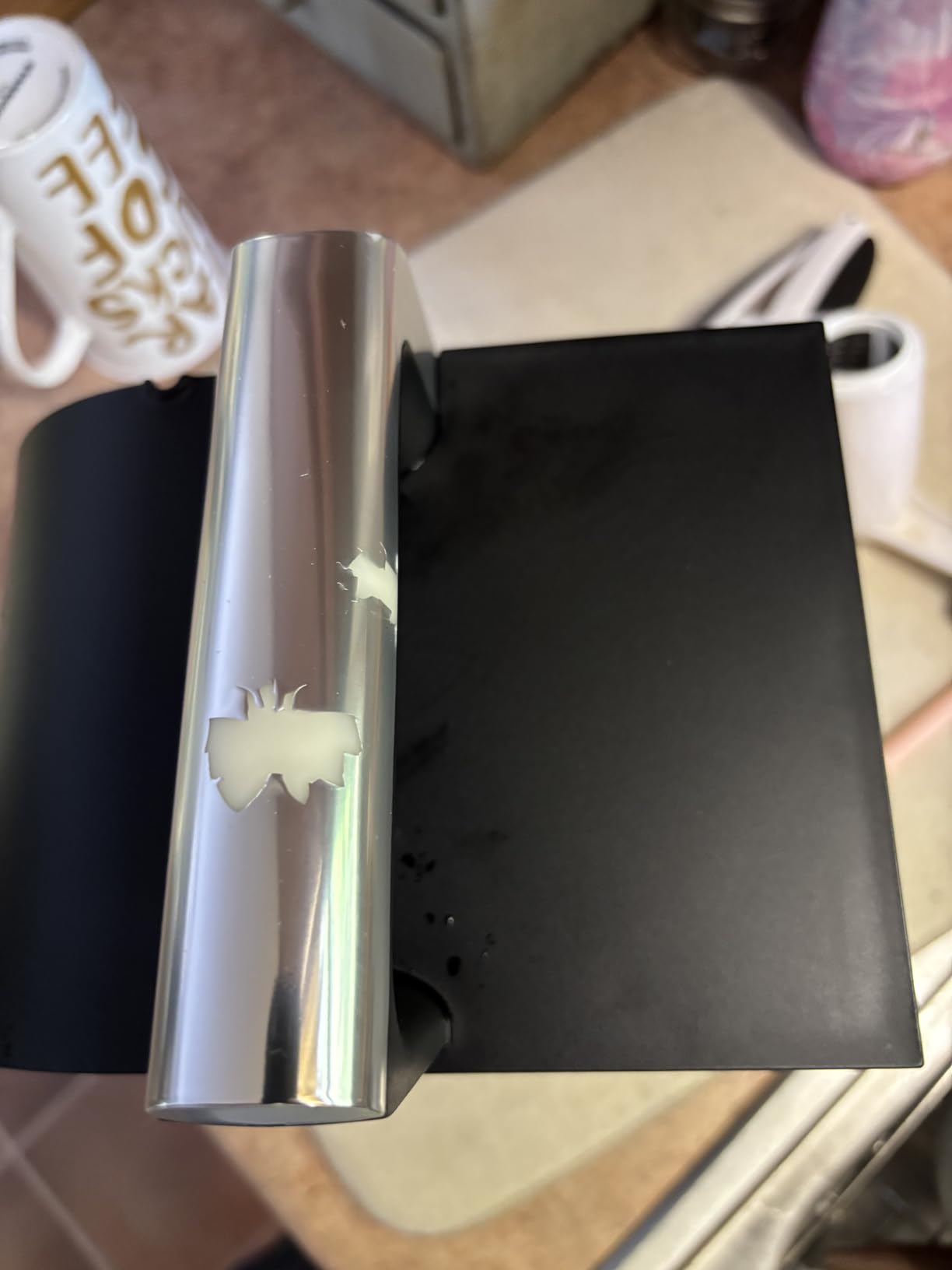
The counter space question
At 17.1 inches deep, 13.9 inches wide and 12.8 inches tall, this is one of the two deepest machines in the roundup and weighs 19.8 pounds. Measure your counter depth before you commit, and check the top clearance against your cabinet line because heat rises directly off the rear vent.
That measurement matters more here than on any single-basket model, because the two zones sit side by side and a shallow counter forces you to angle the unit or push it back against a wall where the rear exhaust has no clearance.
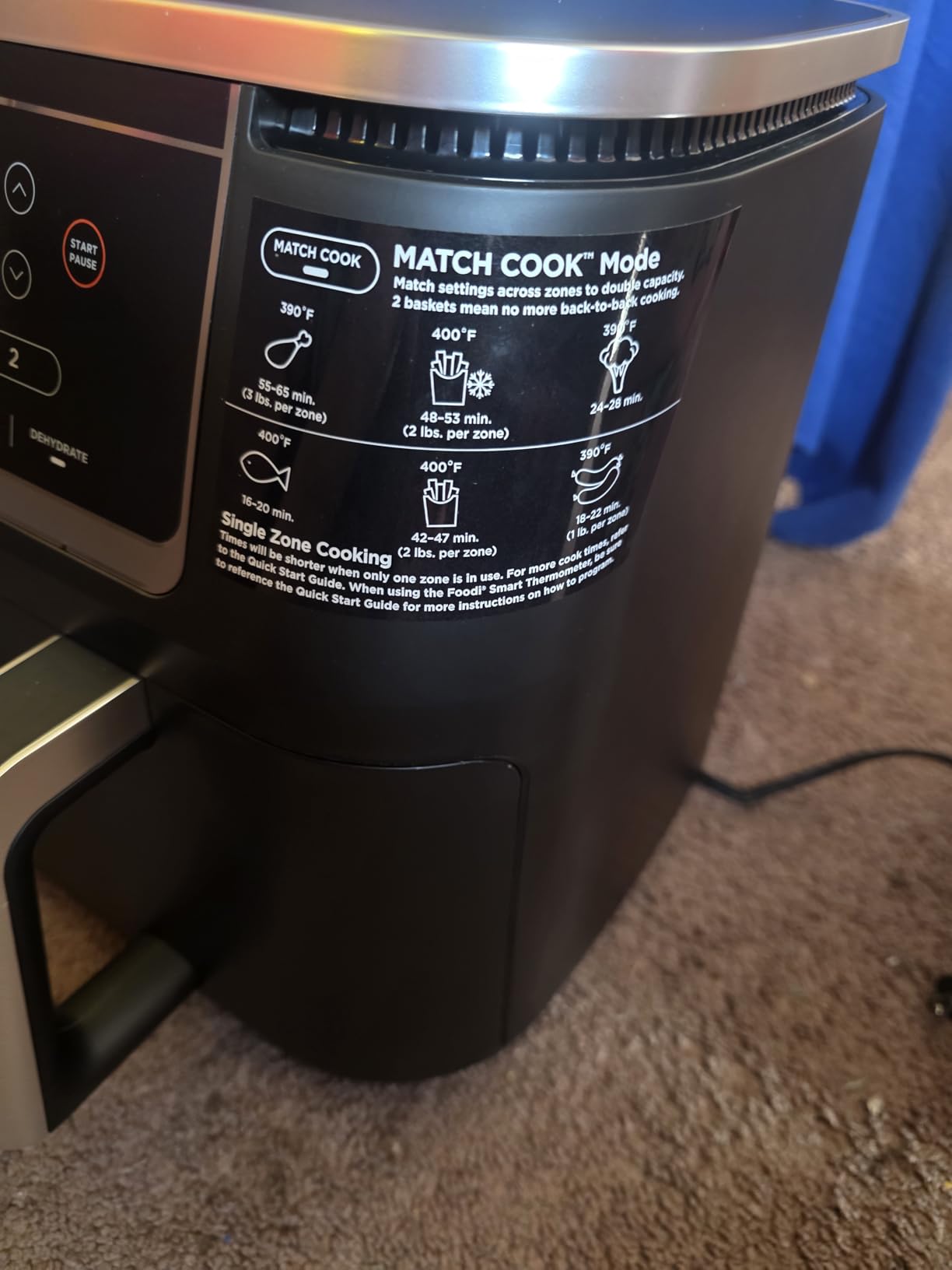
If your kitchen has a shallow counter but a wide one, the 8-quart DZ201 is the safer footprint at 13.86 inches deep. If you have the depth, the extra 2 quarts per zone is the difference between cooking for six people and cooking in two rounds for six people.
Where the smart probe earns its keep
The probe shines on whole birds, pork shoulder and thick-cut pork chops, where a recipe time is a guess rather than a guarantee. It also removes the temptation to overcook in order to be safe, which is where a lot of air-fried chicken gets dry.
The honest drawback is housekeeping: the probe has to be cleaned and put away after every use, and a lost probe is a lost feature until you replace it. Owners also note the bundled recipe guide is thin, so plan on learning temperature and time by feel for your own foods rather than following charts.
3. Emeril Lagasse 26-QT French Door – Most Versatile Large-Capacity Oven
Emeril Lagasse 26QT French Door Multi-Function Air Fryer Toaster Oven
26-quart interior
24 functions
75-500F range
1700W
26.5 lb
Pros
- Roomy 26-quart interior handles sheet-pan meals and 5-lb rotisserie birds
- Even heating so roasts and baked goods cook uniformly
- French doors open with one pull and load far easier than a drawer
- Rotisserie
- grill
- dehydrate and bake modes all perform
Cons
- Toast preset does not produce true toast so a toaster is still needed
- Runs hot outside and can smoke with greasy foods
- Bulky footprint needs clearance on all sides
If your household thinks in sheet pans, this is the machine to look at. A 26-quart interior is oven-scale, and unlike a deep basket it lets you lay food out in a single layer on a rack, which is precisely the condition that produces even cooking. That is a different cooking model from a basket fryer, and it is why this category keeps showing up in answers about feeding very large families on r/KitchenPro.
Twenty-four functions on a touchscreen cover far more than air frying, with a temperature range from 75F to 500F and a dual-speed 360-degree fan. French doors that swing open together with a single pull are a genuine ergonomic win over a deep drawer, and the interior light lets you check food without losing heat.
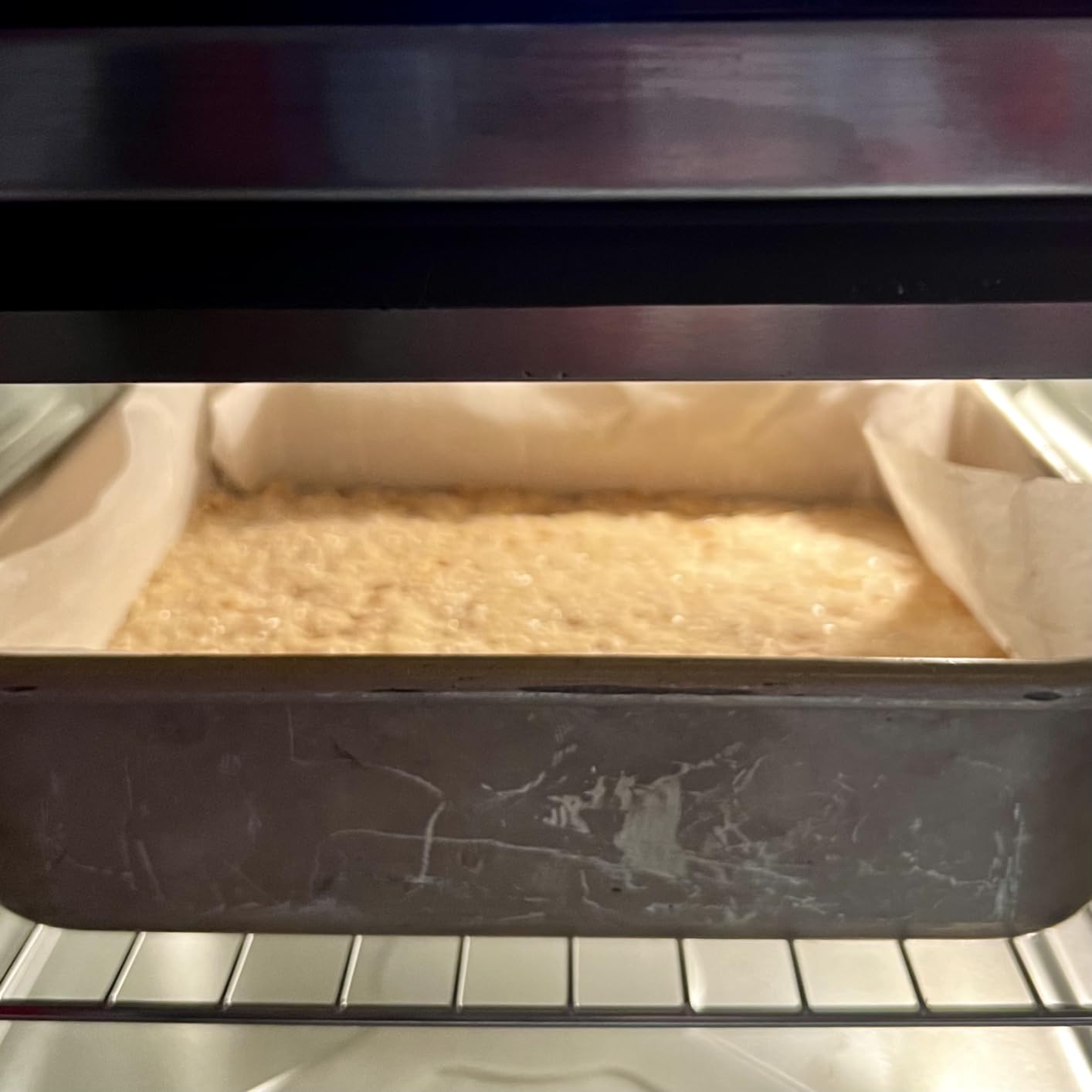
It is also popular as a second oven in RVs and small kitchens, where the 26.5-pound weight and 16.9 by 15.8 by 14.8-inch body are manageable because the machine sits on a permanent surface rather than being shuffled around.
What actually fits inside
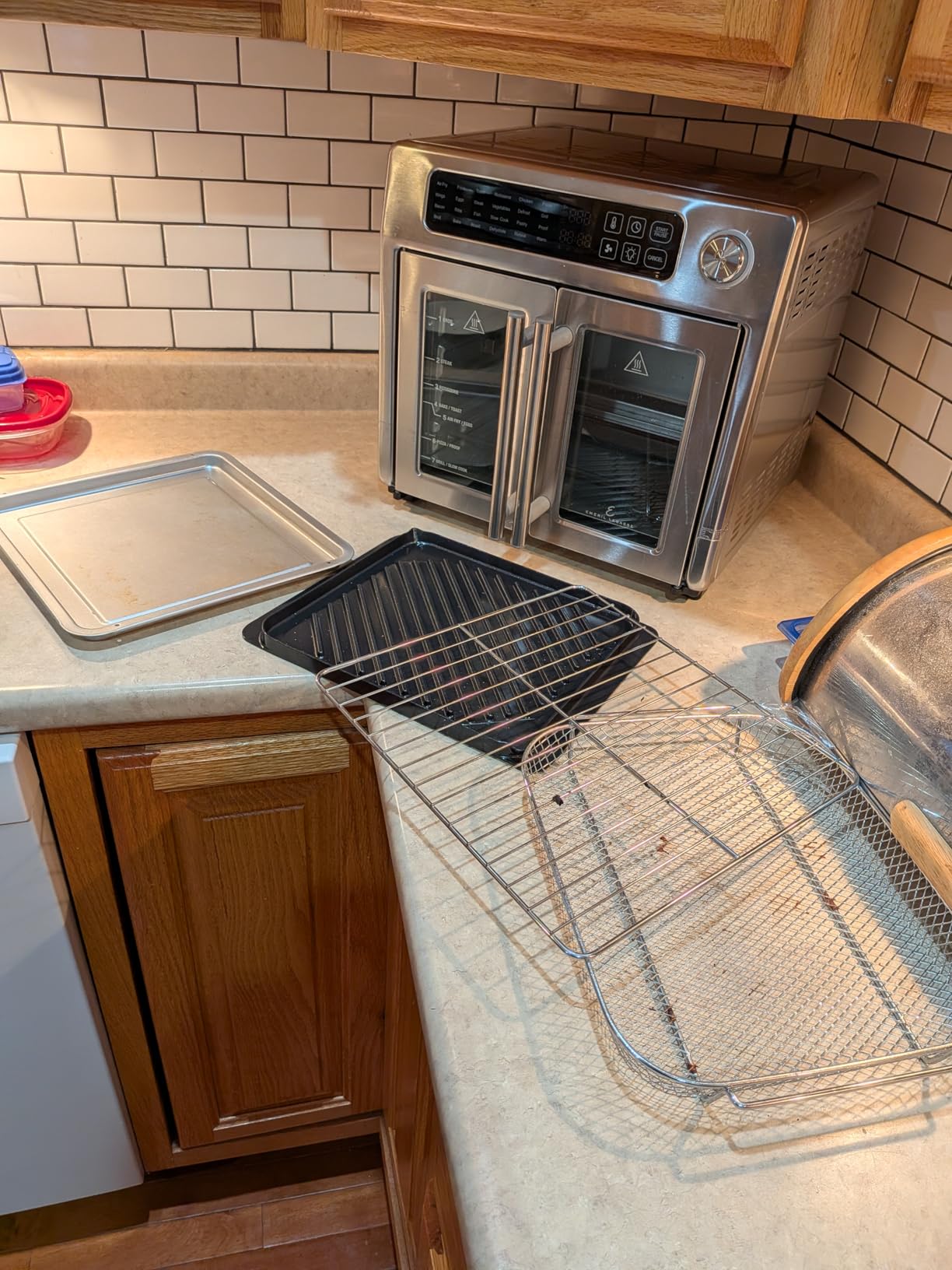
The included accessories cover most of the ground: a rack, a bake pan, a drip tray, a crisper basket, a rotisserie spit and a fetch tool. Rotisserie birds up to about 5 pounds cook comfortably, and anything heavier is tight in the cavity.
The 500F ceiling gives you real oven-style roasting and broiling, which basket fryers usually cannot match. For a family of six on a holiday meal, the rotisserie plus the sheet-pan capacity is the combination that makes this worth the footprint.
Where it frustrates owners
The toast preset does not produce true toast, so a two-slot toaster is still a sensible addition. The exterior runs hot, and greasy foods can produce smoke, which matters in an open-plan kitchen where the appliance sits near cabinetry.
Presets also restrict manual override of time, fan and burner settings, and that inflexibility is a real complaint among cooks who want to experiment. The 15.8-inch width plus required side clearance is one of the two largest footprints in this roundup, so measure before buying rather than after.
4. Emeril Lagasse 25-QT Dual Zone – Best Dual-Zone Oven
Emeril Lagasse Dual Zone Technology 25QT Air Fryer Oven
25-quart cavity
Removable divider
QuickSync
75-360F
1750W
Pros
- Divider turns one 25-quart oven into two zones at different temperatures
- Large bright interior with a viewing door
- Rotisserie performs reliably and pairs well with a wireless thermometer
- Handles pans up to roughly 14 by 11.5 inches
Cons
- Gets very hot outside and needs generous cabinet clearance
- Buttons have a steep learning curve
- Drip tray sits under the heating element so liners are hard to fit
This is the same oven philosophy as the 26-quart French Door, with one big addition: a removable divider. Pull it out and you have two independently controlled temperature zones, then use QuickSync to match cooking times and settings so both halves finish together. The result is dual-basket convenience in a full-size oven body, which no other machine in this list does.
You get a 10-in-1 appliance with custom presets, a rotisserie spit, two baskets, three bake pans, and an interior that takes pans up to roughly 14 by 11.5 inches. At 1750W with a 75F to 360F range it leans toward roasting and baking more than high-heat crisping.
Households that cook a roast in one zone and a vegetable tray in another get the same synchronised workflow from a dual-zone basket fryer, but with racks, pans and a rotisserie added. That is the argument for this machine over a cheaper dual-basket unit.
The tradeoffs owners actually mention
Exterior heat is the most repeated caution, and it is why this needs real clearance above and at the sides rather than tucking under a cabinet. Several owners also report loud fan noise, or a fan that keeps running briefly after cooking stops.
Crisping speed is the second honest drawback. Air fryer ovens take longer than basket fryers to brown food, because the air volume is larger and the perforated basket concentrates heat more aggressively. If a large share of your weeknight cooking is breaded and fried food, a dual-basket fryer will feel faster.
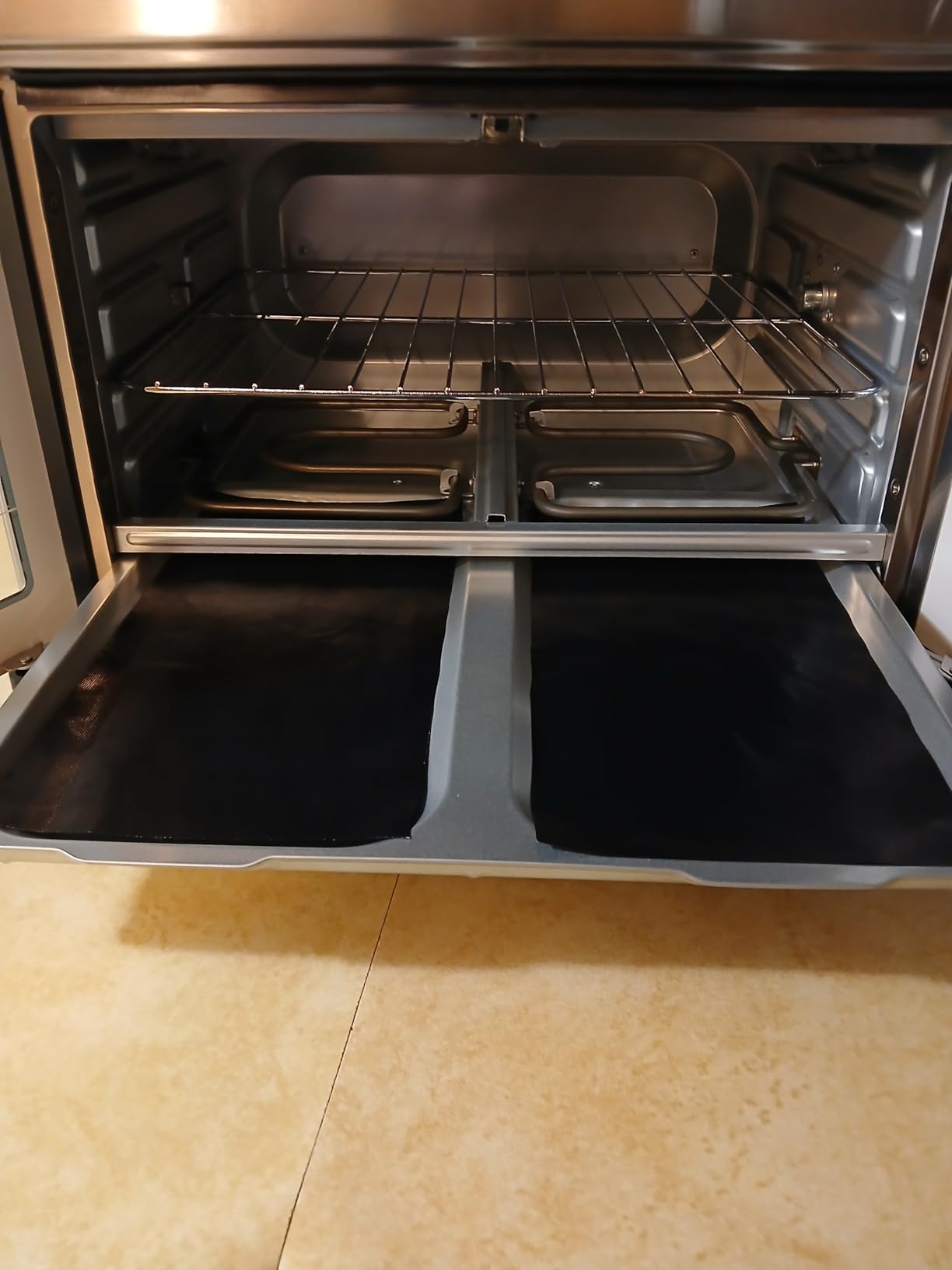
One practical detail catches people out: the drip tray sits directly under the heating element, so the foil or parchment liners that make oven cooking easy do not fit without obstructing airflow.
Best fit for a large household
This suits a family that treats dinner as a project: a Sunday roast, a holiday bird, a batch of cookies alongside a main, or a big gathering where several dishes go in at once. The learning curve on the temperature and timer buttons is real, so give yourself a week of experimenting before judging it.
At 17.72 inches deep and 15.94 inches wide, it is one of the two largest footprints here, so the same measuring advice applies as with the 26-quart model.
5. Nuwave Brio Plus 8-Qt – Best PFAS-Free Coating
Nuwave Brio Plus 8 Qt Air Fryer, PFAS Free, New & Improved, 50-400°F in 5°F
8-quart basket
PFAS-free ceramic nonstick
50-400F in 5F steps
1800W
Pros
- PFAS-free ceramic nonstick coating for toxin-conscious households
- Very low 50F minimum unlocks gentle dehydrating and warming
- Temperature adjustable in precise 5F increments with a continuously running heater
- Large cool white display readable in any light
Cons
- Single-basket design means one dish at a time
- Ceramic nonstick needs gentler utensils and careful cleaning
- Large digital panel has more buttons to learn than simple units
The Brio Plus is the pick for a household where the coating is a real concern rather than a footnote. The cooking surface is PFAS-free ceramic nonstick, and that single spec is what families searching for non-toxic kitchen gear are actually filtering on. If that is your top question, this is the model to compare everything else against.
The temperature control is genuinely unusual for a fryer this size. It runs from 50F to 400F in exact 5-degree increments, and the heater modulates continuously rather than cycling on and off, which produces steadier results at low temperatures. That low floor is what makes it usable for gentle dehydrating and for keeping food warm without drying it out.
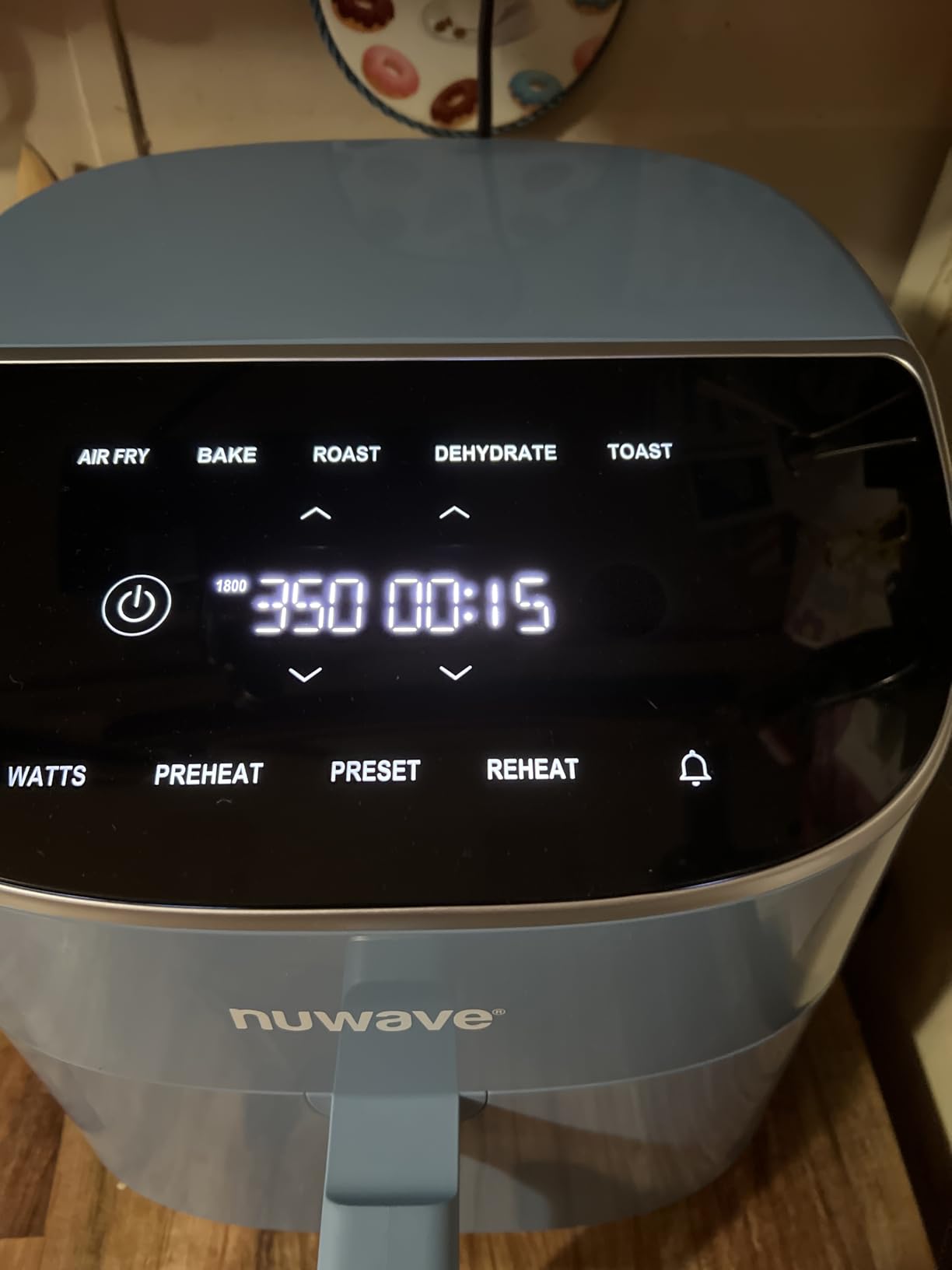
At 1800W this is one of the more powerful single baskets here, and the oversized touchscreen with a cool white backlight is far easier to read than faded silkscreen dials on older models. Five cook modes, 100 presets and 50 memory slots give you room to save your own family recipes, which matters when six people eat the same six meals on rotation.
Where the single-basket design bites
Eight quarts is a decent single-basket size, and it will take a whole chicken or a large tray of vegetables. But with one basket, a main and a side still cook in sequence, which is the core limitation for families of six or more.
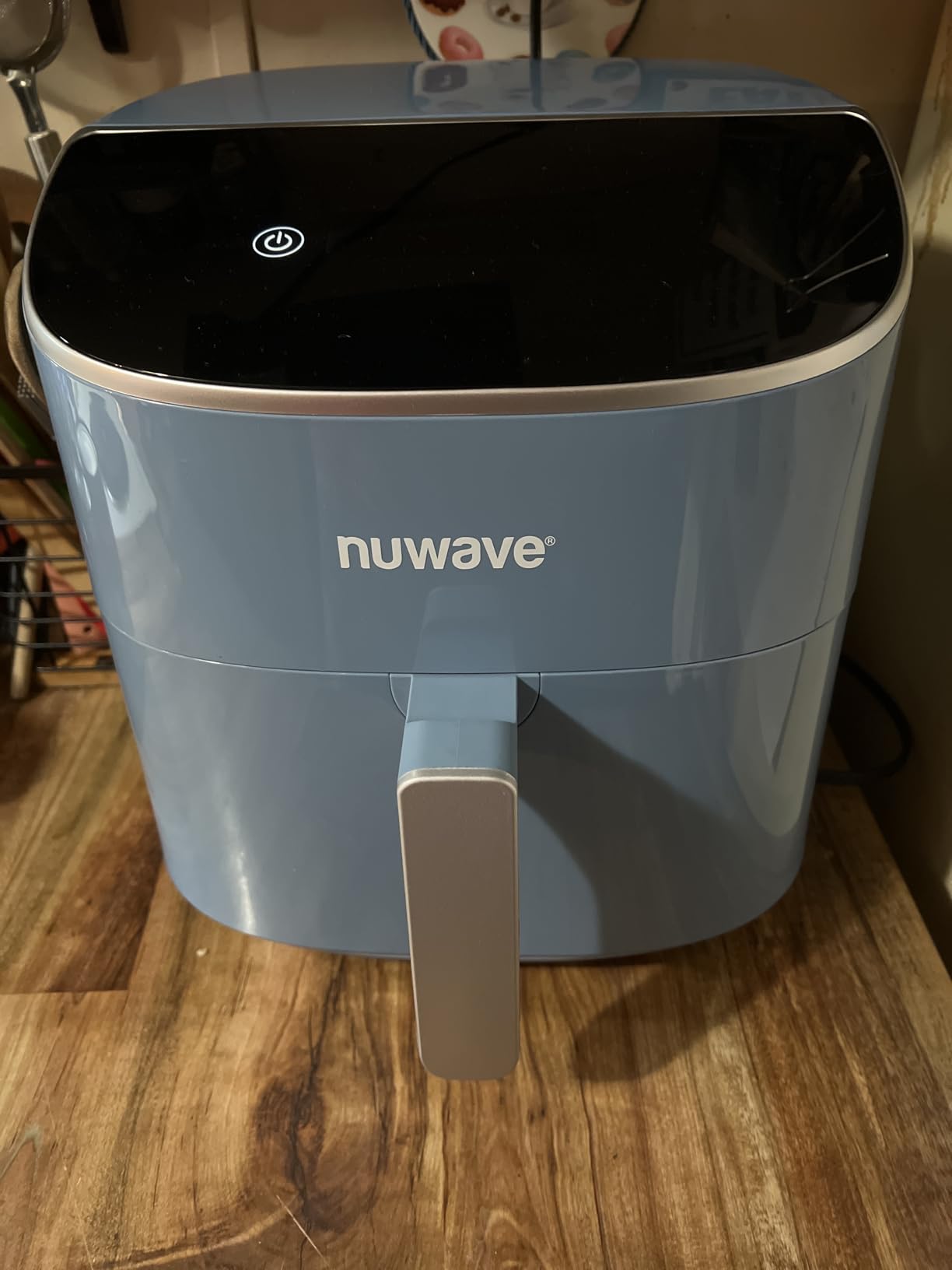
That is why we placed this fifth rather than higher. If you are a family of four or five and coating safety is your priority, the Brio Plus is the clear answer. If you are a family of six-plus, the timing maths works against you every night.
Handling the ceramic coating
Ceramic nonstick is more sensitive than traditional coating. Use silicone or wood utensils, avoid the dishwasher on the basket if you can, and expect it to last longer than a coating exposed to daily metal-utensil scraping.
Owners also flag the panel itself: there is more to learn here than on a simple dial-and-knob fryer. Plan ten minutes of setup, saving your family temperatures into the memory slots, and it becomes one of the more set-and-forget machines in this list.
6. Gourmia 14-Qt Rotisserie Oven – Best for Rotisserie Meals
Gourmia Air Fryer – 14 Qt Rotisserie Oven with Window, Stainless Steel
14-quart cavity
Front-loading door
90-400F
1750W
14.8 lb
Pros
- 14-quart cavity cooks a full meal including a whole rotisserie chicken
- Front door and rotatable baskets are far easier to use than a deep drawer
- Digital touch controls do not wear off like printed panel labels
- Crisp results with little oil and minimal smoke on fatty meats
Cons
- Top-heavy and can tip if the door is opened without a hand on top
- Curved door interior makes crumbs harder to wipe out
- Smaller review base than the other models here
The Gourmia is a compact rotisserie option, and at 14.8 pounds it is one of the lighter large-capacity machines we looked at, which makes it easier to reposition. The front-loading door changes the whole workflow compared with a drawer: you can see the food, load it without reaching down into a deep basket, and check browning without losing heat.
Twelve one-touch functions cover everything from fries to jerky, the FryForce 360-degree circulation handles crisping with little oil, and the temperature range runs 90F to 400F. The rotisserie spit, lift tool and forks are all included, along with two air fry baskets, a drip tray and racks, and the removable pieces are dishwasher-safe.
For a family of five that wants a whole chicken on Sundays without hauling out a countertop oven that weighs 26 pounds, this is a reasonable middle path. It also fits under standard cabinets more easily than the French door models.
Two practical concerns
Several owners describe the unit as top-heavy enough to tip forward slightly if you pull the door without steadying the top with a hand. That is a habit to build early, especially with children in the kitchen, and it argues for a stable spot on the counter rather than a pull-out shelf.
The curved door interior also collects crumbs in corners that a cloth does not reach, which is minor but annoying in a house that cooks daily. The long stop beep and brief run-on after shutoff are the other small annoyances people mention.
How it compares on evidence
This model carries a 4.5-star average, which is strong, but on a review base several times smaller than the Ninja dual-zone units. The rating reflects satisfied owners rather than a large volume of long-term data, and the coating lifespan question matters more in a home that uses it every day.
Our general rule from the owner forums: a nonstick basket that sees daily use typically starts showing wear somewhere in the 6 to 12 month window, and metal utensils accelerate it. Plan for silicone tools and gentle cleaning no matter which brand you pick.
7. Chefman TurboFry 8-Qt – Best Value Single Basket
Chefman Air Fryer 8 Qt | TurboFry® 4-in-1 with 450°F Hi-Fry Option for Crispier Results | Bake, Dehydrate, Frozen | XL Nonstick Dishwasher-Safe Basket | Stainless Steel
8-quart basket
450F Hi-Fry boost
4-in-1 functions
1700W
Pros
- Large 8-quart basket fits a whole chicken or a totino pizza
- 450F Hi-Fry finishing step crisps potatoes and chicken well
- Halfway shake reminder removes the need for a separate kitchen timer
- Stainless steel finish stays looking clean
Cons
- Digital display can be hard to read on some units
- A minority of models report failure within roughly 6 months to 2 years
- Bulky square body takes more counter width than round fryers
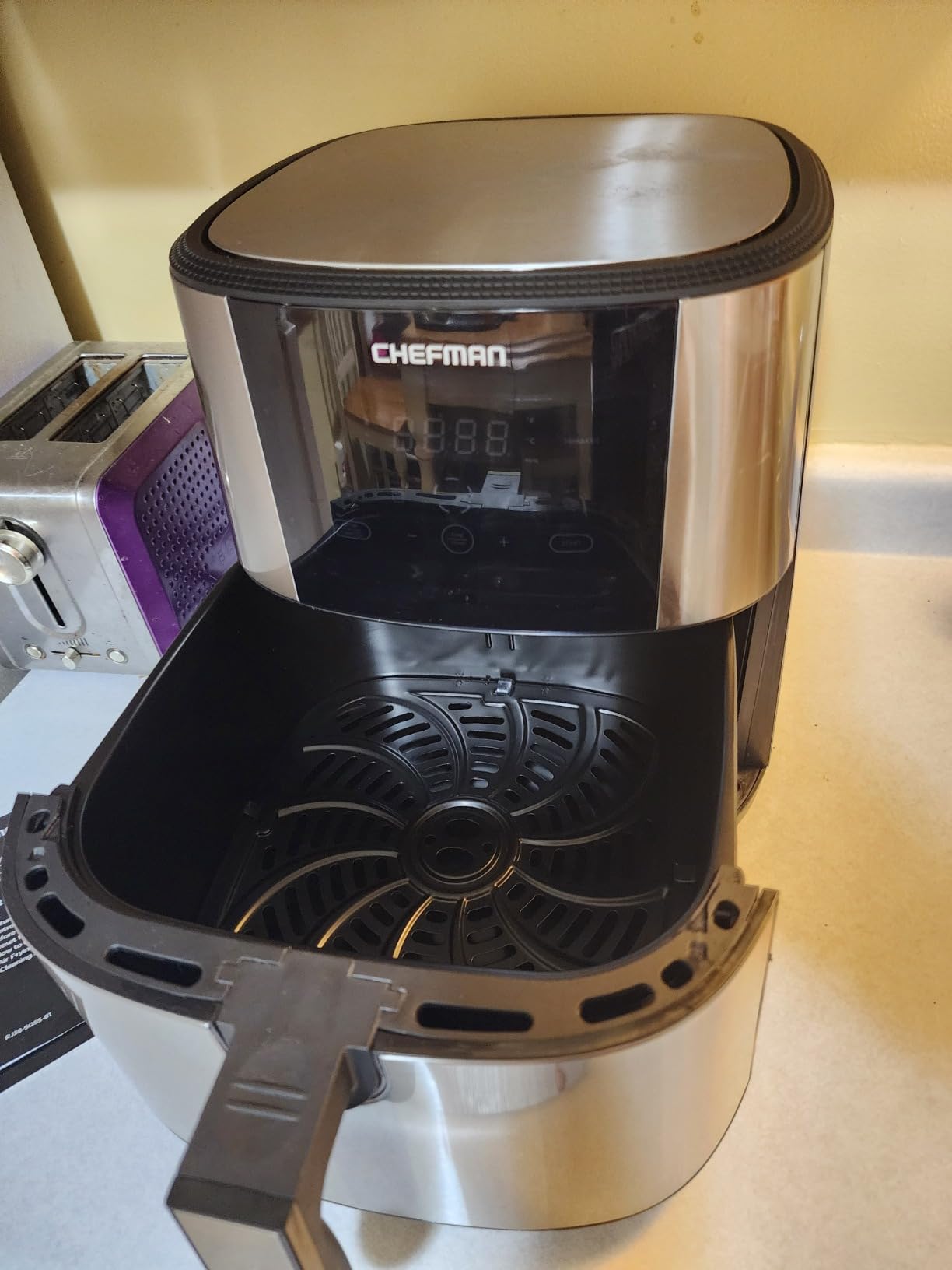
The curated 8-Qt is a single-basket answer to a simple question: can you feed five people without cooking two rounds? With an 8-quart basket and a square body that maximizes interior space for its footprint, the answer is usually yes, with one 4-quart zone rather than two independent ones.
Its signature feature is the Hi-Fry button, which boosts to 450F for the final two minutes of cooking. That is a real advantage over the many 400F fryers at this size, because the last two minutes are where browning and crisping happen. Four-in-one functions cover Air Fry, Bake, Reheat and a Frozen setting that defrosts then crisps fries and mozzarella sticks.
Owners also like the halfway shake reminder, which is a small thing that removes a real failure mode in a busy kitchen. The top-rack dishwasher-safe nonstick basket and the stainless steel body are both practical for daily use, and the redesigned frame keeps the exterior tighter than earlier models.
Reading the durability complaints fairly
A small set of reviews report early electronic failures between roughly six months and two years, and a few note that the readout strip arrived misplaced or that Hi-Fry was missing on their model. Against more than 16,000 reviews at a 4.4 average, this is a minority pattern, not a headline verdict.
The 4-in-1 approach also means fewer zones. With one basket, chicken and potatoes cook in sequence, so the sync advantage of a dual-zone machine is absent. If your evenings are back-to-back main and side, that difference shows up within a week of use.
Who this suits
This suits a family of four or five on a tight counter budget who cooks one big dish rather than two dishes at once. It suits households cooking a whole chicken or a large tray of vegetables in a single layer, and it is a reasonable second fryer for a second kitchen zone.
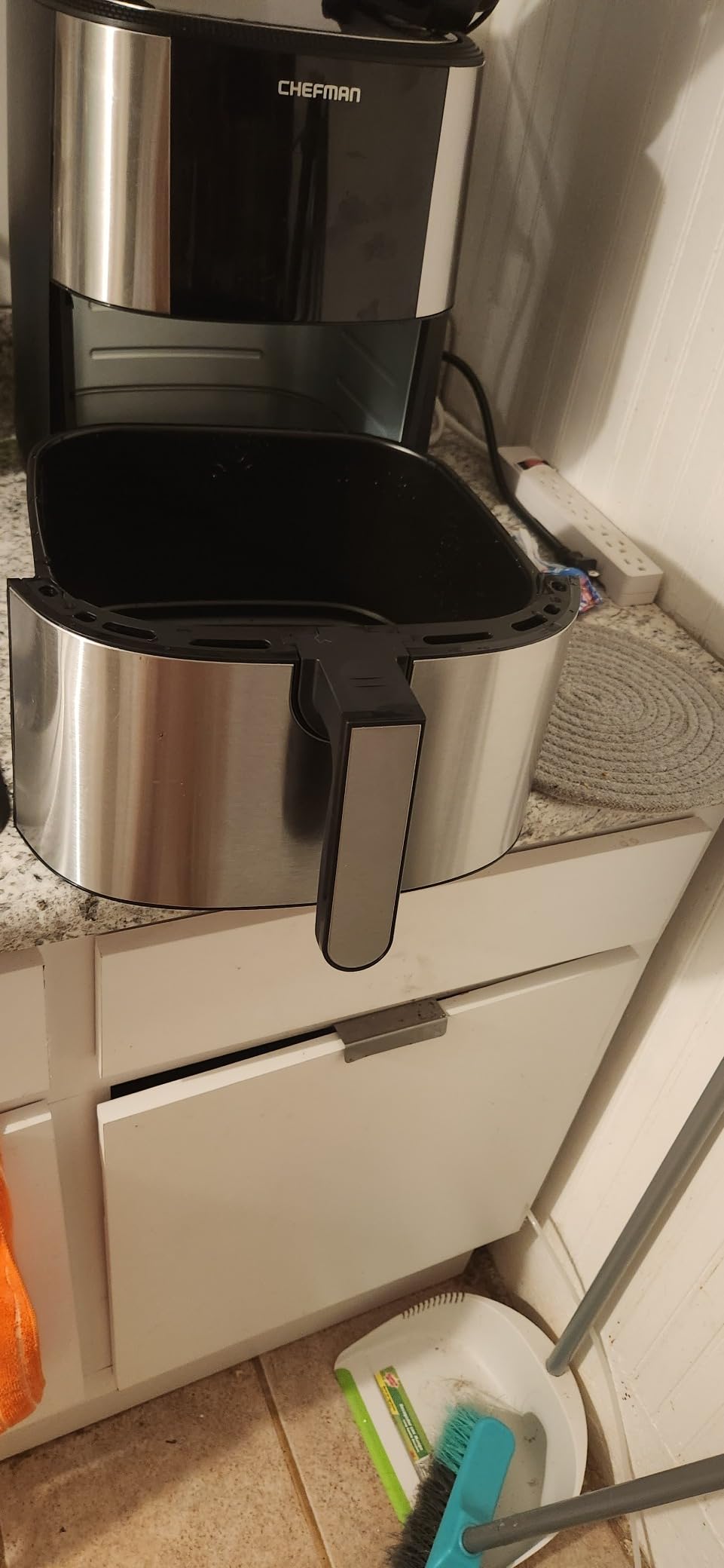
The square body is wider than a round fryer at 13.5 inches across, and at 12.75 inches deep it is not especially compact. Measure before you commit.
8. Chefman 10-Qt Multifunctional – Budget Pick With a Rotisserie
CHEFMAN Multifunctional Digital Air Fryer+ Rotisserie, Dehydrator, Convection Oven, 17 Touch Screen Presets Fry, Roast, Dehydrate, Bake, XL 10L Family Size, Auto Shutoff, Large Easy-View Window, Black
10-quart basket
17 touch presets
Rotisserie
1700W
14.2 lb
Pros
- Large 10-quart family-size capacity for big batches
- 17 touch presets plus rotisserie and dehydrate modes
- Dishwasher-safe removable parts and drip tray make cleanup simple
- Viewing window and interior light let you monitor cooking
Cons
- Touch controls can be less responsive than physical buttons
- Mesh basket surface is harder to clean than smooth nonstick
- A separate toaster is still preferable for toast
The multifunctional Chefman is the budget route into a 10-quart basket, and at 14.2 pounds it is lighter than most machines of this size. It needs no preheat, which on a weeknight schedule with hungry children is not a small saving, and it includes a rotisserie spit with a retrieval tool.
Seventeen touch presets give you a wide menu without memorising times, and the viewing window plus an interior light mean you are not opening the door and dropping the temperature to check a roast. The removable drip tray and dishwasher-safe parts handle cleanup, which is the factor most often ignored and most often regretted.
With more than 26,000 reviews behind it, this is one of the most proven machines in the category, which is a meaningful trust signal in a product category where new models appear constantly. It ranks in the top ten for air fryers on Amazon, so the volume of long-term owner reports is substantial.
Where the tradeoffs show
Touch controls on this model are less responsive than physical buttons according to a recurring share of reviews, and the mesh basket surface is harder to wipe than smooth nonstick. Both are daily-use annoyances rather than dealbreakers, but they add up in a kitchen that cooks two meals a day.
It is also a single basket, so 10 quarts is one big space rather than two smaller ones. That is great for a whole chicken or a full tray of wings and frustrating for a main plus a side at different temperatures.
Best use case
This is the sensible pick for a family of five or six cooking one substantial dish most evenings, especially if anyone in the house helps with prep and would benefit from simple one-touch presets. It is also a natural second fryer for a basement, garage kitchen or rental unit.
Rotisserie capability at this capacity is the feature that separates it from cheaper 10-quart baskets, and it is included rather than sold as an accessory.
9. Chefman TurboFry Touch Dual 9-Qt – Best Lightweight Dual Basket
Chefman TurboFry Touch Dual Air Fryer, Maximize The Healthiest Meals With Double Basket Capacity, One-Touch Digital Controls And Shake Reminder For The Perfect Crispy And Low-Calorie Finish
9 qt across two baskets
Sync Finish
100-400F
1700W
7.4 kg
Pros
- Two baskets cook two foods at different temperatures and finish together
- Sync Finish removes the mental math of staggered start times
- Wide 20-inch layout fits under standard upper cabinets
- Lighter than most dual-basket fryers at 7.4 kg
Cons
- Nonstick coating reported peeling within months on some models
- Touch controls can be unresponsive and time entry feels clunky
- 400F ceiling is lower than high-heat dual-zone models
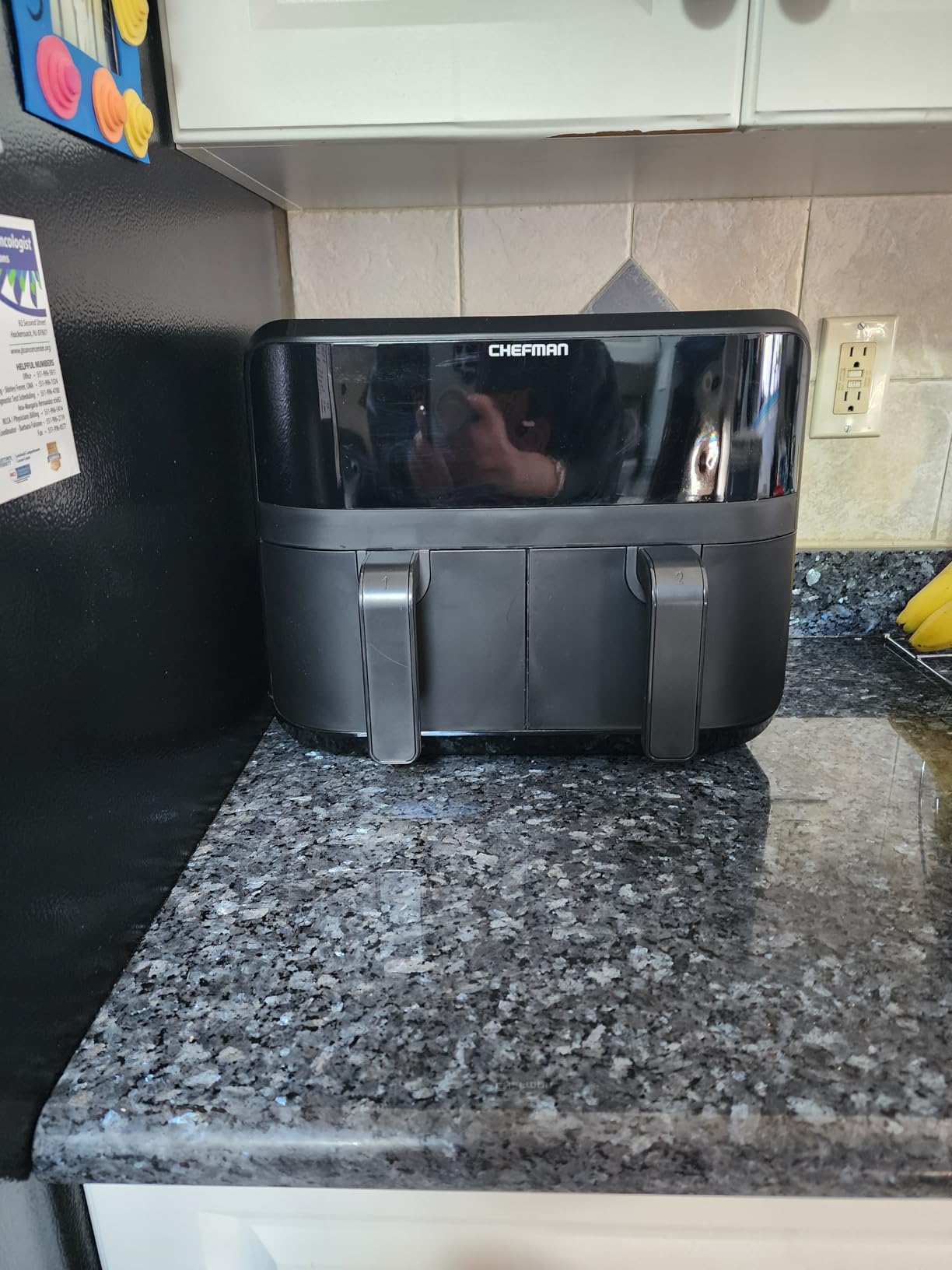
This dual-basket fryer answers a problem most compact kitchens have: you want two independent zones, but you do not have 18 inches of counter depth. The 20-inch-wide, 10-inch-deep layout is shallow and wide, and at 7.4 kilograms it is the easiest dual-basket machine here to lift and reposition when you need the counter space back.
Nine quarts split across two baskets is real capacity for a family of five, and Sync Finish synchronizes the end time of both baskets so you are not mentally tracking two start times. A visual and audio shake reminder fires at the halfway point, and the nonstick interior comes with basket liners. Baskets and racks are top-rack dishwasher safe.
The 400F ceiling is the limitation to weigh. It is fine for most frying and reheating, but it is the reason the Ninja dual-zone models reach 450F, and that extra heat is what browns frozen items properly.
The coating question deserves attention
A recurring minority of reviews report the nonstick coating on the baskets and grates peeling within months. In a household that cooks daily, coating durability is a bigger factor than preset count, and it is worth using silicone tools and hand washing where you can.
Touch control responsiveness and clunky time entry come up often enough to mention. If a family member will be cooking unsupervised or quickly, physical buttons are easier to operate without looking.
Where this fits in a shallow kitchen
This suits a family of five with shallow counter space who needs dual-zone convenience more than they need a rotisserie or a very high temperature. Two independent baskets let you run a vegetable side and a protein at different settings, finishing together.
For deeper counters and hotter cooking, the Ninja DZ201 covers the same ground with a 450F ceiling and a much larger review base. For shallow counters specifically, this layout is the one to measure against your available depth.
10. PowerXL 7-Qt Maxx Classic – Best 7-Quart Basket
PowerXL 7QT Air Fryer Maxx Classic
7-quart basket
400F max
Seven one-touch presets
1700W
13 lb
Pros
- Holds 1.75 lb of fries or 23 wings or a 3-lb chicken or a 6-inch pizza
- Seven one-touch presets simplify everyday cooking
- Dishwasher-safe basket and crisper tray
- Includes a 90-day money-back guarantee
Cons
- Plastic body feels less premium than stainless competitors
- Touch panel can be unresponsive and need a power-cycle reset
- Lower 400F ceiling than high-heat dual-zone models
The 7-quart is the smallest capacity here, and that is deliberate: it is the honest minimum for a family of four who cooks real meals rather than reheats leftovers. Owners use it for a 3-pound chicken, 23 wings or a batch of fries, and at 13 pounds it is one of the easier machines to move aside when you need the counter.
Seven one-touch presets cover air fry, French fries, broil, roast, bake, shrimp, chicken and steak, with manual time and temperature control underneath. Rapid Air Technology heats to 400F with up to 70 percent less fat than traditional frying, and both the basket and the crisper tray are dishwasher-safe.
At a 4.6-star average this matches the 10-quart Ninja on rating, and the 90-day money-back guarantee is a useful cushion if your household turns out to need more room than 7 quarts.
Knowing when 7 quarts is enough
Seven quarts works if your family eats one main dish per meal and you are not feeding guests regularly. It becomes tight the moment you want a main and a side simultaneously, or you routinely cook for six or more.
The plastic body is the most common aesthetic complaint, and the touch panel is reported by some owners as needing a power-cycle reset. Those are the two tradeoffs for a lower-cost, lighter, well-reviewed basket.
Where it fits in a large kitchen
Think of this as a second fryer rather than the only one, in a basement kitchen, a pool house, a rental property or a kid’s cooking corner. It is also the sensible pick for a family of four upgrading from a 4-quart model without a step-change in footprint.
Its 400F ceiling matches most of the field, so nothing is lost on heat compared with a typical basket fryer. The real difference is space, and space is the whole point of this roundup.
What Real Owners Regret Buying
Capacity regret is the dominant complaint theme across the air fryer owner forums, and the pattern is remarkably consistent. One r/airfryer owner returned a 5.5-quart Ninja because, in their words, you cannot really use much of it. Half-filling the basket with fries meant the bottom batch stayed crisp while the top batch went soggy and broke apart when shaken, and they moved up to a 10-quart dual basket instead.
That single story explains the entire buying case for this list. Air circulation needs space around the food. A basket packed to the brim blocks airflow and cooks unevenly, and a basket filled only halfway wastes the capacity you paid for. Both failures get blamed on the machine when the real cause is the fit between the food and the basket.
Five regret patterns show up repeatedly:
Undersized baskets. The single most common return reason. A 4-quart or 5.5-quart fryer for a family of five produces batch cooking fatigue, and families report the machine ends up sitting unused after a few weeks.
Batch cooking fatigue. Cooking a main, then a side, then a second side takes longer than heating the conventional oven, which defeats the reason the appliance was bought.
Oven-style units bought for air frying. One owner described a two-rack oven-style purchase as doing a lot of things good but nothing great, with air frying being the weakest point, and criticised the machine for shipping with only a single fryer tray.
Coating that peels early. Daily use wears a nonstick basket somewhere in the 6 to 12 month window, and metal utensils speed that up dramatically.
Counter space surrender. A dual-zone unit that gets pushed to a corner because it takes too much room, then gets used once a month.
The last point is the one roundups rarely mention. A model that is technically right for your family but physically impossible to leave on the counter is a model that collects dust, and that failure looks identical to choosing the wrong capacity.
One more thread worth surfacing: families cooking for very large households often land on a 7 to 8 quart basket, or on a full air fryer oven, precisely because the basket shapes in that range are deep enough to cook a whole chicken without the food touching the heating element. If whole birds are a regular part of your cooking, filter the list by rotisserie and cavity size rather than by wattage.
What Actually Fits in Each Basket Size
Quart numbers only mean something once you translate them into food. The estimates below are conservative rather than optimistic, because an overcrowded basket is exactly the failure the owner forums describe.
4 quarts. Two large chicken breasts, a small personal pizza, about 1 pound of fries, or a snack portion. Adequate for two people, or a side dish in a family of four. Not a family-size main.
5.5 to 6 quarts. Four chicken thighs, a whole chicken up to about 5 pounds, or roughly 2 pounds of fries. This is a genuine family-of-four basket. A 6-quart basket can fit a small whole chicken, but it is tight, and the bird should not touch the heating element.
7 to 8 quarts. A 3-pound chicken, 23 wings, a 6-inch pizza, a full tray of vegetables, or one large main course. This is the sensible single-basket size for a family of four to five cooking one dish at a time.
9 to 10 quarts, single basket. A 5-pound roast, a large tray of wings, or a generous sheet-pan-style load. Without zones you still cook sequentially, so budget time accordingly.
10 quarts as two 5-quart zones. Two 6-pound chickens, or 8 pounds of wings, at once. For a family of six or more this is the configuration that ends batch cooking entirely.
14 quarts and above, oven-style. Whole rotisserie birds up to about 5 pounds in the 14-quart cavity, and larger birds in the 25 and 26-quart cavities, plus sheet pans laid out in a single layer. This is oven capacity wearing an air fryer oven shell.
The rule of thumb we use: count the people at the table, then add one portion for anyone who eats seconds, then check whether the model has zones. A family of five cooking one main at a time is well served by a 7 or 8-quart single basket. A family of six cooking a main and a side every night needs two zones, no matter how large the single basket is.
If you cook a whole chicken or a holiday bird regularly, size up rather than sideways. Two zones or a rotisserie cavity is the difference between one cycle and a whole afternoon of batches.
Single-Basket vs Dual-Basket vs Oven-Style
Single-basket, 7 to 10 quarts. The simplest option and the smallest footprint. It suits families of four to five who cook one substantial dish per meal. Its weakness is sequencing: one basket means one dish at a time, and that is where batch fatigue starts.
Dual-basket, 8 to 10 quarts. Two independent zones with sync and Match Cook functions. This is the category for families of five to six-plus, and the sync function is what actually changes daily cooking rather than the raw capacity. The cost is a wider, deeper unit and two heating systems to maintain.
Oven-style, 14 to 26 quarts. Racks, sheet pans, rotisserie and multiple cooking functions. This is the right choice when your cooking looks like baking and roasting, when you host, or when you want to replace a conventional oven. The cost is heat, counter space, longer preheat and slower crisping than a basket fryer.
Where oven-style units are genuinely unfair to judge is crisping. Air fryer ovens take longer to brown breaded and frozen food, and an owner describing one as doing nothing great at air frying is describing a real characteristic, not a defect. Cooks on r/KitchenPro still land on a 7 to 8 quart basket or a full air fryer oven for even cooking, so the honest answer depends on what you actually cook.
Our recommendation for a household of six or more is a dual-basket model for weeknights and an oven-style unit only if you regularly roast, bake or host. Running both is common, and the dual basket air fryer guide covers that category in more detail.
How to Choose an Air Fryer for a Large Family
Six criteria decide this purchase, and only one of them is wattage.
1. Usable capacity, not total capacity. A 10-quart dual-basket model gives you two 5-quart spaces. A 10-quart single basket gives you one space and a queue. Ask the fit question directly: can a full dinner go in without stacking or crowding? If not, you will cook in batches and the machine will disappoint you.
2. Zones and sync. Independent temperature control per basket is what lets you cook a protein and a side that need different heat. A sync or Smart Finish function stops both zones at the same moment, which is the difference between one round of cooking and two.
3. Coating. PFAS-free ceramic or PFAS-free nonstick is a real filter for toxin-conscious households, and only some models here meet it. Whichever coating you choose, use silicone utensils, because a nonstick basket under daily family use typically starts to degrade somewhere in the 6 to 12 month window and metal tools accelerate it.
4. Cleaning. Dishwasher-safe baskets, crisper plates and drip trays are the difference between cooking every night and cooking twice a week. Deep basket wells and mesh surfaces resist a wipe-down, so a dishwasher-safe basket matters more than any preset.
5. Footprint and clearance. Measure depth, width and height, not just the counter surface. The deepest machine here is 17.72 inches and the widest large model is 20 inches, and both oven-style units need clearance on the sides and above because of exterior heat. Our turkey fryer guide covers the capacity thinking for very large birds if a holiday turkey is on the menu.
6. Power, temperature range and noise. A 400F ceiling is adequate for most family cooking; 450F is better for frozen foods and skin. Higher-wattage models run a 1690W to 1800W draw, which is also why some owners comment on noise in an open-plan kitchen.
On energy use, a basket air fryer at 1700W running for about 25 minutes uses roughly 0.7 kWh per meal, against two to three times that for a conventional oven cycle. A short fryer cycle is also faster than preheating a full oven, so the saving is real for a family cooking most nights. If you want the deep-fried texture that an air fryer cannot deliver, our deep fryer guide covers the cases where that matters.
On lifespan, expect the fan motor and heating element to define the end of the machine’s useful life, commonly in the three to five year range under heavy daily use. The basket is usually replaceable, so a peeling coating is an annoyance rather than a retirement.
Frequently Asked Questions
What size air fryer is best for a family of 6 people?
For six people, aim for 9 to 10 quarts split across two independent zones, or an oven-style unit with a 25-quart cavity. A single 8-quart basket works only if you cook one main dish at a time. Two zones let a main and a side finish together, which is what removes batch cooking from a six-person weeknight.
Can a 6 quart air fryer fit a whole chicken?
A 6-quart basket can fit a whole chicken of roughly 5 pounds or under, provided the bird does not touch the heating element or the basket sides. For anything larger, move up to an 8-quart basket or a model with a rotisserie spit. Buy a probe thermometer, because whole-bird cook times vary far more than recipe charts suggest.
Is a dual basket air fryer worth it for families?
Yes, for households of five or more who cook a main and a side at different temperatures. Two independent zones plus a sync function stop both baskets at the same moment, which removes the second round of cooking. For a family of four cooking one dish, a single 7 to 8-quart basket is the better use of counter space.
Why are people getting rid of air fryers?
Undersized baskets are the top reason, because a partly filled basket cooks unevenly and forces batch cooking that is slower than a conventional oven. Other recurring reasons are nonstick coating peeling after 6 to 12 months of daily use, touch controls that prove unresponsive, and dual-basket units that take too much counter space to leave out.
Do air fryers use a lot of electricity?
A 1700W basket fryer running 25 minutes uses roughly 0.7 kWh per meal, against two to three times that for a conventional oven, and it skips the preheat stage entirely. Oven-style units at 1750W draw more and take longer to heat, so basket models are the cheaper option for everyday weeknight cooking.
How long do air fryers typically last?
Under heavy daily use, the fan motor and heating element usually define the end of useful life somewhere in the three to five year range. The nonstick basket often degrades earlier, typically in the 6 to 12 month window, but baskets are replaceable. Using silicone utensils and hand washing extends coating life noticeably.
Our Final Verdict
The best air fryers for large families in 2026 are the ones that let a full dinner finish in one cycle. Pick the Ninja Foodi DZ201 8-Qt DualZone if you are a family of four to five and want the strongest all-round package with two independent zones and a 450F ceiling. Pick the 10-Qt DualZone Smart XL if six or more people eat at your table, or if you cook whole birds regularly and want the built-in probe thermometer.
Choose the 26-quart French Door or the 25-quart Dual Zone oven instead if your cooking is roasting, baking and hosting rather than quick weeknight frying. Choose the Nuwave Brio Plus 8-Qt if the coating is your top concern, and the Chefman 10-Qt multifunctional if you want a rotisserie and 17 presets on a lighter body. Whatever you choose, measure the counter and check the fit chart before you buy.