
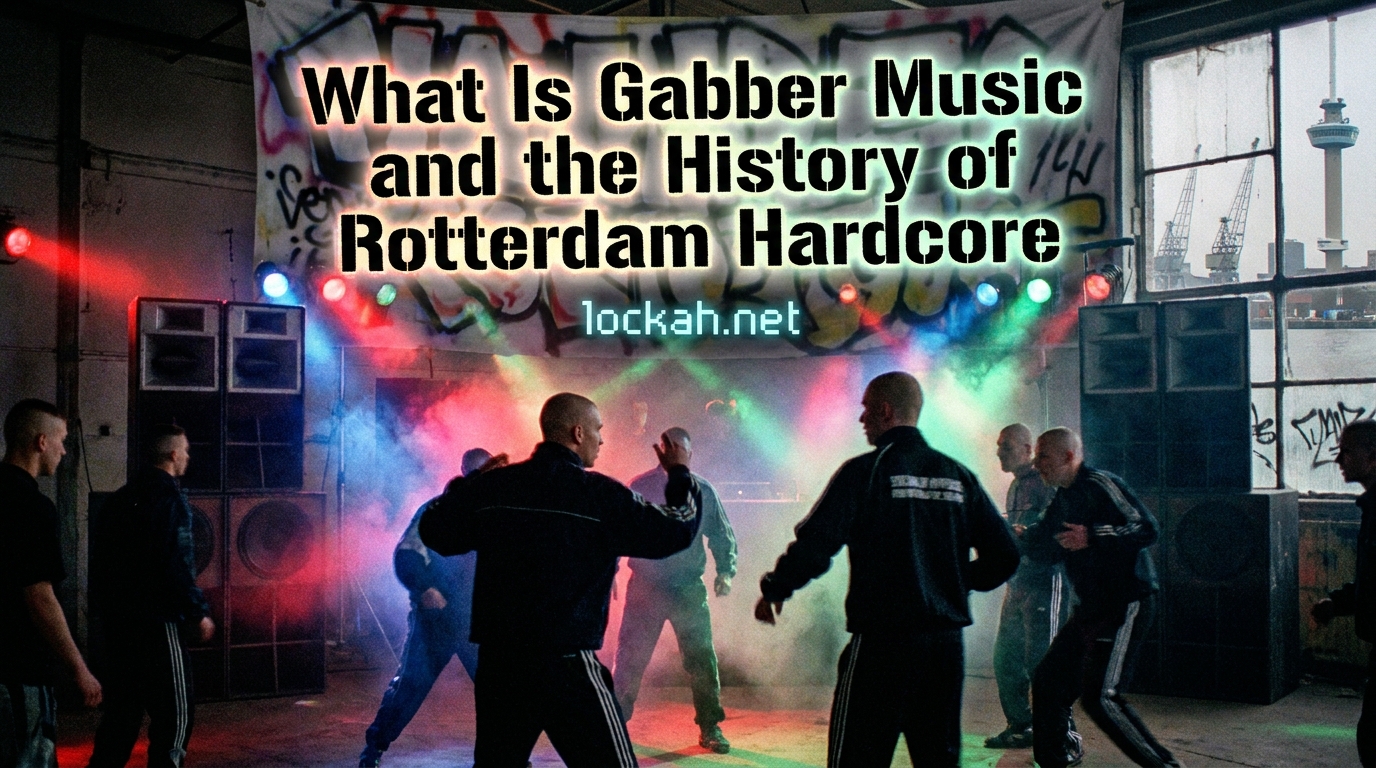
Gabber is a style of electronic dance music and a subgenre of hardcore techno that emerged from Rotterdam, Netherlands in the early 1990s. The word “gabber” comes from Amsterdam Bargoens slang and simply means “friend” or “mate,” though the music itself is anything but gentle.
Characterized by breakneck tempos ranging from 150 to 220 BPM, heavily distorted kickdrums, and aggressive synthesizer riffs, gabber became the soundtrack to a distinctive youth subculture. In this guide, I will walk you through everything you need to know about gabber music: its Rotterdam origins, the sound that defined a generation, the fashion and dance culture that surrounded it, and how this uniquely Dutch phenomenon influenced electronic music worldwide.
Table of Contents
What Is Gabber Music?
Gabber music is a high-intensity electronic dance genre that takes the fundamental elements of techno and hardcore and pushes them to their absolute extremes. The defining characteristic is the tempo, which typically ranges from 150 to 220 beats per minute, far faster than mainstream techno which usually sits between 120-140 BPM.
The word “gabber” originates from Amsterdam Bargoens, a Dutch cant slang historically used by criminals and street traders. In this dialect, “gabber” simply translates to “friend” or “buddy.” The term was adopted by the early scene as an inclusive label, suggesting that anyone who embraced this music was part of the community, a friend to the cause.
Musically, gabber is defined by its aggressive sound design. The kickdrum is the heart of every track, often created using a Roland TR-909 drum machine and then heavily distorted through overdrive and compression. These kicks hit with a pounding intensity that defines the genre’s physical impact. Layered on top are typically dark synthesizer melodies, samples from films or other media, and occasional shouted or roared vocals that add to the aggressive atmosphere.
It is worth clarifying the terminology. While “gabber” and “hardcore techno” are sometimes used interchangeably, there is a distinction. Gabber specifically refers to the Dutch strain of hardcore that emerged from Rotterdam, with its own distinct production techniques and cultural context. Hardcore techno is the broader umbrella term that encompasses similar high-BPM electronic music from other regions and scenes.
The Rotterdam Origins: Where Gabber Was Born?
The story of gabber begins in Rotterdam during the late 1980s and early 1990s. Rotterdam, with its working-class heritage and industrial port landscape, provided the perfect breeding ground for a music genre that reflected the city’s hard-edged character. While Amsterdam was known for its house music sophistication, Rotterdam developed something rougher and more aggressive.
The genre emerged from the warehouse party scene, where illegal raves were held in abandoned industrial buildings across the city. These events drew thousands of young people seeking an escape from the economic difficulties and social challenges facing the Netherlands at the time. The music needed to match the intensity of these spaces, vast concrete halls where subtlety would be lost.
Key to understanding Rotterdam’s role is recognizing the city’s identity. Unlike Amsterdam with its tourist-friendly image, Rotterdam had rebuilt itself after World War II bombing into a modern industrial center. This no-nonsense, working-class attitude permeated the music. Rotterdam’s youth wanted something that reflected their reality, not the polished sounds coming from elsewhere.
The first gabber tracks began appearing around 1990-1991, evolving from the new beat and acid house sounds that had dominated Belgian and Dutch clubs in the late 1980s. Producers started experimenting with faster tempos and harder kicks, driven by crowd reactions at local parties. When a track hit harder and faster, the crowd responded with more energy. This feedback loop pushed the sound toward what would become gabber.
By 1992, the scene had crystallized enough that dedicated labels began forming. Rotterdam Records, founded by Paul Elstak, became one of the most influential. The sound was no longer just a variation of existing genres. It was becoming something distinctly Dutch, something that would soon capture national and international attention.
The Sound of Gabber: Musical Characteristics (2026)
To truly understand gabber, you need to understand what makes it sonically distinct from other electronic music. The production techniques developed in Rotterdam created a template that defined an entire genre.
The Infamous Kickdrum
The kickdrum is the foundation of every gabber track. Producers typically start with the sound of a Roland TR-909 drum machine, specifically the kick sample that has defined electronic music for decades. But in gabber, this kick is processed aggressively through distortion, overdrive, and compression until it becomes something entirely different.
The resulting sound is a distorted, thunderous thump that can physically shake a room. When played on a proper sound system, these kicks create a physical sensation, felt in the chest as much as heard in the ears. This physicality is central to the gabber experience.
Breakneck BPM
Gabber tracks typically range from 150 BPM on the slower end to 220 BPM at the extreme. The golden zone for most classic tracks sits between 160-180 BPM. This is significantly faster than house music at 120-130 BPM or even mainstream techno at 130-140 BPM.
At these speeds, the music becomes intense and driving. The rapid-fire kickdrums create a relentless energy that does not let up. This is music designed for peak-time dancefloor moments, for losing yourself in the energy of the crowd.
Dark Themes and Samples
Lyrically and thematically, early gabber often embraced darkness. Tracks featured samples from horror films, dystopian movies, and aggressive vocal snippets. The atmosphere was intentionally intense and sometimes unsettling, matching the distorted sonic palette.
Synthesizer riffs were typically simple but effective, often using minor keys to create tension. The minimalism of the production meant every element had to count. There was no room for excess when the kickdrum dominated the mix.
Gabber Culture: Fashion, Dance, and Identity
Gabber was never just about the music. It was a complete subculture with its own fashion, dance style, and community values. Understanding this culture is essential to understanding why the movement became so powerful in the Netherlands.
The Hakken Dance
The dance style associated with gabber is called “hakken,” which translates roughly to “chopping” in Dutch. It involves rapid foot movements where dancers appear to be chopping at the floor with their heels while keeping their upper body relatively still. The movement matches the fast tempo of the music perfectly.
Hakken is typically performed in a circle of friends, with dancers taking turns showing their skills in the center. The dance requires stamina and coordination, as the rapid footwork at 160+ BPM is genuinely physically demanding. For many in the scene, mastering hakken was a badge of honor.
The Iconic Fashion
Gabber fashion became instantly recognizable. The uniform consisted of tracksuits, often by brands like Australian or Nike, paired with bomber jackets. Shaved heads were common among men, while both men and women often sported the look.
The most iconic element was the Nike Air Max shoe. Specifically, the Nike Air Max Classic BW in black and red became the unofficial official shoe of gabber culture. This was partly practical, the shoes provided support for hours of hakken, and partly symbolic, representing the working-class roots of the scene.
The look was deliberately anti-fashion in many ways. While other scenes embraced the latest trends, gabber stuck to its uniform. This consistency created a sense of belonging. When you saw someone in a tracksuit and Air Maxes, you knew you shared something in common.
Community Values
Despite the aggressive sound and tough appearance, the gabber community developed strong internal bonds. The word itself, meaning “friend,” reflected an inclusive ethos. The scene welcomed people from all backgrounds who shared a love for the music.
Importantly, the scene maintained an anti-fascist and anti-racist stance. While the shaved heads and aggressive music sometimes led to outsiders confusing gabber with far-right skinhead culture, the community actively rejected these associations. Unity through music was the core value.
This anti-fascist stance became particularly important as the scene grew. When far-right elements occasionally tried to claim the culture, the community responded with clear opposition. Events and labels explicitly promoted unity and rejected hate.
Pioneers and Labels That Shaped the Scene
Several key artists and record labels were instrumental in developing and spreading the gabber sound. Understanding these names is essential for anyone wanting to explore the genre’s history.
Paul Elstak and Rotterdam Records
Paul Elstak is arguably the most important figure in gabber history. As the founder of Rotterdam Records, he helped define the sound and bring it to a wider audience. His own productions, including tracks like “Luv U More” and his work as part of various projects, became anthems of the scene.
Elstak had a unique ability to balance underground credibility with commercial appeal. While Rotterdam Records released hard, underground tracks, Elstak also understood how to make the sound accessible to newcomers. This dual approach helped the scene grow while maintaining its core identity.
DJ Rob and The Prophet
DJ Rob was another foundational Rotterdam artist whose early productions helped establish the template. His tracks from the early 1990s are still considered classics today, representing the raw, unpolished sound of the genre’s origins.
The Prophet, both as an individual artist and through his work with labels like Scantraxx, became one of the most recognizable names in hardcore. His production style influenced countless other artists, and his tracks became staples at events worldwide.
Thunderdome
No discussion of gabber history is complete without mentioning Thunderdome. The Thunderdome compilation series, launched by ID&T in 1993, became the definitive document of the genre’s golden age. These compilations sold hundreds of thousands of copies and introduced the sound to mainstream Dutch audiences.
The accompanying Thunderdome events became legendary. Held at massive venues and drawing tens of thousands of ravers, these parties represented the peak of gabber’s commercial success. The Thunderdome logo, featuring a skull with headphones, became an iconic symbol of the culture.
Mokum Records and Industrial Strength
While Rotterdam Records was the most influential Dutch label, Mokum Records from Amsterdam also played a major role. Mokum, which is Amsterdam slang for the city itself, released countless classic tracks and helped bridge the gap between Rotterdam and Amsterdam scenes.
From the United States, Industrial Strength Records, founded by Lenny Dee, connected the Dutch sound with international audiences. This label helped spread gabber and hardcore to American ravers and established the global network that would sustain the genre.
The Rise, Peak, and Evolution of Gabber
The history of gabber can be divided into distinct phases, each with its own characteristics and challenges. Understanding this timeline helps explain where the genre has been and where it stands today.
1990-1992: The Formation Years
In the early years, gabber was emerging from the Dutch club scene. Producers were experimenting with faster tempos and harder sounds, building on the new beat and acid house foundations. The first dedicated tracks began appearing, though the sound was still evolving.
During this period, the Rotterdam warehouse scene provided the testing ground. DJs would try out new tracks and gauge crowd reactions. The feedback was immediate and intense. When a track worked, the crowd responded with explosive energy.
1993-1997: The Golden Age
The mid-1990s represent the golden age of gabber. The sound exploded from underground warehouses into the Dutch mainstream. Thunderdome compilations topped charts. Radio stations began playing hardcore tracks. The fashion became a nationwide phenomenon.
This was the era when gabber became truly massive. Events moved from illegal warehouses to massive legal venues. The culture developed its own media, magazines, and television programs. For a brief period, gabber was undeniably mainstream in the Netherlands.
1997-2000: The Split
By the late 1990s, the scene began to fragment. One branch moved toward “happy hardcore,” a lighter, more melodic sound with cartoonish aesthetics and higher-pitched vocals. This appealed to a younger audience and became commercially successful in its own right.
The other branch stayed true to the harder sound, evolving into what would eventually be called “hardstyle.” Hardstyle maintained the distorted kicks but introduced more structured arrangements and euphoric breakdowns. This sound would eventually eclipse gabber in popularity.
The 2000s and Beyond
In the 2000s, pure gabber became an underground concern again. While hardstyle dominated the mainstream, dedicated producers and fans kept the original sound alive. Smaller events, specialist labels, and online communities sustained the culture.
The anti-fascist stance of the community became particularly important during this period. As far-right movements attempted to co-opt aspects of hardcore culture in some European countries, the gabber community explicitly rejected these associations. Unity and inclusion remained core values.
Does Gabber Still Exist? The Modern Revival
Yes, gabber absolutely still exists. While it may not dominate the charts as it did in the mid-1990s, the genre has maintained a dedicated following and is currently experiencing something of a revival.
Contemporary artists are keeping the sound alive while pushing it in new directions. Producers like Partyraiser, Miss K8, and Angerfist have taken the classic gabber template and updated it for modern audiences. These artists play at major festivals worldwide, introducing new generations to the sound.
Events dedicated to hardcore and gabber continue to draw significant crowds. Dominator, Masters of Hardcore, and Thunderdome itself, which returned after a hiatus, remain major fixtures on the electronic music calendar. These events attract tens of thousands of fans, proving the genre’s enduring appeal.
The nostalgia factor has also played a role. Many who grew up with gabber in the 1990s now attend revival events, bringing their children or younger friends. This intergenerational connection keeps the culture vibrant and evolving.
Digital preservation has helped too. Classic tracks that were once rare vinyl-only releases are now available on streaming platforms. New listeners can easily discover the history of the genre, and older fans can revisit the tracks that defined their youth.
Global Impact and Lasting Legacy
The influence of gabber extends far beyond the Netherlands. This uniquely Dutch creation helped establish the country as a global powerhouse in electronic music, a status it maintains today.
Hardstyle, one of the most popular electronic genres worldwide, owes a direct debt to gabber. The distorted kicks, the anthemic structures, the high-energy approach, all trace back to those early Rotterdam productions. Artists like Headhunterz, Wildstylez, and countless others work in a tradition that began with gabber.
The global spread of hardcore music can be traced through gabber’s influence. From Germany to Australia, from Brazil to Japan, scenes developed that were directly inspired by the Dutch sound. Each region added its own flavor, but the Rotterdam template remained recognizable.
Academically, gabber has gained recognition as a legitimate cultural phenomenon. Musicologists and cultural studies researchers have examined the genre, its social context, and its impact. The Netherlands Institute for Sound and Vision has preserved gabber materials, recognizing their cultural significance.
Perhaps most importantly, gabber proved that electronic music could be a vehicle for authentic cultural expression. It was not just entertainment but a genuine subculture with values, community, and identity. This lesson has influenced every electronic music movement since.
Frequently Asked Questions
What does gabber mean in Dutch?
The word ‘gabber’ comes from Amsterdam Bargoens, a Dutch cant slang historically used by criminals and traders. In this dialect, ‘gabber’ simply means ‘friend,’ ‘mate,’ or ‘buddy.’ The term was adopted by the early hardcore scene to suggest that anyone who embraced this music was part of the community.
What is gabber culture in the Netherlands?
Gabber culture encompasses the music, fashion, dance, and community values surrounding Rotterdam hardcore. Key elements include the hakken dance style, tracksuits and Nike Air Max shoes as fashion staples, shaved heads, and an inclusive anti-fascist community ethos. The culture emphasizes unity through music and rejects discrimination.
Does gabber still exist?
Yes, gabber still exists today. While it operates more as an underground genre compared to its mainstream peak in the mid-1990s, dedicated artists, labels, and events continue to keep the sound alive. Contemporary producers like Partyraiser and Angerfist perform at major festivals worldwide, and events like Thunderdome and Dominator attract thousands of fans.
What makes gabber dance unique?
The gabber dance style is called ‘hakken,’ which means ‘chopping’ in Dutch. It involves rapid foot movements where dancers appear to chop at the floor with their heels while keeping their upper body relatively still. The dance matches the fast tempo of gabber music and requires significant stamina. It is typically performed in circles with dancers taking turns showing their skills.
Why is Rotterdam famous for gabber?
Rotterdam is the birthplace of gabber music. The city’s working-class industrial heritage and warehouse party scene in the early 1990s provided the perfect environment for this aggressive, high-energy music to develop. Rotterdam’s no-nonsense attitude and distinct identity from Amsterdam helped shape a sound that was uniquely Dutch.
What is the difference between gabber and hardcore techno?
While the terms are sometimes used interchangeably, there is a distinction. Hardcore techno is the broader umbrella term encompassing high-BPM electronic music from various regions. Gabber specifically refers to the Dutch strain of hardcore that emerged from Rotterdam in the early 1990s, with its own distinct production techniques, cultural context, and associated fashion and dance culture.
Conclusion
Gabber music stands as one of the most distinctive and influential electronic music movements to emerge from Europe. Born in the warehouses of Rotterdam in the early 1990s, it grew from an underground scene into a cultural phenomenon that defined a generation of Dutch youth.
What is gabber music? It is the sound of distorted kickdrums at 180 BPM, the sight of thousands of dancers in tracksuits and Air Maxes, the feeling of community among people who found their place in the music. It is a testament to how a city like Rotterdam, with its industrial heritage and working-class identity, could create something that resonated worldwide.
The history of Rotterdam hardcore is still being written. As new generations discover the sound and veteran ravers return to the dancefloor, the culture continues to evolve while honoring its roots. Whether you are a curious newcomer or a dedicated fan from the golden age, gabber remains a powerful force in electronic music culture.