
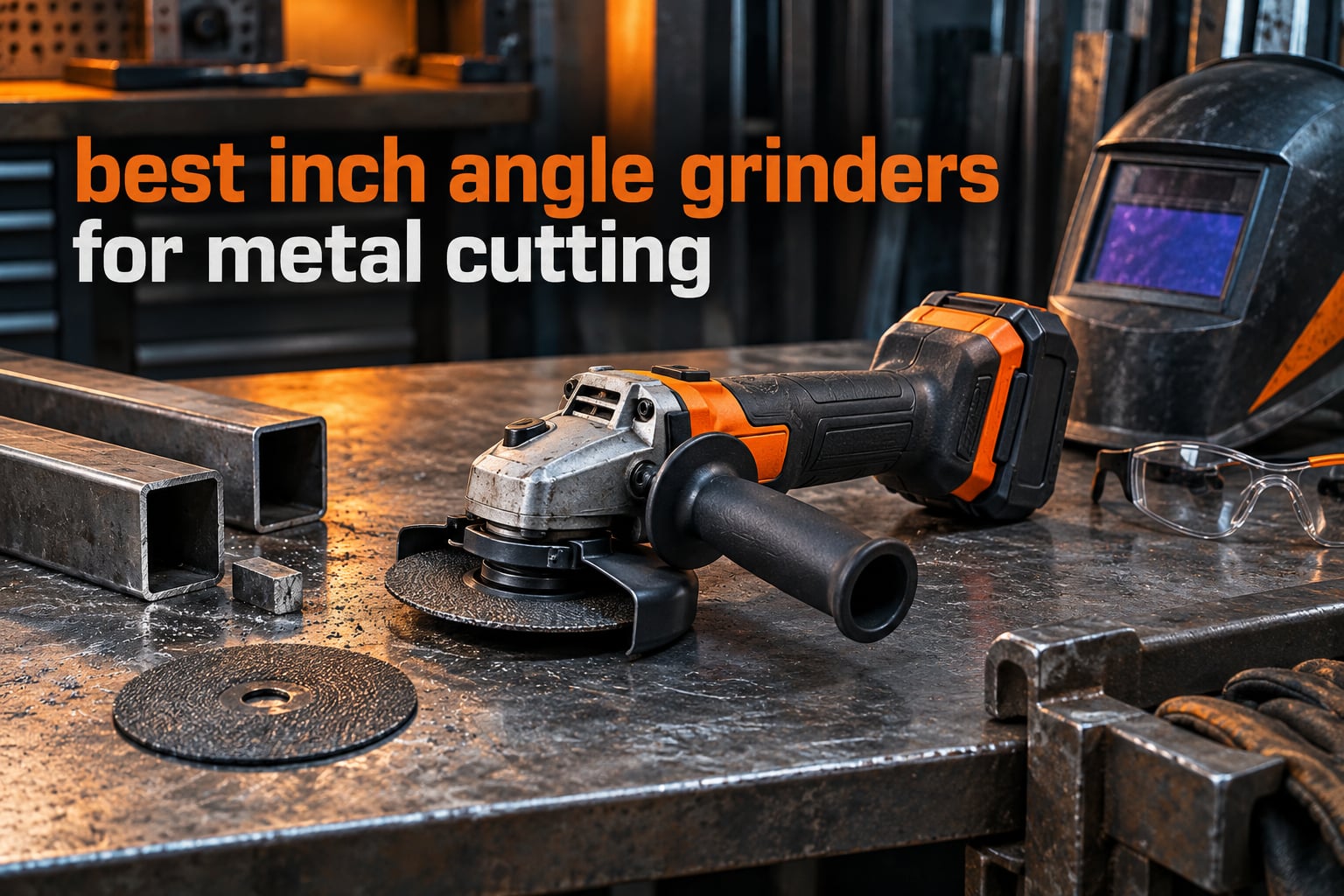
Most people pick the wrong 4 inch angle grinder because they read the wattage number on the box and stop there. The real test for metal cutting is what happens to wheel speed after the disc touches steel, because a grinder that bogs down under load burns the wheel, stalls the cut and throws sparks in every direction. We lined up ten of the most widely owned small grinders and compared their published output, their safety hardware and what owners report after months of real metalwork.
This guide covers the best 4 inch angle grinders for metal cutting, from corded shop tools to bare-tool cordless kits, plus the disc selection advice that decides whether any of them perform. A few naming notes up front: most grinders marketed as 4 inch actually take a 4-1/2 inch wheel, and every model below is listed with the wheel size the manufacturer states. If you want the wider view across every disc size, our angle grinder roundup covers the 5 inch and larger end of the market.
Corded or cordless? A corded grinder holds speed under load all day and never pauses, which is why fabricators and welders still reach for one. Cordless brushless models have closed most of that gap and win outright on job sites where a cord is a liability. If you cut steel for six hours a day, buy corded. If you move between jobs and already own batteries, buy the bare cordless tool that fits your platform.
Every rating and review count in this roundup comes from the product listings themselves, and every owner detail traces back to reported review content. We have not invented a single measurement, and where the data is thin we say so rather than filling the gap with a guess. If you also cut steel on a bandsaw, see our metal cutting band saw guide for continuous stock cutting.
Top 3 Best 4 Inch Angle Grinders for Metal Cutting (October 2026)

The DEWALT DCG413B takes the top slot because it pairs a brushless motor with an electronic kickback brake that stops the wheel in two seconds or less, and it carries more owner reviews than any other cordless small grinder here. The Makita 9557PBX1 is the corded answer, with a 7.5 amp motor, labyrinth seals and the most complete accessory package we found. The Metabo HPT G12SR4 wins on value, bundling five grinding wheels and a hard case with a 12,000 rpm motor.
All 10 Picks at a Glance
| Product | Specifications | Action |
|---|---|---|
| DEWALT DCG413B |
|
Check Latest Price |
 Makita 9557PBX1 Makita 9557PBX1 |
|
Check Latest Price |
 Milwaukee 2880-20 Milwaukee 2880-20 |
|
Check Latest Price |
 CRAFTSMAN CMCG400B CRAFTSMAN CMCG400B |
|
Check Latest Price |
 Metabo HPT G12SR4 Metabo HPT G12SR4 |
|
Check Latest Price |
 DEWALT DWE4011 DEWALT DWE4011 |
|
Check Latest Price |
 SKIL 9295-01 SKIL 9295-01 |
|
Check Latest Price |
 AVID POWER AAG589 AVID POWER AAG589 |
|
Check Latest Price |
 AOBEN AT102D-115 AOBEN AT102D-115 |
|
Check Latest Price |
 WEN 944 WEN 944 |
|
Check Latest Price |
1. DEWALT DCG413B – Best Brushless Cordless Grinder for Metal Cutting
DEWALT 20V MAX* Angle Grinder Tool Cordless Brushless, 4 1/2 Inch, with Paddle Switch and Kickback Brake, Tool Only (DCG413B)
20V cordless brushless
4-1/2 inch wheel
Kickback brake in 2 seconds
3.8 lb, tool only
Pros
- Brushless motor needs no brush changes
- Effective kickback brake on bind-up
- Light 3.8 lb body
- Two-stage paddle switch
- Allen wrench disc changes
Cons
- Battery and charger sold separately
- Less raw power than a corded grinder
This is the cordless grinder we would put in the hands of someone who already owns DEWALT 20V packs and wants to cut steel away from an outlet. The brushless motor needs no brush changes, which removes the maintenance issue that comes back most often on brushed cordless tools, and owners consistently describe it as having plenty of power for cutting and grinding metal.
The safety hardware is what separates it from the pack. When the wheel pinches, stalls or binds, the kickback brake engages with maximum force and stops the spinning wheel in two seconds or less on average, then shuts the tool down. On a 4 inch wheel loaded against a solid steel bar, that is the difference between a spark shower and a dropped tool.
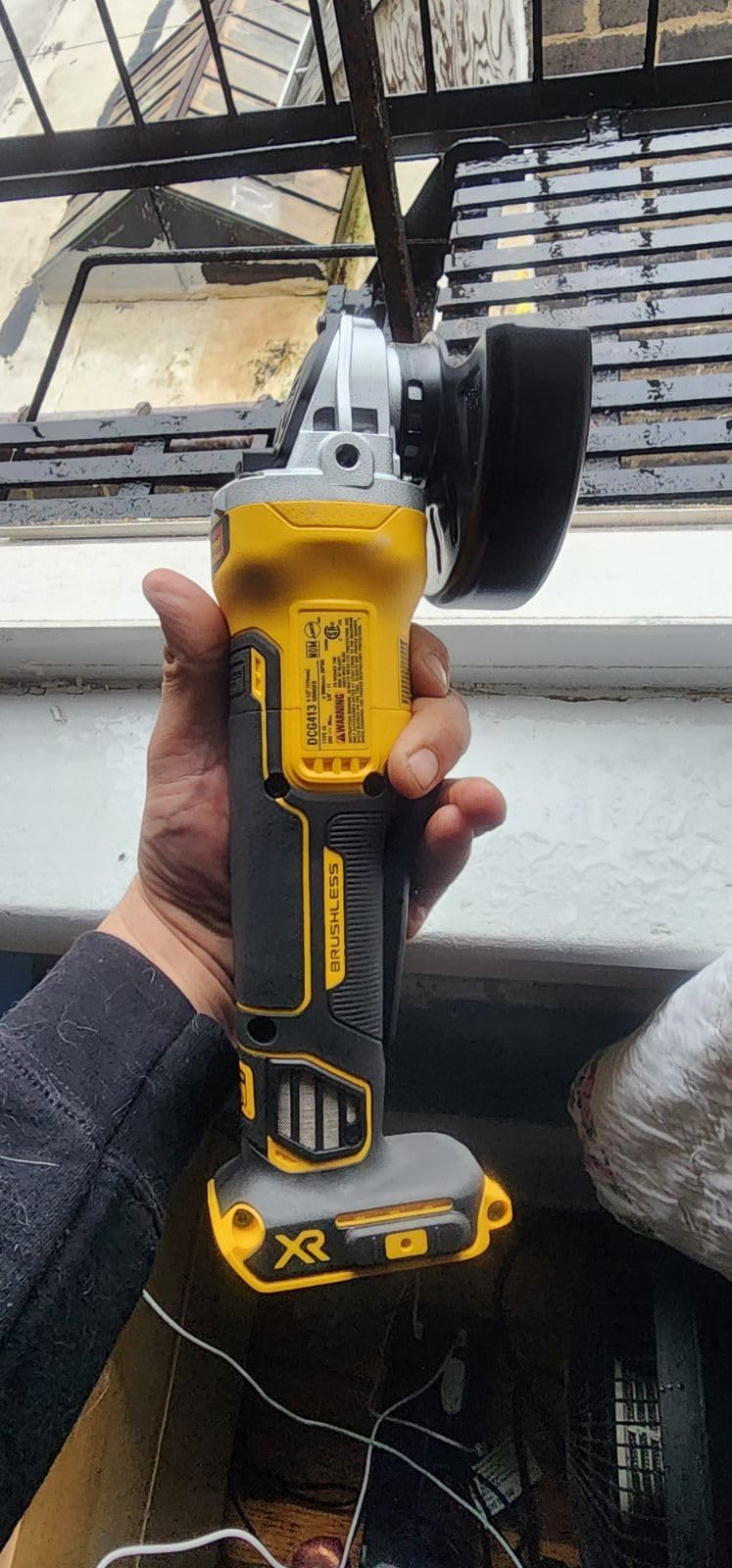
The two-stage paddle switch adds a second action before the tool spins up, and the no-volt release means it will not restart by itself after the battery is reseated. Disc changes use the standard Allen wrench rather than a pin spanner, and the 3.8 lb body sits well-balanced in the hand for overhead and awkward-angle work.
There is one honest limitation, and it is the battery rather than the tool. Owners report roughly 20 to 30 minutes of runtime on a 4Ah pack during heavy grinding, which is fine for repair work but short for an afternoon of production grinding. Batteries and charger are also sold separately, so the platform cost matters if you start from zero.
What the kickback brake actually protects you from
When a cutoff wheel binds in a cut, the wheel stops, the motor keeps driving and the reaction torque spins the grinder out of your hands. The DCG413B senses the bind electronically and dumps that energy into the brake instead. On a jobsite with rebar and structural tube, that protection is worth more than any accessory in the box.
Where it falls short against a corded tool
It will not out-cut a 7 amp corded grinder on thick structural steel, and review data makes that clear. Cordless output also drops as the pack drains, so the last third of a battery produces a noticeably weaker cut than the first third. Choose it for mobility, not for raw cutting throughput.
2. Makita 9557PBX1 – Best Corded Grinder for Shop and Garage
Makita 9557PBX1 4-1/2″ Paddle Switch Cut-Off/Angle Grinder
Corded 7.5 amp at 11000 rpm
4.5 lb
5/8-11 spindle
Labyrinth seals
Pros
- Compact barrel grip at 2.5 inches
- Labyrinth seals block dust and debris
- Metal gear housing with ball bearings
- Comes with case and five wheels
- AC/DC switch accepts other power sources
Cons
- Case will not hold the tool with handle fitted
- Guard swap needs a Phillips screwdriver not included
- Lock-on switch unmarked and finicky
The Makita 9557PBX1 is the grinder we recommend when metal work is a regular Saturday activity rather than an occasional job. The 7.5 amp motor delivers 11000 rpm and, in owner reports, handles mild steel and stainless without complaint, while the labyrinth seal construction keeps abrasive dust out of the bearings and the zig-zag varnish coating protects the armature.
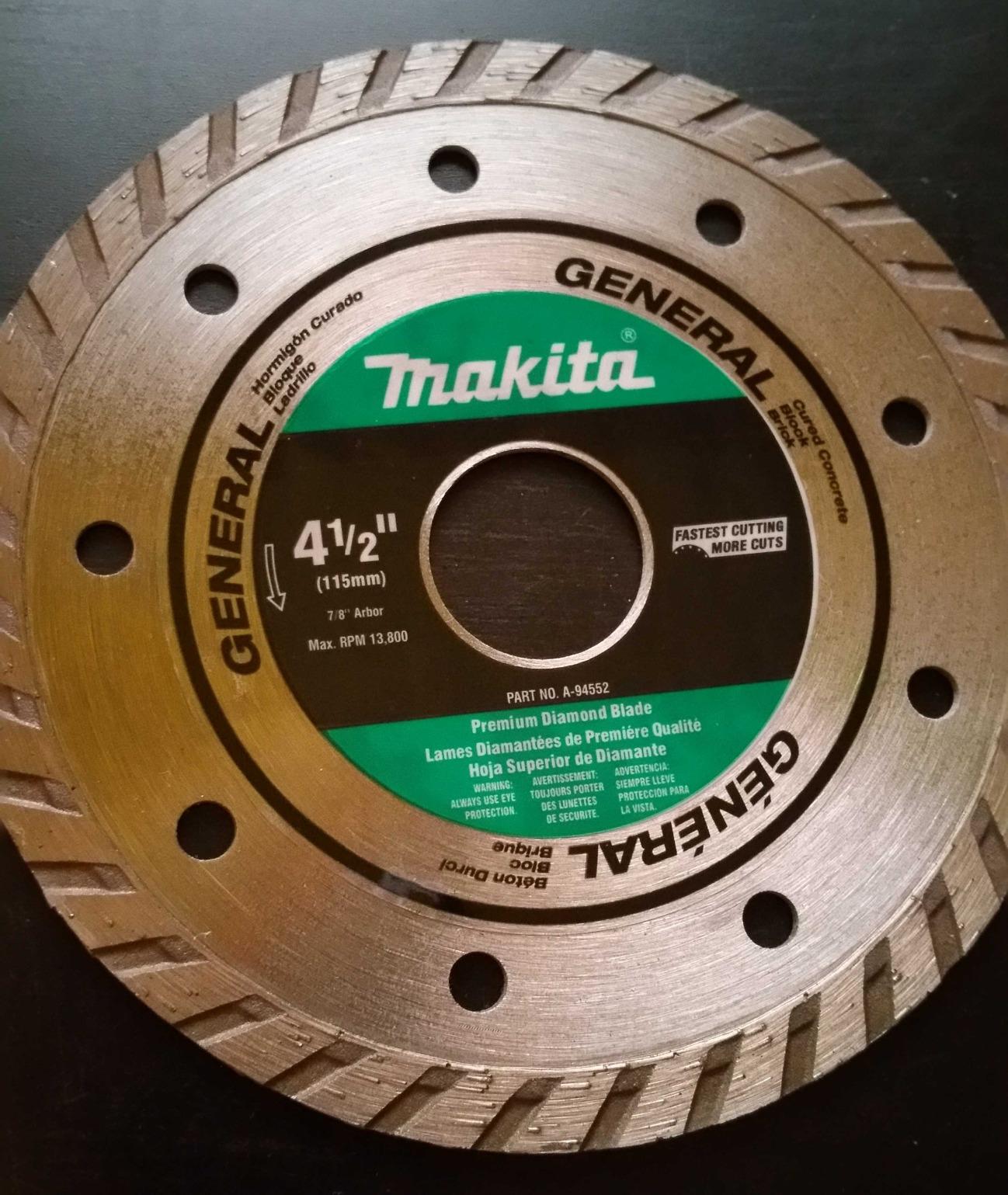
What stands out most is the accessory package. You get an aluminum case, a side handle, both a grinding guard and a cut-off guard, five grinding wheels, a turbo diamond blade and the lock nut wrench. For someone building a first metalworking kit, that removes a whole round of separate purchases.
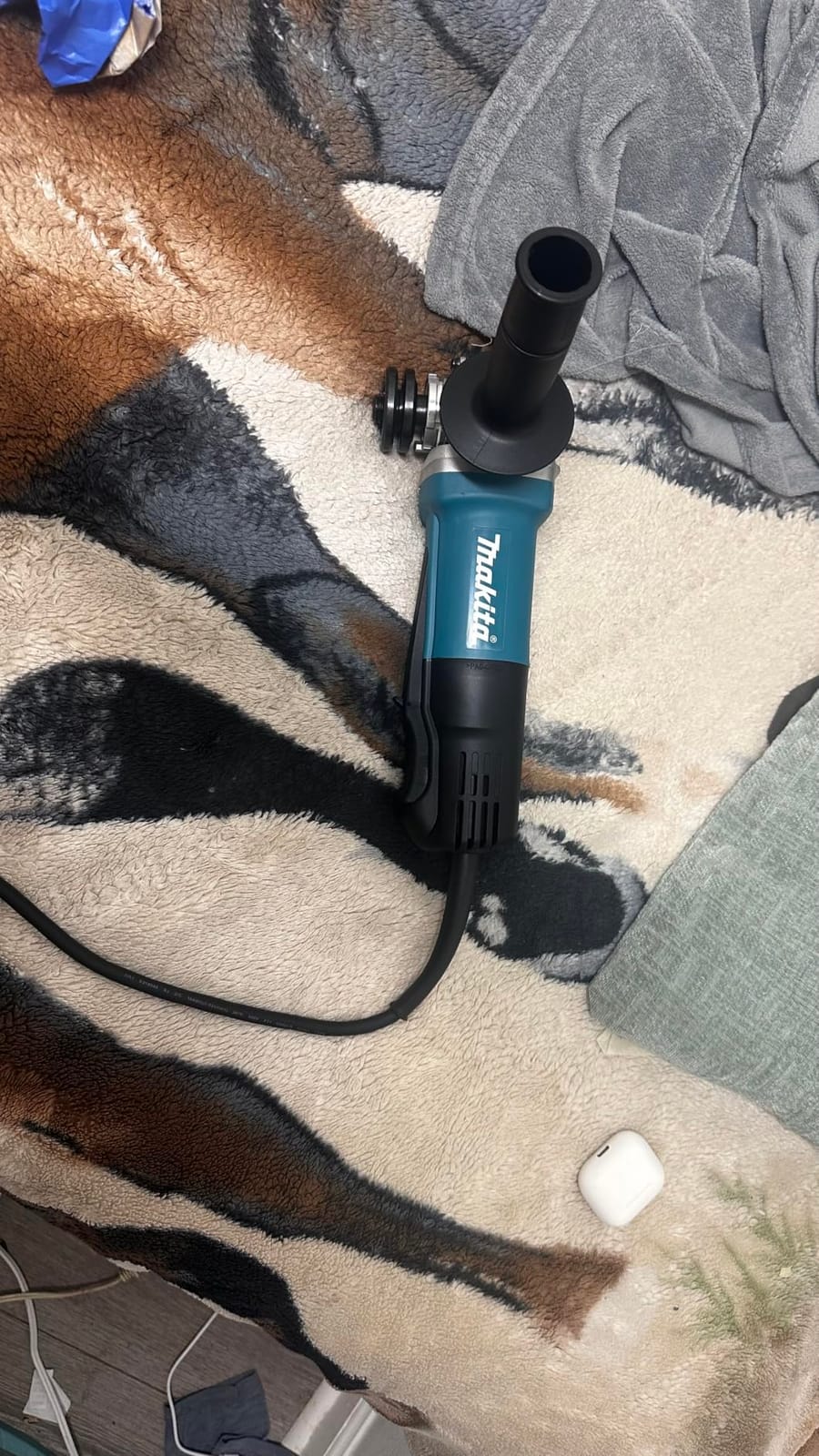
The barrel grip measures just 2.5 inches in diameter across a 4.5 lb tool, which is why owners keep reaching for it in tight spaces and overhead positions. The paddle switch offers both lock-on for continuous operation and lock-off to prevent accidental startup, and the all-ball-bearing drive with a metal gear housing is the kind of construction that survives years of shop use.
There are small design omissions worth knowing. The aluminum case does not fit the tool with the side handle attached, which defeats the point of a case. Swapping between the two guard types needs a Phillips screwdriver that is not in the box, and the lock-on control at the back of the paddle is unmarked and fiddly until you know where it is.
Whether the accessory kit is a real advantage
For a first grinder, yes. For a shop that already has wheels in every diameter and grit, less so. The five included grinding wheels suit the mild steel and stainless work most people start with, and the diamond blade covers tile and masonry if you also cut stone.
The arbor confusion you should know about
Support has stated the grinder takes 5/8 inch arbor only, while the manual indicates the lock nut inserts can be reversed for 7/8 inch arbors. Owners checking this before buying wide-format wheels is the sensible move, because buying 7/8 inch discs that will not mount is an easy mistake.
3. Milwaukee 2880-20 – Best Cordless Grinder for M18 Battery Owners
Milwaukee 2880-20 M18 Fuel Brushless Lithium-Ion 4-1/2 in. / 5 in. Cordless Small Angle Grinder with No-Lock Paddle Switch (Tool Only)
18V M18 FUEL brushless
Takes 4-1/2 and 5 inch wheels
Electronic clutch
5 lb
Pros
- Electronic clutch cuts kickback risk
- Overload protection extends motor life
- Anti-vibration side handle
- Works with every M18 battery
- Standard 5/8-11 spindle
Cons
- Battery and charger sold separately
- 8500 rpm is well below corded output
If you already run M18 batteries, this grinder drops into that ecosystem with no extra chargers and no platform lock-in cost. It accepts both 4-1/2 inch and 5 inch wheels on the same 5/8-11 spindle, which means the same cutting disc bin covers light sheet metal work and heavier structural cuts.
The electronic clutch is the headline safety feature. It detects a bind-up and cuts motor power in a controlled way, protecting both the operator and the workpiece. Overload protection handles the other common scenario, shutting the motor down before heat damage shortens its life.
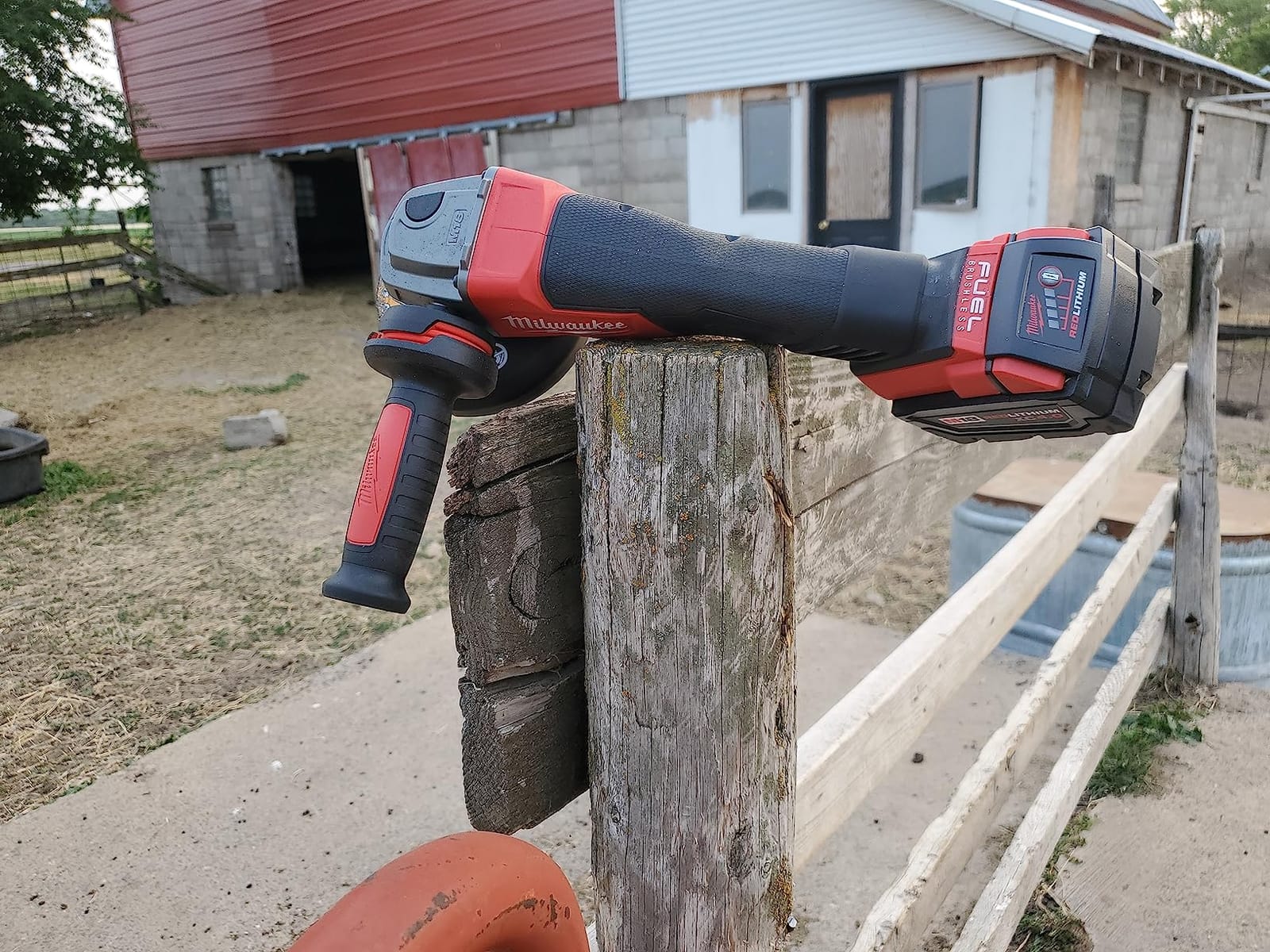
Owners consistently single out the anti-vibration side handle as more than a comfort feature. It damps the feedback that travels through the gear head during long cuts on solid steel, which is exactly the vibration that tires your hands over a full shift. The switch is a no-lock paddle, meaning you cannot latch it on for continuous work.
The trade-off is speed and weight. At 8500 rpm this sits well below the 12,000 rpm class corded grinders reach, and at 5 lb it is one of the heavier tools here, which makes overhead work harder. Reviewers also note the bare-tool format, so batteries and a charger come off your existing M18 collection.
Why the two wheel sizes matter for steel
Switching to a 5 inch cutting wheel on the same body gives you roughly a quarter more cut depth without a second tool. For rebar, square tube and structural sections, that is the practical reason to favor this one over a fixed 4-1/2 inch cordless design.
Where 8500 rpm costs you
RPM is where disc edge speed comes from, so a lower figure means a slower cut and more heat into the workpiece. On thin gauge and small angle sections this barely registers. On heavy structural steel it is noticeable, and for that work a corded model remains the better tool.
4. CRAFTSMAN CMCG400B – Best Cordless Grinder for Heat and Durability
CRAFTSMAN V20* Angle Grinder, Small, 4-1/2-Inch, Tool Only (CMCG400B)
20V cordless
8500 rpm class
Cast metal gear housing
Tool-free guard
Pros
- Cast metal gear housing sheds heat
- Tool-free guard repositioning
- Three-position handle
- Contoured over-molded grip
- Limited lifetime warranty
Cons
- Battery and charger sold separately
- 9000 rpm top speed trails corded grinders
The CRAFTSMAN CMCG400B stands out for one component: a cast metal gear housing instead of the typical aluminum or plastic shell. Metal conducts heat away from the gearset, and that is the difference between a tool that stays cool through a long grinding session and one that gets hot enough to slow down.
Everything else follows a sensible cordless design. The guard repositions without tools, the handle moves to three positions and the contoured over-molded grip keeps hand fatigue down. Owners rate the tool-free guard as the feature they notice most after unboxing.
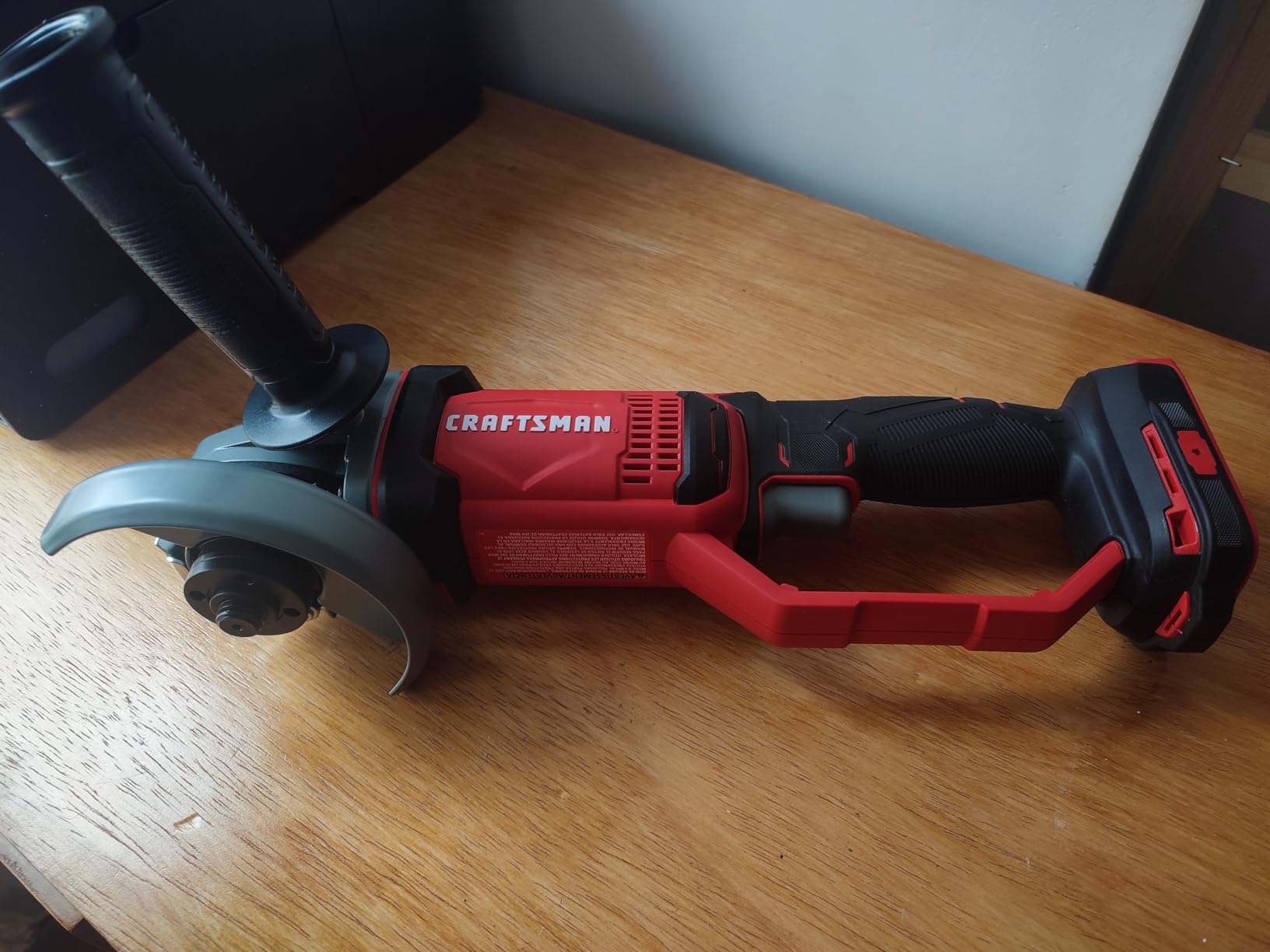
The limited lifetime warranty is unusual in this category and changes how the purchase feels next to a one-year warranty on a comparable corded tool. For a metal fabricator who runs one grinder for years, that coverage carries real weight when deciding between two otherwise similar machines.
Output is the compromise. The 8500 rpm class speed is respectable for a battery grinder but well short of what a 12,000 rpm corded machine delivers on steel. The battery and charger are sold separately, and the listed item weight is heavy for a cordless tool, which affects overhead work.
Heat is the real enemy of a small grinder
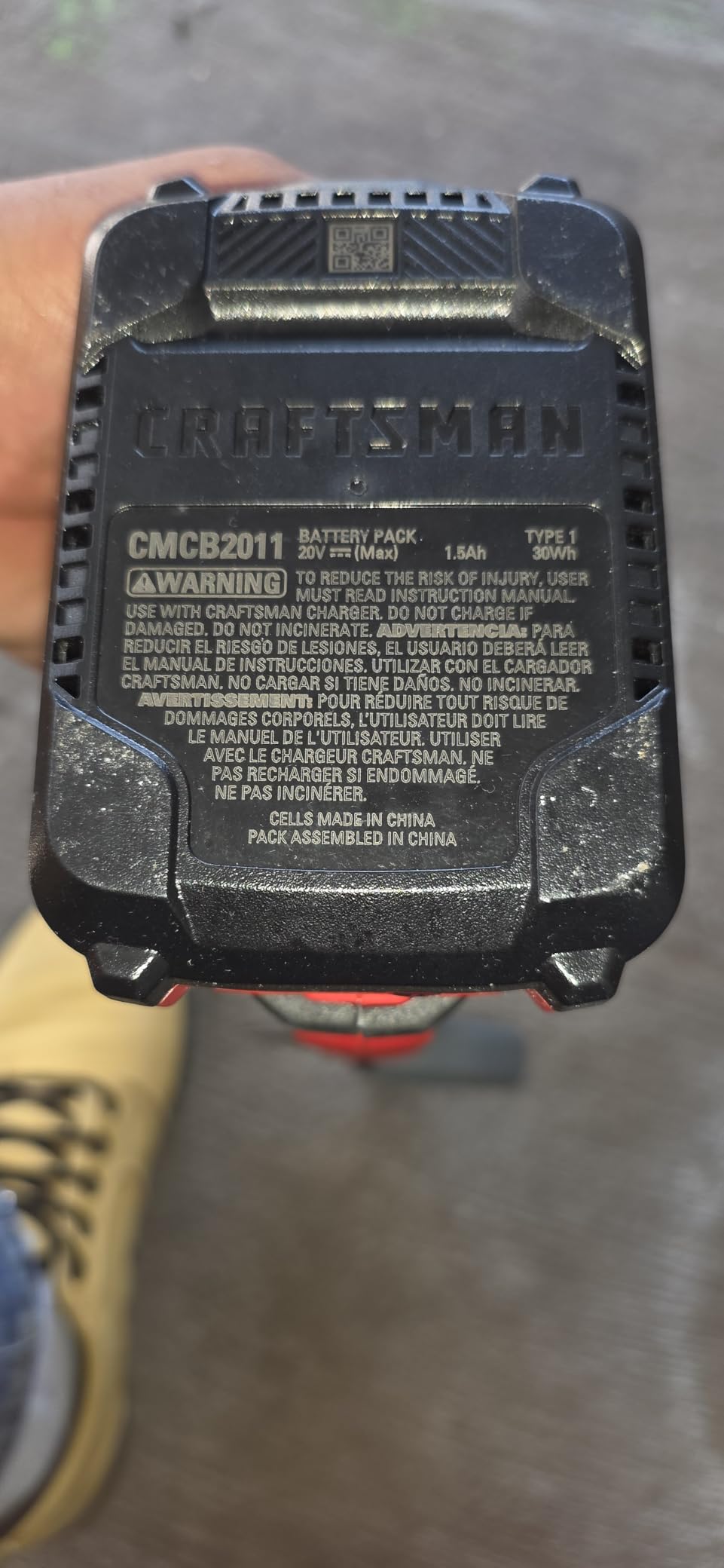
Abrasive dust and sustained load both generate heat in the gear head. Once the bearings and gearset run hot, grease breaks down and the whole assembly wears faster. A cast metal housing moves that heat away from the gearset faster than a composite shell, which is why this design earns its place in a shop.
What you give up for that housing
Weight, and a speed figure that will not match a corded grinder on thick material. If your work is thin sheet, small angle iron and cleanup rather than heavy structural cuts, the speed difference is minor. If you cut solid bar all day, it is not.
5. Metabo HPT G12SR4 – Best Value Corded Grinder with a Full Kit
Metabo HPT 4-1/2-Inch Angle Grinder, Includes 5 Grinding Wheels & Hard Case, 6.2-Amp Motor, Compact & Lightweight, G12SR4
Corded 6.2 amp / 980W
12000 rpm
4.0 lb
Spindle lock
Pros
- Five grinding wheels and hard case included
- Spindle lock speeds disc changes
- Light 4.0 lb body with small grip
- Low-profile gear case for tight areas
- Labyrinth design for dust durability
Cons
- Slide switch is mounted on one side only
- One-year warranty is the shortest here
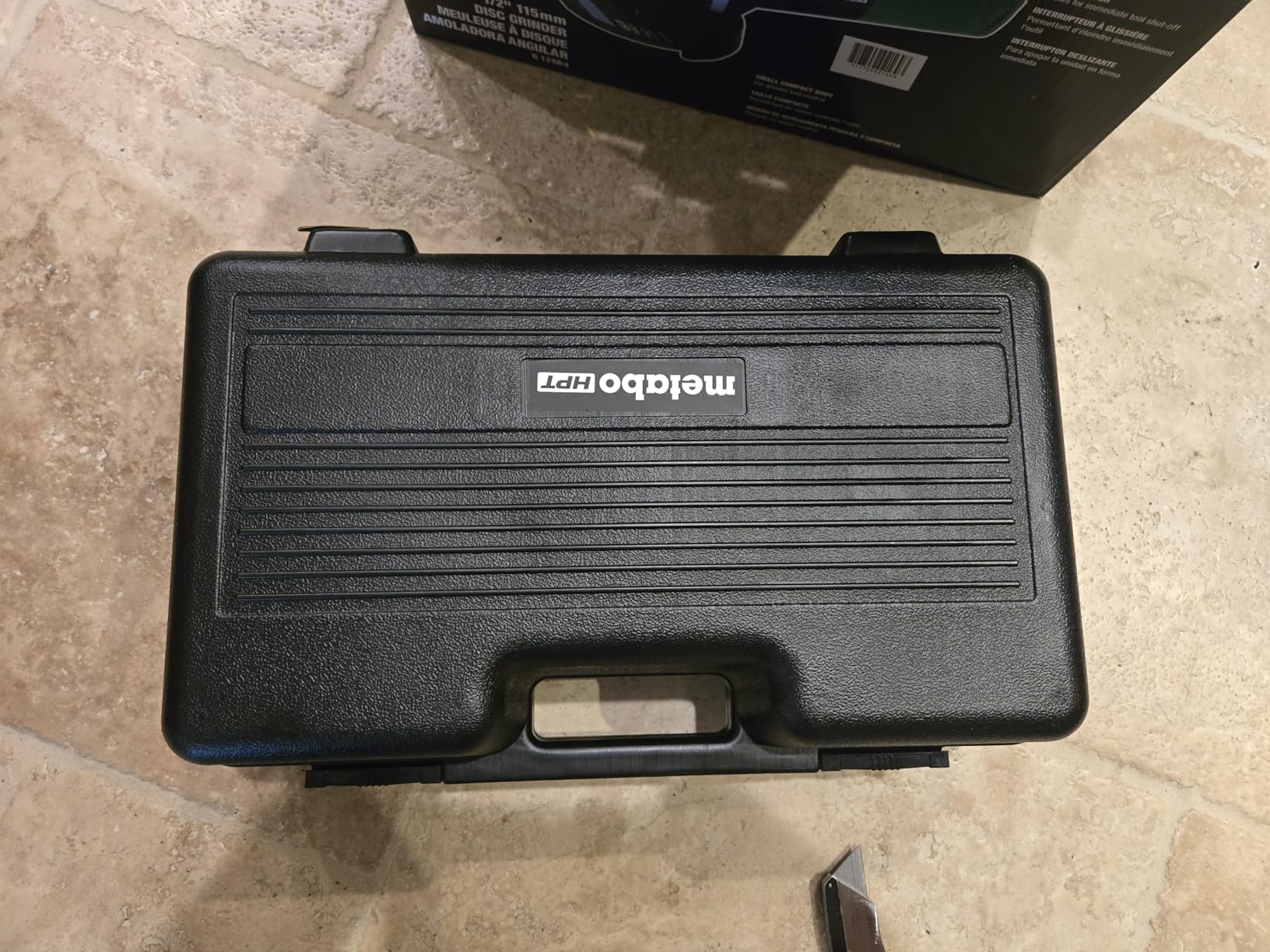
The Metabo HPT G12SR4 is the recommendation for anyone who wants a working metal grinder without assembling a parts list first. At 6.2 amps and 980W with 12000 rpm, it is genuinely capable on tough grinding jobs, and the box includes five grinding wheels plus a hard carrying case.
At 4.0 lb it is among the lighter corded options here, and the smaller grip diameter is designed to reduce hand fatigue over a long session. The low-profile gear case is the quiet advantage, letting the head reach into tight corners where a taller housing will not fit.
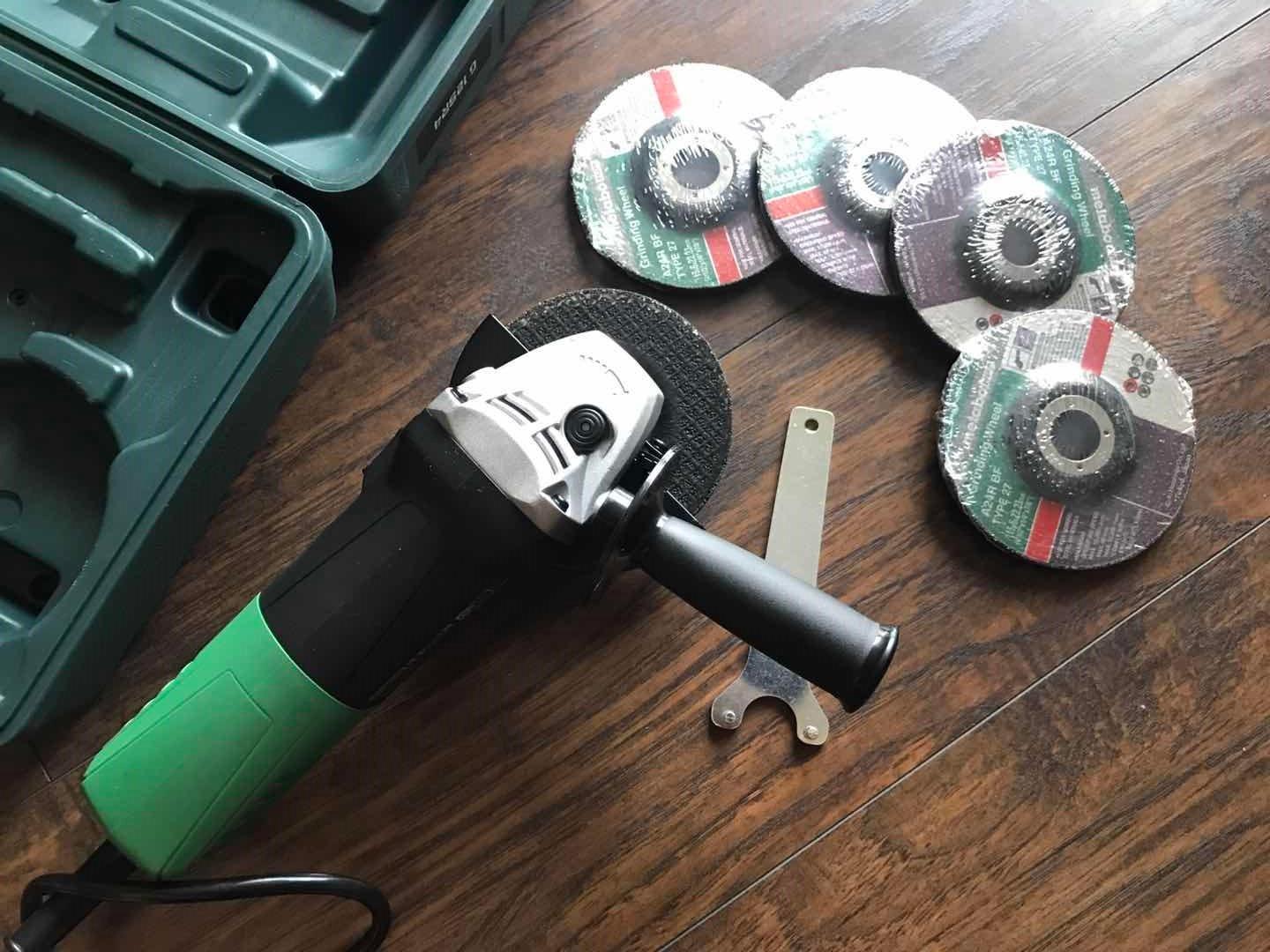
The spindle lock removes the spanner wrench from disc changes, so switching between a cutting wheel and a grinding wheel takes seconds rather than a minute. The removable side handle is forward-canted and works for either hand, which matters when you are cutting overhead or at hip height.
Two limitations stand out. The slide switch is mounted on one side only, so it does not suit users who prefer a different grip position or work with the tool in the opposite hand. The one-year warranty is also the shortest offered by any tool in this roundup, which is a consideration if you buy expecting years of daily service.
Whether five included wheels actually matter
They matter more than the count suggests. A new grinder with no usable wheels cannot cut anything until you make another purchase, and the bundled set covers grinding, cutting and finishing from the box. That removes friction for beginners and saves a trip for experienced users replacing a set.
Where the one-year warranty stings
Compare it against competitors that offer longer coverage on similar power output. If you plan to keep this grinder for professional work, the shorter warranty is a real cost in the back half of its life. If you are refreshing a garage tool every few years, it matters much less.
6. DEWALT DWE4011 – Best Corded Grinder for Tool-Free Guard Changes
DEWALT Angle Grinder, One-Touch Guard, 4-1/2 -Inch (DWE4011)
Corded 7 amp AC/DC
12000 rpm
3.9 lb
One-Touch guard
Pros
- One-Touch guard needs no tool
- Quick-change wheel release works without a wrench
- 7 amp at 12000 rpm cuts thin metal fast
- Slim body fits smaller hands
- Fewer exposed body screws
Cons
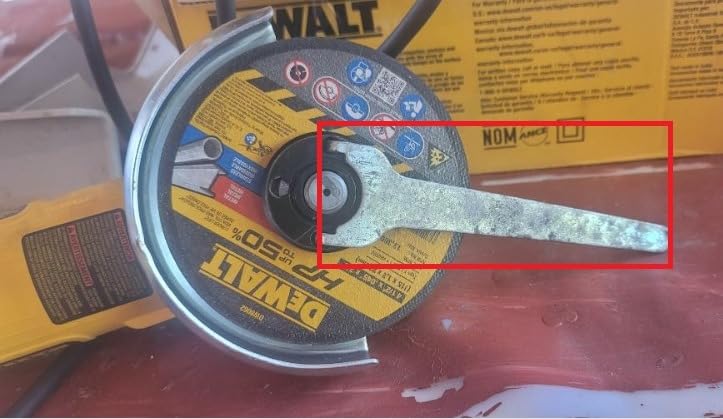
- Spanner wrench no longer included
- Small slide switch is easy to miss
- Noticeably noisy with elevated vibration
The DWE4011 is the corded grinder to buy if you change discs constantly. The One-Touch guard rotates by lever with no tool at all, and the quick-change wheel release removes discs without a wrench, so the only time you need a tool is changing accessories, not repositioning the guard.
Underneath, a 7 amp AC/DC motor at 12000 rpm is designed for faster material removal and better overload protection. Owners report it cuts thin metal quickly, and the 5/8-11 spindle accepts a wide range of 4-1/2 inch accessories, so it shares discs with the rest of the DEWALT small grinder range.
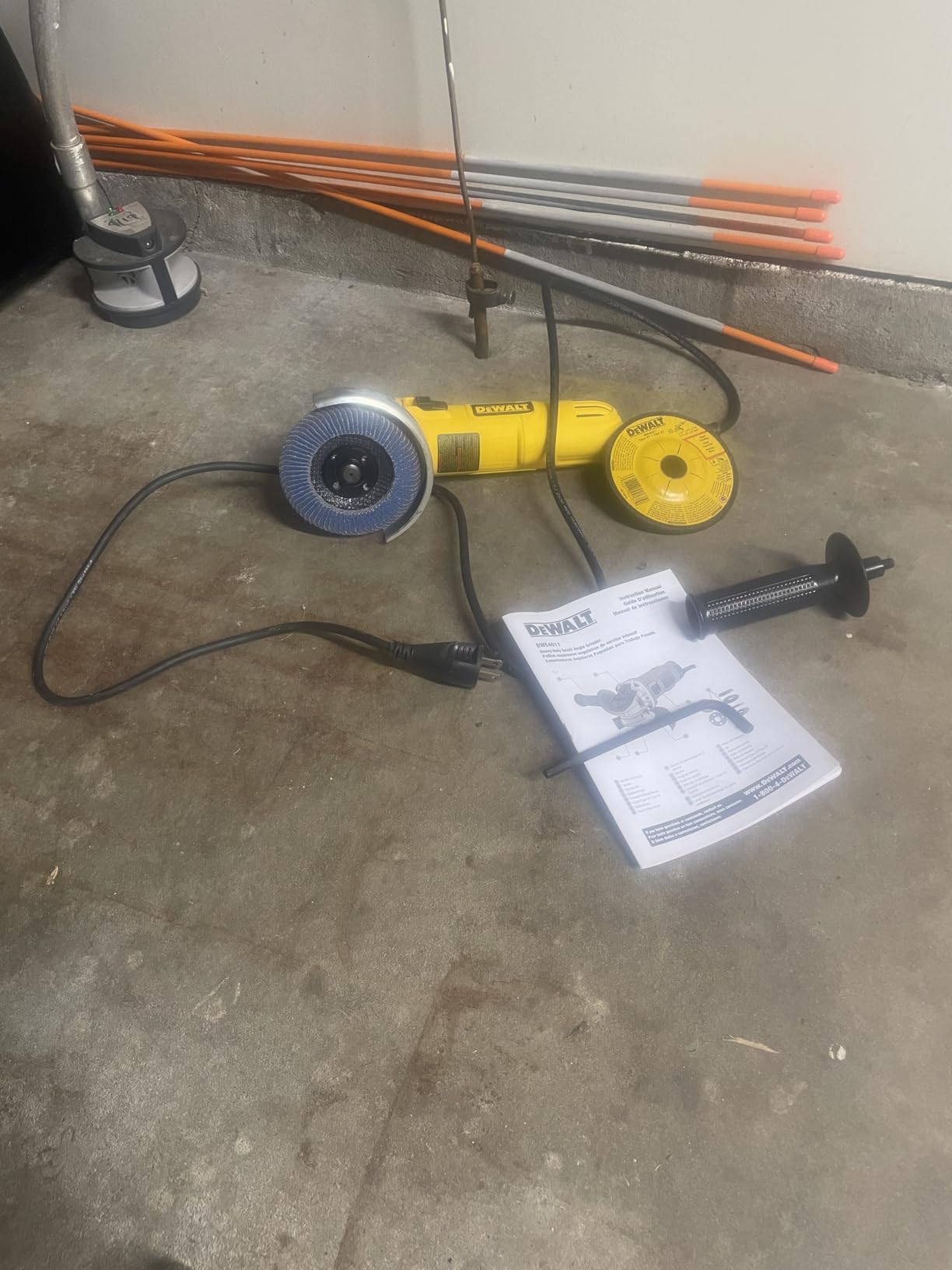
The slim ergonomic body fits smaller hands, and the two-position removable side handle gives you a choice of grip angle. It also carries fewer exposed body screws than earlier generations, which reduces the chance of vibration working fasteners loose over time. At 3.9 lb it stays comfortable in extended use.
The complaints are consistent. DEWALT dropped the spanner wrench from the box, which some owners miss. The slide switch is small enough that a thumb occasionally misses it. And the tool is noticeably noisy with somewhat elevated vibration, which is the one area where this generation does not improve on its predecessors.
Why tool-free guard changes matter for metal cutting
Every switch between a cut-off wheel and a grinding disc means repositioning the guard to cover the operator rather than the work. Doing that with a hex key while wearing gloves, on a ladder, in the middle of a job, is the annoyance tool-free adjustment removes. It is a small feature that adds up across hundreds of cycles.
What the noise tells you
Louder operation and higher vibration usually point to the motor and bearing package rather than the disc. It does not shorten tool life in owner reports, but it does raise fatigue on long sessions, so consider the side handle position carefully if you work overhead for hours.
7. SKIL 9295-01 – Best Budget Grinder for Home Metalwork
SKIL 6 Amp 4-1/2-Inch Corded Angle Grinder – 9295-01
Corded 6.0 amp
11000 rpm
4 lb
Three-position handle
Pros
- Cuts thin-gauge metal without trouble
- Solid metal gear housing at about 4 lb
- Handle threads onto either side or top
- Wheel wrench stores inside the handle
- Tool-less guard adjustment
Cons
- 6 amp output is light for heavy continuous work
- Cord is short at roughly 4 to 5 feet
The SKIL 9295-01 is a solid first grinder for home metalwork. A 6.0 amp motor at 11000 rpm cuts thin-gauge metal with a cutting disc without drama, and owners describe it as solid feeling and relatively light at about 4 lb.
The build is more substantial than the tier suggests. The heavy duty metal gear housing adds ruggedness, and the vibration-reducing handle stores the wheel-change wrench inside itself, so the tool you need for disc changes is already on the tool. The guard adjusts without tools.
The side handle threads onto either side of the body or the top, giving three grip positions that matter when you are cutting pipe on the ground or working on a ladder. The compact grip design supports control on smaller material.
Be realistic about the limits. Six amps is underpowered for contractors doing heavy continuous work, and owners say so directly. The cord runs roughly 4 to 5 feet, which is short for a garage or driveway. No case is included, and the power button feels awkward until you build the habit.
Where 6 amps is genuinely enough
Rust removal, sharpening mower blades, cutting thin sheet, trimming angle iron and cleaning up welds are all within reach at this output. The motor does not bog down on those jobs, which is the whole question for metal cutting.
When you should step up instead
Solid bar, thick structural tube and hours of continuous cutting will expose the gap. If your work is professional or you already cut heavy material regularly, step up to a 7 amp or 7.5 amp corded machine rather than fighting a motor that is out of its depth.
8. AVID POWER AAG589 – Best Grinder for Cross-Brand Wheel Compatibility
AVID POWER Angle Grinder, 7.5-Amp 4-1/2 inch Electric Grinder Power Tools with Grinding Wheels, Cutting Wheels and Auxiliary Handle for Cutting, Grinding, Polishing and Rust Removal – Red
Corded 900W / 7.5 amp
12000 rpm
7/8 inch arbor
5.1 lb
Pros
- 7.5 amp at 12000 rpm for the money
- Wheels cross-compatible with major brands
- Spindle lock for tool-free changes
- Bundle includes cutting and grinding wheels
- Tool-free multi-angle guard
Cons
- Guard lock is basic with few positions
- On/off switch feels fragile
- Sparse reports of seized outer flanges
The AVID POWER AAG589 is the pick if you already own discs from other brands and want them to fit. The standard 7/8 inch arbor with a 5/8-11 threaded spindle accepts wheels that owners confirm cross-compatibility with major brands, and the integrated spindle lock makes changes quick without tools.
Power is the second surprise. A 900W 7.5 amp motor at 12000 rpm is output usually found on tools costing substantially more, and it handles metal cutting, grinding, polishing, rebar and metal pipe as well as sharpening mower blades and stripping rust and paint.
The accessory bundle is unusually complete, with two metal cutting wheels, two metal grinding wheels, a flap disc, a side handle, a spanner wrench, a wheel guard and a pair of spare carbon brushes. Extra brushes matter because they extend the motor’s service life without another order.
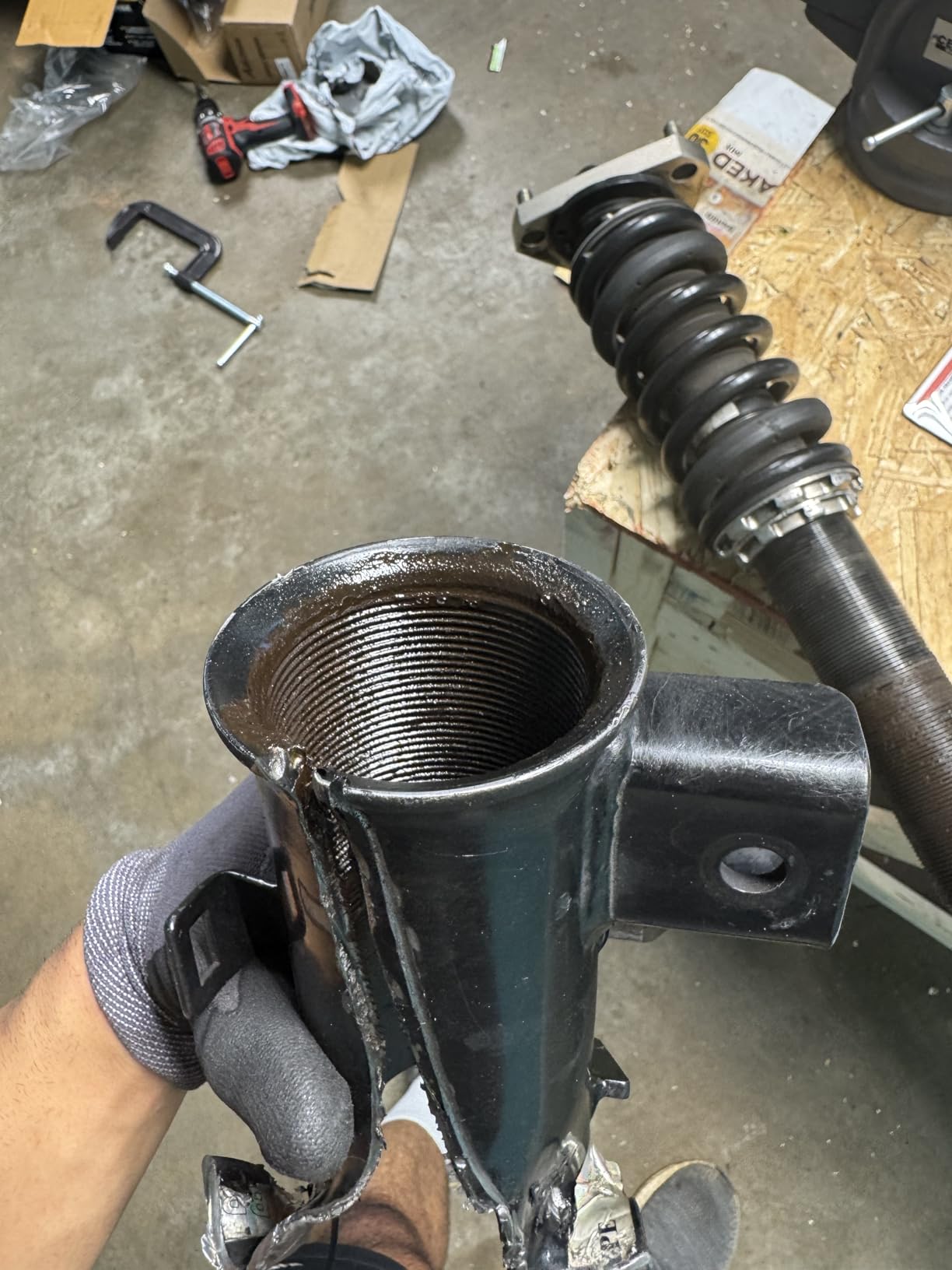
The build quality is where the value tier shows. The guard locking mechanism is basic and offers few adjustment positions, and the on/off switch is hard to depress and feels fragile. Some examples have reported seized outer flanges that could not be loosened, though manufacturer warranty service has replaced those in some cases. The included cutting wheels are thicker than typical and grind down faster than standard discs.
Why disc compatibility matters more than brand
Experienced users on metalworking forums repeatedly make the point that disc quality changes how a grinder performs more than the tool does. Buying a grinder with a standard 7/8 inch arbor means you can buy any disc you find at a better price and never wait on a single-brand wheel supply.
Why experienced users own two grinders
The two-wheeler habit comes straight from shop practice on tools forums. Keeping a second grinder dedicated to cutoff wheels means you are not swapping a cut-off wheel back and forth with a grinding disc, which saves guard adjustments and stops you wearing out one wheel type faster than the other.
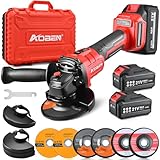
9. AOBEN AT102D-115 – Best Cordless Kit with Two Batteries Included
AOBEN Cordless Angle Grinder 4-1/2 inch, 21V Battery Grinder Kit, Power Electric Cut Off Tool, Brushless Motor, 2×4.0Ah Battery & Charger, for Metal Cutting, Grinding, Polishing
21V cordless brushless
3 speeds to 9500 rpm
Two 4.0Ah batteries
Charger included
Pros
- Two batteries and a charger in the box
- Quiet brushless motor with low-speed torque
- Three speed settings up to 9500 rpm
- Spindle lock for fast wheel changes
- Two guards including a half cover
Cons
- Trigger safety latch is fragile and easy to engage
- Batteries do not fit other brands
- Guard default position leaves fingers exposed
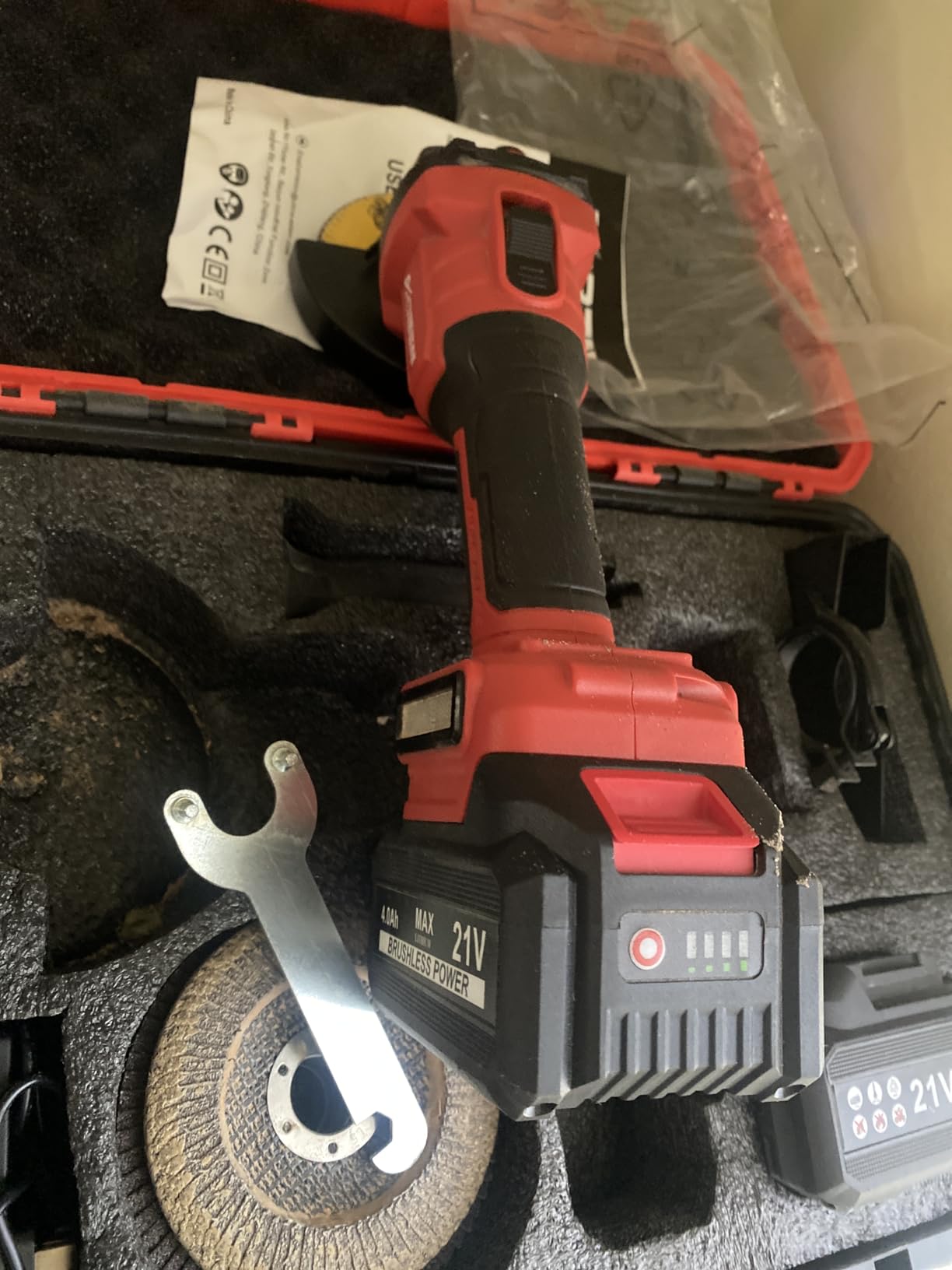
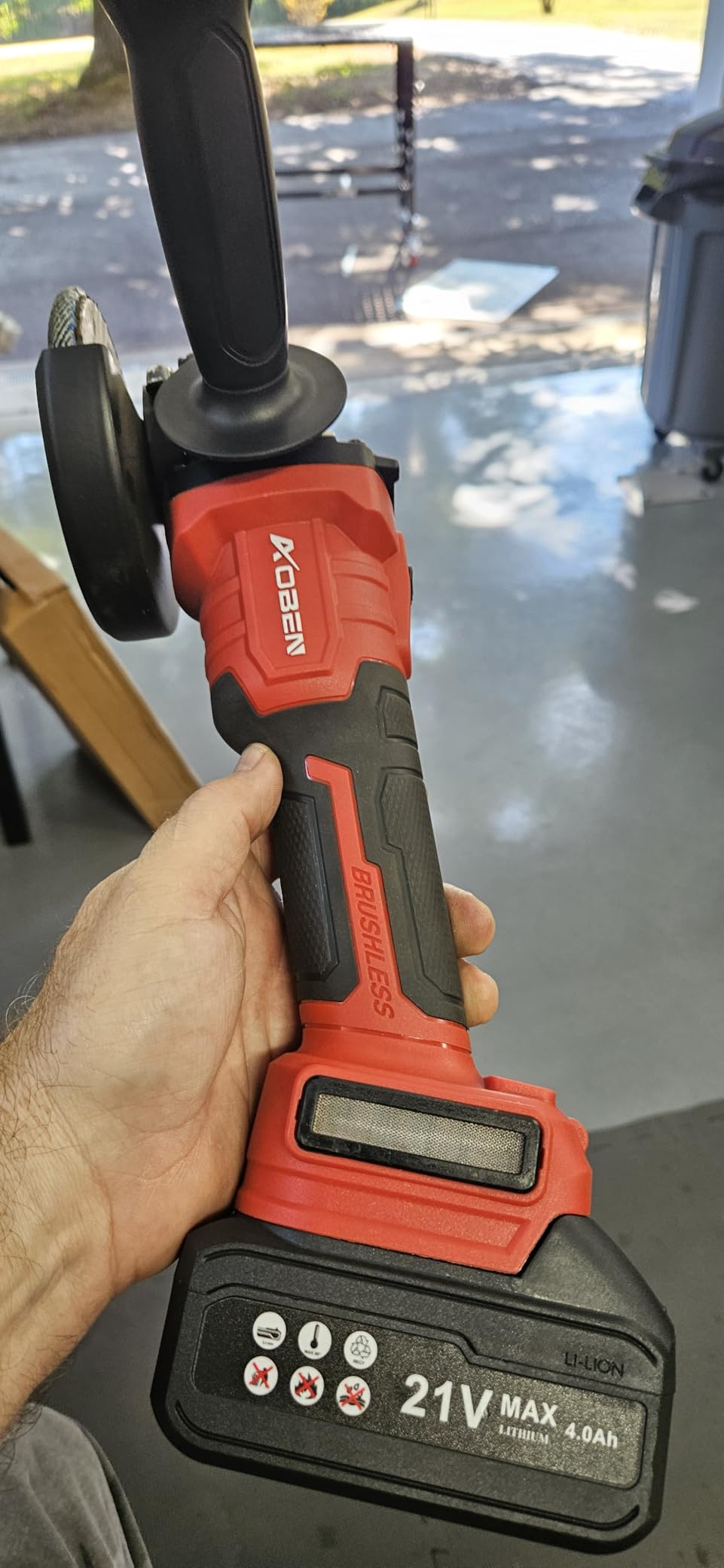
The AOBEN AT102D-115 is unusual in this roundup because the box contains everything: two 21V 4.0Ah batteries, a charger, six discs, two wheel guards and a carrying case. There is no platform to join and no separate battery purchase, which makes it the simplest entry to cordless metal cutting.
The brushless motor runs quiet with good low-speed torque, and three adjustable speeds up to 9500 rpm give you an option for finishing work where full speed is unnecessary. A smart chip triggers overload and overheating protection, suspending work temporarily rather than cooking the motor.
Two guards are included, a regular one and a half-covered version for close-quarter work where sparks fly back toward you. The spindle lock and 7/8 inch arbor with 5/8-11 spindle make wheel changes straightforward, and the same discs fit the other grinders in this roundup.
There are real caveats. The batteries do not fit any other brand, so you are committed to this platform. One detailed review measured battery capacity at roughly half the claimed 4.0Ah and RPM well below the stated 9500, which is worth weighing against the headline numbers. The trigger safety latch looks fragile and is easy to engage by accident, and the guard’s default position leaves fingers exposed until you reposition it. The case foam is too dense to accept the handle.
Whether variable speed earns its place
On a single-speed grinder, every job runs at maximum RPM whether you are cutting 1/4 inch angle iron or blending a weld. Three settings let you slow down for finishing and speed up for heavy cuts, which reduces burn-through on thin plate and gives better control on small parts.
Where this kit is the wrong buy
If you already run DEWALT, Milwaukee, Makita or CRAFTSMAN packs, adding a fourth battery platform costs you money and shelf space. The bare-tool route on an existing platform is usually cheaper over the long run. Buy this one if you have no batteries at all and want to start cutting metal this week.
10. WEN 944 – Best Low-Cost Starter Grinder
WEN 7-Amp Angle Grinder with 4-1/2-Inch Wheel and Reversible Handle (944)
Corded 7 amp
11000 rpm
4.6 lb
Arbor adapter for 5/8 and 7/8 inch
Pros
- Genuine cutting ability on steel for the outlay
- Quiet running for a tool at this level
- Arbor adapter fits two arbor sizes
- Reversible handle for either hand
- Two-year warranty
Cons
- Switch can stick in the on position
- Factory grease is minimal so re-greasing is advised
- Not built for professional daily duty
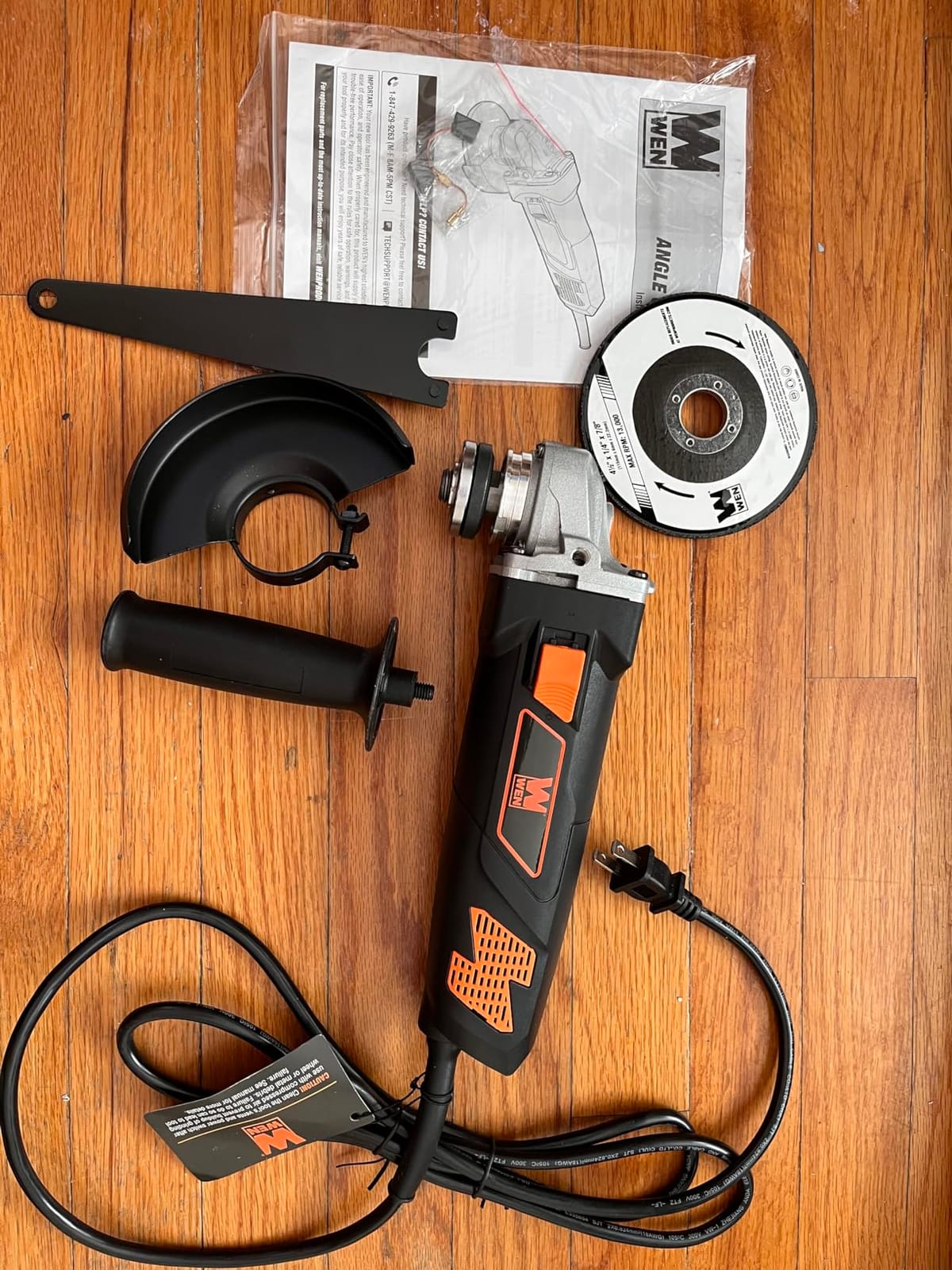
The WEN 944 is an inexpensive way into metal cutting, and owners report it has real torque on steel plate rather than just spinning. At 7 amps and 11000 rpm it produces more output than several higher-priced hobby tools, and it is described by owners as quiet running for a tool at this level.
The arbor adapter accepts grinding wheels with both 5/8 inch and 7/8 inch arbors, so it fits discs from the AVID POWER and DEWALT-style tools in this roundup. The reversible side handle attaches to either side, and the rubber-lined grip keeps the 4.6 lb body comfortable. The two-year warranty is longer than several competitors offer.
Metalworkers posting about budget options on forums routinely make the same argument: a low-cost grinder that gets the job done is a reasonable buy, and you can replace it rather than service it. That logic fits this tool well.
The shortcomings are honest ones. The lock-on switch can stick in the on position, which is a safety concern worth knowing about. Factory grease on the gears and bearings is minimal, so owners recommend re-greasing on assembly. Some examples arrive with a scratched or nicked grinding disc that wears unevenly. And it is not built for professional daily duty.
Should you re-grease it out of the box
Owners who did it report a straightforward improvement in tool life and noise. The gear head arrives with minimal factory grease, so a service check on assembly is a reasonable first step, and anyone comfortable with a screwdriver will find it quick.
When this is the right purchase
Occasional cutting of rod, pipe and plate, sharpening tools, and stripping rust are all within its range. If you are cutting for hours every day in a shop, move up to a higher output corded model instead, because duty cycle is where entry-level tools give out first.
How to Choose a 4 Inch Angle Grinder for Metal Cutting
Speed under load matters more than headline RPM
A grinder that spins freely at its rated RPM on the bench but bogs down the moment the disc meets steel is not delivering that number in practice. Speed under load is what sets edge speed on the wheel, and edge speed is what cuts metal. Look for brushless motors and metal gear housings, both of which help hold speed, and treat the published RPM figure as a ceiling rather than a guarantee.
Choosing the right cutting disc for metal
Use a depressed center Type 1 cutting wheel, which is the standard for cutting steel, angle iron, pipe and rebar on a small grinder. Type 27 raised hub wheels are for grinding and blending, not for edge-on cutting. Match the wheel diameter to the grinder, use a fiber reinforced or heavier grade wheel for thicker material, and stay within the wheel’s stated burst rating. A 0.9mm wheel cuts faster and flexes more; a 1.2mm wheel is stiffer and safer on hard steel and thicker cuts. Diamond wheels belong on masonry, tile and stone, not steel.
Wheel thickness and how the metal decides the disc
For light gauge sheet and thin wall tube, a thin flexible wheel with more teeth cuts faster and throws fewer sparks. For structural steel and rebar, choose a wheel rated for the thickness you are cutting, not the thinnest wheel in the pack. Replace a wheel the moment it thins noticeably or starts to wobble, because a worn wheel deflects, throws a much wider spark stream and shatters more easily.
Corded or cordless: the short answer
Buy corded if you cut steel for hours at a time and value holding speed without pause. Buy cordless if you work away from outlets, on ladders, inside ductwork or on job sites where a cord is a trip hazard. Cordless brushless models in this roundup run 8500 to 9500 rpm against 11000 to 12000 rpm for corded units, so corded still wins on heavy material.
If you already own batteries from a major platform, the economics change. A bare-tool cordless grinder on the platform you own is cheaper over five years than buying a new machine plus batteries and a charger, and experienced buyers consistently treat platform lock-in as a legitimate reason to choose a tool.
Switch systems, brakes and kickback protection
A paddle switch with lock-on lets you work continuously without holding the trigger, and lock-off prevents a restart after a jam. Beyond that, look for an electronic kickback brake or clutch. When a wheel binds in a cut, these systems sense the event and stop motor power quickly, which several shop users on tool forums describe as the single safety feature they look for first.
Weight, balance and grip
Most small grinders land between 4 and 5 lb. The number matters less than balance, because a 4.5 lb tool centered well in the hand is easier to control overhead than a lighter one that is nose heavy. Grip diameter is the detail most people miss: a narrower barrel reduces hand fatigue over a long session and gives better control on small material.
Dust, seals and heat management
Metal cutting produces abrasive dust that gets past the guard and into the bearings. Look for labyrinth seal construction, sealed bearings and a zig-zag varnish coating on the armature. Metal gear housings move heat away from the gearset, which extends life during long grinding sessions.
4 inch vs 4-1/2 inch vs 5 inch sizing
Most grinders advertised as 4 inch take a 4-1/2 inch wheel, so check the stated wheel size on every listing rather than trusting the headline. A 4-1/2 inch wheel gives more cut depth than a true 4 inch wheel, while 5 inch adds roughly a quarter more again at the cost of weight and bulk. In tight spaces and for overhead work, the smaller grinder stays controllable. For rebar and structural sections, the extra depth of 5 inch pays off. The Milwaukee 2880-20 accepts both 4-1/2 and 5 inch wheels, which makes it a useful compromise if your work spans both.
How Deep Can a 4 Inch Grinder Cut?
A 4-1/2 inch wheel produces roughly half an inch of cut depth per side on flat plate, so about 1 inch of total depth when the wheel is taken straight through. A true 4 inch wheel loses roughly a quarter inch compared to that. The relationship is simple and linear: bigger diameter means more depth, and depth means you can cut thicker bar or square tube without turning the piece halfway through.
That single-cut figure is not a limit on the material, only on one pass. To cut thicker material, let the wheel edge travel past the workpiece rather than forcing the wheel face into the cut. Keep the grinder at roughly a 10 to 15 degree angle to the work, use light pressure and let the motor do the work. Slow, steady travel also keeps the wheel cool, and heat is what kills cutting wheels.
When a wheel binds in a cut and the motor is still driving, the reaction torque is what throws the grinder out of your hand. That is the moment the kickback brake on the DEWALT DCG413B and the electronic clutch on the Milwaukee 2880-20 earn their place. Keep a firm grip with two hands, make sure the side handle is fitted, and let the guard sit between your hand and the sparks. For profiles that need a cleaner or straighter edge than a cut-off wheel leaves behind, a vertical band saw is the usual next step, and our vertical band saw roundup for metal cutting covers that side of the shop.
Frequently Asked Questions
How thick of metal can an angle grinder cut?
A 4-1/2 inch cutting wheel on a small angle grinder gives about half an inch of depth per side, so roughly 1 inch of total depth in a single pass on flat steel. Thicker bar or square tube is still cuttable by taking the wheel edge past the material in several passes at a shallow angle instead of forcing the wheel face into the cut.
How deep will a 4 inch grinder cut?
A true 4 inch wheel cuts about a quarter inch less per side than a 4-1/2 inch wheel, which is why most grinders sold as 4 inch models actually take a 4-1/2 inch wheel. Always check the stated wheel size on the listing, since the depth figure follows the wheel diameter, not the marketing name.
What type of grinder blade for metal?
For cutting steel, use a depressed center Type 1 abrasive cutting wheel rated for the material. Type 27 raised hub wheels are for grinding and blending. Use a thinner, flexible wheel for thin gauge sheet and a stiffer, higher grade wheel for structural steel and rebar. Diamond wheels are for masonry, tile and stone only.
Is a 4 inch angle grinder powerful enough for metal cutting?
Yes, for rod, pipe, rebar, angle iron, sheet metal, weld cleanup and rust removal. Output matters more than size: models here range from 6.0 to 7.5 amps corded, and those figures cover most garage and light fabrication work. Continuous cutting of thick structural steel is where a 7.5 amp corded grinder earns its extra cost.
Should I buy a corded or cordless angle grinder?
Buy corded for long sessions and heavy material, since it holds speed without pause and reaches 11000 to 12000 rpm. Buy cordless for work away from outlets and on job sites, where a cord is a trip hazard. If you already own batteries from a major platform, a bare-tool cordless grinder on that platform is usually the cheaper long-term choice.
What safety gear should be used with an angle grinder?
Wear eye or face protection, hearing protection, gloves and non-slip footwear, and make sure clothing is tight fitting. Clamp the work rather than holding it, fit the side handle, and check that the guard sits between your hand and the sparks. Never use a wheel that has been dropped, cracked, or that has worn noticeably thin.
Are 4 inch and 4-1/2 inch angle grinders the same?
Not quite. A true 4 inch wheel is smaller and cuts less deep, while most grinders marketed as 4 inch models are designed to take a 4-1/2 inch wheel. Because wheel diameter determines both cut depth and disc availability, always verify the stated wheel size before buying discs or planning cuts on thick stock.
Conclusion: Which 4 Inch Angle Grinder Should You Buy?
Buy the DEWALT DCG413B if you want the best overall 4 inch angle grinder for metal cutting and already run 20V packs. Its kickback brake stops the wheel in two seconds or less, which is the strongest protection in this group. Buy the Makita 9557PBX1 if you want corded power and a complete accessory kit in the box. Buy the Metabo HPT G12SR4 if you want full cutting capability without assembling a parts list.
Buy the Milwaukee 2880-20 for M18 battery owners who need both 4-1/2 and 5 inch capability, the CRAFTSMAN CMCG400B for a cordless tool built around heat management and a lifetime warranty, and the DEWALT DWE4011 when tool-free guard changes matter most. Start with the SKIL 9295-01 or WEN 944 for occasional home work, and consider the AVID POWER AAG589 if you want to use any brand of disc you can find.
Whichever one you pick, the disc does more for your cut than the tool does. Pick it up, run it for a few hours on your own steel, and you will know within a week whether it holds up.