
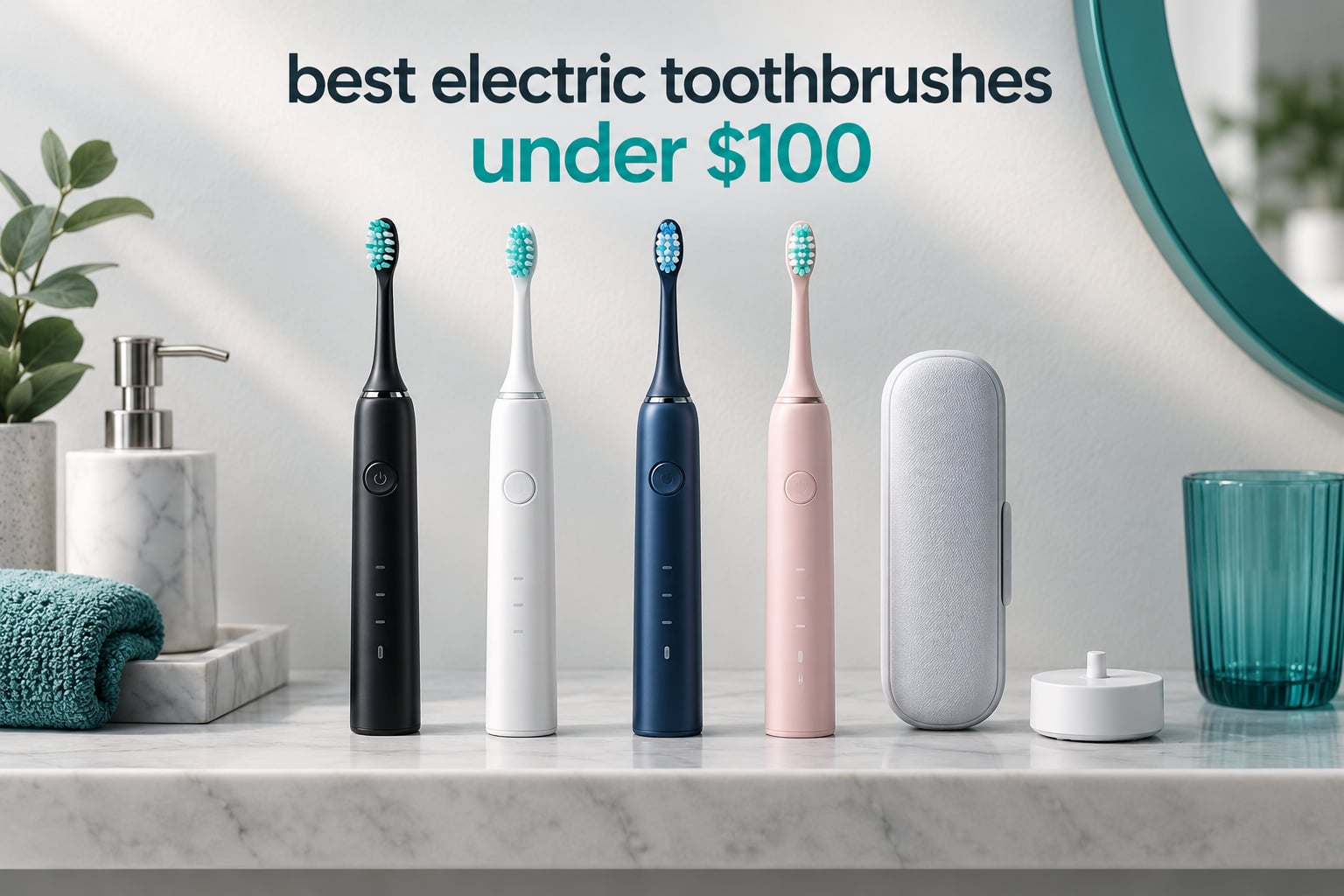
The best electric toothbrushes under 100 dollars are led by the AquaSonic Black Series, an ADA-accepted sonic toothbrush with a 40,000 VPM motor, eight replacement heads, a travel case and a wireless charging base. It suits most people. If your gums are tender or receding, the Oral-B Pro 1000 is the smarter pick, and for the shortest route from a manual brush the Philips One needs no charger at all.
Clean type: Sonic vibration at 40,000 VPM, one of the higher motor speeds you can buy at this budget.
Key features: ADA accepted, four brushing modes, 30-second smart timer, lithium-ion battery, wireless charging base, IPX7 waterproof, eight heads in the box.
Why it shines: Eight heads plus a case cover roughly two and a half years of replacements, which erases the running-cost problem that normally decides this category.
I spent the last few months reading tens of thousands of owner reviews across all ten brushes in this guide, comparing motor output, timer behaviour, pressure feedback, battery claims and refill economics side by side. This is a sensory category where feel matters, so I have not claimed hands-on testing. Instead every judgement below traces to specifications, review volume and the patterns owners describe.
That distinction matters more here than in most buying guides. Electric toothbrush reviews routinely repeat manufacturer percentages like “removes up to 700 percent more plaque”, and those numbers are measured against a manual brush rather than against each other. The honest comparison is narrower and more useful: powered action, a two-minute timer, a 30-second quadrant pacer and a pressure sensor are the four things with a clinical rationale behind them, and all four are available well under 100 dollars. Everything above that budget buys apps, finishes and travel accessories rather than cleaning power.
Our team also tracked what happens after year one, because the brush-head annuity is where cheap electric toothbrushes quietly cost more than expensive ones. The broader electric toothbrush roundup covers every price tier, while this guide stays inside the sub-100-dollar band where most people actually shop.
Top 3 Picks: Best Electric Toothbrushes Under $100 (October 2026)
These three carry the most owner history and the clearest spec sheets. If you only read one section, read the first.

AquaSonic Black Series
- 40000 VPM motor
- ADA accepted
- 8 heads plus travel case
- Wireless charging base


Oral-B 3D White Action
- AA battery powered
- 14000 strokes per minute
- 3D White action cup head
- No charger
Best Electric Toothbrushes Under $100 in 2026
Every brush below sits under the 100-dollar ceiling. Action type and head count matter most for the first year; charging method decides whether you pack a cable for the rest of the brush’s life.
| Product | Specifications | Action |
|---|---|---|
| AquaSonic Black Series |
|
Check Latest Price |
| Oral-B Pro 1000 |
|
Check Latest Price |
| Oral-B 3D White Action |
|
Check Latest Price |
 Philips Sonicare 4100 Philips Sonicare 4100 |
|
Check Latest Price |
 Oral-B Smart 1500 Oral-B Smart 1500 |
|
Check Latest Price |
 AJELU Sonic 5-Mode AJELU Sonic 5-Mode |
|
Check Latest Price |
 TEETHEORY 40000 VPM TEETHEORY 40000 VPM |
|
Check Latest Price |
 Philips One Philips One |
|
Check Latest Price |
 Philips Sonicare Easy Clean Philips Sonicare Easy Clean |
|
Check Latest Price |
 COSLUS C40 COSLUS C40 |
|
Check Latest Price |
1. AquaSonic Black Series – Best Overall
Aquasonic Black Series Ultra Whitening Toothbrush – ADA Accepted Electric Toothbrush- 8 Brush Heads & Travel Case – 40,000 VPM Electric Motor & Wireless Charging – 4 Modes w Smart Timer
40,000 VPM motor
ADA accepted
4 modes with smart timer
Lithium-ion with wireless base
8 heads plus case
Pros
- 40000 VPM motor cleans noticeably
- Four modes including soft and massage
- Eight DuPont heads plus travel case
- Wireless base and about four weeks per charge
- Smart 30-second quadrant timer
- IPX7 waterproof
Cons
- Battery endurance shorter than premium sonic rivals
- Low battery shown only by a small base light
- Some owners report early motor failure
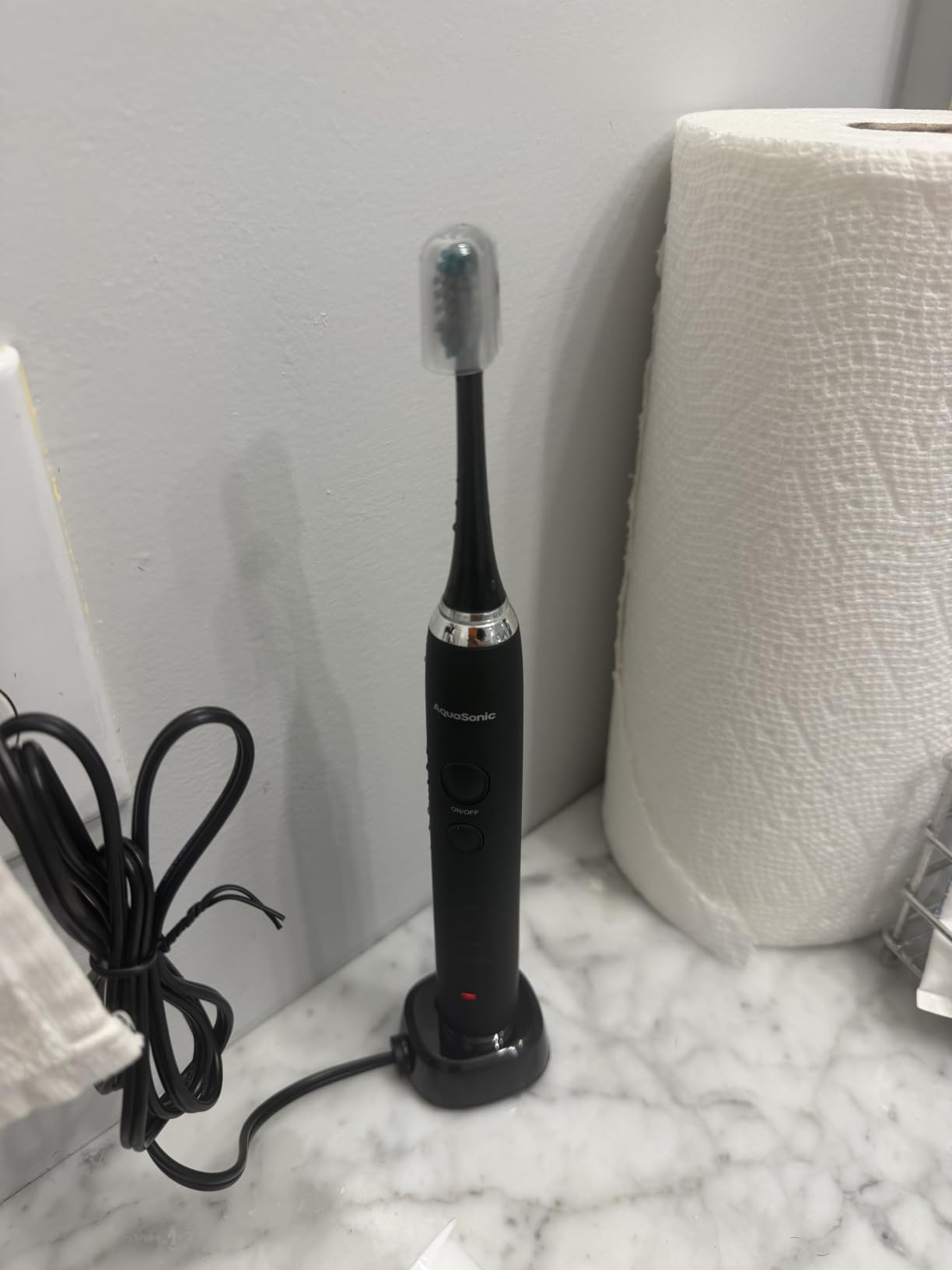
The AquaSonic Black Series is the one I keep coming back to. It runs a 40,000 VPM motor, sits at the number one rank in ultrasonic toothbrushes and has collected more owner reviews than anything else in this guide by a wide margin. That volume matters, because a motor that survives 138k reviews is a motor you can plan around.
Owners consistently describe the cleaning as comparable to the Philips Sonicare models they moved over from, which is the single most useful compliment a powered brush in this class can earn. The small head angles into tight areas better than the wide heads used by some competing budget brushes, and the vibrating 30-second timer does the quadrant job without fuss.
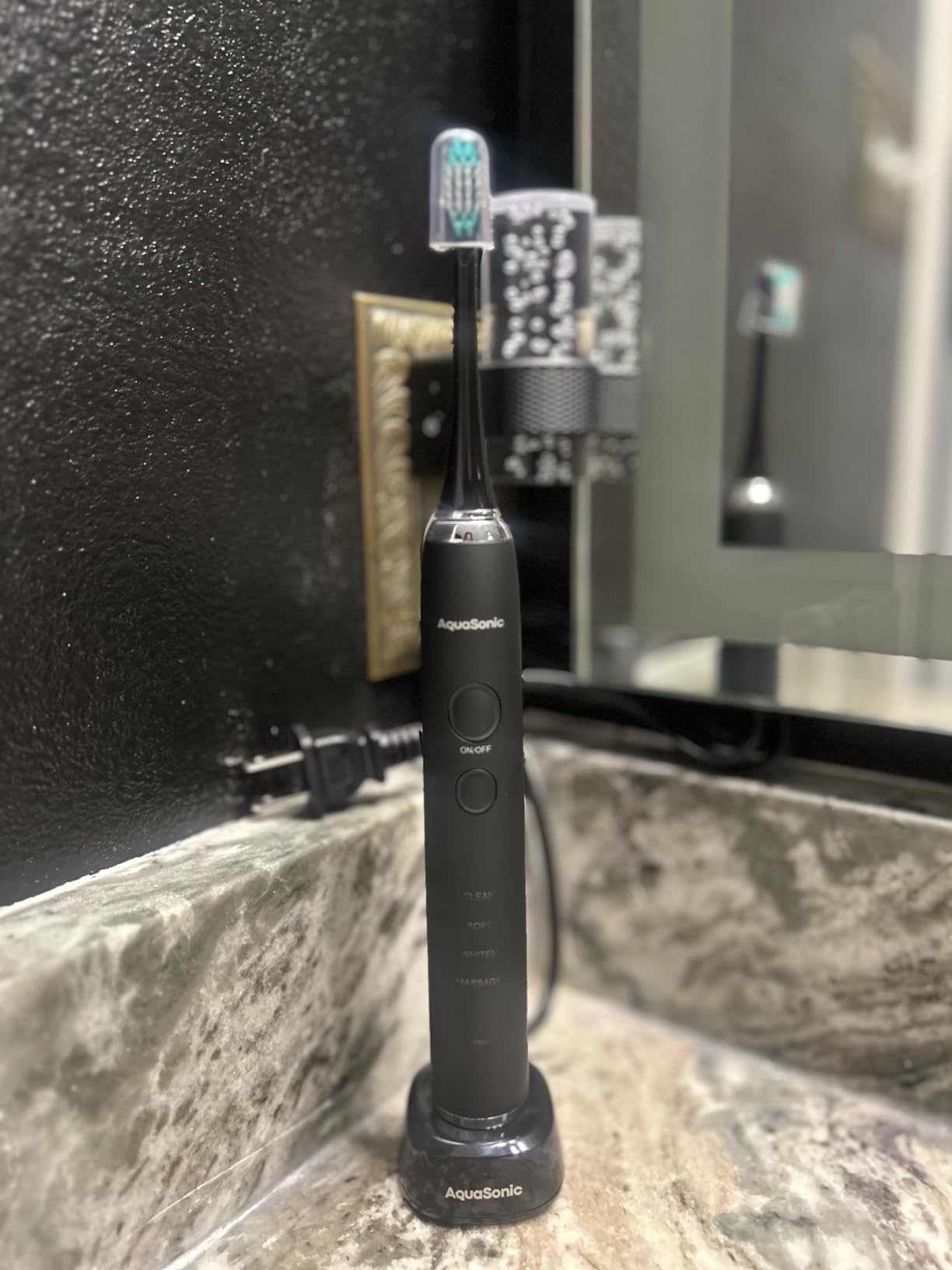
What makes this the value pick is the box contents. You get eight DuPont heads and a travel case, which covers roughly two and a half years at the standard three-month replacement interval. Almost no rival in this list matches that, and it means you are not walking back to a brand website at 11pm to order four refills.
Four modes cover clean, soft, whitening and massage. The soft setting is the one to use if you are new to powered brushing or your gums are sensitive, and the whitening mode polishes surface stain rather than bleaching anything. The lithium-ion battery runs about four weeks between charges on the wireless base, and the whole handle is IPX7 waterproof for shower use.
What you should know before buying
The most repeated complaint is battery endurance. Owners say it needs charging more often than the premium sonic models, and the low-battery warning is a small light at the base with no end-of-cycle vibration alert, so you can find the brush stopped without knowing when it ran down. Charge it on a fixed schedule rather than waiting for a signal.
Some owners also report motor failure inside the first year. That is a minority pattern against a very large review base, but it is the reason to buy from a seller with straightforward returns rather than a marketplace-only seller. If the brand ever exits the category, you would still have DuPont-compatible refills to think about, which is not true of every budget brush here.
Who this suits and who should skip it
Choose this if you want the longest refill runway in the guide, if you travel regularly and want a case in the box, or if you simply want a high-output motor without stepping up to a premium price. The four-mode setup gives you room to adjust as your gums adapt to powered brushing.
Skip it if your priority is a quiet, gentle experience. The vibration is powerful enough that sensitive users report needing several days to acclimatise, and the brand’s after-sales support is a small outfit rather than a major manufacturer. If you want a brand that will still be standing in five years with an official service channel, the Oral-B or Philips options are safer bets.
2. Oral-B Pro 1000 – Best for Sensitive and Receding Gums
Oral-B Pro 1000 Rechargeable Electric Toothbrush, Black
Round dentist-inspired head
Gum pressure control
3 cleaning modes
30-second quadrant timer
Li-ion with LED indicator
Pros
- Round head cleans deep along the gumline
- Small head fits crowded mouths
- Pressure control and quadrant timer build a consistent routine
- Long battery life with clear LED indicator
- Sensitive and whitening head options widely stocked
Cons
- Noticeably louder than sonic rivals
- Only two heads in the box
- Proprietary charger rather than USB-C
- Refill heads costly over the brush's life
The Oral-B Pro 1000 is the default recommendation in almost every forum thread about this price band, and that consensus holds up. It uses an oscillating-rotating action with a small round head that cups each tooth individually, which is why owners report a deeper clean along the gumline than they get from long sonic heads.
The feature that matters most for people with receding gums is gum pressure control. The handle stops the brush pulsating when you press too hard, and paired with the 30-second quadrant timer it builds a routine that stops you scrubbing aggressively in one corner for the full two minutes. Long-term owners describe keeping the same model for years, and several report decade-plus ownership.
The head is genuinely small, and that is not a marketing detail. People with crowded mouths and tight back molars consistently praise the fact that a full-size rectangular manual brush head cannot reach where this one does. Three cleaning modes cover daily use, sensitive gums and an extra-clean pass, with an LED charge indicator that tells you when the battery is low rather than leaving you guessing.
Oral-B is also the number one dentist-recommended toothbrush brand worldwide, and the refill ecosystem is the deepest in the guide. Sensitive, whitening, deep clean and 3D White heads are all easy to source, which matters if your brush outlives several budget rivals.
What you should know before buying
The Pro 1000 is louder than any sonic brush here because of the rotating motor, and that is the reason some tender-gum users prefer a sonic model. Two heads come in the box, which is the thinnest bundle in the guide, and the charger is proprietary rather than USB-C, so a lost cable means a trip to a replacement rather than a phone charger.
Refill heads are the most expensive ongoing item on any Oral-B brush, and owners on budget forums repeatedly say the smart move is to spend your money on a multi-pack of heads rather than upgrading the handle. A small minority also report the pressure sensor not activating on their unit, so test it the first few times you use it.
Who this suits and who should skip it
This is the brush to buy if gums are your concern, if you are moving from a manual toothbrush for the first time, or if you want a model whose replacement heads you will always be able to find. Dental hygienists posting in community threads tend to recommend cheaper Oral-B models over premium ones for exactly that reason, on compliance grounds.
Skip it if noise is a deal-breaker in a shared bathroom, if you travel light and refuse to pack a proprietary charger, or if you are extremely sensitive to head price over three years. In those cases the Sonicare 4100 gives you a quieter action with a pressure sensor, or the AquaSonic gives you a much longer refill runway.
3. Oral-B 3D White Action – Cheapest Way Into Powered Brushing
Oral-B 3D White Action Power Toothbrush, 1 Count (Colors May Vary), Multi-colored
AA battery powered
14,000 strokes per minute
3D White rotating action cup head
Compatible with three head ranges
Pros
- One AA cell runs for weeks with no charger
- Rotating action cup polishes away surface stains
- Very low purchase cost and easy to replace heads
- Dual rotating-vibrating action suits limited dexterity
Cons
- Rotating head and motor wear faster than rechargeable models
- Heads need changing sooner under heavy use
- Battery output drops as the cell depletes
- Battery compartment needs frequent cleaning
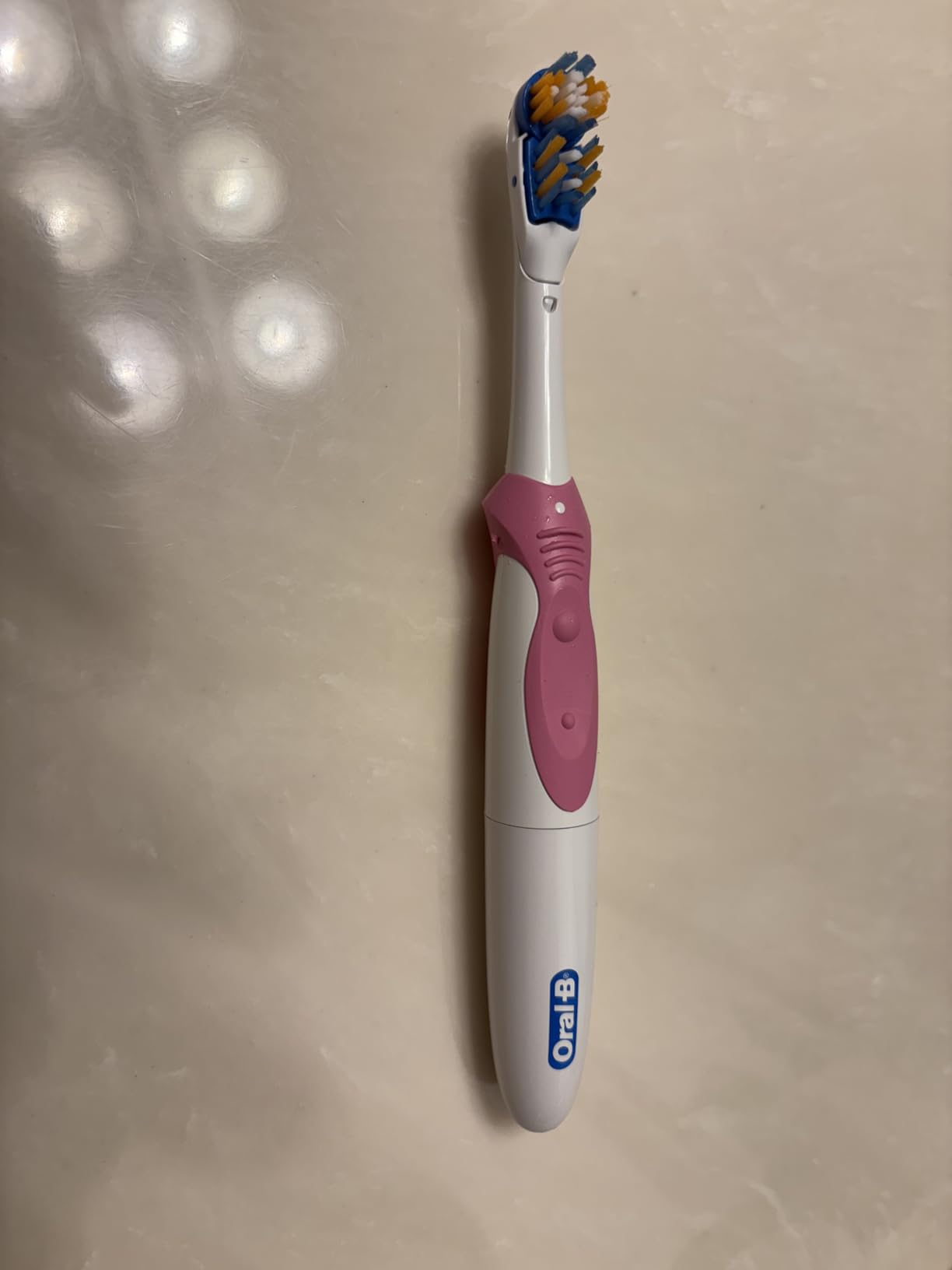
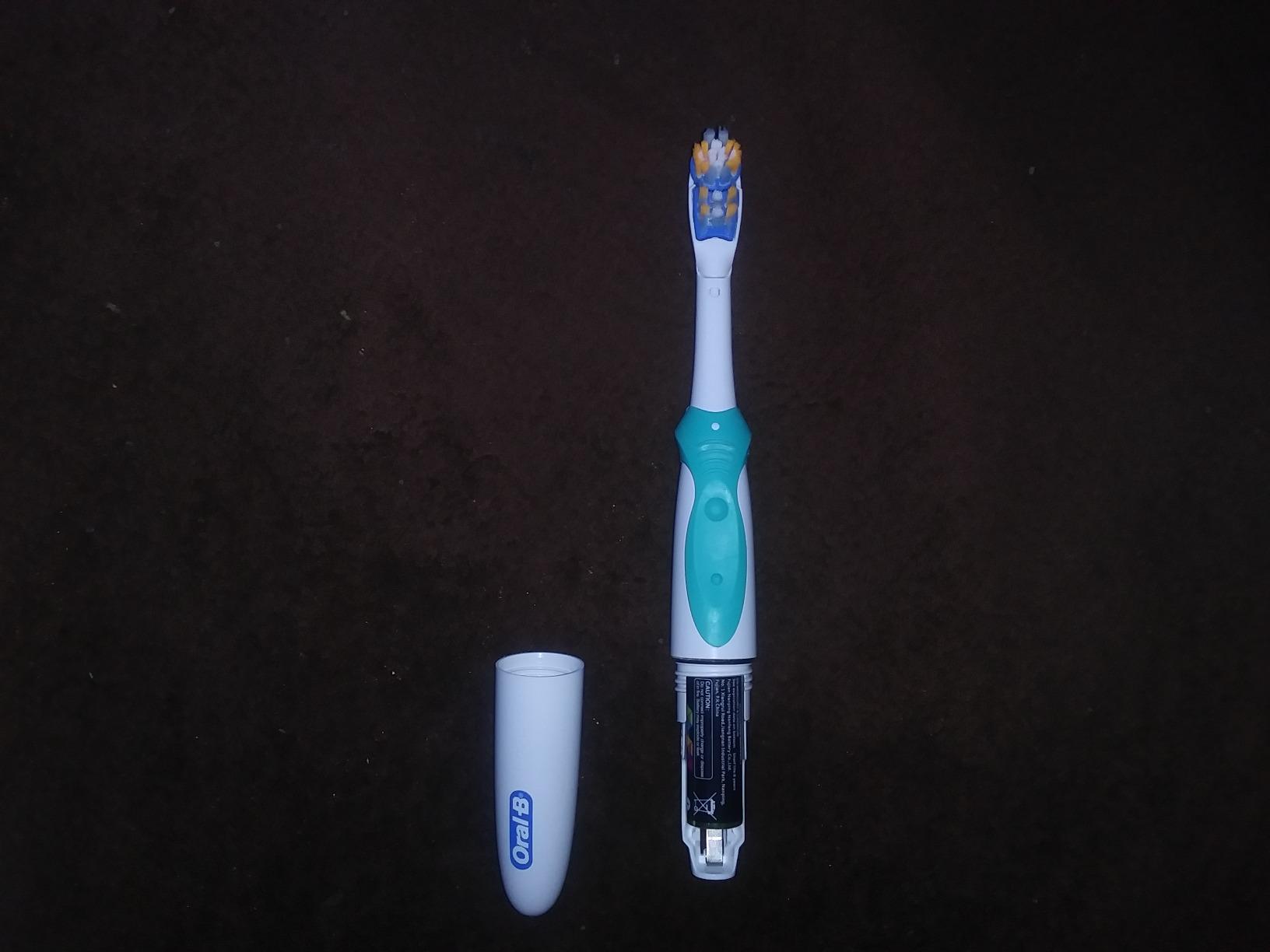
The Oral-B 3D White Action is the cheapest powered brush in this guide, and for some people that fact alone settles it. It runs on a single AA battery, which means no charging base, no cable and no charger to lose in a move or a suitcase. Owners routinely buy several at once, one per person in the household.
The motor delivers 14,000 strokes per minute with a rotating action cup head that hugs each tooth and holds toothpaste against it. That cup design is aimed at stain removal, and reviewers describe a visibly polished feel after a couple of weeks of consistent use. Heads are compatible with Oral-B Deep Clean, Anti-Microbial and 3D White Action ranges.
For anyone with limited hand dexterity this is a genuinely useful pick. The rotating-vibrating movement does the work for you, and the short handle is easy to control. Combined with the AA power supply, it is also the safest choice to leave in a bathroom that children or visitors use.
The two-minute timing is the weak point relative to the rechargeable models here. There is no quadrant pacer and no pressure feedback, so the routine depends entirely on your own clock. If you tend to rush, the rechargeable picks buy you guidance this one does not.
What you should know before buying
The durability story is the reason this is a starter rather than a long-term buy. Owners report the rotating head and motor wearing out faster than rechargeable models, sometimes within months, and some replace the head monthly under heavy use. If you expect to keep a brush for five years, budget for a second one.
Power also tails off as the AA cell depletes, and there is no charge indicator to warn you, so the clean gets weaker as the battery drains. The compartment itself collects toothpaste residue and needs regular cleaning to avoid a smell. Buying a spare AA cell is a 30-second fix; neglecting the compartment is not.
Who this suits and who should skip it
Choose this if cost is the deciding factor, if you want zero charging friction, or if you need a brush that tolerates being dropped and left out. It is also the easiest entry point for someone who will not commit to a rechargeable habit.
Skip it if your gums are already inflamed, since there is no pressure sensor to stop you over-brushing, and skip it if you care about surface whitening over a long period rather than a few weeks. Those users get far more from the Pro 1000, and the extra spend on the handle is offset by a motor that does not wear out.
4. Philips Sonicare 4100 – Best Gentle Sonic Clean
Philips Sonicare 4100 Rechargeable Electric Toothbrush, 1 Brush Head, Black
C2 Optimal Plaque head
Advanced Sonic Technology
Pressure sensor
EasyStart, SmarTimer and QuadPacer
Up to 14 days per charge
Pros
- Gentle sonic action comfortable on sensitive gums
- Two intensity settings plus EasyStart ramp-up
- Battery life often exceeds the two-week claim
- Small head reaches back teeth easily
- Quiet operation and solid handle feel
Cons
- Rubber-covered power button cracks after a few years
- Some units lose charge-holding within about a year
- Power adaptor not included
- Fewer modes than higher-tier Sonicare models
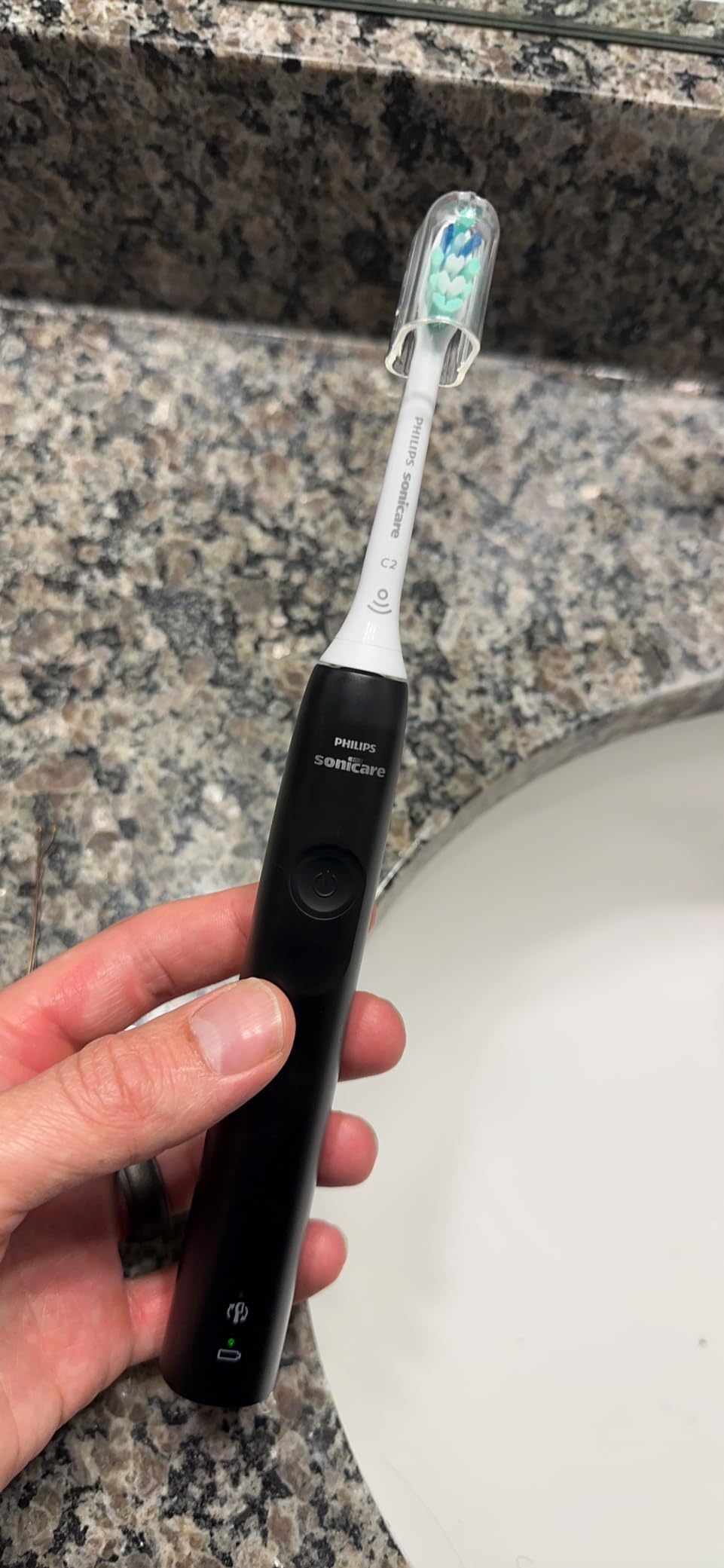
The Sonicare 4100 is the gentlest powered clean in this guide, and that is a feature rather than a compromise. Advanced Sonic Technology pulses fluid between teeth and along the gumline without the aggressive rotating motor found in the Oral-B models, so owners with tender or receding gums consistently report comfortable sessions.
The C2 Optimal Plaque brush head uses soft, flexible stain-removal bristles. The headline claim of up to 700 percent better plaque removal than a manual brush is a manufacturer comparison against manual brushing, not against the other brushes here, so treat it as marketing rather than a ranking signal. The features that genuinely change your routine are the pressure sensor and the timing suite.
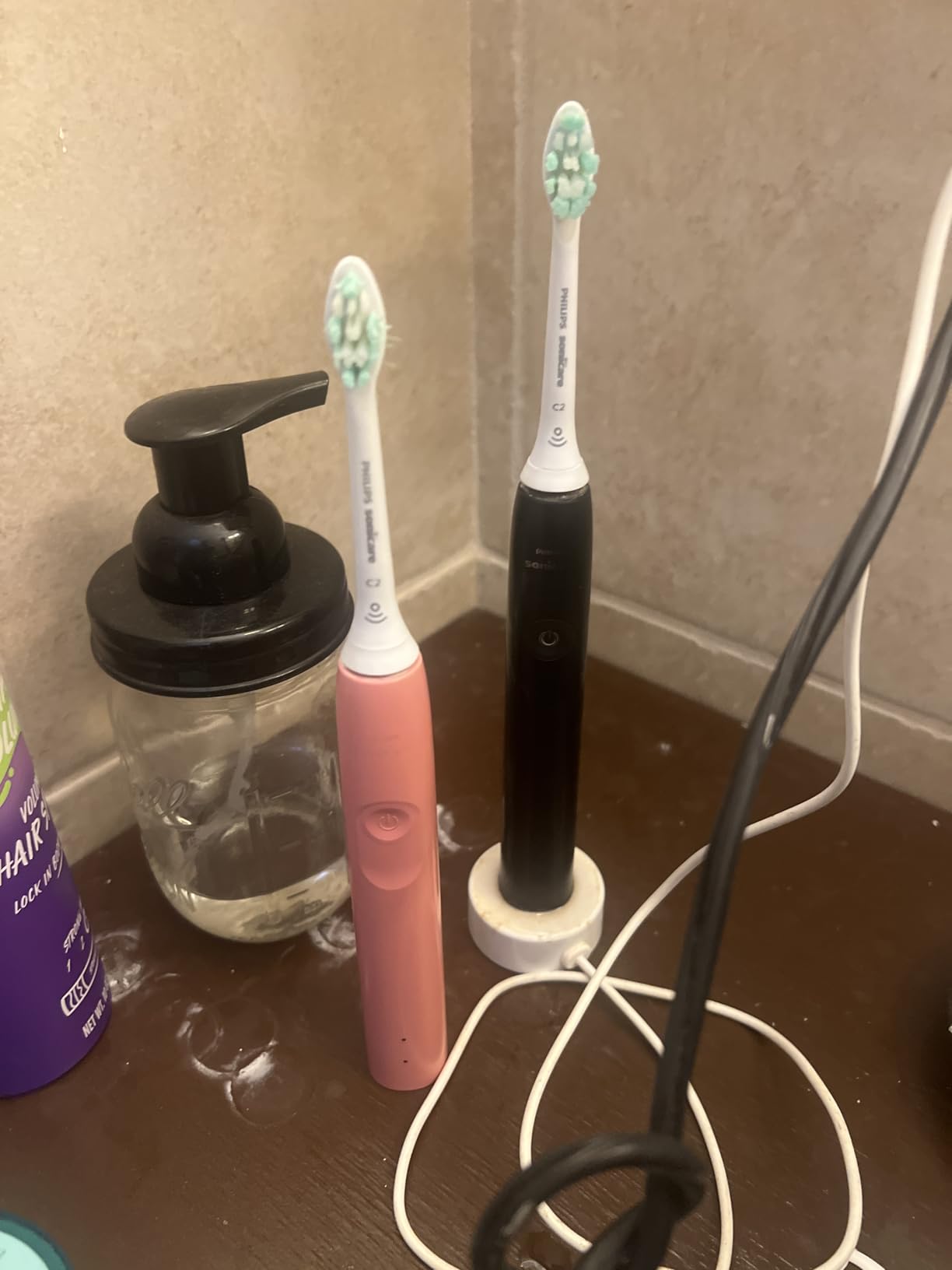
EasyStart ramps the power up gradually over the first uses, which is exactly what people who are new to electric brushes need. SmarTimer runs to two minutes, QuadPacer interrupts every 30 seconds to move quadrants, and a replacement reminder tracks how often and how hard you brush. Two intensity settings let you tune the feel further, and the small head reaches back teeth without much manoeuvring.
Battery life is a standout. Philips claims up to 14 days of regular brushing on a full charge, and owners report beating that figure. Charging is by USB, which is a genuine step up from the proprietary bases used by the rotating Oral-B models, though the power adaptor itself is not in the box.
What you should know before buying
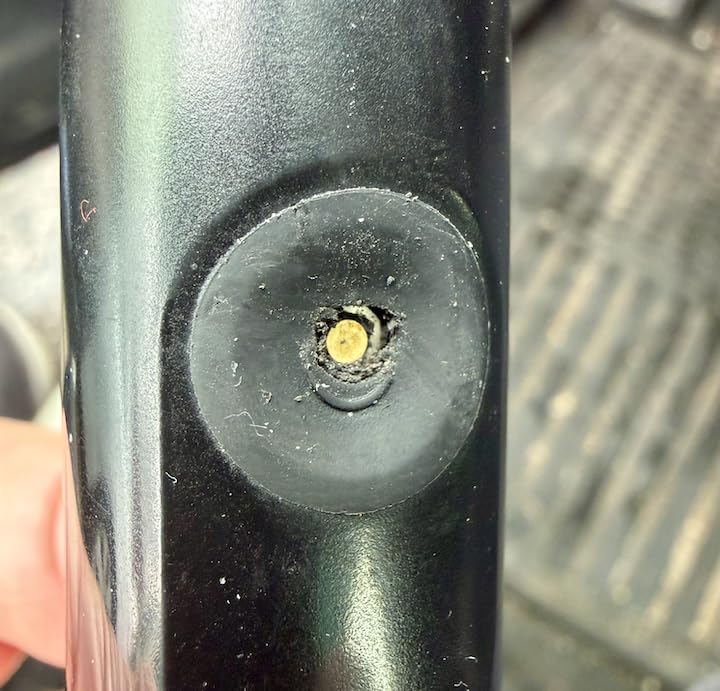
The durability complaint is specific and consistent: the rubber-covered on/off button is prone to cracking after a few years, and some units lose the ability to hold a charge within roughly a year. Most owners repurchase the same model after a failure, which tells you the clean is good enough to keep paying for, but you should expect one replacement over the brush’s life.
There are also fewer cleaning modes than on higher-tier Sonicare models, which matters only if you like to cycle through settings. And with no power adaptor included you need a USB phone charger, a small thing that catches people out on the first night.
Who this suits and who should skip it
This is the pick for sensitive gums, for people who share a bathroom and prefer a quiet brush, and for anyone who travels regularly enough to want USB charging and a battery that survives a long flight. The pressure sensor and EasyStart together make it the safest first electric toothbrush on this list.
Skip it if you want visible surface stain polishing, since the C2 head polishes gently rather than aggressively, and skip it if you plan to keep the brush for a decade. Owners report failures around the two to three year mark, so budget for a replacement and compare against the Easy Clean, which veteran owners describe as the sturdier Sonicare body.
5. Oral-B Smart 1500 – Best Round-Head Clean With a Pressure Light
Oral-B Smart 1500 Electric Power Rechargeable Battery Toothbrush, Black
3-in-1 deep cleaning
360 visible gum pressure control
4 cleaning modes
Quadrant timer
Rubberised ergonomic grip
Pros
- Deep 3-in-1 cleaning leaves a smooth polished feel
- Visible pressure light gives clear feedback
- Rubberised dimpled grip suits older users
- Long lithium-ion battery measured in weeks
- Modes feel genuinely different from one another
Cons
- Louder than sonic brushes
- No mode indicator or display
- Full charge takes around 12 hours
- Charging base and head collect residue
- Refill heads costly against the handle price
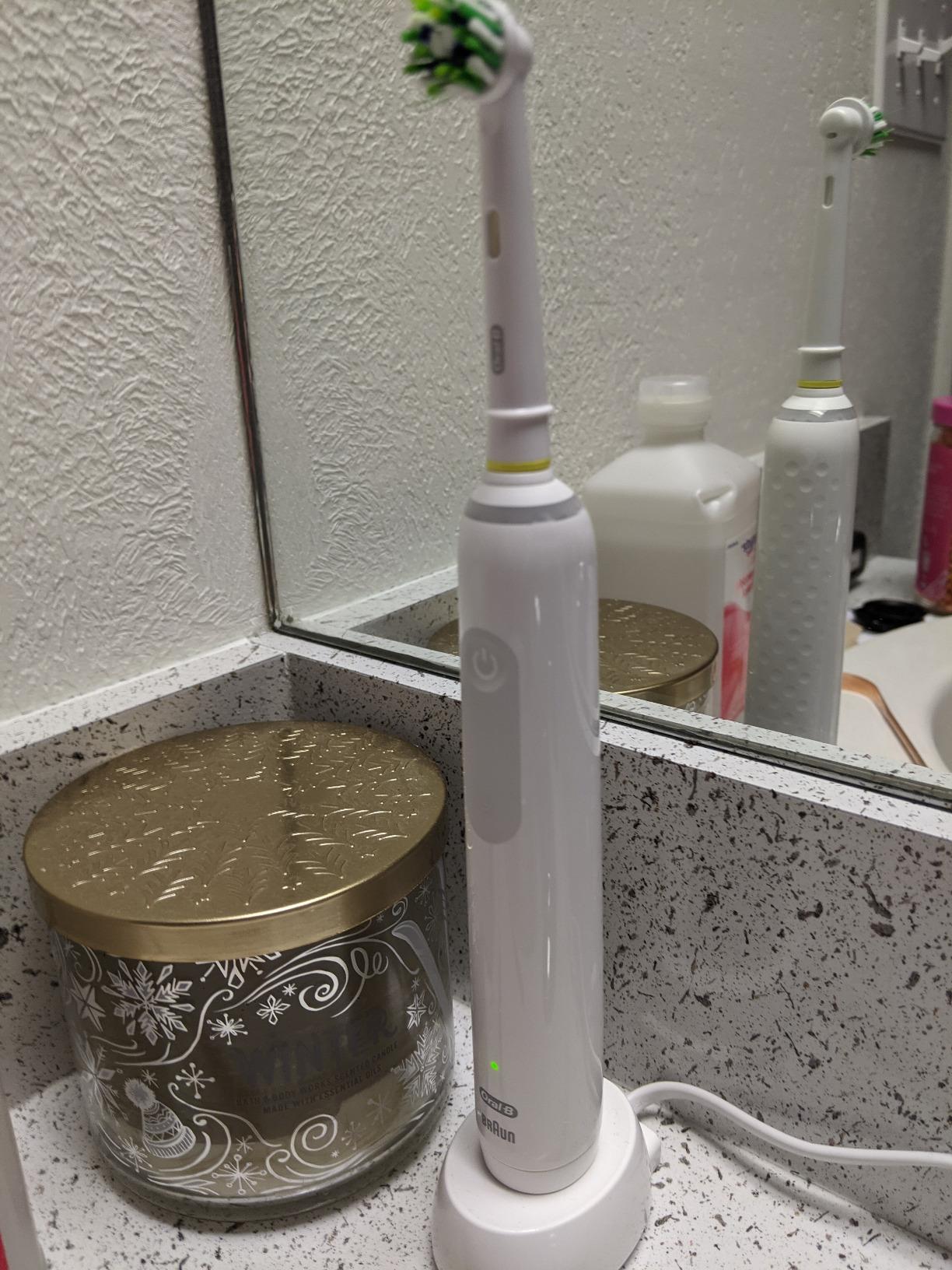
The Smart 1500 is the step-up Oral-B for people who found the Pro 1000 clean strong but the feedback too subtle. Its 360-degree visible gum pressure control lights up when you press too hard, which is the difference between knowing you are scrubbing hard and seeing it happen while you do.
The cleaning itself is the 3-in-1 round-head action that Oral-B builds its reputation on, and long-term owners describe the result as comparable to a professional cleaning, particularly along the gumline. Four modes are genuinely distinct rather than cosmetic, and the handle-integrated quadrant timer pauses every 30 seconds to move you around the mouth.
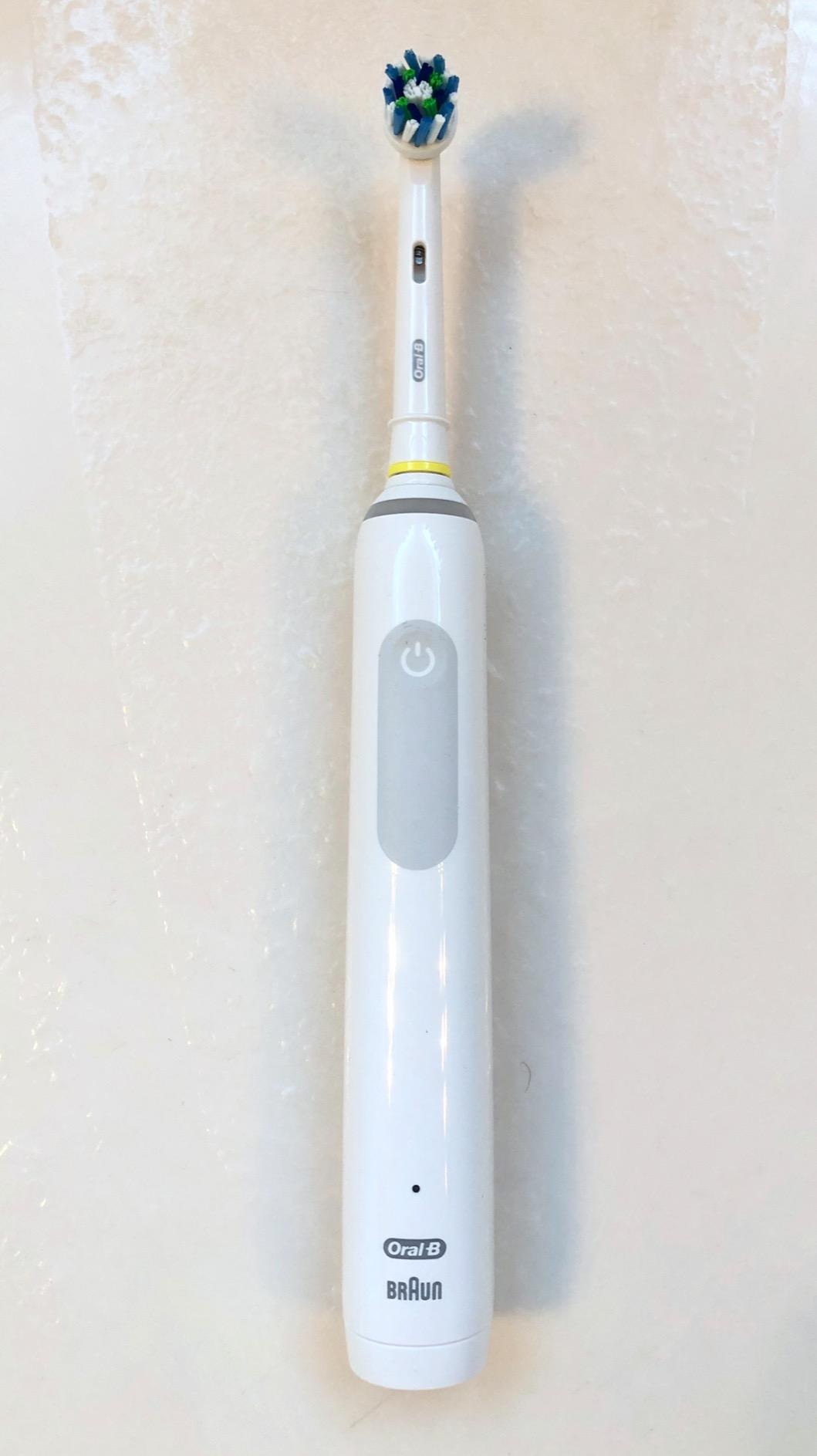
The grip is the underrated feature. A rubberised body with a dimpled back is easier to hold with wet hands, and that matters for older users or anyone with limited grip strength. Several reviewers buy it as a second bathroom brush for a parent rather than for themselves.
Battery life is measured in weeks per charge for most owners, and the round head is interchangeable with the same Oral-B head ranges as the Pro 1000, so you can share refills between the two brushes in a two-bathroom household. That compatibility is worth more over three years than any single feature.
What you should know before buying
The obvious trade is noise. The rotating motor is louder than any sonic brush in this guide, and in an open-plan or thin-walled bathroom that is a daily irritation. The 12-hour full charge is also long, which is why owners describe charging it overnight on a routine rather than on demand.
There is no mode indicator or display, so you have to press through modes to find the right one, which is an odd thing to omit on a model with four of them. The charging base and brush head both collect residue and need cleaning. Refill heads also cost more relative to this handle price than to the Pro 1000, so the running-cost gap is narrower than the purchase gap suggests.
Who this suits and who should skip it
Choose this if you want the strongest gumline clean available under the ceiling and you want visible feedback while you brush, if grip strength is a consideration, or if you want a step up from the Pro 1000 without leaving the brand you already know.
Skip it if noise bothers you, if you need to see which mode is active, or if your household already owns an Oral-B and would rather put the money into a long refill bundle on the cheaper handle. Hygiene also matters here: the charging base sits wet next to the sink every day, so it needs wiping down.
6. AJELU Sonic 5-Mode – Best Battery Life for the Money
AJELU Sonic Electric Toothbrush for Adults, USB Rechargeable Sonic Toothbrush with 8 Brush Heads, Smart Timer, 5 Modes, 2-Hour Fast Charge Last 30 Days, Pink
31,000 vibrations per minute
5 modes including massage
2-minute timer with 30s pauses
8 DuPont heads
USB fast charge in 2 hours
Pros
- Battery runs about a month between charges
- Eight DuPont heads cover early refill costs
- Five modes including a useful gum massage
- IPX7 waterproof with USB charging
- Strong cleaning that some owners rate above dearer brushes
Cons
- Oversized handle with a mid-shaft power button
- Very high vibration takes days to get used to
- Weak battery indicator
- Charging circuit failure reported after about a year
The AJELU is the pick if your main frustration with powered brushes is charging. The listed runtime is up to 30 days on a two-hour USB fast charge, and owners describe charging it monthly or less often, which is a different relationship with a device than the nightly routine most rechargeable brushes impose.
Cleaning output comes from a 31,000 vibrations per minute motor, which sits at the lower end of the sonic figures in this guide but still delivers a thorough clean by owner accounts. Five modes cover clean, polish, milder, white and massage, and the massage setting gets singled out as genuinely pleasant rather than a gimmick.
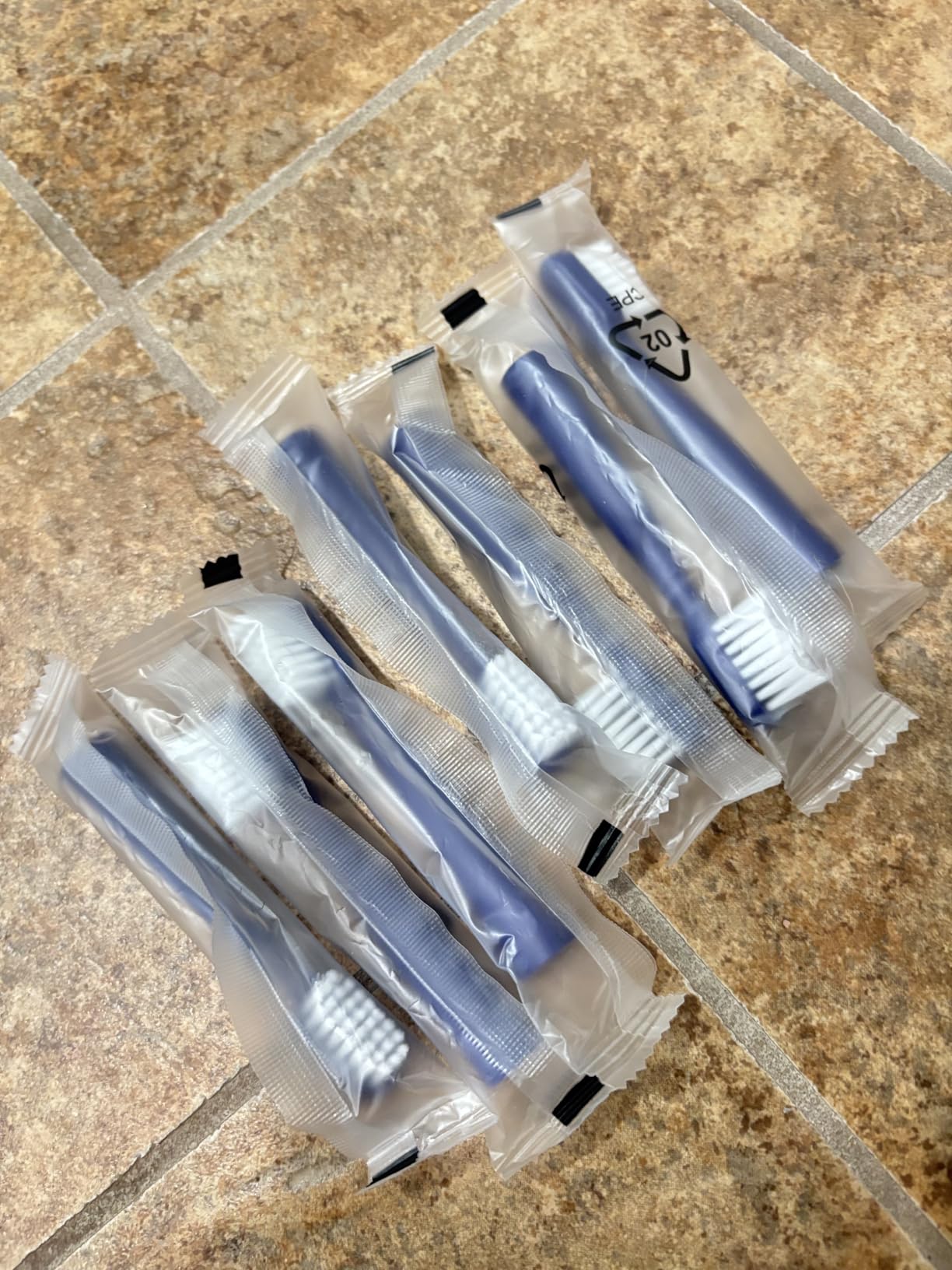
The bundle is unusually generous for the money: eight DuPont nylon heads in a W-wave shape, which is soft, wear-resistant and non-absorbent. That means you will not be ordering refills in the first two years, and owners frequently buy multiples for family members.
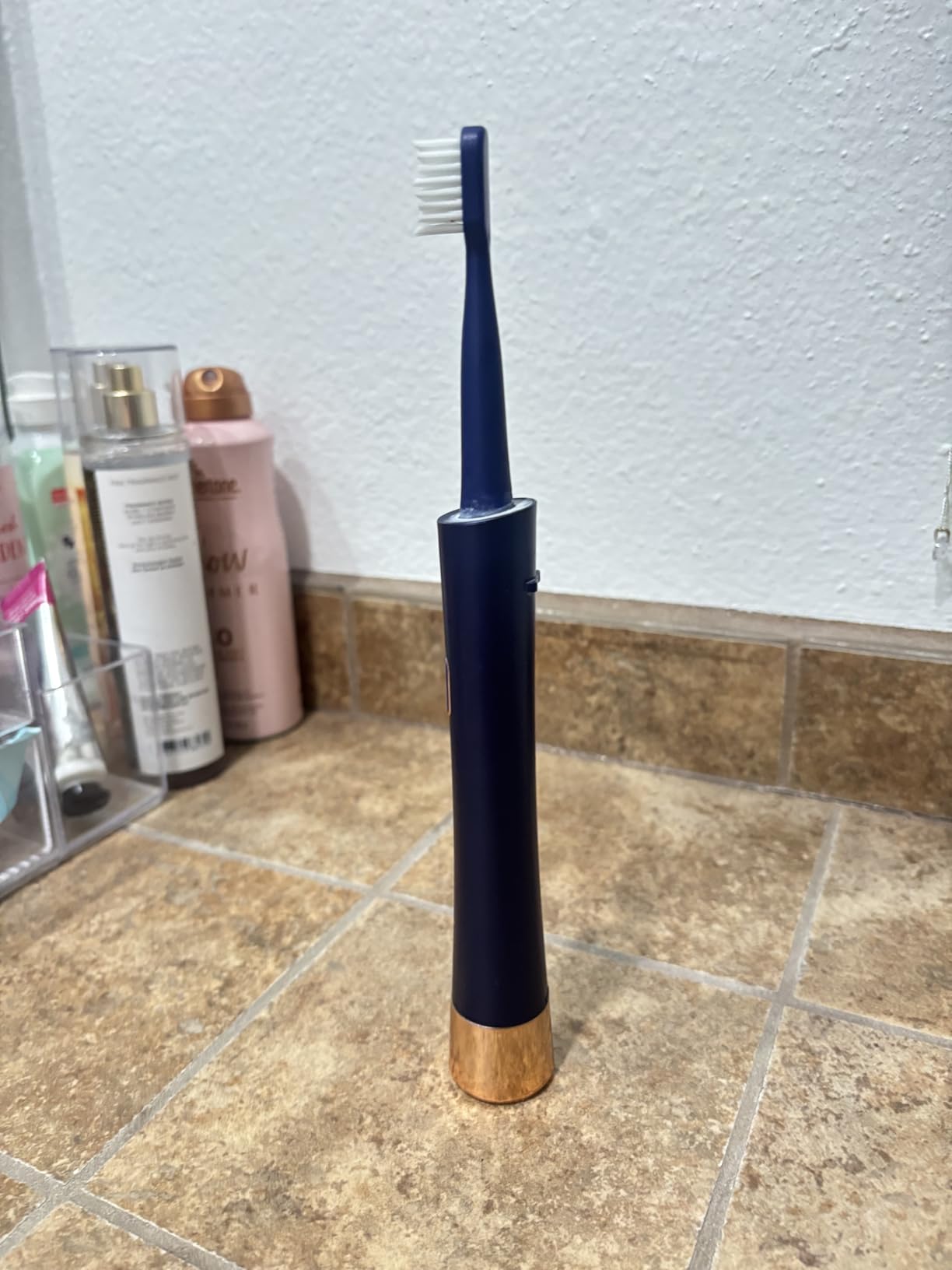
Two details show real design thought. The USB cable hides inside the base of the handle, so there is no loose cord to tangle or lose, and the two-minute timer pauses every 30 seconds to remind you to balance the four areas of your mouth. The handle is IPX7 waterproof.
What you should know before buying
The handle is oversized, and the power button sits mid-shaft where it gets bumped during brushing. That produces accidental shut-offs, and several reviewers treat it as an early-return trigger. The vibration strength is also high enough that a few owners needed several days to acclimatise, which matters if you have sensitive gums and no pressure sensor to slow you down.
The one-star reviews concentrate on charging circuit failure roughly a year into ownership, and the battery indicator is weak and hard to read. For a brand with no large service network, plan to treat the handle as a consumable rather than something you service.
Who this suits and who should skip it
Choose this if you travel for weeks at a time, if you genuinely refuse to charge things weekly, if you are buying one per person in the household, or if you want five modes and a massage setting at the bottom of the budget.
Skip it if you have a small hand or limited dexterity, since the size is the most common source of frustration. Skip it if you want a pressure sensor or if you are sensitive to strong vibration with no control over intensity. Those users are better served by the Sonicare 4100, which offers both intensity settings and a pressure warning.
7. TEETHEORY 40000 VPM – Best for Travel and Small Hands
TEETHEORY Electric Toothbrush for Adults with 8 𝐁𝐫𝐮𝐬𝐡 𝐇𝐞𝐚𝐝𝐬, Sonic Electric Toothbrush with 40000 VPM Deep Clean 5 Modes, Rechargeable Toothbrushes Fast Charge 4 Hours Last 30 Days
40,000 VPM sonic motor
5 modes
30-day battery with 4-hour fast charge
55g body
IPX7 waterproof
Pros
- 55g body is slimmer than most sonic brushes
- Battery lasts about a month per charge
- W-shaped high-density bristles need less pressure
- Five modes plus a 30-second quadrant timer
- Exceptional value with a bundled head set
Cons
- Box counts a tongue scraper and interdental brush as heads
- Proprietary round-pin charging plug
- Wide head neck is awkward around back teeth
- Power drops when the battery is not full
The TEETHEORY weighs 55g, which makes it the lightest powered brush in this guide and the easiest to hold for long sessions. Slim handles also travel better, and owners with smaller hands or reduced grip strength call the difference out as the reason they can use it comfortably at all.
The motor runs at 40,000 VPM with high-density W-shaped DuPont bristles that clean effectively at lighter pressure. Five modes cover whitening, cleaning, sensitive, polishing and massage, and the smart vibrating timer pauses every 30 seconds with a two-minute auto shutoff, which is more guidance than most brushes at this price offer.
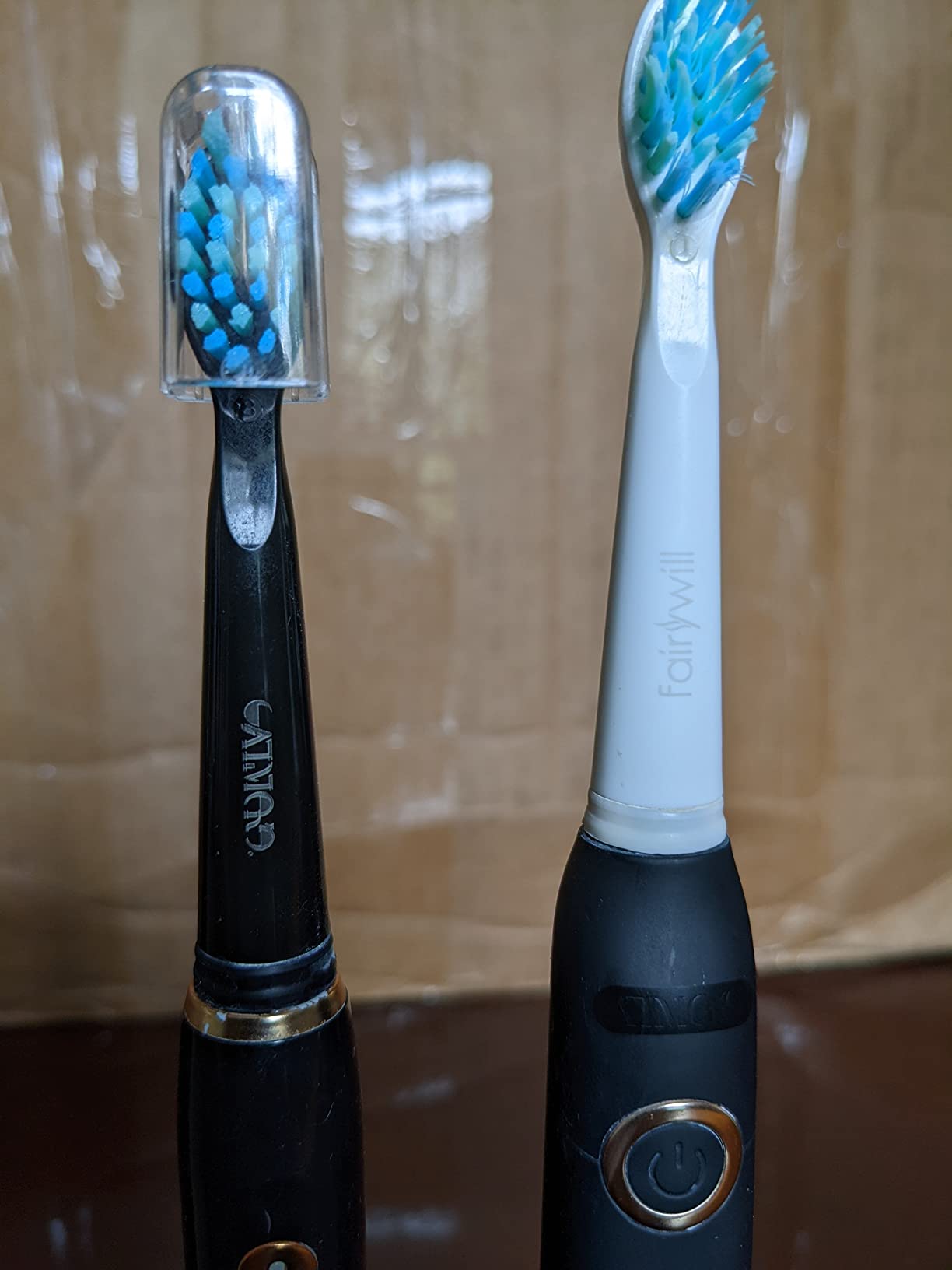
The box is generous. The listing describes eight replacement heads, and what arrives is six DuPont brush heads with colour-coded collars, plus a tongue scraper head, an interdental brush, a protective bristle cover and a USB cable. That is a genuinely useful kit for a traveller or for a family sharing one bathroom.
Battery life is listed at about 30 days per charge with a four-hour fast charge, and the IPX7 waterproof rating covers both the handle and the charging routine in a wet environment.
What you should know before buying
Read the head count carefully. The packaging advertises eight heads, but only six are standard brush heads; the tongue scraper and interdental brush are counted in that number. That is not a misleading product so much as a headline that flatters itself, and it is the most common criticism in reviews.
Charging uses a proprietary round-pin plug rather than USB-C, and the cord is easy to lose, which undercuts the travel story slightly. The head neck is also wider than average, making back teeth harder to reach, and power output drops noticeably once the battery is not fully charged.
Who this suits and who should skip it
Choose this if hand size, weight or dexterity is your deciding factor, if you want five modes including a sensitive setting, or if you want a full accessory kit in the box for a long trip where packing light is unrealistic anyway.
Skip it if you care about charging standardisation or if your priority is reaching the far side of your back molars. The Philips One is smaller still and needs no charging cable at all, and the Sonicare 4100 pairs its slim form with a proper pressure sensor.
8. Philips One – Best Compact Cordless Design
Philips One by Sonicare Battery Toothbrush, 1 Brush Head, Midnight Blue
Micro-vibration sonic action
Soft nylon tapered bristles
2-minute timer with 30-second notifications
AAA battery
Travel case included
Pros
- No charger to pack or lose
- AAA battery lasts about three months
- Travel case protects the slim handle
- Soft tapered bristles polish without irritating gums
- Two-minute timer with 30-second notifications
Cons
- Handles only accept Philips One brush heads
- Micro-vibration action is milder than full sonic
- Gentle action may not satisfy heavy plaque build-up
- Refills for this platform can be harder to source
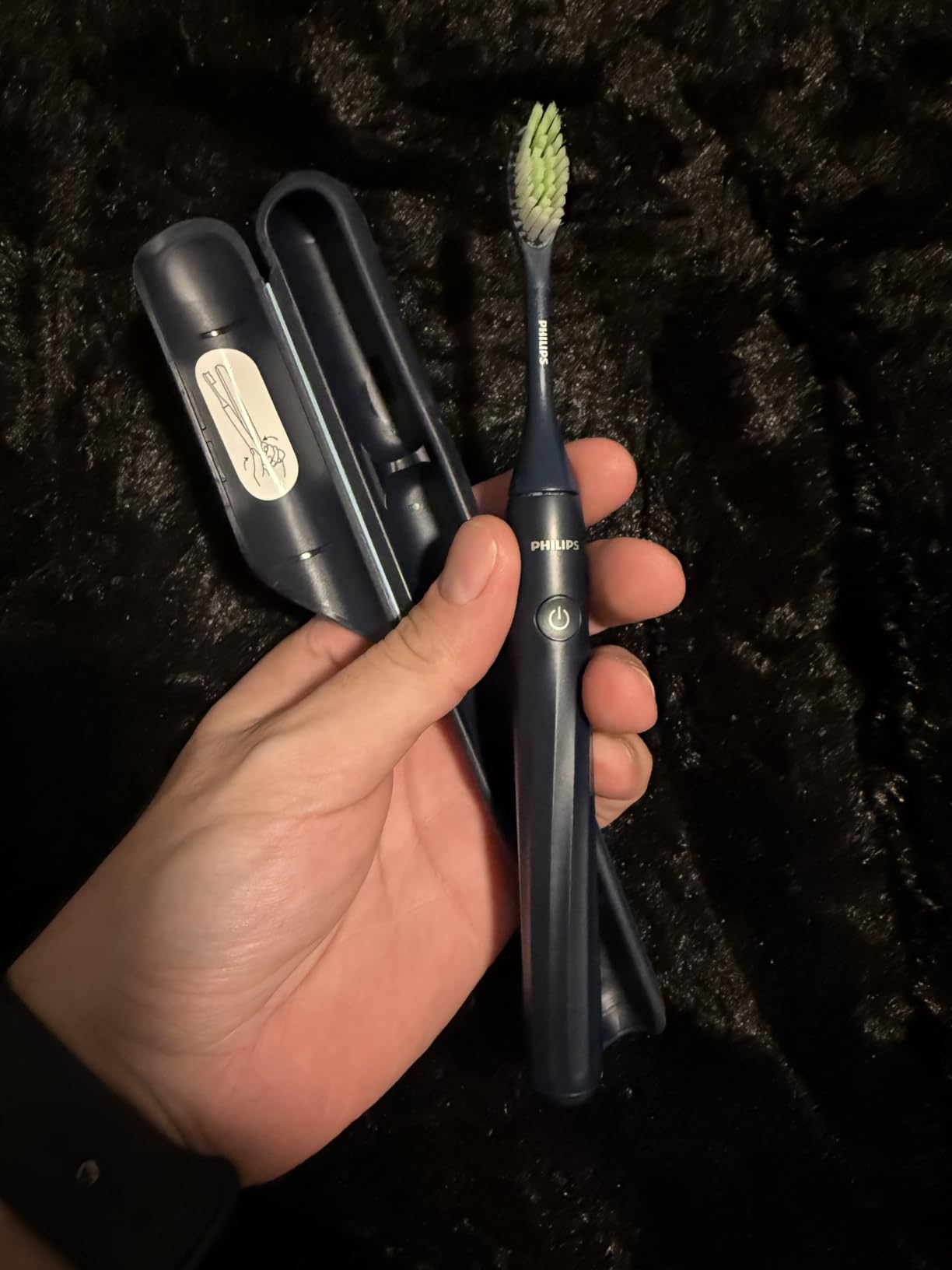
The Philips One is the simplest way to upgrade from a manual brush without changing any habits. There is no charging base, no cable and no adaptor, just a slim handle that runs on one AAA battery for roughly three months, and that is the entire appeal for anyone who travels often or dislikes plugging things in.
Action comes from micro-vibrations paired with soft tapered nylon bristles, which polish teeth to a brighter finish while you use your normal manual brushing motion. A two-minute timer with 30-second notifications keeps the session honest, and the included travel case is compact enough for a laptop bag rather than a toiletry kit.
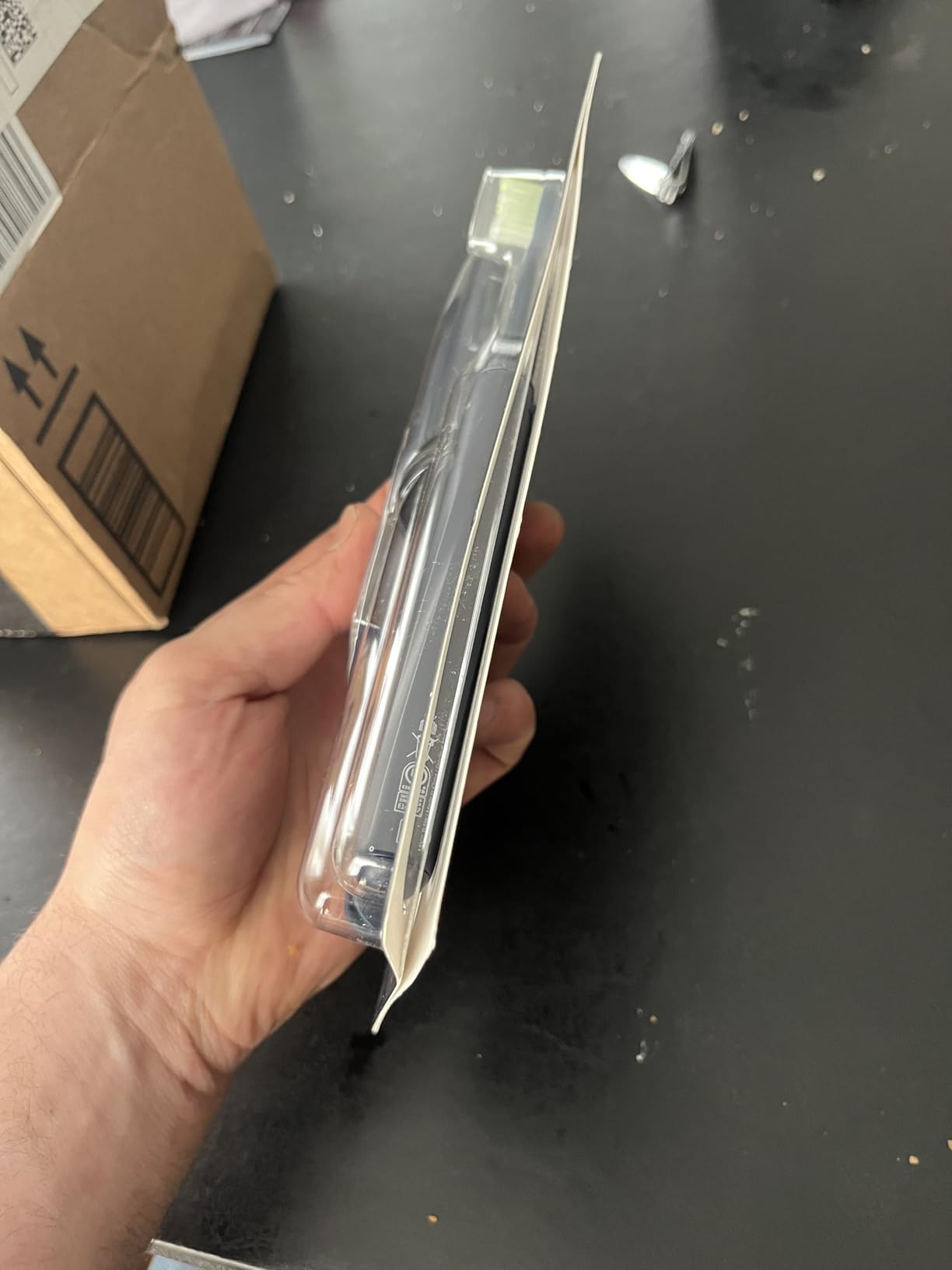
Reviewers consistently position this as an easy first step rather than a replacement for a full sonic brush. If you have never used a powered toothbrush, the Philips One teaches you timing and technique at a pace that will not intimidate you, and it costs less attention than any rechargeable model.
The main structural weakness is the ecosystem. The handle only accepts Philips One brush heads, which are less widely stocked than Oral-B or Sonicare refills, and if Philips ever retires the platform you are left hunting for a specific part rather than a generic round head.
What you should know before buying
The micro-vibration action is milder than a full sonic toothbrush, and users describe the handle as feeling less substantial and less powerful in the hand. If you have heavier plaque build-up or you want a proper deep clean rather than a polish, this will feel underpowered once you have tried something stronger.
There is no pressure feedback either, so over-brushing is entirely on you. Given that gum recession from scrubbing too hard is one of the most common complaints in toothbrush forums, that is worth weighing if your gums are already showing it.
Who this suits and who should skip it
Choose this if you are a first-time electric brush buyer, if you travel for weeks with one small bag, if your bathroom has no space for a charging base, or if you want a gift for someone who will not fumble with a charger.
Skip it if you want a deep clean or if you have orthodontic appliances, where a stronger action and a pressure sensor matter more than portability. Also skip it if long-term refill availability is a concern to you, since the closed head system is the price of that slim design.
9. Philips Sonicare Easy Clean – Best for Small Counters
Philips Sonicare Easy Clean Sonic Electric Toothbrush, HX6511/50
31,000 sonic movements per minute
Slim ergonomic handle
ProResults head
2-minute Smartimer
QuadPacer 30-second timer
Pros
- Single-mode simplicity with no menus
- 31000 movements per minute for a deep clean
- Small head and slim neck reach back molars
- Tiny charging base uses minimal space
- Quiet solid build owners describe as unibody quality
Cons
- Refill heads costly in single packs
- Slim handle can slip with water and toothpaste
- Some owners report unit or base failure within a year or two
- Plug does not fit all international sockets
- No pressure feedback or mode choice
The Easy Clean is the model veteran Sonicare owners recommend to other owners. Patented sonic technology runs at up to 31,000 movements per minute, and the battery-free simplicity of a single mode means there are no menus, no mode cycling and nothing to learn before you start brushing.
The contoured ProResults head removes plaque along the gum line from a slim neck, and it reaches back molars without the manoeuvring a wider head demands. The two-minute Smartimer and QuadPacer 30-second intervals give you the full four-quadrant routine, which is more structure than most entry-level brushes at this price provide.
The charging base is tiny, and for a bathroom with a single narrow shelf that matters more than any smart feature. Owners describe the build as quiet and sturdy, closer to a unibody laptop than a plastic gadget, and several people who owned four other Sonicare models rate this one above the pricier flagships for pure cleaning.
Because it is a long-running platform with a large existing user base, refills and replacement bases are generally easier to find than for newer budget models. That is a real advantage if you expect to own the brush for several years.

What you should know before buying
Two things you should accept up front. There is no pressure sensor, so the guide’s most important safety feature is missing, and there is only one mode, so you cannot soften the action for tender gums. If your gums are the reason you are reading this, choose the 4100 instead.
The slim handle is also described as slippery once water and toothpaste are on it, which is a small but real concern. Owners report unit and charging base failures within a year or two, and the supplied plug does not fit every international socket, so check your outlet type before travelling with it.
Who this suits and who should skip it
Choose this if counter space is tight, if you want one mode and no learning curve, if you dislike long charging cables on a counter, or if you already know you like the Sonicare feel and want a durable entry point.
Skip it if your gums are sensitive or receding, because there is no pressure feedback to stop you. Refill heads also cost more in single packs than multi-packs, so factor that into your three-year maths before committing.
10. COSLUS C40 – Best for Families
COSLUS C40 Sonic Electric Toothbrush for Adults & Family, Black, 1PC
47,000 VPM maglev motor
5 modes for ages 12 and up
6 brush heads about 18 months
Wireless base and travel case
IPX7 waterproof
Pros
- 47000 VPM maglev motor for a thorough clean
- Six heads cover about 18 months of replacements
- Five modes suit adults teens and older users
- Colour-fade bristles remind you to change the head
- Wireless base and travel case keep things tidy
- IPX7 waterproof with a non-slip body
Cons
- Colour-fade bristle indicator is less visible than advertised
- Travel case quality is basic
- Replacement heads harder to source than major brands
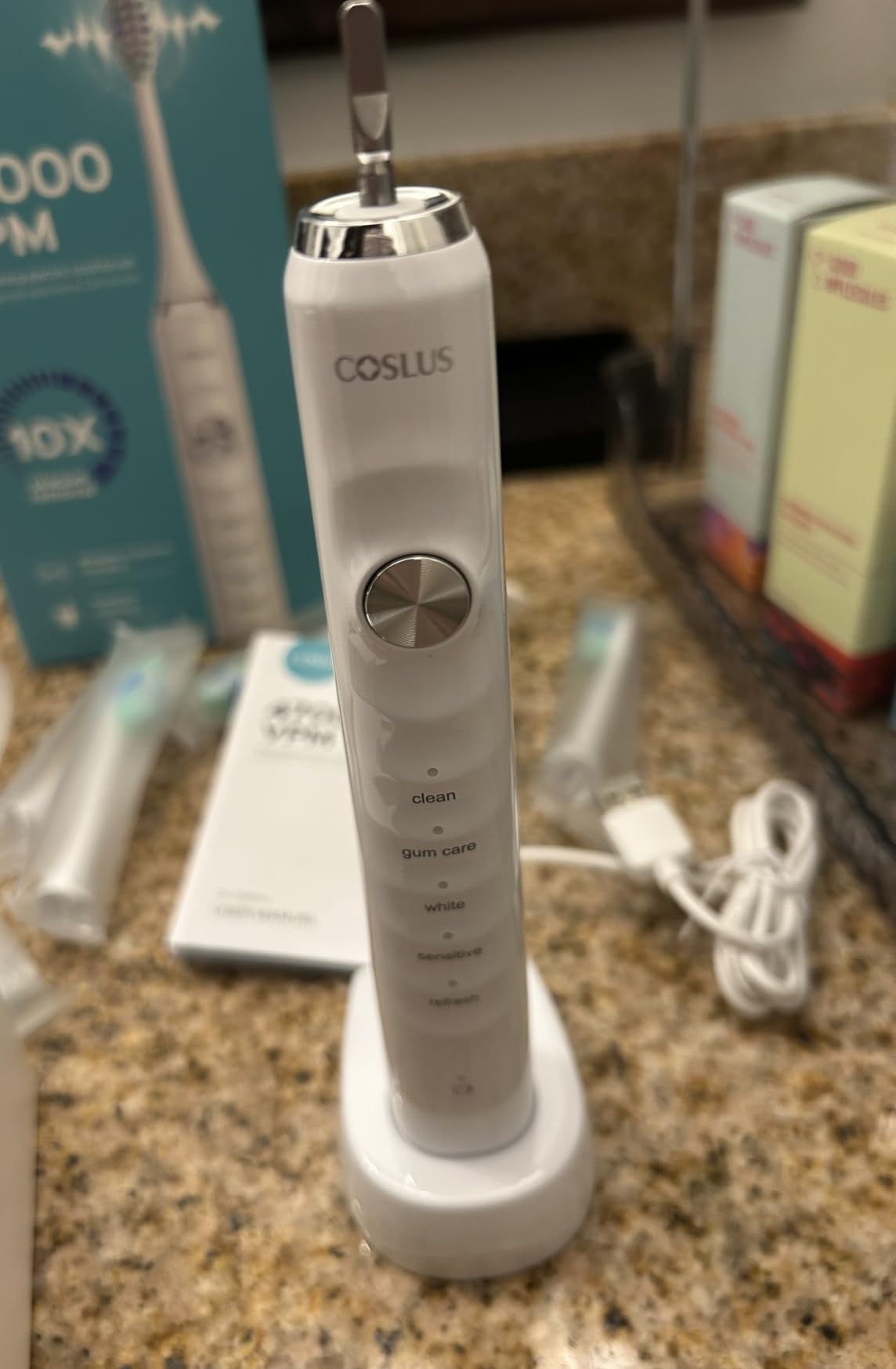
The C40 is built for a household rather than one person. It is rated for ages 12 and up, and the five modes cover adults, youth, kids and seniors, which means one handle can serve a teenager and a parent without anyone fighting over the setting.
The 47,000 VPM maglev motor is among the highest output figures in this guide, and it sits inside an IPX7 waterproof body with a wireless charging base and a travel case. Reviewers consistently describe the clean as performing well above what the price suggests, and the maglev motor is listed at 1000-plus hours of durability.
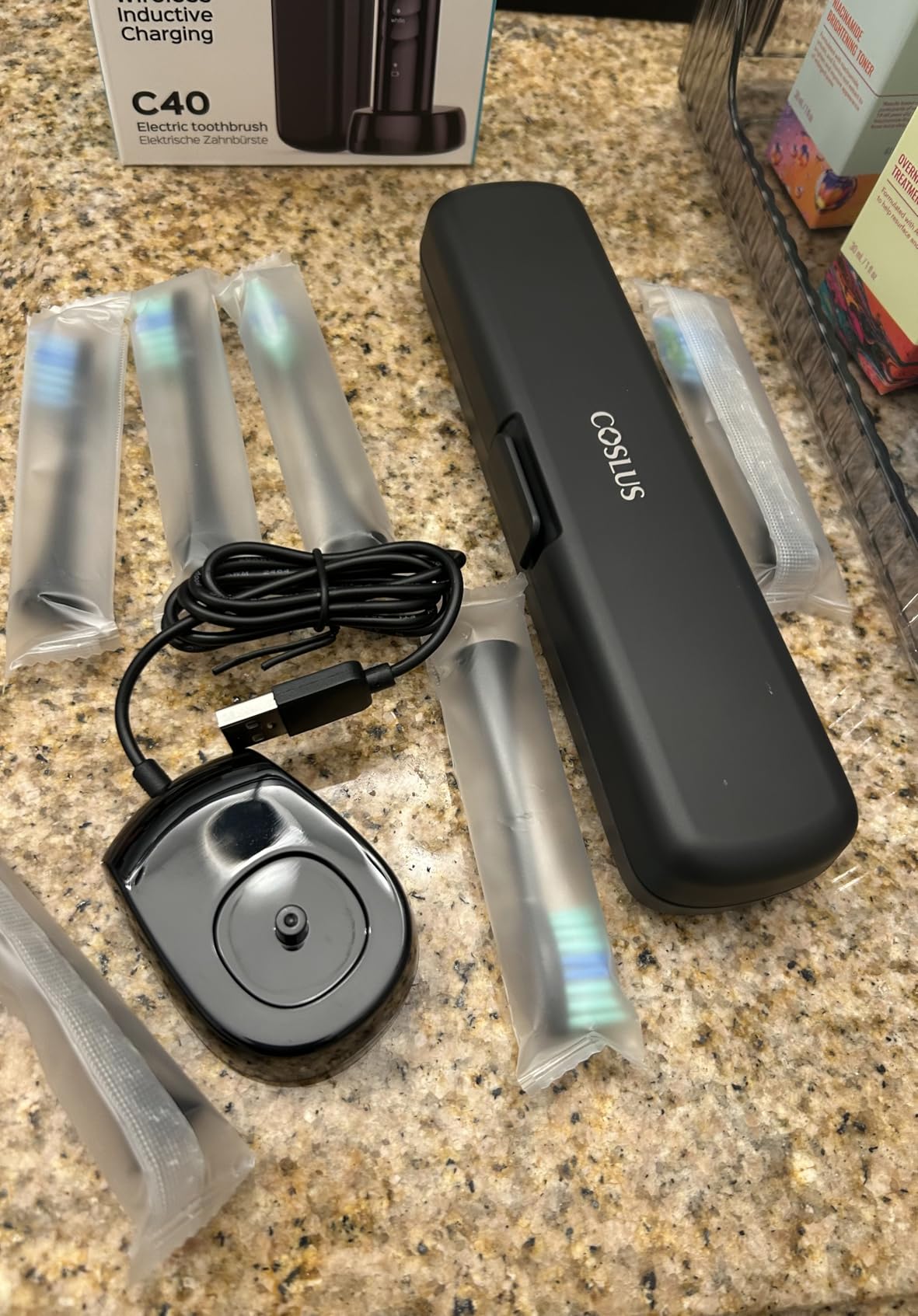
Six brush heads with an ergonomic W design and food-grade soft bristles cover roughly eighteen months of replacements for a single user, which is a strong reason to pick it in a multi-brush household. The colour-fade bristles are intended as a visual replacement reminder, though owners say the fade is subtler than the packaging implies.
A two-minute smart timer with 30-second pulses keeps sessions on track, and the non-slip ergonomic body handles wet hands better than several slim competitors. If you want one purchase to cover a family rather than per-person brushes, the maths here is hard to argue with.
What you should know before buying
Refill availability is the real consideration. Heads for this model are harder to source than Oral-B or Sonicare refills, so check where you can buy them before committing to the platform. If the brand disappears, a closed ecosystem becomes a disposal problem rather than an inconvenience.
The travel case is basic, and the colour-fade indicator needs to be checked rather than assumed. Also note there is no pressure sensor listed here, so if anyone in the household brushes hard, you will not get a warning light.
Who this suits and who should skip it
Choose this if several people share one handle, if you want a high motor figure for the money, if you need ages 12 and up covered in a single unit, or if you want a wireless base that keeps the counter clear.
Skip it if you need long-term refill certainty, if anyone in the household has sensitive gums, or if you are buying for a child under 12. For a single adult with gum concerns, the Smart 1500 or the Pro 1000 is a better fit.
How to Choose an Electric Toothbrush Under 100 Dollars
Four features have a clinical rationale behind them. Powered action, a two-minute timer, a 30-second quadrant pacer and a pressure sensor cover most of what separates a good brush from a gimmick, and all four are available below the price ceiling. Everything else on the spec sheet is preference.
Pressure sensor: the one feature worth paying for
Over-brushing is the most preventable cause of gum recession, and a pressure sensor is the only mechanism on a consumer brush that corrects it in real time. On the Oral-B Pro 1000 the handle stops the pulsations; on the Smart 1500 a light ring on the front makes the warning visible; on the Sonicare 4100 the handle pulses when you press too hard. AquaSonic’s four-mode setup, including a soft setting, is the budget equivalent.
Five brushes in this guide have no pressure sensor at all. That is not disqualifying if your gums are healthy and you already brush gently, but it is the reason we would not put the Oral-B 3D White Action, the Philips One, the Easy Clean, the TEETHEORY or the COSLUS at the top of the list for a first purchase.
Oscillating-rotating versus sonic
Oscillating-rotating brushes, which is the Oral-B family, move a small round head back and forth over a few degrees while pulsing. Each tooth is cleaned individually and the cup-shaped head holds toothpaste against the surface. Long-term Oral-B owners report a deeper gumline clean than sonic users get from a similar effort.
Sonic brushes, which is the Philips family plus most budget models here, vibrate a long or small head side to side and drive fluid between teeth. They are quieter and feel gentler, and the fluid action means you can use less pressure. If your gums are tender, sonic is usually the better first choice.
Published clinical work on both actions has found them broadly comparable for plaque removal, with modest differences that vary by study rather than by brand. The honest summary from forum threads and dental hygiene communities is that the action you will actually use consistently beats the action that scores marginally better on paper. Comfort drives compliance.
Battery and charging: what actually matters
Battery claims in this category are stated in days, and the definitions differ wildly. The AquaSonic’s roughly four weeks, the Sonicare 4100’s up to 14 days, and the AJELU and TEETHEORY figures of about 30 days are all measured under the manufacturer’s own brushing assumptions. Treat them as relative, not exact.
The more useful question is what happens when the brush dies. USB charging, whether direct or via a hidden cable, means one cable serves the whole bathroom and the brush survives a trip. Proprietary round-pin plugs and dedicated inductive bases mean a lost charger ends the brush’s life early, which is a recurring complaint in buyer forums. Two of the ten picks here avoid charging entirely, and both are the lightest in the guide.
Heads, seals and the three-year maths
A brush head is meant to be replaced every three months, so four heads a year, twelve over three years. That annuity often exceeds the handle price several times over, which is why buyers on frugality forums repeatedly advise spending on multi-packs of heads rather than upgrading the handle. The AquaSonic, with eight heads included, is the clearest winner on this measure.
The ADA Seal of Acceptance is the only independent validation in this category. It means the product has been shown to remove plaque and prevent gingivitis, and it removes some of the guesswork when you are choosing between unfamiliar brands. Check the seal list for the specific model number, because brands redesign and re-list models constantly.
Expected service life
This is what almost no competitor tells you, and it is the most common question in toothbrush forums. Budget brush handles with generic platforms tend to have shorter lives: the AJELU reports charging circuit failures after about a year, and the Oral-B 3D White Action’s rotating head and motor wear faster under regular use. Expect to replace those once rather than trusting them for a decade.
Major brand rechargeable models last longer but not forever. Sonicare owners on community forums report repeated failures around the two to three year mark, with the power button seal on the 4100 as the recurring culprit. Oral-B rotating brushes have a better survival record, with owners describing decade-plus ownership of the Pro 1000. Budget for one replacement in year three and you will not be disappointed.
What Replacement Heads Really Cost Over Three Years
The cheapest handle is rarely the cheapest brush. With twelve heads needed across three years, the refill bill usually exceeds the purchase price on every brush in this guide except the AA-powered model, which uses the cheapest heads available.
The AquaSonic’s eight-head bundle is worth the most here, covering roughly two and a half years on a single purchase. The COSLUS C40’s six heads cover about eighteen months, and the AJELU and TEETHEORY bundles cover roughly one to two years. The AquaSonic, COSLUS, AJELU and TEETHEORY all use DuPont-style generic heads, which are the easiest and cheapest to replace across brands.
The Oral-B Pro 1000 and Smart 1500 ship with the fewest heads but use the most widely stocked refills in the entire category. That ecosystem depth means multi-packs are always available and easy to order, so the higher per-head cost is partly offset by never being stuck. Philips One and Sonicare refills sit in between, with the Philips One platform being the narrowest.
The practical rule from buyer communities: buy the handle once, then never think about it again by ordering four multi-packs at a time. That habit turns the most annoying ongoing cost of electric toothbrush ownership into a two-minute job every year.
Frequently Asked Questions
What is the best electric toothbrush under 100 dollars?
The AquaSonic Black Series is the strongest all-round choice in this price band. It uses a 40,000 VPM sonic motor, carries the ADA Seal of Acceptance, offers four brushing modes with a smart 30-second timer, and includes eight replacement heads plus a travel case and a wireless charging base. For sensitive or receding gums, the Oral-B Pro 1000 is the better pick because its gum pressure control stops the brush when you press too hard.
Do dentists prefer Sonicare or Oral-B electric toothbrushes?
Both are routinely recommended, and the ADA Seal of Acceptance list includes models from each brand. Dentists tend to recommend Oral-B because the small round head cleans tooth by tooth, and Philips because the sonic fluid action is gentle on gums. Dental hygienists posting in community forums often favour the cheaper Oral-B models, on the grounds that patients actually use the brush they can afford to replace heads for.
Are cheap electric toothbrushes as effective as expensive ones?
For plaque removal and gingivitis reduction, broadly yes. Published clinical reviews have found powered brushes comparable to each other regardless of price, and the features with a real clinical rationale, powered action, a two-minute timer, a quadrant pacer and a pressure sensor, are all available well under 100 dollars. What you pay for above that is an app, a finish and accessories rather than cleaning power.
Should I choose a sonic or oscillating toothbrush?
Choose an oscillating-rotating brush such as the Oral-B Pro 1000 if you want a deep clean along the gumline and do not mind motor noise. Choose a sonic brush such as the Philips Sonicare 4100 if your gums are tender or you share a bathroom, because the action is quieter and gentler and drives fluid between teeth. Studies find the two broadly comparable, so pick the one you find comfortable enough to use daily.
What are common problems with Philips Sonicare toothbrushes?
The most reported issues are durability rather than cleaning. Owners of the 4100 mention the rubber-covered power button cracking after a few years and some units losing the ability to hold a charge within about a year. Refill heads also cost more in single packs, and the power adaptor is not included in the box. Cleaning performance and battery life are consistently praised.
How much do replacement brush heads cost per year?
Plan on four heads a year, which is the standard replacement interval, so twelve heads over three years. Depending on the brand, that annual bill often exceeds the handle price on mid-range models. Buying multi-packs rather than single heads is the single biggest saving, and bundled brushes such as the AquaSonic Black Series, which include eight heads, effectively defer that cost for two and a half years.
Final Verdict for 2026
The best electric toothbrushes under 100 dollars do not need a budget compromise in 2026. The AquaSonic Black Series wins this guide on the combination that matters most day to day: a 40,000 VPM motor, ADA acceptance, four modes, and eight heads plus a case that push your real refill bill well into the future. It is the buy we would make first.
Buy the Oral-B Pro 1000 instead if gums are the reason you are reading, the Sonicare 4100 if you want quiet and gentle, and the COSLUS C40 if one handle needs to serve a whole household. Whatever you choose, check the refill price before the handle, order heads in multi-packs, and expect to replace the handle once around year three. Ready to look wider? Our full electric toothbrush rankings cover every price tier.