
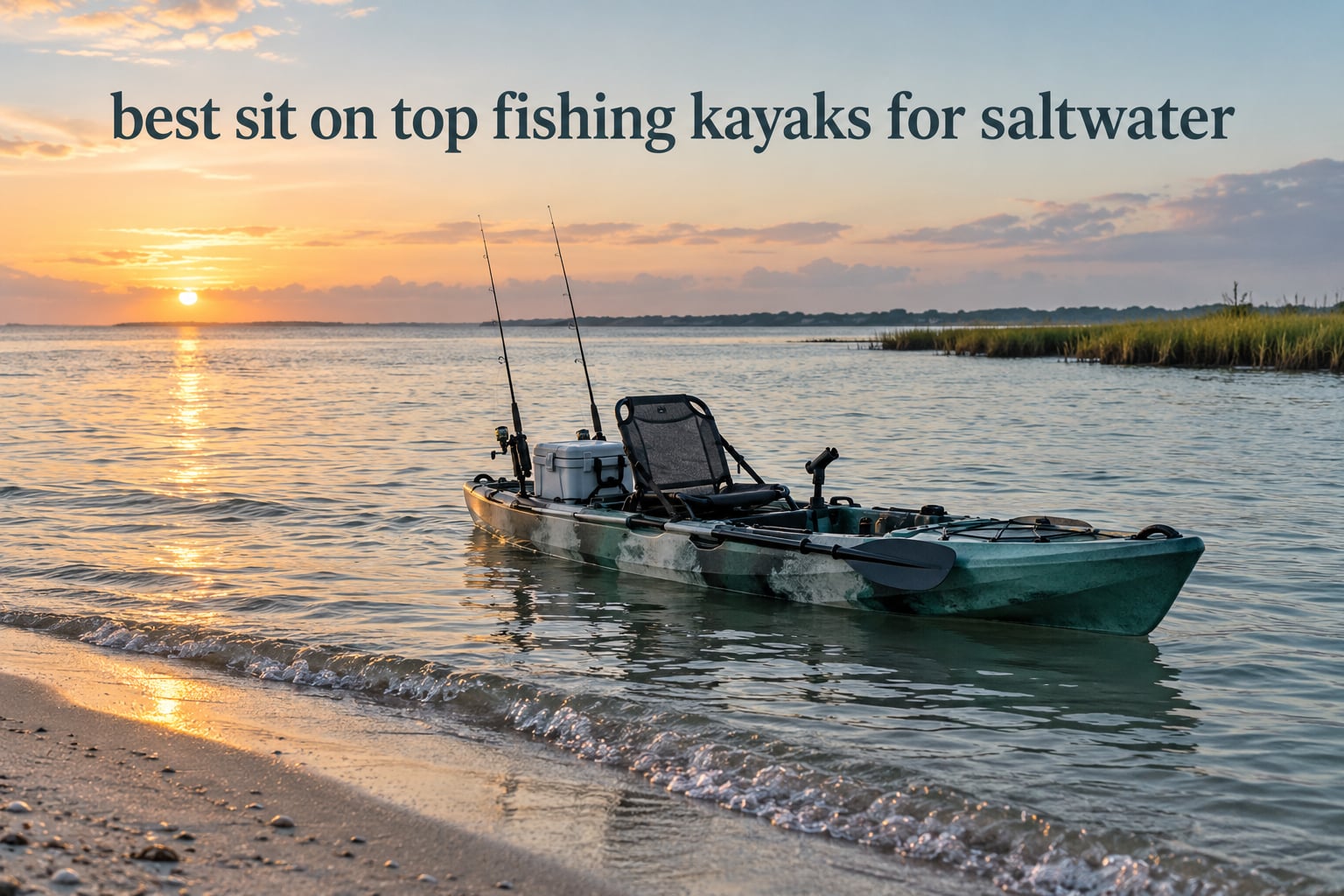
Most of the advice out there about fishing kayaks is written for somebody launching from a lake ramp. That advice falls apart the moment you are dragging a 60 pound hull through ankle-deep surf, then dealing with a flood tide and a two foot chop on the way out. Finding the best sit on top fishing kayaks for saltwater is less about finding a boat with rod holders and more about finding one that stays stable, drains fast and holds a line when the water starts moving.
We spent 2026 season working through twelve sit-on-top angling kayaks, reading owner reviews closely and comparing hull width, capacity, tracking hardware and the unglamorous details that decide whether a boat is fun or a chore. Everything in this list is a hardshell polyethylene sit-on-top, because that remains the right hull type for salt water. If you want the wider context first, our best sit-on-top kayaks roundup covers the hull type in general and our best fishing kayaks guide covers the rigging side.
What follows is a ranked list with a clear verdict on each board, the water type it actually suits, and an honest note on where it falls short. Two of the picks in the middle of the list are pedal-drive models, and we explain when a propeller or fin drive earns its place. We also cover the things almost no roundup bothers with: rudder choice, the 120 rule, salt-air corrosion and the safety kit that matters when you are a mile from a boat ramp.
Top 3 Picks: Sit On Top Fishing Kayaks for Saltwater in 2026
Three boards earned a place above the rest this year. The Lifetime Tamarack Angler 100 tops the list because it does the things that matter in salt water without asking much of the owner, and it carries by far the largest body of owner feedback in the group. The Pelican Catch Mode 110 wins on stability and load capacity for a boat under 12 feet, and the Perception Outlaw 11.5 is the pick for anglers who carry serious weight.

Lifetime Tamarack Angler 100
- Sharp bow for speed and tracking
- Skeg for straight-line paddling
- 275 lb capacity
- 51 lb hull
Pelican Catch Mode 110
- Tunnel hull for maximum stability
- 375 lb capacity
- Two 4 inch rigging tracks
Best Sit On Top Fishing Kayaks at a Glance in October
Every board below is a rotomolded or high-density polyethylene sit-on-top with rod holders and open deck storage. Length, capacity and weight are the three numbers that decide whether you can carry it, load it and paddle it where the fish are.
| Product | Specifications | Action |
|---|---|---|
| Lifetime Tamarack Angler 100 |
|
Check Latest Price |
 Pelican Sentinel 100X Angler Pelican Sentinel 100X Angler |
|
Check Latest Price |
| Pelican Catch Mode 110 |
|
Check Latest Price |
| Perception Outlaw 11.5 |
|
Check Latest Price |
 Perception Tribe 9.5 Perception Tribe 9.5 |
|
Check Latest Price |
 Reel Yaks Raptor Modular Reel Yaks Raptor Modular |
|
Check Latest Price |
 Pelican Catch Classic 100 Pelican Catch Classic 100 |
|
Check Latest Price |
 Wilderness Systems Tarpon 120 Wilderness Systems Tarpon 120 |
|
Check Latest Price |
 Reel Yaks Radar Modular Reel Yaks Radar Modular |
|
Check Latest Price |
 Albott Modular Fishing Kayak Albott Modular Fishing Kayak |
|
Check Latest Price |
 Lifetime Lockport 94 Modular Lifetime Lockport 94 Modular |
|
Check Latest Price |
 Old Town Sportsman PDL 106 Old Town Sportsman PDL 106 |
|
Check Latest Price |
1. Lifetime Tamarack Angler 100 – Best All-Rounder That Still Handles Chop
Lifetime Muskie Angler Sit-On-Top Kayak with Paddle, Tan, 120″
Length: 10 ft
Weight: 51 lb
Capacity: 275 lb
Hull: HDPE
Pros
- Stable flat bottom holds up in chop and open water
- Light enough for one person to roof-rack solo
- Deep tracking channels and a skeg for straight lines
- 1343 owner reviews to learn from
Cons
- Tracking is only fair and it drifts sideways when you stop
- Stock paddle is short and flimsy
- Seat clips bend under load
The Tamarack Angler 100 is the boat we kept coming back to during this comparison, and the reason is simple: it is the only one in the group with a large enough body of owner feedback to tell you where it fails. Owners consistently describe it as stable in choppy water and usable in open ocean conditions, which is not a claim most budget sit-on-tops can support.
It is a sharp-bowed boat with deep hull tracking channels and a skeg, so it moves in a straight line better than the wide tunnel-hull alternatives. That matters more offshore than raw stability does, because you spend a lot of time covering water rather than sitting still. The trade is a narrower deck and a 31 inch beam, so casting is seated rather than standing.
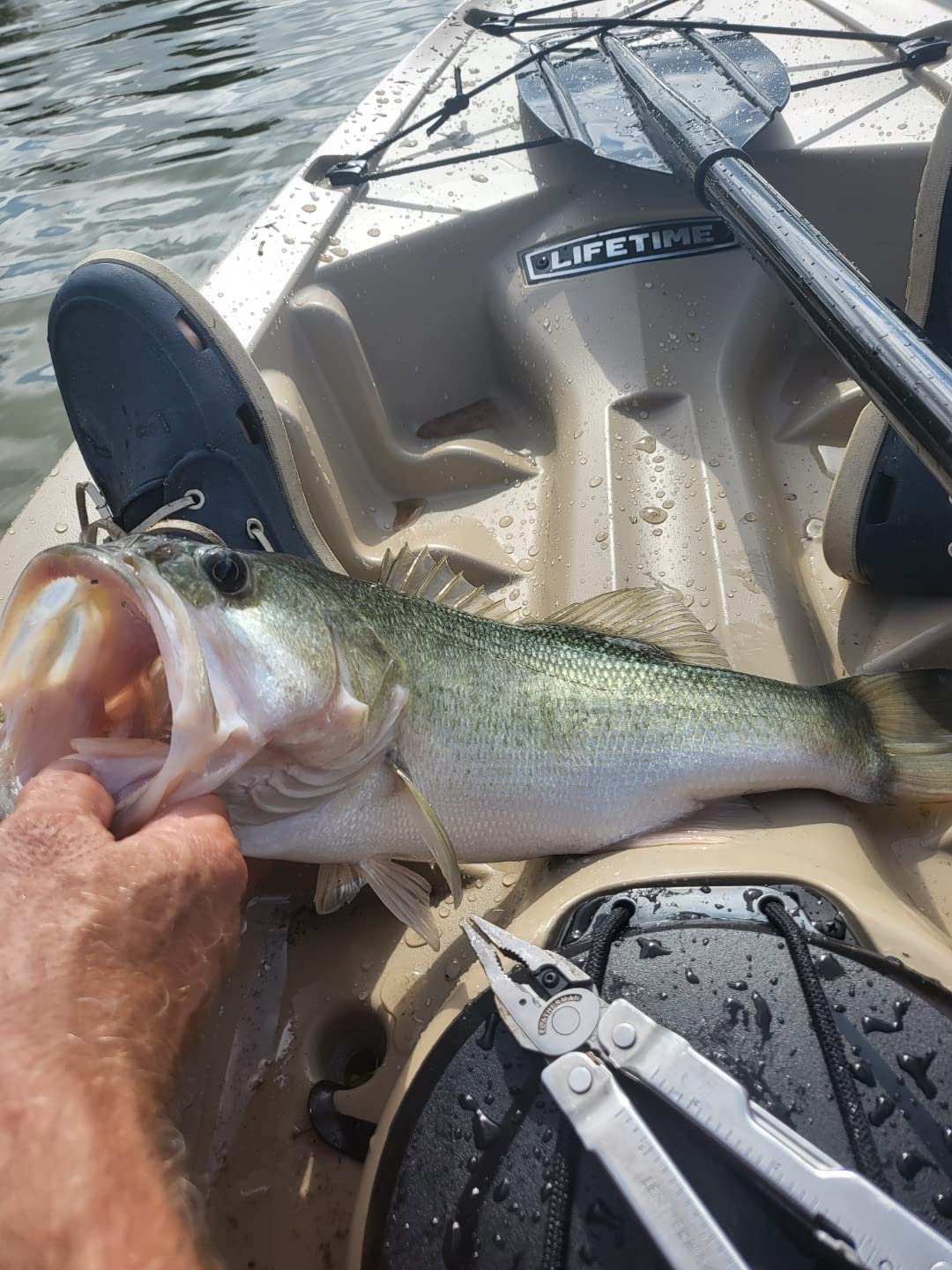
At 51 pounds it is one of the few boards here a single person can lift onto a roof rack without a second set of hands, which matters when your launch is a boat ramp at a state park rather than a marina cart. The adjustable padded seat and multiple footrest positions are genuinely useful over a long day, and two flush-mounted rod holders plus a top-mount holder cover the common cases.
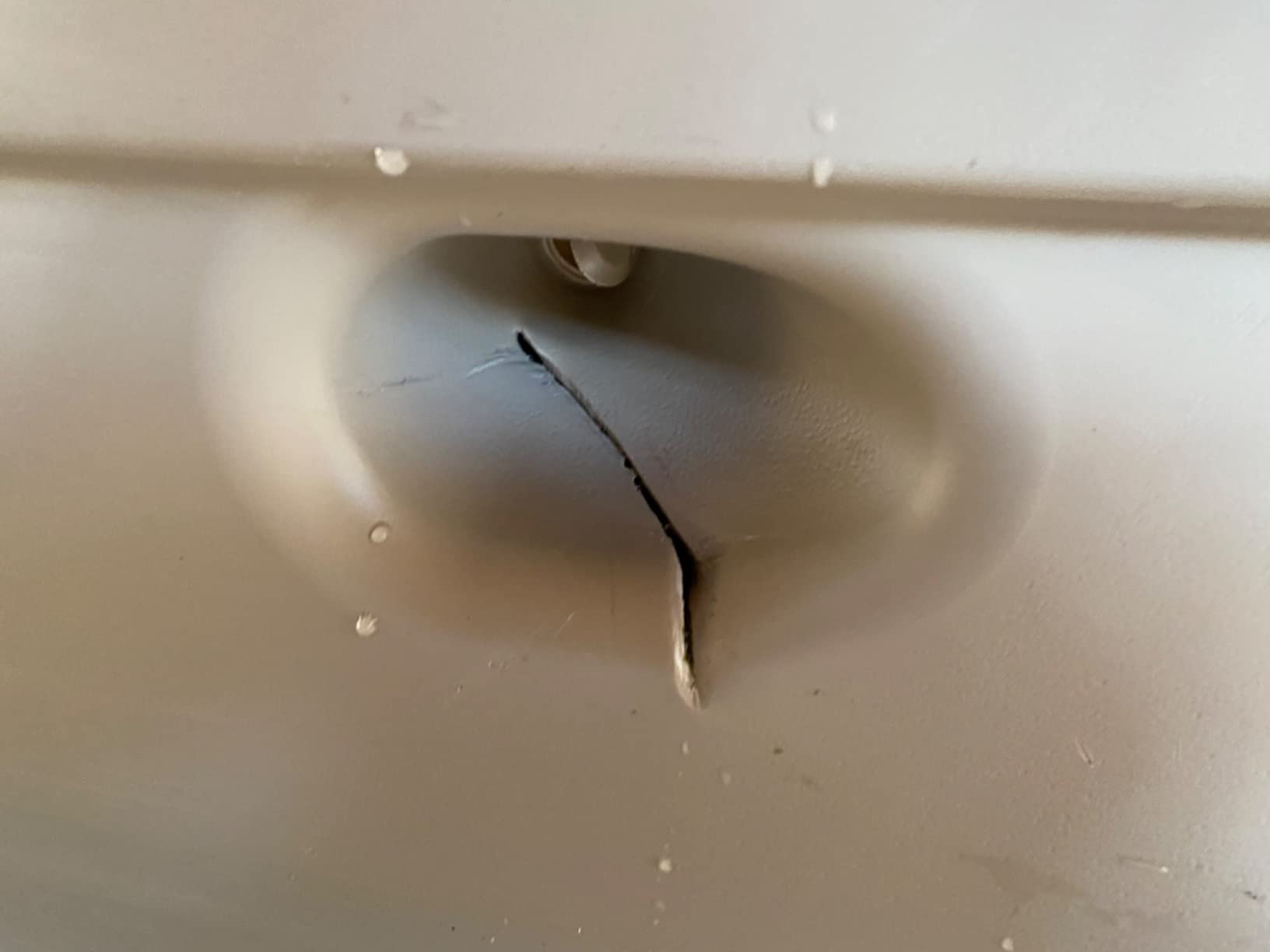
The honest weaknesses are real. Owners report that the kayak drifts sideways when you stop paddling, and the plastic seat mounting clips are a recurring failure point on an older hull. The included paddle is short and flimsy, so budget for a proper one. Storage compartments are not sealed without separately sold cup inserts, which in salt water means dry bags in every case.
Is the Tamarack Angler 100 safe for open coastal water?
For protected bays, tidal creeks, estuary mouths and days when the forecast shows one to two feet of chop, yes. The 10 foot length and sharp bow give it enough composure to paddle across a morning breeze and a flood tide without the constant correcting that shorter, wider boats demand. Many owners use it in exactly those conditions year round.
For a genuine blue-water crossing or a day with a swell running well over three feet, we would move up to a longer hull with a rudder. The Tamarack has a skeg, not a rudder, so in strong crosswind you are either paddling harder or accepting drift. That is manageable in a bay and annoying twenty miles offshore.
Where the Tamarack Angler 100 is the wrong boat
If you are a heavy angler with a full load of tackle, the 275 pound rating leaves little headroom once you add a cooler and a fish box. Run the arithmetic in the buying guide below, and if you land close to the limit, the Perception Outlaw 11.5 or the Pelican Catch Mode 110 are the safer buys.
It is also the wrong pick if you plan to stand and cast to surface fish. The narrow beam and the standard seat position make that a seated, one-foot-on-the-deck operation. Anglers chasing tarpon and cobia from a standing platform should look at a wider tunnel hull instead. Our general sit-on-top kayak comparison covers the wider-beam picks in more depth.
2. Pelican Sentinel 100X – Lightest Board Here for Solo Carry
Pelican Sentinel 100X – Angler Sit on top Fishing Kayak – Forest Mist – Lightweight – Ergolounge™ Seating System – 10 ft, Sentinel 100X Angler Fishing Kayak
Length: 9 ft 6 in
Weight: 44.6 lb
Capacity: 275 lb
Hull: PE
Pros
- Lightest angler kayak here at 44.6 lb
- Sub-10 foot length stores in a closet or trunk
- High wide padded backrest
- Four rod holders including two vertical
Cons
- 275 lb capacity is the lowest in the group
- 30 inch beam gives limited deck stability
- Takes on water in waves without scupper plugs
The Sentinel 100X is the transport answer in this list. At 44.6 pounds it is the lightest angler kayak we tested, and at 9 feet 6 inches it is short enough to live in a garage corner or the back of a small SUV without a roof rack. For a beach launch with a long carry from the parking lot, that combination removes more friction than any amount of hull refinement.
The Ergolounge seating system is the reason owners keep it. The cushioning is thicker than most, and the backrest is taller and wider than a standard framed seat, which makes a long session in the sun far more tolerable. The removable ExoPak compartment is a nice touch because you can pack it in the car and drop it into the kayak when you arrive rather than loading gear at the waterline.
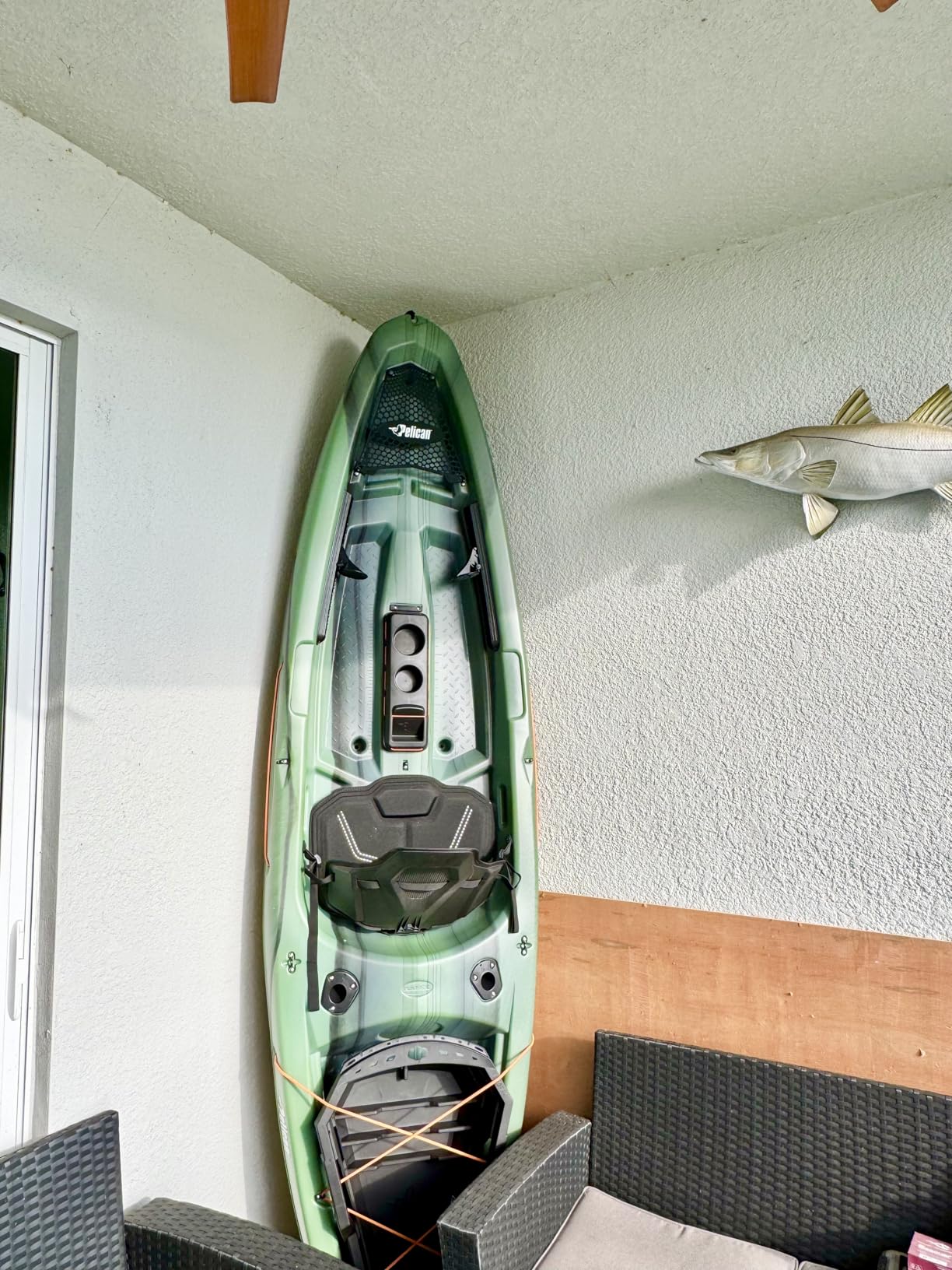
Four rod holders is generous for a board this size, with two flush mounts on the deck and two vertical ones in the ExoPak. Molded-in side carrying handles mean you can lift it from the side, which is the easier grip for a boat with a narrow beam like this one.
The limits are structural. A 275 pound rating is the lowest here, and a 30 inch beam gives you a much smaller platform than the tunnel-hull models when you want to brace for a cast or reach for a falling rod. Owners also note that the open deck takes on water in waves unless you fit scupper plugs, and we would not plan an open-water day on that basis.
Where the Sentinel 100X handles saltwater well
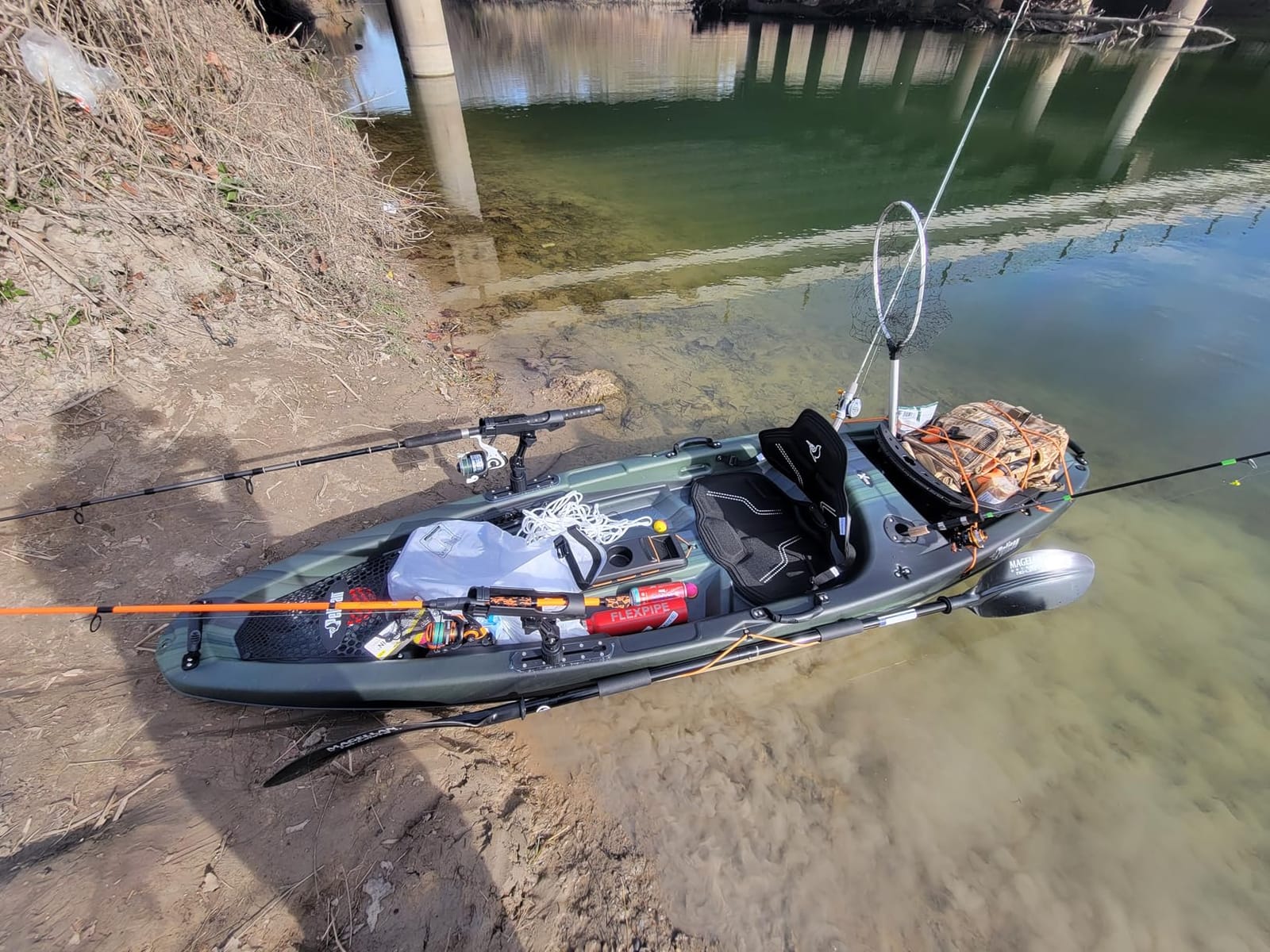
This is a flats and inshore boat. Put it in a shallow bay, a lagoon, a mangrove edge or a sheltered estuary and it is excellent: light enough to carry across soft sand, narrow enough to slip through a tight channel, and stable enough to cast from seated for the usual species in that water. The quick launch and recovery is the feature you will appreciate most.
It handles a mild chop and a light breeze without drama. What it cannot do is hold a line for you. There is no rudder and no skeg mentioned in the spec sheet, so correcting course in current means paddle strokes, and in a two knot flood that is a constant low-level effort rather than something you set and forget.
Where the Sentinel 100X is the wrong boat
The wrong boat for a long paddle to offshore structure, because you will be paddling the entire way and the hull is not built for sustained speed. Also the wrong choice for anyone who needs to stand, or whose loaded weight approaches a quarter ton, or who plans to be out in conditions that put water over the gunwales.
If your weight plus gear plus catch lands anywhere near 275 pounds, do not buy this one. Go up to a 350 pound rated hull at minimum, and a kayak cart is worth budgeting for on any of them so the launch is a rolling job rather than a lift.
3. Pelican Catch Mode 110 – Widest Stable Platform Under 12 Feet
Pelican Catch Mode 110 Fishing Kayak – Premium Angler Kayak with Lawnchair seat, Granite – 10.5 Ft.
Length: 10 ft 8 in
Beam: 34.5 in
Weight: 67 lb
Capacity: 375 lb
Pros
- Tunnel hull gives exceptional primary stability
- 375 lb rating handles a full load
- ERGObost seat folds flat for standing
- Two rigging tracks plus large tank wells
Cons
- Wide flat hull is slow
- 67 lb weight needs a cart for solo portage
- No dry compartments so dry bags are required
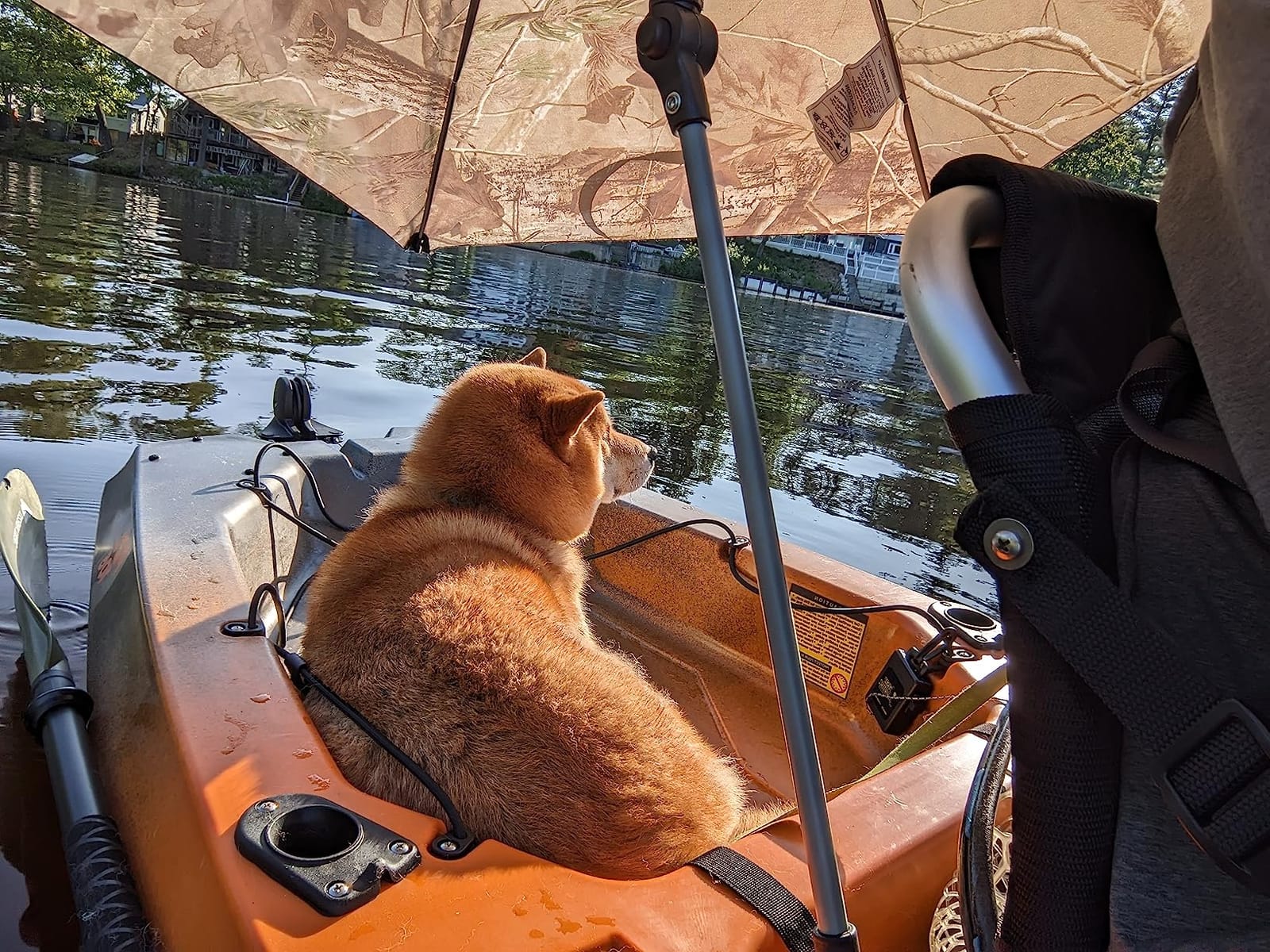
The Catch Mode 110 has the highest rating in this group at 4.6, and the reason is that it is the most genuinely stable boat we paddled. The tunnel hull gives a wide, flat deck that holds a hard brace when you stand up, and owners report fishing with a large dog aboard without any drama. For an angler who wants to stand and cast, this is the pick in this list.
Its 375 pound capacity is unusually generous for a 10 foot 8 inch hull, and that headroom matters once you add a crate, tackle, a cooler and a fish box. Two 4 inch rigging tracks accept a standard 13 by 13 inch milk crate, front and rear tank wells take soft gear, and three flush-mounted rod holders handle the working setup.
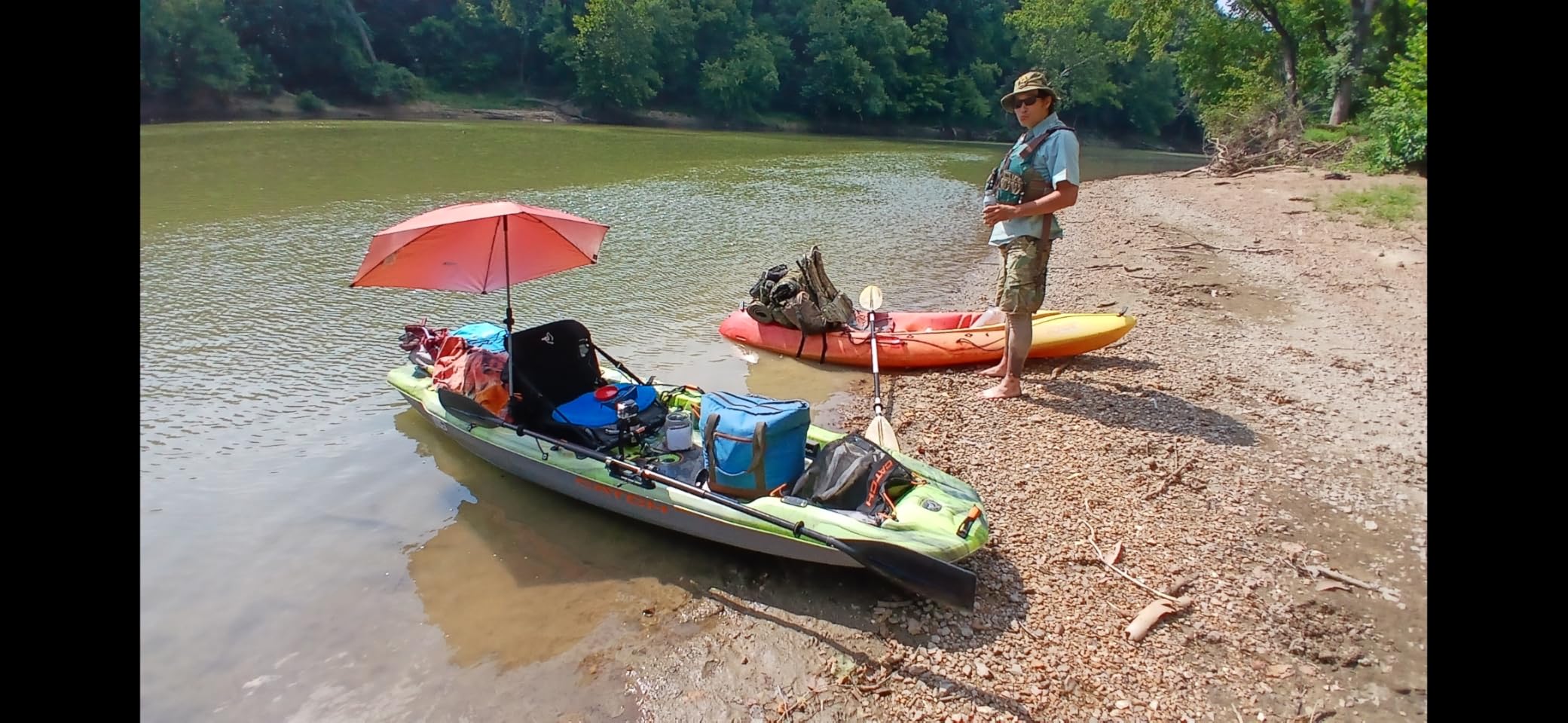
The ERGObost seating system adjusts to a higher position for sightlines and folds flat when you want the whole deck, and the manufacturer adds internal flotation to meet or exceed ABYC standards, which is a meaningful detail for a boat you might fish in open water. Anti-slip deck carpet and traction pads keep footing underfoot in wet conditions.
You give up speed for that stability. A wide tunnel hull is a barge, and paddlers report rubbing the sides with the blade. At 67 pounds it also wants a kayak cart, and the hull scratches easily, so a keel guard is sensible if you work rocky structure. There are no dry compartments at all, which means your electronics and dry layers live in dry bags.
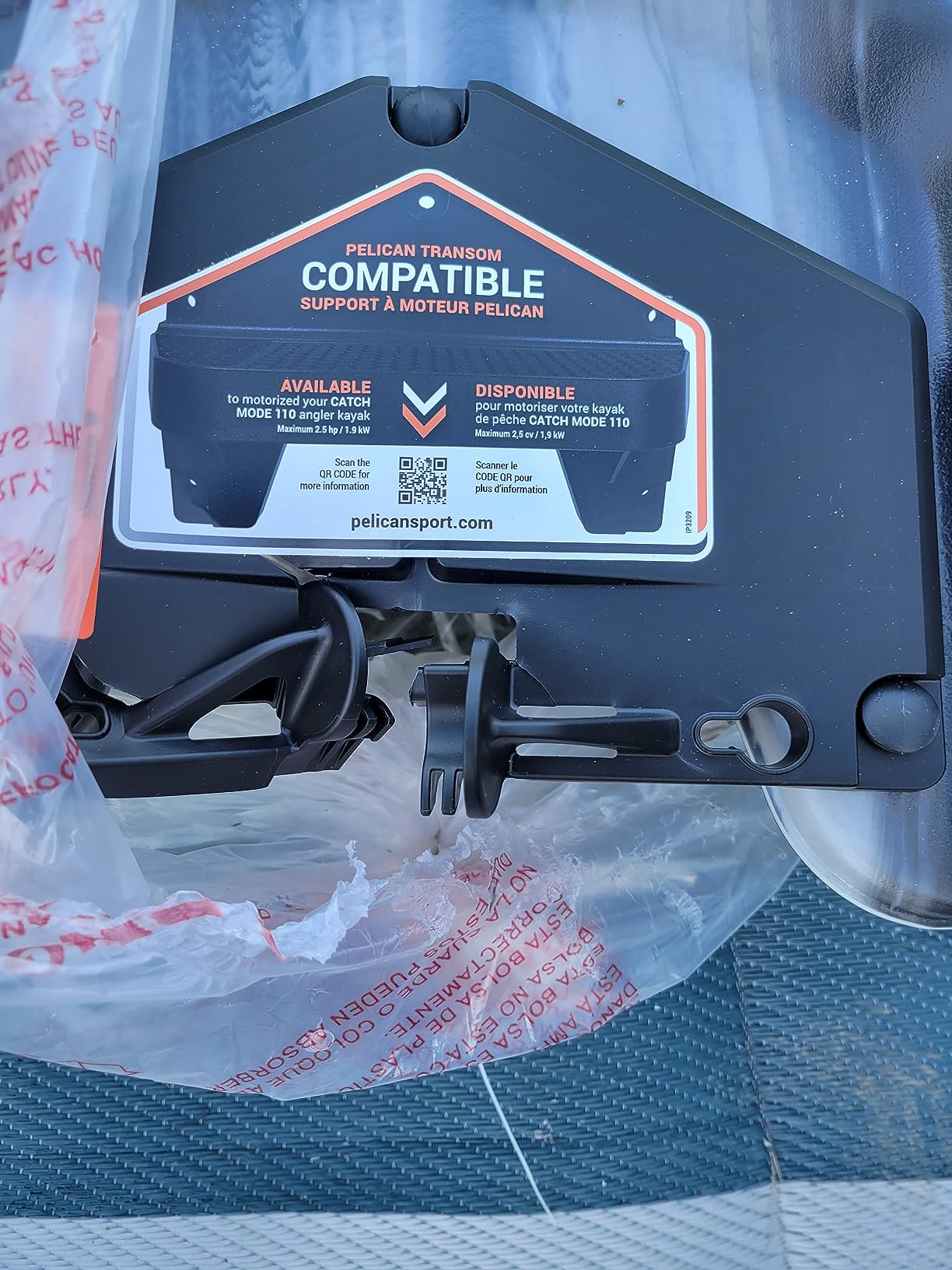
Can the Catch Mode 110 handle coastal chop?
Yes, within limits. The combination of a 34.5 inch beam, 375 pound rating and a skeg and rudder setup means it stays composed in moderate chop and holds a heading in wind better than most paddle-only boats. Owners use it in bay and coastal water with the standard caution about wind strength.
What it is not is fast. Covering distance to a reef or a drop-off means a slow, steady paddle or a bow-mounted trolling motor on the accessory tracks. If your fishing depends on reaching water that is a long way out, the pedal options further down this list are the better tool.
Who should skip the Catch Mode 110
Angler who plan long paddle trips and care more about speed than a standing platform. The Catch Mode 110 will not cover ground the way a pointed 12 footer does, and no amount of effort changes the hull shape.
It is also a two-person lift in most cases at 67 pounds, so factor a cart into the purchase or accept that every launch is a coordinated effort. Owners also report deck flex for paddlers over 200 pounds, which is a firm but not disqualifying issue. For shorter paddlers the seat height is adjustable enough to solve it.
4. Perception Outlaw 11.5 – Built Around a 425 Pound Load Rating
Perception Kayaks – Outlaw 11.5 Fishing Kayak – Sit on Top – Fold Away Lawn Chair Seat – 4 Rod Holders – Integrated Tackle Trays – 11.5 ft – Dapper
Length: 11 ft 6 in
Beam: 35 in
Capacity: 425 lb
Hull: PE
Pros
- Highest capacity in the group at 425 lb
- Four integrated rod holders and tackle trays
- Large rear tank well plus front storage
- Fold-away frame seat for long sessions
Cons
- Largest and heaviest board here
- Harder to transport and store solo
- Premium price band for the category
The Outlaw 11.5 exists to solve a specific problem: a big angler with a lot of gear who wants a sit-on-top that will not flex, tip or complain. The 425 pound capacity is the highest in this roundup, and the 35 inch beam and 11 foot 6 inch length give a platform that stays level with a heavy paddler and a full load aboard.
It is laid out like a fishing boat rather than a paddling boat. Four integrated rod holders, integrated tackle trays within reach, a large rear tankwell and a front storage area that takes coolers, crates or dry bags. The fold-away frame seat is comfortable over long sessions, which matters when you are stationary for four hours on a structure.
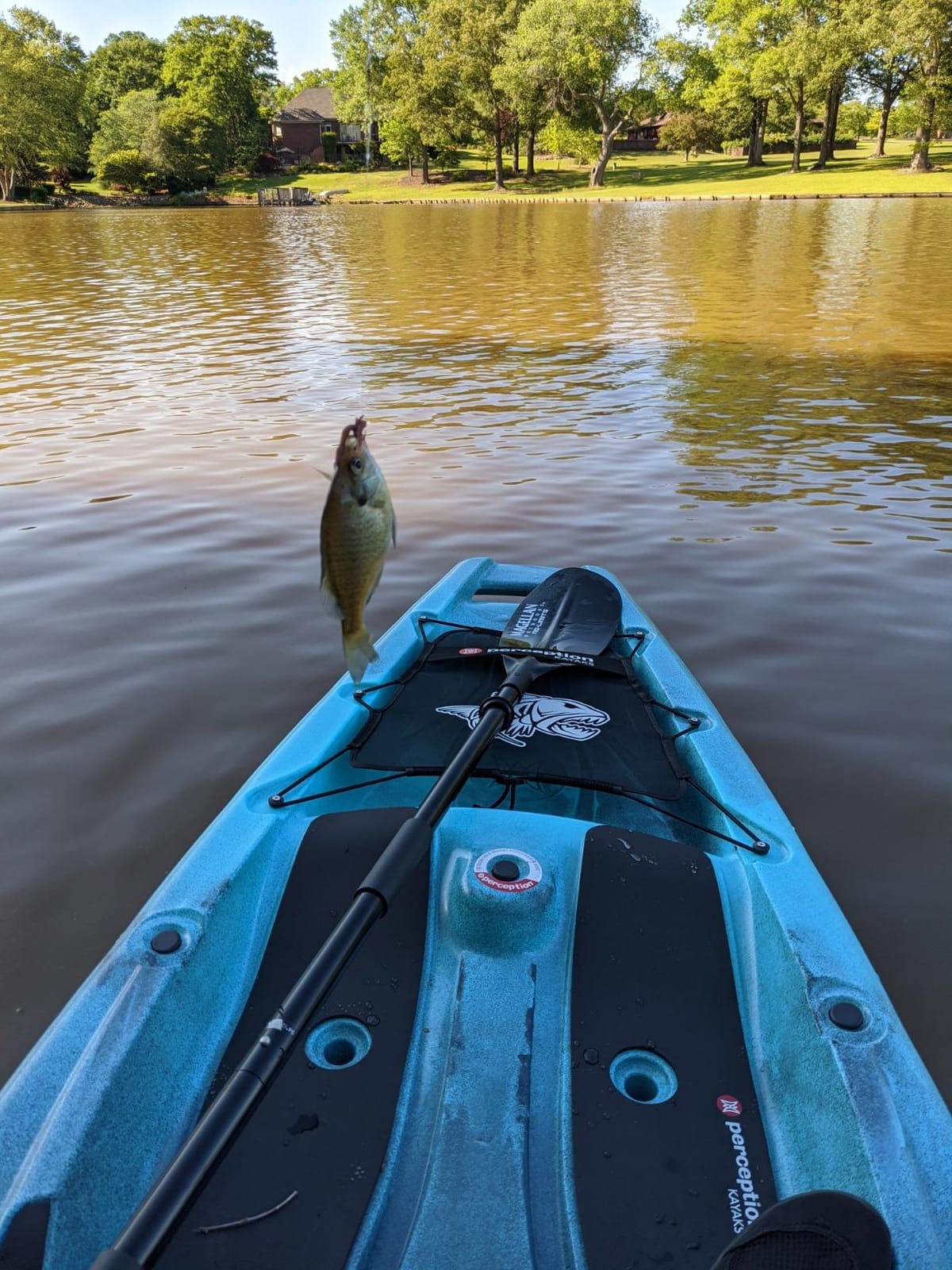
Perception builds it in the USA and backs the hull and deck with a 5-year limited warranty, which is real peace of mind in salt air. Eleven and a half feet is a length that tracks better than shorter hulls and carries more gear, and it is short of the point where a boat becomes a two-person carry every time.
The drawback is straightforward: this is the largest and heaviest board in the group, so it is less convenient to transport solo and takes real estate to store and rack. It also sits in the premium price band, which is not hard to justify if you actually need the capacity but is wasted money if you do not.
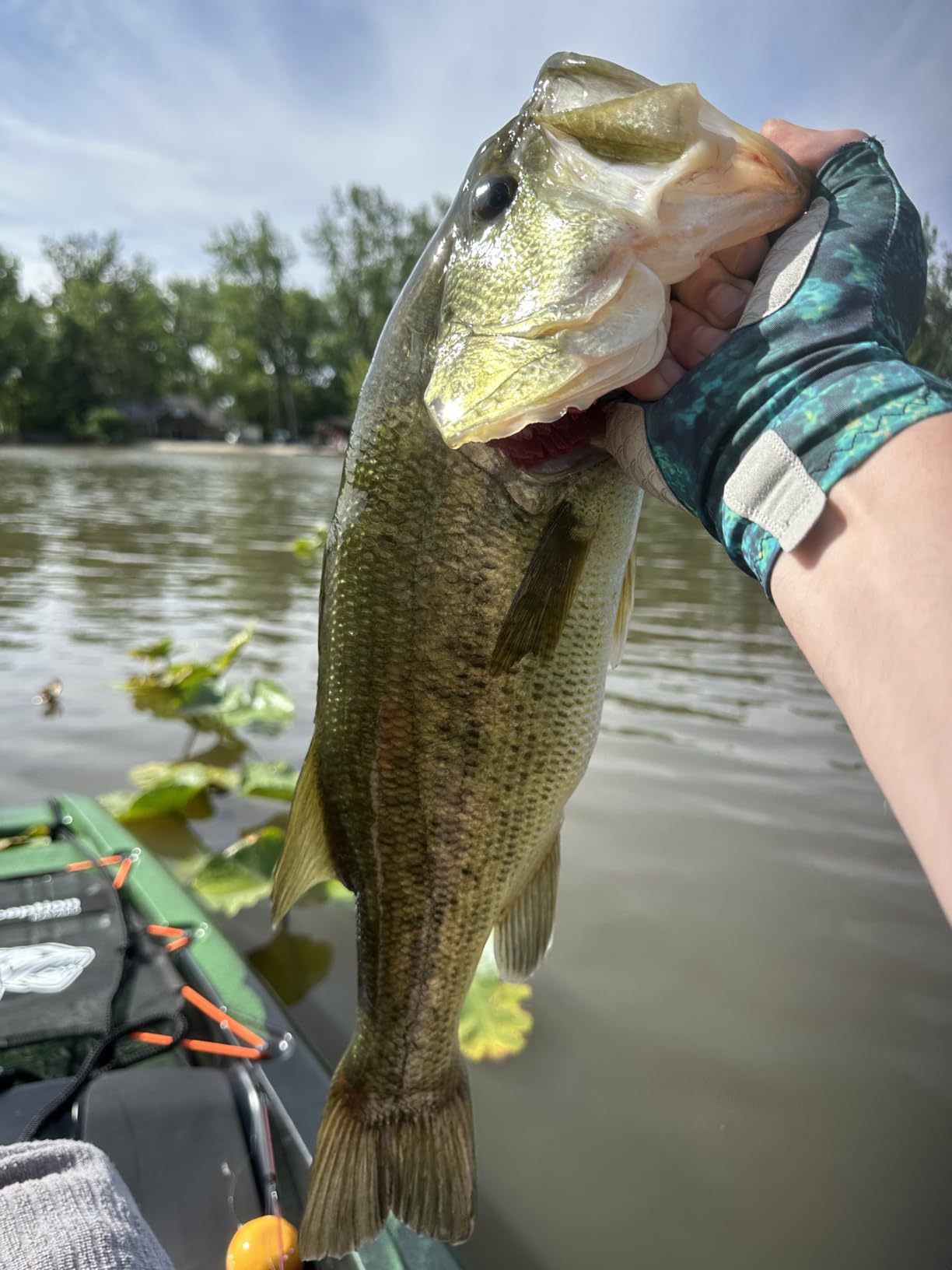
Is a 425 pound capacity kayak worth the extra size?
If your body weight plus your full rig plus a realistic fish is anywhere above 350 pounds, then yes, and the alternative is a boat that is over-loaded and unhappy in chop. Capacity is not a bragging number, it is a structural limit, and running near it in a seaway is how boats get wet.
If you are a mid-sized angler carrying light tackle, the same money in a lighter board buys a much nicer boat to paddle and a much easier car trip. Do the arithmetic in the buying guide before committing, and buy for the loaded figure rather than the body weight.
Where the Outlaw 11.5 is the wrong boat
It is the wrong boat for anyone without a roof rack, a trailer or a second pair of hands. The size and weight are real, and so is the storage penalty: an 11 foot 6 inch hull does not tuck into a closet the way a modular model does.
It is also not a pedal or motor platform out of the box, so reaching distant offshore water means paddling. For anglers covering long distances in current, our pedal kayak roundup covers the drive systems built for that job.
5. Perception Tribe 9.5 – Comfortable Board for Sheltered Water
Perception Tribe 9.5 – Recerational Kayak Sit on Top – Large Rear Storage with Tie Downs – 9.5 ft – Sunset
Length: 9 ft 5 in
Weight: 46 lb
Capacity: 300 lb
Hull: PE
Pros
- High-back frame seat with adjustable recline
- 300 lb rating for a sub-10 foot boat
- 46 lb weight and stackable hull
- Handles mild ocean waves per the maker
Cons
- Tall seat raises center of gravity
- Two people needed to carry it solo
- Small rear storage will not keep gear dry
The Tribe 9.5 is the comfort pick. The high-back frame seat with adjustable recline positions is the feature owners mention most, and several long-term owners report years of use in coastal and salt-marsh water. If you are putting in a full day of fishing rather than covering miles, the seat matters more than the speed.
It is a straightforward recreational sit-on-top that Perception describes as suitable for lake cruising and mild ocean waves, which is an honest framing rather than an offshore claim. A 300 pound rating in a sub-10 foot hull is generous, and the 46 pound weight keeps it manageable with a cart.
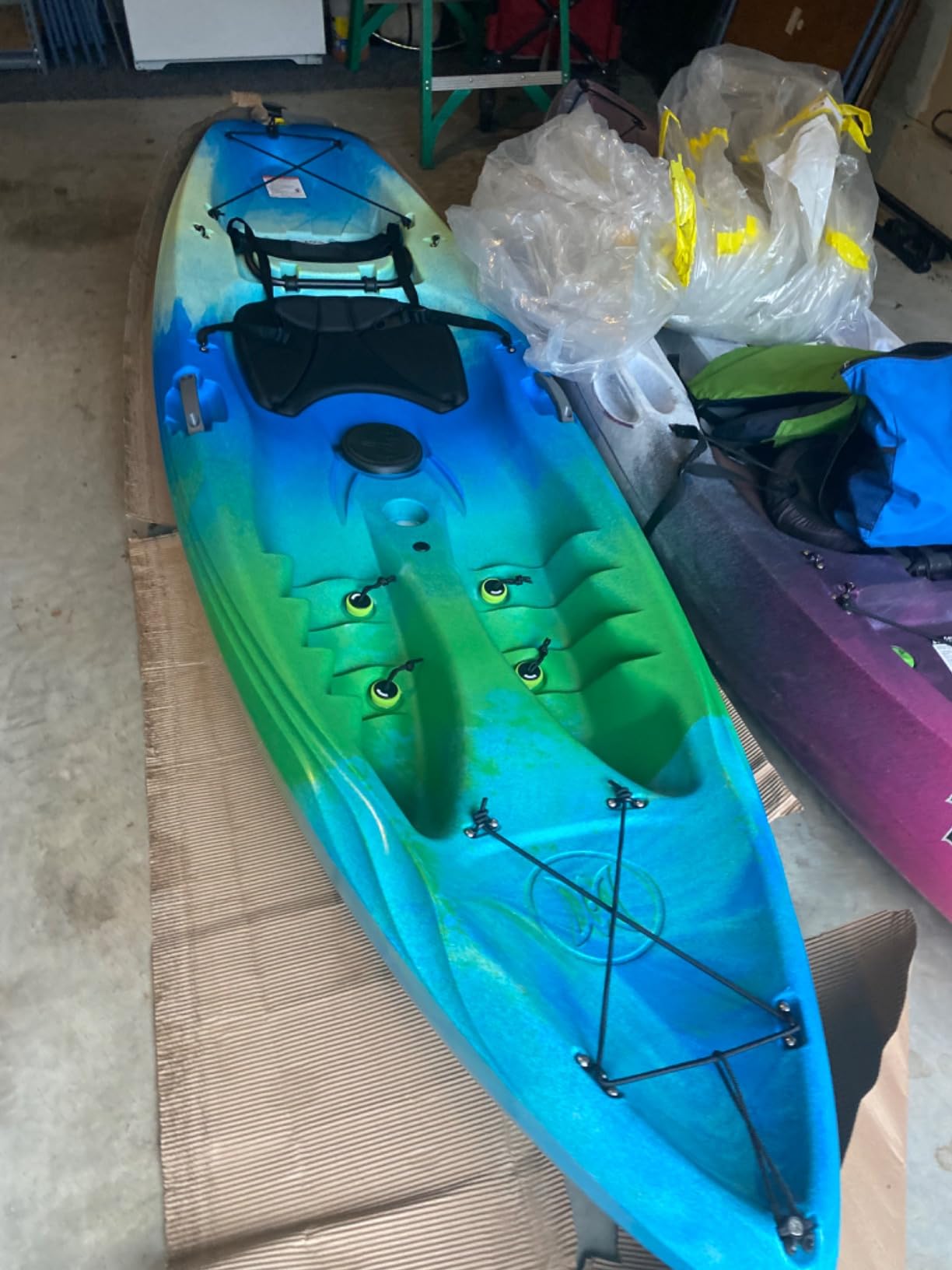
Rear cargo storage with durable tie-downs is enough for a dry bag and a cooler. Made in the USA with a 5-year hull and deck warranty. The self-bailing hull design is the right architecture for salt water, though owners note that some scupper holes sit under the seat and are easy to miss on a pre-launch check.
Two things work against it offshore. The tall seat back raises your center of gravity, which costs secondary stability in moving water, and a 9 foot 5 inch hull with a blunt recreational shape is slow. Owners also find it heavier to carry solo than the 46 pound figure suggests.

How much chop can a 9 foot sit-on-top handle?
Roughly a foot of chop and a light to moderate breeze, comfortably. Beyond that the short length starts to pitch and the low freeboard puts water over the deck more often, and the taller seat makes a capsize slower to recover from. For protected bays, rivers, marshes and calm mornings it is a pleasure to be in.
Buoyancy matters more than most buyers think in this situation. A sit-on-top with a high seat and a taller back will float and recover better than a low sit-in, which is the core argument for the hull type in salt water. The Tribe is a good example of a boat that will come back to you.
Who should not buy the Tribe 9.5
Anglers who intend to run to offshore structure or cover distance, because the hull will not get you there efficiently. Anyone planning to stand and cast, since the seat height and the recreational beam are not a standing platform. Anyone who has to carry the boat alone a long way, for the same solo-lift reason.
It is also a poor choice for keeping gear dry, because the rear storage is a bungee area rather than a sealed compartment. For inshore and sheltered fishing that is fine with a dry bag. For an overnight or multi-day trip, add a hull bag.
6. Reel Yaks Raptor Modular – Pedal Drive That Breaks Into Two Pieces
Reel Yaks Raptor Modular Fishing Kayak, Fin Drive 9.5ft, 380 lbs Capacity
Length: 9.5 ft
Weight: 62 lb
Capacity: 380 lb
Drive: fin
Pros
- Two-piece hull fits in a trunk or closet
- Fin drive moves quietly against wind and current
- Each half is light enough for a solo carry
- 380 lb rating on a wide W hull
Cons
- Rudder control wiring and ferrules fail repeatedly
- Rudder guide screw snaps easily
- Low seat leaves no under-seat storage
- Stock paddle is cheap
The Raptor solves a problem most pedal kayaks ignore: transport. The two-piece modular hull separates for storage in an apartment, a closet, a garage or a vehicle trunk, and each section is light enough for one person to carry a real distance. Optional third center sections convert it to a tandem, which is unusual flexibility for a pedal boat.
The fin drive is the quiet, efficient one. It holds a heading into wind and current with far less effort than a paddle, and it keeps your hands on the rod instead of the shaft, which is the entire point when you are working structure for hours. A wide W hull and 380 pound rating give a stable platform while casting.
It comes rigged with flush-mount rod holders, track rails and storage hatches including a front compartment, plus a stadium seat and paddle. Owners rate the manufacturer’s customer service and video troubleshooting very highly, which matters when you own a drive system.
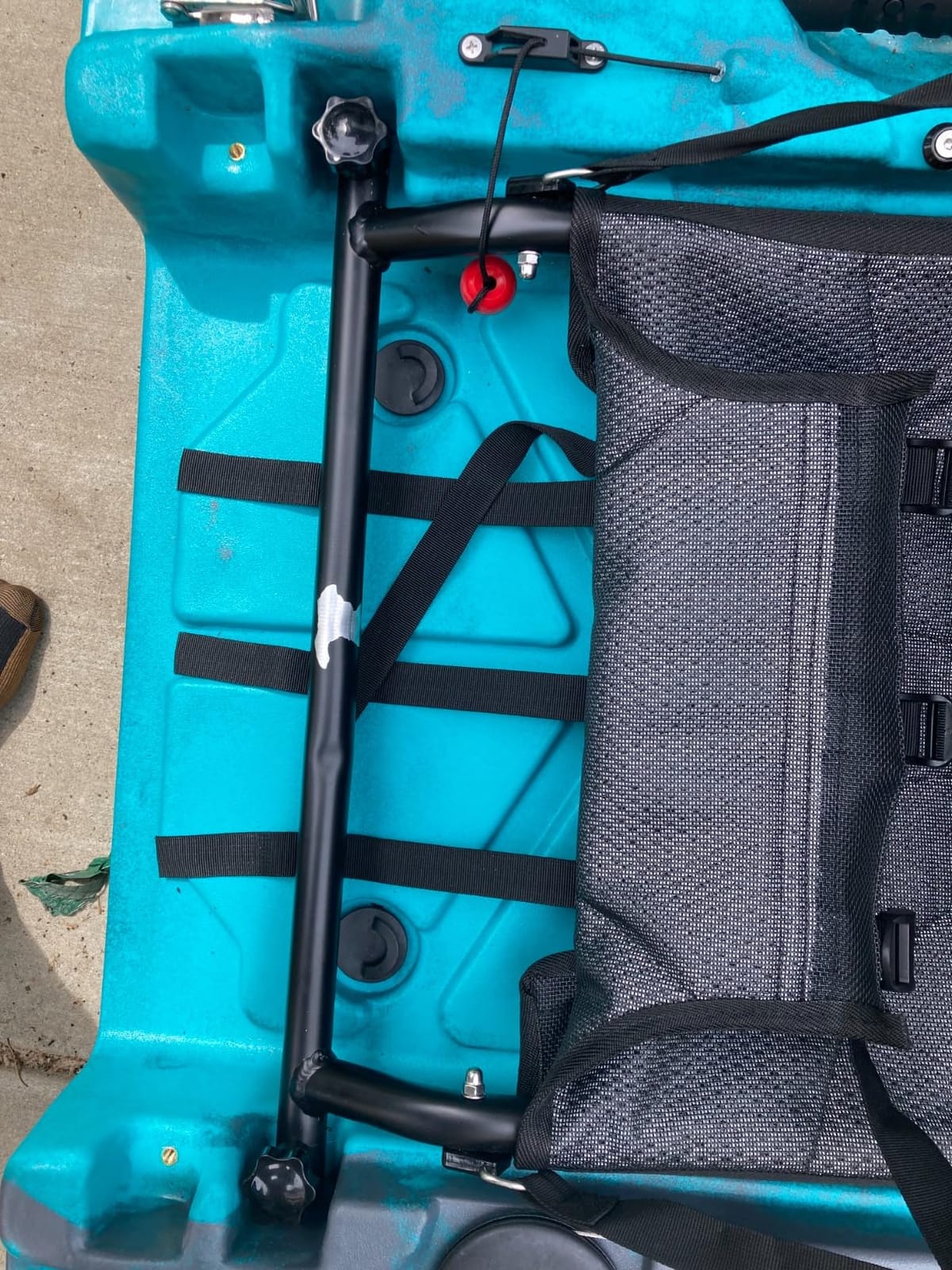
The dominant complaint, concentrated in the low-star reviews, is a recurring rudder-control hardware failure. The rudder wiring and ferrules are weak and the rudder guide screw can snap within a season. That is a repairable but genuinely annoying failure in a boat whose whole appeal is hands-free control in current, so it is worth knowing before you buy.
Is a pedal kayak better than a paddle kayak for offshore fishing?
For long runs to offshore structure, yes, clearly. A pedal drive holds a line across a current that would otherwise have you paddling continuously, and it lets you fish while travelling. On a short trip in calm water it is a luxury you do not need, and the extra weight and complexity are a real cost.
The Raptor is also modular, which means a drive system in a boat you can actually store. That combination is unusual, and it is why we rated it above several more expensive conventional pedal kayaks for most coastal anglers.
Where the Raptor falls short
The rudder hardware is the issue. If you buy this, inspect the rudder control and guide hardware at every launch, and be prepared to service it. The seat also sits low, especially in the rear position, and there is no under-seat storage to absorb the loss.
At 9.5 feet with a 30.3 inch beam it is also a narrower platform than the tunnel-hull boats, so standing to cast is possible but not a feature. Accessory rail end caps require loosening the track to fit add-ons, and the manufacturer accessories carry a premium.
7. Pelican Catch Classic 100 – Enclosed Storage in a 10 Foot Hull
Pelican Catch Classic 100 Angler – Sit-on-Top Fishing Kayak – Ergocast Dual Position Seating System – 10 ft – Outback
Length: 10 ft
Beam: 34 in
Weight: 57 lb
Capacity: 350 lb
Pros
- Tunnel hull and flat deck for casting while standing
- Front quick-lock hatch plus rear tank well
- ERGOCast seat adjusts high or low
- 350 lb rating with added hull flotation
Cons
- Wide beam makes the boat slow and less nimble
- Only two flush-mounted rod holders
- Higher share of one-star reviews on delivery damage
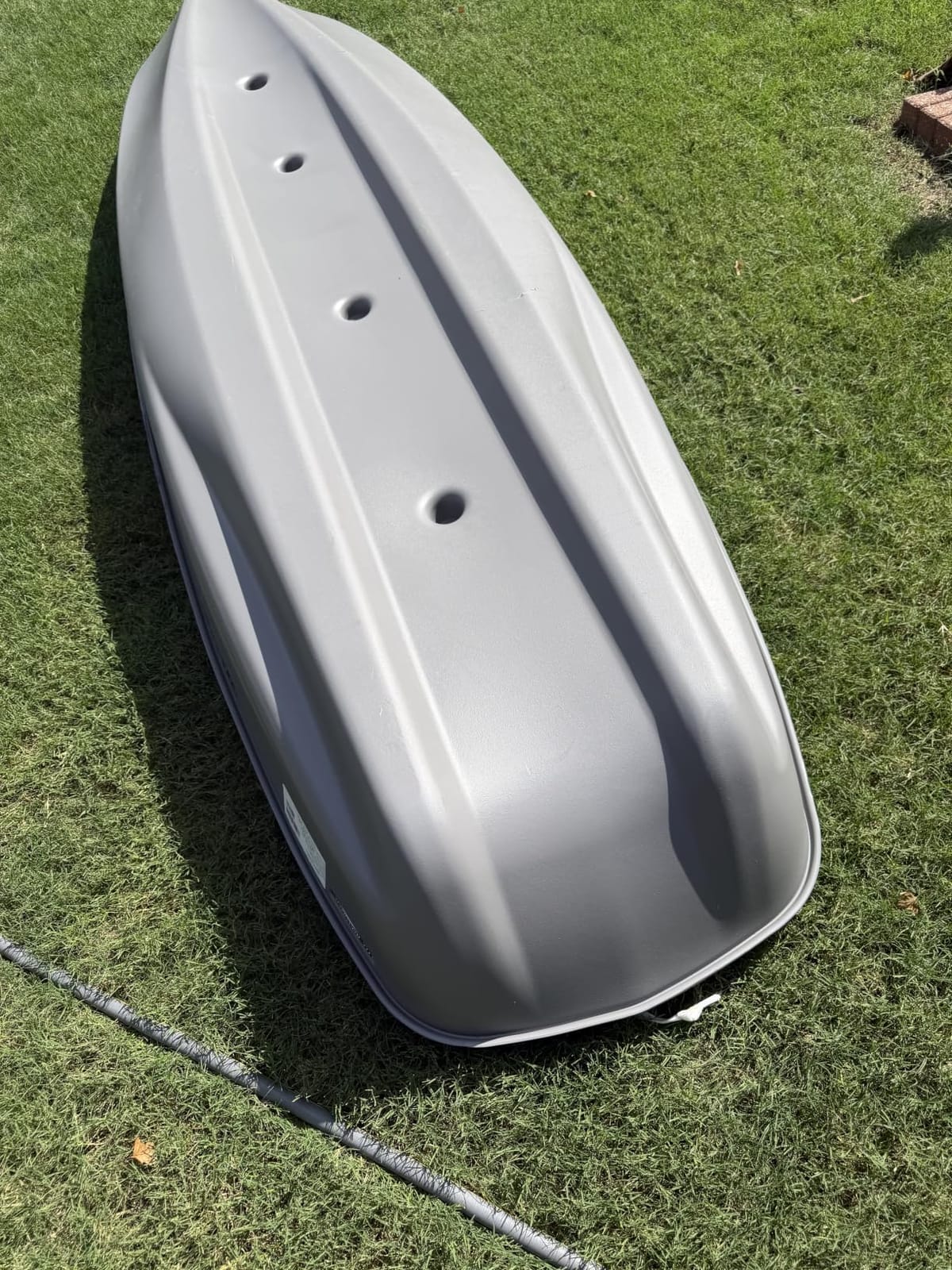
The Catch Classic 100 is the one to look at if the Catch Mode 110 feels like more boat than you need. It is 8 inches shorter, 10 pounds lighter, and it has something the Mode does not: a front quick-lock hatch, which is real enclosed storage rather than a bungee well. For phones, keys and a spare layer in salt spray, that matters.
Otherwise the formula is familiar and it works. Tunnel hull, flat deck, a 34 inch beam, a 350 pound rating and internal flotation added to meet or exceed ABYC standards. The ERGOCast Classic seat adjusts between high and low positions so you can pick your sightline or open up the deck for casting.
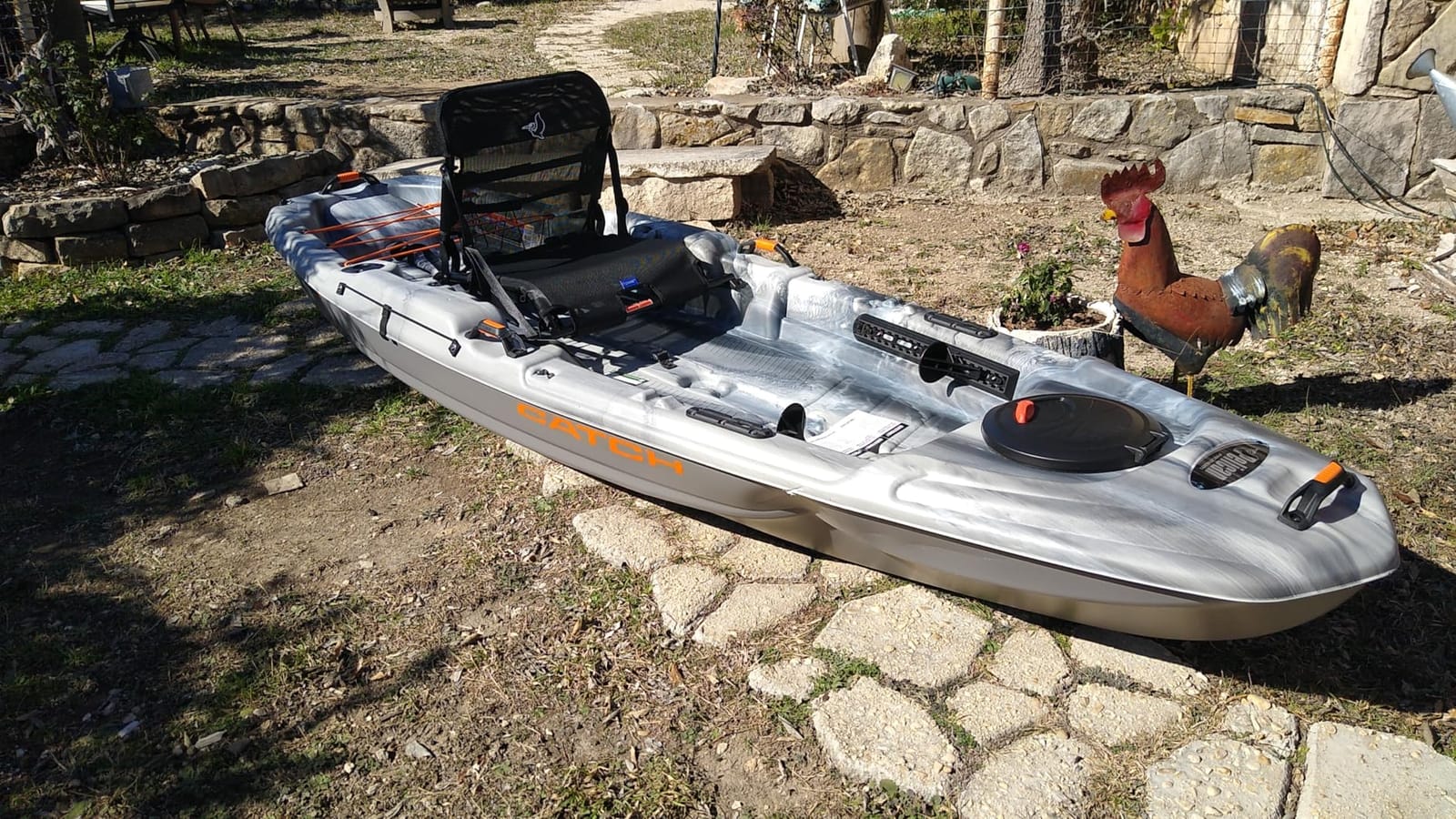
Rigging comes in the form of two 4 inch tracks and two accessory eyelets, two flush-mount rod holders, adjustable footrests, a bottle holder and paddle tie-downs. At 57 pounds with ergonomic carrying handles it is one of the lighter boats in its class, which is unusual for a 10 foot tunnel hull.
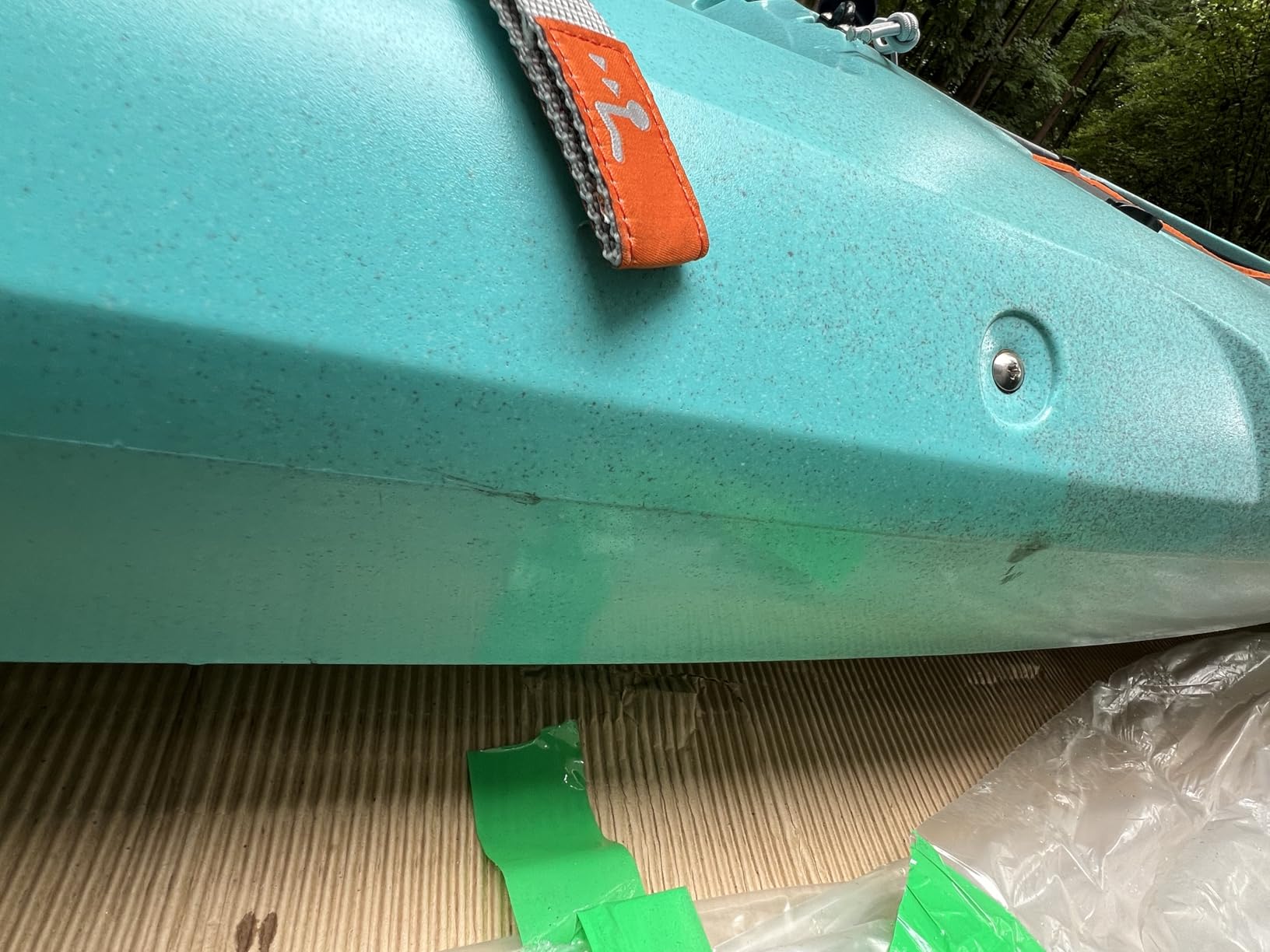
Two things temper the recommendation. The wide beam makes it slow and less nimble, so it is a fishing platform rather than a paddling boat, and the one-star share of reviews is higher than we would like, largely tied to delivery damage and missing scupper plugs rather than the boat itself. Inspect the hull on arrival.
Is a quick-lock hatch better than a tank well in salt water?
For anything you cannot replace, yes. A tank well is open deck space that keeps things accessible and lets water through. A sealed hatch keeps electronics, documents and dry clothing dry when the boat takes water over the deck in a wave or you capsize.
The practical answer is to use both. A quick-lock hatch for the electronics and the dry layer, and the rear tank well with bungee cords for the tackle, the kill board and the fish bag. This board is one of the few under 12 feet that supports that split.
Who should look elsewhere
Anglers who want speed. This hull will not cover distance efficiently, and if your day is defined by a long paddle to a reef you need a longer, sharper boat. The Old Town Sportsman PDL 106 further down this list solves that with a pedal drive.
Also consider alternatives if you need more than two rod holders live at once, since the Catch Mode 110 carries three. The adjustable footrests and hardware here feel basic next to premium models, though nothing on the boat is troublesome.
8. Wilderness Systems Tarpon 120 – Longest and Fastest Tracker Here
Wilderness Systems Tarpon 120 – Sit on Top Fishing Kayak – Premium Angler Kayak – Adjustable and Designed Seat – 12.3 ft – Galaxy
Length: 12 ft 3 in
Weight: 63 lb
Capacity: 350 lb
Hull: PE
Pros
- Fast and straight tracking for a fishing kayak
- Phase 3 Air Pro seat with cool-touch fabric
- Removable dry box plus front dry hatch
- Owner reports of 7-8 years of coastal use
Cons
- Low seat with no standing position
- UV-sensitive seat fabric fades within months
- Only modest lumbar support on its own
The Tarpon 120 is the boat in this list that behaves most like a sea kayak, which is exactly what you want when the paddle is the transport system rather than a seat. At 12 feet 3 inches it tracks straight, moves efficiently and covers ground in a way none of the wide tunnel hulls do, and owners report long-term use in surf, estuary and open-ocean conditions.
Storage is the strongest part of the package. A large rear well takes crates, coolers and diving gear, and there is a front hatch for dry storage plus a removable Dry Tec dry box for wallets, phones and keys. That matters in salt water, where a soaked phone ends the trip.
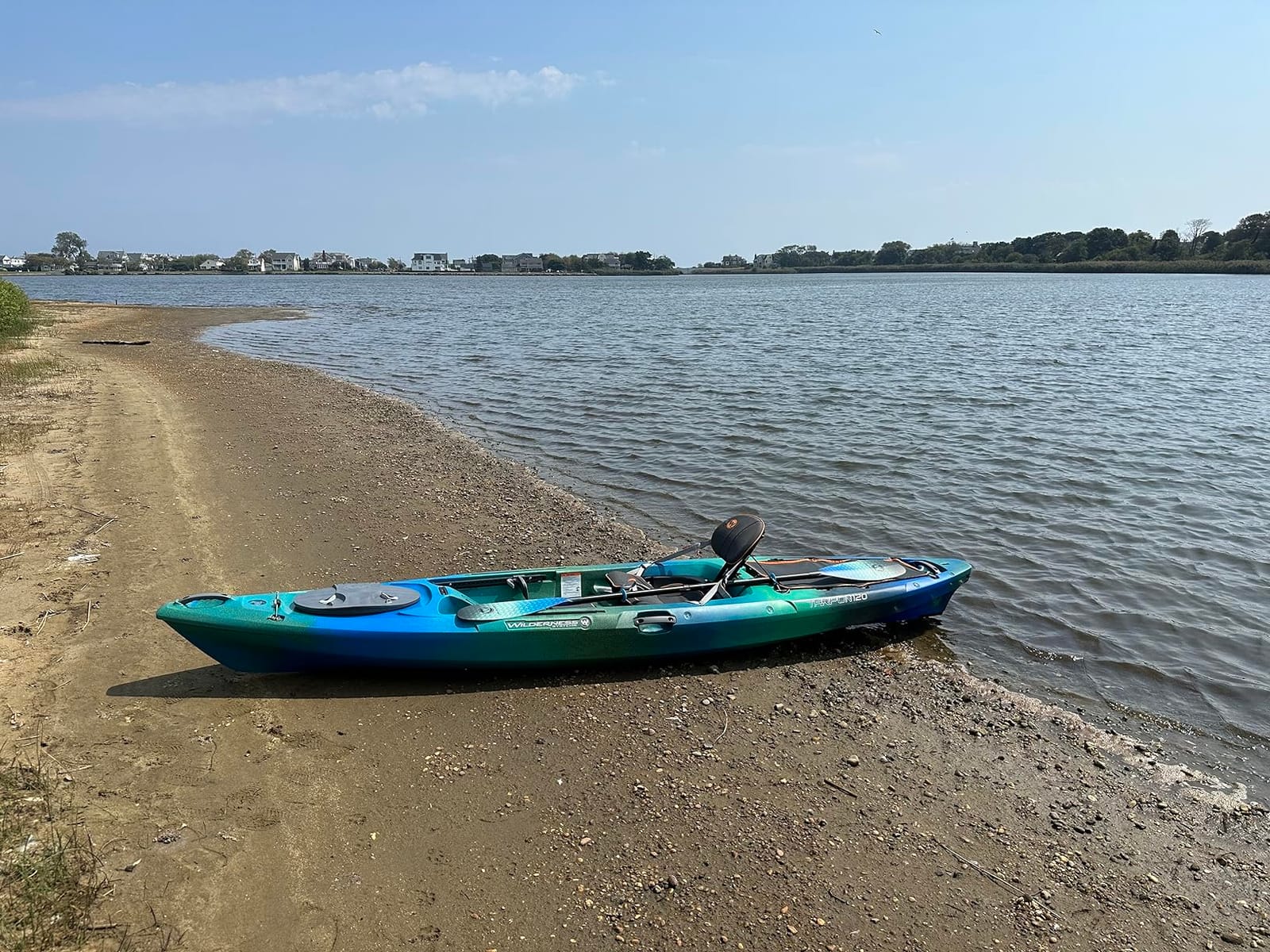
The Phase 3 Air Pro seating system is widely praised for all-day comfort and lumbar support, with a cool-touch surface that stays cooler in the sun than standard fabric. Large padded footrests with a quick-adjust locking lever accommodate different paddler heights, and the SideTracks accessory rails plus a magnetic bottle strap system let you customise the deck.
The compromises are real. The seat is low with no raised or standing fishing position, so every cast is seated, and the UV-sensitive seat fabric and trim reportedly fade within months of coastal use. Owners also find lumbar support modest unless you add a separate pad. One owner in particular reported 7-8 years of the same model in coastal and estuary fishing, which tells you the hull holds up.
Is 12 feet long enough for open water fishing?
Yes. Twelve feet is roughly the point where a sit-on-top starts to behave credibly in chop and a following sea, because hull volume and length combine to add stability and reserve buoyancy. Of the boats here, this is the one we would be least hesitant about taking past the breakwater on a normal forecast day.
The caveat is loading. At 63 pounds with a full rig you are carrying a real weight, and the 350 pound rating gives less headroom than the 425 pound Outlaw. Work out your loaded figure before committing, and remember that length adds weight to every launch.
Where the Tarpon 120 is the wrong boat
It is the wrong boat for an angler who wants to stand and fish, full stop. The low seat and the 31 inch beam are a seated platform, and a surf launch with a 63 pound hull is a two-person job or a cart job.
It is also the wrong pick if storage that keeps gear dry is not a priority and you would rather have the simplest possible boat. Some reviews are also driven by shipping damage and missing accessories rather than the kayak, so check the box contents on arrival before you plan a trip.
9. Reel Yaks Radar Modular – Foot Drive With Instant Reverse
Reel Yaks Radar Modular Fishing Kayak, 10ft, 430 lbs Capacity
Length: 10 ft
Beam: 33 in
Capacity: 430 lb
Drive: propeller
Pros
- Propeller drive with instant forward and reverse
- 430 lb rating on a pedal platform
- Two-piece hull stores in a trunk or closet
- HDPE shell with 2-year hull warranty
Cons
- Heaviest rig here at 88 lb
- Smallest review base at 35 reviews
- Drive and rudder hardware need periodic troubleshooting
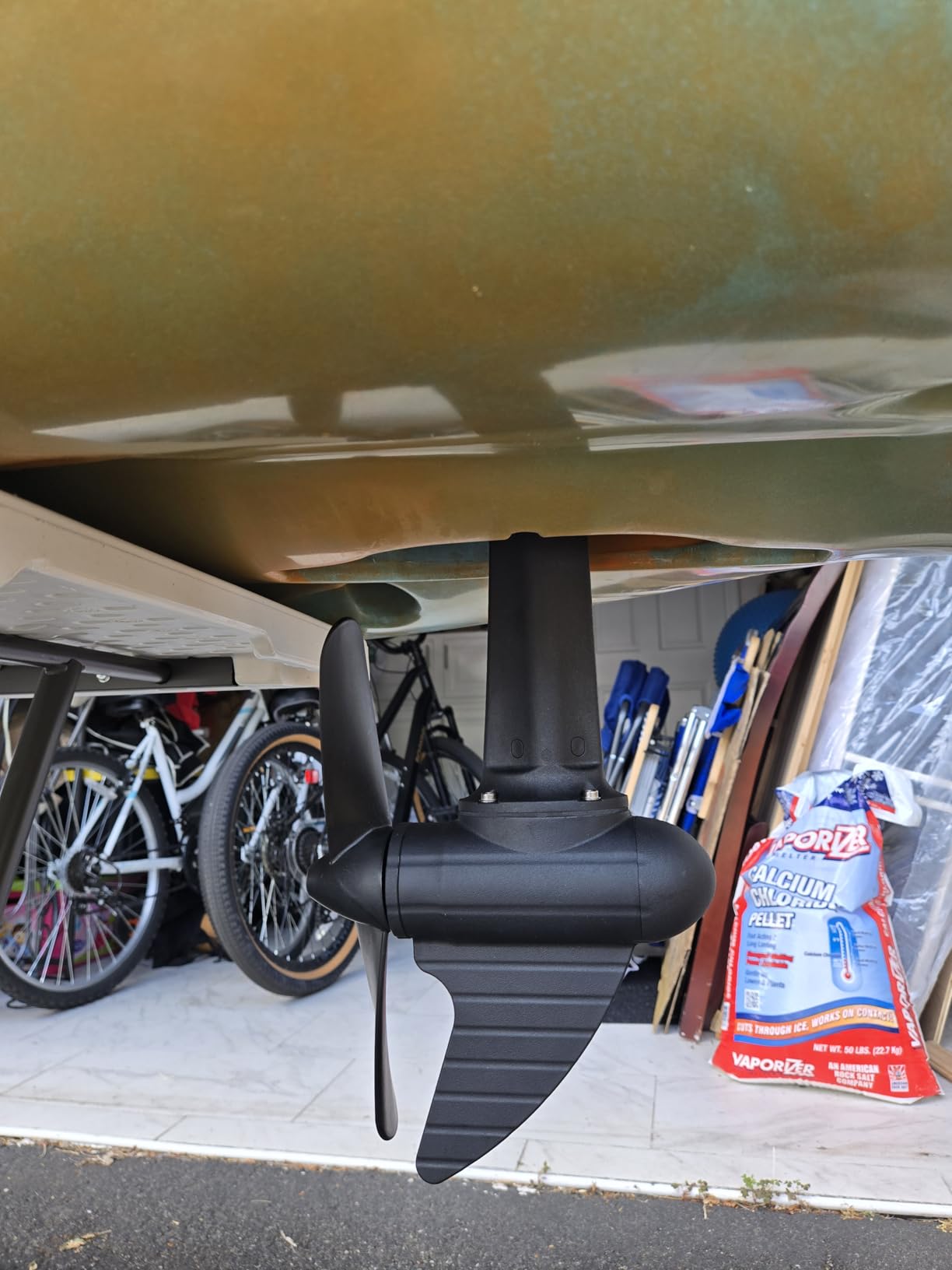
The Radar is the one to look at if you need a high capacity and a pedal drive and you cannot own a trailer. The propeller drive gives instant forward and reverse, which makes backing onto a fish or positioning yourself in a tight mangrove cut far easier than a fin drive or a paddle. Two-piece modular storage means it lives in a closet between trips.
Capacity is the headline number at 430 pounds on a wide W hull, so it stays planted when you stand up to cast. It comes with a 360 rod holder, track rails, storage hatches, a stadium seat and a paddle. The HDPE shell is backed by a 2-year hull warranty.
Honest caveat first: the feedback base is thin at 35 reviews, so the sentiment is encouraging but not deeply proven. What the reviews do show is strongly positive on drive response and capacity, with a visible cluster of three-star feedback about assembly and drive-hardware friction during the first outings.
At 88 pounds for the rig, splitting it in two does not make it a light boat. Several users still treat each half as a two-person carry, and you will want a cart regardless. The propeller and rudder hardware can need periodic troubleshooting, which is a normal cost of owning a drive system.
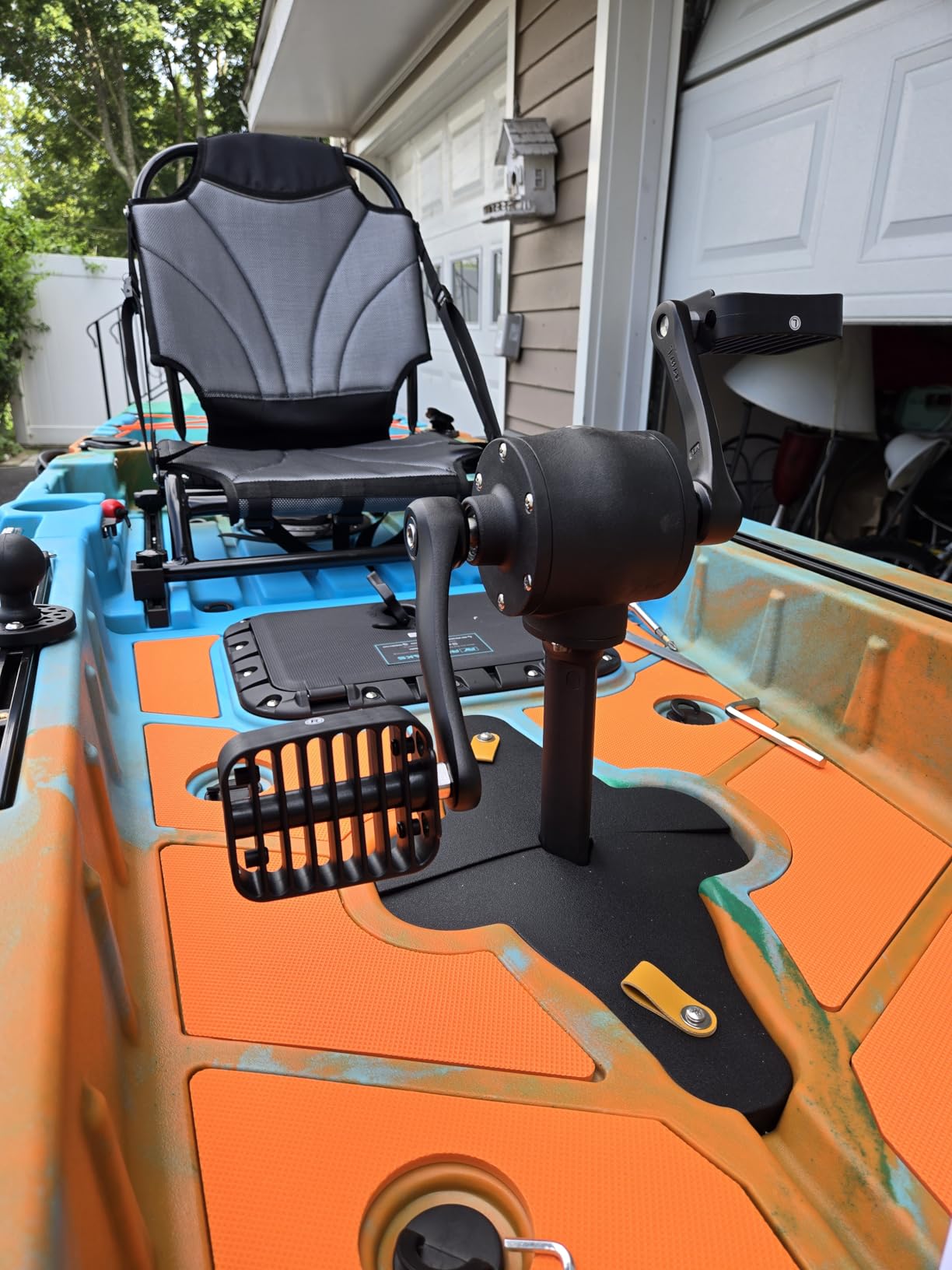
Do you need instant reverse on a fishing kayak?
If you fish tight water, yes. Instant reverse is what lets you back down onto a school, hold position against a current with the wind on your nose, or slide out of a dead end in a mangrove channel without a long paddle stroke turnaround. It is a small feature until the first time you need it.
On open water with a long run, it matters less because you are travelling rather than manoeuvring. Either way, a propeller drive is quieter in the water than a paddle and leaves your hands free for the rod, which is the reason to consider a pedal boat at all.
Where the Radar is the wrong boat
It is the wrong boat if you cannot solve the 88 pound transport problem. A cart solves the parking lot, but the loading and unloading is still the hardest part of owning it, and the Raptor or Albott are lighter modular alternatives with the same storage advantage.
It is also the wrong pick for a first saltwater kayak with a thin evidence base. If this is your first boat and you are unsure how you will use it, a paddle model with a proven owner history is a more comfortable place to start.
10. Albott Modular Fishing Kayak – Stainless Hardware for Salt Air
Albott Modular Fishing Kayak with Propeller Drive System & Durable HDPE
Length: 9.6 ft
Beam: 34.7 in
Capacity: 400 lb
Drive: propeller
Pros
- 304 stainless hardware and reinforced HDPE hull
- Quiet propeller drive with easy reverse
- Three-step modular assembly with internal handles
- Adjustable seat with generous gear storage
Cons
- Heaviest listed weight at 109.7 lb
- Only a 6-month warranty
- Smallest review base in the group at 34 reviews
This is the boat with the most saltwater-aware hardware in the group, and that is not a small thing. It uses 304 stainless steel for the fittings, a reinforced HDPE hull and secure pin connections between sections, which is exactly the specification list that matters when your boat lives in a wet dock or a rental rack in a coastal town.
The propeller drive is tuned for tight water: quiet acceleration and easy reverse for docks, channels and mangrove edges, which is where a lot of the best inshore fishing actually happens. The reinforced hull is built for commercial rental duty, so it will take more abuse than a personal boat ever will.
Transport is handled with a two-section modular design, internal carry handles in each section and a three-step assembly on a flat surface. The seat is adjustable, storage is generous, and the rudder raises and lowers on a cable with a smooth steering handle. A 400 pound rating and a listed seating capacity of two make it a family or rental-capable boat.
Three honest warnings. It is the heaviest listed rig here at 109.7 pounds, the warranty is only 6 months which is far shorter than anything else in this roundup, and the capacity is listed inconsistently at 400 pounds in the spec table and 420 in the highlight. With 34 reviews, sentiment is the most favourable in the group but the evidence base is the smallest.
Why does stainless hardware matter for a fishing kayak?
Because salt water destroys ordinary steel. A plain steel bolt in a salt spray environment corrodes within a season or two, seizes, and takes the fitting it holds with it. Stainless fittings cost more at the factory and essentially eliminate a whole category of mid-season failures on rods, cleats, tracks and drive hardware.
This is also the argument for rinsing your boat, which we cover in the maintenance section below. The right hardware buys you time, but a freshwater rinse every single trip is what keeps the hull, the rails and the fittings alive over a decade.
Where the Albott is the wrong boat
It is the wrong boat for anyone who moves it alone without a cart, and the wrong boat to buy if warranty length matters to you. A 6-month warranty on a boat you will keep for years is thin next to the 5-year hull coverage on the Lifetime and Perception models.
For personal coastal use it is over-specified, and that is fine if you are outfitting a rental business or sharing with family. For a solo angler, the Lifetime Lockport 94 gives a similar modular convenience at 40 pounds with a much longer warranty.
11. Lifetime Lockport 94 – Modular Hull That Lives in a Trunk
Lifetime Lockport 94 Modular Sit-on-Top Kayak with Paddle, Two-Piece Design with SlideLock System, Rod Holders, Adjustable Seat
Length: 9.3 ft
Beam: 30 in
Weight: 40 lb
Capacity: 250 lb
Hull: HDPE
Pros
- Two-piece hull fits in an SUV or minivan
- Tool-free SlideLock assembly
- Molded skeg and deep channels for tracking
- Chine rails add stability in moving water
Cons
- No rudder so course correction is all paddle
- 250 lb rating is the lowest here
- Molded-in footrests are not adjustable
The Lockport 94 is the practical one. It is the cheapest-per-pound way to own a real hardshell angling kayak that breaks into two pieces and fits in a vehicle without a roof rack, and at 40 pounds it feels rigid in a way no inflatable ever does. If you have been thinking of an inflatable for convenience, this is the hardshell answer to that problem.
Owners frame it as a beginner-friendly durable upgrade, and the assembly is genuinely easy: the two halves slide together on a flat surface once the alignment marks line up, with no tools. The SlideLock tongue-and-groove keel joint and side latches make the on-water ride feel like a single boat rather than a compromise.
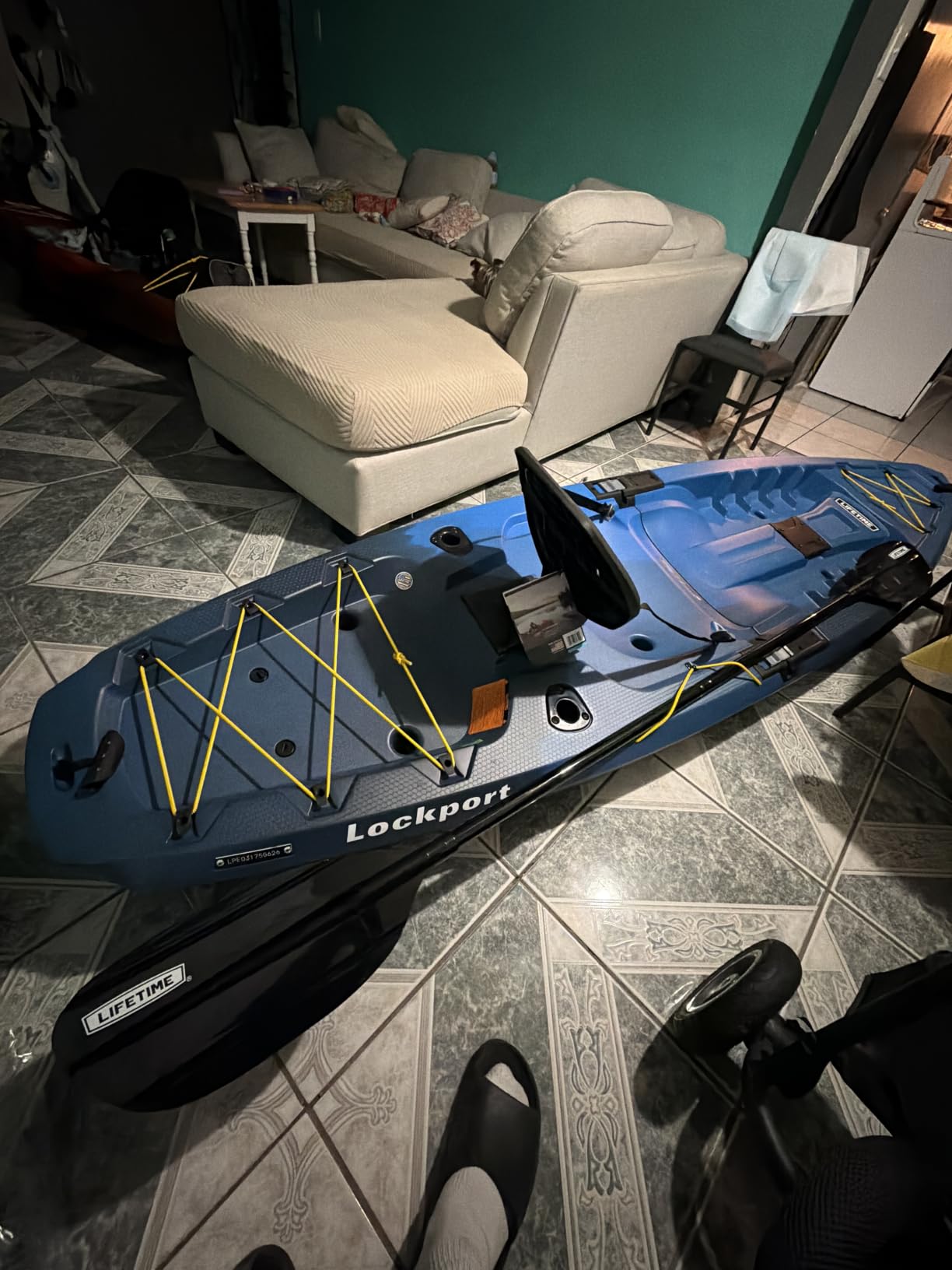
For handling, a molded-in shallow skeg and deep hull channels give straight-line tracking, and chine rails add secondary stability in moving water. The angler fittings are real: two flush-mounted rod holders, a tankwell with bungee lacing, a bottle holder and a paddle keeper, plus an adjustable padded seat back.
The limitations are honest. There is no rudder, so every course correction is a paddle stroke, and the 250 pound rating is the lowest in the roundup. Footrests are molded in rather than adjustable, the seat back is unpadded enough that owners add a cushion, and the centre carry handle is uncomfortable over a long walk.
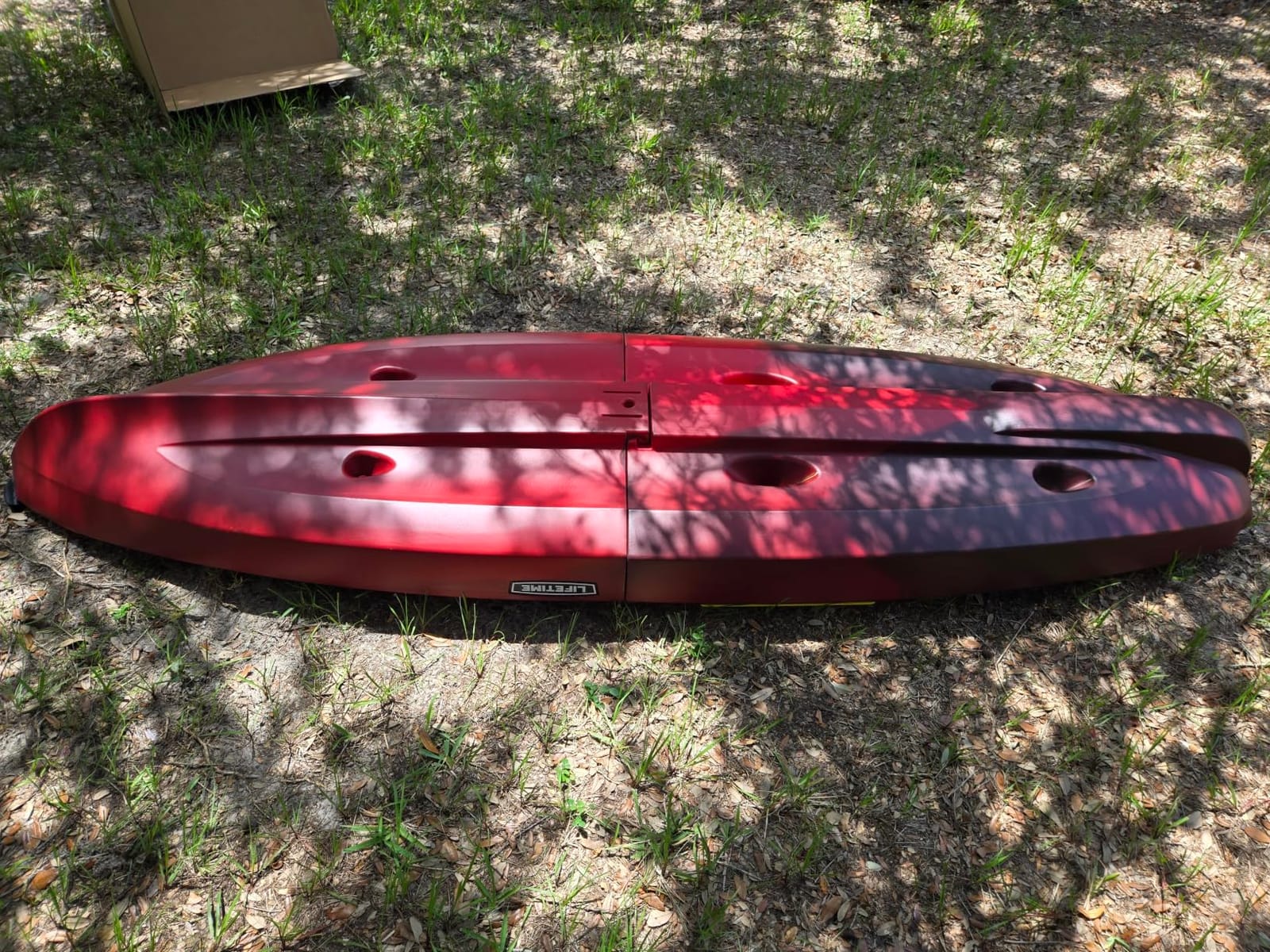
Is a modular kayak as good as a one-piece hull on the water?
For calm and moderate water, yes. Once the SlideLock joint is latched, owners report a rigid ride with no flex and confident tracking. The seam adds a small amount of drag, so it is not the fastest boat here, but that is a fair price for trunk storage.
In heavy chop, a one-piece moulded hull of the same weight would be marginally more continuous in structure. The difference is small enough that we would not rule out the modular design on that basis alone, especially for an angler launching from a beach with a long walk to the water.
Who should skip the Lockport 94
Anyone over about 200 pounds with a full rig, because 250 pounds is a hard ceiling. Anyone fishing in current, because the lack of a rudder means you paddle or you drift, and there is no middle setting. And anyone planning to stand, since a 30 inch beam is a seated platform.
It is genuinely well suited to bay fishing, estuary work, calm rivers and the shallow flats where a lot of beginners start. For offshore work, step up to a 12 footer with a rudder and a realistic capacity.
12. Old Town Sportsman PDL 106 – Pontoon Hull With Forward and Reverse Pedals
Old Town Sportsman PDL 106 Solo Sit-on-Top Fishing Pedal Kayak, 10 ft 6 in, Steel Camo
Length: 10 ft 6 in
Beam: 36 in
Capacity: 450 lb
Drive: forward and reverse
Pros
- Smooth quiet pedal drive with instant reverse
- Exceptionally stable when standing to cast
- 450 lb capacity and a 36 inch beam
- Removable console simplifies cartopping
Cons
- Heaviest boat here at 107 lb plus an 18 lb console
- Paddle sold separately
- Awkward on a car top without a rack and cart
The Sportsman PDL 106 is the offshore and heavy-angler answer, and it carries the highest rating in this roundup at 4.7. The pontoon-style hull pairs real primary stability with a pointed bow that still tracks into skinny water, which is the combination almost nobody else in this list manages. Owners stand up, bounce and bob without worrying about flipping.
The pedal drive is smooth and quiet with forward and reverse, so you can hold position in wind or back into a lily pad or a tight spot without a turnaround. At 10 feet 6 inches with a 36 inch beam and a 450 pound maximum capacity, there is room for a large angler plus a serious load.
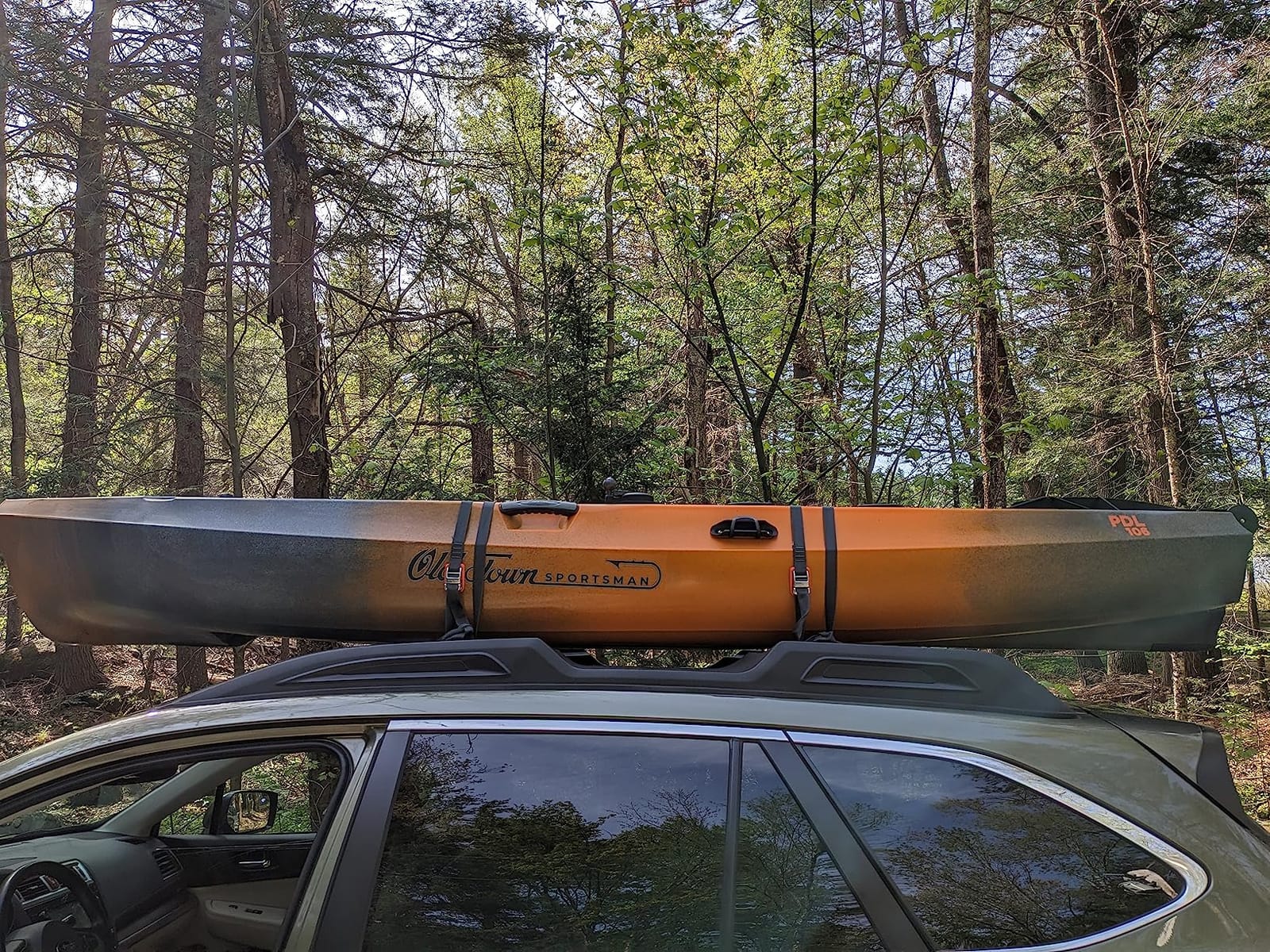
It is also well equipped for electronics. Accessory tracks, cushioned floor pads, a custom tackle box, multiple rod holders and a universal transducer mounting system make adding a fish finder straightforward, and the premium adjustable mesh seat has lumbar support and leg-length adjustment for long days.
Weight is the honest cost. At 107 pounds plus an 18 pound removable pedal console, this is a two-person lift or a cart-and-ramp job, and the paddle is sold separately. The removable console is a real help for solo transport and cartopping, but it does not make the hull light. A limited hull warranty and 5-year drive warranty is reasonable coverage.
Can a pedal kayak go offshore safely?
A pedal kayak in this class can, in the same conditions a small boat of its size would, and the drive system helps because you hold a heading across current while your hands are free. Stability is the real enabler: a 36 inch beam pontoon hull behaves very differently in a chop than a narrow 10 footer.
What it cannot do is overcome weather, distance or a flooded cockpit in a drive system. Keep a VHF, a whistle and a working PFD within reach, check the tide table, and treat a rising onshore wind as a reason to head in early rather than a challenge.
Where the Sportsman PDL 106 is the wrong boat
It is the wrong boat for a beginner, and the wrong boat for anyone whose launch involves carrying the boat any distance. It is also oversized for fishing tight, heavily covered water where a 9 foot hull can work and this one simply will not fit.
Cost is the other filter. This is the premium boat in the group, and if you are not regularly covering real distance in current, the money is better spent on a good paddle kayak with a cart and a decent rod setup. If you do that distance regularly, this is the boat that removes the effort from it.
Sit-On-Top vs Sit-In for Saltwater Fishing
A sit-on-top is the right choice for salt water fishing, and the reason is mounting height rather than performance. You step onto the deck from above instead of sliding through a cockpit, there is no spray skirt to fail in surf or heavy weather, and any water that comes aboard simply drains away through scupper holes instead of filling the hull.
That last point is the safety argument. If you capsize, a sit-on-top floats you higher and you remount from the top, whereas a sit-in with a failed skirt or a flooded cockpit is a far worse place to be a mile offshore. For an angler who wants to stand and cast, a high seated position with a wide deck is also simply more useful.
Where sit-on-tops lose is speed and tracking. A sit-in has a longer, narrower waterline and is noticeably more efficient over distance, which is why paddlers covering ground on long trips often choose one anyway. Sit-on-tops are also more exposed to wind, and they take on spray in waves because there is no deck lip to stop it. The last honest disadvantage is comfort: an open sit-on-top with a framed seat is fine for a long session, but it never matches a sit-in with proper foot braces and a backrest for a full day of touring.
The 120 Rule: How Long Should a Saltwater Kayak Be?
The 120 rule is a sizing guideline for recreational kayaking: your kayak should be at least 120 percent of your height. So a 5 foot 10 inch paddler wants a boat of at least 11 feet 8 inches, and a 6 foot angler wants at least 12 feet.
The reasoning is paddle clearance and trim. Too short and your paddle blade drags the water on every forward stroke, which costs speed and floods the boat in chop. Too long and the boat is harder to control for someone who has not found their footing. It is a guideline for flat and mild water, not a hard limit, but in salt conditions err long.
Applied to fishing, the 120 rule is a floor, not a target. Offshore and in current, add six to twelve inches beyond it for a sharper bow, more tracking and more reserve buoyancy. Check your own number before shopping: multiply your height in inches by 1.2, then compare that against the boat length in the table above and add the safety margin for the water you actually fish.
Rudder vs Skeg vs Trolling Motor in Tide and Current
This is the single most important feature decision in a saltwater angling kayak, and almost no roundup covers it. A skeg is a fixed fin underneath the hull that resists sideways slip, so it improves tracking in a straight line and damps yaw. It costs nothing and needs no control, but it cannot be turned off, and it adds drag in shallow water.
A rudder hangs off the stern and steers with a cable, a handle or foot pedals. Because it only bites when you deploy it, you get the tracking benefit when you want it and clean shallow-water performance when you do not. In a flood tide, a crosswind or a long crossing, a rudder is the difference between holding a line and paddling continuously.
A bow-mounted trolling motor adds thrust, which is a different problem from steering. It keeps you stationary over structure without holding a position with the paddle, which saves energy over a full day. It needs a battery, a wiring point and a mount, and the deep draw has to be budgeted across a ten hour day. The practical decision order is simple: skeg for straight-line calm water, rudder for current and wind, motor or pedal drive when you need to hold station or cover real distance.
Saltwater Corrosion and the Fresh-Water Rinse Routine
Salt air is the enemy of a fishing kayak, and the damage is invisible until a fitting seizes. The rotomolded polyethylene hull itself shrugs off salt water, which is why hardshells last, but every metal part on the boat is on a clock in a coastal environment. The routine below takes ten minutes and is the difference between a ten-year boat and a five-year one.
Rinse before anything else. Fresh water on the hull, deck and underside while the boat is still wet and salt is still loose in the surface.
Pay attention to hardware. Rudder cables, rod holder screws, accessory track bolts, handle bolts and any stainless fittings all get a direct spray.
Run the scupper system. Flush the drain port and check the plug is seated, because a blocked scupper turns a self-bailing boat into a bathtub.
Wash the deck. Salt crystals under bungee cords and around tank wells chew into plastic fittings if you leave them.
Check the drive system. On pedal and propeller models, rinse the drive unit, the cable run and the mounting pins, and dry them before storage.
Inspect the mounting hardware. Look for rust bloom around rivets and bolts, especially on older boats, and replace anything that has pitted.
Let it dry fully. Store the boat dry and out of direct sun, loosely covered rather than sealed in a damp bag.
Wax the seat and trim. UV damage and salt together accelerate the breakdown of seat fabric, and a marine-grade wax slows it.
Two more habits pay off. Keep a spare drain plug and a spare rudder cable in the dry box, because a lost plug in chop is a swim you cannot ignore. And grease the drain plug threads periodically so it still comes out after a season in salt water.
Safety Gear Checklist for Offshore Kayak Fishing
None of the boats in this roundup replaces a safety kit, and the wider the water you fish, the more of that kit you actually need. A basic inshore day trip from a sheltered launch needs far less than a full offshore day, so we have split it by trip type.
Every trip, inshore or offshore:
A properly fitted PFD you will actually wear, with the whistle clipped to a shoulder strap rather than buried in a dry bag.
A whistle on a lanyard, attached to you and not to the boat.
A working paddle plus a spare, and a paddle leash if the water is moving.
Your phone in a waterproof case on your person, plus a headlamp for a dawn or dusk launch.
A bail of fresh water, sun protection, and a knife or line cutters you can reach without unpacking.
Add these for coastal and offshore days:
A handheld VHF radio. Phone reception is not a substitute offshore, and a marine band channel is where help actually is.
A GPS unit or a phone with offline charts, with your route and launch point saved before you leave the car.
A compact anchor with line, or a drift sock, so you can hold station over structure without burning your legs.
A bilge pump or sponge, and a bailer. On a sit-on-top these matter less than on a sit-in, but a wave over a loaded deck still puts water in.
A whistle, light and phone accessible from the seat, not stowed in the hull where they are unreachable after a capsize.
Finally, tell someone your launch point, your planned return time and where you are going. It is the least technical item on the list and the one that most often matters.
Frequently Asked Questions
What is the best kayak for saltwater fishing?
The best kayak for saltwater fishing is a wide-beam, hardshell sit-on-top angling kayak with a self-draining deck, a rudder or skeg for holding a line in current, and corrosion-resistant hardware, rated for your body weight plus your full tackle load. Those four things are what let you surf-launch, paddle through tide and chop, and stay planted while casting.
What is the 120 rule in kayaking?
The 120 rule says your kayak should be at least 120 percent of your height. A 5 foot 10 inch paddler wants a boat of 11 feet 8 inches or longer, and a 6 foot angler wants 12 feet or more. In fishing kayaks treat it as a floor and add six to twelve inches if you will be in current or chop.
Are sit-in kayaks better for fishing than sit-on-top kayaks?
For salt water fishing, no. A sit-on-top is easier to mount and dismount, has no spray skirt to fail, drains water away through scupper holes, and gives you a high wide deck for casting. A sit-in is faster and more efficient over distance, which is the one real argument in its favour.
What are the disadvantages of sit-on-top kayaks?
They are slower and less efficient over distance than a sit-in, they catch more wind, and they take on spray in waves because there is no deck lip. An open framed seat is also less comfortable than a sit-in cockpit for a full day of touring, and many sit-on-tops have no enclosed dry storage.
Do I need a rudder for offshore kayak fishing?
Yes, for anything past protected water. A rudder holds a heading across wind and current so you are not paddling continuously, and it only bites when you deploy it, which keeps it out of the way in shallow water. A skeg improves straight-line tracking but cannot be turned off, so it is not a substitute offshore.
Is a pedal kayak better for fishing than a paddle kayak?
For long runs to offshore structure, yes. A pedal drive holds a line across current with far less effort and lets you fish while travelling, and propeller drives add instant reverse for manoeuvring in tight water. On short trips in calm water it is a luxury you do not need, and the extra weight and maintenance are real costs.
Can I use a freshwater fishing kayak in saltwater?
You can, but only with care. Check the drain plug, fit scupper plugs, keep hardware rinsed with fresh water after every trip, and stay in protected water rather than open coast. A narrow light boat with no rudder and weak tracking is the one that will disappoint you offshore.
Which Sit On Top Fishing Kayak Should You Buy?
Start with your loaded weight, not your height and not the fish you hope to catch. Add your body weight, your boat, your tackle, your cooler and a realistic catch, and buy the next board up from the number that produces. From there the choice is about water and effort.
Fishing sheltered bays, creeks and estuaries on your own? The Lifetime Tamarack Angler 100 is our editor’s choice and the most complete saltwater sit-on-top here, with the sharpest tracking among the mainstream boards and an owner history long enough to trust. Standing to cast, or carrying a serious load? The Pelican Catch Mode 110 gives you a 34.5 inch tunnel hull and a 375 pound rating, and the Perception Outlaw 11.5 goes further still at 425 pounds. Covering real distance in current? Take a pedal drive, and the Old Town Sportsman PDL 106 is the one that handles open water and heavy loads best. Storage and transport decide more purchases than people expect, which is why two modular Reel Yaks models and the Lifetime Lockport 94 sit in this list despite modest ratings.
Whichever you choose, run the 120 rule, buy a kayak cart, and rinse the boat in fresh water after every single trip. That last habit is what keeps any of these on the water in 2026 and beyond.