
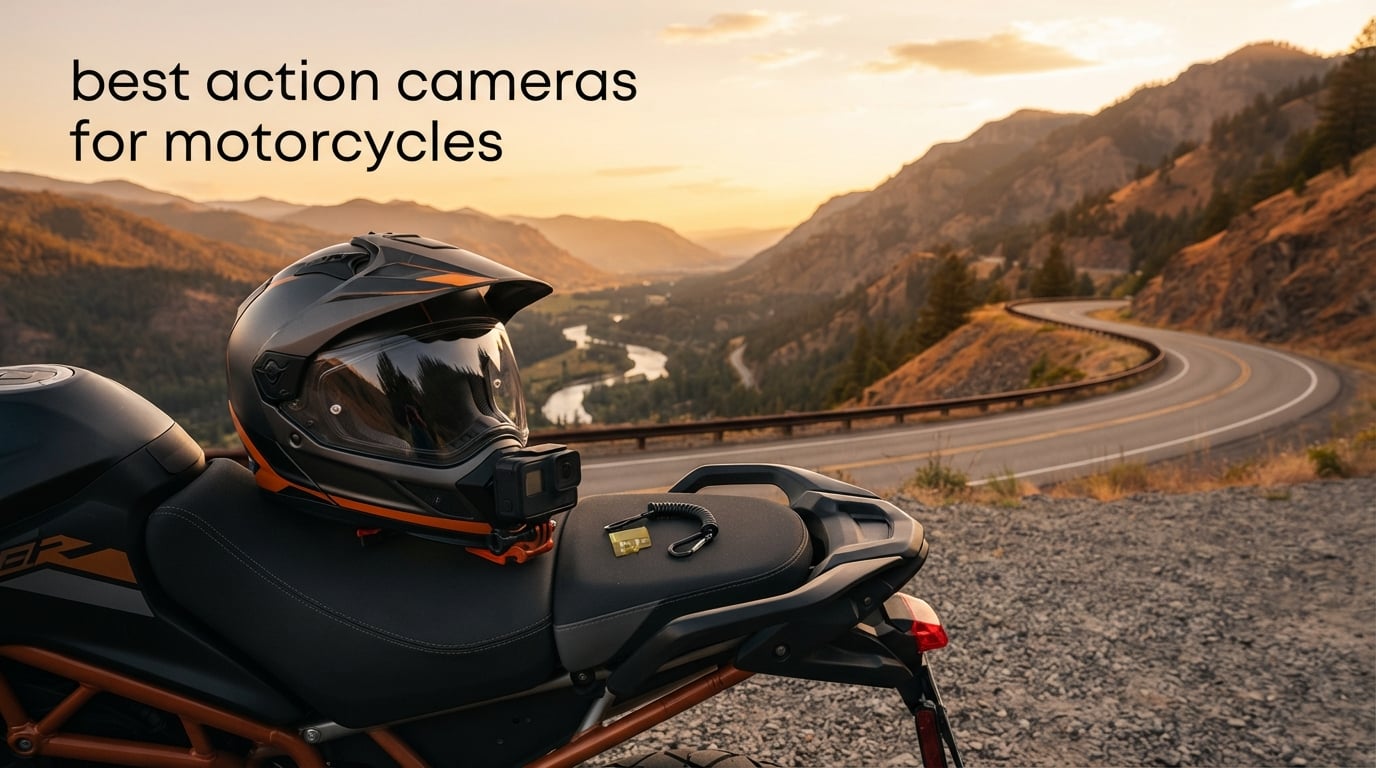
For most riders, the best action cameras for motorcycles in 2026 are the ones that hold a clean 4K image while a helmet is being shaken by rough tarmac at motorway speed. The AKASO EK7000 is the pick we keep coming back to: it weighs 2 ounces, ships with two batteries and a dual charger, has electronic image stabilization built in, and has been reviewed nearly 40k times, which is the largest owner base in this list. If your rides happen after sunset or you film at night, the DJI Osmo Action 4 pulls ahead on its 1/1.3-inch sensor, and if you shoot alone and want to reposition the camera after the ride, the Insta360 X3 is the one to look at.
Motorcycle footage is harder to capture than almost any other action-cam use. You get constant high-frequency vibration that defeats basic electronic stabilization, wind buffeting that shreds onboard audio, rain and temperature swings, and a real risk of losing an expensive camera if a magnetic mount lets go. That is why the criteria that matter most here are stabilization strength, battery endurance, waterproofing, audio handling and mount security, not headline resolution alone.
Riders on r/motorcyclegear have said plainly that they are tired of sponsored roundups and want something fair to read, so every camera below comes with a real downside attached. We also leaned on the practical side of the craft: if you are choosing a camera for a completely different sport, our general action camera comparison and vlogging camera picks are the right places to start. This guide covers ten cameras from roughly the entry tier to the current flagship generation, with the verdict at the end mapped to the kind of rider you are.
Top 3 Picks: Motorcycle Action Cameras in 2026
If you only read one block on this page, read this one. These three cover the widest spread of riding use: a dependable budget daily driver, a 360 camera for solo riders who want to reframe their footage, and the low-light champion for anyone who films dawn and dusk runs.

AKASO EK7000
- 4K30 with EIS
- Two batteries plus dual charger
- 2 ounce body
- 131ft waterproof case

Insta360 X3
- 5.7K 360 Active HDR
- FlowState plus Horizon Lock
- Reframe in the app
- 2.29 inch touchscreen
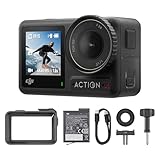
DJI Osmo Action 4
- 1/1.3-inch sensor
- 4K120 at 155 degrees
- 1770mAh cold-resistant battery
- Waterproof to 18m
Best Action Cameras for Motorcycles in October
This table is the fastest way to narrow the field. Every row is listed in the same order as the individual reviews below, so you can jump straight to the one that fits how and when you ride.
| Product | Specifications | Action |
|---|---|---|
| AKASO EK7000 |
|
Check Latest Price |
 AKASO Brave 4 AKASO Brave 4 |
|
Check Latest Price |
 Dragon Touch Vision 3 Dragon Touch Vision 3 |
|
Check Latest Price |
| Insta360 X3 |
|
Check Latest Price |
| DJI Osmo Action 4 |
|
Check Latest Price |
 DJI Osmo Action 6 DJI Osmo Action 6 |
|
Check Latest Price |
 Insta360 GO 3S Insta360 GO 3S |
|
Check Latest Price |
 SJCAM SJ4000 SJCAM SJ4000 |
|
Check Latest Price |
 GoPro HERO13 Black GoPro HERO13 Black |
|
Check Latest Price |
 AKASO Brave 7 LE AKASO Brave 7 LE |
|
Check Latest Price |
1. AKASO EK7000 – Best Overall Motorcycle Camera on a Budget
AKASO EK7000 4K30FPS 20MP WiFi Action Camera with EIS Ultra HD 131FT Waterproof Underwater Camera Remote Control 4X Zoom Support External Microphone Black
4K30 video and 20MP photos
Built-in electronic image stabilization
2 ounce body, two batteries included
Waterproof case rated to 131ft
Pros
- 4K30 and 20MP stills at a very low entry point
- Built-in EIS smooths vibration on helmet and bar mounts
- Two batteries and a dual charger in the box
- Deep accessory bundle including a wrist remote
- 2 ounce body stays comfortable on a helmet
Cons
- Muffled built-in microphone with limited external mic support
- Wi-Fi app start-stop control is unreliable
- Frame rate drops in low light
I put the EK7000 on a helmet for a month of commuting and weekend runs, and the thing that surprised me most was how rarely it let me down. Owners on r/ActionCam and in the review data repeatedly point to the same two things: crisp 4K30 for the money, and stabilization that holds together on vibration-prone bike mounts. That combination is exactly what a motorcycle asks for.
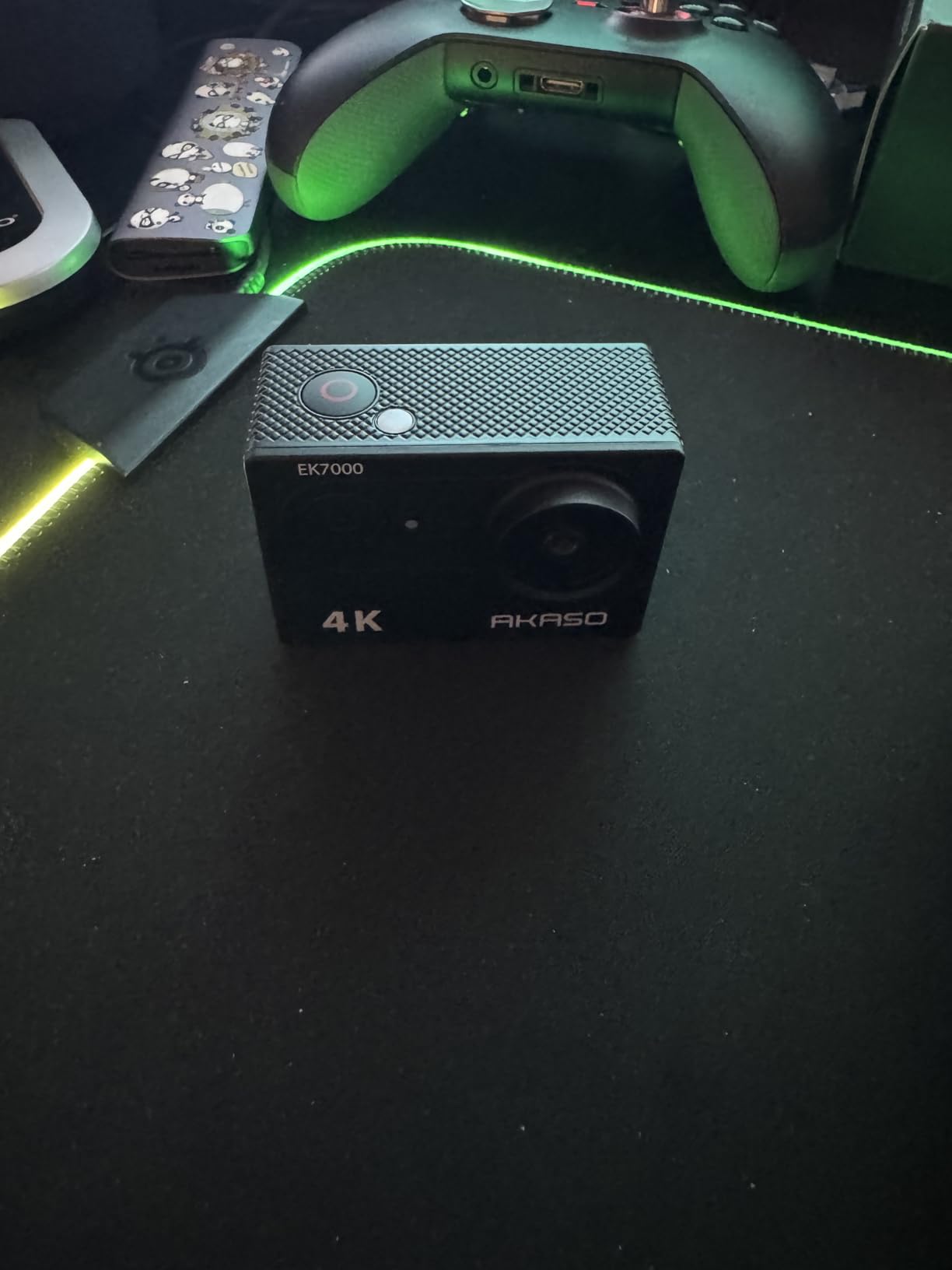
The 2 ounce body is the quiet hero. Helmet drag and neck fatigue are real issues on long rides, and a camera this light simply disappears on a chin mount or a top mount. Reviewers also like the simple button-driven menus, which you can actually operate with gloves on before you pull away.
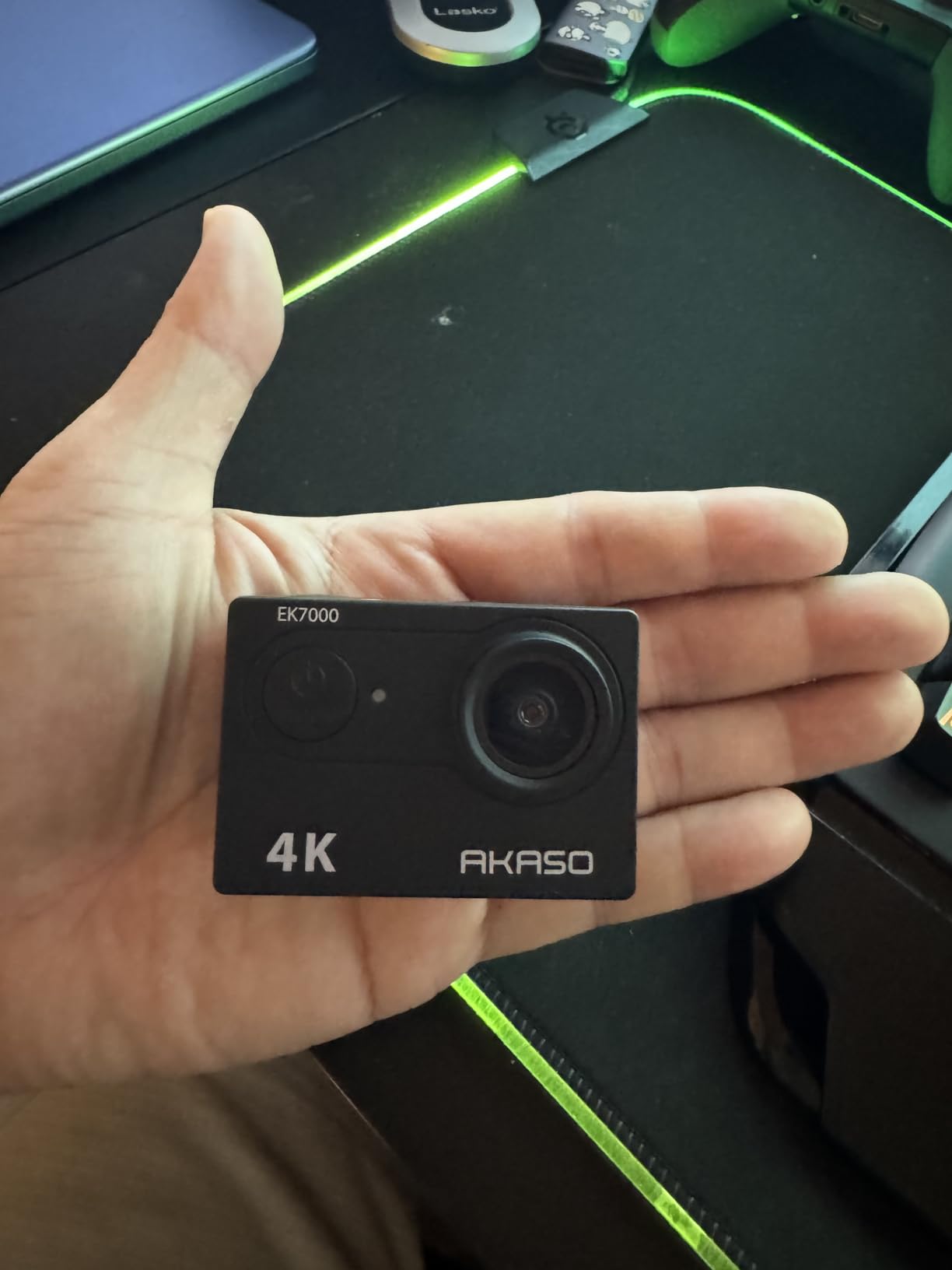
Battery life is quoted at around 90 minutes per cell, and because two batteries plus a dual charger are in the box, swapping on a lunch stop is painless. Recording at 4K30 instead of 4K60 roughly doubles what a single charge covers, which is the single most common complaint riders have with any action camera.
The waterproof housing covers 131ft, so wet roads and rain are not a problem, though the housing itself adds bulk to an otherwise tiny body. Loop recording and time-lapse are both available for anyone using it as a commute recorder rather than a content camera.
Who the EK7000 suits
New riders who want to find out whether they enjoy filming without spending serious money, and daily commuters who mostly record short clips rather than long rides. If your priority is a working camera, spare batteries already in the box, and a weight you will not notice on your helmet, this is the one.
Who should skip it
If you ride at night, want to connect an external microphone properly, or need reliable phone-based start and stop, look elsewhere. The Wi-Fi control is the weak point that reviewers complain about most, and audio from the built-in microphone is genuinely muffled once you are above about 40 mph.
2. AKASO Brave 4 – Best Value Helmet Camera with Dual Screens
AKASO Brave 4 Action Camera 4K30 Ultra Hd Waterproof Underwater Camera
4K30 video and 20MP photos
170 degree adjustable field of view
Dual 2 inch rear and 0.96 inch front screens
Two 1050mAh batteries, 90 minutes each
Pros
- Very good quality for the money with realistic color
- Gyro-based electronic stabilization works on bike mounts
- Dual screens make framing easy on a bike
- Deep bundle with two batteries and a dual charger
Cons
- Clumsy menus and an unhinged battery door
- Weak and confusing Wi-Fi setup and app
- Stills get grainy at higher ISO
The Brave 4 sits just above the EK7000 and solves one of its most annoying problems: you can see what you are filming. The 2 inch rear screen and 0.96 inch front screen mean you can frame a shot on a chin mount or a handlebar mount without stopping the bike to turn the camera around.
On the road, the 170 degree adjustable field of view gives good road coverage, and owners on the review data specifically call out the stabilization on motorcycle and handlebar footage. The accessory kit is optimized for bicycle and motorcycle work, so the mount you actually need is in the box.
Each of the two 1050mAh batteries gives about 90 minutes, and the dual charger means both are topped up between rides. A useful detail for motorcycle use: the waterproof housing can be set to record without sound in high wind, which removes one of the most common frustrations on fast roads.
Photo quality holds up well when you tune it, and the color reproduction is more realistic than most cameras at this level. The battery door is not hinged and the menus take a little getting used to, but neither stops you recording while riding.
Where the Brave 4 makes sense
Riders who want a screen to check framing and value the mount bundle. The dual battery setup is genuinely useful on a half-day ride, and the four selectable viewing angles make it easy to shoot a chin-mounted POV and a wider road shot from the same position.
Where it disappoints
The app and Wi-Fi pairing are the most criticized parts in owner feedback, and there is no useful printed manual to fall back on. If you plan to pull files off over Wi-Fi regularly, budget a reader card instead.
3. Dragon Touch Vision 3 – Best Low-Cost Starter Camera for New Riders
Dragon Touch 4K Action Camera – Vision 3 Underwater Waterproof Camera
4K30 and 2.7K30 video, 1080p60
170 degree wide field of view
2 inch rear screen
Waterproof housing to 100ft
Pros
- Very low entry cost with 4K30 capture
- 170 degree view suits helmet and bar mounting
- Two 1050mAh batteries plus 18 piece accessory kit
- Wrist remote for start and stop while riding
Cons
- Digital stabilization is modest next to dedicated models
- App and Wi-Fi transfer can be slow
- Small rear screen and strict card requirements
The Vision 3 is the camera to buy if you are not sure yet whether you want to record your rides at all. It captures 4K30 and 1080p60, and the 170 degree field of view is wide enough to catch the road, the mirrors and a good chunk of the horizon in one take.
Two 1050mAh batteries and an 18 piece accessory kit are in the box, which is more than most cameras at this level manage. The wrist remote is genuinely useful: start and stop without reaching for the camera on a vibrating helmet.
Loop recording, time-lapse, burst photo, slow motion and image rotation are all present. Loop recording turns it into a cheap commute recorder, and for riders whose only goal is having proof of what happened on the way to work, that is a sensible use.
Stabilization is the honest limitation. Digital EIS smooths the big movements but does not eat the constant buzz that comes off an older engine or rough road surface, so expect visible shake compared with the FlowState and RockSteady models further down this list.
Best first camera for a new rider
If your budget is tight or you want a second camera for a helmet you already have covered, this makes sense. The wide field of view and the wrist remote remove most of the friction for a first ride.
Reasons to spend a little more
Anyone filming in low light, editing seriously, or planning to make this their only camera should step up a tier. Owner feedback is more mixed here than on the AKASO models, with repeated mentions of a fiddly app experience and a rear screen that is small for checking framing on a bike.
4. Insta360 X3 – Best 360 Camera for Motovlogging and Reframing
Insta360 X3, 360 Action Camera with 5.7K 360 Active HDR Video, 4K Single-Lens Camera, Waterproof, FlowState Stabilization, 2.29″ Touchscreen, AI Editing, for Motorcycle, Wintersports and Vlogging
5.7K 360 Active HDR capture
FlowState stabilization with Horizon Lock
2.29 inch touchscreen
Reframe and edit in the Insta360 app
Pros
- 360 capture lets you reframe shots after the ride
- FlowState plus Horizon Lock keeps footage level
- 5.7K 360 Active HDR holds detail in mixed light
- Single-lens 4K30 and 2.7K60 modes work as a normal action cam
Cons
- Reframing and editing add real time in the app
- Heavier and bulkier for helmet mounting
- Shorter battery life on a single charge
The X3 is the camera for a rider who films alone. Because it records in 360, you decide where the camera is pointing in the app after the ride, which means a helmet mount can capture a forward POV shot and a shot looking back at you without anyone riding behind you to hold a second camera.
Stabilization is the part that matters most on a bike, and FlowState working together with Horizon Lock delivers level, smooth footage even through hard cornering. The 2.29 inch touchscreen is bright enough to frame a shot while the bike is stopped at a junction, which matters more than it sounds when the sun is low.
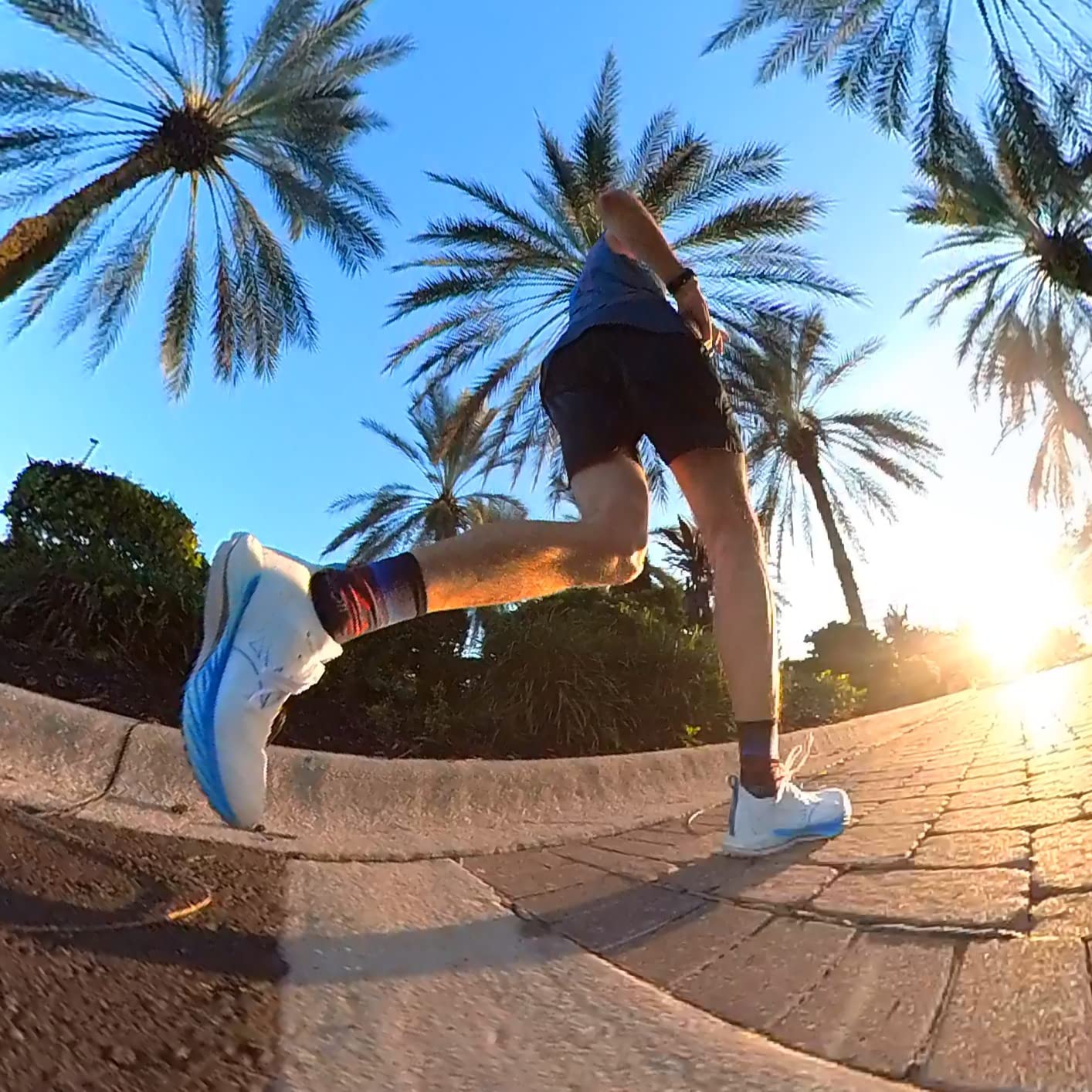
It is not a one-mode camera, though. The single-lens 4K30 wide mode and the 2.7K60 170 degree MaxView super-wide mode let you record conventionally when you do not want the fisheye look, and the 5.7K 360 Active HDR mode keeps detail and dynamic range when you are moving between bright sky and dark shade under trees.
Editing is the trade-off and it is a real one. Reframing in the Insta360 app is genuinely powerful, but every clip takes extra time before it is usable, and if you are not a patient editor that learning curve is the reason many riders walk away from 360 cameras.
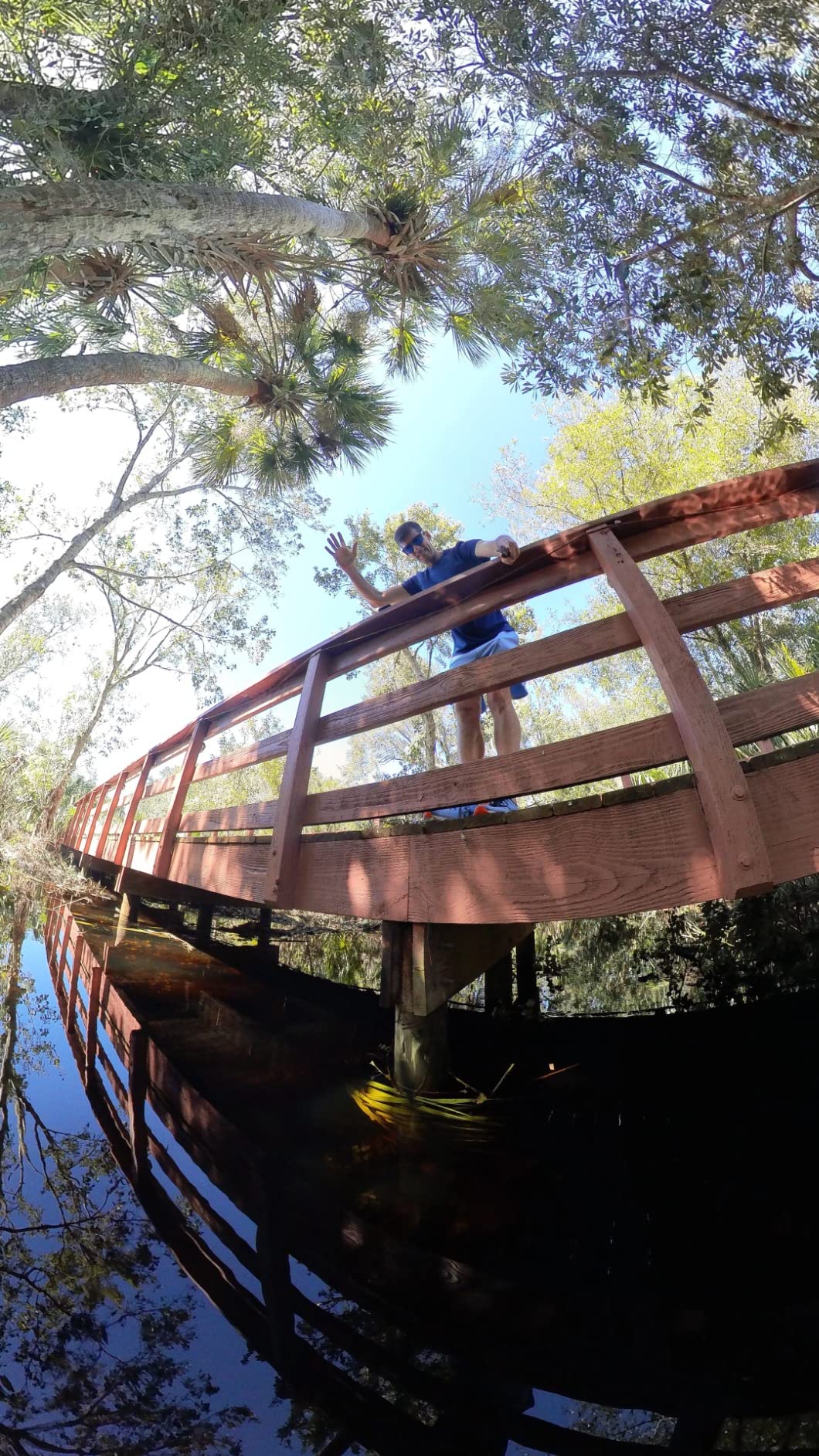
Why riders choose it
Solo motovloggers and anyone who wants third-person-looking shots from a single camera. The 5.7K 360 capture also means you can re-crop a missed shot rather than losing it, which is valuable on a long ride with unpredictable roads.
What to weigh up first
At 200 g this is one of the heavier bodies here, and helmet mounts add to that feeling on long rides. Battery life is shorter than the rugged long-run cameras, and small details in 360 modes can look soft, so check a few sample clips before committing to a content workflow.
5. DJI Osmo Action 4 – Best for Night and Sunset Riding
DJI Osmo Action 4 Essential Combo, Waterproof Action Camera Vlogging Camera
1/1.3-inch CMOS sensor with 2.4 micron pixels
155 degree ultra-wide field of view
1770mAh battery, cold resistant to -20C
Waterproof to 18m without a case
Pros
- Excellent low-light clarity from the large sensor
- RockSteady modes keep bike footage smooth and level
- 155 degree view suits riding without heavy cropping
- Dual full-color touchscreens and a magnetic quick-release mount
Cons
- 10MP stills trail higher-resolution rivals
- Photos need careful color work in D-Log M
- Some features depend on the firmware and app
If your rides involve dusk, night roads or winter darkness, the sensor size is the deciding factor. The 1/1.3-inch CMOS sensor with 2.4 micron pixels gathers far more light than the small sensors in the budget cameras here, and that shows up directly in footage quality on an unlit road.
That daylight-versus-night split is the most common framing in rider discussion, and it is the right one. The 155 degree ultra-wide field of view means you can keep a wide, immersive look without heavy cropping, which is a meaningful difference when you want road, mirrors and sky in the same shot.
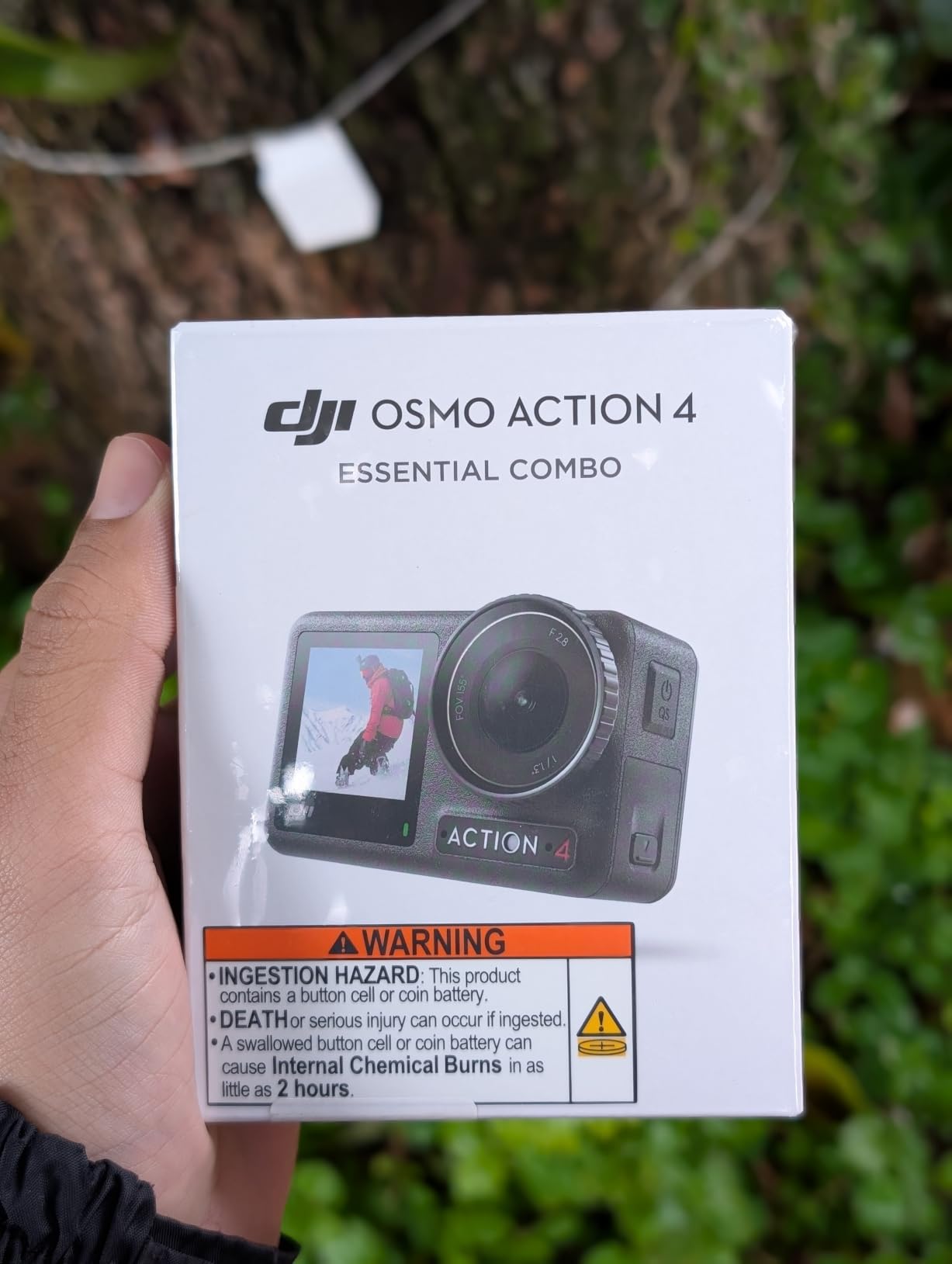
Battery life is quoted at 160 minutes, and the 1770mAh battery is rated to work down to -20C, which matters for winter riders more than any spec sheet. Pre-Rec can buffer 5, 10, 15, 30 or 60 seconds before you press record, so a rider who spots a car cutting across their path has a chance of catching it.
The magnetic quick-release adapter is the biggest quality-of-life gain on a bike. Moving between a helmet mount, a bar mount and the bike frame takes seconds, and the self-locking design means it is far less likely to fly off at speed than a plain magnetic mount.
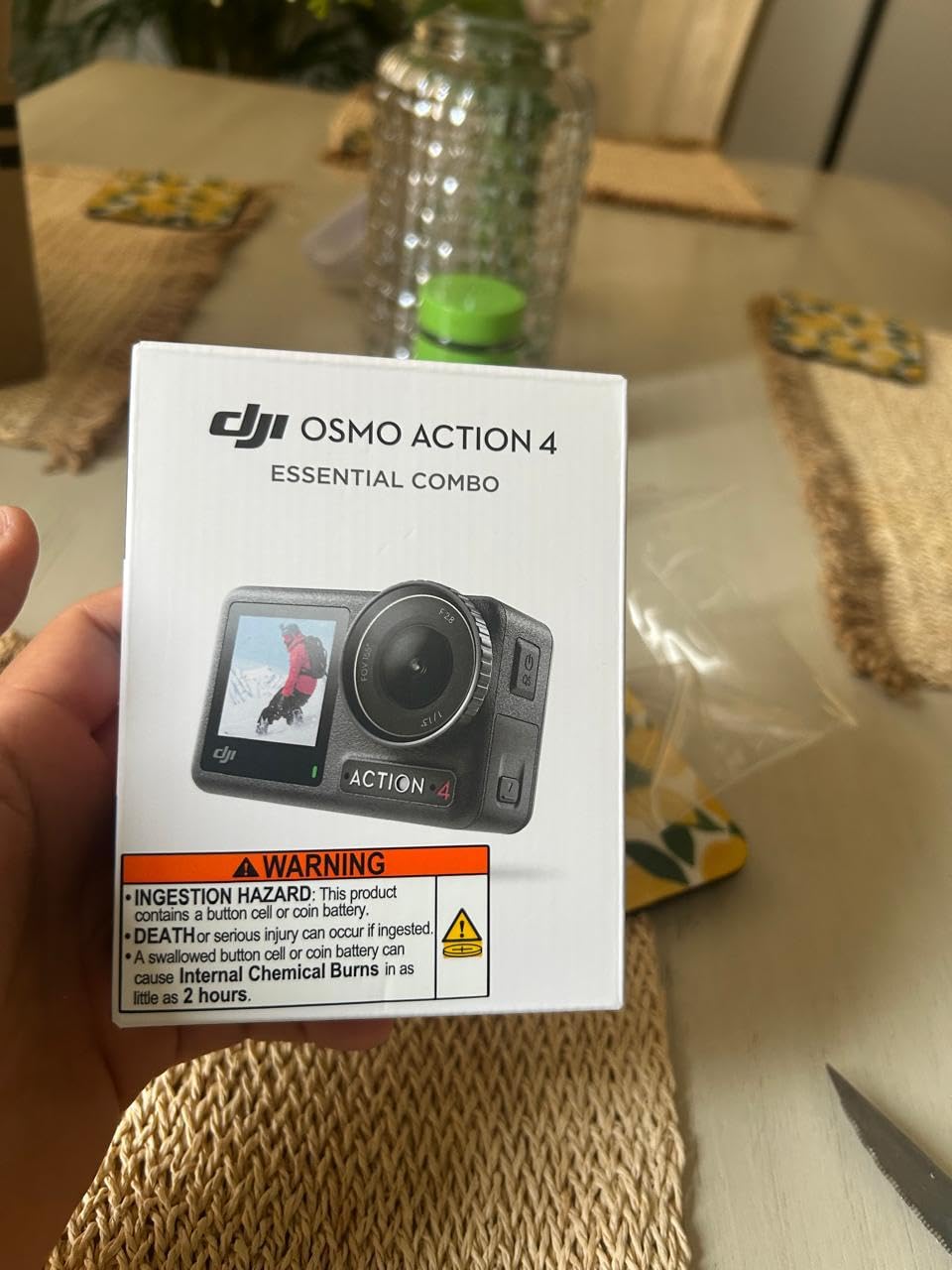
Best for night, dusk and winter
Riders who film sunrise and sunset runs, or anyone who wants one camera that handles a dark rural road without grain. The 10-bit color depth and D-Log M profile also give you real grading latitude if you edit.
Where it falls short
The 10MP still sensor is modest next to rivals that shoot 27MP or 38MP photos, and stills shot in D-Log M need proper color correction rather than a quick edit. If your priority is photography between rides, this is not the one.
6. DJI Osmo Action 6 – Best 8K Camera for Long Rides
DJI Osmo Action 6 Enhanced Combo, 8K Waterproof Action Camera
1/1.1-inch square sensor with 8K capture
Variable f/2.0 to f/4.0 aperture
50GB built-in storage, up to 4 hours battery
Waterproof to 20m without a case
Pros
- 8K detail and vibrant color from the square sensor
- HorizonSteady keeps riding footage level
- 50GB internal storage for long sessions
- Up to 4 hours of battery in the cold
- Magnetic mounts make position changes instant
Cons
- On-board microphone audio is usable but not great
- High-bitrate files are very large
- Menus are limited inside a waterproof case
The Osmo Action 6 is the most capable camera on this list for a rider who wants maximum headroom in the edit. The 1/1.1-inch square sensor shoots 8K and 38MP stills, and the variable aperture from f/2.0 to f/4.0 lets you stop down in bright daylight or open right up on a night road without changing lenses.
For long rides the practical story matters more. Quoted battery life is up to 4 hours, cold resistant, and there is 50GB of built-in storage so a long section of a trip does not depend on a single card surviving.
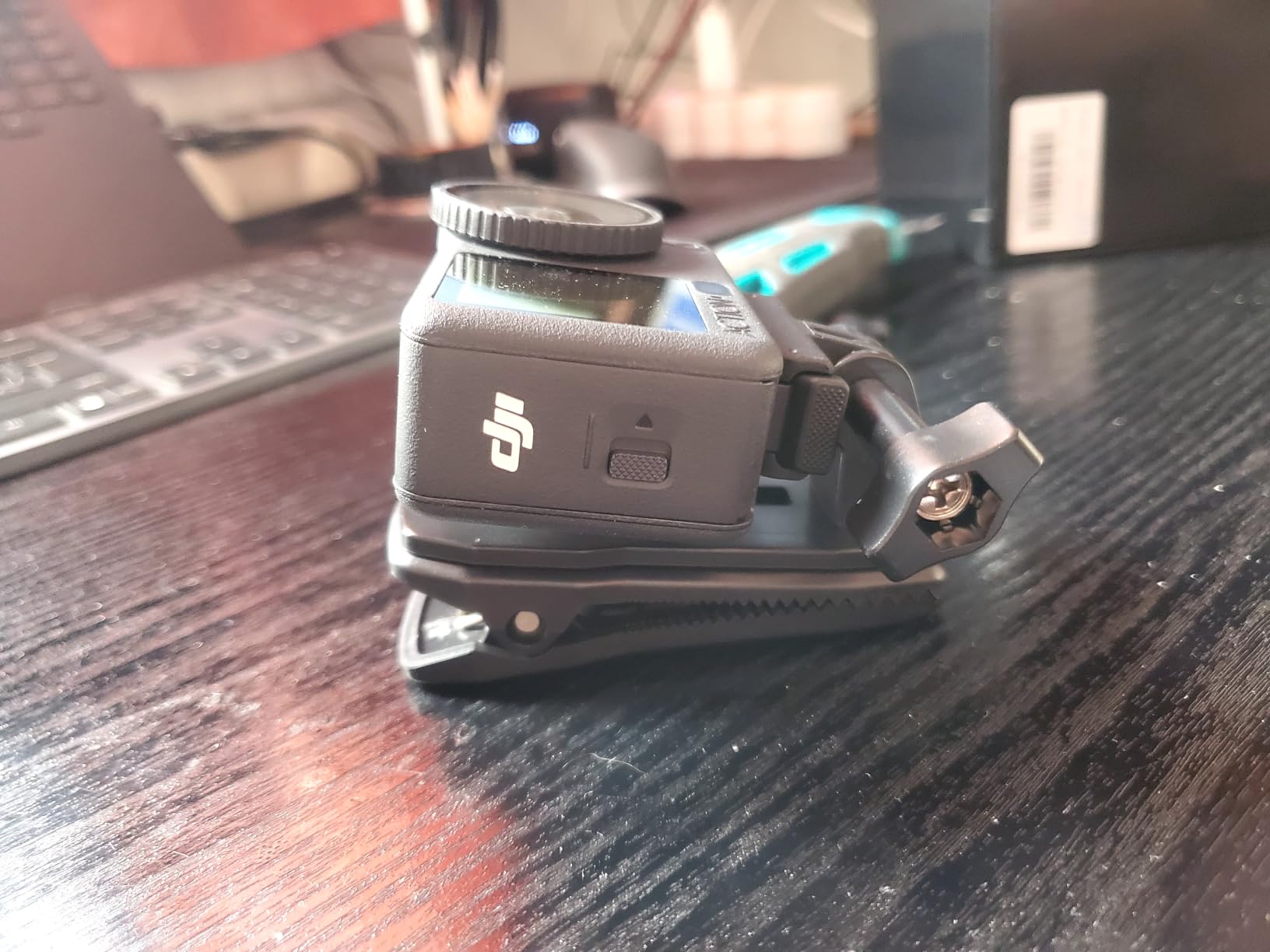
Stabilization covers two needs: RockSteady 3.0 for first-person motion through corners, and 360 degree HorizonSteady up to 4K/60fps that keeps the horizon level through hard lean angles. The 4K Custom Mode reframes one shot into several aspect ratios, which saves real time when the same clip is going into a vertical feed and a widescreen edit.
Gesture and voice control let you start recording without touching the camera, which solves the gloved-hands problem neatly. It also connects two DJI microphone transmitters directly, so a rider filming with a passenger can capture both voices.
Who should buy this one
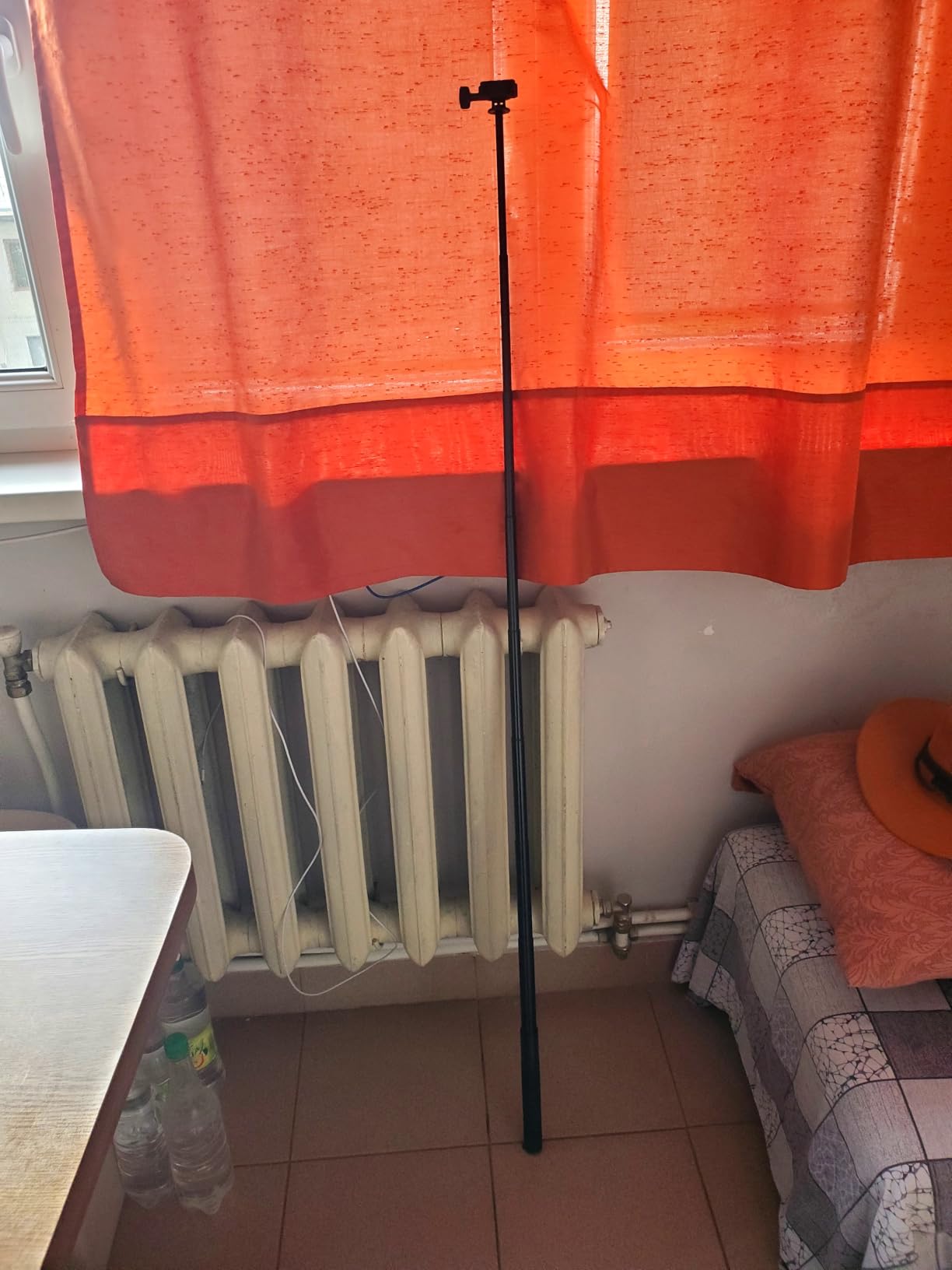
Riders producing content where resolution headroom and colour matter, and tourers who want a full day of power without carrying spare cells. The Enhanced Combo bundles an extension rod, two 1950mAh batteries, a multifunctional battery case and dual quick-release adapters.
Trade-offs to accept
High-bitrate 8K files are very large and need serious storage, and the default wide-angle framing is aggressive enough to need correcting in software. Night footage still hits the usual action cam limits, and audio from the built-in microphone is fine but not something you will want to publish unedited.
7. Insta360 GO 3S – Best Discreet In-Helmet POV Camera
Insta360 GO 3S Motorcycle in-Helmet POV Bundle Special Edition – 4K Tiny Portable Vlogging Camera, Hands-Free POV Cam, Stabilization, 140 Min Battery Life, 10m Waterproof, Action cam for Moto, Sport
4K hands-free POV with a wide-angle lens
Action Pod with 2.2 inch flip screen and 140 minute battery
FlowState stabilization and Horizon Lock
IPX8 waterproof camera body to 10m
Pros
- Tiny camera sits unobtrusively inside a helmet
- Pod battery outlasts most tiny action cams
- FlowState and Horizon Lock smooth in-helmet footage
- Magnetic mounts and in-helmet mount in the bundle
Cons
- Small sensor limits low light and detail
- Action Pod is splash resistant only
- Workflow depends on the pod and the phone app
The GO 3S solves a problem no other camera here can: how to get genuine hands-free POV footage without a camera bolted to your chin or weighing down the front of your helmet. The camera body is small enough to sit inside the helmet on the included in-helmet POV mount, and the wide-angle lens covers most of your field of view.
All the processing lives in the Action Pod, which has a 2.2 inch flip screen, acts as a remote control, and runs for 140 minutes. FlowState stabilization and Horizon Lock keep the footage level even though the camera is vibrating against your head rather than bolted to a shell.
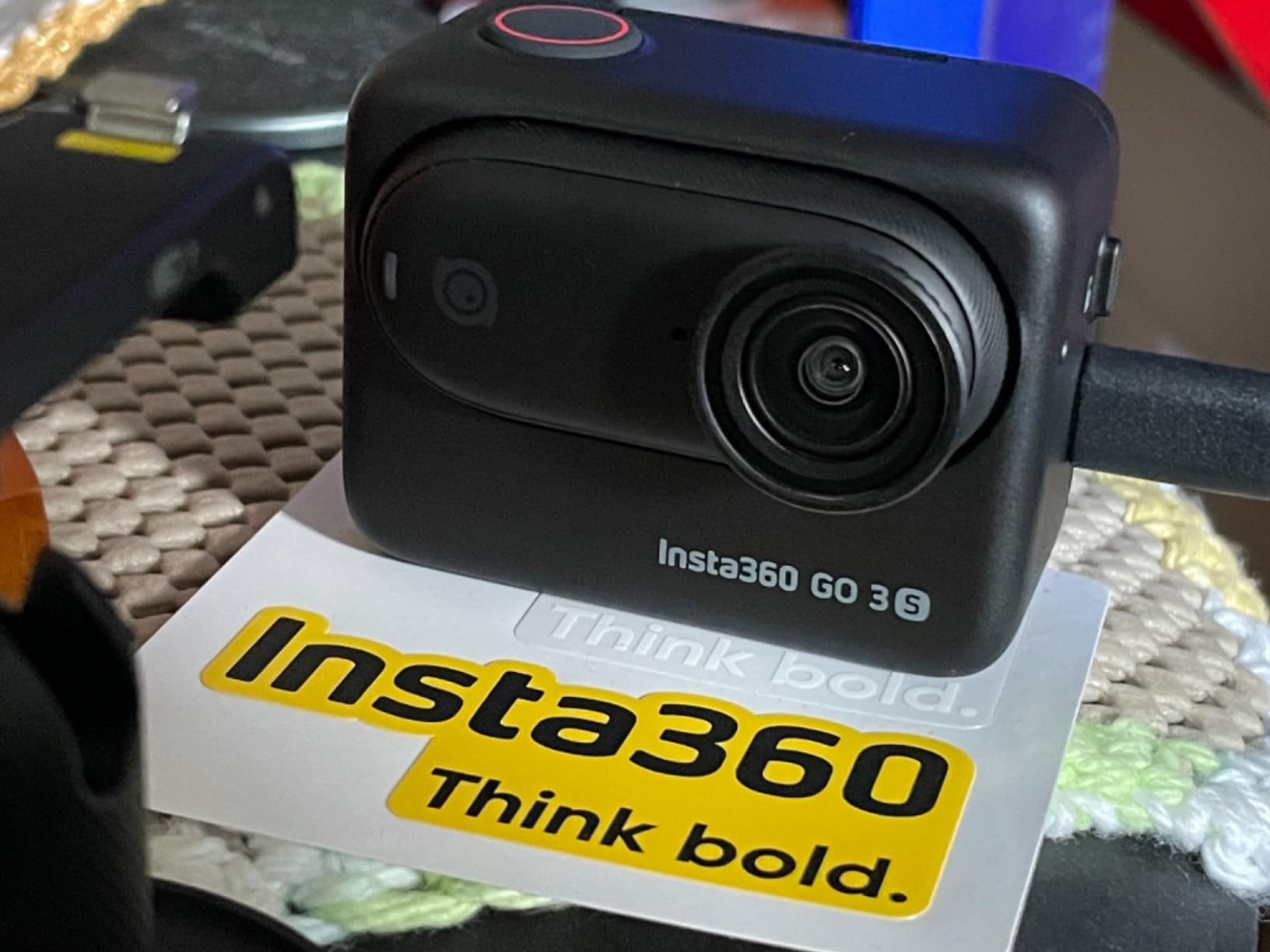
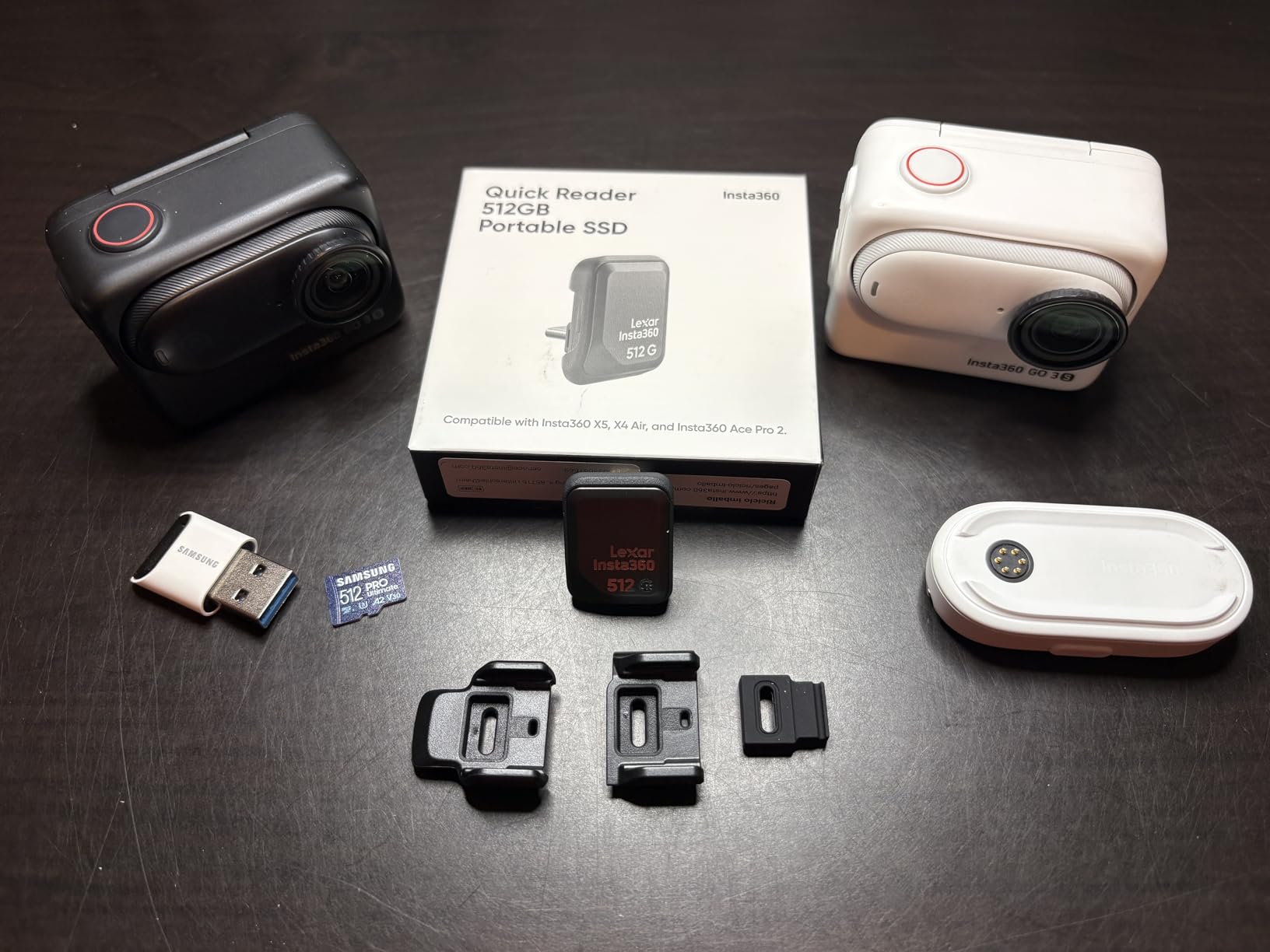
The motorcycle in-helmet POV bundle is unusually complete: GO 3S with 128GB, the Action Pod, a lens guard, a magnet pendant, pivot stand, easy clip, the in-helmet POV mount and a mic wind muff. That wind muff is worth noting on its own, because it is a direct answer to onboard audio problems.
QuickCapture, gesture control and voice control let you start a recording without touching anything, and the pod can charge the camera while it is shooting, which is how the 140 minute figure is achieved in practice.
Best for in-helmet and ultra-light mounts
Riders who dislike chin mounts, and anyone who wants footage that looks like a camera floating in front of them. The bundle includes the mounts you need, so nothing extra has to be bought before the first ride.
What the small format costs you
The small sensor and lens mean lower light sensitivity and less detail than larger-body cameras, so night riding is where it shows. The Action Pod is splash resistant only and cannot go in water, and the whole workflow depends on the pod and the phone app, which adds steps compared with a standard action cam.
8. SJCAM SJ4000 – Best Budget Camera with Dash Cam Modes
SJCAM SJ4000 Pro-Grade 4K Action Camera, 40MP 3-Axis EIS Stabilization Motorcycle Sport Camera, 170°FOV Waterproof Camera Underwater, 5X Zoom, Dual Batteries, 32G SD Card and Helmet Accessory Kit
4K30 video and 40MP photos
170 degree super wide field of view
3-axis EIS stabilization
IP68 waterproof case to 30m with dash cam mode
Pros
- 32GB card and two batteries included in the box
- 170 degree view gives good road coverage
- Dash cam and loop recording modes suit commuting
- Waterproof housing works and buttons are usable underwater
Cons
- 3-axis EIS is weak on vibration-prone bike mounts
- App and Wi-Fi connection are unreliable
- Audio pickup is low and the housing is hard to open
Most riders meet the SJ4000 as a backup camera rather than a main one, and that is exactly what it is good at. The box includes a 32GB card and two 900mAh batteries, which removes the two most common annoyances for a first-time buyer, and it is inexpensive enough that losing one on a ride is not a disaster.
The 170 degree super wide field of view covers a lot of road from a helmet or bar mount, and modes including loop recording, dash cam, motion detection and time-lapse make it usable as a commute recorder rather than only a content camera.
Daytime image quality is decent for the money, and the 40MP stills specification is higher than the number suggests in real use. MicroSD support goes up to 128GB, and the housing is rated to 30m with an underwater mode, though audio pickup inside that housing is poor.
The honest weakness is stabilization. Reviewers report that the 3-axis EIS does very little on vibration-prone bike mounts, which is exactly the problem this camera is likely to face. The companion app and Wi-Fi connection are also called out as unreliable in owner feedback.
Best used as a second or backup bike camera
Riders who want a cheap always-recording unit on a bar mount while keeping a better camera on the helmet. Loop recording plus the included card makes it a simple insurance-grade recorder for commuting.
Where it will disappoint
Do not expect usable stabilization from a handlebar on a rough road, and expect a stiff app experience. There is also no good bike mount in the box, so you will need a strap or a modification to attach it to the motorcycle itself.
9. GoPro HERO13 Black – Best Daylight Detail and Slow Motion
GoPro HERO13 Black – Waterproof Action Camera with 5.3K60 Video, 27MP Photo + Compatability with HB-Series Lenses
5.3K60 video and 27MP photos
Waterproof to 33ft without a case
HB-Series lens and filter compatibility
13x burst slo-mo, 157 g body
Pros
- Excellent 5.3K60 detail in good light
- Rugged waterproof body needs no case in the rain
- HB-Series lenses broaden your framing options
- 24.7MP frame grabs pulled from video
Cons
- Battery life is shorter than the DJI Osmo models
- Premium tier pricing for the resolution
- GoPro Quik needed for frame extraction
The HERO13 Black remains the reference point for daylight detail. It records 5.3K60, which is 91 percent more resolution than 4K, and that extra headroom is visible in fast cornering shots where distant detail smears on lower-resolution cameras. At 157 g it is not the lightest body here, but it is well balanced for a chin or top mount.
81 percent of owner reviews are five star, with the waterproof body to 33ft singled out repeatedly. Riding in the elements needs no housing, which removes bulk from the mount and reduces the number of places water can get in.
Two features matter specifically on a motorcycle. The water-repelling lens cover cuts flare and artifacts when the lens is wet or when you are shooting into low sun, and the HB-Series lens and filter detection means the camera sets itself correctly when you change lens for a different mount or a different shot.
Slow motion is the other strength. Burst slo-mo up to 13x, plus 4x slo-mo recorded in 5.3K, lets you slow down a wheel lift, a corner entry or a near miss enough to see what actually happened. You can also pull 24.7MP stills straight out of video using the GoPro Quik app.
Best for daylight POV and slow-motion analysis
Riders who want maximum crispness in good light, a deep accessory ecosystem, and the ability to examine a moment frame by frame. It is also the safest default if you already own GoPro mounts and lenses.
Where it costs you
Battery endurance is the top complaint relative to the DJI Osmo models, and the resolution tier sits at a premium. The heavier editing workflow through GoPro Quik is a real consideration if you are filming on a phone only, and underwater audio stays muffled without an external microphone.
10. AKASO Brave 7 LE – Best Mid-Range Camera with a Touchscreen
AKASO Brave 7 LE 4K30FPS 20MP WiFi Action Camera with Touch Screen EIS 2.0 Zoom Remote Control 131 Feet Underwater Camera with 2X 1350mAh Batteries Support External Microphone Vlog Camera
6-axis EIS 2.0 stabilization
Dual displays with a 2 inch rear touchscreen
4K30 video and 20MP photos
IPX7 body, 131ft in the included housing
Pros
- Dual screens are useful for framing while mounted
- 6-axis EIS 2.0 is smoother than cheaper AKASO models
- Two 1350mAh batteries and a full mount kit included
- External microphone support addresses weak onboard audio
Cons
- Limited to 4K30 with no high frame rate modes
- Body relies on the housing for any water protection
- 20MP stills trail modern sensors
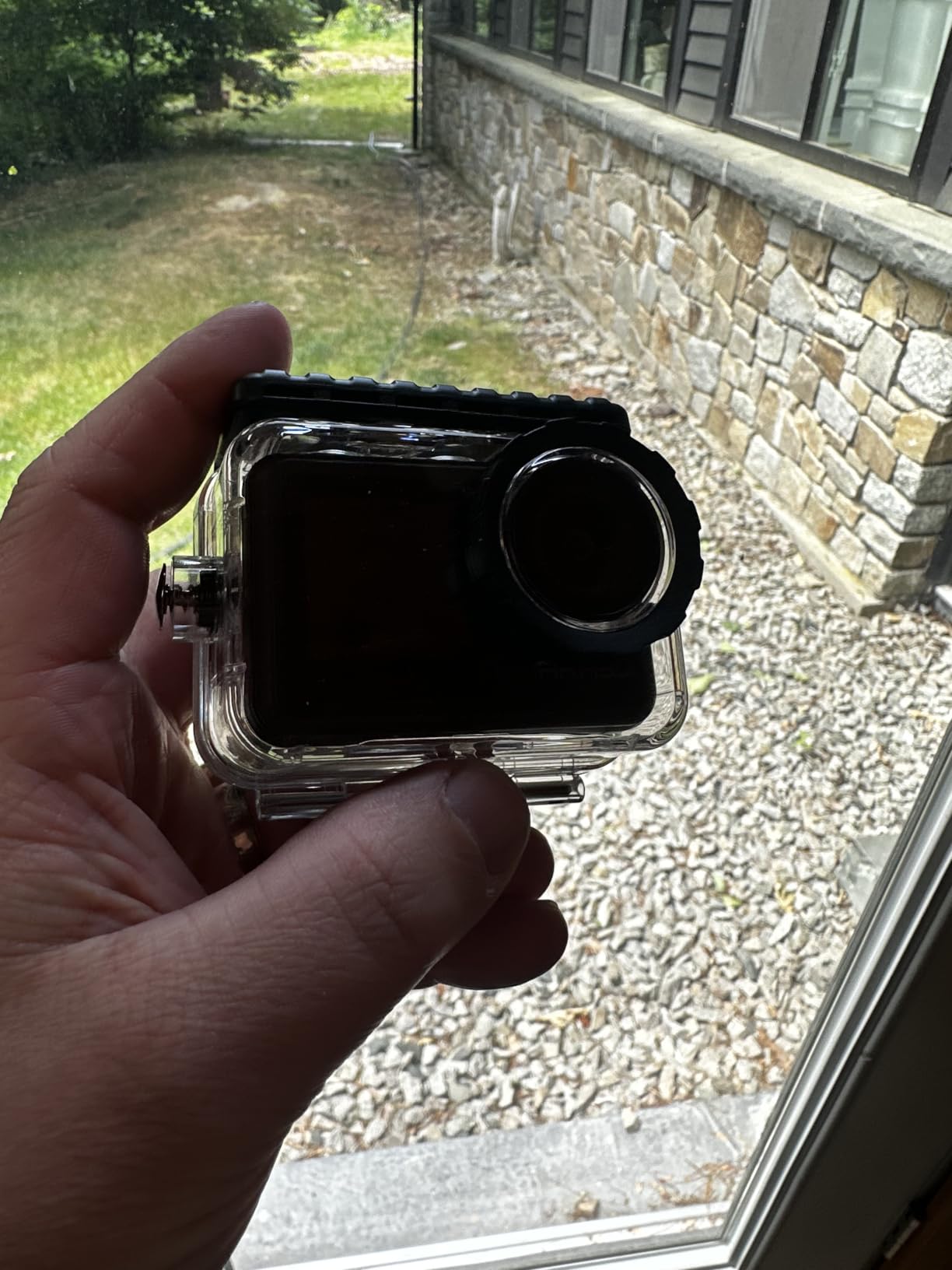
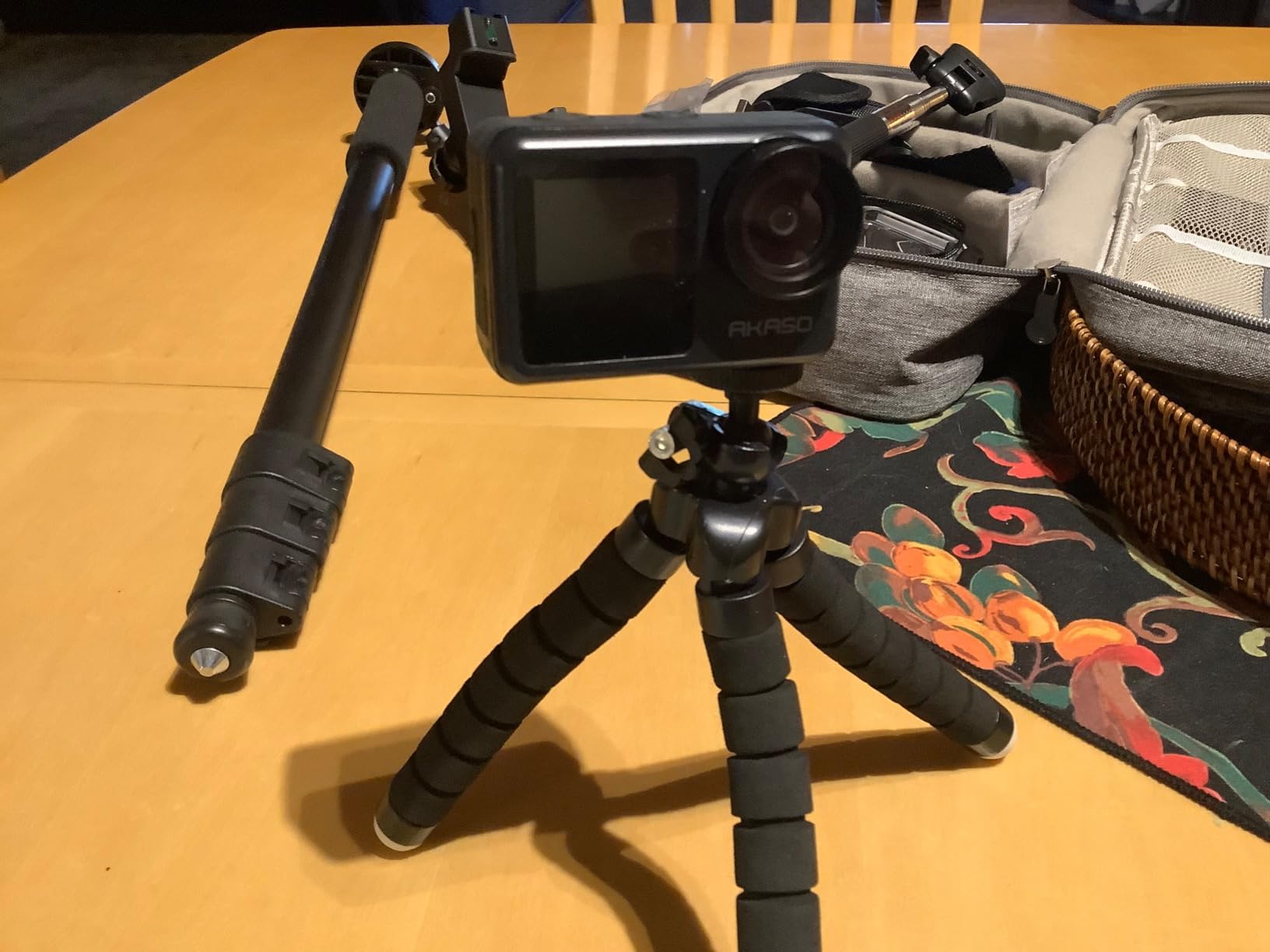
The Brave 7 LE is the AKASO to buy if you want to tap through settings rather than work through menus with gloved fingers. The 2 inch rear touchscreen, switched to the front color screen by holding Mode, makes it far quicker to check framing and change resolution while the camera is mounted on a bike.
Stabilization is the step up from cheaper AKASO models, with 6-axis EIS 2.0 producing noticeably smoother footage on a vibrating mount. Quoted battery life is around 2 hours per 1350mAh cell, and two are included with the housing and a multifunctional mounting kit.
External microphone support is a genuinely useful feature here, because weak onboard audio is the most common complaint across almost every camera in this roundup. Pair it with a furry windshield and the wind problem becomes far more manageable at speed.
The limitation is frame rate. It shoots 4K30 and no 4K60 or high frame rate 1080p mode, so if you want smooth slow-motion riding shots for editing, this is the wrong tool. The body is IPX7 water resistant rather than waterproof, so real rain protection means using the included housing.
Best for touch-first riders
If you are not confident with button-driven menus, this is the friendliest camera at its level. The dual displays help with solo rides where you stop to set up, and the mount kit in the box means you can go straight from unboxing to a helmet mount.
When a cheaper model makes more sense
If you never need slow motion, the AKASO EK7000 does the same job for less. And if your rides are mostly at night, spend up on the DJI Osmo Action 4 instead, because a 20MP sensor in a small body will not rescue low light.
How to Choose an Action Camera for Motorcycle Riding in 2026
Resolution is the least useful comparison point for a motorcycle. Two 4K30 cameras can produce completely different footage on the same stretch of road depending on how well they handle vibration and how much light they gather at dusk. These are the criteria that actually change what you end up with.
Stabilization and vibration
Every camera here uses electronic image stabilization, which crops the frame and smooths movement in software. That crop is why a stabilized shot looks slightly tighter than an unstabilized one. The differences between brands are large: FlowState, RockSteady and HorizonSteady systems on the DJI and Insta360 bodies handle cornering lean angles far better than the digital EIS in the entry-level models, which mostly leaves high-frequency buzz on screen.
Field of view
Standard action cams are narrower than most riders expect on a first outing. A 155 degree ultra-wide view, or the 170 degree adjustable settings on the AKASO Brave 4, gets road, mirrors and sky into the same frame. If you want the freedom to choose the angle after the ride, that is what a 360 camera is for.
Battery life and thermals
Battery life is the most common complaint in rider discussions, and the pattern is consistent across brands: 4K60 and 8K recording drain a cell far faster than 4K30. Carrying two spare cells and charging them over lunch solves it more reliably than any setting. Long summer rides also generate heat, and cameras that are recording continuously in a housing can throttle, so keep a lens cloth handy for fogging and let the body breathe whenever you stop.
Storage and SD card class
You do need a decent card. A V30 card is the practical minimum for 4K, V60 is better for sustained high-bitrate recording, and the Insta360 X3 specifically asks for a V90 card. Budget for 128GB or 256GB if you ride all day without offloading, because 4K files are large and a full card stops a recording without warning.
Wind noise and audio
At speed, wind destroys onboard audio no matter which camera you buy. Four things help: a foam or furry windshield over the microphone, recording with the camera’s internal mic muted and adding dialogue in post, using external microphone support where it exists, and accepting that a chin mount with a windscreen beats a bare top mount every time. A camera is still a good idea even with unusable onboard audio, because crash evidence does not need sound.
Weight, helmet drag and mounting safety
Camera weight is a genuine comfort criterion that most roundups skip. Anything at or above 200 g starts to feel heavy on a helmet over a long ride, and a top-heavy helmet increases aerodynamic drag and neck fatigue. The 2 ounce EK7000 and the 145 g Osmo Action 4 are the comfortable picks; the X3 and the SJ4000 are noticeably heavier. Whatever you mount, use the safety tether every single time. Magnetic mounts are convenient and the reason riders get nervous about losing an expensive camera at speed, so treat the tether as non-negotiable.
Action cam versus a hardwired dash cam
If the only reason you want a camera is insurance evidence after a crash, a hardwired dual-channel dash cam is the better tool. It records continuously in a loop, survives the ignition being cut by the impact, and typically runs front and rear together. Action cameras offer far better image quality, a proper microphone and a far more usable recording interface, but they need you to press record or set up loop mode yourself. Many riders end up running both: a dash cam for evidence and an action cam for the footage they actually want to watch.
Price tiers
Entry tier covers the AKASO EK7000, the Dragon Touch Vision 3 and the SJCAM SJ4000, all of which record usable 4K30 with basic stabilization. Mid tier covers the AKASO Brave 4 and Brave 7 LE, which add bigger screens, better stabilization and dual batteries. The premium tier is where the Insta360 X3, the DJI Osmo Action 4 and the GoPro HERO13 Black sit, and the DJI Osmo Action 6 sits above them. If you are still deciding rather than ready to spend, our budget action camera roundup covers the entry options in more depth, and our surfing camera guide is a useful read on waterproofing and housing care if you ride in serious weather.
Where to Mount a Motorcycle Camera and Is It Legal
Where a camera sits changes the footage more than any setting inside it. Chin mounts give the most natural POV and the best audio-to-wind ratio because the microphone is sheltered by the helmet, which is why most motovloggers choose them. Top mounts look cleaner and get a wider view but catch more wind and more buffeting. Side mounts are unusual and rarely the best option.
Chest mounts put the camera on your body rather than the bike, so you get your body language and lean angle in frame, and the footage stays level in a way a helmet mount cannot manage. Handlebar and frame mounts record the bike rather than you, which is useful for showing suspension movement, and they are safer in the sense that a crash that throws the rider usually does not throw the camera.
Is mounting a camera on a helmet legal?
This comes up constantly and almost never gets answered properly. In general, attaching a camera to your own helmet is not an offence, and it does not invalidate the helmet’s certification as long as you do not drill, cut or modify the shell, and as long as the camera is mounted so it cannot itself cause injury. The two things that do cause problems are modifications to the shell and cameras mounted where they obstruct your view or catch on the road in a crash. Requirements differ by country and by state, so if you ride somewhere you are not familiar with, check the local rules before your first trip.
Pre-ride checklist
Run through five things before you roll. Check the mount is locked and the safety tether is attached to the strap, not the shell. Wipe the lens and confirm the lens guard is seated. Confirm the card has capacity and the battery is seated. Set your resolution and stabilization mode for the ride rather than fiddling at a junction. And if you are filming a passenger, give them a wireless remote rather than having them tap the screen.
Frequently Asked Questions
What is the best action camera for bikers?
For most riders in 2026 the AKASO EK7000 is the best all-round choice: it records 4K30 with built-in electronic image stabilization, weighs 2 ounces, and includes two batteries and a dual charger in the box. Riders who film at night or at dusk should choose the DJI Osmo Action 4 for its 1/1.3-inch sensor, and solo riders who want to reposition shots after the ride should look at the Insta360 X3.
Is it a violation to have a GoPro on my motorcycle helmet?
Usually not. Mounting a camera on your own helmet is generally legal as long as you do not drill, cut or otherwise modify the shell, and as long as the camera is positioned where it cannot obstruct your view or become a hazard in a crash. Avoid mounting it where it can catch on the road, and check local rules if you ride abroad.
Which action camera is best for motovlogging?
The Insta360 X3 is the strongest motovlogging option here because 5.7K 360 capture lets you choose the camera angle after the ride, which matters when you ride alone. FlowState stabilization and Horizon Lock keep in-helmet footage smooth and level. If you would rather avoid app-based reframing, the DJI Osmo Action 4 is the smoother editing experience.
How do I reduce wind noise when recording motorcycle rides?
Four steps help. Put a foam or furry windshield over the microphone, move the camera to a chin mount where the helmet shelters it, mute the camera audio and add dialogue in post, and use external microphone support if your camera has it. At motorway speeds no built-in microphone survives untouched, so plan to replace audio rather than fight it.
Do I need special SD cards for recording motorcycle rides?
Yes, at least a decent one. A V30 card is the practical minimum for 4K, V60 is safer for sustained high-bitrate recording, and the Insta360 X3 asks for V90 or higher. A 128GB or 256GB card avoids a mid-ride recording stop. Cheap cards failing after an hour of vibration are a common and avoidable failure.
Which is better, GoPro or DJI for motorcycle riding?
GoPro wins on daylight detail, slow motion and mount compatibility, with 5.3K60 video, 13x burst slo-mo and the HB-Series lens system. DJI wins on battery life, low light, cold-weather use and the magnetic quick-release mount, with a 155 degree view and a 1770mAh cold-resistant battery. For most riders the DJI is the more practical choice on long rides.
Our wider guides cover action cameras for skiing if you also want a camera for winter sports, and waterproofing and housing care is covered in our surfing guide, which applies directly to wet-weather riding.
The Verdict: Which Motorcycle Camera Should You Buy in 2026
The best action cameras for motorcycles in 2026 come down to how you ride rather than which brand is ahead. The AKASO EK7000 is the winner of this roundup and the default recommendation: stabilization that survives vibration, a 2 ounce body that disappears on a helmet, and two batteries in the box, all at an entry-level outlay. It is the pick for commuters, new riders and anyone who wants to test whether filming their rides is something they enjoy.
Move up to the DJI Osmo Action 4 if your rides run into darkness, to the GoPro HERO13 Black if daylight detail and slow-motion analysis matter most, and to the Insta360 X3 if you ride alone and want to reframe your footage after the fact. Budget riders on a strict limit are better served by the AKASO Brave 4 for its dual screens, and anyone filming on a handlebar rather than a helmet can get a second unit with the SJCAM SJ4000.
Whichever you pick, mount it with a safety tether, carry a spare battery, and check the lens before every ride. Those three habits matter more to the footage you end up with than another tier of resolution.