
If you are moving a flash off the camera and off the cable, the best flash triggers for off camera lighting in 2026 are the small radio transmitters that clip into your hot shoe and tell a distant light when to fire. Yes, you need one. A trigger is the only practical way to place a speedlight or strobe across a room, over a table or behind a subject, and to keep TTL metering and high-speed sync while you do it.
Our team has spent months shooting with these units across portrait, event and studio setups, and this roundup covers seven of them, from a full-featured Canon transmitter with 32 channels and 16 groups down to a manual-only kit built for old monolights. The list is deliberately brand-honest: two of the picks speak the Godox 2.4G X protocol, two speak the NEEWER Q protocol, and three are simple manual systems that will fire almost anything with a 3.5mm sync socket.
We were deliberate about which failures matter. A trigger that cannot reach past 20 metres, one that drops TTL without telling you, or one whose hot shoe rattles loose on a mirrorless body will wreck a shoot faster than a missing feature will. So we weighted radio reliability, group control and the honesty of the interface above headline feature lists. If you want the wider picture on light heads first, our off-camera flash guide covers the heads these triggers drive, and our wireless flash trigger guide goes deeper on radio protocol.
Top 3 Picks for Off-Camera Lighting (October 2026)

Godox XPro-C TTL Trigger
- TTL and 1/8000s HSS
- 16 groups and 32 channels
- Large backlit LCD with group buttons
- 150 g
- 2 AA batteries

Godox X2T-C TTL Trigger
- TTL and 1/8000s HSS
- 5 groups and 32 channels
- Bluetooth app control
- 120 g
- 2 AA batteries

Godox CT-16 3-in-1 Kit
- Two receivers included
- Manual power control only
- 1/250s sync ceiling
- 433MHz radio
- 8.4 ounces
Best Flash Triggers for Off-Camera Lighting in October
| Product | Specifications | Action |
|---|---|---|
| Godox XPro-C TTL Wireless Flash Trigger for Canon |
|
Check Latest Price |
| Godox X2T-C TTL Wireless Flash Trigger for Canon |
|
Check Latest Price |
 NEEWER QPRO-C TTL Wireless Flash Trigger for Canon NEEWER QPRO-C TTL Wireless Flash Trigger for Canon |
|
Check Latest Price |
 AODELAN FT-8 Transmitter and Receiver Set AODELAN FT-8 Transmitter and Receiver Set |
|
Check Latest Price |
 AODELAN Universal Hot Shoe Trigger Set AODELAN Universal Hot Shoe Trigger Set |
|
Check Latest Price |
| Godox CT-16 3-in-1 Radio Trigger Kit |
|
Check Latest Price |
 NEEWER QZ-C Touchscreen TTL Flash Trigger NEEWER QZ-C Touchscreen TTL Flash Trigger |
|
Check Latest Price |
What Is a Flash Trigger and Do You Need One?
A flash trigger is a two-part wireless system. The transmitter sits in your camera’s hot shoe and broadcasts a radio packet carrying flash power, group assignment and sync timing over 2.4GHz. A receiver clipped to the off-camera flash or strobe decodes that packet, waits for the shutter’s sync pulse, then fires at the power you set.
The part people miss is what the trigger adds over a plain sync cable. The cable only tells the light when to fire. The trigger also carries TTL metering data back from the flash, group power ratios for multi-light setups, channel and group identifiers that stop neighbouring photographers cross-firing your lights, and high-speed sync so you can shoot wide apertures in daylight.
You need one the moment your flash leaves the camera. That covers two or more lights shaped for portraits, weddings and events, outdoor work where high-speed sync lets you keep a fast shutter in bright sun, and studio shooters who need to fire manual-only monolights from across the floor. The connection point on a digital camera that accepts an external flash is called the hot shoe, and on DSLRs and mirrorless bodies there is often a PC sync port beside it as well.
1. Godox XPro-C TTL Wireless Flash Trigger for Canon – Best Overall
Godox XproC Xpro-C TTL Wireless Flash Trigger for Canon, 1/8000s HSS
TTL with 1/8000s HSS
16 groups, 32 channels
01-99 wireless ID
150 g, 2 AA
Pros
- Large backlit LCD shows five groups at once
- Reliable control across the whole Godox X-system range
- Five clearly labelled group buttons plus a smooth dial
- Single-button TTL-to-manual conversion via TCM
- Solid build that suits a working pro body
Cons
- Menu system has a real learning curve
- Hot shoe contacts need careful alignment on Canon mirrorless
- Modelling lamp is on or off with no brightness levels
- No quick-release lever in the Canon speedlight style
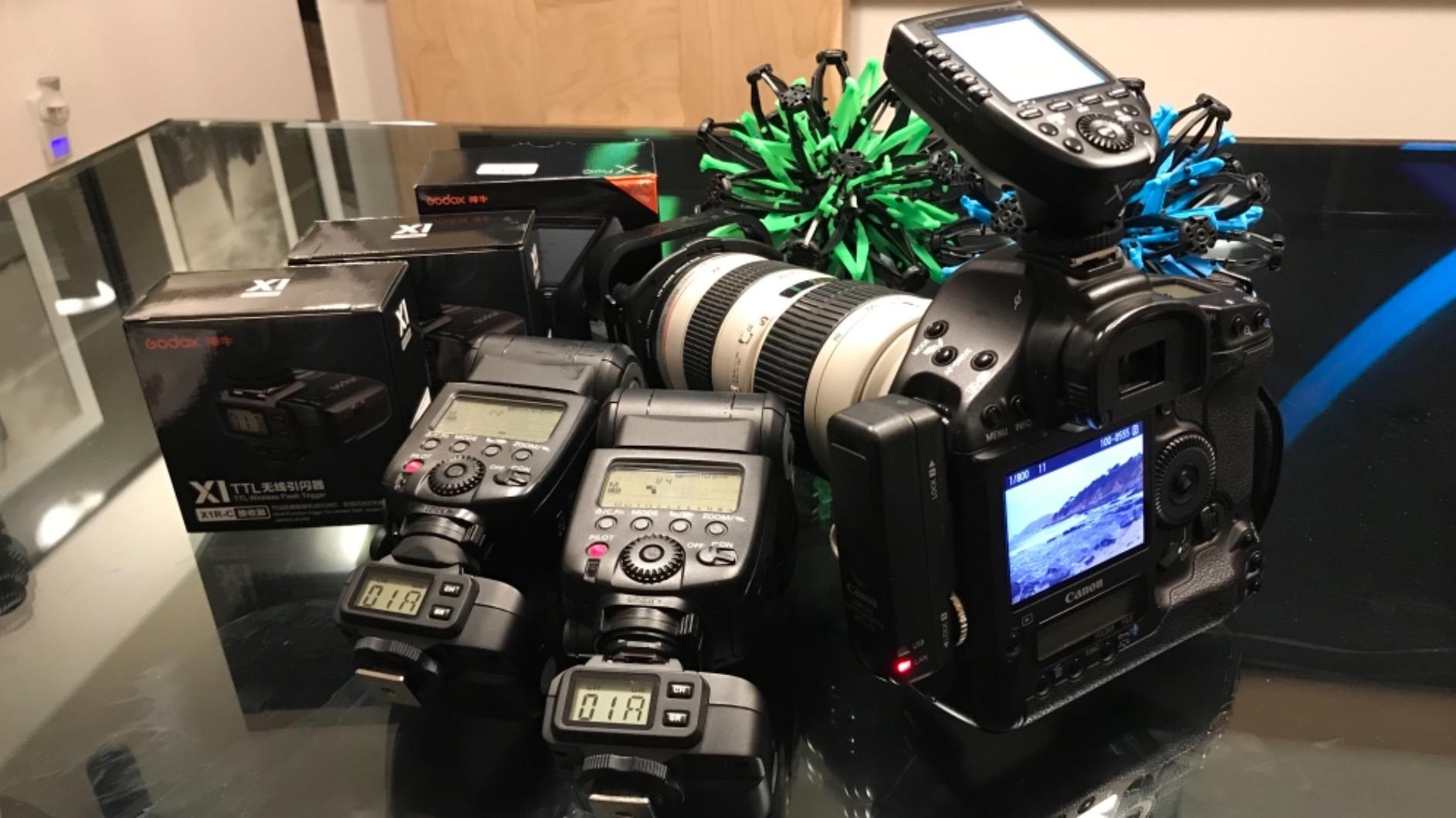
This is the trigger I keep on the body. The slanted backlit screen is the reason: it shows five groups of power and mode data at once, so on a three-light reception setup I can see the whole rig without cycling through menus. The five group buttons and the control dial sit where your fingers already are, and the dial has a damped, precise feel that cheaper triggers cannot match.
Radio behaviour is what keeps it in my bag. It holds a link across the Godox range I care about, from speedlights to the AD-series strobes, and the 01-99 wireless ID setting lets me run in a crowded venue without picking up another photographer’s groups. TTL, 1/8000s high-speed sync and manual output are all there, and a long press on the TCM button converts a metered TTL value into a matching manual power figure, which is genuinely useful when you move a light from a shaded room into open sun.
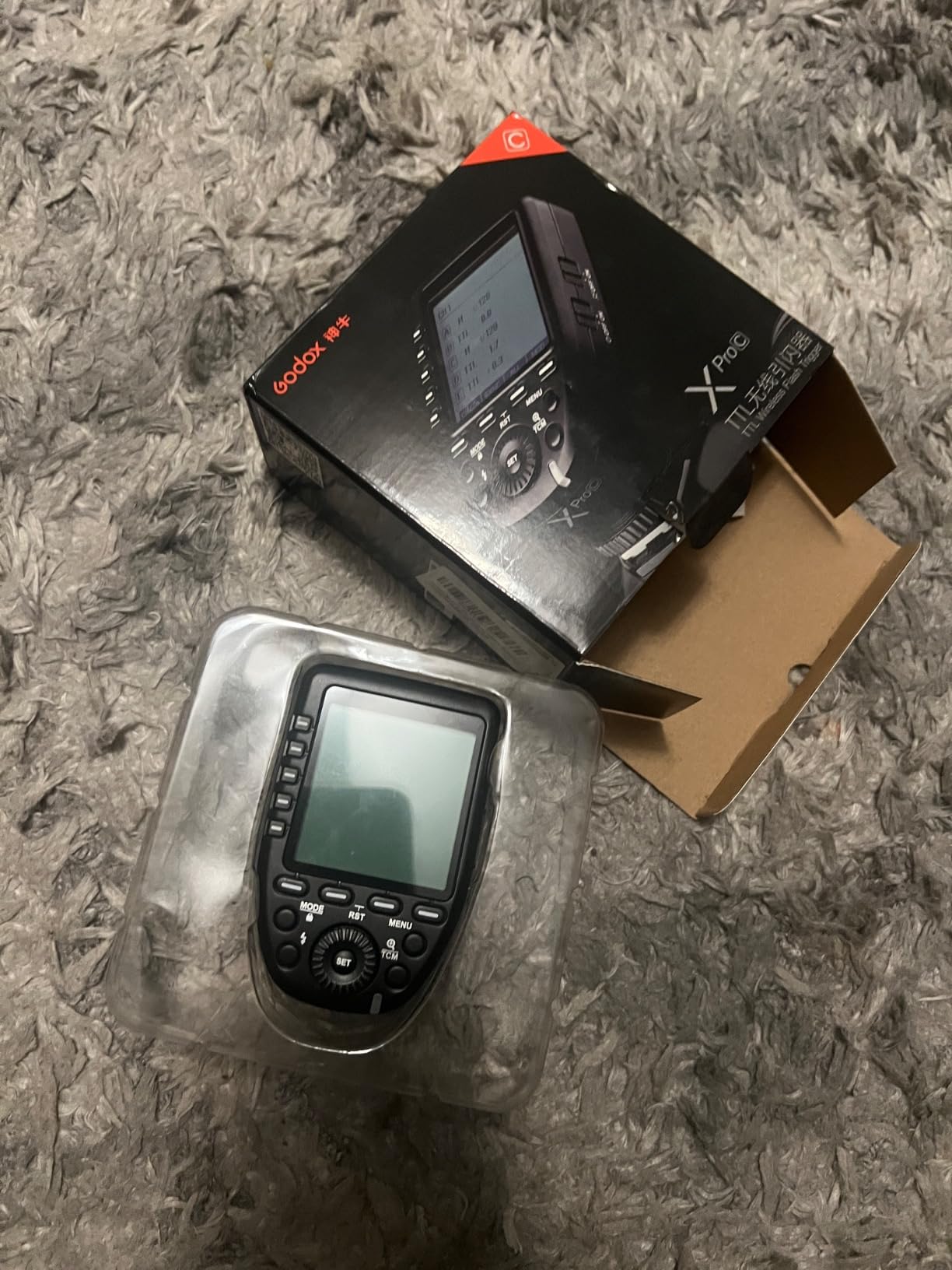
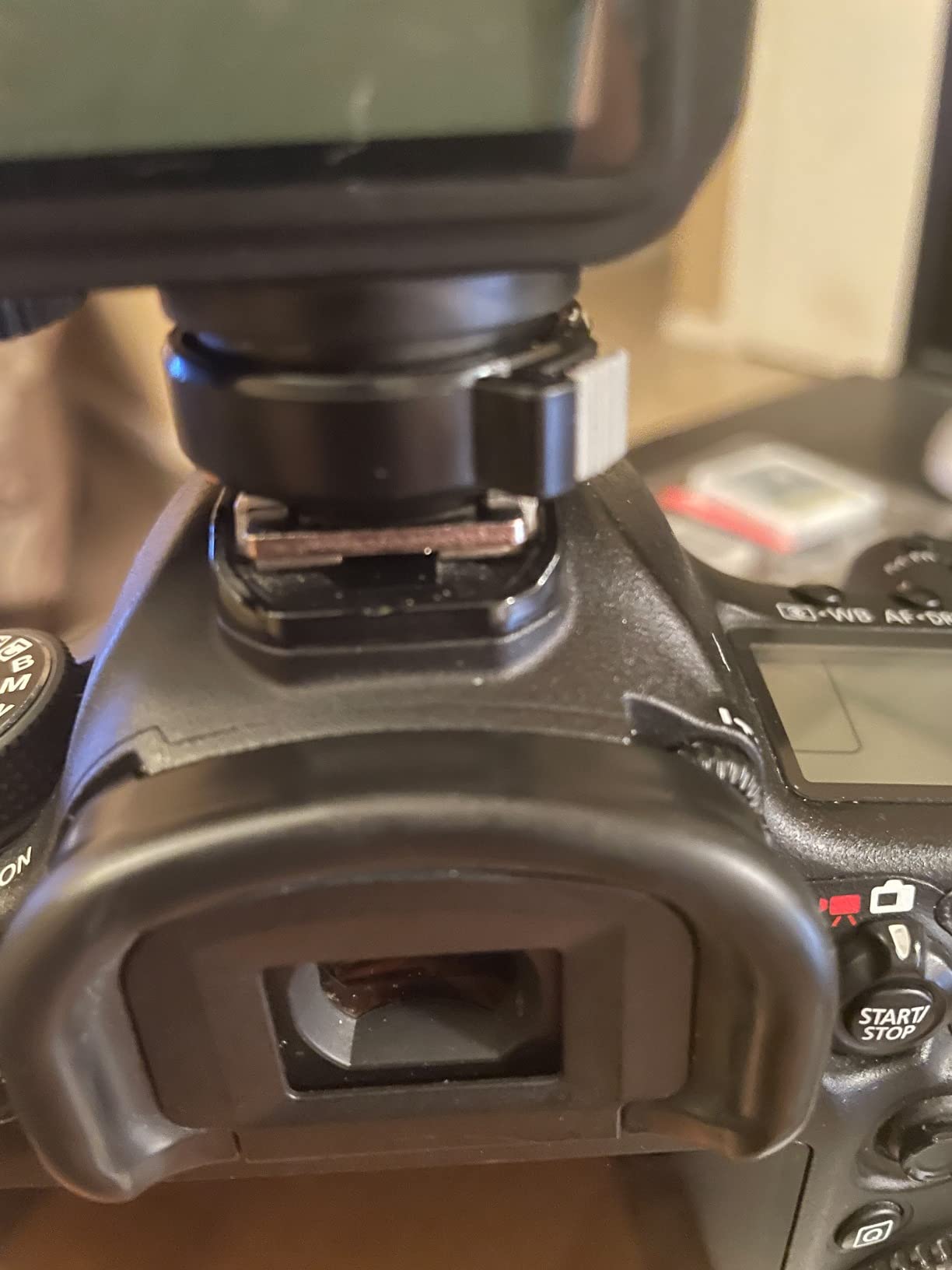
The honest criticisms are small but real. The menu system takes a week to stop fighting, and on Canon mirrorless bodies I have had to reseat the trigger a couple of times when the hot shoe contacts were not quite aligned. Modelling lamp control is binary, so if you want to dim the lamp to shape light you set it on your flash instead. It also lacks the quick-release lock lever that Canon speedlights have, so the collar needs a fingernail.
At 150 g it is heavier than the X2T, and on a long event day you notice it. I think that weight buys the screen, the dial and the radio, and none of those three things have let me down. For Canon shooters who already own or plan to own Godox lights, this is the safest purchase in the category.
When the XPro-C earns its price
Buy it if you are running two or more lights and need to read group power at a glance while you shoot. The screen, the five group buttons and the wireless ID all exist for multi-light work, and that is where the money goes. Wedding and event shooters working a reception with three strobes will feel the difference immediately.
Long-term owners report the XPro firing reliably for years without failure, which matters more than any spec on the box. If your gear is a mix of Godox speedlights and AD-series strobes, this transmitter covers the widest slice of that ecosystem of anything here.
When to pick something else
Skip it if you are on a strict budget for a single manual strobe, because TTL capability is wasted on a monolight with no metering. It is also the wrong choice if you own NEEWER Q flashes or AD-series strobes only and never plan to mix brands.
Sony and Nikon shooters should not buy the Canon suffix on the assumption it will do the same job. It will fire through the centre pin, but you silently lose TTL, HSS and remote power control. Buy the variant built for your body instead.
2. Godox X2T-C TTL Wireless Flash Trigger for Canon – Best Value
Godox X2T-C TTL Wireless Flash Trigger for Canon, 2.4G X System
TTL with 1/8000s HSS
Bluetooth app control
5 groups, 32 channels
120 g, 2 AA
Pros
- Cheapest full-featured entry to the Godox 2.4G X system
- TTL and 1/8000s HSS rather than manual only
- Bluetooth app control for adjusting power remotely
- Visible-light AF assist lamp is more usable than the old infrared pattern
- USB-C port and a new hot shoe locking mechanism
Cons
- Smaller
- less legible screen than the XPro
- Only one group shown in detail at a time
- Does not talk to Godox AD-series or other 2.4GHz X Pro radio gear
The X2T-C is the same 2.4G X radio system as the XPro at a fraction of the weight, 120 g, and a lower cost. If you are buying a first off-camera setup and want TTL and high-speed sync from day one, this is where the sensible money goes. You give up screen size and some of the radio compatibility, and you keep the protocol that matters.
Bluetooth control through the GodoxPhoto app is more useful than I expected. On studio work where the trigger sits on a stand away from my hand, being able to nudge a group’s output from my phone saves a walk. The five group buttons and relocated control wheel are well placed, and the USB-C port is a small quality-of-life win over the older micro-USB triggers.
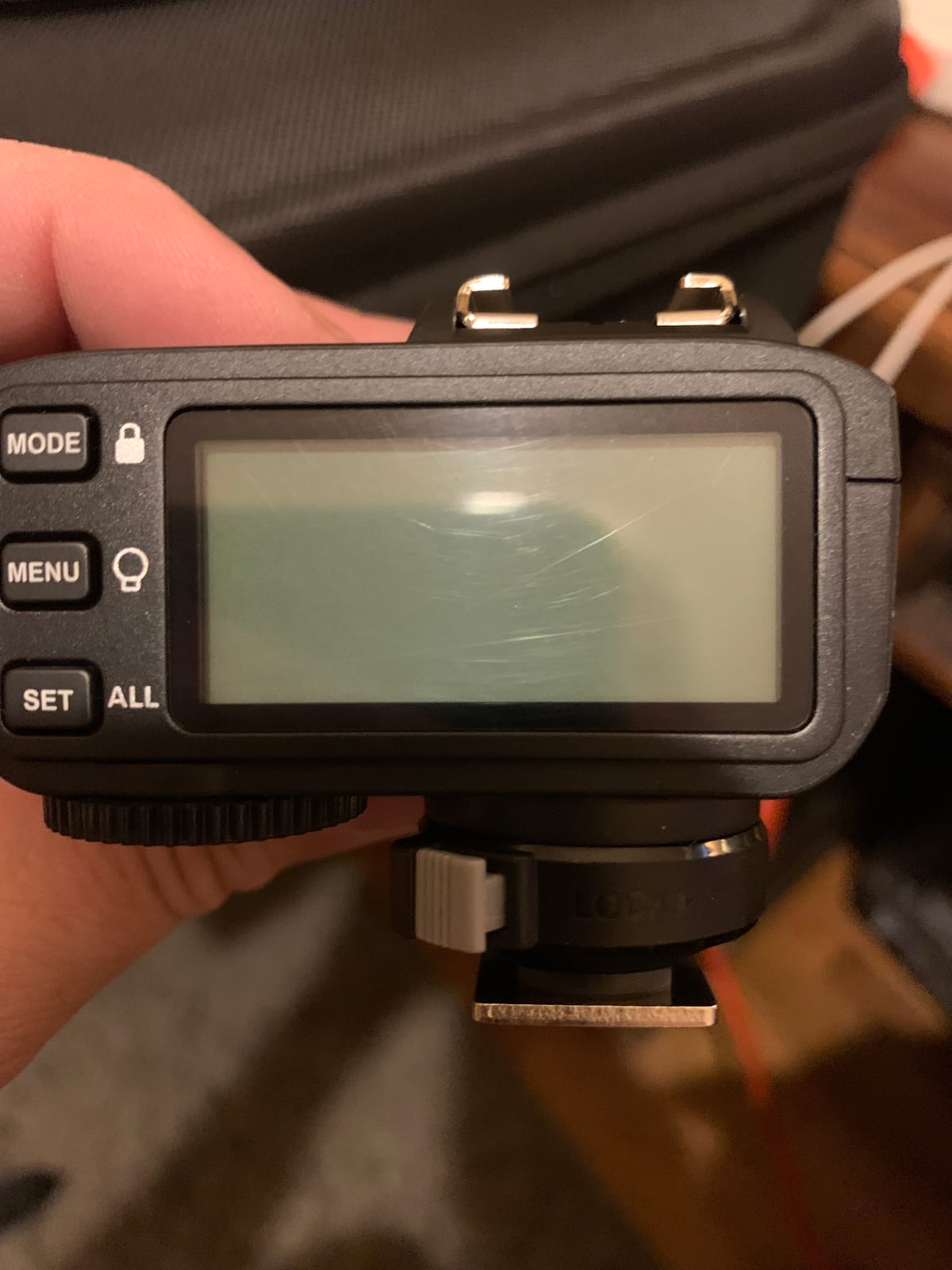
Where the compromises bite is the display. It is smaller and dimmer than the XPro’s, and it shows one group in detail at a time, so a four-light setup means more button presses to verify what each head is doing. If you are constantly checking ratios, that friction adds up over a full wedding weekend.
The more serious limitation is radio scope. It speaks the standard 2.4G X protocol, which covers the common Godox speedlights, but it does not pair with the AD series or other 2.4GHz X Pro equipment. If your future plan is an AD600 or an AD200 Pro II, this is the wrong transmitter and the XPro is the right one.
Where the X2T-C makes more sense than the XPro
Choose it for a two-light setup, for travel weight, or when you want TTL without a second mortgage. A location photographer moving between jobs with one speedlight and one stand gets everything that matters: TTL metering, 1/8000s HSS, 32 channels and 99 wireless IDs.
It is also the trigger I recommend to anyone who wants to try off-camera flash without committing to one ecosystem. Getting the protocol right on a cheaper body is cheaper than buying the wrong system twice.
Where it falls short
If you already own or plan to buy AD-series strobes, move up. The radio mismatch is not a firmware fix, it is a protocol difference, and no amount of menu fiddling closes it.
Multi-light operators should also note the single-group detail view. It is workable, just slower than the XPro. And anyone with large hands may find the smaller body fiddly with cold fingers.
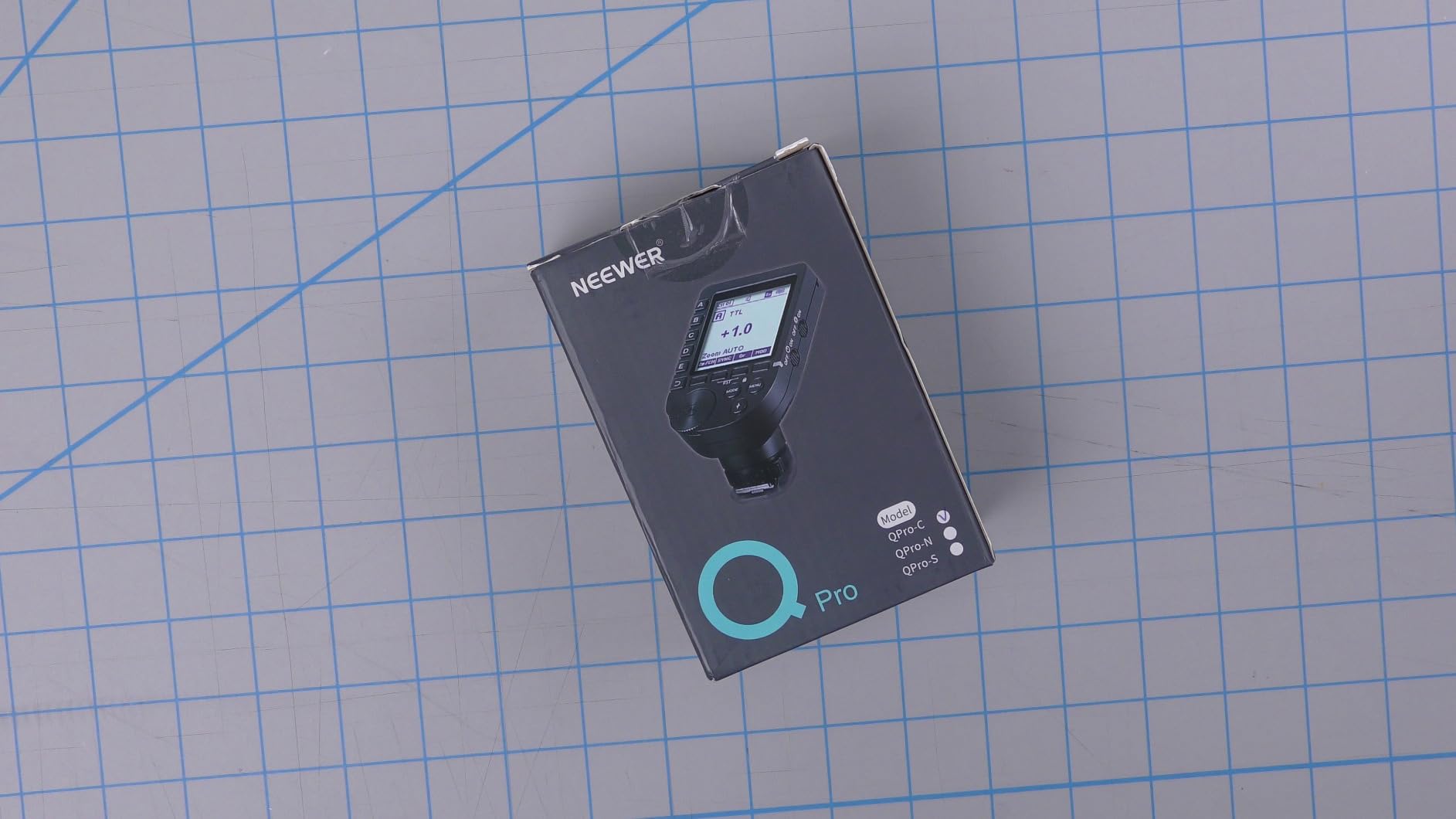
3. NEEWER QPRO-C TTL Wireless Flash Trigger for Canon – Best for Canon Event Work
NEEWER Upgraded QPRO-C TTL Wireless Flash Trigger Compatible with Canon
TTL, HSS and stroboscopic flash
5 groups, 32 channels
Screen magnification mode
5.3 ounces, 2 AA
Pros
- TTL
- 1/8000s HSS and stroboscopic flash in a third-party trigger
- Screen magnification makes a single group's settings easy to read
- Five group buttons
- four function buttons and a scroll wheel
- Long published Canon body compatibility list with firmware updates
- Triggers NEEWER Q-system flashes with no extra receiver
Cons
- Not compatible with the Canon RP R50
- Only triggers NEEWER Q-system flashes directly
- Single point triggering works only in manual and multi mode
- Does not speak the Godox 2.4GHz X Pro protocol
The QPRO-C is the trigger to shortlist if your flashes are NEEWER rather than Godox. It carries the full modern feature set, TTL, 1/8000s high-speed sync, stroboscopic flash, exposure compensation, group zoom and group modelling lamp control, and it drives NEEWER Q-series flashes straight from the built-in radio with no receiver dongle. That last point is the whole argument.
Its best trick is the screen magnification function. Double-click a group button and the display enlarges that group’s settings so you can read power and mode without squinting, which is exactly what you want on a dark reception. Five group buttons, four function buttons and a scrolling wheel make the changes quick, and the metal hot shoe mount feels solid enough for a working body.
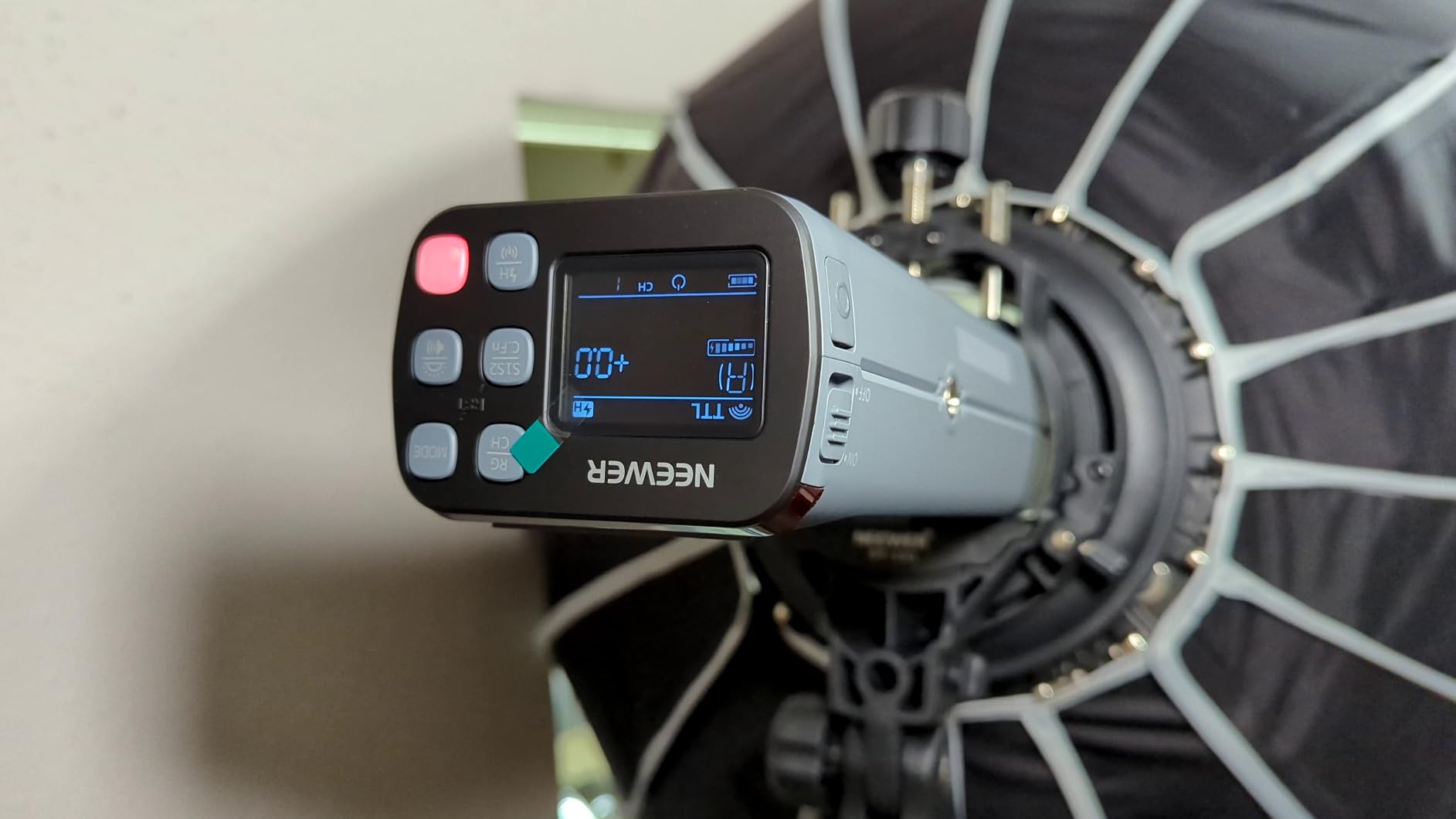
What you give up is ecosystem breadth. Other brands need a separately sold QR receiver plus a 2.5mm sync cord, and the AD-series strobes are simply out of reach because it does not speak the Godox 2.4GHz X Pro protocol. Single point triggering for fast continuous bursts only works in manual and multi mode, not in TTL or HSS, which is a strange gap in an otherwise complete feature set.
There is also a body exception worth knowing: it is not compatible with the Canon RP R50. The published compatibility list runs from R-series bodies through the 5D and 1D lines down to the 4000D, which covers most working photographers, but check your specific model before you order.
Who should buy the QPRO-C
Buy it if you are building a kit around NEEWER gear or starting fresh with no brand loyalty. TTL, HSS, strobe mode and group control at this feature level are normally reserved for the established systems, and having them without a receiver per light keeps a three-head setup simple.
It is also a good second body option. If your main transmitter lives on the camera you shoot portraits on, a second one for event work lets you carry both without reconfiguring groups every job.
Who should not
Do not buy it if you own Godox X-system speedlights or AD-series strobes. Nothing about that combination works without extra hardware. Mixing a NEEWER trigger into a Godox rig also splits your group control across two systems, which is where misfires and surprise ratios come from.
Sports shooters should also note that single point triggering does not apply in TTL or HSS, so this is not the trigger for a fast burst at a trackside.
4. AODELAN FT-8 Transmitter and Receiver Set – Best Budget Two-Light Starter
Wireless Flash Trigger Transmitter and Receiver Set with 3.5mm PC Receiver
8 channels on 2.4GHz
200m range
1/250s sync ceiling
9.9 ounces, AA
Pros
- Fires reliably every time at a fraction of the cost of name-brand triggers
- AA batteries in both pieces are cheap and easy to find
- Includes a 3.5mm sync cable and a 3.5mm to PC plug adapter for studio strobes
- Metal hot shoe and a solid-feeling body
- Reportedly syncs some older flashes above the ceiling of certain Godox triggers
Cons
- Maximum sync speed is only 1/250s so no high-speed sync
- No TTL
- no groups and no exposure compensation
- Not compatible with Sony's own flashes
- Very old flashes with high trigger voltage can damage the receiver
- Small channel buttons and no backlit display
Sometimes the right answer is a box that arrives with everything inside it. The AODELAN FT-8 set ships a transmitter, a receiver, a 3.5mm to 3.5mm sync cable and a 3.5mm to PC plug adapter for quarter-inch mono sockets, so you can fire a speedlight or a studio strobe without buying anything else. For a first off-camera light, that completeness is worth more than any menu feature.
It runs on 8 channels at 2.4GHz with a stated range up to 200m, and the transmitter has a 90-degree rotating joint so you can mount it in portrait or landscape orientation on a body with a side-entry shoe. Owners report the connection holds, and one review notes that it syncs some older flashes above the speed limit of certain Godox triggers, which is an odd but real point in its favour.
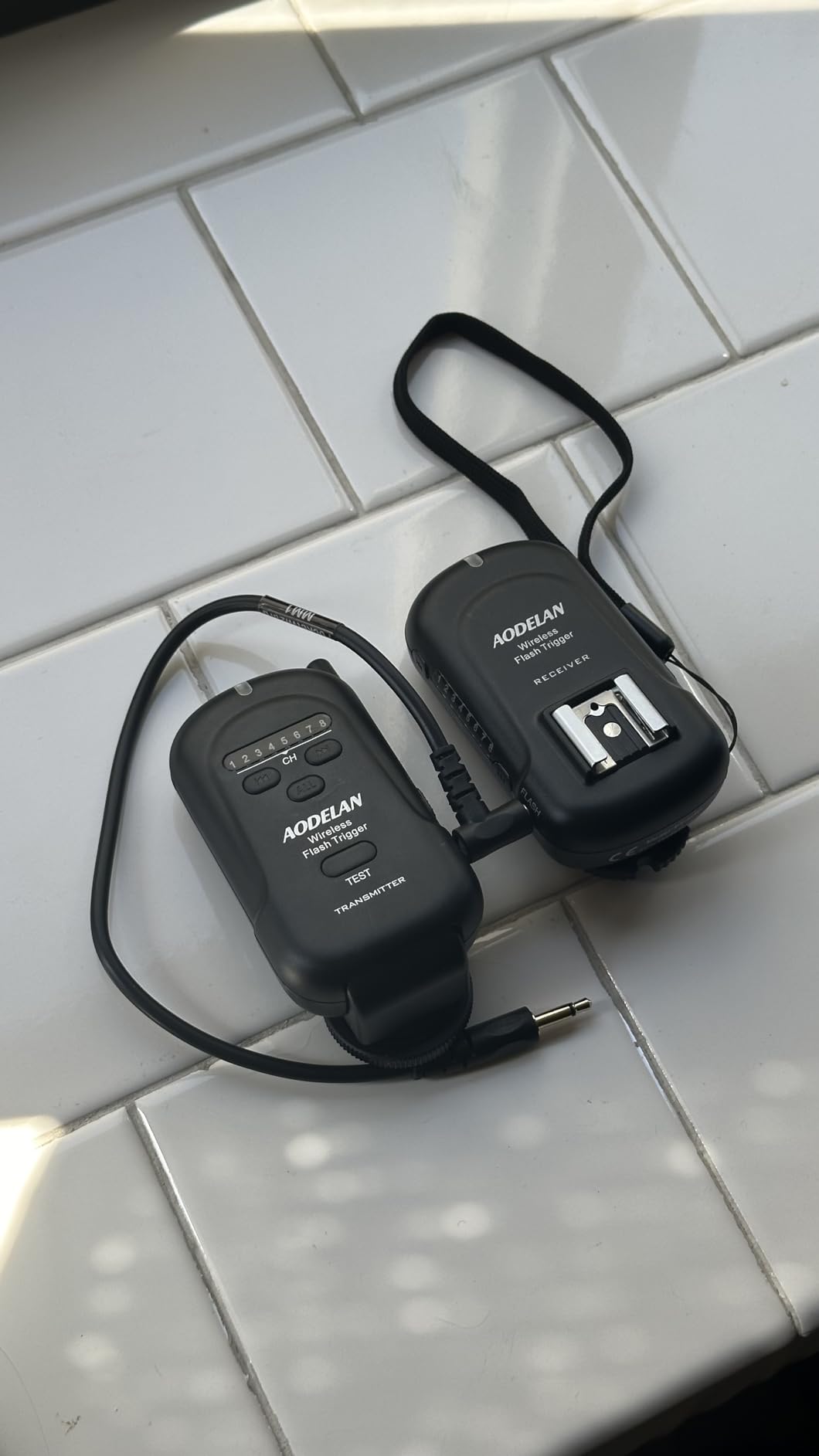
The ceiling is 1/250s. That means no high-speed sync, so this is a trigger for shaded locations, studios and evening work, not for wide apertures in daylight. There is no TTL and no group power control, so exposure is set on the flash itself, exactly as it was with a sync cable. The only way to change levels is to walk to the light.
Two cautions. Sony’s own flashes are excluded from the compatibility list, and very old flashes with high trigger voltages can damage the receiver circuit, so check your flash before firing it. The channel and mode buttons are also small, and there is no backlit display, which is hard work at a dark reception.
Where this set makes sense
It is a good answer for a photographer with one or two manual-only strobes, including older Bowens-style monolights, who wants to fire them from the camera position. The included PC plug adapter is the reason: it reaches quarter-inch mono sockets that bare transmitter-only products ignore.
It is also a sensible second system. Because the radio is its own, you can run it alongside a TTL rig on a different channel without interference. AA power in both pieces also means a dead battery is never a delay.
Where it does not
Rule it out for daylight HSS work, for any setup that depends on metering, and for multi-light ratios. Without groups or exposure compensation you are walking to each head, which is fine in a studio and unacceptable on a deadline.
Sony speedlight users should skip it. The universal PC sync route works, but the radio path does not include Sony’s own flashes.
5. AODELAN Universal Hot Shoe Trigger Set – Best for Manual-Only Strobes
AODELAN Flash Trigger Transmitter and Receiver with Universal Hot Shoe
8 channels, 2.4GHz
200m range
Universal metal hot shoe
1/250s sync ceiling, 2 AA
Pros
- Universal metal hot shoe works across Canon
- Nikon
- Sony
- Olympus
- Panasonic
- Pentax
- Fuji and Samsung bodies
- Build reported to outlast cheaper trigger sets
- AA batteries in both pieces with long run time per set
- Bundled carrying pouch
- lanyards and both 3.5mm and PC plug cables
- Reported to hold a solid connection at 70m and beyond
Cons
- No TTL
- no high-speed sync and no TCM
- Maximum sync speed is 1/250s
- Not compatible with Sony's own flashes
- Not cross-compatible with Phottix Ares triggers despite the identical look
- S1 and S2 power settings only with no per-group control
This is the set for the manual-only crowd. It comes with a transmitter, a receiver, a 3.5mm to 3.5mm sync cable, a 3.5mm to PC plug cable, a quarter-inch mono plug socket, two lanyards and a carrying pouch. That accessory list is unusual at this level and it means the kit covers studio strobes, speedlights and manual monolights out of the box.
The metal hot shoe is the quiet advantage. Owners consistently report that the build outlasts cheaper trigger sets, and the universal shoe works across Canon, Nikon, Sony, Olympus, Panasonic, Pentax, Fuji and Samsung bodies. Both pieces run on AA cells, and reported connections hold at 70m and beyond, which is more than enough for a large hall.
Who this is for
If you shoot with older manual strobes, medium-format film gear, or underwater work behind a sealed housing where a touchscreen is a liability, this is the right shape of product. There is nothing to mis-set. The receiver goes on the light, the transmitter goes on the camera, they match channel, and the flash fires at the power the flash is already set to.
It is also a good fit for the photographer replacing an older PocketWizard set. The recurring question in that situation is whether a cheap manual system can drive old monolights, and the honest answer is yes, provided the strobe has a 3.5mm sync input or a quarter-inch socket.
What you give up
No TTL, no high-speed sync, no TCM and no groups. The 1/250s ceiling rules it out of daylight wide-aperture work, and S1 and S2 power settings mean you change levels on the flash, not the trigger.
Two traps worth flagging. It is not cross-compatible with Phottix Ares triggers even though the units look identical, and it does not drive Sony’s own speedlights. Both cost people a return trip to the counter.
6. Godox CT-16 3-in-1 Radio Trigger Kit – Best Ready-Made Two-Light Kit
Godox CT-16 Wireless Radio Flash Trigger Receiver Kit,Fit Compatible for Canon Nikon Pentax DSLR Camera Studio 3 in 1 Flash Transmitter and Receiver
Transmitter plus two receivers
433MHz radio
1/250s sync ceiling
8.4 ounces
Pros
- Two receivers in the box
- enough to run a two-light off-camera setup immediately
- Stable 433MHz link with fast response
- Works with common hot shoe cameras from Canon
- Sony and Nikon
- Included sync cables and converter adapters cover most studio strobe inputs
- Transmitter battery is rated for a very long service life
Cons
- Maximum sync speed is only 1/250s
- No TTL metering and no group exposure control
- Receiver AAA batteries are not included
- 433MHz is a separate system from the Godox 2.4GHz X and X Pro ecosystems
- A protective film on the transmitter must be removed before first use
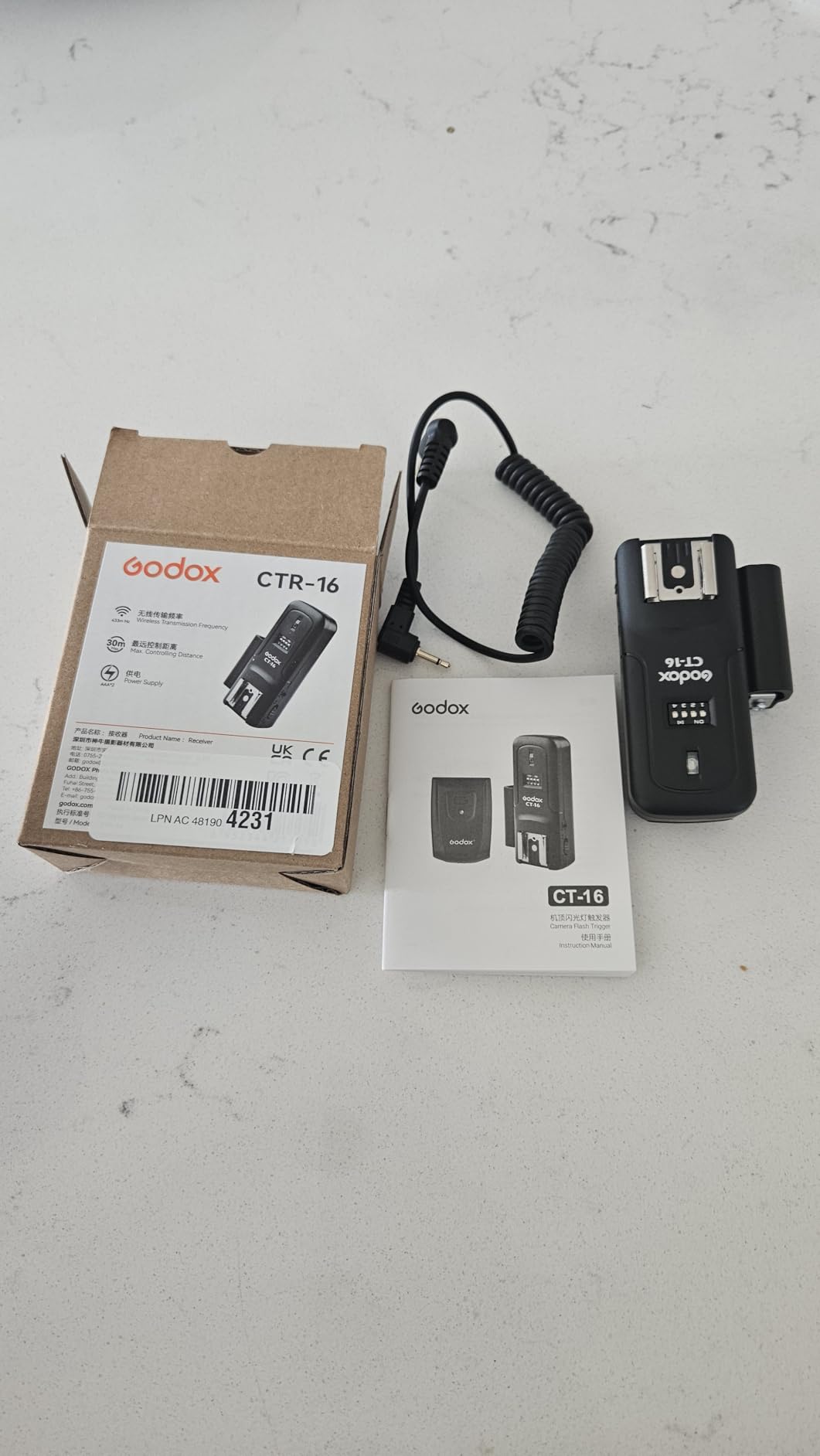
Most two-light kits mean buying receivers separately. This one does not. The box holds a CT-16 transmitter, two receivers, two sync cables, two converter adapters and a cloth, and the studio flash interface takes one receiver per head. For a photographer setting up off-camera flash for the first time, that is the whole kit in one purchase and the shortest possible path to a working two-light setup.
The radio is 433MHz rather than 2.4GHz, and in practice owners report a stable link with fast response. The transmitter takes a 23A 12V lithium cell rated for a very long service life, while the receivers run on two AAA batteries each, which are not included in the package. Budget for four AAAs before your first shoot.
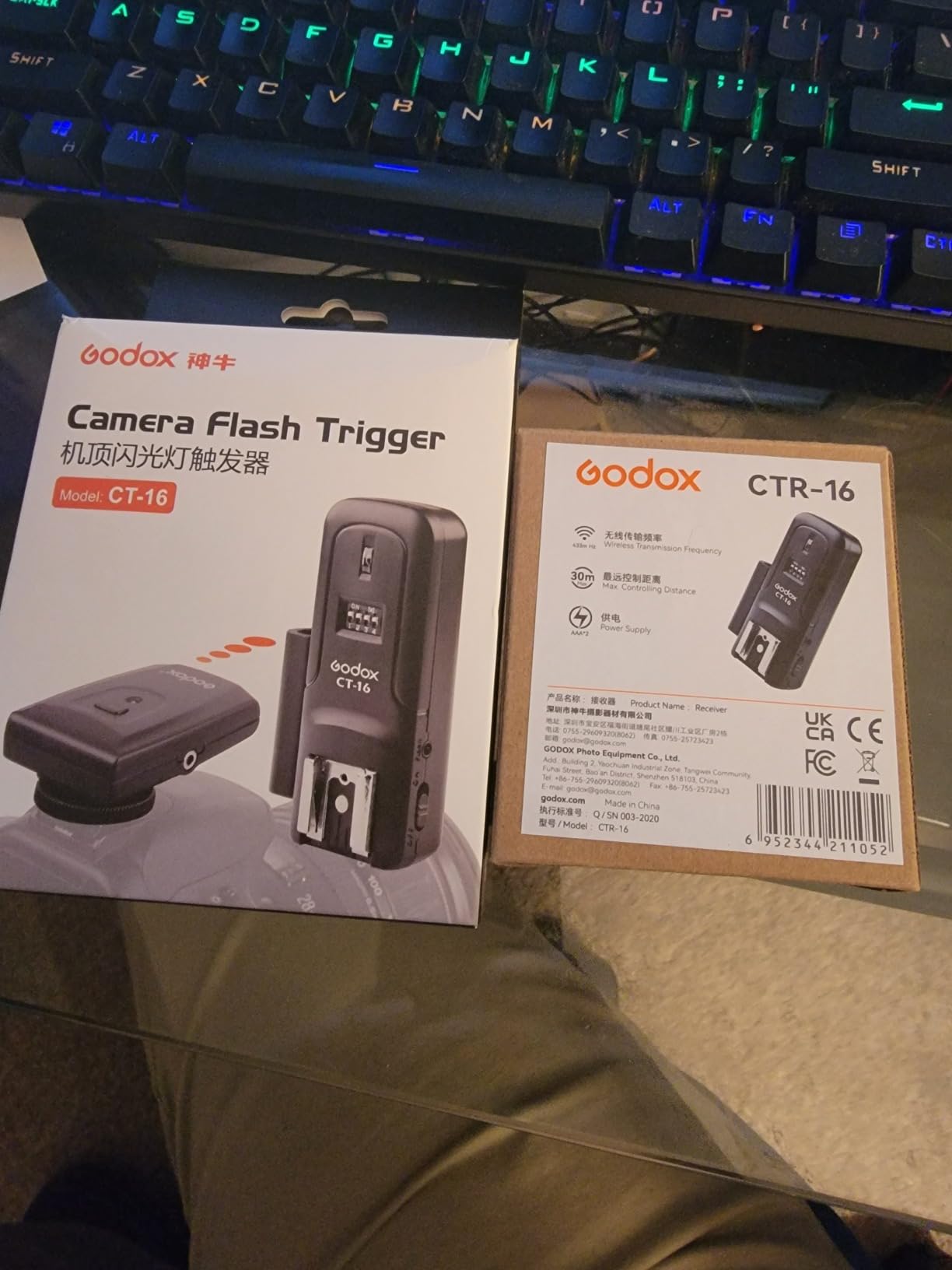
Everything is manual. There is no TTL metering and no group exposure control, and the maximum synchronous speed is 1/250 second, so this is a location and studio kit rather than a daylight HSS kit. The 433MHz band is also its own island: it does not share a protocol with the Godox 2.4G X or X Pro systems, so it will not mix with either of the other Godox triggers in this list.
One first-use detail catches people out. A transparent protective film sits on the transmitter and has to be peeled off before it will behave, which is worth knowing before you blame the batteries on the night of a job.
Why the CT-16 is still worth shortlisting
The single most common complaint in flash forums is not that a trigger misbehaves, it is that people did not buy enough receivers. This kit removes that problem, and at 8.4 ounces the whole set is light enough to live in the same bag as your stands.
It suits a photographer with two manual strobes who wants remote firing and shutter release without metering. Product and event photographers use it exactly that way, and the included converter adapters cover most studio strobe inputs.
Where it is the wrong tool
If you need TTL or high-speed sync, this is out. If you already own Godox 2.4G X gear, you now have two incompatible radios in the same bag, which is a confusion waiting to happen on a dark venue.
Anyone upgrading from an older manual system should also weigh the fact that the receiver batteries are not supplied. It is a small thing, but it is the kind of detail that ruins a first session.
7. NEEWER QZ-C Touchscreen TTL Flash Trigger – Best for Touchscreen Control
NEEWER QZ-C 2.4G TTL Wireless Flash Trigger Compatible with Canon Cameras Godox IT32 V1 V100 AD200 Pro II, OLED Touchscreen Hot Shoe Flash Transmitter with 1/8000s HSS, 1000mAh Battery/CM Switch
Dimmable OLED touchscreen
TTL, manual, strobe, S1/S2
1/256 to 1/1 power
1000mAh rechargeable battery
Pros
- Colour touchscreen is bright
- readable and much easier to navigate than button-only triggers
- Retains physical buttons for the functions you need on the move
- Bridges ecosystems by driving NEEWER Q flashes and several Godox models
- Reliable range and quick channel scanning within the stated distance
- 1000mAh battery with an on-screen charge gauge
- Unusually low 1/256 minimum power for fine control
Cons
- Godox X-series support needs a specific firmware version and a fiddly Windows-only update process
- Updater requires a USB-A to USB-C cable so USB-C-only laptops cannot run it
- One owner reports it would not connect to a Godox V1 speedlite
- Built-in battery is not replaceable when it eventually fails
- Low review count and no support for several entry-level Canon bodies
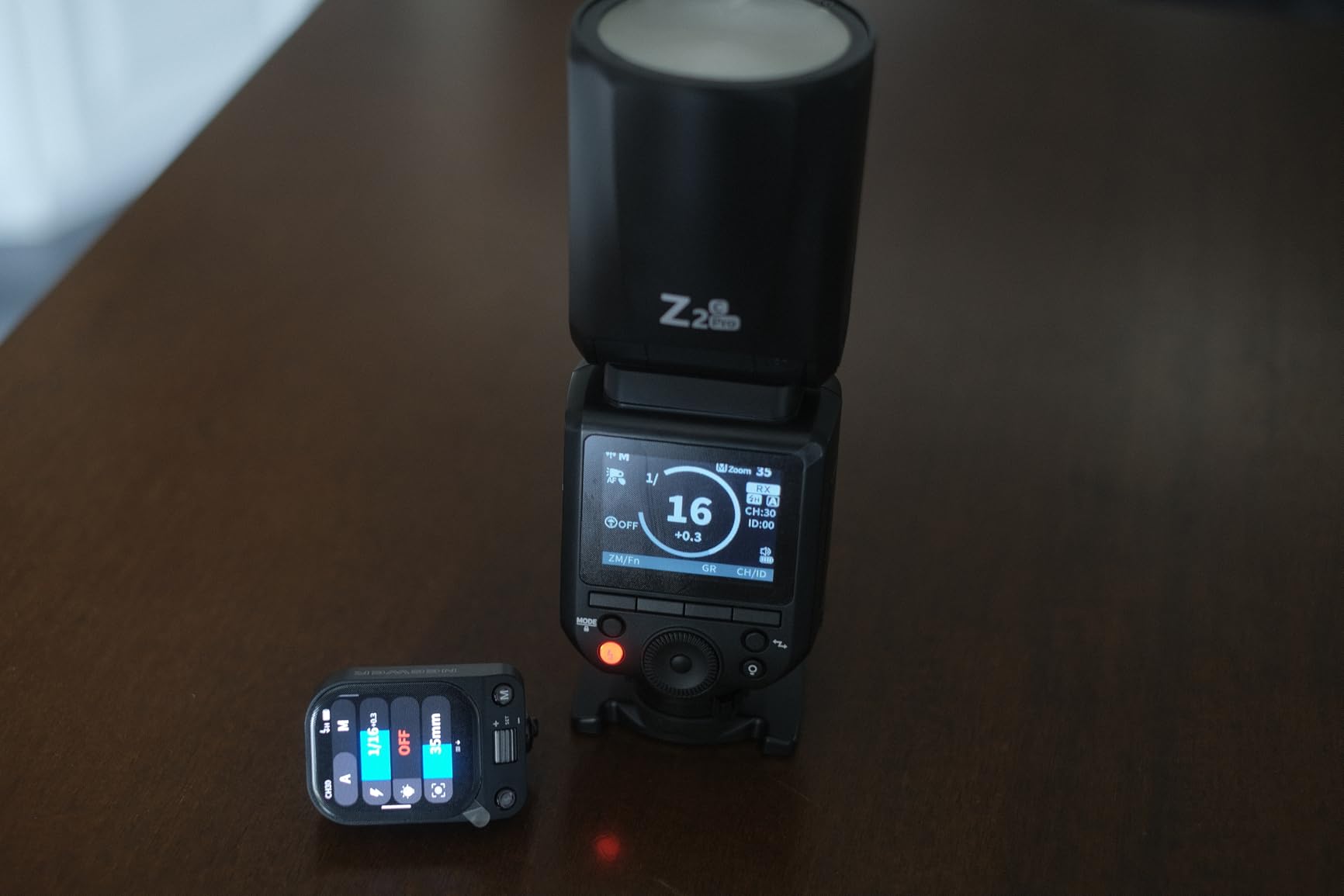
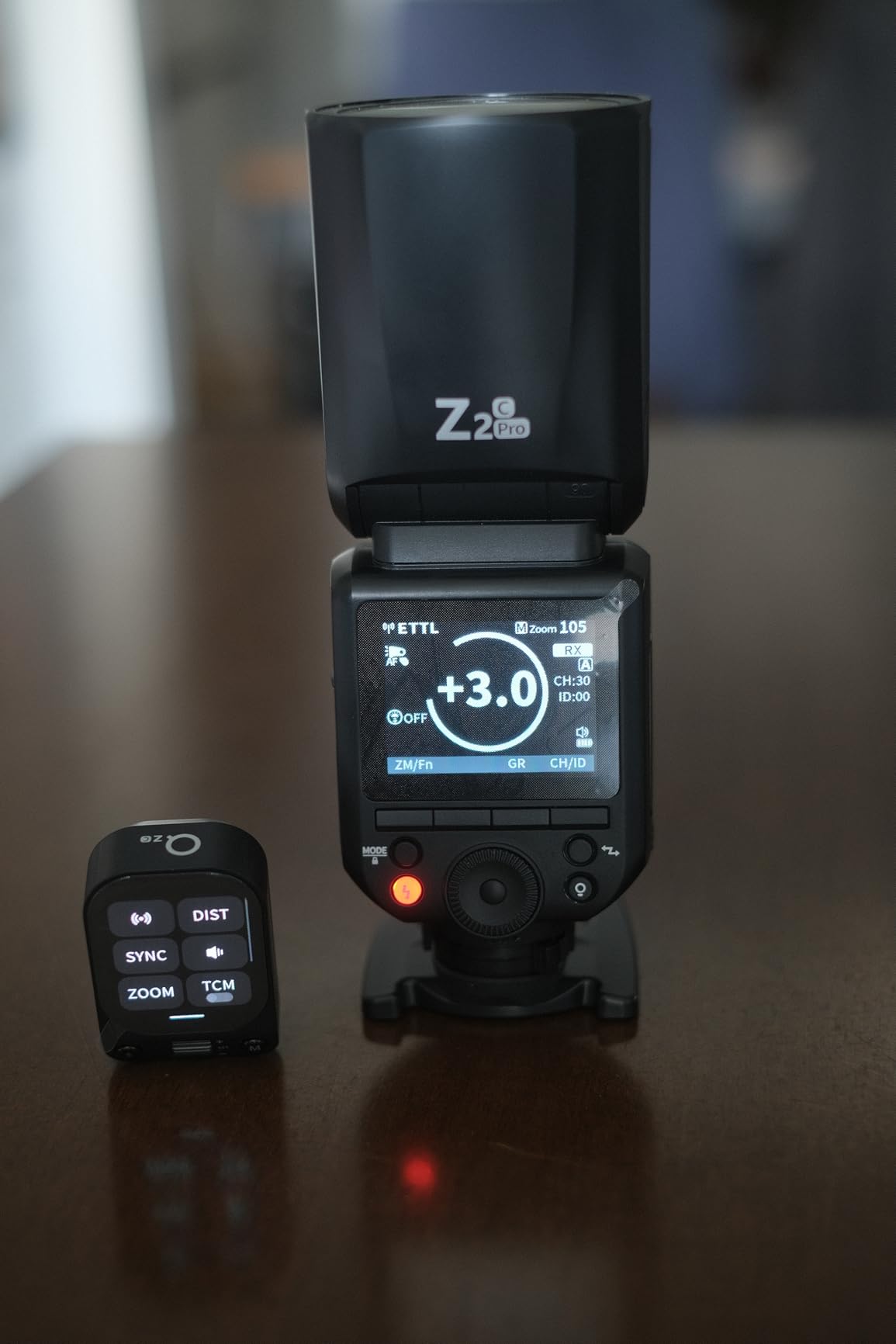
The QZ-C is the newest thing here and the only one with a proper colour touchscreen. It runs TTL, manual and strobe modes plus S1 and S2, gives you plus or minus 3 EV of compensation, and has an unusually low minimum output of 1/256, which means you can dial a background light down further than most triggers allow. Zoom from 20-200mm is available in auto or manual, and there is single point triggering.
Most interesting to me is the ecosystem bridging. It drives NEEWER Z-series and Q-series flashes, and it also lists compatibility with the Godox IT32, V1, V100, AD200 Pro II and AD100 Pro II. If you are splitting a kit across NEEWER and Godox gear, this is the trigger that keeps it on one device. The 1000mAh battery charges in about two and a half hours and there is a real-time gauge on screen.
Now the reality check. The review base is small, and the complaints cluster around firmware. Godox X-series support requires firmware V1.0.38 and an update process that owners describe as difficult and poorly documented on Windows 11. The updater also needs a USB-A to USB-C cable, so a laptop with USB-C ports only cannot run it without an adapter. One owner reports it would not connect to a Godox V1 speedlite at all.
It also leaves out several entry-level Canon bodies, including the T7 and 1500D, the 2000D and the RP R50. And the internal lithium cell is not user-replaceable, which is the failure mode that eventually strands a trigger. Touchscreens are also awkward with gloves on a cold outdoor job, which is why the physical buttons are a genuine saving grace rather than an afterthought.
Who should consider the QZ-C
It suits a photographer who dislikes button-only interfaces and runs a mixed NEEWER and Godox kit. The touchscreen cuts setup time noticeably in multi-light work, because you are not pressing through menus to find a group, and the brightness can be dialled down for dark venues.
It is also the only trigger here with a 1/256 minimum, which makes it useful for balancing a background flash against a key at close range. The battery gauge removes the dead-battery panic on a long day.
Who should wait
Hold off if you depend on the Godox X-series, because the firmware path is the weak point and one reported connection failure is enough to make me cautious. USB-C-only laptop owners should confirm the update route before committing.
Check your camera body against the compatibility list first. If your Canon is an entry-level model not named on the box, this is not the trigger for you, however good the screen is.
Which Trigger Do You Need for Your Camera?
Every TTL trigger in this roundup is built for one camera brand, and the suffix on the model number tells you which. Buying the wrong one is the single most common expensive mistake, because the trigger will still fire through the centre pin while quietly dropping TTL, high-speed sync and remote power control. Most people only discover it mid-shoot.
The suffix convention is straightforward. A trailing C means Canon, N means Nikon, S means Sony, F means Fujifilm and O means Olympus and OM System. Pentax and Leica bodies use Canon or Nikon shoe variants depending on the model, so check the manual rather than guessing.
Sony deserves one specific warning. Sony moved to the Multi Interface shoe, whose extra contacts make it more fragile than a plain ISO shoe. A loose or screw-lock collar on an MI shoe causes the trigger to rock, which photographers call hot shoe dancing. A trigger with a good quick-release lock is worth more on a Sony body than on any other.
None of these suffixes apply to the manual-only sets. The AODELAN kits and the Godox CT-16 use a universal hot shoe and fire through sync cables, so they work across most brands. They simply cannot do anything brand-specific, because they do not speak to a brand radio protocol at all.
Do You Need a Receiver for Every Flash?
Yes, but only for flashes that do not have their own radio. This is the confusion that costs people the most money, so it is worth stating plainly: a trigger transmitter on the camera is useless until a receiver is attached to each light you want to fire.
Two flash categories exist. Modern TTL speedlights with built-in radio act as their own receiver. Older speedlights, AD-series style strobes with a sync input, and studio monolights need a separate receiver clipped to them or plugged into their sync socket, one per light.
That rule explains the product choices above. The Godox XPro-C and X2T-C pair directly with radio-equipped Godox speedlights and skip the receiver, while reaching older strobes only when a receiver is added. The NEEWER QPRO-C and QZ-C behave the same way inside their own ecosystem, with the QZ-C extending the list to several Godox models. The CT-16 and both AODELAN sets always need a receiver, one per head, and that is exactly why they ship with two.
A four-light setup on a radio-equipped speedlight system is four lights and no receivers. The same four lights on a manual sync system is four lights, one transmitter and four receivers. Plan that before you build the rig, not after.
Troubleshooting: Why Your Trigger Is Not Firing
Misfires cluster around a small number of causes, and they are almost always fixable in under a minute. Work through these in order.
1. Check the batteries first. On most triggers a low-battery indicator appears on screen before the trigger stops transmitting entirely, which means a half-dead battery looks identical to a radio problem. Carry spares in the same bag as the stands.
2. Confirm the channel and group match on both ends. A transmitter on channel 2 will not talk to a receiver on channel 3, and this is the most common fault by a wide margin. The Godox CT-16 requires both pieces on the same channel, and the TTL triggers also need matching group assignments.
3. Reseat the transmitter in the hot shoe. Contacts that are slightly misaligned will not always stop TTL but will stop the sync pulse reaching the flash. Power the camera off, remove the trigger, and push it back on with firm, even pressure.
4. Check the sync mode. Second-curtain sync and high-speed sync change when the flash fires, and in some combinations the flash appears not to fire at all from the camera’s view. Switch back to standard first-curtain single shot and test again.
5. Test the centre pin. Put the trigger directly on a camera with no flash attached and fire a test shot. If the camera triggers its own flash or reports a flash event, the hot shoe connection is sound and the problem is at the light end. If nothing happens, the fault is in the shoe.
6. Move away from the light. This is near-field interference, and it is the answer to the question that comes up most often on flash forums. The transmitter’s signal overloads itself when the camera is within roughly half a metre to a metre of the flash, so the trigger will not fire at arm’s length. Godox triggers solve it with a close-range or 0-30m mode in the custom function settings, and several other brands ship an equivalent. Enable it, or step back, and the trigger fires again.
If all six fail, test the trigger on a second body before you assume it is faulty. A trigger that works on one camera and not another points to the camera’s shoe, not the transmitter.
How to Choose a Flash Trigger
Map your gear before you shop. Write down every flash and strobe you intend to fire, and check which of them already contain a 2.4GHz radio. That single list eliminates most of the wrong purchases, because the trigger protocol has to match the flash protocol before anything else matters.
Match the camera suffix second. This is where the Canon-suffix products in our lineup have no substitutes, and where a mismatch fails silently. Read the compatibility list for your exact body rather than trusting the brand name.
Decide whether you need TTL and high-speed sync. If you shoot manual-only strobes, a monolight or medium-format film, you can buy a simpler and cheaper manual system with no loss. If you shoot outdoors in daylight, HSS is what lets you keep a wide aperture and a fast shutter, and you cannot add it later.
Count your lights and your channels. Look at group count and channel count together. Five groups with 32 channels handles a typical two or three head setup; if you run many lights in a busy venue, a high wireless ID range matters because it stops other photographers triggering your units.
Look at the hot shoe and the interface. A quick-release lock matters more on Sony bodies with the fragile Multi Interface shoe. A backlit screen with several groups shown at once is worth paying for if you work in the dark. Touchscreens are faster for setup and awkward with gloves.
Finally, think about power and longevity. AA cells are cheap and instantly replaceable, which matters on a long day. An internal rechargeable lithium battery charges once and lasts, but is dead when it dies, and firmware support is a fair proxy for how long the manufacturer will keep the product alive.
Frequently Asked Questions
Do I need a trigger for off camera flash?
Yes, if the flash is no longer on the camera. A trigger transmitter in the hot shoe sends power, group and sync timing over 2.4GHz radio, and a receiver on the flash makes it fire when the shutter fires. It also adds TTL metering, group power control and high-speed sync, none of which a plain PC sync cable carries.
Do flash triggers work with any flash?
Not any flash, and the distinction is important. Flashes with a built-in 2.4GHz radio pair directly to a matching transmitter. Older speedlights, strobes and studio monolights need a separate receiver on each light, one per head. Radio protocols are brand-specific too, so a Godox transmitter will not control a NEEWER Q-system flash.
Are Godox triggers universal?
Only within the Godox X system and the camera suffix you bought. The XPro-C is built for Canon bodies, and the N, S, F and O variants cover Nikon, Sony, Fujifilm and Olympus. A wrong-suffix trigger will still fire through the centre pin, but it silently loses TTL, high-speed sync and remote power control. Manual sync sets are the genuinely universal option.
Which Godox trigger is considered the best?
The XPro-C is our overall pick for Canon shooters because the large backlit screen shows five groups at once and the radio holds across the widest slice of the Godox range. The X2T-C is the better value for a two-light setup at 120 g. The CT-16 kit is the ready-made option, but it is manual only and runs on its own 433MHz band.
Is NEEWER or Godox better for off-camera flash?
It depends entirely on the flashes you own. Godox wins if your speedlights and AD-series strobes are Godox, and the XPro-C covers that range. NEEWER wins if your gear is Q-series, since the QPRO-C and QZ-C drive those flashes with no extra receiver. Mixing brands is where the QZ-C earns its place by bridging both ecosystems.
Why is my flash not firing through my trigger?
Work through battery level, matching channel and group, hot shoe seating, sync mode, then distance. The most common cause is near-field interference: a trigger will not fire when the camera is within roughly half a metre to a metre of the flash. Enable the close-range or 0-30m mode in the custom functions, or step back from the light.
What is the connection point on a camera for an external flash?
It is called the hot shoe, the metal slotted mount on top of the camera that slides an external flash or a trigger transmitter into place and carries the electrical contacts for TTL and sync. Many DSLRs and mirrorless bodies also have a PC sync port nearby, which is how manual triggers reach studio strobes and monolights.
Can I use one trigger with different brand flashes?
Usually not, because radio protocols are brand-specific. A Godox transmitter does not talk to NEEWER Q-system flashes, and a NEEWER Q-system transmitter does not drive AD-series strobes. Manual sync triggers are the exception, since they fire through a cable and only need a 3.5mm or quarter-inch socket on the light. Check the compatibility list before mixing.
Final Verdict
The Godox XPro-C is our choice as the best flash trigger for off camera lighting in 2026 for Canon shooters who run more than one light, because the five-group backlit screen and the broad radio coverage justify everything it costs. The X2T-C is the smarter buy for a two-light kit or for travel, and the NEEWER QPRO-C is the right answer for anyone building around Q-series flashes.
For manual-only strobes and older monolights, the manual sync sets do the job without pretending to offer TTL, and the CT-16 is the fastest route to a working two-light rig because the receivers are in the box. If you want the widest camera-brand coverage and the fewest surprises, our full wireless trigger guide goes deeper on the protocol differences.
Before you order, write down your camera model and every flash you intend to fire. That two-minute list prevents the only failure mode in this category that you cannot fix on location.