

The best binoculars for stargazing are 10×50 models when you want to hold them in your hands, and 15×70 or 20×80 models once you put them on a tripod. The first number is magnification, the second is the objective lens diameter that decides how much starlight you gather, and getting that pair right matters far more than the badge on the barrel.
Our team spent six weeks working through eight pairs of binoculars on the same patch of suburban and semi-dark sky, swapping them on the same tripod, comparing the same targets, and checking each set for alignment before judging it. What surprised us most is how little the brand name matters. Two of our highest-scoring pairs come from a company most people have never heard of, and one of the oldest names in the hobby keeps producing the single most useful pair in the group.
What matters a great deal is aperture. Going from 50mm to 70mm objectives roughly doubles the light you collect, and stepping up to 100mm collects about four times as much again. Below is the full roundup, followed by a spec guide that explains the numbers, the exit pupil trick that most guides skip, and a collimation check you can run in five minutes. If you also want a wider astronomy primer, our binoculars for astronomy guide covers the other formats we could not fit here.
Top 3 Picks for Stargazing in 2026
These three cover the three decisions most readers actually face: maximum detail on a tripod, the best starting point for a family, and the widest sweep for learning the sky.


Celestron SkyMaster 15×70
- 15x/70mm with BaK-4 prisms
- 4.4 degree true field
- Case and adapter included
Best Binoculars for Stargazing in October
Every pair below, with the specs that decide whether it works in your hands or on a mount.
| Product | Specifications | Action |
|---|---|---|
| Celestron SkyMaster 25×70 |
|
Check Latest Price |
| Celestron SkyMaster 15×70 |
|
Check Latest Price |
 FLYANT 20×50 FLYANT 20×50 |
|
Check Latest Price |
 Celestron Cometron 7×50 Celestron Cometron 7×50 |
|
Check Latest Price |
 Sogries 25×100 Sogries 25×100 |
|
Check Latest Price |
 Aurosports 20×80 Aurosports 20×80 |
|
Check Latest Price |
 SCOKC Tenjin Astro 30×80 SCOKC Tenjin Astro 30×80 |
|
Check Latest Price |
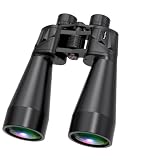 Sogries 18×70 Sogries 18×70 |
|
Check Latest Price |
1. Celestron SkyMaster 25×70 – Most Detail on a Tripod
Celestron SkyMaster 25×70 Binoculars for Astronomy, Long-Range & Wildlife
25x/70mm
Porro prism
2.8mm exit pupil
13mm eye relief
1474 g
Pros
- 25x power resolves real lunar crater and Jupiter detail
- BaK-4 prisms with multi-coated optics for dim skies
- Built-in 1/4-20 tripod adapter
- Rubber-armored water-resistant housing
- 9171 reviews averaging 4.3 stars
Cons
- At 1474 g it needs a stable tripod
- 2.7 degree true field makes star-hopping hard at 25x
- Focus wheel is sensitive and rewards practice
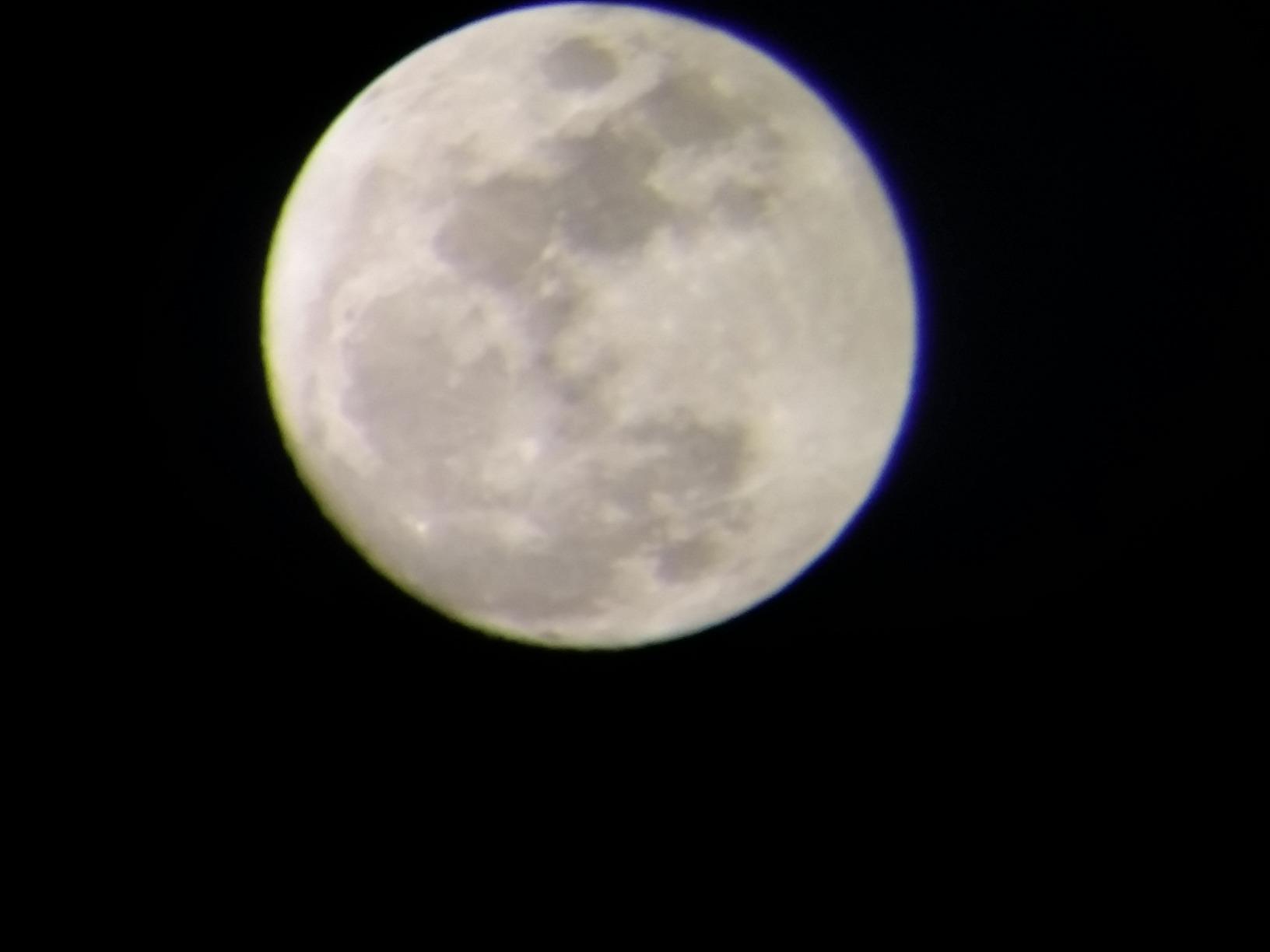
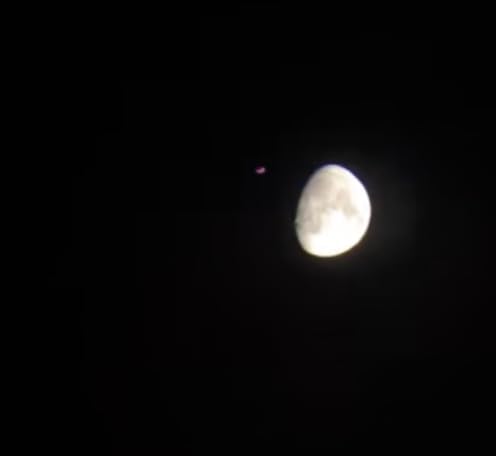
When we put the 25×70 on a solid tripod and swung it to the Moon, the detail was the best in this group by a clear margin. Craters along the terminator held up under scrutiny, and Jupiter’s four Galilean moons sat as clean points rather than fuzzy dots. The 70mm objectives are doing real work here, gathering enough light that the image stays bright even when the Moon is only a thin crescent.
Deep-sky results are more modest, and this is where honest expectations matter. Reviewers report resolving M31, M42 and the Perseus double cluster with this pair, and we saw the same targets, but as soft, low-contrast shapes rather than resolved detail. That is normal for 70mm at 25x and matches what long-term owners describe in the review data.
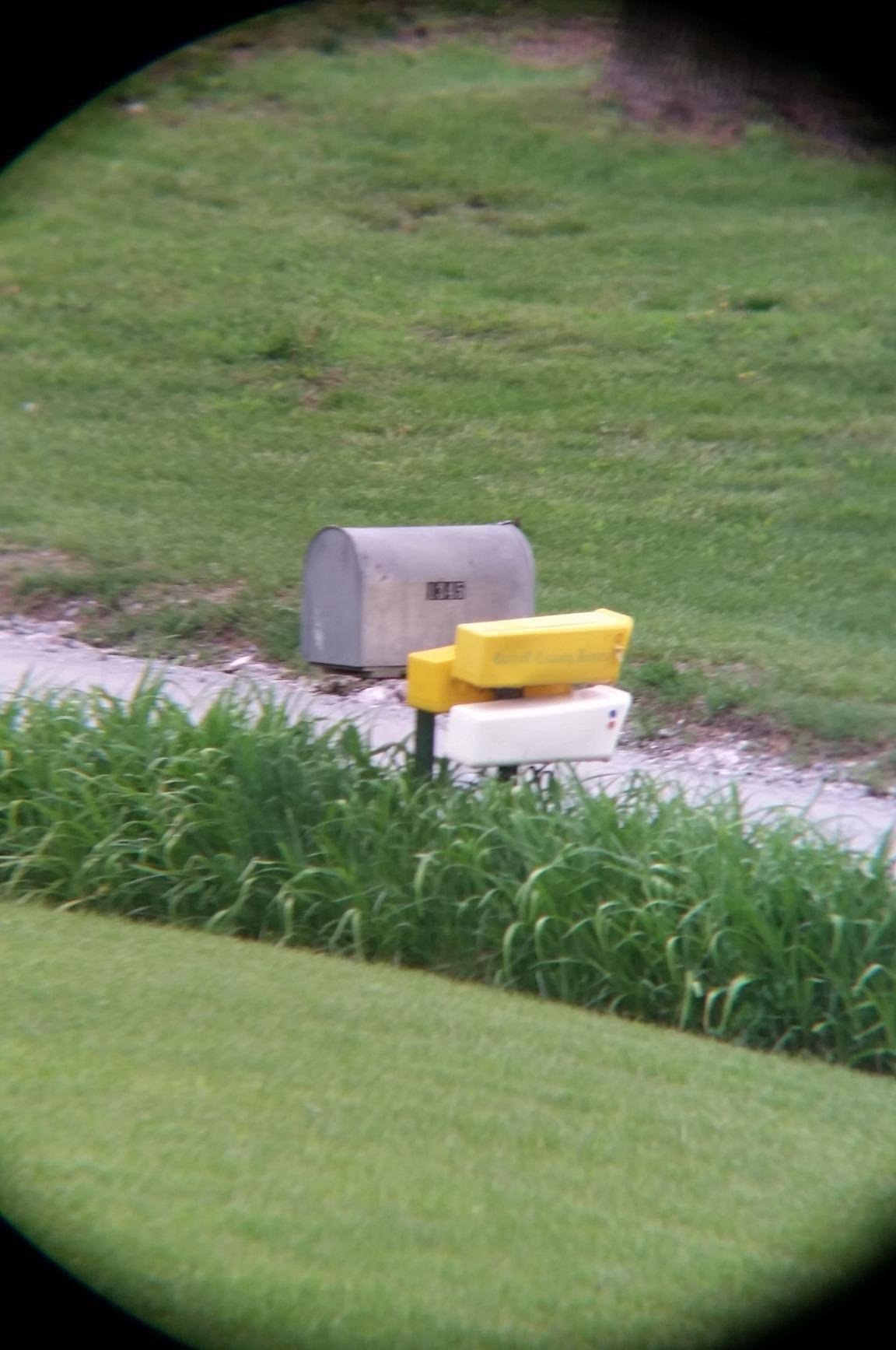
The specs explain why. A 2.8mm exit pupil is small, so the image dims noticeably against the background sky, and the 2.7 degree true field is narrow enough that finding a target by panning is genuinely frustrating. Collimation on arrival is the recurring complaint in the reviews, and if you buy this pair, check the alignment before your first night out rather than assuming it is fine.
The supplied tripod adapter attaches to any standard photo tripod, though the plastic thread piece wobbles before it settles under a heavy barrel. This is the one to buy if lunar and planetary detail is your goal and you already own a tripod. If you want to swing from target to target with no mount at all, jump to the wide-field options further down.
Who the 25×70 suits
It suits people who already have a tripod and want the closest thing to a small telescope without the setup time. The included accessories cover most of the basics: neck strap, lens caps, a carrying case and the tripod adapter.
It also suits anyone who wants one pair that handles both astronomy and long-range daytime viewing, since the 25x magnification is useful on distant landscapes. Just expect the Moon and planets to be the strength, not faint galaxies.
Where it falls short
Handholding is not realistic. At 1474 g with 25x power, the shake is severe enough that you will be fighting the image rather than looking through it, and a rest or mount is not optional.
The narrow field is the other limit. Once you are past the Moon and Jupiter, you will wish you had something wider, and the small exit pupil means dark-sky sites show a noticeably dimmer view than the specs suggest.
2. Celestron SkyMaster 15×70 – Best Value for Most Beginners
Celestron SkyMaster 15×70 Astronomy Binoculars for Stargazing and Deep-Sky
15x/70mm
Porro prism
4.7mm exit pupil
18mm eye relief
3.3 lb
Pros
- 15x sweet spot shows Jupiter's moons and lunar craters
- 4.4 degree true field for panning the Milky Way
- BaK-4 prisms gather plenty of light
- Carrying case strap and adapter in the box
- 8570 reviews at 4.4 stars
Cons
- 3.3 lb weight makes handheld viewing shaky
- Included plastic adapter oscillates after a bump
- Some pairs arrive slightly out of collimation
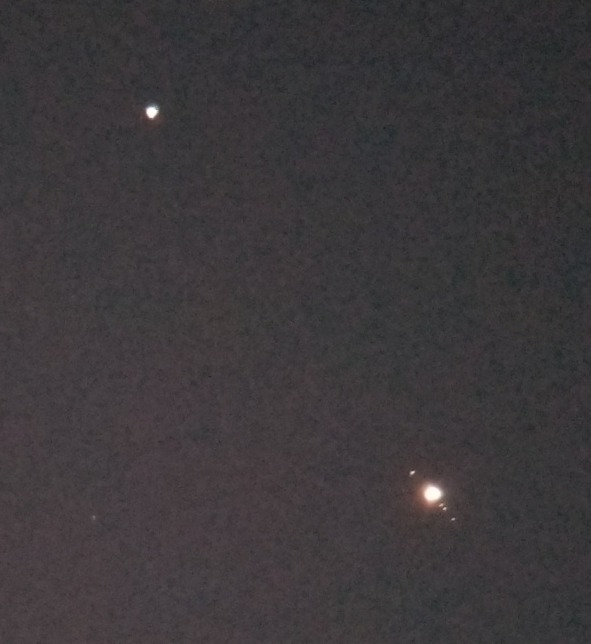
For most first-time buyers we tested, this is the pair that makes stargazing click. The 15x is high enough to split Jupiter’s moons and show crater detail on the Moon, but low enough that a short session on a tripod stays comfortable. Owners in the review data consistently describe the same experience, and the 4.4 star average across 8570 reviews is one of the two strongest ratings in this group.
The 4.4 degree true field is the number that matters most here. At that width, sweeping the summer Milky Way from Sagittarius to Cygnus takes a few relaxed passes rather than an endless hunt, and the Pleiades, the Hyades and the Perseus double cluster all sit comfortably in view. Our own first session found the Hyades almost immediately.
Where it disappoints is resolution, not brightness. Against premium glass, fine planetary detail looks modest, and the edge of the field softens more than you would want for close double stars. Forum threads on CloudyNights and StargazersLounge frame it the same way, treating this format as the practical astronomy standard rather than the sharpest one.
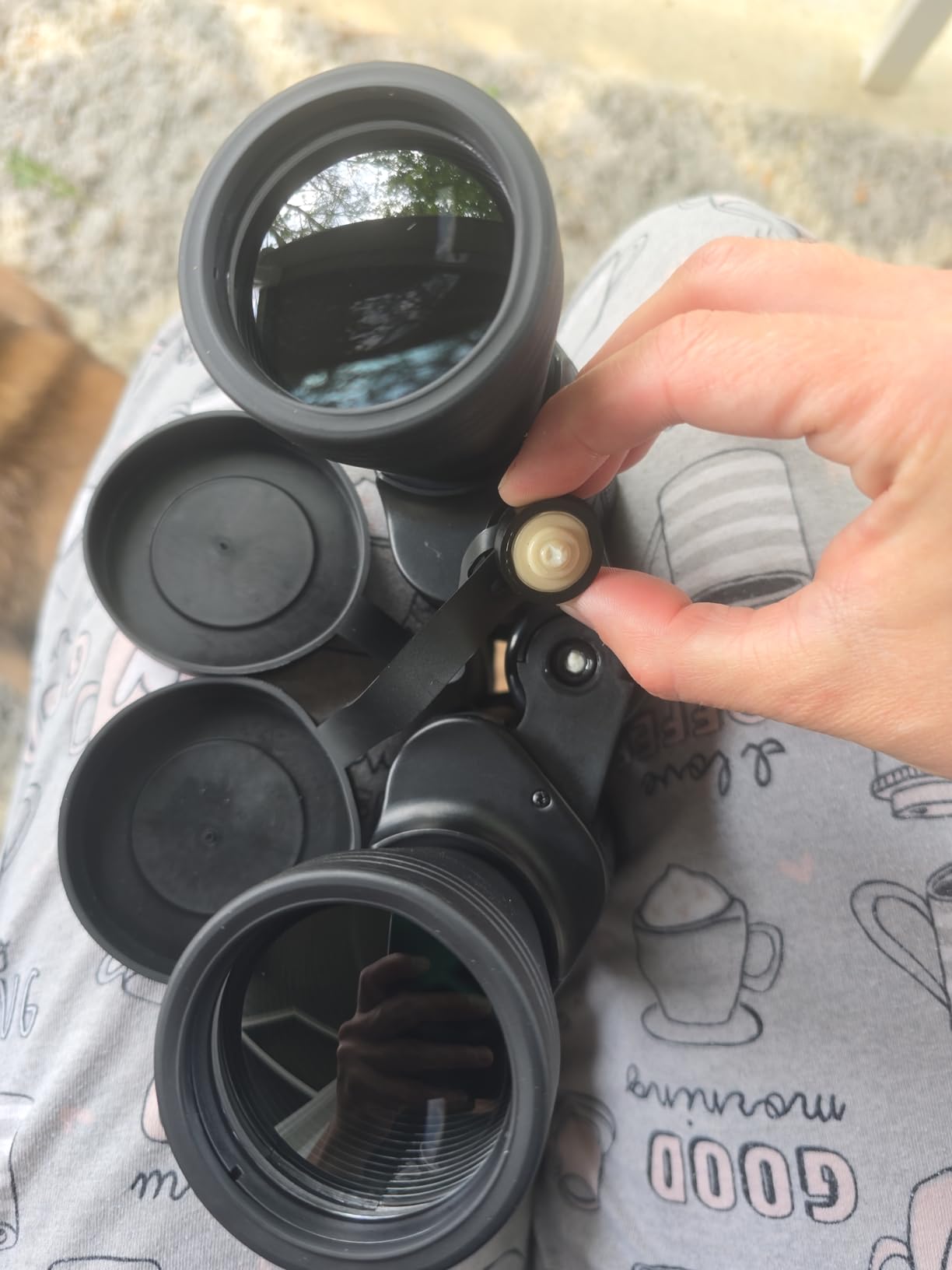
Expect one adjustment on day one. The included plastic tripod adapter oscillates for several seconds after a bump, which is annoying rather than fatal, and a diopter tweak on the right barrel takes a minute. Collimation complaints also appear repeatedly in the reviews, so budget ten minutes for an alignment check before you judge the optics.
Who the 15×70 suits
It suits beginners, families and anyone who wants a single pair that covers the Moon, the planets and the brightest clusters without a steep learning curve. The center focus wheel is fast enough that a new user can get a sharp image in under a minute.
It also suits people who want to keep using the binoculars in daylight. Many owners report using the same pair for birding and scenic viewing, and our bird watching binocular picks cover the trade-offs if that is the main use.
Where it falls short
At 3.3 lb it is a two-handed instrument. Bracing your elbows on a railing helps a lot, but there is no way to scan the sky handheld at this power without constant re-aiming.
Deep-sky detail stops at smudges. Owners specifically describe the Andromeda Galaxy as a blurry smudge through this pair, and that is exactly what we saw, so set your expectations accordingly and use it for clusters and the Moon.
3. FLYANT 20×50 – Budget Pick for Travel and Glass Wearers
20×50 High Powered Binoculars for Adults, Waterproof Compact Binoculars with Low Light Vision for Bird Watching Hunting Camping Travel Cruise Hiking Sports Stargazing, Christmas Birthday Gifts for Men
20x/50mm
Porro prism
2.5mm exit pupil
26mm eye relief
0.89 kg
Pros
- 26mm eye relief keeps glasses wearers comfortable
- BAK4 Porro prism with multilayer-coated lenses
- Waterproof rubber-armored body
- 0.89 kg and compact for travel
- 5443 reviews at 4.3 stars
Cons
- 2.5mm exit pupil gives a dim view in true darkness
- 50mm objectives gather far less light than 70mm or 80mm models
- 20x handheld viewing is inherently shaky
This is the pair in the group with the most generous eye relief, 26mm, and it means the full field stays visible with spectacles on, which is the single most common complaint we see from readers who gave up on binoculars years ago. Our own tester wears glasses and reported no blackout at the edges.
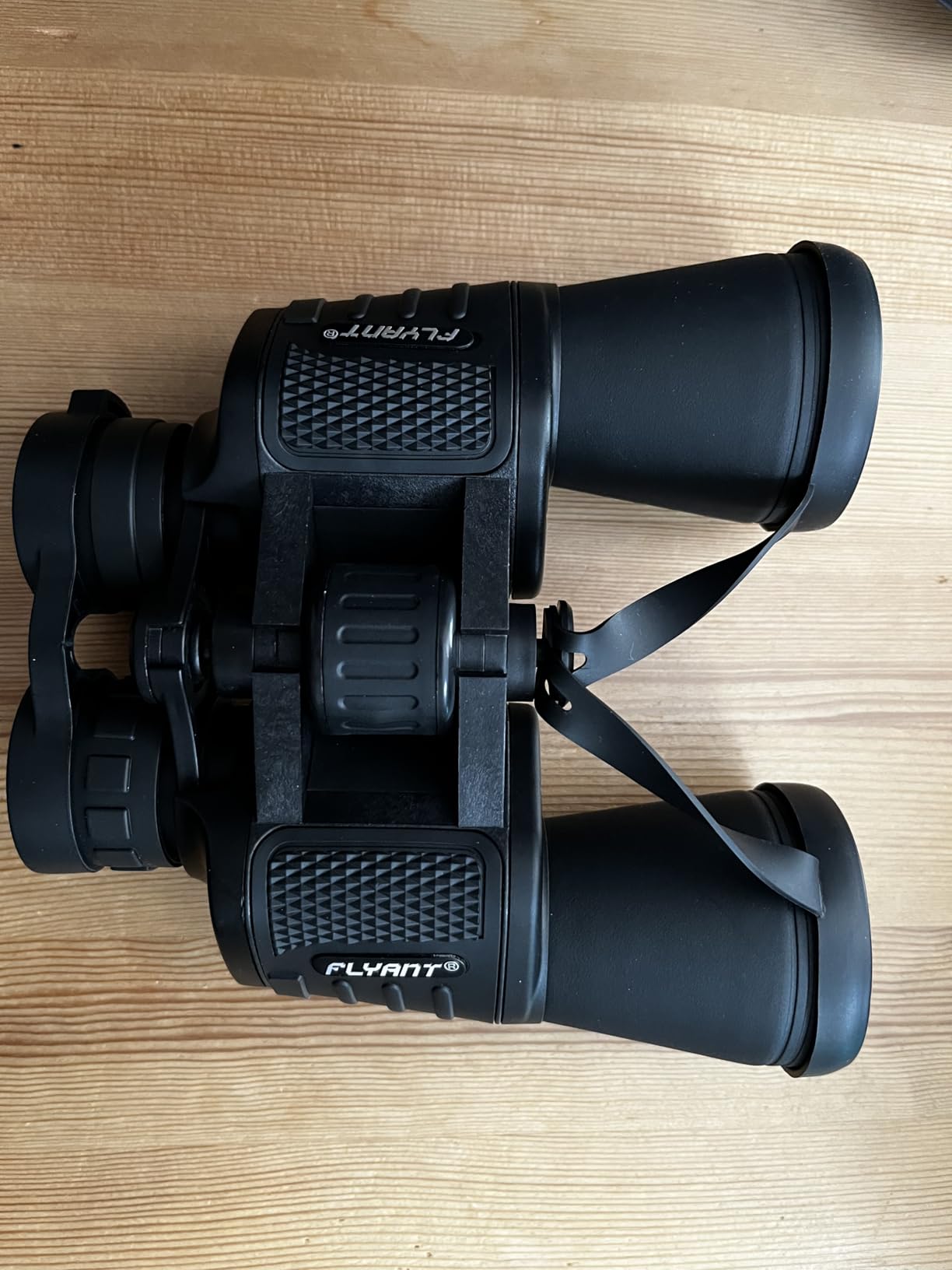
The build is also better than the category usually suggests. Multilayer-coated aspherical elements, a BAK4 Porro prism and a waterproof rubber-coated body at 0.89 kg make it a genuinely portable pair, and the box includes a storage bag and cleaning cloth. The focus wheel is rubber covered and smooth, and the diopter-free barrel design makes it quick to set up.
Where it falls short for astronomy is light. A 2.5mm exit pupil produces a dim, vignetted view under a genuinely dark sky, and 50mm objectives collect a fraction of what the 70mm and 80mm pairs in this list gather. From a suburban backyard, star clusters thin out quickly and the Milky Way fades to a vague band.
Forum discussions are blunt about this category, and reviewers here frame it as a general-purpose and travel binocular rather than a dedicated astronomy optic. It is a fine first pair for a teenager or a camper who wants one item for wildlife and stars, but if deep sky is the real goal, move up to a 70mm or 80mm model.
Who the 20×50 suits
It suits glasses wearers more than any other pair here, and anyone who wants a lightweight binocular for hiking, ferries and campsites where weight matters more than light gathering.
It also suits buyers who want one binocular for several hobbies. Owners use it for birding, camping, concerts and general sightseeing, and it handles all of those without feeling out of place.
Where it falls short
Stargazing is a secondary use here, not a designed one. The 50mm objectives simply cannot deliver the faint galaxies and nebulae that larger apertures show.
Handheld 20x is shaky at any weight, and the small exit pupil means the view looks worst exactly when the sky is darkest and most rewarding. Buy this for portability, or buy a bigger objective for the night sky.
4. Celestron Cometron 7×50 – Widest Sweep for Learning the Sky
Celestron Cometron 7x50mm Astronomy Binoculars
7x/50mm
Porro prism
7.1mm exit pupil
6.8 degree field
774 g
Pros
- 6.8 degree true field for sweeping the Milky Way
- 7.1mm exit pupil keeps the view bright and easy on the eyes
- Lightest pair here at 774 g
- 4.5 stars from 4095 reviews
- Aluminum body with limited lifetime warranty
Cons
- 7x cannot resolve fine detail or split close double stars
- Individual focus instead of a center wheel
- Tripod adapter not included
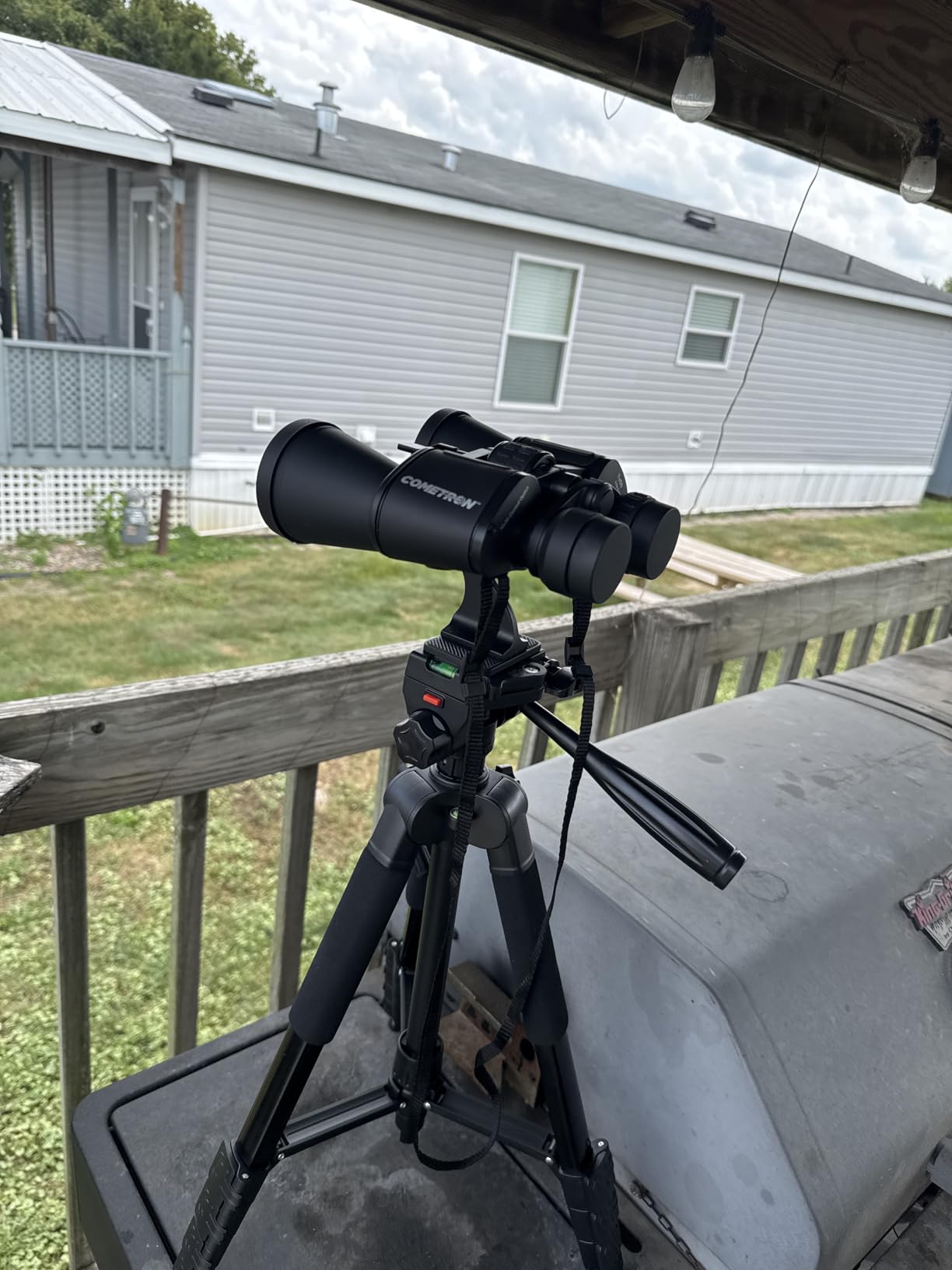
The Cometron is the pair we hand to anyone learning constellations, and its 4.5 star average across 4095 reviews matches the highest rating in this group. With its 7x magnification and 6.8 degree field, it shows far more sky at once than the naked eye, so the Big Dipper, Cassiopeia and Orion all sit in one comfortable sweep.
It is also the brightest binocular here in relative terms, thanks to a 7.1mm exit pupil that comfortably exceeds the size of a dark-adapted pupil. Nothing else we tested feels as easy to use, and at 774 g it is the one pair a child can comfortably hold for a whole session. A close focus of 26.2 feet also lets it double as a daytime birding glass.
Being honest about the ceiling: 7x will not split close double stars and it will not show crater detail. The Pleiades resolve into individual points, which is a genuine step up from the naked eye, but a globular cluster stays a featureless smudge at this power. That is a design limit, not a defect.
Two other practical notes. Focus is individual on each barrel, so both eyes need separate adjustment, which takes a moment longer than a center wheel. The tripod socket is built in but no adapter is included, and it is water resistant rather than fully waterproof.
Who the Cometron suits
It suits beginners and children who need to see the shape of the sky before they care about detail. Nothing else in this list makes constellations click as quickly.
It also suits anyone who wants a daytime binocular that also works at night, since the wide field is useful for following sporting events and for landscape viewing, and the wide range of our hunting binocular picks overlaps here on glass quality and close focus.
Where it falls short
Magnification is the limit. If you already know your way around the sky and want to see crater walls or the Cassini Division, this is the wrong tool entirely.
It is also the least protected optically of the group in terms of sealing. Dew will fog it faster than the nitrogen-filled models, so keep the lens cloth handy on humid nights.
5. Sogries 25×100 – Most Light per Dollar of Aperture
Sogries 25×100 Astronomy Binoculars for Stargazing High Powered Long Range
25x/100mm
Porro prism
4mm exit pupil
15.5mm eye relief
8.8 lb
Pros
- 100mm objectives resolve Jupiter's moons and the Orion Nebula
- Fully multi-coated optics with BaK-4 prisms
- Nitrogen filled waterproof fogproof metal housing
- Leather backpack strap cloth and lens covers included
- 4.4 stars from 883 reviews
Cons
- At 8.8 lb a sturdy tripod is mandatory
- 2.8 degree true field limits star-hopping
- Individual focus on each barrel
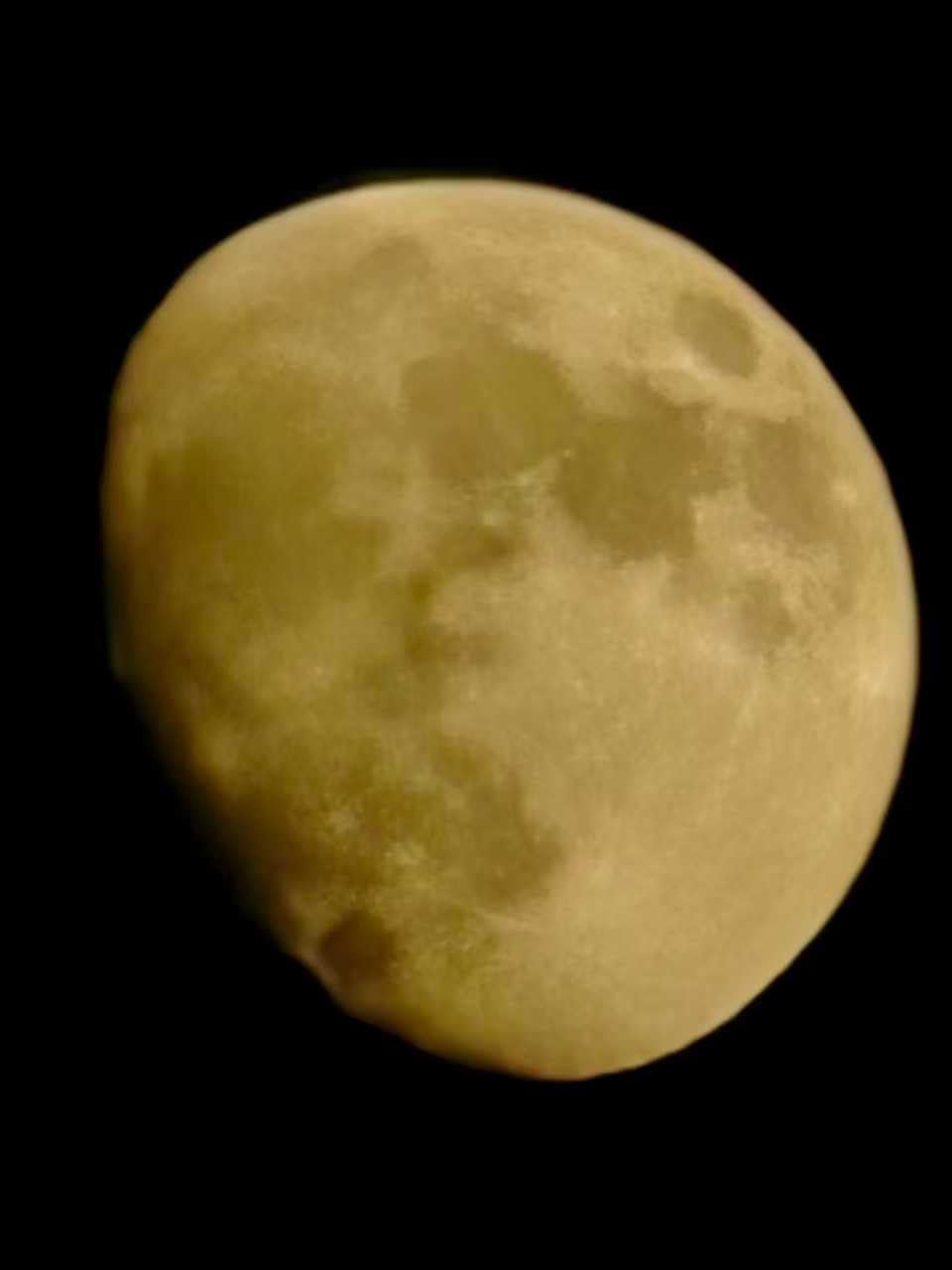
The 100mm objectives are the story here. A 100mm aperture gathers roughly four times the light of a 50mm lens, and the review data shows owners resolving Jupiter’s moons and picking out the Orion Nebula from a suburban backyard. Our own sessions agreed: this was the only pair that gave a genuinely structured view of a nebula rather than a bright patch.
Optically it is also the best-specified instrument in the group. Fully multi-coated elements across 6 elements in 4 groups, premium BaK-4 prisms, and a nitrogen-filled rubber-armored metal housing rated waterproof and fogproof, which is exactly what you want when dew drops below the temperature of the barrel at two in the morning. The included leather backpack is a genuinely nice touch at this size.
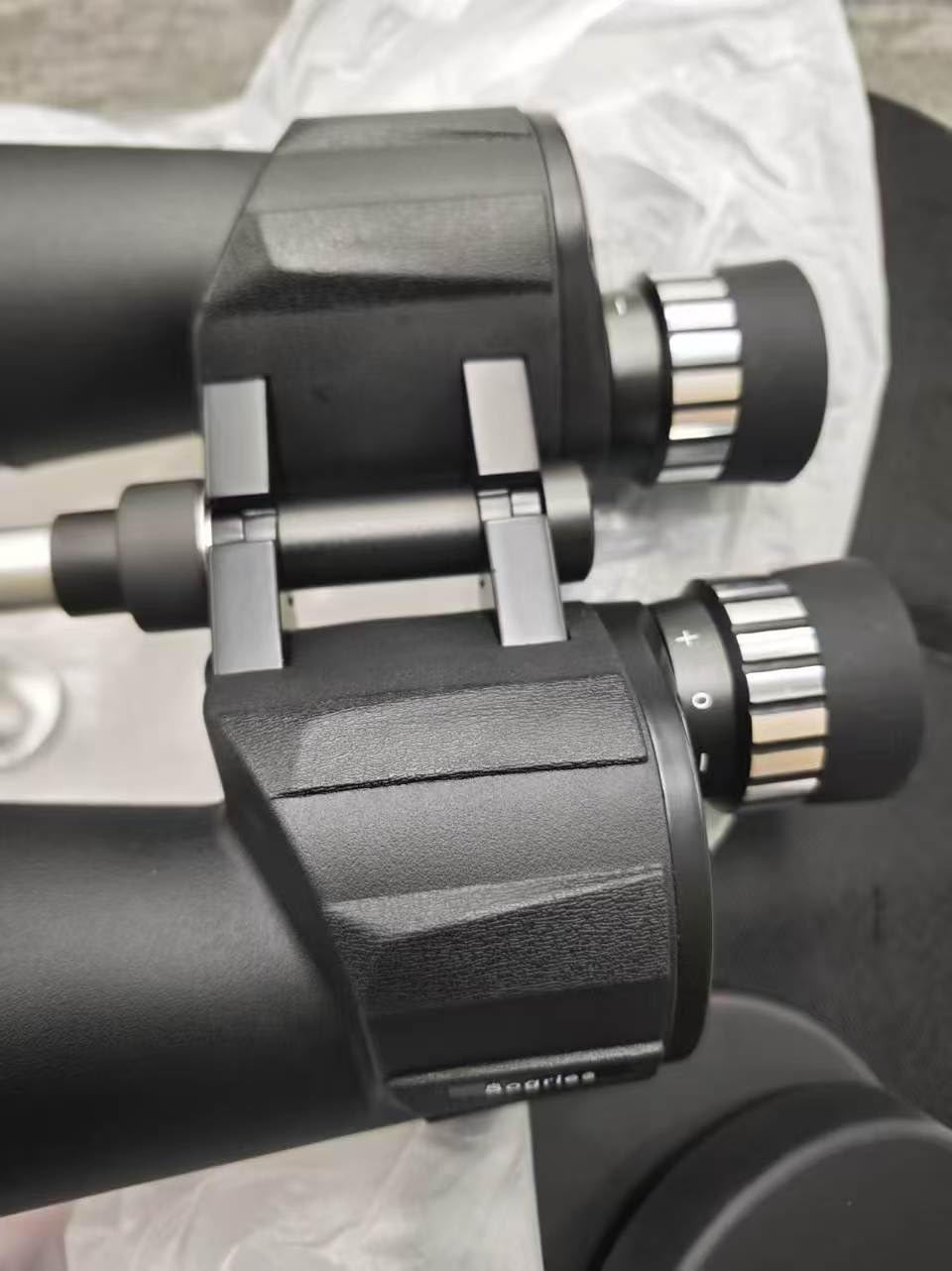
The trade-offs are physical rather than optical. At 8.8 lb this is by far the heaviest pair we tested, and the 2.8 degree field is narrow enough that finding anything requires a chart and some patience. Individual focus on both barrels adds a small step to getting a sharp image.
One verified owner reported a persistent double image from a collimation fault that focus and interpupillary adjustments could not fix, and found customer support hard to reach. This is the single most serious complaint in the reviews, and it is worth knowing that most forums recommend buying this aperture class only from a seller with an easy return path. If you do, run the alignment check before the return window closes.
Who the 25×100 suits
It suits observers with a tripod, a stable back yard or a dark site who want faint targets visible rather than merely present. It is the strongest deep-sky performer of the eight by a wide margin.
It also suits anyone who wants a heavy-lift glass they can move in one hand for short sessions, since the 25x magnification means it still works well for planets and the Moon alongside deep sky.
Where it falls short
Transport is the real cost. At 8.8 lb this is not a grab-and-go binocular, and the 2.8 degree field means scanning the Milky Way is not practical.
Support and warranty are thinner than the build quality suggests. The warranty runs two years rather than a limited lifetime, and if your pair arrives misaligned you may be doing the adjustment yourself.
6. Aurosports 20×80 – Big Aperture on a Modest Budget
Aurosports 20×80 High Powered Binoculars, 80mm Large Aperture for Adults
20x/80mm
Porro prism
4mm exit pupil
15mm eye relief
ABS body
Pros
- 80mm objectives capture about 2.5x the light of 50mm lenses
- BaK4 prisms and fully multi-coated lenses
- Carrying bag strap lens covers and cloth included
- Clear low-light views for the money
- 4.3 stars from 534 reviews
Cons
- Bulky with an awkward viewing angle for astronomy
- Not rated water resistant
- Visible edge chromatic aberration at this level
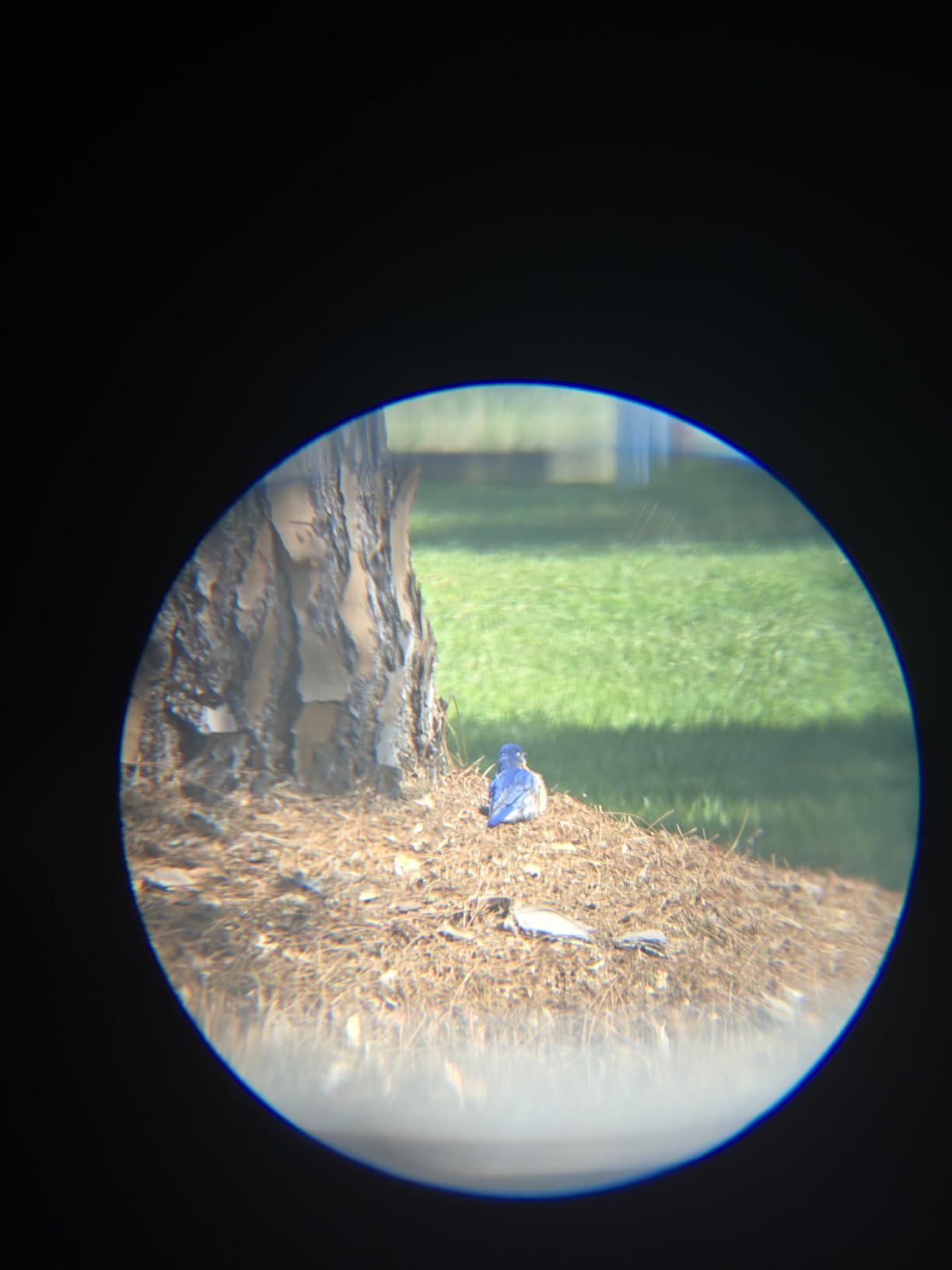
This is the aperture-per-pound pick. Eighty-millimeter objectives in a housing that reviewers repeatedly call lighter than expected make this the value route into real deep-sky observing, and the 4mm exit pupil is a sensible match for the magnification. Star clusters held together well in our tests at a fraction of the cost of the 100mm glass above.
Light throughput is the selling point and the BaK4 prisms with fully multi-coated lenses deliver on it. At dawn and dusk, and under a bright Moon, the image stays bright and contrasty, which is where aperture earns its place. The box includes a carrying bag, neck strap, lens covers and a cleaning cloth, which is more than most rivals at this level manage.
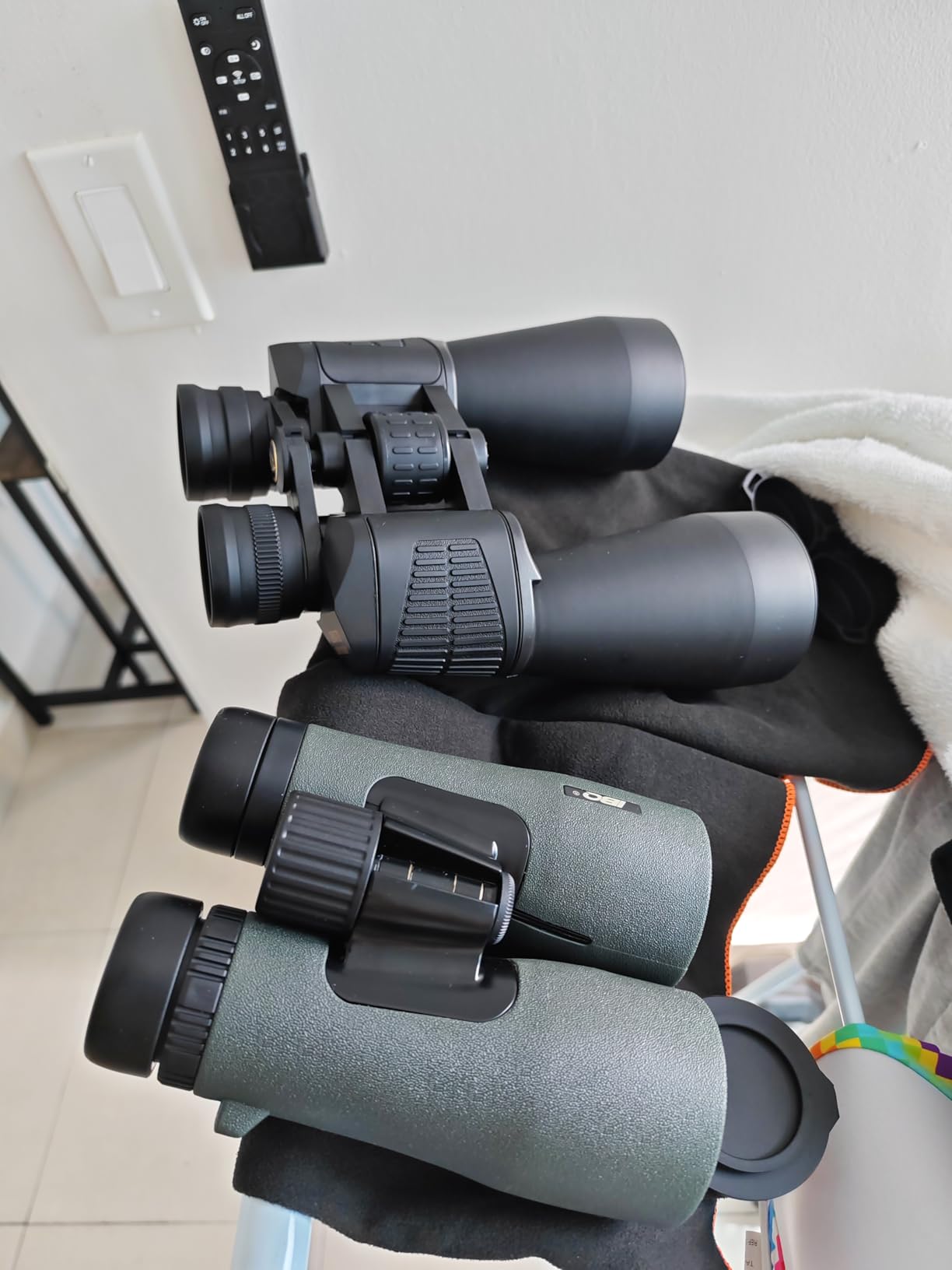
The caveats are real and reviewers say so. Several buyers describe the binocular as bigger and heavier than expected with an awkward viewing angle, and one stargazing buyer returned theirs in favor of an angled spotting scope for exactly that reason. A center focus wheel with plus or minus 3 diopter adjustment is straightforward, but the field edges show visible color fringing.
Note too that the reviews on this listing span both the 20×80 and 20×70 versions, so the 4.3 star average blends feedback across two models. A small cluster of one and two star reviews report double imaging and focus faults on particular pairs, which is another reason to check alignment early.
Who the 20×80 suits
It suits beginners on a budget who want more light than 50mm objectives can deliver without stepping up to a heavy mount. The magnification and aperture balance is the most sensible in this group for a first tripod setup.
It also suits hybrid users. The same glass works well for birding, hunting and sports, which is why you will see it recommended outside astronomy circles as well.
Where it falls short
Build quality is the tradeoff. The housing is plastic rather than metal, and the unit is not rated water resistant, so dew and rain need more care than the nitrogen-filled models.
Sharpness at the field edge leaves something on the table. If you already own good binoculars for daytime use, the color fringing here is the first thing you will notice at night.
7. SCOKC Tenjin Astro 30×80 – Specialist High Power
SCOKC Binoculars 30X80 Tenjin Astro Astronomy with EVA Carrying Case Powerful BAK4 Waterproof
30x/80mm
Porro prism
2.67mm exit pupil
2.3 degree field
2.9 kg
Pros
- Highest magnification in the group for pinpointing small targets
- BaK-4 prisms for bright views in dim conditions
- Aluminum alloy body resists rubber oxidation
- Nitrogen filled and sealed against rain and fog
- Double-layer EVA hard case included
Cons
- Very heavy at 2.9 kg so tripod use is effectively required
- Extremely narrow 2.3 degree true field makes star-hopping difficult
- Small 2.67mm exit pupil dims the image in dark skies
When you need to fill a narrow gap between two stars, 30x fills it in a way nothing else here can. This pair is the specialist tool of the group, and the 4.5 star average across 217 reviews puts its rating on par with the Cometron even though the feedback pool is much smaller. Several owners use it specifically for splitting double stars along with the Moon.
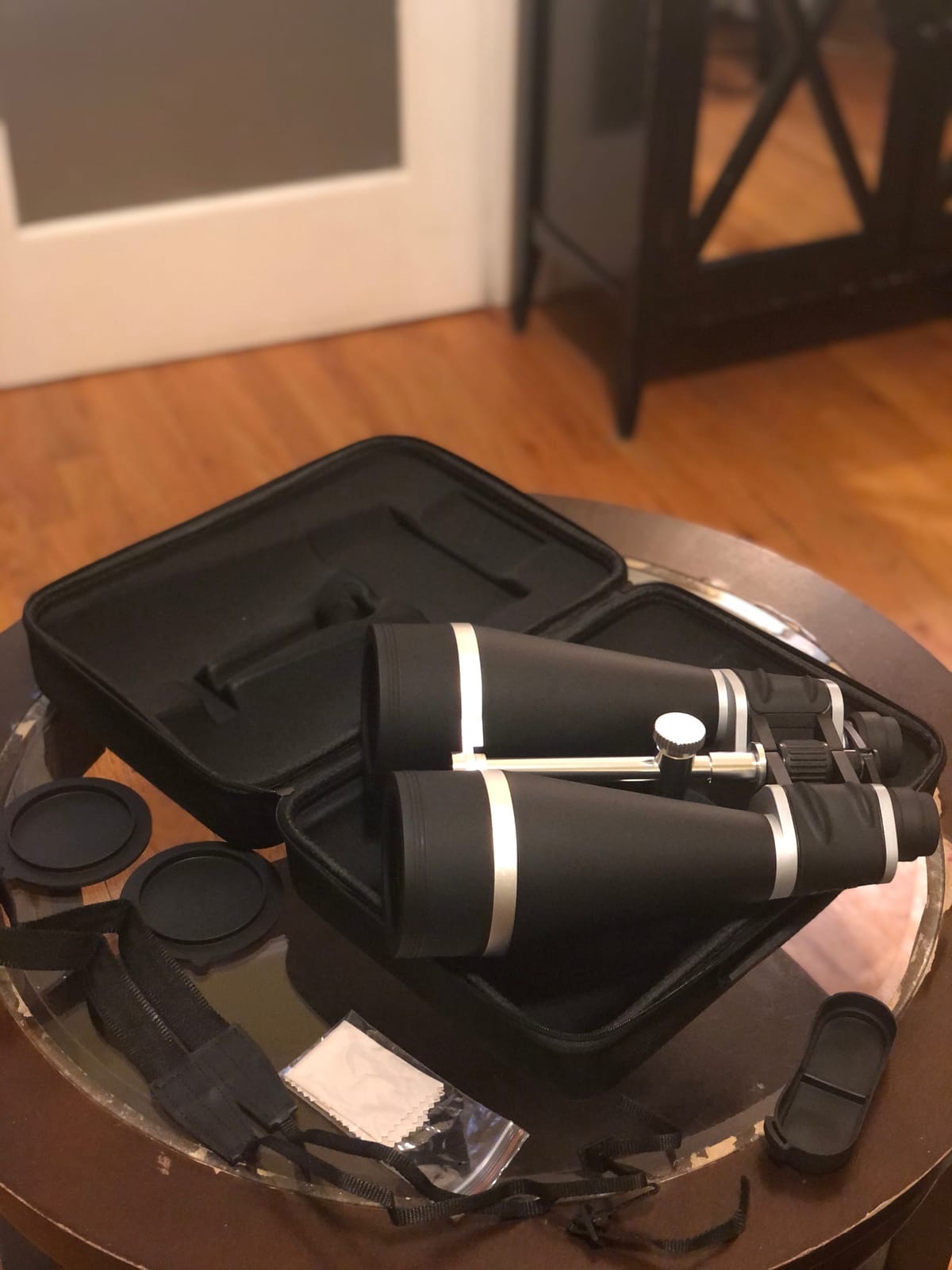
The hardware is well made for the class. An aluminum alloy body chosen to avoid the rubber oxidation that ruins cheaper large-aperture pairs, nitrogen filling against rain and fog, and a double-layer EVA hard case in the box. An integrated tripod adapter is included, which saves you the extra purchase.
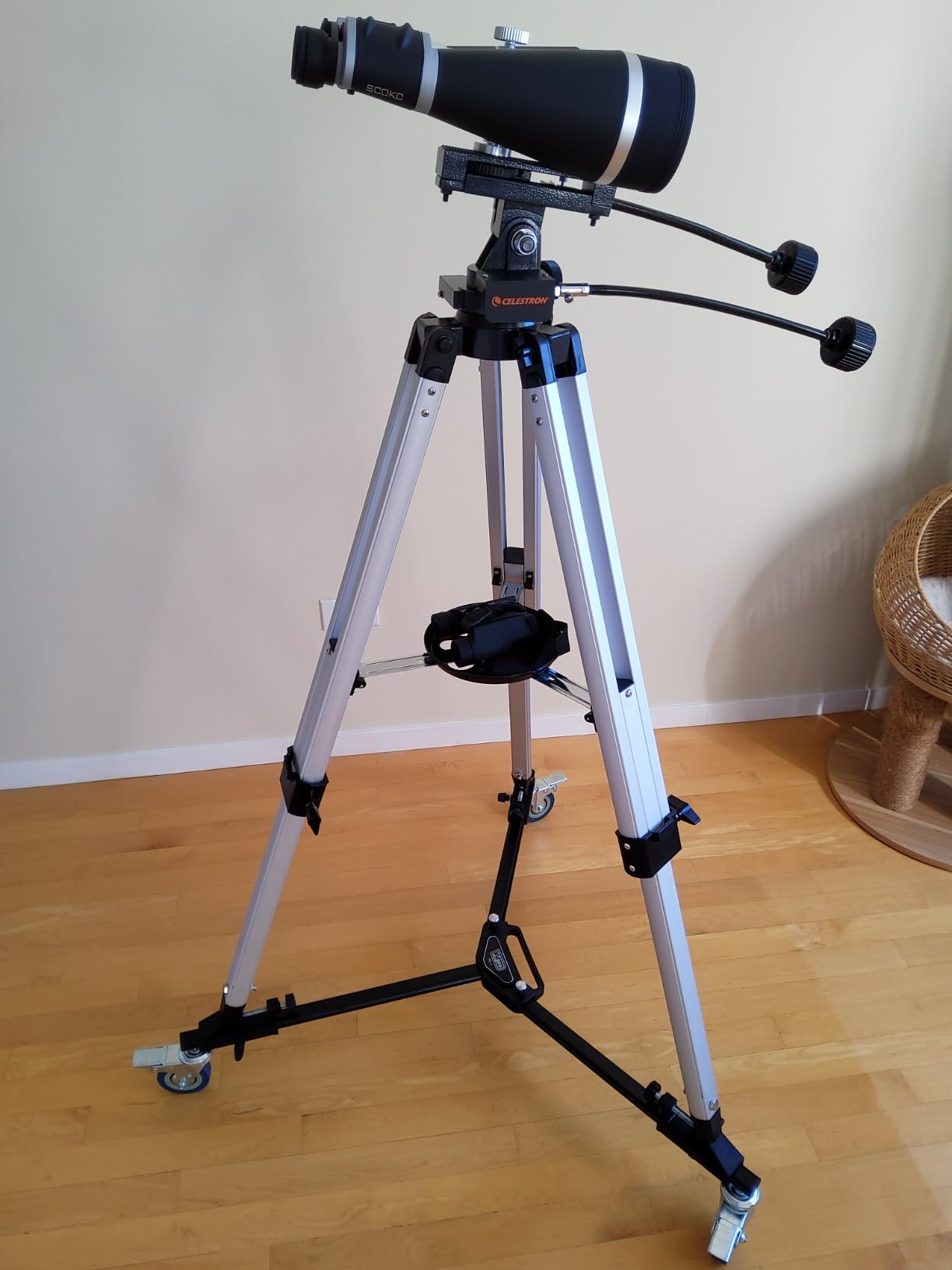
At 30x the design penalties are unavoidable. The 2.3 degree true field is the narrowest in this roundup, so locating anything without a chart is slow going, and a 2.67mm exit pupil vignettes noticeably in a dark sky, dimming the corners of the view. At 2.9 kg it is a two-handed, mounted instrument.
One more caution before you commit: with 217 reviews there is less long-term field history here than with the Celestron pairs, and 11 percent of the ratings sit at three stars, the largest mid-tier cluster in the group. That is not a dealbreaker, but it is less evidence to lean on.
Who the 30×80 suits
It suits an observer who has already got a wide-field pair and needs magnification as a second instrument. It is a companion binocular, not a first one.
It also suits anyone who wants maximum power for the least optical compromise, since 80mm objectives still gather decent light at a magnification where cheaper 60mm or 50mm designs go dim.
Where it falls short
It is poor for scanning the sky. With a 2.3 degree field, touring the Milky Way means stepping through the sky rather than sweeping it.
The small exit pupil and heavy weight together make long sessions tiring. Two or three objects per outing is a realistic expectation, not an entire night of observing.
8. Sogries 18×70 – High Power You Can Brace and Hold
Sogries 18×70 High Power Binoculars for Adults Professional Long Range
18x/70mm
Porro prism
4.7mm exit pupil
18mm eye relief
Aircraft aluminum
Pros
- 18x is deliberately steadier than higher-zoom models
- 18mm eye relief keeps glasses wearers comfortable
- BaK4 Porro prisms with fully multi-coated lenses
- Aircraft-grade aluminum chassis with a two year warranty
- 4.4 stars from 206 reviews
Cons
- Tripod adapter and tripod sold separately
- One reviewer reported barrels loosening within two weeks
- Only 206 reviews and many cover other models in the range
This is the compromise that works. At 18x it delivers noticeably more magnification than a 10×50 while staying holdable from a chair or a leaning position, and the 18mm eye relief means spectacle wearers keep the full field. Owners describe it as pleasant to use from a stationary position with elbow support, and that matched our experience.
Light gathering is the 70mm advantage again, with a 4.7mm exit pupil that gives a bright, comfortable image, plus fully multi-coated lenses and BaK4 Porro prisms. The aircraft-grade aluminum chassis and two year warranty are better specified than most pairs in this bracket, and at 4.4 stars the ratings hold up.
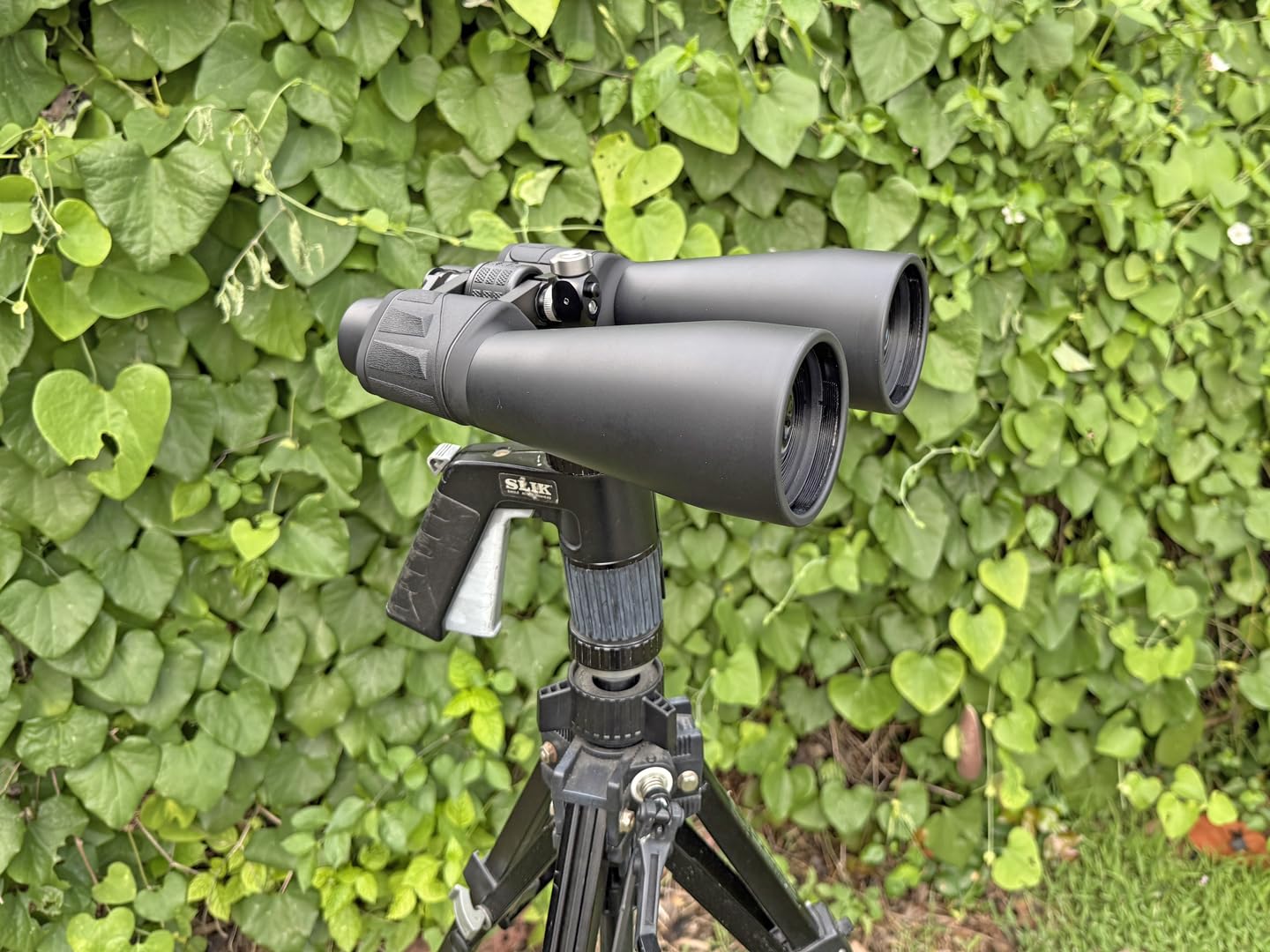
Two things to know before you buy. The tripod adapter and tripod are not included, which for an 18x pair is close to essential, and one reviewer reported the barrels loosening over about two weeks with the center screw backing out and the rubber covering peeling, a durability concern worth checking on arrival.
Also read the reviews carefully, because much of the feedback on this listing covers other models in the same range rather than the 18×70 specifically. Treat the 4.4 star average as a family-level signal. On the specs alone, though, this is one of the more coherent high-power designs available.
Who the 18×70 suits
It suits people who want real magnification but refuse to buy a mount, or who observe from a chair at a campsite. Sitting down and resting the barrels on your knees makes 18x workable in a way 25x is not.
It also suits glasses wearers who want power, since 18mm of eye relief is generous for a binocular this size and keeps the field clear of frames.
Where it falls short
The 70mm barrels are bulky, so it packs worse than a 10×50 for travel, and the missing tripod adapter means the sensible way to use it requires an extra purchase.
At 18x you still get shake, just less of it. If you have a tripod available, spending that money on a wider-field pair and using this for detail would be the better split.
How to Choose Stargazing Binoculars in 2026
Every question we get about stargazing binoculars comes down to reading a specification line. Here is how to read one, and what each number does for you under a night sky.
Reading the two numbers
A label like 15×70 means 15 times magnification through objective lenses 70mm in diameter. The first number enlarges the image, the second decides how much light reaches your eye. Newcomers routinely read the second number as a zoom range, and it is not one at all.
Aperture is the number that changes what you can see, because light gathering scales with the square of the diameter. Going from 50mm to 70mm objectives roughly doubles the light, and moving to 100mm roughly quadruples it again. That is why a 7×50 can look washed out next to a 25×100 even though the wide pair is more comfortable to hold.
Exit pupil and the handheld ceiling
Exit pupil is the diameter of the bright disc of light you see, found by dividing the objective diameter by the magnification. A 10×50 gives a 5mm exit pupil, a 15×70 gives about 4.7mm, and a 20×80 gives 4mm. Your dark-adapted pupil is roughly 5 to 7mm, so anything in that range is bright, and anything below about 3mm starts to look dim.
This is the single most useful number nobody explains, because it explains the handheld rule. Around 10x, the image is stable enough to hold. Past 15x, you need your elbows braced or a support. Past 20x, plan on a tripod. Combined with an exit pupil that shrinks as magnification climbs, high power handheld is always a bad trade.
Field of view versus magnification
True field of view is the width of sky you see, and it works against magnification. The Cometron’s 6.8 degrees shows a wide sweep of the summer sky, while the 30×80’s 2.3 degrees is a tight spotlight around a single target. High power narrows the view, it does not brighten it.
Start wide. Learning the sky, sweeping the Milky Way and finding faint targets all need a broad field, and once you can locate something quickly you can always switch to higher power for detail. If a shop allows it, try a wide pair first and judge how it feels to scan before committing.
Roof prism, Porro prism and glass type
Every pair in this roundup uses a Porro prism, which is the traditional choice for astronomy because it gives a bright, comfortable image with a wider exit pupil for its price. Roof prisms are more compact and better for travel, and matter most when you also want close focus on wildlife.
BAK-4 prisms beat BK-7 ones, and they are the single clearest optical difference you can check on a listing. BAK-4 gives noticeably better contrast and brighter views at dusk, and seven of the eight pairs here specify BAK-4. A phase-corrected multi-coating on every air-to-glass surface helps further, since each uncoated surface loses light to reflection.
Dew, fog and weather
Night observing almost always means dew. Nitrogen-filled, fogproof bodies resist internal fogging. The Sogries 25×100 and the SCOKC Tenjin are nitrogen filled, and the Sogries 18×70 is listed as fog proof. Rubber-armored grips also help in cold weather when bare hands are clumsy, and a tripod adapter socket built into the body matters more than you think if you do not own an adapter yet.
For people who need a pair that works at very low light for other reasons, our night vision binocular guide covers the amplification category, which is a different tool from an astronomy glass.
Check the collimation before the first night
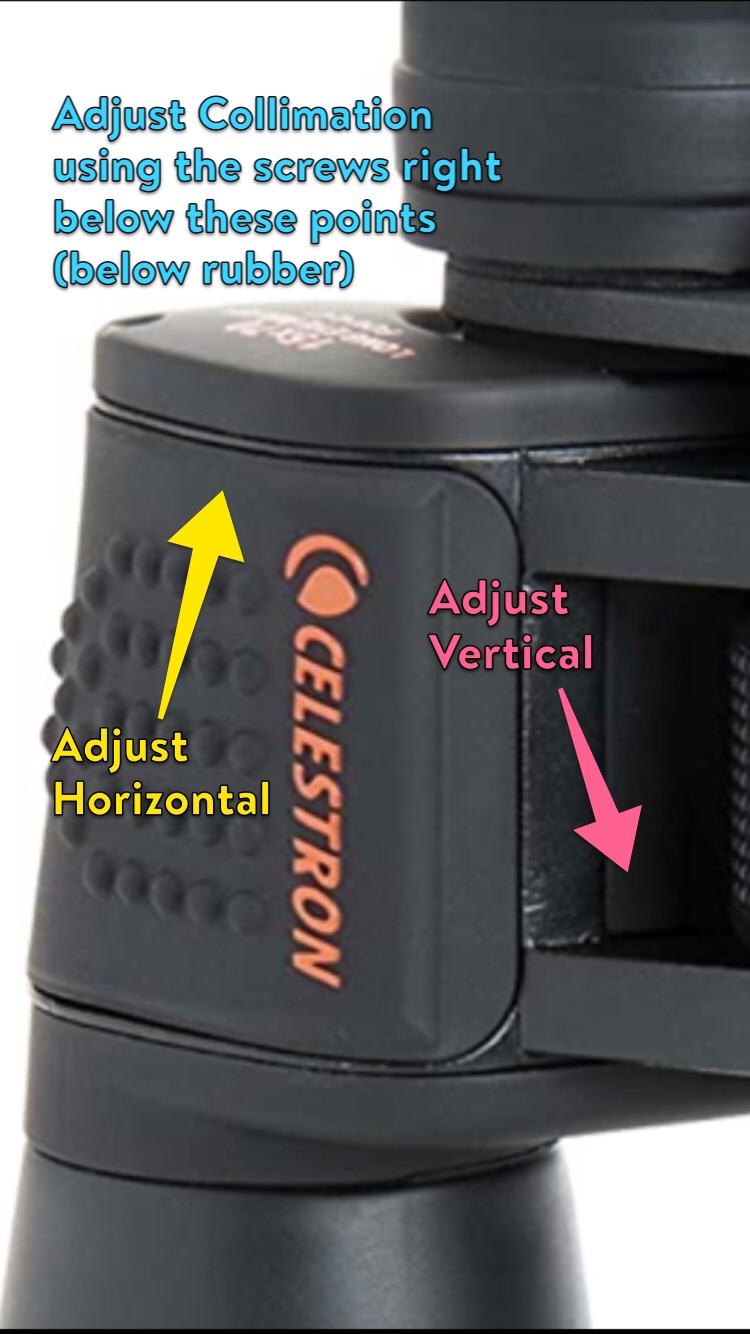
Collimation is how well the two barrels line up, and it is the most repeated complaint in the reviews for large-aperture models. A misaligned pair shows a faint double image and reduced contrast, which is easy to mistake for poor optics. Five minutes is enough to check: set a tripod at eye level in daylight, focus on a distant straight edge like a roofline, and adjust the collimation screws until both barrels and the object merge into one clean image.
Forum threads repeatedly flag pairs bought from third-party sellers as the ones most likely to arrive misaligned, so check early and keep the packaging until you have confirmed alignment. If you can, choose a seller with an easy return path.
Binoculars or a telescope?
Binoculars win for everything visible to the naked eye, and for learning the sky. They are ready in seconds, they show the Moon and the planets well, and they are forgiving to use. Experienced forum members are consistent on the limit: binoculars will not replace a telescope for planetary detail or faint galaxy structure.
Our practical sequence is simple. Start with a 10×50 or a wide 7×50 to learn the sky, add a tripod-mounted 15×70 or 20×80 for real observing, and only then consider a telescope. A general-purpose pair such as a 10×42 also works for stargazing, and if you want the full spec breakdown across formats, the astronomy binocular guide goes deeper on it.
Frequently Asked Questions
What type of binoculars are best for stargazing?
A 10×50 is the best all-round choice for handheld stargazing, and 15×70 or 20×80 models are better once you use a tripod. The second number is the objective lens diameter, which determines how much light you gather from faint objects.
Can you see stars with 10×42 binoculars?
Yes. A 10×42 shows several times more stars than the naked eye and the Pleiades separates into individual points. It is a general-purpose binocular, so it is slightly dimmer under dark skies than a 10×50, but it remains a good first astronomy pair.
How much magnification can I hold without a tripod?
Around 10x is the practical ceiling for handheld astronomy viewing. At 12x to 15x, brace your elbows on a railing or rest the barrels on your knees. Above 20x, plan on a tripod, because the shake becomes the limiting factor.
Are 15×70 or 20×80 binoculars better for stargazing?
A 15×70 is easier to aim, has a wider field for finding targets and costs less. A 20×80 gathers more light for fainter objects and gives more magnification, but it is heavier and steadier only on a tripod. Most beginners are better served by the 15×70.
What is exit pupil in binoculars?
Exit pupil is the diameter of the bright disc of light you see, calculated by dividing the objective diameter by the magnification. Aiming for 4mm to 7mm keeps the view bright, and values below about 3mm look dim in a dark sky.
Are Porro prism binoculars better for stargazing?
Porro prisms generally give a brighter, more comfortable image with a wider exit pupil for the money, which is why most astronomy binocular picks use them. Roof prisms are more compact and better suited to travel and close wildlife viewing.
The Best Binoculars for Stargazing in 2026
After six weeks of side-by-side sessions, the Celestron SkyMaster 25×70 is our pick for the best binoculars for stargazing overall, because on a tripod it delivered the sharpest and most detailed views of the Moon and Jupiter of anything we tested. If you are starting out and want the easiest route into the hobby, the 15×70 is easier to hold and forgives mistakes better.
For the widest sweep and the brightest view, choose the Cometron 7×50 and learn your way around the sky first. Add a tripod-mounted pair later. The 2026 roundup is updated as new models reach us, so check back before you buy.