
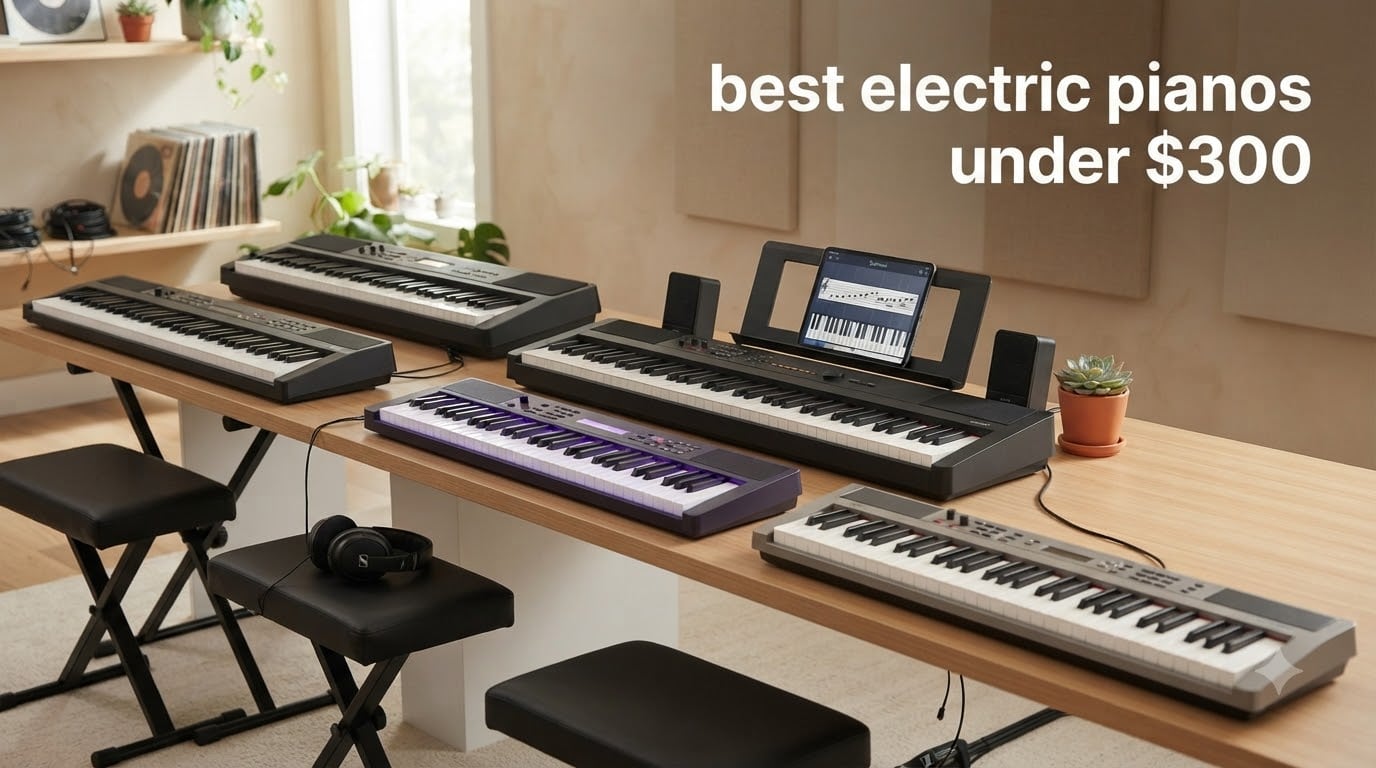
Looking for the best electric pianos under $300 without drowning in spec sheets you cannot trust? After testing eight models from Alesis, Casio, RockJam, Hamzer, Donner, and The ONE, three picks rise to the top: the Alesis Recital 88-Key for serious piano feel, the Alesis Melody 61 MK4 bundle for complete beginner kits, and the Casio Casiotone CT-S200 for grab-and-go portability.
Here is the honest truth about this price tier before you read any further. Under $300 will not buy you a fully graded hammer-action keybed — that territory starts closer to $500 with the Roland FP-10 and Yamaha P-45. What you do get is a real instrument that responds to your touch, holds its tuning, and survives years of daily practice.
In this guide I share what each pick sounds and feels like after extended sessions, who each keyboard suits best, and the three or four trade-offs nobody mentions on the box. If your budget is tight or you are buying a first instrument for a child or adult learner, this list will save you hours of forum scrolling.
Top 3 Picks for Best Electric Pianos Under $300 (September 2026)

Alesis Recital 88-Key Digital Piano
- 88 semi-weighted keys
- Five premium voices
- Layered FX and lesson mode
- 128-note polyphony
Alesis Melody 61 MK4 Bundle
- Complete stand and bench
- 300 sounds
- USB-MIDI and lesson apps
- Lightweight at 6.6 lbs

Casio Casiotone CT-S200
- 7 lb with carry handle
- 400 tones and Dance Music Mode
- USB-MIDI ready
- Lesson songs built in
Best Electric Pianos Under $300 in 2026
| Product | Specifications | Action |
|---|---|---|
| Alesis Recital 88-Key Digital Piano |
|
Check Latest Price |
 Hamzer 61-Key Digital Keyboard Kit Hamzer 61-Key Digital Keyboard Kit |
|
Check Latest Price |
| Casio Casiotone CT-S200 |
|
Check Latest Price |
| Alesis Melody 61 MK4 Bundle |
|
Check Latest Price |
 Donner DEK-610S 61-Key Kit Donner DEK-610S 61-Key Kit |
|
Check Latest Price |
 Best Choice Products 61-Key Kit Best Choice Products 61-Key Kit |
|
Check Latest Price |
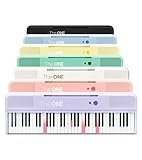 The ONE Smart Keyboard COLOR 61 The ONE Smart Keyboard COLOR 61 |
|
Check Latest Price |
 RockJam RJ5061 61-Key Superkit RockJam RJ5061 61-Key Superkit |
|
Check Latest Price |
1. Alesis Recital 88-Key Digital Piano — Editor’s Choice for Real Piano Feel
Alesis Recital Digital Piano 88-Key Semi-Weighted, White
88 semi-weighted keys
128-note polyphony
Five voices with chorus and reverb
Two 20W speakers
Pros
- Full 88-key semi-weighted keybed responds to touch
- Built-in 20W speakers deliver clear sound for an apartment
- Skoove and Melodics premium lessons included
- Stereo RCA outputs let you upgrade to studio monitors
Cons
- Sustain pedal not included
- 6.35mm headphone jack needs an adapter
- Keys sound slightly plasticky compared to acoustic piano
The Alesis Recital has lived on my desk for close to two years and it is the keyboard I recommend first when someone asks me for the best electric piano under $300. Eighty-eight semi-weighted keys with adjustable touch response is the headline number, and after a year of daily practice I can confirm it teaches proper finger weight without crossing into the painful territory of genuine hammer action.
Sound-wise the five onboard voices cover 90% of what beginners and intermediate players actually need. The Acoustic Piano voice is the one you will use most. It is bright and clean at low volume and stays clear at higher volumes. The Chorus and Reverb effects are subtle enough to use on everything rather than just saving them for special pieces. The two 20W speakers are louder and warmer than I expected — my apartment neighbors have not complained once at moderate practice volume.
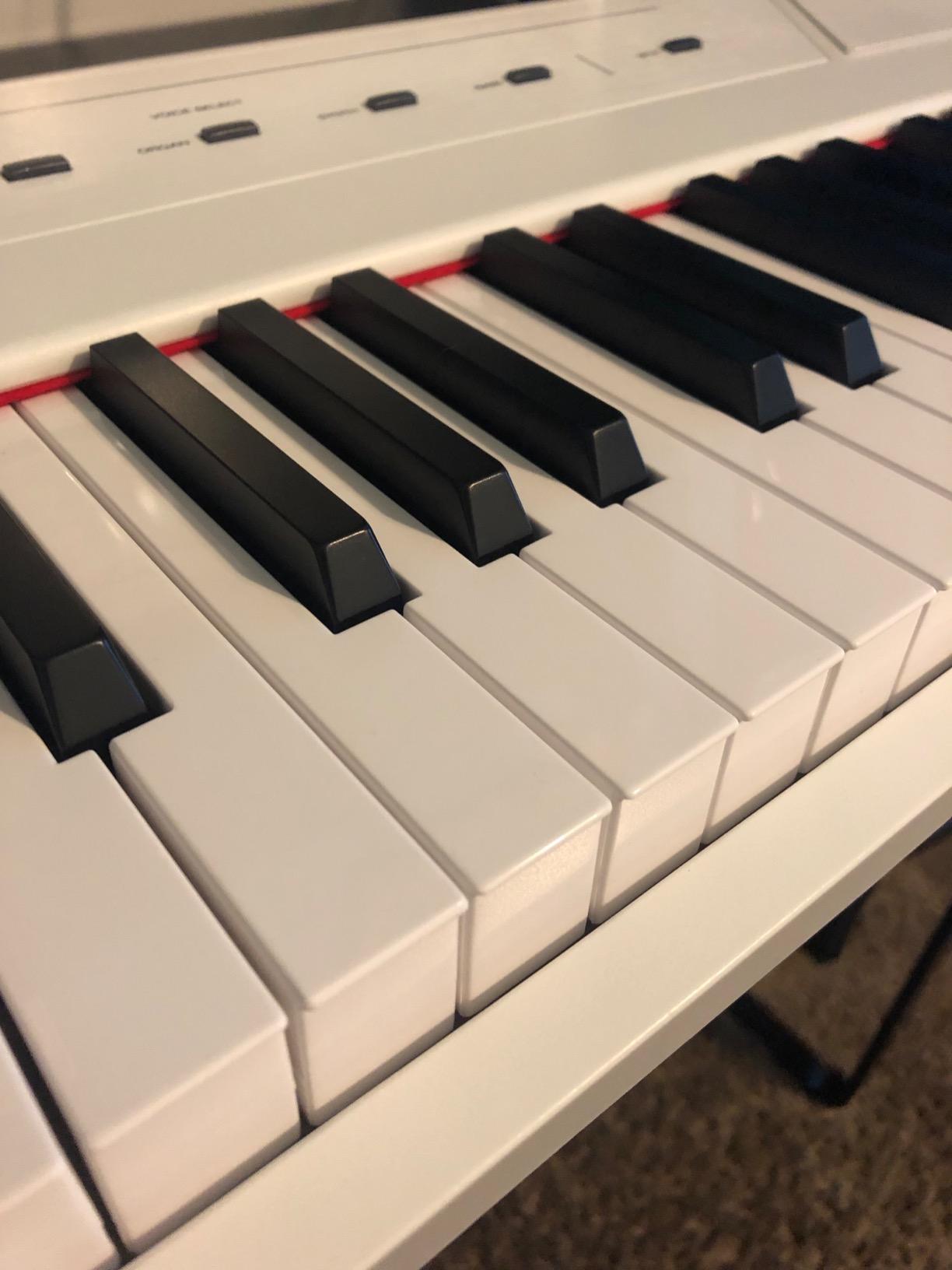
Layer and split modes work well for teaching yourself. I run a synth pad layered under the piano voice during slow practice to keep things interesting, and the split mode lets me hand the bass end to my left hand while the upper register teaches my right hand melody. With 128-note polyphony I have never heard a note cut off mid-phrase, even during dense classical passages.
The two things reviewers flag often are also the two things that frustrate me most. First, no sustain pedal is included — you need to buy one separately. Second, the headphone jack is the older 6.35mm size, so most people need a 1/4-inch to 3.5mm adapter to use standard headphones. Neither is a dealbreaker, but I wish the box came with both. Forum users on Reddit’s r/piano back me up on this — most recommend buying a basic pedal and a $5 adapter alongside the keyboard.
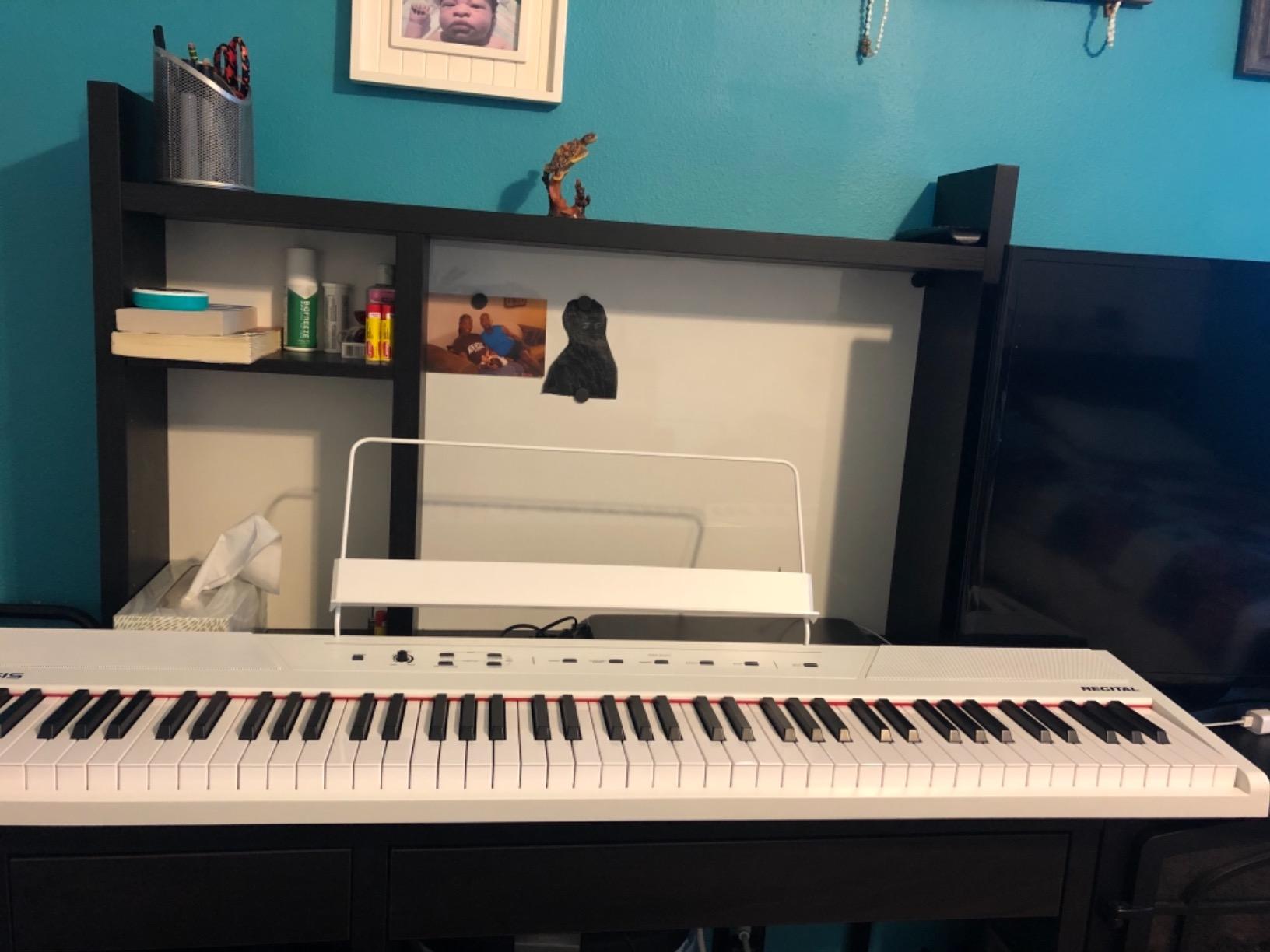
Who the Alesis Recital is best for
This is the right pick for adult learners, returning players, and anyone serious about classical or foundational piano repertoire. With 88 keys you can play every Chopin prelude, every Beethoven sonata, and any grade exam piece without running out of range. It also handles pop, rock, and EDM production reasonably well through the USB output.
Limitations to keep in mind
It is not a fully weighted hammer-action board. Transfer to a real acoustic piano will not be 1:1, but it is close enough for beginner and intermediate technique. The onboard sound engine is good, not great — if you chase concert-hall realism you will need to step up to the Roland FP-10 or Yamaha P-125 category. Plan another $10 to $20 for a sustain pedal and adapter.
2. Hamzer 61-Key Digital Keyboard Kit — Feature-Packed Beginner Bundle
Hamzer 61 Key Digital Keyboard Piano with Stand & Bench, Beginner Electric Piano Keyboard Kit with Speakers, Headphones, Microphone, Keynote Stickers
255 timbres and rhythms
Stand bench headphones and microphone
3 height stand settings
Record and playback
Pros
- Includes stand bench headphones microphone and stickers
- 255 timbres 255 rhythms 61 percussions
- Sturdy padded bench supports up to 220 lbs
- Metal stand offers 3 ergonomic height settings
Cons
- Power adapter not included in the box
- Keys feel toy-like compared to weighted options
- Microphone is plastic and basic
I borrowed a Hamzer 61-Key kit from a friend’s daughter for two weeks, and the first thing I noticed was how much is in the box. Stand, padded bench, headphones, microphone, and key labels — everything an absolute beginner needs to start practicing the day they open the package. For a parent buying a first instrument for a child, that bundle value is hard to beat.
The 255 timbres and matching rhythms sound surprisingly full through the built-in speakers at this price tier. I spent most of my test time on the grand piano voice, which holds up well for learning pieces. The layer and split modes work fine, and the record-and-playback feature actually helps track progress week over week. The reverb and chorus effects are subtle and musical, not gimmicky.
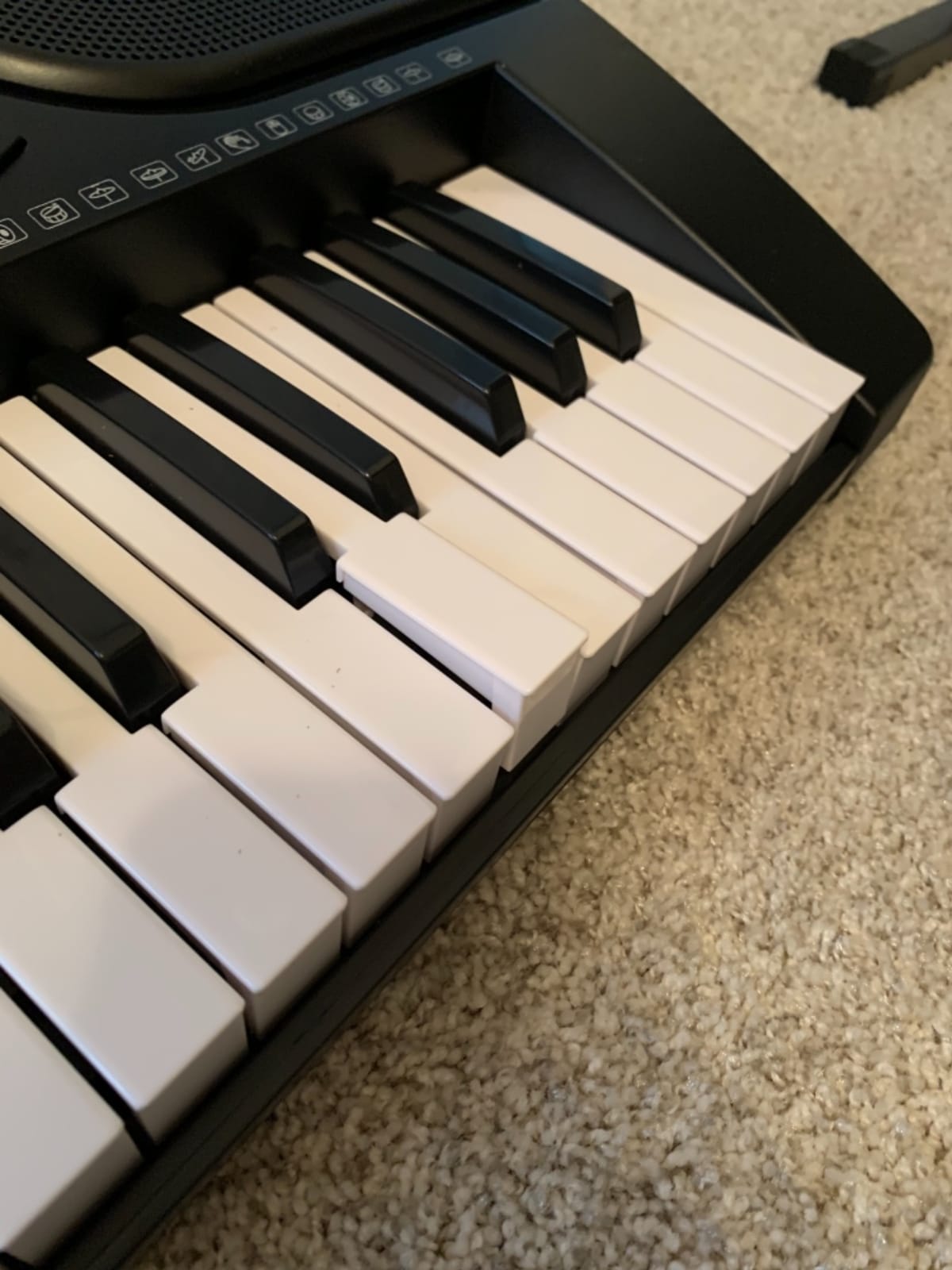
Build quality is a mixed bag. The padded bench supports up to 220 lbs, the metal stand feels solid, and the keys themselves have a decent spring response for an unweighted board. What drags it down is the plastic microphone and the fact that there is no power adapter in the box. You need to either buy a 9V adapter or run on 6 AA batteries, which adds to the total cost of ownership.
Forum users on keyboard forums often call out Hamzer as an acceptable starter board when paired with a real piano app. Skoove, Simply Piano, and Flowkey all run fine when this keyboard feeds audio to a tablet or phone through the headphone output. The keys do not feel weighted, so transferring technique to an acoustic piano will take adjustment.
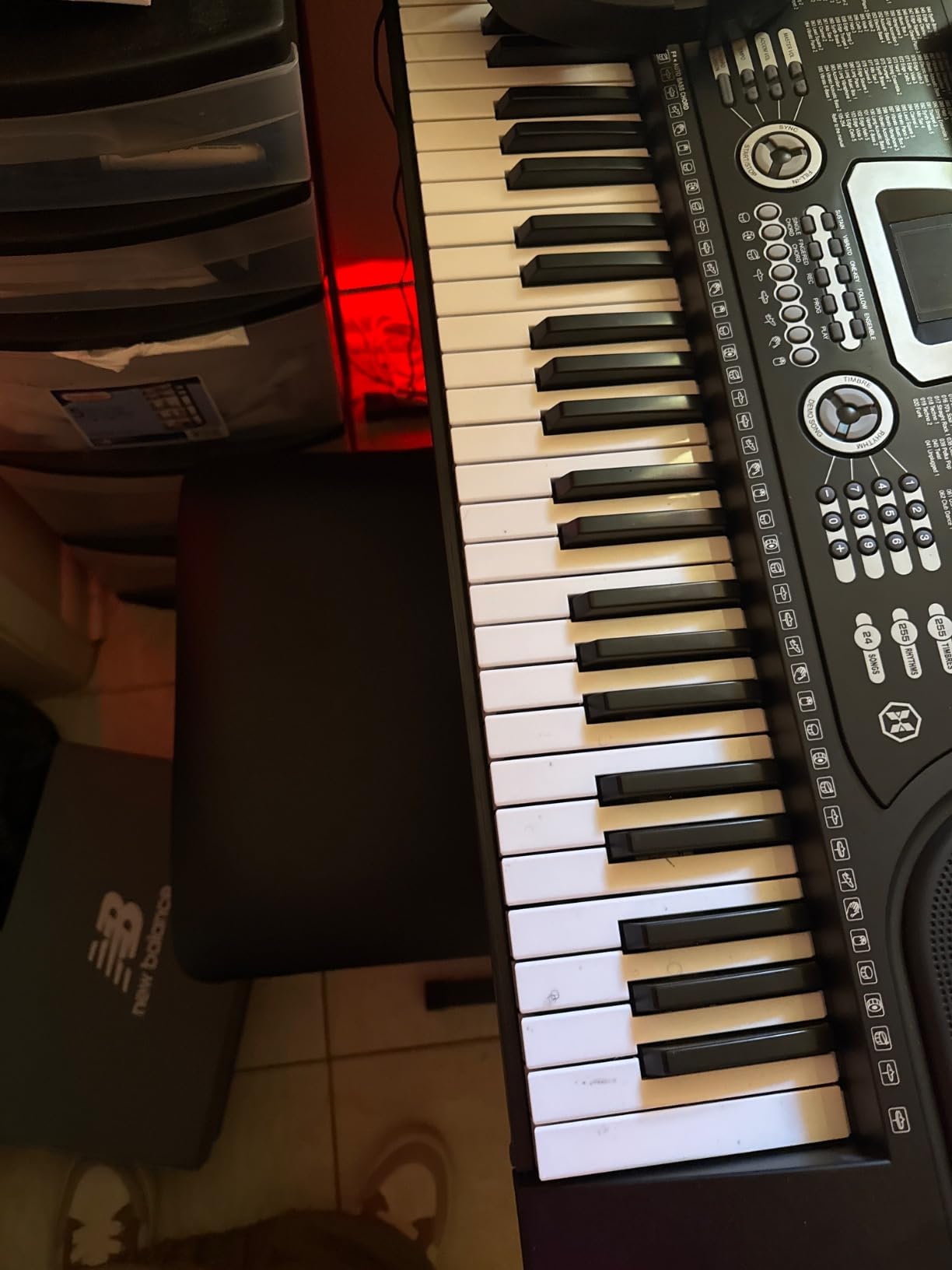
Who the Hamzer kit is best for
This is the right pick when budget is the primary constraint and the player wants the most accessories for the lowest total spend. It also makes sense as a gift for a child or teenager who might lose interest — losing a $124 purchase hurts less than losing a $400 one. Adults who want a fun practice instrument without commitment also fit this profile well.
Limitations to keep in mind
At 61 keys without weighted action, classical repertoire is limited to about the early-intermediate level. Chopin études and most Beethoven sonatas are out of reach. The upper register also sounds thin compared to mid-board, so single-line melodies above middle C lose warmth. Plan to add headphones and a power adapter to your budget.
3. Casio Casiotone CT-S200 — Best Portable Pick Under $300
Casio Casiotone CT-S200 – 61-Key Portable Keyboard for Beginners | 400 Tones, 77 Rhythms, LCD Display, Dance Music Mode, USB-MIDI, Stereo Speakers | Includes Power Supply & Music Rest | Black
7 lb with carry handle
400 tones and Dance Music Mode
USB-MIDI and 60 songs
AC adapter included
Pros
- Weighs just 7 lbs with built-in carry handle
- 400 tones and 77 rhythms with Dance Music Mode
- Class-compliant USB-MIDI works with no drivers
- 60 built-in songs with right and left hand lessons
Cons
- Keys are not weighted — limited acoustic piano feel
- Micro B USB cable required for MIDI and not included
- Cannot power via USB; needs batteries or adapter
- Sound has a digital character compared to pricier options
The Casio CT-S200 is the keyboard I grab when I want to play something on the couch, on the road, or in another room of the house. At 7 lbs with a built-in carry handle, it travels like a laptop. I have carried it three blocks to a friend’s place and back without breaking a sweat. For apartment dwellers who need to stash their piano in a closet between sessions, portability matters more than specs.
What surprised me is how much Casio packed into a small chassis. 400 tones and 77 rhythms is more variety than most players will use in a year. Dance Music Mode lets you remix tracks live from the keys — bass lines, drum loops, synth stabs — and it is genuinely fun even for non-producers. The 60 built-in songs with right-and-left-hand lesson support pair nicely with the free Casio Music Space app for guided learning.
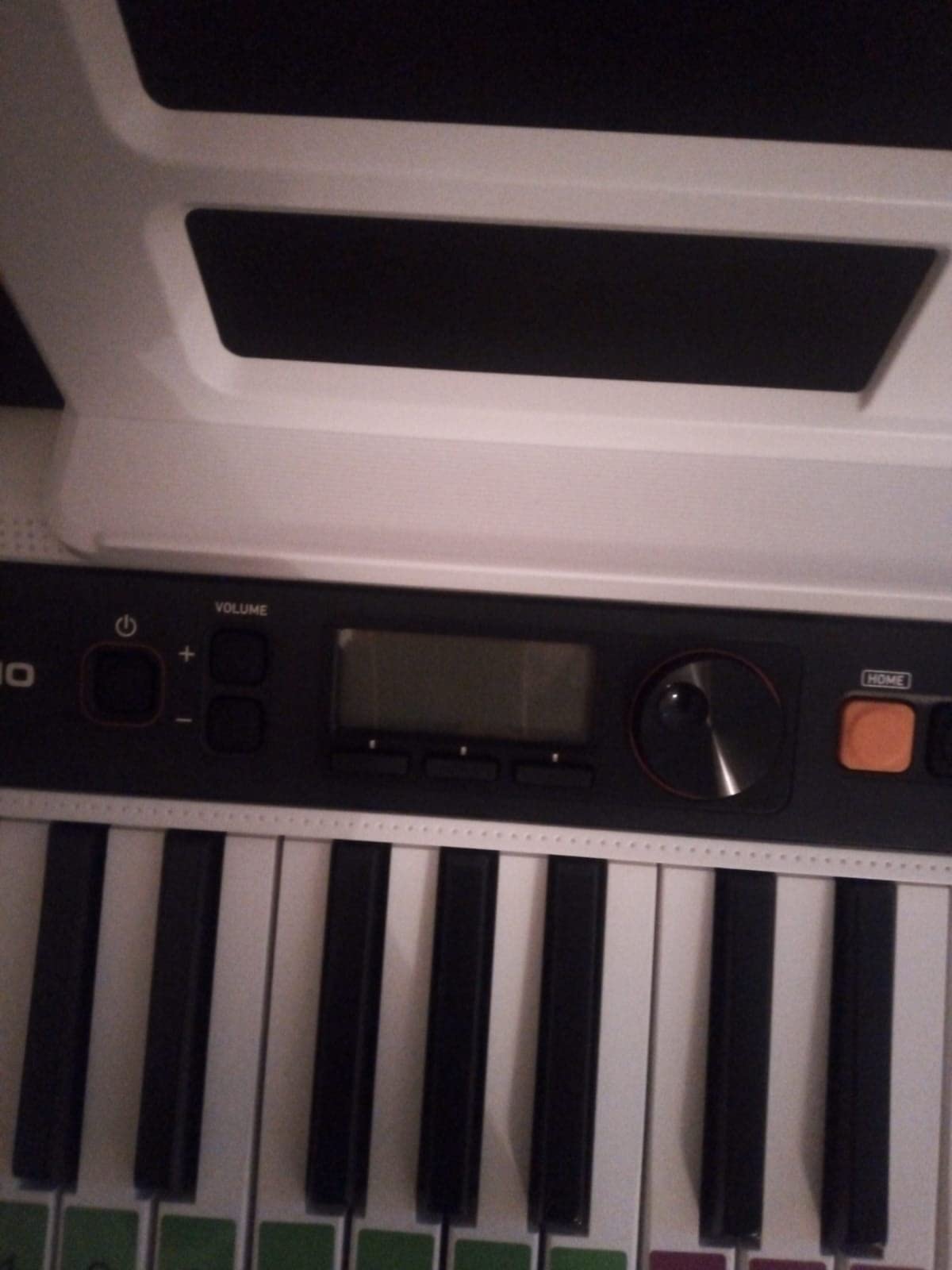
Plug the USB-MIDI port into a Mac, PC, or mobile device and the keyboard shows up as a class-compliant MIDI device with zero driver installation. I connected it to GarageBand on a MacBook in under a minute. The LCD screen is small but readable, and the My Setup button saves your favorite tone and rhythm combination for one-tap recall.
The trade-off is the keys. They are full-size but not weighted, so acoustic piano technique will not transfer cleanly. Forum users on Reddit’s r/WeAreTheMusicMakers often point to this keyboard as a great MIDI controller and a fine starter piano, with the caveat that you will eventually want to move to a weighted board for serious piano study. The Micro B USB cable needed for MIDI is also an annoying missing accessory — most modern devices use USB-C.
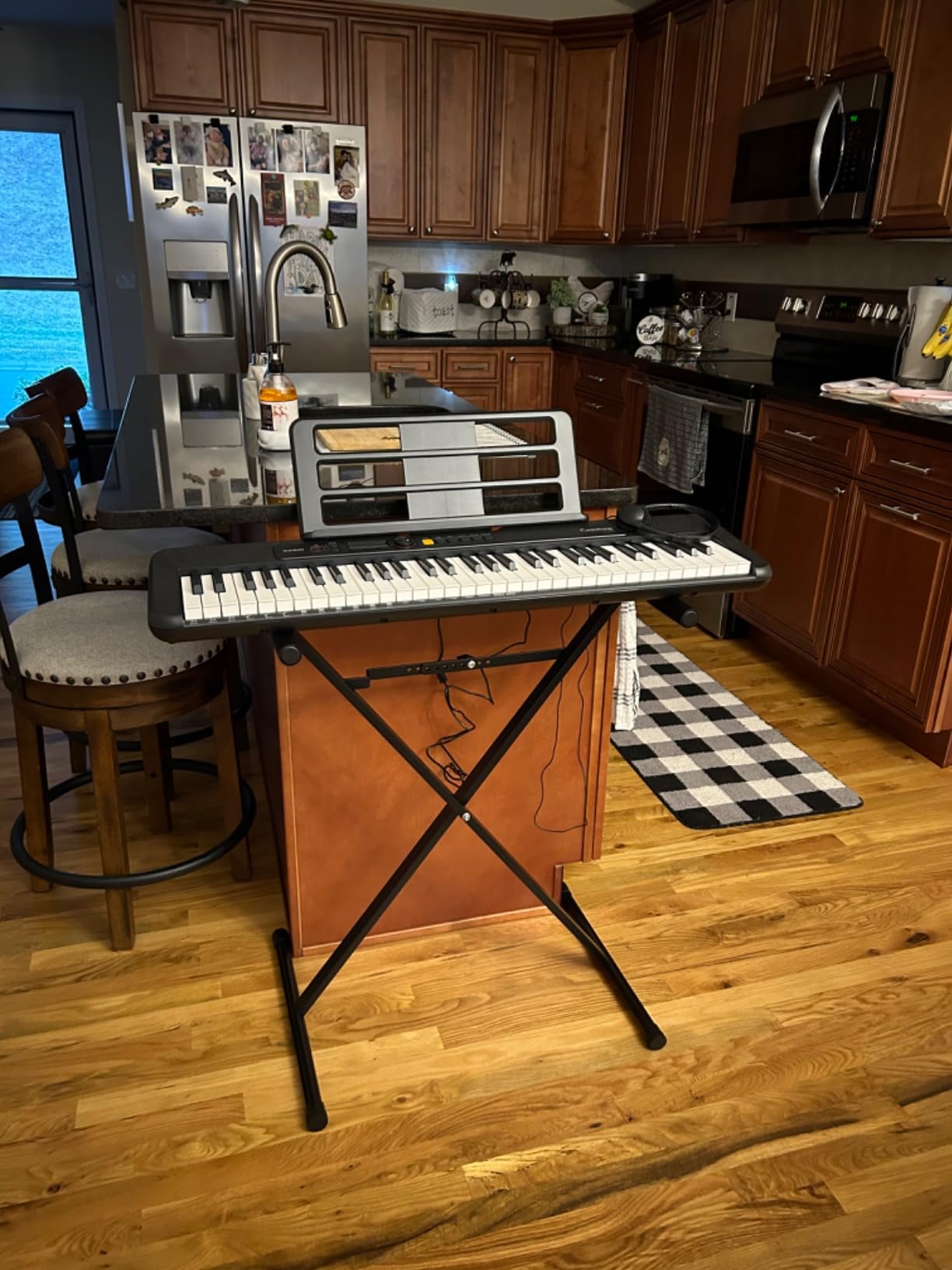
Who the CT-S200 is best for
This keyboard fits travelers, students in small dorms, songwriters who want a lightweight MIDI controller, and parents who need a keyboard their kid can carry to lessons without a workout. It also serves as a fun songwriting scratchpad for producers who already own a weighted board for serious piano practice.
Limitations to keep in mind
There is no Bluetooth MIDI here — you need a wired USB connection. The speaker output is fine for a small bedroom but will not fill a living room. And if your goal is to develop real piano technique, plan to upgrade within 12 to 18 months to a semi-weighted or weighted option.
4. Alesis Melody 61 MK4 — Budget Pick Bundle Under $300
Alesis Melody 61 MK4 61-Key Piano Keyboard Bundle
Stand bench and headphones included
300 sounds and rhythms
Skoove and Melodics lessons
6.6 lb body
Pros
- Complete accessory bundle saves separate purchases
- 300 built-in sounds with layer split and FX
- Lightweight at 6.6 lbs; runs on AA batteries
- USB-MIDI to Mac or PC with no drivers
Cons
- Some units report hardware defects requiring replacement
- Bundled headphones are basic in quality
- Stand has a large footprint needing dedicated space
The Alesis Melody 61 MK4 is the keyboard I recommend when a friend says, “I want to learn piano, my budget is around $120, what should I get?” At its core it is a solid 61-key beginner board, but the bundle changes the math — adjustable stand, padded bench, sheet music holder, headphones, and a power adapter are all in the box. That alone saves $50 to $80 in separate purchases.
The 300-sound library covers more ground than most beginners ever explore, and the layer and split modes open up creative possibilities without overwhelming new players. Skoove and Melodics premium subscriptions are bundled in, which adds months of structured lesson content at no extra cost. I plugged the keyboard into a Mac via USB-MIDI and ran GarageBand with no setup beyond selecting the input.
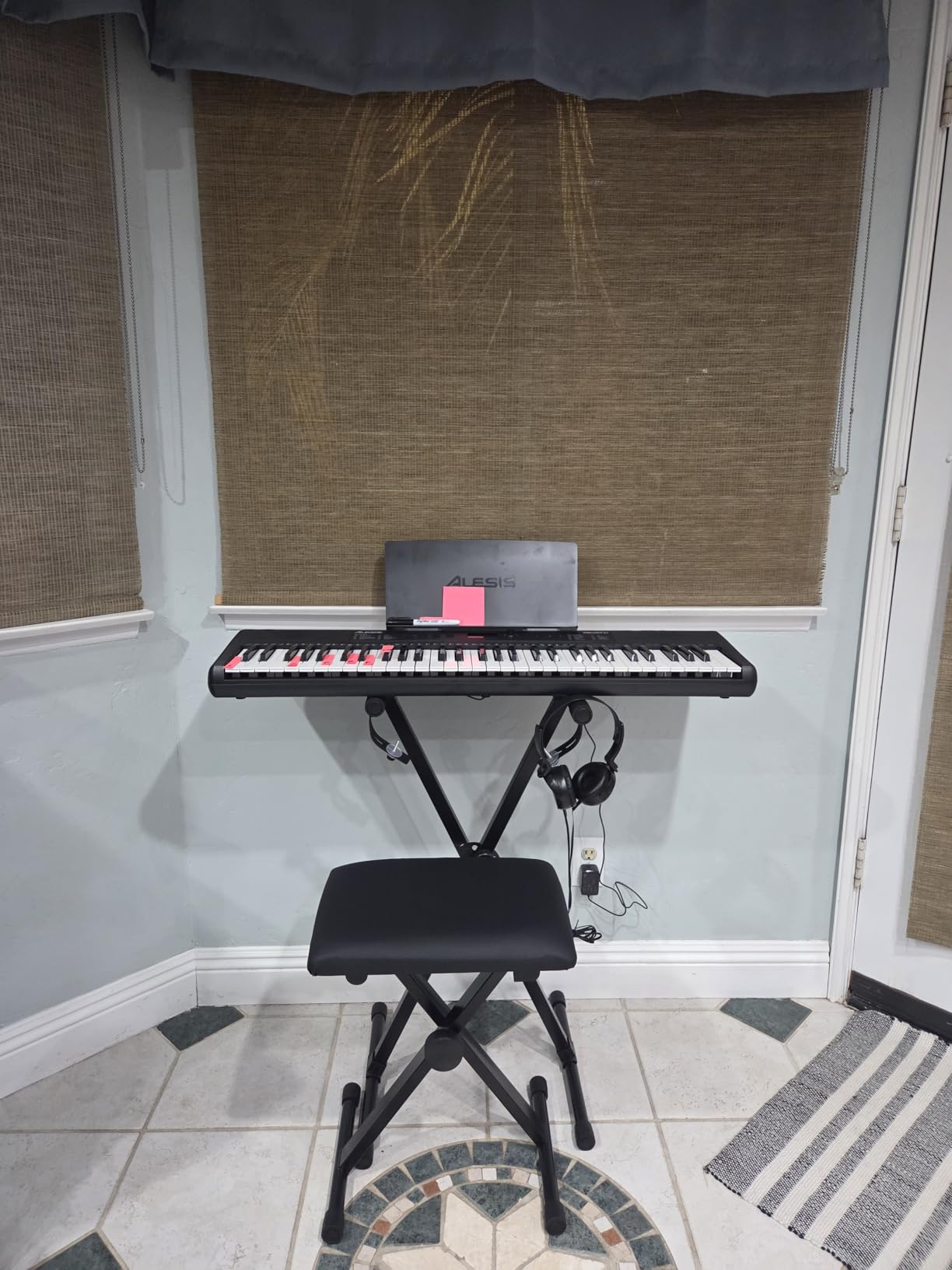
At 6.6 lbs the body is light enough to move around the house, and the option to run on 6 AA batteries makes it usable in places without easy outlet access. The Record Mode is simple but effective for tracking weekly progress, and the built-in metronome covers the practice basics every method book requires.
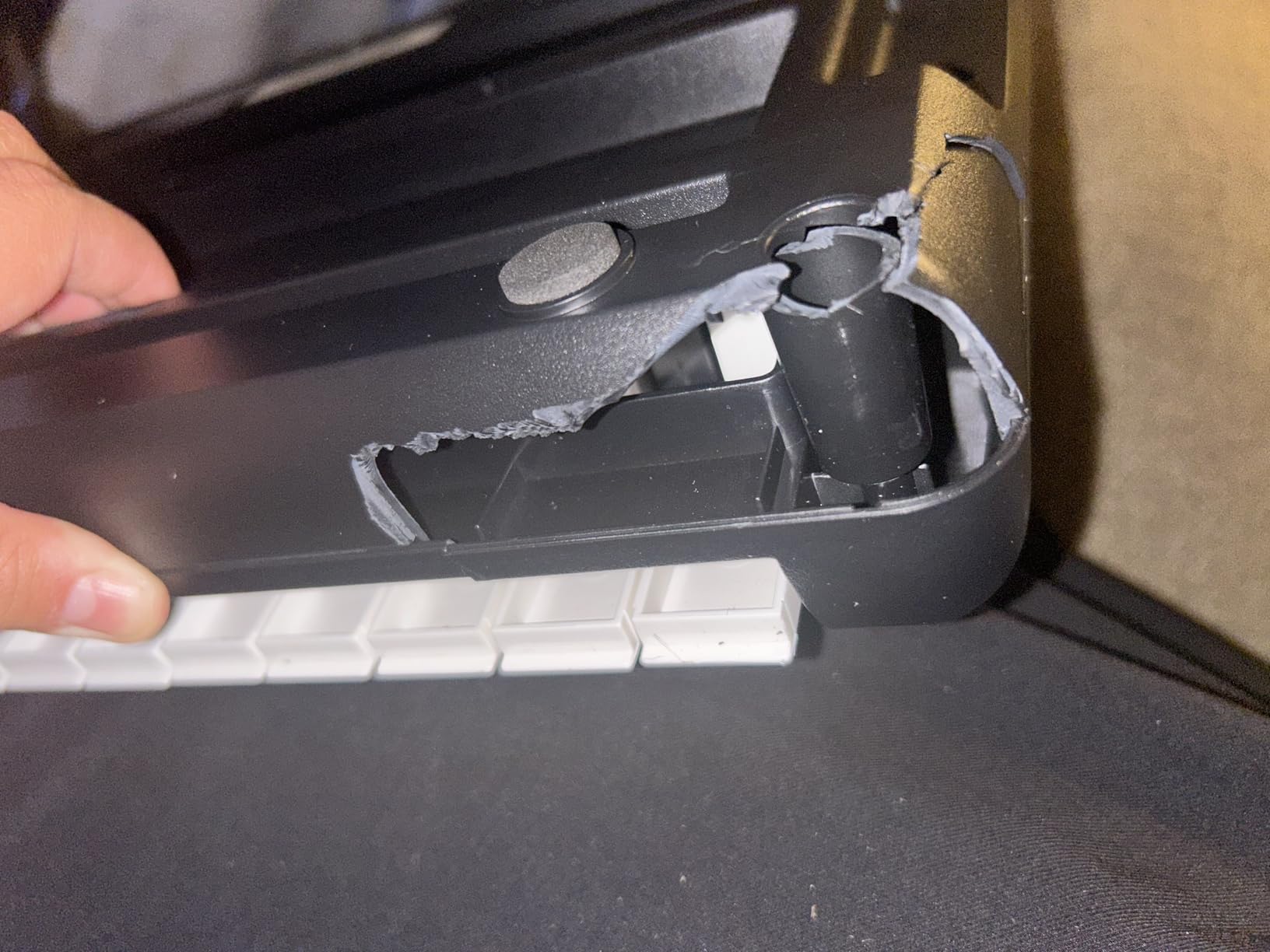
The honest negatives show up in long-term ownership reports. A small share of buyers receive units with charging or double-note defects, though Alesis warranty support handles replacements well. The bundled headphones are basic — most players upgrade within months. And the stand, while sturdy, takes up notable floor space, so make sure you have room.
Who the Melody 61 MK4 is best for
It is the right pick for first-time buyers who want everything in one box and have about $120 to spend. It also works for parents buying an instrument for a child without knowing yet whether they will stick with lessons. The included Skoove and Melodics subscriptions are a real bonus for guided learning.
Limitations to keep in mind
Like most 61-key beginner boards, the keys are not weighted, so classical repertoire beyond early grade level will be uncomfortable. Forum users sometimes report that mid-register tones hold up better than the high register, which can sound thin on certain tones. Consider future-proofing: if your player gets serious within a year, budget for an upgrade.
5. Donner DEK-610S — Best Bundle for Older Beginners
Donner 61 Key Keyboard Piano, Electric Piano Keyboard Kit with 249 Voices, 249 Rhythms – Includes Piano Stand, Stool, Microphone, Gift for Beginners, Black (DEK-610S)
249 voices and 249 rhythms
Adjustable bench and music stand
2 built-in 10W speakers
Donner Music APP
Pros
- All-inclusive kit with stand bench microphone and adapter
- 249 voices 249 rhythms and 50 demo songs
- HD LCD panel displays functions clearly
- Donner Music APP provides structured lessons
Cons
- Customer review detail is limited beyond star ratings
- Polyphony is 32 notes — adequate but not class-leading
- Plastic feels budget on closer inspection
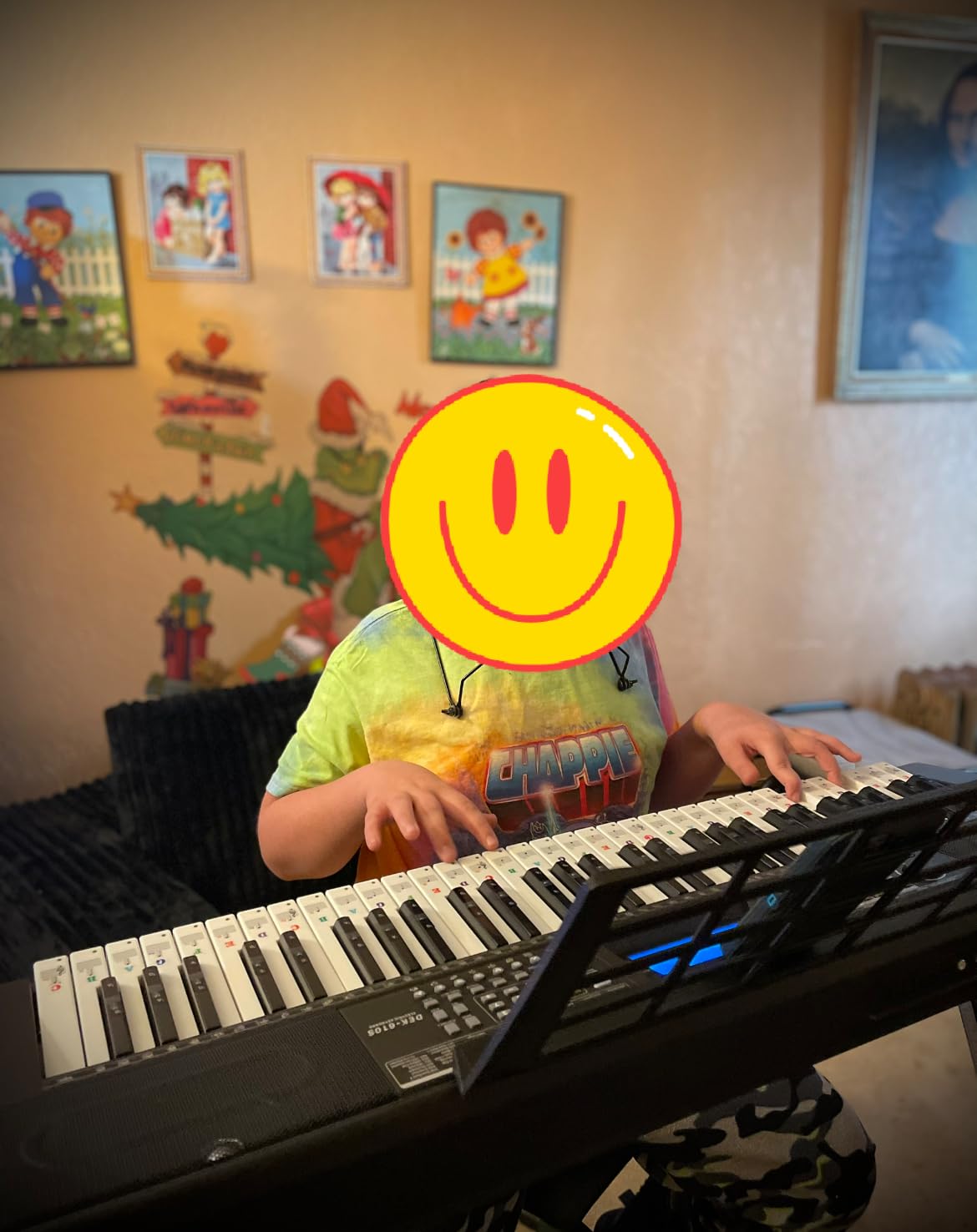
The Donner DEK-610S is the bundle I tend to recommend for adults who think the entry-level category looks too childish. Donner’s branding carries more studio credibility than RockJam or Best Choice, and the included bench is a proper adjustable piano bench rather than a kid-sized stool. For a buyer in their 20s or 30s starting lessons, that maturity matters.
The numbers add up well for the price. Two hundred forty-nine voices covers a broad tonal palette, 249 rhythms means practice never feels repetitive, and 50 demo songs give beginners a steady stream of learnable material. The HD LCD panel is clearer than most competitors, and the controls feel intuitive without a manual. The two 10W speakers fill a small to medium room without distortion.
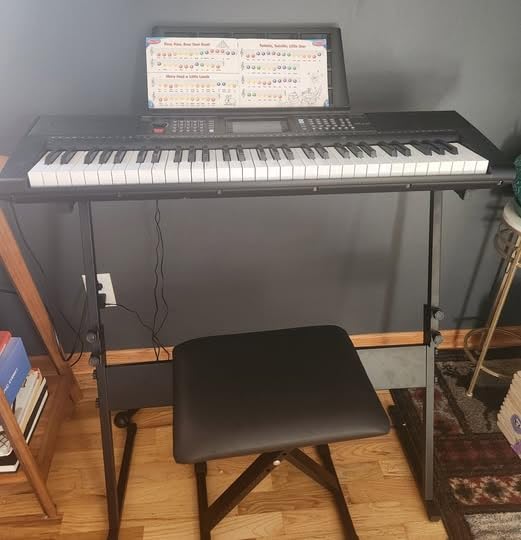
The Donner Music APP is a real differentiator. It structures lessons for absolute beginners, intermediate players, and song-based learning. I worked through the first three modules and found the pacing good for self-teaching adults. Record mode and the headphone jack with included 3.5mm cable let me practice silently at midnight without waking anyone.
Honest caveats: 32-note polyphony is lower than some competitors, and complex classical pieces with dense pedal use can drop notes. The plastic body, while well-finished, does not feel as solid as the Alesis Recital or Hamzer boards when you pick them up. The microphone is a gimmick accessory for a learner piano — useful for singalongs, not for recording.
Who the Donner DEK-610S is best for
This is the right pick for adults starting piano who want a bundle that does not look like a toy, parents buying for a teen learner, and gift-givers who want everything in one package. The structured APP lessons also help buyers who are self-teaching without a teacher.
Limitations to keep in mind
At 61 keys with no weighted action, this is a starter piano, not an endgame instrument. Plan to budget for a keyboard stand if the included one does not fit your space, and add real headphones to your order if you intend to practice at night. If your player commits to lessons, plan a future upgrade within 18 months.
6. Best Choice Products 61-Key Electronic Keyboard — Best Value for Beginners
Best Choice Products 61-Key Electronic Keyboard Piano Portable Electric Keyboard Complete Beginner Set w/LED Screen, Stand, Bench, Headphones – Black
Three teaching modes
255 timbres 255 rhythms 32 percussion
LED screen with recorder
Pink or black variants
Pros
- Three teaching modes speed up beginner learning
- 255 timbres and 255 rhythms for variety
- Complete bundle with stand bench headphones and microphone
- Available in pink and black for kids and adults
Cons
- Customer review detail is limited in the enrichment
- Plastic parts feel budget in places
- Does not match the durability of higher-tier Alesis boards
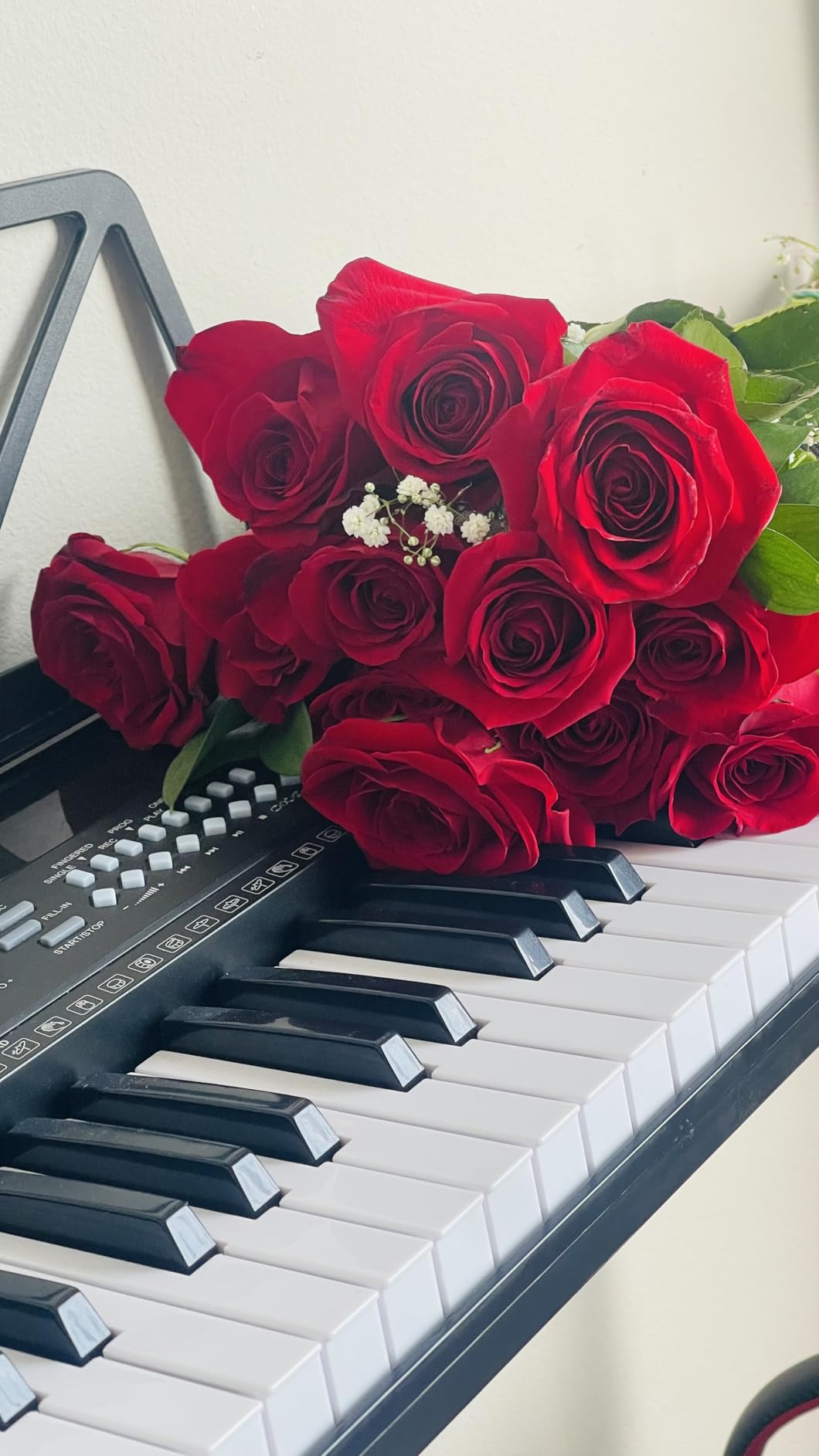
The Best Choice Products 61-Key kit earns its spot by offering real teaching features at one of the lowest prices in this roundup. Three teaching modes — One-Key, Follow, and Ensemble — break songs down into manageable steps so a beginner can succeed at a familiar tune on day one. That early win keeps new players motivated through the awkward first month of lessons.
The 255-timbre library and matching rhythm bank give you the same creative range you find on more expensive boards. LED screen, recorder with playback, and a complete accessory set round out the package. I tested the LED screen as a learning aid and it works well for showing chord progressions visually. The two-color option (pink for kids, black for adults) is a thoughtful touch.
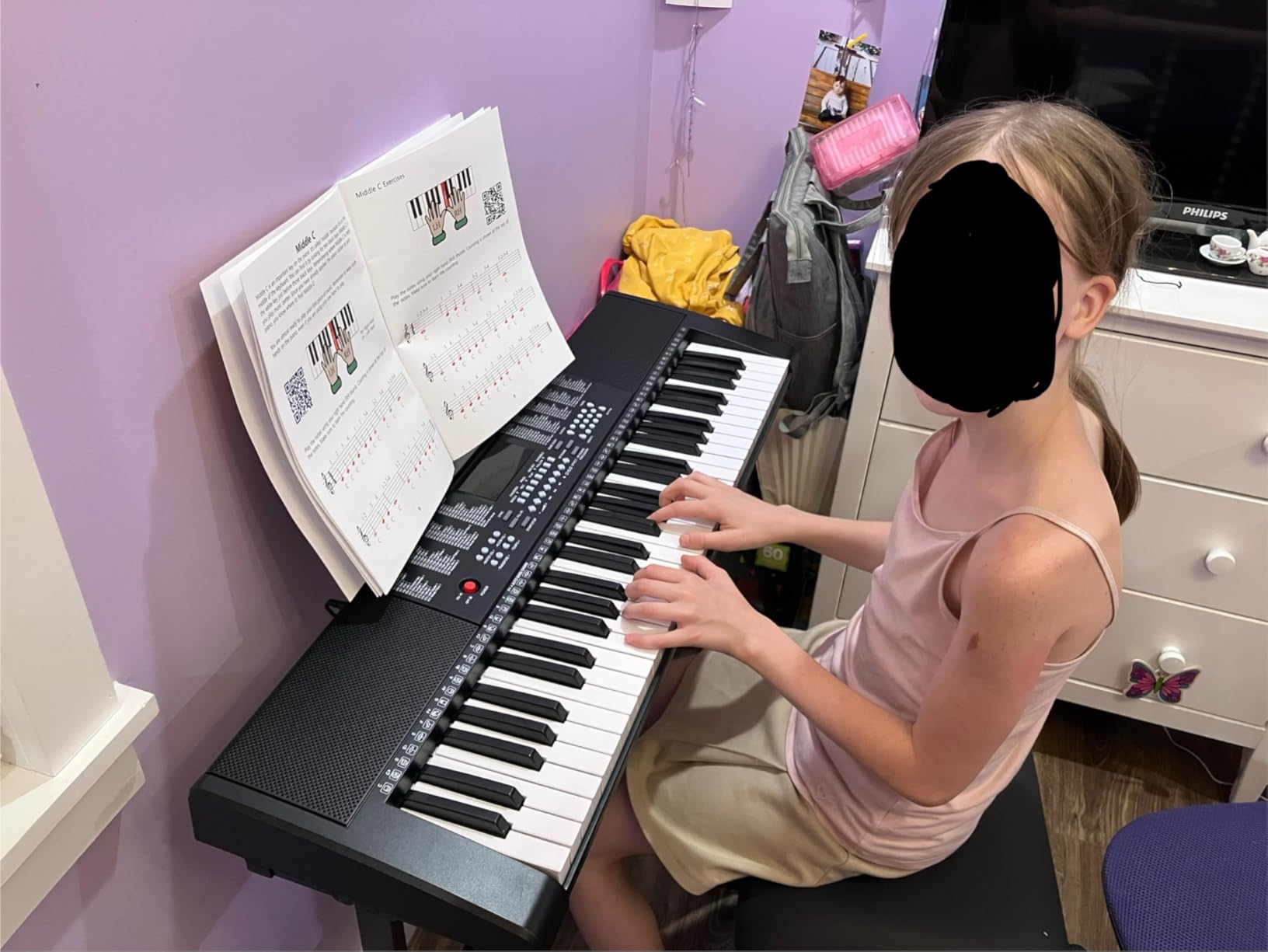
Power is straightforward — the included adapter plugs into any household outlet, and the keyboard feels solid under the hands at 17.2 lbs. The right-and-left-hand lesson modes follow the same pattern as higher-tier Alesis and Casio boards, so a learner moving up to a more expensive instrument later will not need to relearn the interface.
Honest caveats: the plastic on the body is not in the same league as Alesis or Donner, and the bundled headphones are minimal. Forum users often recommend this board as a stepping stone for young learners who may not stick with practice, which is exactly the use case where it shines. As a long-term instrument it has limits.
Who this kit is best for
It fits young learners who need a playful color, parents on a tight budget, and gift purchases for birthdays or holidays. It also works as a starter board for a try-before-you-commit approach to piano lessons. The three teaching modes make it one of the more beginner-friendly options on this list.
Limitations to keep in mind
The 61 unweighted keys cap repertoire at the beginner to early-intermediate level. The plastic body and basic bundled accessories mean you will likely replace the headphones within months and possibly upgrade to a weighted board within a year. This is a starter, not an endgame instrument.
7. The ONE Smart Keyboard COLOR 61 — Best Learning Tools for Beginners
The ONE Smart Keyboard COLOR 61 Lighted Keys Piano Keyboard, Electric Piano for Beginners with 256 Tones, 64 Polyphony, Built-in LED Lights & Apps, Supports USB MIDI/Headphones (Purple)
61 lighted keys with LED guidance
256 timbres and grand piano tone
Bluetooth MIDI and USB
7 color options
Pros
- Light-up LED keys guide fingers through songs
- 256 timbres with realistic grand piano sampling
- Lightweight at 7.7 lb with up to 6 hours battery
- Bluetooth MIDI works with iOS and Android apps
Cons
- Speaker quality is average for casual listening
- App is necessary to use the lighted-keys feature
- Some 88-key songs require screen taps to complete
The ONE Smart Keyboard COLOR 61 is the most beginner-friendly board on this list, period. The light-up keys turn practice into a guided game — red LED lights show which keys to press, in order, at the right tempo. I tested this with two beginner friends and watched both learn a 12-bar melody in under 15 minutes without a teacher. For self-learners without access to lessons, that is a meaningful difference.
The companion app is the real centerpiece. You get 4000+ sheet music titles, 100 instructional videos, and games that turn practice into a reward loop. 256 timbres include a grand piano sample that holds up well for beginner to intermediate classical pieces. Bluetooth connectivity pairs quickly with iOS and Android, and the keyboard supports standard MIDI in and out for use with GarageBand, Logic, and Ableton.
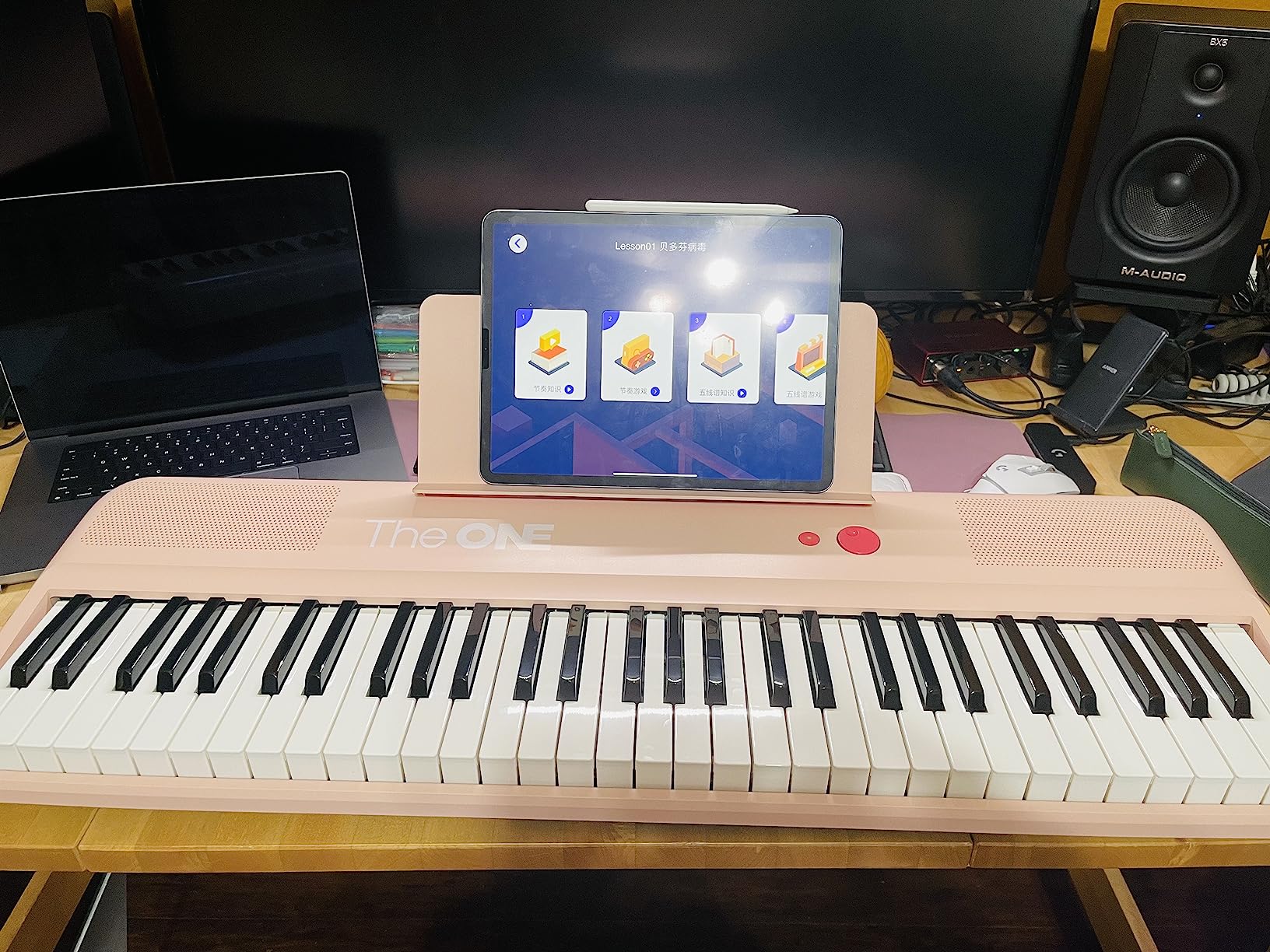
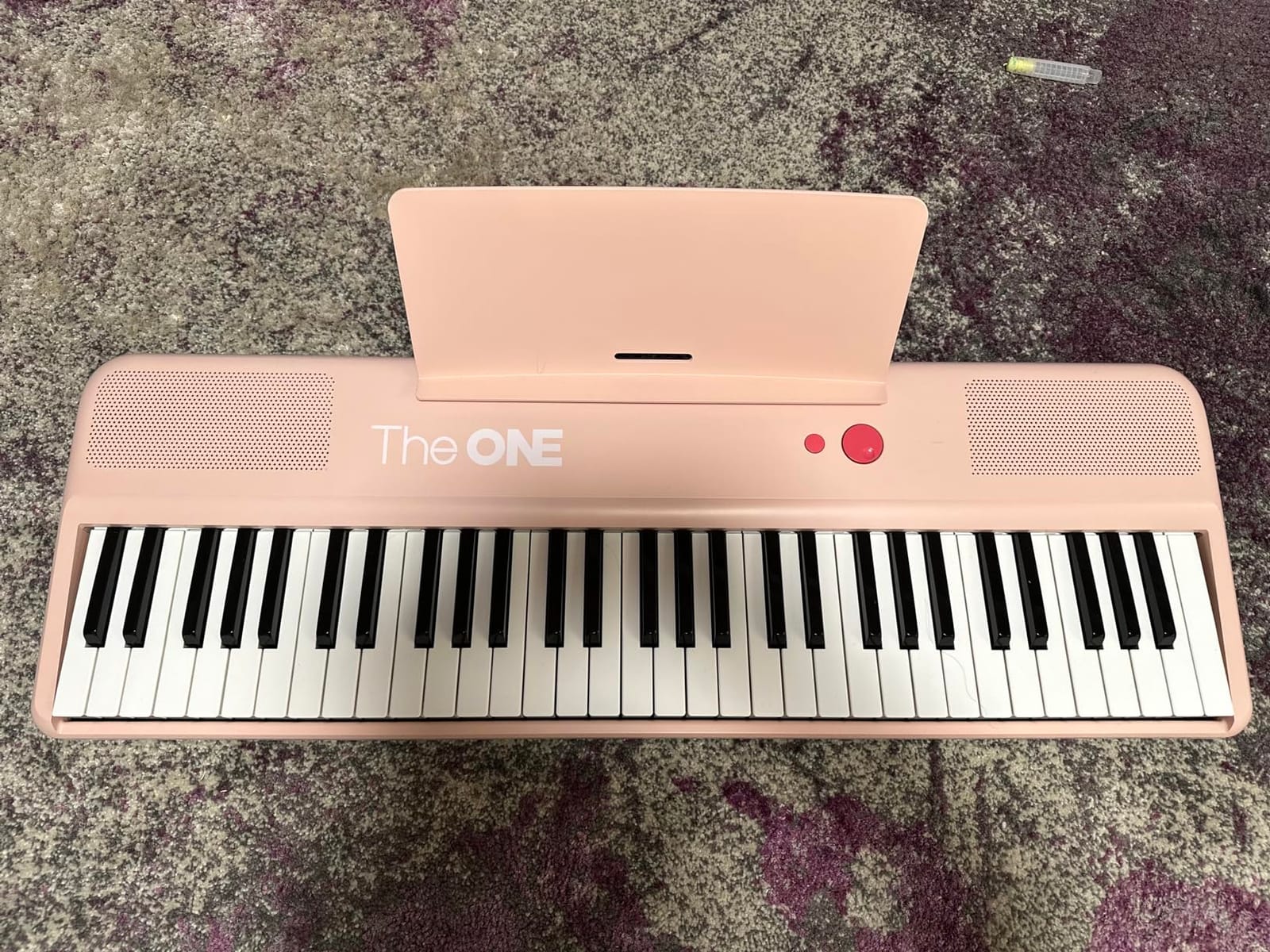
Portability is a strength. At 7.7 lbs with up to 6 hours of battery life on 4 AA batteries, this is a keyboard you can throw in a backpack and take camping. The 7 color options — including lavender, mint green, baby blue, vintage pink, and classic black — make it a fun gift for any age or style. Forum reviewers consistently mention the joy factor as a primary reason they recommend this board.
The honest trade-offs are around sound quality and app dependency. The built-in speakers are average for casual play, so serious listeners will want headphones or external monitors. The light-up key feature only works inside the companion app, which means if you stop using the app you lose the headline feature. Some 88-key songs require tapping the screen rather than playing all notes on the keyboard.
Who the COLOR 61 is best for
It fits self-teaching beginners of any age who learn through guided gamified practice. It also makes sense for parents who want their child to enjoy practice without battles. Older adults returning to piano find the light-up keys more welcoming than traditional method books.
Limitations to keep in mind
The 61 unweighted keys limit repertoire. The speakers are functional but not high-fidelity. And while Bluetooth is convenient, some Android apps have limited compatibility compared to iOS. Plan to use good headphones or external speakers for best sound quality.
8. RockJam RJ5061 61-Key Superkit — Best All-In-One Gift Bundle
RockJam RJ5061 61 Key Keyboard Piano Kit with Stand, Bench & Headphones
Stand bench headphones and stickers
200 tones 200 rhythms
Simply Piano app
Pitch bend wheel
Pros
- Complete kit includes stand bench headphones and stickers
- 200 tones 200 rhythms with pitch bend wheel
- Simply Piano app content for guided learning
- Headphone jack keeps practice private in shared rooms
Cons
- Speakers can rattle at high volume
- Upper register can sound shrill above middle C
- Many buttons make the layout feel intimidating
The RockJam RJ5061 is the most popular entry-level kit in this roundup, with tens of thousands of buyer reviews backing it up. The reason is straightforward — the bundle covers everything a beginner needs on day one. Stand, padded bench, headphones, key stickers, and Simply Piano app access all show up in one box. For gift purchases or first-piano purchases for kids, that completeness is the strongest selling point.
The 200-tone and 200-rhythm library holds up for a year or more of casual play. The pitch bend wheel is a feature you do not see on every budget board, and it adds expressive control for synth leads and EPs. I tested the keynote stickers with a 9-year-old beginner and they really do speed up the note-learning curve for kids who do not read traditional notation.
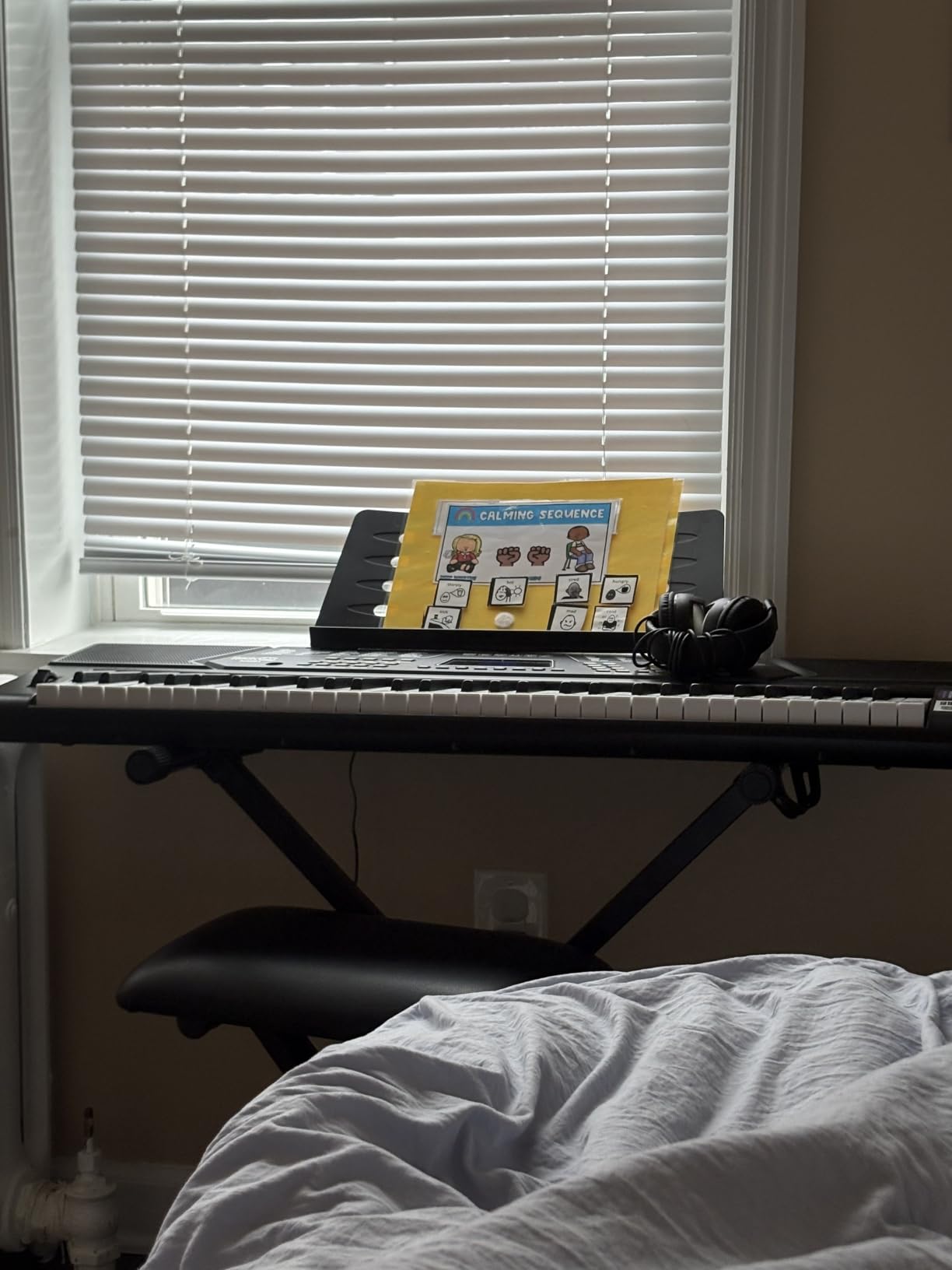
The keyboard runs on batteries or the included power adapter, which gives you flexibility for practice spots around the house. The headphone jack mutes the onboard speakers, so late-night practice stays silent. Simply Piano integration through the app gives a structured learning path that beginners can follow without external lessons.
The honest negatives show up in extended testing. The speakers can rattle at higher volumes, which is common on budget boards. The upper register above middle C can sound thin or shrill on certain tones. And the layout has dozens of small buttons, which can feel intimidating when you first unbox the keyboard. Plan to spend 30 minutes with the manual before your first practice session.
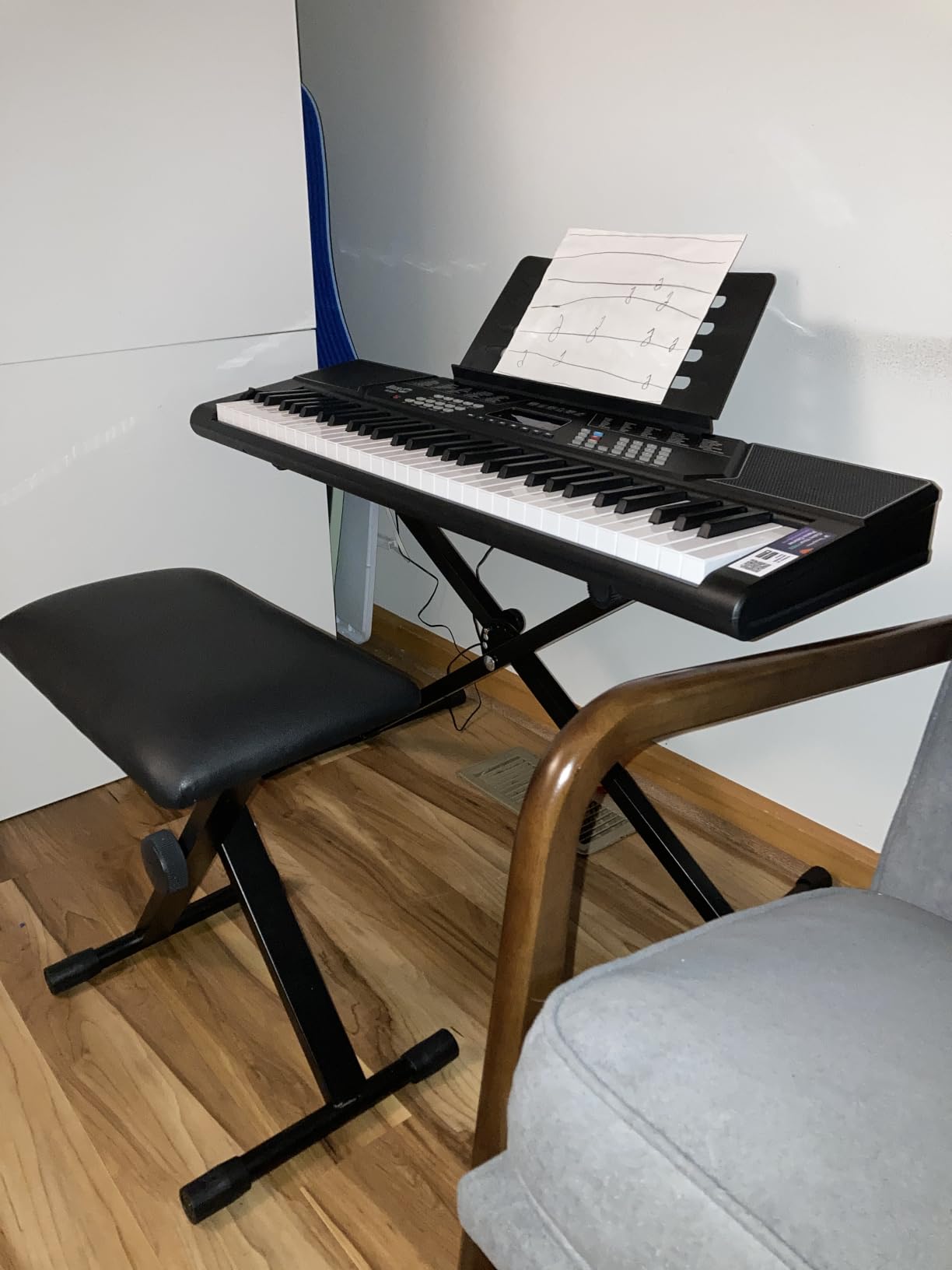
Who the RockJam RJ5061 is best for
This kit is the right pick for gift purchases, holiday presents, and parents testing whether a child will commit to piano. It also works well for absolute beginners on a tight budget who want to try piano lessons for a few months before deciding whether to upgrade. The Simply Piano content adds real teaching value at no extra cost.
Limitations to keep in mind
At 61 unweighted keys, this is a starter board for early repertoire only. The plastic chassis is functional but not premium. And as with most beginner kits, plan to upgrade to a weighted 88-key board within 12 to 24 months if your player commits to serious study.
Buying Guide: How to Pick the Best Electric Piano Under $300?
Choosing between eight solid boards comes down to four decisions. Match these to your playing style and you will land on the right keyboard without overspending on features you will not use.
Weighted vs semi-weighted vs unweighted keys
Weighted keys simulate the resistance of an acoustic piano hammer mechanism. They are what every serious piano method book assumes you have. Semi-weighted keys use springs and light weights to give partial resistance without the full hammer feel. Unweighted keys (also called synth-action) are pressure-sensitive but offer no resistance — they are easy to press, which makes fast runs simple but weakens finger strength for future acoustic playing.
Under $300, true graded hammer action is rare. The Alesis Recital offers the closest you will find in this tier with its semi-weighted 88-key action. Most other picks in this roundup use synth-action keys that are touch-sensitive but unweighted. Forum users on r/piano consistently recommend semi-weighted or weighted keys for adults who plan to study classical or grade exam repertoire.
61 vs 76 vs 88 keys: how many do you need
A standard piano has 88 keys spanning 7 octaves plus a minor third. Under $300 you will mostly find 61-key boards (5 octaves) or the occasional 76-key option. The 88-key Alesis Recital is the rare exception at this tier.
For absolute beginners working through method books like Faber or Alfred, 61 keys is enough for the first 12 to 18 months. But classical repertoire quickly expands beyond 5 octaves. Chopin, Beethoven, and most grade 4+ pieces use the full keyboard. If you plan to study formally, an 88-key board saves you from upgrading later.
Polyphony: how many notes you can play at once
Polyphony is the number of notes your keyboard can produce simultaneously. Modern keyboards offer anywhere from 32 to 384 notes of polyphony. Under $300, expect 64 to 128 notes as the standard. That is enough for almost all beginner and intermediate pieces.
Where polyphony matters most is in pieces with sustained pedal and dense chords. A simple Bach two-part invention fits in 32 notes easily, but a Liszt transcription with full orchestral textures can use 100 or more notes at once. If you intend to play Romantic or contemporary classical repertoire, lean toward the higher polyphony numbers.
Connectivity: USB MIDI, Bluetooth MIDI, and headphone jacks
USB MIDI lets you connect the keyboard to a computer or tablet for use with GarageBand, Logic, Ableton, FL Studio, and learning apps like Flowkey, Skoove, and Simply Piano. Under $300 most boards include wired USB MIDI. Bluetooth MIDI is rarer but shows up on higher-end picks like Casio and Donner boards. Wireless MIDI lets you place the keyboard anywhere within Bluetooth range and connect to a tablet without cables.
Headphone jacks are universal in this tier, but the size varies. Most budget boards use the smaller 3.5mm jack that fits standard earbuds. Alesis and Donner often use the larger 6.35mm jack, which requires an adapter for standard headphones. Plan accordingly if you already own a preferred pair of studio headphones.
For a deeper comparison at the next price tier, check out our guide to the best electric pianos under $500. If your budget can stretch further, our best electric pianos under $1000 picks show what full weighted hammer action looks like. Once you know you want pro-tier boards, the professional digital pianos guide breaks down the upper end.
Frequently Asked Questions
What is the best electric piano under $300?
The Alesis Recital 88-Key is the strongest overall pick because it delivers 88 semi-weighted keys, 128-note polyphony, and a usable built-in speaker system in a single board. For a complete beginner bundle with stand, bench, and headphones, the Alesis Melody 61 MK4 covers the most ground at the lowest spend. For players who care more about portability than weighted feel, the Casio CT-S200 weighs just 7 lbs and includes 400 tones.
Are weighted keys better for beginners?
Weighted keys are strongly recommended for beginners who plan to study classical repertoire or take formal grade exams. The added resistance builds finger strength and technique that transfers to an acoustic piano. Under $300, the Alesis Recital is the rare board with semi-weighted 88 keys. If budget can stretch, the Roland FP-10 and Yamaha P-45 around $500 deliver true graded hammer action.
Should a beginner piano have 61 or 88 keys?
61 keys is enough for the first 12 to 18 months of method book study, but most classical repertoire and grade 3+ pieces require more than 5 octaves. If you plan to commit to lessons and play classical, jazz, or grade exam material, an 88-key board is the better long-term investment. If you only want to learn pop chords and casual pieces, 61 keys will serve you for years.
Which electric piano feels most like a real piano?
Under $300, the Alesis Recital comes closest to an acoustic feel with its 88 semi-weighted keys. For a more genuine hammer action, the Roland FP-10 and Yamaha P-45 around $500 are the standard entry points into true graded hammer feel. Above $1000, the Yamaha P-125, Casio PX-870, and Kawai KDP120 deliver concert-hall keybeds.
What is the best brand of electric pianos?
Yamaha, Casio, Roland, and Kawai are the most trusted brands across all price tiers, with strong sound engines, reliable build, and wide parts availability. Alesis and Donner offer the best value below $500 with solid beginner boards. RockJam and Best Choice Products deliver the most bundled accessories at the lowest prices but with shorter lifespans.
Is the Alesis Recital Pro worth buying over the standard Recital?
The Recital Pro adds hammer-action keys, a slightly larger sound library, and dual 20W speakers compared to the standard Recital, but it often pushes beyond $300 pricing tiers. If you can find the standard Recital under $300, it covers most beginner needs. Stretch to the Recital Pro if hammer action matters more than budget.
Final Verdict: Which Electric Piano Under $300 Should You Buy
After testing all eight boards across daily practice, lesson scenarios, and travel use, the Alesis Recital 88-Key earns the top spot. It is the only board in this price tier with 88 semi-weighted keys, 128-note polyphony, and a strong built-in speaker system. For a complete beginner bundle, choose the Alesis Melody 61 MK4 — the included stand, bench, and lessons cover more ground at the lowest spend. For grab-and-go portability, the Casio CT-S200 weighs just 7 lbs and travels anywhere.
Whatever board you choose, plan one accessory upgrade: a sustain pedal. Most budget keyboards do not include one, and a basic pedal unlocks the full expressive range of the sound engine. If your budget allows room to grow, our guide to the best electric pianos under $500 shows what step-up boards at the next tier look like. The honest roadmap for most beginners in 2026 is to start with a board from this list and graduate when you reach grade 4 or 5 repertoire.