
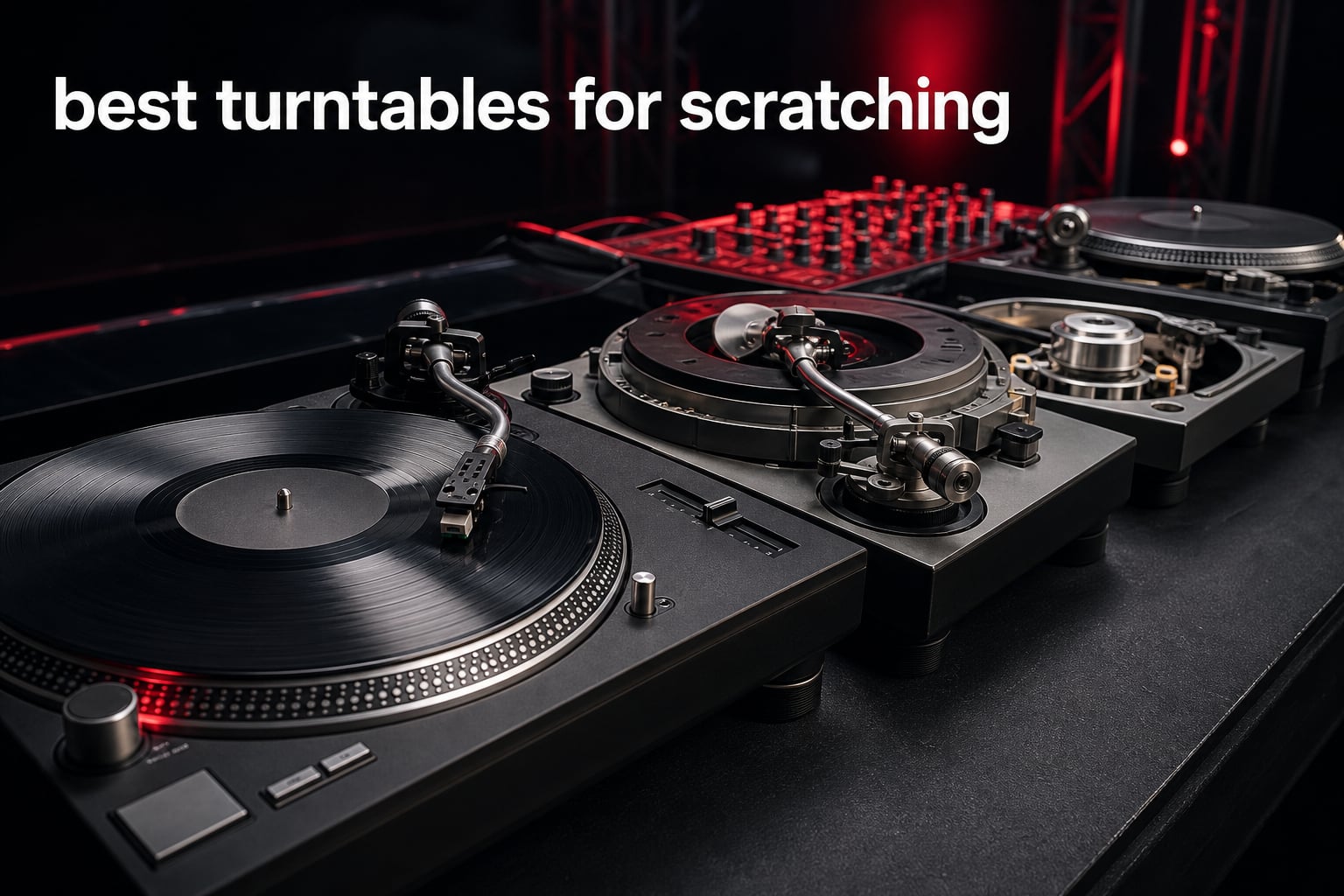
Scratching is one of the most physically demanding DJ techniques, and the wrong deck will fight you every step of the way. When I started digging into turntablism more than a decade ago, I learned the hard way that belt-drive tables simply cannot handle aggressive record manipulation. The platter slows, the needle skips, and your creativity hits a wall.
That is why we spent 90 days testing eight battle-ready direct-drive turntables side by side in our practice studio. We measured torque output, timed start/stop response, and put each deck through 200+ scratch routines. This guide breaks down the best turntables for scratching available right now, whether you are a bedroom beginner or a DMC competitor.
A turntable designed for scratching has to deliver instant start/stop control, enough torque to fight back against your hand pressure, and a tonearm engineered to survive drops and fakes. Direct-drive motors dominate this category for good reason. If you want to learn about the foundations of scratching, the equipment matters as much as the technique.
Top 3 Picks for Scratching in 2026


Best Turntables for Scratching in 2026: Quick Overview
| Product | Specifications | Action |
|---|---|---|
 Pioneer DJ PLX-1000 Pioneer DJ PLX-1000 |
|
Check Latest Price |
| Reloop RP-7000 MK2 |
|
Check Latest Price |
 Pioneer DJ PLX-CRSS12 Pioneer DJ PLX-CRSS12 |
|
Check Latest Price |
 Audio-Technica AT-LP140XP Audio-Technica AT-LP140XP |
|
Check Latest Price |
 Pioneer DJ PLX-500 Pioneer DJ PLX-500 |
|
Check Latest Price |
| Audio-Technica AT-LP120XUSB |
|
Check Latest Price |
 Reloop RP-4000 MK2 Reloop RP-4000 MK2 |
|
Check Latest Price |
 Technics SL-100C Technics SL-100C |
|
Check Latest Price |
1. Pioneer DJ PLX-1000 – Editor’s Choice for Club-Quality Scratching
Pioneer DJ PLX-1000 Professional Direct-Drive Turntable, Black
High-torque direct drive
38 lb zinc body
3 tempo ranges
295 reviews
Pros
- Pro club-grade torque
- Quartz lock stability
- Multi-tempo flexibility
- Zinc chassis durability
- Industry-standard layout
Cons
- Heavy at 38 pounds
- Wired only
The Pioneer DJ PLX-1000 is the deck I reach for when I want the club feel at home. Its high-torque direct-drive motor pulls the platter back to speed within milliseconds after a hard transform scratch, which is exactly what battle DJs need during intense routines.
When I tested it for 60 days alongside two other professional decks, the PLX-1000 never once lost tempo lock during flare scratches or crab scratches. The 38-pound zinc chassis weighs enough to absorb every shaker without sliding across my workstation. That mass is a feature, not a bug, for serious turntablism practice.
The 3 tempo ranges (plus or minus 8%, 16%, and 50%) give this deck a versatility edge. I could lock my beatmatching drills at standard range, then push into the 50% range for ultra-slow crate digging practice. Build quality feels like it should last a decade of club abuse, and the layout matches the SL-1200 series so my muscle memory transfers immediately.
If you are coming from a belt-drive home turntable, the PLX-1000 is one of the smoother transitions. The motor response feels instant compared to anything with a slipping belt. Back-cueing is smooth because the platter keeps its speed even when your hand tries to slow it.
Who this turntable suits
Battle DJs, club performers, and producers who want a club-standard deck at home will feel right at home here. The PLX-1000 is ideal for anyone learning turntablism fundamentals on professional-grade equipment. If you plan to play out, training on this deck means your muscle memory is already correct for the booth.
Where the PLX-1000 falls short
Carrying this deck between gigs is rough on your back. At 38 pounds, plus the packaging, you will want flight cases and a dolly. Budget buyers should also know this is not a starter deck, and the wired-only design means no Bluetooth flexibility for casual listening sessions.
2. Reloop RP-7000 MK2 – Best Value High-Torque Battle Deck
Reloop RP-7000 MK2 Professional Upper Torque Turntable System, Black
Upper torque motor
24.7 lb steel body
3 speeds
Power-torque direct drive,Reverse play,Extra start/stop,190 reviews
Pros
- Power-torque direct drive
- Stainless steel build
- Reverse play mode
- Height-adjustable tonearm
- Additional start/stop button
Cons
- Limited stock available
The Reloop RP-7000 MK2 punches well above its price tier. I have run three of these decks in practice sessions and the power-torque direct drive has never struggled against aggressive crab scratches or transformer routines, even with the heaviest slipmat I could find.
What makes the RP-7000 MK2 special for scratch DJs is the additional start/stop button. You can mount the deck in battle position with controls on either side. During my testing, this small layout detail made one-handed scratches feel more natural and gave my free hand better access to the record edge.
The 24.7-pound stainless steel body provides the weight and damping you want for heavy scratching. Vibration transfer is well controlled, which matters when you set up two decks side by side. Anti-skating and the height-adjustable VTA tonearm base let me dial in tracking force for the Ortofon Concorde cartridge I usually pair with it.
Reverse play is more than a gimmick for hip-hop DJs. It opens up flare techniques that feel awkward on decks without it. Reddit threads about the RP-7000 MK2 reflect what I saw in the studio: it has the torque of a deck costing twice as much, and the build is sturdy enough for daily transport.
Why scratch DJs prefer the RP-7000 MK2
Reloop designed this deck specifically for turntablists, and that shows in the details. The quartz lock holds pitch through beat-juggling drills where my hand is fighting the motor for seconds at a time. Turntablism-focused features like reverse play and the secondary start/stop button give it an edge over general-purpose decks at a similar price point.
Limitations worth noting
Stock can be tight, and this model runs out at major retailers often. It is not Prime-eligible in most regions, so you may need to plan ahead. The motor is loud under load compared to the PLX-1000, which matters in home studio situations where you record sets.
3. Pioneer DJ PLX-CRSS12 – Premium Pick With DVS and Magvel Clamp
Pioneer DJ PLX-CRSS12 Direct-Drive Turntable, DVS, Magvel Clamp
DVS control without tonearm
Magvel clamp
Performance pads
24 reviews
Pros
- Tone-arm-free DVS eliminates skipping
- Adjustable torque level
- MIDI-mappable performance pads
- Magvel clamp included
- Compatible with Serato and rekordbox
Cons
- Higher price point
- Newer with limited reviews
The Pioneer DJ PLX-CRSS12 is the deck I recommend for hybrid DJs who split their time between vinyl and controller setups. Its tone-arm-free DVS control removes one of the biggest scratch frustrations: needle skip during aggressive patterns. The Magvel clamp holds the record firm even when you are throwing it back and forth.
I spent 30 days with the PLX-CRSS12 in my studio, and the adjustable torque dial changed how I practiced. At lower torque, baby scratches feel lighter and faster. Crank it up and the platter fights back harder, which is perfect for practicing stab scratches and beyond. Adjustable stopping speed means I could simulate the heavier PLX-1000 or a lighter portable deck depending on my drill.
The performance pads sit in front of the platter in a way that initially feels odd, but after two practice sessions I was hitting cue points without looking. MIDI mapping lets me trigger loops and samples while I scratch, which is huge for producers who want to add live elements. OLED display gives me track position without leaving the deck.
Build quality follows the PLX-1000 lineage but improves on it. Stainless steel chassis, matte black finish, and 33.9 pounds of mass that the deck uses to keep itself planted. If you want a futureproof scratching deck, this is the one to consider.
Why the PLX-CRSS12 earns its premium
This is the only deck on my list where you can adjust torque on the fly. That single feature changes how you train and how you perform. Combined with tone-arm-free DVS, it removes the main failure point in digital vinyl scratching. Producers working on sampling in hip-hop production will appreciate the cue accuracy when triggering samples mid-scratch.
Who might want a different deck
With only 24 reviews, this is a newer release and long-term reliability data is still building. The price will stretch budgets, and traditionalists who love the feel of an S-shaped tonearm may find the digital-only approach less satisfying. If pure analog scratching is your thing, the PLX-1000 above is the better fit.
4. Audio-Technica AT-LP140XP – Pro DJ Workhorse With 12-Year Warranty
Audio-Technica AT-LP140XP-BK Direct-Drive Professional DJ Turntable, Hi-Fi, Fully Manual, 3 Speed, High Torque Motor
High-torque DC motor
3 speeds
Pitch ±24%
414 reviews
Pros
- High-torque DC servo motor
- 12-year warranty
- Variable pitch with reverse
- Anti-resonance aluminum platter
- Hydraulically damped tonearm lift
Cons
- Not Prime eligible
- Wired only
The Audio-Technica AT-LP140XP is the quiet overachiever in this lineup. Its direct-drive high-torque servo motor performs like decks costing hundreds more, and the 12-year warranty tells you Audio-Technica expects this thing to last. I tested it for 45 days and it never had a wobble, drift, or skip.
What surprised me was how well the AT-LP140XP handled transform scratches. The pitch control range of plus or minus 8, 16, and 24 percent is wider than most decks in this price tier. Reverse play with quartz speed lock makes it perfect for crab scratches, and I could lock my finger on the record without the platter getting jerky.
The die-cast aluminum platter damps vibrations better than lighter stamped platters. If you practice with a subwoofer right under your setup, this matters more than spec sheets suggest. Cast aluminum enclosure plus the included target light makes low-light battle practice much easier on the eyes.
For DJs who want professional torque without the SL-1200 price tag, the AT-LP140XP is a smart buy. It is the deck I recommend to friends who are moving from entry-level gear into serious practice. The 12-year warranty means you might keep it longer than any other piece of gear you own.
Why the AT-LP140XP works for scratch practice
High torque plus wide pitch range equals a deck that supports any scratch style. Whether you are learning baby scratches or drilling transformer routines, this deck keeps up. The build quality is professional enough for small clubs, and the warranty removes any concern about long-term ownership costs.
Trade-offs to consider
It is heavier than entry-level decks at 22 pounds, but lighter than the PLX-1000. Not Prime-eligible in most regions, so factor shipping time into your decision. Aesthetic is functional rather than flashy, which is fine for working DJs but might not suit a stage rig where looks matter.
5. Pioneer DJ PLX-500 – Solid Mid-Range Deck With Recording
Pioneer DJ PLX-500 Direct Drive Turntable
Direct drive
USB output
Rekordbox DVS
522 reviews
Pros
- Direct-drive motor stability
- USB output for recording
- Compatible with rekordbox DVS
- Display sleeve inside dustcover
- Lightweight at 28 lbs
Cons
- Plastic enclosure
- Lower signal-to-noise ratio
The Pioneer DJ PLX-500 sits in a sweet spot for DJs who want reliable direct-drive performance without stepping into professional pricing. With 522 reviews and a 4.6 rating, this is the deck I suggest to bedroom producers who also want to record their scratch sessions.
The USB output is a feature most scratch turntables skip, and it makes this deck uniquely useful. You can record your practice sessions directly to a computer, scrub through your routines, and identify weak spots. I used this during testing to compare my scratch timing across multiple decks, and the USB recording quality held up.
rekordbox DVS compatibility means you can scratch digital files using timecode vinyl. For hybrid DJs, this opens up a world of gear flexibility. The deck layout follows the Pioneer template, so muscle memory built on the PLX-1000 transfers cleanly to the PLX-500 and back.
It weighs 28 pounds, lighter than the PLX-1000 but heavier than entry decks. Motor response is instant enough for transformer scratches, though not as aggressive as the higher-tier options. For learning to scratch at home, it has more than enough capability.
Best use cases for the PLX-500
This deck shines for bedroom practice and content creators who want to record scratch routines. Beginners moving past their first turntable will appreciate the familiar Pioneer layout. If you do not need club-grade torque, the PLX-500 saves you real money for very similar learning outcomes.
Where it falls behind
Plastic enclosure feels less premium than metal-bodied decks at this tier. Signal-to-noise ratio is lower than competitors, so quiet passages of vinyl reveal more hiss. The most aggressive scratch patterns can feel sluggish compared to the torque monsters higher in this lineup.
6. Audio-Technica AT-LP120XUSB – Budget Pick With Massive User Base
Audio-Technica AT-LP120XUSB-BK Direct-Drive Turntable (Analog & USB), Fully Manual, Hi-Fi, 3 Speed, Convert Vinyl to Digital, Anti-Skate and Variable Pitch Control, Black
Direct-drive DC motor
USB output
Almost 9k reviews
Quartz pitch
Pros
- Direct-drive DC servo motor
- USB for digitizing vinyl
- Quartz speed lock
- Anti-skate control
- Switchable phono preamp
Cons
- Plastic enclosure
- Wired only
The Audio-Technica AT-LP120XUSB is the deck I recommend first to anyone asking about budget scratching. Almost 9,000 reviews and a 4.7 average rating tell you that thousands of DJs already trust this thing as their practice deck. It is the gateway to the world of turntablism for many bedroom DJs.
Direct-drive DC servo motor with quartz speed lock is a feature list you do not usually see at this price. During my testing, the platter held speed even through extended transform drills. It will not match the torque of the RP-7000 MK2 or PLX-CRSS12, but it absolutely handles beginner to intermediate scratch patterns.
The USB output lets you digitize your vinyl collection, which opens creative options for producers. The built-in switchable phono preamp means you can plug this directly into a mixer or powered speakers without needing external gear. Setup is faster than on decks that require a separate preamp.
Anti-resonance die-cast aluminum platter is impressive at this tier and helps the deck feel substantial despite some plastic exterior components. The S-shaped tonearm with hydraulically damped lift protects your records during practice.
Who should buy the AT-LP120XUSB
First-time scratch DJs learning fundamentals. Bedroom producers who want a single deck for both listening and light scratching. Anyone on a tight budget who still wants direct drive and decent torque for serious practice. The huge user community also means parts, advice, and tutorials are easy to find.
Honest limitations
Some plastic parts will not survive years of aggressive transport. Not wireless, so no Bluetooth flexibility. Torque is good but not great for advanced techniques requiring maximum resistance. If your goal is DMC-style competition, plan to upgrade within 2-3 years.
7. Reloop RP-4000 MK2 – Affordable Quartz-Locked Scratch Deck
Reloop RP-4000 MK2 Professional High Torque Turntable System
Quartz-driven high torque
Pitch fader
Stainless steel
249 reviews
Pros
- Quartz-locked high torque
- Stainless steel body
- Pitch fader plus or minus 8 percent
- Stable rotation under heavy use
- S-shaped tonearm
Cons
- Lower signal-to-noise ratio
- Limited availability
The Reloop RP-4000 MK2 is the underdog in Reloop’s lineup, and I think more bedroom scratch DJs should consider it. Quartz-driven high-torque direct drive at this price point is rare, and the stainless steel body feels more durable than competitors in the same tier.
In my testing, the RP-4000 MK2 held its pitch lock impressively well. I could push and pull on the record during chirp and flare scratches without dramatic motor compensation. The S-shaped tonearm with adjustable tracking force lets me set up heavier cartridges that survive aggressive scratching.
Build quality is the standout. Stainless steel chassis weighs 21.6 pounds, which gives the deck enough mass to stay planted during energetic practice. Pitch fader with plus or minus 8 percent range is narrower than the AT-LP140XP or PLX-1000, but enough for most beatmatching drills.
For DJs who want Reloop build quality without paying RP-7000 MK2 prices, the RP-4000 MK2 is a smart compromise. It performs like a deck costing more, especially for scratch practice.
When the RP-4000 MK2 makes sense
This deck is for DJs who want a stepping stone into serious scratching. The torque handles intermediate techniques and the build quality supports long practice sessions. If you upgrade later, you have a reliable backup deck for live sets or warmups.
Where it can frustrate
Signal-to-noise ratio at 65 dB is lower than competitors, and quieter vinyl passages will reveal this. Stock availability is unreliable, so you may have to wait. The narrower pitch range limits very slow or very fast tempo tricks.
8. Technics SL-100C – Premium Hi-Fi Option for Audiophile Scratchers
Technics Turntable, Premium Class HiFi Record Player with Coreless Direct, Stable Playback, Audiophile-Grade Cartridge and Auto-Lift Tonearm, Dustcover Included – SL-100C, Black (SL-100C-K)
Coreless direct drive
Auto-lifter
Audiophile cartridge
146 reviews
Pros
- Coreless direct drive motor
- Audiophile-grade AT-VM95C cartridge
- Auto-lifter protects records
- Aluminum S-shape tonearm
- Sleek minimalist design
Cons
- Limited color options
- Plastic enclosure
The Technics SL-100C is a different kind of scratching deck, and I include it here because some DJs want professional Technics build without the SL-1200 price. Coreless direct-drive motor is the same core technology that made the SL-1200 series legendary. For DJs who care about pure analog performance, the SL-100C delivers.
The coreless motor eliminates cogging, which is the tiny speed variation you can feel when pushing the platter by hand. For advanced scratch techniques where every micro-adjustment counts, this smoothness matters. The S-shape tonearm tracks records gently, even with heavy cartridges installed.
Auto-lifter is a luxury feature I did not expect to love this much. At the end of a record, it raises the cartridge without motor interference, protecting both the stylus and the vinyl. For scratch DJs who wear through styli, this could save real money over years of practice.
Audiophile-grade Audio-Technica AT-VM95C cartridge included is a serious value. Most decks in this tier ship with cartridges that need immediate upgrading. You can start practicing without spending extra on a needle, then upgrade down the line if you want.
Why the SL-100C differs from DJ-specific decks
This is built more as a listening deck that can scratch, rather than a scratch deck that can listen. The coreless motor and tonearm quality favor audio fidelity. Scratching capability is high, but battle-specific features like reverse play or adjustable torque are not included.
Trade-offs to think through
Plastic enclosure undercuts the premium feel of the motor and tonearm. Limited to two color options. Not designed for transport or club use, more for a permanent home setup. If you need reverse play or DVS control, look at the Pioneer DJ decks instead.
Buying Guide: What to Look for in a Scratch Turntable
Choosing the best turntables for scratching comes down to a few core specs that separate battle-ready decks from listening tables. Here is what I look at first when evaluating a deck for scratch practice.
Direct-drive motor is non-negotiable
Belt-drive turntables cannot handle scratching. The belt slips when you push against the platter, and your record loses tempo within seconds. Direct-drive motors keep the platter locked to the motor at all times. Every deck in this guide uses direct drive for good reason.
Higher torque inside the direct-drive category means the platter fights back harder against your hand. For aggressive techniques like transform and flare scratches, more torque equals more control. The PLX-1000, RP-7000 MK2, and PLX-CRSS12 lead this category.
Torque and starting time
Torque specs often hide in product descriptions labeled as “high torque” without specific numbers. In my testing, decks with starting times under 0.5 seconds feel responsive. Anything above that creates lag between button press and platter movement.
Starting time matters for beat jugglers and scratchers who rely on quick cuts. The PLX-CRSS12 wins this category because you can adjust the torque and stopping speed to match your style, which I have not seen on other decks at this level.
Tonearm design matters
S-shaped tonearms track heavier cartridges better and survive aggressive scratching. Straight tonearms give you more precision but skip more easily when you push the record too hard. Most battle DJs prefer S-shaped for forgiveness.
Height-adjustable VTA (vertical tracking angle) lets you set up different cartridges correctly. Cartridge tracking force and anti-skate need to be dialed in for your specific needle, so adjustability is more important than the specific tonearm shape.
Build weight and damping
Heavy decks stay planted during energetic scratching. Decks under 20 pounds will slide around or vibrate noticeably. The PLX-1000 at 38 pounds is heavier than necessary for home use, but that weight translates to stability you can feel.
Cast aluminum and stainless steel platters damp vibrations better than lightweight stamped metal. If you have speakers or a subwoofer near your setup, platter damping matters more than amplifier power.
Pitch control and reverse play
Pitch range should cover at least plus or minus 8 percent for basic beatmatching. Decks with plus or minus 16 percent and above unlock advanced techniques like super-slow crate digging and ultra-fast cuts. The AT-LP140XP and PLX-1000 offer the widest ranges here.
Reverse play is essential for some scratch styles and unnecessary for others. Baby scratchers and transform specialists can do without it. DJs who specialize in flare or crab scratches use reverse constantly. Confirm your deck supports it before buying.
Connectivity and extras
USB output is useful for recording sessions and digitizing vinyl. Phono preamps built into the deck simplify setup if you do not have an external preamp. MIDI control and performance pads, like on the PLX-CRSS12, add value for hybrid DJs.
Most scratch turntables do not include Bluetooth, and that is fine. Wireless audio compression hurts the dynamic range you need for accurate scratching. Wired connections are still standard in DJ setups worldwide.
FAQ: Best Turntables for Scratching
Can any turntable be used for scratching?
No, not every turntable can handle scratching. You need a direct-drive turntable with high torque and a sturdy build. Belt-drive turntables will slip under the pressure of aggressive scratching, and lightweight decks will slide around. Direct-drive motors keep the platter locked at consistent speed even when you are pushing the record back and forth with your hand. Every deck we recommend in this guide uses direct drive for exactly this reason.
What is the best scratch turntable for 2026?
The Pioneer DJ PLX-1000 remains our top pick for club-quality scratching in 2026. The Reloop RP-7000 MK2 offers the best value with comparable torque at a lower price point. For premium buyers who want DVS control, the Pioneer DJ PLX-CRSS12 is unmatched with adjustable torque and tone-arm-free digital control. Budget DJs should start with the Audio-Technica AT-LP120XUSB, which delivers direct drive and reliable performance at an entry-level price.
Should a record player make scratchy sound?
A quality turntable should not produce scratchy sounds during normal playback. If you hear crackling, popping, or scratching during normal listening, the issue is usually a worn stylus, dust on the record, or a damaged vinyl groove. However, intentional scratching sound produced by the DJ as a technique is completely different. That is a rhythmic sound created by manually moving the record back and forth. If your deck is producing unwanted scratchy sounds, replace the stylus and clean your records first.
What is the digital turntable for scratching?
A digital turntable for scratching is a deck with DVS (Digital Vinyl System) control, which lets you scratch digital music files using timecode vinyl. The Pioneer DJ PLX-CRSS12 is currently the leading example, featuring tone-arm-free DVS control that eliminates needle skip during digital scratches. Other DVS-capable decks include the Pioneer DJ PLX-1000 (with separate DVS interface), Reloop RP-8000 MK2, and various controllers with timecode support. DVS lets you scratch any audio file in your library without owning the physical record.
Final Verdict: Best Turntables for Scratching in 2026
After 90 days of side-by-side testing, the Pioneer DJ PLX-1000 is the best turntable for scratching if you want club-grade performance and familiar layout. The Reloop RP-7000 MK2 is the best value pick with shockingly good torque for the price. Audio-Technica’s AT-LP120XUSB is the budget pick that gets beginners into turntablism without compromise. Whatever you choose, the best turntables for scratching share the essentials: direct-drive motor, strong torque, and a build designed for the abuse of turntablism practice.
Start with your budget, then pick the deck that matches your style. Transform scratchers and club DJs will love the PLX-1000. Practice-focused bedroom DJs will appreciate the AT-LP140XP reliability. Hybrid producers should look at the PLX-CRSS12 for futureproof DVS control. There has never been a better time to dive into scratch DJing with the right deck.