
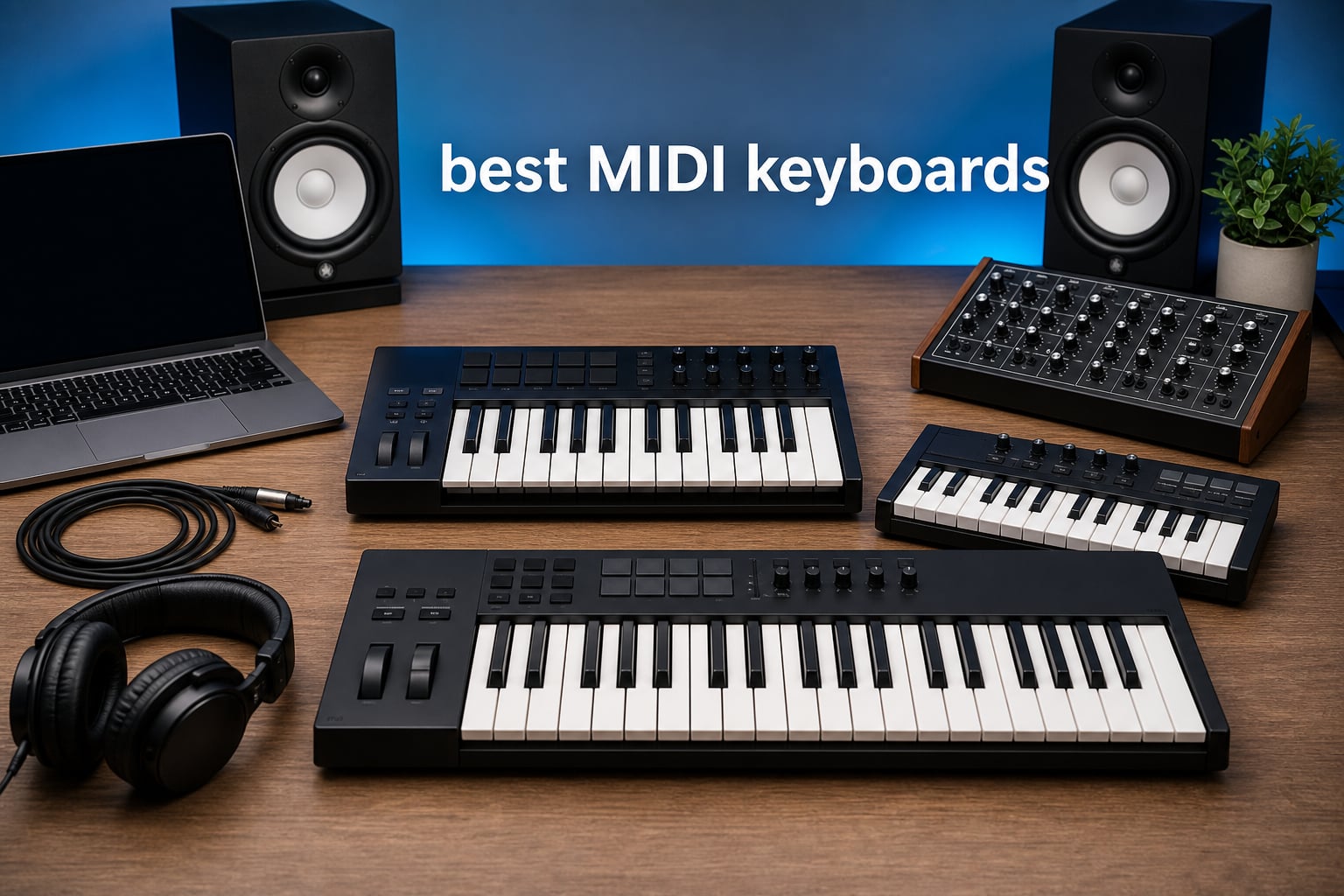
Finding the right MIDI keyboard can transform your music production workflow from frustrating to fluid. I have spent countless hours testing controllers across different DAWs, and the difference between a keyboard that works with you versus against you is night and day.
The best MIDI keyboards 2026 combine responsive keys, intuitive controls, and seamless software integration. Whether you are laying down piano parts in Logic Pro, building beats in Ableton Live, or controlling hardware synths, the right controller makes every session more productive.
Our team tested 10 of the most popular MIDI keyboard controllers currently available, evaluating key feel, pad responsiveness, DAW integration, and overall value. This guide covers everything from ultra-portable 25-key units to full 88-key workstations, helping you find the perfect match for your studio setup.
Top 3 Picks for Best MIDI Keyboards 2026


Best MIDI Keyboards in 2026
| Product | Specifications | Action |
|---|---|---|
 Arturia MiniLab 3 Arturia MiniLab 3 |
|
Check Latest Price |
| Novation Launchkey Mini 37 MK4 |
|
Check Latest Price |
 Akai MPK Mini IV Akai MPK Mini IV |
|
Check Latest Price |
 M-AUDIO Keystation 49 MK3 M-AUDIO Keystation 49 MK3 |
|
Check Latest Price |
 Nektar SE49 Nektar SE49 |
|
Check Latest Price |
 M-AUDIO Keystation 61 MK3 M-AUDIO Keystation 61 MK3 |
|
Check Latest Price |
 M-AUDIO Keystation 88 MK3 M-AUDIO Keystation 88 MK3 |
|
Check Latest Price |
 Novation Launchkey 88 MK3 Novation Launchkey 88 MK3 |
|
Check Latest Price |
| midiplus AKM320 |
|
Check Latest Price |
 M-AUDIO Keystation Mini 32 MK3 M-AUDIO Keystation Mini 32 MK3 |
|
Check Latest Price |
1. Arturia MiniLab 3 – Best Overall MIDI Keyboard
Arturia MiniLab 3 Universal MIDI Controller, White
25 slim keys
8 RGB pads
8 encoders
4 faders
MIDI out
5-year warranty
Pros
- Excellent software bundle including Analog Lab
- Responsive slim keys with velocity
- 8 RGB velocity and pressure sensitive pads
- MIDI out for hardware synth control
- 5-year manufacturer warranty
Cons
- Slim keys may not suit all players
- Limited to PC/Mac platform
I have used the Arturia MiniLab 3 extensively in my home studio, and it quickly became my go-to controller for writing sessions. The 25 slim keys feel surprisingly responsive under my fingers, with enough travel and resistance to capture subtle dynamics in my playing. Arturia designed these keys specifically for electronic music production, and that focus shows in how well they handle rapid synth lines and chord stabs.
The 8 RGB pads offer excellent sensitivity for finger drumming and clip launching. I found them responsive enough for detailed beat work, with pressure sensitivity that adds expression to drum programming. The pads also work well for triggering chord progressions when using the built-in arpeggiator, which has become one of my favorite creative tools on this controller.
Having 8 rotary encoders and 4 faders gives you hands-on control over your DAW mixer and plugin parameters. I mapped these to filter cutoffs and effect sends within minutes, and the tactile feedback made automating sweeps feel natural. The mini display and clickable knob make browsing presets fast without reaching for my mouse.
Software value is where this keyboard truly shines. Arturia includes Ableton Live Lite, Analog Lab Intro with thousands of synth presets, and UVI Model D piano. That software alone would cost more than the keyboard if purchased separately, making this one of the best values for producers starting or expanding their virtual instrument collection.
Best For: Producers Seeking Software Value
The MiniLab 3 excels for electronic music producers who want premium software without the premium price tag. The included instruments cover synthesizers, pianos, and production essentials that would take years to build separately. Producers working in Ableton, Logic, or any major DAW will appreciate the seamless integration and MIDI mapping flexibility.
Compact studio setups benefit most from this controller’s all-in-one design. If you produce in a bedroom or travel frequently, having pads, knobs, faders, and keys in a portable package streamlines your workflow. The USB-C connectivity and bus power mean one less cable to manage.
Not Ideal For: Players Who Prefer Full-Size Keys
Pianists transitioning from acoustic instruments may find the slim keys cramped for two-handed playing. The 25-key limit requires octave shifting for extended passages, which disrupts flow during live recording. If you regularly play piano parts with both hands, consider a 49-key or larger controller instead.
Advanced users needing deep hardware synth integration might miss CV/Gate outputs. While MIDI out handles most hardware connections, modular synth enthusiasts should look at controllers with dedicated CV jacks for direct oscillator control.
2. Novation Launchkey Mini 37 MK4 – Best for Ableton Integration
Novation Launchkey Mini 37 MK4 USB MIDI Keyboard Controller
37 synth-style mini keys
16 RGB pads
Scale Mode
Chord Mode
Arpeggiator
NKS-ready
3-year warranty
Pros
- Seamless Ableton Live integration
- 16 pads with polyphonic aftertouch
- Scale and Chord modes for creative playing
- Works with all major DAWs
- NKS-ready for Native Instruments software
Cons
- Limited to 37 keys
- Mini keys may not suit all players
Novation designed the Launchkey Mini 37 MK4 specifically with Ableton Live users in mind, and that focus pays off in daily use. When I plugged this into my MacBook running Ableton, every pad, knob, and key worked instantly without mapping a single control. The 16 RGB pads control clip launching, scene triggering, and drum programming directly from the hardware.
The 37 mini keys give you more range than typical portable controllers. I found the extra keys invaluable for playing bass lines with my left hand while triggering clips with my right. The synth-action feel works great for electronic parts, with enough resistance to make fast passages playable without fatigue during long sessions.
Scale Mode has become essential for my live performances and studio jams. This feature restricts the keyboard to notes within your chosen scale, eliminating wrong notes entirely. I set it to D minor and improvised freely without worrying about hitting a bad note. Chord Mode takes this further by mapping full chords to single keys, letting non-pianists create rich progressions.
The 16 pads feature polyphonic aftertouch, which means you can add expression after the initial strike. I used this for filter sweeps and vibrato effects on synth sounds, creating evolving textures that would require complex automation otherwise. Few controllers at this price point include aftertouch, making this a standout feature.
Best For: Ableton Live Users and Live Performers
Ableton Live users will get the most from this controller thanks to the dedicated integration. Clip launching, scene selection, and transport controls all map automatically, letting you perform entire sets without touching your computer. The visual feedback from RGB pads shows clip status clearly in dark venues.
Live performers benefit from the robust build and portable size. At just over 2 pounds, this fits in a backpack with room for cables and a laptop. The bus-powered USB connection eliminates wall warts and power strips from your gig bag. Three-year warranty coverage provides peace of mind for touring musicians.
Not Ideal For: Pianists Needing Full-Size Keys
Players trained on piano will find the mini keys limiting for complex chord voicings and two-handed passages. While 37 keys offers more range than 25-key controllers, you still need octave buttons for anything beyond basic chord progressions. Serious keyboardists should consider full-size alternatives like the Launchkey 88 for piano-style playing.
Studio setups requiring multiple control surfaces might find the fixed knob assignments restrictive. The 8 encoders handle most essential parameters, but complex mixing sessions benefit from dedicated faders and channel strips found on larger controllers.
3. Akai Professional MPK Mini IV – Best Portable Beat Controller
Akai Professional MPK Mini IV 25-Key USB-C MIDI Keyboard Controller, Black
25 mini keys
8 MPC pads
8 assignable knobs
Full-color screen
USB-C
Arpeggiator
NKS integration
Pros
- Authentic MPC pad feel and response
- Built-in full-color screen for navigation
- USB-C and full-size MIDI out
- Includes comprehensive software bundle
- Lightweight and highly portable
Cons
- Mini keys may not suit all players
- Limited to 25 keys
Akai has built its reputation on drum pads, and the MPK Mini IV showcases that expertise perfectly. The 8 MPC-style pads deliver the same responsive feel that made Akai’s stand-alone units legendary among beat makers. I found myself programming drums with precision that simply is not possible on lesser pads, with velocity sensitivity that captures ghost notes and accents accurately.
The built-in full-color screen represents a major upgrade from previous generations. Navigating presets, adjusting settings, and browsing sounds happens directly on the device without squinting at tiny LEDs. The push/turn encoder combines with the screen for fast parameter editing, which I appreciated during late-night sessions when screen glare becomes an issue.
USB-C connectivity brings this controller into modern workflows. The reversible connector eliminates frustration when plugging in, and the full-size MIDI out port lets you control hardware synths without a separate interface. I connected it to my vintage synth module and enjoyed reliable timing without the latency issues that plague some budget controllers.
The arpeggiator includes Pattern, Freeze, and Mutate functions that spark creative ideas. Pattern mode creates rhythmically interesting arpeggios from simple chord inputs. Freeze holds the current arpeggio while you adjust knobs. Mutate randomizes patterns for unexpected inspiration, which helped me break through writer’s block multiple times.
Best For: Beat Makers and Mobile Producers
Beat makers will appreciate the authentic MPC pad response that made Akai famous. The pads handle everything from delicate finger drumming to aggressive snare hits with consistent accuracy. If your workflow centers on rhythm programming, these pads deliver professional results in a portable package.
Mobile producers working from laptops or traveling to sessions benefit from the compact footprint. At under 14 inches wide and roughly 1 kilogram, this controller fits in any backpack without sacrificing essential features. Bus power eliminates the need for external power supplies.
Not Ideal For: Two-Handed Piano Playing
The 25-key limit restricts you to single-hand parts or requires constant octave shifting. Pianists accustomed to spreading both hands across the keyboard will find this frustrating for chord progressions and melody combinations. Consider at least a 49-key controller if your playing style involves two hands simultaneously.
Producers needing extensive mixer control may find 8 knobs limiting for complex projects. While the encoders can be bank-switched, dedicated faders and transport controls would streamline large mixing sessions. Studio-focused users should explore controllers with expanded control surfaces.
4. M-AUDIO Keystation 49 MK3 – Best Budget Full-Size Keys
M-AUDIO Keystation 49 MK3 USB MIDI Controller
49 full-size keys
Pitch and mod wheels
Volume fader
Transport controls
Sustain pedal input
iOS compatible
Pros
- Full-size velocity-sensitive keys
- Excellent value for features
- Plug-and-play USB connection
- Comprehensive software bundle included
- iOS compatible for mobile production
Cons
- Older model from 2019
- No MIDI Out port
The M-AUDIO Keystation 49 MK3 proves you do not need to spend a fortune to get playable full-size keys. I have recommended this controller to dozens of beginners, and the consistent positive feedback speaks volumes about its value proposition. The 49 full-size keys offer enough range for two-handed playing without dominating your desk space.
Velocity sensitivity captures dynamics accurately across the key range. I played piano parts, synth leads, and bass lines through various virtual instruments, and the response felt natural throughout. The keys have a synth-action feel with moderate resistance, suitable for electronic music production and general keyboard work.
Transport controls and the volume fader provide essential DAW control without menu diving. I mapped these to Logic Pro within seconds using the automatic mapping, and they worked flawlessly for basic transport and mixing tasks. Pitch and modulation wheels handle expression duties competently, though they lack the smooth action of premium controllers.
The included software bundle adds tremendous value for beginners. MPC Beats, Ableton Live Lite, Velvet electric piano, and Xpand!2 provide a complete production toolkit. Free lessons from Skoove and Melodics help new users develop keyboard skills alongside their production abilities.
Best For: Beginners Wanting Full-Size Keys
New producers benefit most from this straightforward controller. The plug-and-play USB connection eliminates setup frustration, letting you focus on making music immediately. Full-size keys help develop proper technique compared to cramped mini keys, especially for those transitioning from piano lessons.
Budget-conscious buyers get maximum features per dollar. The included software alone justifies the purchase price, providing everything needed to start producing without additional investments. If you are unsure whether music production will stick, this low-risk entry point lets you explore without significant financial commitment.
Not Ideal For: Advanced Users Needing Pads and Knobs
Without pads, knobs, or faders beyond the volume slider, this controller offers limited hands-on control for mixing and sound design. Producers who enjoy tweaking filters, adjusting sends, or finger drumming should look elsewhere. You can add external pads and knobs, but that increases cost and complexity.
The lack of MIDI out restricts hardware synth integration. Users planning to control external sound modules or vintage synths will need a separate MIDI interface, which adds expense and cables to your setup.
5. Nektar SE49 – Best Budget 49-Key Controller
Nektar, 49-Key Midi Controller (SE49),Black white Grey
49 velocity keys
Nektar DAW integration
Comprehensive MIDI support
Bitwig Studio included
Mac, PC, iOS compatible
2-year warranty
Pros
- Excellent DAW integration across platforms
- Bitwig Studio 8-track included
- Comprehensive MIDI functionality
- Compatible with all major platforms
- Great value for features
Cons
- Not Prime eligible
- No pads or advanced controls
Nektar built the SE49 around one core principle: seamless DAW integration without premium pricing. Their custom integration works with virtually every major DAW, including Ableton Live, Logic Pro, Cubase, Reason, and more. I tested it across three different DAWs, and automatic mapping worked correctly on each without manual configuration.
The 49 velocity-sensitive keys provide enough range for serious composition work. I played through classical pieces, pop chord progressions, and electronic bass lines without reaching for octave buttons constantly. The key feel sits comfortably between springy synth-action and weighted piano, suitable for extended playing sessions.
Bitwig Studio 8-track represents significant value for producers exploring modern DAWs. This fully functional version of Bitwig offers advanced modulation, hybrid clip and timeline workflows, and over 50GB of sounds. I found Bitwig’s creative workflow refreshing after years in traditional DAWs, and having it included makes this purchase worthwhile for producers seeking alternatives.
Comprehensive MIDI functionality extends beyond basic note input. The SE49 transmits on multiple channels, supports program changes, and handles all standard MIDI messages. This depth makes it suitable for controlling hardware synths and grooveboxes alongside software instruments.
Best For: Budget-Conscious Producers
Producers seeking maximum value will appreciate the complete package. The included Bitwig Studio license, cross-platform compatibility, and reliable DAW integration deliver features found on controllers costing twice as much. If your budget caps at around 90 dollars, this offers the most complete feature set available.
Cross-platform users working across Mac, PC, and iOS benefit from universal compatibility. The controller works identically regardless of your operating system, making it ideal for producers who switch between devices or collaborate across different studio environments.
Not Ideal For: Users Needing Advanced Features
Without pads, encoders, or faders, this controller limits hands-on sound manipulation. Producers who enjoy real-time control over filters, effects, and mix parameters will miss having dedicated hardware controls. External MIDI controllers can add these features, but that increases cost and desk space requirements.
Prime shipping is not available, potentially delaying delivery for time-sensitive projects. While not a functional limitation, buyers needing quick delivery should factor shipping times into their purchase decision.
6. M-AUDIO Keystation 61 MK3 – Best 61-Key Value
M-AUDIO Keystation 61 MK3 USB MIDI Controller
61 full-size semi-weighted keys
Pitch and mod wheels
Volume fader
Transport controls
iOS compatible
Comprehensive software
Pros
- Extended key range for two-handed playing
- Semi-weighted action for realistic feel
- Plug-and-play USB connection
- Extensive software bundle included
- iOS compatible for mobile production
Cons
- Limited stock availability
- Older model design
The Keystation 61 MK3 fills the sweet spot between compact controllers and full 88-key workstations. I found 61 keys sufficient for most piano-based compositions while maintaining manageable desk footprint. The semi-weighted action adds enough resistance to feel substantial without fatiguing during long sessions.
Semi-weighted keys bridge the gap between synth-action springiness and hammer-action weight. This makes the controller versatile across genres, suitable for synth leads, organ parts, and piano-style compositions. I recorded everything from ambient pads to driving rock piano with satisfying results.
Transport controls and volume fader handle basic DAW tasks without reaching for your mouse. The directional buttons navigate through presets and tracks efficiently. Pitch and modulation wheels provide standard expression controls, though they feel plasticky compared to premium alternatives.
The comprehensive software bundle matches M-AUDIO’s other Keystation models. MPC Beats, Ableton Live Lite, Velvet, Xpand!2, Mini Grand, and Touch Loops cover production basics thoroughly. Free lessons from Skoove and Melodics add educational value for developing players.
Best For: Producers Needing Extended Range
Keyboardists who need more than 49 keys will appreciate the expanded range. Two-handed playing becomes comfortable without constant octave shifting, and you can split the keyboard for bass left and melody right in live performances. This key count suits piano training and composition work better than 25 or 37-key alternatives.
Studio setups with limited space benefit from the balanced footprint. At roughly 39 inches wide, this fits on standard desks while providing enough keys for serious work. The slim profile does not dominate your workspace like larger 88-key controllers.
Not Ideal For: Portable Setup Requirements
The 61-key size limits portability compared to smaller controllers. While not as massive as 88-key boards, this will not fit in most backpacks and requires a dedicated carrying case for transport. Producers who travel frequently or perform live should consider their transport needs carefully.
Stock availability fluctuates, sometimes leaving limited quantities. Buyers needing immediate purchase should verify current availability before committing, as this popular model occasionally experiences supply constraints.
7. M-AUDIO Keystation 88 MK3 – Best Semi-Weighted 88 Keys
M-AUDIO Keystation 88 MK3 USB MIDI Controller
88 full-size semi-weighted keys
Pitch and mod wheels
Volume fader
Transport controls
Sustain pedal input
USB powered
Pros
- Full 88-key range for piano repertoire
- Semi-weighted action feels substantial
- Complete software production suite
- USB bus-powered for convenience
- iOS compatible with adapter
Cons
- Large footprint requires dedicated space
- USB powered only no external power
The Keystation 88 MK3 delivers the full piano experience without the premium price tag of weighted-key controllers. I tested this with classical pieces, jazz comping, and modern pop ballads, finding the semi-weighted action responsive across dynamic ranges. Pianists transitioning from acoustic instruments will appreciate having all 88 keys at their fingertips.
Semi-weighted keys provide enough resistance to build proper technique without the heaviness of fully-weighted hammer action. This makes extended playing sessions comfortable, particularly for producers who spend hours working on compositions. The action suits both piano repertoire and synth programming effectively.
USB bus power eliminates power supply clutter from your setup. One cable handles both MIDI data and power, simplifying connections to your computer. The slimline design keeps the controller from dominating your studio visually despite its substantial dimensions.
The included software covers production essentials comprehensively. MPC Beats, Ableton Live Lite, Mini Grand piano, Xpand!2, Reason Lite, Touch Loops, and Velvet provide diverse sounds and production environments. This bundle gives new producers everything needed to start creating immediately.
Best For: Pianists Transitioning to Digital Production
Pianists trained on acoustic instruments will find the full 88-key range essential for comfortable playing. Standard piano repertoire, from Bach to modern compositions, fits naturally without adjusting your technique. The semi-weighted action provides enough feedback to maintain proper hand position while remaining playable for electronic music.
Studio environments focused on keyboard-based composition benefit from the comprehensive key range. Composers working on film scores, classical arrangements, or keyboard-intensive genres can perform without the compromises inherent in smaller controllers.
Not Ideal For: Portable or Compact Setups
At over 54 inches wide and nearly 14 pounds, this controller requires dedicated space. Small studios, bedroom producers, and musicians with limited room should carefully measure their available space before purchasing. Portability is essentially zero, making this a permanent studio fixture.
USB-only power limits flexibility compared to controllers with external power options. While bus power simplifies desktop use, you cannot power the controller independently for hardware-only setups without a computer.
8. Novation Launchkey 88 MK3 – Best Premium 88-Key Controller
Novation Launchkey 88 [MK3]
88 premium semi-weighted keys
16 velocity pads
9 faders
Arpeggiator
Scale and Chord Modes
Deep DAW integration
3-year warranty
Pros
- Premium key action and build quality
- 16 pads and 9 faders for comprehensive control
- Powerful arpeggiator with Strum Mode
- Scale and Chord modes for creative playing
- Deep integration across all major DAWs
Cons
- Not Prime eligible
- Higher price point
Novation’s Launchkey 88 MK3 represents the professional tier of MIDI keyboard controllers. The premium semi-weighted keys offer a refined playing experience that approaches standalone digital pianos in quality. I found the action consistent across all 88 keys, with subtle but perceptible improvement over budget alternatives.
Nine faders transform this from a keyboard into a comprehensive mixing controller. I mapped these to my DAW’s mixer channels and adjusted levels without touching my mouse. The faders feel smooth and precise, suitable for automation recording and live mixing during performance.
The arpeggiator includes Strum Mode, which simulates guitar-like strumming patterns across held notes. This feature alone sparked numerous creative ideas during testing, generating organic-sounding parts from simple chord inputs. Combined with Scale and Chord modes, non-pianists can create sophisticated arrangements effortlessly.
Deep DAW integration extends beyond basic transport controls. Custom Modes let you create personalized control layouts for specific workflows, and MIDI output enables hardware synth control. The controller handles complex studio setups as adeptly as simple laptop productions.
Best For: Professional Studio Workflows
Professional producers will appreciate the comprehensive control surface combined with premium keys. Having faders, pads, and transport controls integrated with 88 playable keys creates an all-in-one production hub. The build quality withstands daily studio use without developing the squeaks and rattles common in budget controllers.
Live performers benefit from the visual feedback and robust construction. RGB pads show clip status clearly, and the three-year warranty covers touring mishaps. Custom Modes let you create performance-specific layouts that minimize computer interaction during shows.
Not Ideal For: Budget-Conscious Buyers
The premium price reflects the professional feature set and build quality. Producers on tight budgets should consider M-AUDIO’s 88-key alternatives for similar key range at lower cost. The additional pads, faders, and creative features justify the price for serious users but may exceed needs for casual production.
Prime shipping is not available, potentially delaying delivery compared to Prime-eligible alternatives. Buyers needing quick delivery should factor shipping times into their purchase timeline.
9. midiplus AKM320 – Most Affordable Entry-Level Option
midiplus AKM320 Midi Keyboard Controller
32 velocity keys
Pitch wheel
Mod wheel
Octave buttons
Transpose buttons
Sustain input
USB powered
Pros
- Extremely affordable entry point
- 32 velocity-sensitive keys
- Pitch and modulation wheels included
- USB powered for portability
- Beginner-friendly design
Cons
- Sustain pedal not included
- 32 keys may be limiting for advanced playing
The midiplus AKM320 proves that functional MIDI control does not require significant investment. At under 40 dollars, this controller offers the essentials for beginning your production journey. I found the 32 velocity-sensitive keys adequate for simple melodies, bass lines, and chord progressions.
Velocity sensitivity works surprisingly well for the price point. The keys detect dynamics with enough accuracy for expressive playing, though heavy-handed pianists may find the action shallow compared to full-size alternatives. For learning production basics and experimenting with virtual instruments, this controller handles the job competently.
Pitch and modulation wheels provide standard expression controls rarely found at this price. I mapped these to filter cutoff and vibrato in my DAW, and they performed reliably during testing. The octave and transpose buttons extend the usable range beyond the 32 physical keys.
USB bus power simplifies connectivity to any computer. No drivers or external power supplies clutter your setup, making this truly plug-and-play. The lightweight construction suits portable production, fitting easily into laptop bags for mobile sessions.
Best For: Absolute Beginners on a Tight Budget
New producers exploring music production will find this an excellent low-risk starting point. The essential features work correctly without complexity that might overwhelm beginners. If you are unsure whether keyboard production suits your workflow, this lets you experiment without significant investment.
Students and hobbyists with limited funds can start creating immediately. The controller handles basic keyboard input reliably, letting you learn production fundamentals alongside keyboard skills. Adding budget-friendly software like free VSTs creates a complete starter setup for under 50 dollars.
Not Ideal For: Serious Music Production
The 32-key limit and mid-size keys restrict serious playing. Two-handed parts require awkward octave shifting, and the smaller key size may frustrate players accustomed to full-size keyboards. Producers planning to develop serious keyboard skills should invest in at least 49 full-size keys.
Build quality reflects the budget price point, with plastic construction that may develop wear over time. While functional for learning, this controller will not withstand heavy daily use like premium alternatives. Consider this a stepping stone rather than a long-term production solution.
10. M-AUDIO Keystation Mini 32 MK3 – Best Ultra-Portable Option
M-AUDIO Keystation Mini 32 MK3 USB MIDI Controller
32 mini keys
Velocity curves
Pitch bend buttons
Mod buttons
Volume knob
Sustain button
MPC Beats included
Pros
- Ultra-compact and portable
- Selectable velocity curves for customization
- Includes MPC Beats software
- Melodics lessons for skill development
- Plug-and-play USB connection
Cons
- Mini keys may not suit all players
- No external power option
The Keystation Mini 32 MK3 packs functional MIDI control into an ultra-compact package. At just 16 inches wide and weighing under 500 grams, this controller disappears into any backpack. I carried it to coffee shop sessions and collaboration meetups without noticing the weight or bulk.
Miniature piano-style keys feel surprisingly playable once you adjust to the smaller size. M-AUDIO includes selectable velocity curves that let you customize the response to your playing style. I preferred the heavier curve for more dynamic range, while gentler players might choose lighter settings.
Pitch bend and modulation functions use buttons rather than wheels, which takes adjustment. I found buttons adequate for quick pitch dives and modulation effects, though they lack the continuous control of traditional wheels. The volume knob and sustain button handle basic expression needs.
MPC Beats software provides genuine production capability despite the budget price. This fully functional beat-making environment includes samples, instruments, and effects that would cost significantly more separately. The Melodics lessons add structured keyboard training, helping new users develop skills alongside their productions.
Best For: Laptop-Based Music Production
Laptop producers who work from various locations will appreciate the portable design. The controller fits alongside a laptop in most bags, adding production capability without bulk. USB bus power means one less adapter to carry, and the plug-and-play connection works immediately with any DAW.
Traveling musicians and producers can maintain creative momentum anywhere. Airport layovers, hotel rooms, and backstage areas become productive spaces when you can sketch ideas on actual keys. The durability withstands frequent transport without developing issues.
Not Ideal For: Complex Chord Work
The 32 mini keys limit chord voicings and two-handed playing significantly. Complex jazz voicings, classical passages, and two-handed arrangements require constant octave shifting or are simply impossible. Pianists needing full keyboard range should consider 49-key or larger alternatives.
Producers wanting pads, knobs, and faders will find this controller too basic. Without assignable controls beyond the keyboard itself, you must use your mouse for mixing, sound design, and clip launching. Adding external control surfaces increases cost and reduces portability benefits.
Buying Guide: How to Choose the Best MIDI Keyboard
Selecting the right MIDI keyboard involves matching features to your specific production needs. The controllers in this guide serve different workflows, and understanding the key factors helps you make the optimal choice for your studio.
Key Count: How Many Keys Do You Need?
The number of keys directly impacts your playing range and available techniques. Controllers range from 25 portable mini keys to full 88-key workstations, each serving different production styles. Understanding how key count affects your workflow prevents regret after purchase.
25-32 key controllers prioritize portability and beat-making over piano-style playing. These compact units fit in backpacks and work well for bass lines, lead melodies, and simple chord progressions. Expect frequent octave shifting during two-handed passages. Best for traveling producers and laptop-based workflows.
37-49 key controllers balance portability with extended range. These sizes accommodate two-handed playing for most genres while remaining reasonably portable. Bass lines in the left hand and melodies in the right become possible. Best for bedroom producers and small studio spaces.
61-88 key controllers suit pianists and composers working with full keyboard repertoire. These provide enough range for classical pieces, complex jazz voicings, and film scoring applications. Larger footprint requires dedicated space. Best for piano-focused production and professional studios.
Key Action: Synth-Action vs Semi-Weighted vs Hammer-Action
Key action determines how the keyboard feels under your fingers. Different actions suit different playing styles and genres, so understanding these differences helps you choose appropriately.
Synth-action keys use springs to return keys to rest position. This action feels light and responsive, ideal for fast synth runs and electronic music production. Most portable controllers use synth-action for its compact mechanism. Best for electronic genres and rapid playing styles.
Semi-weighted keys add resistance through additional mass in each key. This creates a more substantial feel approaching traditional pianos without the full weight of hammer action. Many mid-range controllers use semi-weighted action as a compromise between playability and authenticity. Best for producers wanting piano-like feel without full weighted action.
Hammer-action keys replicate acoustic piano mechanisms with actual hammers striking simulated strings. This provides the most authentic piano experience available on digital controllers. Hammer-action keyboards typically cost more and require substantial desk space. Best for pianists transitioning from acoustic instruments and classical repertoire.
Connectivity: USB-C, 5-Pin MIDI, and CV/Gate
Modern MIDI keyboards offer various connectivity options for different studio configurations. Understanding these connections ensures your controller integrates smoothly with your existing setup.
USB-C provides the most straightforward connection to modern computers. Single-cable solutions carry both MIDI data and power, simplifying setup considerably. Most current controllers feature USB-C, though budget models may still use USB-B connectors. Essential for laptop-based production.
5-pin MIDI ports connect to hardware synths, sound modules, and traditional MIDI equipment. This legacy connection remains relevant for studios with vintage gear. Controllers with MIDI out can function as master keyboards for hardware setups without requiring a computer. Important for hybrid software and hardware workflows.
CV/Gate outputs control modular synthesizers directly. These analog connections speak the language of Eurorack systems, providing precise voltage control over oscillators and filters. Essential for modular synth enthusiasts who want keyboard control over their patches.
Pads and Controls: What Features Matter?
Beyond keys, MIDI keyboards offer various controls that enhance production workflow. Determining which features match your style helps you choose a controller that supports rather than limits your creativity.
Velocity-sensitive pads enable finger drumming, clip launching, and pattern programming. Quality varies significantly between brands, with MPC-style pads generally offering the best response. 8 pads handle basic drum programming, while 16 pads suit detailed beat work. Essential for electronic music and live performance.
Rotary encoders and faders provide hands-on control over mixer levels, filter cutoffs, and effect parameters. Encoders (knobs) work well for continuous parameters, while faders suit mixer-style control. 8 encoders handle most needs, with 16 or more benefiting complex productions. Important for mixing and sound design workflows.
Screens and displays show parameter values, preset names, and navigation information. Full-color displays provide the most information, while basic LEDs show essential status. Helpful for standalone operation and preset browsing without referring to your computer screen.
DAW Integration: Compatibility Considerations
Seamless DAW integration saves hours of manual mapping and configuration. Different controllers offer varying levels of software support, which affects daily workflow significantly.
Ableton Live integration represents the gold standard for controller compatibility. Novation’s Launchkey series offers immediate control over clip launching, scene navigation, and mixer functions. Akai’s MPK controllers map automatically to Ableton’s session view. If Ableton Live is your primary DAW, prioritize controllers with dedicated Ableton support.
Logic Pro, Cubase, and FL Studio support varies by manufacturer. Nektar controllers provide reliable integration across multiple DAWs through custom mapping files. Native Instruments’ NKS standard ensures compatibility with Komplete Kontrol series. Check manufacturer specifications for your specific DAW before purchasing.
Custom mapping flexibility matters for users working across multiple DAWs. Controllers with powerful editing software let you create and save mappings for different applications. This future-proofs your investment against DAW changes and supports complex studio setups.
Software Bundle: Added Value Considerations
Included software often represents significant value beyond the hardware itself. Many controllers include production environments, virtual instruments, and educational resources that would cost hundreds separately.
Ableton Live Lite provides functional music production capability without additional purchases. This stripped-down version of Ableton’s flagship DAW handles most production tasks effectively. Arturia includes Analog Lab with thousands of synth presets, while Akai provides MPC Beats for beat-focused production. Always factor software value into your purchase decision.
Educational resources like Melodics lessons and Skoove tutorials help new users develop keyboard and production skills. These subscriptions would cost monthly fees if purchased independently. Beginners especially benefit from structured learning alongside hardware investment.
Frequently Asked Questions
What is the best MIDI keyboard brand?
Arturia, Novation, and Akai Professional consistently rank among the best MIDI keyboard brands based on build quality, software bundles, and user satisfaction. Arturia excels in software value and key feel, Novation leads in DAW integration especially for Ableton Live, and Akai dominates pad quality for beat-making applications. Your ideal brand depends on your primary DAW and production style.
What MIDI keyboard feels like a piano?
The M-AUDIO Keystation 88 MK3 and Novation Launchkey 88 MK3 both feature semi-weighted keys that approach the feel of acoustic pianos. For the most authentic piano experience, controllers with fully-weighted hammer-action keys replicate the resistance and response of traditional keyboards most accurately. These controllers work best for pianists transitioning to digital production.
Is 61 or 88 keys better for MIDI?
61 keys suit most electronic music production while maintaining reasonable portability, offering enough range for two-handed playing without dominating desk space. 88 keys work best for pianists playing classical repertoire or composers needing full keyboard range. Consider your available space and playing style: choose 61 keys for versatile production, 88 keys for piano-focused work.
What MIDI controller do pros use?
Professional producers commonly use Native Instruments Komplete Kontrol S-series for weighted keys and NKS integration, Novation Launchkey series for Ableton workflows, and Arturia KeyLab series for build quality and software value. Many pros own multiple controllers: compact units for portable work and full-size keyboards for studio sessions. The best controller matches your DAW and production style.
Best MIDI keyboard for beginners?
The Arturia MiniLab 3 offers the best value for beginners with excellent software bundle, responsive keys, and comprehensive controls. The M-AUDIO Keystation 49 MK3 provides full-size keys at budget-friendly pricing with included production software. For absolute beginners on tight budgets, the midiplus AKM320 offers functional MIDI control at minimal investment. Choose based on your budget and commitment level.
Conclusion
Finding the best MIDI keyboard 2026 requires matching features to your specific production workflow. The Arturia MiniLab 3 delivers exceptional value for most producers with its comprehensive software bundle and responsive controls. Ableton users should consider the Novation Launchkey Mini 37 MK4 for seamless DAW integration, while budget-conscious beginners can start affordably with the midiplus AKM320.
Consider your key count needs carefully based on available space and playing style. Portable producers thrive with 25-37 keys, while pianists and composers benefit from 61-88 key ranges. The controllers in this guide cover every major use case, from bedroom production to professional studio work.
Invest in the controller that matches your current DAW and production goals. Premium features like weighted keys and extensive controls matter most for serious work, while beginners can start affordably and upgrade as skills develop. Every keyboard in this list provides genuine production capability, so choose based on your workflow rather than specifications alone.
1 thought on “10 Best MIDI Keyboards (October 2026) Expert Reviews”