
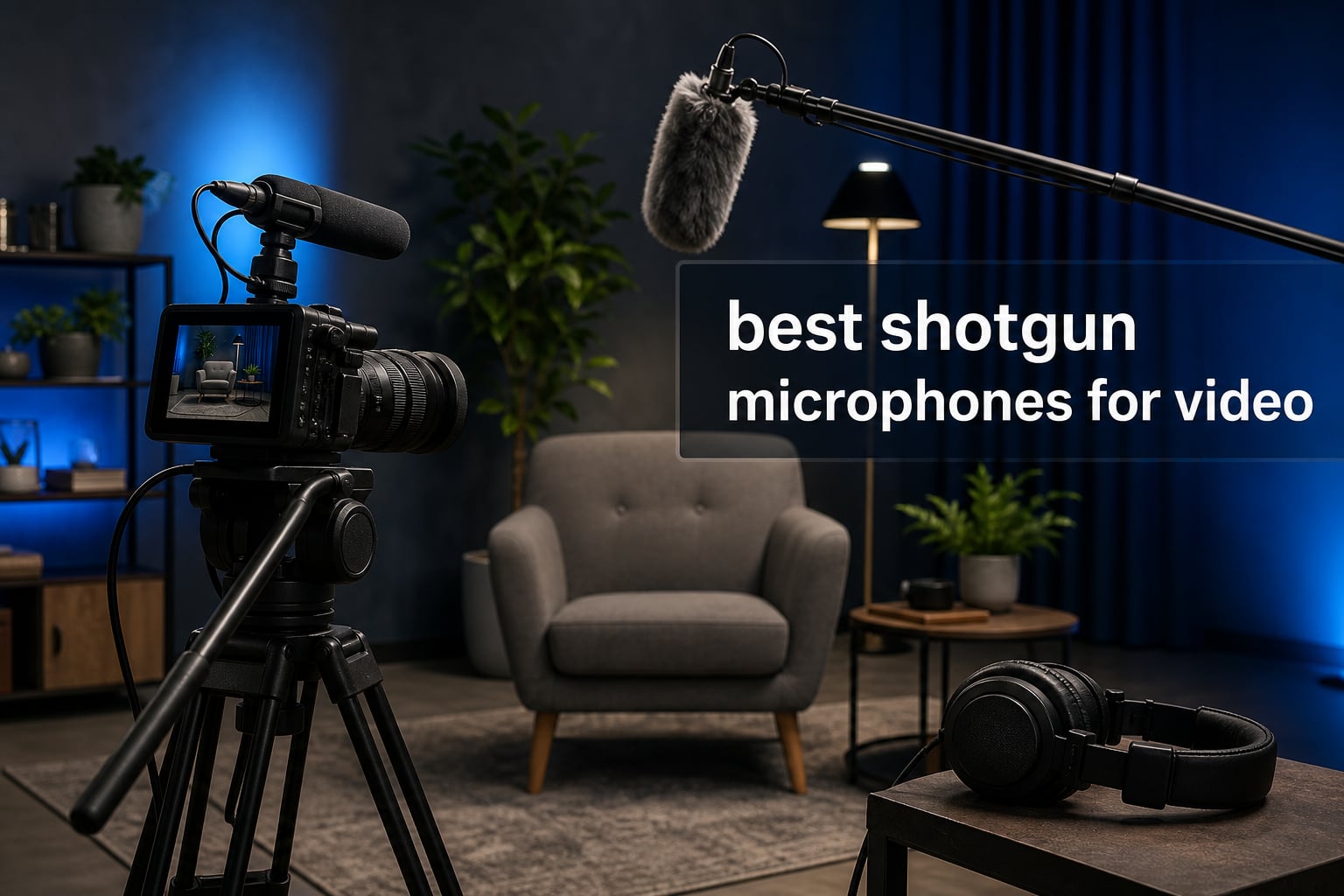
Great video can survive a rushed cut; scratchy, distant dialogue usually cannot. The best shotgun microphones for video put a directional capsule closer to the action than a camera’s built-in microphone can, so interviews, walk-and-talk pieces, and documentary moments begin with a much cleaner source.
A shotgun microphone captures sound from in front of the mic and rejects more sound from the sides and rear than an omnidirectional mic. Its interference tube shapes that directionality, but it does not perform magic: if the speaker is far away, a reflective room is loud, or wind hits the capsule, placement and protection still matter.
I narrowed this guide to eight currently analyzed models and checked the connection, power method, supplied mounting or wind gear, stated pickup pattern, rating, and review count for each. The quick answer is to match the microphone to the input on your camera or recorder first, then choose the control level and form factor your shooting days actually need.
Table of Contents
The top 3 picks for shotgun microphones for video answer three different shooting needs
The Sennheiser MKE 600 is my first choice when a video kit uses XLR and may need either phantom or battery power. Sony camera owners with a compatible Multi Interface Shoe should look first at the ECM-M1, while the Rode VideoMic GO II Helix is the straightforward pick for compact camera, phone, or tablet work through 3.5 mm and USB-C.
Those selections are not substitutes for a connection check. A strong microphone with the wrong plug or power requirement can stop a shoot just as effectively as a weak one.
The complete shotgun microphone comparison for 2026 puts every connection in one place
Use this overview as a compatibility shortlist rather than a substitute for checking your camera manual. XLR models normally belong with a camera or recorder that accepts XLR, the Sony ECM-M1 needs a compatible Sony Multi Interface Shoe, and the remaining models cover different mixes of 3.5 mm, USB-C, or USB connections.
Ratings and review totals below come from the analyzed product listings. They describe customer feedback at the time of analysis, not a laboratory score or a promise that one microphone will solve an untreated room.
| Product | Specifications | Action |
|---|---|---|
 Sennheiser MKE 600 Sennheiser MKE 600 |
|
View on Amazon |
 Sony ECM-M1 Sony ECM-M1 |
|
View on Amazon |
 Audio-Technica ATV-SG1LE Audio-Technica ATV-SG1LE |
|
View on Amazon |
 Sennheiser MKE 400 Sennheiser MKE 400 |
|
View on Amazon |
 Rode VideoMic GO II Helix Rode VideoMic GO II Helix |
|
View on Amazon |
 Movo X1-Mini Movo X1-Mini |
|
View on Amazon |
 COMICA VM20 COMICA VM20 |
|
View on Amazon |
 SMALLRIG Shotgun Mic SMALLRIG Shotgun Mic |
|
View on Amazon |
1. The Sennheiser MKE 600 is the best XLR choice for video teams
Sennheiser MKE 600 Shotgun Microphone Bundled with Universal Shockmount + 20-Feet XLR Microphone Cable + Microfiber Cleaning Cloth (4 Items)
XLR
Phantom or battery
Low-cut filter
Pros
- High directivity
- Low-cut filter
- Two power options
- Includes shock mount
Cons
- Requires XLR input
- Battery operation needs planning
The MKE 600 is the most conventional professional video-production tool in this group. Its XLR connection, unidirectional pattern, metal enclosure, and stated 20,000 Hz frequency response point toward a camera or recorder setup where audio is being treated as a separate part of the job, not an afterthought on the hot shoe.
The product data says it has high directivity with side and rear attenuation, a switchable low-cut filter, and two power paths: phantom power or battery power. That flexibility matters when moving between a recorder that supplies phantom power and a camera that does not, although it also means I would make power status part of the pre-roll routine.
The bundle includes the MKE 600 microphone, MZS 600 shockmount, MZW 600 foam windshield, a universal shockmount, cable, and cleaning cloth. A shock mount is particularly useful when a camera is handheld or mounted on a moving rig because it helps isolate mechanical vibration before it reaches the capsule.
Its listed dimensions are 13.5 by 6 by 6 inches, so this is not the discreet compact alternative for a small travel camera. I would reserve it for interviews, documentary setups, and video cameras or audio interfaces that already have an XLR workflow.
It works best when an XLR signal path is already part of the kit
Choose the MKE 600 when the camera, camcorder, or external recorder has an XLR input and you want the option to run from phantom power. Its included wind and shock accessories make the starting kit more complete than a microphone alone.
The analyzed listing has a 4.9 rating from 33 reviews, with 87% five-star and 13% four-star feedback. That is a small review pool compared with some camera-mounted picks here, so I would still prioritize connector fit and microphone placement over the headline rating.
It needs a deliberate power and mounting plan before recording starts
A battery-capable XLR mic helps with varied cameras, but the battery is one more item to check before an interview. If phantom power is available, verify it is enabled; if it is not, verify the battery condition and carry a spare.
Keep the foam windshield on for basic protection, then use stronger wind protection when conditions call for it. The low-cut filter can reduce unwanted low-frequency wind noise, but it cannot repair clipping or a mic placed too far from the person speaking.
2. The Sony ECM-M1 is the best direct digital option for compatible Sony cameras
Sony Digital Shotgun Microphone ECM-M1,Black
MI Shoe
Four capsules
Eight modes
Pros
- Beamforming capsules
- Eight modes
- Digital filters
- Very light
Cons
- Sony MI Shoe only
- Needs compatible camera
The Sony ECM-M1 makes the strongest case when the camera already supports Sony’s Multi Interface Shoe. Rather than asking you to add a 3.5 mm cable or an XLR adapter, it connects through the shoe and uses a digital audio interface, keeping the setup compact at a listed 2.3 ounces.
Four microphone capsules and beamforming technology support eight rear-dial-selectable recording modes. This is a materially different approach from a fixed-pattern on-camera shotgun mic: it gives a Sony shooter more choices for the kind of scene being recorded, so the dial setting deserves a quick check alongside exposure and white balance.
Sony lists digital signal processing, a digital noise-cut filter, a low-cut filter, volume control, and backup safety recording among its special features. A safety recording can be helpful protection against unexpectedly loud moments, although it is still smarter to monitor levels than to assume a backup will rescue every take.
The stated frequency range is 40 Hz to 20 kHz, and the product has a 4.7 rating from 89 reviews. Its small 2.53 by 1.57 by 2.84 inch footprint suits a camera body that would feel front-heavy with a longer interference tube.
It is right for Sony shooters who need mode flexibility without extra cabling
I would choose the ECM-M1 for a compatible Sony camera when fast changes between recording situations are common. The eight recording modes and rear dial are useful only if you are willing to select the appropriate mode before the take.
It is also a tidy option for run-and-gun shooting because the connection and power arrangement live at the Multi Interface Shoe. That can reduce cable movement around a camera, which is one less source of accidental handling noise.
It is wrong for cameras without the specified Multi Interface Shoe support
The central limitation is simple: this is not a universal 3.5 mm or XLR microphone. Confirm the exact camera’s compatibility with Sony’s Multi Interface Shoe before making it part of a video rig.
Do not treat beamforming as a cure for room reflections or an off-camera speaker. Aim the camera deliberately, keep the subject reasonably close, and do a headphone check for echo, nearby traffic, and air-conditioning before relying on any processing.
3. The Audio-Technica ATV-SG1LE is the best pick for adjustable on-camera aiming
Audio-Technica ATV-SG1LE On-Camera Shotgun Mic
100 mm acoustic tube
12-sided shoe plate
Wind muff
Pros
- Focused pickup
- Adjustable mount
- Wind muff included
- Compact body
Cons
- Limited stock reported
- No listed connector detail
The Audio-Technica ATV-SG1LE brings a practical mounting detail that deserves more attention than it usually gets. Its 12-sided shoe mounting plate can be positioned in 30-degree increments, letting you adjust the microphone’s physical angle rather than accepting a single straight-ahead position.
That helps when a lens, monitor, cage handle, or shooting position makes a conventional on-camera mount awkward. The 100 mm acoustic tube is described as highly directional for focused pickup, and the included wind muff gives outdoor shooters a more useful starting point than a bare capsule.
The listed body measures 5.04 by 1.26 by 2.32 inches and weighs 11 ounces. It is compact enough for an on-camera role, yet the deliberate mount design makes it interesting for creators whose subjects are not always perfectly centered in the frame.
The listing reports a 4.7 rating across 30 reviews, split between 68% five-star and 32% four-star feedback. It also reported limited stock at analysis, so availability may change; I would focus on the product’s actual mounting and connection fit rather than purchase urgency.
It is a smart choice when microphone angle needs more control than a fixed shoe provides
Use the ATV-SG1LE when you want an on-camera directional mic but regularly work around a cage, monitor, or off-center subject. The 30-degree positions can help aim the acoustic tube without moving the entire camera position.
Its wind muff makes it a natural candidate for basic exterior work. In gusty conditions, take a test recording anyway, because wind direction and mic placement can overwhelm any included cover.
It requires a connector check because the analyzed listing does not state one
The product data confirms its camera-oriented design, shoe plate, acoustic tube, and wind muff, but it does not provide the connector type. Check the retailer documentation and your camera’s input before selecting it.
This detail is especially important for mirrorless cameras that accept 3.5 mm input but have low-quality preamps or limited manual level control. A short recording with headphones will reveal more than assuming every hot-shoe-mounted microphone is automatically compatible.
4. The Sennheiser MKE 400 is the best compact choice for camera and mobile recording
SENNHEISER Professional MKE 400 Directional On-Camera Shotgun Microphone with 3.5mm TRS and TRRS Connectors for DSLR, Mirrorless & Mobile , Connects with Auxiliary
TRS and TRRS
Headphone output
Low-cut filter
Pros
- Supercardioid pattern
- Internal suspension
- Phone and camera cables
- Headphone monitoring
Cons
- Uses AAA battery
- Compact body limits distance
The Sennheiser MKE 400 is built around flexible 3.5 mm connectivity: the listing specifies interchangeable TRS and TRRS connectors for DSLR, mirrorless, and mobile use. That is a useful answer for creators who switch between a camera and a phone instead of maintaining separate microphones for each.
Its highly directional supercardioid pattern is paired with integrated wind protection and an internal suspension mount. The latter matters for handheld shooting because physical taps, cable movement, and small jolts can travel into a rigidly mounted microphone as low, distracting thumps.
The MKE 400 adds a built-in low-cut filter, a three-step sensitivity switch, and an integrated headphone output with volume adjustment. I especially like the presence of monitoring on a compact microphone: if the camera has no headphone jack, listening at the mic gives you a way to catch cable problems and wind before recording too much material.
It is listed as a 344-gram metal-bodied condenser microphone with an AAA battery and a 4.5 rating from 558 reviews. The much larger feedback base makes the rating useful context, while the 25-decibel audible-noise figure from the listing should not be confused with a complete measurement of every recording condition.
It is the versatile option for creators alternating between cameras and phones
Pick the MKE 400 if your workflow includes a DSLR or mirrorless body one day and a smartphone rig the next. The supplied TRS and TRRS approach is clearer than trying to repurpose an XLR microphone through multiple adapters.
Use the sensitivity switch to match the source and the camera input, then monitor through the headphone output when possible. Conservative levels are preferable to a clipped interview, which cannot be repaired into clean audio later.
It needs an AAA battery check and realistic distance expectations
The MKE 400 is battery powered, so add the AAA battery to your shoot checklist. Its compact on-camera format is convenient, but a microphone mounted on the camera remains farther from the speaker as soon as you use a wider lens or step back.
For seated interviews, get the microphone closer on a boom or use another mic type when the framing requires distance. A shotgun mic’s directionality reduces side noise; it does not make a distant voice sound close.
5. The Rode VideoMic GO II Helix is the simplest dual-output pick for small rigs
RØDE VideoMic GO II Helix Ultra-Compact On-Camera Shotgun Microphone
3.5 mm and USB-C
60 g
HELIX mount
Pros
- Very light
- Camera and USB-C output
- No battery
- Isolation mount
Cons
- Plastic enclosure
- Limited onboard controls
The Rode VideoMic GO II Helix has a clear practical advantage: it offers a 3.5 mm TRS output for cameras and USB-C for devices, while requiring no battery and no complicated controls. For a creator moving between a camera, smartphone, and tablet, that keeps the audio setup refreshingly direct.
It is listed at 57 grams, described as 60 grams in its feature set, with a 5.91 by 1.97 by 2.06 inch body. A light on-camera microphone matters when a compact mirrorless camera is already carrying a lens, monitor, and cage, because front or top weight changes how long a rig feels comfortable.
The HELIX isolation mount is designed to reduce handling noise before it reaches the microphone. It is not a reason to shake the camera freely, but it is welcome protection when walking, changing grip, or working from a small handheld setup.
The microphone has a supercardioid polar pattern, stated 20 Hz to 20 kHz frequency range, and a 4.5 rating from 502 reviews. Its product page also notes compatibility with Rode Connect and Rode Central software, which may matter to creators whose workflow includes a computer or supported mobile device.
It is the easiest choice when both a camera and USB-C device need one microphone
I would start with the VideoMic GO II Helix for travel, first video kits, and simple creator setups where 3.5 mm and USB-C cover the needed devices. The no-battery arrangement removes one pre-shoot failure point.
The included isolation system is helpful for camera-mounted work, and the small mass suits compact bodies. Confirm your particular phone or tablet can accept USB-C audio before relying on that half of the connection choice.
It asks you to handle gain and monitoring elsewhere in the signal chain
The analyzed listing emphasizes simplicity, not an array of physical microphone controls. Set recording levels at the camera or connected device, and use available headphone monitoring rather than guessing from a screen meter alone.
Its enclosure is listed as plastic, which may matter to shooters who expect a metal-bodied piece of equipment. Protect it in a pouch or case, keep a wind cover ready, and route the short output cable so it does not knock against the camera body.
6. The Movo X1-Mini is the best all-in-one accessory kit for mixed devices
Movo X1-Mini Video Shotgun Mic for Camera – Supercardioid 3.5mm/USB-C Analog/Digital Camera Microphone for DSLR, iPhone and Android Smartphones, Computers – Compatible with Canon EOS, Nikon, Sony
TRS TRRS USB-C
Aluminum
Wind covers included
Pros
- Broad compatibility
- Aluminum body
- Two windscreens
- Carry case
Cons
- Plug-in power limits some devices
- Specs need device check
The Movo X1-Mini takes the accessory-heavy route. Its listed package includes a dual Rycote shockmount, TRS cable, TRRS cable, USB-C output cable, foam windscreen, furry windscreen, and a hard-sided carrying case, which removes several small compatibility purchases from the initial setup.
It is specified for iPhone, Android devices, cameras, camcorders, audio recorders, tablets, laptops, and computers. Broad compatibility is attractive, but I would read that as a prompt to confirm the exact port and any adapter requirement on the device you already own, not as a reason to skip a test recording.
The X1-Mini has a supercardioid pattern, aluminum enclosure, integrated shock mount, and battery-free plug-in-powered design. Movo states digital-mode capture up to 24-bit resolution, while the listing also identifies an 80 dB signal-to-noise ratio.
It carries a 4.5 rating from 333 reviews, with 77% five-star feedback. The kit’s inclusion of both foam and furry wind protection is the headline advantage for a creator starting from zero, because outdoor wind control is often the first accessory gap in a basic camera mic setup.
It is the practical answer when one kit must cover many common device types
Choose the X1-Mini if you move between camera, phone, computer, and tablet projects and want the relevant cables and wind protection close at hand. The hard-sided case also gives small audio accessories a dedicated place rather than leaving them loose in a camera bag.
The aluminum construction and included shock mount speak to a more complete field kit than a microphone-only purchase. Keep each cable labeled or stored consistently so a TRS and TRRS lead are not mixed up at the moment a shoot starts.
It needs a plug-in-power compatibility check before a critical shoot
The listing calls out a battery-free design and notes that it may limit use with some devices. Test the specific camera, phone, or audio recorder with the intended cable before relying on it for an event or a one-time interview.
When using a furry windscreen, check that it is seated securely and not rubbing against the microphone. Then make a short spoken test with the camera pointed in the real shooting direction; nearby surfaces and wind can change the result more than a specification list suggests.
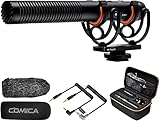
7. The COMICA VM20 is the best choice for visible power and gain controls
COMICA VM20 Professional Shotgun Microphone for iPhones, Androids, Cameras
Hypercardioid
OLED display
Rechargeable battery
Pros
- Gain control
- Two low-cut filters
- Long standby time
- Shock mount
Cons
- Requires battery
- XLR cable not included
The COMICA VM20 is the control-focused entry in this roundup. It pairs a hypercardioid pickup pattern with ten-level gain adjustment, 75 Hz and 150 Hz low-cut filter modes, and an OLED display that shows battery status in real time.
Those controls are useful when conditions change during a shoot: a quiet indoor interview, a sidewalk stand-up, and a moving vlog do not necessarily need identical gain or low-frequency filtering. The display makes the rechargeable battery state visible instead of leaving you to estimate it.
COMICA lists up to 60 hours of standby time from the 3.7 V/300 mAh rechargeable lithium battery. The package includes a shock mount, windscreen, wind muff, TRS-to-TRS cable, TRS-to-TRRS cable, USB charging lead, carry case, and documentation.
The VM20 is listed at 84 grams with a 20 Hz to 20 kHz frequency range and a 75 dB signal-to-noise ratio. Its 4.4 rating from 610 reviews is the largest review total in this guide, though it also has the widest stated percentage of one-star ratings among these products at 8%.
It is the right fit when you want to see and adjust settings at the microphone
I would select the VM20 for creators who want an OLED battery readout, stepped gain control, and low-cut choices on the microphone itself. That tangible feedback can make a developing audio workflow less dependent on menu diving inside a camera.
The included wind muff and Rycote-style shock mount make it well equipped for mobile shooting. Use the low-cut modes as a response to actual low-frequency rumble or wind rather than leaving them on automatically, because filtering also changes the sound you capture.
It needs charging discipline and an XLR accessory if that connection is required
The built-in rechargeable battery means the VM20 needs a charge before recording, despite its stated long standby time. The OLED display helps, but a full charge before an important shoot is still the safest routine.
The listing describes broad 3.5 mm TRS and TRRS compatibility but says an XLR adapter cable is not included. If your recorder or camera expects XLR, budget the time to source and test the appropriate compatible cable rather than assuming the kit contains it.
8. The SMALLRIG Shotgun Mic is the simplest dual-channel basic option
SMALLRIG Shotgun Mic for Camera, Video Microphone for DSLR & for iPhone
Dual channel
No battery
Cold shoe or tripod
Pros
- Stereo mode
- Plug and play
- Wind covers
- Tripod mounting
Cons
- Lower rating
- 3.5 mm only
The SMALLRIG Shotgun Mic stands apart because its listed design uses dual microphones and a left-right channel stereo mode. That can make sense for creators who want more environmental context than a strictly mono voice-focused microphone produces, such as simple travel clips or casual location coverage.
It has a built-in cardioid polar pattern, plug-and-play corded operation, and a TPE shock-absorbing structure. The package feature set includes a furry windscreen and high-density foam cover, which gives you basic options for still and breezy conditions without relying only on the microphone body.
The microphone is listed at 35 grams and 3.23 by 0.79 by 0.79 inches, with a 3.5 mm TRRS connection. It can fit cold-shoe mounts and tripods with a 1/4-inch screw thread, a useful detail for creators who alternate between a camera rig and a small tabletop setup.
Its analyzed rating is 4.2 from 310 reviews, lower than the other selections here. That does not make it unusable, but it is a reason to keep expectations focused on its basic dual-channel, plug-and-play role rather than treating it as a replacement for an XLR production microphone.
It fits lightweight creators who want simple stereo capture and flexible mounting
Choose this SMALLRIG model when low weight, 3.5 mm TRRS use, and the option to mount on a cold shoe or a 1/4-inch tripod point are more useful than advanced menus. Its battery-free operation makes a quick grab-and-record setup easier.
The stereo mode may suit ambient-led scenes, but dialogue creators should make a test clip first. Stereo does not automatically make speech clearer, and the best choice depends on where the speaker is relative to the microphone.
It is less suited to buyers who need a traditional XLR workflow or higher review confidence
The stated connection is 3.5 mm TRRS, so it is not the direct choice for an XLR recorder or a camera with only XLR inputs. Check whether your camera uses TRS or needs an adapter, because TRRS-oriented accessories can behave differently across devices.
Its 4.2 rating and feedback distribution call for a careful first test at home. Listen for handling vibration, monitor the left and right channels, and try the foam and furry covers before you depend on the microphone outside.
The buying guide starts with your camera input and the distance to your subject
The best microphone is the one that connects correctly, suits the way you frame people, and lets you control unwanted sound before it reaches the recording. Start with the port on your camera or recorder, then work through the following choices in order.
Choose the connection that your camera or recorder actually accepts
XLR is the professional connector used by the MKE 600. It normally locks in place and is common on dedicated video cameras, audio recorders, and XLR handle modules, but a camera with only a 3.5 mm input needs a compatible adapter or another microphone.
3.5 mm TRS is the usual camera microphone connection, while TRRS is common in mobile-oriented equipment. The MKE 400 and Movo include options spanning both styles; do not assume the plugs are interchangeable just because both are 3.5 mm.
USB-C can send audio to supported phones, tablets, or computers. The VideoMic GO II Helix and Movo X1-Mini offer USB-C paths, but each device should be tested because operating systems, ports, and adapters can affect recognition.
Sony’s Multi Interface Shoe is its own route. The ECM-M1 is compact and cable-free only when the camera supports that specific shoe connection.
Forum discussions repeatedly show that connection confusion is a frequent reason a new microphone disappoints on day one. I would make a 30-second test recording with the intended cable and device before packing for a shoot, then listen through headphones instead of trusting level meters alone.
Put the microphone closer before buying more directionality
A shotgun mic is a directional microphone, not a zoom lens for sound. Its interference tube reduces side-arriving sound through phase cancellation, focusing the pickup pattern forward, but the person speaking still needs to be close enough for their voice to dominate the recording.
On-camera placement works well for a presenter standing close to the lens, walk-and-talk video, and straightforward documentary coverage. If you frame a subject across a room, a boom microphone placed just out of frame is usually the better move than expecting a camera-mounted shotgun mic to overcome distance.
Echoey rooms are a special problem. Community reports rightly warn that inexpensive shotgun mics can sound poor in reverberant spaces, but even a higher-spec mic hears reflections when hard walls, windows, and bare floors bounce speech around.
For an echoey room, move the mic closer, reduce the distance to the speaker, turn off noisy appliances, and soften nearby reflective surfaces where possible. Pointing a shotgun microphone at the talker helps reject some side sound, yet it cannot erase reflections that arrive from the front after bouncing around the room.
Match power and controls to the way you work
Phantom power is typically 48V supplied through an XLR cable by compatible cameras, mixers, or recorders. The MKE 600 can use phantom or battery power, which is convenient across varied kits, but you must know which source is active.
Battery-powered microphones such as the MKE 400 and COMICA VM20 provide portable operation but need a pre-shoot battery routine. The VM20’s OLED display gives a visible status check, while the MKE 400 uses an AAA battery.
Battery-free models such as the VideoMic GO II Helix and SMALLRIG reduce maintenance, often drawing plug-in power or working through their output connection. This can be simpler, but it makes device compatibility and port behavior all the more important to test.
Low-cut filters reduce low-frequency content such as wind rumble, traffic vibration, or HVAC noise. Use them as a tool when those sounds are present, then listen back: filtering can make a noisy clip more usable, but it is not a universal setting for every voice and scene.
Control wind, handling noise, and changing outdoor conditions at the source
Foam windscreens provide basic protection, while furry wind covers offer more help in moving air. The ATV-SG1LE includes a wind muff, the Movo includes foam and furry covers, the VM20 includes a windscreen and wind muff, and the SMALLRIG offers furry and foam protection.
A shock mount addresses a different issue: vibration moving through the camera, shoe, or cable. The MKE 600 bundle includes a shockmount, the VideoMic GO II has its HELIX isolation mount, and several other models include a shock-mount design.
For outdoor filming, test with the actual rig moving as it will during the shoot. Walk a few steps, gently touch the controls, turn toward the wind, and listen for cable taps; a quiet stationary test does not reveal every real-world problem.
Cold and humid weather call for conservative handling rather than claims that any model is weatherproof, because the analyzed data does not state environmental ratings for these microphones. Keep equipment dry, fit wind protection before going outside, avoid sudden condensation where possible, and give gear time to stabilize when moving between extreme temperatures.
Set gain conservatively and listen for off-axis sound before each important take
Gain control determines how strongly the camera, recorder, or microphone amplifies the signal. The VM20 offers ten levels of gain, the MKE 400 has a three-step sensitivity switch, and the ECM-M1 lists volume control, but every setup also requires attention to the camera or recorder input level.
Set speech at a healthy level with headroom for laughter, emphasis, or a louder answer. Clipping occurs when a signal is recorded too hot; once distorted, it cannot be restored to clean sound with a low-cut filter or an editing plug-in.
Off-axis rejection describes how a directional mic responds to sound from the sides and rear. It is one of the most valuable real-world traits because it can reduce unwanted nearby activity, yet the sound of a source moving off-axis may also change, so keep the microphone aimed toward the voice you need.
Listen for RF interference, too, especially around dense wireless setups and urban equipment. None of the analyzed listings makes a specific RF-resistance claim, so a short location test remains the factual way to find problems from nearby devices before recording a long interview.
The FAQ gives direct answers about shotgun microphones for video
What is the best shotgun mic for video production?
The Sennheiser MKE 600 is the strongest all-round choice here for an XLR video or recorder workflow because it offers high directivity, a low-cut filter, an included shock mount, and phantom or battery power. For a compatible Sony camera, the ECM-M1 is the better direct shoe-mounted choice; for compact 3.5 mm and USB-C setups, consider the Rode VideoMic GO II Helix.
What shotgun mic do YouTubers use?
YouTubers use microphones that fit their camera and shooting style. A compact on-camera option such as the Rode VideoMic GO II Helix suits camera and USB-C setups, while the Sennheiser MKE 400 offers TRS and TRRS connections plus headphone monitoring. Creators who interview people at a distance often get better results by putting a shotgun mic on a boom rather than leaving it on the camera.
How do I choose a shotgun microphone?
First, identify whether your device accepts XLR, 3.5 mm TRS, TRRS, USB-C, or a proprietary shoe connection. Next, choose a microphone that can be placed close enough to the speaker, verify its power needs, and look for useful wind and shock protection. Finally, make a short monitored test with your exact camera, cable, and location before a critical shoot.
What is the difference between shotgun and regular microphones?
A shotgun microphone is highly directional: its interference tube helps it favor sound from the front while reducing sound from the sides and rear. Many regular microphones have wider pickup patterns and capture more surrounding sound. A shotgun mic can improve video dialogue by focusing on a nearby subject, but it cannot eliminate room echo, wind, or a speaker positioned too far away.
The best choice is the microphone that fits your input, placement, and shooting routine
For the best shotgun microphones for video in 2026, I would choose the Sennheiser MKE 600 for an XLR kit, the Sony ECM-M1 for a compatible Sony Multi Interface Shoe camera, and the Rode VideoMic GO II Helix for a compact 3.5 mm and USB-C workflow. The MKE 400, ATV-SG1LE, Movo X1-Mini, COMICA VM20, and SMALLRIG each make more sense when their particular mount, cable set, power scheme, or control layout matches the job.
Before committing, check the camera input, test the correct cable, charge or replace any required battery, add wind protection, and record a short headphone-monitored sample where you will actually shoot. That brief routine does more for dependable video production audio than choosing a microphone by rating alone.