
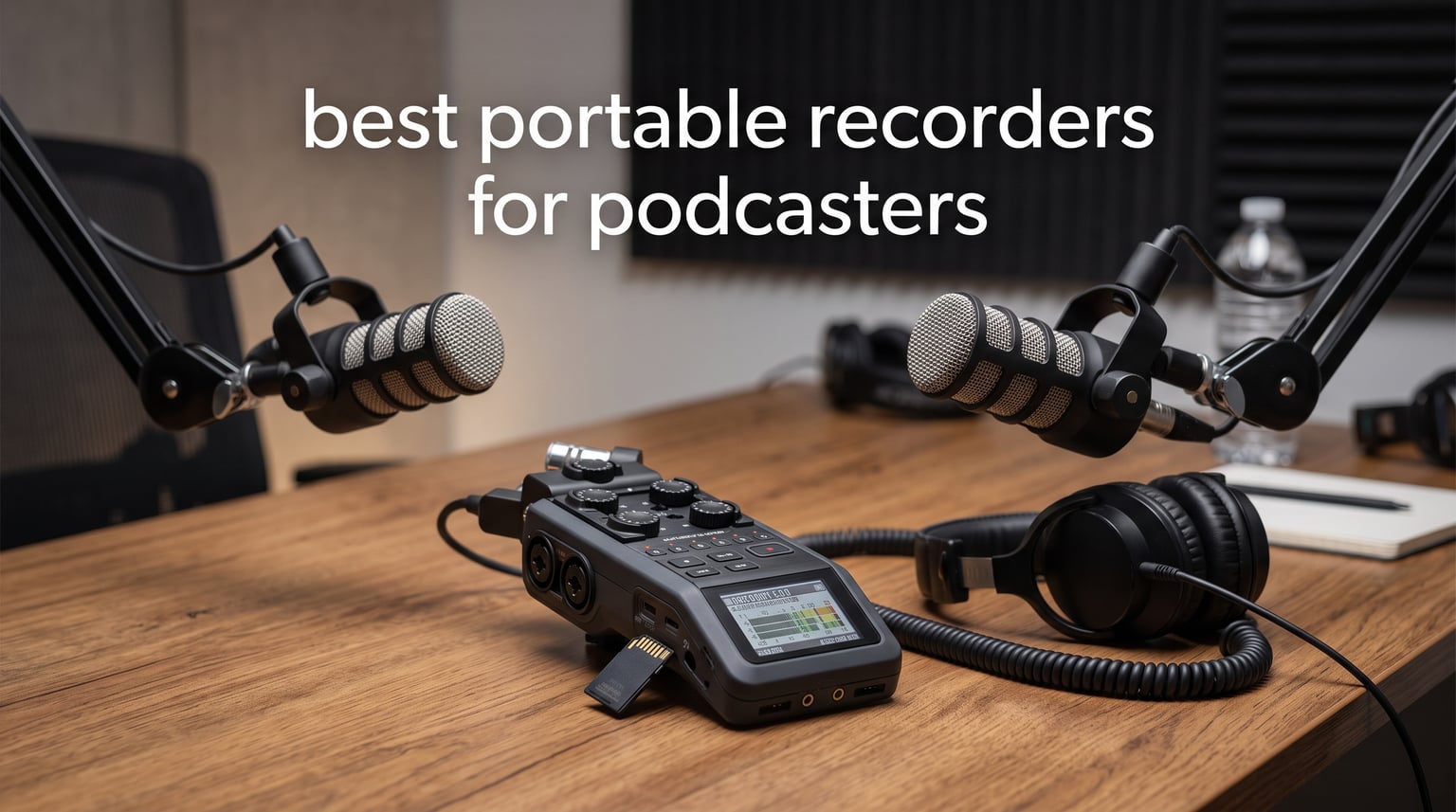
The best portable recorders for podcasters give you a dedicated audio file instead of trusting a phone, laptop, or camera to do every job at once. They capture sound to removable storage, travel easily, and range from simple handheld units with built-in microphones to multitrack XLR recorders for a small group.
For most people, I would start with the Zoom H4 Essential because it combines stereo microphones, two XLR/TRS inputs, four tracks, and 32-bit float recording in one handheld recorder. A solo host can travel lighter with the TASCAM DR-05XP or Zoom H1 Essential, while a show with several in-person voices needs the extra input count of the Zoom H6 Essential.
We selected the portable audio recorder options below by looking at verified input types, track count, storage, battery claims, USB interface capability, and built-in microphone design. One important boundary: a recorder can make an excellent local backup for an interview, but it does not automatically provide the mix-minus workflow that remote-call podcast setups need.
These are the top 3 portable recorders for podcasters in September 2026
This quick overview separates built-in-mic and XLR recorder choices in 2026
The table puts all ten recorders in one place. “Built-in mics” suits a fast solo interview or ambient pickup, while XLR/TRS combo inputs are the better fit when you already use dedicated podcast microphones; track count tells you how many sources the recorder can capture separately.
| Product | Specifications | Action |
|---|---|---|
 Zoom H4 Essential Zoom H4 Essential |
|
View on Amazon |
 TASCAM DR-05XP TASCAM DR-05XP |
|
View on Amazon |
 Zoom H1 Essential Zoom H1 Essential |
|
View on Amazon |
 Zoom F3 Zoom F3 |
|
View on Amazon |
 Zoom H1 XLR Zoom H1 XLR |
|
View on Amazon |
 Zoom H2 Essential Zoom H2 Essential |
|
View on Amazon |
 Zoom H6 Essential Zoom H6 Essential |
|
View on Amazon |
 Zoom H5 Studio Zoom H5 Studio |
|
View on Amazon |
 TASCAM DR-40XP TASCAM DR-40XP |
|
View on Amazon |
 TASCAM DR-07XP TASCAM DR-07XP |
|
View on Amazon |
1. Zoom H4 Essential is the most balanced recorder for two-person podcasting
Zoom H4 Essential Handheld Recorder for Musicians, Podcasters & Filmmakers
2 XLR/TRS inputs
Built-in stereo mics
4-track 32-bit float
Pros
- Two XLR/TRS inputs
- Built-in stereo microphones
- USB-C interface
- 20-hour battery claim
Cons
- Two external inputs only
- No interchangeable mic capsule
I would choose the Zoom H4 Essential when the recording day may change from a sit-down interview to quick atmosphere pickup. Its two XLR/TRS combo inputs can take a pair of external microphones, while the built-in stereo mics cover a simpler setup without extra hardware.
The recorder captures four tracks in 32-bit float WAV at up to 96kHz, so two external sources and the onboard stereo mics can be kept apart. That separation gives an editor more control when one speaker is quieter, and its USB-C 4-in/2-out interface mode offers a direct computer connection while SD-card recording remains available.
Two XLR inputs make this recorder right for an in-person co-host setup
For a host and guest using two dynamic or condenser microphones, the H4 Essential has the connections most compact podcast equipment lists need. Its inputs supply 48V phantom power for compatible condenser microphones, and the 2-inch screen makes basic status checks easier than a recorder with only a tiny display.
At 243 grams, it remains portable enough for a bag, but I would bring two fresh AA batteries for a longer session despite the stated 20-hour operating time. Record a short spoken check first, listen through headphones, and keep the built-in mics pointed away from the people using external mics.
Built-in microphones make this recorder useful when the XLR kit stays home
The H4 Essential has a stronger travel case than a bare XLR recorder because it can make a stereo field recording on its own. That is useful for an opening scene, a live event, or notes recorded immediately after an interview.
It is not the first pick for a three- or four-microphone roundtable because it has only two external inputs. In that case, move to the H6 Essential so each close microphone can have its own recorded track.
2. TASCAM DR-05XP is the straightforward handheld choice for solo spoken audio
TASCAM DR-05XP 32-Bit Float Portable Handheld Field Recorder and USB-C Audio Interface — Digital Stereo Recording of Music, Sound, Voice, Audio for Video and Podcasting
Stereo mics
3.5mm mic input
17.5-hour battery
32-bit float
Pros
- Long stated battery life
- Lightweight body
- USB-C interface
- MicroSD up to 512GB
Cons
- No XLR inputs
- Omnidirectional mics pick up room sound
The TASCAM DR-05XP makes sense when you want to hand a compact digital voice recorder to one speaker and start capturing a clean file. It records stereo with its omnidirectional condenser microphones and supports 32-bit float WAV, plus 24-bit, 16-bit WAV, and MP3 choices.
I like the practical combination of a 3.5mm microphone jack, USB-C 2-in/2-out audio-interface mode, and microSD storage up to 512GB. The unit weighs 0.28 pounds, and its stated 17.5-hour operation on two AA batteries suits a day of short interviews better than a device that needs frequent charging.
The 3.5mm microphone input makes this a simple step beyond phone recording
A clip-on or small microphone with the right 3.5mm connection can be a useful partner here, although this is not an XLR recorder. For a quiet one-on-one conversation, keeping the DR-05XP close and angled toward the speaker is usually more important than adding complicated accessories.
The omnidirectional pickup can capture more of a room than a focused podcast microphone. I would avoid placing it in the middle of a noisy cafe and would use headphones to hear handling noise, air conditioning, and nearby voices before the interview begins.
The long stated battery life makes this recorder better for a full day away
The DR-05XP claims up to 17.5 hours of operation, but battery performance changes with recording mode, card activity, and use. Our practical rule is simple: install new AA batteries before an event and carry a spare pair rather than treating any runtime claim as a guarantee.
Its microphones handle levels up to 125dB SPL, which adds headroom for loud locations. Spoken-word podcasting still benefits from distance control, so keep the recorder close enough that the voice is stronger than the room.
3. Zoom H1 Essential is the lightest practical recorder for a solo host
Zoom H1 Essential Recorder for Musicians, Podcasters & Content Creators
92g handheld
X/Y stereo mics
USB mic mode
32-bit float
Pros
- Very light 92g body
- X/Y stereo microphones
- USB microphone mode
- MicroSD up to 1TB
Cons
- No XLR input
- 10-hour battery claim
The Zoom H1 Essential is the portable podcast recorder I would pack when every ounce matters. At 92 grams, it is easy to keep in a small pouch, and the X/Y stereo microphone arrangement gives quick notes, solo narration, and room sound more direction than a basic phone microphone.
It records 32-bit float WAV files, supports microSD cards up to 1TB, and can act as a USB-C microphone for calls, streaming, or a computer recording session. That USB microphone mode is especially handy for a creator who needs one small device to handle both a local file and desktop audio work.
The 92-gram body makes this recorder the easiest one to carry every day
This is a good fit for host narration, quick guest quotes, walking commentary, and reference recordings that would be missed if a larger kit stayed at home. I would use it with a windscreen outdoors, because a small built-in microphone remains exposed to wind and handling noise.
The H1 Essential uses two AAA batteries and lists 10 hours of recording time. Put a battery check into your pre-record routine, particularly before a travel day, because the small format leaves little room for power reserves.
The built-in X/Y microphones make this recorder best for close solo work
Point the microphone face toward the speaker, hold it steadily, and leave a sensible speaking distance rather than treating it like a desk microphone. This setup can make a useful portable audio recorder for one person, ambient sound, and a quick backup track.
It does not accept XLR microphones, so it is not the unit I would buy for two close-miked hosts. A Zoom H1 XLR or H4 Essential provides the appropriate external mic connections for that format.
4. Zoom F3 is the focused professional recorder for two external microphones
Zoom F3 Professional Field Recorder for Filmmakers & Musicians
2 locking XLR/TRS
96kHz WAV
73-hour battery
32-bit float
Pros
- Locking XLR/TRS inputs
- Ultra-low-noise preamps
- Dual AD converters
- 73-hour battery claim
Cons
- No built-in microphones
- Two inputs only
The Zoom F3 is a deliberately focused field recorder: it has no built-in microphones and puts its attention on two locking XLR/TRS combo inputs, clean preamps, and dual AD converters. I would pick it for a host who already carries two trusted microphones and values a very compact, dedicated XLR capture device.
It records 32-bit float WAV at up to 96kHz to microSD cards up to 512GB. The two AA battery claim is 73 hours, which is notably long for a small recorder, but it is still sensible to pack spare cells and make a fresh test recording after changing cards or cables.
Locking XLR/TRS connections make this recorder suited to mobile interview rigs
A locking connection is useful when cables move during a walk-and-talk, a documentary-style interview, or a crowded event. The F3 also supplies 48V phantom power, so it can work with compatible condenser microphones as well as many dynamic microphones.
Its small 3.04-by-2.95-by-1.88-inch body and 8.48-ounce weight make it easier to place in a sound bag than a larger handheld recorder. Wireless control is available through Zoom’s BTA-1 adapter, while USB adds another path into a computer-based workflow.
The absence of onboard microphones makes this recorder a specialist rather than an all-purpose handheld
You cannot pull out an F3 and record a room without attaching a microphone first. That limitation is a benefit for someone who wants every podcast recording made through a chosen external mic, but it makes the recorder less flexible for spontaneous ambience.
Two inputs also define the format: it is ideal for one host and one guest, not a four-person panel. If you need onboard stereo microphones and more external tracks in one unit, the H6 Essential is the more adaptable option.
5. Zoom H1 XLR is the compact 32-bit float choice for two wired microphones
Zoom H1 XLR 2-Channel Recorder for Filmmakers, Musicians & Podcasters
2 XLR/TRS inputs
3.5mm stereo input
USB-C
32-bit float
Pros
- Two XLR/TRS inputs
- OLED waveform display
- 1TB SDXC support
- USB-C interface
Cons
- No built-in microphones
- 10-hour battery claim
The Zoom H1 XLR fills a useful middle ground for podcasters who want XLR inputs without moving to a bigger multitrack recorder. It has two locking XLR/TRS combo inputs, 48V phantom power, a 3.5mm stereo mic/line input, and 32-bit float recording at 96kHz.
There are no built-in microphones, so this recorder starts with your microphone choice rather than its own capsules. I see that as a sensible trade when you already know you will record two close microphones and would rather carry compact gear than an all-in-one handheld.
The OLED waveform display gives this recorder a useful quick-check advantage
32-bit float reduces the risk of a clipped recording, but monitoring is still good practice. The OLED waveform display and 3.5mm headphone output let you check that the microphones are connected, the correct tracks are armed, and the room is not creating an unexpected problem.
It supports SDXC storage up to 1TB, which is generous for long recording days. USB Type-C also lets it serve as an audio interface, so the recorder can move from an in-person episode to a computer session without changing your central device.
Two primary inputs make this recorder best for a host-and-guest format
Use one microphone per person and keep each speaker on a separate track for easier editing. The 3.5mm stereo input can add another compatible source, but I would plan a podcast around the two XLR/TRS inputs rather than assume it replaces a higher-input multitrack recorder.
The stated battery life is 10 hours on two AA batteries. That is workable for interviews and a single event, yet it asks for more active battery planning than the F3 or the TASCAM handheld models listed here.
6. Zoom H2 Essential is the versatile built-in-mic recorder for quick location conversations
Zoom H2 Essential Handheld Recorder for Musicians, Podcasters & Filmmakers
3 built-in mics
9 recording patterns
20-hour battery
32-bit float
Pros
- Nine microphone patterns
- USB microphone with SD recording
- Bluetooth control
- Accessibility guidance
Cons
- No XLR inputs
- Small 1.3-inch screen
The Zoom H2 Essential is built around microphone flexibility rather than external XLR inputs. Three built-in microphones provide nine selectable patterns for mono, stereo, and surround recording, making it a compelling handheld recorder for a solo voice, an interview across a small table, or natural sound around a location.
It captures 32-bit float WAV at 44.1, 48, or 96kHz and runs for a stated 20 hours on two AA batteries. USB-C audio-interface capability includes USB microphone use with simultaneous SD-card recording, which gives a host a local copy while working through a computer.
Nine pickup patterns make this recorder flexible when the speaker position changes
For an interview, choose a pattern that matches the position of the people you want to hear, then make a short playback check through headphones. I would select a simpler mono or stereo configuration for spoken podcast work instead of using a wider pattern just because it is available.
The H2 Essential can also record up to 2,000 hours on a 32GB card according to the product data. Capacity is helpful, but I still label a card after each session and copy recordings before erasing anything.
The no-XLR design makes this recorder best when built-in microphones are the plan
This is a strong option for mobile journalism and travel stories where setting up stands and XLR cables would slow the moment down. Bluetooth can support wireless control and multi-unit timecode alignment, which may help a more elaborate capture arrangement.
Do not choose it expecting a path for conventional XLR podcast microphones; that connection is absent. The H4 Essential is the more suitable Zoom recorder when your workflow starts with two external mics.
7. Zoom H6 Essential is the portable answer for a four-microphone roundtable
Zoom H6 Essential Handheld Recorder for Musicians, Podcasters & Filmmakers
4 XLR/TRS inputs
Built-in X/Y mics
6 tracks
32-bit float
Pros
- Four XLR/TRS inputs
- Six-track recording
- Interchangeable capsule system
- USB interface and SD recording
Cons
- Heavier 450g body
- Uses four AA batteries
The Zoom H6 Essential is the clearest choice in this group for a multi-person podcast recorded in one place. Four XLR/TRS combo inputs let four close microphones feed separate tracks, while the built-in X/Y microphones add a stereo room capture or a quick standalone option.
It records up to six tracks in 32-bit float WAV at up to 96kHz and supports SD cards up to 1TB. The recorder also works as a USB audio interface while recording to SD, so a desktop session can retain a local card backup instead of relying on one file path.
Four XLR inputs make this recorder the practical portable unit for a small panel
Four people at one table need four microphones if you want the cleanest editing options, and the H6 Essential accommodates that without a separate mixer. Each voice can have its own distance and track, so a loud laugh on one mic does not force an edit across every guest.
The included X/Y mics handle up to 135dB SPL and the capsule system is interchangeable. That flexibility helps a show that alternates between close-miked conversations and location sound, although the recorder is larger than the simpler H-series options.
The larger body makes this recorder better for planned sessions than pocket carry
At 450 grams and powered by four AA batteries, the H6 Essential asks you to pack with purpose. The stated battery life is 18 hours, but four microphone cables, stands, headphones, and spare batteries are part of the real-world kit for a roundtable.
I would set each guest’s microphone before recording and name the tracks in your notes. That small step makes the six-track recording much easier to organize once the SD card reaches the editing desk.
8. Zoom H5 Studio is the high-resolution handheld for detailed music and podcast capture
Zoom H5 Studio Handy Recorder for Filmmakers & Musicians
19.4mm X/Y capsule
2 XLR/TRS
6 tracks
192kHz 32-bit float
Pros
- Large X/Y mic capsule
- Dedicated gain knobs
- 192kHz recording
- USB-C audio interface
Cons
- Uses four AA batteries
- Two external inputs
The Zoom H5 Studio suits a podcaster who also records music, performances, or detailed location sound. Its 19.4mm X/Y stereo microphone capsule, two pro-quality preamps, and WAV recording up to 192kHz/32-bit float put more emphasis on high-resolution capture than a minimal spoken-word recorder.
It records up to six tracks, has two XLR/TRS inputs with dedicated gain knobs, uses microSD storage up to 2TB, and can operate as a USB-C 4-in/2-out audio interface. The physical gain knobs can be especially reassuring for a creator who prefers a fast hands-on adjustment before a take.
The large X/Y capsule makes this recorder useful for musical openings and live performance sound
For a podcast with acoustic music, venue ambience, or a performance segment, the larger stereo capsule gives the H5 Studio a clear role. I would position it deliberately and record a short sample from the actual listener position rather than assuming the closest spot sounds best.
32-bit float recording gives extra room for unexpected loud moments, but good placement still produces a more natural recording. The microphone capsule and external inputs let you choose between an all-in-one handheld method and a close-mic method for interviews.
Two external inputs keep this recorder centered on one-on-one production
The H5 Studio has the features for a polished two-person podcast, one host with a guest, or a creator who records voice and a second source. It does not replace the H6 Essential when four individual XLR microphones are required at the same time.
Four AA batteries provide a stated 15 hours of recording time. Carry spares, use a compatible microSD card, and take a moment to format the card in the recorder before a key session.
9. TASCAM DR-40XP captures built-in and external sources together for flexible field episodes
TASCAM DR-40XP 4-Channel 32-Bit Float Portable Handheld Field Recorder and USB-C Audio Interface — With 2 XLR/TRS Inputs and Adjustable Mics for Music, Audio for Video and Interviews
2 XLR/TRS inputs
Adjustable stereo mics
4 channels
32-bit float
Pros
- Four-channel capture
- Adjustable A-B or X-Y microphones
- Low-noise HDDA preamps
- USB-C interface
Cons
- MicroSD card not included
- Limited review history
The TASCAM DR-40XP is useful when a podcast recording needs both external microphones and a stereo sense of the space. It can record four channels, pairing two XLR/TRS combo inputs with adjustable unidirectional condenser microphones that can be set in A-B or X-Y configuration.
The recorder supports 32-bit float, 24-bit, and 16-bit WAV at 96, 48, or 44.1kHz, and it works as a 2-in/2-out USB-C audio interface. At 6.1 ounces and 6.13 by 2.76 by 1.38 inches, it stays easy to carry despite the extra recording paths.
Adjustable A-B and X-Y microphones make this recorder useful for controlling stereo width
A-B and X-Y are two ways to arrange a stereo microphone pair, and the DR-40XP lets you change that onboard configuration. For spoken podcast audio, I would make the microphones secondary room capture and let external close microphones carry the conversation.
The built-in mics handle up to 125dB SPL, which helps when an episode includes a loud live setting. The HDDA preamps are designed for low noise, but quiet placement and a stable grip still matter if the recorder is held by hand.
Four-channel capture makes this recorder a good choice for interview plus ambience tracks
Record the host and guest through the two external inputs, then keep the onboard pair as a separate stereo reference of the room. That gives an editor options for transitions and scene-setting without blending every source into one irreversible file.
Remember that the microSD card and batteries are not included. I would make those two items part of the recorder kit from day one, along with headphones and a short test routine before you meet a guest.
10. TASCAM DR-07XP gives solo field podcasters adjustable stereo microphones in a light body
TASCAM DR-07XP 32-Bit Float Portable Handheld Field Recorder and USB-C Audio Interface — With Adjustable Mics for Digital Stereo Recording of Music, Sound, Voice, Audio for Video and Podcasting
Adjustable stereo mics
3.5mm mic input
17.5-hour battery
32-bit float
Pros
- Adjustable A-B or X-Y mics
- Long stated battery life
- USB-C interface
- Plug-in-power support
Cons
- No XLR inputs
- MicroSD card not included
The TASCAM DR-07XP is a light, 4.8-ounce handheld recorder for field podcasters who want more control over onboard stereo pickup. Its condenser microphones can be arranged in A-B or X-Y stereo, while a 3.5mm MIC/EXT IN jack with plug-in power adds support for compatible small microphones.
It records 32-bit float, 24-bit, or 16-bit WAV and MP3 at up to 96kHz, stores files on microSD cards up to 512GB, and works as a 2-in/2-out USB-C audio interface. Two AA batteries provide a stated 17.5 hours of operation, matching the practical endurance of the DR-05XP.
Adjustable stereo microphones make this recorder a strong fit for scene-setting audio
Use the DR-07XP to record a market, a venue, a neighborhood walk, or a live performance that frames a story episode. I would decide whether the scene needs a wider A-B impression or the more focused X-Y approach, then listen back before recording the full segment.
The microphones handle up to 125dB SPL, yet distance still controls the balance between a subject and the background. A windscreen and a steady hand improve outdoor audio far more than a menu setting can.
The 3.5mm input makes this recorder better for small-mic workflows than XLR studio kits
Plug-in power support is helpful for a compatible compact microphone, but it is not a substitute for XLR/TRS combo inputs and phantom power. Choose this model when portability and built-in stereo capture are more important than running two conventional podcast microphones.
The separate headphone/line output gives you a way to monitor with headphones. Since the microSD card is not included, select a compatible card before recording an episode and format it in the recorder.
The right recorder depends first on your microphone and guest count
Buying a handheld recorder gets easier when you decide how many voices will be recorded at once and whether they will use external microphones. The best device is not automatically the one with the largest specification list; it is the one whose inputs and recording method match the episode you can realistically set up.
Built-in microphones are best for speed, while XLR inputs are best for close-miked voices
Built-in microphones make sense for solo narration, quick interviews, ambient sound, and situations where setting up stands would make you miss the moment. The H1 Essential, H2 Essential, DR-05XP, and DR-07XP are built around that fast handheld workflow.
XLR/TRS combo inputs are the better route when two people sit down with dedicated microphones. The H1 XLR, H4 Essential, F3, H5 Studio, DR-40XP, and H6 Essential all provide external input options, and several supply 48V phantom power for compatible condenser microphones.
32-bit float recording protects a file from clipping but does not replace good microphone placement
32-bit float recording stores a much wider range of level information than conventional fixed-level recording, allowing extreme peaks to be adjusted later when the recording path supports it. In practical podcast terms, it can reduce the chance that an unexpected laugh, shout, or loud scene ruins a take through clipping.
It does not remove room echo, wind, handling noise, or a microphone placed too far from a speaker. I still monitor with headphones, position the mic close to the voice, and make a short test file before a guest arrives.
Separate tracks are best when more than one person must be edited independently
A stereo file can be enough for a solo note or simple interview, but separate tracks give you far more editing control. The H4 Essential records four tracks, the H6 Essential and H5 Studio list up to six, and the DR-40XP captures four channels.
For a two-person show, two separate microphone tracks are the useful baseline. For a four-person roundtable, look for four XLR-capable inputs and assign one microphone to each person instead of relying on a single recorder in the middle of a table.
USB interface mode helps at a desk, but SD-card recording remains the safer local habit
Many recorders here can work as USB audio interfaces, which means the device can send audio to a computer for calls, streaming, or recording software. The H4 Essential and H6 Essential can record to an SD card while functioning as an interface, adding a valuable local backup path.
Before using any recorder for a remote guest, confirm how the call audio returns to the guest and how it reaches the recorder. Community discussions regularly point to mix-minus as the feature that prevents callers from hearing their own delayed voice, and these handheld recorders do not all provide that routing on their own.
Battery, card, and headphone checks prevent the most avoidable missed recordings
Battery runtime varies with settings and conditions, so take published numbers as a planning reference rather than a promise. Bring fresh AA or AAA batteries, a spare card, headphones, and a small windscreen when working outside.
At the start of each session, format a known-good card in the recorder, verify remaining space, speak into every microphone, listen through headphones, and record a short sample. I also write down which input belongs to which guest, especially when the recorder stores several tracks.
These frequently asked questions give the short answers podcasters need
What is the best portable recorder for podcasting?
The Zoom H4 Essential is the best all-around portable recorder for podcasting in this list because it combines two XLR/TRS inputs, built-in stereo microphones, four-track 32-bit float recording, USB-C interface mode, and SD-card recording. Choose the Zoom H6 Essential instead when four close-miked guests need individual external inputs.
How much does a good podcast recorder cost?
The amount you spend depends on input count, built-in microphones, track count, and USB features. Start by choosing the number of microphones your show needs, then avoid paying for extra inputs or high-resolution features that your recording workflow will not use.
Do I need XLR inputs on a portable recorder?
You need XLR inputs when you plan to use conventional external podcast microphones, particularly for a host-and-guest setup or a multi-person show. Built-in microphones are enough for solo narration, ambient sound, and quick location interviews; the H1 Essential, H2 Essential, DR-05XP, and DR-07XP follow that approach.
What is 32-bit float recording and do I need it?
32-bit float recording captures a very wide level range, so an unexpectedly loud sound is less likely to create permanently clipped audio and can often be adjusted in editing. It is helpful for unpredictable interviews and field work, but it does not repair echo, wind, poor microphone placement, or background noise.
Can I use a portable recorder with external microphones?
Yes, if the recorder has the connections your microphone requires. The Zoom F3, H1 XLR, H4 Essential, H5 Studio, H6 Essential, and TASCAM DR-40XP have XLR/TRS inputs; some also provide 48V phantom power for compatible condenser microphones.
The Zoom H4 Essential is our best all-around recommendation for 2026
For the best portable recorders for podcasters, match the recorder to the episode before choosing extra features. The Zoom H4 Essential is the balanced two-person choice, the TASCAM DR-05XP and Zoom H1 Essential are easier solo companions, the Zoom F3 and H1 XLR serve compact external-mic rigs, and the H6 Essential handles a small roundtable.
Choose one recording workflow, make a short headphone-monitored test, and save to a prepared card before every important conversation. That habit will do more for a usable episode than chasing a specification you will never use.