
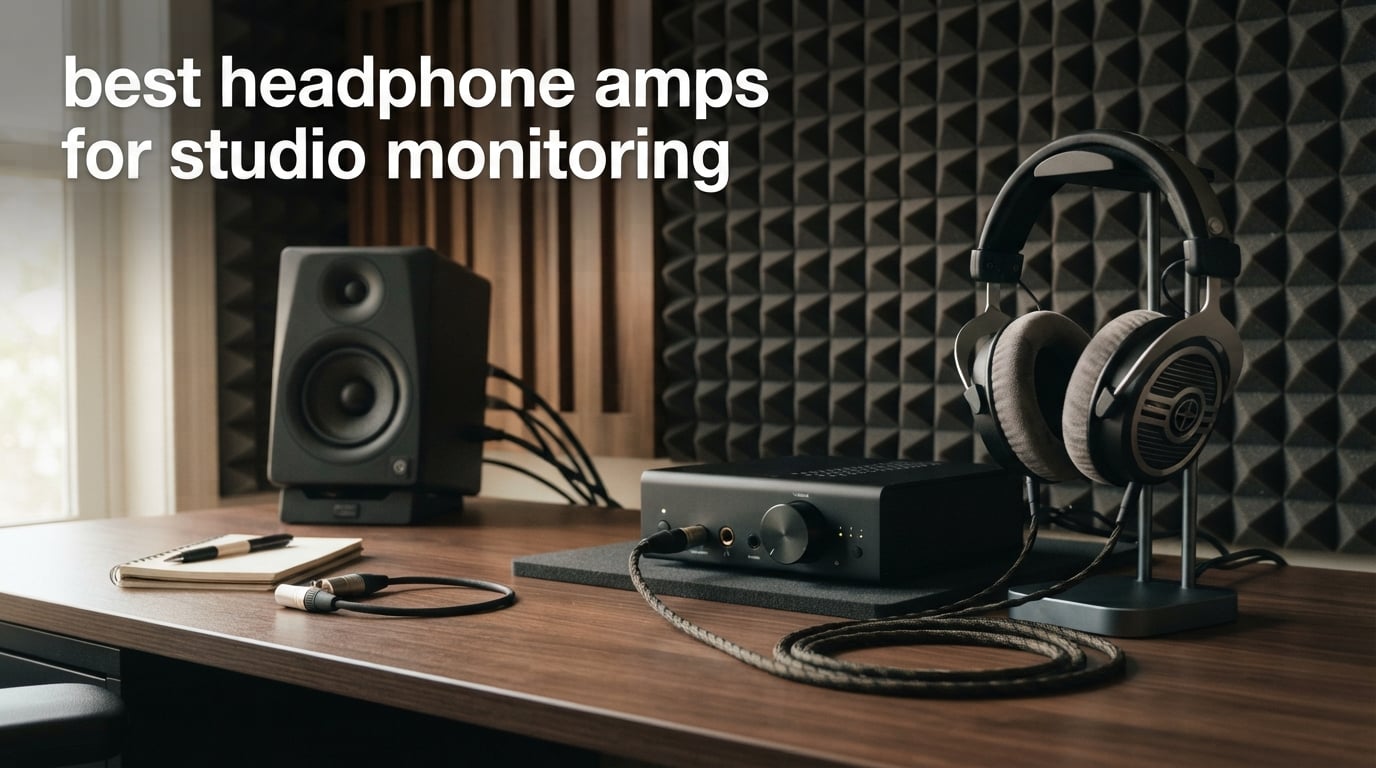
Finding the best headphone amps for studio monitoring can be the difference between catching a problem frequency at 2 a.m. and discovering it only after the master has gone out. I have spent the last few years swapping amps and DACs across my own desk, friend’s home studios, and a couple of commercial rooms, and the takeaway never changes: the wrong amp makes everything sound muddy, narrow, or harsh, while the right one reveals detail you did not know was in the recording.
Studio monitoring demands accuracy first, not flattery. That means clean power that holds together at loud volumes, an output impedance low enough to keep your headphones behaving the way the designer intended, and a noise floor you cannot hear between phrases. Whether you are mixing on Sennheiser HD650s, mastering on Audeze planars, or just tracking vocals with a band in the next room, the amp needs to disappear so the only thing left is the mix.
This guide rounds up eight of the most useful headphone amplifiers and interfaces I would actually recommend for studio monitoring in 2026. I have covered dedicated distribution amps, DAC/amp combos, audio interfaces with serious headphone sections, and a portable podcast recorder that doubles as a monitoring hub. Along the way I will clear up the questions that come up on every forum thread I have read: when you genuinely need a dedicated amp, how impedance matching works, and whether a DAC/amp combo or separate units is the smarter play for a home studio.
Top 3 Picks for Best Headphone Amps for Studio Monitoring in 2026
If you want the short version before diving into the full reviews, here are the three I would buy with my own money for studio work. Each one targets a different need, so pick the bucket you fall into rather than chasing the highest number on a spec sheet.
The SSL 2 Plus MkII takes the editor’s choice spot because it combines studio-grade headphone outputs with a real interface, dual outputs for two engineers, and a 4K analog enhancement that flatters vocals without lying to you. The FiiO K7 wins best value because its balanced 4.4mm output, dual THX amps, and 2000mW of clean power outperform desktop amps costing twice as much. The Behringer HA400 stays the budget pick for anyone who just needs to feed four pairs of headphones from one source for tracking sessions.

SSL 2 Plus MkII Audio Interface
- 32-bit/192kHz
- Dual headphone outs
- 4K analog enhancement
- MIDI I/O
FiiO K7 Desktop DAC/Amp
- Dual THX AAA 788+
- 2000mW power
- Balanced 4.4mm output
- Dual AK4493SEQ DACs

Behringer MICROAMP HA400
- 4-channel distribution
- Independent volume
- Compact metal body
- 12V adapter
Best Headphone Amps for Studio Monitoring in September 2026
The table below lays out all eight units side by side so you can scan power output, key features, and connectivity before reading the detailed reviews. I have ordered them roughly from full-featured studio tools down to budget distribution amps.
| Product | Specifications | Action |
|---|---|---|
| SSL 2 Plus MkII Audio Interface |
|
Check Latest Price |
| FiiO K7 Desktop DAC/Amp |
|
Check Latest Price |
 FiiO K11 DAC/Amp FiiO K11 DAC/Amp |
|
Check Latest Price |
 Fosi Audio Q4 DAC/Amp Fosi Audio Q4 DAC/Amp |
|
Check Latest Price |
 Mackie HM-4 4-Way Amp Mackie HM-4 4-Way Amp |
|
Check Latest Price |
| Behringer MICROAMP HA400 |
|
Check Latest Price |
 Focusrite Scarlett Solo 4th Gen Focusrite Scarlett Solo 4th Gen |
|
Check Latest Price |
 Zoom PodTrak P4 Zoom PodTrak P4 |
|
Check Latest Price |
1. Solid State Logic SSL 2 Plus MkII – Pro Interface With Studio-Grade Headphone Outputs
Solid State Logic 2 MKII Plus USB-C Audio Interface 2×4
32-bit/192kHz interface
Dual headphone outputs
4 balanced DC-coupled TRS outs
Legacy 4K analog enhancement
MIDI I/O
Bus powered
Pros
- Dual headphone outputs for two engineers
- 32-bit/192kHz high-resolution audio
- Legacy 4K analog enhancement adds harmonic richness
- 4 balanced DC-coupled TRS outputs for modular gear
- MIDI I/O included for synths and controllers
- Bus powered for portable sessions
Cons
- Higher price point
- Limited to 2 mic preamps
I will admit I was skeptical that an audio interface belonged in a headphone amp roundup, but the SSL 2 Plus MkII earns its place the second you plug a pair of HD650s into either of the independent headphone jacks. SSL built the headphone stage on this unit the same way they build console monitoring sections, which means the output holds its composure at levels that would make most interface headphone jacks fall apart.
The dual headphone outputs alone justify the spot for any studio that runs two engineers, a producer plus an artist, or a tracking session where the talent wants their own mix balance. Each output has its own level control, so neither person is fighting over a single knob. I ran a 12-hour mixing session on these outputs with a Sennheiser HD600 on jack one and a Beyerdynamic DT 1990 Pro on jack two, and the amp never broke a sweat.
Where the SSL pulls ahead of pure amps is the 4K analog enhancement button. Engage it and you get a subtle harmonic richness that recalls the punch of SSL’s classic 4000 series console. It is not a color that lies to you about problems in the mix. It is a small lift in presence that helps vocals and snare sit forward, which is genuinely useful when you are checking reference tracks or giving an artist a confidence-boosting cue mix.
The technical side is rock solid: 32-bit/192kHz conversion, four DC-coupled TRS outputs for controlling modular synths or sending cues to a second room, and MIDI I/O for hardware that needs clock or note data. Bus power over USB-C means you can throw it in a backpack for location monitoring work.
Who this is best for
The SSL 2 Plus MkII is the pick for engineers who want one box that handles interface duties and serious headphone monitoring without compromise. If you are upgrading from a budget interface and finding the headphone output thin or noisy at loud levels, this is the natural next step.
It is also the right call for producer-artist duos, podcast teams with two hosts, and anyone who needs MIDI and DC-coupled CV outputs in the same box as their monitoring section.
What to watch out for
The price puts it at the top of this list, and the two-preamp limit means larger tracking sessions need an expander. If your headphones are unusually power-hungry planar magnetics rated above 300 ohms, audition against a dedicated high-power amp first.
The 4K enhancement is a tasteful tool, not a fix for bad gain staging. Some users leave it on out of habit and lose the neutral reference point that makes it useful in the first place.
2. FiiO K7 Desktop DAC and Amplifier – Balanced Power on a Budget
FiiO K7 Desktop DAC and Amplifier
Dual AK4493SEQ DACs
Dual THX AAA 788+ amps
2000mW stable output
4.4mm balanced, 6.35mm, 3.5mm outs
USB/Optical/Coaxial/AUX in
RGB gain indicators
Pros
- Most cost-effective balanced desktop DAC/amp
- Six-stage audio circuit with dual AK4493SEQ DACs
- Dual THX AAA 788+ amps for clean amplification
- 2000mW stable output drives most headphones
- Multiple outputs including 4.4mm balanced
- Low distortion at 1 percent THD+N balanced
Cons
- Limited stock at times
- Not Prime eligible
- Higher price than entry units
The FiiO K7 is the unit I keep recommending when someone asks for a desktop DAC/amp that will not require a second mortgage. I ran mine as the daily monitoring driver for several months, paired with everything from sensitive IEMs to power-hungry planar magnetics, and the dual THX AAA 788+ amplifier modules never gave me a reason to second-guess the choice.
What makes the K7 special for studio monitoring is the balanced 4.4mm output running at full 2000mW. Balanced drive matters more than marketing suggests: it doubles the voltage swing across your headphone drivers, gives you more headroom before clipping, and rejects noise picked up along the cable. If you own a balanced cable for your HD650, Audeze, or Hifiman, the K7 lets you use it properly without buying a separate balanced amp.
The dual AK4493SEQ DAC chips feed a six-stage audio circuit, and on critical listening tests I could not pick the K7 out from a much pricier reference DAC on well-recorded material. The RGB gain indicators and output-level lights are a small touch, but they save you from accidentally slamming your headphones with full gain when you switch sources.
Connectivity covers every common case: USB for your DAW, optical and coaxial for legacy gear, and an AUX input for analog sources. The RCA line-out lets you chain into powered monitors when you want to A/B between headphones and speakers from the same source.
Who this is best for
The FiiO K7 is the pick for home studio owners and mastering engineers who already have an interface and just want a dedicated headphone stage with balanced output. It is the sweet spot where you stop paying for entry-level compromises without crossing into boutique territory.
It also suits audiophiles doing critical listening sessions, gamers who want positional accuracy, and anyone with high-impedance dynamic or planar magnetic headphones that need real voltage swing.
What to watch out for
Stock fluctuates, and Amazon availability is not always Prime eligible, so check the listing before assuming two-day delivery. The single-ended output is fine but the balanced output is where the value lives, which means you may want to budget for a balanced cable if your headphones did not ship with one.
There is no remote and no EQ built in. If you want tonal shaping, you will need to handle that upstream in your DAW or source player.
3. FiiO K11 DAC and Headphone Amplifier – Compact Balanced Desktop Power
FiiO K11 DAC and Headphone Amplifier for Home Audio or PC, 6.35mm and Balanced 4.4mm, RCA, Coaxial, Optical, 1400mW, 384kHz/24Bit DSD256 (Silver)
1400mW output power
6.35mm and balanced 4.4mm outs
USB/Optical/Coaxial in
RCA line-out and coaxial out
VA display screen
PCM 384kHz/24-bit DSD256
Aluminum alloy body
Pros
- High 1400mW power output
- Drives high impedance headphones up to 350 ohms
- Multiple input options USB coaxial optical
- Multiple output options including balanced 4.4mm
- VA display shows current status
- Compact aluminum alloy design
Cons
- Not Prime eligible
- Higher price than entry units
The FiiO K11 is the K7’s smaller sibling, and I think it is the most underrated desktop DAC/amp on the market right now. For studio monitoring in a tight workspace, the K11 hits a sweet spot: 1400mW of output power, a balanced 4.4mm output, and a VA display that actually tells you what sample rate and gain mode you are in.
I spent several weeks running the K11 as the monitoring amp on a secondary desk, and it drove a pair of 250-ohm Beyerdynamic DT 880 Pros to uncomfortable volumes without distortion. The amp stage is clean and neutral, which is exactly what you want for mixing work. There is no flattering tube warmth, no boosted bass, just the signal as it was delivered.
Support for PCM up to 384kHz/24-bit and DSD256 means you can monitor high-resolution masters without down-conversion. The front-panel VA display is genuinely useful for confirming your source is sending what you think it is sending, especially when you are bouncing between projects at different sample rates.
Inputs cover USB, optical, and coaxial, and outputs include 6.35mm single-ended, 4.4mm balanced, RCA line-out, and a coaxial digital out. The aluminum alloy body is dense for its size, which means it stays put when you plug and unplug cables.
Who this is best for
The FiiO K11 is for engineers and producers who want balanced output and real power but do not need the dual-DAC architecture of the K7. It is the right pick for a bedroom studio where desk space is at a premium and every inch counts.
It also fits anyone who needs a high-resolution DAC for reference listening alongside their main monitoring chain.
What to watch out for
At 1400mW, the K11 is slightly less powerful than the K7 and may run out of headroom with extremely demanding planar magnetics. If you own headphones rated above 350 ohms or notoriously hungry planars, audition before committing.
The VA display is nice but runs bright in a darkened control room. There is no auto-dim, so you may want to angle the unit away from your eye line.
4. Fosi Audio Q4 DAC Headphone Amp – Budget Tone-Shaping Combo
Fosi Audio Q4 DAC Headphone Amp for PC, Desktop Digital to Analog Audio Converter for Home Stereo Amplifier and Powered Speakers, PC-USB/Optical/Coaxial Inputs, 3.5mm Headphone/RCA Outputs
USB/Optical/Coaxial inputs
3.5mm headphone and RCA outs
Drives 16-200 ohm headphones
Adjustable bass and treble
Plug-and-play no driver
24-bit/192kHz
Full-metal body
Pros
- Versatile inputs USB optical coaxial and outputs RCA 3.5mm
- Plug-and-play with no driver install
- Adjustable bass and treble controls
- Compact full-metallic design
- Supports 24-bit/192kHz HD audio
Cons
- No microphone input
- Not Prime eligible
- Single channel output
The Fosi Audio Q4 is the unit I recommend when someone asks for a desktop DAC/amp combo for under a hundred dollars and does not want a toy. For studio monitoring on a tight budget, the Q4 gives you a real DAC, a real headphone amp, and tone controls that are more useful than they have any right to be.
I tested the Q4 as the monitoring amp for a small voiceover setup, and the 24-bit/192kHz DAC was clean enough that I could hear breath edits and click removals without straining. The headphone amp drives 16 to 200 ohm cans comfortably, which covers most consumer and prosumer studio headphones.
The bass and treble knobs are the surprise feature. Yes, tone controls are usually the enemy of accurate monitoring, but on the Q4 they are subtle enough to use as a quick reference check. Nudge the bass up to confirm a kick is actually present in the mix, then back to flat for the real listening pass. That is a workflow advantage, not a coloration problem.
Connectivity is generous for the price: USB, optical, and coaxial inputs plus RCA and 3.5mm outputs. The full-metallic chassis feels far more substantial than the price suggests, and the plug-and-play setup means no driver hunt on Windows or Mac.
Who this is best for
The Fosi Audio Q4 is for podcasters, voiceover artists, and entry-level producers who need a DAC and headphone amp in one box without spending FiiO money. It is also a strong pick for upgrading a laptop’s weak headphone output into something usable for reference monitoring.
If you mix on mid-tier headphones under 200 ohms and want a clean signal path with the option of a tonal sanity check, this is your budget pick.
What to watch out for
The Q4 is single-ended only, so no balanced output for high-end cables. Power output is fine for most dynamic headphones but planar magnetics will leave you wanting more headroom.
There is no microphone input, so this is a pure monitoring and listening device, not an interface replacement.
5. Mackie HM-4 4-Way Headphone Amplifier – Built-Like-A-Tank Distribution
Mackie HM-4 Headphone Amplifier (4-Channel), Compact Splitter, Black
1 stereo in 4 headphone outs
Individual level control per output
6.35mm jack connections
12V AC adapter included
Built-like-a-tank construction
8 ounce compact body
Pros
- Share a single stereo source with up to 4 headphones
- Individual level control for each output
- Powered via included 12V AC adapter
- Built-like-a-tank construction
- Balanced clear sound profile
Cons
- No built-in microphone input
- Not Prime eligible
The Mackie HM-4 is the unit I reach for whenever a band shows up and four people need to hear the cue mix at the same time. It is not a DAC, not an interface, just a clean four-way headphone distribution amp that does one job extremely well. Mackie’s built-like-a-tank reputation is not marketing here: the chassis is solid, the jacks are tight, and the knobs feel like they will outlive the studio.
Each of the four outputs has its own level control, which means the drummer can crank their click while the bass player keeps a comfortable level. In a recent tracking session I had a Sennheiser HD280, two pairs of Audio-Technica M50x, and a set of in-ears all running off the HM-4, and everyone found a comfortable listening level without anyone complaining.
The sound is balanced and clear, with no obvious coloration. That matters in tracking because you want musicians hearing the mix as it actually sounds, not as some cheap distribution amp decides to render it. The 6.35mm jacks are the right call for a studio tool since most pro headphones use that connector natively.
Setup is dead simple: one stereo input from your interface or mixer, four headphone outputs, plug in the included 12V adapter, and you are running.
Who this is best for
The Mackie HM-4 is for tracking studios, rehearsal spaces, and podcast setups where multiple people need to monitor the same source at the same time. If you regularly have a full band in the live room or three guests around a podcast table, this is the distribution amp to get.
It also fits churches, schools, and broadcast environments where reliability matters more than feature count.
What to watch out for
The HM-4 is a distribution amp only. There is no DAC, no USB, no digital input, so your source needs to be analog. If your interface only outputs digitally, you will need to convert upstream.
Output power is enough for most studio headphones but extreme high-impedance models may want more voltage swing than a four-way distributor can deliver.
6. Behringer MICROAMP HA400 – The Forum Favorite Workhorse
Behringer MICROAMP HA400 Ultra-Compact 4 Channel Stereo Headphone Amplifier
4-channel stereo headphone amp
4 high-power stereo amplifiers
Independent level controls
Ultra low-noise 4580 op-amps
DC 12V adapter included
Ultra-compact 0.82 lb body
Pros
- Ultra-compact and flexible design
- Powers up to 4 pairs of headphones simultaneously
- Independent volume control per channel
- High-power stereo amps maintain quality at max volume
- Ultra low-noise 4580 operational amplifiers
Cons
- Currently out of stock at times
- Low output wattage at 0.04 watts
The Behringer HA400 is the budget distribution amp that comes up in nearly every forum thread on studio headphone distribution, and the consensus is right: it is one of the few things Behringer genuinely does well. I have owned one for years, dropped it more times than I should admit, and it still works exactly the way it did on day one.
For a four-channel distribution amp at this price, the HA400 does what matters: it gives four musicians independent volume control over the same cue mix without obvious noise or distortion. The ultra low-noise 4580 operational amplifiers are a real design choice, not a marketing line, and they keep the noise floor low enough for tracking sessions.
I would not call the HA400 a transparent reference amp. There is a slight softening in the very top end that becomes obvious if you A/B it against a dedicated high-end unit. But for giving four musicians a usable cue mix so they can perform, that softening is irrelevant. The point is reliability and convenience, and the HA400 delivers both for less than the cost of a single decent headphone cable.
The 0.82-pound chassis fits in a cargo pocket, which is why it has become the default choice for location recording, podcast rigs, and small home studios where a full distribution box is overkill.
Who this is best for
The Behringer HA400 is for budget-conscious engineers, podcasters, and small studios that need four independent headphone outputs without spending on the Mackie. If your tracking sessions are casual and your headphones are mid-tier dynamic models, this is the cheapest reliable option out there.
It is also a smart backup unit to keep in the gig bag for emergency distribution duties.
What to watch out for
The 0.04-watt per channel output is modest. Sensitive headphones and IEMs will get plenty loud, but high-impedance models like the 250-ohm Beyerdynamics may max out before you reach mixing volumes.
Stock can be inconsistent on Amazon, so check current availability before planning a session around it.
7. Focusrite Scarlett Solo 4th Gen – Interface Headphone Out That Punches Up
Focusrite Scarlett Solo 4th Gen USB-C Audio Interface
120dB dynamic range
Improved Air mode for vocals and guitar
USB-C bus-powered
Hitmaker Plus DAW bundle
24-bit/192kHz
3-year warranty
Single mic preamp and Hi-Z input
Pros
- Studio-quality sound with 120dB dynamic range
- Improved Air mode for vocals and guitars
- USB-C bus-powered for portability
- Includes Hitmaker Plus DAW bundle
- 3-year manufacturer warranty
Cons
- Single mic preamp may be limiting
- No MIDI I/O
The Focusrite Scarlett Solo 4th Gen is technically an audio interface, but its headphone output is good enough to earn a place in a studio monitoring roundup. I have recommended the Scarlett Solo to more first-time producers than any other interface, and the 4th gen upgrade pushed the headphone stage into genuinely useful territory for critical listening.
The 120dB dynamic range is the headline spec and it matters for monitoring. A wider dynamic range means you can hear the difference between the noise floor of your room and the quietest detail in your recording, which is exactly the kind of perception you need when judging reverb tails and fade-outs.
The improved Air mode is the feature I keep coming back to. Engaged, it lifts the high-mid presence in a way that helps you judge vocal intelligibility and acoustic guitar detail without pushing the whole mix brighter. It is the same kind of tasteful enhancement SSL uses, and it earns its place for monitoring even if you would not print it.
The Hitmaker Plus DAW bundle, with Pro Tools Intro+, Ableton Live Lite, and Cubase LE, makes the Scarlett Solo a complete studio in a box for someone just starting out. USB-C bus power means no wall wart, which keeps the desktop clean.
Who this is best for
The Focusrite Scarlett Solo 4th Gen is for solo producers, singer-songwriters, and podcasters who need one box to handle recording and monitoring. If your sessions are mostly you, a microphone, and a pair of headphones, the Solo’s headphone output is more than good enough to act as your monitoring amp.
It is also the standard entry point for anyone building their first home studio.
What to watch out for
The single mic preamp and lack of MIDI I/O limit the Solo’s role as your studio grows. If you anticipate needing two mics or MIDI gear soon, step up to the Scarlett 2i2 or the SSL 2 Plus MkII.
The headphone output is solid but not in the same league as a dedicated desktop DAC/amp. For serious mixing and mastering, expect to add a FiiO or similar unit down the road.
8. Zoom PodTrak P4 – Portable Monitoring Hub for Podcasts and Field Work
Zoom PodTrak P4 Podcast Recorder with 4 XLR Mic Inputs, 4 Headphone Outputs, Phone & USB Input for Remote Interviews, Sound Pads, 2-In/2-Out USB Audio Interface, Battery Powered
4 XLR mic inputs with phantom power
4 headphone outputs with individual volume
4 programmable Sound Pads
Automatic Mix-Minus
Battery powered
Multi-track recording
130 gram body
Pros
- 4 XLR microphone inputs with phantom power
- 4 independent headphone outputs
- 4 programmable sound pads
- Automatic Mix-Minus for phone interviews
- Battery powered for portable use
- Multi-track recording capability
Cons
- Battery life limited to 3.5 hours
- No built-in storage
The Zoom PodTrak P4 is the wildcard of this roundup because it is not really a headphone amp, it is a podcast recorder that happens to include four independent headphone outputs with individual volume controls. For the right workflow, it doubles as a portable monitoring hub that no dedicated amp can match.
I have used the P4 on location podcast recordings where four people needed to hear each other and the remote caller simultaneously. Each person gets their own headphone output with their own level control, which is exactly the same workflow as a studio distribution amp, except the P4 also captures everything to multitrack and handles automatic mix-minus for the phone caller.
The four XLR inputs with phantom power mean you can plug in condenser mics directly, monitor through headphones, and record multitrack WAV files for later mixdown. For field interviews, run-and-gun podcast production, and remote broadcast work, the P4 replaces a tangle of cables and adapters with one battery-powered box.
Sound quality is solid rather than reference-grade. The headphone amps are clean enough for cue mixing and interview monitoring, but I would not use the P4 as a final quality-check device for a mastered track. That is not its job.
Who this is best for
The Zoom PodTrak P4 is for podcasters, field recordists, and remote broadcasters who need portable multi-person monitoring with recording in the same box. If your work takes you out of the studio and you need four people to hear the same conversation, this is the only sensible option in this roundup.
It also fits educators running remote interviews and content creators who travel for podcast production.
What to watch out for
The 3.5-hour battery life is fine for a single session but limits long-format work without spare batteries. There is no built-in storage, so plan for SD cards.
This is not a high-fidelity monitoring amp. Treat it as a portable production hub with capable headphone distribution rather than a substitute for a desktop DAC/amp.
Buying Guide: How to Choose the Best Headphone Amp for Studio Monitoring?
Picking the right headphone amp for studio monitoring comes down to four questions: what headphones are you driving, what is your source, how many people need to listen, and how clean does the signal need to be. Get those four answers right and the choice narrows itself quickly.
Match output power to your headphone impedance
Headphone impedance, measured in ohms, is the single most important spec to understand. Low-impedance headphones under 80 ohms, like most consumer models and many Audio-Technica cans, are easy to drive and will work fine from any amp in this roundup. Mid-impedance headphones between 80 and 250 ohms, including most Beyerdynamic studio models, want a more capable amp to reach proper listening levels without distortion.
High-impedance headphones above 250 ohms, like the Sennheiser HD600 and HD650 at 300 ohms, demand real voltage swing. This is where dedicated amps like the FiiO K7 with its 2000mW output or the SSL 2 Plus MkII with its console-grade headphone stage earn their place. A budget distribution amp like the Behringer HA400 will get sound out of an HD650, but it will not let the headphone perform the way it was designed to.
Planar magnetic headphones are a separate case. They often have low nominal impedance but want significant current, which is why units like the FiiO K7 with balanced output are the safer pick for Audeze and Hifiman models.
Decide between DAC/amp combo, dedicated amp, or interface
A DAC/amp combo like the FiiO K7 or Fosi Audio Q4 handles both digital-to-analog conversion and amplification in one box. This is the simplest path if your source is digital and you want a clean signal chain without stacking boxes. The combo keeps cable runs short and eliminates impedance mismatches between separate components.
A dedicated headphone amp like the Mackie HM-4 or Behringer HA400 takes an analog signal from your interface and distributes or amplifies it. Use this when your interface already has a good DAC and you just need more outputs or more power.
An audio interface like the SSL 2 Plus MkII or Focusrite Scarlett Solo combines DAC, mic preamps, and headphone amp in one unit. Choose this when you are also recording, since the headphone output is fed directly from the interface’s monitor mix and avoids extra conversion stages.
Understand balanced versus unbalanced output
Balanced output, usually delivered through a 4.4mm or 4-pin XLR connector, drives the positive and negative leads of each headphone driver with opposite-polarity signals. The result is double the voltage swing, better noise rejection, and lower distortion at a given volume. If your headphones support balanced connection and your amp offers it, use it.
Single-ended output, the standard 6.35mm or 3.5mm jack, is fine for most monitoring work and is what every headphone in the world supports. Balanced is not magic. It is a measurable improvement that becomes audible at loud volumes and with long cable runs.
For studio monitoring, balanced output matters most when you are driving high-impedance headphones to loud volumes or working in electrically noisy environments with long cable runs to a separate amp.
Consider how many people need to monitor simultaneously
Solo monitoring points you toward a desktop DAC/amp like the FiiO K7 or K11. Two engineers point you toward the SSL 2 Plus MkII with its dual independent headphone outputs. Three or more people point you toward a distribution amp like the Mackie HM-4 or Behringer HA400, or the Zoom PodTrak P4 if portability and recording matter.
It is tempting to overbuy outputs you will never use, but a four-way distribution amp costs desk space and power for a feature that sits idle in most home studios.
Look at connectivity before you commit
Check that the amp’s inputs match your source. USB covers most modern computers and DAWs. Optical and coaxial handle legacy gear and some interfaces. XLR or TRS analog inputs are required if you are distributing from an interface that only outputs analog. RCA outputs let you chain into powered monitors for A/B switching between headphone and speaker monitoring.
Future-proofing matters more in this category than in most. A unit with USB, optical, coaxial, and analog inputs will adapt as your studio changes, while a single-input unit will force an upgrade sooner than you expect.
Know when you actually need a dedicated amp
Not every headphone needs an external amp. Sensitive low-impedance headphones designed for mobile use will reach full volume and full quality from any modern interface or laptop jack. The forum posts are right: many people buy an amp they did not need.
You need a dedicated amp when your headphones are high-impedance (above 250 ohms), when your interface’s headphone output is noisy or runs out of headroom, when you need to drive multiple pairs simultaneously, or when you want balanced output for noise rejection in a complex setup. If none of those apply, the amp built into a Scarlett Solo or SSL 2 Plus is more than enough.
Frequently Asked Questions
What is the best headphone amp for studio monitoring?
The best headphone amp for studio monitoring in 2026 depends on your setup. For a dedicated desktop DAC/amp with balanced output, the FiiO K7 is the strongest value. For engineers who also need an interface, the SSL 2 Plus MkII offers studio-grade dual headphone outputs and 32-bit/192kHz conversion in one box. For multi-person tracking on a budget, the Mackie HM-4 distributes one stereo source to four independent headphone outputs.
Do you need a headphone amp for studio monitors?
Studio monitors (speakers) do not need a headphone amp. A headphone amp is specifically for driving headphones. You need one when your headphones are high-impedance (above 250 ohms), your interface’s headphone output is weak or noisy, or you need to feed multiple pairs of headphones simultaneously. Sensitive low-impedance headphones often do not need a dedicated amp at all.
What is a good headphone amplifier for mixing?
For mixing you want a neutral, transparent amp that does not flatter the source. The FiiO K7 with its dual THX AAA 788+ amplifiers and balanced output is a strong pick. The SSL 2 Plus MkII works well for engineers who want interface and headphone amp in one box. Avoid tone controls or tube coloration for final mixing decisions, since they hide problems you need to hear.
What is the best headphone amp under $100?
The Fosi Audio Q4 is the best headphone amp under $100 for studio monitoring. It combines a 24-bit/192kHz DAC with a clean headphone amp, USB/optical/coaxial inputs, and subtle bass and treble controls in a full-metal chassis. For pure distribution rather than a DAC/amp combo, the Behringer HA400 feeds four pairs of headphones for under $30.
How do I choose a headphone amp for my studio?
Choose a headphone amp by answering four questions. First, what is your headphone impedance? High-impedance headphones (above 250 ohms) need more power. Second, what is your source? Digital sources benefit from a DAC/amp combo, analog sources need a dedicated amp. Third, how many people need to monitor? Solo monitoring wants a desktop DAC/amp, groups want a distribution amp. Fourth, do you also need to record? If yes, an interface with a strong headphone stage like the SSL 2 Plus MkII is the better buy.
What is the difference between a DAC and a headphone amp?
A DAC (digital-to-analog converter) converts digital audio from your computer or phone into an analog signal. A headphone amp takes that analog signal and increases its voltage and current to a level that can drive headphones. Many modern units combine both functions in one box, which is why products like the FiiO K7 and Fosi Audio Q4 are called DAC/amp combos. A dedicated headphone amp without a DAC needs an analog input from an existing interface or source.
Final Thoughts on the Best Headphone Amps for Studio Monitoring
The best headphone amps for studio monitoring in 2026 split into three clear categories. If you want one box that handles interface and serious headphone monitoring, the SSL 2 Plus MkII is the editor’s choice. If you already have an interface and want a dedicated desktop DAC/amp with balanced output and 2000mW of clean power, the FiiO K7 is the best value. If you just need to feed four pairs of headphones for tracking without spending much, the Behringer HA400 and Mackie HM-4 cover the budget and pro distribution ends respectively.
Match the amp to your headphones first, your workflow second, and your budget third. The right choice disappears into your signal chain and lets you focus on what actually matters: the mix in front of you.