
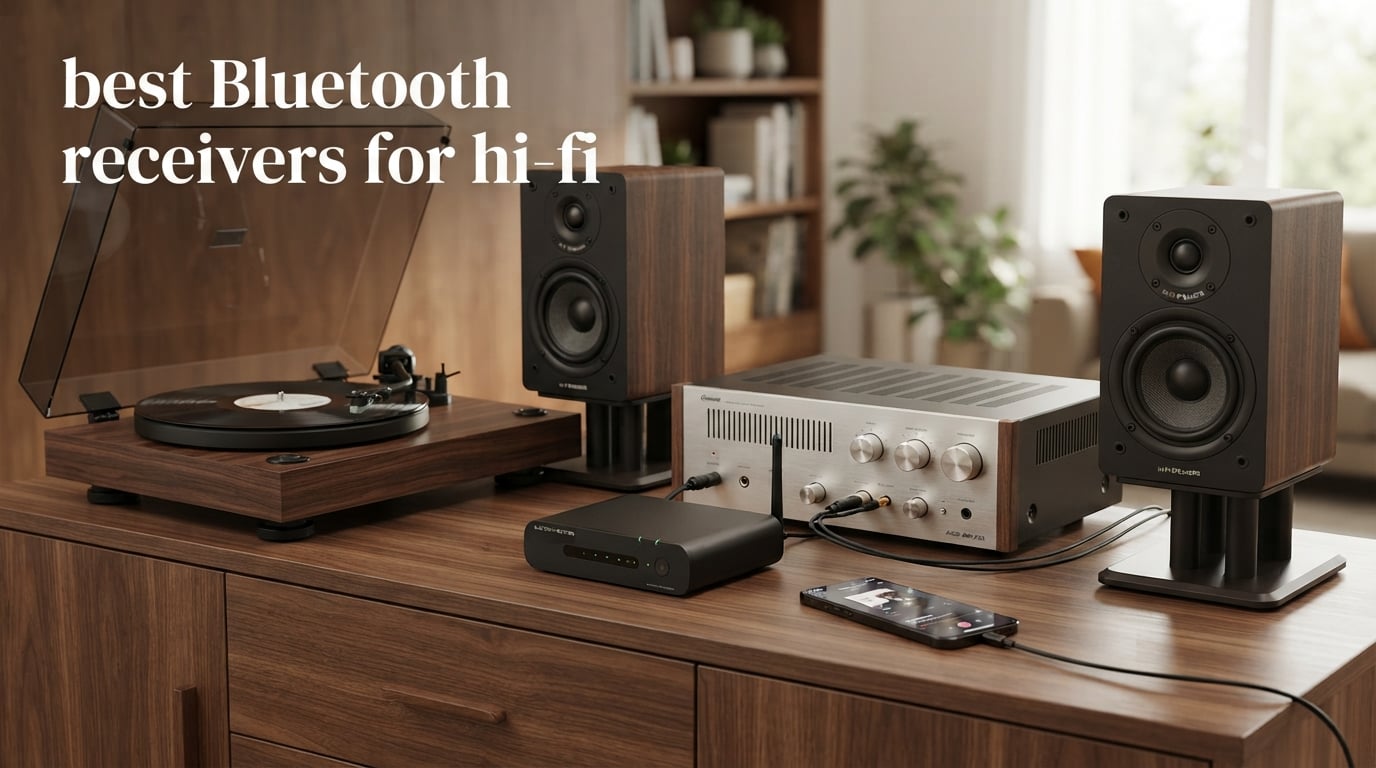
A Bluetooth receiver for hi-fi takes wireless audio from a phone, tablet, or computer, converts it through its built-in digital-to-analog converter, and feeds a stereo through analog or digital outputs. The best Bluetooth receivers for hi-fi make an existing system easier to use without putting the amplifier or receiver on the internet.
I looked for the details that change day-to-day listening: whether your phone and receiver share LDAC or aptX HD, whether the output matches your amplifier, and whether the controls make sense across the room. A premium DAC specification matters, but a receiver cannot create a codec your source device does not transmit.
Forum discussions make that point practical: people value an offline setup, reliable reconnection, and enough range for a normal home as much as a long feature list. The eight receivers below cover direct RCA hookups, optical and coaxial digital paths, balanced XLR, USB DAC duties, displays, and long-range antennas.
The Top 3 Picks Answer Different Hi-Fi Needs in September 2026

blafili B3 Bluetooth Receiver
- ESS ES9018K2M DAC
- XLR RCA optical coaxial outputs
- LDAC and aptX HD


The blafili B3 is my connection-first recommendation because it lists XLR, RCA, optical, and coaxial outputs at the same time. Choose the FiiO BR13 when USB DAC and S/PDIF conversion fit the rest of your system, or the 1Mii B06Pro+ when range and an at-a-glance LCD matter more.
The Best Bluetooth Receivers for Hi-Fi in 2026 Cover Every Common Connection
| Product | Specifications | Action |
|---|---|---|
 1Mii B06T3+ LDAC Receiver 1Mii B06T3+ LDAC Receiver |
|
View Details |
 UGREEN Bluetooth 6.0 Receiver UGREEN Bluetooth 6.0 Receiver |
|
View Details |
| blafili B3 Receiver |
|
View Details |
 1Mii DS500 Hi-Res Receiver 1Mii DS500 Hi-Res Receiver |
|
View Details |
 1Mii DS220 Hi-Res Receiver 1Mii DS220 Hi-Res Receiver |
|
View Details |
| 1Mii B06Pro+ Hi-Fi Receiver |
|
View Details |
 1Mii B06S+ LDAC Receiver 1Mii B06S+ LDAC Receiver |
|
View Details |
| FiiO BR13 HiFi Receiver |
|
View Details |
Start with the outputs on your stereo rather than the biggest codec claim. RCA suits most integrated amplifiers and vintage receivers, while optical or coaxial lets a separate DAC or receiver handle conversion; XLR is useful only when your downstream gear accepts balanced inputs.
1. 1Mii B06T3+ Is the Simple LDAC and RCA Choice
1Mii B06T3+ Bluetooth Receiver with LDAC for Home Stereo, Wired Speakers
Bluetooth 5.3
LDAC aptX HD aptX LL
RCA and 3.5 mm outputs
Pros
- LDAC support
- aptX HD and Low Latency
- RCA and 3.5 mm
- Physical volume knob
- Auto-reconnection
Cons
- Limited review history
- RCA and 3.5 mm outputs only
The 1Mii B06T3+ keeps the job focused: it receives Bluetooth 5.3 audio and supplies either RCA or 3.5 mm analog output. That is the direct route I would take for a vintage receiver, powered speakers, or an amplifier with a free line-level input.
Its verified codec list includes LDAC, aptX HD, and aptX Low Latency, so it has more headroom than a basic SBC-only Bluetooth to RCA adapter. The front knob is also a meaningful convenience when the phone is not in your hand.
Direct analog connection is its clearest strength
Connect the included 3.5 mm-to-RCA cable from the receiver to an unused AUX, CD, or line input on the stereo, then select that input before pairing. I like this approach because it adds wireless playback without changing the rest of an older system.
Auto-reconnection is listed for the last-used device, which can reduce repetitive setup in a single-user room. The small review sample, just 18 reviews in the analyzed data, means I would treat its 4.9 rating as promising rather than conclusive.
Codec matching determines its hi-res result
LDAC only comes into play when the sending device supports and selects it, while aptX options likewise depend on the source. iPhone users should not buy this receiver expecting LDAC from an iPhone, because codec capability begins with the phone as well as the receiver.
There is no optical, coaxial, or XLR output listed, so choose the B06T3+ when a simple analog hookup is the actual goal. Its mechanical knob and compact connection list make that limited scope easy to understand.
2. UGREEN Bluetooth 6.0 Receiver Is the Portable LDAC Choice
UGREEN Bluetooth 6.0 Receiver with LDAC, Hi-Res Wireless Audio Adapter with Low Latency, for Old Stereo/Speakers/Wired Speakers/Home Audio Music Streaming Stereo System
Bluetooth 6.0
LDAC up to 24-bit/96kHz
RCA and 3.5 mm output
Pros
- LDAC 24-bit/96kHz
- Bluetooth 6.0
- Dual pairing
- 15-hour battery
- USB-C charging
Cons
- No automatic iPhone or Galaxy reconnection
- Needs charging
UGREEN’s receiver is the unusual battery-powered option in this group, with up to 15 hours of playback and USB-C charging listed in the product data. I would consider it for a temporary stereo location, a desk, or any setup where a permanently powered box is inconvenient.
It supports LDAC up to 24-bit/96kHz and carries Hi-Res Audio Gold Label certification, while Bluetooth 6.0 and dual pairing focus on current everyday convenience. Its 2,141 analyzed reviews give its 4.6 rating a broader base than several newer models here.
Dual pairing makes shared listening simpler
Dual pairing lets two source devices connect, which is useful when household members take turns playing music. That does not mean both devices play at once; it means switching sources can require fewer pairing resets.
The RCA and 3.5 mm outputs keep it compatible with classic stereo inputs and powered speakers. For my own setup, I would still leave a short, low-strain cable run rather than placing a rechargeable receiver where its connectors can be bumped.
Manual reconnection is the trade-off to accept
The analyzed reviews flag a specific limitation: iPhones and Galaxy devices may need manual reconnection after Bluetooth disconnects. Readers who repeatedly walk in and out of range should weigh that behavior more heavily than the version number on the Bluetooth chip.
Battery power also brings a charging routine that a corded desktop receiver avoids. It is a flexible wireless hi-fi receiver, but not the hands-off choice for a system that stays on all day.
3. blafili B3 Is the Connection-Rich Choice for Hi-Fi and PA Gear
blafili B3 Professional XLR Bluetooth 5.1 Audio Receiver, LDAC & aptX HD
QCC5125 chip
ESS ES9018K2M DAC
XLR RCA optical coaxial outputs
Pros
- ESS ES9018K2M DAC
- XLR RCA optical coaxial outputs
- LDAC and aptX HD
- Custom name and passcode
- Up to 100 ft range
Cons
- No Wi-Fi streaming
- External antenna needed for stated range
The blafili B3 has the widest verified output list in this roundup: balanced XLR, RCA, optical, and coaxial are all listed, along with an ESS ES9018K2M DAC. It is the best Bluetooth receiver for hi-fi when one box must feed an amplifier today and a different audio chain later.
Its Qualcomm QCC5125 chipset supports LDAC, aptX HD, aptX Low Latency, aptX, SBC, and AAC. That broad codec set makes it a sensible fit for mixed-device households, though the source still decides which common codec is negotiated.
Multiple outputs make system matching straightforward
XLR can connect to equipment with balanced analog inputs, while RCA covers conventional line inputs and optical or coaxial can pass digital audio to compatible gear. I appreciate that this avoids buying a separate converter just because an amplifier changes.
The outputs are listed as simultaneous, which is handy for a fixed stereo plus another downstream device. Use one path at a time for critical listening unless you have a clear reason to distribute the signal.
Pairing controls suit shared or public rooms
A custom Bluetooth name and optional four-digit passcode are practical where several B3 units or many phones may be nearby. Silent pairing with no beeps or voice prompts is another small detail that helps this fit a listening room or PA environment.
The removable antenna is part of its stated up-to-33 m or 100-foot range claim, so position it in the open rather than behind metal equipment. It also has a USB DAC function for a computer, although that function is listed up to 16-bit/48 kHz.
4. 1Mii DS500 Is the OLED and Digital-Output Choice
1Mii DS500 Hi-Res Bluetooth 5.3 Receiver, 32-Bit/384kHz Audiophile DAC, Lossless LDAC & aptX HD, OLED Display, Built-in EQ, RCA/Optical/Coaxial Out for Home Stereo, AV Receiver & Amplifier
ESS ES9018K2M DAC
32-bit/384kHz
RCA optical coaxial and OLED
Pros
- ESS Sabre DAC
- 32-bit/384kHz support
- LDAC 990kbps
- OLED display
- Built-in EQ
Cons
- Limited review history
- No XLR output listed
The 1Mii DS500 puts status information in view with an OLED display that reports codec and rate, rather than leaving you to guess what the connection negotiated. Its ESS Sabre ES9018K2M DAC and 32-bit/384kHz specification make it one of the more technical audiophile Bluetooth DAC choices in the list.
RCA, optical, and coaxial outputs give it a comfortable place between a simple analog receiver and a component-oriented digital system. I would use optical or coaxial only when the next component has a DAC I specifically want to use.
The display answers codec questions at a glance
Codec confusion is a repeated forum pain point, and the DS500’s OLED provides a direct check on what the receiver reports. That is more useful than assuming LDAC is active just because both devices list it somewhere in their specifications.
It also has built-in Rock, Pop, and Jazz EQ modes for listeners who prefer quick tonal changes. For a neutral system path, I would begin without an EQ change and add one only after learning the baseline sound.
Its antenna supports a room-to-room layout
The DS500 lists Bluetooth 5.3 and up to 100 feet of range with its external antenna. Real indoor reach can be shorter because walls, equipment racks, and Wi-Fi activity affect radio performance.
With 191 reviews in the analyzed data, it has a smaller feedback pool than some alternatives. The design is strongest for someone who values visible connection feedback and needs optical or coaxial alongside RCA.
5. 1Mii DS220 Is a Flexible Stereo Receiver with Seven EQ Modes
1Mii DS220 Bluetooth Receiver for Home Stereo, Hi-Res LDAC & aptX HD HiFi Audio Adapter with Audiophile DAC, Optical/RCA Outputs for Stereo System, Amplifier, OLED Display, 7 EQ
Bluetooth 5.3
LDAC and aptX HD
Optical RCA OLED and 7 EQ modes
Pros
- LDAC and aptX HD
- Optical and RCA outputs
- OLED status display
- Seven EQ modes
- Auto-reconnection
Cons
- Auto shutoff after 30 minutes
- Some 1-star feedback
The DS220 is a well-rounded option for an amplifier or home stereo that needs both RCA and optical connectivity. Its Bluetooth 5.3 platform supports LDAC, aptX HD, and low-latency playback, while the OLED shows codec, volume, and connection status.
Its seven EQ modes include Bass, Jazz, Classical, Rock, and Pop options, giving it more built-in adjustment than a bare receiver. I see that as a convenience feature, not a substitute for matching speakers, room placement, and amplifier settings.
Optical and RCA make it easy to fit older systems
Use RCA if the DS220’s internal DAC will feed a line input, or use optical when a receiver or external DAC is the preferred conversion stage. This choice is particularly useful for a home stereo system with both old-school analog inputs and newer digital inputs.
The included accessory list identifies an optical cable, RCA cable, and 3.5 mm-to-RCA cable, which gives a new owner several sensible starting paths. I would still check cable length and input labels before committing to placement.
Auto shutoff should match your listening habits
The data notes automatic shutoff after 30 minutes with no connection, a behavior some people will welcome and others may find disruptive. If you often pause music and expect instant return, test that routine during the return period.
The analyzed review profile is 4.5 from 362 reviews, with a recorded 7% one-star share. That mixed detail makes it reasonable to prioritize the DS220’s display and output layout over a claim that it will suit every room.
6. 1Mii B06Pro+ Is the Long-Range Receiver with an LCD
1Mii B06Pro+ Hi-Fi Bluetooth 5.3 Audio Receiver, LDAC Hi-Res Wireless Audio Adapter for Home Stereo w/aptX HD Low Latency, LCD Display, Long Range, Volume Control, 3.5mm AUX Optical Coaxial
Bluetooth 5.3
LDAC and ESS DAC
Dual antennas LCD optical coaxial
Pros
- LDAC and ESS DAC
- Dual antennas
- Up to 197 ft line of sight
- LCD display
- Optical and coaxial outputs
Cons
- Receiver only not transmitter
- Wi-Fi routers may affect connection
The 1Mii B06Pro+ is built around reach, using dual antennas and Class 1 Bluetooth technology. Its listed range is up to 197 feet outdoors with line of sight and 60-100 feet indoors, figures that are more useful when read as a ceiling rather than a promise for every house.
It combines LDAC, aptX HD, aptX Low Latency, aptX, and AAC decoding with an audiophile-grade ESS DAC chip. The LCD display can show song information, while the physical controls cover volume and track selection.
Dual antennas help when the source moves around
Forum users report that a home range from roughly 30 to 100 feet is usually sufficient, but construction and interference decide the real result. I would place the B06Pro+ away from Wi-Fi routers and not bury it behind an amplifier chassis.
The dual-antenna design makes this model a strong candidate when the listening room is not adjacent to the usual phone location. It is still wise to test the exact route between rooms before hiding cables or mounting equipment.
Digital outputs broaden its system role
Along with 3.5 mm output, this receiver lists optical and coaxial connections for systems that already have a favored DAC. That flexibility separates it from the RCA-only and AUX-only style of compact adapters.
It is strictly a receiver, not a transmitter, so it cannot send your stereo’s audio to Bluetooth headphones. Its 6k+ review count is the largest in this selection, though the recorded rating is 4.4 rather than a guarantee of identical results in every network-heavy room.
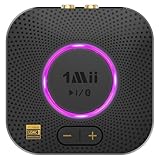
7. 1Mii B06S+ Keeps an RCA Stereo Setup Straightforward
1Mii B06S+ LDAC Bluetooth 5.3 Receiver for Home Stereo Hi-Res Music Streaming, Hi-Fi Wireless Audio Adapter with aptX HD/LL, Long Range, Volume Control, RCA/3.5mm AUX Outputs
Bluetooth 5.3
LDAC aptX HD aptX LL
RCA and 3.5 mm outputs
Pros
- LDAC support
- Bluetooth 5.3
- aptX HD and Low Latency
- Volume and track control
- RCA and 3.5 mm outputs
Cons
- Smaller review pool
- Only RCA and 3.5 mm outputs listed
The 1Mii B06S+ is another direct analog option, with RCA and 3.5 mm outputs, Bluetooth 5.3, LDAC, aptX HD, and aptX Low Latency. It is a logical Bluetooth receiver for amplifier inputs when the goal is to add wireless music without introducing a separate digital chain.
Volume control and track skip can reduce phone handling during casual playback. That small physical-control advantage matters for a stereo across the room, especially when guests are connecting their own devices.
Its focused connection list suits a conventional amp
RCA is the natural connection for a conventional integrated amplifier, and 3.5 mm can serve powered speakers or compact desktop equipment. I would select the B06S+ when those are the only outputs needed and a screen is not a priority.
There is no optical, coaxial, or XLR output in the listed specifications, so it will not replace a more component-style receiver. That is not a flaw when the analog path already matches the system.
Its codecs help with music and video sources
LDAC and aptX HD target higher-quality music transmission from compatible sources, while aptX Low Latency can be relevant to video or gaming when both ends support it. Codec names do not remove all delay, because apps, devices, and displays can add their own timing.
The review data records 541 reviews and a 4.4 rating, which is enough feedback to be useful but less than the B06Pro+. Consider it for a simple wired-speaker or stereo system rather than for a feature-heavy digital rack.
8. FiiO BR13 Combines Bluetooth Receiving with USB DAC Duties
FiiO BR13 HiFi Bluetooth 5.1 Music Receiver Long Range Bluetooth Adapter with USB DAC, LDAC/aptX Low Latency, OLED Display & RCA Optical Coaxial Output for Home Stereo,PC/TV
ES9018K2M DAC
QCC5125 Bluetooth chip
USB optical coaxial RCA and OLED
Pros
- ES9018K2M DAC
- USB DAC function
- S/PDIF conversion
- LDAC support
- App EQ and OLED
Cons
- Limited stock availability
- Lower review count
The FiiO BR13 does more than receive Bluetooth: it adds USB DAC functionality and S/PDIF conversion for coaxial and optical signals. Its ES9018K2M reference DAC, Qualcomm QCC5125 chip, OLED display, and several wired inputs make it a compact control point for a desk or home stereo.
LDAC and aptX Low Latency are listed alongside Bluetooth 5.1, and the app allows seven preset EQ options plus two customizable settings. I would choose it when the system needs a receiver that can also work with a computer or manage digital-source routing.
USB DAC and S/PDIF conversion expand its usefulness
USB, optical, coaxial, and RCA appear in its listed input details, while RCA, optical, and coaxial are listed for output. That gives the BR13 a role beyond phone-to-stereo streaming without claiming that every source needs the same signal path.
The S/PDIF conversion function is especially relevant when optical and coaxial gear must coexist. Before connecting it, I would map source and destination ports on paper so the conversion direction is clear.
App-based EQ gives more control than a basic receiver
The app-controlled EQ and OLED are useful for listeners who want visible feedback and repeatable changes. The TPA1882 op-amp is also listed in the technical details, which will interest readers comparing the component choices behind similar feature sets.
The analyzed data records 351 reviews at 4.4 and notes limited stock availability. If you want a receiver that can also act as a USB DAC and digital bridge, those functions are the reason to pick it over a simpler RCA-only box.
The Right Bluetooth Receiver Starts with Your Source and Stereo Inputs
Choose the receiver after checking three things: the codec your phone or computer actually sends, the input your amplifier or speakers accept, and whether you want the receiver’s DAC or an existing DAC to do conversion. This order prevents buying a feature-rich unit whose best connection or codec cannot be used.
Codec support only matters when both ends share it
LDAC, aptX HD, aptX Adaptive, aptX Low Latency, AAC, and SBC are Bluetooth codec labels, not universal modes. Android and computer support varies by device and operating system, while iPhones commonly use AAC rather than LDAC or aptX.
For music, start by confirming the source codec and then use the receiver display, if fitted, to verify the negotiated result. For video, low-latency support can help, but a receiver cannot remove delay introduced elsewhere in the playback chain.
Analog and digital outputs serve different system paths
RCA is the usual choice for an old stereo system, integrated amplifier, or powered speakers with line inputs. Optical Toslink and coaxial S/PDIF are useful when you want another component’s digital-to-analog converter to handle the signal.
Balanced XLR only helps when the next device has balanced inputs, which is why the blafili B3 is the appropriate choice for that specific connection requirement. Do not select an output simply because it sounds more advanced; match it to the ports you own.
Placement and pairing prevent most home-use frustrations
Place the receiver where its antenna or Bluetooth radio has a reasonably open path to the listening area, away from dense metal racks and Wi-Fi routers when possible. Indoor walls commonly reduce reach, so line-of-sight figures should not be treated as room-to-room guarantees.
For a clean setup, connect the receiver to a line-level input, power it, select that input on the stereo, pair one source device, and play a familiar track at a low level first. If the model supports auto-reconnection, confirm it after turning Bluetooth off and back on before relying on it every day.
The FAQ Answers the Main Hi-Fi Bluetooth Questions
What is the best Bluetooth receiver for audiophile setups?
The blafili B3 is the strongest all-round fit when you need an ESS ES9018K2M DAC plus XLR, RCA, optical, and coaxial outputs. The FiiO BR13 is a better match when USB DAC and S/PDIF conversion are also part of the system.
What low cost Bluetooth adapter would you recommend for connecting to my amplifier?
The UGREEN Bluetooth 6.0 Receiver is a practical compact option for an amplifier with RCA or 3.5 mm input because it supports LDAC, dual pairing, and battery operation. The 1Mii B06S+ is another focused analog choice with RCA and 3.5 mm outputs plus LDAC and aptX HD.
What should I look for while buying a decent Bluetooth receiver?
Check source-device codec support first, then match the receiver output to the amplifier or speakers. Also consider reconnection behavior, range in a wall-filled home, physical controls, and whether you need a built-in DAC, a digital output, or balanced XLR.
What are the limitations of audio quality in Bluetooth audio systems?
Bluetooth quality is limited by the codec shared by the source and receiver, radio conditions, and the receiver DAC or downstream conversion path. A receiver that supports LDAC or aptX HD cannot force an unsupported phone to transmit those codecs, and walls or interference can affect stability.
The Best Choice Is the Receiver That Matches Your Actual Inputs
For the broadest connection set, I would choose the blafili B3; for USB DAC and digital-routing duties, the FiiO BR13 makes more sense; and for a long-range analog or digital receiver, the 1Mii B06Pro+ stands out. The best Bluetooth receivers for hi-fi in 2026 are the ones that match the source codec, stereo inputs, and everyday listening routine you already have.